What is an API Waterfall? Demystifying the Concept
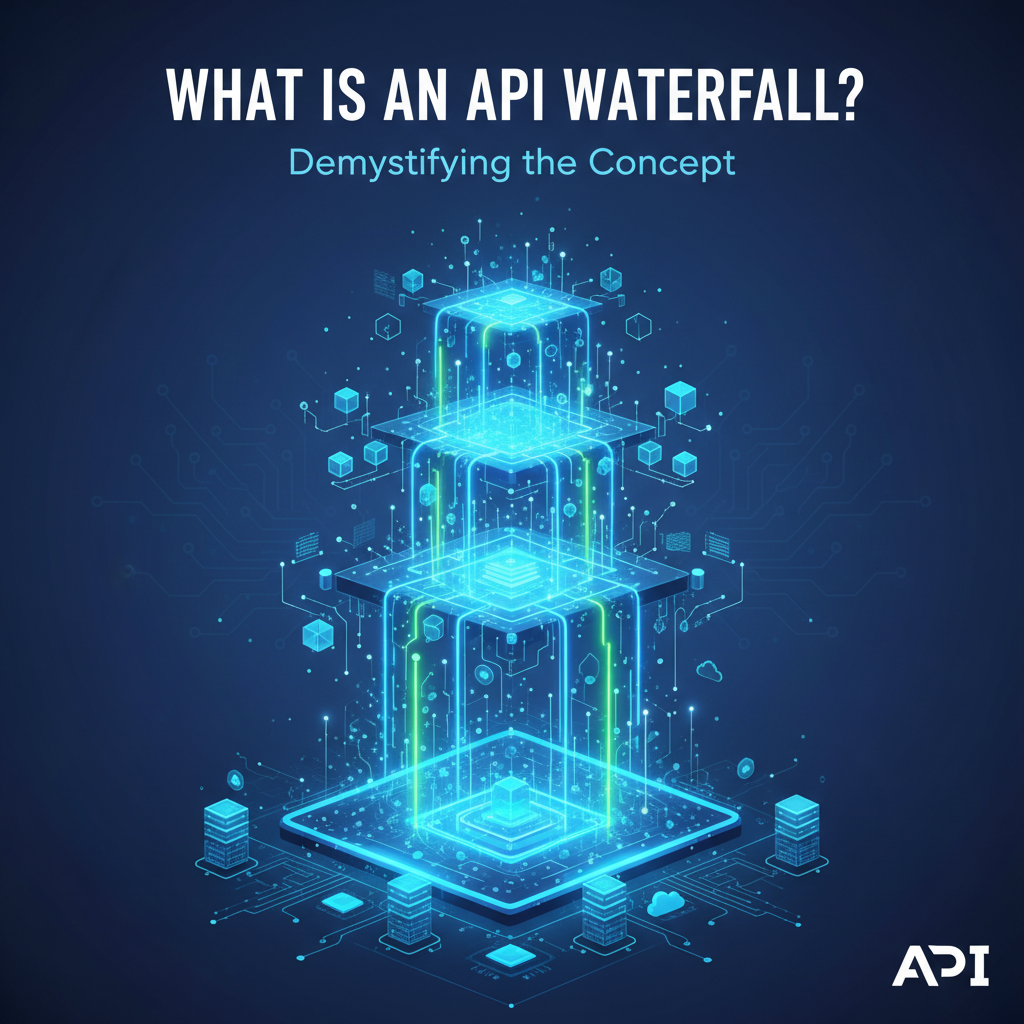


In the intricate tapestry of modern software development, Application Programming Interfaces, or APIs, serve as the essential threads that weave disparate systems into cohesive, functional applications. From the simplest mobile application fetching weather data to complex enterprise systems managing global supply chains, APIs are the silent workhorses, facilitating communication and enabling innovation at an unprecedented pace. Yet, within this interconnected world, certain patterns and phenomena emerge that, while seemingly intuitive, often carry significant implications for performance, scalability, and user experience. One such concept, frequently discussed but sometimes misunderstood, is the "API Waterfall."
The term "API Waterfall" intuitively evokes images of a cascading sequence, much like water flowing from one level to the next. In the context of APIs, this often refers to a series of sequential calls where the output or completion of one API request is a prerequisite for the initiation of the next. While this pattern is a natural consequence of data dependencies and business logic in many applications, it can also manifest as a critical performance bottleneck, accumulating latency and degrading the overall responsiveness of a system. This article aims to comprehensively demystify the API waterfall concept, exploring its various interpretations, dissecting the challenges it presents, and outlining robust strategies for its mitigation and optimization, with a particular focus on the pivotal role of an APIPark as a sophisticated solution. We will delve into the foundational aspects of APIs, examine how waterfalls form, discuss their impact, and present actionable insights for developers and architects striving to build high-performance, resilient applications in an API-driven world.
Understanding the Fundamentals of APIs: The Building Blocks of Interconnectivity
Before we dive deep into the intricacies of API waterfalls, it’s imperative to establish a solid understanding of what an API is and why it has become such a cornerstone of contemporary software architecture. The acronym API stands for Application Programming Interface, and at its heart, it is a set of defined rules, protocols, and tools for building software applications. More simply, it acts as an intermediary that allows two separate software applications to talk to each other.
Imagine you're at a restaurant. You, the client, want to order food. You don't go into the kitchen yourself; instead, you interact with a waiter. You tell the waiter what you want (your request), and the waiter takes your order to the kitchen. The kitchen (the server) prepares the food and gives it back to the waiter, who then brings it to you (the response). In this analogy, the waiter is the API. It defines how you can request services (order food), what types of requests are valid, and how the response will be delivered. You don't need to know the complex details of how the kitchen operates; you just need to know how to interact with the waiter.
The ubiquity of APIs today stems from their ability to foster interoperability and modularity. They enable developers to integrate functionalities from various sources without needing to understand their internal implementations, significantly accelerating development cycles and promoting innovation. Whether it's embedding a payment gateway, fetching real-time stock quotes, integrating mapping services, or building a complex microservices architecture, APIs are the conduits through which data and functionality flow.
Different types of APIs exist, each with its own architectural style and communication protocols. REST (Representational State Transfer) APIs are perhaps the most prevalent, leveraging standard HTTP methods (GET, POST, PUT, DELETE) for stateless communication. SOAP (Simple Object Access Protocol) offers a more rigid, protocol-based approach, often used in enterprise environments due to its strong typing and built-in error handling. Newer paradigms like GraphQL provide clients with the power to request precisely the data they need, thereby reducing over-fetching or under-fetching of data, and gRPC (Google Remote Procedure Call) utilizes HTTP/2 for high-performance, language-agnostic communication. Regardless of their specific implementation, the fundamental purpose of an API remains consistent: to provide a structured, predictable interface for programmatic interaction.
Understanding the anatomy of an API call further clarifies this interaction. A typical API call involves a client (e.g., a web browser, a mobile app, another server) sending a request to a server. This request usually consists of several components: * URL (Uniform Resource Locator): Specifies the address of the resource being requested. * Method: An HTTP verb indicating the desired action (e.g., GET to retrieve data, POST to create new data, PUT to update data, DELETE to remove data). * Headers: Metadata about the request, such as authentication tokens, content type, and caching instructions. * Body (optional): The actual data being sent to the server, typically in JSON or XML format for POST and PUT requests.
Upon receiving the request, the server processes it and sends back a response, which also includes several key components: * Status Code: A three-digit number indicating the outcome of the request (e.g., 200 OK, 404 Not Found, 500 Internal Server Error). * Headers: Metadata about the response, such as content type, caching instructions, and server information. * Body (optional): The data returned by the server, typically in JSON or XML format.
This structured request-response cycle is the fundamental unit of interaction in an API-driven world, and it forms the basis upon which more complex patterns, including the API waterfall, are built. The efficiency and reliability of these individual interactions critically influence the overall performance of applications that depend on them.
The Core Concept: "API Waterfall" in Contexts
With a firm grasp of API fundamentals, we can now delve into the nuanced interpretations of the "API Waterfall." This term, while not a strictly formal or standardized architectural pattern, generally refers to a situation where multiple API calls are executed sequentially, with each subsequent call dependent on the successful completion or data output of the preceding one. However, the context in which this term is used can subtly shift its meaning, often highlighting different aspects of its impact. Let's explore the primary interpretations.
Interpretation 1: The Cascading/Chained API Call Pattern
The most common understanding of an API waterfall describes a scenario where API calls are fundamentally chained together due to logical dependencies. In this pattern, the data or outcome from API call A is directly required as input for API call B, which in turn might provide input for API call C, and so on. This creates a sequential flow, a true "cascade" of operations.
Scenario Examples: * User Profile and Orders Retrieval: Consider an e-commerce application where a user logs in. 1. API Call 1: User Authentication. The client sends user credentials to an authentication service. The response includes an authentication token and the user's basic ID. 2. API Call 2: Get User Profile. Using the user ID from Call 1 and the authentication token, the client requests the user's detailed profile information (name, address, email). 3. API Call 3: Get User's Orders. With the user ID, the client then queries the order service to retrieve a list of all orders placed by that user. 4. API Call 4 (and subsequent): Get Order Details. For each order ID returned in Call 3, the client might make separate API calls to a product service to fetch detailed information about the items within each order, or to a shipping service for delivery status. This sequence forms a clear API waterfall, as each step builds upon the results of the previous one.
- Complex Product Search and Inventory Check:
- API Call 1: Search Products. A user searches for "laptops." The product search API returns a list of product IDs matching the query.
- API Call 2: Get Product Details. For each product ID, a separate API call is made to retrieve detailed specifications, images, and pricing.
- API Call 3: Check Inventory. For the displayed products, additional API calls might be made to an inventory service to check real-time stock levels for each specific product variant (e.g., "13-inch silver laptop"). This dependency means the application cannot fully display the search results with all necessary information until the entire chain of API calls has completed.
In these examples, the waterfall is driven by data dependencies. The application needs the output of one call to formulate the next request, making strict sequential execution a necessity for correct functionality. While essential for logic, this pattern inherently introduces latency accumulating from each individual call.
Interpretation 2: Performance Bottlenecks and Latency Impact
Beyond simple sequential dependency, the "API Waterfall" also frequently refers to the cumulative performance impact of these chained calls. Each API call, regardless of its simplicity, incurs several types of overhead: * Network Latency (Round Trip Time - RTT): The time it takes for a request to travel from the client to the server and for the response to travel back. This is influenced by geographical distance, network congestion, and infrastructure. * Server Processing Time: The time the server spends processing the request, querying databases, executing business logic, and preparing the response. * Data Transfer Time: The time taken to transmit the request and response payload over the network, influenced by data size and network bandwidth.
When multiple API calls are made sequentially, these latencies accumulate. If API Call A takes 100ms, and API Call B (dependent on A) takes 150ms, and Call C (dependent on B) takes 200ms, the total time for this waterfall is at least 450ms, not including any client-side processing between calls. This additive latency can quickly become a significant performance bottleneck, especially in applications where many such chains exist or where network conditions are suboptimal.
This interpretation often highlights the "N+1 problem," commonly discussed in database queries, but equally applicable to APIs. If fetching a list of N items requires N additional API calls to get details for each item, the total number of calls becomes 1 (for the list) + N (for details), leading to a direct linear increase in latency as N grows. This "waterfall" of time can severely impact the Time To First Byte (TTFB) and overall load time of an application, directly affecting user experience. Users perceive slow applications as frustrating, leading to higher bounce rates and decreased engagement.
Interpretation 3: Resource Loading Waterfalls (Web Performance)
In the context of web performance optimization, the term "waterfall" is also widely used to describe the visual representation of resource loading in browser developer tools. When you open the Network tab in your browser's developer console, you see a waterfall chart that graphically depicts the sequence and timing of all network requests made by a webpage as it loads. This includes not only HTML documents, CSS files, JavaScript assets, and images, but crucially, also API calls made by the browser.
This visual waterfall illustrates: * Dependencies: How some resources (like scripts that make API calls) can only start loading after others (like the HTML document itself, or other dependent scripts) have completed. * Parallelism vs. Sequentiality: Which resources are fetched concurrently and which are loaded one after another. * Timing: The exact start and end times for each request, including DNS lookup, initial connection, TLS handshake, request sending, waiting for response, and content download.
An API call appearing in this waterfall chart will show its individual latency profile, and if several API calls are chained or critical to rendering content, their combined duration will contribute significantly to the perceived page load time. For example, if a page needs to make an API call to fetch critical data before it can render its main content, that API call will be high up in the waterfall, and its duration will directly delay the Critical Rendering Path. Analyzing these waterfall charts is a key practice for front-end developers to identify bottlenecks, including slow-running API calls or unnecessary sequential API dependencies that can be optimized.
In summary, while the core idea of sequential, dependent API calls remains central, the "API Waterfall" can be viewed through the lens of architectural patterns, performance bottlenecks, or diagnostic visualizations. Each perspective offers valuable insights into the challenges and opportunities for optimizing API-driven applications.
Dissecting the Challenges Posed by API Waterfalls
The API waterfall, while often an unavoidable consequence of application logic, introduces a cascade of challenges that developers and system architects must actively address. Ignoring these issues can lead to significant performance degradation, increased operational complexity, and ultimately, a compromised user experience. Let's dissect these challenges in detail.
Performance Degradation: The Silent Killer of User Experience
The most immediate and palpable impact of API waterfalls is on application performance. This degradation manifests in several critical ways:
- Additive Latency: As previously discussed, each sequential API call adds its own network round trip time (RTT) and server processing time to the overall transaction duration. This effect is cumulative. Consider a user interaction that requires five sequential API calls, each averaging 100ms (50ms network RTT + 50ms server processing). The absolute minimum time for this sequence would be 5 * 100ms = 500ms (half a second). In real-world scenarios, network conditions can fluctuate, servers can be under load, and processing times can vary, easily pushing this total response time significantly higher. For mobile users on less stable networks, this effect is exacerbated, turning a minor delay into a frustrating wait.
- Increased Time To First Byte (TTFB) and Overall Load Time: For web applications, a waterfall of API calls directly impacts how quickly the initial content is rendered (TTFB) and how long the user has to wait for the page to become fully interactive. If critical data needed for the initial render depends on a long chain of API calls, the user stares at a blank or loading screen for an extended period. This delay not only frustrates users but also negatively impacts SEO rankings, as search engines prioritize fast-loading pages.
- Impact on User Experience: Studies consistently show that users have very low tolerance for slow-loading applications. Even a few hundred milliseconds of delay can lead to a significant drop in user engagement and satisfaction. When an API waterfall causes noticeable lags, users are more likely to abandon the task, switch to a competitor's application, or develop a negative perception of the brand. This user experience degradation is a direct threat to business objectives, leading to lower conversion rates, reduced sales, and diminished customer loyalty. Imagine trying to complete an online purchase where each step of the checkout process waits several seconds for a backend API waterfall to complete – it's an experience few would tolerate.
Increased Complexity: A Developer's Nightmare
Beyond performance, API waterfalls introduce significant complexity into the development and maintenance lifecycle.
- Error Handling in a Chain: When multiple API calls are chained, an error at any point in the sequence can destabilize the entire transaction. How should the application react if API Call B fails after Call A succeeded? Should it retry Call B? Should it roll back the effects of Call A? Implementing robust error handling, including retries with exponential backoff, circuit breakers (to prevent cascading failures), and idempotent operations, becomes vastly more intricate across a waterfall. The state management across these calls also adds complexity.
- Debugging and Troubleshooting: Identifying the root cause of a performance issue or a functional bug within an API waterfall is notoriously difficult. Is the bottleneck in Call A, Call B, the network, or the client-side logic orchestrating the calls? Tracing the flow of data and execution across multiple services, especially in a distributed microservices environment, requires sophisticated logging, monitoring, and distributed tracing tools. Without these, developers can spend hours or days pinpointing a problem that resides deep within a complex dependency chain.
- Code Maintenance and Readability: Code that orchestrates complex API waterfalls can become convoluted, with nested callbacks or
awaitchains that are difficult to read, understand, and maintain. As business requirements evolve, modifying these tightly coupled sequences without introducing new bugs becomes a challenging task. The dependencies also make it harder to refactor or independently test individual components of the waterfall.
Resource Utilization: Unseen Costs
API waterfalls can also lead to inefficient resource utilization, both on the client and server sides.
- Holding Connections Open: Each active API call typically involves an open network connection. A long waterfall means connections are held open for longer periods, consuming client-side resources (like sockets) and potentially tying up server resources (like threads or processes) that could otherwise be serving other requests. While modern HTTP/2 and connection pooling mitigate some of these issues, prolonged sequential operations still impose a heavier burden than optimized, parallel requests.
- Increased Load on Upstream Services: If a client is making numerous sequential calls that eventually fan out to multiple backend services, those upstream services experience a higher cumulative load. Without proper rate limiting, caching, or load balancing, these services can become overwhelmed, leading to degraded performance or even outages for all consumers. This is particularly true if the API waterfall pattern is not managed efficiently, allowing clients to inadvertently create "thundering herd" problems by issuing many requests to the same backend services.
Security Implications: Expanding the Attack Surface
Each API call represents a potential point of vulnerability or attack. In an API waterfall, the chain of calls can expand the attack surface in several ways:
- Token Passing and Re-authentication: If authentication tokens or session IDs need to be passed along each step of the waterfall, secure handling of these credentials becomes paramount. An insecure exposure at any point could compromise the entire session. Furthermore, if each call requires re-authentication or re-authorization checks, this adds not only latency but also a greater chance of security misconfigurations.
- Increased Exposure: More individual API interactions mean more opportunities for malformed requests, denial-of-service attempts, or injection attacks. While each API should be secured independently, the aggregate effect of many chained calls increases the overall complexity of security posture management. Ensuring consistent security policies (authentication, authorization, rate limiting) across a long chain of diverse APIs can be challenging without a centralized management layer.
- Data Integrity and Consistency: If a transaction spanning multiple API calls fails midway, ensuring data integrity and consistency across all involved services is critical. Rolling back partial changes, particularly in distributed systems, is a complex problem that needs careful architectural consideration to prevent data corruption or inconsistent states that could be exploited.
In essence, while API waterfalls are often an architectural necessity, their inherent challenges demand proactive strategies for optimization. Ignoring these issues means accepting trade-offs in performance, increasing development overhead, and potentially introducing security vulnerabilities, all of which detract from the overall quality and resilience of the application.
Strategies for Mitigating and Optimizing API Waterfalls
Addressing the challenges posed by API waterfalls is crucial for building high-performance, scalable, and resilient applications. Fortunately, a range of proven strategies can effectively mitigate their impact, transforming potential bottlenecks into optimized data flows. These strategies often involve a combination of architectural adjustments, clever client-side logic, and robust server-side infrastructure.
Parallelization: Unleashing Concurrency
The most straightforward way to reduce the total time of multiple API calls is to execute them in parallel when their dependencies allow. If two or more API calls are independent of each other – meaning the output of one is not required as input for another – they can be initiated concurrently.
- How it Works: Instead of waiting for Call A to complete before starting Call B, both A and B are fired off at roughly the same time. The total elapsed time for these two calls then becomes the duration of the longest individual call, plus network overhead, rather than the sum of their durations.
- Implementation: Modern programming languages and frameworks provide excellent constructs for asynchronous programming and concurrency.
- In JavaScript,
Promise.all()is a common pattern to wait for multiple promises (representing API calls) to resolve concurrently. - Python offers
asynciofor asynchronous I/O operations, allowing non-blocking network requests. - Go utilizes goroutines and channels to manage concurrent tasks efficiently.
- In JavaScript,
- When to Use: Parallelization is ideal for fetching disparate pieces of data needed to populate a single view, such as fetching user details, notifications, and recent activity streams for a dashboard. The key constraint is true independence; forcing dependent calls into parallel execution will lead to errors or race conditions.
- Benefits: Significantly reduces overall latency for independent operations, leading to faster perceived load times and a more responsive user interface.
- Drawbacks: Increases the number of concurrent network connections, which can consume more client-side resources. If too many calls are parallelized without proper resource management, it can overwhelm the client or lead to network congestion.
Batching/Aggregation: Consolidating Requests
When many small, related API requests are needed, especially if they are dependent on a common identifier, batching them into a single, larger request can dramatically reduce network overhead and the number of round trips.
- How it Works: The client sends a single request to a special "batch" or "aggregation" endpoint on the server. This endpoint then internally makes multiple calls to various backend services, aggregates their responses, and returns a single, consolidated response to the client.
- GraphQL: This API query language is a prime example of aggregation. Clients can request exactly the data they need, including nested resources, in a single query. The GraphQL server then resolves this query by potentially making multiple internal calls to different microservices or databases and compiles the result into a single JSON object. This effectively moves the "waterfall" logic from the client to the server-side GraphQL resolver.
- Custom Batching Endpoints: For REST APIs, developers can design custom endpoints, e.g.,
/api/v1/user/details_and_orders?userId=123. This endpoint would internally call/api/v1/user/123and/api/v1/user/123/orders, combine the data, and return it. - Benefits:
- Reduced Network Overhead: Fewer HTTP requests mean fewer TCP handshakes, TLS negotiations, and HTTP headers exchanged.
- Fewer Round Trips: A single RTT instead of many, significantly reducing cumulative network latency.
- Simpler Client Logic: The client makes one call and receives all necessary data, simplifying error handling and state management.
- Drawbacks: Requires server-side implementation of the batching logic, which can sometimes become complex. Over-aggressive batching can lead to over-fetching data if not all requested parts are always needed.
Caching: Storing and Reusing Data
Caching is a fundamental optimization technique that involves storing copies of frequently accessed data so that subsequent requests for the same data can be served more quickly than by re-fetching it from the original source.
- Client-Side Caching:
- Browser Caching: Browsers can cache static assets (images, CSS, JS) and API responses using HTTP caching headers (Cache-Control, ETag, Last-Modified). If an API response is cacheable and hasn't expired, the browser can serve it instantly from its local cache without making a network request.
- Application-Level Caching: Mobile apps or single-page applications (SPAs) can implement their own in-memory or local storage caches for API data.
- Server-Side Caching:
- Reverse Proxy/CDN Caching: Content Delivery Networks (CDNs) cache static and dynamic content geographically closer to users, reducing latency. Reverse proxies (like Nginx) can also cache API responses before they even reach the application server.
- Application-Level Caching: Services like Redis or Memcached can be used by backend services to store frequently requested data or computationally expensive results. When a backend service receives a request, it first checks its cache; if the data is present and valid, it serves it directly, bypassing database queries or other expensive operations.
- Benefits: Dramatically reduces response times for cached data, lessens the load on backend services and databases, and improves overall system scalability.
- Drawbacks: Cache invalidation is a notoriously hard problem ("two hard things in computer science are cache invalidation, naming things, and off-by-one errors"). Ensuring cached data is fresh and consistent with the source requires careful design. Stale data can lead to incorrect application behavior.
Asynchronous Processing: Decoupling Operations
Not all API calls require an immediate, synchronous response. For operations that can be processed in the background, asynchronous processing can break the synchronous waterfall chain.
- How it Works: Instead of waiting for a long-running API call to complete before proceeding, the client makes an API call that immediately returns a status or a job ID. The actual processing of the request happens in the background, often handled by a separate worker process or service. The client can then poll for the status of the job or register a webhook to be notified upon completion.
- Implementation: Messaging queues (like RabbitMQ, Kafka, AWS SQS) are central to this pattern. An API endpoint might publish a message to a queue, and a separate consumer service picks up the message, performs the long-running task (which might involve its own internal API waterfalls), and then potentially updates the client or another service.
- When to Use: Ideal for tasks like report generation, image processing, video encoding, sending email notifications, or complex data imports that don't need an instant response.
- Benefits: Improves responsiveness for the client, frees up resources on the main API server, and enhances system resilience by decoupling services.
- Drawbacks: Introduces eventual consistency, meaning the client might not see the final result immediately. Requires additional infrastructure (message queues, worker services) and adds complexity to the system architecture.
Optimizing Upstream Services: The Foundation of Performance
While the above strategies focus on managing the flow of API calls, it's equally important to ensure that the individual API endpoints within the waterfall are themselves highly performant. A slow individual API call will bottleneck any chain it's part of, regardless of other optimizations.
- Database Query Optimization: Slow database queries are a common culprit for sluggish API responses. This involves proper indexing, efficient query writing, avoiding N+1 query problems within the backend, and optimizing database schema.
- Efficient Data Serialization/Deserialization: The process of converting data structures to a transmittable format (like JSON) and back consumes CPU cycles. Optimizing these processes and choosing efficient data formats can yield small but cumulative performance gains.
- Resource Management: Ensuring backend services have adequate CPU, memory, and I/O resources, and are configured for optimal concurrency (e.g., connection pooling settings, thread pool sizes).
- Code Profiling and Optimization: Regularly profiling backend code to identify and eliminate performance hot spots.
Using an API Gateway: The Orchestration Hub
Perhaps the most powerful and versatile strategy for mitigating API waterfalls, especially in complex, distributed systems, is the implementation of an API Gateway. An API Gateway acts as a single entry point for all API calls from clients, sitting in front of a multitude of backend services. It is not merely a reverse proxy; it is an intelligent intermediary that can perform a wide range of functions, fundamentally altering how API waterfalls are managed.
- Role of an API Gateway: An API Gateway serves as the centralized point for managing, securing, and optimizing API traffic. It handles common concerns like authentication, authorization, rate limiting, logging, and monitoring, offloading these responsibilities from individual backend services.
- Benefits in Waterfall Context (Orchestration/Composition): The most significant advantage of an API Gateway in the context of waterfalls is its ability to perform API orchestration or composition. Instead of the client making multiple sequential calls to various backend services, the client makes a single request to the API Gateway. The gateway then:This effectively moves the "waterfall" complexity and the bulk of the cumulative network latency from the client to the API Gateway. The client perceives a much faster response because it only makes one network round trip. The gateway, being a server-side component, typically has faster network access to backend services and more powerful processing capabilities to handle the aggregation efficiently.
- Receives the client's request.
- Internally makes multiple, potentially parallel, calls to various backend services (e.g., a user service, an order service, a product service).
- Aggregates the responses from these backend services.
- Transforms and composes the data into a single, tailored response format that the client expects.
- Returns this single, consolidated response to the client.
- Other Gateway Benefits Mitigating Waterfall Effects:
- Load Balancing: Distributes incoming client requests across multiple instances of backend services, preventing any single service from becoming a bottleneck and improving overall system throughput.
- Caching: Gateways can implement their own caching layer, storing responses from backend services and serving them directly for subsequent identical requests, further reducing the load on backend services and speeding up response times.
- Security: Centralized authentication and authorization, rate limiting, and threat protection at the gateway level protect backend services from malicious or overwhelming traffic, ensuring they remain performant.
- Traffic Management: Routing requests to different versions of backend services (for A/B testing or blue/green deployments), throttling requests to prevent service overload.
- Protocol Translation: Enabling clients using one protocol (e.g., HTTP/1.1) to interact with backend services using another (e.g., gRPC).
- Monitoring and Analytics: Providing a centralized point for logging and analyzing all API traffic, making it easier to identify performance bottlenecks within the internal waterfall process.
- Introducing APIPark: For robust API management and to effectively mitigate the challenges of API waterfalls, an advanced API Gateway solution is indispensable. Platforms like APIPark offer comprehensive capabilities that specifically address these concerns, acting as an all-in-one AI gateway and API developer portal. APIPark is designed to simplify the management, integration, and deployment of both AI and REST services, and its features directly contribute to optimizing complex API interactions.APIPark's capabilities are particularly relevant for tackling API waterfalls: * Performance Rivaling Nginx: With its high-performance architecture, APIPark can handle over 20,000 TPS on modest hardware, ensuring that the gateway itself doesn't become the bottleneck when orchestrating numerous internal calls. Its support for cluster deployment guarantees scalability for large-scale traffic, crucial for managing the aggregated load of waterfalls. * Unified API Format for AI Invocation & Prompt Encapsulation into REST API: While focused on AI, these features highlight APIPark's ability to abstract complex backend logic. By standardizing AI invocation and allowing users to combine AI models with custom prompts into new APIs, APIPark effectively performs server-side composition. This means clients don't need to make multiple calls to different AI services or manage complex prompt chains; instead, the gateway handles the internal waterfall, returning a single, consistent response. This dramatically reduces client-side complexity and latency. * End-to-End API Lifecycle Management: By assisting with managing the entire lifecycle of APIs, including design, publication, invocation, and decommission, APIPark provides the tools necessary to analyze and regulate API management processes. This includes managing traffic forwarding, load balancing, and versioning of published APIs – all critical for optimizing the individual components within a waterfall and ensuring their efficiency. * Detailed API Call Logging & Powerful Data Analysis: These features are paramount for diagnosing waterfall issues. APIPark records every detail of each API call, enabling businesses to quickly trace and troubleshoot issues within complex call sequences. Its powerful data analysis capabilities then take this a step further, analyzing historical call data to display long-term trends and performance changes. This allows identifying "slow points" or unexpected dependencies within what might be an internal API waterfall, helping businesses with preventive maintenance before performance degradation impacts users.By centralizing API governance, providing powerful orchestration capabilities, and offering granular insights into API performance, an API Gateway like APIPark transforms the challenge of API waterfalls into an opportunity for improved system architecture and enhanced user experience. It moves the complexity from the fragile client layer to a robust, managed server-side component, making applications faster, more reliable, and easier to develop.
APIPark is a high-performance AI gateway that allows you to securely access the most comprehensive LLM APIs globally on the APIPark platform, including OpenAI, Anthropic, Mistral, Llama2, Google Gemini, and more.Try APIPark now! 👇👇👇
Architectural Patterns that Influence API Waterfall Effects
The architectural choices made during the design phase of an application can profoundly influence the prevalence and impact of API waterfalls. Certain patterns, while offering distinct advantages, inherently lead to a greater number of inter-service communications, which, if not managed carefully, can exacerbate waterfall effects. Understanding these patterns is key to proactively designing systems that mitigate waterfall challenges.
Microservices Architecture: The Double-Edged Sword
Microservices architecture, characterized by developing applications as a suite of small, independently deployable services, each running in its own process and communicating with lightweight mechanisms, has become immensely popular. It offers benefits like independent scalability, technology diversity, and organizational alignment. However, it also inherently increases the potential for API waterfalls.
- Increased Inter-Service Communication: In a monolithic application, different modules might communicate via in-memory function calls. In a microservices architecture, these interactions become inter-service API calls (or messages over a queue). A single user-facing feature that might have been a few internal function calls in a monolith could now involve a dozen or more API calls between different microservices (e.g., authentication service -> user profile service -> order history service -> product catalog service -> inventory service). This explosion of internal API calls creates an "internal API waterfall" that, while hidden from the direct client, still contributes to overall latency and complexity.
- Distributed Transactions: Operations that require updates across multiple microservices (e.g., an e-commerce checkout involving order creation, payment processing, and inventory deduction) become distributed transactions. Managing consistency across these services, often using patterns like the Saga pattern (a sequence of local transactions), involves numerous API calls or message exchanges, forming a complex waterfall of interdependent operations.
- Challenges: The "chattiness" of microservices can lead to significant network overhead and latency if not optimized. Identifying and tracing waterfalls across dozens of services requires sophisticated service mesh technologies (like Istio or Linkerd) and distributed tracing tools to visualize the flow and measure latency at each hop.
- Mitigation: An API Gateway plays a crucial role in microservices by aggregating requests from external clients, reducing the external API waterfall. Internally, careful service design, optimized data fetching, and intelligent use of caching and asynchronous communication (e.g., event-driven architectures) are essential to prevent internal waterfalls from crippling performance.
Backend-for-Frontend (BFF) Pattern: Tailoring the Waterfall
The Backend-for-Frontend (BFF) pattern is a specialized architectural approach often used in conjunction with microservices, specifically designed to address the challenges of diverse client applications interacting with a shared backend.
- How it Works: Instead of a single, general-purpose API Gateway or a monolithic backend API, the BFF pattern introduces a dedicated backend service for each type of client application (e.g., a "Web BFF," a "Mobile iOS BFF," an "Android BFF"). Each BFF is tailored to the specific needs and UI requirements of its client.
- Managing the Waterfall: A key benefit of the BFF pattern is its ability to effectively manage and tailor the API waterfall for specific clients. A mobile client, for instance, might need less data or a different aggregation of data than a web client due to screen size or network constraints. The BFF acts as an aggregation layer, consuming multiple downstream microservices and performing the necessary orchestrations, data transformations, and filtering. This moves the complexity of the API waterfall away from the client and into a server-side component that is optimized for that client's particular use case.
- Benefits:
- Reduced Client-Side Complexity: Clients interact with a simpler, highly specialized API.
- Optimized Performance: The BFF can optimize its internal API calls (parallelization, caching, batching) to reduce the waterfall effect for its specific client, minimizing network overhead and data transfer for mobile users.
- Independent Development: Frontend teams can develop their BFFs independently, reducing dependencies on core backend services.
- Drawbacks: Introduces more services to manage, increasing operational overhead. Requires careful consideration to avoid duplicating business logic across multiple BFFs.
- Relation to API Gateway: A BFF can be seen as a specialized API Gateway, or it can sit behind a more general API Gateway. The general API Gateway handles cross-cutting concerns (global security, rate limiting) for all traffic, while the BFF handles client-specific orchestration.
Event-Driven Architecture: Decoupling and Reacting
Event-Driven Architecture (EDA) is an architectural paradigm that promotes the production, detection, consumption of, and reaction to events. Events represent significant occurrences or state changes within a system (e.g., "OrderCreated," "PaymentProcessed").
- Decoupling Services: Instead of services making direct, synchronous API calls to each other (which can create tight coupling and waterfalls), services communicate by publishing and subscribing to events. When an event occurs, the publishing service simply emits it to a message broker (like Kafka or RabbitMQ) without needing to know which other services will consume it.
- Reducing Synchronous Waterfalls: EDA inherently reduces the need for synchronous API waterfalls between services. For example, instead of an "Order Service" making synchronous API calls to an "Inventory Service" and a "Shipping Service" after an order is created, it simply publishes an "OrderCreated" event. The Inventory Service and Shipping Service then independently consume this event and perform their respective actions (deduct inventory, schedule shipping). This breaks the direct, synchronous dependency chain.
- Benefits:
- Increased Responsiveness: The initial action (e.g., order placement) can return quickly, as subsequent actions are handled asynchronously.
- Improved Scalability and Resilience: Services can scale independently, and the system is more resilient to individual service failures (if one service is down, others can continue processing events).
- Loose Coupling: Services are highly decoupled, making them easier to develop, deploy, and maintain independently.
- Drawbacks:
- Eventual Consistency: Data might not be immediately consistent across all services, which needs to be managed carefully.
- Increased Complexity: Distributed systems using events can be harder to debug and monitor due to the asynchronous nature and lack of direct request-response chains. Event storms can occur if not properly managed.
- Distributed Transactions are Harder: Implementing transactional integrity across event-driven services often requires the Saga pattern, which adds complexity.
By carefully considering these architectural patterns, architects can design systems that proactively manage and minimize the adverse effects of API waterfalls, ensuring both performance and maintainability. While each pattern introduces its own set of trade-offs, combining them judiciously, often with the support of tools like API Gateways, can lead to highly optimized and resilient solutions.
Tools and Best Practices for Analysis and Management
Successfully navigating and optimizing API waterfalls requires more than just understanding the concepts; it demands a proactive approach supported by appropriate tools and established best practices. From identifying bottlenecks to designing efficient APIs, a comprehensive strategy is essential.
Monitoring and Observability: Illuminating the Hidden Paths
You cannot optimize what you cannot measure. Robust monitoring and observability are the first lines of defense against hidden API waterfalls and performance degradation.
- Distributed Tracing: This is arguably the most critical tool for understanding API waterfalls in complex, distributed systems. Distributed tracing systems (e.g., OpenTelemetry, Jaeger, Zipkin) track requests as they flow through multiple services. Each request receives a unique trace ID, and spans are created for each operation (e.g., an API call, a database query) within a service. By linking these spans, developers can visualize the entire journey of a request, identify latency at each hop, and pinpoint exactly where a waterfall is slowing down the overall transaction. This allows for clear visualization of sequential dependencies and cumulative latencies.
- Logging: Comprehensive, structured logging for every API call, both incoming and outgoing, provides an invaluable record. Logs should include details like request ID, timestamp, duration, status code, originating service, and destination service. Aggregating these logs in a centralized system (e.g., ELK Stack, Splunk) allows for quick searching, filtering, and analysis to identify error patterns or unusually slow calls within a waterfall.
- Metrics: Collecting and monitoring key performance indicators (KPIs) for each API endpoint and service is fundamental. Metrics include:Crucially, APIPark's "Detailed API Call Logging" and "Powerful Data Analysis" features are directly tailored to these observability needs. By recording every detail of each API call, APIPark provides the granular data necessary for troubleshooting and tracing. Its data analysis capabilities then turn this raw data into actionable insights, helping businesses identify long-term trends and predict potential issues before they impact users. This integrated approach to observability within the API Gateway itself provides a powerful vantage point for managing API waterfalls.
- Latency: Average, p95, p99 latency for each API call (how long it takes).
- Error Rates: Percentage of failed requests.
- Throughput: Number of requests per second.
- Resource Utilization: CPU, memory, network I/O of services. Monitoring these metrics in real-time dashboards (e.g., Grafana, Prometheus) allows teams to quickly detect deviations from baselines and identify services contributing to a waterfall bottleneck.
Performance Testing: Simulating Reality
Before deploying to production, thoroughly testing API performance under realistic conditions is vital to uncover waterfall-related bottlenecks.
- Load Testing: Simulating expected user load to see how the system behaves. This helps identify if API waterfalls become critical bottlenecks when many users trigger them concurrently.
- Stress Testing: Pushing the system beyond its normal operating limits to find its breaking point and observe how API waterfalls impact system stability under extreme conditions.
- Scenario-Based Testing: Creating test scripts that mimic complex user journeys involving multiple sequential API calls (i.e., simulating API waterfalls) to measure the end-to-end response time for these critical paths.
- Client-Side Performance Testing: Using tools that simulate browser or mobile app behavior to measure perceived load times and identify waterfalls that impact the user interface.
API Design Principles: Building for Efficiency
The way APIs are designed profoundly impacts their susceptibility to waterfall effects. Adhering to certain design principles can prevent many issues from the outset.
- Domain-Driven Design (DDD): Designing APIs around specific business domains helps create clear boundaries and responsibilities for services, reducing the likelihood of tightly coupled dependencies that force complex waterfalls.
- Minimize Round Trips: Strive to design APIs that can return comprehensive data where appropriate, reducing the need for subsequent calls. For example, an
GET /users/{id}endpoint could include common profile details, rather than requiring a separateGET /users/{id}/addressescall if addresses are always needed. However, be cautious of over-fetching, which can increase payload size and lead to its own performance issues. - Offer Flexible Querying (e.g., GraphQL): For highly dynamic clients, consider using GraphQL. It empowers clients to specify exactly what data they need from a single endpoint, letting the server handle the internal data aggregation and waterfall internally, often with greater efficiency than multiple REST calls.
- Version APIs: As APIs evolve, new versions might offer optimized endpoints that aggregate data more efficiently. Versioning allows clients to gradually migrate to newer, more performant APIs without breaking older integrations, preventing waterfalls in legacy clients while new clients benefit from improved designs.
- Provide Batch Endpoints: As discussed earlier, offering specific batching endpoints that allow clients to request multiple resources or perform multiple actions in a single HTTP request can significantly reduce waterfalls. For example,
POST /products/batchcould take an array of product IDs and return an array of detailed product objects.
Documentation: Clarity is Key
Clear and comprehensive API documentation is a best practice that indirectly helps manage waterfalls.
- Dependency Mapping: Documenting the dependencies between APIs helps developers understand potential waterfall scenarios and design their client-side logic accordingly.
- Performance Characteristics: Providing expected latency or throughput metrics for each API endpoint helps developers anticipate performance implications and design for concurrency where possible.
- Usage Examples: Concrete examples of how to consume APIs, including how to handle common sequential patterns, can guide developers towards more efficient integrations.
By integrating these tools and best practices throughout the API lifecycle, from design and development to deployment and ongoing operations, organizations can effectively analyze, manage, and optimize API waterfalls. This holistic approach ensures that APIs remain performant, scalable, and contribute positively to the overall user experience, rather than becoming hidden sources of frustration and inefficiency.
Case Studies and Real-World Examples
To solidify our understanding of API waterfalls and the strategies to mitigate them, let's explore a few real-world scenarios where these patterns commonly emerge and how they can be effectively addressed.
Case Study 1: E-commerce Checkout Process
The online checkout process is a classic example rife with potential API waterfalls, as it involves numerous sequential steps that depend on the successful completion of previous ones.
Typical Waterfall Scenario:
- Add Item to Cart: User clicks "Add to Cart."
- API Call 1 (Client to Backend):
POST /cart/add_item(with product ID, quantity).
- API Call 1 (Client to Backend):
- View Cart / Proceed to Checkout: User navigates to the cart.
- API Call 2 (Client to Backend):
GET /cart(fetches cart contents, which are just product IDs and quantities). - API Call 3 (Client to Backend - for each item in cart):
GET /products/{product_id}(to get name, price, image for display). - API Call 4 (Client to Backend - optional):
GET /inventory/{product_id}(to check real-time stock availability for each item).
- API Call 2 (Client to Backend):
- Apply Discount/Coupon: User enters a coupon code.
- API Call 5 (Client to Backend):
POST /cart/apply_coupon(validates coupon, recalculates total).
- API Call 5 (Client to Backend):
- Select Shipping Address & Method: User selects address and shipping option.
- API Call 6 (Client to Backend):
GET /user/addresses(fetches user's saved addresses). - API Call 7 (Client to Backend):
POST /shipping/calculate_options(with cart items, address, to get available shipping methods and costs).
- API Call 6 (Client to Backend):
- Select Payment Method: User chooses credit card, PayPal, etc.
- API Call 8 (Client to Backend):
GET /user/payment_methods(fetches saved payment options).
- API Call 8 (Client to Backend):
- Place Order: User clicks "Place Order."
- API Call 9 (Client to Backend):
POST /orders(sends cart details, address, payment info). - (Internal Backend Waterfall Triggered)
- Internal Call A (Order Service to Payment Service):
POST /payments/authorize - Internal Call B (Order Service to Inventory Service):
POST /inventory/deduct - Internal Call C (Order Service to Shipping Service):
POST /shipping/create_label - Internal Call D (Order Service to Notification Service):
POST /notifications/send_order_confirmation
- Internal Call A (Order Service to Payment Service):
- API Call 9 (Client to Backend):
How an API Gateway Optimizes This:
An API Gateway, like APIPark, can significantly flatten this waterfall, especially for the client-facing interactions:
- Cart/Checkout Aggregation: Instead of the client making Calls 2, 3, and 4 separately, the client could make a single call to the API Gateway:
GET /checkout/summary. The gateway would then internally perform theGET /cart,GET /products/{product_id}, andGET /inventory/{product_id}calls (potentially in parallel for the product details) and aggregate the results into a single, comprehensive response for the client. This reduces 1 + N + N (where N is cart items) client-side calls to just one. - Combined Address/Shipping/Payment Options: Similarly, a
GET /checkout/optionsendpoint on the gateway could internally query user addresses, calculate shipping options, and fetch payment methods, returning all necessary data for the checkout step in one go. - Order Placement Orchestration: For the "Place Order" (Call 9), the client still makes one call to the gateway
POST /orders. However, the internal waterfall (Calls A, B, C, D) is now orchestrated by the gateway (or a dedicated backend service behind the gateway). The gateway can handle the retries, timeouts, and rollbacks for these internal calls, presenting a single, simpler success or failure response to the client. With APIPark's performance and robust logging, these internal orchestrations are not only fast but also highly observable for troubleshooting. - Caching: The API Gateway could cache frequently accessed product details (Call 3) or even shipping rate calculations (Call 7) for a short period to reduce the load on backend services.
Case Study 2: Social Media Feed Generation
Generating a user's personalized social media feed is another common scenario involving complex data aggregation and potential waterfalls.
Typical Waterfall Scenario (simplified):
- Get User's Friends/Follows:
- API Call 1:
GET /users/{user_id}/friends(returns a list of friend IDs).
- API Call 1:
- Get Posts from Friends:
- API Call 2 (for each friend ID):
GET /posts/by_user/{friend_id}(retrieves recent posts).
- API Call 2 (for each friend ID):
- Enrich Posts with Likes/Comments/Shares:
- API Call 3 (for each post):
GET /posts/{post_id}/engagement(gets like counts, comment previews).
- API Call 3 (for each post):
- Get User Profile for Each Post Author:
- API Call 4 (for each unique author ID):
GET /users/{author_id}/profile(gets display name, profile picture).
- API Call 4 (for each unique author ID):
- Filter/Rank Posts: Based on user preferences, algorithms might need more data.
- Ad Insertion:
- API Call 5:
GET /ads/for_user/{user_id}(fetches personalized ads).
- API Call 5:
This creates a deeply nested waterfall, particularly if Calls 2, 3, and 4 are done individually for each friend and post, leading to a severe N+M problem (N friends, M posts).
How an API Gateway Optimizes This:
An API Gateway can be configured to compose the feed data efficiently:
- Feed Composition Endpoint: The client makes a single request:
GET /feed?user_id={user_id}. - Internal Parallelization and Aggregation: The API Gateway would:
- Call
GET /users/{user_id}/friends. - Concurrently call
GET /posts/by_users(a batch endpoint that takes multiple user IDs) andGET /users/profiles(another batch endpoint for author profiles). - Aggregate these results, potentially enriching posts with engagement data in one go (e.g., the
GET /postsendpoint could allow embedding engagement data). - Call the ad service and blend ads into the feed.
- Return a single, fully structured JSON response to the client.
- Call
This transformation means the hundreds of API calls for a complex feed are managed and optimized on the server side by the gateway, drastically reducing the client's network activity and perceived latency. APIPark's ability to manage diverse APIs, including AI models (which could be used for ranking or content moderation), within a unified platform makes it an excellent choice for such complex composition tasks, ensuring high performance and simplified integration.
Case Study 3: Dashboard Generation
Enterprise dashboards often aggregate data from multiple disparate sources to provide a unified view of business operations. This is a fertile ground for API waterfalls.
Typical Waterfall Scenario:
A sales dashboard might need to display: * Total Sales (from Sales CRM API) * Top 5 Products by Revenue (from Product Catalog API and Sales CRM API) * Customer Engagement Metrics (from Marketing Automation API) * Inventory Levels (from Inventory Management API) * Support Ticket Count (from Helpdesk API)
If each widget on the dashboard makes its own set of API calls sequentially or even in parallel from the client, the sheer volume of requests can be overwhelming, leading to slow load times and inconsistent data display.
How an API Gateway Optimizes This:
The API Gateway is perfect for orchestrating such a complex data aggregation:
- Single Dashboard Endpoint: The client calls
GET /dashboard/sales_overview?period=month. - Gateway Orchestration: The API Gateway:
- Internally calls the Sales CRM API for total sales and top products.
- Concurrently calls the Product Catalog API for product details.
- Concurrently calls the Marketing Automation API for customer metrics.
- Concurrently calls the Inventory Management API.
- Concurrently calls the Helpdesk API.
- Aggregates all these responses, potentially transforming and enriching the data, and returns a single, comprehensive dashboard data payload to the client.
This approach not only minimizes client-side network calls but also centralizes the logic for data aggregation, making the dashboard faster and easier to maintain. APIPark's "Powerful Data Analysis" would also be invaluable here, allowing administrators to monitor the performance of these complex dashboard data compositions and identify any downstream API that is consistently slowing down the aggregation.
These case studies highlight that API waterfalls are a pervasive and often unavoidable aspect of modern application development. However, by strategically applying techniques like parallelization, batching, caching, and especially by leveraging the advanced orchestration capabilities of an API Gateway like APIPark, developers can effectively mitigate their negative impacts, leading to more performant, robust, and user-friendly applications.
Table Example: Comparison of API Waterfall Mitigation Strategies
To summarize the various strategies for managing and optimizing API waterfalls, the following table provides a concise comparison of their key characteristics, benefits, and potential drawbacks. This overview can assist developers and architects in selecting the most appropriate techniques based on their specific application requirements and architectural context.
| Strategy | Description | Benefits | Drawbacks | Key Considerations |
|---|---|---|---|---|
| Parallelization | Execute independent API calls concurrently. | Significantly reduces overall transaction time for non-dependent operations. Faster UI responsiveness. | Only applicable for calls without direct data dependencies. Increases concurrent connections. | Evaluate dependencies carefully. Use client-side Promise.all or server-side concurrency primitives. |
| Batching/Aggregation | Combine multiple related requests into a single API call (client to server). | Reduces network overhead (fewer HTTP handshakes, less header data). Fewer round trips. Simplifies client logic. | Requires server-side support (custom endpoints or GraphQL resolvers). Can lead to complex server logic. Potential for over-fetching. | Design server-side batch endpoints or use GraphQL for flexible aggregation. |
| Caching | Store frequently accessed API responses (client, server, or CDN). | Dramatically reduces latency for repeated requests. Decreases load on backend services and databases. | Cache invalidation is complex. Risk of serving stale data. | Implement HTTP caching headers, client-side caches, or server-side (Redis, Memcached) caches. |
| Asynchronous Processing | Handle long-running or non-critical operations in the background. | Improves client responsiveness (immediate feedback). Decouples services, enhancing resilience. | Introduces eventual consistency. Adds infrastructure complexity (message queues, workers). Debugging can be harder. | Use for tasks where immediate synchronous results are not required. Employ message queues. |
| API Gateway Orchestration | Gateway aggregates and composes multiple backend service responses into a single response for the client. | Offloads complexity and multiple round trips from clients. Centralized control for security, caching, traffic. Improves performance and simplifies client integration. | Introduces an additional network hop and potential latency if not optimized. Requires robust gateway management. Single point of failure if not highly available. | Essential for microservices. Consider features like APIPark's performance, logging, and data analysis capabilities. |
| Optimizing Upstream Services | Improve the performance of individual backend API endpoints. | Fundamental improvement across the board. Ensures the building blocks are efficient. | Requires deep understanding of individual service internals (database queries, code logic). | Profile and optimize database queries, application code, and infrastructure resources. |
| BFF Pattern | Dedicated backend service tailored for a specific client (e.g., mobile BFF). | Optimizes API waterfalls for unique client needs. Reduces client-side complexity. | Increases the number of services to manage. Potential for logic duplication if not managed well. | Best for diverse client types with distinct data requirements. Can sit behind a main API Gateway. |
| Event-Driven Architecture | Services communicate via events, reacting to state changes asynchronously. | Decouples services, reducing synchronous waterfalls. Enhances scalability and resilience. | Leads to eventual consistency. Increases complexity in debugging and monitoring. | Suitable for highly decoupled systems where immediate consistency is not paramount. |
This table serves as a quick reference guide, emphasizing that a multi-faceted approach, often combining several of these strategies, yields the most effective mitigation of API waterfall effects. The API Gateway, in particular, emerges as a central component for implementing many of these optimizations at a strategic layer.
Conclusion: Navigating the Currents of API Waterfalls
The "API Waterfall," whether interpreted as a necessary chain of dependent API calls, a cumulative performance bottleneck, or a diagnostic visualization in developer tools, is an inherent and often unavoidable aspect of modern software architectures. As applications become increasingly distributed, interconnected, and reliant on a multitude of services, understanding and effectively managing these cascades of API interactions becomes paramount for delivering high-performance, resilient, and user-friendly experiences.
We have seen that ignoring the implications of API waterfalls can lead to significant performance degradation, frustrating users with slow load times and unresponsive interfaces. Beyond performance, complex waterfalls introduce substantial development and operational overhead, complicating error handling, debugging, and overall system maintenance. Moreover, each additional API call in a chain expands the potential attack surface and requires careful consideration of security and data consistency.
However, the good news is that a comprehensive arsenal of strategies exists to effectively mitigate and optimize API waterfalls. Techniques such as parallelization and batching can dramatically reduce the number of network round trips and cumulative latency. Strategic caching, whether client-side, server-side, or at the CDN level, can minimize the need for repeated API calls. Asynchronous processing decouples long-running operations, enhancing responsiveness and system resilience. Fundamentally, ensuring that individual upstream services are highly optimized forms the bedrock upon which all other waterfall optimizations are built.
Central to a robust strategy for managing API waterfalls, especially in complex microservices environments, is the deployment of an advanced API Gateway. As demonstrated, an API Gateway, such as APIPark, acts as a powerful orchestration hub, capable of transforming multiple client-side API calls into a single, efficient request. By internalizing complex data aggregation, performing load balancing, offering centralized caching, enforcing security policies, and providing invaluable monitoring and analytics, the API Gateway effectively flattens the waterfall, dramatically reducing client-side latency and simplifying integration. APIPark's high performance, unified management capabilities for both AI and REST services, and detailed logging and analysis features make it an exemplary solution for tackling these challenges head-on, ensuring that the gateway itself is a solution, not a new bottleneck.
Ultimately, mastering API waterfalls is not about eliminating them entirely—as they are often a logical necessity—but about intelligently designing systems that minimize their negative impacts. By adopting a proactive mindset, leveraging appropriate architectural patterns, employing effective optimization strategies, and deploying robust tools and API management platforms, developers and organizations can navigate the currents of API waterfalls with confidence. This mastery is crucial for building scalable, performant, secure, and resilient applications that meet the ever-increasing demands of the digital age.
Frequently Asked Questions (FAQs)
1. What exactly is an API waterfall, and why is it problematic?
An API waterfall refers to a sequence of API calls where the initiation or data input of one call depends on the successful completion or output of a preceding call. This creates a chain of dependencies. It's problematic because each sequential call adds its own network latency and server processing time, leading to cumulative delays. This "additive latency" can significantly slow down application response times, degrade user experience, complicate error handling and debugging, and increase the load on backend services.
2. Are API waterfalls always a bad thing, or are they sometimes necessary?
API waterfalls are not inherently "bad"; they are often a natural and necessary consequence of application logic and data dependencies. For instance, you can't fetch a user's orders until you've authenticated the user and retrieved their ID. The problem arises when these necessary waterfalls are unoptimized, leading to excessive latency and complexity. The goal is not to eliminate all waterfalls but to identify critical ones and apply strategies to mitigate their performance impact.
3. How can an API Gateway help in mitigating API waterfalls?
An API Gateway is incredibly effective in mitigating API waterfalls, particularly for client-facing applications. It acts as an orchestration layer: instead of the client making multiple sequential API calls to different backend services, the client makes a single request to the gateway. The gateway then internally executes the necessary backend API calls (often in parallel where dependencies allow), aggregates the results, and returns a single, consolidated response to the client. This significantly reduces network round trips for the client and offloads the orchestration complexity and latency to the server-side gateway. Platforms like APIPark further enhance this by providing high performance, comprehensive logging, and advanced analytics for these orchestrated calls.
4. What are the key strategies to optimize an API waterfall?
Key strategies to optimize API waterfalls include: * Parallelization: Executing independent API calls concurrently to reduce overall waiting time. * Batching/Aggregation: Combining multiple related requests into a single API call to reduce network overhead. * Caching: Storing frequently accessed API responses at the client, server, or CDN level to avoid repeated calls. * Asynchronous Processing: Handling long-running or non-critical tasks in the background using message queues. * API Gateway Orchestration: Using an API Gateway to aggregate and compose responses from multiple backend services into a single client response. * Optimizing Upstream Services: Ensuring individual backend APIs are fast and efficient through database optimization, code profiling, etc.
5. How can I identify an API waterfall in my application?
You can identify API waterfalls using several tools and practices: * Browser Developer Tools: The "Network" tab in browser developer tools (e.g., Chrome DevTools, Firefox Developer Tools) displays a waterfall chart of all network requests, showing their sequence and timing. This is excellent for client-side waterfalls. * Distributed Tracing: Tools like OpenTelemetry, Jaeger, or Zipkin track requests across multiple microservices, providing a visual map of the entire request flow and highlighting latency at each step, revealing internal API waterfalls. * Logging and Metrics: Comprehensive, structured logs and performance metrics (latency, throughput) for each API call, aggregated in a centralized monitoring system, can help pinpoint slow or dependent calls. APIPark's detailed logging and powerful data analysis features are specifically designed for this purpose within the API Gateway context. * Performance Testing: Load and stress testing, especially with scenario-based scripts that simulate user journeys, can expose bottlenecks caused by API waterfalls under realistic traffic conditions.
🚀You can securely and efficiently call the OpenAI API on APIPark in just two steps:
Step 1: Deploy the APIPark AI gateway in 5 minutes.
APIPark is developed based on Golang, offering strong product performance and low development and maintenance costs. You can deploy APIPark with a single command line.
curl -sSO https://download.apipark.com/install/quick-start.sh; bash quick-start.sh

In my experience, you can see the successful deployment interface within 5 to 10 minutes. Then, you can log in to APIPark using your account.

Step 2: Call the OpenAI API.