Unlock AI Potential with AWS AI Gateway
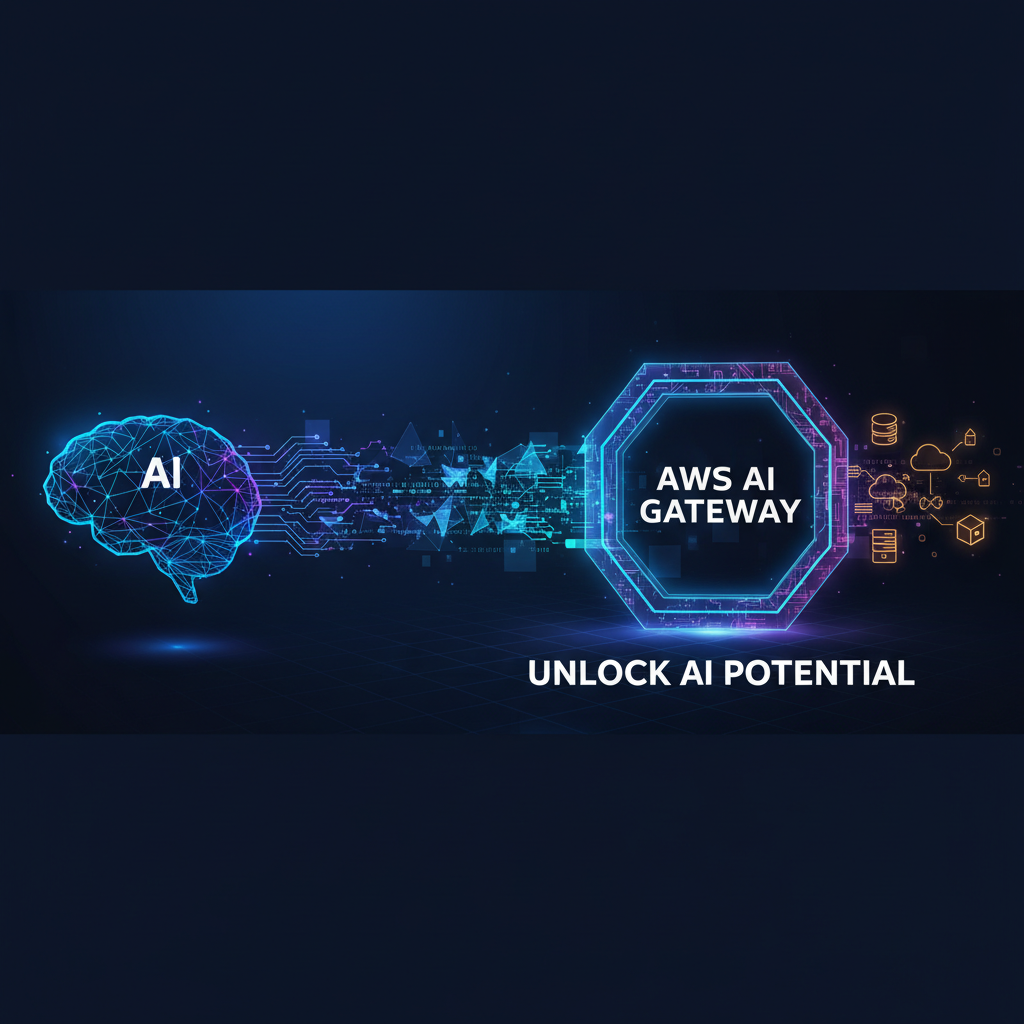


In an era increasingly defined by data and intelligent automation, Artificial Intelligence (AI) has transcended the realm of academic research to become an indispensable engine for business innovation. From sophisticated large language models (LLMs) that power intelligent chatbots and content generation to computer vision systems that automate quality control and personalized recommendation engines that enhance customer experience, AI is reshaping industries at an unprecedented pace. However, the journey from AI model development to seamless, secure, and scalable deployment in production environments is fraught with complexities. Organizations often grapple with challenges related to managing diverse AI services, ensuring robust security, controlling costs, maintaining high performance, and providing a cohesive developer experience. This is where the concept of an AI Gateway emerges as a critical architectural component, acting as the intelligent intermediary between consuming applications and a myriad of underlying AI services.
Specifically, leveraging Amazon Web Services (AWS) to construct an AI Gateway offers a powerful, flexible, and scalable solution for orchestrating and exposing AI capabilities. An "AWS AI Gateway" isn't a single, monolithic product but rather a carefully architected combination of various AWS services, each playing a vital role in creating a robust, enterprise-grade AI infrastructure. This integrated approach allows businesses to unlock the full potential of their AI investments, transforming disparate AI models and services into consumable, governed, and highly available APIs. This comprehensive article delves deep into the architecture, benefits, implementation strategies, and advanced considerations for building and operating an AWS AI Gateway, demonstrating how it becomes the linchpin for operationalizing AI at scale. We will explore how an LLM Gateway – a specialized form of an AI Gateway designed to handle the unique demands of large language models – fits into this broader architectural vision, and how the fundamental principles of a traditional API Gateway are extended and enhanced to meet the specific requirements of the AI domain.
The AI Revolution and the Imperative for Intelligent Gateways
The rapid advancements in AI, particularly in machine learning (ML) and deep learning, have ushered in a new era of possibilities. What began with discrete algorithms for specific tasks has evolved into highly sophisticated models capable of understanding natural language, recognizing intricate patterns in visual data, and generating creative content. The advent of Large Language Models (LLMs) such as GPT-series, Claude, and LLaMA, among others, represents a quantum leap in AI capabilities. These foundation models, pre-trained on vast datasets, exhibit remarkable proficiency across a wide range of tasks, from complex reasoning and code generation to detailed summarization and translation. This power, however, comes with its own set of operational challenges when transitioning from development to production.
Integrating AI models and services directly into applications can lead to a tangled web of dependencies, security vulnerabilities, and management headaches. Consider an enterprise building multiple applications, each needing access to various AI functionalities: sentiment analysis for customer service, image recognition for product cataloging, translation for global outreach, and an LLM for intelligent search. Without a centralized management layer, each application would need to:
- Directly manage authentication and authorization for each individual AI service, which might use different credentials and security protocols.
- Handle rate limiting and throttling to prevent abuse or exceeding service quotas, requiring custom logic for each integration.
- Implement logging and monitoring independently for every AI call, making centralized observability a nightmare.
- Manage different API schemas and data formats, increasing development complexity and brittleness.
- Address potential data privacy and compliance concerns for each AI interaction, especially when sensitive information is involved.
- Cope with model versioning and updates, potentially breaking dependent applications with every change.
- Optimize for performance and latency, which can vary significantly across different AI services.
- Control costs by tracking usage across numerous endpoints from various providers.
These complexities quickly become unmanageable as the number of AI models, consuming applications, and data volumes grow. This is precisely why an intelligent intermediary – an AI Gateway – becomes not just beneficial, but essential. It abstracts away the underlying complexities of diverse AI services, presenting a unified, secure, and scalable interface to developers. For organizations embracing LLMs, a specialized LLM Gateway extends these benefits by addressing challenges unique to these powerful models, such as prompt engineering, response parsing, and managing the high computational costs associated with LLM inference. At its core, an API Gateway provides the foundational principles for routing, security, and management, which are then specialized for the nuances of AI workloads.
Dissecting the AWS AI Gateway: A Modular Architecture
An AWS AI Gateway is an architectural pattern that combines several AWS services to create a single, unified entry point for accessing a wide array of AI capabilities. It centralizes control, enhances security, optimizes performance, and simplifies the consumption of AI models, whether they are pre-built AWS AI services, custom models deployed on Amazon SageMaker, or even third-party AI APIs. Unlike a single product, this gateway is a custom solution built by orchestrating various AWS primitives. Let's break down the key components that typically form an AWS AI Gateway:
1. Amazon API Gateway: The Front Door for AI APIs
At the heart of any AWS AI Gateway is Amazon API Gateway, a fully managed service that makes it easy for developers to create, publish, maintain, monitor, and secure APIs at any scale. For AI applications, it acts as the primary entry point, handling all incoming requests from client applications.
- API Management: API Gateway allows you to define RESTful APIs or HTTP APIs, creating logical endpoints for your AI services. You can map incoming requests (e.g.,
POST /sentiment-analysis,GET /image-tags) to specific backend AI models or processing logic. - Request Routing and Transformation: It intelligently routes requests to the correct backend service based on defined rules. Crucially, it can transform request and response payloads using mapping templates (VTL – Velocity Template Language) before forwarding them. This is invaluable for standardizing input formats for AI models or formatting AI model outputs into a consistent structure for consuming applications, even if the underlying AI services have different API contracts.
- Throttling and Rate Limiting: To protect your backend AI services from being overwhelmed and to manage costs, API Gateway provides robust throttling and rate-limiting capabilities. You can set global limits or specific limits per API method, ensuring fair usage and preventing denial-of-service attacks.
- Caching: For AI models whose outputs are frequently requested and change infrequently, API Gateway can cache responses, significantly reducing latency and the load on backend AI services. This is particularly useful for common queries to LLMs or for image analysis results that might be re-requested.
- API Key Management: It enables the creation and management of API keys, allowing you to track usage per client and control access granularly. This is a fundamental layer of access control for your AI APIs.
2. AWS Lambda: The Serverless Logic Layer
AWS Lambda is a serverless compute service that lets you run code without provisioning or managing servers. It's the perfect glue logic for an AWS AI Gateway, serving as the backend target for API Gateway.
- Request Pre-processing: Lambda functions can perform complex pre-processing on incoming requests before they reach the actual AI model. This includes input validation, data sanitization, PII (Personally Identifiable Information) redaction, or enriching the request with additional context.
- Model Invocation and Orchestration: A Lambda function can invoke various AWS AI services (e.g., Amazon Rekognition, Amazon Comprehend, Amazon Textract, Amazon Translate), interact with custom models deployed on Amazon SageMaker endpoints, or even call external third-party AI APIs. For LLMs, a Lambda function is crucial for constructing sophisticated prompts, handling multi-turn conversations, and selecting the appropriate LLM provider (e.g., Amazon Bedrock, external OpenAI API) based on business logic.
- Response Post-processing: After receiving a response from the AI model, Lambda can further process it – aggregating results from multiple models, formatting the output into a standardized JSON structure, performing additional sentiment analysis on an LLM's output, or logging detailed metrics.
- Dynamic Routing: Lambda can implement intelligent routing logic. For example, based on the input text's language, it could route to different translation models. Or, for an LLM Gateway, it could route requests to different LLMs based on cost, performance, or specific prompt characteristics.
3. Amazon SageMaker: Hosting Custom AI Models
For organizations developing their own custom machine learning models, Amazon SageMaker provides a fully managed service for building, training, and deploying ML models at scale. SageMaker endpoints can be directly integrated as backends for API Gateway via Lambda.
- Custom Model Deployment: SageMaker allows you to deploy models trained using various frameworks (TensorFlow, PyTorch, XGBoost, etc.) as real-time inference endpoints.
- Model Monitoring: SageMaker Model Monitor continuously monitors the quality of your deployed models and alerts you to concept drift or data drift, ensuring your AI Gateway consistently serves accurate predictions.
- Endpoint Scalability: SageMaker endpoints can automatically scale to handle varying inference loads, ensuring your custom AI models are always available and performant behind the gateway.
4. Amazon Bedrock: Managed Access to Foundation Models
Amazon Bedrock is a fully managed service that provides access to foundation models (FMs) from Amazon and leading AI startups via a single API. It's especially relevant for building an LLM Gateway.
- Simplified LLM Access: Bedrock abstracts away the complexities of interacting with various LLMs, offering a unified API for models like Amazon Titan, Anthropic Claude, AI21 Labs Jurassic, Stability AI Stable Diffusion, and Cohere.
- Model Selection and Customization: Through Bedrock, you can select the most suitable LLM for a given task, and even fine-tune these models with your own data to make them more domain-specific.
- Agents for Bedrock: This feature helps build conversational agents that can perform complex tasks by breaking them down, invoking APIs, and leveraging FMs. This capability can be exposed directly through the AI Gateway.
- Knowledge Bases for Bedrock: Connect FMs to your company data sources for Retrieval Augmented Generation (RAG), enhancing the factual accuracy and relevance of LLM responses. The AI Gateway can expose these RAG-powered LLM capabilities.
5. Security Services: AWS WAF, AWS Shield, Amazon Cognito, AWS IAM
Security is paramount for any production system, especially when dealing with AI models and potentially sensitive data. AWS offers a robust suite of security services that integrate seamlessly into the AI Gateway architecture.
- AWS WAF (Web Application Firewall): Protects your AI APIs from common web exploits and bots that could affect availability, compromise security, or consume excessive resources. It allows you to define custom rules based on IP addresses, HTTP headers, URI strings, and other request parameters.
- AWS Shield: Provides managed Distributed Denial of Service (DDoS) protection for applications running on AWS. Standard Shield is automatically included for all AWS customers, while Shield Advanced offers enhanced protection and specialized support.
- Amazon Cognito: Provides user authentication, authorization, and user management. It can be used to secure access to your AI APIs, allowing only authenticated and authorized users to invoke them. API Gateway supports Cognito User Pool authorizers.
- AWS IAM (Identity and Access Management): Controls access to AWS resources. IAM roles are essential for granting Lambda functions the necessary permissions to invoke AI services or SageMaker endpoints securely. IAM authorizers can also be used with API Gateway for machine-to-machine authentication.
6. Monitoring and Observability: Amazon CloudWatch, AWS X-Ray, Amazon Kinesis
Understanding the performance, usage, and health of your AI Gateway and backend services is crucial for operational excellence.
- Amazon CloudWatch: Collects and tracks metrics, collects and monitors log files, and sets alarms. You can monitor API Gateway request counts, latency, error rates, and Lambda function invocations, durations, and errors.
- AWS X-Ray: Helps developers analyze and debug distributed applications built with microservices. It provides an end-to-end view of requests as they travel through your AI Gateway, Lambda, and other backend services, helping identify performance bottlenecks.
- Amazon Kinesis / Kinesis Firehose: For high-volume, real-time logging and analytics of AI API calls, Kinesis can stream raw log data to various destinations like Amazon S3 for archival, Amazon Redshift for advanced analytics, or third-party SIEM (Security Information and Event Management) tools.
7. Storage and Database: Amazon S3, Amazon DynamoDB
- Amazon S3 (Simple Storage Service): An object storage service that can be used for storing input data for asynchronous AI processing, caching large AI model responses, or archiving detailed API call logs.
- Amazon DynamoDB: A fast and flexible NoSQL database service, useful for storing metadata related to API keys, user quotas, prompt templates for LLMs, or configuration data for dynamic routing logic within Lambda.
By strategically combining these AWS services, organizations can construct a highly customized and robust AWS AI Gateway that addresses their specific AI operational requirements, moving beyond mere integration to true AI orchestration.
Key Capabilities and Benefits of an AWS AI Gateway
The strategic implementation of an AWS AI Gateway brings a multitude of benefits, transforming the way enterprises interact with and deploy their artificial intelligence capabilities. These advantages span across security, performance, cost management, developer experience, and governance, making it an indispensable component of a modern AI infrastructure.
1. Unified Access and Centralized Management
One of the most profound benefits of an AI Gateway is its ability to provide a single, unified access point to a diverse ecosystem of AI models and services. Instead of applications needing to understand the unique API contracts, authentication mechanisms, and endpoints of individual AI services—be they AWS Comprehend, Amazon Rekognition, custom SageMaker models, or third-party LLMs—they interact with a single, consistent API exposed by the gateway.
- Abstraction Layer: The gateway acts as an abstraction layer, decoupling consuming applications from the underlying AI model implementations. If an organization decides to switch from one LLM provider to another, or update a custom sentiment analysis model, the consuming applications require minimal to no changes, as they continue to interact with the same gateway API. This significantly reduces application-side refactoring and accelerates innovation cycles.
- Consistent Developer Experience: Developers gain a standardized way to discover, integrate, and consume AI capabilities. This reduces cognitive load, speeds up development time, and promotes best practices across teams. The gateway can enforce common data formats and API structures, making it easier for new developers to onboard and contribute to AI-powered applications.
- Streamlined Governance: Centralizing access enables centralized governance. Policies around usage, security, and data handling can be applied uniformly across all AI services exposed through the gateway, ensuring compliance and consistency.
2. Robust Security and Authentication
Security is paramount, especially when AI models process potentially sensitive data or are critical to business operations. An AWS AI Gateway significantly strengthens the security posture of your AI infrastructure.
- Multi-layered Authentication & Authorization:
- API Keys: Basic but effective for client identification and usage tracking.
- AWS IAM: For machine-to-machine authentication, providing granular permissions based on roles.
- Amazon Cognito: For user authentication, integrating with identity providers like Google, Facebook, or enterprise directories (SAML).
- Custom Authorizers (Lambda): For highly customized authentication and authorization logic, allowing integration with existing identity systems or complex business rules. This ensures that only authorized users or services can invoke specific AI APIs.
- DDoS Protection: AWS Shield and AWS WAF protect the gateway from various types of DDoS attacks and common web vulnerabilities, ensuring the availability and integrity of your AI services. AWS WAF can filter malicious traffic based on IP addresses, geographical locations, and suspicious request patterns.
- Data Encryption: All data in transit between clients and the API Gateway, and typically between the gateway and backend AWS services, is encrypted using TLS/SSL. Data at rest (e.g., in S3 or DynamoDB) can also be encrypted, providing end-to-end data protection.
- VPC PrivateLink Integration: For enhanced security and privacy, API Gateway can be integrated with AWS PrivateLink, allowing private connectivity between your VPCs and the API Gateway endpoint service, bypassing the public internet entirely. This is crucial for highly regulated industries.
3. Performance Optimization and Scalability
AI inference can be computationally intensive and latency-sensitive. An AWS AI Gateway provides mechanisms to optimize performance and ensure high availability under varying loads.
- Caching: API Gateway's caching capabilities significantly reduce latency for frequently requested AI model inferences by serving responses directly from the cache. This reduces the load on backend AI services and improves the end-user experience.
- Throttling and Rate Limiting: By setting limits on the number of requests per second or per client, the gateway protects backend AI services from being overloaded. This prevents resource exhaustion, maintains service availability, and helps manage costs by controlling the rate of expensive AI inferences.
- Auto-scaling: Backend services like AWS Lambda and Amazon SageMaker endpoints inherently auto-scale based on demand. The API Gateway transparently leverages this elasticity, ensuring that your AI capabilities can handle sudden spikes in traffic without manual intervention.
- Edge Optimization: For global applications, API Gateway can integrate with Amazon CloudFront, AWS’s content delivery network (CDN). This routes requests through CloudFront’s edge locations, minimizing latency for users worldwide by serving API responses from a location geographically closer to them.
4. Cost Management and Monitoring
Operationalizing AI at scale involves significant costs. An AWS AI Gateway provides visibility and control mechanisms to manage these expenditures effectively.
- Detailed Usage Tracking: API Gateway logs every request, providing data for precise usage tracking. Combined with API keys, this allows organizations to attribute costs to specific applications, teams, or even individual users.
- Cost Control through Throttling: By limiting request rates, the gateway directly controls the number of AI inferences, thereby directly impacting the variable costs associated with pay-per-use AI services.
- Centralized Logging and Monitoring:
- Amazon CloudWatch: Gathers comprehensive metrics for API Gateway and Lambda (e.g., latency, error rates, invocations), enabling real-time performance monitoring and alarm generation.
- AWS X-Ray: Provides end-to-end tracing of requests through the entire AI Gateway architecture, helping identify performance bottlenecks across multiple services.
- Kinesis Firehose: For high-volume data, Firehose can stream detailed API call logs to S3, data warehouses (like Redshift), or analytics platforms for historical analysis and compliance auditing. This granular data helps identify trends, optimize resource allocation, and proactively address potential issues.
5. Prompt Engineering and Model Orchestration (Especially for LLM Gateway)
For LLMs, the gateway transcends simple routing to become an intelligent orchestrator, crucial for what is often termed an LLM Gateway.
- Prompt Templating and Versioning: The gateway (via Lambda) can store and manage various prompt templates. This ensures consistency in how LLMs are invoked, facilitates A/B testing of different prompts, and allows for version control of prompt strategies without altering consuming applications.
- Dynamic Prompt Augmentation: Lambda can dynamically inject context, user-specific data, or retrieval-augmented generation (RAG) results into prompts before sending them to the LLM, making responses more relevant and accurate.
- Model Selection and Fallback: Based on the complexity of the request, cost considerations, or specific model capabilities, the gateway can dynamically choose which LLM to invoke. It can also implement fallback mechanisms, routing to a different LLM if the primary one fails or is over capacity.
- Output Parsing and Post-processing: LLM outputs can be verbose or unstructured. Lambda can parse these responses, extract relevant information, reformat them into a structured JSON, or even perform secondary AI analyses (e.g., sentiment analysis on the LLM's generated text).
6. Data Governance and Compliance
Handling data, especially sensitive or proprietary information, with AI models requires strict governance and adherence to compliance standards. The AI Gateway provides a crucial control point.
- PII Redaction/Masking: Lambda functions can be implemented to automatically detect and redact or mask personally identifiable information (PII) from input data before it reaches an AI model, and from output data before it’s returned to the client, ensuring data privacy.
- Data Residency Control: By selecting specific AWS regions for deploying your AI Gateway and backend services, you can enforce data residency requirements, keeping data within specific geographical boundaries as mandated by regulations like GDPR or local data sovereignty laws.
- Audit Trails: Comprehensive logging (CloudWatch, Kinesis to S3) provides detailed audit trails of every API call, including who accessed what, when, and with what parameters. This is essential for compliance auditing and forensic analysis.
- Access Control Policies: Fine-grained access control through IAM and Cognito ensures that only authorized entities can submit or retrieve data from AI services, preventing unauthorized data exposure.
7. Enhanced Developer Experience and API Lifecycle Management
An AI Gateway simplifies the entire lifecycle of an AI API, from design to deprecation.
- Developer Portal: While AWS API Gateway itself doesn't offer a full-fledged developer portal out of the box, it provides the building blocks. Organizations can create custom developer portals or leverage third-party solutions to list available AI APIs, provide documentation, and manage API keys for their developers.
- API Versioning: API Gateway supports easy versioning of APIs, allowing you to deploy new iterations (e.g.,
v1,v2) without breaking existing applications. This is crucial for managing model updates or changes in AI service contracts. - SDK Generation: API Gateway can automatically generate client SDKs in various programming languages, accelerating the integration process for developers.
- Centralized Display: The gateway provides a centralized platform to display all available AI services, making it easy for different departments and teams to discover and utilize the required AI capabilities.
It is worth noting that while AWS provides an incredibly robust set of primitives, specialized tools can further enhance developer experience and operational efficiency for AI and API management. For instance, platforms like APIPark, an open-source AI gateway and API management platform, offer comprehensive features like quick integration of 100+ AI models, unified API formats, prompt encapsulation into REST APIs, and end-to-end API lifecycle management. These solutions can complement an AWS-centric strategy by providing a ready-to-use developer portal and advanced API governance capabilities, particularly beneficial for managing a diverse landscape of AI and REST services, and streamlining team collaboration around APIs. APIPark's ability to unify authentication, track costs, standardize data formats, and manage API subscriptions, along with its high performance and detailed logging, addresses many of the same challenges tackled by a custom AWS AI Gateway, offering a compelling alternative or supplementary tool for organizations seeking a more out-of-the-box solution with a strong focus on AI integration.
To illustrate the breadth of services involved in building an AWS AI Gateway and their respective roles, consider the following table:
| AWS Service | Primary Role in AI Gateway | Key Benefit for AI Integration |
|---|---|---|
| Amazon API Gateway | The unified entry point for all AI APIs; handles request routing, transformation, caching, throttling, and API key management. | Provides a single, secure, and scalable endpoint for diverse AI services, abstracting complexity and enhancing developer experience. Foundation for AI Gateway and LLM Gateway. |
| AWS Lambda | Serverless compute for implementing custom logic: request pre-processing, AI model invocation (e.g., Bedrock, SageMaker, external APIs), response post-processing, dynamic routing, prompt engineering, PII redaction. | Enables highly flexible and scalable business logic for AI interactions, allowing for sophisticated orchestration and customization of AI workflows without server management. Crucial for LLM Gateway prompt management. |
| Amazon Bedrock | Managed service for accessing foundation models (LLMs, image generation) from Amazon and third-party providers via a unified API. | Simplifies and centralizes access to powerful LLMs, enabling rapid development of generative AI applications without needing to manage underlying model infrastructure. Core component for an LLM Gateway. |
| Amazon SageMaker | For hosting custom machine learning models (e.g., fine-tuned LLMs, specific computer vision models) as real-time inference endpoints. | Allows organizations to deploy and manage their proprietary AI models securely and at scale, integrating them seamlessly into the gateway architecture alongside managed services. |
| AWS WAF | Web Application Firewall that protects the API Gateway from common web exploits and bots. | Enhances the security posture by filtering malicious traffic, preventing common attacks (e.g., SQL injection, cross-site scripting), and mitigating the risk of unauthorized access or data breaches to your AI services. |
| Amazon Cognito | Provides user authentication and authorization services for securing access to AI APIs. | Manages user identities, allowing for secure login and access control, ensuring that only authenticated and authorized end-users or applications can consume specific AI capabilities. |
| AWS IAM | Manages access to AWS resources; provides fine-grained permissions for Lambda functions to invoke AI services and for clients (via IAM authorizers) to access API Gateway. | Ensures least privilege access, securely controlling which AWS services can interact with each other and which clients can access the AI Gateway. Fundamental for overall AWS security. |
| Amazon CloudWatch | Collects metrics and logs, sets alarms for API Gateway, Lambda, and other integrated services. | Provides essential visibility into the operational health, performance, and usage patterns of the AI Gateway, enabling proactive monitoring, troubleshooting, and performance tuning. |
| AWS X-Ray | End-to-end tracing of requests as they flow through the AI Gateway and its backend services. | Helps developers analyze and debug distributed applications, pinpointing performance bottlenecks and service failures across complex AI workflows, thereby improving reliability and development velocity. |
| Amazon S3 | Object storage for large AI inputs/outputs, persistent prompt templates, or archival of detailed API logs. | Provides durable, scalable, and cost-effective storage for various AI-related data assets, supporting both synchronous and asynchronous AI processing patterns. |
| Amazon DynamoDB | NoSQL database for storing dynamic configuration data, such as API quotas, user access permissions, or prompt versioning for LLMs. | Offers a high-performance, fully managed database for storing critical metadata and configuration, enabling dynamic behavior and rapid adjustments within the AI Gateway logic. |
This table underscores the modular nature of an AWS AI Gateway, where each service contributes a specialized function to create a cohesive and powerful AI orchestration layer.
Building an AWS AI Gateway: A Step-by-Step Conceptual Guide
Constructing an AWS AI Gateway, while leveraging a suite of services, can be approached systematically. Let's outline the conceptual steps involved in exposing an LLM (using Amazon Bedrock) as a managed, secure, and scalable API through our gateway. This example specifically illustrates the creation of an LLM Gateway using AWS primitives, demonstrating how the general AI Gateway principles apply to the specialized needs of large language models. The foundational service here remains an API Gateway.
Scenario: Exposing an LLM for Text Summarization
Imagine we want to provide an API endpoint that takes a block of text and returns a concise summary using an LLM.
Step 1: Define the API Endpoint with Amazon API Gateway
The first step is to establish the entry point for our summarization service.
- Choose API Type: For most AI APIs, a REST API is suitable due to its flexibility and broad client support. HTTP APIs offer lower latency and cost for simpler integrations but might lack some advanced features like caching or request/response transformation directly within API Gateway. For our example, we'll assume a REST API to showcase more features.
- Create an API Resource: Define a logical path for your service, e.g.,
/summarize. - Configure an API Method: For summarization, a
POSTmethod is appropriate, as clients will be sending data (the text to be summarized). - Integration Type: Initially, we'll set the integration type to
Lambda Functionbecause our Lambda will handle the logic of calling the LLM.
At this stage, we have a public-facing URL like https://{api-id}.execute-api.{region}.amazonaws.com/prod/summarize that clients can call.
Step 2: Implement Backend Logic with AWS Lambda and Amazon Bedrock
This is where the core AI invocation happens.
- Create a Lambda Function: Develop a Python (or Node.js, Java, etc.) Lambda function. This function will be triggered by API Gateway.
- Process Request: Inside the Lambda, parse the incoming JSON payload from API Gateway. Expect a field like
textcontaining the content to be summarized. - Construct Prompt for LLM: Design a clear and effective prompt for the LLM. For example:
"Please summarize the following text concisely:\n\n" + event['body']['text'] + "\n\nSummary:"This demonstrates basic prompt engineering within the Lambda function, a key aspect of an LLM Gateway.
Invoke LLM via Amazon Bedrock: Use the AWS SDK (Boto3 in Python) to call the Amazon Bedrock runtime. Specify the desired LLM (e.g., anthropic.claude-v2, amazon.titan-text-express-v1) and pass the constructed prompt. ```python import json import boto3bedrock_runtime = boto3.client('bedrock-runtime', region_name='us-east-1')def lambda_handler(event, context): try: body = json.loads(event['body']) text_to_summarize = body.get('text')
    if not text_to_summarize:
        return {
            'statusCode': 400,
            'body': json.dumps({'error': 'Missing "text" field in request body'})
        }

    # Prompt engineering for summarization
    prompt = f"Summarize the following text concisely:\n\n{text_to_summarize}\n\nSummary:"

    # Invoke Amazon Bedrock LLM (e.g., Claude)
    response = bedrock_runtime.invoke_model(
        modelId='anthropic.claude-v2',  # Or 'amazon.titan-text-express-v1'
        contentType='application/json',
        accept='application/json',
        body=json.dumps({
            "prompt": prompt,
            "max_tokens_to_sample": 200,
            "temperature": 0.5
        })
    )

    response_body = json.loads(response['body'].read())
    summary = response_body['completion'].strip()

    return {
        'statusCode': 200,
        'body': json.dumps({'summary': summary})
    }
except Exception as e:
    print(f"Error: {e}")
    return {
        'statusCode': 500,
        'body': json.dumps({'error': str(e)})
    }
`` 5. **Configure Lambda IAM Role:** Ensure the Lambda function's execution role has permissions to invokebedrock-runtime:InvokeModel`.
Step 3: Enhance Security and Authentication
Securing your AI API is paramount.
- API Keys:
- In API Gateway, enable API Key required for your
/summarizemethod. - Create usage plans and API keys. Assign clients specific keys. This allows you to track usage per client and apply throttling limits per key.
- In API Gateway, enable API Key required for your
- Custom Authorizer (Lambda Authorizer): For more sophisticated authentication (e.g., JWT validation, integration with an existing identity system), create another Lambda function as a custom authorizer. This Lambda will execute before your summarization Lambda, validating the incoming token (e.g., from an
Authorizationheader) and returning an IAM policy allowing or denying access.- Attach this authorizer to your
/summarizemethod.
- Attach this authorizer to your
- AWS WAF: Deploy AWS WAF in front of your API Gateway. Configure rules to block common web attacks, filter requests from suspicious IP ranges, or limit requests based on geographic location.
Step 4: Implement Throttling and Caching
To manage performance and costs.
- Throttling:
- Global Level: In API Gateway settings, set a default steady-state rate and burst capacity for all APIs.
- Method Level: Override global limits for the
/summarizemethod if it's particularly resource-intensive. - Usage Plan Level: Crucially, set specific throttling limits per API Key within usage plans. This allows different clients (or tiers of clients) to have different request quotas (e.g., free tier gets 5 RPM, premium tier gets 100 RPM).
- Caching:
- Enable API Gateway caching for the stage (e.g.,
prod). - Configure cache settings: size, TTL (Time To Live).
- For the
/summarizemethod, you might enable caching if identical input texts are frequently summarized. However, for LLMs, where output might vary slightly even for the same prompt, or where prompts are highly dynamic, caching might be less effective or require careful consideration of cache keys (e.g., caching only based on a hash of the input text).
- Enable API Gateway caching for the stage (e.g.,
Step 5: Configure Logging and Monitoring
Visibility is key to operational stability.
- API Gateway Logs: Enable CloudWatch Logs for API Gateway. Configure execution logging to capture detailed request and response payloads, errors, and performance metrics.
- Lambda Logs: All
printstatements orloggeroutputs from your Lambda function automatically go to CloudWatch Logs. - CloudWatch Metrics and Alarms:
- Monitor API Gateway metrics like
Count(requests),Latency,4xxError,5xxError. - Monitor Lambda metrics like
Invocations,Errors,Duration,Throttles. - Set up CloudWatch Alarms to notify you (e.g., via SNS) if error rates spike, latency increases beyond a threshold, or throttling occurs.
- Monitor API Gateway metrics like
- AWS X-Ray: Enable X-Ray tracing for both API Gateway and Lambda. This provides a visual service map and detailed trace timelines for each request, showing how much time is spent in API Gateway, Lambda, and the call to Bedrock, helping pinpoint performance bottlenecks.
Step 6: Request/Response Transformation (Advanced)
While Lambda handles much of this, API Gateway can do basic transformations.
- Mapping Templates: For cases where the client's input format is slightly different from what your Lambda expects, or if you want to standardize the Lambda's output without modifying its code, API Gateway's integration request and response mapping templates (using VTL) can transform payloads.
- Example: Transform a client's
{"content": "..."}to your Lambda's{"text": "..."}. - Example: Extract only the
summaryfield from a verbose Lambda response.
- Example: Transform a client's
Step 7: Versioning and Deployment
Managing changes gracefully.
- API Gateway Stages: Use stages (e.g.,
dev,test,prod) to manage different versions of your API. Each stage can have distinct configurations (e.g., different Lambda versions, different caching settings). - Lambda Versioning and Aliases: Publish new versions of your Lambda function (e.g.,
$LATEST,v1,v2). Use Lambda aliases (e.g.,prod-alias) to point to specific versions, allowing for blue/green deployments or canary releases. Update the API Gateway integration to point to the new Lambda alias.
By following these steps, you can establish a robust AWS AI Gateway for your LLM summarization service. This architecture is highly flexible and can be adapted to expose virtually any AI model or capability, forming the backbone of your enterprise AI strategy.
APIPark is a high-performance AI gateway that allows you to securely access the most comprehensive LLM APIs globally on the APIPark platform, including OpenAI, Anthropic, Mistral, Llama2, Google Gemini, and more.Try APIPark now! 👇👇👇
Advanced Use Cases and Architectures for AWS AI Gateway
Beyond the basic setup, an AWS AI Gateway can be extended to handle more complex scenarios, offering sophisticated AI orchestration and integration capabilities. These advanced patterns demonstrate the true power and flexibility of this architectural approach.
1. Multi-Model Orchestration and Intelligent Routing
As organizations deploy more AI models, the need to dynamically route requests based on various criteria becomes crucial. An AI Gateway, powered by Lambda, can act as an intelligent router.
- Dynamic Model Selection: Based on the input text characteristics (e.g., language, domain, complexity), request headers (e.g., user group, API key tier), or even real-time performance metrics (e.g., latency of a specific LLM), the Lambda function can decide which AI model to invoke. For instance, highly sensitive data might be routed to a fine-tuned, internally hosted SageMaker model, while general queries go to a cost-effective Bedrock LLM.
- A/B Testing and Canary Releases: The gateway can be configured to split traffic between different versions of an AI model or different underlying models. For example, 10% of requests go to
LLM-v2and 90% toLLM-v1, allowing for real-world performance evaluation before a full rollout. This is a critical capability for continuous improvement and risk mitigation in AI deployments. - Regional Routing: For global applications, the gateway can route requests to AI models deployed in the closest AWS region to minimize latency, or to specific regions to satisfy data residency requirements.
2. Serverless AI Backends with Workflow Orchestration
Combining Lambda with AWS Step Functions and Amazon SQS can enable powerful asynchronous AI processing workflows.
- Asynchronous AI Processing: For long-running AI tasks (e.g., processing large documents, video analysis, complex LLM chains), the API Gateway can receive the initial request, store the input in S3, and then trigger an asynchronous workflow. The client immediately receives a correlation ID, and the final AI processing result is delivered via a callback or polling mechanism.
- Complex AI Pipelines with Step Functions: AWS Step Functions allows you to define serverless workflows (state machines) that orchestrate multiple Lambda functions, AI services, and other AWS resources. An API Gateway request can initiate a Step Functions workflow that, for example:
- Transcribes audio (Amazon Transcribe).
- Translates the transcription (Amazon Translate).
- Performs sentiment analysis on the translation (Amazon Comprehend).
- Summarizes the key findings using an LLM (Amazon Bedrock).
- Stores the final results in a database and notifies the client. This pattern ensures reliability, retries, and error handling for multi-step AI tasks.
3. Real-time Stream Processing with AI
Integrating the AI Gateway with streaming data services like Amazon Kinesis can enable real-time AI inference on continuous data streams.
- Real-time Anomaly Detection: Data flowing into a Kinesis Data Stream can trigger Lambda functions that perform real-time AI inference (e.g., using a SageMaker anomaly detection model) via the gateway. Alerts can be generated immediately if anomalies are detected.
- Live Sentiment Analysis on Chat: Chat messages streamed into Kinesis can be processed by Lambda functions that call sentiment analysis APIs through the gateway, providing instant insights into customer sentiment.
- Dynamic Content Personalization: User interaction streams can feed into AI models via the gateway to update user profiles or recommend content in real time.
4. Data Privacy and Compliance Specifics
For highly regulated environments, the AI Gateway can be hardened with advanced privacy features.
- VPC PrivateLink and Endpoint Services: Ensure that all traffic between your internal applications, the API Gateway, and backend AI services (Lambda, Bedrock, SageMaker) remains entirely within the AWS network, never traversing the public internet. This significantly reduces the attack surface and helps meet strict compliance requirements.
- Confidential Computing with AWS Nitro Enclaves: For extremely sensitive AI workloads, specific parts of the inference process can be run within Nitro Enclaves, providing an isolated and cryptographically attested compute environment even from other users and administrators on the same EC2 instance. The AI Gateway could orchestrate calls to such secure enclaves.
- Homomorphic Encryption/Federated Learning Integration: While still emerging, the gateway can be designed to facilitate interactions with AI models that use advanced privacy-preserving techniques like homomorphic encryption or federated learning, ensuring data privacy during inference.
5. Edge AI Gateway for Low-Latency Inference
For applications requiring ultra-low latency or operating in environments with intermittent connectivity, the concept of an AI Gateway can extend to the edge.
- AWS Local Zones and Outposts: Deploying components of the AI Gateway (e.g., API Gateway, Lambda, SageMaker endpoints) closer to end-users or on-premises using AWS Local Zones or Outposts can significantly reduce inference latency.
- IoT Greengrass for On-Device Inference: For true edge AI, models can be deployed directly on IoT devices via AWS IoT Greengrass. The "gateway" in this context might be a lightweight local service that manages access to these on-device models, perhaps pushing results back to a cloud-based gateway for aggregation and further processing.
- Hybrid Architectures: The edge AI Gateway can intelligently decide whether to perform inference locally (for low-latency, common tasks) or offload more complex or less frequent tasks to the cloud-based AI Gateway.
These advanced use cases underscore the versatility of an AWS AI Gateway, demonstrating its capacity to not only simplify access to AI but also to enable sophisticated, resilient, and highly optimized AI-driven solutions across a wide spectrum of enterprise needs. From managing diverse LLMs to orchestrating complex, multi-step AI workflows, the modularity of AWS services provides the building blocks for an incredibly powerful AI infrastructure.
Challenges and Considerations in Implementing an AWS AI Gateway
While an AWS AI Gateway offers significant advantages, its implementation is not without challenges. Understanding these considerations upfront is crucial for a successful and sustainable deployment.
1. Complexity of Setup and Integration
The primary challenge stems from the fact that an AWS AI Gateway is an architectural pattern rather than a single, off-the-shelf product. It requires orchestrating multiple AWS services, each with its own configuration nuances and best practices.
- Service Integration: Connecting API Gateway to Lambda, configuring IAM roles, setting up CloudWatch logging, and integrating with security services like WAF demands a deep understanding of each service's capabilities and how they interact. This learning curve can be steep for teams new to AWS or serverless architectures.
- Configuration Management: Managing configurations across different services, especially when dealing with multiple environments (dev, test, prod), can become complex. Infrastructure as Code (IaC) tools like AWS CloudFormation or Terraform are essential for defining, deploying, and managing the gateway consistently and repeatably, but they also add to the initial setup complexity.
- Debugging Distributed Systems: Identifying the root cause of issues in a distributed system, where a request passes through API Gateway, Lambda, and potentially multiple backend AI services (Bedrock, SageMaker), can be challenging. Tools like AWS X-Ray are invaluable but require proper instrumentation and understanding.
2. Cost Management and Optimization
While serverless services often boast cost-efficiency, an AI Gateway, especially one heavily utilizing LLMs, can incur significant costs if not managed carefully.
- Per-Request Billing: Services like API Gateway, Lambda, and Bedrock are billed per request/invocation. High traffic volumes or inefficient Lambda code (e.g., long execution times) can quickly accumulate costs.
- LLM Inference Costs: Large Language Models, particularly advanced proprietary models, can be expensive on a per-token basis. Without careful prompt optimization, response truncation, and intelligent routing (e.g., using cheaper models for simpler tasks), LLM costs can skyrocket.
- Monitoring and Alerting: Robust cost monitoring using AWS Cost Explorer, coupled with CloudWatch alarms for high usage or budget overruns, is essential to prevent unexpected bills. Implementing throttling and quotas effectively within the gateway is the primary defense against runaway costs.
3. Latency and Performance Overhead
Adding a gateway layer inherently introduces some overhead, which can impact latency-sensitive AI applications.
- Network Hops: Each service in the chain (client -> API Gateway -> Lambda -> AI Service) introduces network latency. While AWS services are optimized for low latency, these cumulative hops can become noticeable for real-time applications.
- Lambda Cold Starts: If Lambda functions are not frequently invoked, they might experience "cold starts" where the environment needs to be initialized, adding a few hundred milliseconds of latency to the first few requests. Provisioned Concurrency can mitigate this but adds cost.
- Optimization Strategies: Careful design, caching at the API Gateway, efficient Lambda code, and using edge optimization (CloudFront) are crucial for minimizing latency. For extremely low-latency requirements, evaluating direct integration or alternative architectures might be necessary.
4. Vendor Lock-in
Building an AWS AI Gateway deeply integrates your AI infrastructure with the AWS ecosystem. While this provides powerful, seamless integrations, it also means a degree of vendor lock-in.
- Service-Specific Features: Leveraging unique features of AWS services (e.g., Bedrock, SageMaker, IAM policies) makes it harder to migrate the entire gateway architecture to another cloud provider or on-premises solution without significant re-engineering.
- Mitigation: Abstracting core AI invocation logic within Lambda functions can provide some portability for the AI model calls themselves (e.g., calling an external LLM via its HTTP API), but the surrounding infrastructure (security, logging, API management) remains AWS-centric.
5. Maintaining Custom Logic and Evolution
The custom logic within Lambda functions, which handles prompt engineering, model orchestration, data transformation, and PII redaction, requires ongoing maintenance and evolution.
- Code Management: As AI models evolve, prompts change, or new security requirements emerge, the Lambda code needs to be updated, tested, and redeployed. This requires robust CI/CD pipelines.
- Skill Set Requirements: Maintaining such an architecture requires a team with diverse skills, including AWS cloud engineering, serverless development, security best practices, and AI/ML operationalization (MLOps).
- Prompt Engineering Updates: For an LLM Gateway, prompt engineering is an evolving field. The gateway needs to be flexible enough to allow for rapid iteration and deployment of new prompt strategies without impacting consuming applications.
Addressing these challenges requires a deliberate approach to architecture design, meticulous implementation, continuous monitoring, and a commitment to MLOps best practices. Despite these considerations, the benefits of centralization, security, scalability, and enhanced developer experience often outweigh the complexities, making an AWS AI Gateway a strategic investment for organizations serious about operationalizing AI.
The Future of AI Gateways
The landscape of Artificial Intelligence is in a state of perpetual evolution, and so too will the role and capabilities of AI Gateways. As AI models become more sophisticated and deeply embedded into business operations, the gateways that manage them will necessarily grow in intelligence and autonomy.
- Increased Intelligence within the Gateway: Future AI Gateways, particularly LLM Gateways, will likely incorporate more AI themselves. This could manifest as:
- Self-optimizing Routing: Gateways might dynamically learn the optimal routing strategy for requests based on real-time factors like LLM performance, cost, and specific prompt characteristics, adjusting traffic automatically.
- Adaptive Rate Limiting: Instead of static limits, the gateway could use machine learning to adapt throttling policies based on observed usage patterns and backend system health, preventing overloads more intelligently.
- Automated Prompt Refinement: The gateway could automatically suggest or even apply minor prompt adjustments to improve LLM response quality or reduce token usage, leveraging feedback loops from model evaluations.
- Integrated Model Health Monitoring: Proactive detection of model drift or performance degradation within the gateway, potentially triggering alerts or routing to alternative models.
- Standardization of AI API Formats: As the number of AI models and providers proliferates, there will be an increasing demand for standardized API formats for invoking common AI tasks (e.g., summarization, classification, image generation). Future AI Gateways will play a crucial role in enforcing and translating between these standards, further simplifying integration for developers. Initiatives around Open AI specifications or similar open standards will likely gain traction, allowing gateways to become truly interoperable.
- Enhanced Security Features for AI Data: The unique security and privacy concerns surrounding AI (e.g., prompt injection attacks, data leakage in model responses, securing fine-tuning data) will drive the development of specialized security features within gateways. This could include:
- Advanced PII/PHI Detection & Masking: More sophisticated, context-aware PII detection and redaction capabilities, potentially using AI models within the gateway itself.
- Content Moderation for LLM Outputs: Automated filtering of potentially harmful, biased, or inappropriate content generated by LLMs before it reaches end-users.
- Federated Learning and Confidential Computing Integration: More native and seamless support for privacy-preserving AI techniques, allowing organizations to leverage sensitive data without exposing it.
- More Managed LLM Gateway Services: Cloud providers will likely offer more opinionated, fully managed LLM Gateway services that abstract away even more of the underlying complexity, providing out-of-the-box features for prompt management, cost optimization, security, and multi-model orchestration. This would reduce the burden of building custom solutions and accelerate the adoption of LLMs in enterprises. These services would likely compete with or incorporate capabilities currently offered by specialized platforms like APIPark.
- Seamless Integration with Data Observability and Governance Platforms: AI Gateways will become more tightly integrated with enterprise data governance, data observability, and MLOps platforms, providing a holistic view of data flow, model usage, compliance, and overall AI system health. This convergence will be critical for achieving trustworthy and responsible AI deployments.
The evolution of AI Gateways signifies a shift from mere API management to intelligent AI orchestration. They will increasingly become the command centers for enterprise AI, empowering organizations to leverage the full transformative power of artificial intelligence securely, efficiently, and responsibly.
Conclusion
The journey to effectively harness the transformative power of Artificial Intelligence is complex, demanding sophisticated infrastructure to manage, secure, and scale diverse AI models and services. The AWS AI Gateway stands out as a powerful and flexible architectural pattern that addresses these challenges head-on. By thoughtfully combining services like Amazon API Gateway, AWS Lambda, Amazon Bedrock, Amazon SageMaker, and a suite of robust security and monitoring tools, organizations can construct a unified, intelligent, and resilient entry point for all their AI capabilities.
This gateway acts as a critical abstraction layer, centralizing access, enforcing stringent security protocols, optimizing performance through caching and throttling, and providing invaluable insights into usage and costs. For the burgeoning field of Large Language Models, the specialized functionality of an LLM Gateway—built upon these AWS primitives—becomes indispensable for prompt engineering, model orchestration, and managing the unique demands of foundation models. It empowers developers with a consistent and streamlined experience, freeing them from the intricacies of individual AI service integrations, while simultaneously providing operations teams with unparalleled control and observability.
While the implementation of an AWS AI Gateway requires a thoughtful design and a good understanding of various AWS services, the long-term benefits far outweigh the initial investment. From safeguarding sensitive data and ensuring regulatory compliance to maximizing the efficiency of expensive AI inference and accelerating time-to-market for AI-powered applications, the strategic deployment of an API Gateway specialized for AI becomes the cornerstone of any enterprise looking to truly unlock its AI potential. As AI continues its rapid evolution, the AWS AI Gateway will remain a vital component, continually adapting and expanding its capabilities to meet the ever-growing demands of intelligent systems.
Frequently Asked Questions (FAQ)
1. What is an "AWS AI Gateway," and how is it different from a regular API Gateway?
An "AWS AI Gateway" is not a single AWS product but rather an architectural pattern or conceptual solution built by combining several AWS services (primarily Amazon API Gateway, AWS Lambda, and AI/ML services like Amazon Bedrock or SageMaker). Its core function is to provide a unified, secure, and managed entry point for accessing various Artificial Intelligence (AI) models and services.
The key difference from a regular API Gateway lies in its specialization for AI workloads. While a traditional API Gateway handles general API routing, security, and management for any backend service, an AI Gateway extends these capabilities with features specific to AI. This includes dynamic routing to multiple AI models, sophisticated prompt engineering (especially for LLMs), data pre-processing (like PII redaction), intelligent response post-processing, and fine-grained cost management tailored to AI inference. It abstracts away the unique invocation methods and data formats of diverse AI services, presenting a consistent interface to consuming applications.
2. Why do I need an AI Gateway for my AI applications, especially with Large Language Models (LLMs)?
An AI Gateway is crucial for several reasons:
- Centralized Management: It provides a single point of entry for all AI services, simplifying integration for developers and streamlining operational management.
- Enhanced Security: It centralizes authentication, authorization, rate limiting, and DDoS protection, ensuring robust security for your valuable AI assets and sensitive data.
- Cost Optimization: By enabling granular usage tracking, throttling, and intelligent routing to cost-effective models, it helps control the potentially high inference costs of AI, particularly LLMs.
- Performance and Scalability: Features like caching, auto-scaling backend services, and edge optimization improve response times and ensure high availability under varying loads.
- Abstraction and Flexibility: It decouples applications from specific AI models or providers. If you change an LLM, update a custom model, or switch vendors, consuming applications remain unaffected, reducing technical debt.
- Prompt Engineering & Orchestration: For LLMs (making it an LLM Gateway), it allows for centralized prompt templating, dynamic prompt augmentation, multi-model fallback, and complex AI workflow orchestration, which are vital for harnessing the full potential of foundation models.
3. What AWS services are typically used to build an AWS AI Gateway?
An AWS AI Gateway leverages a suite of integrated services:
- Amazon API Gateway: The primary entry point for all AI APIs, handling routing, caching, throttling, and basic security.
- AWS Lambda: Provides the serverless compute for custom business logic, prompt engineering, AI model invocation (e.g., Bedrock, SageMaker, external APIs), and data transformation.
- Amazon Bedrock: For managed access to Large Language Models (LLMs) and foundation models.
- Amazon SageMaker: To host and manage custom machine learning models.
- AWS WAF & AWS Shield: For web application firewall and DDoS protection.
- Amazon Cognito & AWS IAM: For comprehensive authentication and authorization.
- Amazon CloudWatch & AWS X-Ray: For monitoring, logging, and performance tracing.
- Amazon S3 & DynamoDB: For data storage, caching, and configuration management.
These services are orchestrated together to create a cohesive and powerful AI gateway solution.
4. Can an AWS AI Gateway help me manage the costs associated with LLMs?
Yes, an AWS AI Gateway is highly effective in managing LLM costs. Here's how:
- Throttling and Rate Limiting: You can set limits on the number of LLM requests per second per client or per API key, preventing unexpected spikes in usage.
- Usage Tracking: Detailed logging and API key management allow you to precisely track which applications or users are consuming LLM resources, enabling accurate cost attribution.
- Intelligent Routing: The gateway can implement logic to route simpler queries to less expensive (or locally cached) LLMs, while only complex tasks are sent to more powerful, potentially costlier models.
- Response Truncation: Lambda functions can be used to limit the maximum token length of LLM responses, ensuring you don't pay for excessively verbose outputs.
- Caching: For common LLM queries that produce consistent outputs, API Gateway caching can reduce the number of direct LLM invocations, saving costs.
5. How does APIPark fit into an AWS AI Gateway strategy?
APIPark is an open-source AI gateway and API management platform that can complement or serve as an alternative to building a custom AWS AI Gateway from scratch. While AWS provides the foundational services, APIPark offers a more opinionated, out-of-the-box solution focused specifically on AI and API lifecycle management.
APIPark features like quick integration of 100+ AI models, unified API formats, prompt encapsulation into REST APIs, and a comprehensive developer portal directly address many of the benefits of an AWS AI Gateway. It simplifies the setup and maintenance of an AI gateway by providing a pre-built platform for authentication, cost tracking, traffic management, and API sharing. Organizations can use APIPark as their primary AI Gateway layer, leveraging AWS infrastructure for deployment (e.g., running APIPark on EC2, EKS, or in a Docker environment on AWS) while benefiting from APIPark's specialized AI API management features, thus accelerating their AI operationalization efforts with a more ready-to-use solution.
🚀You can securely and efficiently call the OpenAI API on APIPark in just two steps:
Step 1: Deploy the APIPark AI gateway in 5 minutes.
APIPark is developed based on Golang, offering strong product performance and low development and maintenance costs. You can deploy APIPark with a single command line.
curl -sSO https://download.apipark.com/install/quick-start.sh; bash quick-start.sh

In my experience, you can see the successful deployment interface within 5 to 10 minutes. Then, you can log in to APIPark using your account.

Step 2: Call the OpenAI API.