Understanding gRPC vs tRPC: Key Differences


In the rapidly evolving landscape of software architecture, the methods by which services communicate form the backbone of any robust application. From monolithic structures giving way to microservices, and from traditional RESTful APIs to more specialized paradigms, developers are constantly seeking tools that offer greater efficiency, stronger guarantees, and an enhanced developer experience. At the forefront of this evolution stand Remote Procedure Call (RPC) frameworks, which have seen a resurgence in popularity thanks to modern implementations. Among these, gRPC and tRPC have emerged as prominent contenders, each offering distinct advantages tailored to different architectural needs and development philosophies. While both aim to simplify inter-service communication and enforce contracts, their underlying mechanisms, design principles, and ideal use cases diverge significantly.
This comprehensive exploration delves into the core tenets of gRPC and tRPC, meticulously dissecting their operational paradigms, architectural implications, and the unique benefits they bring to the table. By the end of this deep dive, you will possess a profound understanding of their key differences, enabling you to make informed decisions when selecting the most appropriate communication strategy for your next project, whether it involves building high-performance microservices, creating type-safe full-stack applications, or managing complex API ecosystems with an advanced API gateway. Understanding these nuances is not merely an academic exercise; it is crucial for building scalable, maintainable, and efficient distributed systems in today's demanding technical environment. The choice of an API technology profoundly impacts everything from development velocity and operational overhead to system performance and long-term maintainability, underscoring the importance of a thorough comparative analysis.
The Enduring Foundation: Remote Procedure Calls (RPC)
Before we dissect gRPC and tRPC, it is essential to understand the foundational concept they both build upon: Remote Procedure Calls (RPC). RPC is a protocol that allows a program to cause a procedure (or subroutine) to execute in another address space (typically on a remote computer on a shared network) without the programmer explicitly coding the details for this remote interaction. In essence, the client-side stub "marshals" the parameters into a standardized format, sends them over the network to the server, where the server-side stub "unmarshals" them, executes the procedure, and then marshals the results back to the client. From the perspective of the calling program, it feels almost identical to calling a local function.
The concept of RPC dates back to the 1970s, gaining significant traction in the 1980s with systems like Sun RPC. Its appeal lay in abstracting away the complexities of network communication, treating remote interactions as extensions of local function calls. This abstraction promised simpler, cleaner code by allowing developers to focus on business logic rather than socket programming, serialization, and network error handling. Early RPC systems, however, often struggled with interoperability, performance, and evolving data schemas, leading to their eventual decline in popularity as more flexible, though often less performant, alternatives like SOAP and later REST emerged.
The core motivation behind RPC has always been efficiency and strong contracts. Unlike REST, which typically relies on generic HTTP verbs and resource-based URLs, RPC defines explicit functions or methods that can be invoked remotely. This explicit contract often leads to more optimized network interactions, as the client knows precisely what function to call and what parameters to provide, reducing the ambiguity and overhead associated with more generalized HTTP requests. This paradigm is particularly beneficial in scenarios where fine-grained control over communication, stringent performance requirements, and tight coupling between services are acceptable or even desired.
The resurgence of RPC in modern distributed systems, particularly in the context of microservices, is a testament to its inherent strengths when combined with modern protocols and serialization formats. As systems become increasingly distributed, the cost of network communication, both in terms of latency and bandwidth, becomes a critical performance bottleneck. Modern RPC frameworks aim to minimize this cost while reintroducing the benefits of strong type contracts and schema enforcement that were often lost in the flexibility of REST. This evolution has paved the way for frameworks like gRPC and tRPC, which, while both RPC-based, tackle different aspects of the distributed system challenge using distinct methodologies. Their common heritage in RPC underscores a shared goal: to make inter-service communication more efficient, reliable, and developer-friendly.
Part 2: Deep Dive into gRPC – Google’s High-Performance RPC Framework
gRPC, an open-source high-performance RPC framework developed by Google, has rapidly become a cornerstone for building distributed systems, particularly within microservice architectures. Launched in 2015, gRPC was designed to address the shortcomings of traditional RPC implementations and even RESTful APIs in scenarios demanding extreme performance, efficiency, and strict API contracts across multiple programming languages. It leverages state-of-the-art technologies like HTTP/2 for its transport layer and Protocol Buffers for its Interface Definition Language (IDL) and message serialization, enabling a robust and highly efficient communication paradigm.
What is gRPC?
At its heart, gRPC is about defining a service with methods that can be called remotely with their parameters and return types. Instead of sending JSON over HTTP/1.1 with REST, gRPC uses Protocol Buffers (Protobuf) to define the service interface and the structure of the payload messages. These definitions are then compiled into client and server code in various languages, providing strongly typed interfaces for both ends of the communication. This approach significantly reduces the chances of runtime errors due to mismatched data structures and enhances development productivity through auto-completion and compile-time checks.
Key features that define gRPC include:
- High Performance: Achieved through HTTP/2's multiplexing, header compression, and server push capabilities, combined with the efficient binary serialization of Protocol Buffers.
- Strong Type Contracts: Enforced via
.protofiles, which act as a single source of truth for the API, ensuring consistency across all services and clients, regardless of their implementation language. - Bidirectional Streaming: Beyond simple request-response, gRPC supports client-side streaming, server-side streaming, and full bidirectional streaming, enabling powerful real-time communication patterns.
- Multi-language Support: With generated code for nearly every major programming language, gRPC is truly polyglot, making it ideal for heterogeneous microservice environments where different teams might prefer different languages.
- Pluggable Authentication, Load Balancing, and Tracing: gRPC is designed to be extensible, allowing for easy integration with various infrastructure components and operational tools.
How gRPC Works: The Underlying Mechanics
Understanding the power of gRPC requires a closer look at its foundational components: Protocol Buffers and HTTP/2.
Protocol Buffers (Protobuf): The Language-Agnostic IDL and Efficient Serialization
Protocol Buffers are Google's language-neutral, platform-neutral, extensible mechanism for serializing structured data. They are central to gRPC for two primary reasons:
- Interface Definition Language (IDL): Developers define their services and message structures in
.protofiles. These files explicitly specify the remote procedures (methods) that a service exposes, along with the data types of the request and response messages. For example:```protobuf syntax = "proto3";package helloworld;service Greeter { rpc SayHello (HelloRequest) returns (HelloReply) {} rpc SayHelloStream (HelloRequest) returns (stream HelloReply) {} // Server-side streaming example }message HelloRequest { string name = 1; }message HelloReply { string message = 1; } ```This.protofile serves as the contract. Any client or server wanting to interact with theGreeterservice must adhere to this definition. - Efficient Binary Serialization: Once defined, the
protoccompiler generates source code in various languages (e.g., C++, Java, Python, Go, Node.js, C#) from the.protodefinitions. This generated code includes classes for the messages and interfaces for the services. When data is sent over the wire, Protobuf serializes it into a compact binary format. This binary representation is significantly smaller and faster to parse than text-based formats like JSON or XML, leading to substantial performance gains and reduced bandwidth consumption, especially for high-volume, low-latency communication. Deserialization is equally efficient, converting the binary data back into native language objects.
HTTP/2: The High-Performance Transport Layer
While Protocol Buffers handle data serialization and service definition, HTTP/2 provides the robust transport layer for gRPC. HTTP/2, a major revision of the HTTP network protocol, offers several key features that gRPC leverages for its performance characteristics:
- Multiplexing: Unlike HTTP/1.1, which typically requires multiple TCP connections for concurrent requests, HTTP/2 allows multiple concurrent requests and responses to be sent over a single TCP connection. This eliminates head-of-line blocking and reduces the overhead of establishing and tearing down connections, leading to faster page loads and more efficient use of network resources. For gRPC, this means multiple RPC calls can be active simultaneously on the same connection.
- Header Compression (HPACK): HTTP/2 compresses HTTP headers using a specialized compression scheme (HPACK). This is particularly beneficial in gRPC, where metadata and headers might be frequently exchanged, reducing the size of each request and response.
- Server Push: Although less directly utilized for core RPC calls, HTTP/2's server push capability allows a server to proactively send resources to a client that it anticipates the client will need, further optimizing performance.
- Bidirectional Streaming: HTTP/2's stream model is fundamental to gRPC's support for streaming RPCs. A single HTTP/2 connection can carry multiple, independent, bidirectional streams, enabling gRPC to implement client-side streaming (client sends a sequence of messages, server responds with one), server-side streaming (client sends one message, server responds with a sequence), and fully bidirectional streaming (client and server send sequences of messages concurrently). This is a powerful feature for real-time applications, chat services, and IoT device communication.
Client-Server Interaction: Stubs and Method Invocation
The workflow of a gRPC interaction typically involves:
- Defining the
*.protofile: This specifies the service interface and message types. - Generating code: The
protoccompiler generates client stub and server interface code in the desired programming language(s). - Server Implementation: The server-side developer implements the generated service interface, providing the actual business logic for each RPC method.
- Client Usage: The client-side developer uses the generated client stub to invoke remote methods as if they were local functions. The stub handles the serialization of parameters, network communication (via HTTP/2), and deserialization of the response.
This process ensures strong type safety from compilation to execution, providing a robust framework for inter-service communication.
Advantages of gRPC
The architectural choices made in gRPC bestow it with several compelling advantages:
- Exceptional Performance and Efficiency: The combination of HTTP/2 and Protocol Buffers results in significantly lower latency and higher throughput compared to traditional RESTful APIs using JSON over HTTP/1.1. Binary serialization is faster and produces smaller payloads, and HTTP/2's multiplexing and header compression optimize network utilization.
- Strong, Enforced API Contracts: The
.protofiles serve as a single, unambiguous source of truth for the API. This contract is enforced at compile time through code generation, preventing common API integration errors and ensuring consistency across diverse client and server implementations. - Polyglot Support: With code generation for numerous languages, gRPC excels in polyglot microservice environments. Teams can choose the best language for each service while maintaining seamless and type-safe communication with other services written in different languages.
- Advanced Streaming Capabilities: Full support for client, server, and bidirectional streaming makes gRPC an excellent choice for real-time applications, live data feeds, chat services, and IoT device communication where continuous data flow is required.
- Tooling and Ecosystem Maturity: Backed by Google and widely adopted, gRPC boasts a mature ecosystem with extensive tooling, libraries, interceptors, and integrations for various platforms and operational concerns (e.g., tracing, logging, metrics).
Disadvantages of gRPC
Despite its strengths, gRPC is not without its drawbacks, which can influence its suitability for certain projects:
- Increased Complexity and Learning Curve: The reliance on Protocol Buffers, code generation, and the specifics of HTTP/2 can introduce a steeper learning curve compared to simple REST APIs. Developers need to understand how to define
.protofiles, compile them, and work with generated code. - Tooling Overhead: While
protocis powerful, managing.protofiles, ensuring consistent compilation across different build systems, and versioning schemas can add overhead, especially in smaller projects or those less familiar with IDLs. - Browser Support Challenges: Web browsers do not natively support HTTP/2 bidirectional streaming or gRPC's binary framing directly. To use gRPC from a web browser, a proxy layer (like gRPC-Web) is required to translate gRPC calls into standard HTTP/1.1 requests (often using fetch/XHR) that browsers understand. This adds another component to the architecture.
- Less Human-Readable: Protocol Buffers are binary, meaning the payload data is not human-readable over the wire without specialized tools. This can complicate debugging and introspection compared to JSON-based APIs.
- Not Ideal for Public REST-like APIs: For public-facing APIs where clients might be diverse and uncontrolled (e.g., third-party developers, webhooks), REST is often preferred due to its ubiquitous tooling, browser compatibility, and human-readable format. gRPC shines more in internal service-to-service communication.
Use Cases for gRPC
Given its characteristics, gRPC is particularly well-suited for:
- Microservices Communication: Ideal for high-performance, internal communication between services in a distributed system, where efficiency and strong contracts are paramount.
- IoT Devices: The small message size and efficient communication make it excellent for resource-constrained IoT devices and low-bandwidth networks.
- Mobile Backends: Efficient data transfer and low battery consumption make it suitable for mobile applications communicating with a backend.
- Real-time Services: Streaming capabilities are perfect for applications requiring continuous data flow, such as live updates, chat applications, gaming, and financial trading platforms.
- Inter-service Communication in Polyglot Systems: When different parts of a system are written in different languages, gRPC provides a unified, type-safe communication mechanism.
- High-Performance APIs: Any scenario where latency and throughput are critical performance metrics.
In summary, gRPC is a powerful framework for building resilient, high-performance distributed systems, especially where efficiency, strong contracts, and multi-language support are key requirements. Its reliance on Protocol Buffers and HTTP/2 positions it as a leader in optimizing inter-service communication, albeit with a slightly higher initial learning curve and tooling complexity. Managing such diverse services, especially when they need to be exposed or secured, often necessitates a robust API gateway. Tools like APIPark, an open-source AI gateway and API management platform, become invaluable in orchestrating these complex environments, providing features for authentication, traffic management, and monitoring across various API types, including those powered by gRPC-Web, enhancing security and operational visibility for all your APIs.
Part 3: Deep Dive into tRPC – Type-Safe RPC for TypeScript
While gRPC aims for high performance and polyglot support across distributed systems, tRPC carves out a niche focused on maximizing developer experience and ensuring end-to-end type safety within the TypeScript ecosystem. tRPC stands for "TypeScript RPC" and embodies a philosophy that transforms your server-side functions directly into consumable, type-safe APIs for your client, all without the need for code generation, schema definition languages (like Protobuf), or complex build steps. It is a testament to the power of TypeScript's inference system, particularly effective in full-stack TypeScript applications, often within a monorepo setup.
What is tRPC?
tRPC is a framework that allows you to build fully type-safe APIs between your backend and frontend using TypeScript. Its core promise is to eliminate the need for manual type synchronization, boilerplate code, or traditional schema files by leveraging TypeScript's ability to infer types directly from your server-side procedures. The result is an incredibly smooth developer experience where changes to your backend API automatically reflect in your frontend types, providing compile-time safety across the entire stack.
Unlike gRPC, which targets broad interoperability and maximum performance with binary protocols, tRPC is unashamedly TypeScript-centric. It shines in environments where both the client and server are written in TypeScript and are often part of the same project (e.g., a monorepo). This tight coupling allows tRPC to achieve its remarkable type safety guarantees without introducing external tooling or build steps, simplifying the development workflow significantly.
Key characteristics of tRPC:
- End-to-End Type Safety: The defining feature. Types are inferred from server-side function definitions and propagated directly to the client, providing compile-time errors if a client tries to call an API with incorrect parameters or expects an incorrect return type.
- Zero-Config & No Code Generation: Unlike gRPC or GraphQL, tRPC doesn't require separate
.protofiles,.graphqlschemas, or a code generation step. Your TypeScript server functions are your API definition. - Incredible Developer Experience (DX): Autocompletion, immediate feedback on type mismatches, and reduced boilerplate lead to faster development cycles and fewer runtime bugs.
- Lightweight and Performant: It uses standard HTTP (often JSON payloads) for transport, similar to REST, but optimized for its specific type-safe RPC pattern. It aims for minimal runtime overhead.
- Monorepo Friendly: While not strictly required, tRPC's strengths are most apparent in monorepos where client and server codebases reside together, simplifying type sharing.
How tRPC Works: Leveraging TypeScript's Power
The magic of tRPC lies in its elegant use of TypeScript's advanced type inference capabilities.
The Philosophy: "Write a Function, Get an API."
The core idea is strikingly simple: you define a backend "procedure" as a regular TypeScript function. This function takes an input (which can be validated using Zod, a TypeScript-first schema validation library) and returns a value. tRPC then exposes this function as an API endpoint.
For example, on the server, you might define a procedure:
// server.ts
import { initTRPC } from '@trpc/server';
import { z } from 'zod';

const t = initTRPC.create();

const appRouter = t.router({
  hello: t.procedure
    .input(z.object({ name: z.string().optional() }))
    .query(({ input }) => {
      return `Hello ${input?.name || 'world'}!`;
    }),
  // ... other procedures
});

export type AppRouter = typeof appRouter;
This hello procedure takes an optional name string and returns a greeting. Notice there's no explicit API route definition or serialization boilerplate. It's just a TypeScript function.
Key Concept: End-to-End Type Safety through Inference
When the client wants to call this hello procedure, it doesn't need to know the exact URL or manually define types for the request and response. Instead, the client imports the AppRouter type directly from the server code (this is where the monorepo benefit shines, though it can be done with shared packages too).
// client.ts
import { createTRPCProxyClient, httpBatchLink } from '@trpc/client';
import type { AppRouter } from './server'; // Import the type from the server!

const trpc = createTRPCProxyClient<AppRouter>({
  links: [
    httpBatchLink({
      url: 'http://localhost:2025/trpc',
    }),
  ],
});

async function main() {
  // Autocompletion for 'hello' and its arguments
  const result1 = await trpc.hello.query({ name: 'Alice' });
  console.log(result1); // Type of result1 is inferred as 'string'

  const result2 = await trpc.hello.query({});
  console.log(result2); // Type of result2 is inferred as 'string'

  // This would cause a compile-time error:
  // const result3 = await trpc.hello.query({ age: 30 }); // Error: 'age' does not exist in type '{ name?: string | undefined; }'
}

main();
Here's what's happening:
- The client creates a
createTRPCProxyClientinstance, providing it with theAppRoutertype imported from the server. - The
trpcclient object now magically knows all the available procedures (helloin this case), their input types, and their output types. - When you try to call
trpc.hello.query({ name: 'Alice' }), your IDE provides full autocompletion forhello,query, and thenameparameter. - If you pass an incorrect parameter (e.g.,
age: 30), TypeScript immediately flags it as a compile-time error, preventing potential runtime issues. - The return type of
result1is also correctly inferred asstring, so you get type safety all the way to consuming the data.
This seamless type flow is tRPC's superpower. It eliminates an entire class of errors related to API contract mismatches, making refactoring safer and development much faster.
Underlying Transport: Standard HTTP
While gRPC relies on HTTP/2 and binary Protobuf, tRPC typically uses standard HTTP/1.1 with JSON payloads. When the client calls a procedure like trpc.hello.query({ name: 'Alice' }), tRPC internally translates this into a standard HTTP GET or POST request to an endpoint (e.g., /trpc/hello?input={"name":"Alice"}). The server receives this request, executes the hello procedure, and returns a JSON response.
tRPC also supports batching, where multiple client calls can be combined into a single HTTP request, reducing network overhead. Although it uses text-based JSON, its focus is less on raw network performance optimization (like gRPC) and more on developer velocity and type safety within a specific technology stack.
Advantages of tRPC
tRPC's design choices yield significant benefits for TypeScript developers:
- Unparalleled Developer Experience (DX): This is tRPC's strongest selling point. Autocompletion for API calls, immediate type error feedback in the IDE, and the feeling of directly calling server functions significantly boost productivity and reduce cognitive load.
- True End-to-End Type Safety: By directly inferring types from server code, tRPC provides compile-time guarantees that your client-side API calls match your server-side definitions, eliminating an entire category of runtime errors. No more manually writing or synchronizing types.
- Zero Boilerplate & No Code Generation: The absence of a separate IDL or code generation step simplifies the development workflow. There's less to learn, less to configure, and fewer build artifacts to manage.
- Fast Iteration: Changes to server-side procedures instantly reflect in client-side types, allowing for rapid iteration and refactoring with confidence.
- Small Bundle Sizes: Since there's no heavy runtime client library for serialization/deserialization or complex protocol handling, client bundle sizes tend to be very small.
- Easy to Reason About: Because server procedures are just TypeScript functions, and the transport is standard HTTP, it's generally easier to understand and debug compared to more complex binary protocols.
Disadvantages of tRPC
Despite its developer-friendliness, tRPC has specific constraints that limit its applicability:
- TypeScript-Centric: This is by design, but also its biggest limitation. Both the client and server must be written in TypeScript to leverage tRPC's end-to-end type safety. It's not suitable for polyglot systems where different services are in different languages.
- Primarily Suited for Monorepos/Full-Stack TS Projects: While technically possible to use across separate repositories (e.g., by publishing the
AppRoutertype as a shared npm package), tRPC's "import server types directly" workflow is most natural and effective within a monorepo or tightly coupled full-stack setup. - Less Mature Ecosystem: Compared to gRPC (backed by Google, years of adoption) or GraphQL, tRPC is a newer framework. Its ecosystem, while growing rapidly, is less mature, and there might be fewer battle-tested integrations or community resources available for very niche use cases.
- Not Designed for Broad Public API Consumption: For public APIs intended for a wide range of external developers (who might use any language or framework), REST or GraphQL are generally more appropriate due to their ubiquity and established tooling.
- Performance Characteristics: While "good enough" for most web applications, tRPC's reliance on JSON over HTTP/1.1 (or HTTP/2 without binary serialization) means it won't achieve the raw network performance of gRPC's binary Protobuf and HTTP/2 optimizations. For extreme low-latency, high-throughput scenarios, gRPC often has the edge.
- No Native Streaming: Unlike gRPC, tRPC does not inherently support advanced streaming patterns (server-side, client-side, or bidirectional streaming) out of the box in the same way. It's primarily request-response based.
Use Cases for tRPC
tRPC excels in specific environments where its strengths align perfectly with project needs:
- Full-Stack TypeScript Applications: This is the quintessential use case. If you're building a web application where both the frontend (e.g., React, Next.js, Vue) and backend (e.g., Node.js with Express/Fastify) are written in TypeScript, tRPC provides an unparalleled development experience.
- Monorepos: Ideal for monorepos where client and server codebases coexist, allowing seamless type sharing and enabling tRPC's end-to-end type safety with minimal setup.
- Internal APIs within a TypeScript Ecosystem: For internal services or microservices that are all implemented in TypeScript, tRPC offers a highly productive way to communicate.
- Rapid Prototyping and Development: The minimal boilerplate and strong type guarantees significantly speed up development, making it great for quickly building out features or MVPs.
- Applications Prioritizing Developer Experience: Teams that value developer velocity, code quality through type safety, and a seamless development workflow will find tRPC highly appealing.
In essence, tRPC revolutionizes API development for full-stack TypeScript projects by making API integration feel like calling a local function. It is a powerful choice for teams deeply committed to TypeScript and seeking to eliminate the friction typically associated with defining and consuming APIs.
APIPark is a high-performance AI gateway that allows you to securely access the most comprehensive LLM APIs globally on the APIPark platform, including OpenAI, Anthropic, Mistral, Llama2, Google Gemini, and more.Try APIPark now! 👇👇👇
Part 4: Key Differences – gRPC vs tRPC in Depth
Having explored gRPC and tRPC individually, it becomes clear that while both aim to simplify and optimize inter-service communication, they do so with fundamentally different approaches and target audiences. Their distinctions span design philosophy, language support, serialization methods, transport protocols, and developer experience. Understanding these core differences is paramount for selecting the right tool for your specific architectural challenges.
Let's dissect these differences across various critical dimensions:
Fundamental Design Philosophy: Explicit Contracts vs. Implicit Inference
- gRPC: Explicit, Universal Contracts: gRPC's philosophy is rooted in explicit, language-agnostic service definitions using Protocol Buffers. This IDL (Interface Definition Language) serves as a rigid contract that must be adhered to by all clients and servers, regardless of the programming language they use. This "schema-first" approach ensures interoperability and strong type guarantees across a diverse, polyglot ecosystem. The contract is the single source of truth, from which language-specific code is generated.
- tRPC: Implicit, TypeScript-Native Inference: tRPC, conversely, operates on the principle of "code-first" within a purely TypeScript context. Its philosophy is to leverage TypeScript's powerful type inference to derive the API contract directly from your server-side function definitions. There is no separate IDL; your TypeScript code is the contract. This approach prioritizes a seamless developer experience and end-to-end type safety specifically for full-stack TypeScript applications, without any code generation steps.
Language Support: Polyglot vs. TypeScript-Only
- gRPC: Polyglot (Multi-language): gRPC is designed for heterogeneous environments. Through
protoc(the Protocol Buffer compiler), it supports code generation for a wide array of programming languages including C++, Java, Python, Go, Node.js, C#, Ruby, PHP, and more. This makes gRPC an excellent choice for microservice architectures where different services might be implemented in the language best suited for their specific task. - tRPC: TypeScript-Only: tRPC is exclusively built for TypeScript. Its core mechanism relies entirely on TypeScript's type system to infer API contracts from server functions and provide type safety to the client. This means both your backend and frontend must be written in TypeScript. It is not suitable for integrating with services written in other languages.
Serialization Format: Binary Protocol Buffers vs. Text-based JSON
- gRPC: Protocol Buffers (Binary): gRPC uses Protocol Buffers for message serialization. Protobufs encode data into a compact binary format, which is significantly smaller on the wire and faster to serialize/deserialize than text-based formats. This binary efficiency is a major contributor to gRPC's high performance and lower bandwidth consumption. However, binary data is not human-readable without specialized tools.
- tRPC: JSON (Text-based): tRPC typically uses JSON for data serialization, transmitted over standard HTTP. JSON is a human-readable text format that is universally supported and easy to work with for debugging and inspection. While less efficient in terms of payload size and serialization speed compared to Protobufs, JSON's ubiquity and ease of use align with tRPC's focus on developer experience and standard web technologies.
Transport Layer: HTTP/2 vs. HTTP/1.1 (or HTTP/2 for transport)
- gRPC: HTTP/2: gRPC mandates HTTP/2 as its transport layer. HTTP/2 offers significant performance benefits over HTTP/1.1, including multiplexing (multiple concurrent requests over a single connection), header compression, and server push. Crucially, HTTP/2's stream-based architecture enables gRPC's advanced streaming capabilities (client, server, and bidirectional streaming).
- tRPC: Standard HTTP (typically HTTP/1.1 for calls): tRPC leverages standard HTTP requests (GET/POST) for communication, which usually defaults to HTTP/1.1 in many environments but can operate over HTTP/2 if the underlying server/proxy supports it. It doesn't impose HTTP/2 as a requirement and doesn't inherently use its advanced streaming features. Its communication pattern is closer to traditional REST, albeit with a unique type-safe RPC abstraction on top.
Type Safety Mechanism: Code Generation vs. TypeScript Inference
- gRPC: Code Generation from IDL: Type safety in gRPC is achieved through code generation. The
protoccompiler reads the.protoservice definition and generates language-specific client stubs and server interfaces. These generated artifacts provide strongly typed methods and message objects in the respective programming languages, enforcing the contract at compile time. - tRPC: TypeScript Inference: tRPC achieves its end-to-end type safety by directly inferring types from your server's TypeScript code. By importing the server's router type into the client, TypeScript's advanced inference system provides immediate compile-time type checking for all API calls, parameters, and responses. There is no intermediate code generation step or separate IDL.
Performance and Efficiency: Raw Speed vs. Developer Velocity
- gRPC: Maximized Raw Performance: Due to its use of HTTP/2 and binary Protocol Buffers, gRPC generally offers superior raw performance in terms of lower latency, higher throughput, and reduced bandwidth consumption. This makes it ideal for high-volume, performance-critical internal services.
- tRPC: Optimized for Developer Velocity: While tRPC's performance is generally good for typical web applications, it doesn't aim to optimize raw network performance to the same extent as gRPC. Its primary performance gain is in developer productivity, reducing bugs, and speeding up iteration cycles through seamless type safety and minimal boilerplate.
Browser Support: Proxies vs. Native Compatibility
- gRPC: Requires gRPC-Web Proxy for Browsers: Standard gRPC (with its HTTP/2 and binary Protobufs) is not directly supported by web browsers. To use gRPC from a browser, a gRPC-Web proxy is required to translate gRPC calls into standard HTTP/1.1 requests (often using fetch/XHR) that browsers can understand. This adds an additional architectural component.
- tRPC: Native Browser Compatibility: tRPC uses standard HTTP requests and JSON payloads, making it natively compatible with web browsers without any special proxies or additional layers. It integrates seamlessly with
fetchAPI or any HTTP client in the browser.
Tooling and Ecosystem Maturity: Enterprise-Grade vs. Niche & Growing
- gRPC: Mature, Broad, Enterprise-Grade: Being backed by Google and widely adopted in enterprise microservice architectures, gRPC has a very mature and extensive ecosystem. There's robust tooling for various languages, monitoring, tracing, load balancing, and a large community.
- tRPC: Growing, Niche, Developer-Focused: tRPC is a newer framework with a rapidly growing but more niche ecosystem, primarily focused on the TypeScript community. While its tooling for full-stack TypeScript is excellent, it might not have the same breadth of enterprise-grade integrations or community resources as gRPC for very specialized scenarios outside its core use case.
Architecture: Distributed Polyglot Systems vs. Tightly Coupled TypeScript Applications
- gRPC: Ideal for Distributed, Polyglot Microservices: Its multi-language support and performance characteristics make gRPC perfect for complex microservice architectures where services might be written in different languages and require high-speed, reliable communication across network boundaries. It's a foundational component for building resilient distributed systems.
- tRPC: Best for Tightly Coupled Full-Stack TypeScript: tRPC shines in environments where the client and server are both TypeScript, often within a monorepo or a closely managed full-stack application. It excels at bridging the gap between a frontend and its dedicated backend, making API interactions feel almost local.
The Role of API Gateways: Orchestration and Protocol Translation
Regardless of whether you choose gRPC or tRPC, in a complex distributed system, an API gateway often plays a crucial role. An API gateway acts as a single entry point for all clients, routing requests to the appropriate backend services, handling authentication, authorization, rate limiting, and often performing protocol translation. This centralized control point is essential for managing security, scalability, and observability across a myriad of services.
- API Gateways with gRPC: When using gRPC, especially in conjunction with browser clients, an API gateway can serve as a gRPC-Web proxy, translating HTTP/1.1 requests from browsers into gRPC's HTTP/2 binary format for backend services. It can also manage authentication and authorization for gRPC services, apply rate limits, and provide observability into gRPC traffic. The gateway ensures that internal gRPC services, optimized for server-to-server communication, can still be securely and efficiently exposed to external clients (including web browsers) or managed as part of a broader API ecosystem.
- API Gateways with tRPC: For tRPC services, an API gateway typically treats them much like regular RESTful HTTP services. The gateway can route these requests, apply security policies, and monitor their performance. While tRPC's primary benefits are internal to the TypeScript development experience, an API gateway is still vital for managing external access, aggregating multiple tRPC (and other) services, and providing enterprise-grade security and governance for your entire API portfolio. It provides a crucial layer of abstraction and control, particularly when internal tRPC-powered services need to be consumed by external applications or integrated into a larger gateway architecture.
In complex microservice environments, especially those juggling various API paradigms like gRPC, REST, and even specialized AI model integrations, an advanced API gateway becomes indispensable. Platforms like APIPark offer comprehensive API management solutions, providing an open-source AI gateway and API developer portal that streamlines the integration and deployment of both AI and REST services. It can be configured to manage various types of API traffic, including gRPC-Web proxies, making it a powerful tool for modern distributed systems. APIPark helps regulate API management processes, manage traffic forwarding, load balancing, and versioning of published APIs, ensuring system stability and data security across your entire API landscape.
Here's a summary table highlighting the core differences between gRPC and tRPC:
| Feature/Aspect | gRPC | tRPC |
|---|---|---|
| Core Philosophy | High-performance, polyglot RPC with explicit IDL contracts | Type-safe RPC for full-stack TypeScript via implicit inference |
| Language Support | Polyglot (C++, Java, Python, Go, Node.js, C#, etc.) | TypeScript only (both client & server) |
| Serialization Format | Protocol Buffers (binary, compact, efficient) | JSON (text-based, human-readable, widely compatible) |
| Transport Layer | HTTP/2 (mandated, for multiplexing, streaming) | Standard HTTP/1.1 (or HTTP/2) over typical fetch/XHR |
| Type Safety | Compile-time via generated code from .proto IDL |
Compile-time via TypeScript's native type inference (end-to-end) |
| Code Generation | Required (from .proto files) |
Not required |
| Developer Experience | Initial setup overhead with IDL & code generation, then strong safety | Seamless, intuitive, "write a function, get an API," immediate feedback |
| Performance | Generally higher (HTTP/2, binary Protobuf for speed and efficiency) | Good (standard HTTP, JSON); focuses on DX over raw network optimization |
| Browser Support | Requires gRPC-Web proxy for web clients | Native browser fetch API compatible (no proxy needed) |
| Streaming | Full support for client, server, and bidirectional streams | Primarily request-response; no native advanced streaming |
| Use Cases | Microservices, IoT, mobile backends, real-time comms, polyglot systems | Full-stack TS applications, monorepos, internal TS APIs, rapid iteration |
| Ecosystem Maturity | Mature, broad, extensive tooling, enterprise-ready | Growing rapidly, focused on TS development, newer |
| Debugging | More challenging due to binary format; requires specialized tools | Easier due to human-readable JSON and standard HTTP |
| Complexity | Higher (understanding Protobuf, HTTP/2, build steps) | Lower (leverages TS, standard HTTP, minimal config) |
Part 5: When to Choose Which? Making an Informed Decision
The choice between gRPC and tRPC is not about one being inherently "better" than the other; rather, it's about aligning the tool with the specific requirements, constraints, and philosophical underpinnings of your project and team. Both frameworks excel in their respective domains, and a clear understanding of your needs will guide you to the optimal solution.
Choose gRPC if:
- You are building a polyglot microservice architecture: If your system comprises services written in various programming languages (e.g., Go for one service, Java for another, Python for a third), gRPC's multi-language code generation from a single
.protodefinition makes it the unequivocal choice for seamless, type-safe communication across these diverse components. It is built for interoperability in heterogeneous environments. - Performance and efficiency are paramount: For scenarios demanding the absolute lowest latency, highest throughput, and most efficient use of network bandwidth, gRPC's combination of HTTP/2 and binary Protocol Buffers delivers superior performance. This is critical for high-volume internal APIs, real-time data streaming, IoT device communication, and mobile backends where resource constraints or network speed are primary concerns.
- You require advanced streaming capabilities: If your application needs features like server-side streaming (e.g., live stock updates), client-side streaming (e.g., uploading large files in chunks), or full bidirectional streaming (e.g., a chat application), gRPC's native support for these patterns over HTTP/2 is a significant advantage that tRPC does not offer in the same capacity.
- Strict, enforced API contracts across organizational boundaries are essential: In large organizations with many teams developing services independently, gRPC's schema-first approach with
.protofiles provides an unambiguous, language-agnostic contract. This explicit contract helps prevent integration issues and ensures API stability, acting as a "source of truth" that all parties must adhere to. - You already have a Protocol Buffers ecosystem: If your organization already utilizes Protocol Buffers for other data serialization needs, integrating gRPC will be a natural extension, leveraging existing knowledge and tooling.
- Your project needs an enterprise-grade, widely adopted solution: gRPC, backed by Google and with years of widespread adoption in large-scale distributed systems, offers a mature ecosystem, robust tooling, and extensive community support, providing a sense of stability and reliability for enterprise applications.
Choose tRPC if:
- You are building a full-stack TypeScript application, especially within a monorepo: This is tRPC's sweet spot. If both your frontend (e.g., Next.js, React, Vue) and backend (e.g., Node.js with Express/Fastify) are written in TypeScript and ideally live in the same repository, tRPC provides an unparalleled developer experience. The ability to import server types directly into the client eliminates type synchronization issues and vastly speeds up development.
- Developer experience and rapid iteration are your top priorities: tRPC dramatically simplifies API development by removing boilerplate, code generation steps, and manual type definitions. Autocompletion, immediate type error feedback in the IDE, and the feeling of directly calling server functions make development incredibly fast and enjoyable, leading to fewer bugs and quicker feature delivery.
- End-to-end type safety without compromise is crucial for your TypeScript stack: If you want to eliminate an entire class of runtime errors related to API contract mismatches, tRPC offers the most seamless and effective solution for achieving compile-time type safety across your entire TypeScript application.
- You prefer a "code-first" approach over a "schema-first" approach: For teams that find IDLs and code generation cumbersome, tRPC's philosophy of using existing TypeScript code as the API definition is much more appealing. It reduces cognitive load and allows developers to focus purely on TypeScript logic.
- Your internal APIs are exclusively consumed by other TypeScript services/clients: If all your consumers are also written in TypeScript, the language-specific nature of tRPC is not a limitation but rather an advantage, allowing you to fully leverage its unique type inference capabilities.
- Simplicity and minimal tooling overhead are desired: tRPC requires virtually no setup beyond installing a few npm packages. There are no separate compilers, build steps for schemas, or complex configurations to manage, making it very easy to get started and maintain.
Ultimately, the decision rests on a comprehensive evaluation of your project's technical landscape, team expertise, performance targets, and development workflow preferences. For large-scale, polyglot microservice architectures where performance and interoperability across diverse language stacks are critical, gRPC stands out. Conversely, for full-stack TypeScript applications where developer experience, rapid iteration, and guaranteed end-to-end type safety are paramount, tRPC offers an innovative and highly effective solution. Both represent modern advancements in RPC, pushing the boundaries of what's possible in efficient and reliable inter-service communication.
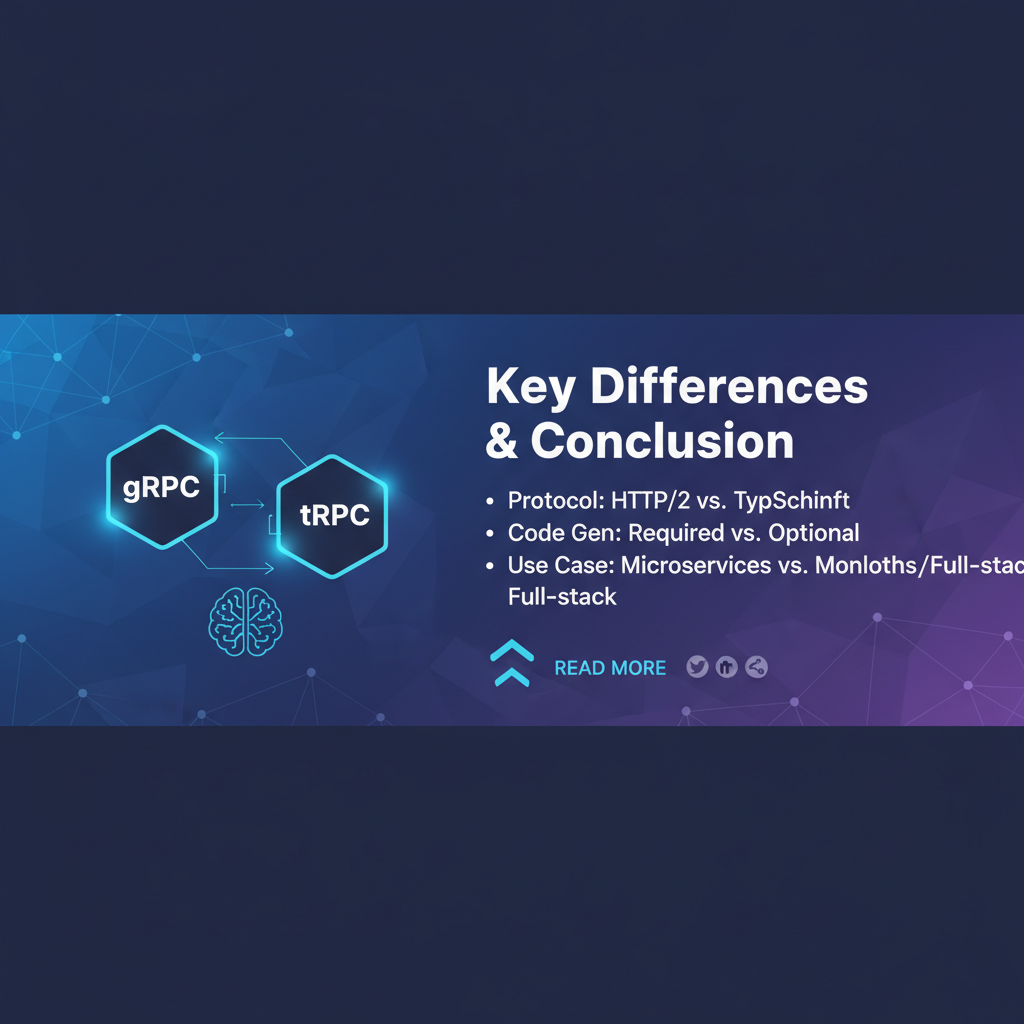
Conclusion
The journey through gRPC and tRPC reveals two distinct yet powerful approaches to modern API communication, each meticulously crafted to solve particular challenges in the evolving landscape of software architecture. gRPC, with its origins in Google's robust infrastructure, stands as a beacon of high performance, efficiency, and polyglot interoperability. Leveraging HTTP/2 and binary Protocol Buffers, it provides a formidable framework for building scalable microservices, real-time applications, and distributed systems where speed, compact data, and strict cross-language contracts are non-negotiable. Its schema-first philosophy ensures architectural integrity across diverse components, making it an indispensable tool for complex, heterogeneous environments.
In stark contrast, tRPC champions an unparalleled developer experience and end-to-end type safety within the vibrant TypeScript ecosystem. By ingeniously harnessing TypeScript's type inference capabilities, tRPC transforms server-side functions directly into consumable, fully typed APIs for the client, all without the traditional overhead of IDLs, code generation, or complex build steps. This "code-first" paradigm is a game-changer for full-stack TypeScript applications, particularly within monorepos, where it fosters rapid iteration, drastically reduces boilerplate, and eliminates an entire class of API-related runtime errors. Its focus is less on raw network performance optimization and more on supercharging developer productivity and code quality through seamless type guarantees.
The fundamental distinction lies in their core philosophies and target environments. gRPC is the workhorse for broad, high-performance, polyglot microservice architectures, demanding explicit contracts and optimal network efficiency. tRPC is the artisan's tool for deeply integrated, type-safe full-stack TypeScript projects, prioritizing developer delight and frictionless internal API consumption. Choosing between them is not about finding a universal winner, but rather about a pragmatic assessment of your project's specific needs: do you require broad interoperability and maximum network efficiency for a diverse system, or do you seek the ultimate developer experience and type safety within a unified TypeScript stack?
Regardless of the choice, the increasing complexity of distributed systems, coupled with the proliferation of various API paradigms (from gRPC and tRPC to traditional REST and GraphQL), underscores the critical importance of effective API management. Solutions like an advanced API gateway become not just beneficial, but essential. Whether it's to manage gRPC-Web proxies, secure diverse API endpoints, or streamline the integration of AI models, a robust gateway is the central nervous system of modern API ecosystems. Platforms such as APIPark exemplify this necessity, offering comprehensive API management that helps bridge the gap between disparate services, ensuring security, scalability, and operational efficiency across your entire API landscape. As communication technologies continue to evolve, the ability to smartly manage and orchestrate these diverse methods will remain key to building resilient and future-proof applications. Both gRPC and tRPC represent significant advancements in this domain, providing powerful options for developers navigating the intricate world of modern software development.
Frequently Asked Questions (FAQs)
1. What is the fundamental difference between gRPC and tRPC in terms of their core problem-solving approach?
The fundamental difference lies in their core problem-solving approaches: gRPC focuses on providing a high-performance, polyglot RPC framework for inter-service communication in distributed systems by using a language-agnostic Interface Definition Language (IDL) like Protocol Buffers and HTTP/2 for transport. It solves the problem of efficient, strictly contracted communication across diverse programming languages. tRPC, on the other hand, focuses on delivering an unparalleled developer experience and end-to-end type safety for full-stack TypeScript applications. It solves the problem of API contract synchronization and boilerplate code within a purely TypeScript ecosystem by leveraging TypeScript's native type inference without an explicit IDL or code generation.
2. Can I use gRPC and tRPC in the same project or organization?
Yes, absolutely. gRPC and tRPC are designed for different contexts and are not mutually exclusive. An organization might use gRPC for high-performance, polyglot microservice communication between its backend services (e.g., a Go service communicating with a Java service), and simultaneously use tRPC for a specific full-stack web application where both the frontend and its dedicated backend are written in TypeScript within a monorepo. An API gateway can then be used to manage and expose these various types of services, providing a unified control plane for your entire API landscape, regardless of the underlying communication technology.
3. Which framework offers better performance, gRPC or tRPC?
gRPC generally offers better raw network performance. This is primarily due to its reliance on HTTP/2 for multiplexing, header compression, and its use of Protocol Buffers for highly efficient, compact binary serialization. These technologies reduce latency and bandwidth consumption significantly, making gRPC ideal for high-throughput, low-latency scenarios. tRPC, while performant enough for most web applications, typically uses standard HTTP (often HTTP/1.1) with text-based JSON payloads, which is less efficient in terms of data size and serialization speed compared to gRPC's binary protocol. tRPC's performance benefits are more about developer velocity than raw network efficiency.
4. Is tRPC suitable for building public APIs for third-party developers?
Generally, no. tRPC is primarily designed for internal, tightly coupled full-stack TypeScript applications where both the client and server are part of a managed ecosystem. Its reliance on TypeScript's type inference means that external clients (who might be using any programming language or framework) would not be able to leverage its end-to-end type safety benefits directly, making the api effectively just a standard HTTP JSON api without its core value proposition. For public APIs targeting a broad range of third-party developers, RESTful APIs or GraphQL are typically more suitable due to their widespread tooling, language agnosticism, and established documentation practices.
5. How does an API Gateway like APIPark fit into an architecture using gRPC or tRPC?
An API gateway like APIPark serves as a crucial abstraction layer and control point for both gRPC and tRPC services in a distributed system. For gRPC services, it can act as a gRPC-Web proxy, translating browser-compatible HTTP/1.1 requests into gRPC's HTTP/2 for backend services, making gRPC accessible to web clients. It can also handle authentication, authorization, rate limiting, and observability for gRPC endpoints. For tRPC services, the API gateway treats them as standard HTTP services, routing requests, applying security policies, and providing monitoring. In both cases, APIPark enhances security, streamlines management of diverse API types (including AI models), and offers a centralized portal for discoverability and access control, ensuring efficient and secure operation of your entire API portfolio, regardless of the underlying RPC framework.
🚀You can securely and efficiently call the OpenAI API on APIPark in just two steps:
Step 1: Deploy the APIPark AI gateway in 5 minutes.
APIPark is developed based on Golang, offering strong product performance and low development and maintenance costs. You can deploy APIPark with a single command line.
curl -sSO https://download.apipark.com/install/quick-start.sh; bash quick-start.sh

In my experience, you can see the successful deployment interface within 5 to 10 minutes. Then, you can log in to APIPark using your account.

Step 2: Call the OpenAI API.