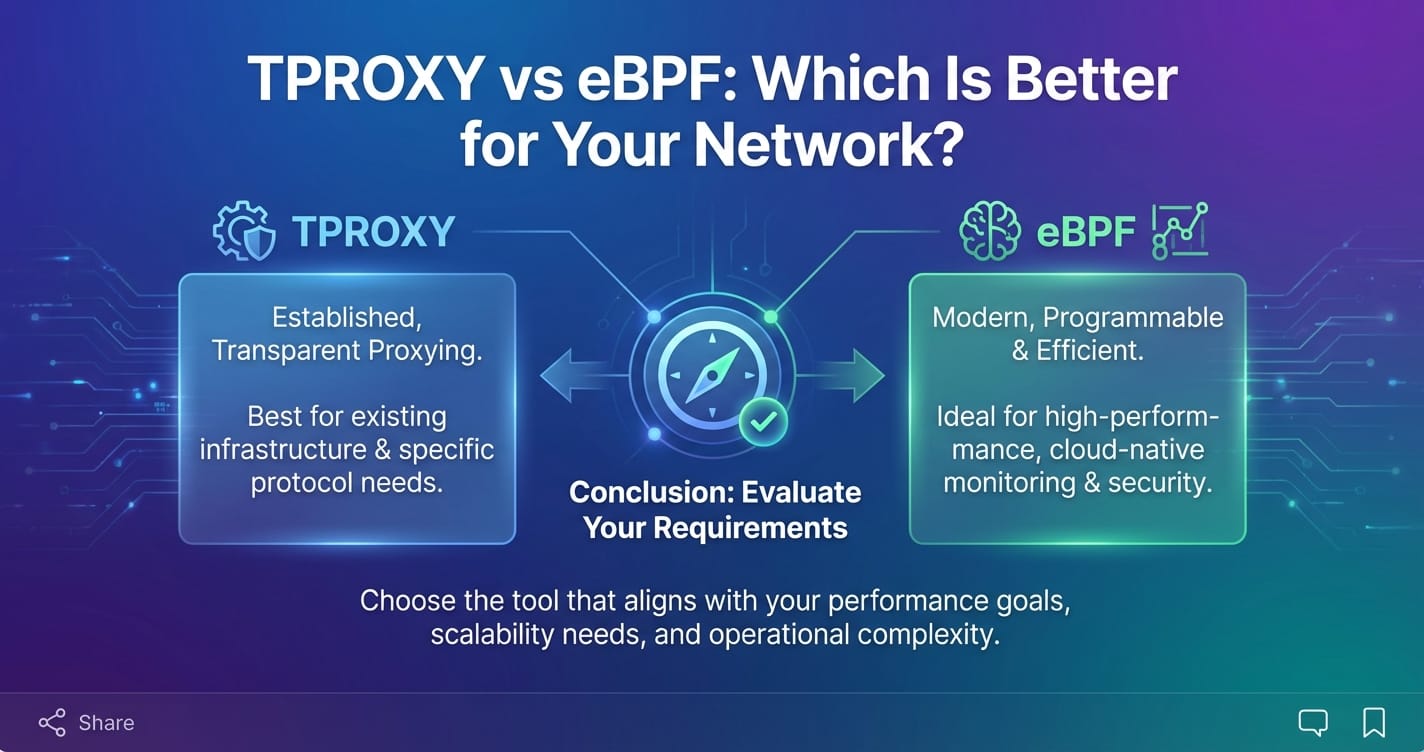
TPROXY vs eBPF: Which Is Better for Your Network?


The intricate tapestry of modern networks grows ever more complex, a dynamic landscape where efficiency, security, and flexibility are not merely desirable attributes but absolute necessities. As digital transformation accelerates, fueled by the relentless demands of microservices, cloud-native architectures, and increasingly, artificial intelligence workloads, the underlying mechanisms for traffic interception, manipulation, and control have become paramount. At the heart of this challenge lie two powerful, yet fundamentally distinct, approaches to orchestrating network traffic within the Linux kernel: TPROXY and eBPF. Both offer solutions for redirecting and processing packets transparently, but they operate at different layers of abstraction and possess dramatically different capabilities and implications for network architects and engineers.
For organizations managing vast digital ecosystems, from intricate microservice deployments to robust API gateways that serve as the crucial entry points for external and internal communications, the choice of underlying network technologies can significantly impact performance, scalability, and security. A high-performance API gateway is not just about the application logic; it relies heavily on an optimized network stack that can efficiently handle millions of requests, often needing transparent proxying capabilities to preserve client IP addresses or inject custom logic. This article will embark on a comprehensive journey to dissect TPROXY and eBPF, exploring their core principles, architectural nuances, advantages, disadvantages, and ultimately, guiding you towards an informed decision on which technology might be better suited for your specific network challenges and aspirations. We will delve into their operational mechanics, compare their strengths and weaknesses, and envision their roles in shaping the future of network management, particularly in the context of advanced gateway solutions.
TPROXY: The Established Workhorse of Transparent Proxying
TPROXY, or Transparent Proxying, represents a well-established and battle-tested method within the Linux kernel for intercepting and redirecting network traffic without the client needing to be aware of the proxy's existence. Its primary allure lies in its ability to force connections through a proxy server while preserving the original source IP address of the client, a critical feature for many applications, including load balancers, firewalls, and application-layer proxies. This "transparency" simplifies network topology and often eliminates the need for complex network address translation (NAT) configurations that might obscure client identity.
Understanding the Mechanics of TPROXY
At its core, TPROXY leverages a combination of standard Linux networking tools: iptables (or its modern successor, nftables), ip rules, and ip routes, along with a special socket option. The magic happens primarily in the PREROUTING chain of the mangle table in iptables (or equivalent nftables chains). Here’s a detailed breakdown of how it orchestrates transparent traffic redirection:
- Packet Interception: When a packet destined for a service behind the proxy arrives at the Linux host configured for TPROXY, it first hits the
PREROUTINGchain. A specificiptablesrule (e.g.,iptables -t mangle -A PREROUTING -p tcp --dport 80 -j TPROXY --on-port 8080 --on-ip 127.0.0.1) is configured to match incoming traffic based on protocol, destination port, or other criteria. TPROXYTarget: Instead of merely modifying the packet headers (like DNAT), theTPROXYtarget modifies the packet's metadata. Crucially, it sets the destination IP address of the packet to the proxy's IP address (typically127.0.0.1for local proxies) and the destination port to the proxy's listening port (e.g.,8080). However, it does not alter the destination IP address in the packet header itself. This is a subtle but critical distinction. TheTPROXYtarget also marks the packet with afwmark(firewall mark) to allow routing decisions to be made based on this mark.- Routing Table Lookup (with
fwmark): After thePREROUTINGchain, the kernel performs a routing table lookup. This is whereip rulesandip routescome into play. A specificip ruleis created to direct packets with the assignedfwmarkto a custom routing table. For example,ip rule add fwmark 1 lookup 100. This rule tells the kernel that any packet marked with1should consult routing table100. - Custom Routing Table: Routing table
100would contain a default route (or a specific route) that points back to the loopback interface (lo). For instance,ip route add local 0.0.0.0/0 dev lo table 100. This is counter-intuitive but essential: it tells the kernel that packets marked for TPROXY should be treated as if they are destined for the local machine, forcing them up the network stack to a local socket. - Proxy Application and
IP_TRANSPARENT: The proxy application (e.g., Nginx, HAProxy, Squid) running on the same host must be configured to listen on the specified port (e.g.,8080) and, critically, must set theIP_TRANSPARENT(for IPv4) orIPV6_TRANSPARENT(for IPv6) socket option on its listening socket. This special socket option allows the proxy to bind to an IP address that doesn't belong to the local machine (the original destination IP of the client's packet) and to accept connections whose destination IP is not its own. When the proxy application accepts such a connection, it receives the original client's source IP address and the original destination IP address (the service it's proxying for) in the connection metadata, allowing it to initiate a new connection to the real backend server using the original client's source IP address as its own source IP.
Essentially, TPROXY enables the proxy to "pretend" to be the actual destination server to the client, while simultaneously "pretending" to be the client to the actual backend server, all without altering the client's source IP, thus maintaining transparency throughout the chain. This preserves crucial client identity information, which is vital for logging, security, and authentication across the entire service ecosystem.
Advantages of TPROXY
TPROXY’s straightforward integration with the Linux kernel and its established nature offer several compelling advantages:
- True Transparency and Source IP Preservation: This is TPROXY's hallmark feature. It ensures that the backend servers see the client's original IP address, which is invaluable for logging, access control, and geographically-based services. Without TPROXY, the backend would typically only see the proxy's IP address, obscuring the true client. This is particularly important for
API gatewayswhere detailed client request logging is essential for analytics and troubleshooting. - Simplicity for Specific Use Cases: For common transparent proxying needs, such as load balancing HTTP/S traffic, TPROXY is relatively simple to configure. Network administrators familiar with
iptablesand basic routing can implement it without a steep learning curve. The rules are declarative and follow a well-understood logic. - Maturity and Stability: TPROXY has been a part of the Linux kernel for a considerable time. Its behavior is well-documented, widely tested, and highly stable. This makes it a reliable choice for production environments where predictability is paramount. Extensive community support and examples are readily available.
- Wide Compatibility: Most modern proxy applications (like Nginx, HAProxy, Squid, Envoy) have built-in support for the
IP_TRANSPARENTsocket option, making it easy to integrate TPROXY with existing application-layer proxy solutions. This avoids the need for custom code modifications in the proxy software itself. - Integration with Existing Network Tools: TPROXY seamlessly integrates with the traditional Linux networking stack, allowing it to coexist with other
iptablesrules, routing policies, and network monitoring tools. This allows for a layered approach to network management and security.
Disadvantages of TPROXY
Despite its strengths, TPROXY is not without its limitations, especially when confronted with the demands of highly dynamic and performance-sensitive modern networks:
- Reliance on
iptablesComplexity: As network requirements grow, theiptablesrule set can become incredibly complex, difficult to manage, and prone to errors. Debugging intricate rule chains can be a tedious and time-consuming process. Large numbers of rules can also introduce performance overhead due as the kernel traverses the chains for each packet. - Performance Overhead (Context Switching): TPROXY involves multiple layers of the kernel's networking stack:
iptables, routing, and then delivering the packet up to a user-space application socket. This process involves multiple context switches between kernel space and user space, which can introduce latency and consume CPU cycles, potentially limiting throughput in extremely high-traffic scenarios. While efficient for many use cases, it may not be optimal for line-rate packet processing. - Limited Programmability and Flexibility: TPROXY's logic is largely static, defined by
iptablesrules and routing tables. While effective for redirection, it offers minimal opportunities for dynamic, programmatic packet manipulation or injecting custom logic directly within the kernel. Any complex decision-making must be offloaded to the user-space proxy application, incurring context switching costs. - Debugging Challenges: While
iptableslogging can help, understanding the exact packet flow through complex TPROXY configurations, especially when combined with multipleip rulesand custom routing tables, can be challenging. Tools for deep visibility into the exact packet path within the kernel are limited for TPROXY. - Requires Root Privileges: Setting up and modifying
iptablesrules and routing tables typically requires root privileges. This can be a security concern in some environments, as it grants broad control over the networking stack. - Scalability of State Management: For connections requiring persistent state tracking (e.g., connection tracking for firewalls), TPROXY relies on the kernel's
conntrackmodule, which can become a bottleneck under extreme load, especially with very short-lived connections common in microservice architectures.
In summary, TPROXY remains a robust and reliable solution for transparent proxying where its specific features align with the use case. It is particularly well-suited for traditional load balancing, caching proxies, and basic security enforcement, forming a solid foundation for many existing gateway implementations. However, as we look towards the next generation of network demands, especially in high-performance, programmable environments, its limitations in flexibility and raw speed become more apparent.
eBPF: The Revolutionary Kernel Programmability Framework
Extended Berkeley Packet Filter (eBPF) is not merely a networking technology; it is a fundamental paradigm shift in how we interact with and program the Linux kernel. It allows user-space programs to execute custom, sandboxed code directly within the kernel, triggered by various events such as network packet arrivals, system calls, function entries/exits, or kernel tracepoints. This revolutionizes how developers can observe, secure, and accelerate network traffic, opening up possibilities that were previously unattainable without modifying the kernel itself.
The Evolution from BPF to eBPF
To truly appreciate eBPF, it's helpful to understand its origins. BPF, the original Berkeley Packet Filter, was introduced in the early 1990s as a mechanism to filter packets efficiently in user space (e.g., for tcpdump). It was a simple, register-based virtual machine designed purely for packet filtering.
eBPF extends this concept dramatically. It transforms the simple BPF into a general-purpose, high-performance execution engine that is no longer limited to networking. It features a larger set of registers, more complex instruction sets, a sophisticated verifier, and the ability to access kernel data structures safely. This evolution has transformed it from a mere packet filter into a powerful, in-kernel programmable engine.
Unpacking the Technical Mechanics of eBPF
eBPF's power stems from several interconnected components that work in harmony:
- eBPF Programs: These are small, event-driven programs written in a restricted C dialect (or Rust with
bpf-linker), compiled into eBPF bytecode using specialized compilers (e.g., Clang with LLVM backend). These programs are designed to be safe and efficient, operating within a sandboxed environment in the kernel. - eBPF Maps: eBPF programs cannot directly access arbitrary kernel memory. Instead, they interact with the kernel and other eBPF programs through shared data structures called "maps." Maps provide a generic key-value store interface, allowing eBPF programs to store state, share data, and communicate with user-space applications. This enables stateful logic within the kernel.
- eBPF Verifier: Before any eBPF program is loaded into the kernel, it undergoes a rigorous verification process by the eBPF verifier. This component ensures that the program is safe to run in the kernel. It checks for:
- Termination: Guarantees the program will always terminate (no infinite loops).
- Memory Safety: Ensures no out-of-bounds memory accesses.
- Resource Limits: Confirms the program doesn't consume excessive CPU or memory.
- Privilege Escalation: Prevents any attempts at privilege escalation. This strict verification is what allows eBPF programs to run with kernel privileges without compromising kernel stability or security.
- JIT Compiler: Once verified, the eBPF bytecode is translated into native machine code by a Just-In-Time (JIT) compiler. This ensures that eBPF programs execute at near-native speeds, eliminating interpretation overhead and making them extremely performant.
- Attachment Points: eBPF programs attach to various "hooks" or "attachment points" within the kernel. These hooks determine when and where the eBPF program will be executed. Key networking attachment points include:
- XDP (Express Data Path): This is the earliest possible point in the network driver for processing incoming packets. XDP programs can process packets even before the kernel has allocated a full
sk_buff(socket buffer). This allows for ultra-high-performance operations like DDoS mitigation, load balancing, and fast packet dropping, effectively providing a kernel bypass for certain operations. - TC (Traffic Control): eBPF programs can also attach to ingress and egress Traffic Control hooks, allowing for more complex packet manipulation, shaping, classification, and redirection after the
sk_buffhas been allocated. This is suitable for sophisticatedgatewaytraffic management, firewalling, and network policy enforcement. sockmap/sockops: These allow eBPF programs to intercept and manipulate socket operations, enabling advanced use cases like transparent proxying, connection steering, and application-level load balancing without context switches for existing connections.kprobes/uprobes/Tracepoints: While not strictly networking-focused, these allow eBPF programs to attach to any kernel or user-space function entry/exit, providing deep observability and enabling the collection of network-related metrics and traces at an unprecedented granularity.
- XDP (Express Data Path): This is the earliest possible point in the network driver for processing incoming packets. XDP programs can process packets even before the kernel has allocated a full
How eBPF Facilitates Network Manipulation (e.g., Transparent Proxying)
eBPF can achieve transparent proxying, load balancing, and advanced traffic steering with significantly greater flexibility and performance than TPROXY. For instance, using XDP or TC with eBPF:
- XDP for Front-End Load Balancing: An XDP program can be loaded directly onto a network interface. When a packet arrives, the XDP program can inspect its headers, make load balancing decisions (e.g., using a hash function and an eBPF map of backend IPs), and then redirect the packet to a specific
TXqueue of another interface (e.g., a virtual interface) or even directly to another CPU core, effectively bypassing much of the kernel's normal networking stack. It can also rewrite destination MAC addresses or even IP addresses on the fly while preserving the original source IP for theAPI gatewaylogic if needed at higher layers. - TC for Sophisticated Routing/Firewalling: An eBPF program attached to a TC ingress hook can perform detailed packet inspection, stateful firewalling, sophisticated policy enforcement, and dynamic routing based on custom criteria (e.g., application-layer protocols, TLS SNI, or even connection metadata stored in eBPF maps). It can then redirect the packet to a local socket, another network interface, or drop it, all within the kernel. This is incredibly powerful for implementing advanced gateway security features and routing policies.
sockmapfor Connection Steering: eBPFsockmapprograms can intercept connections at the socket layer. For example, an eBPF program can transparently splice (redirect) a TCP connection from one socket to another without data ever leaving the kernel or undergoing a user-space context switch. This is ideal for efficient, in-kernel service mesh proxying or connection-aware load balancing where the proxy logic needs to operate at a very high throughput with minimal overhead.
In essence, eBPF moves much of the "programmable network logic" that traditionally resided in user-space proxies or rigid kernel modules into a safe, dynamic, and high-performance execution environment within the kernel itself.
Advantages of eBPF
eBPF’s transformative capabilities translate into a host of compelling advantages, particularly for modern, cloud-native environments and high-performance API gateways:
- Unprecedented Performance (XDP): By processing packets at the earliest possible point in the network driver (XDP), eBPF can achieve near line-rate performance. It drastically reduces CPU cycles per packet by avoiding
sk_buffallocation, checksum recalculations, and multiple kernel layer traversals. This makes it ideal for high-throughput scenarios like DDoS mitigation, ultra-low-latency load balancing, and kernel-resident firewalls. - Extreme Flexibility and Programmability: Unlike the static rules of
iptables, eBPF programs are truly programmable. They can implement arbitrary logic, custom algorithms, and dynamic decision-making directly within the kernel. This allows for fine-grained control over network traffic, enabling sophisticated routing, load balancing, security policies, and custom protocol parsing that were previously impossible or extremely difficult to achieve. This level of flexibility is crucial for adaptableAI Gatewaysolutions. - Reduced Context Switching: Many eBPF use cases allow network processing to remain entirely within the kernel, or at least minimize the number of context switches between kernel and user space. For instance,
sockmapcan splice connections directly, and XDP operates entirely in the kernel. This significantly reduces CPU overhead and improves overall throughput and latency compared to user-space proxies. - Enhanced Observability and Tracing: eBPF offers unparalleled visibility into kernel operations, network stack behavior, and application performance without needing to modify applications or restart services. By attaching to various tracepoints and function calls, eBPF programs can collect rich telemetry data, providing deep insights for debugging, performance analysis, and security monitoring. This is a game-changer for monitoring the health and performance of an API gateway.
- Dynamic and Hot-Patchable Kernel Logic: eBPF programs can be loaded, updated, and unloaded dynamically without requiring kernel reboots or recompilations. This allows for agile deployment of new network features, security patches, or performance optimizations, significantly reducing downtime and operational complexity.
- Robust Security Model: The eBPF verifier ensures that all programs are safe before execution, preventing malicious or buggy code from compromising kernel stability. This sandboxed execution model provides a strong security boundary, allowing for powerful kernel-level capabilities without the typical risks associated with kernel modules.
- Foundation for Next-Gen Network Functions: eBPF is at the heart of many innovative networking projects, including service meshes (e.g., Cilium), cloud-native load balancers, and advanced security solutions. It's becoming the de facto standard for building programmable infrastructure in modern data centers and cloud environments.
Disadvantages of eBPF
While revolutionary, eBPF does come with its own set of challenges and considerations:
- Higher Learning Curve: Developing eBPF programs requires a deep understanding of Linux kernel internals, networking concepts, and C programming (or Rust). The mental model of writing kernel-resident, event-driven, sandboxed code is significantly different from traditional user-space development or
iptablesconfiguration. Debugging tools, while improving, are still less mature than those for user-space applications. - Requires Modern Kernel Versions: eBPF capabilities have evolved rapidly. To leverage the full power of eBPF (especially XDP,
sockmap, and advanced features), a relatively recent Linux kernel (typically 4.18+ or 5.x+) is required. This can be a limiting factor for organizations running older, more conservative operating system distributions. - Tooling and Ecosystem are Evolving: While the eBPF ecosystem is growing at an incredible pace, the tools, libraries, and best practices are still rapidly evolving. This means that developers might need to work with cutting-edge (and sometimes less stable) tools, and the available documentation might be less comprehensive than for older technologies.
- Potential for Complexity: While eBPF offers flexibility, implementing highly complex network logic can still result in intricate eBPF programs. Managing, testing, and debugging these programs requires a sophisticated approach and robust CI/CD pipelines.
- Security Responsibility: Although the verifier provides strong safety guarantees, the responsibility for writing secure and efficient eBPF programs ultimately lies with the developer. A poorly designed eBPF program, while not crashing the kernel, could introduce performance regressions or logical errors if not carefully implemented and tested.
- Platform Specificity: eBPF is deeply integrated with the Linux kernel. While its concepts are transferable, the specific implementation and tools are Linux-centric. This is not necessarily a disadvantage for Linux-dominant environments but is a factor for heterogeneous OS deployments.
In summary, eBPF represents the cutting edge of kernel network programmability. It offers unparalleled performance, flexibility, and observability, making it an ideal choice for building highly optimized, dynamic, and resilient network functions. Its steep learning curve and reliance on modern kernels are trade-offs for its immense power, positioning it as the future backbone for advanced networking within cloud-native and high-performance computing environments, including sophisticated API gateway solutions.
Comparative Analysis: TPROXY vs. eBPF
Having explored both TPROXY and eBPF in detail, it becomes clear that while they can both achieve transparent packet redirection, they represent fundamentally different philosophies and capabilities. The choice between them hinges on the specific requirements, constraints, and long-term vision for your network infrastructure.
Let's lay out a side-by-side comparison to highlight their key distinctions:
| Feature/Aspect | TPROXY (Transparent Proxying) | eBPF (Extended Berkeley Packet Filter) |
|---|---|---|
| Core Mechanism | iptables/nftables rules, ip rules/ip routes, IP_TRANSPARENT socket option. |
Programmable, event-driven execution of bytecode programs within the kernel. |
| Execution Context | Utilizes existing kernel networking stack (multiple layers), then user-space proxy. | Direct execution in kernel, often at early stages (XDP) or within specific kernel hooks (TC, sockmap). |
| Programmability | Limited to declarative iptables rules and static routing policies. |
Highly programmable with custom C/Rust logic, dynamic decision-making, and stateful operations via maps. |
| Performance | Good for most use cases, but can incur context switching overhead, especially at very high rates. | Excellent to near line-rate performance (especially XDP) by minimizing context switches and kernel stack traversal. |
| Flexibility | Relatively rigid, focused on transparent redirection. | Extremely flexible, enabling custom networking, security, and observability solutions. |
| Observability | Basic logging via iptables; relies heavily on user-space proxy logs. |
Unprecedented deep visibility into kernel and application events, real-time metrics, and custom tracing. |
| Security Model | Relies on iptables permissions and configuration. Full root required for setup. |
Strong kernel-level security guarantees via the verifier, preventing unsafe operations. |
| Learning Curve | Moderate for experienced Linux network administrators. | Steep, requires deep kernel and programming knowledge. |
| Kernel Requirements | Widely available across most Linux kernel versions. | Requires relatively modern Linux kernels (typically 4.18+ or 5.x+ for full features). |
| Use Cases | Traditional transparent load balancing, simple caching proxies, basic firewalls, existing API gateways. |
High-performance load balancing, advanced service mesh, DDoS mitigation, custom firewalls, deep observability, AI Gateway traffic optimization. |
| State Management | Relies on kernel conntrack and user-space proxy state. |
Utilizes eBPF maps for highly efficient, in-kernel state management shared across programs. |
| Development Cycle | Static configuration, changes often require service restart. | Dynamic loading/unloading of programs, hot-patching kernel logic without reboots. |
Deep Dive into Key Differences:
- Performance and Efficiency: This is perhaps the most significant differentiator. TPROXY, while efficient for its design, inherently involves traversing a significant portion of the kernel's networking stack and often relies on user-space applications for the actual proxy logic. This leads to multiple context switches and data copying, which introduce overhead. eBPF, especially when leveraging XDP, operates at a significantly lower level. It can process packets before they fully enter the kernel's traditional network stack, reducing memory allocations and CPU cycles per packet. For high-volume environments, such as a busy
API gatewayhandling millions of requests, eBPF's performance advantage can be transformative, directly translating into higher throughput and lower latency. - Flexibility and Programmability: TPROXY's actions are largely predefined by
iptablesrules and routing tables. You can redirect, but intricate logic, dynamic decision-making based on packet content, or custom protocol handling must occur in a user-space proxy. eBPF, by contrast, is a full-fledged programming environment within the kernel. You can write custom code to inspect any part of a packet, query external data (via maps), make complex routing decisions, modify packet headers, or even create entirely new network protocols. This allows for truly bespoke network functions and unparalleled adaptability, which is crucial for evolvinggatewayrequirements, particularly for specialized workloads likeLLM GatewayorAI Gatewaytraffic that might require unique routing or policy enforcement. - Observability: TPROXY offers limited introspection into kernel-level packet handling beyond
iptablescounters. Debugging often involves tracing packets through user-space applications. eBPF shines brightly in observability. By attaching to various kernel tracepoints and function calls, eBPF programs can collect highly granular metrics, trace specific network paths, monitor application-level latency, and debug issues with unprecedented clarity, all with minimal overhead. This capability is invaluable for maintaining the health and performance of complex API gateway infrastructures. - Complexity of Implementation vs. Operation: While TPROXY configuration can become complex with many rules, its conceptual model is generally easier to grasp for traditional network engineers. eBPF has a steeper learning curve for development, requiring programming skills and kernel knowledge. However, once eBPF programs are deployed, they can simplify operational aspects by consolidating complex logic into fewer, more efficient kernel components, reducing the need for sprawling user-space proxy configurations and extensive context switching. For a platform like
APIPark(ApiPark), which is anopen-source AI gateway & API management platformfocused on quick integration and high performance, the underlying network efficiency facilitated by technologies like eBPF could be crucial for delivering its advertised "Performance Rivaling Nginx" and "Detailed API Call Logging" features. WhileAPIParkoperates at a higher application and API management layer, the foundational network optimizations provided by eBPF contribute to the overall responsiveness and capability of the host infrastructure. - Security: TPROXY's security relies on the correct configuration of
iptablesand root access. Misconfigurations can easily create vulnerabilities. eBPF's strict verifier provides a strong safety net; programs cannot crash the kernel or access unauthorized memory locations. This inherent safety allows for powerful kernel-level network logic to be deployed with greater confidence, reducing the risk of kernel instability or security exploits from buggy code.
APIPark is a high-performance AI gateway that allows you to securely access the most comprehensive LLM APIs globally on the APIPark platform, including OpenAI, Anthropic, Mistral, Llama2, Google Gemini, and more.Try APIPark now! 👇👇👇
When to Choose Which: Use Cases and Scenarios
The decision between TPROXY and eBPF is not about one being universally "better" but rather about selecting the most appropriate tool for a given job. Their strengths align with different operational philosophies and technical requirements.
When TPROXY Shines (The Traditional Approach):
TPROXY remains an excellent choice for scenarios where:
- Simple Transparent Proxying is Sufficient: If your primary need is straightforward transparent redirection of TCP/UDP traffic to a user-space proxy while preserving the client's source IP, TPROXY is often the quickest and simplest path. Examples include basic HTTP/HTTPS load balancing, transparent caching proxies (e.g., Squid), or internal security inspection gateways.
- Legacy Systems or Older Kernel Versions: If your infrastructure relies on older Linux distributions or kernel versions where advanced eBPF features are not fully available or stable, TPROXY provides a reliable and well-understood alternative.
- Integration with Existing Proxy Solutions: Many mature user-space proxies (Nginx, HAProxy, Envoy) have well-documented support for TPROXY. If you're leveraging these, TPROXY offers a familiar and proven integration method, minimizing application-level changes.
- Network Administrators are Familiar with
iptables: For teams proficient iniptablesand traditional Linux networking, TPROXY's configuration model aligns with existing skill sets, reducing the learning curve and deployment effort. - Moderate Traffic Volumes: For networks with moderate traffic throughput where the overhead of context switching is not a critical bottleneck, TPROXY offers a perfectly adequate performance profile. A robust
API gatewayhandling thousands, but not necessarily millions, of requests per second might find TPROXY sufficient when paired with a highly optimized user-space proxy.
Example Scenario: A small to medium-sized enterprise deploying an API gateway using Nginx for external API exposure. They need to ensure backend services see the true client IP for logging and rate limiting. TPROXY would be an efficient and relatively simple solution to implement, allowing Nginx to act as a transparent proxy for incoming gateway traffic.
When eBPF is the Superior Choice (The Modern Paradigm):
eBPF emerges as the decisively superior choice for environments that demand:
- Extreme Performance and Low Latency: For applications requiring near line-rate packet processing, ultra-low latency, or direct kernel bypass capabilities (e.g., DDoS mitigation, high-frequency trading, real-time analytics, or the highest-performance
API gateways), XDP-based eBPF solutions are unmatched. - Highly Dynamic and Programmable Network Logic: When static rules are insufficient, and you need to implement complex, dynamic, or custom network policies directly in the kernel – such as intelligent load balancing based on application-level metrics, advanced traffic engineering, custom firewalling, or sophisticated QoS – eBPF provides the necessary programming flexibility. This includes specialized AI Gateway or LLM Gateway solutions that might need very specific routing or content-aware processing at the network layer.
- Deep Observability and Troubleshooting: For complex, distributed systems (like microservices or service meshes) where granular visibility into network and application performance is critical for debugging, monitoring, and security auditing, eBPF's tracing and metric collection capabilities are invaluable. It allows for a holistic view of traffic within a sophisticated API gateway infrastructure.
- Cloud-Native and Containerized Environments: eBPF is a natural fit for modern cloud-native architectures, container orchestration platforms (like Kubernetes), and service meshes (e.g., Cilium leverages eBPF extensively). It enables robust network policies, load balancing, and observability for dynamic workloads, often without
kube-proxyoriptablesrules. - Advanced Security Features: When building kernel-resident firewalls, intrusion prevention systems, or custom security policies that operate at wire speed and require deep packet inspection, eBPF offers a powerful and secure platform. This level of security is increasingly important for protecting the exposed surface of a public-facing API gateway.
- Reducing Operational Overhead through Consolidation: By bringing network logic into the kernel, eBPF can sometimes simplify the overall architecture, reducing the number of user-space components and the associated context switching, which can lead to better resource utilization and reduced operational complexity for a large-scale
gatewaydeployment.
Example Scenario: A large-scale cloud provider or a company building a high-volume AI Gateway that processes millions of requests per second for various AI models. They need ultra-low latency, dynamic traffic steering based on AI model load, advanced security filtering, and real-time observability. Implementing an eBPF-based solution using XDP for initial packet processing and TC for more intricate routing would provide the performance, flexibility, and visibility required for such a demanding gateway environment. An API gateway platform like APIPark (ApiPark) that aims to be an open-source AI gateway & API management platform with "Performance Rivaling Nginx" and robust logging features would ultimately benefit from an underlying network infrastructure optimized by eBPF. While APIPark manages the API lifecycle and AI model invocation at a higher layer, the ability of eBPF to handle massive traffic, apply dynamic policies, and provide deep insights at the kernel level directly contributes to the overall stability, speed, and security that such a platform requires to excel in an AI-driven API ecosystem.
The Future Landscape: eBPF's Transformative Impact
While TPROXY will likely remain relevant for specific, simpler use cases and legacy environments, the trajectory of network innovation clearly points towards eBPF as the dominant force shaping the future of networking, security, and observability within the Linux ecosystem. Its ability to safely extend kernel functionality without requiring kernel module development or recompilations represents a profound shift.
eBPF is not just an incremental improvement; it's a foundational technology enabling entirely new paradigms:
- Service Mesh Evolution: Projects like Cilium have demonstrated how eBPF can completely rethink the service mesh, moving network policy enforcement, load balancing, and observability from user-space sidecars into the kernel. This drastically reduces resource consumption, improves performance, and simplifies the operational complexity of managing microservices at scale, creating a highly efficient distributed API gateway for inter-service communication.
- Kernel-Native Security: eBPF is powering next-generation firewalls, intrusion detection systems, and runtime security solutions that can analyze system calls, network events, and process behavior with unparalleled depth and speed, all within the kernel's secure sandbox. This offers a more robust defense against sophisticated threats targeting the underlying infrastructure of an
API gateway. - Programmable Data Plane: The vision of a truly programmable network data plane, where network behavior can be dynamically altered and optimized in real-time based on application needs, is being realized through eBPF. This allows for highly adaptive routing, traffic engineering, and resource allocation tailored to the demands of diverse workloads, including unpredictable
LLM Gatewaytraffic patterns. - Unified Observability Stack: eBPF is bridging the gap between kernel-level and application-level observability. By collecting metrics and traces from every layer of the software stack, it provides a unified, high-fidelity view of system behavior, dramatically simplifying troubleshooting and performance tuning. This is invaluable for platforms like
APIParkthat rely on "Detailed API Call Logging" and "Powerful Data Analysis" to provide insights to businesses. The more granular the data captured at the network layer (thanks to eBPF), the richer the insightsAPIParkcan derive from API call histories.
The ongoing development in the eBPF ecosystem, including improved tooling, higher-level libraries (like libbpf, bpftool, BCC, Aya), and community adoption, continues to lower the barrier to entry, making this powerful technology more accessible to a broader range of developers and organizations. While the learning curve remains, the immense benefits it offers for high-performance, programmable, and observable infrastructure are increasingly outweighing the initial investment.
For any organization building or operating critical network infrastructure, especially those dealing with the scale and complexity of modern API gateways, AI gateways, or any other high-performance gateway solutions, understanding and strategically adopting eBPF is no longer optional but a strategic imperative. It represents the future of controlling the Linux kernel's network stack, enabling unprecedented levels of efficiency, security, and innovation.
Conclusion
In the intricate dance of network traffic management, both TPROXY and eBPF offer distinct approaches to the crucial task of transparent proxying and packet manipulation. TPROXY, a mature and reliable veteran, leverages established Linux networking tools to deliver robust, source-IP-preserving redirection, making it a solid choice for simpler, traditional transparent proxying needs and environments where familiarity with iptables and existing proxy solutions is paramount. It serves as a dependable workhorse for many conventional API gateway implementations.
However, eBPF emerges as the undisputed disruptor, a revolutionary framework that transforms the Linux kernel into a programmable, high-performance execution environment. Its ability to execute custom logic at near wire speed, provide unparalleled observability, and dynamically adapt network behavior from within the kernel's secure confines positions it as the future of advanced networking. For cutting-edge API gateways, particularly those designed for the demanding requirements of AI Gateway or LLM Gateway traffic, eBPF's flexibility, raw performance, and deep insights are indispensable. It empowers platforms like APIPark (ApiPark) to achieve "Performance Rivaling Nginx" and deliver "Detailed API Call Logging" by optimizing the underlying network's ability to handle massive throughput and provide granular data.
Ultimately, the choice between TPROXY and eBPF is not a hierarchical one, but rather a contextual decision driven by your specific architectural goals, performance targets, team expertise, and infrastructure constraints. For foundational, well-understood transparent proxying, TPROXY remains a viable and stable solution. But for those charting a course towards the next generation of cloud-native, hyper-scalable, and intelligent networks – where programmability, extreme performance, and deep observability are non-negotiable – eBPF is not just a better option; it is the transformative technology that unlocks unparalleled potential and drives innovation in how we build and manage our digital world.
Frequently Asked Questions (FAQs)
1. What is the primary difference in how TPROXY and eBPF handle network traffic? TPROXY relies on modifying the kernel's routing decisions and requiring user-space applications to use a special socket option (IP_TRANSPARENT) to achieve transparent proxying. It largely works with the existing kernel network stack. eBPF, on the other hand, allows you to write and execute custom programs directly within the kernel at various hook points (like network driver ingress or traffic control layers), enabling arbitrary, dynamic packet manipulation, redirection, and inspection with high performance, often bypassing significant portions of the traditional network stack.
2. Which technology offers better performance for high-throughput API Gateway solutions? eBPF generally offers significantly better performance, especially when leveraging its XDP (Express Data Path) capability. XDP allows eBPF programs to process packets at the earliest possible point in the network driver, minimizing kernel overhead, context switches, and memory allocations. TPROXY, while efficient, still involves more layers of the kernel stack and often relies on user-space proxies, leading to higher latency and lower throughput compared to optimized eBPF solutions for extreme traffic volumes common in advanced AI Gateway environments.
3. Is eBPF harder to learn and implement than TPROXY? Yes, eBPF has a significantly steeper learning curve. Implementing eBPF solutions requires strong programming skills (typically C or Rust) and a deep understanding of Linux kernel internals, data structures, and the eBPF programming model. TPROXY, while requiring familiarity with iptables and Linux routing, is generally considered easier to configure for network administrators accustomed to traditional Linux networking tools.
4. Can TPROXY and eBPF be used together, or are they mutually exclusive? While they address similar problems, they are generally used as alternative approaches for specific network functions rather than being directly combined within the same exact packet path. However, a modern system might utilize both: for example, an eBPF program could perform high-speed initial filtering (like DDoS mitigation at XDP) before passing legitimate traffic up the stack, where a transparent user-space API gateway (which might be using TPROXY) then handles application-level proxying. They operate at different levels and can coexist in a broader networking infrastructure.
5. What role does eBPF play in modern cloud-native gateway architectures and service meshes? eBPF is foundational to many modern cloud-native gateway architectures and service meshes. Projects like Cilium leverage eBPF to implement high-performance, kernel-resident network policies, load balancing, security enforcement, and observability for containerized workloads. It replaces traditional kube-proxy iptables rules and often offloads sidecar proxy functionality directly into the kernel, drastically improving efficiency, reducing latency, and providing granular control and visibility for microservice communication, effectively creating a distributed and highly optimized gateway for inter-service APIs.
🚀You can securely and efficiently call the OpenAI API on APIPark in just two steps:
Step 1: Deploy the APIPark AI gateway in 5 minutes.
APIPark is developed based on Golang, offering strong product performance and low development and maintenance costs. You can deploy APIPark with a single command line.
curl -sSO https://download.apipark.com/install/quick-start.sh; bash quick-start.sh

In my experience, you can see the successful deployment interface within 5 to 10 minutes. Then, you can log in to APIPark using your account.

Step 2: Call the OpenAI API.