Stateless vs Cacheable: What's the Difference & Why It Matters
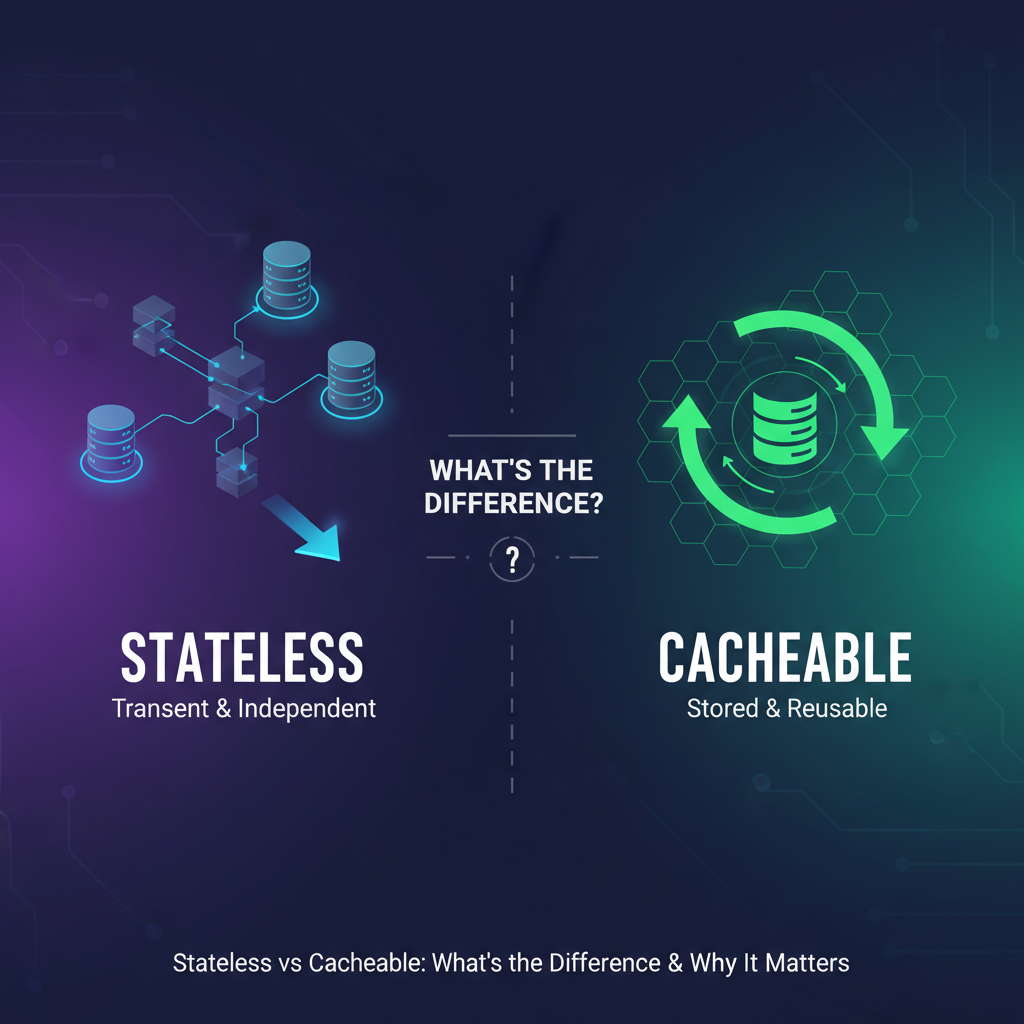


In the intricate landscape of modern distributed systems, where performance, scalability, and resilience are paramount, architects and developers constantly grapple with fundamental design choices. Two concepts that frequently arise in these discussions, often misunderstood or conflated, are "statelessness" and "cacheability." While seemingly distinct, these paradigms are deeply intertwined and play critical, often complementary, roles in shaping the behavior and efficiency of applications, particularly in the realm of API design and gateway implementations. Understanding the nuances between statelessness and cacheability is not merely an academic exercise; it is a foundational requirement for building robust, high-performance systems that can withstand the demands of the digital age.
This comprehensive exploration will delve into the core definitions, characteristics, advantages, and disadvantages of stateless and cacheable architectures. We will dissect how these principles manifest in real-world applications, examine their synergistic relationship, and highlight their critical impact on the functionality and efficiency of an API gateway. By the end of this article, readers will possess a clear understanding of why these concepts matter, how to leverage them effectively in their designs, and how they contribute to the overall success of modern API and microservices ecosystems.
1. Deconstructing Statelessness: The Foundation of Predictability
Statelessness is a fundamental principle in computer science, particularly vital in network protocols and distributed system design. At its core, a stateless system is one where each request from a client to a server contains all the necessary information for the server to fulfill that request. Crucially, the server does not store any context or session information about past interactions with that client. Every request is treated as if it were the very first, entirely independent of any previous or subsequent requests from the same client.
Imagine a simple vending machine: each time you insert coins and select an item, the machine processes that transaction in isolation. It doesn't remember what you bought five minutes ago or anticipate what you might buy next. Each interaction is a fresh start, requiring you to provide all the necessary inputs (coins, selection) for that specific transaction. This analogy perfectly illustrates the essence of a stateless interaction: the server doesn't retain any "memory" of the client between requests.
1.1. Core Characteristics of Stateless Systems
The defining features of stateless systems stem directly from their lack of server-side session persistence:
- Self-Contained Requests: Every single request from the client must include all the data and context required for the server to process it completely, without needing to retrieve information from a prior request or a server-side session store. This often means including authentication tokens, user preferences, or other contextual data with each API call.
- Independence of Interactions: Each request is an isolated event. The server processes it solely based on the information present in that request, returning a response without relying on any prior state. This fosters a clear, predictable interaction model.
- No Server-Side Session State: This is the most critical characteristic. The server explicitly avoids storing any client-specific data or session identifiers that persist across multiple requests. If a server crashes, no client session data is lost, as there was none to begin with.
- Simplified Server Logic: Because the server doesn't need to manage complex session states, its internal logic can be streamlined. It merely processes the incoming request and generates a response, without the overhead of session management, garbage collection for expired sessions, or synchronization across multiple servers.
- Easier to Reason About Failure: In a stateless system, if a server fails, other servers can immediately take over processing subsequent requests from the same client without any loss of context, as the context is carried by the client in each request. This greatly simplifies recovery mechanisms and improves system resilience.
1.2. Advantages of Embracing Statelessness
The benefits of designing systems with statelessness are profound, particularly for large-scale distributed applications and public-facing APIs:
- Exceptional Scalability: This is arguably the most significant advantage. Since no server maintains client-specific state, any server in a cluster can handle any client request at any time. This allows for effortless horizontal scaling: simply add more server instances to distribute the load without needing complex session replication or sticky sessions. Load balancers can route requests to any available server, maximizing resource utilization. Imagine a fleet of identical servers, each capable of fulfilling any customer order independently; you can scale your operations by simply adding more identical units.
- Enhanced Reliability and Resilience: The failure of a single server in a stateless system has minimal impact on the overall service. There's no critical session data residing on the failed server that needs to be recovered or transferred. Clients can simply retry their request, potentially routed to a different server, without noticing a disruption in their logical interaction sequence. This "fail-fast, fail-anywhere" characteristic significantly boosts the fault tolerance of the system.
- Simplified Development and Operations: Developers don't need to worry about the complexities of session management, state synchronization across servers, or potential race conditions related to shared state. This reduces cognitive load, simplifies debugging, and accelerates development cycles. Operations teams benefit from easier deployment, scaling, and recovery processes.
- Improved Efficiency with Load Balancing: With no need for sticky sessions (where a client's subsequent requests must always go to the same server that holds their session state), load balancers can distribute traffic much more efficiently and evenly across all available servers. This optimizes resource utilization and prevents individual servers from becoming bottlenecks.
- Fundamental for RESTful APIs: The Representational State Transfer (REST) architectural style, which underpins the vast majority of modern web APIs, explicitly mandates statelessness. Each RESTful API request must contain all the information necessary to understand and process the request, leading to highly scalable and flexible API designs. An API gateway handling such APIs can thus operate with greater efficiency and less internal complexity.
1.3. Disadvantages and Considerations for Stateless Systems
While highly advantageous, statelessness also presents its own set of challenges and trade-offs:
- Increased Request Size and Bandwidth Usage: Because each request must carry all necessary context, including authentication tokens, authorization details, and other user-specific data, individual requests can be larger than those in a stateful system. This can lead to slightly increased network bandwidth consumption and processing overhead for parsing repeated information.
- Potential Performance Overhead: Repeated transmission and parsing of contextual information can introduce a marginal performance overhead per request. For extremely high-volume, low-latency scenarios where context rarely changes, this could be a factor, though often negligible in modern networks.
- Complexity Shifted to the Client: While server-side logic is simplified, the burden of managing "state" often shifts to the client. The client application needs to consistently manage tokens, user preferences, and other data to include in each request, ensuring a consistent user experience. This might involve local storage, client-side session management, or persistent cookie mechanisms.
- Security Implications: Since every request is processed independently, each request must be fully authenticated and authorized. This often means including a security token (like a JSON Web Token - JWT) with every API call. While secure, managing and verifying these tokens on every request adds processing overhead. Improper handling of these tokens on the client or server side can lead to security vulnerabilities.
- Loss of Context for Long-Running Operations: For operations that span multiple interactions and genuinely require persistent server-side context (e.g., complex multi-step wizards, WebSocket connections), a purely stateless approach might require creative workarounds, such as using external, shared data stores (like Redis) to simulate state, or adopting a different architectural pattern altogether.
1.4. Real-World Examples of Statelessness
The internet itself is built upon stateless principles. HTTP, the protocol powering the web, is inherently stateless. Each request a browser sends to a web server is independent. When you browse a website, your browser sends separate requests for the HTML page, CSS files, JavaScript files, and images. The server processes each of these requests without remembering your previous interaction. Modern RESTful APIs, microservices, and many serverless functions are prime examples of stateless design, embodying its principles to achieve immense scalability and flexibility.
2. Unpacking Cacheability: The Art of Storing for Speed
Cacheability, in contrast to statelessness, is concerned with optimizing performance and reducing resource consumption by storing copies of responses to fulfill subsequent identical requests more quickly. It's about recognizing patterns of repeated data access and strategically intercepting those requests with pre-computed or previously fetched results. The goal is to avoid redundant processing, database queries, and network round trips, thereby significantly reducing latency and server load.
Consider a popular book in a library. Instead of ordering a brand new copy from the publisher every time someone wants to read it, the library keeps a copy on its shelves. When a patron requests the book, the librarian checks if it's available locally. If it is, the patron gets it much faster than if they had to wait for a new copy. If the book is updated or becomes unavailable, the librarian might need to get a new edition or inform the patron it's out. This illustrates caching: providing quicker access to frequently requested information, but with the caveat of needing to manage its freshness.
2.1. Defining Cacheability and Its Core Purpose
A resource or response is "cacheable" if it can be stored, either by the client or an intermediary, and then reused to satisfy future requests without needing to go back to the original server. The primary objective of caching is:
- Reduce Latency: By serving responses from a local cache, the time it takes for a client to receive data is drastically cut, leading to a snappier user experience.
- Decrease Server Load: When a request is served from a cache, the backend server doesn't need to process it, execute database queries, or perform computations. This frees up server resources for unique or non-cacheable requests, improving overall system capacity.
- Minimize Network Traffic: Caching reduces the number of full data transfers over the network, saving bandwidth for both the client and the server. In many cases, a cache can serve a "304 Not Modified" response, indicating the client's cached copy is still valid, further reducing data transfer.
2.2. Types and Locations of Caches
Caching can occur at various layers within a distributed system, each with its own scope and characteristics:
- Client-Side Caching (Browser Cache, Application Cache):
- Location: Resides directly on the client's device (web browser, mobile application).
- Purpose: Stores resources like HTML, CSS, JavaScript, images, and API responses specific to that client to speed up subsequent visits or interactions.
- Control: Primarily controlled by HTTP headers sent by the server (e.g.,
Cache-Control,Expires).
- Proxy Caching (API Gateway Cache, CDN):
- Location: Intermediate servers positioned between clients and origin servers.
- Purpose: Serves multiple clients. A Content Delivery Network (CDN) is a large-scale distributed proxy cache designed for static and semi-static content globally. An API gateway can act as a centralized caching layer for backend API responses.
- Control: Configured by the proxy itself, often respecting origin server headers.
- Server-Side Caching (Application Cache, Database Cache, Object Cache):
- Location: Within the server's infrastructure, typically closer to the data source.
- Purpose: Caches results of expensive database queries, computationally intensive operations, or frequently accessed data objects to reduce load on databases or other backend services. Examples include Redis, Memcached, or even in-memory caches within an application.
- Control: Managed by the application or infrastructure layer.
2.3. Mechanisms for Implementing Cacheability
HTTP provides robust mechanisms for controlling caching behavior, allowing servers to instruct clients and intermediaries on how to cache resources:
Cache-ControlHeaders: This is the most powerful and flexible header for dictating caching policies. Key directives include:max-age=<seconds>: Specifies the maximum amount of time a resource is considered fresh.no-cache: Means the cache must revalidate with the origin server before using a cached copy (it doesn't mean "don't cache at all").no-store: Absolutely prohibits caching the response by any cache.public: Indicates the response can be cached by any cache, even if usually non-cacheable.private: Indicates the response can only be cached by a single-user cache (e.g., a browser), not by shared proxies.s-maxage=<seconds>: Similar tomax-agebut applies only to shared caches (proxies, CDNs).must-revalidate: Forces revalidation with the origin server if the cached entry is stale.
ExpiresHeader: An older header specifying a fixed date/time after which the response is considered stale. Less flexible thanCache-Control'smax-age.ETag(Entity Tag): An opaque identifier or "fingerprint" assigned by the server to a specific version of a resource. When a client makes a subsequent request, it can send theETagusing theIf-None-Matchheader. If the server'sETagmatches, it returns a304 Not Modifiedstatus, indicating the client's cached copy is still current.Last-ModifiedHeader: Specifies the date and time the resource was last modified. Clients can use theIf-Modified-Sinceheader with this date. If the resource hasn't changed since then, the server returns a304 Not Modified.
2.4. Advantages of Implementing Caching
The strategic application of caching yields significant performance and operational benefits:
- Dramatic Performance Improvement: By serving data from closer, faster memory or storage, caching drastically reduces the round-trip time for requests, leading to much quicker response times for users. This directly translates to a better user experience, higher engagement, and potentially improved search engine rankings.
- Substantial Reduction in Server Load: When requests are fulfilled by a cache, the backend servers are spared the processing overhead. This means fewer CPU cycles, memory usage, and database queries on the origin server, allowing it to handle a greater volume of unique requests or simply operate with more headroom. This is especially crucial for expensive computations or database reads.
- Lower Network Traffic and Bandwidth Costs: By avoiding repeated data transfers, caching reduces the overall bandwidth consumed, which can lead to significant cost savings, especially for cloud-hosted applications and those serving global audiences.
304 Not Modifiedresponses, in particular, minimize data transfer to just header information. - Increased System Resilience: Caches can sometimes serve stale content when the origin server is temporarily unavailable, providing a degree of graceful degradation and ensuring some level of service continuity even during outages.
- Improved User Experience: Faster loading times, quicker data retrieval, and a more responsive interface directly contribute to a positive user experience, reducing frustration and increasing user satisfaction.
2.5. Disadvantages and Challenges of Cacheability
Despite its powerful benefits, caching introduces its own set of complexities and potential pitfalls:
- The Cache Invalidation Problem: Often cited as one of the hardest problems in computer science. Knowing when a cached item is no longer fresh and needs to be updated or removed is critical. Incorrect invalidation can lead to clients receiving stale data, causing inconsistencies and user confusion. Over-invalidation negates caching benefits, while under-invalidation leads to data staleness.
- Data Consistency Challenges: Ensuring that all distributed caches (client, proxy, server-side) reflect the absolute latest state of the data is incredibly difficult. Achieving strong consistency with aggressive caching strategies is often impractical, requiring a trade-off for eventual consistency.
- Increased Infrastructure Complexity: Implementing and managing a robust caching layer adds complexity to the system architecture. This involves deploying cache servers (e.g., Redis clusters), configuring cache policies, monitoring cache hit rates, and developing invalidation strategies.
- Security Risks with Sensitive Data: Caching sensitive or personalized data inappropriately can lead to serious security breaches. For example, caching a user's private dashboard data in a public proxy cache would be catastrophic. Careful consideration of
privateandno-storedirectives is crucial. - Cache Stampedes: When a popular cached item expires, and many clients simultaneously request it, all those requests hit the origin server at once, potentially overwhelming it. This is known as a cache stampede and requires sophisticated solutions like cache-aside patterns with mutex locks or probabilistic caching.
- Memory/Storage Overhead: Caches require dedicated memory or storage resources to hold cached items, which can be a significant cost for very large datasets.
2.6. Real-World Examples of Cacheability
Caching is ubiquitous in modern computing. Web browsers cache resources locally to speed up browsing. Content Delivery Networks (CDNs) cache static assets (images, videos, scripts) at edge locations worldwide, serving content from the closest geographical point to the user. Databases use query caches to store results of frequently run queries. API gateways employ caching to reduce the load on backend microservices, serving common responses directly.
3. The Symbiotic Relationship: Statelessness and Cacheability in Harmony
While distinct in their primary concerns, statelessness and cacheability are not mutually exclusive; rather, they form a powerful, symbiotic relationship that underpins the design of highly scalable and efficient distributed systems. In many ideal architectures, especially those involving APIs, these two principles work hand-in-hand, each enabling and enhancing the other.
3.1. How Statelessness Paves the Way for Cacheability
Statelessness inherently creates conditions that make caching particularly effective and safe:
- Predictable and Consistent Responses: In a truly stateless system, given the same request and the same backend state, the server will always produce the same response. There are no server-side session variables or contextual information to subtly alter the output. This predictability is precisely what makes responses ideal candidates for caching. If a resource's representation is always the same for a given URI, it can be cached confidently.
- Idempotency and Side-Effect Minimization: Stateless RESTful APIs encourage idempotent operations (e.g.,
GET,PUT,DELETEare often idempotent). Idempotent requests, by definition, can be called multiple times without producing different outcomes beyond the initial state change. This makes their responses more stable and easier to cache.GETrequests, which are intended to be read-only and free of side effects, are the quintessential cacheable operations in a stateless design. - Simpler Cache Keys: Without complex session states influencing the response, the cache key (the identifier used to store and retrieve a cached item) can often be straightforward, typically derived from the request URI, headers, and query parameters. This simplifies cache lookups and management.
- Clearer Cache-Control Directives: Because stateless responses are less prone to variation due to server-side context, it becomes easier for the server to accurately define
Cache-Controlheaders and other caching directives, providing clear instructions to clients and intermediaries about how long a resource can be cached and under what conditions.
If a server had to maintain individual session states for each client, and those states could subtly change the content of a GET request, caching that response would be incredibly difficult and risky, as the cached version might only be valid for a specific client's session. Statelessness removes this ambiguity.
3.2. How Cacheability Enhances Stateless Systems
Conversely, caching plays a crucial role in mitigating some of the inherent disadvantages of statelessness, thereby making stateless architectures even more viable and performant:
- Alleviating "Increased Request Size" Overhead: One drawback of statelessness is the need for each request to carry all necessary context (e.g., authentication tokens). Caching helps by reducing the number of full requests that need to be sent. If a resource is cached, subsequent requests might only involve a conditional
If-None-MatchorIf-Modified-Sinceheader, which is much smaller than the full request payload and certainly smaller than re-transmitting the entire response. - Mitigating "Performance Overhead" from Repeated Processing: While each stateless request might incur a small processing overhead for authentication and parsing, caching dramatically reduces how often that overhead is incurred for frequently accessed resources. By serving responses directly from a cache, the backend server completely bypasses the need for re-processing, re-authenticating, or re-querying, making the overall system much faster and more efficient.
- Improving Overall User Experience in Stateless Interactions: Even though stateless interactions are inherently independent, users still perceive them as a continuous experience. Caching ensures that repetitive interactions (like navigating between pages or re-fetching static data) are incredibly fast, giving the impression of a highly responsive system, even though the underlying APIs are strictly stateless.
- Optimizing Resource Consumption: The reduced server load and network traffic enabled by caching directly contribute to lower operational costs, which is a significant benefit for cloud-native, scalable stateless architectures that often have variable billing based on resource usage.
In essence, statelessness provides the architectural purity and flexibility needed for scale, while cacheability provides the performance boost and resource efficiency that make such scale practical and cost-effective.
3.3. Strategic Design Considerations for Their Synergy
To effectively leverage both statelessness and cacheability, system architects must adopt a holistic approach from the design phase:
- Identify Cacheable Resources: Clearly distinguish between resources that are truly static or rarely change (highly cacheable, e.g., product images, configuration files, static pages) and those that are dynamic or highly personalized (less cacheable, e.g., shopping cart contents, user profile data).
- Design APIs with Caching in Mind: Ensure that
GETendpoints are idempotent and return consistent representations. Use appropriate HTTP methods. For sensitive data, ensureCache-Control: privateorno-storeis used. For public data, usepublicandmax-age. - Implement Effective Cache Invalidation: Plan for how cached data will be updated or invalidated when the source data changes. This might involve TTL (Time-To-Live) based expiry, event-driven invalidation from backend systems, or cache-busting techniques (e.g., versioned URLs for static assets).
- Centralized Caching with an API Gateway: An API gateway is an ideal location to implement a shared caching layer for multiple backend services. This provides a single point of control for caching policies and can significantly reduce load on individual microservices.
By treating statelessness and cacheability not as separate concerns but as integral parts of a coherent strategy, developers can build systems that are not only infinitely scalable but also exceptionally performant and resilient.
4. The Pivotal Role of an API Gateway
In the complex tapestry of microservices and distributed APIs, the API gateway emerges as a critical architectural component, acting as a single, intelligent entry point for all client requests. Its position at the edge of the system makes it an ideal locus for implementing and enforcing both stateless and cacheable principles, thereby optimizing the entire API ecosystem.
4.1. What is an API Gateway? A Central Nervous System for APIs
An API gateway is essentially a reverse proxy that sits in front of one or more backend services (often microservices), routing client requests to the appropriate service. But its capabilities extend far beyond simple routing. It acts as an API management layer, handling a myriad of cross-cutting concerns that would otherwise need to be implemented in each individual backend service.
Key functions of an API gateway include:
- Request Routing: Directing incoming requests to the correct backend service based on defined rules (e.g., URL path, HTTP method, headers).
- Authentication and Authorization: Verifying client credentials, applying access policies, and forwarding authenticated user information to backend services.
- Rate Limiting and Throttling: Protecting backend services from overload by controlling the number of requests clients can make within a specific time frame.
- Load Balancing: Distributing traffic evenly across multiple instances of backend services.
- Monitoring and Analytics: Collecting metrics on API usage, performance, and errors.
- Request/Response Transformation: Modifying request payloads, headers, or response bodies to decouple clients from backend service specifics.
- Caching: Storing responses from backend services to reduce latency and server load.
- Protocol Translation: Converting between different protocols (e.g., HTTP to gRPC).
4.2. How API Gateways Embrace Statelessness
The design philosophy of a robust API gateway itself heavily leans into statelessness to achieve its own scalability and resilience goals:
- Stateless Operation of the Gateway Itself: A well-designed API gateway is typically stateless. It does not maintain client-specific session information across requests. Each request it receives is processed independently, authenticated, authorized, routed, and potentially cached. This allows the gateway to be horizontally scaled effortlessly; any instance of the gateway can handle any incoming request. If one gateway instance crashes, traffic can be seamlessly rerouted to another instance without losing client context.
- Enabling Stateless Backend Services: By offloading common cross-cutting concerns like authentication, rate limiting, and monitoring, the API gateway empowers backend microservices to remain truly stateless and focused on their core business logic. The gateway can handle the token validation and then forward a simplified, verified identity to the backend service, reducing the burden on individual services.
- Simplified Load Balancing for Backend Services: Since the gateway itself is stateless, and it interacts with ideally stateless backend services, load balancing becomes highly efficient. The gateway can distribute requests using simple round-robin or least-connection algorithms, maximizing the utilization of backend resources without the need for complex sticky session management.
4.3. How API Gateways Master Cacheability
The API gateway is arguably the most strategic location for implementing centralized caching, transforming it into a powerful performance optimization tool:
- Centralized Caching Layer: An API gateway can act as a shared cache for responses from multiple backend services. Instead of each microservice implementing its own caching, the gateway can consolidate this functionality. When a client requests data, the gateway first checks its cache. If a fresh, valid response is found, it's served immediately, completely bypassing the backend service.
- Reduced Backend Load: By caching frequently accessed responses at the gateway level, the load on backend services (databases, computation-heavy microservices) is significantly reduced. This not only improves their performance but also makes them more resilient to traffic spikes.
- Improved Client Latency: Responses served from the gateway's cache are typically much faster than those fetched from a distant backend service, especially when the gateway is geographically closer to the client or uses high-speed in-memory caches.
- Granular Cache Control: Modern API gateways offer sophisticated caching policies. Administrators can configure Time-To-Live (TTL) for cached items, conditional caching based on request headers or query parameters, and various invalidation strategies (e.g., manual invalidation, event-driven invalidation). They can specify which APIs are cacheable, which HTTP methods are cacheable (typically
GET), and howCache-Controlheaders from backend services should be interpreted or overridden. 304 Not ModifiedSupport: The API gateway can handle conditional requests (If-None-Match,If-Modified-Since) directly. If the gateway's cached response still matches the client'sETagorLast-Modifieddate, it can immediately return a304 Not Modifiedstatus, saving bandwidth and backend processing.
For instance, robust api gateway solutions like APIPark are designed not only to manage the entire lifecycle of APIs but also to optimize performance through intelligent caching mechanisms, ensuring that even complex AI service invocations can benefit from reduced latency and server load. APIPark, as an open-source AI gateway and API management platform, allows quick integration of 100+ AI models and encapsulates prompts into REST API, making its caching capabilities invaluable for performance.
4.4. The Synergistic Benefits Provided by an API Gateway
When an API gateway effectively combines stateless operation with intelligent caching, it delivers a powerhouse of benefits:
- Enhanced Overall System Performance: The combination of an infinitely scalable, stateless gateway and centralized caching dramatically speeds up response times for frequently accessed data, while ensuring backend services are not overwhelmed.
- Increased Resilience and Fault Tolerance: A stateless gateway can gracefully handle failures of individual instances. Caching adds another layer of resilience by potentially serving stale data if backend services become temporarily unavailable, preventing total service disruption.
- Simplified Backend Development: Backend teams can focus purely on business logic, knowing that the gateway handles common concerns like authentication, rate limiting, and caching. This leads to faster development cycles and cleaner codebases.
- Centralized Management and Observability: The gateway provides a single point for configuring caching policies, monitoring cache hit rates, and gaining insights into API performance, simplifying the operational overhead.
- Cost Efficiency: Reduced load on backend services can mean fewer server instances are needed, leading to lower infrastructure costs. Minimized network traffic also contributes to savings, particularly in cloud environments.
The API gateway is thus not just a router; it's an intelligent traffic cop, a bouncer, and a memory store all rolled into one, meticulously crafted to ensure that every API interaction is as efficient, secure, and performant as possible, all while adhering to the core tenets of statelessness and cacheability.
APIPark is a high-performance AI gateway that allows you to securely access the most comprehensive LLM APIs globally on the APIPark platform, including OpenAI, Anthropic, Mistral, Llama2, Google Gemini, and more.Try APIPark now! 👇👇👇
5. Deep Dive into Implementation and Best Practices
Effectively implementing statelessness and cacheability requires more than just understanding the concepts; it demands careful design choices, adherence to best practices, and a proactive approach to managing the inherent complexities. This section delves into the practical aspects of building systems that master these two crucial principles.
5.1. Designing Truly Stateless APIs
The success of a scalable API ecosystem hinges on designing backend APIs that are inherently stateless. This involves several key considerations:
- Adherence to REST Principles: The REST architectural style, with its focus on resources and standard HTTP methods, inherently promotes statelessness.
GET,PUT,DELETE, andPATCHrequests should be designed to be idempotent where applicable, meaning multiple identical requests have the same effect as a single one.POSTrequests, which create new resources, are generally not idempotent and require careful handling. - Authentication and Authorization with Tokens: Instead of server-side sessions, stateless APIs typically rely on tokens for authentication and authorization.
- API Keys: Simple tokens often used for programmatic access, passed in headers or query parameters.
- JSON Web Tokens (JWTs): These are self-contained tokens that carry claims (user ID, roles, expiry) signed by the server. The server can verify the signature on each request without needing to query a database, making verification stateless. The client sends the JWT (e.g., in the
Authorization: Bearer <token>header) with every protected request. The API gateway is an ideal place to perform JWT validation. - OAuth 2.0: An authorization framework that provides access tokens, often JWTs, to client applications on behalf of a user. The access token is then used for subsequent API calls.
- Contextual Information in Requests: Any information required to process a request that is not inherent to the resource itself (e.g., preferred language, currency, user ID for auditing) should be passed in the request headers or body, not stored on the server.
- HATEOAS (Hypermedia as the Engine of Application State): While not always strictly implemented, HATEOAS can reinforce statelessness by providing links within API responses that guide the client to discover subsequent available actions, rather than the server maintaining client "state."
- Transaction Management: For multi-step transactions that require atomicity, consider patterns like distributed transactions with saga orchestration, or ensure each step is an independent, idempotent API call, with the client or an orchestration service managing the overall workflow state.
- Avoid Server-Side Session Storage: This is the golden rule. No
session_idcookies that map to server-side memory. If a shared state is absolutely necessary across multiple services or requests, externalize it to a highly available, fault-tolerant data store (e.g., Redis, Cassandra) that can be accessed by any server instance, effectively making the application layer stateless, even if the overall system has a stateful component.
5.2. Implementing Robust Caching Strategies
Effective caching is an art form that balances performance gains with data freshness. A multi-layered approach using the right tools and techniques is crucial:
- Leveraging HTTP Cache-Control Headers:
Cache-Control: no-store: Use for highly sensitive data that must never be cached (e.g., financial transactions, personal health information).Cache-Control: no-cache: For data that might be public but needs revalidation on every request (e.g., user's inbox content). The client/proxy will ask the origin server if its cached copy is still valid before using it.Cache-Control: private, max-age=X: For personalized but temporarily stable data (e.g., a user's dashboard widgets) that should only be cached by the client's browser, not shared proxies.Cache-Control: public, max-age=X, s-maxage=Y: For public, universally applicable content (e.g., product catalog, static news articles).s-maxageis for shared caches (like an API gateway or CDN) and can be shorter or longer thanmax-age.Cache-Control: immutable: For resources that will never change, allowing caches to store them indefinitely without revalidation (e.g., versioned assets like/css/main.v123.css).
- Utilizing ETags and Last-Modified Headers for Conditional Requests:
- For
GETrequests, always includeETagandLast-Modifiedheaders in your responses. - Clients (browsers, API gateways) can then use
If-None-Matchwith theETagandIf-Modified-Sincewith theLast-Modifieddate in subsequent requests. - If the resource hasn't changed, the server (or API gateway) can return a
304 Not Modifiedresponse, avoiding the transfer of the full response body. This significantly reduces bandwidth usage for frequently accessed resources that change infrequently.
- For
- Designing Cache Invalidation Mechanisms:
- Time-to-Live (TTL): The simplest method. Cached items expire after a set duration. Suitable for data that can tolerate some staleness.
- Event-Driven Invalidation: When the underlying data changes in the backend, an event is published (e.g., via a message queue) that triggers the invalidation of relevant cached entries in the API gateway and other cache layers. This provides strong consistency.
- Cache Busting: For static assets, changing the URL (e.g., by appending a version number or a hash of the content:
style.css?v=123orstyle.<hash>.css) forces clients and intermediaries to fetch the new version. - Manual Invalidation: Providing API endpoints or administrative interfaces to manually clear specific cache entries.
- Choosing the Right Caching Layers:
- Client-Side (Browser/App): Best for static assets and user-specific, non-sensitive dynamic content to ensure a fast UI.
- API Gateway/CDN: Ideal for public, frequently accessed API responses and static assets to reduce origin server load and provide geo-distributed performance. APIPark, with its high-performance gateway capabilities, serves as an excellent example of this layer, providing a unified caching mechanism for various services, including integrated AI models.
- Application-Level (e.g., Redis, Memcached): For caching results of expensive queries or computations within the application's domain, often used as a shared cache by multiple instances of a microservice.
- Database-Level: Many databases offer built-in caching for query results or data blocks.
- Considerations for Cache Key Design: A good cache key uniquely identifies the cached resource. It usually combines the request URI, HTTP method, and relevant request headers or query parameters (e.g.,
Acceptheader for content negotiation,Authorizationfor personalized caching).
5.3. Challenges and Common Pitfalls to Avoid
Navigating the complexities of caching requires vigilance:
- Stale Data Issues: The most common problem. Serving outdated information can lead to incorrect decisions, frustrated users, or even financial discrepancies. Proper invalidation strategies are paramount.
- Over-Caching vs. Under-Caching: Caching too much (especially dynamic or sensitive data) creates invalidation headaches and security risks. Caching too little misses out on performance benefits. Find the right balance.
- Inconsistent Cache Invalidation: If different cache layers (e.g., CDN, API gateway, application cache) have conflicting invalidation rules or fail to synchronize, users might experience inconsistent data across different access points.
- Caching Sensitive or Personalized Data Publicly: A critical security blunder. Always use
Cache-Control: privateorno-storefor user-specific or confidential information. The API gateway should have robust mechanisms to prevent this. - Cache Stampedes: When a popular cached item expires, and numerous requests hit the origin server simultaneously, causing a spike in load. Implement protection mechanisms like dog-piling prevention (e.g., using a single request to refresh the cache while others wait) or a thundering herd problem solver.
- Debugging Caching Issues: It can be notoriously difficult to determine why a specific response is being cached (or not cached) or why stale data is being served. Comprehensive logging, clear
Cache-Controlheader inspection, and effective monitoring tools are essential. - Misunderstanding
no-cachevs.no-store:no-cachemeans "revalidate before using," whileno-storemeans "never store this anywhere." Usingno-cachewhenno-storeis intended is a common error.
By meticulously planning and implementing these best practices, developers can harness the immense power of statelessness and cacheability to build APIs and systems that are not only performant and scalable but also reliable and maintainable.
6. Practical Scenarios and Use Cases
Understanding statelessness and cacheability is best cemented by examining their application in various real-world scenarios. These principles are not abstract academic concepts but fundamental building blocks for diverse digital infrastructure.
6.1. E-commerce Platforms
E-commerce sites, with their high traffic and diverse data types, offer a compelling illustration of statelessness and cacheability working in concert.
- Product Catalog (Highly Cacheable, Stateless API): Product listings, images, descriptions, and pricing (that don't change frequently) are prime candidates for caching. When a customer browses products, the requests for this static or semi-static data can be served quickly from a CDN, an API gateway's cache, or the client's browser cache. The API for retrieving product details would be a stateless
GETrequest, returning the same response for all users asking for the same product ID. This significantly reduces the load on the backend product service and database. - Shopping Cart (Highly Stateful, Less Cacheable): A customer's shopping cart is inherently stateful; it's unique to their session and changes frequently. While a client-side application might temporarily cache its own view of the cart for responsiveness, the authoritative cart data resides on a backend service that must maintain state (e.g., in a database or dedicated microservice). The APIs for adding/removing items or updating quantities (
POST,PUT,DELETE) are not cacheable, and the API gateway would pass these requests directly to the backend. The authentication for these requests, however, would still leverage a stateless token (like a JWT). - User Authentication (Stateless Token-Based): When a user logs in, the authentication API generates a token (e.g., a JWT). This token is then sent with every subsequent API request to verify the user's identity. The authentication API itself is stateless, and the verification of the token by the API gateway or backend service is also a stateless operation, relying only on the token's content and signature, not server-side session data.
- Order Placement (Stateful Transaction): Placing an order is a complex, stateful transaction that involves multiple steps (inventory check, payment processing, order creation). The APIs involved here are transactional and not cacheable. While individual microservices handling parts of the order might be stateless, the orchestration of the order process itself needs to manage state.
6.2. Content Delivery Networks (CDNs)
CDNs are perhaps the most widespread and effective application of caching in conjunction with stateless HTTP.
- Global Distribution and Caching: CDNs operate a geographically distributed network of proxy servers (edge nodes). When a user requests content (e.g., an image, video, JavaScript file) from a website, the request is routed to the nearest CDN edge node.
- Stateless HTTP and Cacheability: The CDN edge node checks if it has a cached copy of the requested asset. Since these assets are typically static and served over stateless HTTP, they are highly cacheable. If present, the asset is served directly from the edge node, drastically reducing latency and load on the origin server. If not, the edge node fetches it from the origin, caches it, and then serves it to the user.
- Leveraging
Cache-Control: CDNs heavily rely onCache-Controlheaders from the origin server to determine how long to cache content. They often uses-maxageto specify caching duration for shared caches. - Massive Scale and Performance: CDNs exemplify how combining stateless protocols with robust caching can deliver unparalleled global scale and performance for content delivery.
6.3. Real-time Data Feeds vs. Historical Data
The nature of data itself often dictates its cacheability and how it interacts with stateless principles.
- Real-time Data Feeds (Less Cacheable, Often Stateful Connections): Data that changes rapidly and needs to be delivered with minimal delay (e.g., stock tickers, live sports scores, IoT sensor readings) is generally not suitable for traditional caching. While intermediate buffering might occur, strict caching of responses would lead to severe staleness. These often rely on stateful protocols like WebSockets, which maintain a persistent connection between client and server, allowing for real-time push updates. Even here, the underlying APIs might still be stateless for initial data fetching, with the WebSocket managing the differential updates.
- Historical Data (Highly Cacheable, Stateless API): Conversely, historical data (e.g., past stock prices, archived news articles, aggregated analytics reports) changes infrequently or not at all. APIs for retrieving such data are ideal candidates for caching. A stateless
GETAPI endpoint that retrieves historical data for a given date range can be cached extensively at the API gateway, CDN, and client levels, significantly reducing load on historical data stores.
6.4. Microservices Architectures
Microservices, by design, embrace statelessness as a core principle for individual services.
- Stateless Microservices: Each microservice is typically designed to be stateless, independent, and communicate via stateless APIs (usually REST over HTTP). This allows individual services to be scaled, deployed, and updated independently without affecting others.
- API Gateway as Central Cache: The API gateway becomes crucial in this context. While individual microservices are stateless, the API gateway can implement a centralized caching layer for common requests that span multiple services or for frequently accessed data from specific services. This prevents redundant calls to multiple backend microservices for the same information. For instance, if a "User Service" API provides user profiles, the API gateway can cache these responses, reducing direct load on the user service for every profile lookup.
- Distributed Caching for Shared State: When microservices need to share state (e.g., user preferences, shared configuration), they typically do so through a distributed, highly available data store (like a Redis cluster or a database) rather than maintaining state internally. Even though the shared data store is stateful, the microservices accessing it remain stateless with respect to their internal process state.
These examples underscore that the judicious application of statelessness and cacheability is not a one-size-fits-all solution but a strategic choice based on the nature of the data, the required consistency, and the performance goals of the system. Understanding these contexts allows architects to make informed decisions that lead to robust, scalable, and efficient applications.
7. The Evolution of API Management and Gateways
The journey of API gateways and API management platforms has been one of continuous evolution, driven by the increasing complexity of distributed systems and the insatiable demand for performance and security. From simple proxies to sophisticated traffic managers, the core tenets of statelessness and cacheability have remained central to their design and functionality.
7.1. From Simple Proxies to Intelligent Traffic Managers
Early gateways were often little more than reverse proxies, primarily handling basic request routing and load balancing. As APIs proliferated and microservices architectures gained traction, the demands on gateways grew exponentially. They needed to do more than just forward requests; they needed to understand, secure, manage, and optimize the API traffic flowing through them. This evolution led to what we now recognize as modern API gateways and comprehensive API management platforms.
This transformation has been characterized by the integration of numerous advanced features, all while striving to maintain the fundamental benefits of stateless operation and intelligent caching.
7.2. Enduring Principles: Statelessness and Cacheability at the Core
Despite the added complexity, the foundational principles of statelessness and cacheability have remained paramount for API gateways:
- Stateless by Design: As discussed, for an API gateway to be truly scalable and resilient, it must operate statelessly. This means any instance of the gateway can handle any request, and the failure of one instance doesn't disrupt ongoing client interactions. This inherent statelessness is what allows gateways to be deployed in highly available, horizontally scalable clusters, seamlessly handling vast amounts of concurrent traffic.
- Cache as a Performance Multiplier: Caching is not just an optional feature for API gateways; it's a critical performance optimization. By intercepting and serving repeated requests from its cache, the gateway offloads significant processing from backend services, reduces latency for clients, and conserves network bandwidth. This is particularly vital in architectures with numerous microservices, where avoiding redundant calls across service boundaries can yield massive performance improvements.
7.3. Beyond Routing and Caching: A Holistic Approach
Modern API gateways and management platforms offer a rich suite of capabilities that extend far beyond their core routing and caching functions:
- Advanced Authentication and Authorization: They provide sophisticated mechanisms for authenticating users and applications (e.g., JWT validation, OAuth 2.0 enforcement, API key management) and enforcing fine-grained access policies, all centrally configured and managed.
- Rate Limiting and Throttling: Crucial for protecting backend services from abuse or overload, ensuring fair usage, and managing subscription tiers.
- Monitoring, Analytics, and Logging: Comprehensive logging of all API calls, real-time metrics, and analytical dashboards provide deep insights into API performance, usage patterns, and potential issues. This allows for proactive identification and resolution of problems.
- Request/Response Transformation: The ability to modify headers, query parameters, or entire payloads of requests and responses, decoupling client-facing APIs from the internal implementation details of backend services. This enables versioning and schema evolution without breaking existing clients.
- Security Policies: Implementing Web Application Firewall (WAF) capabilities, DDoS protection, API security policies (e.g., input validation, preventing SQL injection attempts), and secure communication (TLS/SSL termination).
- Developer Portal: Providing a self-service portal for API consumers, including documentation, SDKs, client registration, and subscription management.
Platforms like APIPark exemplify this evolution, providing not just high-performance gateway capabilities but also comprehensive api lifecycle management, supporting quick integration of diverse AI models, prompt encapsulation, and robust security features, all while maintaining stateless operation and intelligent caching for optimal performance. APIPark simplifies the integration of over 100 AI models with a unified format, effectively leveraging its gateway and caching features to streamline AI invocation and reduce operational costs. It also ensures end-to-end API lifecycle management and detailed logging, crucial for both performance and security in modern API ecosystems.
7.4. Value Proposition for Enterprises
The sophistication of modern API gateways translates into significant value for enterprises:
- Accelerated Development and Innovation: By offloading cross-cutting concerns to the gateway, development teams can focus on building core business logic, accelerating time-to-market for new features and APIs.
- Enhanced Security: Centralized security enforcement at the gateway provides a robust defense layer for all APIs, reducing the attack surface and ensuring compliance.
- Improved Performance and Scalability: Leveraging stateless design and intelligent caching guarantees that APIs can handle high traffic volumes with low latency, providing a superior user experience.
- Better Governance and Control: Centralized API management through a gateway provides full visibility and control over API usage, versions, and access, facilitating effective governance.
- Reduced Operational Complexity and Cost: Consolidating common functionalities at the gateway reduces the operational burden on individual microservices, leading to streamlined operations and potentially lower infrastructure costs due to optimized resource utilization.
The modern API gateway is thus far more than a simple piece of infrastructure; it is an intelligent, strategic component that acts as the control plane for an organization's digital assets, ensuring that APIs are not only discoverable and usable but also secure, scalable, and performant—all built upon the enduring principles of statelessness and cacheability.
8. Stateless vs. Cacheable: A Comparative Overview
To crystallize the differences and complementary aspects of these two critical concepts, let's look at a comparative table:
| Feature/Aspect | Stateless | Cacheable |
|---|---|---|
| Primary Goal | Enable scalability, resilience, and simplicity by eliminating server-side state. | Reduce latency, server load, and network traffic by storing and reusing responses. |
| Core Principle | Each request is self-contained and independent; server holds no client memory. | Responses can be copied and reused for subsequent identical requests. |
| Server's Memory | No memory of previous client interactions. | Stores copies of responses, potentially across multiple clients. |
| Request Size | Can be larger (requires full context/authentication with each request). | Can be smaller for subsequent requests (conditional requests, 304 Not Modified). |
| Scalability | Excellent horizontal scalability (any server can handle any request). | Enhances scalability by offloading work from origin servers. |
| Reliability | High; server failure doesn't lose client context. | High; can serve stale content during origin server outages, but risk of staleness exists. |
| Complexity | Simplifies server logic; complexity shifts to client for state management. | Adds complexity for invalidation, consistency, and infrastructure. |
| HTTP Methods | All methods can be part of a stateless API. | Primarily GET requests are cacheable. |
| Key Headers | Authorization, custom context headers. |
Cache-Control, Expires, ETag, Last-Modified. |
| Primary Benefit | Simplicity, horizontal scalability, resilience. | Performance boost, reduced server load, lower bandwidth. |
| Primary Challenge | Increased request overhead, client-side state management. | Cache invalidation, data consistency, potential staleness. |
| Relationship | Enables safe and effective caching (predictable responses). | Mitigates stateless overheads, improves overall performance. |
| Example Role in API Gateway | Gateway itself is stateless for scalability; ensures backend APIs are stateless. | Gateway acts as a central cache for backend API responses. |
9. Conclusion
The distinction between statelessness and cacheability is not just a matter of semantics; it represents two fundamental architectural patterns that, when properly understood and applied, are indispensable for building high-performance, scalable, and resilient distributed systems. Statelessness provides the underlying structural integrity, enabling systems to scale effortlessly and recover gracefully from failures by ensuring that every interaction is self-sufficient. This architectural purity forms the backbone of modern microservices and RESTful APIs, preventing the insidious problems of distributed state management.
Cacheability, on the other hand, is the performance accelerant. It leverages the predictability offered by stateless interactions to intelligently store and reuse data, drastically cutting down on latency, reducing server load, and conserving valuable network bandwidth. While introducing its own set of challenges, particularly around ensuring data freshness and consistency, the benefits of strategic caching are undeniable in almost any real-world application.
Crucially, these two concepts are not opposing forces but complementary allies. A well-designed stateless API makes an ideal candidate for caching, as its consistent responses are easy to store and retrieve. Conversely, caching helps to offset the minor overheads (like larger request sizes) that can arise from a purely stateless design, making the overall system exceptionally efficient. The API gateway stands as a prime example of this synergy, operating statelessly to maximize its own scalability while simultaneously implementing intelligent caching to optimize the performance of the entire API ecosystem it manages. Platforms like APIPark exemplify this powerful combination, delivering high-performance API management and AI gateway capabilities built on these foundational principles.
Ultimately, mastering statelessness and cacheability is about making intelligent design choices. It involves understanding the nature of your data, the needs of your users, and the constraints of your infrastructure. By meticulously applying these principles—designing stateless APIs, implementing robust caching strategies, and leveraging advanced API gateway solutions—developers and architects can forge systems that are not only capable of handling the demands of today but are also future-proofed for the evolving complexities of tomorrow's digital landscape.
10. Frequently Asked Questions (FAQ)
1. What is the fundamental difference between stateless and cacheable? The fundamental difference lies in their primary concerns. Statelessness refers to the server's inability to retain any memory or context about a client's previous interactions; each request is processed independently. Its goal is primarily about scalability and resilience. Cacheability, on the other hand, refers to the ability to store a copy of a response for future use to reduce latency and server load. Its goal is primarily about performance optimization. While distinct, they often work together: stateless systems often produce predictable responses that are ideal for caching.
2. Why is statelessness important for API scalability? Statelessness is crucial for API scalability because it allows any server in a cluster to handle any client request without needing to worry about retrieving or maintaining client-specific session data. This enables horizontal scaling: you can simply add more server instances to distribute the load, and a load balancer can route requests to any available server, maximizing resource utilization and resilience. If a server goes down, no client session state is lost, making recovery seamless.
3. What role does an API Gateway play in statelessness and cacheability? An API Gateway plays a pivotal role in both. It is typically designed to be stateless itself to ensure its own scalability and resilience. It also acts as a centralized enforcement point for stateless backend APIs by handling authentication tokens and routing. For cacheability, the API Gateway is an ideal location to implement a shared caching layer for multiple backend services. It can cache responses, reduce load on origin servers, improve latency, and offer granular control over caching policies, serving as an intelligent proxy.
4. Can a highly dynamic API be cacheable? While highly dynamic APIs that produce unique or frequently changing responses are generally less suitable for aggressive caching, they can still leverage some caching mechanisms. For instance, conditional caching using ETags or Last-Modified headers can still reduce bandwidth by allowing a 304 Not Modified response if the data hasn't changed. Client-side caching with a very short max-age for specific, non-sensitive components might also be feasible. However, the benefits are less pronounced, and the risk of serving stale data increases significantly.
5. What is the "cache invalidation problem" and how is it managed? The "cache invalidation problem" is a recognized challenge in computer science: knowing precisely when a cached item becomes stale and needs to be updated or removed. Incorrect invalidation leads to users seeing outdated information (under-invalidation) or negates caching benefits by forcing constant re-fetches (over-invalidation). It's managed through various strategies: * Time-to-Live (TTL): Items expire after a set duration. * Event-Driven Invalidation: Backend changes trigger messages to invalidate relevant cache entries. * Cache Busting: Changing resource URLs (e.g., adding a version hash) forces clients to fetch new versions. * Conditional Caching: Using ETags and Last-Modified to revalidate with the origin server before serving a cached copy.
🚀You can securely and efficiently call the OpenAI API on APIPark in just two steps:
Step 1: Deploy the APIPark AI gateway in 5 minutes.
APIPark is developed based on Golang, offering strong product performance and low development and maintenance costs. You can deploy APIPark with a single command line.
curl -sSO https://download.apipark.com/install/quick-start.sh; bash quick-start.sh

In my experience, you can see the successful deployment interface within 5 to 10 minutes. Then, you can log in to APIPark using your account.

Step 2: Call the OpenAI API.