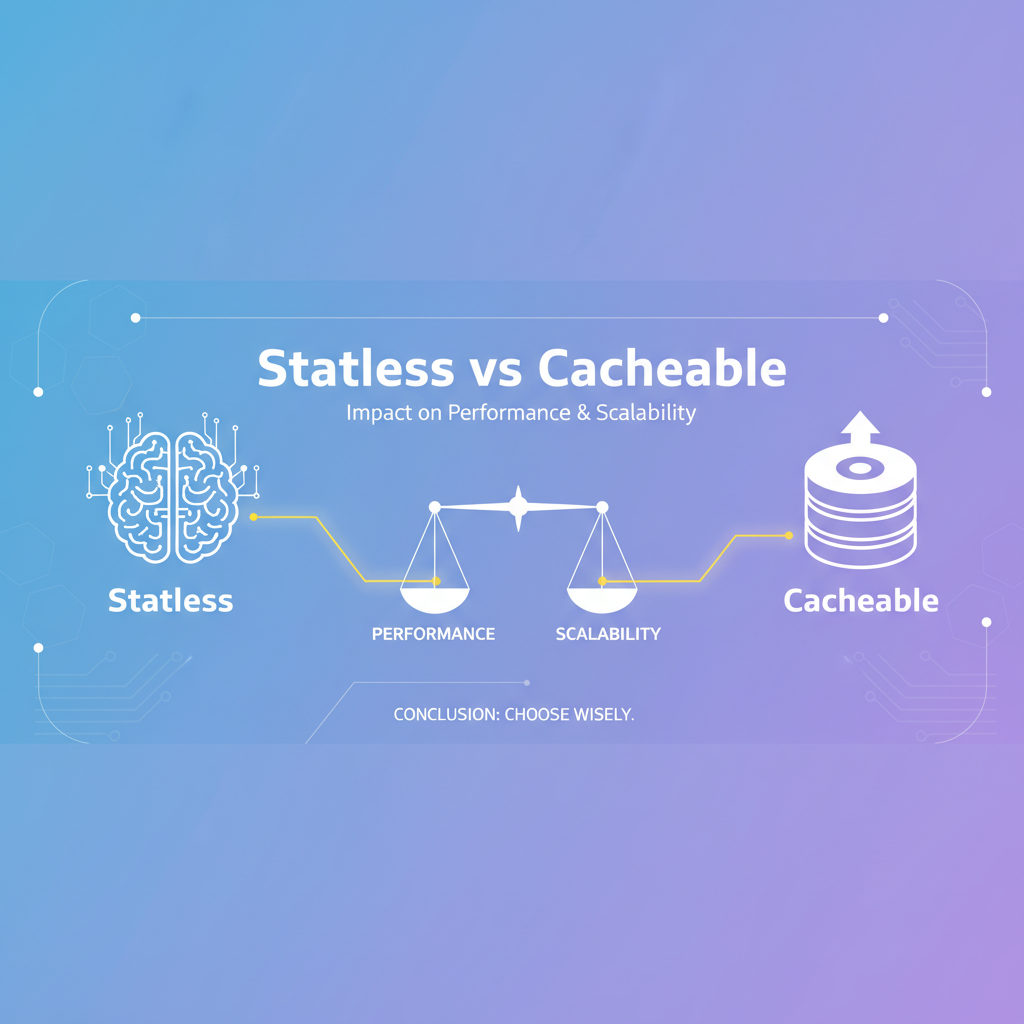
Stateless vs Cacheable: Impact on Performance & Scalability


In the dynamic realm of modern software architecture, where demands for speed, reliability, and the ability to handle astronomical user loads are ever-increasing, system designers are constantly navigating a labyrinth of choices. Among the most fundamental architectural decisions, deeply influencing a system's core capabilities, lie the concepts of "stateless" and "cacheable." These aren't merely technical jargon but represent distinct philosophies in how a system manages interactions and data, with profound implications for its overall performance and scalability. The intricate dance between maintaining a system's independence from past interactions (statelessness) and optimizing access by storing frequently used data closer to the source (cacheability) is a critical balancing act for any robust application, especially those relying heavily on API interactions and managed through an API gateway. This comprehensive exploration will dissect each concept, unraveling their definitions, advantages, disadvantages, and the often-synergistic relationship that defines the backbone of high-performing, scalable distributed systems.
The Foundation: Understanding Stateless Architectures
At its core, a stateless architecture dictates that each request from a client to a server must contain all the information necessary to understand and process that request. The server itself retains no memory or context of previous client interactions. This principle is often lauded for its simplicity and robustness in distributed environments, fundamentally altering how systems are designed and how they respond to varying loads.
Defining Statelessness
To truly grasp statelessness, one must imagine a server that possesses no internal state related to a specific client session between requests. Every single API call is treated as a completely independent transaction. If a client sends ten requests, the server processes each one as if it were the very first, relying entirely on the data provided within that particular request to fulfill its function. This means there are no "sticky sessions," where a client is consistently routed to the same server instance because that instance holds specific session data. Instead, any available server can handle any incoming request from any client at any time.
Consider a practical example: authenticating a user. In a stateless system, after initial login, the server might issue a JSON Web Token (JWT) to the client. Subsequent requests from the client would then include this JWT. The server, upon receiving a request, would validate the JWT to authenticate and authorize the user, without needing to query a central session store or remember any previous login state. The entire authentication context is embedded within the token itself, making the request self-contained.
Key Characteristics of Stateless Systems
Several defining characteristics emerge from the stateless paradigm:
- Self-Contained Requests: Each request carries all the necessary data, including authentication details, context, and parameters, for the server to process it completely. There's no expectation for the server to retrieve past interaction information.
- Independence of Interactions: The order or sequence of requests from a client does not inherently influence the server's processing of any single request. Every request stands alone.
- No Server-Side Session State: Crucially, the server does not store any session-specific data that persists across multiple requests from the same client. Any session-related information is either managed client-side or passed explicitly with each request.
- Ease of Horizontal Scaling: This characteristic is perhaps the most celebrated. Because no server holds unique client state, new server instances can be added or removed dynamically without disrupting ongoing client sessions. Load balancers can distribute traffic across any available server without complex session affinity rules.
Advantages of Stateless Architectures
The benefits of adopting a stateless approach are manifold, particularly in an era of cloud-native applications and microservices:
- Exceptional Scalability: This is arguably the most significant advantage. When servers don't maintain session state, scaling horizontally becomes incredibly straightforward. You can spin up new instances of your application or service behind a load balancer, and any request can be routed to any instance. There's no need for complex sticky session configurations, which can become bottlenecks themselves. This fluidity allows systems to handle sudden spikes in traffic with remarkable agility, making them ideal for high-volume
apiecosystems. Anapi gatewayleveraging stateless principles can effortlessly route requests to an expanding pool of backend services. - Enhanced Resilience and Fault Tolerance: If a server instance fails in a stateless system, it merely means one less server is available to handle requests. No client's session data is lost because no session data was stored on that specific server to begin with. Clients can simply retry their request, which will then be routed to a healthy server instance. This inherent robustness significantly reduces downtime and improves the overall availability of the system, a critical factor for any enterprise-grade
apiservice. - Simplified Server-Side Design and Management: Developers on the server side don't need to concern themselves with complex session management logic, garbage collection of stale sessions, or state synchronization across multiple instances. This simplifies the codebase, reduces potential for bugs related to state inconsistencies, and allows engineers to focus on the core business logic. The
gatewayitself can operate with minimal internal state, primarily focused on routing and policy enforcement. - Improved Predictability: Each request's outcome is solely determined by its contents and the current state of backend data (like a database). This makes debugging and testing easier, as replicating an issue often only requires replaying a specific request, rather than an entire sequence of interactions. This deterministic behavior contributes to more stable and understandable systems.
Disadvantages of Stateless Architectures
While statelessness offers compelling advantages, it's not without its drawbacks:
- Increased Data Transfer per Request: To ensure each request is self-contained, more information often needs to be sent from the client to the server with every interaction. This can include authentication tokens, user preferences, or other contextual data that might have been implicitly stored in a session in a stateful system. This overhead can lead to slightly larger request sizes, potentially consuming more network bandwidth and increasing processing time for parsing and validating the extra data on each request.
- Potential for Repeated Processing: If certain context or authorization details need to be validated on every single request, even if they haven't changed, this can introduce a degree of redundant processing. For example, decoding and validating a JWT on every single
apicall, while secure, consumes CPU cycles that might otherwise be saved if the authentication state was maintained on the server. This specific point, however, can often be mitigated by intelligentapi gatewayimplementations that cache authentication results or offload validation. - Increased Client Complexity for State Management: If the server is truly stateless, the responsibility for managing any conversational or session state often shifts to the client. This means the client application might need to store more data locally, manage its own session tokens, or orchestrate a series of requests to achieve a complex workflow. This can make client-side development more challenging and introduce its own set of potential issues related to data persistence and security on the client.
- Handling Long-Running Processes: For operations that require multiple steps and a consistent context over an extended period, pure statelessness can become cumbersome. While solutions like correlation IDs or sagas can manage workflows, they introduce their own complexities, effectively shifting the state management problem to a different architectural layer or pattern rather than eliminating it entirely.
Statelessness forms the bedrock for many modern web services and api designs, particularly RESTful apis, due to its inherent benefits in horizontal scaling and resilience. However, understanding its limitations is crucial for designing a balanced and efficient system.
Delving into Cacheable Architectures
In contrast to statelessness, which focuses on the independence of requests, cacheability is all about optimizing the speed and efficiency of data retrieval. A cacheable architecture aims to store copies of frequently accessed data closer to the consumer or at an intermediate layer, thereby significantly reducing latency, offloading the primary data source, and improving overall system responsiveness.
Defining Cacheability
Cacheability refers to the ability of a system to store a copy of a resource (e.g., an API response, a database query result, a static asset) in a temporary, high-speed storage location, known as a cache. When a request for that resource arrives, the system first checks the cache. If a valid copy exists (a "cache hit"), it's served directly from the cache, bypassing the slower, more resource-intensive process of generating the response from scratch (e.g., querying a database, performing complex calculations, or fetching from a backend service). If the resource is not in the cache or is deemed stale (a "cache miss"), the request is forwarded to the origin server, the response is then served, and a copy is typically stored in the cache for future requests.
The fundamental principle here is locality of reference – data that has been accessed recently or frequently is likely to be accessed again soon. By exploiting this principle, caching drastically improves perceived performance and reduces the load on backend infrastructure.
Types of Caching Mechanisms
Caching can be implemented at various layers of a system's architecture, each serving a specific purpose:
- Client-Side Caching (Browser Cache): Web browsers maintain a local cache of resources (HTML, CSS, JavaScript, images,
apiresponses) to speed up subsequent visits to websites. HTTP caching headers likeCache-Control,Expires,Last-Modified, andETagare instrumental here, instructing the browser on how long to store a resource and how to validate its freshness. - Proxy Caching (CDN, Reverse Proxy, API Gateway):
- Content Delivery Networks (CDNs): Geographically distributed networks of proxy servers that cache content (especially static assets and sometimes dynamic
APIresponses) at edge locations closer to end-users. This drastically reduces latency for geographically dispersed users. - Reverse Proxies and
API Gateways: Positioned in front of backend services, these components can cacheAPIresponses for specific endpoints. When multiple clients request the same data, thegatewaycan serve it directly from its cache, protecting the backend services from repetitive load. This is a crucial feature for any high-performanceapi gatewaylikeAPIPark.
- Content Delivery Networks (CDNs): Geographically distributed networks of proxy servers that cache content (especially static assets and sometimes dynamic
- Application-Level Caching: Within an application, caching can occur:
- In-Memory Caching: Storing data directly in the application's RAM (e.g., using libraries like Caffeine or Guava in Java, or simple dictionaries in Python). This is the fastest form of cache but is limited by the server's memory and is not shared across instances.
- Distributed Caching: Using dedicated cache servers (e.g., Redis, Memcached, Apache Ignite) that are accessible by multiple application instances. This allows for shared cached data across a cluster of servers, crucial for horizontally scaled applications.
- Database Caching: Databases themselves often have internal caching mechanisms (e.g., query caches, buffer pools) to speed up frequently executed queries or data block access. ORM frameworks can also implement caching for query results or entity objects.
Advantages of Cacheable Architectures
The strategic implementation of caching brings a host of benefits that directly impact performance and scalability:
- Significant Performance Improvement and Reduced Latency: This is the most immediate and visible benefit. By serving data from a fast cache rather than generating it anew, response times for cached resources can drop from hundreds of milliseconds to just a few milliseconds. This dramatically enhances user experience and allows
apiconsumers to receive data much faster. - Reduced Load on Origin Servers: Caching acts as a protective shield for your backend services and databases. Each cache hit means one less request that the origin server needs to process, one less database query to execute, and one less CPU cycle spent. This offloading allows origin servers to dedicate their resources to unique, non-cacheable requests, preventing them from becoming overwhelmed during peak loads. An
api gatewaywith caching capabilities can significantly reduce the pressure on downstream microservices. - Improved Scalability of Backend Services: By reducing the load, caching effectively increases the capacity of your backend services without necessarily adding more instances. A single backend service can support many more
apicalls if a significant portion of those calls are handled by an upstream cache. This allows for more efficient resource utilization and defers the need for costly horizontal scaling of origin services. - Bandwidth Reduction: For clients downloading the same large assets or
apiresponses repeatedly, caching at intermediate layers (like CDNs orapi gateways) or on the client side itself can drastically reduce the amount of data transferred over the network. This not only saves bandwidth costs but also improves performance for users with limited network speeds.
Disadvantages of Cacheable Architectures
Despite its powerful benefits, caching introduces its own set of complexities and challenges:
- Cache Invalidation - The Hard Problem: Ensuring that cached data remains fresh and consistent with the origin source is notoriously difficult. Serving stale data can lead to incorrect application behavior, poor user experience, or even critical errors. Strategies for cache invalidation (e.g., Time-To-Live (TTL), explicit invalidation messages, versioning) add significant complexity to system design and implementation. This is often cited as "one of the two hard problems in computer science."
- Increased Infrastructure Complexity: Implementing a robust caching strategy, especially distributed caching, requires additional infrastructure components (cache servers, monitoring tools, invalidation mechanisms). This adds to the operational overhead, deployment complexity, and maintenance burden. Careful consideration must be given to cache size, eviction policies, and redundancy.
- Data Consistency Challenges: In systems where data changes frequently, maintaining strong consistency between the cache and the origin can be a constant battle. Depending on the application's requirements, designers might need to choose between strong consistency (always serving the freshest data, potentially sacrificing some performance) and eventual consistency (data might be slightly out-of-date for a short period, prioritizing performance and availability).
- The Cold Cache Problem: When a cache is first populated or after a major invalidation event, it's "cold." The initial requests for specific data will result in cache misses, meaning they will hit the origin server and incur the full latency. This can lead to temporary performance dips during system startup or after deployments. Strategies like cache warming (pre-populating the cache) can mitigate this but add further complexity.
- Caching Personalized Content: Caching data that is highly personalized or specific to an individual user can be challenging. Each user might have a unique version of a resource, making it difficult to achieve a high cache hit ratio without risking data leakage or serving incorrect information. Careful keying and segmentation strategies are required.
Caching is an indispensable tool for optimizing performance and scalability in almost any modern system. However, its effective implementation demands a deep understanding of its mechanisms, careful planning, and robust strategies to manage its inherent complexities, particularly concerning data freshness.
The Interplay: Statelessness and Cacheability in Harmony (or Conflict)
While statelessness and cacheability address different aspects of system design – independence of requests versus efficiency of data retrieval – they are far from mutually exclusive. In fact, in many high-performance architectures, they are complementary, working in concert to create robust and highly scalable systems. Understanding how they interact is crucial for optimal design.
Can They Coexist? Absolutely.
The short answer is a resounding yes. Modern API ecosystems and microservices architectures routinely blend stateless API designs with sophisticated caching strategies. The principles underlying statelessness often create an ideal environment for effective caching, while caching mechanisms can further amplify the benefits of statelessness.
How Statelessness Facilitates Caching
Stateless APIs are inherently easier to cache because their responses depend solely on the input provided in the request itself, rather than on any prior interaction or server-side session state. This makes a cached response for a given request universally applicable to any client making the exact same request, as long as the underlying data hasn't changed.
Consider a GET request to retrieve a list of products from an e-commerce API. If this API endpoint is stateless, meaning its response is determined purely by the request parameters (e.g., GET /products?category=electronics&limit=10), then the response for that specific set of parameters can be cached. Any subsequent request with the same parameters, from any user, can then be served from the cache. There's no concern that user-specific session data might alter the response, which is a common challenge for caching in stateful environments.
The predictable nature of stateless requests, where a specific input always yields a specific output (given the underlying data state), is a perfect match for caching. It simplifies cache key generation and reduces the risk of serving incorrect or personalized data inappropriately. This is why RESTful APIs, which are typically stateless, are prime candidates for extensive caching, especially on API gateways and CDNs.
When Caching Might Introduce State-Like Behavior (and how to avoid it)
While statelessness is generally beneficial for caching, it's important to be mindful of how caching itself can, if not carefully managed, inadvertently introduce state-like dependencies or consistency issues that undermine the benefits of statelessness.
For example, if an API gateway caches a response for a user, but that user's permissions or profile changes, the cached response might become stale and serve incorrect data, effectively behaving as if it's "remembering" an old state. This isn't true statefulness in the server, but it creates a similar problem where subsequent interactions don't reflect the current reality.
To avoid this, designers must:
- Be meticulous with Cache Keys: Ensure cache keys accurately reflect all relevant parameters that influence an
APIresponse, including any headers that might affect personalization (e.g.,Accept-Language,Authorization). - Implement Robust Invalidation Strategies: For data that changes, establish clear mechanisms to invalidate cached entries. This could involve short TTLs, explicit invalidation calls, or event-driven invalidation.
- Distinguish Cacheable vs. Non-Cacheable Endpoints: Not all
APIendpoints are suitable for caching.POST,PUT,DELETErequests that modify data are generally not cached.GETrequests that retrieve highly dynamic or personalized data might require very short TTLs or no caching at all, pushed closer to the client or to anAPI gatewaythat can selectively cache.
Impact on an API Gateway
An API gateway sits at the confluence of these two architectural philosophies, playing a pivotal role in orchestrating both stateless routing and intelligent caching strategies. It acts as a crucial control point, enhancing both performance and scalability:
- Stateless Operations at the Gateway: An
API gatewayfundamentally operates in a largely stateless manner concerning the requests it forwards. It receives a request, applies policies (authentication, rate limiting, transformation), and routes it to an appropriate backend service. This routing decision is made independently for each request, based on predefined rules, not on prior interactions with the specific client. This stateless nature allowsgateways to be highly scalable themselves, handling massive volumes of traffic by simply adding moregatewayinstances. - Intelligent Caching Capabilities: Beyond stateless routing, a robust
API gatewayprovides powerful caching features. It can inspect incomingGETrequests, check its internal cache for a valid response, and serve it directly if available, bypassing the backend services entirely. This not only speeds up responses but also significantly reduces the load on downstream services, enhancing their scalability and resilience. Thegatewaycan manage HTTP caching headers, implement sophisticated cache invalidation, and even pre-cache frequently accessed data. - Authentication Offloading: Many
API gateways can offload authentication and authorization from backend services. For example, validating a JWT token on every request is a stateless operation. Thegatewayperforms this once, and if valid, forwards the request (perhaps with enriched user context) to the backend. While the token validation itself is stateless, the result of that validation can sometimes be cached for a very short duration within thegatewayto optimize performance for a burst of requests from the same user if thegatewayarchitecture supports it (though strict statelessness often means re-validating the token each time).
In essence, the API gateway acts as a smart traffic cop and a performance booster. It ensures that stateless requests are routed efficiently to available services and leverages caching to intercept and quickly fulfill repetitive requests, creating a highly performant and scalable API ecosystem.
Performance Implications: A Detailed Look
The choice between stateless and cacheable architectures, or more realistically, their strategic combination, has profound and measurable impacts on system performance. Understanding these implications is vital for designing systems that meet user expectations for speed and responsiveness.
Latency: The Battle for Speed
- Stateless Architectures: In a purely stateless system without caching, every request typically involves the full round-trip to the backend service. This includes network transit time, server-side processing (e.g., database queries, business logic execution, authentication validation), and network transit back to the client. While individual components might be optimized, the inherent need to re-process each request means a baseline latency exists for every interaction.
- Cacheable Architectures: Caching dramatically reduces latency for cache hits. When a request is served from a local or intermediate cache, the network round-trip to the origin server is eliminated, and server-side processing is bypassed. This can reduce response times from hundreds of milliseconds to single-digit milliseconds, resulting in an almost instantaneous feel for the end-user. For cache misses, the latency is equivalent to a non-cached stateless request, potentially with a slight additional overhead for the cache lookup itself.
Throughput: Handling the Volume
- Stateless Architectures: Stateless systems are inherently capable of high throughput because they are easy to scale horizontally. By adding more server instances, you can linearly increase the number of requests per second (RPS) your system can handle, provided the backend database or other shared resources don't become a bottleneck. The key is that each server can process any request, distributing the load efficiently.
- Cacheable Architectures: Caching significantly boosts effective throughput by offloading work from origin servers. If 80% of requests are served from the cache, the backend services only need to handle 20% of the actual load. This means the origin servers can process many more unique requests or handle the remaining requests more quickly, leading to a much higher overall system throughput. An
API gatewaywith effective caching can handle an order of magnitude more requests than it would if every request had to go to the backend.
Resource Utilization: Making the Most of What You Have
- Stateless Architectures: While stateless services are scalable, they still require resources for every request. Each
apicall consumes CPU for processing, memory for data manipulation, and network bandwidth. If traffic increases, resource utilization on individual servers also increases, necessitating horizontal scaling to distribute the load. - Cacheable Architectures: Caching is a resource multiplier. By serving responses from a cache, you reduce the CPU cycles, memory usage, database connections, and I/O operations on your backend services. This means your existing backend infrastructure can handle a greater effective load without being upgraded or scaled out. You get more "bang for your buck" from your computing resources. An
api gatewaycan utilize its own resources to serve cached content, preventing resource exhaustion on potentially more expensive backend services.
Scalability Metrics: Growth Potential
- Stateless Architectures: Excel in horizontal scalability. Adding more instances of a stateless service is typically the most straightforward way to increase its capacity. The
gatewayplays a crucial role in load balancing these stateless instances. - Cacheable Architectures: Enhance scalability by increasing the efficiency of existing resources. It allows your backend services to scale vertically (handle more load per instance) more effectively by reducing demand, and horizontally by extending the overall system's capacity beyond what the origin servers alone could manage. The
api gatewayfacilitates this by acting as a distributed cache layer.
Cost Efficiency: Balancing Performance and Budget
- Stateless Architectures: While highly scalable, if every request needs full processing, it might imply a higher baseline cost for compute resources (CPU, RAM) to maintain desired performance levels, especially for very high traffic volumes.
- Cacheable Architectures: Can lead to significant cost savings. By reducing the load on expensive backend services and databases, you might be able to run fewer instances, or smaller instances, of these components. Reducing network bandwidth usage (especially for egress traffic in cloud environments) also contributes to cost reduction. The infrastructure cost of a cache (e.g., Redis cluster) might be offset by the savings on backend compute.
Case Studies/Scenarios
- High-Read, Low-Write
APIs (e.g., Product Catalogs, News Feeds): These are prime candidates for aggressive caching. The data doesn't change frequently, but is read often. A statelessapiendpoint for fetching products, coupled with anapi gatewaycaching its responses with a generous TTL, will yield massive performance benefits. - Personalized Dashboards (e.g., User Activity Feeds): These are challenging for caching. While the underlying
apimight be stateless, the response is unique to each user. Caching here might require very granular keys or client-side caching only, with short expiration times, making it less impactful on backend load. - Authentication and Authorization (
API GatewayOffload): Anapi gatewaycan perform stateless token validation for every request. However, it can also cache the results of complex authorization checks (e.g., role-based access control lookups) for a short period to avoid re-evaluating them for every single request within a tight window. This is a subtle blend where thegatewayitself might maintain a very temporary, limited internal cache to speed up policies.
The ultimate goal is to strike a balance. Pure statelessness might be inefficient for frequently accessed, unchanging data, while overly aggressive caching can introduce consistency nightmares. The most performant and scalable systems strategically combine both, using statelessness as a robust foundation and caching as an intelligent accelerator, often mediated by a sophisticated API gateway.
APIPark is a high-performance AI gateway that allows you to securely access the most comprehensive LLM APIs globally on the APIPark platform, including OpenAI, Anthropic, Mistral, Llama2, Google Gemini, and more.Try APIPark now! 👇👇👇
Scalability Implications: Expanding Horizons
Scalability is the ability of a system to handle a growing amount of work or its potential to be enlarged to accommodate that growth. Both statelessness and cacheability are fundamental drivers of scalability, albeit through different mechanisms.
Horizontal Scaling: The Stateless Advantage
Horizontal scaling, or scaling out, involves adding more servers or instances to distribute the load. This is where stateless architectures truly shine.
- Effortless Distribution: Because no server holds client-specific session data, any request can be routed to any available server instance. This simplifies the logic for load balancers, allowing them to distribute traffic evenly across a pool of servers without worrying about "sticky sessions" or session affinity. New instances can be added dynamically during peak loads and removed when demand subsides, enabling elastic scaling. This flexibility is a cornerstone of cloud-native and microservices architectures.
- Elimination of Single Points of Failure (SPOF) for Sessions: In stateful systems, if a server holding a user's session state goes down, that user's session is lost, leading to disruption. Statelessness eliminates this SPOF for session data, improving overall system resilience and allowing for much greater scalability without fear of state loss.
- Microservices Architectures: The stateless principle aligns perfectly with microservices. Each microservice should ideally be stateless, processing requests independently. This allows individual services to be scaled up or down based on their specific demand, without affecting other services or creating complex state management challenges across the distributed system. An
API gatewayorchestrates these stateless microservices, ensuring smooth request routing.
Load Balancing: Orchestrating Traffic
- Simpler for Stateless: Load balancing is significantly simpler and more efficient with stateless services. Standard round-robin, least-connections, or IP hash algorithms can be used, as there's no need to maintain session affinity. This maximizes the utilization of all available server instances.
- Complements with Caching: While statelessness simplifies load balancing for backend services, caching adds another layer of load distribution. An
api gatewayor CDN with caching capabilities acts as a first line of defense, intercepting a large portion of traffic before it even reaches the backend load balancer, further enhancing scalability.
Geographic Distribution: Reaching Global Audiences
- CDNs and Edge Caching: This is where cacheability becomes paramount for global scalability. CDNs strategically place cached content at "edge" locations closer to users around the world. For
apis, this means responses can be served from a server in the user's region, drastically reducing network latency caused by geographical distance. This is crucial for applications with a global user base, where every millisecond matters. - Distributed Caches: For internal application data that needs to be cached and shared across different data centers or cloud regions, distributed caching solutions (e.g., multi-region Redis clusters) enable consistent and scalable data access across geographically dispersed deployments.
- Stateless Global
APIs: Combining statelessapiendpoints with globalAPI gatewaydeployments and CDNs allows enterprises to serve theirapis with low latency and high availability to users anywhere on the planet.
Impact on Overall System Capacity
Ultimately, both statelessness and cacheability contribute to increasing the overall capacity of a system to handle concurrent users and requests.
- Statelessness provides the breadth: It ensures that you can linearly add more capacity by spinning up more instances, distributing the workload across a potentially infinite number of servers.
- Cacheability provides the depth: It ensures that each unit of backend capacity is used more efficiently, offloading repetitive work and allowing existing servers to handle a disproportionately higher number of requests.
A well-architected system will leverage both. The api gateway acts as the intelligent conductor of this orchestra, ensuring that incoming requests are processed with the optimal blend of stateless processing and efficient caching, thereby maximizing both the performance and scalability of the entire API ecosystem.
Designing for Statelessness and Cacheability
Implementing these architectural principles effectively requires careful design considerations and adherence to best practices throughout the development lifecycle. The role of an API gateway in facilitating these designs cannot be overstated.
Best Practices for Stateless Design
Designing for statelessness is primarily about ensuring that your services are truly self-contained regarding client interaction.
- Authentication and Authorization with Tokens (JWT, OAuth): Avoid server-side sessions for authentication. Instead, issue secure, self-contained tokens (like JWTs) to clients after successful login. These tokens, signed by the server, contain all necessary authentication and authorization information. On subsequent requests, the client includes this token, and the server (or
api gateway) validates it without needing to look up any server-side state. This pattern is fundamental to scalableapisecurity. - Idempotent
APIEndpoints: Design yourapis so that repeated requests have the same effect.GET,PUT, andDELETEoperations should generally be idempotent. This is particularly important in distributed systems where network issues can lead to retries. While not strictly about statelessness, it complements it by ensuring that repeated, self-contained requests don't cause unintended side effects. - Client-Side Context Management: If a complex workflow requires state, push that state management to the client. The client can store necessary context in cookies, local storage, or in memory, and pass it back with each request. The server still remains stateless, merely processing the information provided in the request.
- No Server-Side Session Affinity: Ensure your load balancer is configured for simple distribution (e.g., round-robin) and does not attempt to "stick" a client to a specific server instance. This confirms your services are truly stateless and can handle traffic from any source.
Best Practices for Cacheable Design
Effective caching goes beyond simply turning on a cache; it requires strategic thought about data lifecycle and consistency.
- Leverage HTTP Caching Headers: For web
APIs, use standard HTTPCache-Controlheaders (e.g.,max-age,no-cache,no-store,must-revalidate),Expires,Last-Modified, andETag. These headers instruct browsers, CDNs, andapi gateways on how to cache responses and how to revalidate them. For instance,Cache-Control: public, max-age=3600tells intermediaries they can cache the response for one hour. - Design Idempotent and Safe
APIEndpoints (GET requests): Caching is most effective forGETrequests, which are intended to retrieve data and should have no side effects.POST,PUT,DELETErequests that modify data should generally not be cached, or if so, only at the client level for very short durations with strict invalidation. - Implement Effective Cache Invalidation Strategies:
- Time-To-Live (TTL): The simplest strategy. Cache entries expire after a set duration. Suitable for data that can tolerate some staleness.
- Event-Driven Invalidation: When the source data changes (e.g., a product price update in a database), trigger an event that explicitly invalidates the relevant cache entries. This requires more complex infrastructure (e.g., message queues, webhooks).
- Versioned URLs: For static or semi-static assets, include a version hash in the URL (e.g.,
/styles.v123.css). When the asset changes, update the URL, ensuring clients always fetch the new version, and the old cached version never conflicts.
- Consider Cache-Aside vs. Read-Through Patterns:
- Cache-Aside: The application code is responsible for checking the cache first. If a miss, it fetches data from the origin, then stores it in the cache for future use.
- Read-Through: The cache acts as a proxy to the origin. The application queries the cache, and if data isn't present, the cache itself fetches it from the origin and stores it. This pattern can simplify application logic.
- Monitor Cache Performance: Track cache hit ratios, miss rates, and latency. This data is crucial for optimizing cache configurations and identifying opportunities for further improvements.
The Role of the API Gateway in Facilitating Both
The API gateway serves as a strategic point of control for implementing and enforcing both stateless and cacheable patterns across an organization's API landscape.
- Request Routing and Load Balancing (Stateless Operations): The
gatewayefficiently routes incoming requests to the appropriate backend services, distributing the load across multiple instances. Its stateless nature ensures that it can scale independently to handle massive traffic volumes, acting as a highly available entry point. - Authentication and Authorization Offloading: By handling JWT validation, OAuth token introspection, and authorization checks, the
gatewayoffloads this repetitive, yet critical, processing from backend services. This is a stateless operation that every request undergoes, ensuring security without burdening individual services. - Response Caching at the Edge: Many
API gateways, includingAPIPark, offer robust response caching capabilities. Thegatewaycan cache responses forGETrequests, reducing latency and shielding backend services from redundant calls. This is particularly powerful for widely consumed publicAPIs or forAPIs serving frequently accessed, relatively static data. The ability for anAPI gatewayto manage traffic forwarding, load balancing, and versioning of publishedAPIs directly benefits from stateless principles, ensuring that requests are handled efficiently regardless of the backend service instance. The caching mechanisms within thegatewayfurther enhance this efficiency.
Speaking of powerful API gateways, a prime example is APIPark. As an open-source AI gateway & API management platform, APIPark is specifically designed to manage, integrate, and deploy AI and REST services with ease. Its architecture inherently embraces the principles of statelessness and cacheability to achieve its remarkable performance. For instance, APIPark's capability to achieve over 20,000 TPS with modest hardware requirements (8-core CPU, 8GB memory) underscores its highly optimized design, which likely leverages efficient stateless processing for routing and policy enforcement, combined with intelligent caching to offload backend services. Its feature of a unified API format for AI invocation inherently supports stateless interactions, as the request carries all necessary data without relying on prior session state. Furthermore, by allowing prompt encapsulation into REST APIs, APIPark helps create APIs that are inherently more cacheable, as the "prompt" part of the AI interaction can often be a fixed input for specific APIs, allowing their responses to be cached effectively. APIPark's comprehensive API lifecycle management, including traffic forwarding and load balancing, provides the scaffolding needed to implement these architectural patterns effectively across your entire API ecosystem. It enables developers and enterprises to build highly scalable and performant API solutions, whether for AI models or traditional REST services, by providing the tools to manage both stateless interactions and judicious caching strategies.
Advanced Considerations and Challenges
While the concepts of statelessness and cacheability provide powerful architectural blueprints, real-world systems often present nuanced challenges that require deeper consideration.
Stateful Services with Stateless Interactions
It's important to distinguish between a stateless service and a stateless interaction. Many modern applications rely on databases, message queues, or external state stores (like Redis) as their source of truth. These underlying components are inherently stateful. However, the application services interacting with them can still be designed to be stateless.
For example, a microservice might write data to a database (a stateful operation), but the microservice itself processes each incoming client request independently without holding any user-specific state in its memory. The database then acts as the shared, persistent state that all stateless instances of the microservice can access. This pattern allows for the horizontal scalability benefits of stateless services while still managing persistent data. The challenge lies in managing transactions and consistency across these distributed stateful components.
Eventual Consistency vs. Strong Consistency: Implications for Caching
Data consistency is a critical factor when implementing caching.
- Strong Consistency: Guarantees that any read operation will always return the most recently written data. This is often the default expectation for many users. Achieving strong consistency with caching is difficult. It usually requires complex cache invalidation mechanisms that are tightly coupled with the data write operations, potentially impacting write performance. For example, a write-through cache might ensure immediate consistency, but it sacrifices some of the performance benefits of a cache.
- Eventual Consistency: Tolerates a brief period where cached data might be out-of-date after a write operation, but eventually, all copies of the data will converge to the same value. This model is often adopted in highly distributed and scalable systems (like CDNs or large-scale distributed caches) where performance and availability are prioritized over immediate consistency. For example, a product listing might be cached for 5 minutes. If a price changes, users might see the old price for up to 5 minutes, but eventually, the cache will expire, and the new price will be fetched. The choice between these models depends entirely on the business requirements and the acceptable level of data staleness.
Personalized Content: Caching Challenges
Caching highly personalized content presents significant hurdles. If every user receives a unique response to an API request (e.g., a personalized recommendation list), then caching that response for one user won't benefit other users. This leads to a very low cache hit ratio.
Strategies for personalized content caching include:
- Client-Side Caching: Pushing the caching responsibility further to the client, which can manage its own personalized data.
- Segmented Caching: Caching common, non-personalized parts of a response and then dynamically injecting personalized elements client-side or at the
api gateway. - Very Short TTLs: Caching personalized data for a very brief period (e.g., seconds) to handle bursts of requests from the same user within a short window, with quick invalidation.
- User-Specific Cache Keys: Generating cache keys that include the user ID, but this can lead to an explosion of cache entries and make cache management more complex.
Often, for truly personalized and dynamic content, the benefits of caching for performance might be minimal or outweighed by the complexity of maintaining consistency and ensuring privacy.
Security Implications: Caching Sensitive Data
Caching sensitive data (e.g., financial information, personal identifiers) introduces security risks. If a cache is compromised, sensitive data could be exposed.
- Never Cache Sensitive Authentication Credentials: Authentication tokens should be encrypted and validated, but not typically cached in a way that risks exposure.
- Encrypt Cached Data: For highly sensitive but cacheable data, consider encrypting it within the cache.
- Strict Access Controls: Implement robust access controls on your cache infrastructure.
- Avoid Caching Error Responses with Sensitive Information: If an
APIreturns an error response containing sensitive data (e.g., stack traces, internal IDs), ensure these are not cached or are stripped before caching.
A robust API gateway implementation will offer security features that manage these risks, ensuring that sensitive information is handled appropriately, whether it's part of a stateless authentication flow or a cacheable response. It's a constant balancing act between performance optimization and maintaining the highest standards of security and privacy.
Comparative Overview: Stateless vs. Cacheable
To summarize the intricate relationship and distinct characteristics, the following table provides a high-level comparison:
| Feature/Aspect | Stateless Architectures | Cacheable Architectures |
|---|---|---|
| Core Principle | Server retains no client-specific state between requests. | Store copies of data for faster retrieval. |
| Primary Goal | Maximize horizontal scalability, resilience, and simplicity. | Maximize performance (reduce latency), reduce backend load. |
| Data Flow | Each request contains all necessary data. | Data flows from cache (if hit) or origin (if miss). |
| Horizontal Scaling | Excellent. Easy to add/remove server instances. | Enhanced. Reduces load on origin, allowing more effective scaling. |
| Latency | Baseline latency for every request (full round-trip). | Significantly reduced for cache hits, baseline for misses. |
| Throughput | High, scales linearly with instances. | Massively increased (effective throughput) due to offloading. |
| Resource Usage | Consumes resources for every request. | Reduces resource consumption on origin servers. |
| Resilience | High. Server failure doesn't lose session state. | Improves overall system resilience by absorbing traffic. |
| Complexity | Simpler server-side logic; client might manage more state. | Higher. Cache invalidation, infrastructure, consistency are complex. |
| Data Consistency | Always reflects current backend state (assuming no bugs). | Challenges with staleness; trade-offs between strong/eventual consistency. |
| Typical Use Cases | RESTful APIs, JWT authentication, microservices. | Static assets, frequently accessed API responses, database query results. |
API Gateway Role |
Route requests, offload authentication, enforce policies. | Store and serve API responses, manage HTTP caching headers. |
Conclusion
The journey through stateless and cacheable architectures reveals them not as competing ideologies, but as fundamental design tools that, when understood and applied judiciously, form the bedrock of high-performance and highly scalable systems. Statelessness provides the architectural agility and resilience necessary for distributed environments, enabling seamless horizontal scaling and simplified server-side logic by decoupling interactions from server-held state. It ensures that every request is a fresh start, making the system robust and easy to distribute.
Complementing this, cacheability acts as a powerful accelerator, dramatically reducing latency, offloading critical backend resources, and boosting effective system throughput. By strategically storing frequently accessed data closer to the consumer, caching transforms the user experience and extends the operational capacity of existing infrastructure. However, the allure of caching comes with the notorious challenge of cache invalidation and the complexities of ensuring data consistency, demanding careful planning and robust implementation.
The synergistic relationship between these two paradigms is perhaps most evident and impactful at the API gateway layer. An intelligent gateway acts as the critical orchestrator, adeptly managing the stateless routing and policy enforcement for every incoming API call, while simultaneously leveraging its caching capabilities to intercept and fulfill repetitive requests with lightning speed. Whether it's validating a JWT token in a stateless manner or serving a product catalog from its cache, the API gateway optimizes the entire API lifecycle, enhancing both security and performance.
Products like APIPark exemplify this integrated approach, providing a robust platform that inherently supports both stateless API designs and sophisticated caching strategies to manage diverse services, from traditional REST APIs to cutting-edge AI models. Its ability to handle high transaction volumes and streamline API governance showcases the practical power of these architectural principles in action.
Ultimately, the choice is rarely "either/or." Instead, it's about a strategic blend—designing stateless services where maximum scalability and resilience are paramount, and applying intelligent caching where performance and resource efficiency can be significantly gained. Balancing the simplicity of statelessness with the complexity of caching requires a deep understanding of system requirements, data characteristics, and operational realities. By mastering this balance, architects and developers can build the responsive, reliable, and scalable systems that define the modern digital landscape.
Frequently Asked Questions (FAQs)
1. What is the fundamental difference between stateless and stateful services?
The fundamental difference lies in how a service manages client interaction history. A stateless service retains no memory or context of previous client requests; each request is treated as an entirely new, independent transaction, containing all necessary information for its processing. This makes stateless services highly scalable and resilient. In contrast, a stateful service remembers client interactions across multiple requests, often by storing session data on the server. This can simplify client-side logic but introduces challenges for horizontal scaling, fault tolerance, and load balancing due to the need for session affinity.
2. Why is statelessness considered crucial for microservices architectures?
Statelessness is crucial for microservices because it enables independent scalability, resilience, and simpler deployment. Each microservice can be scaled up or down based on its specific demand without impacting other services or requiring complex session management across a distributed system. If a microservice instance fails, no client session data is lost, as the next request can simply be routed to a healthy instance. This independence significantly simplifies load balancing, reduces deployment complexity, and makes the overall architecture more robust and agile.
3. How does an API Gateway leverage both stateless and cacheable principles?
An API gateway leverages both by acting as an intelligent intermediary. It handles stateless operations like request routing, load balancing, and authentication/authorization offloading (e.g., validating a JWT for each incoming request without remembering past logins). Simultaneously, it implements cacheable principles by storing and serving API responses for frequently accessed GET requests directly from its cache, bypassing backend services. This dual role enhances overall performance, reduces backend load, and boosts the scalability of the entire API ecosystem.
4. What are the main challenges associated with implementing caching in a system?
The main challenges of implementing caching are: 1. Cache Invalidation: Ensuring that cached data remains consistent with the origin source and invalidating stale entries is notoriously complex ("the hardest problem in computer science"). Incorrect invalidation can lead to serving outdated information. 2. Data Consistency: Deciding between strong consistency (always up-to-date data) and eventual consistency (some temporary staleness) based on application requirements. 3. Infrastructure Complexity: Managing cache servers, distributed caches, and their monitoring adds operational overhead. 4. Cold Cache Problem: Initial requests after a cache clear or restart will result in cache misses and slower responses until the cache is populated. 5. Caching Personalized Content: Effectively caching data unique to each user can be difficult without leading to a low cache hit ratio or security risks.
5. When should you prioritize statelessness over cacheability, and vice versa?
You should prioritize statelessness when: * High horizontal scalability and resilience are paramount. * The system needs to handle highly dynamic or personalized API interactions that are difficult to cache effectively. * Simplicity in server-side logic and load balancing is desired.
You should prioritize cacheability (or use it strategically) when: * There's a significant amount of read-heavy traffic for relatively static or infrequently changing data (e.g., product catalogs, news articles). * Reducing latency and improving response times for end-users is critical. * Offloading backend services to reduce load and extend their capacity is needed. * Reducing network bandwidth costs (especially for geographically distributed users via CDNs).
Often, the most effective architectures strike a balance, designing core services to be stateless and then selectively applying caching layers for specific API endpoints or data types that benefit most from it.
🚀You can securely and efficiently call the OpenAI API on APIPark in just two steps:
Step 1: Deploy the APIPark AI gateway in 5 minutes.
APIPark is developed based on Golang, offering strong product performance and low development and maintenance costs. You can deploy APIPark with a single command line.
curl -sSO https://download.apipark.com/install/quick-start.sh; bash quick-start.sh

In my experience, you can see the successful deployment interface within 5 to 10 minutes. Then, you can log in to APIPark using your account.

Step 2: Call the OpenAI API.