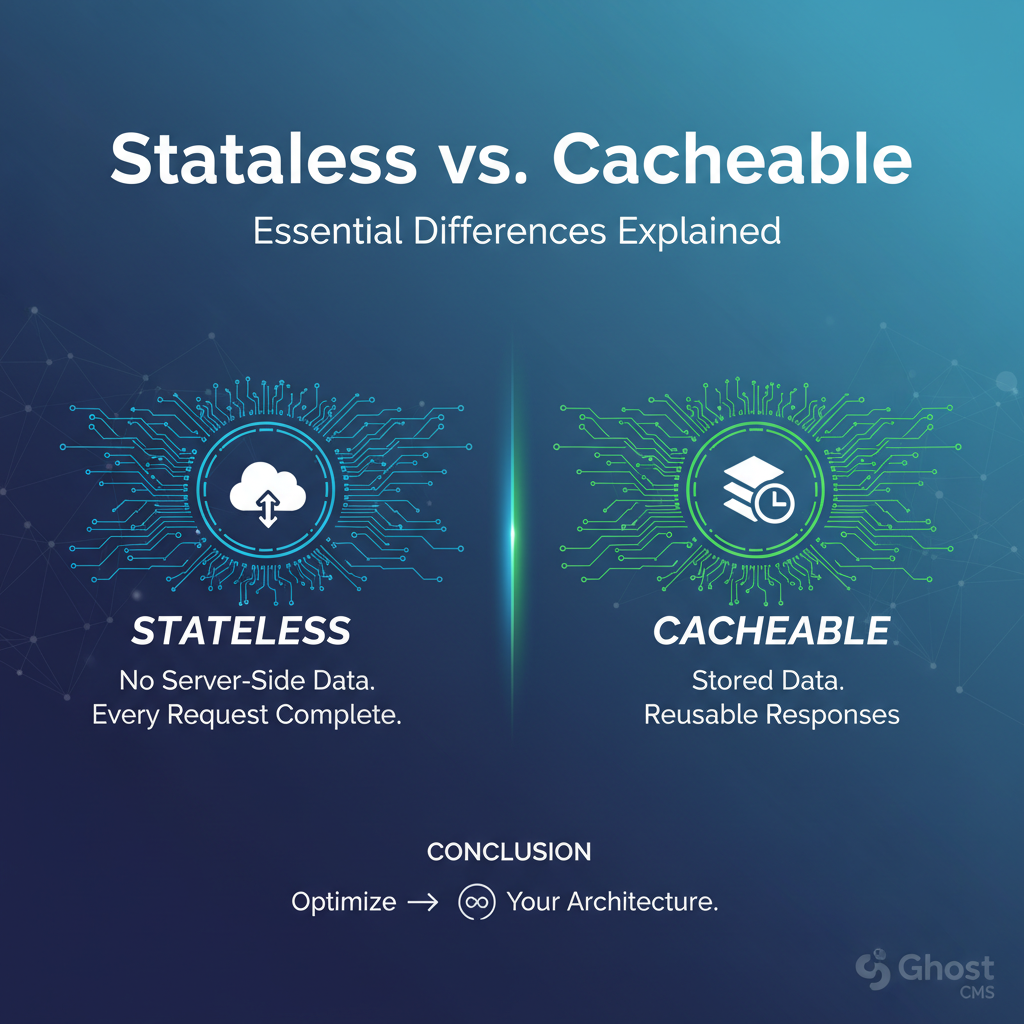
Stateless vs. Cacheable: Essential Differences Explained


In the intricate tapestry of modern software architecture, particularly within the realm of web services and Application Programming Interfaces (APIs), two foundational concepts often arise: statelessness and cacheability. These principles, while distinct, are deeply intertwined and play a pivotal role in shaping the performance, scalability, and resilience of distributed systems. Understanding their individual nuances, their synergistic relationship, and their potential points of conflict is not merely an academic exercise; it is an imperative for any developer, architect, or operations professional striving to build robust, efficient, and future-proof digital infrastructures. From the foundational protocols like HTTP to sophisticated microservices and AI-driven platforms managed by an api gateway, the judicious application of statelessness and cacheability dictates the very success of an api ecosystem.
This comprehensive exploration delves into the core definitions, architectural implications, practical advantages, and inherent challenges associated with both statelessness and cacheability. We will dissect how these principles manifest in real-world scenarios, particularly within the context of API design and consumption, and how intelligent gateway solutions can optimize their interplay. By the end of this journey, readers will possess a profound understanding of these concepts, enabling them to make informed design decisions that leverage the strengths of each, ultimately leading to more performant and maintainable systems.
The Paradigm of Statelessness: A Deep Dive into Disconnected Interactions
Statelessness is a fundamental architectural constraint in many distributed systems, most notably championed by the Representational State Transfer (REST) architectural style. At its core, a stateless system is one where each request from a client to a server contains all the information necessary to understand the request, and the server does not store any client context between requests. This means that every single request must be self-contained; the server should not rely on any previous interactions with that client to fulfill the current request. It's akin to having a conversation where each sentence is a complete thought, independent of any prior sentences, yet still contributing to a broader narrative.
Origins and Architectural Foundations
The concept of statelessness finds its most prominent home in the Hypertext Transfer Protocol (HTTP), the backbone of the World Wide Web. HTTP was deliberately designed to be stateless. When you click a link or type a URL, your browser sends an HTTP request. The web server processes this request, sends back an HTTP response, and then immediately forgets about you. The server retains no memory of your previous visits or actions on its part. This design choice was revolutionary and incredibly powerful, born out of the need for a protocol that could scale massively across a decentralized network without burdening servers with persistent state management for millions of concurrent users.
This architectural decision has profound implications. For instance, in a truly stateless system, if a client sends a request and then another request, the server treats both as entirely new interactions, even if they originated from the same client. Any state information, such as user authentication tokens, preferences, or session IDs, must be explicitly included with each request by the client. This shifts the responsibility of maintaining session state entirely to the client, or to an external, shared state management system, rather than the individual server processing the requests. This separation of concerns is a cornerstone of scalable distributed systems.
Advantages of Statelessness: Why It Matters for Scalability and Reliability
The benefits derived from embracing statelessness are manifold, particularly when designing apis and large-scale distributed applications:
- Enhanced Scalability: This is arguably the most significant advantage. Because servers don't store client-specific state, any request can be routed to any available server in a cluster. There's no need for "sticky sessions," where a client must repeatedly connect to the same server to maintain its context. This allows for horizontal scaling – simply adding more servers to handle increased load – without complex state synchronization mechanisms. Load balancers can distribute traffic evenly across all available resources, optimizing resource utilization and ensuring high availability. For an
api gatewayhandling millions of requests, this ability to distribute without concern for session continuity is paramount. - Increased Reliability and Fault Tolerance: If a server fails in a stateless system, it doesn't lead to a loss of client session state, because no state was stored on that server to begin with. The client can simply retry its request, and a different server in the cluster can seamlessly pick it up. This significantly improves the overall resilience of the system, minimizing downtime and enhancing user experience even in the face of infrastructure failures. Contrast this with stateful systems where a server crash could mean the loss of all active sessions, requiring users to log in again or restart their processes.
- Simplified Server Design and Implementation: Developing stateless services is often simpler because the server logic doesn't need to manage complex session states, timeouts, or garbage collection for idle sessions. Each request is a self-contained unit, making it easier to reason about, test, and deploy individual services. This reduction in complexity for the server-side logic frees up developers to focus on core business functionality rather than infrastructure concerns.
- Improved Resource Utilization: Without the need to allocate and maintain memory or CPU cycles for persistent client sessions, servers can dedicate their resources entirely to processing incoming requests. This leads to more efficient use of hardware and lower operational costs, as each server can potentially handle a greater volume of requests.
- Easier Cacheability (Synergistic Benefit): As we will explore in detail, statelessness inherently makes systems more amenable to caching. Since responses don't depend on dynamic server-side session state, they are more likely to be identical for the same request parameters, making them ideal candidates for caching at various layers. This synergy is a powerful driver for performance optimization.
Challenges and Considerations in a Stateless World
While the advantages of statelessness are compelling, it's not without its own set of challenges that need careful management:
- Increased Request Data Size: Since each request must carry all necessary context, requests can become larger. For example, authentication tokens (like JWTs) or other session-related data must be sent with every single
apicall. While often a small overhead, for extremely high-volume or bandwidth-sensitive applications, this can accumulate. - Security Implications: With state often managed client-side (e.g., in cookies or local storage), security becomes a paramount concern. Data stored client-side must be protected against tampering and unauthorized access. Server-side validation of all incoming data, including authentication tokens, is non-negotiable. An
api gatewayoften plays a crucial role here, intercepting requests to validate tokens and enforce security policies before forwarding them to backend services. - Managing "User Experience State": While the server is stateless, the user still experiences a stateful interaction. For instance, adding items to a shopping cart or navigating through a multi-step form involves maintaining user-specific state. This client-side state needs to be managed effectively, often through mechanisms like client-side storage (cookies, local storage, session storage) or by storing minimal identifiers in the client that the server can use to retrieve larger state objects from a distributed, shared store (e.g., Redis, database). The critical distinction is that this shared state is external to the individual application server processing the request, maintaining the stateless nature of the application server itself.
- Orchestration Complexity: For complex workflows spanning multiple
apicalls, the client often bears the burden of orchestrating these calls and managing the intermediate state. This can sometimes lead to "chatty" clients and increased network round-trips if not designed carefully.
Statelessness in Practice: REST APIs and Microservices
RESTful APIs are the quintessential embodiment of the stateless principle. Every resource is identified by a URI, and interactions with these resources are stateless. For example, a GET /users/123 request should always return the same representation of user 123, regardless of previous requests from the same client (assuming the user data hasn't changed). Any authentication (e.g., OAuth tokens, API keys) must be provided with each request. This design philosophy has been instrumental in the widespread adoption and success of web apis.
Microservices architectures also heavily rely on statelessness. Individual microservices are typically designed to be stateless concerning client interactions. This enables independent deployment, scaling, and resilience of each service. When state is required across services or for long-running processes, it's usually externalized into dedicated data stores or event queues, ensuring the processing services themselves remain stateless.
Consider an api gateway like APIPark, which serves as an open-source AI gateway and API management platform. When managing hundreds of diverse apis, including AI models, ensuring statelessness at the core service level is vital for its impressive performance and scalability. APIPark can route requests efficiently to multiple backend services without concern for session affinity, facilitating quick integration of 100+ AI models. For instance, if an AI model API processes a sentiment analysis request, the gateway ensures that the request is self-contained. The AI service performs the analysis and returns a response, forgetting the context of that specific user's previous request. This allows APIPark to achieve over 20,000 TPS (transactions per second) with an 8-core CPU and 8GB of memory, supporting cluster deployment to handle massive traffic, a feat heavily reliant on the stateless nature of the underlying services and the gateway's ability to distribute these independent requests. APIPark's official website, ApiPark, provides further details on how it leverages these principles for robust API management.
The Power of Cacheability: Accelerating Interactions and Reducing Load
Cacheability refers to the ability to store a copy of a given resource or response and serve subsequent requests for that resource from the stored copy, rather than generating it anew. It is an optimization technique designed to improve performance, reduce latency, and decrease the load on origin servers. While statelessness focuses on simplifying server interaction, cacheability focuses on avoiding server interaction altogether when possible.
Fundamentals of Caching: A Layered Approach
Caching can occur at various layers within a distributed system, each offering different benefits and challenges:
- Browser Cache (Client-Side Cache): The simplest and most common form of caching. Web browsers store copies of static assets (images, CSS, JavaScript files) and API responses. When a user revisits a page or requests the same resource, the browser can serve it from its local cache, avoiding a network request entirely.
- Proxy Cache: Intermediate servers (proxies) between clients and origin servers can cache responses. These are often used by internet service providers (ISPs) or corporate networks to reduce upstream bandwidth usage and speed up access to frequently requested content for multiple users.
- Reverse Proxy / API Gateway Cache: A specialized type of proxy that sits in front of one or more origin servers. An
api gatewayor reverse proxy can cache responses from backendapis, serving them directly to clients. This is particularly effective for read-heavy APIs where data doesn't change frequently, significantly reducing the load on backend services. This is where solutions like APIPark can shine, offering performance rivaling Nginx through intelligent caching strategies within thegatewayitself. - Content Delivery Networks (CDNs): A geographically distributed network of proxy servers and their data centers. CDNs cache content closer to end-users, reducing latency and improving delivery speeds, especially for global audiences. They are essentially large-scale, distributed proxy caches optimized for content delivery.
- Application-Level Cache (Server-Side Cache): Within an application server, data that is frequently accessed or computationally expensive to generate can be cached in memory (e.g., using Redis, Memcached, or an in-process cache). This avoids redundant database queries or complex calculations for repeated requests.
HTTP Caching Mechanisms: The Language of Cache Control
HTTP provides a rich set of headers to control caching behavior. These headers are crucial for telling caches (browsers, proxies, CDNs) how long a resource can be stored, whether it needs revalidation, and under what conditions it can be served.
Cache-Control: This is the most important and versatile caching header. It provides directives for both client and server:max-age=<seconds>: Specifies the maximum amount of time a resource is considered fresh. After this time, the cache must revalidate with the origin server.s-maxage=<seconds>: Similar tomax-age, but applies only to shared caches (proxies, CDNs).public: Indicates that the response can be cached by any cache, even if the response is normally non-cacheable or cacheable only by a private cache.private: Specifies that the response is intended for a single user and cannot be stored by a shared cache. Typically used for authenticated user-specific data.no-cache: This is often misunderstood. It doesn't mean "don't cache." Instead, it means "cache, but always revalidate with the origin server before serving." This ensures freshness.no-store: This directive truly means "do not cache anything about this request or its response." Sensitive information should always useno-store.must-revalidate: The cache must revalidate the status of the stale resource with the origin server before using it.proxy-revalidate: Similar tomust-revalidate, but applies only to shared caches.
Expires: An older header that specifies a date/time after which the response is considered stale. It's largely superseded byCache-Control: max-agebut is still often sent for backward compatibility.ETag(Entity Tag): A unique identifier (often a hash) for a specific version of a resource. When a cache has a stale response, it can send anIf-None-Matchheader with theETagto the origin server. If the resource hasn't changed, the server responds with a304 Not Modified, saving bandwidth.Last-Modified: The date and time the resource was last modified on the origin server. Similar toETag, caches can useIf-Modified-Sinceto ask the server if the resource has changed since that date.
Here's a simplified table comparing common HTTP cache headers:
| HTTP Cache Header | Purpose | Scope | Example Usage |
|---|---|---|---|
Cache-Control |
Primary header for specifying caching policies | Client & Shared Caches | Cache-Control: public, max-age=3600 |
Expires |
Specifies an absolute expiration date/time (older, less flexible) | Client & Shared Caches | Expires: Thu, 01 Dec 1994 16:00:00 GMT |
ETag |
Unique identifier for a resource version (for conditional requests) | Client & Shared Caches | ETag: "v1.2.3-abc" |
Last-Modified |
Date and time the resource was last modified (for conditional requests) | Client & Shared Caches | Last-Modified: Wed, 21 Oct 2015 07:28:00 GMT |
Vary |
Specifies that the cache response should vary based on request headers | Client & Shared Caches | Vary: Accept-Encoding, User-Agent |
Pragma |
Older header, mostly for backward compatibility (no-cache) |
Client & Shared Caches | Pragma: no-cache |
Advantages of Cacheability: Performance, Efficiency, and Resilience
Implementing effective caching strategies offers a host of benefits that directly impact system performance and operational costs:
- Dramatic Performance Improvement and Reduced Latency: By serving responses from a cache, the need for a network round trip to the origin server, database queries, and potentially complex backend computations is eliminated. This translates into significantly faster response times for clients, leading to a much smoother and more responsive user experience. For APIs, this means quicker data retrieval, which is critical for interactive applications.
- Reduced Load on Origin Servers: Each cached hit is a request that doesn't reach the backend server. This reduces the CPU, memory, and database load on the origin servers, allowing them to handle a greater number of unique requests or simply operate with less stress. This can defer the need for costly server upgrades and improve the stability of the system under peak loads.
- Significant Bandwidth Savings: Caching reduces the amount of data transferred across the network. For client-side caches, data is not even sent over the internet. For proxy caches and CDNs, data is fetched once from the origin and then distributed locally, saving upstream bandwidth and potentially reducing data transfer costs. Conditional requests (using
ETagorLast-Modified) also save bandwidth by sending only a304 Not Modifiedstatus code instead of the entire response body. - Increased Availability and Resilience: In some cases, caches can continue to serve stale content even if the origin server is temporarily unavailable (e.g., using
stale-while-revalidateinCache-Control). This can improve the perceived availability of the service and provide a better user experience during transient outages or system maintenance.
Disadvantages and Challenges of Caching
Despite its powerful advantages, caching introduces its own set of complexities and potential pitfalls:
- Data Staleness and Invalidation: The primary challenge with caching is ensuring that clients receive fresh data. If a cached response becomes outdated (stale) due to changes on the origin server, but the cache continues to serve it, users will see incorrect or old information. Cache invalidation – the process of removing or updating stale entries in the cache – is notoriously difficult and often referred to as one of the hardest problems in computer science. Strategies include time-based expiration (
max-age), explicit invalidation (purging cache entries), or content-based hashing (ETag). - Increased Complexity: Implementing a robust caching strategy requires careful planning and understanding of HTTP caching semantics. Incorrect
Cache-Controlheaders can lead to either poor cache hit rates or, worse, serving stale data. Managing multiple layers of caching (browser, CDN, API Gateway, application) adds further complexity. - Security and Privacy Concerns: Caching sensitive or personalized data can pose security risks. For instance, if user-specific banking details were cached publicly, it could lead to data breaches. The
privateandno-storeCache-Controldirectives are crucial for mitigating these risks. Anapi gatewayneeds to be intelligent about not caching responses that contain sensitive, user-specific information. - Cache Coherence and Consistency: In distributed caching scenarios, ensuring all cache nodes have a consistent view of the data is challenging. This can involve complex synchronization mechanisms or accepting eventual consistency for improved performance.
The Symbiotic Relationship and Essential Distinctions
While statelessness and cacheability are distinct concepts, they often work in concert to create highly performant and scalable systems. In many ways, statelessness is a prerequisite for effective cacheability.
How Statelessness Enables Cacheability
The fundamental connection lies in the fact that a truly stateless api response does not depend on any server-side session state. This means that if two identical requests arrive, they should ideally yield identical responses, assuming the underlying data hasn't changed. This predictability is precisely what caches thrive on.
- No Session-Dependent Responses: In a stateful system, a response might vary based on the user's logged-in session, even for the same URL. This makes caching difficult because the cache would need to store a separate version for every possible session state, which is impractical. With statelessness, responses are typically only dependent on the request parameters themselves (e.g., URL path, query parameters, headers like
Accept), making them much easier to cache. - Idempotency: Many RESTful
apiGETrequests are designed to be idempotent, meaning making the same request multiple times has the same effect as making it once. Such requests are perfect candidates for caching, as their outcome is predictable and repeatable. - Simplified Invalidation: Since there's no dynamic server-side state contributing to the response, cache invalidation strategies can often focus solely on the resource's last modification time or
ETag. Changes to the resource invalidate the cache entry, but not complex session states.
Essentially, statelessness provides the clean, predictable canvas upon which efficient caching mechanisms can be painted. Without it, caching would be significantly more complex, error-prone, and less effective, particularly for dynamically generated content.
When to Prioritize Each Principle
Understanding when to emphasize one principle over the other is key to optimal api design:
- Prioritize Statelessness for:
- Write Operations (POST, PUT, DELETE): These operations inherently change server state and are typically not cacheable (or should be cached with extreme caution). It's crucial that each request is processed independently and that the server doesn't rely on prior state for modification requests.
- Sensitive Transactions: Financial transactions, user registration, or any operation requiring strict sequential processing and security.
- Real-time, Non-Aggregatable Data: Data that is constantly changing and must be absolutely fresh, such as live stock prices or sensor readings.
- Authentication and Authorization
apis: While tokens might be cached client-side, the actualapiendpoints for login, token issuance, or permission checks should be stateless in their server-side processing to ensure integrity.
- Prioritize Cacheability for:
- Read-Heavy
apis (GET requests): Especially for data that changes infrequently or where a small degree of staleness is acceptable. Examples include static content, product catalogs, public news feeds, or user profiles. - Globally Accessed Content: Assets or data that are requested by a wide audience, making them ideal for CDN and proxy caching.
- Computationally Intensive Data Generation: If generating a response requires significant CPU cycles or database queries, caching the result can save considerable resources.
- Static Assets: Images, CSS, JavaScript files, and fonts are prime candidates for aggressive caching due to their unchanging nature.
- Read-Heavy
Misconceptions and Points of Conflict
A common misconception is that a cacheable system is inherently stateful or that statelessness precludes caching. This is incorrect. A system can be entirely stateless at the server level (each request independent) while still having its responses aggressively cached. The cache itself is a form of state, but it's response state, not session state managed by the origin server.
Conflict can arise when trying to cache data that appears static but is actually highly dynamic or user-specific without proper Cache-Control directives. For example, a "user dashboard" api might look like a GET request, but its content is unique to each logged-in user. If improperly cached (e.g., public, max-age=3600), one user might see another user's dashboard. This is where private and careful use of Vary headers become critical, or simply marking such apis as no-cache or no-store if the content changes too frequently or is too sensitive for any form of shared caching.
The api gateway plays a crucial role in navigating these complexities. It acts as an intelligent intermediary that can apply caching policies based on the type of api, the nature of the data, and authentication status. A robust api gateway can implement sophisticated caching strategies, such as time-to-live (TTL) caching for static data, while ensuring that sensitive, personalized responses are never inadvertently cached by shared proxies.
APIPark is a high-performance AI gateway that allows you to securely access the most comprehensive LLM APIs globally on the APIPark platform, including OpenAI, Anthropic, Mistral, Llama2, Google Gemini, and more.Try APIPark now! 👇👇👇
The Indispensable Role of the API Gateway
In modern, distributed architectures, the api gateway has evolved beyond simple routing to become a central control point for managing the complex interplay of statelessness, cacheability, security, and performance. It is a critical component that abstracts the complexities of backend services, providing a unified and optimized entry point for clients.
Centralization of Concerns
An api gateway serves as an orchestration layer that centralizes numerous cross-cutting concerns that would otherwise need to be implemented in each individual backend service. This includes:
- Authentication and Authorization: The
gatewaycan intercept all incoming requests, validate authentication tokens (like JWTs or API keys), and enforce authorization policies before requests even reach the backend services. This ensures that backend services can remain stateless and focus purely on business logic, trusting thegatewayto handle security upfront. - Request Routing and Load Balancing: Based on the incoming request, the
gatewayintelligently routes it to the appropriate backend service instance. With stateless services, load balancing becomes simple round-robin or least-connections, as any instance can handle any request, significantly enhancing scalability. - Traffic Management and Rate Limiting: An
api gatewaycan apply traffic shaping, rate limiting, and surge protection policies to prevent individual clients or services from overwhelming backend resources, contributing to overall system stability and resilience. - Transformation and Protocol Translation: The
gatewaycan transform request and response payloads, or even translate between different communication protocols, allowing clients and backend services to interact without being tightly coupled.
Enforcing Statelessness and Implementing Caching at the Edge
A sophisticated api gateway is uniquely positioned to manage both statelessness and cacheability effectively:
- Enforcing Statelessness for Backend Services: By offloading authentication, session management (if any, typically through token validation), and other client-specific state concerns to the
gateway, backend services can remain truly stateless. Thegatewaymight be the component that receives an authentication token, validates it, and then passes a simplified, authorized request to the backend. This allows each backend service to operate as an independent, stateless processing unit. - Strategic Response Caching: The
api gatewaycan implement powerful caching mechanisms for responses from backendapis.- Read-Through Cache: When a request arrives, the
gatewayfirst checks its cache. If a fresh response is found, it's served immediately. If not, thegatewayforwards the request to the backend, caches the response, and then returns it to the client. - Cache Invalidation: The
gatewaycan support various invalidation strategies, including time-based expiration (e.g.,max-age), explicit purges (e.g., via an administration API call when backend data changes), or conditional revalidation usingETagandLast-Modifiedheaders. - Context-Aware Caching: The
gatewaycan be configured to cache responses based on specific request parameters, headers (e.g.,Accept-Language), or even user roles (forprivatecaches), ensuring that correct and relevant data is served while respecting security boundaries.
- Read-Through Cache: When a request arrives, the
For platforms like APIPark, an open-source AI gateway and API management platform, the capabilities of an api gateway are amplified. APIPark’s core function of providing "Unified API Format for AI Invocation" ensures that regardless of the underlying AI model, the gateway presents a consistent, often stateless, interface to the consumer. This standardization simplifies AI usage, and by centralizing api invocation, APIPark can apply intelligent caching strategies to frequently requested AI model outputs or static prompt templates, reducing the load on potentially expensive AI inference engines. For example, if a common prompt for a translation api yields the same output for a given input, APIPark can cache this response, significantly improving latency and reducing computational costs for subsequent identical requests.
APIPark's "End-to-End API Lifecycle Management" naturally incorporates considerations for statelessness and cacheability. During API design, developers define whether an api endpoint is cacheable and what its Cache-Control policy should be. The gateway then enforces these policies, managing traffic forwarding and load balancing across potentially many stateless backend instances. The platform's ability to achieve "Performance Rivaling Nginx" is a direct testament to its efficient handling of these architectural patterns. By intelligently routing stateless requests and selectively caching responses, APIPark ensures high throughput and low latency, critical for enterprises managing diverse apis, from traditional REST services to cutting-edge AI models. This powerful gateway solution, described in detail on ApiPark, offers a compelling example of how these architectural principles translate into tangible performance benefits.
Practical Design Patterns and Best Practices
To effectively leverage statelessness and cacheability in your api and system design, adhering to certain best practices is crucial.
Designing for Statelessness
- Embed State in Requests (Client-Side State): Instead of storing session state on the server, have the client send all necessary context with each request. This is commonly done with JWTs (JSON Web Tokens) for authentication, where the token itself contains user identity and permissions, signed by the server. The server simply validates the token's signature without needing to query a session store.
- Use Idempotent HTTP Methods: Ensure that
GET,PUT, andDELETErequests are idempotent. Repeated identicalGETrequests should return the same resource. RepeatedPUTrequests should result in the same resource state. RepeatedDELETErequests should ensure the resource remains deleted (or report its absence after the first deletion). Idempotency simplifies error handling and enables safe retries.POSTrequests, by their nature, are generally not idempotent, as they often create new resources. - Avoid Session-Affinity (Sticky Sessions): Design your services so that any instance can handle any client request at any time. This allows load balancers to distribute traffic freely and enables seamless scaling and fault tolerance.
- Externalize Persistent State: If state must be maintained across requests (e.g., for long-running processes or user preferences), store it in a centralized, distributed data store (database, distributed cache like Redis, message queue) that is external to the application servers themselves. The application servers then retrieve this state on a per-request basis, preserving their stateless nature.
Designing for Cacheability
- Use Appropriate HTTP Methods: Only
GETandHEADrequests are safely cacheable by default.POSTresponses can be cached under specific conditions (e.g., ifCache-Controlheaders explicitly allow it), but this is less common and often introduces complexity.PUT,DELETE, andPATCHrequests are not cacheable, as they modify resources. - Leverage
Cache-ControlHeaders Judiciously: This is the most critical aspect of controlling caching.- For static assets (images, CSS, JS), use
public, max-age=<long_duration>, immutable. - For frequently accessed
apidata that can tolerate some staleness, usepublic, max-age=<medium_duration>. - For user-specific data that can be cached by the client but not by shared proxies, use
private, max-age=<duration>. - For highly dynamic or sensitive data that should never be cached, use
no-store. - For data that needs freshness verification on every request but can still benefit from conditional requests (saving bandwidth), use
no-cache.
- For static assets (images, CSS, JS), use
- Implement
ETagandLast-Modifiedfor Validation: Even if a resource'smax-agehas expired, clients can sendIf-None-MatchwithETagorIf-Modified-SincewithLast-Modified. This allows the server to respond with304 Not Modifiedif the resource hasn't changed, saving significant bandwidth. - Consider
VaryHeader: If a response for a given URL can differ based on specific request headers (e.g.,Accept-Encodingfor compression,User-Agentfor device-specific content,Acceptfor different media types), use theVaryheader to inform caches.Vary: Accept-Encodingtells caches to store separate versions of the response for differentAccept-Encodingvalues. - Use Content Delivery Networks (CDNs): For publicly accessible, frequently requested assets or
apiresponses, a CDN can drastically improve global performance and offload origin servers. Configure your CDN to respect yourCache-Controlheaders. - Implement Cache Invalidation Strategies: Beyond time-based expiration, consider explicit invalidation mechanisms. When data changes in your backend, you might need to actively purge corresponding entries from an
api gatewaycache or CDN. This can be done via webhooks, messaging queues, or administrative API calls.
Advanced Considerations and Future Trends
The principles of statelessness and cacheability continue to evolve alongside new architectural patterns and technologies.
Distributed Caching
As systems scale, a single caching layer might not suffice. Distributed caches (e.g., Redis Cluster, Memcached, Apache Ignite) allow cache entries to be spread across multiple nodes, providing high availability and scalability for application-level caching. The api gateway might interact with such a distributed cache for even more sophisticated caching strategies, sharing cached responses across its own instances.
Edge Computing and CDNs
The proliferation of edge computing brings caching even closer to the user. Edge nodes, often part of CDN infrastructure, can perform light computation and serve responses directly, minimizing latency. This is particularly relevant for global api deployments where milliseconds matter.
GraphQL Caching Challenges
GraphQL apis, while offering great flexibility, introduce unique caching challenges. Since a single GraphQL query can fetch multiple resources in a custom shape, traditional HTTP caching (which relies on caching entire URL-based responses) is less effective. Client-side GraphQL caches often operate at the object ID level (e.g., Apollo Client's normalized cache), and server-side caching requires more sophisticated techniques, sometimes involving storing and serving pre-computed fragments or results of common queries. The api gateway could play a role in intelligently caching common GraphQL query results before they reach the backend service, but this requires deep understanding of the GraphQL schema.
Streaming APIs and Their Relationship to Statelessness/Cacheability
For streaming apis (like WebSockets or Server-Sent Events), the concept of statelessness shifts. While the initial connection handshake might be stateless, the subsequent persistent connection is inherently stateful from the client's perspective. Caching is generally not applicable to streaming data, as its very nature implies continuous, fresh delivery. However, the data that feeds the streaming api might originate from stateless and cacheable RESTful endpoints.
Conclusion: Mastering the Foundations for Modern API Excellence
The journey through statelessness and cacheability reveals them not as isolated concepts, but as complementary forces that, when harmonized, lay the groundwork for high-performing, scalable, and resilient api and web architectures. Statelessness provides the architectural purity and simplicity that enables horizontal scalability and fault tolerance, freeing servers from the burden of managing client context. Cacheability, in turn, acts as a powerful accelerator, drastically improving response times, reducing server load, and conserving bandwidth by intelligently storing and reusing api responses.
Mastering these foundational principles is no longer optional; it is a prerequisite for building robust digital products. From the design of individual api endpoints to the strategic deployment of api gateway solutions, every decision must consider how it impacts the system's ability to remain stateless where appropriate and leverage caching where beneficial. Tools like APIPark, serving as an advanced api gateway, exemplify how these architectural tenets are put into practice to manage complex api ecosystems, including cutting-edge AI services, by centralizing concerns like routing, security, and performance optimization through intelligent caching and stateless processing.
By meticulously crafting apis that embrace statelessness, developers create systems that are inherently easier to scale, deploy, and maintain. By thoughtfully implementing caching strategies, they build experiences that are faster, more responsive, and more efficient. The synergy between statelessness and cacheability is a testament to the enduring power of well-understood architectural patterns, guiding us toward a future of even more dynamic, powerful, and accessible digital interactions.
Frequently Asked Questions (FAQs)
Q1: What is the primary difference between a stateless and a stateful API?
A1: The primary difference lies in how server context is handled. A stateless API means each request from a client to a server contains all the information needed to process it, and the server does not store any client-specific "session state" between requests. It treats every request as a new, independent interaction. Conversely, a stateful API requires the server to remember information about previous interactions with a specific client (e.g., a logged-in session, items in a shopping cart stored on the server) to process subsequent requests correctly. Stateless APIs are generally more scalable and resilient, while stateful APIs can simplify client-side logic at the cost of server complexity and scalability challenges.
Q2: Why is statelessness considered beneficial for API scalability and reliability?
A2: Statelessness significantly enhances scalability and reliability because servers do not need to maintain client-specific session state. This allows any incoming request to be handled by any available server instance in a cluster, enabling easy horizontal scaling by simply adding more servers. Load balancing becomes straightforward, as there's no need for "sticky sessions." For reliability, if a server fails, no client session state is lost on that server, and subsequent requests can be seamlessly redirected to another healthy server, minimizing downtime and improving fault tolerance.
Q3: How does an API Gateway contribute to managing statelessness and cacheability?
A3: An api gateway plays a crucial role by acting as an intelligent intermediary. For statelessness, it can offload concerns like authentication and authorization from backend services. The gateway validates tokens (e.g., JWTs) and ensures that backend services receive self-contained, authorized requests, allowing them to remain truly stateless. For cacheability, the api gateway can implement sophisticated caching strategies, storing responses from backend apis and serving them directly to clients for subsequent identical requests. This reduces load on backend services, improves latency, and manages cache invalidation, all while adhering to defined Cache-Control policies to prevent serving stale or sensitive data.
Q4: Can a stateless API be cached? If so, what are the key considerations?
A4: Yes, a stateless API is inherently more amenable to caching than a stateful one. Since stateless API responses do not depend on server-side session state, identical requests should ideally yield identical responses, making them perfect candidates for caching. The key considerations for caching a stateless API are: 1. Idempotency: GET and HEAD requests are safely cacheable. 2. Cache-Control Headers: Use appropriate headers like max-age, public, private, no-cache, or no-store to dictate caching behavior. 3. Validation: Implement ETag and Last-Modified for conditional requests to save bandwidth. 4. Vary Header: Use if responses vary based on specific request headers. 5. Sensitive Data: Never cache sensitive, user-specific, or frequently changing data in public caches; use private or no-store as appropriate.
Q5: What are the common pitfalls to avoid when implementing caching for APIs?
A5: Common pitfalls in API caching include: 1. Serving Stale Data: Incorrect max-age or poor invalidation strategies can lead to users seeing outdated information. 2. Caching Sensitive Data: Accidentally caching personalized or sensitive user data in public caches, leading to security breaches. Always use private or no-store for such cases. 3. Ignoring Vary Header: Not using the Vary header when responses depend on request headers (e.g., Accept-Language, User-Agent), leading to incorrect content being served from cache. 4. Over-Caching Dynamic Data: Caching data that changes too frequently, resulting in low cache hit rates and increased invalidation overhead. 5. Under-Caching Static Data: Not aggressively caching truly static assets or rarely changing API responses, missing out on significant performance benefits. 6. Complex Invalidation: Implementing overly complex cache invalidation mechanisms that are difficult to manage and debug. Simple time-based expiration or explicit purge APIs are often more practical.
🚀You can securely and efficiently call the OpenAI API on APIPark in just two steps:
Step 1: Deploy the APIPark AI gateway in 5 minutes.
APIPark is developed based on Golang, offering strong product performance and low development and maintenance costs. You can deploy APIPark with a single command line.
curl -sSO https://download.apipark.com/install/quick-start.sh; bash quick-start.sh

In my experience, you can see the successful deployment interface within 5 to 10 minutes. Then, you can log in to APIPark using your account.

Step 2: Call the OpenAI API.