Stateless vs Cacheable: Choosing the Right Approach
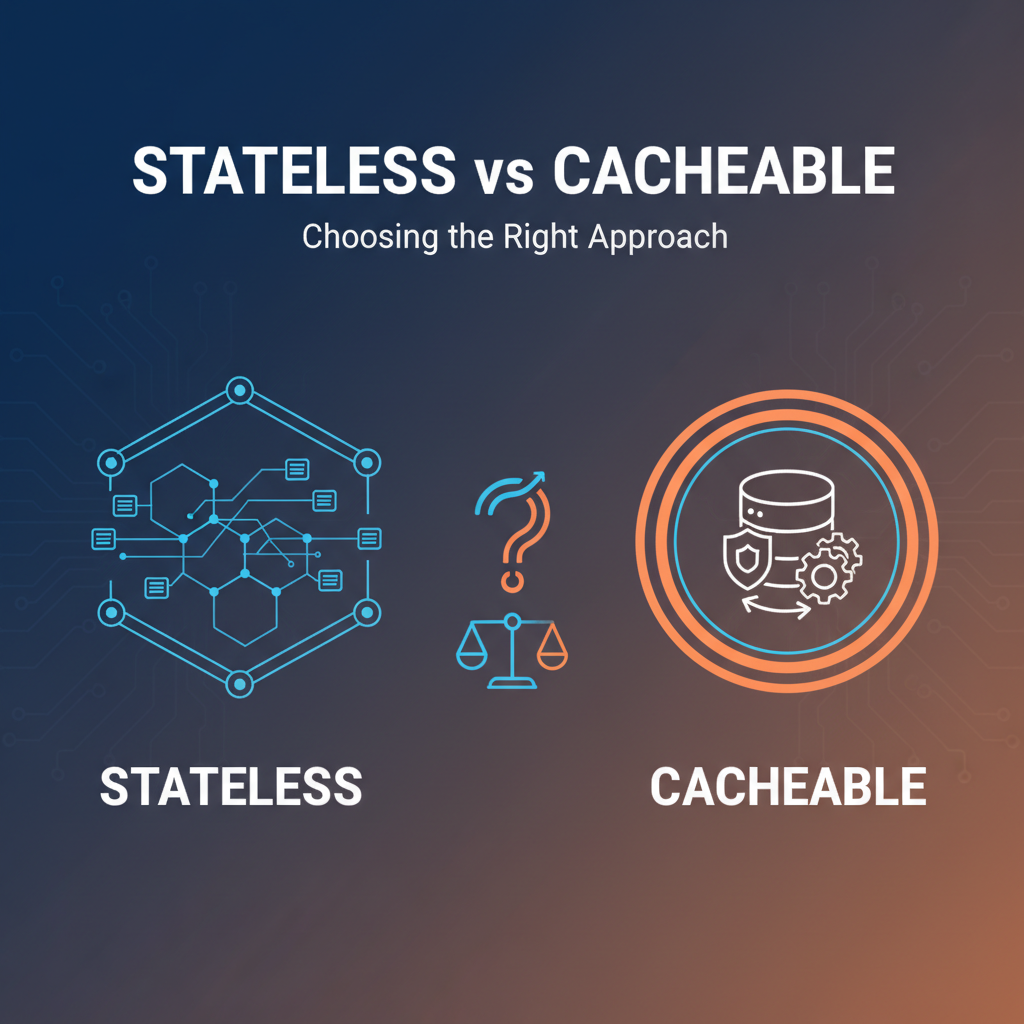


In the complex tapestry of modern software architecture, where distributed systems, microservices, and Application Programming Interfaces (APIs) form the backbone of countless applications, the fundamental design choices made at the architectural level profoundly impact performance, scalability, resilience, and maintainability. Among the most critical of these decisions are the adoption of statelessness and the strategic implementation of caching. These two concepts, while distinct, often intersect and complement each other, shaping how applications interact with data and how efficiently they serve users. Understanding the nuances, advantages, and challenges associated with both stateless and cacheable approaches is not merely an academic exercise; it is an imperative for architects, developers, and system administrators striving to build robust, high-performing, and cost-effective digital experiences.
The journey through the intricacies of stateless versus cacheable design begins with a foundational understanding of each paradigm in isolation, before exploring their symbiotic relationship and the practical considerations that guide their application. We will delve into how these principles manifest in real-world scenarios, particularly within the context of API development and management, and examine the pivotal role of an API gateway in orchestrating these strategies. This comprehensive exploration aims to equip readers with the knowledge to make informed decisions, ensuring that their systems are not only functional but also optimized for the demands of an ever-evolving digital landscape.
Understanding Stateless Architectures: The Foundation of Scalability
A stateless architecture is predicated on the principle that the server retains no client-specific information (state) between successive requests. Each request from a client to a server is treated as an independent transaction, containing all the necessary information for the server to fulfill that request without relying on any previous interactions. This design philosophy stands in stark contrast to stateful systems, where servers maintain session-specific data, often linking subsequent requests to prior ones. The implications of this fundamental difference reverberate throughout the entire system, affecting everything from resource utilization to deployment flexibility.
Definition and Core Characteristics
At its heart, statelessness means that the server doesn't remember anything about the client from one request to the next. When a client sends a request, it must provide all the context required for the server to process it. For instance, if a client is authenticated, it might send an API key or a JSON Web Token (JWT) with every request, rather than relying on the server to remember its authenticated status from a previous login. This self-contained nature of each request is a defining characteristic, ensuring that no server-side resources are perpetually tied to a particular client session. The server processes the request, sends a response, and then forgets about that specific interaction, effectively resetting its internal state relevant to that client.
Advantages of a Stateless Approach
The benefits of adopting a stateless architecture are numerous and compelling, particularly in the realm of distributed systems and microservices:
- Exceptional Scalability: Perhaps the most significant advantage of statelessness is the ease with which systems can scale horizontally. Since no server holds unique client state, any available server instance can handle any incoming request. This means new server instances can be added or removed dynamically behind a load balancer without disrupting ongoing client sessions or requiring complex state migration. This elasticity is crucial for applications experiencing variable or rapidly growing traffic loads, allowing them to adapt gracefully to demand spikes.
- Enhanced Resilience and Fault Tolerance: In a stateless environment, the failure of a single server instance does not lead to the loss of client sessions or data, as there is no session-specific data stored on that server. If a server goes down, the load balancer simply redirects subsequent requests from that client (or any other client) to a different, healthy server instance. This inherent fault tolerance significantly improves the overall reliability and uptime of the system, minimizing the impact of individual component failures.
- Simplified Load Balancing: Because any server can process any request, load balancers have an easier job distributing traffic evenly. They don't need to employ sticky sessions (where a client is always routed to the same server to maintain state), which can complicate load distribution and reduce the effectiveness of horizontal scaling. This simplicity in load balancing contributes to better resource utilization and more predictable performance under high loads.
- Reduced Server-Side Complexity: Eliminating the need to manage and synchronize client-specific state across multiple servers significantly reduces the complexity of the server-side application logic. Developers can focus on processing individual requests rather than grappling with distributed state management issues, such as replication, consistency, and session recovery, which are notoriously challenging problems in distributed computing.
- Improved Resource Utilization: Without the burden of maintaining state, servers can process requests more efficiently. Resources like memory and CPU are not tied up holding onto idle session data, allowing servers to dedicate their capacity to active request processing. This can lead to better throughput and potentially lower infrastructure costs.
Disadvantages and Challenges
Despite its many advantages, the stateless approach is not without its challenges:
- Potential for Redundant Data Transfer: For applications that require persistent user identity or preferences across many requests, the client might need to send the same contextual information repeatedly. This could lead to increased network traffic and slightly larger request payloads, as opposed to a stateful system where this information might be looked up server-side after an initial identification.
- Client-Side or External State Management: While the server remains stateless, the overall application might still require state. This state must then be managed either on the client side (e.g., in cookies, local storage, or application memory) or offloaded to an external, shared state store (e.g., a distributed cache like Redis, a database, or a dedicated session service). While externalizing state preserves server statelessness, it introduces its own set of complexities related to managing and ensuring the availability and consistency of this external state.
- Increased Processing Per Request (Potentially): If every request requires re-validation of credentials, re-computation of certain data, or re-retrieval of user preferences from an external store, each individual request might incur a slightly higher processing overhead compared to a stateful system that has readily available in-memory state. However, this is often offset by the gains in scalability and resilience.
Use Cases and Practical Implementations
Stateless architectures are pervasive in modern software, with prime examples found in:
- RESTful APIs: The Representational State Transfer (REST) architectural style, a cornerstone of web services, strongly advocates for statelessness. Each REST API request should contain all the information needed to understand and process the request, making RESTful services inherently scalable and robust.
- Web Servers: Traditional web servers (like Apache or Nginx) are often configured to be stateless, serving static content or proxying requests without maintaining client-specific session data.
- Microservices: The independent deployment and scaling of microservices are greatly facilitated by stateless design. Each microservice can operate autonomously, handling requests based solely on the input provided, simplifying inter-service communication and reducing coupling.
Deep Dive: Authentication and Authorization in Stateless Systems
In stateless systems, traditional session-based authentication (where the server creates a session ID and stores it) is replaced by mechanisms that allow each request to be independently verifiable.
- JSON Web Tokens (JWTs): A JWT is a compact, URL-safe means of representing claims to be transferred between two parties. When a user authenticates, the server issues a JWT, which the client then includes in the header of subsequent requests. The server can verify the token's signature (without needing to query a database) to authenticate and authorize the request. This completely avoids server-side session storage.
- API Keys: For machine-to-machine communication or public APIs, API gateways often use API keys. The client sends a unique key with each request, which the gateway validates against a backend store or an in-memory cache to grant access.
- OAuth 2.0: While OAuth is primarily an authorization framework, its tokens (access tokens, refresh tokens) are often implemented as stateless credentials (like JWTs) that can be verified independently by resource servers.
Deep Dive: Session Management Strategies for Stateless Systems
Even in stateless architectures, applications often need to manage user sessions for personalization or persistent interactions. When server instances themselves do not store state, external mechanisms are employed:
- Client-Side Cookies/Local Storage: Basic session data, like user preferences or non-sensitive shopping cart items, can be stored in browser cookies or local storage. However, this approach is limited by size and security concerns for sensitive data.
- Distributed Session Stores: For more robust session management, external data stores like Redis, Memcached, or even a dedicated database are used. When a user authenticates, their session data is stored in this central, highly available, and replicated store. Each server instance can then retrieve the session data for a given request, process it, and update it back in the store. While servers remain stateless (they don't own the state), the overall system relies on a separate stateful component. This pattern is commonly observed in the context of an api gateway managing user sessions and routing requests to stateless backend services.
The stateless approach, by disentangling the server from the client's conversational history, provides a resilient and highly scalable foundation, making it the preferred architectural style for many modern distributed applications. However, its efficiency can be significantly enhanced when combined with another powerful paradigm: caching.
Understanding Cacheable Architectures: Accelerating Data Delivery
While statelessness focuses on independence and scalability at the server level, cacheability is concerned with optimizing data access and delivery. A cacheable architecture leverages stored copies of data, strategically placed closer to the point of consumption, to accelerate retrieval and reduce the load on primary data sources. This principle is vital for improving performance, user experience, and overall system efficiency, especially in environments where data access is frequent and expensive.
Definition and Core Characteristics
Caching involves storing frequently accessed or computationally intensive data in a temporary, fast-access location. When a request for this data arrives, the system first checks the cache. If the data is found in the cache (a "cache hit"), it is served directly from there, bypassing the slower original source (like a database or a backend service). If the data is not in the cache (a "cache miss"), the system retrieves it from the original source, serves it to the client, and typically stores a copy in the cache for future requests. The primary characteristic of a cacheable system is its ability to intelligently store and retrieve data copies, thereby reducing latency and minimizing repeated processing or data fetching from the origin.
Types of Caching and Their Placement
Caching can occur at various layers within a system, each offering different benefits and trade-offs:
- Client-Side Caching:
- Browser Cache: Web browsers store static assets (images, CSS, JavaScript) and sometimes API responses locally. Subsequent requests for the same resources can be served instantly from the browser's cache, eliminating network round trips. HTTP headers like
Cache-ControlandExpiresare critical for controlling browser caching behavior. - Application Cache: Mobile apps or desktop applications can cache data locally for offline access or faster UI rendering.
- Browser Cache: Web browsers store static assets (images, CSS, JavaScript) and sometimes API responses locally. Subsequent requests for the same resources can be served instantly from the browser's cache, eliminating network round trips. HTTP headers like
- Proxy Caching:
- Content Delivery Networks (CDNs): CDNs are distributed networks of proxy servers located geographically closer to users. They cache static and sometimes dynamic content, significantly reducing latency for globally dispersed users and offloading traffic from origin servers.
- Reverse Proxies/Load Balancers: Services like Nginx, Varnish Cache, or an API gateway can act as reverse proxies that cache responses from backend services. When multiple clients request the same data, the proxy can serve it from its cache, protecting the backend from repetitive requests. This is a common and effective strategy for API gateways handling high volumes of read requests.
- Server-Side Caching:
- In-Memory Cache: Application servers can store frequently accessed data in their own memory (e.g., using libraries like Guava Cache or Ehcache in Java). This offers the fastest access but is limited by the server's memory capacity and is not shared across multiple server instances.
- Distributed Caches: For shared, scalable caching across multiple application instances, dedicated distributed caching systems like Redis or Memcached are used. These systems store data in a cluster of servers, providing high availability and allowing applications to access a unified cache store.
- Database Caching: Databases themselves often have internal caching mechanisms (e.g., query caches, buffer pools) to store frequently accessed data blocks or query results.
Advantages of a Cacheable Approach
Integrating caching strategically into an architecture yields substantial benefits:
- Significantly Reduced Latency: By serving data from a cache, which is typically much faster than fetching it from a database or performing complex computations, the response time for clients is drastically improved. This leads to a snappier and more responsive user experience.
- Reduced Load on Backend Servers: Caching offloads a substantial portion of the request volume from backend services, databases, and computation engines. This allows backend systems to handle a greater number of unique or write-heavy requests without being overwhelmed, improving their overall stability and availability. An api gateway with robust caching can be particularly effective in shielding backend microservices from excessive read traffic.
- Improved Throughput and Performance: With fewer requests hitting the backend and faster response times, the system as a whole can handle a much higher volume of requests per second (throughput). This directly translates to better scalability and the ability to serve more users concurrently.
- Cost Savings: By reducing the load on primary data sources and computational services, caching can indirectly lead to cost savings. Less powerful (or fewer) backend servers might be needed, and database read replica scaling can be optimized. Reduced egress bandwidth costs can also be a factor, especially with CDN caching.
Disadvantages and Challenges
Despite its benefits, caching introduces its own set of complexities:
- Cache Invalidation Complexity (The "Hardest Problem"): Deciding when and how to remove or update stale data in the cache is notoriously difficult. If cached data becomes outdated but is still served, it leads to data inconsistency and potentially incorrect application behavior. Strategies range from simple time-to-live (TTL) expiration to complex event-driven invalidation.
- Staleness Issues: There's an inherent trade-off between freshness and performance. Aggressive caching leads to better performance but increases the risk of serving stale data. Applications must determine their acceptable level of data staleness.
- Increased Memory/Storage Requirements: Caches require dedicated memory or storage capacity. For very large datasets or complex data structures, this can become a significant resource overhead and cost.
- Consistency Challenges in Distributed Caches: In distributed caching systems, ensuring that all cached instances are consistent, especially during updates, adds complexity. Various consistency models (eventual, strong) exist, each with its own implications.
- Cache Coherence: When multiple caches store the same data, ensuring they all reflect the most current version is a challenge. This becomes especially relevant in highly distributed environments.
Use Cases and Practical Implementations
Caching is indispensable in many application scenarios:
- Read-Heavy Applications: Websites, social media feeds, news portals, e-commerce product catalogs where read operations vastly outnumber write operations are prime candidates for extensive caching.
- Static and Semi-Static Content: Images, videos, CSS, JavaScript files, and infrequently updated textual content (e.g., blog posts, documentation) are perfectly suited for caching at multiple layers, especially CDNs and browser caches.
- Frequently Accessed Dynamic Content: User profiles, personalized dashboards, or aggregated reports that are complex to generate but viewed often can be cached for a short period.
- API Responses: Many APIs, especially those providing data feeds or querying information, can greatly benefit from caching their responses, thereby reducing the load on backend services. An API gateway is an ideal place to implement this kind of caching.
Deep Dive: HTTP Caching Headers
HTTP provides powerful mechanisms for controlling caching behavior, primarily through response headers:
Cache-Control: This header dictates who can cache the response, for how long, and under what conditions.public: Can be cached by any cache (client, proxy, CDN).private: Can only be cached by the client (browser), not shared proxies.no-store: Do not cache anything.no-cache: Cache, but revalidate with the origin server before serving.max-age=<seconds>: Specifies the maximum amount of time a resource is considered fresh.s-maxage=<seconds>: Similar tomax-agebut applies only to shared caches (proxies, CDNs).
ETag: An entity tag is an opaque identifier assigned by the web server to a specific version of a resource. If the client has an ETag, it can send anIf-None-Matchheader with a subsequent request. If the ETag matches, the server returns a304 Not Modifiedstatus, and the client uses its cached copy.Last-Modified: Similar to ETag, but uses a timestamp. The client can send anIf-Modified-Sinceheader. If the resource hasn't changed since that timestamp, a304 Not Modifiedis returned.Expires: An older HTTP/1.0 header that specifies a date/time after which the response is considered stale.Cache-Control: max-ageis generally preferred as it's relative to the request time.
Deep Dive: Cache Eviction Policies
When a cache fills up, it needs a strategy to decide which items to remove to make space for new ones. Common eviction policies include:
- Least Recently Used (LRU): Discards the least recently used items first. This is very popular and effective, assuming recently used items are likely to be used again.
- Least Frequently Used (LFU): Discards items that have been used the fewest times. This can be complex to implement as it requires tracking access counts.
- First-In, First-Out (FIFO): Discards the oldest item first, regardless of how often it's been accessed. Simple but often less efficient than LRU.
- Random Replacement (RR): Randomly discards items. Simple but generally least effective.
- Time-To-Live (TTL): Items expire after a fixed duration. This is often combined with other policies.
The strategic implementation of caching, despite its inherent complexities, is an indispensable tool for building high-performance, scalable, and cost-efficient applications. When combined with the principles of statelessness, it forms a potent combination capable of addressing the rigorous demands of modern distributed systems.
The Interplay: Statelessness and Cacheability – A Symbiotic Relationship
It is crucial to understand that statelessness and cacheability are not mutually exclusive architectural paradigms; rather, they are often complementary and frequently employed together to achieve optimal system performance and scalability. A well-designed system, especially one built around APIs and microservices, will typically embrace statelessness at its core while intelligently layering caching mechanisms on top. The magic often happens at the intersection of these two concepts, where the inherent benefits of each reinforce the other.
Not Mutually Exclusive: How They Work Together
A truly stateless API, by definition, does not store any session-specific data on the server. Each request carries all the necessary information, making it inherently independent and highly scalable. However, while a server instance might not retain state about a specific client session, it might frequently access shared data that doesn't change often. This shared, read-only or infrequently updated data is where caching perfectly fits into a stateless design.
Consider a public API endpoint that provides current stock prices, weather forecasts, or a list of available products. The service handling these requests can be entirely stateless: it receives a request, fetches the data, and returns it. It doesn't need to remember who made the previous request. Now, imagine this API is hit thousands of times per second. If each request triggers a fresh call to an external stock exchange data feed or a complex database query for product information, the backend systems will quickly become overwhelmed, regardless of how many stateless server instances are running.
This is precisely where caching steps in. An API gateway, a reverse proxy, or even the application itself, can cache the responses for these common, stable data requests. When a request for stock prices comes in, the caching layer (which itself can be stateless in terms of client sessions but stateful in terms of data storage) can immediately serve the pre-fetched data. The backend stateless service only gets hit when the cache expires or the data is not present, thereby dramatically reducing its workload.
In this scenario, the stateless nature of the backend services ensures excellent horizontal scalability and resilience, while the caching layer adds a crucial dimension of performance optimization and load reduction. The client's request experience is faster, the backend servers are less stressed, and the overall system is more efficient.
When Statelessness Alone is Sufficient
There are contexts where the benefits of statelessness outweigh the need for pervasive caching, or where caching provides minimal advantage. This is often the case for:
- Highly Dynamic or Real-time Data: If data changes constantly and must be absolutely fresh (e.g., real-time bidding platforms, high-frequency trading apis), aggressive caching can lead to unacceptable staleness. While micro-caching (very short TTLs) might be considered, the primary focus remains on direct, stateless access to the most current information.
- Write-Heavy Operations: For operations that modify data (e.g., creating a user account, placing an order, updating a record), caching offers little benefit in speeding up the write itself and introduces significant cache invalidation complexities if the write needs to be reflected instantly. While read-after-write might involve cache updates, the core write operation is typically stateless.
- Unfrequently Accessed Data: If a particular API endpoint or data segment is rarely accessed, the overhead of managing a cache for it might not be justified. The cache hit ratio would be very low, making the cache ineffective.
In these situations, the inherent scalability and resilience of a purely stateless backend are the primary architectural drivers, ensuring that each request is processed independently and correctly, even if it means hitting the origin data source every time.
When Caching Becomes Essential for Stateless Services
Conversely, caching transforms a merely scalable stateless service into a high-performance, resilient one when:
- High Read-to-Write Ratio: Services that primarily serve data (e.g., public data apis, content feeds, product listings) benefit immensely. Caching reduces the load on databases and computation engines, allowing them to focus on fewer, more complex tasks.
- Predictable and Stable Data: Data that doesn't change rapidly (e.g., user profiles, configuration settings, static assets) can be cached for extended periods, providing significant performance gains with minimal risk of staleness.
- Performance Bottlenecks at the Backend: If the backend database or computational service is struggling to keep up with request volume, even with horizontal scaling of stateless application servers, caching becomes a crucial defense mechanism, absorbing the bulk of repetitive read requests.
- Geographically Distributed Users: For global applications, caching at the edge (CDN or regional API gateway) brings content physically closer to users, drastically reducing latency and improving perceived performance, regardless of the statelessness of the origin service.
The Critical Role of an API Gateway in Harmonizing Both
An API gateway is a powerful architectural component that sits at the edge of an organization's systems, acting as a single entry point for all client requests to its internal APIs and services. It plays a pivotal role in enforcing and leveraging both statelessness and cacheability.
On the one hand, an API gateway inherently supports the stateless design of backend services. It can:
- Process Stateless Authentication: A gateway can validate JWTs, API keys, or OAuth tokens on behalf of the backend services, ensuring that authenticated requests are forwarded without the backend needing to maintain session state.
- Enforce Rate Limiting and Quotas: These policies are typically applied per-request or per-client, without requiring the gateway to track long-term session state, aligning with stateless principles.
- Handle Request Routing and Load Balancing: The gateway efficiently directs incoming requests to appropriate backend services, often without needing sticky sessions, thanks to the stateless nature of these services.
On the other hand, an API gateway is an ideal location to implement caching strategies for stateless backend services:
- Edge Caching: By caching responses at the gateway itself, it prevents identical requests from even reaching the backend services. This provides immediate performance benefits and significantly reduces the load on the entire downstream infrastructure. The gateway can intelligently manage cache entries, applying
Cache-Controlheaders, TTLs, and other invalidation strategies. - Centralized Cache Management: A gateway provides a centralized point to configure and monitor caching policies across multiple APIs, ensuring consistency and ease of management.
- Traffic Reduction: Beyond reducing load, caching at the gateway can also cut down on internal network traffic between the gateway and backend services.
Consider a platform like APIPark. As an open-source AI gateway and API management platform, APIPark is specifically designed to facilitate unified API management, integration, and deployment for both AI and REST services. Its architecture naturally supports the principles discussed. For instance, its capability to integrate 100+ AI models with a unified API format means that the invocation of these models can be handled in a stateless manner by the core application logic, while APIPark itself, acting as the gateway, can implement efficient caching mechanisms for frequently requested AI model outputs or common prompt responses. This dramatically enhances performance and reduces the computational load on the AI models themselves. Features like its high performance (over 20,000 TPS) highlight its ability to handle large-scale traffic for both stateless and cache-optimized APIs, further supported by detailed API call logging and powerful data analysis for monitoring and optimizing these strategies.
In essence, an API gateway acts as a strategic buffer, allowing backend services to remain lean and stateless, focusing solely on their core business logic, while the gateway handles the complexities of security, routing, and, critically, performance optimization through caching. This synergy allows organizations to build systems that are both highly scalable and incredibly performant, delivering an optimal experience to end-users.
Choosing the Right Approach: Factors to Consider
The decision to lean more heavily on statelessness, caching, or a combination of both is rarely a one-size-fits-all solution. It's a strategic architectural choice that must be informed by a thorough understanding of the application's specific requirements, operational context, and future growth trajectories. Architects and developers must weigh various factors, carefully balancing performance, scalability, consistency, and complexity.
1. Data Volatility: How Often Does the Data Change?
This is perhaps the most critical factor influencing caching decisions.
- Highly Volatile Data (e.g., real-time sensor readings, stock market tickers): Data that changes every second or minute is generally unsuitable for aggressive caching. Caching such data risks serving stale information, which can lead to critical errors or poor user experience. While very short TTLs (seconds) or cache invalidation triggered by real-time events can be considered, the primary approach here will typically favor direct, stateless access to the origin to ensure freshness. The overhead of constant invalidation might negate caching benefits.
- Moderately Volatile Data (e.g., user profiles, product inventory, news feeds): Data that updates every few minutes or hours can be an excellent candidate for caching. A reasonable TTL (e.g., 5-15 minutes) can provide significant performance benefits without causing major staleness issues. Event-driven invalidation (e.g., invalidating a user profile cache entry when the user updates their profile) can further optimize this.
- Low Volatility / Static Data (e.g., configuration settings, static assets, old blog posts): Data that changes rarely or never is ideal for aggressive caching, with long TTLs (hours, days, or even indefinite). CDNs and client-side caches are extremely effective here, drastically reducing load on origin servers.
2. Read vs. Write Ratio: The Dominant Operation Type
The nature of interactions with your system heavily dictates the caching strategy.
- Read-Heavy Systems (e.g., content sites, e-commerce product browsing, public APIs): Applications where clients primarily retrieve information (GET requests) benefit tremendously from caching. Caching absorbs the majority of read requests, protecting backend databases and services from being overwhelmed. The stateless nature of the read operations further facilitates horizontal scaling of the read path.
- Write-Heavy Systems (e.g., transactional systems, social media posting, IoT data ingestion): For applications dominated by data modification (POST, PUT, DELETE operations), caching offers less direct benefit to the write operation itself. In fact, caching introduces complexity due to the need for immediate cache invalidation or update after a write to ensure consistency. Statelessness is paramount for write operations to ensure atomicity and correct processing of each transaction. Caching might still be used for subsequent reads of the newly written data, but it requires careful coordination.
3. Scalability Requirements: Handling Growth
Both statelessness and cacheability contribute to scalability, but in different ways.
- Statelessness for Horizontal Scalability: A stateless design is the cornerstone for easy horizontal scaling. Adding more server instances behind a load balancer immediately increases capacity without complex session management or data synchronization concerns between instances. This is fundamental for growing to meet increasing request volumes.
- Caching for Load Reduction and Throughput: Caching enhances scalability by reducing the effective load on backend systems. By serving requests from a fast cache, it allows a smaller number of backend instances to handle a much higher overall request volume. This improves throughput and allows the system to scale its effective capacity significantly beyond the raw capacity of its backend servers. For example, an API gateway with caching can absorb spikes in read requests, allowing backend services to maintain stable performance.
4. Performance Targets: Latency and Throughput Demands
Specific performance metrics will guide your choices.
- Low Latency Demands: If sub-millisecond or single-digit millisecond response times are critical, caching at the closest possible point to the user (client, edge gateway, in-memory cache) becomes essential. The overhead of database queries or complex computations must be minimized.
- High Throughput Demands: To handle thousands or tens of thousands of requests per second, a combination of horizontally scaled stateless services and robust caching layers is almost always necessary. The stateless nature allows adding more processing units, while caching reduces the workload per unit, multiplying the overall capacity. APIPark, for instance, boasts performance rivaling Nginx, achieving over 20,000 TPS, which speaks directly to its capability to handle high throughput, partly through efficient request routing and potentially integrated caching mechanisms.
5. Consistency Requirements: Strict vs. Eventual
The acceptable level of data freshness directly impacts caching decisions.
- Strict Consistency: If clients absolutely must see the most up-to-the-second data (e.g., banking transactions, critical inventory updates), caching is very challenging. Any cached data introduces the risk of staleness. If caching is used, it must be paired with extremely aggressive, synchronous invalidation, which can add significant complexity and overhead. Often, direct, stateless access to the authoritative data source is preferred, accepting higher latency for guaranteed consistency.
- Eventual Consistency: For many applications (e.g., social media feeds, content platforms, most read operations), a slight delay in data propagation is acceptable. Here, caching is highly beneficial. Data can be cached for a certain period, and even if it's slightly stale, it doesn't break the user experience. The system eventually becomes consistent.
6. Complexity Tolerance: Managing the Trade-offs
Both approaches simplify some aspects while complicating others.
- Stateless Simplicity (Server-Side): Eliminates complex distributed session management on the server, simplifying application logic. However, it shifts state management responsibility either to the client or to an external, shared state service, which introduces its own complexity.
- Caching Complexity (Cache Invalidation): While conceptually simple, managing cache invalidation effectively is one of the hardest problems in computer science. Incorrect cache invalidation can lead to elusive bugs, data inconsistency, and a poor user experience. Implementing robust invalidation strategies (TTL, pub/sub for event-driven invalidation) adds architectural complexity. The choice depends on the team's ability to manage this complexity.
7. Resource Constraints: Memory, CPU, and Network
Infrastructure limitations play a role.
- Memory/Storage: Caches require memory or storage. For very large datasets, this can be a significant cost. Distributed caches help by pooling resources, but it's still a factor.
- CPU: While caching reduces CPU load on backend servers, the caching layer itself consumes CPU for cache lookups, policy enforcement, and data serialization/deserialization. Stateless services generally consume CPU proportional to incoming request volume.
- Network Bandwidth: Stateless services might send more redundant data. Caching, especially at the edge, dramatically reduces network traffic to origin servers.
8. Cost Implications: Infrastructure and Operational Expenses
Architectural choices have direct financial consequences.
- Reduced Backend Infrastructure: Effective caching can reduce the number or size of expensive backend servers and database instances required, leading to lower hosting costs.
- Caching Infrastructure Costs: Implementing distributed caches (Redis clusters, CDN services) incurs its own costs in terms of software licenses, hosting, and operational overhead.
- Development and Maintenance: The initial development and ongoing maintenance of complex cache invalidation logic can be costly. Stateless systems might have simpler initial development but could require robust external state management.
Ultimately, choosing the right approach is about making informed trade-offs. It requires a deep understanding of the application's unique access patterns, data characteristics, and business requirements. Often, the most robust and performant solutions strategically combine both stateless backend services with intelligent, multi-layered caching, carefully considering where each principle delivers the most value while minimizing its associated drawbacks. The role of an API gateway becomes paramount in orchestrating these strategies, providing a centralized control point for both stateless request handling and optimized caching.
APIPark is a high-performance AI gateway that allows you to securely access the most comprehensive LLM APIs globally on the APIPark platform, including OpenAI, Anthropic, Mistral, Llama2, Google Gemini, and more.Try APIPark now! 👇👇👇
Implementation Strategies and Best Practices
Having understood the theoretical underpinnings and the factors influencing choice, the next step is to translate these concepts into actionable implementation strategies. Effectively leveraging both statelessness and caching requires adherence to best practices in design and deployment, ensuring that systems are robust, performant, and maintainable.
Designing Stateless APIs
Crafting truly stateless APIs involves more than just avoiding server-side sessions; it requires a conscious effort to make each interaction self-contained and predictable.
- Idempotency for Write Operations: While the core of statelessness applies to all request types, it’s particularly critical for write operations (POST, PUT, DELETE) to consider idempotency. An idempotent operation is one that produces the same result regardless of how many times it is performed. For example,
PUT /users/123to update user 123 should have the same effect whether executed once or five times.DELETE /users/123should also be idempotent. This is vital in distributed systems where network failures might cause retries. Stateless services should be designed such that repeating a request doesn't cause unintended side effects. For non-idempotent POSTs (e.g., creating a new user), the client must receive a unique identifier (like a UUID) for the new resource in the first response, which it can then use for subsequent idempotent operations. - Self-Descriptive Messages: Each API request and response should contain all the information necessary for its understanding without relying on prior context. This includes clear resource identifiers, standard HTTP methods, and appropriate status codes. Request bodies should be complete, and responses should provide enough data for the client to proceed.
- Leveraging Hypermedia (HATEOAS): While not strictly a requirement for statelessness, the HATEOAS (Hypermedia As The Engine Of Application State) principle within REST further reinforces it. By including links in API responses that guide the client on what actions it can take next, the server effectively communicates the available "application state" through representations, eliminating the need for the server to maintain session state for navigation. The client interacts with the application by following these links, making each interaction fully self-guided.
- Stateless Authentication: As discussed earlier, employing mechanisms like JWTs, API keys, or OAuth tokens ensures that each request carries its own proof of authentication and authorization. The server (or API gateway) can validate these tokens without needing to consult a shared session store for every request, maintaining its stateless character. This approach simplifies horizontal scaling, as any server instance can validate any token.
Implementing Caching Effectively
Strategic caching is an art form, requiring careful consideration of placement, policies, and invalidation.
- Choosing the Right Caching Layer:
- Client-Side: Best for static assets, highly personalized data, or supporting offline modes. Control with
Cache-Control,Expires. - CDN: Ideal for global distribution of static and semi-static content, reducing latency for geographically dispersed users.
- Reverse Proxy / API Gateway: Excellent for caching common API responses, protecting backend services, and enforcing global caching policies. This is often the first and most effective layer for dynamic content caching.
- Application Cache (In-Memory/Distributed): For application-specific data that benefits from very low-latency access and needs to be shared across service instances (distributed cache). Choose solutions like Redis or Memcached for distributed, high-performance caching.
- Database Caching: Often handled internally by the database, but application-level query caching can also be implemented.
- Client-Side: Best for static assets, highly personalized data, or supporting offline modes. Control with
- Strategic Use of HTTP Caching Headers: For web-based APIs, mastering HTTP caching headers (
Cache-Control,ETag,Last-Modified) is fundamental. These headers provide powerful directives to clients and intermediary caches (like CDNs and API gateways) on how to cache resources, for how long, and under what conditions. Correctly configured headers can drastically improve cache hit ratios and reduce backend load. - Implementing Robust Cache Invalidation: This is the most challenging aspect of caching.
- Time-To-Live (TTL): The simplest approach, where cached items expire after a fixed duration. Suitable for moderately volatile data where some staleness is acceptable.
- Event-Driven Invalidation (Cache Busting): When data changes, a notification (e.g., via a message queue like Kafka or RabbitMQ) is sent to invalidate the relevant cache entries. This ensures data freshness but adds complexity in distributed systems. For example, when a user profile is updated, an event triggers the invalidation of that specific user's cached profile.
- Versioned URLs: For static assets or immutable API responses, including a version number or hash in the URL (
/js/app.v123.js,/api/products/latest_v2) allows aggressive caching with very long TTLs. When the content changes, the URL changes, effectively "busting" the old cache entry. - Stale-While-Revalidate/Stale-If-Error: Advanced
Cache-Controldirectives that allow serving stale content while asynchronously revalidating it in the background, or serving stale content if the origin server is unavailable. This improves perceived performance and resilience.
- Monitoring Cache Hit Ratio and Performance: Regularly monitor key caching metrics: cache hit rate, cache miss rate, latency reduction, and memory usage. A low hit rate might indicate inefficient caching strategies, while high latency might suggest cache contention or misconfiguration. Tools provided by an API gateway (like the detailed API call logging and powerful data analysis features of APIPark) can be invaluable for understanding how caching strategies are performing and identifying areas for optimization.
- Considering Distributed Caching Solutions: For high-traffic applications that need to share cached data across multiple application instances, distributed caches like Redis, Memcached, or Apache Ignite are essential. They offer high availability, replication, and sophisticated data structures, making them powerful tools for scaling cacheable data.
The Integral Role of an API Gateway
The API gateway stands as a linchpin in harmonizing stateless and cacheable strategies. It can manage a myriad of functions that support both:
- Unified API Format and Orchestration: A platform like APIPark offers a unified API format, simplifying how backend AI models or REST services are invoked. This abstraction allows the backend services to remain stateless and focused on their specific logic, while the gateway handles the complexities of routing and data transformation.
- Centralized Security and Authentication: The gateway offloads authentication (JWT validation, API key verification) from individual services, ensuring that backend services only receive authenticated, authorized requests. This maintains statelessness at the service level.
- Rate Limiting and Throttling: The gateway can enforce rate limits to protect backend services from overload, without requiring the services themselves to manage this state.
- Edge Caching: As highlighted, an API gateway is a prime location for implementing caching. It can store responses from frequently accessed API endpoints, significantly reducing latency and backend load. This feature is particularly powerful when dealing with read-heavy APIs or when integrating AI models where repeated invocations with the same inputs can yield identical results.
- Traffic Management: Load balancing, circuit breaking, and retry mechanisms implemented at the gateway level contribute to the resilience of the entire system, regardless of the stateless or cacheable nature of individual services.
- Monitoring and Analytics: Comprehensive logging and data analysis provided by an advanced gateway allow architects to observe the real-world impact of their stateless and caching decisions, enabling continuous optimization.
By centralizing these cross-cutting concerns, an API gateway empowers backend services to adhere strictly to stateless principles, while simultaneously providing robust caching capabilities to boost overall system performance and efficiency. This integrated approach is fundamental to building scalable and resilient modern architectures.
Case Studies and Practical Scenarios
To illustrate the practical application and interaction of statelessness and caching, let's explore a few case studies that highlight their benefits and challenges. These examples demonstrate how these principles are applied in real-world API design and system architecture.
Case Study 1: A Purely Stateless Microservice – User Profile Management (Write Operations)
Scenario: Imagine a microservice responsible for managing user profiles (e.g., updating email, changing password, modifying preferences). This service is part of a larger system accessed via an API gateway.
Stateless Design: * Each request to update a user profile (e.g., PUT /users/{userId}) is entirely self-contained. The client sends the userId in the URL path and the new profile data in the request body, along with a JWT in the Authorization header. * The API gateway validates the JWT to ensure the client is authenticated and authorized to modify that specific user's profile. * The microservice receives the request, processes the update (e.g., updates a database record), and returns an appropriate HTTP status (e.g., 200 OK or 204 No Content). * The microservice retains no memory of previous requests from that client. If the same client sends another request immediately after, it's treated as a brand new, independent operation. * Idempotency: The PUT operation is designed to be idempotent. If the network temporarily fails and the client retries the PUT request, the database update happens only once, or multiple identical updates have the same end state.
Why Statelessness is Paramount: * Data Integrity: Each update is a distinct transaction, minimizing race conditions and ensuring data consistency. * Scalability: If the service experiences a surge in profile updates, new instances of the microservice can be spun up quickly. The API gateway distributes requests, and any instance can handle any update without needing to know about past interactions with that user, leading to seamless horizontal scaling. * Resilience: If one microservice instance crashes during an update, the API gateway can route the retry (if the client initiates one) to another healthy instance, and the stateless nature ensures the operation can proceed without loss of session context.
Role of Caching: * Limited Direct Caching: For write operations, direct caching of the response itself is often counterproductive or complex due to the need for immediate invalidation. Caching could potentially be used for read-after-write scenarios (e.g., caching the updated profile after the write is confirmed), but the write path itself is typically not cached. * External Cache Invalidations: If other services read user profiles and cache them, the profile update microservice would be responsible for sending an invalidation event to those caches upon a successful write, ensuring consistency.
Case Study 2: A Stateless API with Extensive Caching – Public Weather Data
Scenario: An API that provides current and forecasted weather data for various locations. This API is consumed by many client applications and experiences high read traffic.
Stateless Design: * Clients make requests like GET /weather?location=London or GET /forecast?location=NewYork. * Each request is independent. The backend weather service doesn't care if "London" was requested five minutes ago by the same client. * Authentication (e.g., via an API key validated by the API gateway) is also stateless.
Integration of Caching: * API Gateway Caching: The API gateway is configured to cache responses for weather and forecast APIs. * Cache-Control: public, max-age=300 (5 minutes) is set for the weather data API responses. * When a client requests GET /weather?location=London, the gateway checks its cache. * If a fresh entry for London exists, it immediately serves the cached response. This is a cache hit. * If not (cache miss or expired), the gateway forwards the request to the backend weather service. * The backend service fetches the latest data (e.g., from an external weather provider) and returns it. * The API gateway stores this response in its cache for 5 minutes before forwarding it to the client. * CDN for Static Assets: Any associated static assets (weather icons, CSS for embedded widgets) are served via a CDN with long Cache-Control headers. * Backend Micro-Caching: The backend weather service might also implement a very short, in-memory cache for external data provider calls to avoid overwhelming them if the API gateway cache misses frequently for a very short duration.
Why This Combination is Effective: * Performance: Users experience extremely fast response times because most requests are served directly from the API gateway's cache, eliminating network latency to the backend and the time required for data fetching. * Scalability: The backend weather service is shielded from the majority of traffic. It only needs to process requests when the cache misses. This allows a small number of stateless backend instances to handle massive read loads. * Cost Reduction: Fewer backend resources are needed, and potentially fewer calls to expensive external weather data providers. * Resilience: If the backend weather service temporarily goes down, the API gateway can continue serving stale (but still recent) data from its cache thanks to policies like stale-if-error, providing a better user experience during outages.
Case Study 3: The Challenges of Mixing State – E-commerce Shopping Cart
Scenario: An e-commerce system where users add items to a shopping cart. The shopping cart state needs to persist across multiple page views or API calls.
Initial (Problematic) Stateful Approach: * A traditional server-side session stores the shopping cart items. * This makes the system difficult to scale horizontally (requires sticky sessions or complex distributed session management). * If a server instance fails, the user's shopping cart state might be lost unless robust session replication is in place.
Stateless with External State (Recommended Approach): * Stateless Backend Services: The microservices (e.g., product catalog, order processing) remain stateless. They don't store the user's cart in their own memory. * External Distributed Session Store: The shopping cart data is stored in a highly available, distributed cache/database like Redis. * Client Identification: The client sends an identifier (e.g., a session ID stored in a secure cookie or a JWT payload) with each request. * API Gateway Role: The API gateway receives the request, validates the client, and forwards it to the appropriate microservice. * Microservice Interaction: When a microservice needs to access or modify the cart, it uses the client's identifier to fetch the cart data from Redis, performs the operation, and saves the updated cart back to Redis.
Why This Blended Approach Works: * Scalability: All backend microservices remain stateless, meaning they can scale horizontally without complex session synchronization. The burden of state management is offloaded to a specialized, highly scalable, and highly available external service (Redis). * Resilience: The failure of an individual microservice instance does not result in the loss of the shopping cart, as the state resides externally. * Performance (with Caching): Redis itself is a very fast in-memory data store, effectively acting as a high-performance cache for the shopping cart. For read-heavy operations on the cart (e.g., displaying the cart contents), it's served quickly from Redis.
These case studies underscore the power of thoughtfully combining stateless principles with strategic caching. While statelessness provides the architectural foundation for resilience and horizontal scalability, caching injects performance and efficiency, shielding backend systems from repetitive loads. An API gateway serves as the critical orchestrator, enabling these strategies to work in concert, delivering robust and high-performing applications.
Advanced Considerations in Modern Architectures
As systems grow in complexity and distributed nature, the interplay between statelessness and cacheability encounters more sophisticated challenges and opportunities. Modern architectural patterns and technologies offer new ways to optimize these paradigms.
Edge Computing and Caching
The rise of edge computing, where computation and data storage occur closer to the data sources and end-users rather than in centralized cloud data centers, profoundly impacts caching strategies.
- Decentralized Caching: Edge locations can host micro-caches or even full distributed caches. This drastically reduces latency for users accessing content or APIs served from a geographically proximate edge node.
- Reduced Backhaul Traffic: By processing and caching data at the edge, less data needs to be sent back to the central cloud, saving bandwidth and improving efficiency, especially for IoT devices generating vast amounts of data.
- Enhanced Resilience: Edge caches can continue serving content even if the connection to the central cloud is temporarily disrupted, improving local availability and user experience.
- API Gateway at the Edge: An API gateway can be deployed at edge locations to act as the primary caching and routing layer, bringing the benefits discussed earlier even closer to the end-users. This decentralizes the gateway function, further improving performance and fault tolerance.
Event-Driven Architectures and Cache Invalidation
Event-driven architectures (EDAs) offer a powerful mechanism to manage cache invalidation in complex, distributed systems.
- Publisher-Subscriber Model: When a data change occurs in a microservice (e.g., a product price update, a user profile modification), that service publishes an event (e.g., "ProductUpdated", "UserProfileChanged") to a message broker (like Kafka, RabbitMQ, or AWS SNS/SQS).
- Cache Listener: Other services, including caching layers or dedicated cache invalidation services, subscribe to these events. Upon receiving an event, they can selectively invalidate or update the relevant entries in their caches.
- Benefits: This approach ensures strong cache consistency without requiring synchronous calls between services. It decouples the data modification from the cache invalidation logic, improving system resilience and scalability.
- Complexity: Designing an effective event schema and ensuring reliable event delivery and processing can add significant architectural complexity. Careful consideration of eventual consistency models is also necessary.
Microservices and Caching Strategies
In a microservices architecture, where many small, independent services communicate via APIs, caching decisions become even more localized and nuanced.
- Local Caches (Within Microservice): Each microservice can implement its own in-memory cache for frequently accessed internal data (e.g., configuration, lookup tables) or data fetched from other services. This optimizes internal performance but doesn't benefit other services.
- Shared Distributed Caches (Across Microservices): For data that is frequently consumed by multiple microservices, a shared distributed cache (e.g., Redis cluster) can act as a common layer. This avoids each microservice from repeatedly fetching the same data from the original source. However, it requires careful management of cache keys and invalidation strategies.
- API Gateway Caching: As extensively discussed, the API gateway serves as a crucial caching layer before requests hit any microservice, significantly reducing overall system load. This is often the first line of defense for read-heavy microservice APIs.
- Data Aggregation Caching: If an API requires data from multiple microservices (e.g., a "dashboard" API), the aggregated response can be cached by a dedicated aggregation service or the API gateway itself.
The choice of caching strategy within a microservices ecosystem depends on the data's ownership, volatility, access patterns, and consistency requirements.
Serverless Functions and Statelessness
Serverless computing (e.g., AWS Lambda, Azure Functions, Google Cloud Functions) inherently promotes statelessness.
- Ephemeral Execution: Serverless functions are typically short-lived and executed in isolated environments. They do not maintain state between invocations. Each function invocation is a fresh start.
- Stateless by Design: This architectural model forces developers to design functions that are inherently stateless. Any required state must be externalized to databases, object storage, or distributed caches.
- Cold Starts and Caching: While functions are stateless, "cold starts" (the time it takes for a function to initialize) can impact latency. Caching at upstream layers (like an API gateway or CDN) or using external distributed caches (e.g., Redis for session data) becomes even more critical to maintain responsiveness, especially for interactive serverless APIs.
- APIPark's Relevance: For organizations leveraging serverless functions for their AI or REST services, an API gateway like APIPark can provide essential management, security, and performance layers. It can abstract the underlying serverless implementations, handle common concerns like authentication and rate limiting, and apply caching to boost the responsiveness of serverless API endpoints.
Security Implications for Both Approaches
Security is paramount and must be woven into both stateless and cacheable designs.
- Stateless Security:
- JWT Security: Proper signing algorithms (e.g., HS256, RS256), short expiration times, and secure storage on the client side are critical for JWTs. Revoking JWTs before expiration (e.g., upon logout or compromise) requires a separate mechanism, such as a blacklist or a short-lived token combined with refresh tokens.
- API Key Security: API keys must be kept confidential, transmitted over HTTPS, and access restricted by strong permissions and rate limits. API gateways play a key role in enforcing these.
- Data in Transit: All communication with stateless services should use HTTPS to protect the self-contained requests.
- Cacheable Security:
- Sensitive Data in Cache: Never cache highly sensitive or personalized data (e.g., PII, financial details) in public caches (CDNs, shared API gateway caches). If caching sensitive data is unavoidable, it must be encrypted in the cache and access strictly controlled. Private caches (client-side, application-specific) are generally safer, but still require careful consideration.
- Cache Poisoning: Protect against malicious actors injecting bad data into caches. This can happen through manipulated HTTP headers or compromised upstream services.
- Cache Invalidation for Security Events: If a user's permissions change, their related cached data should be immediately invalidated to prevent unauthorized access.
- Authentication Caching: Caching authentication decisions (e.g., whether a JWT is valid) can improve performance, but the cache TTL must be carefully balanced with the need for immediate revocation upon security events.
Integrating these advanced considerations ensures that architectural choices around statelessness and cacheability are not only performant and scalable but also secure and resilient in the face of evolving technological landscapes and user demands. The deliberate design of these systems, often facilitated by robust platforms like an API gateway, is key to long-term success.
Comparison Table: Stateless vs. Cacheable
To summarize the key differences and complementarities, the following table provides a concise comparison across various dimensions.
| Feature | Stateless Approach | Cacheable Approach |
|---|---|---|
| Core Principle | Server retains no client state between requests; each request is self-contained. | Stores copies of data closer to consumer to accelerate retrieval. |
| Primary Benefit | Horizontal scalability, resilience, simplified load balancing, fault tolerance. | Reduced latency, reduced backend load, improved performance/throughput. |
| Scalability | Excellent: Easy horizontal scaling by adding more server instances. | Indirect: Enhances scalability by reducing effective load on origin servers. |
| Performance | Good baseline; can suffer from repeated data transfer/computation per request. | Excellent: Drastically reduces response times and improves throughput. |
| Complexity | Simpler server-side logic; shifts state management to client/external service. | Introduces cache invalidation complexity ("hardest problem"). |
| Consistency | Strict: Each request gets the latest data (unless external state is stale). | Compromised: Risk of serving stale data; eventual consistency often accepted. |
| Data Volatility | Favored for highly dynamic/real-time data or write-heavy operations. | Ideal for static, semi-static, or read-heavy, moderately volatile data. |
| Resource Usage | Potentially more network bandwidth; less server memory for session state. | Increased memory/storage for cache; reduced backend CPU/database load. |
| Use Cases | RESTful APIs, microservices, transactional services, serverless functions. | Public APIs, content delivery, e-commerce product listings, user profiles. |
| API Gateway Role | Enforces stateless security, routing, rate limiting; ensures backend statelessness. | Implements edge caching, manages cache policies, reduces backend traffic. |
| Example | User profile update API (PUT), order processing API. | Public weather data API, image assets, blog posts. |
This table highlights that while distinct, statelessness lays the groundwork for robust, scalable systems, and cacheability provides the crucial layer of performance optimization. A sophisticated API gateway effectively mediates and enhances both.
Conclusion: Harmonizing for Optimal Architecture
The architectural choices between statelessness and cacheability are among the most impactful decisions in the design of modern software systems. Each paradigm offers distinct advantages, addressing different facets of system behavior, but their true power often lies in their synergistic application. Statelessness provides the fundamental bedrock of scalability, resilience, and simplicity for backend services, allowing them to expand horizontally and recover from failures with grace. It mandates that each interaction is a complete unit, fostering a highly distributed and robust environment.
Conversely, caching acts as a crucial accelerator, optimizing data delivery and significantly mitigating the load on core backend infrastructure. By strategically storing copies of data closer to the consumers, it dramatically reduces latency, improves throughput, and ultimately enhances the user experience, while also leading to considerable cost efficiencies. However, caching introduces its own set of complexities, most notably the perennial challenge of cache invalidation and the trade-offs between data freshness and performance.
The most effective modern architectures, particularly those built around APIs and microservices, deftly combine these two principles. They leverage stateless backend services to ensure inherent scalability and fault tolerance, while strategically implementing multi-layered caching (from client-side to CDNs, and crucially, at the API gateway) to achieve unparalleled performance and efficiency for read-heavy operations. An API gateway emerges as an indispensable orchestrator in this intricate dance, serving as a centralized point for enforcing stateless policies like authentication and rate limiting, while simultaneously acting as a powerful edge-caching layer to protect and optimize backend APIs. Platforms like APIPark exemplify how an API gateway can unify management, enhance performance through caching, and provide critical insights into API usage, empowering organizations to manage complex, hybrid architectures effectively.
Ultimately, the choice is not about selecting one over the other, but rather about understanding the specific demands of your application, the volatility of your data, and your tolerance for complexity and consistency trade-offs. It requires a thoughtful, iterative design process, continuously monitoring performance and adjusting strategies. By embracing both statelessness and judicious caching, architects can construct systems that are not only capable of meeting current demands but are also highly adaptable and resilient to the challenges of future growth and evolving technological landscapes. The journey toward optimal architecture is one of continuous evaluation, balancing fundamental principles with innovative solutions, always aiming to deliver the best possible experience to end-users while maintaining system health and efficiency.
Frequently Asked Questions (FAQ)
1. What is the fundamental difference between stateless and stateful architectures? The fundamental difference lies in how a server handles client interactions. In a stateless architecture, the server retains no client-specific information (state) between requests; each request contains all necessary context. In a stateful architecture, the server remembers client information from previous requests (e.g., session data), linking subsequent interactions to earlier ones.
2. Why is statelessness often preferred for API design and microservices? Statelessness is highly preferred because it enables exceptional horizontal scalability, as any server instance can handle any client request without needing prior context. It also improves resilience (server failures don't lose session data), simplifies load balancing, and reduces server-side complexity by offloading session management. This is crucial for managing large-scale distributed systems like those facilitated by an API gateway.
3. What are the main benefits of implementing caching in a system? Caching offers several key benefits: significantly reduced latency for clients, decreased load on backend servers and databases, improved system throughput and overall performance, and potential cost savings by requiring fewer backend resources. It's particularly effective for read-heavy operations and static content.
4. Can stateless APIs also be cacheable? How do these two concepts interact? Yes, absolutely. Stateless APIs are excellent candidates for caching. While the backend API service remains stateless (not storing client session data), its responses for common, frequently accessed data can be cached by intermediaries (like an API gateway, CDN, or client browser). This combination allows the backend to remain scalable and resilient, while the caching layer dramatically improves performance and reduces the load on the backend.
5. How does an API gateway contribute to both stateless and cacheable approaches? An API gateway plays a pivotal role in both. For statelessness, it enforces stateless authentication (e.g., JWT validation, API key management), handles request routing, and applies rate limiting without requiring backend services to manage session state. For cacheability, an API gateway acts as an edge caching layer, storing and serving API responses to reduce latency and protect backend services from repetitive requests. This central role, as demonstrated by platforms like APIPark, allows for unified management and optimization of API traffic across both paradigms.
🚀You can securely and efficiently call the OpenAI API on APIPark in just two steps:
Step 1: Deploy the APIPark AI gateway in 5 minutes.
APIPark is developed based on Golang, offering strong product performance and low development and maintenance costs. You can deploy APIPark with a single command line.
curl -sSO https://download.apipark.com/install/quick-start.sh; bash quick-start.sh

In my experience, you can see the successful deployment interface within 5 to 10 minutes. Then, you can log in to APIPark using your account.

Step 2: Call the OpenAI API.