Stateless vs. Cacheable: A Guide to Choosing the Right Approach
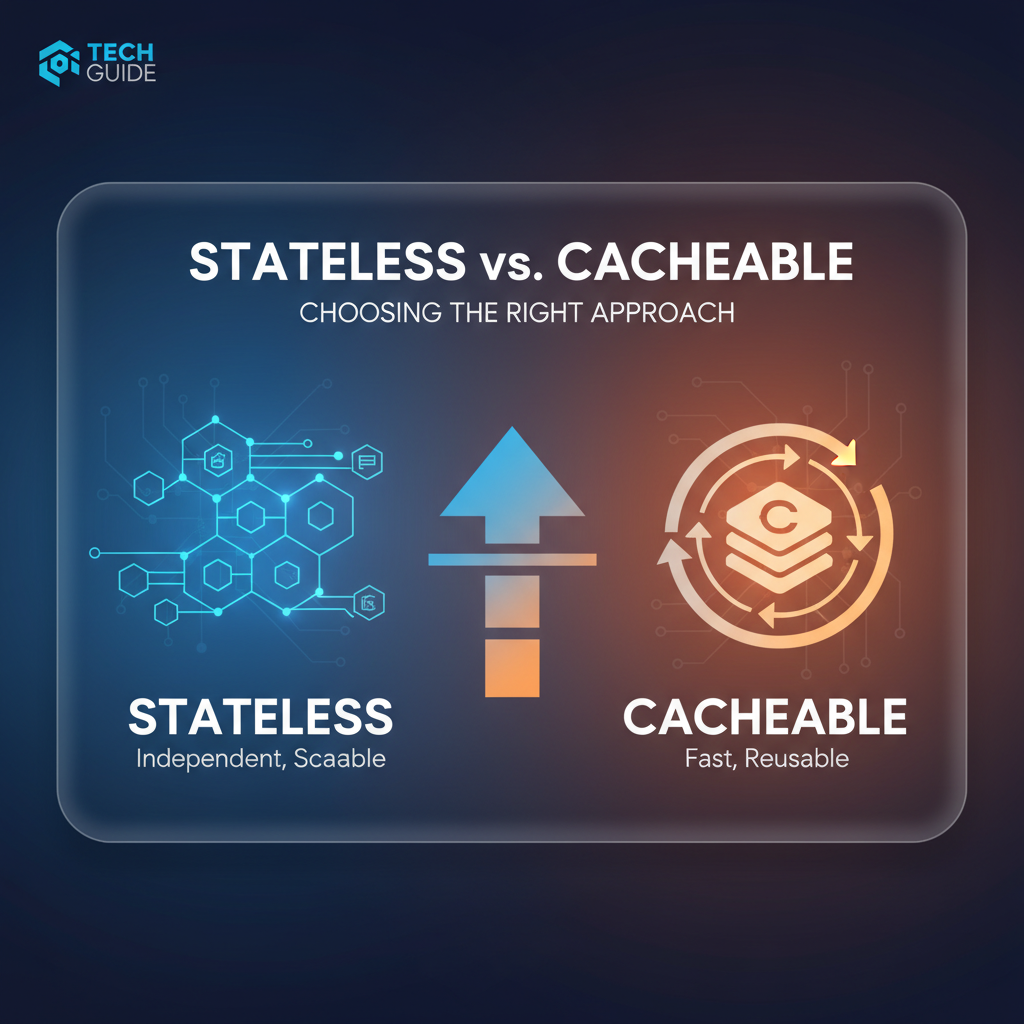


In the vast and intricate landscape of modern software architecture, designers and engineers are constantly faced with a myriad of fundamental decisions that significantly impact the performance, scalability, resilience, and maintainability of their systems. Among these critical choices, the architectural approach concerning state management—specifically, whether to design services as stateless or to leverage cacheable components—stands as a cornerstone. This decision is far from trivial; it underpins the very fabric of how distributed systems interact, how resources are utilized, and ultimately, how end-users perceive the responsiveness and reliability of an application.
The advent of cloud computing, microservices, and the exponential growth of API-driven ecosystems has only amplified the importance of this architectural dichotomy. From traditional web services to cutting-edge artificial intelligence applications, the principles of statelessness and cacheability play crucial, often intertwined, roles. Understanding their individual strengths, weaknesses, and the intricate dance between them is not merely an academic exercise but a practical necessity for crafting robust and efficient solutions. This comprehensive guide delves deep into the nuances of stateless and cacheable architectures, offering a framework for discerning the most appropriate strategy for diverse scenarios, including the increasingly vital realm of AI and Large Language Model (LLM) deployments.
The Foundations: Understanding Stateless Architectures
At its core, a stateless architecture dictates that each request from a client to a server must contain all the information necessary to understand and process the request. The server itself does not store any session-specific data or context about previous requests from that client. Every interaction is treated as a completely new, independent transaction, devoid of any memory of prior communications. This paradigm is a fundamental tenet of many modern web services, particularly those adhering to the Representational State Transfer (REST) architectural style.
Defining Statelessness in Practice
Imagine a conversation where each sentence you utter needs to re-introduce every character, setting, and plot point from the beginning. While cumbersome for human interaction, this is precisely how a truly stateless system operates. When a client sends a request—be it for data, to trigger an action, or to authenticate—it must provide all the necessary parameters, credentials, and context within that single request. The server, upon receiving it, processes it based solely on the information provided in that request and sends back a response. Once the response is sent, the server effectively "forgets" about that particular interaction; it retains no record of the client's state or the transaction's history that would be relevant to a subsequent request.
This stands in stark contrast to stateful systems, where the server might maintain a "session" or "context" for a client, storing information across multiple requests. For instance, in a classic web application, a server might store a user's logged-in status or items in a shopping cart in server-side memory or a session store. In a stateless system, this responsibility shifts to the client, which might carry a token (like a JWT), a session ID, or the entire shopping cart content in its request headers or body.
Core Characteristics of Stateless Systems
Stateless systems are identifiable by several key characteristics that directly influence their architectural implications:
- Self-Contained Requests: Each request is a complete unit. It contains all the data, parameters, and authentication information required for the server to fulfill it without needing to reference any prior interaction. This means that if a client is authenticated, every subsequent request must carry its authentication credentials or a valid token to prove its identity.
- No Server-Side Session State: The server does not maintain any persistent data or session information specific to a particular client between requests. While it might store general application data (like user profiles in a database), it does not keep track of a client's "current state" in its own memory.
- Independent Requests: The order in which requests arrive at the server does not matter. Each request can be processed independently, without reliance on a sequential flow or the outcome of a previous request from the same client. This independence is a powerful enabler for parallel processing and distributed architectures.
- Client Manages State: If an application requires conversational flow or persistent context (e.g., a multi-step form, a shopping cart), the responsibility for maintaining and transmitting that state falls squarely on the client. The client might store this state locally (e.g., in browser cookies, local storage, or application memory) and send it with each relevant request.
Advantages of Stateless Architectures
The architectural decisions to embrace statelessness bring forth a powerful suite of benefits, particularly crucial in the demanding environments of modern distributed systems:
- Exceptional Scalability: This is arguably the most significant advantage. Because no server instance holds client-specific state, any request can be routed to any available server. This makes horizontal scaling incredibly straightforward: simply add more server instances to distribute the load. There's no complex state synchronization or sticky session management required. This elasticity is paramount for applications experiencing fluctuating traffic, a common scenario in cloud-native deployments. An api gateway, for instance, thrives on this principle, efficiently routing millions of requests without tying them to specific backend instances.
- Enhanced Resilience and Fault Tolerance: If a server instance fails, it does not lead to a loss of client-specific session data because no such data resides on the server. Clients can simply retry their requests, potentially being routed to a different, healthy server. This drastically improves the system's ability to withstand failures without impacting the overall user experience, making systems inherently more robust.
- Simplified Server Design and Management: The absence of state management logic on the server simplifies its internal design. Developers can focus on the business logic for processing individual requests rather than grappling with complex session management, concurrency issues, or data consistency across multiple server instances. This leads to cleaner codebases and fewer bugs related to state corruption.
- Easier Load Balancing: Load balancers can distribute incoming requests using simple algorithms (e.g., round-robin, least connections) without needing to worry about "sticky sessions" or ensuring a client always hits the same server. This maximizes resource utilization and simplifies infrastructure configuration.
- Cloud-Native and Microservices Alignment: Statelessness is a natural fit for cloud environments, containerization (Docker, Kubernetes), and serverless computing. These platforms are designed for ephemeral, auto-scaling instances, where stateful servers are difficult to manage. It enables rapid deployment, graceful shutdowns, and efficient resource allocation, perfectly aligning with the agility required by microservices architectures.
Disadvantages and Challenges of Stateless Architectures
While powerful, statelessness is not without its trade-offs and potential drawbacks:
- Increased Request Overhead: Every request must carry all necessary information, which can sometimes lead to larger request sizes. For very chatty clients or complex multi-step processes, repeatedly sending the same context information can consume more bandwidth and CPU cycles for serialization/deserialization.
- Potential for Duplicate Processing (without Idempotency): If a client experiences a network issue or timeout, it might resend a request. Without careful design (specifically, making operations idempotent), this could lead to duplicate actions (e.g., processing the same payment twice). While idempotency is a design choice, statelessness often necessitates a more explicit focus on it.
- Increased Client Complexity: The burden of managing application state shifts from the server to the client. This means client-side applications (web browsers, mobile apps) might need to implement more sophisticated state management logic, including storing, retrieving, and securely transmitting contextual data with each request.
- Performance Implications for Repeated Data Fetching: For data that is frequently accessed but rarely changes, a purely stateless approach means the server might repeatedly fetch this data from its underlying data store (e.g., a database) for every single request, even if it's the same data. This can lead to unnecessary load on backend systems and increased latency, which is where caching becomes highly relevant.
Common Use Cases for Stateless Architectures
Statelessness is the default choice for a vast array of modern applications:
- RESTful APIs: The quintessential example. Each API call (e.g., GET /products/123, POST /orders) is designed to be self-contained.
- Microservices: Individual microservices are typically stateless to maximize their independent deployability and scalability.
- Webhooks: Automated notifications where a service sends a one-off payload to another service.
- Public-Facing APIs: Used by third-party developers, where session management would be impractical and restrictive.
- Authentication with Tokens (e.g., JWT): After initial authentication, a client receives a token. Subsequent requests include this token, allowing the server to verify authenticity without needing to store session data.
The Performance Enhancer: Understanding Cacheable Architectures
In contrast to statelessness, cacheability introduces a layer where copies of data or the results of computations are stored temporarily closer to the point of use. The primary motivation behind caching is performance optimization: by avoiding redundant computation or fetching data from slower, more distant sources, cached responses can be delivered significantly faster, while also reducing the load on backend systems. While statelessness describes the interaction model of a service, cacheability describes a strategy for improving the efficiency of data access within that or any service.
Defining Cacheability
To be "cacheable" means that a response, or a part of it, can be stored and reused for subsequent identical requests without needing to re-generate it from the original source. Think of it like remembering an answer to a common question. Instead of looking up the answer every time someone asks, you just recall it from memory. In computing, this "memory" is the cache.
The essence of caching lies in the trade-off: you gain speed and reduced load, but you introduce the complexity of data freshness. A cached item is a copy, and like any copy, it can become outdated if the original source changes. Managing this potential for "stale data" is the central challenge in cache design.
Types of Caching Layers
Caching can occur at various levels within a distributed system, each with its own scope and characteristics:
- Client-Side Caching:
- Browser Cache: Web browsers automatically cache static assets (images, CSS, JavaScript) and sometimes API responses based on HTTP headers (e.g.,
Cache-Control,Expires). - Application-Level Cache: Within a client application (e.g., a mobile app, desktop software), frequently used data might be stored in memory or local storage for quicker access.
- Browser Cache: Web browsers automatically cache static assets (images, CSS, JavaScript) and sometimes API responses based on HTTP headers (e.g.,
- Proxy Caching:
- CDNs (Content Delivery Networks): Geographically distributed servers that cache static and sometimes dynamic content close to users, drastically reducing latency and origin server load.
- Reverse Proxies/Load Balancers: Components like Nginx or specialized
api gatewaysolutions can cache responses before forwarding them to backend services. This is particularly effective for public APIs.
- Server-Side Caching:
- In-Memory Cache: Application servers can store frequently accessed data in their RAM. Fast, but volatile and local to a single instance.
- Distributed Caches (e.g., Redis, Memcached): Separate, dedicated cache servers or clusters that store data accessible by multiple application servers. Offers higher availability and shared state across a cluster.
- Database Caching: Databases themselves might cache query results or data blocks to speed up subsequent requests.
- Specialized Caching:
AI Gateway/LLM GatewayCaching: In the context of AI services, anAI Gatewaymight cache the results of expensive AI model inferences. If the same input prompt is given to an LLM multiple times, theLLM Gatewaycan return the cached response, saving computational cost and time from re-running the model.
Core Characteristics of Cacheable Systems
- Data Duplication: A cached system inherently involves having multiple copies of data (original and cached).
- Expiration Policies: Cached data must have a defined lifespan (Time-To-Live, TTL) or an event-driven invalidation mechanism to prevent serving stale information indefinitely.
- Invalidation Strategies: Mechanisms are needed to remove or update cached data when the original source changes. This is often the most complex aspect of caching.
- Trade-off between Freshness and Performance: A heavily cached system prioritizes speed and reduced backend load, potentially at the expense of serving slightly outdated data. The acceptable level of staleness is application-dependent.
Advantages of Cacheable Architectures
The benefits of implementing caching are directly tied to enhancing the user experience and optimizing resource utilization:
- Significant Performance Boost: The most immediate and noticeable advantage. Retrieving data from a cache is almost always orders of magnitude faster than fetching it from a database, performing a complex computation, or making a remote service call. This translates directly to lower latency and quicker response times for end-users.
- Reduced Load on Backend Services: By serving requests from the cache, fewer requests reach the origin servers, databases, or expensive computational engines (like AI models). This alleviates pressure on these critical backend components, allowing them to handle higher overall traffic volumes or perform more complex tasks without becoming overloaded.
- Improved User Experience: Faster loading times and more responsive applications directly contribute to a superior user experience, leading to higher engagement and satisfaction. In an era where users expect instant gratification, caching is a fundamental tool for meeting those expectations.
- Cost Savings: By reducing the load on backend infrastructure, caching can lead to substantial cost savings. Fewer servers might be needed, or existing servers can operate more efficiently. For pay-per-use services like cloud-based AI models, caching common
LLM Gatewayrequests can directly reduce operational expenses. - Increased System Resiliency: If a backend service temporarily goes down or experiences degraded performance, a well-implemented cache can continue serving requests for a period, acting as a buffer and maintaining service availability during outages.
Disadvantages and Challenges of Cacheable Architectures
The power of caching comes with its own set of complexities that require careful consideration:
- Stale Data Issues: This is the paramount challenge. If cached data is not invalidated or refreshed promptly when the original data changes, clients might receive outdated information. The consequences range from minor inconsistencies to critical errors (e.g., incorrect stock levels, old pricing).
- Cache Invalidation Complexity: Often famously dubbed one of the two hardest problems in computer science. Designing a robust and efficient cache invalidation strategy is notoriously difficult. It involves deciding when to invalidate, how to broadcast invalidation signals across distributed caches, and handling race conditions.
- Increased Infrastructure Complexity: Implementing and managing a caching layer, especially a distributed one, adds another layer of infrastructure. This involves deploying and maintaining cache servers, monitoring their health, and ensuring data consistency across the cache cluster.
- Memory/Storage Overhead: Caches consume resources—RAM, disk space, and network bandwidth for synchronization. These resources must be provisioned and managed.
- Security Concerns: Caching sensitive or personalized data improperly can lead to security vulnerabilities, such as data leakage if a cache is inadvertently shared or exposed. Strict controls are needed to ensure sensitive information is not cached inappropriately or is encrypted.
- Cache Warm-up: When a cache starts empty (e.g., after deployment or a restart), it needs to be "warmed up" by gradually populating it with data. During this warm-up period, the system operates without the full benefits of caching, potentially leading to initial performance dips.
Common Use Cases for Cacheable Architectures
Caching is beneficial in scenarios where data access patterns exhibit high read-to-write ratios and where some degree of data staleness is acceptable:
- Read-Heavy Applications: Websites, social media feeds, news portals, product catalogs where content is viewed far more often than it's updated.
- CDN-delivered Assets: Static files like images, videos, CSS, and JavaScript, which are ideal candidates for caching at the edge.
- Public API Responses: Responses from APIs that provide non-sensitive, frequently requested data (e.g., weather forecasts, public statistics).
- Expensive Computations: Results of complex algorithms, data analytics reports, or AI model inferences that take a long time to compute. An
AI GatewayorLLM Gatewaycan significantly benefit from caching model outputs for identical inputs, reducing both latency and cost. - Lookup Data: Infrequently changing reference data like country codes, currency lists, or configuration settings.
The Interplay and Nuances: When to Mix and Match
It is critical to understand that "stateless" and "cacheable" are not mutually exclusive architectural paradigms, nor are they always in direct opposition. In reality, most high-performing, scalable distributed systems wisely combine aspects of both. A service can be fundamentally stateless in its interaction model, yet strategically employ caching to optimize performance and resource utilization. The art lies in understanding where each principle best applies and how they can be harmoniously integrated.
Stateless Services and External Caching Layers
Consider a microservice that exposes a RESTful API. By design, this service is stateless: it doesn't hold client-specific session information. Each incoming request is processed independently based solely on the data it carries. However, this very stateless service might itself use an external cache (e.g., Redis) to store frequently accessed data it retrieves from a database, or it might sit behind an api gateway that caches its responses.
In this scenario: * The service remains stateless in its relationship with its clients. * The caching layer (whether external or within the service's access pattern) is an optimization that reduces the load on its internal dependencies (like a database) and speeds up its responses.
This distinction is crucial. A service being stateless means it doesn't retain conversational state; it doesn't mean it operates without any memory whatsoever. It just means that memory isn't tied to a specific client session on the server itself.
REST and Cacheability: An Intrinsic Link
The REST architectural style, a prime example of a stateless approach, inherently supports cacheability through its use of standard HTTP methods and headers.
- GET Requests: By convention, GET requests are designed to be idempotent and safe, meaning they retrieve data and should not have any side effects on the server. This makes them ideal candidates for caching.
- HTTP Headers for Caching:
Cache-Control: This header is paramount for dictating caching behavior. It can specify whether a response is cacheable (public,private), for how long (max-age), whether it must be revalidated (no-cache), or if it should not be cached at all (no-store).Expires: An older header specifying an absolute expiration date/time.ETag(Entity Tag): A unique identifier for a specific version of a resource. Clients can send anIf-None-Matchheader with a previously receivedETag. If the resource hasn't changed, the server can respond with a304 Not Modified, telling the client to use its cached version.Last-Modified: Similar toETag, it provides the last modification date. Clients can useIf-Modified-Sincefor conditional requests.
These HTTP mechanisms allow stateless services to inform caches (browsers, proxies, api gateways) about how their responses can and should be cached, facilitating efficient data reuse without compromising the stateless nature of the core service.
Granularity of Caching
Deciding what to cache and at what level of detail is another important nuance. * Whole Response Caching: The entire HTTP response (headers and body) is stored and served. Easiest to implement, but least flexible. Ideal for static pages or API calls that return complete, stable datasets. * Fragment Caching: Caching specific parts or "fragments" of a larger page or API response. More complex to manage invalidation but offers greater flexibility. * Data Object Caching: Caching raw data objects (e.g., a user object, a product item) that are frequently retrieved from a database. This allows different parts of an application to construct various responses using the same cached underlying data. * Query Result Caching: Caching the results of specific database queries, often employed at the database or ORM level.
The choice of granularity depends on the data's volatility, access patterns, and the effort required for invalidation.
Choosing the Right Approach: A Decision Framework
The optimal architectural strategy is rarely a one-size-fits-all solution. Instead, it emerges from a careful evaluation of an application's specific requirements, constraints, and characteristics. Here's a decision framework to guide you through the process of determining when to prioritize statelessness, when to leverage caching, and how to combine them effectively.
1. Data Volatility: How Often Does the Data Change?
- High Volatility (Changes Frequently):
- Stateless with Minimal Caching: Data that changes constantly (e.g., real-time stock quotes, active user counts, sensor readings) is generally not a good candidate for extensive caching. The risk of serving stale data is high, and frequent invalidation can negate caching benefits. Focus on a robust, scalable stateless backend that can handle fresh data efficiently.
- Short TTL Caching (Carefully): If performance is absolutely critical, very short Time-To-Live (TTL) caching (e.g., a few seconds) might be considered, but only with a clear understanding of the acceptable staleness.
- Low Volatility (Changes Infrequently):
- High Cacheability: Data that rarely changes (e.g., product descriptions, static configurations, archived news articles, country lists) is an ideal candidate for aggressive caching. Long TTLs can be used, and invalidation is simpler as it's less frequent. This is where an
api gatewaycan be configured for maximum caching effectiveness.
- High Cacheability: Data that rarely changes (e.g., product descriptions, static configurations, archived news articles, country lists) is an ideal candidate for aggressive caching. Long TTLs can be used, and invalidation is simpler as it's less frequent. This is where an
2. Read-Write Ratio: How Many Reads vs. Writes?
- Read-Heavy Systems (Many Reads, Few Writes):
- Strong Caching Emphasis: Applications like content platforms, e-commerce product catalogs, or dashboards that display pre-computed reports benefit enormously from caching. The cost of a cache miss (going to the backend) is far outweighed by the benefits of cache hits.
- An
AI Gatewaymanaging multiple AI models for inference might cache results if the same prompts are frequently queried, as AI inference can be a read-heavy operation.
- Write-Heavy Systems (Many Writes, Few Reads):
- Prioritize Statelessness and Strong Consistency: Systems dealing with financial transactions, inventory updates, or real-time data ingestion (e.g., IoT data streams) often require strong consistency and immediate reflection of changes. Caching in such scenarios is challenging due to complex invalidation requirements and the high risk of stale data. Focus on ensuring the underlying stateless services are robust and quickly process writes. Caching might be limited to non-critical, eventually consistent views of the data.
3. Performance Requirements: How Critical is Low Latency?
- Sub-millisecond Latency Critical:
- Aggressive Caching: For applications requiring extremely fast responses (e.g., real-time bidding, interactive dashboards, gaming leaderboards), caching is essential. Data must be served from memory or very close to the client. This might involve multiple layers of caching (client-side, CDN, distributed cache).
- An
LLM Gatewaycan utilize aggressive caching for common prompts to reduce inference time from potentially slow LLMs.
- Moderate Latency Acceptable:
- Balanced Approach: Most applications fall into this category. A combination of stateless services with strategic caching at key points (e.g.,
api gatewaylevel, database caching) is usually sufficient.
- Balanced Approach: Most applications fall into this category. A combination of stateless services with strategic caching at key points (e.g.,
4. Scalability Demands: How Many Users/Requests Anticipated?
- Massive Scalability Required:
- Statelessness First, then Caching: For systems designed to handle millions of concurrent users or high request volumes (e.g., social media platforms, large-scale APIs), stateless backend services are fundamental. Caching then acts as an indispensable multiplier, reducing the effective load on these stateless services, enabling them to scale even further without proportionate increases in backend infrastructure.
api gateways are crucial here, handling routing and often incorporating caching to offload backend services.
- Moderate Scalability:
- Focus on Simplicity: While both are good, avoid over-engineering with complex caching if not strictly necessary. A simple stateless design might suffice initially.
5. Consistency Requirements: Eventual vs. Strong Consistency
- Strong Consistency Required (Immediate Data Freshness):
- Prioritize Stateless Backend, Minimize Caching: If every user must see the absolute latest data at all times (e.g., banking transactions, critical inventory counts), then aggressive caching is risky. Any caching must have very short TTLs or robust, synchronous invalidation, which can be complex and reduce performance benefits.
- Eventual Consistency Acceptable (Slight Lag is OK):
- Embrace Caching: For many applications (news feeds, social media posts, product reviews), a slight delay in data propagation is perfectly acceptable. This is where caching shines, as it allows for high performance without needing immediate, global consistency guarantees.
6. Complexity Tolerance: Willingness to Manage Cache Invalidation?
- Low Tolerance for Complexity:
- Simple Stateless Design, Minimal Caching: If development teams are small, or time-to-market is critical, defer complex distributed caching until necessary. Focus on making the stateless backend efficient.
- High Tolerance for Complexity:
- Sophisticated Caching Strategies: If performance gains are paramount and resources are available, invest in advanced caching (e.g., distributed caches with event-driven invalidation). The benefits often outweigh the added operational overhead for large-scale systems.
7. Cost Implications: Infrastructure vs. Backend Load
- High Backend Computation/Resource Cost:
- Prioritize Caching: If backend operations (e.g., complex database queries,
LLM Gatewayinferences, image processing) are expensive in terms of CPU, memory, or external service calls, caching their results can lead to significant cost savings.
- Prioritize Caching: If backend operations (e.g., complex database queries,
- Low Backend Cost / High Cache Infrastructure Cost:
- Evaluate Trade-offs: Sometimes, the cost of setting up and maintaining a complex distributed cache might exceed the savings from reducing backend load. Ensure a clear ROI for your caching strategy.
8. Security Considerations: Caching Sensitive Data?
- Sensitive/Personal Data:
- Avoid Caching: Generally, sensitive user-specific data (e.g., financial details, PII, authenticated session tokens) should not be cached in shared caches due to security risks. If absolutely necessary, ensure robust encryption at rest and in transit, and strict access controls. Client-side caching might be acceptable for some non-critical user preferences, but server-side shared caches require extreme caution.
- Public/Non-Sensitive Data:
- Cache Freely: Data that is publicly accessible and non-sensitive can be cached aggressively without major security concerns (beyond ensuring the cache itself is secured from unauthorized access).
Real-World Scenarios and Examples
Let's explore how these principles manifest in common application types, particularly highlighting the role of api gateway, AI Gateway, and LLM Gateway in modern architectures.
E-commerce Product Catalog
- Scenario: A website displaying millions of products, with product details (name, description, price, images) that change infrequently. Users browse extensively, but updates to product info are rare.
- Stateless Aspect: The backend
api gatewayand microservices for retrieving product details are stateless. Each request for/products/{id}is independent; the server doesn't maintain user-specific product browsing history. - Cacheable Aspect: This is an ideal candidate for aggressive caching.
- CDN: Product images and static assets are served from a CDN.
API GatewayCaching: Theapi gatewaycan cache responses forGET /products/{id}requests, significantly reducing load on the product microservice and database. The TTL for these caches can be long (hours or even days), with specific invalidation triggered only when a product is updated.- Distributed Cache (e.g., Redis): The product microservice itself might cache entire product objects in a distributed cache, allowing it to serve data rapidly without hitting the database for every request.
- Benefit: Extremely fast product page loads, reduced database load, high scalability for peak shopping events.
User Profile Information
- Scenario: A social media application where users view their own and others' profiles. Some profile information is public and stable (e.g., username, profile picture), while other parts are private and frequently mutable (e.g., active status, direct messages).
- Stateless Aspect: All
api gatewayendpoints and backend services are stateless. Retrieving/users/{id}/profilerequires authentication, but the server doesn't retain knowledge of which profile a user just viewed. - Cacheable Aspect:
- Public Profile Data: Usernames, profile pictures, and bios can be cached by the
api gatewayor CDN with moderate TTLs. Invalidation occurs upon user updates. - Private/Mutable Data: Active status, private messages, or friend requests are highly volatile and sensitive. These are generally not cached in shared caches or are given very short, private TTLs (e.g., in a client-side cache for a very brief period). Strong consistency is prioritized.
- Public Profile Data: Usernames, profile pictures, and bios can be cached by the
- Benefit: Fast loading of public profile views, while maintaining security and freshness for private, mutable data.
Financial Transactions Processing
- Scenario: A system for processing real-time payments, requiring high availability, strong consistency, and idempotency.
- Stateless Aspect: Every payment request (e.g.,
POST /transactions) must be processed independently by a stateless transaction service. The service never holds session data for a specific transaction beyond the life of the request. If a request times out, the client can safely retry because the transaction service is designed to be idempotent (processing the same request multiple times has the same effect as processing it once). - Cacheable Aspect:
- Minimal Caching: Caching transaction processing itself is generally avoided due to the need for strong consistency and real-time updates.
- Reporting/Analytics Caching: Once a transaction is complete and immutable, aggregated reports or historical transaction data can be cached for analytical purposes, where eventual consistency is acceptable.
- Benefit: High reliability, data integrity, and auditability for critical financial operations. Scalability is achieved through stateless services rather than caching the core process.
AI Model Inference and LLM Gateways
- Scenario: An application that uses multiple AI models (e.g., image recognition, natural language processing, sentiment analysis, large language models) to respond to user queries. These models can be expensive to run and have varying inference times.
- Stateless Aspect: An
AI GatewayorLLM Gatewaymanaging these models often operates in a stateless manner regarding its routing and policy enforcement. Each request to infer something from a model is treated independently. TheAI Gatewayroutes the request to the appropriate backend AI service, applies policies (rate limiting, authentication), and returns the result, without storing conversational context about the AI interaction. - Cacheable Aspect: This is where caching becomes profoundly valuable for AI/LLM operations.
- Expensive Inference Caching: Many AI models, especially large language models, consume significant computational resources (GPUs, TPUs) and take time to generate responses. If a user asks the same prompt or submits the same image for recognition multiple times, or if different users frequently submit identical common queries, caching the AI model's output can offer massive benefits.
- An
AI GatewayorLLM Gatewaycan implement smart caching:- Keying: The cache key could be a hash of the input prompt/image and model parameters.
- TTL: A reasonable TTL can be set, or the cache can be invalidated if the underlying model is updated.
- Cost Reduction: Caching reduces the number of actual inferences performed by the expensive AI backend, leading to substantial cost savings (especially for cloud-based AI services).
- Latency Reduction: Immediate responses for cached queries dramatically improve user experience.
- Benefit: Cost-effective and high-performance delivery of AI capabilities, making AI integration more practical for real-world applications. This is a prime example of where a stateless service (the gateway's routing) is greatly enhanced by an intelligent caching layer.
APIPark is a high-performance AI gateway that allows you to securely access the most comprehensive LLM APIs globally on the APIPark platform, including OpenAI, Anthropic, Mistral, Llama2, Google Gemini, and more.Try APIPark now! 👇👇👇
APIPark: Bridging Statelessness and Cacheability for AI & API Management
In the evolving landscape of digital services, where the efficiency of API delivery and the seamless integration of artificial intelligence are paramount, platforms that expertly combine the benefits of stateless architecture with intelligent caching mechanisms stand out. APIPark, an open-source AI Gateway and API Management Platform, epitomizes this hybrid approach, providing a robust solution for developers and enterprises.
An api gateway is inherently designed for high performance and scalability, fundamentally operating in a largely stateless manner for its core functions of request routing, authentication, authorization, and policy enforcement. This statelessness allows APIPark to efficiently distribute incoming traffic across numerous backend services, ensuring high availability and horizontal scalability, much like a traditional api gateway. It can handle millions of requests, routing them to the correct microservice or AI model without carrying any session-specific state between requests, aligning perfectly with the principles of resilience and simplified load balancing discussed earlier.
However, recognizing that raw statelessness alone might not always deliver optimal performance and cost-efficiency, especially for demanding AI workloads, APIPark strategically integrates powerful caching capabilities. As an advanced AI Gateway and LLM Gateway, APIPark can be configured to cache responses from various AI models, including expensive large language models. This means if the same complex prompt is submitted repeatedly, instead of re-invoking the underlying AI service—which can be time-consuming and costly—APIPark can serve the response directly from its cache. This intelligent caching mechanism dramatically reduces latency for subsequent identical requests and, crucially, lessens the computational load and associated costs on the actual AI backend services.
This dual approach is particularly valuable for APIPark's key features, such as:
- Quick Integration of 100+ AI Models: By managing and potentially caching responses from a diverse range of AI models,
APIParkensures that integrating new AI capabilities doesn't automatically translate into performance bottlenecks or exorbitant operational expenses. - Unified API Format for AI Invocation: While standardizing requests for AI models (a stateless abstraction),
APIParkcan cache the standardized output, reinforcing the efficiency gains. - Prompt Encapsulation into REST API: When users create new APIs by combining AI models with custom prompts (e.g., a sentiment analysis API), caching the results of common prompt invocations through the
APIParkAI Gatewayensures these custom APIs are both powerful and performant.
Furthermore, APIPark's end-to-end API lifecycle management capabilities mean that administrators can define granular caching policies for different APIs, tailoring the cache behavior to the volatility and sensitivity of the data being served. Whether it's caching public product data for a traditional REST API or storing the deterministic output of an LLM, APIPark provides the tools to implement a balanced and optimized strategy.
By combining the inherent scalability and resilience of a stateless api gateway with intelligent, configurable caching for both conventional and AI-driven services, APIPark offers a comprehensive solution that meets the rigorous demands of modern distributed systems. It's a testament to the power of thoughtful architectural choices, ensuring high performance, cost-effectiveness, and a seamless developer experience. You can learn more about how APIPark can enhance your API and AI management at ApiPark.
Implementation Considerations
Once the decision is made to incorporate caching, several practical considerations come into play to ensure effective and reliable implementation.
1. HTTP Cache-Control Headers
These headers are the primary mechanism for controlling caching behavior in web and API contexts. They allow origin servers to specify how, and for how long, responses should be cached by clients and intermediate caches (like CDNs or api gateways).
Cache-Control: public, max-age=3600: Indicates the response can be cached by any cache (public or private) for 3600 seconds.Cache-Control: private, max-age=600: Indicates the response is for a single user and can only be cached by private caches (e.g., browser cache) for 600 seconds.Cache-Control: no-cache: The cache should revalidate with the origin server before using a cached copy, even if the cache has a fresh copy. This is often misunderstood as "don't cache", but it means "always revalidate".Cache-Control: no-store: Absolutely do not store any part of the request or response in any cache. Used for highly sensitive data.Cache-Control: must-revalidate: Forces caches to revalidate stale responses with the origin server.
Properly setting these headers is crucial for communicating caching intent and ensuring consistency.
2. ETags and Last-Modified for Conditional Requests
These headers enable caches and clients to perform "conditional requests," which save bandwidth and backend load by only sending the full response if the resource has actually changed.
ETag(Entity Tag): A unique identifier (often a hash) that represents the state of a resource version.- Server includes
ETag: "abcdef123"in its response. - Client/cache stores this.
- On a subsequent request, client sends
If-None-Match: "abcdef123". - If the server's current
ETagfor the resource still matches, it returns a304 Not Modifiedstatus, telling the client to use its cached version.
- Server includes
Last-Modified: A timestamp indicating when the resource was last modified.- Server includes
Last-Modified: <date-time>in its response. - Client/cache stores this.
- On a subsequent request, client sends
If-Modified-Since: <date-time>. - If the resource hasn't changed since that date, server returns
304 Not Modified.
- Server includes
These mechanisms are vital for no-cache policies and for optimizing bandwidth usage, making stateless APIs more efficient.
3. Cache Invalidation Strategies
Managing stale data is the biggest challenge. Effective invalidation strategies are key:
- Time-Based Expiration (TTL - Time-To-Live): The simplest strategy. Cached items expire after a set duration. Suitable for data where a degree of staleness is acceptable. (e.g.,
max-ageinCache-Control). - Event-Driven Invalidation: When the source data changes, an event is triggered (e.g., a message queue, a direct API call to the cache) to explicitly remove or update the corresponding cached items.
- "Publish/Subscribe" pattern: A data change event is published, and cache services subscribe to invalidate relevant entries.
- "Cache-Aside" pattern: Application code explicitly checks the cache first, if not found, fetches from the database, and then stores in the cache. When data is updated, the application invalidates the cache entry.
- Write-Through / Write-Back:
- Write-Through: Data is written synchronously to both the cache and the backing store. Ensures cache consistency but adds latency to writes.
- Write-Back: Data is written only to the cache first, and the cache asynchronously writes to the backing store. Faster writes, but data loss if cache fails before sync. Generally less common for primary caching of API responses.
- Cache Tagging/Segmentation: Grouping related cached items with "tags." When an update occurs, all items with a specific tag can be invalidated simultaneously. This is useful for complex data structures where a single update affects multiple related cached responses.
4. Distributed Caching Solutions
For scalable, high-performance applications, a single in-memory cache on an application server is insufficient. Distributed caches provide shared, fault-tolerant caching across multiple application instances.
- Redis: An extremely popular, versatile in-memory data store often used as a distributed cache, message broker, and database. Supports various data structures, high availability, and persistence.
- Memcached: A high-performance, distributed memory object caching system, simpler than Redis but highly efficient for key-value pair caching.
- Apache Ignite / Hazelcast: More sophisticated distributed data grids that can also provide in-memory computing capabilities, often used for more complex caching needs.
Choosing the right distributed cache depends on requirements for data structures, persistence, high availability, and operational complexity.
5. Monitoring and Analytics
Implementing caching without robust monitoring is flying blind. Key metrics to track include:
- Cache Hit Rate: Percentage of requests served from the cache. A high hit rate indicates effective caching.
- Cache Miss Rate: Percentage of requests that require fetching from the backend. Helps identify areas for improvement.
- Cache Eviction Rate: How often items are removed from the cache due to policies (e.g., TTL, LRU). High eviction rates might indicate insufficient cache size or overly short TTLs.
- Cache Latency: Time taken to retrieve data from the cache.
- Backend Load Reduction: Observe the reduction in requests reaching the origin servers or database after caching is implemented.
These metrics provide critical insights into the efficiency and effectiveness of the caching strategy, allowing for continuous optimization.
Table: Stateless vs. Cacheable - A Comparative Overview
To crystallize the distinctions and areas of overlap, the following table provides a comparative overview of key aspects of stateless and cacheable architectures.
| Feature/Aspect | Stateless Architecture | Cacheable Architecture |
|---|---|---|
| Core Principle | Server retains no client-specific state between requests; each request is independent. | Stores copies of data/results for faster retrieval; avoids redundant processing. |
| Primary Goal | Scalability, Resilience, Simplicity (server-side), Ease of Load Balancing. | Performance enhancement, Reduced backend load, Improved user experience, Cost savings. |
| State Management | Client manages its own state; server has no "memory" of past interactions. | Involves data duplication and temporary storage (the "cache") for reuse. |
| Scalability | Excellent horizontal scalability; adding servers is trivial. | Improves effective scalability of backend by reducing load; cache itself needs to be scalable. |
| Resilience | High; server failures don't lose client state; easy to retry on another server. | Can improve resilience by serving stale data during backend outages; cache itself can fail. |
| Data Freshness | Always serves the freshest data from the backend (potentially slower). | Trade-off between freshness and performance; risk of serving stale data. |
| Complexity Added | Minimal on server-side; potentially more on client-side for state management. | Significant due to cache invalidation, consistency, and infrastructure management. |
| Resource Usage | Higher backend resource use for repeated data fetching/computation. | Higher cache resource use (memory/storage); lower backend resource use. |
| Typical Use Cases | RESTful APIs, Microservices, Transaction processing, Webhooks, JWT authentication. | Read-heavy apps, Static assets (CDN), Public APIs, Expensive AI/LLM inferences. |
| Example Component | Core api gateway routing, Microservice for processing an order. |
Browser cache, CDN, Redis, AI Gateway caching LLM responses. |
| Relationship to HTTP | Fundamental to REST, relies on request headers/body for context. | Leverages HTTP Cache-Control, ETag, Last-Modified for control. |
This table underscores that while statelessness defines the interaction model, cacheability is an optimization strategy that can be (and often is) applied to stateless services to enhance their operational efficiency.
Advanced Topics
Beyond the core principles, several advanced topics shed further light on the nuanced relationship between statelessness and cacheability in complex system designs.
Idempotency
Idempotency is the property of an operation that means it can be applied multiple times without changing the result beyond the initial application. In stateless systems, where requests might be retried due to network errors or timeouts, ensuring operations are idempotent is crucial.
- Stateless Connection: A stateless service doesn't know if a request is a retry or a new one.
- Idempotent Operations:
GETrequests are inherently idempotent.PUT(update a resource completely) is typically idempotent.DELETEis idempotent (deleting an already deleted resource has no further effect).POST(create a new resource) is generally not idempotent unless specifically designed with an idempotency key.
- Relationship to Caching: While not directly related, idempotent operations can be more safely cached, as retrieving the same result multiple times from a cache or the backend still yields the same outcome. Furthermore, idempotency allows safe retries if a cache update fails, ensuring eventual consistency.
Rate Limiting
Rate limiting is a technique to control the number of requests a client can make to a server over a given period. It's often implemented by an api gateway. While the api gateway itself might be stateless in its core routing, rate limiting requires maintaining some form of client-specific state (e.g., how many requests a user has made in the last minute). This state is typically stored in a fast, shared, cache-like data store (e.g., Redis) that all gateway instances can access.
- This is an example of a "stateful cache" being used by an otherwise stateless component (the
api gateway) to implement a stateful policy, without making the gateway itself stateful in its core processing.
Security Considerations for Caching
While briefly mentioned, security in caching deserves deeper attention.
- Authentication Tokens: Never cache raw, client-specific authentication tokens (e.g., JWTs) in a shared cache. These tokens should be short-lived, encrypted, and primarily handled client-side or by the authentication service. If a gateway needs to verify them, it typically does so for each request.
- Personal Identifiable Information (PII): Caching PII requires robust encryption both at rest and in transit within the cache. Access to the cache infrastructure must be highly restricted. It's often safer to avoid caching PII entirely unless absolutely necessary and with strong security controls.
- Cache Poisoning: An attacker injects malicious or incorrect data into a cache, which is then served to legitimate users. Protection involves rigorous input validation, preventing SQL injection, and ensuring the integrity of cached content.
- Insecure Cache Configurations: Default cache settings might expose sensitive information or allow unauthorized access. Always review and secure cache server configurations (e.g., Redis passwords, network access controls).
Microservices and Caching
In a microservices architecture, caching can be applied at multiple levels:
- Client-Side Caching: As discussed, browser or mobile app caches.
API GatewayCaching: The centralapi gateway(likeAPIPark) can cache responses from downstream microservices, acting as the first line of defense for performance. This is particularly effective for highly consumed, stable data.- Service-Level Caching: Each microservice can have its own internal cache (in-memory or distributed) for data it frequently accesses from its own data store or other microservices. This provides localized optimization without affecting other services.
- Database Caching: Standard database caching mechanisms.
The challenge is to avoid redundant caching, manage invalidation across these layers, and understand the consistency implications of each cache boundary. A well-designed system will leverage these layers strategically to maximize performance and minimize operational burden.
Conclusion
The decision between stateless and cacheable architectures, or more accurately, how to judiciously combine them, is one of the most impactful choices in designing modern, scalable, and resilient distributed systems. Statelessness provides the bedrock of scalability, fault tolerance, and simplicity, enabling services to be deployed, managed, and scaled with remarkable agility, perfectly suiting the demands of microservices and cloud-native environments.
On the other hand, caching offers an unparalleled pathway to performance optimization, drastically reducing latency and alleviating the load on backend infrastructure. It is an indispensable strategy for read-heavy workloads, expensive computations, and scenarios where immediate, strong consistency is not the paramount concern.
As we've explored, these paradigms are not mutually exclusive. A stateless service can profoundly benefit from an intelligent caching layer, whether it's a browser cache, a CDN, a distributed cache like Redis, or a sophisticated api gateway and AI Gateway like APIPark. The key lies in understanding the characteristics of your data, the demands of your application, and the trade-offs inherent in each approach.
For applications dealing with artificial intelligence, particularly those integrating large language models, the synergy between stateless routing and intelligent caching through an LLM Gateway or AI Gateway is transformative. It allows organizations to harness the power of AI cost-effectively and with superior responsiveness, turning computationally intensive tasks into performant, scalable services.
Ultimately, the choice is contextual. There is no absolute "best" approach. Instead, successful architects and engineers will meticulously analyze their requirements, embrace thoughtful design, and continuously monitor their systems to strike the optimal balance. By mastering both stateless and cacheable principles, developers can craft robust, efficient, and future-proof architectures that deliver exceptional user experiences in an ever-evolving digital landscape.
Frequently Asked Questions (FAQs)
1. What is the fundamental difference between a stateless and a stateful system? A stateless system processes each request independently, containing all necessary information within the request itself, and does not store any client-specific data between requests on the server. In contrast, a stateful system maintains and remembers client-specific information or context (session state) across multiple requests, often tying subsequent requests to the same server instance.
2. Why is statelessness so important for scalability in modern applications? Statelessness is crucial for scalability because it allows any server instance to handle any client request at any time. This enables easy horizontal scaling: you can simply add more server instances to distribute the load without needing complex mechanisms to synchronize or transfer client session data between servers. If a server fails, no client state is lost, further enhancing resilience.
3. What are the main benefits of using caching in an API-driven system? The primary benefits of caching include significantly improved performance (lower latency), reduced load on backend servers and databases, better user experience due to faster response times, and potential cost savings by minimizing resource usage for expensive computations (like AI model inferences managed by an AI Gateway).
4. What are the biggest challenges when implementing caching, and how can they be addressed? The biggest challenge is managing "stale data" and ensuring cache consistency. This is addressed through robust cache invalidation strategies, such as time-based expiration (TTL), event-driven invalidation (e.g., signaling caches when source data changes), and using conditional requests with HTTP headers like ETag and Last-Modified. Careful monitoring of cache hit rates and consistency is also essential.
5. How do an API Gateway, AI Gateway, and LLM Gateway relate to statelessness and cacheability? An API Gateway (like APIPark) is typically stateless in its core routing and policy enforcement, allowing it to scale massively. However, to enhance performance, it often implements caching capabilities for frequently accessed API responses. An AI Gateway and LLM Gateway (specialized API Gateways for AI/LLM services) extend this by strategically caching the results of expensive AI model inferences. While the gateway itself remains stateless in its interaction with clients, its caching layer helps reduce latency, computational cost, and load on the underlying AI/LLM models, effectively combining the best of both architectural principles.
🚀You can securely and efficiently call the OpenAI API on APIPark in just two steps:
Step 1: Deploy the APIPark AI gateway in 5 minutes.
APIPark is developed based on Golang, offering strong product performance and low development and maintenance costs. You can deploy APIPark with a single command line.
curl -sSO https://download.apipark.com/install/quick-start.sh; bash quick-start.sh

In my experience, you can see the successful deployment interface within 5 to 10 minutes. Then, you can log in to APIPark using your account.

Step 2: Call the OpenAI API.