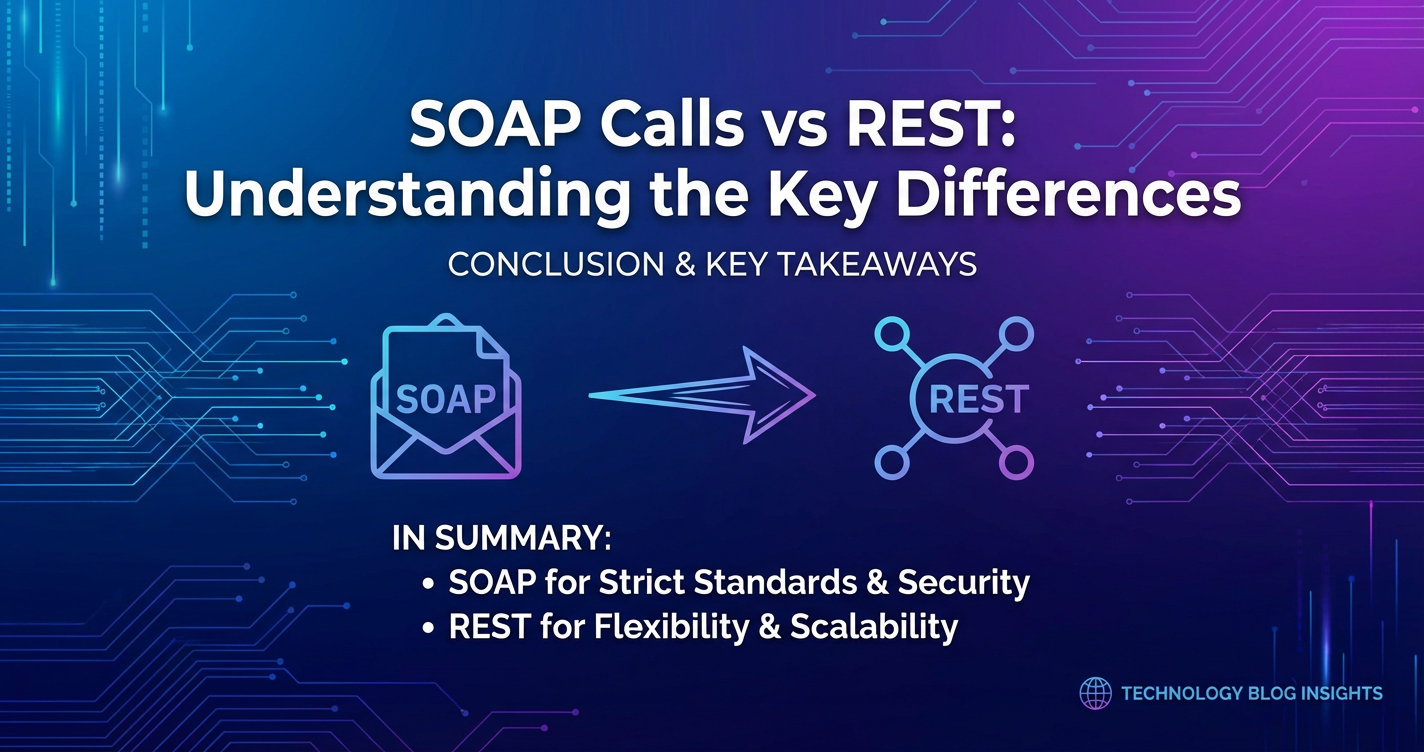
SOAP Calls vs REST: Understanding the Key Differences



In the vast and ever-evolving landscape of software development, the ability of different applications to communicate and exchange data seamlessly is paramount. This interoperability is largely facilitated by Application Programming Interfaces, or APIs. These interfaces act as digital contracts, defining how software components should interact. For decades, developers have relied on various architectural styles and protocols to design and implement these crucial communication channels. Among the most prominent and widely adopted approaches are SOAP (Simple Object Access Protocol) and REST (Representational State Transfer). While both serve the fundamental purpose of enabling inter-application communication, they differ significantly in their underlying philosophies, complexity, performance characteristics, and ideal use cases. Understanding these distinctions is not merely an academic exercise; it is crucial for architects and developers to make informed decisions that impact the scalability, maintainability, and efficiency of their systems.
The choice between SOAP and REST often shapes the entire development paradigm for an integration project, influencing everything from the tooling selected to the expertise required within a development team. This comprehensive exploration will delve deep into the intricacies of SOAP and REST, dissecting their core principles, architectural constraints, advantages, disadvantages, and the scenarios where each excels. We will also examine the pivotal role of an api gateway in managing these diverse integration patterns and explore how specifications like OpenAPI have revolutionized the development and consumption of modern web services. By the end of this discussion, readers will possess a robust understanding of when and why to choose one over the other, empowering them to design more robust and future-proof distributed systems.
What is an API? The Digital Handshake of the Modern Web
Before diving into the specifics of SOAP and REST, it is essential to establish a foundational understanding of what an api truly is. At its core, an api is a set of defined rules that dictate how two software components should interact with each other. It acts as an intermediary, allowing different applications to exchange information without needing to understand the intricate internal workings of each other. Think of it as a menu in a restaurant: you, the customer, don't need to know how the food is prepared in the kitchen; you just need to know what you can order from the menu and what to expect when it arrives. Similarly, an api abstracts away complexity, providing a clear, standardized way for developers to request services or data from another system.
The functionality provided by an api can range from retrieving simple pieces of data, such as weather forecasts or stock prices, to executing complex operations, like processing payments, sending emails, or managing cloud resources. APIs are the backbone of the internet as we know it today, powering everything from mobile applications that connect to backend servers, to microservices within a large enterprise architecture, to third-party integrations that allow different platforms to share data seamlessly. Without APIs, the interconnected web of services and applications that we rely on daily would simply not exist. They enable innovation by allowing developers to build upon existing functionalities rather than reinventing the wheel, fostering an ecosystem of collaboration and rapid development. The widespread adoption of APIs has not only streamlined software development but also catalyzed the creation of entirely new business models centered around data sharing and service provision.
Unpacking SOAP: The Enterprise-Grade Protocol
SOAP, or Simple Object Access Protocol, represents a foundational technology for enterprise application integration, emerging in the late 1990s as a Microsoft initiative. Unlike REST, which is an architectural style, SOAP is a well-defined, XML-based messaging protocol. This distinction is crucial: a protocol dictates the precise rules for communication, ensuring strict adherence to a predefined structure. SOAP was designed with a strong emphasis on formality, robustness, and extensibility, making it particularly attractive for complex enterprise environments where reliability and security are paramount. It operates over a variety of transport protocols, including HTTP, SMTP, TCP, and even JMS (Java Message Service), though HTTP is by far the most common due to its ubiquity in web infrastructure.
The core of a SOAP message is an XML document containing an Envelope, which defines what is in the message and how to process it; an optional Header, for application-specific information like authentication or transaction IDs; and a Body, containing the actual message payload (the data being sent). Any errors encountered during processing are communicated via a Fault element, also part of the Body. This rigid XML structure ensures that messages are unambiguous and can be parsed consistently across different platforms and programming languages.
Key Characteristics of SOAP
One of the defining features of SOAP is its reliance on WSDL (Web Services Description Language). WSDL is an XML-based language used to describe the functionality offered by a web service. It essentially acts as a contract, detailing the operations (methods) available, the input parameters they expect, the data types involved, and the output they will return. A WSDL document provides a machine-readable description of a SOAP service, allowing development tools to automatically generate client-side code (stubs) that can interact with the service. This "contract-first" approach ensures strong typing and strict validation, minimizing integration errors and promoting a high degree of interoperability, even between disparate systems built on different technologies.
SOAP also comes with a rich set of WS- (Web Services) specifications, which extend its capabilities significantly. These specifications address various cross-cutting concerns critical for enterprise applications: * WS-Security: Provides mechanisms for message integrity, confidentiality, and authentication through XML encryption and digital signatures. This is a fundamental differentiator, as security is baked directly into the protocol. * WS-AtomicTransaction: Enables distributed transactions across multiple services, ensuring an "all or nothing" commitment (ACID properties) for complex operations that span several systems. This is vital for financial transactions or critical business processes where data consistency is non-negotiable. * WS-ReliableMessaging: Guarantees message delivery, even in the face of network outages or system failures, by providing mechanisms for message retransmission and duplicate detection. * WS-Addressing: Standardizes how addressing information is included within SOAP messages, enabling more flexible message routing.
These extensions make SOAP incredibly robust and powerful for specific use cases, particularly in highly regulated industries or environments where strong transactional integrity and built-in security features are mandatory.
Advantages of SOAP
The structured and protocol-driven nature of SOAP brings several significant advantages:
- Robust Security (WS-Security): The built-in, standardized security features of WS-Security are a major selling point for enterprise applications. It provides end-to-end message-level security, allowing for encryption and digital signatures of individual parts of a message, not just the transport layer. This granular control over security is often a non-negotiable requirement for sensitive data and compliance.
- ACID Compliance for Distributed Transactions: With extensions like WS-AtomicTransaction, SOAP services can participate in distributed transactions, ensuring atomicity, consistency, isolation, and durability across multiple services. This is invaluable for complex business processes that require multiple operations to succeed or fail as a single unit, preventing data corruption and maintaining system integrity.
- Language and Platform Independence: As an XML-based protocol, SOAP messages are inherently platform and language-agnostic. Any programming language capable of parsing XML and sending HTTP requests can interact with a SOAP service, provided it adheres to the WSDL contract. This makes it highly suitable for heterogeneous enterprise environments with diverse technology stacks.
- Formal Contract (WSDL): The WSDL contract provides a formal, machine-readable description of the service's capabilities. This enables strong validation, automatic client code generation, and easier integration into IDEs, reducing development time and potential errors. It acts as a single source of truth for service consumers.
- Reliability and Error Handling: SOAP offers robust mechanisms for reliability (WS-ReliableMessaging) and standardized error handling (SOAP Faults), ensuring that messages are delivered correctly and that failures are communicated uniformly, aiding in troubleshooting and system stability.
Disadvantages of SOAP
Despite its strengths, the formality and extensibility of SOAP come with considerable drawbacks:
- Complexity and Verbosity: The most common criticism of SOAP is its sheer complexity. The XML payloads can be extremely verbose, even for simple operations, leading to larger message sizes and increased bandwidth consumption. The learning curve for SOAP and its various WS-extensions is steep, requiring developers to understand a multitude of specifications.
- Higher Overhead: The extensive XML parsing and the processing of various WS-headers introduce significant overhead, impacting performance, especially for high-volume, low-latency applications. Compared to lighter-weight alternatives, SOAP can feel sluggish.
- Tooling Dependence: While WSDL enables automated tooling, SOAP development often relies heavily on specialized toolkits and frameworks to handle the parsing, validation, and generation of complex XML structures. This can lead to vendor lock-in or increased dependencies on specific development environments.
- Less Human-Readable: The XML structure, especially with the addition of WS-specifications, can be difficult for humans to read and debug directly. This contrasts sharply with the human-readable nature of many RESTful
apiresponses. - Tighter Coupling: The contract-first approach with WSDL can lead to tighter coupling between client and server. Any change in the WSDL contract necessitates updates on the client side, potentially making service evolution more cumbersome.
Ideal Use Cases for SOAP
Given its characteristics, SOAP finds its niche in specific enterprise contexts:
- Financial Services and Banking: Where ACID transactions, robust security, and guaranteed message delivery are absolute requirements for processing payments, managing accounts, or transferring funds.
- Legacy Enterprise Systems: Integrating with existing enterprise applications (e.g., ERP, CRM systems) that were traditionally built using SOAP or require its specific features.
- Telecommunications: For billing, network management, and provisioning services, where reliability and complex transaction management are critical.
- Regulated Industries: Sectors with stringent compliance standards (e.g., healthcare, government) often leverage SOAP's built-in security and formal contracts to meet regulatory requirements.
- Complex Workflow Integration: For orchestrating multi-step business processes that span across several disparate systems and demand strong transactional guarantees.
Exploring REST: The Architectural Style of the Modern Web
REST, or Representational State Transfer, is not a protocol but rather an architectural style that prescribes how networked applications should be designed. Coined by Roy Fielding in his 2000 doctoral dissertation, REST gained prominence with the rise of the World Wide Web, fundamentally shaping how web services are built today. Its philosophy emphasizes simplicity, scalability, and loose coupling, aligning perfectly with the principles that made the web so successful. RESTful services are built upon standard web protocols, primarily HTTP, leveraging its existing methods and status codes to create a straightforward and widely understood communication paradigm.
The core idea behind REST is that network resources (such as documents, images, or even complex data entities) should be exposed via unique identifiers, typically URLs (Uniform Resource Locators). Clients interact with these resources by sending standard HTTP requests, and the server responds with a representation of the requested resource, often in a lightweight format like JSON (JavaScript Object Notation) or sometimes XML. The key principle here is "statelessness," meaning each request from a client to a server must contain all the information necessary to understand the request, and the server should not store any client context between requests.
Key Principles and Characteristics of REST
RESTful architecture adheres to a set of six fundamental constraints, which together define its unique approach:
- Client-Server: This is a fundamental separation of concerns. The client (e.g., a web browser, mobile app, another server) is responsible for the user interface and user experience, while the server is responsible for data storage and processing. This separation allows independent evolution of client and server components.
- Stateless: Each request from the client to the server must contain all the information needed to understand the request. The server must not store any client context between requests. This means the server can process requests without relying on previous interactions, improving scalability by making it easier to distribute requests across multiple servers.
- Cacheable: Responses from the server should explicitly or implicitly define themselves as cacheable or non-cacheable. If a response is cacheable, the client is granted the right to reuse that response data for later, equivalent requests, improving performance and reducing server load.
- Layered System: A client cannot ordinarily tell whether it is connected directly to the end server, or to an intermediary along the way. Intermediary servers (like proxies, gateways, or load balancers) can be introduced to enhance scalability, security, and reliability without affecting client-server communication.
- Uniform Interface: This is the most crucial constraint, defining how clients interact with resources. It consists of four sub-constraints:
- Identification of Resources: Resources are identified by URIs (e.g.,
/users/123). - Manipulation of Resources Through Representations: Clients interact with resources by sending representations of the resource (e.g., JSON or XML data) in the request body, and servers respond with representations of the resource's current state.
- Self-Descriptive Messages: Each message includes enough information to describe how to process the message. For example, HTTP headers provide context (Content-Type, Accept).
- Hypermedia as the Engine of Application State (HATEOAS): The server's responses should include links to other related resources, guiding the client on available actions and state transitions. This principle aims to make
apidiscovery and navigation dynamic, though it is often the least implemented constraint in practice.
- Identification of Resources: Resources are identified by URIs (e.g.,
- Code-On-Demand (Optional): Servers can temporarily extend or customize the functionality of a client by transferring executable code (e.g., JavaScript applets). This constraint is less common in most RESTful web services.
How REST Leverages HTTP
RESTful services brilliantly leverage the standard methods of HTTP (Hypertext Transfer Protocol) to perform CRUD (Create, Read, Update, Delete) operations on resources:
- GET: Used to retrieve a resource or a collection of resources. It should be idempotent (multiple identical requests have the same effect as a single one) and safe (it doesn't change the state of the server).
- POST: Used to create a new resource or to submit data to be processed. It is typically not idempotent.
- PUT: Used to update an existing resource or create a resource at a client-specified URI. It is idempotent.
- DELETE: Used to remove a resource. It is idempotent.
- PATCH: Used to apply partial modifications to a resource. It is typically not idempotent.
The use of standard HTTP status codes (e.g., 200 OK, 201 Created, 400 Bad Request, 404 Not Found, 500 Internal Server Error) provides clear, universally understood feedback on the outcome of a request, simplifying error handling and debugging.
Advantages of REST
The architectural simplicity and web-centric nature of REST offer numerous benefits:
- Simplicity and Ease of Use: REST is considerably simpler to understand and implement than SOAP. It leverages existing web standards (HTTP, URLs) and commonly uses lightweight data formats like JSON, making it easier for developers to get started quickly.
- Performance and Scalability: Due to its stateless nature, lightweight message formats (JSON), and efficient use of HTTP caching, RESTful APIs are generally faster and more scalable than SOAP APIs. Servers don't need to store session information, making it easier to distribute traffic across multiple nodes and handle high volumes of requests.
- Flexibility in Data Formats: While JSON is the most common, REST APIs can return data in various formats, including XML, plain text, or even custom formats. This flexibility allows developers to choose the most suitable representation for their needs.
- Broad Tooling and Language Support: Virtually every programming language and development environment has robust, built-in support for HTTP requests and JSON parsing, making REST an incredibly versatile choice.
- Human-Readable: REST endpoints and JSON payloads are often intuitive and human-readable, which greatly assists in development, debugging, and testing.
- Loose Coupling: The uniform interface and stateless nature promote loose coupling between client and server, allowing each to evolve independently without breaking the other, provided the resource representation remains consistent.
Disadvantages of REST
Despite its widespread popularity, REST is not without its limitations:
- Lack of Formal Standard/Contract: Unlike SOAP with WSDL, REST does not inherently come with a formal, machine-readable contract. This can lead to ambiguity regarding API functionality, input requirements, and response structures. Developers often rely on external documentation, which can become outdated. However, this gap is largely addressed by the
OpenAPISpecification (formerly Swagger), which we will discuss shortly. - Less Built-in Security: REST itself does not prescribe security mechanisms beyond relying on HTTPS for transport-level encryption. Message-level security, authentication, and authorization need to be implemented separately, often using mechanisms like
apikeys, OAuth 2.0, or JSON Web Tokens (JWT). This requires more custom implementation compared to SOAP's integrated WS-Security. - Absence of Transactional Support: REST does not natively support distributed transactions in the way SOAP does with WS-AtomicTransaction. Implementing ACID properties across multiple REST services requires custom logic and compensation patterns, which can be complex.
- Over-fetching or Under-fetching: Clients often receive more data than they need (over-fetching) or need to make multiple requests to get all required data (under-fetching), especially with complex resources. This can impact performance and efficiency, leading to the rise of alternatives like GraphQL.
Ideal Use Cases for REST
REST is the dominant architectural style for a wide array of modern applications:
- Public-facing Web Services: Most public APIs (e.g., social media APIs, payment gateways, mapping services) are RESTful due to their simplicity, widespread adoption, and ease of consumption by web and mobile applications.
- Mobile Applications: REST's lightweight nature and efficient use of bandwidth make it ideal for mobile clients where network latency and battery life are critical considerations.
- Single-Page Applications (SPAs): Modern web applications built with frameworks like React, Angular, or Vue.js heavily rely on RESTful APIs to fetch and update data asynchronously.
- Microservices Architectures: The statelessness and loose coupling of REST align perfectly with the principles of microservices, enabling independent deployment and scaling of small, focused services.
- IoT Devices: For devices with limited processing power and network capabilities, REST offers a lightweight communication mechanism.
SOAP vs REST: A Detailed Comparative Analysis
Having explored each paradigm individually, a direct comparison reveals their fundamental differences and helps clarify when one might be preferred over the other. The choice between SOAP and REST is rarely arbitrary; it's a strategic decision driven by project requirements, existing infrastructure, and long-term goals.
| Feature/Aspect | SOAP (Simple Object Access Protocol) | REST (Representational State Transfer) |
|---|---|---|
| Nature | A messaging protocol with strict rules. | An architectural style with a set of constraints. |
| Message Format | Primarily XML (often verbose). | Flexible; commonly JSON, also XML, plain text, etc. (typically lightweight). |
| Transport Protocol | Can operate over HTTP, SMTP, TCP, JMS, etc. (HTTP is most common). | Primarily HTTP/HTTPS. |
| Statelessness | Can be stateful or stateless (supports stateful operations). | Strictly stateless (each request contains all necessary info). |
| Service Description | WSDL (Web Services Description Language) – a formal, machine-readable contract. | No inherent formal contract, but OpenAPI (Swagger) Specification is widely used for documentation. |
| Security | Built-in WS-Security provides message-level security, encryption, digital signatures. | Relies on transport-level security (HTTPS) and external mechanisms (OAuth, API keys, JWT) for message-level security. |
| Performance | Generally slower due to verbose XML parsing and overhead from WS-extensions. | Generally faster due to lightweight data formats and efficient use of HTTP caching. |
| Complexity | Higher complexity, steeper learning curve, often requires specialized tooling. | Simpler to understand and implement, leverages existing web standards. |
| Error Handling | Standardized SOAP Faults for error reporting. | Uses standard HTTP status codes (4xx for client errors, 5xx for server errors). |
| Transactional Support | Strong support for distributed ACID transactions (WS-AtomicTransaction). | No native support for distributed transactions; requires custom compensation logic. |
| Tooling/Ecosystem | Heavily relies on IDEs and frameworks for WSDL parsing and client generation. | Broad support across all languages; rich ecosystem of client libraries, testing tools. |
| Loose/Tight Coupling | Can lead to tighter coupling due to rigid WSDL contract changes. | Promotes looser coupling due to uniform interface and statelessness. |
| Primary Use Cases | Enterprise-level integrations (banking, telecom), highly regulated industries, legacy systems. | Public APIs, mobile apps, web apps, microservices, IoT, SaaS platforms. |
Protocol vs. Architectural Style: A Fundamental Distinction
The most significant difference lies in their very nature. SOAP is a protocol, meaning it defines a rigid set of rules for structuring messages, communicating errors, and describing services. This protocol-driven approach ensures high interoperability and a predictable interaction model, which is beneficial in environments demanding strict adherence to standards. However, this rigidity can also lead to increased overhead and complexity.
REST, conversely, is an architectural style. It provides a set of design principles for building networked applications, rather than dictating a specific message format or communication protocol. Its flexibility allows developers to choose the best implementation details, such as data format, as long as they adhere to the core REST constraints. This freedom contributes to its simplicity and adaptability, making it suitable for a wider range of applications, especially those on the open web.
Message Format: XML's Verbosity vs. JSON's Brevity
SOAP's exclusive reliance on XML for message payloads often results in verbose messages. Even simple requests or responses can be bulky due to XML's tag-heavy syntax and the extensive headers added by WS-specifications. This verbosity directly impacts network bandwidth and parsing time, leading to lower performance, particularly over high-latency networks.
REST, while capable of using XML, predominantly employs JSON (JavaScript Object Notation). JSON is a lightweight, human-readable data interchange format that is much more concise than XML for representing structured data. Its native compatibility with JavaScript also makes it incredibly convenient for web applications. The smaller message sizes contribute significantly to REST's performance advantages.
Statelessness: A Key to Scalability
REST's strict statelessness constraint means that each request must contain all the information needed for the server to process it. The server does not store any session-specific data between requests. This design choice is a cornerstone of REST's scalability, allowing requests to be handled by any available server in a cluster, making load balancing and fault tolerance much easier to implement.
SOAP, while it can be implemented statelessly, also supports stateful operations. This means a server might retain information about a client's session across multiple requests, which can simplify certain complex workflows but introduces challenges for scalability and fault tolerance. Managing state across multiple servers typically requires external mechanisms, adding to complexity.
Service Description: WSDL vs. OpenAPI
SOAP relies heavily on WSDL (Web Services Description Language) as its formal contract. WSDL provides a comprehensive, machine-readable description of all service operations, their parameters, and data types. This contract-first approach enables robust validation and automatic client-side code generation, ensuring strong type checking and reducing integration errors.
REST, by its very nature, does not have an equivalent native description language. However, the industry has largely adopted the OpenAPI Specification (formerly known as Swagger Specification) to address this gap. OpenAPI allows developers to describe the structure of their REST APIs in a language-agnostic, machine-readable format (typically JSON or YAML). It serves a similar purpose to WSDL for SOAP, enabling interactive documentation, client and server code generation, and automated testing, thereby bringing a much-needed layer of formality and discoverability to RESTful services without sacrificing their inherent flexibility. The growth of OpenAPI has significantly matured the REST ecosystem, making it easier to design, build, and consume RESTful APIs at scale.
Security: Integrated vs. Externalized
SOAP offers robust, built-in security features through WS-Security, which provides message-level encryption, digital signatures, and authentication directly within the SOAP envelope. This means security can be applied to specific parts of a message, offering fine-grained control and meeting stringent compliance requirements without relying solely on transport-layer security.
REST, on the other hand, typically relies on the underlying transport protocol (HTTPS) for encryption. Message-level security, authentication, and authorization are handled by external mechanisms such as api keys, OAuth 2.0 (for delegated authorization), or JSON Web Tokens (JWT). While these mechanisms are highly effective and widely adopted, they require more explicit implementation and configuration compared to SOAP's integrated approach. The trade-off is often between built-in complexity (SOAP) and flexible, composable security patterns (REST).
APIPark is a high-performance AI gateway that allows you to securely access the most comprehensive LLM APIs globally on the APIPark platform, including OpenAI, Anthropic, Mistral, Llama2, Google Gemini, and more.Try APIPark now! 👇👇👇
The Crucial Role of an API Gateway
Regardless of whether an organization primarily uses SOAP or REST, or more commonly, a hybrid of both, the management and governance of these APIs become increasingly complex as the number of services grows. This is where an api gateway becomes an indispensable component of any modern distributed architecture. An api gateway acts as a single entry point for all client requests, routing them to the appropriate backend services while simultaneously providing a layer of security, management, and control. It effectively centralizes cross-cutting concerns that would otherwise need to be implemented within each individual service, thereby simplifying development, improving consistency, and enhancing overall system security and performance.
An api gateway serves multiple critical functions:
- Request Routing: It intelligently routes incoming requests to the correct backend service based on defined rules,
apipaths, or other parameters. This allows for dynamic routing and service discovery. - Authentication and Authorization: The gateway can offload authentication and authorization from individual services, ensuring that only legitimate and authorized clients can access backend resources. It can validate
apikeys, process OAuth tokens, or enforce role-based access control. - Security Policies: Beyond authentication, gateways enforce security policies such as IP whitelisting/blacklisting, WAF (Web Application Firewall) capabilities, and protection against common
apiattacks. - Rate Limiting and Throttling: To prevent abuse, overload, or ensure fair usage, an
api gatewaycan enforce rate limits, controlling how many requests a client can make within a specified period. - Load Balancing: By distributing incoming traffic across multiple instances of a backend service, the gateway ensures high availability and optimal performance.
- Monitoring and Analytics: Gateways collect metrics on
apiusage, performance, and error rates, providing valuable insights intoapihealth and consumer behavior. This data is crucial for capacity planning, troubleshooting, and business intelligence. - Protocol Translation/Transformation: In hybrid environments, an
api gatewaycan even translate requests between different protocols (e.g., expose a legacy SOAP service as a RESTfulapi), allowing modern clients to interact with older systems without direct integration complexity. - Version Management: It can manage different versions of an API, allowing developers to evolve services without breaking existing client applications.
APIPark: An Open Source AI Gateway & API Management Platform
In the contemporary landscape where businesses increasingly leverage both traditional RESTful services and advanced AI models, the need for a versatile and robust api gateway and management solution is more pronounced than ever. This is precisely the void that platforms like APIPark are designed to fill. APIPark is an open-source AI gateway and API developer portal released under the Apache 2.0 license, providing a comprehensive solution for managing, integrating, and deploying a diverse range of services, including both conventional REST and AI services.
APIPark stands out by offering features specifically tailored to the unique challenges of integrating AI models into existing application architectures. For instance, it provides quick integration of over 100+ AI models, offering a unified management system for authentication and cost tracking. More critically, it unifies the api format for AI invocation, standardizing request data across various AI models. This ensures that changes in underlying AI models or prompts do not disrupt dependent applications or microservices, significantly simplifying AI usage and reducing maintenance overhead. Furthermore, APIPark allows users to encapsulate prompts into REST APIs, quickly combining AI models with custom prompts to create new, specialized APIs (e.g., for sentiment analysis or translation).
Beyond its AI-centric capabilities, APIPark delivers end-to-end API lifecycle management, assisting with everything from API design and publication to invocation and decommissioning. It helps regulate API management processes, handle traffic forwarding, load balancing, and versioning of published APIs. For teams and enterprises, features like api service sharing within teams and independent api and access permissions for each tenant (allowing multiple teams with independent configurations to share underlying infrastructure) enhance collaboration and resource utilization. With robust performance rivaling Nginx, supporting over 20,000 TPS on modest hardware, and offering detailed api call logging and powerful data analysis, APIPark provides the necessary infrastructure for scalable, secure, and observable api operations across an organization. Its ability to manage diverse api types, from traditional business logic to cutting-edge AI services, makes it an invaluable tool for enterprises navigating the complexities of modern distributed systems.
The OpenAPI Specification: Bringing Structure to REST
As noted earlier, one of the perceived weaknesses of REST compared to SOAP was the lack of a formal, machine-readable contract akin to WSDL. This made documenting REST APIs a manual, often inconsistent process, leading to integration challenges for consumers. The advent and widespread adoption of the OpenAPI Specification (OAS), formerly known as the Swagger Specification, have largely mitigated this concern, revolutionizing how REST APIs are designed, documented, and consumed.
The OpenAPI Specification is a language-agnostic definition format for RESTful APIs. It allows developers to describe their API's operations, parameters, authentication methods, and data models in a standardized, structured format (JSON or YAML). Essentially, it provides a blueprint for an API, defining its entire surface area in a way that is both human-readable and machine-readable.
Benefits of OpenAPI
The impact of OpenAPI on the REST ecosystem is profound, offering numerous benefits:
- Comprehensive Documentation:
OpenAPIfiles can be used to generate interactive, live documentation (e.g., using Swagger UI). This providesapiconsumers with an always up-to-date, explorable interface to understand an API's capabilities without needing to read through static documents or code. - Automated Client and Server Code Generation: Tools can read an
OpenAPIdefinition and automatically generate client SDKs in various programming languages, significantly reducing the effort required forapiintegration. Similarly, server stubs can be generated, accelerating backend development. - API Design-First Approach: By writing the
OpenAPIdefinition before implementing the API, teams can adopt a "design-first" approach. This fosters better collaboration, allows for early feedback onapidesign, and ensures consistency across multiple APIs. - Automated Testing:
OpenAPIdefinitions can be used to generate test cases, validateapiresponses, and ensure that the implemented API adheres to its defined contract, improving overall quality and reliability. - API Discovery and Governance: For
api gatewaysolutions like APIPark,OpenAPIdefinitions are instrumental inapidiscovery, cataloging, and enforcing governance policies across an organization'sapilandscape. - Enhanced Developer Experience: By providing clear contracts and automated tools,
OpenAPIsignificantly improves the developer experience for bothapiproviders and consumers, fostering faster integration and reducing friction.
In essence, OpenAPI has brought a much-needed layer of formality and consistency to the flexible world of REST, allowing organizations to manage their growing api portfolios with greater efficiency and less ambiguity. It bridges the gap between REST's simplicity and SOAP's contract-driven robustness, demonstrating how evolution and community-driven standards can enhance an architectural style.
Evolution, Trends, and the Future of API Communication
The landscape of API communication is not static; it is a dynamic field continually evolving to meet new demands and leverage emerging technologies. While SOAP and REST remain the dominant forces, other paradigms and considerations are shaping the future.
The Rise of Microservices and REST's Dominance
The widespread adoption of microservices architectures has further cemented REST's position as the de facto standard for inter-service communication. Microservices, by definition, are small, independently deployable services that communicate over a network, and REST's statelessness, simplicity, and efficiency align perfectly with this paradigm. The ability to deploy and scale services independently, without tight coupling, is a cornerstone of microservices, and REST facilitates this with minimal overhead.
GraphQL: A Powerful Alternative for Data Fetching
While REST excels in many areas, its limitations, particularly around over-fetching or under-fetching data, led to the development of alternatives like GraphQL. GraphQL is a query language for APIs and a runtime for fulfilling those queries with your existing data. It allows clients to request precisely the data they need, no more, no less, often in a single request. This contrasts with REST, where clients might need to make multiple requests or receive superfluous data. GraphQL offers greater flexibility for complex frontend applications that require highly tailored data sets, particularly in mobile environments where bandwidth efficiency is critical.
The Enduring Niche of SOAP
Despite the pervasive adoption of REST and the emergence of GraphQL, SOAP is far from obsolete. It continues to be actively used and maintained in many large enterprises, particularly in sectors with stringent regulatory requirements, complex transactional needs, or extensive legacy systems. Migrating away from mature SOAP-based systems, especially in industries like finance or healthcare, is a massive undertaking with significant costs and risks. For these organizations, SOAP's built-in WS-Security, ACID transaction support, and formal WSDL contracts continue to provide critical value that newer, lighter-weight alternatives do not natively offer. Therefore, a hybrid approach, where new services are built with REST or GraphQL while integrating with existing SOAP services, often becomes the practical reality.
The Growing Importance of API Management and Gateways
The proliferation of APIs, both internal and external, has made api management and the role of an api gateway more critical than ever. As organizations expose more services, they face challenges in ensuring security, controlling access, monitoring performance, and providing a consistent developer experience. Api gateway solutions, such as APIPark, provide the necessary infrastructure to manage this complexity, acting as a control plane for all api traffic. They abstract the underlying complexities of diverse backend services (whether SOAP, REST, or even AI models) and present a unified, secure, and performant interface to consumers. This centralization is essential for maintaining governance, achieving scalability, and fostering an api economy within and beyond organizational boundaries.
The trend towards hybrid architectures, where various communication styles coexist, further emphasizes the need for flexible api gateway solutions that can handle protocol translation, unified security policies, and consolidated monitoring across heterogeneous environments. This adaptability is key to unlocking the full potential of both legacy and cutting-edge technologies.
Conclusion: Making the Informed Choice
The journey through the intricacies of SOAP and REST reveals two distinct yet powerful paradigms for inter-application communication. SOAP, with its protocol-driven approach, rigid XML structure, and extensive WS-specifications, offers a robust, secure, and transactional framework ideal for complex enterprise environments, regulated industries, and legacy integrations where formality and reliability are paramount. Its strengths lie in its built-in security, transactional integrity, and strong contract definition via WSDL, making it a dependable choice for mission-critical operations.
Conversely, REST, an architectural style built upon the simplicity and ubiquity of HTTP, champions flexibility, performance, and scalability. Its lightweight JSON payloads, stateless nature, and clear use of standard HTTP methods make it the preferred choice for modern web and mobile applications, microservices, and public APIs where ease of use, speed, and widespread compatibility are key. The emergence of the OpenAPI Specification has significantly matured the REST ecosystem, providing a much-needed layer of formal description and tooling that bridges the gap with SOAP's contract-first approach.
Ultimately, there is no single "best" solution; the optimal choice between SOAP and REST, or even considering alternatives like GraphQL, hinges entirely on the specific requirements of a project. Factors such as security needs, transactional guarantees, performance demands, development complexity, existing infrastructure, and the target audience for the api must all be carefully weighed. Organizations often find themselves managing a portfolio of APIs, employing both SOAP and REST to leverage their respective strengths. In such diverse environments, the role of a sophisticated api gateway, like APIPark, becomes indispensable. It acts as the intelligent orchestration layer, unifying management, security, and monitoring across disparate api types, thereby enabling seamless integration and efficient governance of an entire api landscape. By understanding the core tenets and practical implications of each, developers and architects can make informed decisions that drive the success and longevity of their distributed systems in an ever-connected world.
Frequently Asked Questions (FAQs)
1. When should I choose SOAP over REST?
You should consider choosing SOAP when your project requires strong security features (like message-level encryption and digital signatures) that are built directly into the protocol (WS-Security), needs robust support for distributed ACID transactions (WS-AtomicTransaction) across multiple services, and operates within a highly regulated enterprise environment (e.g., banking, healthcare, telecommunications) where formal contracts (WSDL) and guaranteed message delivery (WS-ReliableMessaging) are non-negotiable. SOAP is also often preferred for integrating with legacy systems that already expose SOAP services.
2. When is REST the better choice for my API development?
REST is generally the better choice for most modern api development, especially for public-facing web services, mobile applications, single-page applications, and microservices architectures. Its simplicity, lightweight message formats (JSON), statelessness, and reliance on standard HTTP methods lead to better performance, scalability, and ease of use. If your primary concerns are developer experience, broad language support, rapid development, and efficient communication over the internet, REST is typically the preferred architectural style.
3. Can SOAP and REST APIs coexist within the same enterprise architecture?
Yes, it is very common for SOAP and REST APIs to coexist within the same enterprise architecture, especially in larger organizations with diverse systems and evolving technology stacks. Many companies leverage their existing SOAP services for critical internal enterprise applications while building new external-facing or mobile-friendly APIs using REST. An api gateway can play a crucial role in managing both types of APIs, providing a unified management, security, and routing layer, and even facilitating protocol translation between them if necessary.
4. What is the role of the OpenAPI Specification for REST APIs, and how does it compare to WSDL for SOAP?
The OpenAPI Specification (OAS) provides a language-agnostic, machine-readable format (JSON or YAML) to describe RESTful APIs, detailing their operations, parameters, authentication methods, and data models. It serves a similar purpose to WSDL for SOAP in that both provide a formal contract for an api. However, WSDL is an XML-based language specifically designed for SOAP, tightly coupled with its protocol. OpenAPI, on the other hand, brings a much-needed layer of formal documentation, tooling, and discoverability to the more flexible REST architectural style, enabling automated documentation, client/server code generation, and testing, thereby enhancing the developer experience for REST APIs.
5. How do api gateway solutions improve the management of both SOAP and REST APIs?
Api gateway solutions like APIPark improve the management of both SOAP and REST APIs by acting as a centralized entry point for all client requests. They provide a consistent layer for cross-cutting concerns such as authentication, authorization, rate limiting, security policies, load balancing, and monitoring, regardless of the underlying api type. This centralization simplifies development, improves security posture, enhances performance, and provides crucial analytics across an organization's entire api portfolio. For hybrid environments, an api gateway can even abstract the differences between SOAP and REST, providing a unified experience for consumers and streamlining the integration of diverse services, including traditional business logic and AI models.
🚀You can securely and efficiently call the OpenAI API on APIPark in just two steps:
Step 1: Deploy the APIPark AI gateway in 5 minutes.
APIPark is developed based on Golang, offering strong product performance and low development and maintenance costs. You can deploy APIPark with a single command line.
curl -sSO https://download.apipark.com/install/quick-start.sh; bash quick-start.sh

In my experience, you can see the successful deployment interface within 5 to 10 minutes. Then, you can log in to APIPark using your account.

Step 2: Call the OpenAI API.