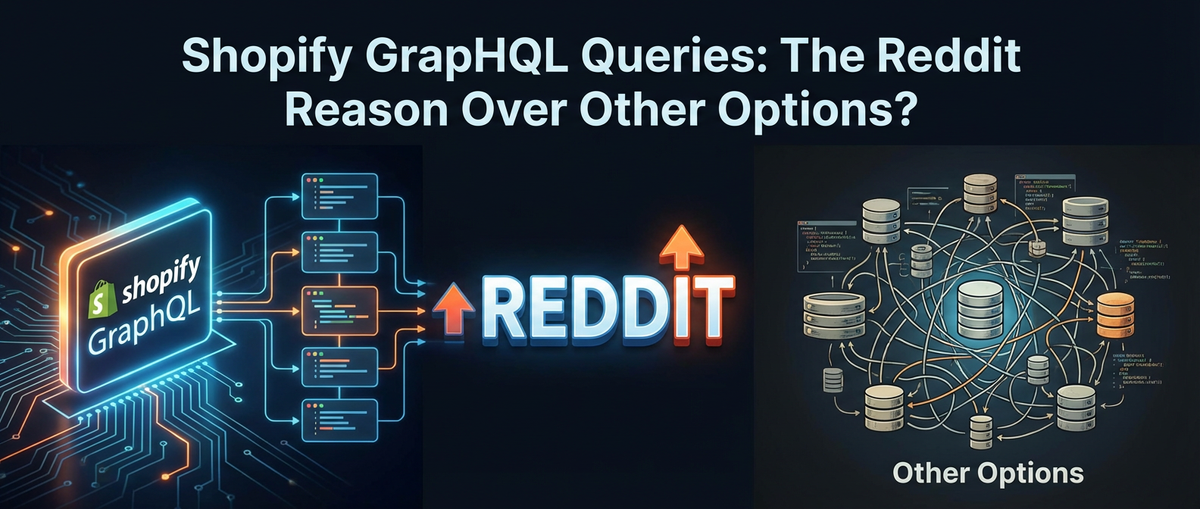
Shopify GraphQL Queries: The Reddit Reason Over Other Options?


In the dynamic world of e-commerce, staying ahead means constantly optimizing the user experience and streamlining development workflows. For businesses building on Shopify, a ubiquitous platform for online stores, the choice of how to interact with the underlying data is paramount. For years, the Shopify REST API served as the primary conduit, a familiar and robust workhorse for countless integrations and custom applications. Yet, a growing chorus, often echoing in the vibrant developer communities found on platforms like Reddit, champions an alternative: Shopify's GraphQL API. This isn't merely a technical preference; it's a strategic shift driven by compelling reasons rooted in efficiency, flexibility, and an elevated developer experience that often leaves traditional methods in its wake. This extensive exploration will delve into why Shopify GraphQL queries are not just an alternative, but increasingly the preferred choice, examining the nuances of its architecture, its practical advantages, and how it addresses the modern demands of sophisticated e-commerce applications, often outshining other options.
The Evolving Landscape of E-commerce Data Access
Before we dissect the allure of GraphQL, it's essential to understand the context. E-commerce platforms like Shopify are complex ecosystems, brimming with product data, customer information, order details, inventory levels, and a myriad of other interconnected entities. Accessing, manipulating, and presenting this data forms the bedrock of every online store, from simple storefronts to intricate marketplaces. The method chosen for this data interaction directly impacts everything from page load times and mobile responsiveness to the agility of development teams and the scalability of applications. For a long time, the go-to standard for web service communication was the Representational State Transfer, or REST, an architectural style that has powered much of the internet's interconnectedness.
The Reign of Shopify REST API: Strengths and Limitations
The Shopify REST API has been a cornerstone for developers, offering a well-defined set of endpoints for interacting with various resources. It's conceptually straightforward: you want products, you hit /admin/api/2023-04/products.json; you want an order, you go to /admin/api/2023-04/orders.json. Each resource typically has its own distinct URL, and standard HTTP methods (GET, POST, PUT, DELETE) map to CRUD operations. This simplicity makes it easy to get started, and its widespread adoption means a wealth of documentation and community support. Developers familiar with HTTP and JSON can quickly integrate Shopify data into their applications, building custom storefronts, automating inventory updates, or integrating with third-party logistics providers.
However, as applications grew more complex and user expectations soared, the inherent limitations of REST began to surface, often leading to frustration among developers striving for optimal performance and development speed. One of the most significant challenges is "over-fetching" and "under-fetching." Over-fetching occurs when a REST endpoint returns more data than the client actually needs for a specific view. For instance, fetching a list of products might return dozens of fields for each product, even if your UI only requires the product title and image URL. This wastes bandwidth, increases payload size, and can slow down applications, especially on mobile devices or in regions with slower internet connectivity. Conversely, "under-fetching" arises when a single request doesn't provide all the necessary data, forcing the client to make multiple subsequent requests to different endpoints to gather all the required information. Imagine needing product details, variants, and associated images for a single product page – this could easily translate into three or more separate REST calls, each incurring network latency and adding to the overall load time. These inefficiencies, while manageable for simpler applications, become significant bottlenecks for modern, feature-rich e-commerce experiences that demand instant responsiveness and minimal data transfer. The rigid structure of REST endpoints, while predictable, often forces developers to either accept unnecessary data or make a cascade of requests, neither of which is ideal for performance-sensitive applications.
Enter GraphQL: A Paradigm Shift in API Interaction
In response to the limitations of traditional REST APIs, Facebook developed and open-sourced GraphQL in 2012, later making it public in 2015. GraphQL isn't a new protocol or a replacement for HTTP; rather, it's a query language for your API and a runtime for fulfilling those queries with your existing data. It offers a fundamentally different approach to how clients request data from a server, providing a more efficient, powerful, and flexible alternative that significantly enhances developer productivity and application performance. Shopify, recognizing the burgeoning potential and the increasing developer demand for more flexible data access, wisely adopted GraphQL, offering it alongside its established REST API.
What is GraphQL? The Core Principles
At its heart, GraphQL operates on a simple yet profound principle: the client dictates precisely what data it needs. Instead of relying on fixed endpoints that return predefined data structures, a GraphQL API exposes a single endpoint. Clients send a query (a string) to this endpoint, specifying the exact fields and relationships they require. The server then processes this query, fetches only the requested data, and returns it in a predictable JSON structure that mirrors the shape of the query.
Key principles that define GraphQL include:
- Declarative Data Fetching: Clients declare their data requirements, and the server fulfills them. There's no guesswork or over-fetching.
- Strongly Typed Schema: Every GraphQL API is defined by a schema, which acts as a contract between the client and the server. This schema specifies all the types of data that can be queried, the fields available for each type, and the relationships between them. This strong typing provides excellent validation and enables powerful tooling, including automatic documentation and autocompletion.
- Hierarchical Structure: GraphQL queries naturally follow the relationships between objects, allowing developers to fetch deeply nested data in a single request. For example, you can query a product, its variants, and for each variant, its images, all within one query.
- Versionless API: Unlike REST APIs, which often require versioning (e.g.,
v1,v2), GraphQL allows for graceful evolution. New fields can be added to existing types without breaking old clients, and deprecated fields can be marked as such, giving clients ample warning to update. This significantly reduces the burden of API maintenance and ensures forward compatibility.
Shopify's implementation of GraphQL leverages these principles to provide an incredibly powerful interface for its vast e-commerce data. Developers can construct complex queries to retrieve precisely the information required for custom storefronts, administrative applications, or integration services, eliminating much of the friction associated with traditional API interactions. This flexibility is particularly valuable in an ecosystem where diverse applications, from mobile apps to analytics dashboards, might all need to access overlapping but distinct subsets of data.
Diving Deep into Shopify GraphQL Queries
Interacting with Shopify's GraphQL API involves understanding its schema and crafting queries, mutations, and subscriptions. For the scope of fetching data (queries), the process is straightforward once the foundational concepts are grasped.
Understanding the Shopify GraphQL Schema
The Shopify GraphQL Admin API and Storefront API each have their own comprehensive schemas. These schemas define the data available, how it's structured, and what operations (queries, mutations) can be performed. Tools like GraphiQL or GraphQL Playground provide an interactive interface to explore these schemas. You can discover types like Product, Order, Customer, Collection, and their associated fields, such as Product.title, Product.priceRange, Product.variants, and Order.lineItems. The schema is the definitive reference for what you can query and how to structure your requests. It acts as a live, self-documenting blueprint of the entire api.
Constructing Basic Queries
A basic GraphQL query for Shopify typically involves selecting an entry point (a root field), specifying the desired fields, and optionally adding arguments for filtering or pagination.
Let's illustrate with an example: fetching the title and ID of the first 10 products.
query GetProducts {
  products(first: 10) {
    edges {
      node {
        id
        title
        handle
      }
    }
  }
}
In this query: * query GetProducts: Defines the operation as a query and gives it a name for clarity (optional, but good practice). * products(first: 10): This is a root field that queries a connection of products. The first: 10 argument specifies that we want the first 10 products. * edges { node { ... } }: Shopify's GraphQL API often uses the Relay connection model for paginated lists. edges represents the connections, and node is the actual item (in this case, a product). * id, title, handle: These are the specific fields we want to retrieve for each product.
The power here is that if you later decide you also need the createdAt date for each product, you simply add createdAt to your query without changing the endpoint or making another request. The response will include only these specified fields, and nothing more.
Advanced Queries: Filtering, Pagination, and Nested Data
Shopify's GraphQL API truly shines when handling more complex data requirements.
- Filtering: You can filter collections of resources using
queryarguments. For example, to find products with "shirt" in their title:graphql query GetShirts { products(first: 5, query: "title:shirt") { edges { node { id title } } } } - Pagination: Beyond
firstandlast, GraphQL usesbeforeandaftercursors for efficient pagination, allowing you to traverse large datasets without performance degradation. This is crucial for applications that need to display large inventories or customer lists. - Nested Data: The ability to fetch related data in a single request is a monumental advantage. Imagine needing a product's title, its variants' IDs and prices, and the URL of its primary image.
graphql query GetProductDetailsWithVariants { product(id: "gid://shopify/Product/12345") { # Replace with actual product ID id title descriptionHtml images(first: 1) { edges { node { src } } } variants(first: 5) { edges { node { id title price { amount currencyCode } } } } } }This single query fetches a product's core details, its primary image, and the details of its first five variants. In a RESTful approach, this would typically involve at least three separate requests: one for the product, another for its images (potentially), and yet another for its variants, leading to increased latency and development overhead. The nested structure of GraphQL queries perfectly mirrors the hierarchical relationships inherent in most e-commerce data.
Mutations: Modifying Data
While queries fetch data, mutations are used to create, update, or delete data on the server. Just like queries, mutations are strongly typed and defined in the schema. For example, creating a new product or updating an existing order would be performed via a mutation.
mutation ProductCreate($input: ProductInput!) {
  productCreate(input: $input) {
    product {
      id
      title
    }
    userErrors {
      field
      message
    }
  }
}
# Variables for the mutation (example)
{
  "input": {
    "title": "New Custom Widget",
    "productType": "Widget",
    "vendor": "Acme Inc.",
    "status": "ACTIVE"
  }
}
This mutation creates a new product, and the response specifies what fields of the newly created product it should return, along with any potential user errors. The ability to define the response shape for mutations means you can immediately fetch updated data or related resources after a modification, further reducing the need for subsequent API calls.
Tools and Resources for Shopify GraphQL Development
The robust tooling around GraphQL significantly enhances the developer experience.
- GraphiQL/GraphQL Playground: These interactive in-browser IDEs allow developers to explore the schema, build queries, execute them, and view responses. They provide autocompletion, syntax highlighting, and inline documentation, making API exploration intuitive.
- Apollo Client/Relay: These are popular client-side libraries that simplify GraphQL consumption in front-end frameworks like React, Vue, and Angular. They handle caching, state management, and query execution, significantly reducing boilerplate code.
- Shopify CLI: Shopify's command-line interface includes tools for generating boilerplate code and integrating with their development environment, which can support GraphQL operations.
- Postman/Insomnia: These API clients have built-in support for GraphQL requests, allowing developers to test queries and mutations outside of a browser.
The combination of a well-defined API, powerful query language, and extensive tooling makes developing with Shopify GraphQL a highly productive and enjoyable experience. The self-documenting nature derived from the schema removes much of the ambiguity typically associated with undocumented or poorly documented RESTful apis, fostering confidence and accelerating development cycles.
APIPark is a high-performance AI gateway that allows you to securely access the most comprehensive LLM APIs globally on the APIPark platform, including OpenAI, Anthropic, Mistral, Llama2, Google Gemini, and more.Try APIPark now! 👇👇👇
The "Reddit Reason": Why Developers Prefer GraphQL Over Other Options
The "Reddit Reason" isn't a single, monolithic argument but rather a confluence of practical advantages and developer sentiment that collectively push GraphQL to the forefront for Shopify development. When developers discuss their experiences, particularly in forums dedicated to optimizing web applications, the pain points of traditional REST often come up, and GraphQL emerges as a celebrated solution. This preference is particularly strong for complex, data-intensive applications where performance and developer agility are paramount.
1. Efficiency: Precision Data Fetching
This is arguably the most cited benefit. As discussed, REST APIs often lead to over-fetching (getting more data than needed) or under-fetching (needing multiple requests for all data). GraphQL elegantly solves both.
- Eliminating Over-fetching: By allowing the client to specify exactly which fields it needs, GraphQL ensures that only the necessary data is transmitted over the network. For a Shopify storefront, this means faster page loads, especially on mobile devices or in areas with limited bandwidth. If a product listing page only needs the product title and main image, the GraphQL query will only return those two fields, drastically reducing payload size compared to a REST endpoint that might return dozens of fields by default. This direct control over the data payload is a massive boon for performance optimization.
- Reducing Under-fetching and Multiple Roundtrips: The hierarchical nature of GraphQL queries allows clients to request deeply nested and related data in a single request. Instead of making one
GET /products, then for each product,GET /products/{id}/variants, and then for each variant,GET /variants/{id}/images, a single GraphQL query can fetch all this interconnected data simultaneously. This dramatically reduces the number of network roundtrips, which in turn minimizes latency and improves the overall responsiveness of the application. Developers on Reddit frequently share stories of how migrating from multiple REST calls to a single GraphQL query transformed their application's loading speed and perceived performance.
2. Flexibility: Adaptability to Evolving Frontend Needs
Modern web and mobile applications are constantly evolving. Frontend requirements change frequently, necessitating new data combinations or entirely new views.
- Decoupled Frontend-Backend Development: With REST, adding a new feature or modifying an existing one often requires backend changes to create new endpoints or modify existing ones to accommodate the new data requirements. This creates a tight coupling between frontend and backend teams, slowing down development. GraphQL, with its single, flexible endpoint and declarative nature, allows frontend developers to iterate rapidly without waiting for backend modifications. They simply adjust their queries to fetch the new fields or relationships as they become available in the schema. This autonomy empowers frontend teams to build more agilely.
- Versionless API Evolution: The ability to add new fields to the schema without breaking existing clients is a significant advantage. Deprecated fields can be marked as such, allowing clients to gradually migrate. This contrasts sharply with REST APIs, where major changes often necessitate versioning (e.g.,
api.example.com/v1,api.example.com/v2), leading to maintenance overhead and potential fragmentation as different clients use different API versions. Shopify's GraphQL API, like many others, embraces this evolutionary approach, providing a smoother path for long-term development.
3. Superior Developer Experience
The quality of an API's developer experience (DX) can make or break its adoption. GraphQL excels here, transforming what can often be a frustrating experience into an intuitive and productive one.
- Introspection and Self-Documentation: Every GraphQL API is self-documenting through its schema. Tools like GraphiQL or GraphQL Playground can query the schema itself to provide comprehensive documentation, including available types, fields, arguments, and their descriptions, all in real-time. This eliminates the need for external, often outdated, documentation. Developers can instantly see what data is available and how to query it, reducing the learning curve and debugging time. This contrasts with REST APIs where
OpenAPI(formerly Swagger) specifications are crucial for documentation, but require manual generation or maintenance to stay up-to-date, which is often overlooked or becomes a burdensome task. - Strong Typing and Validation: The strongly typed nature of GraphQL means that queries are validated against the schema before execution. This catches many errors early in development, preventing runtime issues. Autocompletion in IDEs and GraphQL clients further streamlines query construction, making it less prone to typos and syntax errors.
- Predictable Responses: The response structure in GraphQL always mirrors the shape of the query. This predictability makes client-side data parsing and state management much simpler, reducing complexity and potential bugs in frontend applications. Developers always know exactly what to expect from the server.
4. Reduced Client-Side Complexity (and Backend Simplification)
By centralizing data fetching logic on the server and empowering clients to define their data needs, GraphQL can simplify both client-side and backend development. On the client, less logic is needed to combine data from multiple endpoints. On the backend, while the initial setup of a GraphQL server can be more involved, it often leads to a more maintainable api layer in the long run, as it avoids the proliferation of specialized REST endpoints for every new client requirement. This is especially relevant for backend-for-frontend (BFF) architectures, where a GraphQL layer can serve as a powerful aggregation point.
5. Community Momentum and Modern API Standard
The "Reddit Reason" also stems from the broader industry trend and community enthusiasm surrounding GraphQL. It's perceived as a modern, forward-thinking approach to API design, attracting talent and fostering a rich ecosystem of tools and libraries. Developers are actively sharing best practices, solutions to common problems, and success stories, further solidifying its reputation as a superior option for complex data interactions. This collective knowledge base is invaluable for anyone embarking on a new project or optimizing an existing one.
To encapsulate the core differences, consider this comparison table for Shopify's API options:
| Feature/Aspect | Shopify REST API | Shopify GraphQL API | "Reddit Reason" Perspective |
|---|---|---|---|
| Data Fetching | Fixed endpoints, often over-fetches or under-fetches | Client specifies exact data, avoids over/under-fetching | "No more bloated payloads or waterfall requests!" - Focus on performance, especially for mobile. |
| Endpoints | Multiple, resource-specific URLs | Single endpoint for all queries/mutations | "One endpoint to rule them all." - Simplifies client configuration and reduces network overhead. |
| Flexibility | Less flexible, new data often needs new endpoints | Highly flexible, client-driven data shapes | "Frontend teams can move faster without waiting for backend." - Empowers agile development cycles. |
| Documentation | External docs (e.g., OpenAPI), can get outdated |
Self-documenting via schema introspection | "Live, interactive docs are a game-changer for DX." - Reduces learning curve and debugging time. |
| Network Requests | Often multiple requests for related data | Single request for complex, nested data | "One query, all the data. Period." - Drastically improves latency and responsiveness. |
| API Evolution | Versioning (v1, v2) common, breaking changes | Versionless, additive changes, deprecation | "No more forced migrations or maintaining old versions." - Simplifies long-term maintenance. |
| Learning Curve | Generally lower, familiar HTTP concepts | Steeper initially, new concepts (schema, queries) | "Worth the initial investment for the long-term gains." - Acknowledge initial hurdle, emphasize eventual productivity. |
| Developer Tools | Standard HTTP clients, some code generators | GraphiQL/Playground, powerful client libraries | "The tooling makes it a joy to work with." - Highlights autocompletion, validation, and advanced client-side frameworks. |
This table clearly illustrates why, for many developers, especially those dealing with dynamic and complex UI requirements, GraphQL is not just a viable alternative but a superior choice. The perceived initial learning curve is quickly outweighed by the gains in efficiency, flexibility, and overall developer satisfaction.
Overcoming Challenges and Best Practices with Shopify GraphQL
While GraphQL offers significant advantages, it's not without its own set of considerations and challenges. Adopting best practices is crucial for maximizing its benefits and mitigating potential pitfalls.
1. The Learning Curve
For developers accustomed to REST, the transition to GraphQL requires understanding new concepts: schemas, queries, mutations, types, and the Relay connection model for pagination. This initial learning investment can feel daunting. * Best Practice: Start with simple queries, leverage GraphiQL/GraphQL Playground extensively to explore the schema, and gradually introduce more complex features. Utilize Shopify's excellent GraphQL documentation and community resources. The investment pays off significantly in the long run.
2. N+1 Problem (and its mitigation)
The N+1 problem is a classic performance issue that can arise when fetching nested data. If a query requests a list of products, and for each product, it then requests a related resource (e.g., variants), the server might make N+1 database queries (one for the list, and N more for each item's related data). * Shopify's Solution: Shopify's GraphQL API is designed to mitigate this internally. Their backend resolvers are optimized to batch data fetches efficiently. * Client-Side Awareness: On the client side, while GraphQL reduces network roundtrips, it doesn't inherently solve backend database efficiency. It's important to understand that a single GraphQL query can still trigger multiple operations on the server. For the Shopify platform, this is handled by Shopify's robust infrastructure. For custom GraphQL servers, data loader patterns are essential.
3. Security Considerations
While GraphQL doesn't inherently introduce new security vulnerabilities compared to REST, its flexibility can expose different attack vectors if not properly managed. * Rate Limiting: Shopify enforces rate limits on its GraphQL API, similar to its REST API. It's crucial for applications to implement proper error handling and retry mechanisms to gracefully manage rate limit breaches. * Authorization: Ensure that your application's access tokens (e.g., Storefront API access tokens, Admin API access tokens) have only the minimum necessary permissions. GraphQL's introspection feature can be used by malicious actors to map out the API if not restricted in production environments (Shopify generally handles this on their end). * Query Depth and Complexity: Maliciously crafted deep or complex queries can potentially overload a server. Shopify's platform has internal mechanisms to prevent this, but for custom GraphQL implementations, server-side query depth limiting and complexity analysis are vital.
4. Caching
Caching strategies for GraphQL can be more nuanced than for REST, where resource-based URLs often simplify HTTP caching. * Client-Side Caching: Libraries like Apollo Client provide robust in-memory and persistent caching mechanisms that intelligently normalize data based on IDs, reducing the need to refetch data. * Server-Side Caching: Shopify handles its own server-side caching. For custom GraphQL implementations, strategies often involve caching resolver results or leveraging content delivery networks (CDNs) for static query results where applicable.
By being mindful of these considerations and adopting the recommended best practices, developers can harness the full power of Shopify's GraphQL API to build high-performance, maintainable, and scalable e-commerce applications.
The Broader API Ecosystem and Management: Beyond Shopify's Walls
While Shopify's GraphQL API simplifies interaction with its specific data, the reality for many businesses, especially larger enterprises or those building complex digital products, is a multi-faceted api landscape. An e-commerce platform might integrate with dozens of different external and internal services: payment gateways, shipping providers, CRM systems, marketing automation tools, inventory management systems, and increasingly, specialized AI services for personalization, recommendation engines, or customer support chatbots. Each of these services might expose its own api, often varying widely in style (REST, SOAP, GraphQL), authentication methods, and data formats. This disparate ecosystem presents its own set of challenges, even for a developer who has mastered Shopify GraphQL.
Managing this diverse collection of APIs becomes a critical task for ensuring seamless operations, robust security, and efficient development across an organization. This is where the concept of an api gateway comes into play, serving as a single entry point for all client requests, routing them to the appropriate backend services. An api gateway acts as a traffic cop, handling cross-cutting concerns like authentication, authorization, rate limiting, logging, and caching, allowing backend services to focus purely on business logic. It provides a crucial layer of abstraction, shielding clients from the complexities of the underlying microservices architecture and enabling centralized control over the entire api portfolio.
For organizations dealing with a mix of RESTful apis, it's worth noting the importance of OpenAPI specifications (formerly Swagger). OpenAPI provides a standard, language-agnostic interface description for RESTful APIs, allowing humans and computers to discover and understand the capabilities of the service without access to source code, documentation, or network traffic inspection. While GraphQL has its self-documenting schema, OpenAPI is indispensable for documenting, testing, and generating client code for REST APIs, ensuring that these "other options" in the API world remain manageable and usable. In a holistic API management strategy, both GraphQL's introspection and OpenAPI's rigorous documentation serve their respective purposes to maintain clarity and usability across different API styles.
Introducing APIPark: Streamlining Your Diverse API Landscape
In an environment where businesses interact with a multitude of APIs, including sophisticated AI models, the need for a comprehensive management platform becomes evident. This is precisely the domain where a solution like APIPark offers significant value. APIPark positions itself as an all-in-one AI gateway and API management platform, designed to simplify the complex task of integrating, managing, and deploying a wide array of services, from traditional REST APIs to cutting-edge AI models.
APIPark stands out by addressing the challenges of a fragmented API ecosystem, particularly in the burgeoning field of AI. Its ability to quickly integrate over 100+ AI models under a unified management system for authentication and cost tracking is a game-changer. Imagine managing multiple AI services for product recommendations, customer service chatbots, or dynamic pricing on your e-commerce platform – APIPark standardizes the invocation process, ensuring that changes in underlying AI models or prompts don't ripple through your applications. This unique feature, "Prompt Encapsulation into REST API," allows users to combine AI models with custom prompts to quickly create new, accessible APIs for tasks like sentiment analysis or data classification, thereby transforming complex AI functionalities into easily consumable services for other parts of your system or even third-party integrations.
Beyond AI, APIPark provides end-to-end API lifecycle management, a critical feature for any organization operating a large number of internal or external APIs. It helps regulate API management processes, manage traffic forwarding, load balancing, and versioning, ensuring that all your APIs, regardless of their origin or purpose, are well-governed. This is particularly relevant when considering how an e-commerce platform might integrate various external services (like shipping apis or payment processor apis) or offer its own custom apis to partners. The platform facilitates API service sharing within teams, centralizing all services for easy discovery and reuse, which significantly boosts internal developer efficiency. Furthermore, its tenant isolation capabilities allow for the creation of multiple teams, each with independent applications, data, and security policies, all while sharing underlying infrastructure, leading to improved resource utilization and reduced operational costs – a significant benefit for larger organizations or those operating multi-tenant solutions.
Security is paramount in API management, and APIPark addresses this with features like API resource access approval, where callers must subscribe to an API and await administrator approval. This ensures controlled access and prevents unauthorized API calls, safeguarding sensitive data. Performance is also a key differentiator, with APIPark boasting Nginx-rivaling speeds, capable of handling over 20,000 TPS on modest hardware, with support for cluster deployment to manage large-scale traffic. Detailed API call logging and powerful data analysis tools further empower businesses to monitor API performance, troubleshoot issues, and gain insights into long-term trends, moving from reactive problem-solving to proactive maintenance.
In essence, while Shopify GraphQL brilliantly tackles the intricacies of Shopify data access, solutions like APIPark extend this principle of streamlined efficiency to the broader API landscape. It addresses the meta-challenge of managing all your APIs, providing a robust api gateway solution that brings order, security, and performance to a complex web of interconnected services. For enterprises striving for comprehensive API governance and seamless integration of cutting-edge AI capabilities, APIPark offers a compelling, open-source-backed solution.
Conclusion: Embracing the Future of E-commerce Development with GraphQL
The journey through Shopify's GraphQL API reveals a powerful shift in how developers interact with e-commerce data. The "Reddit Reason" – a distillation of countless developer experiences and shared insights from community forums – unequivocally points to GraphQL as a superior option for building modern, high-performance Shopify applications. Its declarative nature, precision data fetching, inherent flexibility, and unparalleled developer experience collectively address the long-standing frustrations associated with traditional REST APIs.
By empowering clients to specify exactly what data they need, GraphQL eliminates the inefficiencies of over-fetching and under-fetching, leading to faster load times, reduced network traffic, and a smoother user experience – critical factors in today's competitive e-commerce landscape. The agility it grants to frontend teams, allowing them to iterate rapidly without constant backend modifications, significantly accelerates development cycles. Furthermore, the self-documenting schema and robust tooling associated with GraphQL transform the often-tedious process of API integration into an intuitive and enjoyable one.
While the initial learning curve exists, the long-term benefits in terms of performance, maintainability, and developer satisfaction make it a worthwhile investment. For any developer or business looking to push the boundaries of what's possible with Shopify, whether building a bespoke storefront, a complex backend integration, or an innovative mobile application, embracing GraphQL is not just a technical choice; it's a strategic move towards a more efficient, flexible, and future-proof development paradigm. As the digital commerce ecosystem continues to evolve, GraphQL stands ready as a cornerstone for building the next generation of online shopping experiences, providing the power and control developers need to create truly exceptional products.
5 Frequently Asked Questions (FAQs)
1. What is the main "Reddit Reason" why developers prefer Shopify GraphQL over REST? The primary "Reddit Reason" boils down to efficiency and developer experience. Developers frequently cite GraphQL's ability to fetch exactly the data needed in a single request, eliminating common REST issues like over-fetching (getting too much data) and under-fetching (needing multiple requests for all data). This leads to faster application performance, reduced network overhead, and a much more flexible and productive development workflow, thanks to its self-documenting schema and powerful tooling.
2. Is Shopify GraphQL a complete replacement for the Shopify REST API? Not necessarily a complete replacement, but a powerful alternative and often preferred for new, complex applications. Shopify continues to maintain and update its REST API, which remains suitable for simpler integrations or developers more familiar with its paradigms. However, for highly dynamic applications, custom storefronts, or scenarios demanding precise data control and fewer network requests, Shopify GraphQL offers significant advantages and is often the recommended choice by experienced developers.
3. What kind of applications benefit most from using Shopify GraphQL? Applications that benefit most from Shopify GraphQL are typically those with complex, dynamic user interfaces and significant data requirements. This includes custom-built headless storefronts (where the frontend is decoupled from Shopify's native theme engine), sophisticated mobile applications, and administrative tools or dashboards that need to aggregate data from various Shopify resources efficiently. Any application where performance, flexibility, and rapid iteration are critical will find GraphQL particularly valuable.
4. How does Shopify GraphQL help with frontend development speed? Shopify GraphQL dramatically speeds up frontend development by decoupling it from backend changes. Frontend developers can query for precisely the data their UI needs without waiting for backend engineers to create or modify specific REST endpoints. The self-documenting nature of GraphQL's schema, combined with strong typing and interactive tools like GraphiQL, allows frontend teams to quickly discover and consume data, reducing communication overhead and allowing for more agile iteration cycles.
5. Are there any downsides or challenges to using Shopify GraphQL? Yes, while highly beneficial, GraphQL does come with a steeper initial learning curve compared to REST for developers unfamiliar with its concepts (schemas, queries, mutations, etc.). There are also considerations around caching (which can be more complex than HTTP-based REST caching), rate limiting management, and ensuring query complexity doesn't lead to performance issues on the server (though Shopify's platform generally handles this efficiently). However, for many, the long-term benefits far outweigh these initial challenges.
🚀You can securely and efficiently call the OpenAI API on APIPark in just two steps:
Step 1: Deploy the APIPark AI gateway in 5 minutes.
APIPark is developed based on Golang, offering strong product performance and low development and maintenance costs. You can deploy APIPark with a single command line.
curl -sSO https://download.apipark.com/install/quick-start.sh; bash quick-start.sh

In my experience, you can see the successful deployment interface within 5 to 10 minutes. Then, you can log in to APIPark using your account.

Step 2: Call the OpenAI API.