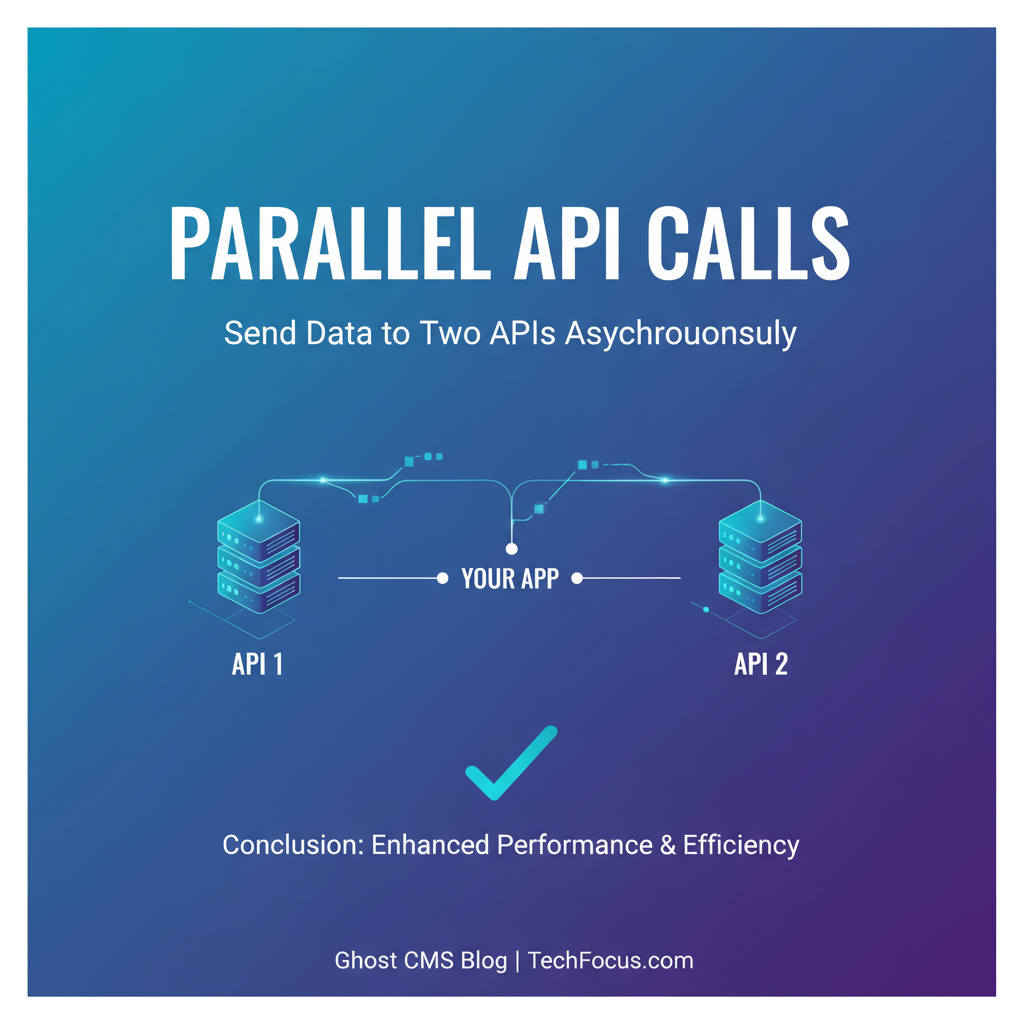
Parallel API Calls: Send Data to Two APIs Asynchronously


In the intricate tapestry of modern software architecture, where microservices communicate across networks and cloud-native applications interact with a multitude of external and internal services, the ability to orchestrate these interactions efficiently and reliably stands as a paramount challenge. Applications today are rarely monolithic; instead, they are often a symphony of interconnected components, each potentially making numerous calls to different Application Programming Interfaces (APIs). From fetching user profile details from one service while simultaneously retrieving their order history from another, to updating records across disparate systems like a CRM and an inventory management platform, the demands on an application's ability to handle multiple data exchanges are ceaseless. The pursuit of optimal performance, enhanced user experience, and robust system resilience necessitates a departure from purely sequential processing, leading us into the realm of parallel asynchronous API calls.
This comprehensive exploration delves deep into the foundational principles, practical implementations, architectural considerations, and advanced strategies for effectively sending data to two or more APIs asynchronously. We will unravel the 'why' behind this critical paradigm shift, dissecting the myriad benefits it offers in terms of responsiveness, scalability, and resource utilization. Furthermore, we will navigate the complexities inherent in asynchronous programming, examining various language-specific constructs and design patterns that enable concurrent execution. A significant portion of our journey will be dedicated to understanding the role of an API Gateway, a pivotal component in managing and securing these intricate interactions, and how platforms like APIPark empower developers and enterprises to master their API ecosystems. By the end of this extensive guide, readers will possess a profound understanding of how to leverage parallel asynchronous API calls not merely as a technical capability, but as a strategic advantage in building high-performing, resilient, and scalable applications.
Chapter 1: The Landscape of Modern API Interactions
The digital era has ushered in an unprecedented level of interconnectedness, transforming how software applications are built, deployed, and interact. At the heart of this transformation lies the Application Programming Interface (API), serving as the universal language through which disparate software components communicate. Gone are the days when a single, monolithic application managed all functionalities within its confines; today's applications are often distributed ecosystems, leveraging a mosaic of specialized services, both internal and external, each exposed through its own API. This architectural shift, largely driven by the microservices paradigm and the advent of cloud computing, has profound implications for how developers approach data exchange and system orchestration.
The Evolution of APIs and Distributed Systems
Initially, APIs were often direct function calls within a single program or library, tightly coupled and executed synchronously. The advent of network-based APIs, particularly those adhering to the Representational State Transfer (REST) architectural style, revolutionized inter-application communication. REST APIs, with their stateless nature and standard HTTP methods, enabled services to communicate over the internet, fostering loose coupling and allowing for independent development and deployment of components. This freedom, however, introduced new challenges: network latency, reliability issues, and the sheer volume of data exchange required to compose a complete user experience or execute a complex business process.
The explosion of data and the imperative for real-time responsiveness have further pushed the boundaries. Concepts like GraphQL emerged to address the over-fetching and under-fetching issues common with REST, offering clients more control over the data they receive. Event-driven architectures gained prominence, allowing services to communicate reactively without direct coupling. Regardless of the specific protocol or style, the fundamental premise remains: modern applications are composed of numerous components that frequently need to interact with multiple external or internal services to fulfill their functions. This inherently leads to scenarios where an application needs to reach out to several distinct APIs, potentially for different pieces of data or to trigger various actions.
The Bottleneck of Synchronous Calls
In a traditional synchronous model, when an application needs to interact with an external service via an API, it sends a request and then pauses, waiting for the response to arrive before proceeding with any subsequent operations. This "wait-and-block" approach is straightforward to implement and debug, making it a natural choice for many developers. However, its simplicity belies a significant performance bottleneck, especially in systems that depend on multiple API calls.
Consider a scenario where a user dashboard needs to display: 1. Their personal profile information (from a User Service API). 2. A list of their recent orders (from an Order Service API). 3. Their current loyalty points balance (from a Loyalty Program API). 4. Customized product recommendations (from a Recommendation Engine API).
If these four API calls are made synchronously, one after the other, the total time to render the dashboard will be the sum of the latencies of each individual call, plus any processing time in between. If each API call takes, on average, 200 milliseconds, the total load time for the dashboard would be at least 800 milliseconds, not accounting for network overhead or server-side processing delays. This sequential execution dramatically increases the perceived latency for the end-user, leading to a sluggish and frustrating experience. Moreover, it ties up valuable application resources (like threads or event loop cycles) while waiting for I/O operations to complete, hindering the application's ability to handle other requests concurrently and severely limiting its overall throughput and scalability. In an era where milliseconds matter for user engagement and business conversion, such inefficiencies are simply unacceptable.
Introducing Concurrency and Parallelism in Software
To overcome the limitations of synchronous execution, modern software systems extensively employ concurrency and parallelism. While often used interchangeably, these terms describe distinct yet related concepts fundamental to achieving high performance and responsiveness:
- Concurrency refers to the ability of an application to handle multiple tasks seemingly at the same time. It's about structuring a program so that multiple computations are in progress at the same instant, often by rapidly switching between tasks. A single-core CPU can achieve concurrency by time-slicing, giving a little bit of processing time to each task. The analogy often used is a chef juggling multiple cooking tasks: putting a dish in the oven, chopping vegetables, then stirring a sauce – all appearing to happen simultaneously, even if the chef is only doing one precise action at a time.
- Parallelism refers to the ability of an application to execute multiple tasks physically at the same time. This requires multiple processing units (e.g., multiple CPU cores, distributed machines) that can truly perform different computations simultaneously. Extending the chef analogy, parallelism would be two or more chefs working in the same kitchen, each simultaneously performing distinct tasks.
In the context of API calls, we are primarily interested in achieving concurrency through asynchronous I/O operations. When an application initiates an API request, it's essentially an I/O-bound task. Instead of blocking and waiting, an asynchronous approach allows the application to "send and forget" (temporarily) that specific request and move on to initiate other tasks or API calls. When the response eventually arrives, a callback mechanism or a promise resolution handles the data. If the underlying system has the capability (e.g., multiple CPU cores, efficient I/O mechanisms), these asynchronous operations can even be executed in parallel, further accelerating the overall process. This distinction is crucial for understanding how we can simultaneously dispatch requests to multiple APIs and effectively manage their responses without bogging down the entire system. The subsequent chapters will delve into the mechanisms and patterns that make this possible, transforming bottlenecks into pathways for superior performance.
Chapter 2: Understanding Asynchronous Programming
The cornerstone of making parallel API calls lies in a deep understanding and proficient application of asynchronous programming principles. Without the ability to initiate an operation and continue execution without waiting for its immediate completion, the concept of parallelism, particularly in I/O-bound scenarios like API calls, would be largely unattainable or extremely cumbersome to manage. Asynchronous programming is a paradigm shift from the traditional sequential execution model, offering a powerful toolkit for building responsive, efficient, and scalable applications.
What is Synchronous vs. Asynchronous? An Illustrative Analogy
To grasp the essence of asynchronous programming, it's often helpful to draw parallels with real-world scenarios.
Synchronous Analogy: The Single-Tasking Chef Imagine a chef in a kitchen who can only focus on one task at a time. If a customer orders a soup, a steak, and a dessert, the chef would first prepare the soup from start to finish. While the soup is simmering, the chef stands idly by, waiting for it to be ready before moving on. Once the soup is plated, the chef then starts on the steak, again waiting for it to cook fully. Finally, the dessert. This sequential approach means the entire order takes a very long time, and the chef is unproductive during many waiting periods. If another customer places an order, they must wait for the first order to be entirely finished before the chef can even begin thinking about their request. This illustrates the blocking nature of synchronous operations: one task must complete before the next can begin, leading to delays and inefficient resource utilization.
Asynchronous Analogy: The Multi-Tasking Chef with Assistants Now, picture the same chef, but this time, they are a master of delegation and multitasking. When the order for soup, steak, and dessert comes in, the chef immediately puts the soup to simmer (an I/O-bound task that takes time but doesn't require constant attention). Instead of waiting, the chef then moves on to prepare the steak, putting it on the grill. While the steak is cooking, the chef starts assembling the dessert. The chef doesn't stand idly by waiting for the soup to simmer or the steak to grill; instead, they continually initiate tasks and, when a task (like the soup finishing its simmer) signals completion, the chef attends to it. The chef might even have an "assistant" (like an event loop) to listen for these completion signals (e.g., a timer goes off for the soup). This approach allows multiple items to be in progress simultaneously. The entire order is completed much faster, and the chef is constantly productive, efficiently handling various stages of different dishes. This is the essence of asynchronous programming: initiating long-running tasks (like API calls) and immediately moving on to other work, returning to handle the results only when they become available.
Benefits of Asynchronous Operations: Responsiveness, Resource Utilization, Scalability
The adoption of asynchronous programming paradigms yields significant advantages across several critical dimensions:
- Enhanced Responsiveness: For user-facing applications, responsiveness is paramount. In a synchronous model, a long-running API call can freeze the user interface (UI) or make the backend unresponsive, leading to a poor user experience. Asynchronous operations prevent this by allowing the application to continue processing other events or updating the UI while waiting for an API response. This ensures a fluid and interactive experience for the user. On the server side, it means the server can continue processing new incoming requests instead of being blocked by an outgoing API call, improving overall throughput.
- Optimized Resource Utilization: Many API calls are I/O-bound operations, meaning they spend most of their time waiting for data to travel over a network or for a remote server to process a request. In a synchronous, thread-per-request model, each waiting API call ties up a dedicated thread. Threads are expensive resources, consuming memory and CPU cycles for context switching. Asynchronous I/O, particularly with event-driven architectures, allows a single thread or a small pool of threads to manage hundreds or thousands of concurrent I/O operations. Instead of dedicating a thread to wait for each response, the thread initiates the request, registers a callback, and then becomes free to do other work. When the response arrives, the system dispatches it to the appropriate callback handler, often running on the same thread or from the small thread pool. This dramatically reduces the overhead, enabling applications to handle a much larger volume of concurrent connections and operations with fewer resources, leading to significant cost savings and improved efficiency.
- Improved Scalability: By making better use of existing resources and reducing the blocking nature of I/O operations, asynchronous programming inherently boosts an application's ability to scale. An application that can process more concurrent requests per server instance will require fewer servers to handle a given load, or can handle a much higher load with the same number of servers. This horizontal scalability is crucial for applications that experience fluctuating traffic patterns or need to serve a large global user base. The ability to efficiently fan out requests to multiple downstream services and aggregate their responses also becomes a critical factor in scaling complex distributed systems.
Common Asynchronous Patterns and Primitives
Over the years, various programming languages and frameworks have developed different mechanisms to facilitate asynchronous programming. While their syntaxes and specific implementations differ, the underlying principles often converge around a few core patterns:
- Callbacks: One of the earliest and most fundamental patterns. A callback function is passed as an argument to an asynchronous function. When the asynchronous operation completes (or fails), the callback function is invoked with the result or error.
- Example (JavaScript):
``javascript function fetchData(url, callback) { // Simulate an async operation setTimeout(() => { const data =Data from ${url}`; callback(null, data); // null for error, data for success }, 1000); }fetchData('api.example.com/users', (error, data) => { if (error) { console.error(error); } else { console.log(data); } }); ``` * Challenge: Callback Hell (or Pyramid of Doom) arises when multiple nested asynchronous operations make the code difficult to read, write, and maintain.
- Example (JavaScript):
- Promises/Futures: Introduced to address the callback hell problem, Promises (or Futures in some languages) represent the eventual result of an asynchronous operation. A promise can be in one of three states: pending (initial state), fulfilled (operation completed successfully), or rejected (operation failed). They allow for chaining asynchronous operations in a more readable, sequential manner.
- Example (JavaScript Promise):
``javascript function fetchData(url) { return new Promise((resolve, reject) => { setTimeout(() => { const success = Math.random() > 0.3; // Simulate success/failure if (success) { resolve(Data from ${url}); } else { reject(new Error(Failed to fetch from ${url}`)); } }, 1000); }); }fetchData('api.example.com/users') .then(data => console.log(data)) .catch(error => console.error(error));// Parallel calls with Promise.all Promise.all([ fetchData('api.example.com/users'), fetchData('api.example.com/products') ]) .then(([userData, productData]) => { console.log("All data fetched:", userData, productData); }) .catch(error => { console.error("One or more parallel fetches failed:", error); }); ```
- Example (JavaScript Promise):
- Async/Await: A syntactic sugar built on top of Promises/Futures, designed to make asynchronous code look and behave more like synchronous code, making it significantly easier to read and write. An
asyncfunction implicitly returns a Promise, and theawaitkeyword can only be used inside anasyncfunction to pause its execution until a Promise settles (resolves or rejects), then resumes with the Promise's resolved value. - Observables: Found in reactive programming libraries (like RxJS), Observables represent a stream of values over time. They are more powerful than Promises for handling multiple values, events, or long-lived connections (e.g., WebSockets). They are "lazy" (don't execute until subscribed to) and offer a rich set of operators for transformation, filtering, and combination.
Example (JavaScript Async/Await): ```javascript async function fetchAllData() { try { const userPromise = fetchData('api.example.com/users'); const productPromise = fetchData('api.example.com/products');
    const userData = await userPromise;
    const productData = await productPromise;

    console.log("All data fetched:", userData, productData);
} catch (error) {
    console.error("An error occurred during fetch:", error);
}
} fetchAllData();// For truly parallel execution and awaiting all results: async function fetchAllDataParallel() { try { const [userData, productData] = await Promise.all([ fetchData('api.example.com/users'), fetchData('api.example.com/products') ]); console.log("All data fetched in parallel:", userData, productData); } catch (error) { console.error("One or more parallel fetches failed:", error); } } fetchAllDataParallel(); ```
How Different Languages Handle Async
The mechanisms for asynchronous programming vary across languages, each tailored to its ecosystem and design philosophy:
- JavaScript (Node.js/Browser): Historically relied on callbacks. Modern JavaScript extensively uses Promises and the
async/awaitsyntax, which is built on Promises, for elegant asynchronous control flow. The event loop model is central to JavaScript's non-blocking I/O. - Python: Introduced
asyncioin Python 3.4, a library for writing concurrent code using theasync/awaitsyntax. It's built around an event loop and coroutines, enabling highly efficient asynchronous I/O. Libraries likehttpxoffer first-classasync/awaitsupport for HTTP requests. - Java: Has evolved from callbacks to
Futureinterfaces and, more recently,CompletableFuture(Java 8+), which provides a more fluent and powerful API for composing asynchronous computations. Project Loom aims to further simplify concurrent programming with "virtual threads." - C# (.NET): Features
async/awaitas a first-class language construct, making asynchronous operations remarkably straightforward to write and understand. It builds uponTaskobjects, which are similar to Promises. - Go: Employs goroutines (lightweight, independently executing functions) and channels (typed conduits through which you can send and receive values) as its primary concurrency primitives. Go's approach is based on communicating sequential processes (CSP), offering a unique and powerful model for concurrent programming without explicit
async/awaitkeywords. - Kotlin: Provides coroutines, a lightweight concurrency framework similar to
async/awaitconcepts, allowing for structured concurrency and easier management of asynchronous tasks on the JVM.
Understanding these underlying mechanisms is crucial for effectively implementing parallel API calls. The choice of pattern or primitive will depend heavily on the specific language and framework being used, but the core objective remains the same: to initiate multiple I/O operations concurrently and efficiently manage their eventual results. The next chapter will explore the compelling reasons and diverse use cases that necessitate this powerful approach.
Chapter 3: The Imperative for Parallel API Calls
In an interconnected digital landscape, applications are rarely isolated islands. They frequently interact with a multitude of services to compose a complete user experience, fulfill complex business logic, or maintain data consistency across disparate systems. While synchronous, sequential API calls are simple to reason about, they quickly become a performance bottleneck in any system requiring interactions with multiple external endpoints. This is precisely where the imperative for parallel API calls becomes overwhelmingly clear, transforming sluggish operations into swift, responsive interactions. The ability to dispatch multiple requests simultaneously and process their responses as they arrive is not merely a technical optimization; it is a fundamental requirement for building modern, high-performance, and resilient applications.
Core Use Cases Driving the Need for Parallelism
The scenarios demanding parallel API calls are abundant and diverse, spanning across almost every domain of software development. Understanding these common use cases highlights the strategic importance of asynchronous, concurrent execution:
3.1 Data Aggregation and Composition
One of the most pervasive reasons for making parallel API calls is the need to aggregate data from multiple independent sources to form a unified view or complete data object. Modern applications often consume data from various microservices, each responsible for a specific domain.
- User Dashboard: Consider a user's profile page on an e-commerce platform. To display a comprehensive view, the application might need to fetch:
- Basic user details (name, email) from a
UserProfile API. - A list of recent orders from an
OrderHistory API. - Shipping addresses from an
AddressManagement API. - Payment methods from a
PaymentService API. - Loyalty points balance from a
RewardsProgram API. If these calls are made sequentially, the user would experience a significant delay as each piece of data loads one after another. By initiating all these requests in parallel, the application only waits for the slowest of these operations to complete, drastically reducing the overall loading time for the dashboard.
- Basic user details (name, email) from a
- Product Details Page: Similarly, a product detail page might combine data from a
ProductCatalog API(basic info), anInventory API(stock levels), aReviewService API(user reviews), and aRecommendation API(related products). Parallel execution is crucial for a fast-loading product page that enhances user engagement and conversion.
3.2 Redundant Data Submission and Event Broadcasting
Sometimes, it's necessary to send the same or related data to multiple endpoints, either for redundancy, auditing, or to trigger various downstream processes simultaneously.
- Logging and Analytics: After a critical event occurs (e.g., a successful transaction, user signup), an application might need to:
- Log the event to an internal
Audit Log APIfor compliance. - Send the event data to an
Analytics Platform API(e.g., Google Analytics, Mixpanel) for business intelligence. - Push a notification to a
Monitoring System API(e.g., Datadog, Prometheus) to track application health. These operations are often independent and do not necessarily depend on each other's success to proceed with the core business logic. Executing them in parallel ensures that all relevant systems are updated promptly without delaying the user's primary interaction (e.g., the transaction confirmation).
- Log the event to an internal
- Data Synchronization: When an update occurs in a primary system, it might need to be replicated to several secondary systems (e.g., updating a customer's email in the CRM, marketing automation platform, and support ticketing system). Parallel calls ensure these systems are brought into sync quickly.
3.3 Performance Optimization for UI Components
In frontend applications, parallel API calls are instrumental in improving the perceived performance and responsiveness of user interfaces. Modern web and mobile applications often feature rich UIs composed of many independent widgets or components.
- Dynamic Dashboards: A dashboard with multiple data widgets (e.g., sales charts, active users, system health indicators) can fetch data for each widget concurrently. As each API call completes, the corresponding widget can be rendered or updated, providing a progressively loading and more interactive experience for the user. Instead of a blank screen while all data loads, users see parts of the UI appear quickly.
3.4 Cross-Platform Integration and Workflow Automation
Businesses frequently rely on a diverse ecosystem of software tools, each serving a specialized purpose. Integrating these tools often involves multiple API interactions.
- Onboarding Workflow: When a new customer signs up, a single action might trigger several parallel updates:
- Create a user record in the
Authentication Service. - Create a customer record in the
CRM System. - Subscribe the user to an email list in the
Marketing Automation Platform. - Provision resources for the user in a
Billing System. Automating this workflow with parallel API calls streamlines the onboarding process, making it faster and more efficient for both the business and the new customer.
- Create a user record in the
3.5 A/B Testing or Shadowing for New Features
When rolling out new features or making significant architectural changes, developers often employ A/B testing or shadowing strategies to compare performance or ensure compatibility.
- Shadowing Live Traffic: To test a new API version or a new recommendation engine without impacting live users, an application might send a copy of every incoming request to both the old (production) API and the new (shadow) API in parallel. The response from the old API is returned to the user, while the response from the new API is used for logging, metrics, and comparison, allowing developers to safely evaluate the new system's behavior and performance under real-world load.
Why Parallel is Better Than Sequential for These Cases
The advantages of parallel execution over sequential execution in these scenarios are clear and compelling:
- Reduced Latency: As demonstrated by the user dashboard example, the total execution time for parallel calls is dictated by the longest-running API call, not the sum of all call times. This dramatically reduces the perceived latency, making applications feel snappier and more responsive.
- Improved User Experience: Faster loading times, progressively rendered UIs, and quicker feedback loops directly translate to a better user experience, leading to higher engagement and satisfaction.
- Increased Throughput: On the server side, parallel asynchronous calls free up application threads or event loop cycles much faster. This allows the server to handle more incoming requests concurrently, significantly increasing its overall throughput and enabling it to serve more users with the same infrastructure.
- Efficient Resource Utilization: By not blocking while waiting for I/O, computing resources (CPU, memory, network connections) are used more efficiently. This can lead to cost savings in cloud environments where resource consumption directly correlates with billing.
- Enhanced Reliability (with proper error handling): While parallelism introduces complexity, when combined with robust error handling (e.g., fallbacks, retries for specific calls), it can enhance reliability. A failure in one independent parallel call doesn't necessarily block or fail the entire operation, allowing for graceful degradation.
It's important to note that not all API calls are suitable for parallel execution. Calls that have strict dependencies (e.g., creating a user and then fetching their newly created ID to assign a role) must remain sequential or be structured as dependent asynchronous chains. However, for the vast majority of independent data fetching or event triggering scenarios, embracing parallel asynchronous API calls is a fundamental strategy for building high-performance, resilient, and scalable distributed systems. The next chapter will explore the architectural considerations necessary to implement these patterns effectively and securely.
Chapter 4: Architectural Considerations for Parallel API Calls
Implementing parallel asynchronous API calls effectively requires more than just knowing the syntax for async/await or Promise.all(). It demands a thoughtful architectural approach that addresses potential complexities and ensures the reliability, consistency, and security of the entire system. Without careful design, the benefits of parallelism can quickly be overshadowed by issues such as data corruption, cascading failures, and difficult-to-debug race conditions. This chapter delves into the crucial design principles and the pivotal role of an API Gateway in orchestrating these complex interactions.
Design Principles for Robust Parallelism
When orchestrating multiple API calls concurrently, several critical design principles must guide the development process:
- Idempotency: This is perhaps the most crucial consideration when sending data to multiple APIs in parallel, especially when dealing with writes or state-changing operations. An idempotent operation is one that, if called multiple times with the same parameters, produces the same result (or no additional side effects) as if it were called only once.
- Why it's vital: In a parallel asynchronous setup, network issues, timeouts, or transient errors can lead to situations where a request is sent multiple times (e.g., due to automatic retries), or a response is lost even if the operation succeeded on the remote server. If your "create user" API is not idempotent, retrying a request after a timeout could lead to duplicate user records. If your "charge credit card" API is not idempotent, retries could lead to multiple charges.
- Implementation: Design APIs to be naturally idempotent where possible (e.g.,
PUTrequests for updating a specific resource by ID are often idempotent,DELETErequests are also typically idempotent). For non-idempotent operations likePOST(create), use unique request IDs or transaction IDs (e.g., aclient-generated-uuid) that the server can use to detect and de-duplicate repeated requests.
- Robust Error Handling: Parallel calls introduce the possibility of partial failures – one API call might succeed while another fails. A comprehensive error handling strategy is non-negotiable.
- Partial Failures: Decide how to handle situations where some parallel calls succeed and others fail. Should the entire operation be considered a failure? Can the successful results be used, perhaps with a fallback for the failed parts? For instance, if user profile data loads but product recommendations fail, perhaps show a default message for recommendations rather than failing the entire page load.
- Retries: Implement intelligent retry mechanisms for transient errors (e.g., network glitches, temporary service unavailability). This often involves exponential backoff strategies to avoid overwhelming the failing service and a maximum number of retry attempts. However, retries must be carefully balanced with idempotency.
- Circuit Breakers: Implement circuit breakers to prevent cascading failures. If a particular API consistently fails or is slow, the circuit breaker can "trip," preventing further calls to that service for a period, thus protecting the application and allowing the failing service to recover. This prevents an overloaded or failing downstream service from dragging down your entire application.
- Fallbacks: Define alternative actions or data sources for when a critical API call fails. This could involve returning cached data, default values, or a user-friendly error message, ensuring a graceful degradation of service rather than a complete outage.
- Data Consistency: When parallel writes or updates occur to related data across different services, maintaining consistency becomes challenging.
- Eventual Consistency: For many distributed systems, immediate strong consistency across all services is hard to achieve and often unnecessary. Eventual consistency, where data eventually becomes consistent across all replicas/services, is a common pattern. However, the window of inconsistency should be acceptable for the business context.
- Transactional Guarantees: For operations requiring strong consistency (e.g., financial transactions), a distributed transaction manager (e.g., Saga pattern) or a two-phase commit might be necessary, though these add significant complexity and often reduce performance. For most parallel API calls, aim for idempotency and robust error handling over complex distributed transactions.
- Rate Limiting: External APIs often impose rate limits to prevent abuse and ensure fair usage. When making parallel calls, it's easy to inadvertently exceed these limits, leading to temporary blocks or permanent bans.
- Client-Side Rate Limiting: Implement rate limiting in your application before dispatching parallel requests. This can be done by managing a queue of requests and ensuring that only a certain number are "in flight" within a given time window for each target API.
- Token Buckets/Leaky Buckets: These algorithms are commonly used to implement client-side rate limiting, ensuring a smooth flow of requests without exceeding the allowance of the external API provider.
- Timeouts: Each parallel API call should have an appropriate timeout. Without timeouts, a slow or unresponsive external API can indefinitely block your application's resources, leading to resource exhaustion and degraded performance.
- Connection Timeout: How long to wait to establish a connection.
- Read/Write Timeout: How long to wait for data to be sent or received after a connection is established.
- Setting sensible timeouts prevents your application from waiting endlessly and allows your error handling mechanisms (like retries or fallbacks) to kick in promptly.
- Resource Management: Parallel calls can consume significant resources (network connections, memory, CPU).
- Connection Pooling: Reusing HTTP connections rather than establishing a new one for each request reduces overhead and improves performance. Most modern HTTP client libraries offer connection pooling.
- Thread Pools/Worker Pools: For languages that rely on threads for concurrency, managing a fixed-size thread pool prevents the creation of too many threads, which can lead to excessive context switching and resource contention.
The Role of an API Gateway
Managing the complexities of numerous parallel API calls, especially in a microservices environment, can become overwhelming. This is where an API Gateway becomes an indispensable architectural component. An API Gateway acts as a single entry point for all API requests, sitting between clients and a collection of backend services. It centralizes common concerns, offloading them from individual microservices and providing a unified façade for clients.
How an API Gateway Facilitates Parallel API Calls and API Management:
- Centralized Request Routing and Orchestration: An API Gateway can intelligently route incoming requests to multiple backend services. Crucially, it can also perform service orchestration, allowing a single incoming request from a client to trigger multiple parallel calls to different backend services, aggregate their responses, and then compose a single, unified response back to the client. This significantly simplifies client-side logic, as the client only needs to make one call to the gateway, abstracting away the complexity of parallel backend interactions. This is a core feature that platforms like APIPark specialize in.
- Authentication and Authorization: The Gateway can handle authentication and authorization for all incoming requests before forwarding them to backend services. This ensures that only legitimate and authorized requests reach your microservices, centralizing security enforcement.
- Rate Limiting and Throttling: The API Gateway is the ideal place to enforce global or per-client rate limits. It can prevent clients from overwhelming your backend services with too many parallel requests, protecting your infrastructure and ensuring fair usage. This is particularly important when your application itself is making parallel calls to downstream APIs; the gateway can ensure your internal calls don't exceed your allowed quota to external providers.
- Load Balancing: If you have multiple instances of a backend service, the Gateway can distribute incoming requests (including those initiated through internal parallel calls) across these instances to ensure optimal resource utilization and high availability.
- Caching: The Gateway can cache responses from backend services. If multiple parallel requests from different clients (or even the same client for different parts of an aggregation) ask for the same static data, the Gateway can serve it directly from the cache, reducing load on backend services and speeding up response times.
- Request/Response Transformation: It can transform request and response payloads, converting data formats, adding headers, or filtering sensitive information before forwarding to the client or backend services. This is especially useful for adapting older APIs to modern clients or unifying disparate API responses.
- Service Discovery Integration: Gateways often integrate with service discovery mechanisms (e.g., Eureka, Consul) to dynamically locate and route requests to available backend service instances.
- Monitoring, Logging, and Tracing: By acting as the central entry point, the Gateway provides an excellent vantage point for comprehensive monitoring, logging, and distributed tracing. It can record every API call, collect performance metrics, and inject correlation IDs, which are invaluable for debugging complex parallel call flows. This is a key capability highlighted by APIPark, which offers detailed API call logging and powerful data analysis features to trace and troubleshoot issues, ensuring system stability and data security.
Platforms like APIPark, an open-source AI gateway and API management platform, exemplify the power of such a component. APIPark is designed not only to manage the entire lifecycle of APIs—from design to publication and decommission—but also to facilitate rapid integration of AI models and REST services. Its capabilities for unified API format, prompt encapsulation into REST API, end-to-end API lifecycle management, and team service sharing make it particularly well-suited for environments heavy in parallel API interactions. The platform's ability to achieve high performance (rivaling Nginx, with over 20,000 TPS on modest hardware) and its robust logging and data analysis features are crucial for managing the demands of complex, parallel asynchronous workflows. For enterprises, APIPark offers a robust solution for centralizing API governance, ensuring that parallel API calls are not only efficient but also secure, compliant, and easy to monitor. It allows for independent API and access permissions for each tenant and offers approval features for API resource access, adding layers of security and control essential in a distributed system making many API calls.
In summary, while the core logic for making parallel API calls resides within your application code, a well-designed architecture that includes an API Gateway provides the necessary infrastructure to manage these interactions efficiently, securely, and scalably. It abstracts away much of the underlying complexity, allowing developers to focus on business logic while benefiting from centralized control and operational visibility.
APIPark is a high-performance AI gateway that allows you to securely access the most comprehensive LLM APIs globally on the APIPark platform, including OpenAI, Anthropic, Mistral, Llama2, Google Gemini, and more.Try APIPark now! 👇👇👇
Chapter 5: Implementing Parallel Asynchronous API Calls (Practical Examples)
Having established the theoretical underpinnings and architectural considerations, it's time to delve into the practical implementation of parallel asynchronous API calls. The approach and specific syntax will vary depending on the programming language and framework being used, but the core principle remains consistent: initiate multiple network requests without blocking, and await their collective or individual completion. This chapter will provide illustrative code snippets and discuss common patterns in popular languages, demonstrating how to achieve concurrency for API interactions.
Common Approaches to Server-Side Concurrency
While client-side concurrency (e.g., in a browser using fetch with Promise.all) is common, the true power of parallel API calls often manifests on the server, where applications process heavy loads and orchestrate complex workflows.
5.1 Python: Leveraging asyncio and httpx
Python's asyncio library, introduced in Python 3.4 and significantly improved since, provides a robust framework for writing concurrent code using the async/await syntax. For making HTTP requests, the httpx library is a modern, asyncio-native alternative to requests that supports async/await out of the box.
Scenario: Fetch user details and their recent orders concurrently.
import asyncio
import httpx
import time

# --- Simulate an API client with async methods ---
class MockAPIClient:
    async def fetch_user_details(self, user_id: int):
        print(f"[{time.time():.2f}] Fetching user details for {user_id}...")
        await asyncio.sleep(1.5)  # Simulate network latency
        if user_id == 123:
            return {"id": user_id, "name": "Alice Smith", "email": "alice@example.com"}
        elif user_id == 456:
            return {"id": user_id, "name": "Bob Johnson", "email": "bob@example.com"}
        else:
            raise ValueError(f"User {user_id} not found")

    async def fetch_user_orders(self, user_id: int):
        print(f"[{time.time():.2f}] Fetching orders for {user_id}...")
        await asyncio.sleep(2.0)  # Simulate network latency
        if user_id == 123:
            return [
                {"order_id": "ORD001", "item": "Laptop", "price": 1200},
                {"order_id": "ORD002", "item": "Mouse", "price": 25}
            ]
        elif user_id == 456:
            return [
                {"order_id": "ORD003", "item": "Keyboard", "price": 75}
            ]
        else:
            raise ValueError(f"Orders for user {user_id} not found")

# --- Function to make parallel API calls ---
async def get_user_data_parallel(user_id: int):
    client = MockAPIClient() # In a real app, client would be instantiated once or shared
    start_time = time.time()
    print(f"\n[{start_time:.2f}] Starting parallel fetch for user {user_id}...")

    try:
        # Create tasks for parallel execution
        user_details_task = asyncio.create_task(client.fetch_user_details(user_id))
        user_orders_task = asyncio.create_task(client.fetch_user_orders(user_id))

        # Await both tasks. This will wait for the slower of the two to complete.
        user_details = await user_details_task
        user_orders = await user_orders_task

        end_time = time.time()
        print(f"[{end_time:.2f}] All data fetched in {end_time - start_time:.2f} seconds.")
        return {
            "user_details": user_details,
            "orders": user_orders
        }
    except ValueError as e:
        print(f"[{time.time():.2f}] Error during parallel fetch: {e}")
        return {"error": str(e)}
    except Exception as e:
        print(f"[{time.time():.2f}] An unexpected error occurred: {e}")
        return {"error": "An unexpected error occurred"}


# --- Function to demonstrate sequential API calls for comparison ---
async def get_user_data_sequential(user_id: int):
    client = MockAPIClient()
    start_time = time.time()
    print(f"\n[{start_time:.2f}] Starting sequential fetch for user {user_id}...")

    try:
        user_details = await client.fetch_user_details(user_id)
        user_orders = await client.fetch_user_orders(user_id)

        end_time = time.time()
        print(f"[{end_time:.2f}] All data fetched in {end_time - start_time:.2f} seconds.")
        return {
            "user_details": user_details,
            "orders": user_orders
        }
    except ValueError as e:
        print(f"[{time.time():.2f}] Error during sequential fetch: {e}")
        return {"error": str(e)}
    except Exception as e:
        print(f"[{time.time():.2f}] An unexpected error occurred: {e}")
        return {"error": "An unexpected error occurred"}


# --- Main execution ---
async def main():
    print("--- Demonstrating Parallel API Calls ---")
    data_parallel = await get_user_data_parallel(123)
    print("Parallel result:", data_parallel)

    print("\n--- Demonstrating Sequential API Calls (for comparison) ---")
    data_sequential = await get_user_data_sequential(123)
    print("Sequential result:", data_sequential)

    print("\n--- Demonstrating Parallel API Calls with Error Handling ---")
    data_error = await get_user_data_parallel(999) # User 999 not found
    print("Parallel result with error:", data_error)

    # A more sophisticated way to handle groups of parallel tasks with error isolation
    print("\n--- Parallel calls with return_exceptions=True for independent error handling ---")
    async def fetch_multiple_users_data(user_ids: list[int]):
        api_client = MockAPIClient()
        tasks = [
            get_user_data_parallel(user_id) for user_id in user_ids
        ]
        # Using asyncio.gather with return_exceptions=True
        # This allows other tasks to complete even if one fails, returning the exception as a result.
        results = await asyncio.gather(*tasks, return_exceptions=True)
        return results

    multiple_results = await fetch_multiple_users_data([123, 456, 999])
    print("\nResults for multiple parallel user fetches:")
    for i, res in enumerate(multiple_results):
        if isinstance(res, dict) and "error" in res:
            print(f"  User {i+1} fetch failed: {res['error']}")
        elif isinstance(res, Exception):
            print(f"  User {i+1} fetch failed with unexpected exception: {res}")
        else:
            print(f"  User {i+1} data: {res['user_details']['name'] if 'user_details' in res and res['user_details'] else 'N/A'}")

if __name__ == "__main__":
    asyncio.run(main())
Explanation: * The MockAPIClient simulates network requests with asyncio.sleep(). * In get_user_data_parallel, asyncio.create_task() immediately schedules the two API calls to run concurrently. * await user_details_task and await user_orders_task pause the get_user_data_parallel coroutine until both results are available. asyncio efficiently manages the context switching, allowing the I/O operations to run "in the background." The total time is approximately 2 seconds (the duration of the fetch_user_orders task), which is significantly less than the 3.5 seconds for the sequential approach. * The asyncio.gather(*tasks, return_exceptions=True) pattern is particularly powerful for robust parallel execution, allowing you to collect results from all tasks, even if some of them fail, without stopping the entire execution. This means you can process the successful results and specifically handle failures for individual parts.
5.2 Node.js: Embracing Promise.all and async/await
Node.js, with its event-driven, non-blocking I/O model, is inherently well-suited for asynchronous operations. async/await and Promise.all are the standard ways to manage concurrency for API calls.
Scenario: Fetch a list of articles and associated comments concurrently for a blog post.
const axios = require('axios'); // A popular HTTP client for Node.js

// --- Simulate an API client with async methods ---
class MockAPIClient {
    async fetchArticle(articleId) {
        console.log(`[${Date.now()}] Fetching article ${articleId}...`);
        await new Promise(resolve => setTimeout(resolve, 1200)); // Simulate network latency
        if (articleId === 'blog-post-1') {
            return { id: articleId, title: "Deep Dive into Async APIs", author: "Jane Doe" };
        }
        throw new Error(`Article ${articleId} not found`);
    }

    async fetchComments(articleId) {
        console.log(`[${Date.now()}] Fetching comments for article ${articleId}...`);
        await new Promise(resolve => setTimeout(resolve, 1800)); // Simulate network latency
        if (articleId === 'blog-post-1') {
            return [
                { commentId: 'c1', user: 'UserA', text: 'Great article!' },
                { commentId: 'c2', user: 'UserB', text: 'Very insightful.' }
            ];
        }
        throw new Error(`Comments for article ${articleId} not found`);
    }
}

// --- Function to make parallel API calls ---
async function getArticleDataParallel(articleId) {
    const client = new MockAPIClient();
    const startTime = Date.now();
    console.log(`\n[${startTime}] Starting parallel fetch for article ${articleId}...`);

    try {
        // Promise.all takes an array of promises and returns a single promise
        // that resolves when all of the input promises have resolved,
        // or rejects immediately if any of the input promises reject.
        const [articleDetails, comments] = await Promise.all([
            client.fetchArticle(articleId),
            client.fetchComments(articleId)
        ]);

        const endTime = Date.now();
        console.log(`[${endTime}] All data fetched in ${(endTime - startTime) / 1000:.2f} seconds.`);
        return {
            articleDetails,
            comments
        };
    } catch (error) {
        console.error(`[${Date.now()}] Error during parallel fetch: ${error.message}`);
        return { error: error.message };
    }
}

// --- Function to demonstrate sequential API calls for comparison ---
async function getArticleDataSequential(articleId) {
    const client = new MockAPIClient();
    const startTime = Date.now();
    console.log(`\n[${startTime}] Starting sequential fetch for article ${articleId}...`);

    try {
        const articleDetails = await client.fetchArticle(articleId);
        const comments = await client.fetchComments(articleId);

        const endTime = Date.now();
        console.log(`[${endTime}] All data fetched in ${(endTime - startTime) / 1000:.2f} seconds.`);
        return {
            articleDetails,
            comments
        };
    } catch (error) {
        console.error(`[${Date.now()}] Error during sequential fetch: ${error.message}`);
        return { error: error.message };
    }
}

// --- Main execution ---
async function main() {
    console.log("--- Demonstrating Parallel API Calls ---");
    const dataParallel = await getArticleDataParallel('blog-post-1');
    console.log("Parallel result:", dataParallel);

    console.log("\n--- Demonstrating Sequential API Calls (for comparison) ---");
    const dataSequential = await getArticleDataSequential('blog-post-1');
    console.log("Sequential result:", dataSequential);

    console.log("\n--- Demonstrating Parallel API Calls with Error Handling ---");
    const dataError = await getArticleDataParallel('non-existent-post'); // Non-existent article
    console.log("Parallel result with error:", dataError);

    // Using Promise.allSettled for independent error handling
    console.log("\n--- Parallel calls with Promise.allSettled for independent error handling ---");
    async function fetchMultipleArticleData(articleIds) {
        const api_client = new MockAPIClient();
        const promises = articleIds.map(id =>
            Promise.all([
                api_client.fetchArticle(id),
                api_client.fetchComments(id)
            ]).catch(e => ({ error: e.message })) // Catch individual errors for each pair of calls
        );
        const results = await Promise.allSettled(promises); // Wait for all promises to settle, whether fulfilled or rejected
        return results;
    }

    const multipleResults = await fetchMultipleArticleData(['blog-post-1', 'another-post', 'blog-post-2']);
    console.log("\nResults for multiple parallel article fetches:");
    multipleResults.forEach((result, i) => {
        if (result.status === 'fulfilled') {
            if (result.value && result.value.error) {
                 console.log(`  Article ${i+1} fetch failed (inner): ${result.value.error}`);
            } else {
                 console.log(`  Article ${i+1} data: ${result.value.articleDetails.title}`);
            }
        } else {
            console.log(`  Article ${i+1} fetch failed (outer): ${result.reason}`);
        }
    });
}

main();
Explanation: * Promise.all() is the key. It takes an array of Promises and returns a single Promise that resolves with an array of results from the input Promises, in the same order. * If any Promise in the input array rejects, Promise.all() immediately rejects with the reason of the first Promise that rejected. This "fail-fast" behavior is often desirable but requires careful error handling for partial successes. * For scenarios where you want all parallel operations to complete regardless of individual failures, Promise.allSettled() (ES2020) is invaluable. It returns a Promise that resolves after all of the given Promises have either fulfilled or rejected, with an array of objects describing each Promise's outcome (status: 'fulfilled' | 'rejected' and value or reason). This allows for more robust error handling of independent parallel tasks.
Choosing the Right Tool/Library
The choice of HTTP client library and async constructs is crucial for efficient parallel API calls:
- Python: For modern asynchronous Python,
httpx(withasyncio) is highly recommended due to its nativeasync/awaitsupport and excellent performance. For older codebases or simpler, non-async concurrency,requestscombined withconcurrent.futures.ThreadPoolExecutororProcessPoolExecutorcan be used, thoughhttpxis generally preferred forasyncioapplications. - Node.js:
fetchAPI (native in browsers and Node.js 18+),axios, ornode-fetchare standard choices. All return Promises, making them directly compatible withasync/awaitandPromise.all/allSettled. - Java:
CompletableFutureis the modern choice for composing asynchronous operations. For HTTP,HttpClient(Java 11+) offers a non-blocking API, or libraries likeSpring WebClientprovide reactive capabilities. - Go: Goroutines and channels are powerful. You would typically launch multiple goroutines for API calls and use a
sync.WaitGroupto wait for all of them to complete, or channels to collect results. - C#:
HttpClientwithasync/awaitis the standard. UseTask.WhenAll()to await multiple parallelTaskobjects (which are analogous to Promises).
When implementing, remember to also integrate the architectural considerations discussed in Chapter 4, such as timeouts, retry logic, and connection pooling, ideally configured at the HTTP client level. For complex orchestrations involving numerous backend services, especially when external clients are involved, remember that an API Gateway like APIPark can abstract much of this logic, making your individual services simpler and more focused on their core domain. The Gateway can handle the fan-out/fan-in, authentication, rate limiting, and monitoring, becoming a central point of control for your entire API ecosystem.
Chapter 6: Advanced Patterns and Best Practices
While the fundamental concept of dispatching multiple API calls asynchronously is straightforward, real-world applications often demand more sophisticated approaches. Implementing robust, scalable, and maintainable parallel asynchronous API calls involves adopting advanced patterns and adhering to best practices that mitigate risks and optimize performance. This chapter explores these advanced strategies, moving beyond simple Promise.all scenarios to address more complex orchestration, error recovery, and operational concerns.
6.1 Fan-out/Fan-in Pattern
The fan-out/fan-in pattern is a common and powerful technique for processing a collection of items by distributing them to multiple parallel workers (or API calls) and then aggregating their results. This pattern is essentially an extension of the basic parallel API call concept, often applied to lists of data.
- Scenario: Processing a batch of orders, where each order needs to be validated by a
Fraud Detection APIand then updated in anInventory API. Instead of processing each order sequentially, you can "fan out" by sending each order to these APIs in parallel. Once all individual order processing results are received, you "fan in" to aggregate the outcomes, perhaps generating a report or updating a dashboard. - Implementation:
- Fan-out: Create a list of asynchronous tasks (e.g., Python
asyncio.Task, JavaScriptPromise) for each item in the collection. - Execution: Use mechanisms like
asyncio.gather(Python),Promise.allorPromise.allSettled(Node.js), orTask.WhenAll(C#) to await the completion of all these tasks. - Fan-in: Collect and process the results from all individual tasks. This might involve filtering, aggregating, or combining the data into a final structure.
- Fan-out: Create a list of asynchronous tasks (e.g., Python
- Considerations:
- Batching: For very large collections, consider batching requests to avoid overwhelming the downstream APIs or consuming too much memory/CPU on the calling side. Process batches sequentially or with controlled concurrency.
- Error Handling: Employ
return_exceptions=Truewithasyncio.gatherorPromise.allSettledto ensure that a single failing item doesn't crash the entire batch processing.
6.2 Bulk Operations
Closely related to fan-out/fan-in, bulk operations involve sending multiple data items within a single API request to a single API endpoint, rather than making separate calls for each item. While not strictly "parallel API calls" in the sense of calling different APIs, it often interacts with other parallel calls and optimizes efficiency.
- Scenario: Updating the status of 100 orders in an
Order Management API. If the API supports a/orders/bulk-updateendpoint, sending a single request with all 100 updates is vastly more efficient than making 100 individual API calls, even if those 100 calls were made in parallel. - Benefits: Reduces network overhead (fewer connection establishments, fewer HTTP headers), reduces load on the target server (processes one request instead of many), and can often be executed more atomically on the server side.
- Integration with Parallelism: You might make parallel bulk update calls to different APIs (e.g., bulk update orders in one system, and bulk update inventory in another). Or, you might fan-out to prepare multiple bulk payloads and then send those bulk payloads to the same API concurrently if the API supports concurrent bulk operations.
6.3 Prioritization and Resource Guarding
Not all API calls are of equal importance. Some might be critical for core functionality, while others are for analytics or supplementary data. In a highly concurrent environment, it's essential to prioritize critical calls and guard against resource exhaustion.
- Prioritization: Implement a queuing mechanism with priority levels. High-priority API calls (e.g., user authentication) can jump ahead of low-priority calls (e.g., background analytics data submission). This ensures that essential services remain responsive even under heavy load.
- Resource Pools: Use fixed-size thread pools or connection pools to limit the number of concurrent outgoing requests. This prevents your application from opening too many connections, which can exhaust local network resources, overwhelm external APIs, or consume too much memory. Libraries like
aiohttpin Python oraxiosin Node.js allow for configuring connection pool sizes. - Semaphore/Mutex: For fine-grained control over concurrent access to shared resources or to limit the number of concurrent calls to a specific API (beyond just overall rate limiting), a semaphore can be used. This allows only a certain number of tasks to proceed concurrently.
6.4 Observability: Logging, Monitoring, Tracing
When dealing with parallel asynchronous API calls, debugging issues and understanding performance bottlenecks can be significantly more challenging than with sequential code. Robust observability is paramount.
- Detailed Logging: Log the initiation and completion of each API call, including request parameters, response status codes, and latency. Crucially, include correlation IDs in your logs. A correlation ID (or trace ID) is a unique identifier generated at the start of a request flow and passed through all subsequent internal and external API calls. This allows you to link together all logs related to a single user request, regardless of which parallel path it took.
- Metrics and Monitoring: Collect metrics for each API call: success rates, error rates, average latency, p95/p99 latency. Use monitoring tools (e.g., Prometheus, Datadog) to visualize these metrics and set up alerts for anomalies. This helps identify slow or failing downstream services affecting your parallel operations.
- Distributed Tracing: Tools like Jaeger, OpenTelemetry, or Zipkin are invaluable. They visualize the entire chain of API calls (including parallel ones) made to fulfill a single user request, showing latencies and dependencies. This makes it incredibly easy to pinpoint which specific API call is the bottleneck or cause of an error in a complex, parallel workflow. This is where the detailed API call logging and powerful data analysis features of an API Gateway like APIPark become particularly beneficial, providing an end-to-end view of API interactions and helping businesses quickly trace and troubleshoot issues.
6.5 Idempotent Retries with Exponential Backoff and Jitter
As discussed, idempotency is critical for retries. The strategy for retrying should be sophisticated.
- Exponential Backoff: Instead of retrying immediately after a failure, wait for an exponentially increasing amount of time between retries (e.g., 1s, 2s, 4s, 8s...). This prevents overwhelming a temporarily overloaded service.
- Jitter: Add a random component (jitter) to the backoff time. If all clients retry at the exact same exponential interval, they might all hit the service at the same time again, creating a thundering herd problem. Jitter smooths out these retry attempts.
- Max Retries: Define a maximum number of retry attempts to prevent indefinite loops and eventually fail fast if a service is genuinely down.
- Circuit Breaker Integration: Retries should work in conjunction with circuit breakers. If a circuit breaker is open for a service, don't even attempt a retry; fail immediately with a fallback.
6.6 Testing Strategies for Concurrent Code
Testing parallel asynchronous code is inherently more complex than testing sequential code due to the non-deterministic nature of concurrency.
- Unit Tests: Test individual asynchronous functions in isolation, ensuring they handle success, failure, and edge cases correctly. Mock external API calls to control their responses and latencies.
- Integration Tests: Test the entire parallel flow by calling actual (or mocked) external services. Introduce artificial delays and error injections to simulate real-world conditions (e.g., slow responses, timeouts, specific error codes). This helps verify your error handling, retry logic, and fallback mechanisms.
- Load Testing: Crucial for identifying performance bottlenecks and race conditions that only manifest under high concurrency. Simulate multiple concurrent users making requests that trigger parallel API calls. Tools like JMeter, k6, or Locust can be used. Monitor resource usage (CPU, memory, network) during these tests.
- Chaos Engineering: Deliberately introduce failures into your system (e.g., shut down a microservice, introduce network latency, cause an API to return errors) to observe how your application's parallel logic handles these disruptions.
6.7 Security in a Parallel API Ecosystem
When making multiple API calls, especially across different services or domains, security must be a paramount concern.
- Principle of Least Privilege: Ensure that each API call uses credentials with the minimum necessary permissions. If a service only needs to read user data, it should not have write access.
- Secure Credential Management: Store API keys, tokens, and other sensitive credentials securely (e.g., using environment variables, secret management services like HashiCorp Vault, AWS Secrets Manager, or Azure Key Vault). Avoid hardcoding them in code.
- Token Forwarding/Propagation: For authenticated user requests, ensure that the user's authentication token (e.g., JWT) is securely propagated to downstream parallel API calls. An API Gateway is instrumental here, as it can manage the initial authentication and then generate or forward appropriate tokens to backend services, ensuring that the entire chain of parallel calls respects the user's identity and permissions. APIPark, for instance, offers robust authentication and authorization features, enabling the creation of multiple teams (tenants) with independent applications and security policies, and requiring approval for API resource access, which significantly enhances the security posture of an API ecosystem.
- Data Validation: Even with parallel calls, all data received from external APIs should be thoroughly validated before being used or stored, to prevent injection attacks or data inconsistencies.
By thoughtfully applying these advanced patterns and best practices, developers can harness the full power of parallel asynchronous API calls, constructing resilient, high-performance, and secure distributed systems that meet the demanding requirements of modern applications. The strategic use of an API Gateway, with its centralized management, security, and observability features, further streamlines this complex endeavor.
Chapter 7: Challenges and Pitfalls
While the benefits of parallel asynchronous API calls are undeniable, the approach is not without its complexities and potential pitfalls. Embracing concurrency and distribution introduces new classes of problems that can be difficult to diagnose and resolve if not addressed with careful design and meticulous implementation. Understanding these challenges is as crucial as understanding the solutions, enabling developers to anticipate issues and build more robust systems.
7.1 Increased Complexity and Debugging Difficulties
The most immediate challenge introduced by parallel asynchronous operations is the inherent increase in complexity. Sequential code is predictable: execution flows from one line to the next. Asynchronous code, especially with multiple parallel branches, introduces non-determinism, making it harder to reason about the exact order of events and the state of the system at any given moment.
- Race Conditions: This occurs when the outcome of the program depends on the relative timing of events, such as the order in which two or more parallel tasks complete and attempt to access or modify a shared resource. For example, if two parallel API calls update the same database record, without proper locking or idempotent updates, the final state might be incorrect or unexpected. These issues are notoriously difficult to reproduce and debug because they often only manifest under specific load conditions or timing circumstances.
- Deadlocks (less common with async I/O): While more prevalent in multi-threaded synchronous programming, deadlocks can theoretically occur in asynchronous systems if tasks become circularly dependent on each other for resources or completions. However, pure asynchronous I/O typically avoids this by not blocking threads.
- Error Propagation and Handling: When multiple operations are running in parallel, an error in one branch needs to be handled gracefully without necessarily crashing the entire application or corrupting other results. Debugging which specific parallel task failed and why, especially across multiple services, requires sophisticated logging and tracing mechanisms.
- Stack Traces: Asynchronous stack traces can sometimes be harder to interpret, as the "call stack" might not directly represent the logical flow of execution due to callbacks, promises, or coroutine switching.
7.2 Resource Contention and Overwhelming Services
While parallel calls aim to optimize resource utilization, without proper management, they can lead to resource contention and overwhelm downstream services.
- External API Overload: Making too many parallel calls to an external API can quickly exceed its rate limits or overwhelm its infrastructure, leading to your application being throttled, blocked, or even permanently banned. This is particularly problematic if your parallel calls are triggered by a large volume of incoming user requests.
- Internal Service Overload: Similarly, parallel calls to your own internal microservices can lead to an overload if those services are not adequately scaled or designed to handle high concurrency. This can cause cascading failures where one overloaded service brings down others.
- Network Congestion: A large number of simultaneous outbound network requests can saturate your application's network interface or the network infrastructure it relies on, creating a local bottleneck that degrades performance for all outgoing traffic.
- Connection Exhaustion: Each HTTP request typically requires a network connection. If not properly managed with connection pooling, making too many parallel calls can exhaust the available ephemeral ports on your server or the maximum number of open connections allowed by the operating system, leading to connection refused errors.
7.3 Cascading Failures
One of the most dangerous pitfalls of complex, interconnected systems is the risk of cascading failures. A problem in one component can trigger failures in dependent components, which then trigger more failures, eventually bringing down a large part or even the entire system.
- Slow Downstream Service: If one of the APIs in a parallel call group becomes slow, it dictates the maximum speed for the entire group (the "longest pole in the tent" problem). If not properly handled with timeouts, this slow service can tie up resources in your application, eventually leading to your application becoming slow or unresponsive itself.
- Error Spreading: A failing downstream service returning errors can cause your application to generate errors, which, if not gracefully handled, might lead to more internal errors or propagate back to the client as an unhelpful server error. Without circuit breakers, your application might continually try to call a failing service, wasting resources and perpetuating the problem.
7.4 Ordering Guarantees and Data Inconsistency
When operations are executed in parallel, their completion order is not guaranteed. While this is often beneficial for performance, it can introduce issues where strict ordering or strong consistency is required.
- Non-Deterministic Order: If you make two parallel API calls,
API_AandAPI_B, there's no guarantee which one will complete first. If the subsequent logic depends onAPI_A's result being processed beforeAPI_B's, this can lead to logical errors or data inconsistencies. For example, ifAPI_Aupdates a user's status andAPI_Bperforms an action based on that status, butAPI_Bcompletes beforeAPI_A's update is committed,API_Bmight operate on stale data. - Data Race Conditions on Shared State: If multiple parallel tasks attempt to modify the same in-memory data structure or shared state within your application without proper synchronization (e.g., locks, atomic operations), it can lead to corrupted data. While modern asynchronous I/O often reduces this risk by favoring immutable data and single-threaded event loops, it's still a concern when shared resources are involved.
7.5 Performance Bottlenecks: The Longest Pole in the Tent
While parallel calls improve overall latency by running tasks concurrently, the total time for a group of parallel operations is still limited by the slowest individual operation.
- Slowest Link: If you make five parallel API calls, and four complete in 100ms but one takes 5 seconds, your application still has to wait for the 5-second call. Identifying and optimizing these "longest poles" becomes critical for overall performance.
- Overhead of Concurrency: While asynchronous I/O is efficient, there's still some overhead associated with managing tasks, promises, callbacks, and context switching. For very short-duration, CPU-bound tasks, sequential execution might sometimes be marginally faster due to reduced overhead, though this is rare for network I/O.
- Resource Limits: Even with parallel calls, if the underlying infrastructure (e.g., database, CPU, network bandwidth) becomes a bottleneck, the benefits of parallelism can be negated. Scalability must be considered end-to-end.
Table: Synchronous vs. Asynchronous Parallel API Calls - A Comparison
To summarize some of the key distinctions and implications, let's look at a comparative table:
| Feature/Aspect | Synchronous API Calls (Sequential) | Asynchronous Parallel API Calls |
|---|---|---|
| Execution Flow | One call completes before the next begins. | Multiple calls initiated and processed concurrently. |
| Total Latency | Sum of individual API call latencies. | Dictated by the longest-running API call. |
| Responsiveness | Often blocked during I/O, can freeze UI/backend. | Non-blocking, maintains responsiveness. |
| Resource Usage | Can tie up threads/processes inefficiently during I/O waits. | Efficient use of resources (e.g., one thread for many I/O ops). |
| Scalability | Limited by blocking I/O, harder to scale for high concurrency. | Inherently more scalable, handles more concurrent requests. |
| Complexity | Relatively simple to understand and debug. | Higher complexity, potential for race conditions, harder to debug. |
| Error Handling | Errors are sequential; easier to pinpoint. | Requires robust partial failure handling (e.g., Promise.allSettled). |
| Dependencies | Naturally handles dependencies (output of A is input to B). | Requires careful management for dependencies; often suited for independent calls. |
| Idempotency | Less critical for simple one-off calls, but good practice. | Crucial for retries and handling uncertain outcomes. |
| Monitoring | Straightforward tracing. | Requires distributed tracing and comprehensive logging. |
| Best Use Case | Simple, few API calls with strict dependencies. | Multiple independent API calls, data aggregation, high-performance needs. |
Navigating these challenges requires a commitment to sound engineering practices: defensive programming, robust error handling, comprehensive testing, and powerful observability tools. An API Gateway, like APIPark, can abstract away and centralize many of these concerns, providing a managed layer for rate limiting, security, monitoring, and even orchestration, thus reducing the burden on individual microservices and making parallel API calls more manageable in large-scale deployments. By being aware of these potential pitfalls, developers can design and implement parallel asynchronous API calls that truly deliver on their promise of performance and resilience.
Conclusion
The modern application landscape is undeniably driven by interconnectedness, with the Application Programming Interface (API) serving as the fundamental backbone for communication between diverse services. As we've thoroughly explored, the demand for highly responsive, scalable, and efficient applications necessitates a sophisticated approach to these interactions, moving beyond the inherent limitations of sequential processing. Parallel asynchronous API calls emerge not merely as a technical feature, but as a strategic imperative for any system striving to deliver exceptional performance and user experience in a distributed environment.
Throughout this extensive guide, we have dissected the very essence of asynchronous programming, illustrating how it frees applications from the bottlenecks of waiting for I/O operations, thereby optimizing resource utilization and enhancing overall responsiveness. We delved into a myriad of compelling use cases, from complex data aggregation for dynamic dashboards to critical redundant data submissions for auditing and analytics, all of which unequivocally benefit from the concurrent execution of API requests. The significant reduction in perceived latency and the dramatic increase in application throughput achieved through parallelization fundamentally transform how users interact with our software and how our systems scale under pressure.
However, the journey into asynchronous parallelism is not without its intricate pathways. We have meticulously examined the critical architectural considerations that underpin robust implementations, emphasizing the paramount importance of idempotency, comprehensive error handling strategies (including retries, circuit breakers, and fallbacks), diligent rate limiting, and meticulous resource management. These principles are the guardrails that prevent the promise of parallelism from devolving into a quagmire of data inconsistencies, cascading failures, and resource exhaustion.
A pivotal element in managing this complexity is the API Gateway. As demonstrated, an API Gateway serves as the intelligent traffic controller, providing a centralized layer for orchestration, security, monitoring, and even advanced routing logic. Platforms like APIPark, with its robust feature set spanning AI model integration, unified API management, performance optimization, and detailed observability, empower developers and enterprises to navigate the complexities of their API ecosystems with confidence. APIPark not only facilitates the seamless integration and deployment of both AI and REST services but also provides the critical governance tools—such as end-to-end API lifecycle management, independent tenant permissions, and performance rivalling Nginx—that are essential for orchestrating a multitude of parallel API calls securely and efficiently, transforming potential chaos into controlled and optimized workflows.
From practical Python asyncio and Node.js Promise.all examples to the discussion of advanced patterns like fan-out/fan-in, intelligent retries with jitter, and the indispensable role of distributed tracing, we have provided a holistic view of both the 'how' and the 'why.' We also confronted the inherent challenges—increased complexity, debugging difficulties, the risks of resource contention, and cascading failures—underscoring the necessity for disciplined design, thorough testing, and vigilant observability.
In conclusion, mastering parallel asynchronous API calls is no longer an optional optimization but a fundamental skill in the arsenal of every modern developer and architect. It is the key to unlocking superior performance, fostering resilient systems, and delivering exceptional user experiences in a world that operates asynchronously. By embracing these principles, leveraging powerful tools like APIPark, and remaining cognizant of the inherent challenges, we can build the next generation of applications that are not only powerful and efficient but also scalable and robust.
Frequently Asked Questions (FAQs)
1. What's the fundamental difference between concurrency and parallelism, especially in the context of API calls?
Concurrency is about structuring your program to handle multiple tasks seemingly at the same time, often by rapidly switching between tasks. For API calls, this means initiating an API request and then, instead of waiting, immediately starting another API request or performing other work. The operating system or runtime environment (like Node.js's event loop or Python's asyncio) manages when your program gets to run, giving the illusion of simultaneous execution for I/O-bound tasks. Parallelism, on the other hand, means genuinely executing multiple tasks at the exact same physical time. This requires multiple processing units (e.g., multi-core CPUs, distributed servers). When you make multiple asynchronous API calls, they are handled concurrently by your application, and if your system has multiple cores or processors, the actual network I/O and remote server processing for these calls will often happen in parallel, contributing to the overall speedup. So, concurrency is about managing many things at once, while parallelism is about doing many things at once.
2. When should I not use parallel API calls?
While powerful, parallel API calls are not always the best solution. You should generally avoid them or use them with extreme caution in the following scenarios: * Strict Dependencies: If the output of one API call is a direct and mandatory input for another (e.g., creating a resource and then immediately using its newly generated ID to create a related sub-resource), these operations must be sequential or carefully chained. Parallelizing them without proper dependency management will lead to errors. * Shared Mutable State: If multiple parallel calls attempt to modify the same shared data structure or resource within your application without proper synchronization (locks, atomic operations), it can lead to race conditions and corrupted data. * Low Number of Calls with High Overhead: For a very small number of API calls where the overhead of setting up and managing asynchronous tasks outweighs the potential gains (rare for network I/O, but possible for extremely fast local operations), sequential might be simpler and marginally faster. * Overwhelming Downstream Services: If the target APIs are known to be fragile, have very strict rate limits, or are prone to breaking under high load, aggressively parallelizing calls might exacerbate the problem, leading to throttling, errors, or service outages. In such cases, carefully controlled concurrency with robust rate limiting and circuit breakers is essential.
3. How do I handle errors when one of several parallel API calls fails?
Handling errors in parallel API calls requires a nuanced approach: * Fail-Fast (e.g., Promise.all, asyncio.gather without return_exceptions=True): The entire group of parallel operations is considered a failure if even one individual call fails. The first error encountered typically rejects the collective promise/future, and subsequent successful results might be discarded. This is suitable when all parts of the operation are critical. * Partial Success (e.g., Promise.allSettled, asyncio.gather with return_exceptions=True): This pattern allows all parallel operations to complete (or fail) independently. You receive a list of results, where each result indicates whether the specific call succeeded (with its value) or failed (with its error). This is ideal when you can process successful results and gracefully handle failures for individual components, providing a better user experience (e.g., showing some data even if parts failed). * Retries and Circuit Breakers: Implement intelligent retry mechanisms (with exponential backoff and jitter) for transient errors, but only for idempotent operations. Use circuit breakers to prevent repeatedly calling a consistently failing service, allowing it to recover and preventing cascading failures in your own application. * Fallbacks: Define default values, cached data, or alternative logic to use when an API call fails, allowing your application to continue functioning in a degraded but still useful state.
4. What role does an API Gateway play in managing parallel API calls?
An API Gateway is a crucial architectural component that acts as a single entry point for all API requests to your backend services. In the context of parallel API calls, it plays several vital roles: * Orchestration and Aggregation: It can receive a single request from a client, fan out to multiple backend services in parallel, aggregate their responses, and then send a single, combined response back to the client. This offloads complexity from both the client and individual microservices. * Centralized Security: Handles authentication and authorization at the edge, ensuring all parallel calls are secure without each backend service having to implement this. * Rate Limiting and Throttling: Enforces rate limits on incoming requests, protecting your backend services from being overwhelmed, even if a client attempts to trigger many parallel calls. * Load Balancing and Routing: Distributes requests across multiple instances of backend services for high availability and performance. * Monitoring and Logging: Provides a central point for comprehensive API call logging, metrics collection, and distributed tracing, which is invaluable for debugging complex parallel workflows. * Transformation: Can transform request and response payloads, adapting different backend API formats for a unified client experience. An API Gateway like APIPark significantly simplifies the management, security, and scalability of complex API interactions, including those involving extensive parallel asynchronous calls.
5. Are there performance drawbacks to using parallel API calls?
While parallel API calls primarily offer performance benefits, there can be some potential drawbacks if not implemented carefully: * Overhead of Concurrency Management: There's a small overhead associated with creating and managing asynchronous tasks, promises, or goroutines. For very simple operations, this overhead might occasionally negate minor gains, though for I/O-bound tasks (like network calls), the benefits almost always outweigh this. * Resource Consumption: Making many parallel calls simultaneously can consume more system resources (memory for open connections, CPU for context switching, network bandwidth) on your application server if not properly managed (e.g., without connection pooling or limiting the number of concurrent tasks). * "Longest Pole in the Tent": The total time for a group of parallel calls is determined by the slowest individual call. If one API is consistently very slow, parallelizing won't make it faster; it will only ensure you don't wait for other faster calls unnecessarily. Identifying and optimizing the slowest link is crucial. * Overwhelming Downstream Services: As mentioned, too many simultaneous requests can overwhelm the target APIs, leading to throttling, errors, and overall performance degradation for everyone involved. Careful rate limiting and circuit breakers are essential to prevent this. The key is to intelligently apply parallelism where it yields the most benefit, while carefully managing resources and anticipating potential bottlenecks.
🚀You can securely and efficiently call the OpenAI API on APIPark in just two steps:
Step 1: Deploy the APIPark AI gateway in 5 minutes.
APIPark is developed based on Golang, offering strong product performance and low development and maintenance costs. You can deploy APIPark with a single command line.
curl -sSO https://download.apipark.com/install/quick-start.sh; bash quick-start.sh

In my experience, you can see the successful deployment interface within 5 to 10 minutes. Then, you can log in to APIPark using your account.

Step 2: Call the OpenAI API.