Optimize GraphQL: Seamlessly Use gql type into fragment
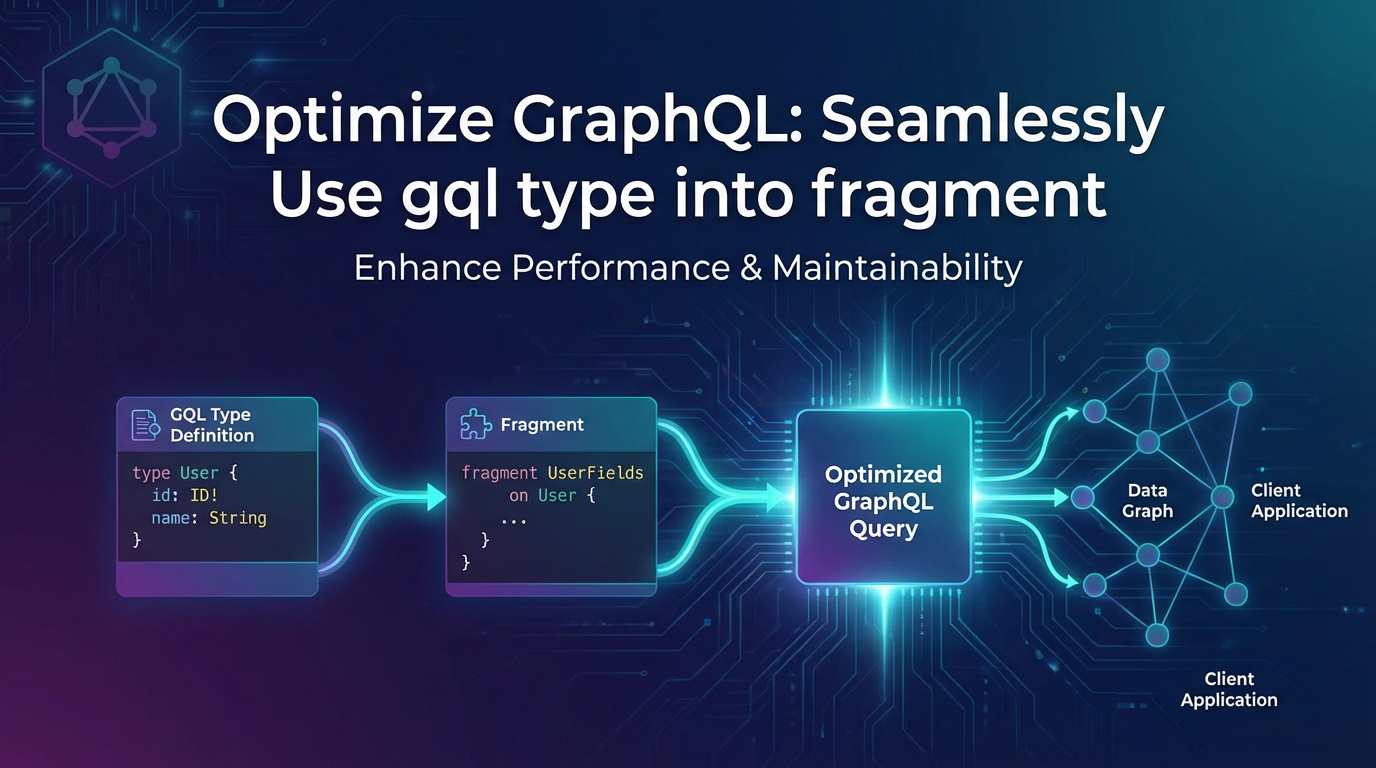


GraphQL has emerged as a transformative technology in the landscape of modern application development, fundamentally altering how client applications fetch and interact with data. Unlike its RESTful predecessors, GraphQL offers a powerful, efficient, and flexible approach, allowing clients to precisely define the data they need, eliminating over-fetching and under-fetching issues. This paradigm shift, while offering immense benefits, also introduces new layers of complexity, particularly when it comes to managing data structures, ensuring type safety, and optimizing query performance across large, collaborative teams. At the heart of GraphQL's efficiency and modularity lies the concept of fragments – reusable units of query logic that can significantly enhance developer experience and maintainability. However, truly unlocking the full potential of fragments requires a seamless integration with GraphQL's robust type system, ensuring that the client-side data structures derived from these fragments are not just consistent, but also strongly typed, directly reflecting the backend gql schema definitions.
This comprehensive guide will delve deep into the art and science of optimizing GraphQL queries by leveraging the power of fragments, specifically focusing on how to integrate gql type definitions directly into these fragments. We will explore the foundational principles of GraphQL, understand the critical role of its type system, and confront the challenges developers face in maintaining type consistency between the server and client. Through practical examples and detailed discussions, we will illustrate strategies, primarily focusing on code generation, that bridge this gap, transforming how developers consume and interact with their GraphQL APIs. By adopting these techniques, teams can achieve unparalleled levels of type safety, boost development velocity, reduce boilerplate, and foster a more robust and error-resistant API ecosystem, ultimately leading to more stable and performant applications. This level of optimization is crucial not just for individual developers but for entire organizations seeking to build scalable and maintainable applications that depend heavily on efficient api interactions.
I. Understanding the Fundamentals of GraphQL
Before we delve into the intricate dance of gql types and fragments, it's imperative to establish a solid understanding of GraphQL itself. Its design philosophy and core components lay the groundwork for effective optimization strategies.
A. What is GraphQL?
GraphQL, developed by Facebook in 2012 and open-sourced in 2015, is not a database technology but a query language for your API and a runtime for fulfilling those queries with your existing data. It provides a complete and understandable description of the data in your api, allowing clients to ask for exactly what they need and nothing more. This contrasts sharply with traditional RESTful APIs, where endpoints typically return fixed data structures, often leading to over-fetching (receiving more data than necessary) or under-fetching (requiring multiple requests to gather all necessary data).
At its core, GraphQL revolves around a schema, which is a strongly typed description of the data available on the server. This schema acts as a contract between the client and the server, defining all possible data types, fields, and operations (queries, mutations, and subscriptions).
- Client-Driven Data Fetching: One of GraphQL's most significant advantages is its client-driven nature. Instead of the server dictating the data structure, the client sends a query specifying precisely the fields it requires. This empowers frontend developers with unprecedented flexibility and reduces the iteration cycles often associated with backend changes in traditional
apiarchitectures. Imagine building a complex user interface where different components require varying subsets of user data; with GraphQL, a single request can satisfy all these diverse data needs, drastically simplifying client-side data management. - Type System and Schema: The cornerstone of GraphQL's reliability is its robust type system. Every field and argument in a GraphQL schema has a defined type, which can be a scalar (like
String,Int,Boolean), an object type (likeUserorProduct), an enum, an interface, or a union. This strict typing ensures data integrity and provides powerful validation at both development and runtime. The schema is written using the GraphQL Schema Definition Language (SDL), which is intuitive and easy to read. This explicit schema definition is invaluable for documentation, as it inherently describes the capabilities of theapi, allowing developers to explore available data and operations easily, often through tools like GraphiQL or GraphQL Playground. - Query, Mutation, Subscription: GraphQL defines three primary operation types:
- Queries: Used for reading data. Similar to GET requests in REST, but with the added flexibility of specifying desired fields. A GraphQL query always returns a JSON object that mirrors the shape of the query, making data consumption predictable and straightforward.
- Mutations: Used for writing data, e.g., creating, updating, or deleting records. Mutations are akin to POST, PUT, PATCH, or DELETE requests in REST. Critically, mutations can also fetch data in their response, allowing clients to retrieve the updated state of an object immediately after modification, eliminating the need for subsequent data fetching calls.
- Subscriptions: Used for real-time data updates. Subscriptions allow clients to subscribe to specific events and receive data from the server automatically when those events occur. This is particularly useful for applications requiring live updates, such as chat applications, stock tickers, or notification systems, leveraging technologies like WebSockets for persistent connections.
- Comparison with REST (Over-fetching/Under-fetching): To truly appreciate GraphQL, it's useful to contrast it with REST. In REST, resources are identified by URLs, and fetching related data often requires multiple round trips to different endpoints. For example, fetching a user and their posts might require
/users/1and then/users/1/posts. This leads to:- Over-fetching: An endpoint might return a large JSON object with many fields, even if the client only needs a few.
- Under-fetching: To get all necessary data, a client might need to make several requests to different endpoints, increasing latency and network overhead. GraphQL elegantly solves these issues by allowing a single query to fetch precisely the data from multiple related resources, optimizing network usage and simplifying client-side data aggregation. This granular control over data fetching is a game-changer for building performant and responsive applications.
B. The Role of GraphQL Fragments
As applications grow in complexity, so do the GraphQL queries required to power their user interfaces. Repeatedly writing the same set of fields for different parts of a query or in different components can quickly lead to verbose, hard-to-maintain code. This is where GraphQL fragments come into play, offering a powerful solution for modularity and reusability.
- Definition: Reusable Units of Query Logic: A GraphQL fragment is a reusable piece of a query. It's a selection of fields that can be included in multiple queries or mutations. Think of it as a subroutine or a partial template for your data requirements. Fragments are defined independently and then "spread" into queries or other fragments using the
...FragmentNamesyntax. This allows developers to encapsulate common data requirements into a single, well-defined unit. - Why Use Them: Avoid Repetition, Modularity, Readability, Maintainability:
- Avoid Repetition (DRY Principle): The most immediate benefit is reducing redundant code. If multiple components in your application require the same set of fields for a
Userobject (e.g.,id,name,email), you can define aUserFieldsfragment once and reuse it wherever needed. This ensures consistency and reduces the chance of errors that arise from copy-pasting code. - Modularity: Fragments promote a modular approach to data fetching. Each UI component can define its own data requirements as a fragment, without needing to know the complete data needs of its parent or sibling components. This makes components more self-contained and easier to reason about. For instance, a
UserProfileCardcomponent might define aUserProfileCard_Userfragment, while aUserListItemcomponent defines aUserListItem_Userfragment, both operating on theUsertype but requesting different fields. - Readability: Breaking down large, complex queries into smaller, named fragments significantly enhances readability. Instead of a single, sprawling query, you get a collection of focused fragments that clearly indicate their purpose and the data they represent. This makes it easier for new developers to understand the data requirements of an application and for existing developers to navigate the codebase.
- Maintainability: When the schema changes, or if a new field needs to be added to a common data set, you only need to update the fragment in one place. This change will then propagate to all queries that use that fragment, drastically simplifying maintenance and reducing the risk of introducing regressions. Without fragments, you would have to manually update every single query where those fields are used, a tedious and error-prone task.
- Avoid Repetition (DRY Principle): The most immediate benefit is reducing redundant code. If multiple components in your application require the same set of fields for a
- Basic Fragment Syntax and Usage: Fragments are defined using the
fragmentkeyword, followed by the fragment name, theonkeyword, and the GraphQL type the fragment applies to.```graphql fragment UserInfo on User { id firstName lastName email }query GetUserProfile { user(id: "123") { ...UserInfo bio createdAt } }query GetPostAuthor { post(id: "456") { title author { ...UserInfo } } } ```In this example,UserInfois a fragment defined on theUsertype. It selectsid,firstName,lastName, andemail. This fragment is then reused in two different queries:GetUserProfileto fetch a user's profile andGetPostAuthorto fetch the author details of a post. Both queries benefit from the consistent and reusableUserInfofragment, illustrating how fragments enhance the modularity and maintainability of your GraphQL data fetching logic.
II. The Power of GraphQL's Type System
The type system is the backbone of GraphQL, providing a powerful contract between the server and all its clients. Understanding its intricacies is crucial for building robust and reliable applications, especially when aiming for seamless integration of gql types into client-side code.
A. Deep Dive into GraphQL Types
GraphQL schemas are composed of various types, each serving a specific purpose in defining the data structure and capabilities of your api.
- Scalar Types (Int, String, Boolean, ID, Float): These are the simplest types, representing atomic values.
Int: A signed 32-bit integer.Float: A signed double-precision floating-point value.String: A UTF-8 character sequence.Boolean:trueorfalse.ID: A unique identifier, often serialized as a String. It's treated specially by GraphQL clients (e.g., for caching) but is fundamentally a string. These basic types ensure that data received by clients is always of an expected format, preventing common data parsing errors that plague loosely typedapis.
- Object Types (Custom Types): Object types are the most fundamental building blocks of a GraphQL schema. They represent a "thing" you can fetch from your service, with a name and a set of fields. Each field in an object type has a name and a type, which can be another object type, a scalar, or a list of types.```graphql type User { id: ID! firstName: String! lastName: String email: String! posts: [Post!]! }type Post { id: ID! title: String! content: String author: User! }
`` Here,UserandPostare object types. The!denotes a non-nullable field, meaning that field must always return a value. The[Post!]!means a list of non-nullablePost` objects, and the list itself cannot be null. This level of detail in type definition is powerful for schema validation and client expectations. - Enums, Interfaces, Unions:
- Enums (Enumeration Types): Enums are special scalar types that restrict a field to a particular set of allowed values. They are useful for representing states or categories. ```graphql enum PostStatus { DRAFT PUBLISHED ARCHIVED }type Post { # ... status: PostStatus! } ``` Enums provide self-documenting data constraints and prevent invalid values from being passed or returned.
- Interfaces: An interface is an abstract type that defines a set of fields that any object type implementing the interface must include. This is similar to interfaces in object-oriented programming. ```graphql interface Node { id: ID! }type User implements Node { id: ID! username: String! }type Product implements Node { id: ID! name: String! price: Float! }
`` Interfaces are invaluable for building polymorphicapis, allowing clients to query for data based on common fields, regardless of the concrete type. For instance, anode(id: ID!)query could return any type that implementsNode`. - Unions: A union type is an abstract type that expresses that a field can return one of a specified set of object types, but not any fields in common (unlike interfaces). ```graphql union SearchResult = User | Post | Commenttype Query { search(term: String!): [SearchResult!]! }
`` Unions are perfect for scenarios where a field might return different kinds of objects, and the client needs to handle each case specifically. For example, a search result could be aUser, aPost, or aComment`.
- Input Types: Input types are special object types used as arguments to fields. They allow you to pass complex objects as arguments to mutations or queries, making your
apicleaner and more organized. ```graphql input CreateUserInput { firstName: String! lastName: String email: String! }type Mutation { createUser(input: CreateUserInput!): User! } ``` Input types separate the data structure used for input from the data structure used for output, enhancing clarity and preventing security vulnerabilities where internal object fields might accidentally be exposed as input fields.
B. Type Safety and Developer Experience
The rigorous type system of GraphQL is not merely an academic exercise; it has profound implications for the robustness and efficiency of the development process, directly impacting developer experience (DX).
- How Strong Typing Prevents Errors:
- Schema Validation: Every query sent to a GraphQL server is validated against the schema. If a client requests a non-existent field, or provides an argument of the wrong type, the server will reject the request with a clear error message before any business logic is executed. This prevents many common
apimisuse errors at the earliest possible stage. - Runtime Guarantees: Because the schema defines what data looks like, clients can rely on receiving data that conforms to these types. This eliminates a vast category of bugs related to unexpected data shapes, null values in supposedly non-nullable fields, or missing fields that are critical for UI rendering. Developers can write code with confidence, knowing the data contract is strictly enforced.
- Clear Contracts: The schema serves as an explicit and undeniable contract between frontend and backend teams. Any changes to the
apimust be reflected in the schema, making breaking changes immediately visible and fostering better communication and coordination between teams.
- Schema Validation: Every query sent to a GraphQL server is validated against the schema. If a client requests a non-existent field, or provides an argument of the wrong type, the server will reject the request with a clear error message before any business logic is executed. This prevents many common
- Intellisense, Auto-completion, Static Analysis: The biggest win for developer experience comes from how IDEs and development tools leverage the GraphQL schema.
- Intellisense and Auto-completion: With a GraphQL language server or appropriate IDE extensions (e.g., Apollo GraphQL extension for VS Code), developers get real-time feedback, auto-completion for fields and arguments, and inline documentation for their queries directly within their editor. When writing a query, the editor can suggest available fields on an object, indicate required arguments, and highlight type mismatches. This significantly speeds up query writing and reduces context switching.
- Static Analysis: Tools can analyze GraphQL queries at build time, comparing them against the schema to catch potential errors even before deployment. This includes checking for undefined fields, incorrect argument types, or invalid fragment spreads. This "fail fast" approach shifts error detection from runtime to compile time, making development more efficient and preventing bugs from reaching production.
- Schema Introspection: GraphQL servers can be queried about their own schema. This introspection capability is what powers tools like GraphiQL, allowing developers to explore the entire
apistructure interactively. It's a self-documentingapithat provides an up-to-date source of truth for all available data and operations. The combination of strong typing and excellent tooling transforms the experience of working with GraphQL. Developers spend less time debuggingapiresponses and more time building features, confident in the data they are consuming. This is particularly valuable in complexapienvironments where anapi gatewaymight be handling multiple upstream services, as the GraphQL layer provides a unified and type-safe façade.
III. The Challenge: Bridging gql Type Definitions and Fragments
While GraphQL's type system and fragments offer powerful benefits, integrating them seamlessly into a cohesive client-side development workflow presents its own set of challenges. The core issue often revolves around maintaining type consistency and providing a superior developer experience when fragments are involved.
A. Traditional Fragment Usage and Its Limitations
In their simplest form, fragments are just pieces of a query. While incredibly useful for reuse and modularity, their traditional usage, especially without explicit client-side type generation, can introduce several limitations that hinder developer velocity and increase the potential for errors.
- Fragments as Pure Query Snippets: Initially, developers might view fragments solely as syntax sugar to avoid repeating fields. A fragment like
UserInfoonUsersimply dictates that certain fields (id,firstName,email) should be selected whenever this fragment is used. However, this definition stops short of providing client-side applications with a concrete type definition for the data thatUserInfowill yield. When the data arrives at the client, it's typically just a plain JavaScript object. Developers then have to mentally map this object structure to the expectedUserfields, or worse, manually define an interface or type in TypeScript. - Manual Type Inference or Redundant Type Declarations: When consuming data returned by a GraphQL query that uses fragments, developers often resort to one of two less-than-ideal approaches in strongly typed languages like TypeScript:
- Manual Type Inference: Relying on TypeScript's inference capabilities, which can be brittle. If a fragment changes, or if different queries select the same fragment but also additional fields, the inferred type might not accurately reflect the complete data structure, leading to potential runtime errors or type assertion hell (
as any). - Redundant Type Declarations: Manually creating TypeScript interfaces or types that mirror the fields selected by a fragment. For example, if you have
fragment UserFields on User { id name }, you might manually writeinterface UserFields { id: string; name: string; }. This introduces a significant maintenance burden. Every time the fragment in your.graphqlfile orgqltag changes, you would need to manually update the corresponding TypeScript interface. This duplication is a primary source of inconsistencies and bugs, especially in large codebases with many fragments and types.
- Manual Type Inference: Relying on TypeScript's inference capabilities, which can be brittle. If a fragment changes, or if different queries select the same fragment but also additional fields, the inferred type might not accurately reflect the complete data structure, leading to potential runtime errors or type assertion hell (
- Potential for Type Mismatches if Schema Evolves: GraphQL schemas are living documents. As an
apievolves, fields might be added, removed, or their types might change. When this happens:- If you're using manual type declarations for fragments, any schema evolution requires a manual update to both the GraphQL fragment and its corresponding TypeScript type. Forgetting one of these updates can lead to a type mismatch where the client-side code expects one shape of data but receives another from the
api, resulting in subtle and hard-to-debug runtime errors. - Without a direct link between the
gqlfragment definition and the client-side type, the development environment provides little assistance in catching these discrepancies. The problem might only surface when the application attempts to access a field that no longer exists or expects a string but receives a number.
- If you're using manual type declarations for fragments, any schema evolution requires a manual update to both the GraphQL fragment and its corresponding TypeScript type. Forgetting one of these updates can lead to a type mismatch where the client-side code expects one shape of data but receives another from the
- Lack of Strong Correlation Between
gqlSchema Types and Client-Side Fragment Types: Thegqlschema types (liketype User { ... }) define the server's data contract. Fragments (fragment UserInfo on User { ... }) then define a subset of that contract for specific query patterns. The disconnect arises because the schema types are often managed on the server (or in a shared schema definition file), while the fragment types are needed on the client. Without a robust mechanism to automatically derive client-side types directly from the schema and the fragments, developers are left to bridge this gap manually, which is inefficient and error-prone. This impedance mismatch can significantly slow down development, as developers are constantly performing mental mapping or fighting with type declarations.
B. The Need for Seamless Integration
The limitations of traditional fragment usage highlight a clear and pressing need for a more integrated approach. Developers require a system that automatically connects the server's gql schema types with the client's fragment definitions, ensuring type safety and enhancing the development workflow.
- Desire for Single Source of Truth for Types: The ideal scenario is to have one definitive source for all type information. This source should be the GraphQL schema (
.graphqlorgqldefinitions). From this single source, all client-side types – whether for entire queries, mutations, or fragments – should be automatically derived. This eliminates redundancy and ensures that any change in the schema or a fragment instantly reflects in the client's type definitions. A single source of truth dramatically simplifies type management and reduces the surface area for errors. - Improving Developer Velocity and Reducing Boilerplate: When client-side types for fragments are automatically generated, developers no longer need to manually write or update TypeScript interfaces. This saves a tremendous amount of time, especially in large projects with hundreds of fragments. The focus shifts from boilerplate maintenance to actual feature development. Furthermore, with accurate, up-to-date types, developers gain full benefits of Intellisense, auto-completion, and static analysis directly within their components, leading to faster coding, fewer errors, and a more enjoyable development experience. This is critical for teams working on complex applications that interact with sophisticated
apis, potentially managed through anapi gateway. - Ensuring Consistency Between Frontend Data Structures and Backend Schema: The ultimate goal is to guarantee that the data structures expected by the frontend application precisely match the data structures provided by the backend
api. Seamless integration ofgqltypes into fragments ensures this consistency. If the backendgqlschema defines aUserwith anidandname, and a client-side fragment requests these fields, the generated TypeScript type for that fragment will correctly reflectid: stringandname: string. If a field is removed from the schema, the generated type will update, immediately flagging errors in client code that attempts to access the now-non-existent field. This proactive error detection is invaluable for maintaining application stability and greatly enhances the reliability of the entireapiconsumption pipeline. In anapiecosystem where anapi gatewayis routing requests, ensuring this consistency at the GraphQL layer prevents errors from cascading through the system.
By addressing these needs, we move towards a more robust, efficient, and enjoyable GraphQL development experience, where the power of the gql type system is fully leveraged, not just on the server, but throughout the entire client-side application.
IV. Strategies for Seamlessly Integrating gql Types into Fragments
The solution to bridging the gap between GraphQL's gql type definitions and client-side fragment usage lies primarily in automation. Leveraging powerful tools and established practices can transform the development workflow, making type safety and consistency an inherent part of the process.
A. Code Generation Approaches (e.g., GraphQL Codegen)
Code generation is the most prevalent and effective strategy for seamlessly integrating gql types into fragments. It involves using specialized tools to read your GraphQL schema and your client-side operations (queries, mutations, fragments), and then automatically generate corresponding type definitions in your target language (e.g., TypeScript, Flow).
- How Code Generation Works: From Schema to Client-Side Types: The process typically follows these steps:
- Schema Introspection/Definition: The code generator first needs access to your GraphQL schema. This can be obtained either by introspecting a running GraphQL server (making an introspection query) or by directly reading a
.graphqlschema definition file (or multiple files). The schema is the definitive source of truth for all types and operations available in yourapi. - Parsing Client Operations: The generator then scans your client-side code or
.graphqlfiles to find all GraphQL queries, mutations, and most importantly for our discussion, fragments. It parses these operations to understand the specific fields being requested for each type. - Type Mapping: Using the schema as a reference, the generator then maps the fields selected in each operation and fragment to their corresponding
gqltypes defined in the schema. For example, if a fragment selectsidandnamefrom aUsertype, and the schema definesidasID!andnameasString!, the generator will know to create a TypeScript type withid: stringandname: string. - Code Output: Finally, the generator outputs the generated type definitions into designated files. These files can then be imported and used directly in your client-side application code.
- Schema Introspection/Definition: The code generator first needs access to your GraphQL schema. This can be obtained either by introspecting a running GraphQL server (making an introspection query) or by directly reading a
- Generating TypeScript/Flow Types from
.graphqlFiles or EmbeddedgqlTags: The most popular tool for this purpose is GraphQL Codegen. It's highly configurable and supports generating types for various GraphQL clients (Apollo, Relay) and different frontend frameworks (React, Vue, Angular), and crucially, for multiple target languages including TypeScript and Flow.- From
.graphqlFiles: Developers often define their queries and fragments in separate.graphqlfiles (e.g.,user.fragment.graphql,getUser.query.graphql). GraphQL Codegen can read these files directly. - From Embedded
gqlTags: Many modern GraphQL clients (like Apollo Client) allow embedding GraphQL queries directly within JavaScript/TypeScript files using tagged template literals (e.g.,gql\query ... `). GraphQL Codegen can be configured to parse these embeddedgql` strings, extracting the operations and generating types.
- From
- Specifically, Generating Types for Fragments: This is where GraphQL Codegen truly shines for our objective. When you define a fragment like this:
graphql // src/fragments/userProfile.fragment.graphql fragment UserProfileFragment on User { id firstName lastName email }GraphQL Codegen, when configured correctly, will generate a TypeScript type definition that accurately reflects the data shape of this fragment. For instance, it might generate an interface like:typescript // generated/graphql.ts export type UserProfileFragment = { __typename?: 'User'; id: string; firstName: string; lastName?: string | null; email: string; };This generated type can then be imported into any component that usesUserProfileFragment, providing full type safety and Intellisense for the data it receives. - Example/Demonstration (Conceptual Steps): Let's illustrate with a conceptual flow:
Define GraphQL Schema: ```graphql // schema.graphql type Query { user(id: ID!): User }type User { id: ID! name: String! email: String! bio: String } * **Define a Fragment:**graphql // fragments/userBasicInfo.fragment.graphql fragment UserBasicInfo on User { id name email } * **Define a Query using the fragment:**graphql // queries/getUserProfile.query.graphql
import "../fragments/userBasicInfo.fragment.graphql"
query GetUserProfile($id: ID!) { user(id: $id) { ...UserBasicInfo bio } } * **Configure `graphql-codegen`:** A `codegen.yml` file would point to `schema.graphql` and all `fragments/**/*.graphql` and `queries/**/*.graphql` files. It would then specify a TypeScript plugin to generate types. * **Run Codegen:** Execute `graphql-codegen`. * **Apply Generated Types:** The `graphql-codegen` output file (e.g., `src/generated/graphql.ts`) would contain:typescript // This is a simplified representation of generated types export type UserBasicInfoFragment = { __typename?: 'User'; id: string; name: string; email: string; };export type GetUserProfileQuery = { __typename?: 'Query'; user?: ({ __typename?: 'User'; bio?: string | null; } & UserBasicInfoFragment) | null; }; * **Use in Client Component (React example):**typescript import { useGetUserProfileQuery } from '../generated/graphql'; import type { GetUserProfileQuery } from '../generated/graphql';interface UserProfileProps { userId: string; }const UserProfile: React.FC = ({ userId }) => { const { data, loading, error } = useGetUserProfileQuery({ variables: { id: userId }, });if (loading) returnLoading...; if (error) returnError: {error.message}; if (!data?.user) returnUser not found.;// Data here is fully typed as GetUserProfileQuery, // which includes fields from UserBasicInfoFragment return (
{data.user.name}
Email: {data.user.email}Bio: {data.user.bio}); }; `` Notice howdata.useris typed to include bothbio(from the query) and fields fromUserBasicInfoFragment`. This automatic merging of fragment types into query types is a core strength of code generation.
B. Runtime Type Validation (Less Common for Fragment Type Integration)
While code generation focuses on static, compile-time type safety, runtime type validation offers a different layer of defense. This approach typically involves libraries that validate incoming api responses against the expected schema at runtime.
- Briefly Discuss Libraries that Validate Queries Against Schema at Runtime: Some GraphQL client libraries or specialized tools can perform a runtime check to ensure that the data received from the server conforms to the schema or the client-side query's expectations. This can catch discrepancies that might have slipped past static analysis, perhaps due to a misconfigured build pipeline or an unexpected server behavior. However, for client-side type definition for fragments, runtime validation is less direct. It tells you if the data is correct, but doesn't generate the types for you to use in your code. Its primary role is to serve as a safety net.
- Why Static Analysis is Generally Preferred for Fragment Type Integration: For the specific problem of integrating
gqltypes into fragments, static analysis (code generation) is overwhelmingly preferred because:- Proactive Error Detection: Errors are caught at compile-time, preventing them from ever reaching a running application. This is far more efficient than debugging runtime errors.
- Enhanced Developer Experience: Intellisense, auto-completion, and inline error feedback are available while writing code, significantly boosting productivity.
- Reduced Overhead: Runtime validation adds overhead to each
apicall, which might be acceptable for debugging but is generally avoided in production for performance-critical applications. Therefore, code generation is the go-to strategy for achieving seamless, type-safe fragment integration.
C. Leveraging IDE Extensions and Language Servers
Beyond code generation, IDE extensions and GraphQL language servers play a crucial role in enhancing the developer experience by understanding gql types and fragments. These tools provide real-time feedback and assistance, even before code generation is run or committed.
- How Tools Enhance the Developer Experience by Understanding
gqlTypes:- Syntax Highlighting and Formatting: Proper syntax highlighting makes GraphQL queries and fragments much more readable within
JavaScript/TypeScriptfiles or.graphqlfiles. - Schema-Aware Auto-completion: As developers type, these extensions can introspect the schema (either from a local file or a running endpoint) and offer context-sensitive auto-completion for field names, arguments, types, and fragment names. This means you don't have to remember every field or argument; your IDE suggests them.
- Validation and Error Checking: The language server can perform real-time validation of your GraphQL operations against the schema. If you try to query a non-existent field, pass an argument of the wrong type, or use an undefined fragment, the IDE will immediately highlight the error, often with a helpful message. This immediate feedback loop is invaluable for catching mistakes early.
- Go-to-Definition and Hover Information: You can often hover over a field or type name in a query to see its definition from the schema, or jump directly to its definition. This is incredibly useful for navigating large schemas and understanding the data model without leaving your editor.
- Fragment Awareness: These tools understand fragment definitions and their usage. When you spread a fragment, the language server knows which fields that fragment contributes and can validate accordingly.
- Syntax Highlighting and Formatting: Proper syntax highlighting makes GraphQL queries and fragments much more readable within
These IDE enhancements, combined with robust code generation, create an unparalleled development environment for working with GraphQL, where type safety and developer productivity are maximized. They make GraphQL api consumption feel native and intuitive, minimizing the cognitive load on developers.
APIPark is a high-performance AI gateway that allows you to securely access the most comprehensive LLM APIs globally on the APIPark platform, including OpenAI, Anthropic, Mistral, Llama2, Google Gemini, and more.Try APIPark now! 👇👇👇
V. Practical Implementation: Step-by-Step Guide with Examples
Having explored the theoretical underpinnings and various strategies, let's now walk through a practical implementation. This section will provide a step-by-step guide on how to set up graphql-codegen and integrate gql types into your fragments, using TypeScript as the target language.
A. Setting up Your Development Environment
To begin, ensure you have the necessary tools installed.
- Node.js, npm/yarn: GraphQL development typically relies on the Node.js ecosystem. If you don't have it, download and install Node.js (which includes npm) from nodejs.org. Alternatively, you can use Yarn (
npm install -g yarn). - GraphQL Client Library (e.g., Apollo Client, Relay): While the type generation for fragments is somewhat client-agnostic, you'll need a client library to actually execute your GraphQL queries. Apollo Client is a popular choice for React, Vue, and Angular applications. Relay is another powerful option, especially for large, performance-sensitive applications, but has a steeper learning curve. For this guide, we'll assume a general setup that works with most clients.
- If using Apollo Client:
npm install @apollo/client graphql
- If using Apollo Client:
graphql-codegenInstallation: This is the core tool for generating our types. We'll install it as a development dependency.bash npm install --save-dev @graphql-codegen/cli @graphql-codegen/typescript @graphql-codegen/typescript-operations @graphql-codegen/typescript-react-apollo graphql@graphql-codegen/cli: The main command-line interface.@graphql-codegen/typescript: Generates basic TypeScript types for your schema.@graphql-codegen/typescript-operations: Generates TypeScript types for your queries, mutations, and fragments.@graphql-codegen/typescript-react-apollo: (Optional) If you're using React with Apollo Client, this plugin generates React hooks (useQuery,useMutation, etc.) that are fully typed. If you're using another client or framework, choose the appropriate plugin (e.g.,typescript-vue-apollo,typescript-urql).graphql: The core GraphQL library, often a peer dependency.
B. Defining Your GraphQL Schema and Types
For this example, let's consider a simple blog application schema. We'll define types for User and Post.
Create a file named schema.graphql at the root of your project:
# schema.graphql
type Query {
  users: [User!]!
  user(id: ID!): User
  posts: [Post!]!
  post(id: ID!): Post
}

type Mutation {
  createUser(input: CreateUserInput!): User!
  updatePost(id: ID!, input: UpdatePostInput!): Post!
}

type User {
  id: ID!
  name: String!
  email: String!
  bio: String
  posts: [Post!]!
}

type Post {
  id: ID!
  title: String!
  content: String!
  published: Boolean!
  author: User!
  createdAt: String!
  updatedAt: String!
}

input CreateUserInput {
  name: String!
  email: String!
  bio: String
}

input UpdatePostInput {
  title: String
  content: String
  published: Boolean
}
This schema defines Query and Mutation types, along with User and Post object types and corresponding input types. The non-nullable ! ensures robust type contracts.
C. Crafting Fragments with gql Type Integration
Now, let's create a fragment and a query that uses it. We'll put them in separate files for better organization, which is a common practice in larger projects.
Create a directory src/graphql for your operations.
- Define a fragment for
User: Createsrc/graphql/fragments/UserBasicInfo.fragment.graphql:graphql # src/graphql/fragments/UserBasicInfo.fragment.graphql fragment UserBasicInfo on User { id name email }This fragment specifies the basic fields we often need for aUser. - Define a query that uses the fragment: Create
src/graphql/queries/GetUserProfile.query.graphql: ```graphql # src/graphql/queries/GetUserProfile.query.graphql #import "../fragments/UserBasicInfo.fragment.graphql"query GetUserProfile($userId: ID!) { user(id: $userId) { ...UserBasicInfo bio posts { id title published } } }`` Notice the#importdirective, whichgraphql-codegenunderstands to resolve fragments. The query asks for theUserBasicInfofields, plusbioand a subset ofPost` fields.
Demonstrate Using the Generated Type with the Fragment in a Component: First, we need to set up graphql-codegen to actually generate the types.Table Example: Fragment Definition ApproachesTo highlight the benefits, let's compare the traditional manual approach versus the code-generated approach for handling fragment types.
| Feature / Aspect | Manual Type Definition (Traditional) | Code-Generated Type Definition (Recommended) |
|---|---|---|
| Type Source | Developer manually creates TypeScript interfaces. | Types are automatically derived from gql schema and fragment definitions. |
| Maintenance | High: Manual updates required for every schema/fragment change. | Low: Types regenerate automatically, reflecting changes instantly. |
| Consistency | Prone to inconsistencies; manual errors can lead to mismatches. | Guaranteed consistency with gql schema; single source of truth. |
| Developer Experience | Less robust Intellisense; more boilerplate, slower development. | Full Intellisense, auto-completion, static analysis; faster, safer coding. |
| Error Detection | Primarily runtime errors or manual code reviews. | Compile-time errors caught by TypeScript compiler and build tools. |
| Boilerplate | High: Re-writing gql type definitions as TS interfaces. |
Very Low: Generated types reduce repetitive code to almost zero. |
| Scalability | Becomes a significant burden in large projects with many fragments. | Scales well with project size; automation handles complexity. |
D. Automating Type Generation
This is the core step that bridges the gql definitions with your client-side TypeScript code.
- Configuration for
graphql-codegen: Create acodegen.ts(orcodegen.yml) file at the root of your project. Using.tsallows for more powerful configuration, especially if you need dynamic paths or custom logic.```typescript // codegen.ts import type { CodegenConfig } from '@graphql-codegen/cli';const config: CodegenConfig = { overwrite: true, schema: './schema.graphql', // Path to your schema documents: './src/graphql/*/.graphql', // Path to your queries, mutations, and fragments generates: { './src/generated/graphql.ts': { plugins: [ 'typescript', 'typescript-operations', 'typescript-react-apollo', // If using React with Apollo Client ], config: { // Optional: Customize how types are generated enumsAsTypes: true, // Generate enums as TypeScript types instead of enum objects nonNullableFragments: true, // Ensures fragment types are non-nullable if the object they spread on is non-nullable skipTypename: false, // Include __typename field in generated types }, }, }, };export default config;`` *overwrite: true: Ensures the generated file is always up-to-date. *schema: Points to yourschema.graphqlfile. If your schema is on a remote server, you'd put the URL here. *documents: Specifies the glob pattern for your GraphQL operation files (queries, mutations, fragments). *generates: Defines the output files and the plugins to use. *plugins:typescript(for base types),typescript-operations(for query/mutation/fragment types), andtypescript-react-apollo` (for Apollo React hooks). - NPM Scripts for Running the Generator: Add a script to your
package.jsonto easily rungraphql-codegen.json { "name": "my-graphql-app", "version": "1.0.0", "scripts": { "generate": "graphql-codegen --config codegen.ts" }, "devDependencies": { "@graphql-codegen/cli": "^5.0.0", "@graphql-codegen/typescript": "^4.0.0", "@graphql-codegen/typescript-operations": "^4.0.0", "@graphql-codegen/typescript-react-apollo": "^4.0.0", "graphql": "^16.8.0", "typescript": "^5.0.0" }, "dependencies": { "@apollo/client": "^3.0.0", "react": "^18.0.0", "react-dom": "^18.0.0" } }Now, you can runnpm run generate(oryarn generate) to generate your types. - Integration into CI/CD Pipeline: For a robust development workflow, it's crucial to integrate the type generation step into your CI/CD pipeline.By automating this process, you ensure that your client-side code always has accurate and up-to-date type definitions, directly derived from your GraphQL schema and operations, including all your carefully crafted fragments. This dramatically reduces the potential for type-related bugs and significantly improves developer productivity.
- Pre-commit Hook: You can use tools like
huskyto runnpm run generateas a pre-commit hook. This ensures that no code is committed without the latest types being generated, preventing type-related issues in your version control. - Build Step: Always run
npm run generateas part of your application's build process. This guarantees that your compiled application uses up-to-date types, especially important for production deployments. A typicalbuildscript might look likegraphql-codegen --config codegen.ts && tsc && webpack.
- Pre-commit Hook: You can use tools like
VI. Advanced Techniques and Best Practices
With the foundation of gql type integration into fragments established, we can explore more advanced techniques and best practices to further optimize your GraphQL development workflow. These strategies address complex data scenarios and the broader api ecosystem.
A. Fragment Composition
Fragments are not just for basic reuse; they can be composed to build increasingly complex data requirements in a modular fashion, mirroring the component hierarchy of your UI.
- Ensuring Type Safety Across Compositions: The power of code generation means that as you compose fragments, the generated TypeScript types automatically reflect this composition. If
UserHeaderFragmentcontributes{ id: string, name: string }andUserDetailsFragmentcontributes{ email: string, bio?: string | null }, thenUserProfilePageFragmentwill correctly combine these, along with thepostsarray, into a single, comprehensive type. This automatic type merging ensures that even in highly nested fragment compositions, your client-side code remains fully type-safe, preventing mismatches and making refactoring a breeze.
Building Complex UI Components from Smaller, Type-Safe Fragments: Imagine a UserProfile page that consists of a UserHeader, UserDetails, and UserPostsList component. Each of these components can define its own fragment for the specific data it needs. ```graphql // src/graphql/fragments/UserHeader.fragment.graphql fragment UserHeaderFragment on User { id name }// src/graphql/fragments/UserDetails.fragment.graphql fragment UserDetailsFragment on User { email bio }// src/graphql/fragments/PostCard.fragment.graphql fragment PostCardFragment on Post { id title published createdAt }// src/graphql/fragments/UserProfilePage.fragment.graphql
import "./UserHeader.fragment.graphql"
import "./UserDetails.fragment.graphql"
import "./PostCard.fragment.graphql"
fragment UserProfilePageFragment on User { ...UserHeaderFragment ...UserDetailsFragment posts { ...PostCardFragment } } `` And then a top-level query would just spreadUserProfilePageFragment. This approach makes each UI component self-contained in terms of its data dependencies. Whengraphql-codegenruns, it will correctly generate types forUserHeaderFragment,UserDetailsFragment,PostCardFragment, andUserProfilePageFragment, ensuring that theUserProfilePageFragment` type is a composite of all its nested fragment types. This leads to a highly maintainable and type-safe data architecture that perfectly aligns with component-based UI development.
B. Handling Polymorphic Data with Union and Interface Types
GraphQL's Union and Interface types allow for polymorphic data, where a field can return different object types. Fragments are essential for querying these types, and code generation excels at providing type safety for them.
- Fragments on Unions/Interfaces (
... on TypeName): When querying a Union or Interface type, you must use inline fragments (... on TypeName) to specify the fields you want to fetch for each possible concrete type. ```graphql interface SearchResult { id: ID! __typename: String! # Important for client-side type discrimination }type User implements SearchResult { id: ID! __typename: String! name: String! }type Post implements SearchResult { id: ID! __typename: String! title: String! content: String! }union FeedItem = User | Postquery GetFeed { feed: [FeedItem!]! { __typename ... on User { id name } ... on Post { id title } } }`` In this example,feedis a list ofFeedItem, which can be either aUseror aPost. The query uses inline fragments to conditionally requestnameforUserobjects andtitleforPost` objects. - How Code Generation Handles These More Complex Scenarios:
graphql-codegenunderstands these inline fragments and union/interface types perfectly. For theGetFeedquery above, it will generate a TypeScript type that is a discriminated union.typescript // Simplified generated type for GetFeed.feed items export type GetFeedQuery = { __typename?: 'Query'; feed: Array< { __typename: 'User'; id: string; name: string } | { __typename: 'Post'; id: string; title: string } >; };This allows you to write type-safe code using type guards:typescript if (item.__typename === 'User') { console.log(item.name); // 'name' is safely accessible here } else if (item.__typename === 'Post') { console.log(item.title); // 'title' is safely accessible here }The__typenamefield is automatically included bygraphql-codegenwhen dealing with polymorphic types, which is crucial for client-side type discrimination. This capability is vital for applications that display heterogeneous lists or search results, ensuring that every piece of data is handled with precision and type safety.
C. Versioning and Schema Evolution
GraphQL schemas are dynamic. Managing changes to the schema and ensuring client compatibility is a critical aspect of api governance.
- Impact of Schema Changes on Generated Types and Fragments: When you modify your
schema.graphql(e.g., add a new field, change a field's type, make a nullable field non-nullable), runninggraphql-codegenwill immediately reflect these changes in your generated client-side types.- Adding a field: The new field will appear in the generated type, allowing clients to start using it.
- Removing a field: The removed field will disappear from the generated type. Any client code attempting to access it will result in a compile-time TypeScript error, alerting developers to the breaking change immediately.
- Changing a type: If
User.namechanges fromStringtoString!, the generated type will update fromname?: string | nulltoname: string, enforcing stricter type checks.
- Strategies for Managing These Changes Gracefully:
- Backward Compatibility (Deprecation): Instead of immediately removing fields, mark them as
@deprecatedin yourgqlschema. This informs clients that the field will eventually be removed and allows them to gradually migrate to new fields.graphql-codegencan optionally include deprecated fields in generated types but might also generate warnings. - Schema Stitching/Federation: For very large or microservices-based
apis, consider GraphQL Federation or Schema Stitching. These approaches allow you to compose a single logical GraphQLapifrom multiple underlying services, each with its own schema. This provides greater modularity and allows different teams to evolve their parts of the schema independently, with agatewayservice unifying them. - Automated Testing: Implement robust end-to-end tests for your GraphQL
apiand client applications. These tests should cover critical queries and mutations, ensuring that schema changes don't inadvertently break existing functionality. - CI/CD Integration: Ensure
graphql-codegenis always run as part of your CI/CD pipeline. This guarantees that your build fails if schema changes introduce breaking changes for your client, preventing deployment of incompatible code.
- Backward Compatibility (Deprecation): Instead of immediately removing fields, mark them as
D. Performance Considerations and api gateway Integration
While fragments primarily optimize client-side data fetching and developer experience, it's crucial to consider the broader api infrastructure, especially how an api gateway can complement and enhance a GraphQL ecosystem.
- While fragments optimize client-side fetching, how do
apiandapi gatewaycomponents fit in? Fragments make your client-side queries more efficient and maintainable by reducing repetition and enhancing type safety. However, the performance and security of your GraphQLapialso heavily depend on the underlyingapiinfrastructure. Anapi gatewaysits between your client applications and your backend services (which resolve your GraphQL queries). It plays a vital role in managing the entireapilifecycle, providing a single entry point for allapiconsumers. - Briefly introduce the role of an
api gatewayin managing, securing, and optimizing GraphQL endpoints: Anapi gatewayis a critical component for any robustapistrategy. For GraphQLapis, it offers several benefits:- Authentication and Authorization: Centralized security policies, authenticating incoming requests before they reach your GraphQL server. This offloads security concerns from individual services.
- Rate Limiting: Protects your backend from abuse and ensures fair usage by controlling the number of requests clients can make within a given time frame.
- Caching: Caches
apiresponses (especially for frequently accessed data), significantly reducing the load on your GraphQL server and improving response times for clients. While GraphQL's dynamic nature makes general caching challenging, anapi gatewaycan implement query-specific caching strategies. - Traffic Management: Handles routing, load balancing, and failover across multiple GraphQL server instances or even different backend services that contribute to the GraphQL schema.
- Monitoring and Analytics: Provides a centralized point for logging and monitoring
apitraffic, performance metrics, and error rates, giving a comprehensive view ofapihealth and usage patterns. - API Transformation and Aggregation: In complex architectures (e.g., microservices), an
api gatewaycan aggregate data from multiple backend services and transform it into a single GraphQL response, simplifying client-side consumption.
- Naturally mention APIPark here: For instance, platforms like ApiPark provide robust
apimanagement capabilities, including intelligent routing and unified access control, which can greatly complement a well-structured GraphQLapiecosystem. Its ability to quickly integrate 100+ AI models and standardizeapiformats ensures that even complex GraphQLapis can be managed efficiently, reducing operational overhead. APIPark, as an open-source AIgatewayandapimanagement platform, allows enterprises to centralize the governance of theirapiresources, providing a unified and secure interface for allapiconsumers. This is particularly valuable for GraphQLapis, where diverse queries from various clients demand consistent management and performance optimization, ensuring that the efficiency gained from fragments isn't lost at the infrastructure layer. The detailedapicall logging and powerful data analysis features within APIPark further ensure that administrators have full visibility into how their GraphQLapis are being used, allowing for proactive adjustments and performance tuning. This robustgatewaysolution complements the type-safe development practices with fragments by securing and streamlining the delivery of your high-performance GraphQLapis.
VII. The Broader Impact on API Development and Management
Optimizing GraphQL with seamless gql type integration into fragments extends far beyond just writing cleaner code. It profoundly impacts team collaboration, api reliability, and the overall efficiency of api consumption and management across an organization.
A. Enhanced Developer Collaboration
In modern development, where frontend and backend teams often work in parallel, clear contracts and shared understanding are paramount. GraphQL, with strongly typed fragments, becomes a powerful tool for fostering this collaboration.
- Clearer Contracts Between Frontend and Backend: The GraphQL schema, augmented by type-safe fragments, acts as an unambiguous contract. Frontend developers explicitly define their data needs via fragments, which are then validated against the backend schema. This eliminates ambiguity and guesswork that often plagues RESTful
apiinteractions, where implicit contracts or outdated documentation can lead to misunderstandings. Both teams operate on a single source of truth, reducing the friction typically associated withapiversioning and changes. If a frontend component needs a new field, they simply add it to their fragment, and the backend team immediately sees this new data requirement reflected in the generated types (if the schema supports it), or a build error occurs if it doesn't. - Reduced Communication Overhead: With auto-generated types for fragments, frontend developers spend less time asking backend developers "What data does this
apireturn?" or "Is this field nullable?". The IDE, powered bygraphql-codegen's output, provides all the answers directly. This significantly reduces context switching and unnecessary meetings, allowing both teams to focus on their core competencies. The self-documenting nature of strongly typed fragments means that developers can confidently explore and consumeapis without constant external communication, streamlining the entire development lifecycle, especially when dealing with multipleapis exposed through anapi gateway.
B. Improved API Reliability and Maintainability
Type-safe fragments directly contribute to the stability and long-term health of your application.
- Fewer Runtime Errors Due to Type Mismatches: The most significant advantage is the proactive elimination of runtime errors. By catching type mismatches at compile time (thanks to
graphql-codegenand TypeScript), developers prevent scenarios where the client expects a string but receives a number, or tries to access a property that no longer exists. This dramatically reduces production bugs, leading to a more reliable application and a better user experience. Imagine a critical user profile page breaking because a backend change removed a field without the frontend being aware – type-safe fragments prevent this by failing the build. - Easier Refactoring and Understanding of Code: When every piece of data fetched by a fragment is precisely typed, refactoring becomes a much safer operation. If you need to rename a field in your schema,
graphql-codegenwill update your client-side types, and TypeScript will immediately highlight all places in your code that need adjustment. This gives developers the confidence to make large-scale changes without fear of introducing subtle regressions. Furthermore, the explicit types make the codebase much easier to understand for new team members. They can instantly grasp the data structure that a fragment provides, rather than having to parse complex query strings or refer to external documentation. This inherent clarity reduces the learning curve and improves overall code quality.
C. Streamlined api Consumption
The end goal of any api strategy is to make data consumption as efficient and user-friendly as possible. Type-safe GraphQL fragments are a cornerstone of this objective.
- Clients Get Exactly What They Need, Strongly Typed: GraphQL's client-driven fetching ensures that clients receive precisely the data they request. When combined with type-safe fragments, this data arrives not only in the correct shape but also with precise type definitions. This means frontend applications can consume the data with full confidence, leveraging the power of their language's type system. It eliminates the need for defensive programming (e.g.,
if (data && data.user && data.user.name)) and enables cleaner, more predictable code. - Faster Development Cycles for
apiConsumers: The combination of powerfulgqltype integration, code generation, and IDE tooling accelerates the development cycle forapiconsumers. Developers spend less time figuring outapicontracts, debugging data issues, or writing repetitive type declarations. This allows them to build features faster, respond more quickly to business requirements, and deliver value to users with greater agility. This velocity is invaluable in competitive markets where rapid iteration is key. - Mention how a good
api gateway(like APIPark) further enhances this by providing a unified, secure, and performant access layer, simplifyingapiconsumption and governance across the organization: While type-safe fragments optimize the how of data fetching, a robustapi gatewayaddresses the where and through what ofapiconsumption. By providing a unified, secure, and performant access layer, agatewaylike APIPark simplifiesapiconsumption and governance across the entire organization. It acts as a single point of entry, abstracting away the complexities of multiple backend services and ensuring consistent authentication, authorization, and rate-limiting policies for all GraphQLapis. This reduces the burden on individual developers to manageapisecurity and performance concerns, allowing them to focus purely on implementing features using their type-safe GraphQL fragments. APIPark's comprehensive logging and analytics also provide invaluable insights intoapiusage patterns, ensuring that the entireapiecosystem—from the backend resolvers to the client-side fragments and the interveningapi gateway—is running optimally, securely, and efficiently. This holistic approach ensures thatapiconsumption is not just type-safe but also reliable, secure, and scalable, facilitating broader adoption and success ofapi-driven initiatives within the enterprise.
Conclusion
The journey to optimize GraphQL api consumption is a continuous one, driven by the pursuit of efficiency, reliability, and an exceptional developer experience. At the heart of this optimization lies the seamless integration of GraphQL's powerful gql type system directly into its fragments. As we have thoroughly explored, this approach transcends mere code organization; it is a fundamental shift that transforms how developers interact with data, fostering unparalleled levels of type safety and consistency across the entire application stack.
By leveraging code generation tools like graphql-codegen, developers can bridge the traditional gap between server-side schema definitions and client-side data expectations. This automation eliminates tedious manual type declarations, drastically reduces boilerplate, and ensures that every fragment, whether simple or intricately composed, is backed by precise, up-to-date type information. The benefits are multifaceted: enhanced developer velocity through superior IDE tooling, a dramatic reduction in runtime errors, safer refactoring processes, and clearer communication contracts between frontend and backend teams. This ultimately leads to more robust, maintainable, and scalable applications that can confidently evolve alongside changing business requirements and api specifications.
Furthermore, we've contextualized these client-side optimizations within the broader api landscape, highlighting the indispensable role of an api gateway. Solutions like ApiPark exemplify how a robust gateway complements type-safe GraphQL development by providing a secure, performant, and centrally managed access layer for all apis. Such a gateway ensures that the efficiency gained from meticulously crafted, type-safe fragments is not undermined by inadequate infrastructure, but rather amplified through intelligent routing, comprehensive security, and insightful monitoring.
In essence, embracing the seamless integration of gql types into fragments, supported by a sophisticated api gateway, is not just a best practice; it is a cornerstone of modern api development. It empowers development teams to build complex, data-rich applications with confidence and agility, securing their api assets, and ensuring that their data consumption strategies are as efficient and reliable as possible. As the demand for highly interactive and data-driven experiences continues to grow, optimizing GraphQL through these advanced techniques will remain paramount for success in the ever-evolving digital landscape.
Frequently Asked Questions (FAQs)
1. What is the primary benefit of using gql type into fragments compared to manually defining types? The primary benefit is achieving a single source of truth for your data types. By automatically generating client-side types directly from your GraphQL schema and fragment definitions, you eliminate redundant manual type declarations. This drastically reduces boilerplate code, ensures perfect consistency between your backend api and frontend expectations, and significantly improves developer experience by providing robust type safety, auto-completion, and compile-time error checking, preventing a whole class of runtime bugs.
2. Is graphql-codegen compatible with all GraphQL clients and frontend frameworks? graphql-codegen is highly versatile and extensible. While it offers first-class support for popular clients like Apollo Client and Relay, and frameworks like React, Vue, and Angular through dedicated plugins, its core typescript and typescript-operations plugins can generate base types that are client-agnostic. This flexibility allows it to be integrated into almost any modern JavaScript/TypeScript project, making it a universal tool for type generation in GraphQL ecosystems.
3. How does an api gateway like APIPark complement the use of type-safe GraphQL fragments? While type-safe fragments optimize client-side data fetching and development, an api gateway like ApiPark enhances the overall api ecosystem by providing a unified, secure, and performant access layer. It handles crucial infrastructure concerns such as authentication, authorization, rate limiting, caching, and traffic management for your GraphQL apis. This means that the efficient and type-safe data fetched by your fragments is delivered reliably, securely, and at scale, without placing the burden of these cross-cutting concerns on individual services or client applications. APIPark centralizes api governance, monitoring, and even AI model integration, thereby improving the entire api lifecycle.
4. What happens if my GraphQL schema changes after I've generated types for my fragments? If your GraphQL schema changes (e.g., a field is added, removed, or its type is altered), your generated client-side types will become outdated. When you rerun graphql-codegen (which should be part of your build or CI/CD process), it will regenerate the types based on the new schema. Your TypeScript compiler will then immediately flag any parts of your client code that are no longer compatible with the updated types, alerting you to breaking changes at compile time and preventing them from reaching production.
5. Can fragments be used to handle polymorphic data (Union and Interface types) with type safety? Yes, fragments are essential for handling polymorphic data in GraphQL. By using inline fragments (... on TypeName), you can specify different fields to query based on the concrete type returned by a Union or Interface. graphql-codegen will then generate discriminated union types in TypeScript, allowing you to use type guards (e.g., checking the __typename field) to safely access type-specific fields in your client-side code. This ensures full type safety even when dealing with dynamic and varied data structures.
🚀You can securely and efficiently call the OpenAI API on APIPark in just two steps:
Step 1: Deploy the APIPark AI gateway in 5 minutes.
APIPark is developed based on Golang, offering strong product performance and low development and maintenance costs. You can deploy APIPark with a single command line.
curl -sSO https://download.apipark.com/install/quick-start.sh; bash quick-start.sh

In my experience, you can see the successful deployment interface within 5 to 10 minutes. Then, you can log in to APIPark using your account.

Step 2: Call the OpenAI API.