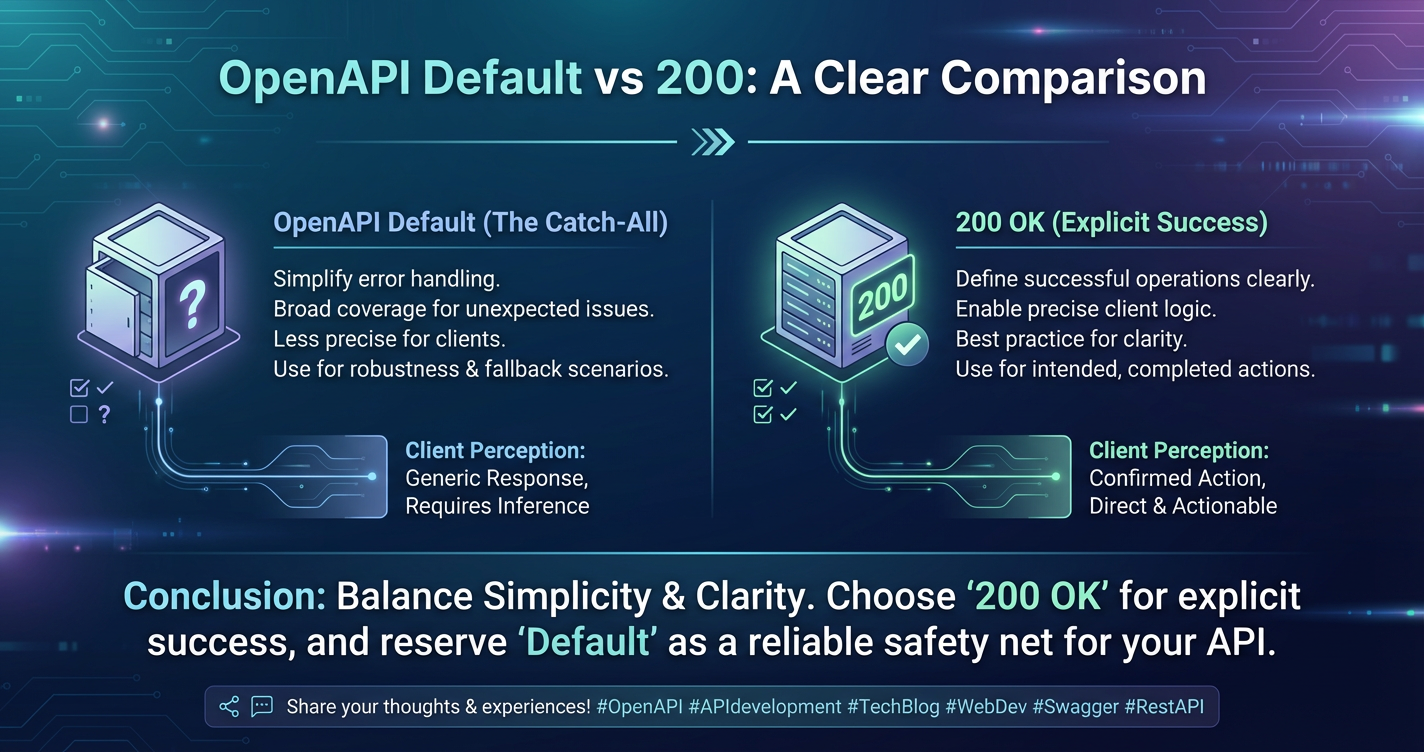
OpenAPI Default vs 200: A Clear Comparison



In the intricate world of modern software development, Application Programming Interfaces (APIs) serve as the fundamental building blocks, enabling distinct systems to communicate, share data, and orchestrate complex workflows. From mobile applications querying backend services to microservices interacting within a distributed architecture, APIs are the very fabric that stitches together the digital landscape. As the reliance on APIs continues to burgeon, the need for clear, consistent, and machine-readable API documentation has become paramount. This is precisely where the OpenAPI Specification (OAS) steps in, providing a universal, language-agnostic interface for describing RESTful APIs. It allows both humans and computers to understand the capabilities of a service without needing to access source code, additional documentation, or network traffic inspection.
However, merely adopting OpenAPI is not enough; the true power lies in its thoughtful and precise implementation. One of the most critical, yet often subtly misunderstood, aspects of designing an OpenAPI definition revolves around how responses are documented, particularly the distinction and interplay between explicit HTTP status codes like 200 OK and the catch-all default response. This choice, seemingly minor on the surface, carries profound implications for an API's usability, maintainability, and the robustness of client-side integrations. It impacts everything from automated client SDK generation to the way an api gateway validates and routes traffic, fundamentally shaping the developer experience and the overall reliability of the system.
This comprehensive article will embark on a detailed exploration of these two response paradigms within the OpenAPI Specification. We will dissect their definitions, illuminate their intended purposes, delineate their respective advantages and disadvantages, and, crucially, provide a clear comparison to guide developers and architects in making informed decisions. By delving into practical use cases, best practices, and the broader impact on API management and tooling, we aim to furnish a definitive understanding that transcends mere syntax, fostering a deeper appreciation for the art and science of meticulous api design. Our journey will highlight how clarity in response definitions, whether through specific 200 responses or a carefully considered default, is not just a documentation exercise, but a cornerstone of building resilient, scalable, and developer-friendly API ecosystems.
Unpacking the OpenAPI Specification: The Blueprint for Modern APIs
Before we dive deep into the nuances of response definitions, it's essential to firmly grasp the foundation: the OpenAPI Specification itself. Born from the Swagger Specification, OAS has evolved into the industry standard for defining HTTP APIs, backed by the Linux Foundation. Its primary goal is to create a standardized, language-agnostic interface description for RESTful APIs, which can then be used by various tools to automate API-related processes. Think of it as the architectural blueprint for your API, detailing every accessible endpoint, the operations they support, the parameters they expect, and, critically, the responses they will return.
The history of OpenAPI reflects the growing complexity and distributed nature of software systems. As microservices architectures became prevalent and third-party API consumption skyrocketed, developers faced increasing challenges in understanding, integrating, and maintaining APIs. Manual documentation was often outdated, inconsistent, or simply insufficient. OpenAPI addresses these pain points by providing a machine-readable format (YAML or JSON) that can be generated, consumed, and validated by software. This capability unlocks a plethora of benefits:
- Improved Documentation: Automatically generated, interactive documentation portals (like Swagger UI) that are always in sync with the API's implementation. This significantly reduces the effort required to keep documentation current and accurate.
- Enhanced Developer Experience: Developers can quickly understand how to interact with an API, reducing onboarding time and friction. Clear specifications empower them to build client applications more efficiently.
- Automated Tooling: OpenAPI definitions serve as input for various tools, including:
- Client SDK Generators: Automatically creating client libraries in different programming languages, streamlining API consumption.
- Server Stub Generators: Generating boilerplate code for server-side implementation, accelerating API development.
- Testing Tools: Facilitating the generation of API tests, ensuring compliance with the defined contract.
- API Gateways: Enabling advanced features like request/response validation, traffic management, and security policy enforcement based on the specification.
- API Governance and Design Consistency: By providing a structured way to define APIs, OpenAPI promotes consistency in design patterns, error handling, and data models across an organization's API portfolio.
- Collaboration: A common specification facilitates clearer communication between frontend and backend teams, as well as between API providers and consumers.
At the heart of an OpenAPI document lies the paths object, which describes the individual endpoints (paths) of the API. Each path can have one or more HTTP methods (operations) associated with it, such as GET, POST, PUT, DELETE. Within each operation, you define various aspects like parameters, requestBody, and responses. Our focus for this discussion specifically lands on the responses object.
The responses object is a map of HTTP status codes or default to Response Objects. Each Response Object then defines the expected schema of the response body, any relevant headers, and a human-readable description. HTTP status codes themselves are a fundamental component of the HTTP protocol, categorizing the result of an API request. They are three-digit integers grouped into five classes: * 1xx (Informational): The request was received, continuing process. * 2xx (Success): The request was successfully received, understood, and accepted. * 3xx (Redirection): Further action needs to be taken to complete the request. * 4xx (Client Error): The request contains bad syntax or cannot be fulfilled. * 5xx (Server Error): The server failed to fulfill an apparently valid request.
Understanding these foundational concepts is crucial, as the choices made within the responses object directly dictate how accurately and comprehensively your API's behavior is documented and, consequently, how effectively it can be used and managed. The seemingly small decision between 200 OK and default carries significant weight in this intricate ecosystem.
Deconstructing the 200 OK Response in OpenAPI
When an API client sends a request to a server, the most eagerly anticipated outcome is often a successful response, signaling that the operation was completed as intended. In the realm of HTTP, 200 OK stands as the quintessential status code for success. Within the OpenAPI Specification, explicitly defining the 200 OK response is a declaration of confidence and clarity, articulating precisely what a consumer should expect when their request is handled without error. This specific definition is more than just an acknowledgement; it's a contract, detailing the shape, content, and meaning of the data returned upon a successful invocation.
Definition and Purpose
The 200 OK HTTP status code indicates that the request has succeeded. The payload sent back in a 200 response typically contains the data requested by the client for GET operations, or a confirmation of the action taken for POST, PUT, or DELETE operations where a specific resource isn't necessarily returned but the operation itself was successful. In OpenAPI, defining 200 means you are creating a specific Response Object associated with this status code. This object will include:
- A
description: A human-readable explanation of what this successful response signifies. This is critical for documentation and understanding. - A
contentobject: This object specifies the media types (e.g.,application/json,text/plain) that the response can have, along with their respective schemas. The schema defines the structure and types of the data returned in the response body. - An optional
headersobject: If the successful response includes specific HTTP headers (e.g.,X-Rate-Limit-Remaining,Location), these can be defined here, along with their types and descriptions.
The primary purpose of defining 200 OK is to provide an unambiguous contract for successful API interactions. It leaves no room for guesswork, ensuring that clients can confidently parse the response and act upon its contents.
Typical Use Cases and Examples
The 200 OK response is pervasive across almost all RESTful APIs, serving various successful scenarios:
- Successful Data Retrieval (GET requests): This is perhaps the most common use case. When a client performs a
GETrequest to retrieve resources, a200 OKresponse indicates that the resource was found and is being returned.yaml paths: /products/{id}: get: summary: Retrieve a single product by ID parameters: - in: path name: id required: true schema: type: integer description: Unique ID of the product responses: '200': description: Product details successfully retrieved content: application/json: schema: $ref: '#/components/schemas/Product' components: schemas: Product: type: object properties: id: type: integer format: int64 description: The product's unique identifier. name: type: string description: The name of the product. price: type: number format: float description: The price of the product. currency: type: string description: The currency of the product price (e.g., USD, EUR). inStock: type: boolean description: Indicates if the product is currently in stock. createdAt: type: string format: date-time description: Timestamp when the product was created. required: - id - name - price - currency - inStockIn this example, the client knows precisely that a200response will yield a JSON object conforming to theProductschema, containingid,name,price,currency,inStock, andcreatedAtfields. - Successful Updates (PUT/PATCH requests): After a client updates a resource, a
200 OKcan confirm the update, potentially returning the updated resource or a simple confirmation message. Note that204 No Contentis also frequently used here if no body is returned.yaml paths: /products/{id}: put: summary: Update an existing product parameters: - in: path name: id required: true schema: type: integer description: Unique ID of the product to update requestBody: required: true content: application/json: schema: $ref: '#/components/schemas/ProductUpdate' responses: '200': description: Product successfully updated content: application/json: schema: $ref: '#/components/schemas/Product' # Returns the updated product components: schemas: ProductUpdate: type: object properties: name: type: string price: type: number format: float inStock: type: boolean # Not all fields are required for an updateHere, the API explicitly states that a successful update will return the full, updatedProductobject. - Successful Deletion (DELETE requests): While
204 No Contentis often preferred for deletions where no response body is expected,200 OKcan be used if a confirmation message or a deleted resource's ID is returned.yaml paths: /products/{id}: delete: summary: Delete a product by ID parameters: - in: path name: id required: true schema: type: integer description: Unique ID of the product to delete responses: '200': description: Product successfully deleted content: application/json: schema: type: object properties: message: type: string example: "Product with ID {id} successfully deleted." deletedId: type: integer example: 123In this case, the200response provides explicit feedback to the client about the success of the deletion and the ID of the deleted item.
Advantages of Explicit 200
Defining 200 OK (and other specific success codes like 201 Created, 204 No Content) explicitly offers several compelling advantages:
- Unambiguous Clarity for Consumers: The most significant benefit is clarity. API consumers instantly know the exact structure of a successful response. This reduces ambiguity, prevents misinterpretation, and ensures that client-side code can reliably handle the expected data.
- Precise Schema Validation: By associating a specific schema with the
200response, the OpenAPI definition enables robust validation. Tools, api gateway implementations, and even human reviewers can verify that the actual responses produced by the API adhere to the documented contract. This is crucial for data integrity and system reliability. - Enhanced Code Generation and SDKs: When client SDKs are generated from an OpenAPI specification, explicit
200definitions lead to strongly typed success models. This means developers using the SDK get compile-time checks and IDE autocompletion for successful responses, significantly boosting productivity and reducing errors. Without it, successful responses might be treated as generic objects or require more runtime type assertions. - Improved Automated Testing: Test suites can be designed to specifically assert the structure and content of
200responses, ensuring that the API continues to return the expected data format. This makes tests more targeted and effective. - Better API Governance: Organizations can enforce strict adherence to their
200response schemas as part of their API governance strategy. This ensures consistency across different APIs and teams, which is invaluable for large-scale API programs. - Clearer Documentation: Tools like Swagger UI render
200responses beautifully, showcasing the expected data structure with examples, making the API easier to understand and use for developers.
Disadvantages/Limitations
While the benefits are substantial, defining 200 OK (and other success codes) explicitly does come with a few considerations:
- Verbosity: If an API operation has multiple distinct successful outcomes (e.g., a
POSTthat returns200for an existing resource and201for a new one), each needs its own explicit definition. While this is good practice, it can make the OpenAPI document slightly longer. However,200itself is usually quite singular in its definition for a given operation. - Maintenance Overhead: Any change to the structure of a successful response requires an update to the OpenAPI definition. While this is arguably a good thing for contract management, it does represent a potential maintenance task.
In summary, the explicit definition of 200 OK (along with other specific success codes) in OpenAPI is a hallmark of a well-designed, developer-friendly, and robust API. It champions clarity, enables powerful tooling, and lays the groundwork for a reliable api ecosystem.
Exploring the default Response in OpenAPI
In contrast to the explicit 200 OK response, which delineates a specific successful outcome, the default response in OpenAPI serves a fundamentally different purpose: it acts as a catch-all. It is designed to describe the response for any HTTP status code that is not explicitly defined within the operation's responses object. This makes default particularly useful for handling generic error scenarios, providing a fallback mechanism when the API encounters an unexpected situation or when a granular error definition for every possible status code would lead to excessive verbosity.
Definition and Purpose
The default keyword within the responses object specifies a Response Object that applies to all status codes not explicitly listed. It is not tied to a specific HTTP status code, but rather acts as a generic blueprint for "everything else." Typically, the default response is used to describe a common error structure that the API will return for various client errors (4xx) and server errors (5xx) for which a specific definition isn't provided or needed.
For instance, if an API operation explicitly defines 200 OK, 400 Bad Request, and 404 Not Found, the default response would cover 401 Unauthorized, 403 Forbidden, 500 Internal Server Error, or any other status code that the API might return but hasn't been individually documented. It's crucial to understand that default has the lowest precedence; if an API returns a 404 and a 404 response is explicitly defined, the 404 definition will be used. The default is only invoked when no specific match is found.
The primary purpose of default is to:
- Provide a generic error contract: Ensure that API consumers always have some schema to expect, even for unforeseen or less common error conditions.
- Reduce verbosity: Avoid duplicating error schemas for numerous HTTP status codes that share a common structure.
- Simplify initial API design: Allow developers to focus on core successful paths and common error paths, deferring extremely granular error definitions.
- Act as a safeguard: Catch unexpected behaviors from the API implementation without breaking client-side integrations that might rely on a predictable error format.
Typical Use Cases and Examples
The default response finds its utility in scenarios where a generic error structure is sufficient or preferred:
- Generic Error Handling (Problem Details): A common and highly recommended use case for
defaultis to define a standardized "Problem Details" structure, often aligning with RFC 7807, for all unspecified errors. This provides a consistent way for clients to handle a wide range of issues.yaml paths: /users: post: summary: Create a new user requestBody: required: true content: application/json: schema: $ref: '#/components/schemas/NewUser' responses: '201': description: User successfully created content: application/json: schema: $ref: '#/components/schemas/User' '400': description: Invalid input provided content: application/json: schema: $ref: '#/components/schemas/ProblemDetails' default: description: An unexpected error occurred. content: application/json: schema: $ref: '#/components/schemas/ProblemDetails' components: schemas: NewUser: type: object properties: username: type: string email: type: string format: email required: - username - email User: type: object properties: id: type: integer username: type: string email: type: string required: - id - username - email ProblemDetails: type: object properties: type: type: string format: uri description: A URI reference that identifies the problem type. title: type: string description: A short, human-readable summary of the problem type. status: type: integer format: int32 description: The HTTP status code (e.g., 400, 500). detail: type: string description: A human-readable explanation specific to this occurrence of the problem. instance: type: string format: uri description: A URI reference that identifies the specific occurrence of the problem. required: - type - title - status - detailIn this scenario,201is for success,400handles validation errors, anddefaultcatches everything else –401,403,404(if not explicitly defined),500, etc., all conforming to theProblemDetailsschema. - Internal APIs or APIs in Early Development: For internal APIs where development velocity might take precedence over exhaustive client-side type safety, or for APIs still undergoing rapid iteration,
defaultcan simplify the specification. It allows developers to quickly define core functionality without getting bogged down in detailing every possible error status. - Third-Party Integration with Unknown Error Patterns: When integrating with external services whose error patterns might be less predictable or subject to change, using a
defaultresponse can provide a safety net for unexpected responses.
Advantages of default
- Conciseness: It significantly reduces the size and complexity of the OpenAPI document by avoiding repetitive error definitions for status codes that share a common response structure. This is particularly beneficial for APIs with a large number of potential error states.
- Flexibility and Resilience to Change: The
defaultresponse provides a robust mechanism to handle unforeseen HTTP status codes or newly introduced error types without requiring immediate updates to the OpenAPI specification. This makes the API definition more resilient to evolution. - Guaranteed Error Schema: Even if an API returns an unusual or undocumented error code, clients can still expect a response conforming to the
defaultschema, allowing for basic error parsing and display. This ensures that clients aren't left guessing. - Focus on Core Logic: API designers can prioritize defining successful responses and the most critical error paths, relying on
defaultfor the less common or more generic error scenarios, thus streamlining the design process.
Disadvantages/Risks
The flexibility of the default response comes with significant trade-offs that can impact API consumers:
- Lack of Specificity and Ambiguity: This is the primary drawback. When a client receives a
defaultresponse, it doesn't know which specific HTTP status code triggered it. This lack of specificity makes it challenging for client applications to implement precise, conditional error handling logic. For example, adefaultresponse could represent401 Unauthorized,403 Forbidden,404 Not Found, or500 Internal Server Error, each requiring a different client-side reaction (e.g., redirect to login, show "access denied," show "resource not found," retry later). - Poor User Experience: Generic error messages derived from a
defaultschema often lead to less informative feedback for end-users. Instead of "User not found," they might see "An unexpected error occurred," which is frustrating and unhelpful. - Challenges for Code Generation: Client SDKs generated from OpenAPI specs with heavy reliance on
defaultresponses will typically produce generic error types. Developers using these SDKs will have to perform runtime checks (e.g., inspect thestatusfield within theProblemDetailsobject) to determine the actual error, rather than benefiting from strongly typed exceptions or distinct error objects. This reduces developer productivity and increases the likelihood of errors in client implementations. - Masking Underlying Issues: Over-reliance on
defaultcan sometimes mask critical design flaws or common error patterns that should have explicit definitions. If many common errors are falling intodefault, it might indicate that the error handling strategy needs more granularity. - Inconsistent Behavior Across APIs: Without explicit definitions, different APIs or even different operations within the same API might return varied error structures for similar problems, even if they all fall under
default, leading to inconsistent client-side handling.
How it Interacts with Other Status Codes
It's crucial to remember the precedence rule: specific status code definitions always take precedence over default. If your OpenAPI definition includes:
responses:
  '200':
    description: Success
  '404':
    description: Not Found Error
  default:
    description: Generic Error
- A
200response will use the'200'definition. - A
404response will use the'404'definition. - A
401response (not explicitly defined) will use thedefaultdefinition. - A
500response (not explicitly defined) will use thedefaultdefinition.
In essence, default acts as the safety net, catching anything that falls through the cracks of your explicit definitions. While convenient, its power must be wielded with caution, ensuring that clarity and consumer experience are not compromised for the sake of brevity.
APIPark is a high-performance AI gateway that allows you to securely access the most comprehensive LLM APIs globally on the APIPark platform, including OpenAI, Anthropic, Mistral, Llama2, Google Gemini, and more.Try APIPark now! 👇👇👇
Direct Comparison: default vs. 200 and Other Specific Status Codes
The choice between using 200 OK (and other explicit status codes like 201 Created, 204 No Content, 400 Bad Request, 404 Not Found, 500 Internal Server Error) and the default response in your OpenAPI definition is a fundamental design decision. It reflects a trade-off between contract precision and conciseness. Understanding when to favor one over the other, or better yet, how to combine them effectively, is paramount for building robust, maintainable, and developer-friendly APIs.
When to Use 200 (and Other Specific Success/Error Codes)
Prioritizing explicit, specific status code definitions is generally the recommended approach for the vast majority of production-grade APIs, especially those consumed externally or across multiple teams.
- For Well-Defined, Expected Outcomes: Any successful outcome that has a predictable structure and meaning should be explicitly defined (e.g.,
200 OKfor data retrieval,201 Createdfor resource creation,204 No Contentfor successful operations with no returned body). Similarly, common, anticipated error scenarios (400 Bad Request,401 Unauthorized,403 Forbidden,404 Not Found,409 Conflict,429 Too Many Requests,500 Internal Server Error) that have distinct meanings and often require specific client-side handling should also be explicitly documented with their own schemas. - When Client Applications Need Specific Reactions: If a client application needs to display a particular message, redirect a user, retry an operation differently, or log a specific type of error based on the HTTP status code, then that status code must be explicitly defined in OpenAPI. Specificity empowers clients to build sophisticated, responsive, and user-centric error handling.
- For Public APIs and Third-Party Integrations: APIs exposed to external developers or used for critical integrations demand the highest level of clarity. Explicit definitions minimize ambiguity, streamline onboarding, and reduce support overhead. They form a clear, testable contract that fosters trust and reliability.
- Ensuring Robust API Governance: Organizations with strong API governance policies will advocate for explicit definitions. This allows for automated validation of API responses against the defined schemas, ensuring contract adherence. An api gateway, for instance, can leverage these precise schemas to perform real-time request and response validation, preventing malformed data from reaching backend services or incorrect data from being returned to clients. This enhances security, data integrity, and overall API health.
- Optimizing Tooling: Explicit definitions lead to superior code generation, more effective documentation, and more granular testing capabilities. Client SDKs will provide strongly typed success and error objects, making API consumption significantly easier and less prone to errors for developers.
When to Use default
The default response, while powerful, should be used judiciously and thoughtfully, primarily as a fallback mechanism rather than a primary mode of response definition.
- For Common, Generic Error Structures: The best use case for
defaultis to define a generic "Problem Details" style error response (like RFC 7807) that can apply to any status code not explicitly listed. This ensures that even for unexpected errors, clients receive a consistent, machine-readable error structure, rather than an arbitrary HTML page or an empty body. - As a Fallback for Unexpected Errors: It serves as a safety net. No matter how meticulously you define your API, unforeseen server-side issues, infrastructure problems, or future error conditions might arise. The
defaultresponse ensures that there's always a baseline contract for these "other" scenarios. - In Internal APIs (with caution): For highly internal APIs where the consuming teams have direct access to the API development team and can easily coordinate changes, and where extreme client-side type safety might be less critical than speed of development,
defaultcould be used for a broader range of errors. However, even here, a hybrid approach is often superior. - During Initial API Design/Evolution: In the very early stages of API design or when an API is rapidly evolving,
defaultcan provide flexibility, allowing developers to define core functionality quickly and refine specific error handling later. But this should be seen as a temporary measure.
Hybrid Approach: The Recommended Best Practice
For most production APIs, the most effective strategy is a hybrid approach that combines the precision of specific status codes with the safety net of default. This typically involves:
- Explicitly defining
200 OK(and other relevant2xxcodes like201,204) with their precise schemas. - Explicitly defining common
4xxclient errors (e.g.,400,401,403,404,429) and5xxserver errors (e.g.,500) that have distinct meanings and might require specific client-side logic or user feedback. - Using
defaultas the ultimate catch-all for any other status code not explicitly listed. Thisdefaultresponse should almost always point to a generic, consistent error structure (like RFC 7807 Problem Details). This ensures that no matter what unexpected status code the API returns, clients have a predictable format for basic error handling.
This hybrid model maximizes clarity for common scenarios while providing a robust, consistent fallback for all others, striking an optimal balance between detailed contracts and specification conciseness.
Table Comparison
To further crystallize the distinctions, let's examine a direct comparison of features and implications:
| Feature | 200 OK (and Other Specific Codes) |
default Response |
|---|---|---|
| Purpose | Defines a specific, anticipated outcome (success or a known error). | Catch-all for any status code not explicitly defined (often for generic errors). |
| Clarity for Consumers | High – clients know exact response structure and meaning. | Low – clients receive a generic response for various unforeseen issues; requires runtime checks. |
| Schema Validation | Enables precise schema definition and validation for specific scenarios. | Defines a generic schema for unspecified responses, typically an error structure. |
| Code Generation | Generates strongly typed success/error models (e.g., specific exceptions). | Generates generic error models, often requiring developers to parse status or type fields. |
| API Evolution | Requires updates to the spec for new specific outcomes or errors. | More resilient to new, undefined error codes without immediate spec changes. |
| Best Use Case | Public APIs, mission-critical operations, clear success/error contracts, common error patterns. | Generic error structures (e.g., Problem Details), initial API design, fallback for truly unexpected errors. |
| Precedence | Highest; takes precedence over default for its specific status code. |
Lowest; only applies if no specific status code matches. |
| Impact on API Gateway | Allows strict, specific validation, routing, and monitoring based on detailed schemas. | Gateway can apply generic error transformations, logging, or monitoring for undefined errors, but with less granularity. |
| Developer Experience | Excellent – clear contracts, strong typing, easy integration. | Challenged – less specific, requires more manual handling, higher chance of runtime errors. |
By carefully considering this comparison, API designers can architect response definitions that not only accurately reflect their API's behavior but also significantly enhance the experience for API consumers and the efficacy of API management tools.
Impact on API Management and Tooling
The choices made in documenting API responses within the OpenAPI Specification, particularly the distinction between explicit status codes like 200 OK and the default response, ripple through the entire API lifecycle, profoundly influencing API management, development tooling, and operational efficiency. These definitions are not merely static documentation; they are executable contracts that drive automated processes and enable sophisticated capabilities across the API ecosystem.
API Gateways and Contract Enforcement
An api gateway is a critical component in modern API architectures, acting as a single entry point for all API requests. It handles a multitude of cross-cutting concerns, including authentication, authorization, traffic management, caching, and, crucially, contract enforcement. API gateways often leverage OpenAPI definitions to perform their functions.
- Schema Validation: A well-defined OpenAPI specification allows an api gateway to perform rigorous schema validation on both incoming requests and outgoing responses.
- For
200 OKand other explicitly defined responses, the gateway can validate that the payload returned by the backend service precisely matches the defined schema. If the backend returns malformed data, the gateway can intercept it, preventing invalid data from reaching the client, potentially returning a standardized error (perhaps thedefaulterror structure itself) to the client while logging the internal discrepancy. This ensures data integrity and helps enforce the API contract at the perimeter. - For
defaultresponses, the gateway can still validate against the generic schema. While less specific, it ensures that even unexpected errors conform to a baseline structure, making it easier for client-side error handlers to process.
- For
- Routing and Transformation: While less directly tied to response definitions, the overall clarity of the OpenAPI spec, including its responses, informs an API gateway's ability to intelligently route requests and transform response payloads. Consistent
200responses make it easier to apply uniform transformations if needed. - Monitoring and Analytics: Gateways can use response status codes and schemas for detailed monitoring. Specific
200 OKdefinitions allow for precise tracking of successful operations, while specific error codes enable granular monitoring of different failure types. Adefaultresponse might lead to more generic error logging, making it harder to distinguish between distinct error conditions in monitoring dashboards.
Platforms like APIPark, an open-source AI gateway and API management platform, rely heavily on well-defined OpenAPI specifications to provide features like unified API format for AI invocation, end-to-end API lifecycle management, and detailed API call logging. Clear 200 OK and specific error definitions ensure that APIPark can validate, route, and monitor API traffic with precision, enhancing both security and performance. Its ability to integrate 100+ AI models and encapsulate prompts into REST APIs also benefits immensely from standardized response handling, making integration smoother and more predictable. By leveraging robust OpenAPI contracts, APIPark helps developers manage, integrate, and deploy AI and REST services with ease, ensuring that the defined behavior is consistently enforced across all API interactions.
Client SDK Generation
One of the most powerful features of OpenAPI is its ability to automatically generate client software development kits (SDKs) in various programming languages. The way responses are defined has a direct and significant impact on the quality and usability of these SDKs.
- Strongly Typed Success Responses: When
200 OK(and other2xxcodes) are explicitly defined with detailed schemas, generated SDKs will produce strongly typed objects for successful responses. For example, aGET /products/{id}operation returning a200with aProductschema will result in an SDK method that returns aProductobject. This provides compile-time safety, auto-completion in IDEs, and reduces the chance of runtime errors for developers using the SDK. - Specific Error Handling: Similarly, explicitly defined
4xxand5xxerror codes can be mapped to specific exception types or distinct error objects in the generated SDK. This allows client developers to catch and handle different error conditions (e.g.,ProductNotFoundException,UnauthorizedException) with precision and clarity. - Generic
defaultResponses: In contrast, if an API heavily relies ondefaultfor errors, the generated SDKs will typically provide a generic error type or a baseApiErrorclass. Client developers will then have to manually inspect properties likestatus,type, orcodewithin that generic error object to understand the actual problem, leading to more verbose, less robust, and error-prone client-side error handling logic. This undermines the benefits of strong typing and compile-time safety.
Documentation Tools
OpenAPI definitions are the backbone of interactive API documentation portals (e.g., Swagger UI, Redoc). The clarity of response definitions directly translates to the quality of the displayed documentation.
- Detailed and Clear Success/Error Paths: Explicit
200 OKand specific error definitions allow documentation tools to render detailed explanations, example response bodies, and schema structures for each possible outcome. This provides an incredibly rich and comprehensive resource for developers. - Generic
defaultRepresentations: Adefaultresponse will be displayed as a generic "Error" or "Other Responses" section. While it provides some information, it lacks the specific context that developers need to react accurately to various problems. Developers will still need to refer to separate human-readable documentation to understand the meaning behind differentdefaulterror instances.
Automated Testing
OpenAPI specifications play a vital role in automating API testing.
- Contract Testing: With explicit
200 OKand error definitions, automated tests can be generated to ensure that the API's actual responses strictly adhere to the defined schemas. This includes validating data types, required fields, and structural integrity for both successful and error scenarios. - Functional Testing: Precise response definitions help in designing functional tests that assert specific behaviors. For instance, a test can specifically assert that a valid GET request returns a
200 OKwith aProductobject containing expected fields, while an invalid ID returns a404 Not Foundwith a specificErrorobject. - Reduced Test Flakiness: Clear contracts reduce test flakiness, as the expected response format is unambiguous, leading to more reliable and consistent test results.
API Governance and Standardization
Finally, the way responses are defined profoundly impacts an organization's API governance strategy.
- Enforcing Standards: Explicit response definitions facilitate the enforcement of enterprise-wide API standards for success and error handling. This ensures consistency across an organization's entire API portfolio, making it easier for developers to consume multiple APIs.
- Architectural Review: During architectural reviews, well-defined response contracts provide a clear basis for discussion and feedback, ensuring that API designs meet functional and non-functional requirements.
- Maintainability and Evolution: While
defaultcan offer initial flexibility, the long-term maintainability of APIs generally benefits from explicit definitions. As APIs evolve, clearer contracts make it easier to manage changes and communicate impact to consumers.
In conclusion, the meticulous definition of 200 OK and other specific HTTP status codes within OpenAPI is far more than an academic exercise. It's a strategic decision that directly influences the efficiency of API management platforms like APIPark, the usability of generated client SDKs, the clarity of documentation, the robustness of automated testing, and the overall governance of an organization's API landscape. Investing time in precise response definitions pays dividends across the entire API lifecycle.
Best Practices and Recommendations for OpenAPI Responses
Crafting an effective OpenAPI specification requires a delicate balance between conciseness, precision, and clarity. When it comes to defining responses, making informed choices between specific status codes (like 200 OK) and the default response significantly impacts the usability, maintainability, and overall quality of your API. Adhering to a set of best practices ensures that your API is not only well-documented but also easily consumable by a diverse range of clients and effectively managed by tools like an api gateway.
1. Prioritize Specificity for Success (2xx Codes)
Always define 200 OK explicitly. This is the golden rule for successful responses. Every operation that can succeed should have a precisely defined 200 response, complete with its schema and a clear description. This leaves no ambiguity for API consumers about the expected payload upon a successful interaction.
- Leverage Other
2xxCodes: Don't limit yourself to just200. Use other specific success codes where appropriate:201 Created: ForPOSToperations that successfully create a new resource. The response should typically include aLocationheader pointing to the newly created resource and often a representation of the resource in the body.202 Accepted: For requests that have been accepted for processing, but the processing is not yet complete (e.g., asynchronous operations).204 No Content: For successful operations where no response body is returned (e.g., a successfulDELETEorPUTthat doesn't return the updated resource). This is often preferred over200with an empty body.
2. Define Common Error Codes Explicitly (4xx and 5xx Codes)
Just as crucial as defining success is clearly articulating common error scenarios. For any error that a client might reasonably anticipate or that requires a specific client-side reaction, provide an explicit definition.
400 Bad Request: For client-side input validation errors (e.g., missing required fields, invalid format). The schema should detail the specific validation failures.401 Unauthorized: For requests that lack valid authentication credentials.403 Forbidden: For requests where the client is authenticated but does not have permission to access the resource or perform the action.404 Not Found: For requests targeting a resource that does not exist.409 Conflict: For requests that conflict with the current state of the resource (e.g., attempting to create a resource that already exists, or optimistic locking failures).429 Too Many Requests: For rate-limiting scenarios.500 Internal Server Error: While500typically indicates an unexpected server-side issue, defining a generic structure for it provides a consistent fallback for critical internal failures.- Use Consistent Error Structures: Regardless of the specific error code, strive for a consistent error payload structure across your entire API. The RFC 7807 "Problem Details for HTTP APIs" standard is an excellent model for this, providing fields like
type,title,status,detail, andinstance.
3. Use default Judiciously – As a Fallback
The default response should be reserved for what it truly is: a catch-all for any other status code not explicitly listed. It acts as a safety net, ensuring that even truly unexpected or un-modeled error conditions return a predictable structure.
- Generic Problem Details: The ideal use case for
defaultis to define a genericProblemDetailsschema. This means that if your API returns a418 I'm a teapotor a future501 Not Implementedthat you haven't explicitly defined, the client will still receive a structured error response, rather than an opaque response or an empty body. - Never for Expected Success: Avoid using
defaultfor successful outcomes. This would severely undermine clarity and tooling benefits. - Minimize Reliance: While essential as a fallback, strive to minimize the number of common errors that fall into the
defaultcategory. The more specific your error definitions, the better the client experience.
4. Consistency is Key
- Standardize Error Structures: As mentioned, maintain a consistent structure for error responses across all your API operations. This simplifies client-side error parsing immensely.
- Consistent Naming Conventions: Apply consistent naming conventions for schemas, properties, and parameters throughout your OpenAPI document, including response bodies.
- Clear Descriptions: Provide meaningful, human-readable descriptions for every response, schema, and field. These descriptions are crucial for developers consuming your API and for automated documentation tools.
5. Versioning and Evolution
API responses, like other parts of an API, will evolve over time. Plan for this through:
- Semantic Versioning: Follow semantic versioning (
MAJOR.MINOR.PATCH) for your API. Backward-incompatible changes to response schemas (e.g., removing a required field, changing a field's type) should trigger aMAJORversion increment. Adding optional fields is typically aMINORchange. - Deprecation Strategies: When phasing out old response fields or structures, clearly mark them as deprecated in your OpenAPI definition and provide guidance on alternatives.
6. Leverage API Management Platforms
An effective API management strategy, often powered by an api gateway like APIPark, thrives on well-defined OpenAPI specifications. These platforms can:
- Enforce Contracts: Validate requests and responses against the defined schemas, ensuring adherence to your documented contracts. APIPark's end-to-end API lifecycle management capabilities are greatly enhanced by precise response definitions, allowing for granular control and validation at every stage.
- Monitor Performance and Errors: Track successful requests (
200 OK,201 Created, etc.) and specific error types (404,500) to gain insights into API health, usage patterns, and potential issues. APIPark's detailed API call logging and powerful data analysis features benefit significantly from well-categorized responses. - Facilitate AI Integration: For platforms like APIPark that integrate 100+ AI models and encapsulate prompts into REST APIs, standardized response formats are essential for unified invocation and simplified maintenance, ensuring that the AI service responses are predictable and manageable.
By diligently applying these best practices, API developers and architects can create OpenAPI definitions that are not only technically correct but also exceptionally usable, paving the way for more robust integrations, superior developer experience, and more efficient API operations. The investment in clear, specific, and well-structured response definitions is an investment in the long-term success of your API ecosystem.
Conclusion
The journey through the intricate landscape of OpenAPI response definitions, particularly the comparison between explicit 200 OK (and other specific status codes) and the catch-all default response, underscores a fundamental truth in API design: precision and clarity are paramount. While the default response offers a convenient shorthand and a necessary safety net for unforeseen circumstances, the explicit definition of successful outcomes and common error conditions forms the bedrock of a robust, developer-friendly, and maintainable API ecosystem.
We have seen that 200 OK and its brethren (201 Created, 204 No Content) serve as unambiguous contracts for successful API interactions. Their explicit schemas empower clients with strongly typed models, enable rigorous validation by api gateway solutions, streamline client SDK generation, and foster unparalleled clarity in documentation. This meticulous approach minimizes ambiguity, reduces integration friction, and ultimately elevates the developer experience, making an API a pleasure to consume.
Conversely, the default response, while valuable, should be wielded with caution. Its strength lies in providing a consistent fallback for any status code not explicitly defined, typically pointing to a generic error structure like RFC 7807 Problem Details. This prevents clients from encountering completely un-schematized responses. However, over-reliance on default can lead to a lack of specificity, hindering client-side error handling, compromising the benefits of generated SDKs, and potentially masking critical design flaws or common error patterns that deserve explicit attention.
The recommended best practice, therefore, emerges as a hybrid approach. This strategy advocates for the explicit definition of all expected successful responses and common, actionable error codes (400, 401, 403, 404, 500), thereby providing maximum clarity for the most frequently encountered scenarios. The default response is then wisely employed as a judicious catch-all, guaranteeing a structured error response for any remaining, less common, or truly unexpected status codes. This balanced methodology ensures that API consumers are always equipped with sufficient information to react intelligently, whether for success or error, while maintaining a manageable and concise OpenAPI definition.
Ultimately, thoughtful API design, including the meticulous handling of responses, is not merely a technical exercise but a strategic imperative. It directly impacts the efficiency of development, the reliability of integrations, and the satisfaction of API consumers. Platforms like APIPark, with their capabilities as an open-source AI gateway and API management solution, thrive on well-defined OpenAPI specifications. Such clarity allows them to perform advanced functions like request/response validation, traffic management, unified AI invocation, and detailed logging with precision, reinforcing the API contract and ensuring operational excellence. By investing in the clarity and precision of your OpenAPI response definitions, you are laying a strong foundation for a resilient, scalable, and highly usable api landscape that drives innovation and fosters seamless digital interactions.
Frequently Asked Questions (FAQs)
Q1: What is the fundamental difference between 200 OK and default in OpenAPI responses?
A1: The fundamental difference lies in their specificity and purpose. 200 OK (and other specific HTTP status codes like 201, 400, 500) defines a precise contract for a particular, expected HTTP status code, detailing its exact response body schema and description. It signifies a known, anticipated outcome. In contrast, default is a catch-all response that applies to any HTTP status code not explicitly defined elsewhere in the operation's responses object. It serves as a generic fallback, typically used for common error structures when specific error types are too numerous to define individually or are unexpected.
Q2: Why is it generally recommended to define 200 OK explicitly instead of letting it fall into default?
A2: Defining 200 OK explicitly offers significant advantages for clarity, tooling, and developer experience. It provides an unambiguous contract for successful interactions, enabling precise schema validation, generating strongly typed client SDKs, and creating detailed documentation. If 200 OK were handled by default, clients would receive a generic response model, requiring runtime checks and reducing the benefits of compile-time type safety and clear expectations, making client-side development harder and more error-prone.
Q3: When is it appropriate to use the default response in an OpenAPI specification?
A3: The default response is most appropriately used as a fallback for any HTTP status code that is not explicitly defined, particularly for generic error conditions. A common best practice is to define a standardized "Problem Details" (e.g., RFC 7807) schema for default, ensuring that even unexpected or unspecified errors return a consistent, machine-readable structure. It can also be useful for internal APIs where extreme granularity for every error might be overkill, or in early development phases for flexibility, but it should be used judiciously to avoid ambiguity.
Q4: How do 200 OK and default responses impact API gateway functionalities like validation?
A4: Both 200 OK and default responses are critical for api gateway functionalities. An API gateway, such as APIPark, leverages explicit 200 OK definitions to perform rigorous, specific validation of successful responses, ensuring that backend services adhere to the defined contract before data reaches the client. This enhances data integrity and security. For default responses, the gateway can still validate against the generic error schema, ensuring that even unforeseen errors conform to a predictable structure. While default provides less granular validation, it still maintains a baseline of consistency for all unhandled responses.
Q5: What are the main drawbacks of relying too heavily on the default response for errors?
A5: Over-reliance on default for errors leads to a significant lack of specificity. Client applications won't know the exact HTTP status code or specific error type, making it difficult to implement precise error handling logic (e.g., showing a "resource not found" message versus prompting for re-authentication). This results in a poorer user experience, less robust client-side code (often requiring manual runtime parsing), and less effective automated testing. It can also mask common error patterns that should ideally have explicit, actionable definitions.
🚀You can securely and efficiently call the OpenAI API on APIPark in just two steps:
Step 1: Deploy the APIPark AI gateway in 5 minutes.
APIPark is developed based on Golang, offering strong product performance and low development and maintenance costs. You can deploy APIPark with a single command line.
curl -sSO https://download.apipark.com/install/quick-start.sh; bash quick-start.sh

In my experience, you can see the successful deployment interface within 5 to 10 minutes. Then, you can log in to APIPark using your account.

Step 2: Call the OpenAI API.