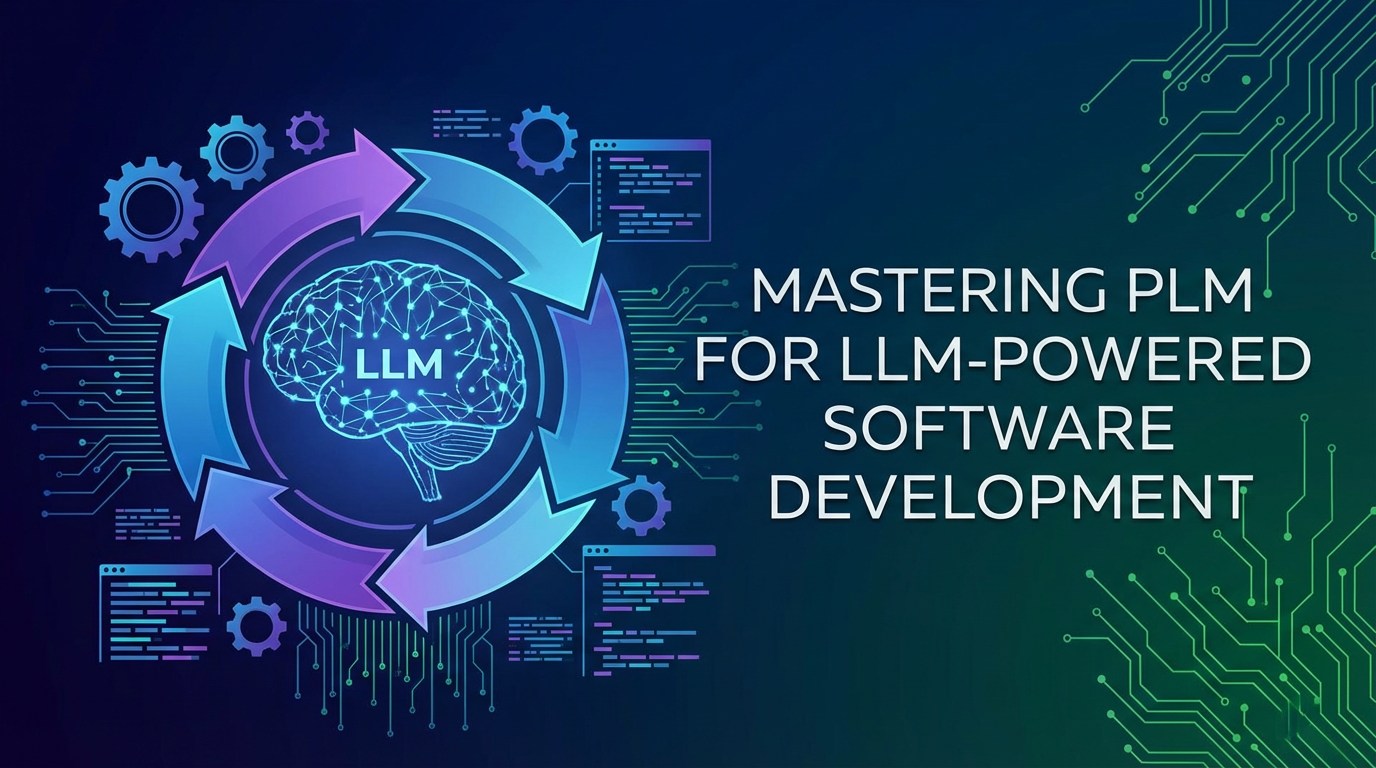
Mastering PLM for LLM-Powered Software Development


The advent of Large Language Models (LLMs) has irrevocably altered the landscape of software development, ushering in an era of unprecedented capability and transformative potential. From sophisticated chatbots and intelligent content generation systems to code assistants and complex analytical tools, LLMs are no longer experimental curiosities but foundational components of modern applications. However, this profound shift brings with it a new frontier of complexity, demanding a re-evaluation of traditional software engineering paradigms. The lifecycle of an LLM-powered application is far more intricate than that of conventional software, encompassing not just code, but also models, vast datasets, intricate prompts, continuous fine-tuning, and a dynamic interplay of human-AI collaboration. Navigating this labyrinthine process effectively necessitates a structured, holistic approach that goes beyond agile sprints and DevOps pipelines alone. This is where the principles of Product Lifecycle Management (PLM), long a cornerstone in complex manufacturing and engineering, emerge as an indispensable framework.
Traditionally, PLM has been the bedrock for managing physical products from their initial ideation through design, development, manufacturing, service, and eventual retirement. It provides a comprehensive system for integrating data, processes, business systems, and, ultimately, people across the entire value chain. Adapting these robust, time-tested principles to the nuanced domain of LLM-powered software offers a powerful methodology to tame the inherent volatility, ensure quality, manage risk, and accelerate innovation. This article will meticulously explore how PLM can be strategically applied to master the entire lifecycle of LLM-powered software development. We will delve into the unique challenges posed by these intelligent systems and demonstrate how a PLM mindset, augmented by critical technologies like the LLM Gateway and the Model Context Protocol (MCP), can transform a chaotic development process into a streamlined, resilient, and continuously evolving ecosystem, enabling organizations to truly unlock the full potential of artificial intelligence.
The Enduring Value of Product Lifecycle Management in Traditional Industries
To appreciate the profound relevance of PLM for LLM-powered software, it is crucial to first understand its foundational role in traditional product development. At its core, PLM is not merely a software tool, but a strategic business approach that manages the entire lifecycle of a product from its conception, through design and manufacturing, to service and disposal. It integrates people, data, processes, and business systems, providing a product information backbone for companies and their extended enterprises. Imagine the complexity involved in developing a new automobile, an aerospace engine, or a sophisticated medical device. These products involve thousands of components, intricate engineering designs, rigorous testing, compliance with stringent regulations, and a multi-year development cycle involving diverse teams scattered across the globe. Without a robust PLM strategy, such endeavors would quickly descend into chaos, plagued by version control issues, data silos, communication breakdowns, and catastrophic design flaws.
PLM systems are designed to address these challenges by offering a centralized repository for all product-related data, including CAD models, specifications, bills of materials (BOMs), simulation results, manufacturing instructions, quality control reports, and service manuals. This single source of truth ensures that every stakeholder, from design engineers to production managers and after-sales support teams, is working with the most current and accurate information. Key tenets of traditional PLM include:
- Data Management: Ensuring all product data is captured, stored, secured, and readily accessible, preventing data loss and inconsistencies.
- Version and Configuration Control: Meticulously tracking every revision of a design, every component change, and every configuration of a product, which is vital for traceability, compliance, and managing product variants.
- Collaboration: Facilitating seamless communication and collaboration among geographically dispersed teams and external partners throughout the product lifecycle.
- Process Management: Standardizing and automating workflows, approvals, and change management processes to improve efficiency and reduce errors.
- Compliance and Regulatory Adherence: Helping organizations meet industry standards, safety regulations, and environmental guidelines by providing robust audit trails and documentation capabilities.
- Supply Chain Integration: Connecting product development with sourcing, procurement, and logistics to optimize manufacturing and delivery.
- Continuous Improvement: Enabling iterative design improvements based on feedback from testing, manufacturing, and customer usage, leading to higher quality and more innovative products over time.
While these principles were originally conceived for tangible products, their underlying logic—managing complexity, ensuring consistency, fostering collaboration, and driving continuous improvement across a long and intricate lifecycle—is profoundly transferable. The software development lifecycle (SDLC) itself has adopted many PLM-like ideas through methodologies like Agile, DevOps, and version control systems. However, the unique characteristics of LLM-powered software introduce an entirely new dimension of complexity that demands a more comprehensive PLM perspective, one that treats the LLM, its data, and its prompts as "components" of an evolving product.
The Unique and Multifaceted Challenges of LLM-Powered Software Development
The integration of Large Language Models into software applications introduces a paradigm shift that concurrently offers immense potential and unprecedented challenges. Unlike traditional software, where logic is explicitly coded and behavior is largely deterministic, LLM-powered applications operate with a degree of inherent unpredictability and a dynamic external dependency on vast, evolving models and data. This introduces a host of complexities that demand a specialized approach to lifecycle management.
One of the foremost challenges lies in Model Management. The sheer diversity of available LLMs, from proprietary giants like GPT-4 and Claude to open-source alternatives like Llama and Mixtral, presents a continuous decision-making process. Developers must select the appropriate model, potentially fine-tune it with proprietary data, and then manage its lifecycle. This involves meticulous versioning of models, tracking their performance metrics (accuracy, latency, cost), evaluating their biases, and understanding their specific limitations. A model that performs excellently today might be superseded tomorrow, or even exhibit performance degradation (known as "model drift") as the underlying data distribution changes in the real world. Managing multiple model versions, A/B testing different models in production, and ensuring seamless transitions without disrupting user experience is a complex undertaking, often lacking standardized tools and processes.
Closely intertwined with model management is the intricate domain of Data Management. LLM-powered applications depend on enormous datasets, both for their initial pre-training and for any subsequent fine-tuning or prompt augmentation. This raises critical concerns around data quality, privacy, security, and ethical sourcing. Biases embedded in training data can lead to biased model outputs, perpetuating and amplifying societal inequalities. Ensuring data provenance, implementing robust data governance policies, and maintaining compliance with regulations like GDPR or CCPA become paramount. Furthermore, the data used for inference (user inputs, conversational history, retrieval-augmented generation sources) must also be managed carefully, as it directly influences the model's real-time behavior and can provide crucial feedback for future model improvements or retraining. Versioning data, tracking schema changes, and securing sensitive information are constant battles.
Perhaps one of the most novel and challenging aspects is Prompt Engineering. In LLM-powered software, the "code" isn't just the application logic; it's also the carefully crafted instructions, examples, and context provided to the LLM—the prompts themselves. Effective prompt engineering is an iterative art and science, requiring extensive experimentation to elicit desired behaviors from the model. As applications evolve, prompts need to be updated, refined, and versioned. A slight change in wording can significantly alter the model's output, impacting performance, cost, and user experience. Managing a library of prompts, ensuring their reusability, testing their efficacy across different model versions, and understanding their dependencies on application logic creates a new layer of configuration management that traditional software tools are not inherently designed to handle. The evolving nature of prompts means that what works today might not work with a future model version, or might need to be adapted for different use cases or user segments.
Deployment and Operations of LLM-powered software present their own unique set of hurdles. LLMs can be computationally intensive, requiring significant resources for inference, leading to concerns about latency, cost, and scalability. Deploying and managing these models in production environments demands specialized infrastructure, intelligent load balancing, and sophisticated monitoring tools. Beyond standard application metrics, developers must monitor model-specific performance indicators, detect drift, identify security vulnerabilities specific to LLMs (like prompt injection attacks), and ensure robust fallback mechanisms. The dynamic nature of LLM outputs also necessitates robust error handling and validation far beyond what is typical for deterministic software.
Furthermore, Compliance and Ethics are not afterthoughts but core considerations from inception. The "black box" nature of many LLMs makes explainability a significant challenge. Regulators and users increasingly demand transparency regarding how AI systems make decisions. Ensuring responsible AI practices, addressing issues of fairness, privacy, accountability, and safety throughout the lifecycle is critical. This involves not only technical safeguards but also robust documentation, ethical guidelines, and internal review processes.
Finally, the inherent Continuous Evolution of LLMs themselves, coupled with the rapid pace of research and development in the AI field, means that LLM-powered software is in a constant state of flux. Unlike many traditional software components that might remain stable for extended periods, LLM models, their underlying data, and the best practices for prompting are all subject to frequent and significant change. This necessitates a development approach that is inherently flexible, adaptable, and designed for continuous iteration, demanding a lifecycle management strategy that can not only cope with change but actively leverage it for innovation. Without a structured framework like PLM, these challenges can quickly overwhelm development teams, leading to unmanageable complexity, inconsistent performance, security vulnerabilities, and a failure to deliver on the promise of AI.
Adapting PLM Principles for LLM-Powered Software: A Holistic Approach
Applying PLM principles to LLM-powered software development requires a thoughtful adaptation of its traditional phases to accommodate the unique characteristics of AI systems. This holistic approach ensures that models, data, and prompts are treated as critical product components, subject to rigorous management throughout their lifecycle.
Phase 1: Conception & Planning – Defining the AI Product Vision
The initial phase of any product lifecycle, whether physical or digital, is critical for laying a solid foundation. For LLM-powered software, this phase is expanded to encompass not just user requirements but also ethical considerations, model strategy, and data governance from the very outset.
- Defining the LLM Application Scope and Use Cases: This goes beyond typical software requirements. Here, teams must explicitly define what problem the LLM is expected to solve, how it will interact with users, and what level of autonomy it will possess. This includes identifying specific user personas, defining success metrics, and outlining the desired behaviors and guardrails for the LLM. For instance, is it a generative AI for creative content, a conversational agent for customer support, or a analytical tool for data insights? Each use case implies different model requirements, data needs, and ethical considerations.
- Establishing Ethical Guidelines and Risk Assessment: Unlike traditional software, LLMs carry inherent risks of bias, misinformation, privacy breaches, and unintended consequences. This phase must include a proactive assessment of potential ethical pitfalls. Teams need to define acceptable use policies, establish bias detection strategies, and plan for data privacy measures right from the start. This involves interdisciplinary input from ethicists, legal experts, and product managers, not just engineers.
- Initial Model Selection Strategy: Based on the defined use cases and ethical guidelines, an initial model strategy is formulated. This involves evaluating various LLMs (open-source vs. proprietary, general-purpose vs. specialized) based on factors like performance, cost, security, ease of fine-tuning, and long-term support. The decision isn't static but informs subsequent development.
- Data Strategy Formulation: A comprehensive data strategy is paramount. This includes identifying sources for training data (if fine-tuning), inference data, and feedback data. Data quality, privacy, security, and ethical sourcing are non-negotiable. Planning for data annotation, storage, and access controls is initiated. How will sensitive user data be handled? What anonymization techniques are needed? These questions drive the initial architectural decisions.
- Requirements Gathering for Model Performance, Data Quality, and Prompt Effectiveness: This goes beyond functional requirements. Teams must specify target metrics for the LLM itself, such as accuracy (for classification/summarization), coherence (for generation), latency, and cost per inference. Data quality requirements (e.g., minimum cleanliness score, absence of bias) and initial expectations for prompt effectiveness (e.g., achieving X level of response quality with Y tokens) are established, providing measurable goals for the development phase.
Phase 2: Design & Development – Building the Intelligent Core
This phase focuses on the actual construction of the LLM-powered application, treating the LLM, its data, and its prompts as integral, versioned components. It necessitates an iterative design due to the inherent variability of LLM behavior.
- Model Development and Versioning: This involves selecting the base LLM, potentially fine-tuning it with specific datasets, and rigorous evaluation. Crucially, every iteration of a fine-tuned model, or even the choice of a new base model, must be versioned and tracked meticulously, much like source code. This includes recording training configurations, dataset versions used, evaluation metrics, and resource consumption. MLOps platforms become essential here for model registries and experiment tracking.
- Prompt Design, Libraries, and Version Control: Prompt engineering evolves from ad-hoc experimentation to a structured process. Teams develop libraries of tested prompts, potentially categorized by intent or persona. Each prompt, or set of prompts, undergoes version control, allowing developers to revert to previous versions, compare performance, and understand the impact of changes. This is similar to managing UI components in traditional development. Templatized prompts and prompt chaining are also designed and managed within this framework.
- Data Pipeline Construction and Governance: Robust data pipelines are built to ingest, clean, transform, and store data for both model training/fine-tuning and real-time inference. This includes implementing data validation rules, anonymization techniques, and access controls. Data governance policies are operationalized, ensuring compliance and data quality throughout the lifecycle. Versioning of data schemas and datasets themselves is critical for reproducibility.
- Integration Architecture: Connecting LLM Services: This is where the application interacts with the LLM. Rather than directly calling an LLM API, a more robust architecture involves an abstraction layer. This layer often manifests as an LLM Gateway, which provides a unified interface to multiple models, handles authentication, rate limiting, load balancing, and potentially caches responses. This separation of concerns is vital for flexibility and scalability. For instance, if an organization uses multiple LLMs (e.g., one for summarization, another for translation), an LLM Gateway centralizes access and management, allowing the application to simply request "summarization" without needing to know the specific model being used. This modularity is a core tenet of effective software architecture. APIPark offers a powerful solution in this space, functioning as an all-in-one AI gateway and API developer portal. Its capability for quick integration of over 100 AI models and providing a unified API format for AI invocation directly addresses the complexities of integrating diverse LLM services into an application architecture.
- Iterative Design and Testing: Due to the probabilistic nature of LLMs, development is inherently iterative. Teams continuously test model outputs, refine prompts, and adjust the surrounding application logic based on observed behavior. A/B testing different prompts or model versions becomes a standard practice. Automated testing frameworks are adapted to evaluate LLM responses for coherence, accuracy, safety, and adherence to desired styles.
Phase 3: Deployment & Operations – Sustaining Performance and Value
Once the LLM-powered application is developed, the focus shifts to robust deployment, continuous monitoring, and effective operational management in a production environment. This phase is heavily influenced by DevOps principles but requires LLM-specific considerations.
- Deployment Strategies: LLM-powered applications are typically deployed using containerization (e.g., Docker) and orchestration platforms (e.g., Kubernetes) to ensure scalability, reliability, and efficient resource utilization. Strategies for canary deployments, blue/green deployments, and A/B testing of different model versions or prompt sets in a live environment are crucial to minimize risk and evaluate changes without affecting all users simultaneously. The LLM Gateway plays a pivotal role here, allowing traffic to be routed intelligently to different model versions or configurations.
- Comprehensive Monitoring: Monitoring for LLM applications extends beyond traditional infrastructure and application metrics. It includes:
- Model Performance Metrics: Tracking accuracy, precision, recall, F1-score (for classification), ROUGE/BLEU (for summarization/translation), perplexity, latency, and throughput.
- Cost Monitoring: Given the token-based pricing models of many LLMs, meticulous tracking of API call costs is essential for budget management and optimization.
- Bias and Drift Detection: Continuously monitoring model outputs for signs of performance degradation over time (drift) or emergent biases that were not present during initial evaluation. This often involves statistical analysis of input and output distributions.
- Security Monitoring: Detecting prompt injection attempts, data exfiltration risks, and other LLM-specific attack vectors.
- User Experience Metrics: Analyzing user engagement, satisfaction with LLM responses, and task completion rates.
- Feedback Loops and Data Collection: Establishing robust mechanisms for collecting user feedback (e.g., thumbs up/down, explicit ratings, free-form comments) and capturing inference data. This data is invaluable for identifying areas for improvement, retraining models, and refining prompts. An effective data capture strategy must balance utility with privacy concerns.
- Traffic Management and Load Balancing: For applications interacting with multiple LLMs or serving a large user base, efficient traffic management and load balancing are critical. An LLM Gateway can intelligently distribute requests across different model instances, regions, or even different LLM providers, optimizing for latency, cost, and availability. It can also manage rate limits and enforce access policies. APIPark excels in this domain, providing End-to-End API Lifecycle Management, including regulating API management processes, managing traffic forwarding, load balancing, and versioning of published APIs. This ensures high performance and reliability for LLM-powered services.
Phase 4: Evolution & Retirement – Continuous Improvement and Sunsetting
The final phase acknowledges that LLM-powered applications are never truly "finished." They must continuously evolve and eventually be retired, with proper procedures for each stage.
- Continuous Improvement Cycles: This is the heart of an adaptive PLM. Based on monitoring data, user feedback, and new research, teams initiate cycles of model retraining, prompt optimization, and application logic refinement. New versions of models and prompts are developed, rigorously tested, and deployed, feeding back into Phase 2 and 3. This iterative loop ensures the application remains relevant, performant, and secure.
- Model and Prompt Retirement Strategies: Eventually, older models or prompt configurations may become obsolete, inefficient, or superseded by superior alternatives. A clear strategy for retiring these components is necessary. This involves migrating users to newer versions, archiving old models and prompts for historical record or compliance, and ensuring that no active services are unknowingly dependent on deprecated components.
- Archiving for Compliance and Reproducibility: All artifacts—model versions, training datasets, prompt libraries, evaluation reports, and deployment configurations—must be archived in a structured manner. This is crucial for regulatory compliance, auditability, and the ability to reproduce past results if necessary. The robust logging capabilities of an LLM Gateway like APIPark, which records every detail of each API call, become invaluable here for ensuring system stability, data security, and providing an auditable trail.
By meticulously applying these adapted PLM phases, organizations can bring order to the inherent complexity of LLM-powered software, moving beyond ad-hoc experimentation to a mature, predictable, and continuously improving development paradigm.
APIPark is a high-performance AI gateway that allows you to securely access the most comprehensive LLM APIs globally on the APIPark platform, including OpenAI, Anthropic, Mistral, Llama2, Google Gemini, and more.Try APIPark now! 👇👇👇
The Indispensable Role of Key Technologies in PLM for LLMs
Effectively implementing PLM for LLM-powered software is not merely a process shift; it is deeply intertwined with the adoption and strategic utilization of specialized technologies. Among these, the LLM Gateway and the Model Context Protocol (MCP) stand out as fundamental enablers, addressing core challenges in model abstraction, performance, security, and context management.
The LLM Gateway: A Central Nervous System for AI Interactions
An LLM Gateway serves as a critical intermediary layer between your application and the underlying Large Language Models. Conceptually similar to an API Gateway for traditional microservices, it provides a centralized entry point for all interactions with diverse LLMs, whether they are hosted internally, by cloud providers, or by third-party services. Its role is far more profound than simple request routing; it acts as an intelligent proxy that simplifies, secures, optimizes, and standardizes LLM usage across an enterprise.
Without an LLM Gateway, developers would face a fragmented ecosystem. Each LLM might have its own API, authentication mechanism, data format requirements, and rate limits. Integrating multiple models would mean writing bespoke code for each, leading to significant development overhead, maintenance nightmares, and inconsistent behavior. The LLM Gateway abstracts away this complexity, offering a unified interface to the application.
Benefits of an LLM Gateway in a PLM Context:
- Unified API Abstraction: It provides a consistent API format for invoking any integrated LLM. This means that if you decide to switch from Model A to Model B, or use both simultaneously, your application code remains largely unaffected. This significantly reduces the coupling between your application logic and specific LLM implementations, fostering greater agility in the "design and development" phase of PLM. APIPark directly delivers on this, offering a Unified API Format for AI Invocation, which ensures that changes in AI models or prompts do not affect the application or microservices, thereby simplifying AI usage and maintenance costs.
- Centralized Authentication and Authorization: All LLM calls can be routed through the gateway, allowing for a single point of enforcement for security policies, API keys, and access controls. This is vital for managing security risks and ensuring compliance across the "deployment and operations" phase.
- Load Balancing and Intelligent Routing: The gateway can distribute requests across multiple instances of the same model, or even different models based on criteria like cost, performance, or availability. For example, less critical requests might go to a cheaper, slightly slower model, while high-priority requests are routed to a premium, low-latency model. This optimizes resource utilization and cost, directly impacting the "deployment and operations" phase.
- Rate Limiting and Quota Management: Prevents abuse, manages costs, and ensures fair usage by enforcing limits on the number of requests an application or user can make to LLMs within a given timeframe.
- Caching: Can cache LLM responses for common queries, reducing latency and API costs, especially for frequently asked questions or stable prompts.
- Observability and Logging: The LLM Gateway becomes a central point for capturing detailed logs of all LLM interactions—inputs, outputs, latency, errors, and costs. This data is invaluable for monitoring model performance, debugging issues, conducting audits, and feeding back into the "evolution and retirement" phase for continuous improvement. APIPark provides Detailed API Call Logging, recording every aspect of API calls, which is essential for traceability and troubleshooting.
- A/B Testing and Canary Releases: The gateway can intelligently route a percentage of traffic to a new model version or a modified prompt, allowing for live A/B testing in production without affecting all users. This is critical for validating changes in the "evolution and retirement" phase before full rollout.
- Prompt Management and Encapsulation: Some advanced gateways allow for the storage and versioning of prompts. This means developers can define prompts at the gateway level, and the application simply refers to a prompt ID. This is a game-changer for prompt engineering, allowing for centralized management and easy updates. APIPark offers Prompt Encapsulation into REST API, enabling users to quickly combine AI models with custom prompts to create new APIs, such as sentiment analysis or translation.
- Cost Optimization and Billing Management: By centralizing LLM calls, the gateway can provide granular insights into token usage and costs across different applications, teams, or even individual users, enabling better financial planning and cost allocation. APIPark's capabilities for cost tracking for integrated AI models are a direct benefit here.
In essence, an LLM Gateway acts as the crucial infrastructure component that transforms LLM interaction from a bespoke, chaotic process into a structured, manageable, and scalable service, directly supporting every phase of the LLM product lifecycle. APIPark, as an open-source AI gateway and API management platform, embodies these features, offering quick integration of over 100 AI models, unified API invocation, prompt encapsulation, and comprehensive API lifecycle management, thereby serving as an ideal LLM Gateway solution for modern development teams. Its robust performance, rivaling Nginx, ensures it can handle high-scale traffic, supporting the most demanding LLM-powered applications.
Model Context Protocol (MCP): Standardizing Statefulness and Relevance
The Model Context Protocol (MCP) addresses one of the fundamental challenges in building truly intelligent and persistent LLM-powered applications: managing conversational state and background knowledge effectively. LLMs, by their nature, are stateless; each API call is treated independently unless explicit context is provided. This necessitates carefully constructing the prompt for each turn of a conversation, including relevant history, user preferences, and any specific domain knowledge. The context window of LLMs, while growing, still imposes practical limits on how much information can be passed in a single prompt.
Without a standardized protocol like MCP, developers would implement ad-hoc context management strategies for each application. This leads to inconsistencies, increases the likelihood of context windows being exceeded, results in less relevant or "hallucinated" responses, and makes debugging and evolving these systems incredibly difficult.
Benefits of a Model Context Protocol (MCP) in a PLM Context:
- Standardized Context Management: An MCP defines a structured way to represent and transmit various types of context to an LLM. This might include:
- Conversational History: A structured log of past turns, potentially with summarization to fit within context windows.
- User Profile and Preferences: Information about the user's role, language, preferred tone, and specific settings.
- Session State: Any ongoing task-specific variables or data relevant to the current interaction.
- External Knowledge: Relevant information retrieved from databases, knowledge graphs, or documents (e.g., using Retrieval Augmented Generation - RAG).
- System Instructions: Persistent directives or guardrails for the LLM's behavior.
- Improved Relevance and Coherence: By ensuring that the LLM consistently receives the most pertinent information, MCP helps generate more accurate, relevant, and coherent responses, leading to a better user experience. This directly impacts the "design and development" and "deployment and operations" phases by improving the quality of the "product."
- Reduced Token Usage and Cost: Intelligent context management can prevent redundant information from being sent with every prompt. For example, if user preferences rarely change, they can be inserted only when necessary or managed more efficiently, thus reducing the number of tokens processed and subsequently the cost. This is a key optimization for the "deployment and operations" phase.
- Enhanced Personalization: MCP facilitates robust personalization by consistently injecting user-specific context into prompts, allowing the LLM to tailor its responses to individual needs and preferences.
- Easier Prompt Engineering and Versioning: With a defined protocol for context, prompt engineers can design prompts that explicitly leverage specific context fields. This makes prompts more modular, easier to test, and simpler to version, as changes to the context structure are managed within the MCP, rather than requiring extensive prompt rewrites. This is invaluable for the "design and development" phase.
- Reproducibility and Debugging: A standardized context allows for easier reproduction of specific LLM interactions, which is crucial for debugging unexpected behaviors, validating prompt changes, and ensuring consistent model performance across different deployments or versions. This directly supports the "evolution and retirement" phase.
- Cross-Model Compatibility: An MCP can be designed to be model-agnostic, providing a consistent context structure even when switching between different LLMs via an LLM Gateway.
MCP is essentially about managing the "memory" and "understanding" that an LLM-powered application possesses beyond the immediate prompt. It ensures that the LLM "remembers" what it needs to for a meaningful, continuous interaction, making the application more intelligent and robust. Together, the LLM Gateway and Model Context Protocol form a powerful architectural foundation for implementing a successful PLM strategy for LLM-powered software, moving organizations beyond mere integration to true lifecycle mastery.
Data Versioning and Governance: The Lifeblood of LLM Products
Beyond the gateway and context protocol, robust data management is foundational. For LLM-powered software, this means meticulous versioning of every dataset used—training data, validation data, and even the live inference data captured from production. Just as code changes are tracked, so too must changes to data. This ensures:
- Reproducibility: The ability to reproduce a specific model's behavior or a prompt's output by knowing precisely which version of the data was used.
- Auditability: A clear trail of data lineage for compliance with privacy regulations (GDPR, CCPA) and ethical AI guidelines.
- Traceability: If a bias or performance issue is discovered, it's possible to trace it back to a specific data version.
- Rollback Capability: The ability to revert to an older, stable dataset if a new version introduces problems.
Data governance policies, including access controls, data quality standards, and retention policies, must be deeply integrated into the PLM framework from the "conception and planning" phase.
MLOps Tools: Automating the LLM Lifecycle
MLOps (Machine Learning Operations) platforms are the operational arm of PLM for LLMs. They provide specialized tools and workflows for:
- Experiment Tracking: Logging all model training runs, hyperparameters, metrics, and associated data versions.
- Model Registries: A centralized repository for versioning, storing, and managing trained models.
- Data Pipelines: Automating the ingestion, transformation, and preparation of data for model training and inference.
- Model Deployment: Streamlining the deployment of models into production environments, often integrating with containerization and orchestration platforms.
- Monitoring and Alerting: Setting up automated monitoring for model performance, drift, and resource utilization.
- Pipeline Orchestration: Automating the entire ML workflow from data ingestion to model deployment and monitoring, ensuring consistency and efficiency.
These tools are indispensable for automating the "design and development" and "deployment and operations" phases, bringing software engineering rigor to the machine learning lifecycle.
Version Control Systems: Expanding Beyond Code
Traditional version control systems (like Git) are essential, but their application must be extended beyond just application code. For LLM-powered software, version control needs to encompass:
- Prompt Templates: Storing and tracking changes to all prompt templates, along with metadata about their purpose and expected output.
- Model Configurations: Versioning the configurations used to train or fine-tune models (e.g., hyperparameters, optimizer settings).
- Data Schemas: Tracking changes to the structure of input and output data for LLMs and the application.
- Application Configurations: Managing environment variables, API keys, and other settings that influence LLM interaction.
This comprehensive approach to version control ensures that every component of the LLM-powered product is traceable and reversible, a core tenet of PLM.
Ethical AI Frameworks: Integrating Responsibility by Design
Finally, integrating ethical AI frameworks is not a separate step but an embedded practice across all PLM phases. This involves:
- Establishing AI Principles: Defining organizational guidelines for fairness, transparency, accountability, and privacy.
- Bias Detection and Mitigation: Implementing tools and processes to detect and mitigate biases in training data and model outputs.
- Explainability (XAI): Exploring techniques to understand why an LLM produces a particular output, especially in critical applications.
- Human-in-the-Loop Strategies: Designing systems where human oversight and intervention are possible, especially for sensitive decisions.
- Regular Audits: Conducting periodic reviews of LLM systems for compliance with ethical guidelines and regulatory requirements.
By weaving these technologies and practices into the fabric of an adapted PLM framework, organizations can effectively manage the immense complexity of LLM-powered software, ensuring that these transformative tools are developed, deployed, and evolved responsibly and sustainably.
Implementing PLM for LLM-Powered Software: Practical Steps and Best Practices
Transitioning to a PLM-driven approach for LLM-powered software development requires not just technological adoption but also significant shifts in organizational culture, processes, and interdisciplinary collaboration. Here are practical steps and best practices to guide this implementation:
1. Establish Clear Governance and Roles
The first step is to define a clear governance structure. This involves appointing a dedicated team or individuals responsible for overseeing the entire LLM product lifecycle. Roles such as "Model Product Manager," "Chief Prompt Engineer," and "AI Ethics Lead" become crucial, working alongside traditional software product managers, data scientists, and engineers. Define clear responsibilities for model selection, data sourcing, prompt versioning, ethical reviews, and deployment strategies. This ensures accountability and a holistic view of the LLM-powered product.
2. Adopt a "Model-as-a-Product" Mindset
Treat the LLM itself, along with its specific fine-tuning and accompanying prompts, as a standalone product component. This means applying product management principles to it: define its roadmap, track its performance metrics, gather user feedback on its outputs, and manage its versions and eventual retirement. This mindset encourages a long-term view of the model's evolution, rather than seeing it as a static, one-off deployment.
3. Invest in Robust MLOps Infrastructure
A strong MLOps foundation is non-negotiable. This includes: * Experiment Tracking Platforms: To log all model training runs, hyperparameters, and evaluation metrics. * Model Registries: A centralized system to store, version, and manage pre-trained and fine-tuned models. * Data Versioning Tools: To track changes in training, validation, and inference datasets. * Automated CI/CD Pipelines for ML: To automate model testing, deployment, and monitoring. * Centralized Logging and Monitoring Tools: To collect detailed logs from LLM interactions, application performance, and cost metrics. These logs, especially from an LLM Gateway like APIPark, are critical for continuous improvement and troubleshooting.
4. Prioritize Data Quality and Ethical Sourcing
Data is the fuel for LLMs, and its quality directly impacts performance and ethical outcomes. Implement stringent data governance policies: * Data Provenance: Document the origin of all data, especially for training. * Data Cleaning and Validation: Establish automated pipelines for cleaning and validating data inputs. * Bias Detection: Implement tools and processes to identify and mitigate biases in training data. * Privacy-Preserving Techniques: Utilize anonymization, differential privacy, and secure multi-party computation where appropriate, adhering to regulations. * Regular Audits: Periodically audit data pipelines and datasets for quality and compliance.
5. Develop a Structured Prompt Engineering Workflow
Move beyond ad-hoc prompting to a systematic workflow: * Prompt Libraries: Create centralized repositories for tested and approved prompt templates, categorized by use case or persona. * Prompt Versioning: Treat prompts like code, using version control to track changes, review, and revert if necessary. * Prompt Testing Frameworks: Develop automated tests to evaluate prompt efficacy across different model versions and scenarios, checking for desired outputs, safety, and coherence. * Prompt Best Practices: Document guidelines for crafting effective prompts, including temperature settings, few-shot examples, and chain-of-thought prompting. * Leverage an LLM Gateway: Utilize features like prompt encapsulation offered by solutions like APIPark to manage prompts as reusable API endpoints, simplifying their deployment and updates.
6. Implement Comprehensive Monitoring and Feedback Loops
Effective "deployment and operations" rely on robust monitoring. Beyond standard system metrics, focus on: * Model Performance Monitoring: Track metrics specific to the LLM's task (e.g., accuracy, fluency, relevance, toxicity). * Cost Tracking: Monitor token usage and API call costs diligently, using insights to optimize. * Drift Detection: Continuously monitor for changes in model output distributions or input data that indicate model degradation. * User Feedback Integration: Build mechanisms within the application to collect direct user feedback on LLM responses (e.g., thumbs up/down, satisfaction scores). * Data Collection for Retraining: Securely collect inference data and user interactions to form new datasets for continuous model improvement. * Automated Alerting: Set up alerts for significant deviations in performance, cost spikes, or unusual behavior.
7. Foster Interdisciplinary Collaboration
Successful PLM for LLMs is inherently collaborative. Break down silos between: * Data Scientists/ML Engineers: Responsible for model development, fine-tuning, and evaluation. * Software Engineers: Integrating LLM services into applications, building robust data pipelines, and managing deployment. * Product Managers: Defining use cases, gathering user requirements, and prioritizing features. * UI/UX Designers: Designing intuitive interactions and feedback mechanisms for LLM-powered features. * AI Ethicists/Legal Counsel: Ensuring compliance, managing risks, and advocating for responsible AI. Regular cross-functional meetings and shared tools are crucial for alignment.
8. Security from Design to Deployment
Security for LLM-powered applications is multifaceted. * Input Validation and Sanitization: Guard against prompt injection attacks by carefully validating and sanitizing user inputs. * Output Filtering: Implement safeguards to filter out potentially harmful, biased, or inappropriate model outputs before they reach users. * Access Control: Apply granular access controls to LLM APIs, internal model registries, and sensitive datasets. * Data Encryption: Ensure data is encrypted both in transit and at rest. * Vulnerability Testing: Regularly test LLM-powered applications for common security vulnerabilities and LLM-specific attack vectors. * API Management Platforms: Leverage the security features of an LLM Gateway like APIPark, which enables independent API and access permissions for each tenant and allows for subscription approval features to prevent unauthorized API calls.
9. Regular Audits and Compliance Checks
Given the evolving regulatory landscape for AI, regular audits are essential: * Ethical Audits: Periodically review LLM systems against internal ethical guidelines and external frameworks. * Compliance Audits: Ensure adherence to data privacy regulations (e.g., GDPR, CCPA) and industry-specific standards. * Performance Audits: Conduct comprehensive reviews of model performance, cost efficiency, and resource utilization. * Documentation: Maintain meticulous documentation of all decisions, changes, and audit results throughout the lifecycle.
By diligently applying these practical steps and best practices, organizations can construct a robust and adaptive PLM framework for their LLM-powered software, moving from reactive problem-solving to proactive, strategic management of these transformative technologies. This systematic approach not only mitigates risks but also significantly accelerates the realization of business value from AI investments.
Here's a table summarizing key PLM phases with corresponding LLM-specific actions:
| PLM Phase | Key Objective | LLM-Specific Actions | Critical Technologies/Tools |
|---|---|---|---|
| 1. Conception & Planning | Define vision, requirements, and ethical boundaries. | - Define LLM application scope & use cases. | - AI Ethics Frameworks |
| - Establish ethical guidelines & risk assessment. | - Requirements Management Systems | ||
| - Formulate initial model selection & data strategies. | - Collaborative Documentation Tools | ||
| 2. Design & Development | Build and integrate LLM components and application logic. | - Select, fine-tune, and version models (e.g., Llama-2-v1, Llama-2-v2). | - MLOps Platforms (Model Registries, Experiment Trackers) |
| - Develop, test, and version prompts (e.g., "Summarize_News_V1", "Translate_Formal_V2"). | - Version Control Systems (Git for code & prompts) | ||
| - Construct data pipelines; ensure data quality & governance. | - Data Versioning Tools, Data Governance Platforms | ||
| - Architect LLM Gateway for unified access & abstraction (e.g., using APIPark). | - LLM Gateway (e.g., ApiPark) | ||
| - Design Model Context Protocol (MCP) for stateful interactions. | - Custom MCP Implementations, Session Management Systems | ||
| 3. Deployment & Operations | Launch, monitor, and maintain the LLM application. | - Deploy models & application with CI/CD, A/B testing of models/prompts. | - Containerization (Docker), Orchestration (Kubernetes) |
| - Monitor model performance (accuracy, latency, drift), cost, & security. | - MLOps Monitoring Tools, APM Tools | ||
| - Manage traffic, load balance, and ensure high availability via LLM Gateway. | - LLM Gateway (e.g., APIPark) | ||
| - Collect user feedback & inference data. | - Feedback Collection Systems, Data Capture Pipelines | ||
| 4. Evolution & Retirement | Continuously improve, update, and deprecate components. | - Iterate on models, data, and prompts based on feedback & performance. | - MLOps Retraining Pipelines |
| - Plan & execute model/prompt retirement, migrate users to new versions. | - Model/Prompt Version Control, Archival Systems | ||
| - Archive all artifacts for compliance and reproducibility. | - Centralized Data Lakes, Compliance Management Systems | ||
| - Conduct regular ethical & security audits. | - AI Ethics Audit Tools, Security Scanners |
Conclusion
The integration of Large Language Models into software development represents a pivotal moment in the history of technology, promising unparalleled innovation and efficiency. However, realizing this potential is contingent upon effectively managing the inherent complexities that LLMs introduce. Traditional software development lifecycles, while robust, are simply not equipped to handle the dynamic interplay of models, datasets, prompts, and the continuous evolution that characterizes LLM-powered applications. This article has thoroughly demonstrated why the principles of Product Lifecycle Management (PLM), adapted from industries that master intricate, long-lived products, are not just beneficial but essential for navigating this new frontier.
By adopting a PLM mindset, organizations can bring structure, predictability, and resilience to the development of LLM-powered software. From the initial ethical considerations and strategic planning in the "Conception & Planning" phase, through the rigorous versioning of models and prompts in "Design & Development," to the continuous monitoring and optimization during "Deployment & Operations," and finally, the systematic evolution and retirement in "Evolution & Retirement," PLM provides a comprehensive roadmap. This framework ensures that every component—be it a specific LLM model, a meticulously crafted prompt, or a foundational dataset—is treated as a critical asset, managed with precision and foresight.
Crucial to this modern PLM approach are specialized technologies that bridge the gap between traditional software engineering and the unique demands of AI. The LLM Gateway stands out as an indispensable architectural component, centralizing interaction with diverse models, enforcing security, managing costs, and enabling crucial MLOps practices like A/B testing and comprehensive logging. Products like APIPark exemplify the capabilities of a robust LLM Gateway, offering unified API formats, prompt encapsulation, and end-to-end API lifecycle management, thereby significantly simplifying the integration and governance of AI services. Complementing this, the Model Context Protocol (MCP) provides a standardized mechanism for managing statefulness and delivering relevant information to LLMs, moving beyond stateless interactions to create more intelligent, coherent, and personalized user experiences.
The journey towards mastering LLM-powered software development is a continuous one, demanding adaptability, interdisciplinary collaboration, and a steadfast commitment to responsible AI. By strategically implementing PLM principles, supported by powerful tools and protocols, organizations can transform the challenges of LLMs into opportunities for sustainable innovation. This comprehensive lifecycle management approach is not just about mitigating risks; it is about unlocking the full, transformative potential of AI, ensuring that these intelligent systems are developed, deployed, and evolved in a manner that is secure, ethical, efficient, and ultimately, truly valuable to humanity. The future of software is intelligent, and its successful journey will undoubtedly be guided by the enduring wisdom of Product Lifecycle Management.
Frequently Asked Questions (FAQs)
1. What is PLM, and why is it suddenly relevant for LLM-powered software? Product Lifecycle Management (PLM) is a strategic business approach for managing the entire lifecycle of a product, from conception, through design and manufacturing, to service and disposal. Traditionally used for physical products, it's becoming highly relevant for LLM-powered software because these applications are far more complex than conventional software. They involve managing not just code, but also rapidly evolving AI models, vast datasets, intricate prompts, continuous fine-tuning, and ethical considerations. PLM provides a structured framework to manage this complexity, ensure quality, and accelerate innovation, much like it does for aerospace or automotive products.
2. What are the biggest challenges in applying traditional software development processes to LLM-powered applications? Traditional software development (like Agile or DevOps) excels with deterministic code. However, LLM-powered applications introduce unique challenges: managing constantly changing models (versioning, performance tracking, drift), handling vast and sensitive datasets (quality, privacy, bias), designing and versioning dynamic prompts, dealing with the inherent unpredictability and "black box" nature of LLMs, and ensuring ethical and regulatory compliance. These aspects require a more holistic, product-centric approach that traditional software processes often lack the depth to address comprehensively.
3. How does an LLM Gateway (like APIPark) contribute to a PLM strategy for LLM-powered software? An LLM Gateway acts as a central abstraction layer for interacting with multiple LLMs. In a PLM context, it's crucial for several reasons: it provides a unified API for different models (simplifying integration and allowing model swapping without application changes), centralizes security and access control, enables intelligent routing and load balancing, caches responses to optimize cost and latency, and provides comprehensive logging for monitoring and auditing. APIPark specifically offers features like quick integration of 100+ AI models, a unified API format, prompt encapsulation into REST APIs, and detailed call logging, making it an ideal tool to manage and secure the "deployment and operations" phase of LLM-powered products. You can learn more about it at ApiPark.
4. What is the Model Context Protocol (MCP) and why is it important for LLM applications? The Model Context Protocol (MCP) is a standardized way to manage and transmit various types of context (like conversational history, user preferences, session state, or external knowledge) to an LLM. Since LLMs are inherently stateless, MCP is vital for making applications truly intelligent and persistent. It ensures that the LLM receives all necessary background information for coherent and relevant responses, improves personalization, helps reduce token usage and cost, and makes prompt engineering, testing, and debugging more manageable across different versions and models.
5. What are some key best practices for implementing PLM for LLM-powered software? Key best practices include establishing clear governance and roles (e.g., AI Ethics Leads), adopting a "model-as-a-product" mindset, investing in robust MLOps infrastructure (for model versioning, experiment tracking, and automated pipelines), prioritizing data quality and ethical sourcing, developing a structured prompt engineering workflow (with versioning and testing), implementing comprehensive monitoring (for performance, cost, and drift), fostering strong interdisciplinary collaboration, and embedding security and compliance from the design phase through continuous audits.
🚀You can securely and efficiently call the OpenAI API on APIPark in just two steps:
Step 1: Deploy the APIPark AI gateway in 5 minutes.
APIPark is developed based on Golang, offering strong product performance and low development and maintenance costs. You can deploy APIPark with a single command line.
curl -sSO https://download.apipark.com/install/quick-start.sh; bash quick-start.sh

In my experience, you can see the successful deployment interface within 5 to 10 minutes. Then, you can log in to APIPark using your account.

Step 2: Call the OpenAI API.