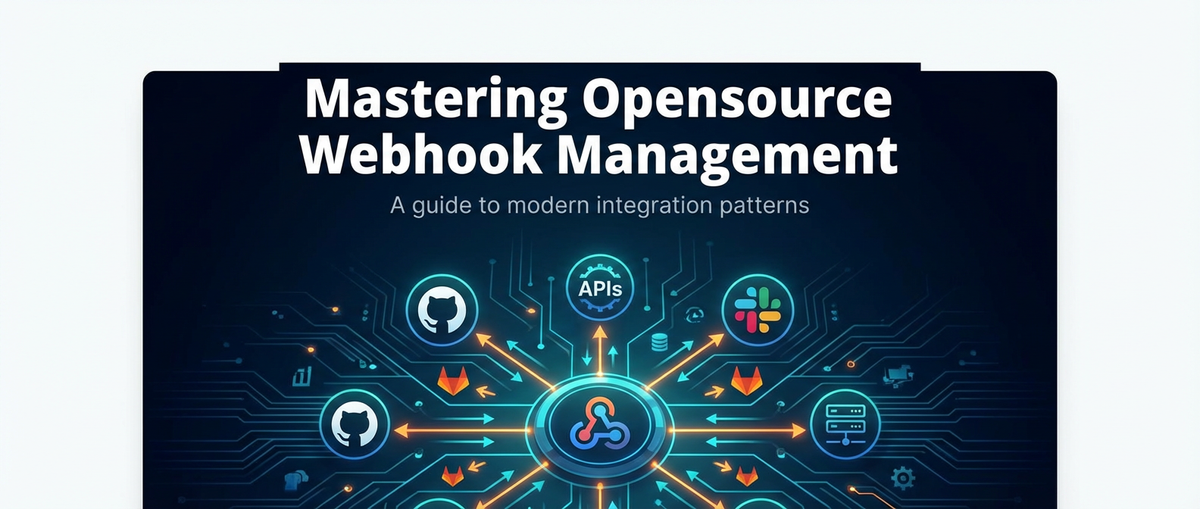
Mastering Opensource Webhook Management


In the sprawling landscape of modern software development, where microservices reign supreme and real-time data flows are the lifeblood of applications, the humble webhook has emerged as an indispensable cornerstone. Far beyond a mere technological curiosity, webhooks represent a fundamental paradigm shift in how services communicate, moving from the often inefficient and resource-intensive model of polling to an elegant, event-driven push mechanism. Yet, while their conceptual simplicity makes them alluring, the practicalities of effectively managing webhooks, particularly at scale and with an emphasis on reliability and security, present a formidable challenge. This challenge is precisely where the power and flexibility of open-source solutions truly shine, offering developers and organizations the tools and methodologies to construct resilient, observable, and adaptable webhook infrastructures.
This comprehensive exploration delves into the intricate world of open-source webhook management, dissecting its core principles, confronting its inherent challenges, and charting a course through the best practices and architectural patterns that empower developers to harness the full potential of event-driven communication. We will navigate the complexities of ensuring delivery guarantees, fortifying security, achieving scalability, and fostering a developer-friendly experience, all while leveraging the collaborative spirit and transparent nature of open-source software. By the end of this journey, the reader will possess a profound understanding of how to architect and maintain a robust webhook system, transforming potential pitfalls into pillars of a responsive and dynamic digital ecosystem.
Unpacking the Fundamentals: What Exactly are Webhooks?
At its heart, a webhook is a user-defined HTTP callback that is triggered by a specific event. It's often referred to as a "reverse API" because, unlike a traditional API where you make requests to fetch data, a webhook causes data to be sent to you when an event occurs. This distinction is crucial: instead of constantly asking ("polling") a server if something has changed, the server proactively notifies your application when a change happens. This push-based model significantly enhances efficiency, reduces latency, and conserves resources for both the sender and the receiver.
Imagine a scenario where an e-commerce platform needs to inform a shipping provider the moment an order is placed. With traditional polling, the shipping provider would have to repeatedly query the e-commerce platform's API at regular intervals, say every minute, to check for new orders. This approach is inherently inefficient: most of these queries would return no new data, wasting computational resources on both ends. Furthermore, there would be an inherent delay between an order being placed and the shipping provider becoming aware of it, directly proportional to the polling interval.
Enter the webhook. When an order is successfully placed on the e-commerce platform, the platform—acting as the "publisher"—automatically sends an HTTP POST request to a pre-configured URL endpoint belonging to the shipping provider—the "subscriber." This request contains a "payload," typically a JSON object, detailing the new order's information. The shipping provider's application, upon receiving this request, can then immediately initiate the shipping process. This shift from "pull" to "push" transforms synchronous, request-response interactions into asynchronous, event-driven communications, enabling near real-time updates and significantly improving the responsiveness of integrated systems.
The power of webhooks lies in their ability to facilitate seamless integration between disparate systems without requiring constant synchronization logic or complex state management. They are the invisible threads that weave together the fabric of the modern internet, powering everything from continuous integration/continuous deployment (CI/CD) pipelines that trigger builds upon code commits, to payment gateways notifying merchants of successful transactions, to chat applications pushing messages to various clients. Their underlying mechanism is straightforward: an event occurs, a pre-registered URL is invoked with relevant data, and the receiving system processes that data. This simplicity, however, belies a layer of complexity that arises when considering the reliability, security, and scalability required for production-grade applications. Mastering open-source webhook management is about taming this complexity, ensuring these vital notifications always reach their destination, securely and efficiently.
The Webhook Lifecycle: A Deeper Dive into Mechanics
To truly master webhook management, one must understand the complete journey of a webhook event. It begins with an event source or publisher system. This could be GitHub reporting a new commit, Stripe confirming a payment, or a custom internal service indicating a data change. When a predefined event occurs, the publisher formulates a webhook payload. This payload is typically a JSON (JavaScript Object Notation) document, though XML or even plain text can be used, containing all the pertinent details about the event. For instance, a GitHub webhook payload for a push event would include information about the repository, commit hash, author, and changed files.
Once the payload is ready, the publisher sends an HTTP POST request to a list of subscriber URLs that have previously registered interest in this specific event type. These subscriber URLs are the endpoints exposed by the receiving applications. The HTTP POST request includes the payload in its body and may also contain specific headers, such as Content-Type: application/json to indicate the payload format, or custom headers for authentication or event identification.
Upon receiving the HTTP POST request, the subscriber application is expected to process the incoming data. This processing might involve validating the request, updating a database, triggering another internal service, or sending a notification. Crucially, the subscriber is also expected to return an HTTP status code to the publisher. A 2xx status code (e.g., 200 OK, 204 No Content) signals successful receipt and processing. Any 4xx (client error) or 5xx (server error) status code indicates a failure, prompting the publisher to potentially retry the delivery.
The distinction between webhooks and traditional API polling is perhaps best illustrated by their respective resource utilization and immediacy. Polling involves a client making periodic requests to a server to check for new data. This creates continuous traffic, often with redundant requests, and introduces latency equal to the polling interval. Webhooks, conversely, operate on an "only when necessary" principle. Data is pushed only when an event occurs, leading to significantly reduced network traffic and immediate notification. This makes webhooks ideal for real-time applications where responsiveness is paramount, and resources need to be conserved. Consider a chat application where new messages must appear instantly; polling would introduce noticeable delays, whereas webhooks ensure messages are pushed to clients as soon as they are sent. This fundamental difference underscores why webhooks are not just a convenience, but a strategic architectural choice for efficiency and responsiveness.
The Gauntlet of Webhook Challenges: Navigating Complexity
While the elegance and efficiency of webhooks are undeniable, their implementation and management in production environments are fraught with challenges that demand meticulous planning and robust engineering. Ignoring these complexities can lead to unreliable integrations, security vulnerabilities, performance bottlenecks, and a debugging nightmare. Mastering open-source webhook management necessitates a proactive approach to mitigating these issues from the outset.
Reliability and Delivery Guarantees
One of the most pressing concerns for any system relying on webhooks is ensuring reliable delivery. What happens if the subscriber's endpoint is down, unresponsive, or encounters an internal error? Without a robust mechanism to handle these failures, critical events could be permanently lost, leading to data inconsistencies or service disruptions.
- Idempotency: A fundamental principle for webhook receivers is idempotency. This means that processing the same webhook payload multiple times should have the exact same effect as processing it once. This is vital because publishers often implement retry mechanisms, meaning a subscriber might receive the same event multiple times due to network glitches or timeouts. The receiver must be designed to gracefully handle these duplicates without causing unintended side effects (e.g., creating duplicate orders, sending duplicate notifications). Often, this involves storing a unique event ID and checking it before processing.
- Retry Mechanisms and Exponential Backoff: Publishers must implement intelligent retry strategies. A simple retry might be insufficient if the subscriber is experiencing prolonged downtime. Exponential backoff, where the delay between retries increases with each subsequent attempt, is a common and effective pattern. This prevents overwhelming a temporarily struggling subscriber and allows it time to recover, while still ensuring eventual delivery. Publishers should also define a maximum number of retries and a maximum total duration for retries, after which the event is considered failed.
- Dead-Letter Queues (DLQs): For events that ultimately fail all retry attempts, a dead-letter queue is indispensable. Instead of discarding these critical events, they are moved to a DLQ for manual inspection, reprocessing, or archival. This ensures no data is truly lost and allows operators to investigate the root cause of persistent failures, whether it's a bug in the subscriber's logic or a fundamental issue with the endpoint.
- Delivery Order: While less common, some applications might require webhooks to be delivered in a strict chronological order. Achieving this with asynchronous, distributed systems is challenging and often requires additional mechanisms like sequence numbers within payloads or dedicated ordered queues, adding significant complexity.
Security Concerns: Fortifying Against Malice
Webhooks involve external systems pushing data into your application, making security a paramount concern. An unsecured webhook endpoint is a direct pathway for malicious actors to inject false data, trigger unintended actions, or even launch denial-of-service attacks.
- Signature Verification: This is arguably the most critical security measure. The publisher can compute a cryptographic hash of the webhook payload using a shared secret key and send this hash (the "signature") in an HTTP header. The subscriber then recomputes the hash using the same payload and secret, comparing it to the received signature. If they don't match, the request is illegitimate and should be rejected. This ensures both authenticity (the request truly came from the expected publisher) and integrity (the payload hasn't been tampered with in transit).
- HTTPS: All webhook communication should occur over HTTPS (HTTP Secure). This encrypts the data in transit, protecting against eavesdropping and man-in-the-middle attacks, ensuring that payloads and signatures remain confidential.
- Secret Management: The shared secret keys used for signature verification must be securely managed. They should not be hardcoded, exposed in logs, or committed to version control. Environment variables, secret management services (like HashiCorp Vault, AWS Secrets Manager), or secure configuration stores are appropriate places for these secrets.
- IP Whitelisting: If possible, restrict incoming webhook traffic to a predefined list of IP addresses used by the webhook publisher. This adds an extra layer of defense, ensuring that only requests originating from trusted sources are even considered, though it can be challenging with cloud providers that use dynamic IP ranges.
- Payload Validation and Sanitization: Even authenticated webhooks can contain malicious or malformed data. Subscribers must rigorously validate the structure and content of incoming payloads against expected schemas and sanitize any user-generated content to prevent injection attacks (e.g., SQL injection, XSS).
- Rate Limiting: Implement rate limiting on your webhook receiving endpoints to prevent abuse or denial-of-service attacks where an attacker floods your endpoint with a high volume of requests.
Scalability and Performance: Handling the Deluge
As your system grows, the volume of webhook events can increase dramatically. An inefficient webhook management system can quickly become a bottleneck, leading to delayed processing, dropped events, and impaired overall system performance.
- Asynchronous Processing: Webhook receivers should process events asynchronously. The immediate response to the publisher should be a
2xxstatus code, indicating that the event has been received and enqueued for processing. The actual business logic should then be executed in a separate background process, worker, or serverless function. This prevents long-running operations from tying up the HTTP request thread, which could lead to timeouts from the publisher and unnecessary retries. - Load Balancing and Horizontal Scaling: Deploy multiple instances of your webhook receiver behind a load balancer. As event volume increases, you can horizontally scale your worker processes to handle the additional load, distributing the processing across multiple machines.
- Message Queues: A robust message queue (e.g., RabbitMQ, Apache Kafka, Redis Streams) is almost a prerequisite for scalable webhook management. Publishers can send events to a queue, and multiple workers can consume from the queue. This decouples the event producer from the consumer, buffers events during spikes, and simplifies retry logic by allowing events to be re-queued.
- Efficient Database Interactions: If webhook processing involves database writes, ensure these operations are optimized. Batching updates, using efficient indexing, and minimizing contention can significantly improve performance under high load.
Monitoring and Observability: Seeing the Unseen
When something goes wrong with webhooks, identifying the problem can be exceptionally difficult without proper monitoring. Webhooks operate asynchronously, often across different services and even organizations, making traditional debugging challenging.
- Comprehensive Logging: Log every incoming webhook request, its payload (carefully redacting sensitive information), processing status, and any errors encountered. These logs are invaluable for troubleshooting, auditing, and understanding system behavior.
- Metrics and Dashboards: Collect metrics such as:
- Total webhooks received per second/minute.
- Success rate vs. error rate.
- Processing latency.
- Number of retries for specific events.
- Queue depth (if using message queues).
- These metrics should be visualized on dashboards to provide real-time insights into the health of your webhook system.
- Alerting: Configure alerts for critical thresholds, such as a sudden drop in the success rate, an increase in error rates, or a queue building up rapidly. Proactive alerts enable quick responses to potential issues before they impact users.
- Distributed Tracing: For complex microservice architectures, distributed tracing (e.g., OpenTelemetry, Jaeger) can help track a single webhook event's journey across multiple services, providing visibility into latency and failures at each step.
Developer Experience and Ecosystem Integration
A well-managed webhook system is not just robust; it's also easy to use and integrate with. Poor documentation, complex setup, or lack of testing tools can hinder adoption and lead to integration errors.
- Clear Documentation: Provide comprehensive documentation for external and internal consumers, detailing:
- Available webhook event types.
- The structure of each webhook payload (
OpenAPIcan be used to describe theAPIendpoint that receives the webhook, and the schema of the payload). - Security requirements (signature verification process).
- Expected HTTP response codes.
- Retry policies.
- Testing methodologies.
- Testing and Simulation Tools: Offer tools or guidance for developers to test their webhook integrations locally. Tools like ngrok allow public URLs to be tunnelled to local development environments, while webhook.site provides a temporary, inspectable URL for testing. For internal development, mock webhook servers can simulate various responses, including failures.
- Versioning: As your application evolves, webhook payloads may need to change. Implement clear versioning strategies (e.g., via
APIversion headers, distinct endpoint paths like/v1/webhooks,/v2/webhooks) to manage backward compatibility and ensure smooth transitions for consumers. - Ease of Subscription: Provide a user-friendly interface or
APIfor consumers to subscribe to webhooks, manage their endpoints, and view delivery logs.
By systematically addressing these challenges with thoughtful architectural design and the strategic application of open-source tools, organizations can transform webhook management from a potential liability into a powerful asset, fostering reliable, secure, and highly responsive integrated systems.
APIPark is a high-performance AI gateway that allows you to securely access the most comprehensive LLM APIs globally on the APIPark platform, including OpenAI, Anthropic, Mistral, Llama2, Google Gemini, and more.Try APIPark now! 👇👇👇
Principles of Robust Webhook Management: An Architectural Blueprint
Building a resilient webhook system isn't just about implementing features; it's about adhering to a set of guiding principles that permeate every layer of design and implementation. These principles, deeply rooted in distributed systems best practices, form the architectural blueprint for an open-source webhook management strategy that stands the test of time and scale.
Event-Driven Architecture: The Philosophical Underpinning
At its core, webhook management thrives within an event-driven architecture. This paradigm shifts the focus from direct, tightly coupled service calls to an indirect, loosely coupled system where components communicate by publishing and consuming events. For webhooks, this means the publisher isn't concerned with how the event is processed, only that it is reliably dispatched. The subscriber, in turn, is responsible for reacting to events it cares about.
This decoupling provides immense flexibility. Services can evolve independently, failures in one component are less likely to cascade, and new services can easily subscribe to existing event streams without requiring changes to the publishers. The principle here is to embrace the asynchronous nature of events and design systems that react to change rather than constantly polling for it. This allows for higher throughput, better scalability, and increased fault tolerance.
Design for Failure: Assume the Worst
One of the most critical principles in distributed systems is "design for failure." When dealing with external webhook endpoints, this takes on even greater significance. You must assume that subscriber endpoints will inevitably fail—they might be temporarily down, experience network issues, or be slow to respond. Your webhook publisher and management system must anticipate these failures and be engineered to gracefully handle them without losing events.
This principle translates directly into concrete implementations: * Retries with Exponential Backoff: As discussed, this is non-negotiable. Don't just try once; have a strategy to re-attempt delivery, increasing delay to give the subscriber time to recover. * Circuit Breakers: Implement circuit breakers around external webhook calls. If an endpoint consistently fails for a period, the circuit breaker should "trip," preventing further calls to that endpoint for a set duration. This protects your system from wasting resources on doomed requests and allows the failing endpoint to stabilize without being overwhelmed. * Timeouts: Always set sensible timeouts for HTTP requests to webhook endpoints. Don't let a slow or unresponsive subscriber hold up your internal processes indefinitely. * Idempotency on the Receiving End: The subscriber must be robust enough to handle duplicate events. This is the receiver's responsibility to design its processing logic such that repeated deliveries of the same event produce the same outcome, preventing data corruption or unwanted side effects.
Secure by Design: Embed Security from the Ground Up
Security cannot be an afterthought; it must be an integral part of the webhook management system from its initial design phases. Given that webhooks represent an open channel for external systems to push data into your infrastructure, vulnerabilities can have severe consequences.
- Mandatory HTTPS: Every webhook URL must use HTTPS to ensure encrypted communication and prevent eavesdropping or tampering.
- Signature Verification for Authenticity: This is the primary mechanism to verify the sender's identity and the integrity of the payload. Every webhook receiver must implement robust signature verification using shared secrets.
- Strict Access Control for Subscription: Who can create or modify webhook subscriptions? Ensure only authorized users or services have this capability.
- Principle of Least Privilege: Webhook payloads should only contain the minimum necessary information. Do not expose sensitive data unless absolutely essential. The receiving endpoint should also have only the minimum permissions required to process the webhook.
- Input Validation and Sanitization: Never trust incoming data. Rigorously validate the structure and content of all webhook payloads against defined schemas and sanitize any potentially malicious input to prevent injection attacks.
Observable by Default: Shedding Light on the Black Box
Webhooks, by their asynchronous and often cross-service nature, can be notoriously difficult to debug when things go wrong. The principle of observability dictates that your system should be designed to allow you to understand its internal state simply by observing its outputs.
- Comprehensive Logging: Log every significant event: webhook dispatched, delivery attempt, success, failure, retry, and entry into a dead-letter queue. These logs should be structured and easily searchable.
- Meaningful Metrics: Collect and expose metrics on delivery rates, success rates, latency, retry counts, and queue depth. These metrics provide quantitative insights into the health and performance of your webhook system.
- Actionable Alerting: Configure alerts for deviations from normal behavior (e.g., sustained error rates above a threshold, queues backing up). Alerts should be routed to the appropriate teams to enable quick response.
- Traceability: Ideally, each webhook event should be traceable throughout its lifecycle, from its origination in the publisher to its final processing in the subscriber. Distributed tracing systems can be invaluable here.
Versioning and Compatibility: Managing Evolution
Software systems are dynamic; webhook payloads and their underlying business logic will inevitably change over time. A robust webhook management strategy must account for this evolution while maintaining backward compatibility for existing subscribers.
- Clear Versioning Strategy: Adopt a clear versioning scheme for your webhook
APIs. This could involve embedding version numbers in the URL path (e.g.,/webhooks/v1/event), usingAPIversion headers, or including a version field within the payload itself. - Backward Compatibility: Strive for backward compatibility. Adding new optional fields to a payload is generally safe; removing fields or changing their types requires careful migration strategies.
- Deprecation and Sunsetting: Provide ample notice and a clear timeline when deprecating older webhook versions or event types. Offer migration guides and support to help consumers transition.
- Schema Enforcement: Define and enforce schemas for your webhook payloads (e.g., using JSON Schema). This provides clear documentation and enables automated validation, helping to prevent malformed events and ensuring consistency across versions.
By internalizing and systematically applying these principles, organizations can move beyond simply sending and receiving webhooks to mastering their management. This leads to not only more reliable and secure integrations but also a more agile and responsive overall system architecture that can gracefully handle the complexities of distributed, event-driven communication.
Open-Source Solutions for Webhook Management: A Toolkit for Resilience
The open-source ecosystem provides a rich array of tools, libraries, and frameworks that can be leveraged to build and manage a robust webhook infrastructure. Rather than reinventing the wheel, developers can combine these battle-tested components to construct highly reliable, scalable, and secure systems tailored to their specific needs. This section explores various categories of open-source solutions and how they contribute to a comprehensive webhook management strategy.
Building Your Own: The DIY Approach (and its implications)
While seemingly daunting, understanding the components required to build a webhook management system from scratch using open-source building blocks is incredibly educational. It highlights the underlying complexities and the value proposition of specialized tools. A basic DIY system would typically involve:
- A Web Server/Framework: To expose the webhook receiving endpoint (e.g., Nginx, Apache, or frameworks like Flask, Django, Express.js).
- A Message Queue: To immediately enqueue incoming webhooks for asynchronous processing (e.g., RabbitMQ, Apache Kafka, Redis Streams). This is crucial for decoupling the receiving
APIfrom the processing logic, ensuring theAPIcan return a quick200 OKresponse without waiting for potentially long-running tasks. - Worker Processes/Task Runners: To consume messages from the queue and execute the business logic (e.g., Celery for Python, Go routines with channels, custom worker pools).
- A Database: To store webhook configuration, delivery logs, event status, and for implementing idempotency checks.
- Retry Logic: Custom code to implement exponential backoff and retry failed deliveries.
- Security Measures: Libraries for signature verification, HTTPS setup (often via proxy like Nginx/HAProxy/Envoy), and secret management integrations.
- Monitoring and Logging: Integration with open-source observability stacks (Prometheus, Grafana, ELK stack).
Challenges of Building Your Own: While offering ultimate control, this approach demands significant engineering effort, ongoing maintenance, and deep expertise across various domains (distributed systems, security, operations). For many organizations, the total cost of ownership can quickly outweigh the benefits, especially when commercial products or more integrated open-source solutions exist.
Leveraging Existing Open-Source Frameworks and Libraries
Instead of building everything from scratch, a more pragmatic approach is to combine specialized open-source libraries and platforms that address specific aspects of webhook management.
1. Message Queues and Event Streaming Platforms: The Backbone of Asynchronous Processing
These are arguably the most critical components for building scalable and reliable webhook systems. They decouple the sender from the receiver, provide buffering against load spikes, and facilitate robust retry mechanisms.
- RabbitMQ: A mature and widely adopted open-source message broker that implements the Advanced Message Queuing Protocol (AMQP). It excels in complex routing scenarios, offers guaranteed message delivery, and supports various messaging patterns, making it suitable for managing webhook events and their retries.
- Apache Kafka: A distributed streaming platform designed for high-throughput, fault-tolerant ingestion and processing of event streams. Kafka is ideal for scenarios with very high volumes of webhooks, where events might also need to be consumed by multiple subscribers or persisted for long-term analytics. Its consumer group model makes it highly scalable for processing.
- Redis Streams: Part of the Redis data structure store, Streams offer a log-like data structure that supports multiple consumers, message acknowledgment, and group consumption. It's a lightweight yet powerful option for managing event streams, especially within the Redis ecosystem.
- NATS: A simple, secure, and high-performance open-source messaging system that focuses on publish-subscribe messaging, request-reply, and distributed queues. It's particularly well-suited for microservices communication and can serve as a lightweight event bus for webhooks.
2. Task Queues and Background Job Processors: Decoupling Execution
Once a webhook event is enqueued, a separate system is needed to pick it up and process it asynchronously.
- Celery (Python): A powerful, distributed task queue for Python applications. It seamlessly integrates with message brokers like RabbitMQ or Redis and allows you to define tasks that can be executed in the background, handling retries, scheduling, and error handling for webhook processing.
- Dramatiq (Python): A smaller, simpler, and often faster alternative to Celery, focusing on ease of use and modern Python features, also using RabbitMQ or Redis as a broker.
- Background Jobs in Frameworks: Many web frameworks have built-in or easy-to-integrate background job systems (e.g., Sidekiq for Ruby on Rails, Active Job; built-in queue systems in Laravel for PHP).
3. API Gateways: The Front Door for Webhooks
While primarily known for managing incoming client requests to your APIs, an api gateway can play a crucial role in securing and routing incoming webhooks to the correct internal service.
- Kong Gateway: An open-source, cloud-native
API gatewaybuilt on Nginx. Kong can be used to manage incoming webhook endpoints, applying policies such as rate limiting, authentication, IP whitelisting, and routing requests to internal queueing systems or services. It can also handle TLS termination for HTTPS. - Apache APISIX: Another high-performance, open-source
API gatewaythat offers dynamic routing, load balancing, authentication, and security features. Like Kong, APISIX can serve as the ingress point for webhooks, enforcing security policies before events reach your core application logic. - Envoy Proxy: A high-performance open-source edge and service proxy, often used as a sidecar in microservices architectures. While more of a proxy than a full
API gateway, Envoy can be configured to manage traffic for webhook endpoints, providing advanced routing, load balancing, and observability features.
For organizations managing a broad spectrum of API interactions, including the ingress and egress of event-driven communication, a robust api gateway is indispensable. Platforms like ApiPark, an open-source AI gateway and API management platform, provide functionalities that can streamline the management of various API endpoints, ensuring security, routing, and observability across your services. Such solutions can simplify the operational complexities associated with exposing and consuming numerous API endpoints, including those dedicated to webhook reception.
4. Security Libraries and Tools: Guardians of Integrity
- Cryptography Libraries: Most programming languages have robust cryptographic libraries (e.g.,
PyJWTfor Python,jwt-gofor Go,jsonwebtokenfor Node.js) that can be used to implement signature verification for webhooks, often involving HMAC (Hash-based Message Authentication Code). - Secret Management Systems:
- HashiCorp Vault: An open-source tool for securely accessing secrets. Vault can store and dynamically generate secrets, making it ideal for managing the shared secret keys used in webhook signature verification without hardcoding them.
- External Secrets Operator (Kubernetes): For Kubernetes environments, this operator allows you to use external secret management systems (like AWS Secrets Manager, Azure Key Vault, Google Secret Manager, or HashiCorp Vault) as a source for Kubernetes Secrets, providing a secure way to inject webhook secrets into your pods.
5. Observability Stack: Seeing Into the System
- Prometheus & Grafana: A powerful combination for monitoring. Prometheus collects metrics from your webhook system (e.g., success rates, error counts, queue sizes), and Grafana provides rich dashboards for visualization and alerting.
- ELK Stack (Elasticsearch, Logstash, Kibana): For centralized logging. Webhook logs can be sent to Logstash, stored in Elasticsearch, and visualized/searched using Kibana, providing deep insights into webhook activity and aiding troubleshooting.
- OpenTelemetry & Jaeger: For distributed tracing. OpenTelemetry provides a set of
APIs, SDKs, and tools to instrument, generate, collect, and export telemetry data (metrics, logs, traces). Jaeger, an open-source distributed tracing system, can visualize these traces, showing the full journey of a webhook event across multiple services.
Table: Open-Source Components for Webhook Management
| Component Type | Example Open-Source Tools | Key Benefit for Webhooks |
|---|---|---|
| Message Queue / Event Bus | RabbitMQ, Apache Kafka, Redis Streams, NATS | Decouples producer/consumer, buffers events, enables retries, horizontal scaling. |
| Task Queue / Job Processor | Celery, Dramatiq (Python), Sidekiq (Ruby), Laravel Queues (PHP) | Asynchronous processing, offloads heavy work from HTTP threads, handles background retries. |
API Gateway / Proxy |
Kong Gateway, Apache APISIX, Envoy Proxy, ApiPark | Secures ingress, rate limiting, authentication, intelligent routing to internal services. |
| Secret Management | HashiCorp Vault, External Secrets Operator | Securely stores and manages shared webhook secrets for signature verification. |
| Monitoring & Alerting | Prometheus, Grafana | Real-time insights into delivery rates, errors, latency; proactive issue detection. |
| Centralized Logging | ELK Stack (Elasticsearch, Logstash, Kibana) | Collects, stores, and analyzes all webhook logs for auditing and debugging. |
| Distributed Tracing | OpenTelemetry, Jaeger | Visualizes the end-to-end flow of webhook events across microservices. |
| Payload Validation | JSON Schema validation libraries (various languages) | Enforces data integrity, prevents malformed payloads, aids OpenAPI documentation. |
By strategically selecting and integrating these open-source tools, developers can construct a highly flexible and robust webhook management system, tailored to their specific operational context and evolving needs, without proprietary lock-in or prohibitive licensing costs.
Best Practices for Deploying and Operating Open-Source Webhook Systems
Beyond selecting the right tools, the success of an open-source webhook management strategy hinges on adhering to best practices throughout deployment and ongoing operations. These practices ensure the system remains reliable, secure, and performant as it scales and evolves.
Infrastructure Considerations: Building a Solid Foundation
The underlying infrastructure plays a crucial role in the stability and scalability of your webhook system.
- Containerization (Docker): Encapsulating your webhook receiver, worker processes, and related services (like message queues) in Docker containers provides consistency across different environments (development, staging, production). It simplifies deployment, ensures dependencies are met, and facilitates portability.
- Orchestration (Kubernetes): For complex, high-scale deployments, Kubernetes (K8s) is the de facto standard for container orchestration. It automates deployment, scaling, and management of containerized applications. Kubernetes allows you to easily scale your webhook receiver and worker pods based on load, manage rolling updates, and configure self-healing capabilities. It also integrates well with open-source
API gateways like Kong or APISIX, and secret management tools. - Cloud Agnosticism: While deploying on cloud providers offers immense benefits, designing your system to be cloud-agnostic (using containers, open-source databases, and message queues) provides flexibility and avoids vendor lock-in. This means your webhook system could theoretically run on AWS, Azure, GCP, or on-premise without significant re-architecture.
- High Availability and Disaster Recovery: Deploy your webhook system across multiple availability zones or regions to ensure high availability. Implement backup and restore procedures for any persistent data (e.g., webhook configuration, delivery logs) and test your disaster recovery plan regularly.
Monitoring and Alerting Strategy: Staying Ahead of Issues
Effective monitoring and alerting are the eyes and ears of your webhook operations. Without them, problems can fester unnoticed, leading to significant outages.
- Define Key Metrics: Identify what truly matters: webhook receipt rate, successful delivery rate, average delivery latency, retry count distribution, queue depth, and processing error rates. These are your North Star metrics.
- Granular Logging: Ensure logs are not only comprehensive but also include unique correlation IDs for each webhook event, allowing you to trace a single event through multiple services and log files. Use structured logging (e.g., JSON logs) for easier parsing and analysis by tools like the ELK stack or Grafana Loki.
- Threshold-Based Alerts: Configure alerts for deviations from normal operating parameters. For example:
- Success rate dropping below 95% for 5 minutes.
- Queue depth exceeding a certain threshold (e.g., 1000 messages) for an extended period.
- Latency of webhook processing exceeding a defined SLA.
- Sudden spikes in error rates for specific webhook types.
- Alert Routing: Ensure alerts are routed to the appropriate on-call teams or individuals via robust notification channels (e.g., PagerDuty, Slack, email). Alerts should be actionable, providing enough context for immediate investigation.
- Dashboards for Operational Visibility: Create clear, intuitive dashboards using tools like Grafana. These should provide real-time visualization of key metrics, allowing operations teams to quickly assess the health of the webhook system at a glance.
Security Hardening: A Continuous Endeavor
Security is not a one-time setup but an ongoing process, especially for publicly exposed endpoints.
- Regular Security Audits: Conduct periodic security audits of your webhook infrastructure, including code reviews, penetration testing, and vulnerability scanning.
- Patch Management: Keep all components of your open-source stack (operating system, libraries, application frameworks, message queues,
API gateways) updated with the latest security patches to mitigate known vulnerabilities. Automate this process where possible. - Least Privilege Principle: Ensure that all services, processes, and user accounts have only the minimum necessary permissions required to perform their functions. For instance, the webhook receiver should only have permission to write to the message queue, not directly to sensitive databases.
- Network Segmentation: Isolate your webhook processing infrastructure within its own network segments or VLANs. Use firewalls and network policies to control ingress and egress traffic, allowing only necessary communication channels.
- WAF (Web Application Firewall): Deploy a WAF in front of your webhook endpoints to protect against common web vulnerabilities and brute-force attacks. Open-source WAFs like ModSecurity can be integrated with Nginx or Apache.
Documentation and Onboarding: Fostering Adoption
A powerful webhook system is only as good as its usability. Clear documentation and an easy onboarding process are critical for both internal and external consumers.
- Comprehensive
OpenAPISpecifications: For webhook receivers, use theOpenAPIspecification (formerly Swagger) to meticulously document theAPIendpoint that accepts webhook requests. This includes:- The expected HTTP method (POST).
- The URL path.
- Detailed schema definitions for the incoming JSON (or other format) webhook payload, including required fields, data types, and examples.
- Expected HTTP response codes and their meanings.
- Authentication and security requirements (e.g., how signature verification works).
- This provides a single source of truth for developers integrating with your webhooks.
- Detailed Integration Guides: Provide step-by-step guides for consumers on how to:
- Subscribe to webhooks.
- Implement signature verification on their end.
- Handle retries and idempotency.
- Test their webhook endpoints.
- Webhook Event Catalog: Maintain an up-to-date catalog of all available webhook event types, their purpose, and their corresponding payload structures.
- Sandbox Environment: Offer a sandbox or staging environment where developers can test their webhook integrations without affecting production systems. This is invaluable for rapid iteration and debugging.
Graceful Degradation and Circuit Breakers: Protecting Your System
Your webhook system must be resilient to failures in downstream systems, including third-party webhook publishers or internal services.
- Circuit Breaker Pattern: Implement circuit breakers in your webhook processing logic when making calls to other internal or external services. If a service becomes unresponsive, the circuit breaker can temporarily "open," preventing further calls and allowing the service to recover. This prevents cascading failures and protects your system's resources.
- Bulkhead Pattern: Isolate different types of webhook processing into separate resource pools (e.g., different queues, different sets of worker processes). This prevents a flood of one type of webhook from overwhelming the entire system and impacting other webhook types.
- Backpressure Handling: Design your system to detect and respond to backpressure. If message queues are growing too rapidly, worker processes can signal this upstream, potentially leading to temporary throttling or prioritization of critical events.
Evolving Webhook APIs: Managing Change
As your applications grow, webhook payloads and event types will change. Managing these changes gracefully is crucial to avoid breaking integrations.
- Versioning is Key: As mentioned in principles, strictly adhere to your chosen versioning strategy (e.g.,
v1,v2). - Additive Changes First: When possible, make changes that are additive (e.g., adding new optional fields to a payload). This is generally backward compatible.
- Deprecation Strategy: When breaking changes are unavoidable (e.g., removing a field, changing a data type), implement a clear deprecation policy. Announce changes well in advance, provide a migration path, maintain older versions for a transition period, and offer clear documentation.
- Use
OpenAPIfor Documentation and Validation: Regularly update yourOpenAPIspecifications for new webhook versions and use them to validate incoming payloads to catch schema mismatches early.
By meticulously applying these deployment and operational best practices, combined with the strategic utilization of open-source tools, organizations can build and maintain a webhook management system that is not only highly functional but also remarkably robust, secure, and adaptable to the ever-changing demands of modern event-driven architectures. This mastery ensures that the critical flow of real-time information remains uninterrupted, powering responsive applications and efficient integrations across the digital landscape.
Conclusion: Orchestrating the Future of Event-Driven Communication
The journey through the intricate world of open-source webhook management reveals a landscape of both immense potential and significant complexity. Webhooks, as the silent workhorses of event-driven architectures, are undeniably foundational to the responsiveness and integration capabilities of modern applications. Their ability to foster real-time communication, minimize resource expenditure compared to traditional polling, and decouple services is invaluable in an era dominated by microservices and distributed systems.
However, harnessing this power is not without its challenges. The pitfalls of unreliable delivery, pervasive security threats, daunting scalability requirements, and the sheer difficulty of observing and debugging asynchronous flows demand a rigorous and principled approach. It is precisely in overcoming these obstacles that the open-source ecosystem shines brightest. By strategically combining battle-tested components such as robust message queues, intelligent API gateways, comprehensive observability stacks, and sophisticated security libraries, developers are empowered to construct bespoke webhook management systems that are not only highly effective but also transparent, flexible, and free from proprietary lock-in.
The mastery of open-source webhook management is less about finding a single, magic bullet solution and more about adopting a holistic philosophy. This philosophy is rooted in designing for failure, prioritizing security from conception, ensuring complete observability, and embracing a pragmatic approach to versioning and evolution. It demands a deep understanding of distributed systems principles, a commitment to best practices in deployment and operations, and an ongoing vigilance against emerging threats and evolving requirements.
As we look to the future, the prominence of event streaming, serverless functions, and standardized event formats will only continue to amplify the importance of robust webhook management. By investing in open-source solutions and adhering to the principles outlined in this article, organizations can build not just functional integrations, but truly resilient, scalable, and secure event-driven architectures that stand ready to power the next generation of dynamic digital experiences. The task is demanding, but the tools and knowledge are readily available for those willing to orchestrate them with precision and foresight.
Frequently Asked Questions (FAQ)
1. What is the fundamental difference between webhooks and traditional API polling?
The fundamental difference lies in their communication model. With traditional API polling, a client repeatedly sends requests to a server to check for new data or changes (a "pull" model). This is often inefficient due to redundant requests and introduces latency. Webhooks, conversely, operate on a "push" model: the server (publisher) automatically sends an HTTP POST request to a pre-configured URL endpoint on the client (subscriber) only when a specific event occurs. This provides real-time updates, reduces network traffic, and conserves resources for both parties.
2. Why is signature verification crucial for webhook security, and how does OpenAPI relate to it?
Signature verification is crucial because it ensures the authenticity and integrity of incoming webhook requests. The sender calculates a cryptographic hash of the payload using a shared secret and includes this signature in the request headers. The receiver then recomputes the hash using its copy of the secret and the received payload. If the signatures match, it confirms the request came from the legitimate sender and that the payload hasn't been tampered with. While OpenAPI primarily describes the structure and behavior of RESTful API endpoints, it can be used to document the API endpoint that receives the webhook, specifying the expected payload schema and any required security headers, including where the signature is expected and how it's formatted. This aids developers in correctly implementing the verification logic.
3. What are the key open-source components needed to build a robust webhook management system?
A robust open-source webhook management system typically leverages several key components: 1. Message Queue/Event Bus: (e.g., RabbitMQ, Apache Kafka, Redis Streams) for asynchronous processing, buffering, and decoupling. 2. Task Queue/Job Processor: (e.g., Celery) to execute business logic in the background, handling retries. 3. API Gateway: (e.g., Kong Gateway, Apache APISIX, ApiPark) to secure, route, and manage ingress traffic for webhook endpoints. 4. Secret Management System: (e.g., HashiCorp Vault) for securely storing shared secrets for signature verification. 5. Observability Stack: (e.g., Prometheus, Grafana, ELK Stack, OpenTelemetry, Jaeger) for monitoring, logging, and tracing. 6. Containerization/Orchestration: (e.g., Docker, Kubernetes) for consistent deployment and scalable operations.
4. How do you handle failed webhook deliveries in an open-source setup?
Handling failed webhook deliveries primarily involves implementing retry mechanisms with exponential backoff. The publisher (or a dedicated webhook dispatch service) should attempt to resend the webhook multiple times, increasing the delay between each attempt to give the subscriber time to recover. If all retries fail, the event should be moved to a Dead-Letter Queue (DLQ), typically part of your message queue system (e.g., RabbitMQ DLQ, Kafka topic), for manual inspection, error analysis, or eventual reprocessing. Additionally, the subscriber side should be idempotent, meaning it can safely process the same webhook event multiple times without causing unintended side effects.
5. How can an api gateway enhance webhook management, and where does ApiPark fit in?
An api gateway enhances webhook management by acting as a central ingress point for all incoming webhook traffic. It can provide crucial functionalities such as: * Security: Enforcing authentication, IP whitelisting, and rate limiting. * Routing: Directing webhooks to the correct internal service or message queue based on paths or headers. * Observability: Collecting metrics and logs on incoming webhook traffic. * Traffic Management: Load balancing and ensuring high availability. ApiPark, as an open-source AI gateway and API management platform, fits into this picture by offering a comprehensive solution to manage various API endpoints, including those that receive webhooks. It can streamline the operational complexities of exposing and consuming APIs, ensuring security, efficient routing, and providing essential observability for your event-driven communications.
🚀You can securely and efficiently call the OpenAI API on APIPark in just two steps:
Step 1: Deploy the APIPark AI gateway in 5 minutes.
APIPark is developed based on Golang, offering strong product performance and low development and maintenance costs. You can deploy APIPark with a single command line.
curl -sSO https://download.apipark.com/install/quick-start.sh; bash quick-start.sh

In my experience, you can see the successful deployment interface within 5 to 10 minutes. Then, you can log in to APIPark using your account.

Step 2: Call the OpenAI API.