Mastering eBPF Packet Inspection in User Space
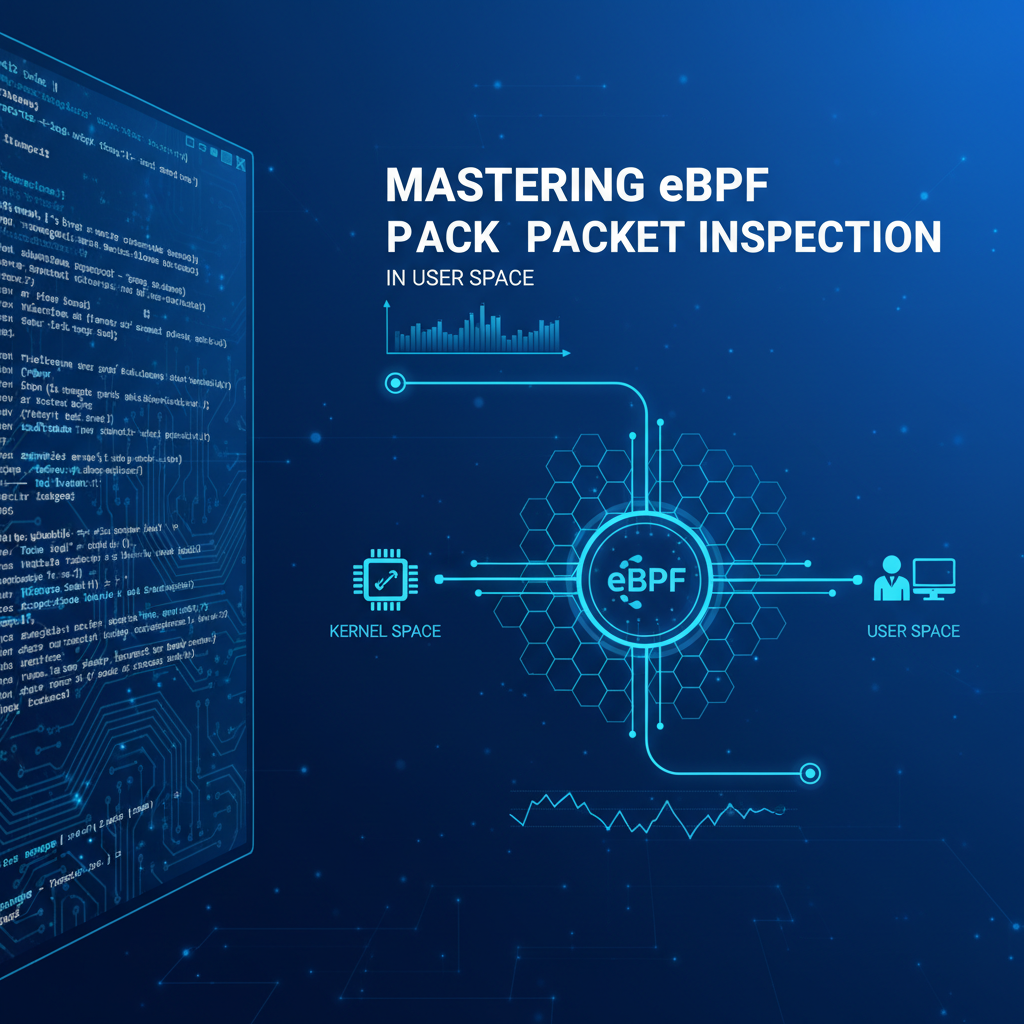


I. Introduction: The Unseen Depths of Network Traffic
In the intricate tapestry of modern computing, network traffic is the lifeblood that connects applications, users, and services across vast and distributed landscapes. From microsecond-latency financial transactions to global content delivery and the seamless flow of data in cloud-native environments, the network's performance, security, and behavior are paramount. Yet, despite its critical role, the internal workings of network processing within operating systems often remain opaque, a black box where packets are transmuted and decisions are made with little direct visibility for application developers or even system administrators. Traditional tools offer glimpses, but rarely provide the granular, real-time insights necessary to truly understand and react to the ever-changing dynamics of network interactions.
For decades, developers and network engineers have relied on a limited set of tools to peer into this crucial domain. Tools like tcpdump and Wireshark have become indispensable for capturing and analyzing packet data, offering invaluable post-mortem analysis capabilities. However, these tools often operate at a higher level of abstraction or introduce significant overhead when deployed for continuous, high-volume monitoring. Furthermore, they primarily focus on capturing data that has already traversed significant portions of the kernel's network stack, making it challenging to intervene or observe events at the earliest, most performance-critical stages of packet processing. The demand for deeper, more programmable observability has grown exponentially, driven by the proliferation of highly dynamic cloud infrastructures, sophisticated security threats, and the unrelenting need for low-latency performance.
Enter eBPF (extended Berkeley Packet Filter), a revolutionary technology that has fundamentally reshaped how we interact with the Linux kernel. Originally conceived as a mechanism for filtering network packets efficiently, eBPF has evolved into a powerful, general-purpose virtual machine that allows users to run sandboxed programs within the kernel without altering the kernel source code or loading kernel modules. This paradigm shift empowers developers to extend the kernel's functionality with custom logic, opening unprecedented avenues for dynamic tracing, performance monitoring, security enforcement, and, most pertinent to our discussion, highly efficient and programmable packet inspection. It bridges a long-standing gap, offering the security and stability of a kernel-enforced sandbox with the flexibility and expressiveness of user-defined code.
While eBPF programs execute within the highly privileged kernel space, their true power is often realized when their insights are brought back to user space. This synergy allows for the best of both worlds: the unparalleled performance and deep visibility afforded by kernel-level execution, combined with the rich processing capabilities, diverse tooling, and ease of development found in user space applications. User space applications can load, manage, and communicate with eBPF programs, collecting data, aggregating metrics, performing complex analytics, and presenting insights through intuitive dashboards. This ability to bridge the kernel-user boundary seamlessly is what makes eBPF packet inspection not just powerful, but immensely practical for real-world scenarios.
This comprehensive article will delve deep into the world of eBPF packet inspection, specifically focusing on how to harness its power to gain unparalleled visibility into network traffic from user space. We will journey from the foundational concepts of packet inspection and eBPF itself, through the intricate mechanisms of attaching eBPF programs to various network hooks, and finally explore advanced techniques for data extraction, analysis, and integration. We will demystify the process, providing a robust understanding of how to implement, manage, and interpret eBPF-driven network data, ultimately empowering you to unlock a new dimension of network observability and control. By the end, you will possess a profound understanding of how to leverage eBPF to monitor, analyze, and even influence network traffic with unprecedented precision and efficiency.
II. The Genesis and Evolution of Packet Inspection
The ability to inspect network packets is as old as networking itself, driven by the fundamental need to understand, diagnose, and secure network communications. The history of packet inspection is a journey from simple, raw byte examination to sophisticated, programmatic analysis deep within the operating system kernel. Understanding this evolution provides crucial context for appreciating the transformative impact of eBPF.
A. Early Days: tcpdump and Wireshark
In the nascent stages of network diagnostics, the primary tools for packet inspection were command-line utilities like tcpdump and graphical network protocol analyzers such as Wireshark (and its predecessor, Ethereal). These tools operate by putting a network interface into "promiscuous mode," allowing it to capture all packets traversing the wire, regardless of their destination MAC address. This raw stream of data is then processed and filtered. tcpdump, often lauded for its powerful filtering capabilities based on BPF (Berkeley Packet Filter) syntax, allowed users to specify precise conditions (e.g., host 192.168.1.1 and port 80) to capture only relevant packets. Wireshark, on the other hand, excels at deep protocol dissection, presenting packet contents in a human-readable format, making it invaluable for debugging application-layer issues and understanding complex protocol interactions.
While immensely useful, these tools primarily offer a passive, "after-the-fact" view of network traffic. They capture packets as they arrive at or leave the network interface card (NIC) and then present them to a user space application for analysis. This approach inherently introduces some overhead, as every captured packet must be copied from kernel buffers to user space. For high-volume traffic or performance-critical environments, this copying overhead can be significant, potentially leading to dropped packets or impacting system performance. Furthermore, these tools are generally not designed for proactive intervention or for aggregating metrics over long periods with minimal resource consumption. Their strength lies in detailed forensic analysis rather than real-time, programmatic control or large-scale data aggregation.
B. Kernel Space vs. User Space: A Historical Perspective
The distinction between kernel space and user space is fundamental to operating system design and has always influenced approaches to packet inspection. User space refers to the memory area where application programs execute. Applications in user space are isolated from each other and from the kernel, providing stability and security. When tcpdump runs, it operates in user space, requesting packet data from the kernel. Kernel space is the privileged memory area where the operating system kernel resides and performs its core functions, including memory management, process scheduling, and handling I/O operations, like network processing. Historically, direct kernel space interaction for custom packet inspection was largely limited to developing kernel modules – a complex, error-prone, and risky endeavor. Kernel modules, while offering maximum power and minimal overhead, require deep kernel understanding, can introduce system instability if buggy, and necessitate recompilation for different kernel versions. This high barrier to entry meant that only specialized developers or those maintaining core OS components ventured into this domain.
The challenge was clear: how to gain the efficiency and deep access of kernel space processing without the dangers and complexity of full kernel module development? This quest drove innovations in network stack design and observability mechanisms.
C. The Rise of Programmable Networking and Observability
The increasing complexity of network infrastructures, especially with the advent of virtualization, cloud computing, and microservices architectures, highlighted the limitations of traditional, static network tools. Environments became dynamic, ephemeral, and incredibly dense with traffic. Monitoring hundreds or thousands of virtual machines, containers, and services, each generating vast amounts of network data, required a new approach. The concept of programmable networking began to emerge, advocating for networks that could be dynamically reconfigured and managed via software, rather than static hardware configurations. This shift also fueled the demand for programmable observability, where monitoring tools could be customized to collect precisely the data needed, at various points in the network stack, and process it in a highly efficient manner. Standard network monitoring tools often provided fixed metrics or required sampling, which could miss crucial ephemeral events. The desire for custom metrics, tailored event triggering, and fine-grained control over what data was collected and how it was processed became paramount. This shift was also influenced by the growing popularity of software-defined networking (SDN) and Network Functions Virtualization (NFV), which pushed for more flexible and programmable control planes for network devices and services.
D. Pre-eBPF Challenges in Dynamic Environments
Before eBPF became mainstream, several significant challenges persisted in achieving deep, programmable network observability in dynamic environments:
- Overhead of User Space Tools: As mentioned, copying all packet data to user space for analysis could consume significant CPU and memory resources, particularly problematic in high-throughput scenarios or on resource-constrained systems.
- Lack of Granularity: Existing kernel mechanisms for filtering (like
netfilterfor firewalling) were powerful but often too coarse-grained for highly specific, custom telemetry or event correlation. Injecting custom logic often required complex and dangerous kernel modules. - Kernel Version Incompatibility: Kernel modules are notoriously brittle across different kernel versions, requiring frequent updates and recompilations, which hindered their adoption and maintenance. This made distributing custom kernel-level tools extremely difficult.
- Security Risks: Writing and loading arbitrary kernel modules posed significant security risks. A single bug could crash the entire system or open severe vulnerabilities, making administrators highly reluctant to deploy third-party kernel code.
- Difficulty in Debugging: Debugging issues within the kernel is inherently more complex than debugging user space applications, often requiring specialized tools and deep kernel knowledge.
- Limited Programmability at Early Stages: Gaining access to packets at the absolute earliest stages of their arrival (e.g., directly from the NIC driver) was largely impossible without modifying the kernel or writing specialized drivers. This limited the ability to implement high-performance packet filtering or dropping before significant kernel processing occurred.
These challenges collectively underscored the need for a safe, efficient, and programmable mechanism to extend kernel functionality, particularly for network operations. The limitations of both pure user space tools and traditional kernel module development created a void that eBPF was uniquely positioned to fill, fundamentally altering the landscape of network observability and security.
E. How eBPF Addresses These Legacy Issues
eBPF directly tackles the aforementioned challenges by offering a robust and elegant solution:
- In-Kernel Processing with Minimal Overhead: eBPF programs execute directly within the kernel, avoiding the costly user space context switches and data copying overhead associated with traditional tools. This allows for extremely high-performance filtering, aggregation, and event processing.
- Safe and Verified Execution: Before an eBPF program is loaded, a strict in-kernel verifier statically analyzes it to ensure it terminates, doesn't contain infinite loops, doesn't access invalid memory, and doesn't crash the kernel. This sandboxed execution model eliminates the primary security concerns associated with kernel modules.
- Stability Across Kernel Versions: eBPF relies on stable kernel APIs and helper functions. While some eBPF features evolve with new kernel versions, basic eBPF programs are generally more resilient to kernel upgrades than traditional kernel modules, which often rely on internal kernel structures.
- Rich Programmability: eBPF offers a rich instruction set and a powerful set of helper functions, allowing developers to write sophisticated logic for packet parsing, state tracking, and metric aggregation directly within the kernel. This enables highly customized observability and security policies.
- Diverse Attachment Points: eBPF programs can be attached to a multitude of kernel "hooks," including network interface drivers (XDP), traffic control egress/ingress queues (TC), and even individual sockets. This provides unprecedented granularity and control over where and when packet inspection occurs.
- Efficient Data Export: eBPF programs can efficiently export aggregated metrics or event data to user space via shared memory structures like BPF maps or
perf_eventring buffers, minimizing the data transfer overhead to user space. - User Space Tooling and Development: While eBPF programs run in the kernel, they are developed, compiled, and managed from user space using standard programming languages (C, Go, Python via frameworks like
BCCorlibbpf). This lowers the barrier to entry significantly.
In essence, eBPF revolutionizes network packet inspection by providing a safe, efficient, and highly programmable interface to the kernel's network stack. It moves the intelligence of packet processing much closer to the data source, transforming network observability from a passive, post-mortem activity into an active, real-time, and deeply integrated capability. This fundamental shift empowers a new generation of network performance, security, and diagnostic tools, enabling unprecedented insights and control over the network's behavior.
III. Deconstructing eBPF: The Basics
To master eBPF packet inspection, a solid understanding of eBPF's core components and operational principles is essential. Far more than just a filter, eBPF is a powerful in-kernel virtual machine that executes user-defined code in a highly controlled environment.
A. What is eBPF? A Kernel Virtual Machine
At its heart, eBPF is a virtual machine embedded within the Linux kernel. This VM allows for the execution of small, sandboxed programs that are loaded by user space applications. Unlike traditional virtual machines that virtualize entire operating systems or processes, the eBPF VM provides a highly optimized environment for executing specific bytecode programs at various predefined "hooks" within the kernel. These programs can interact with kernel data structures, call a limited set of kernel helper functions, and operate on data without needing to copy it to user space.
The "extended" in eBPF refers to its evolution from the classic BPF (cBPF), which was a simpler bytecode interpreter primarily designed for network packet filtering (as used by tcpdump). eBPF vastly expands on cBPF's capabilities, offering: * More Registers: cBPF had two 32-bit registers and an accumulator; eBPF boasts ten 64-bit general-purpose registers, a 64-bit program counter, and a 64-bit stack pointer, enabling more complex computations and data manipulation. * Larger Instruction Set: eBPF's instruction set is significantly richer, supporting arithmetic, bitwise operations, jumps, function calls, and memory access instructions. * Maps: A crucial addition, BPF maps allow eBPF programs to store and share data with other eBPF programs and with user space, enabling stateful operations and data aggregation. * Helper Functions: eBPF programs can call a set of stable, well-defined kernel helper functions for tasks like map lookups/updates, accessing current time, logging, and more. * JIT Compilation: Modern kernels Just-In-Time (JIT) compile eBPF bytecode into native machine code for the host CPU architecture. This ensures that eBPF programs execute at near-native speed, minimizing overhead.
This transformation makes eBPF an incredibly versatile tool, capable of far more than just packet filtering; it can perform tracing, security monitoring, performance analysis, and much more, all without modifying the kernel source or risking system stability.
B. Key eBPF Concepts: Programs, Maps, Hooks, Verifier, JIT Compiler
To effectively utilize eBPF, understanding its fundamental building blocks is crucial:
- eBPF Programs: These are the actual pieces of code written by developers. Typically, they are written in a restricted C dialect (often referred to as "BPF C") and then compiled into eBPF bytecode using a specialized LLVM backend. An eBPF program has a specific type (e.g.,
BPF_PROG_TYPE_XDPfor network drivers,BPF_PROG_TYPE_KPROBEfor kernel function tracing) which dictates where it can be attached and what helper functions it can call. Each program has a single entry point and must always terminate, a property enforced by the verifier. - eBPF Maps: Maps are essential shared data structures that facilitate communication and state management. They allow eBPF programs to store data (e.g., counters, connection states, aggregation results) and share it with other eBPF programs or with user space applications. Maps come in various types (e.g.,
BPF_MAP_TYPE_HASHfor key-value stores,BPF_MAP_TYPE_ARRAYfor fixed-size arrays,BPF_MAP_TYPE_PERF_EVENT_ARRAYfor sending data to user space viaperf_events). User space applications create, manage, and interact with these maps via system calls. - eBPF Hooks: These are predefined points within the kernel where eBPF programs can be attached and executed. Hooks exist throughout the kernel's subsystems: network stack (XDP, TC), system calls, kernel function entries/exits (kprobes), user space function entries/exits (uprobes), tracepoints, security modules, and more. The choice of hook depends on the desired observability or intervention point. For packet inspection, network hooks like XDP and TC are particularly relevant.
- The eBPF Verifier: This is a crucial security and stability component of eBPF. Before an eBPF program is loaded into the kernel, the verifier performs a static analysis of its bytecode. It ensures the program is safe to execute by checking for:
- No infinite loops (all paths must terminate).
- No invalid memory accesses (accessing out-of-bounds memory or uninitialized registers).
- No division by zero.
- Bounded stack usage.
- Valid helper function calls.
- Correct register usage and context access. If the program fails verification, it is rejected, preventing potentially malicious or buggy code from crashing the kernel. This rigorous verification is what makes eBPF safe to use.
- The JIT Compiler: Once an eBPF program passes verification, the kernel's Just-In-Time (JIT) compiler translates the eBPF bytecode into native machine code specific to the host CPU architecture. This compilation happens once, when the program is loaded, and then the native code is executed. This JIT compilation is key to eBPF's exceptional performance, as it eliminates the overhead of interpreting bytecode at runtime.
C. The Security Model: Why eBPF is Safe
The security model of eBPF is meticulously designed to allow powerful in-kernel execution while safeguarding the kernel's integrity. It relies on a multi-layered approach:
- The Verifier: As detailed above, the verifier is the primary security gatekeeper. It enforces strict rules about what an eBPF program can and cannot do. This static analysis prevents entire classes of kernel exploits and ensures program termination.
- Helper Functions: eBPF programs cannot directly call arbitrary kernel functions. Instead, they interact with the kernel through a predefined set of stable and safe helper functions. Each helper function is carefully designed to perform a specific, controlled action, preventing direct manipulation of sensitive kernel structures.
- Context-Specific Access: An eBPF program can only access data within its specific context. For a network program, this means it can access the packet buffer and associated metadata, but not arbitrary kernel memory. This strict scoping limits the blast radius of any potential errors.
- No Arbitrary Pointer Dereferences: The verifier ensures that all memory accesses are valid and within the allowed context. It tracks pointer provenance and ensures they point to valid, initialized memory regions.
- Resource Limits: eBPF programs have limits on their instruction count, stack size, and the number of maps they can use, preventing resource exhaustion attacks.
- Unprivileged eBPF (since Kernel 5.8): While traditionally requiring
CAP_BPForCAP_SYS_ADMINcapabilities, newer kernels allow limited sets of eBPF programs (e.g., for socket filtering) to be loaded by unprivileged users, provided certain security namespaces and restrictions are in place. This expansion further democratizes eBPF while maintaining careful control.
This robust security model is a cornerstone of eBPF's success, making it a trusted technology for extending kernel functionality in production environments.
D. The Performance Advantage: Why eBPF is Fast
eBPF's performance is one of its most compelling attributes, stemming from several key design choices:
- JIT Compilation: Executing native machine code eliminates interpretation overhead, allowing eBPF programs to run at speeds comparable to compiled kernel modules.
- In-Kernel Execution: By operating directly within the kernel, eBPF programs avoid costly context switches between kernel and user space. This is a significant performance gain, especially for high-frequency events like packet processing.
- Direct Data Access: eBPF programs operate directly on kernel data structures (e.g., the
sk_bufffor network packets) without needing to copy them to user space. This dramatically reduces memory bandwidth consumption and CPU cycles. - Optimized Data Structures (BPF Maps): BPF maps are highly optimized kernel data structures designed for fast lookups and updates, ideal for stateful processing, caching, and aggregation.
- Placement at Critical Hooks: Attaching eBPF programs at early hooks, such as XDP (eXpress Data Path), allows for processing packets even before they enter the main network stack. This enables very early filtering or modification, preventing unnecessary processing further up the stack.
- Minimal Overhead: The eBPF VM itself is lightweight, and the verifier and JIT compiler contribute primarily during program loading, not during runtime execution. This ensures that the overhead introduced by running eBPF programs is extremely low, often negligible for many workloads.
These factors combine to make eBPF an extraordinarily efficient mechanism for network packet inspection and other kernel-level tasks, capable of handling millions of packets per second with minimal impact on system performance.
E. Different Types of eBPF Programs (Focus for Networking)
While eBPF supports many program types, several are particularly relevant for network packet inspection:
BPF_PROG_TYPE_SOCKET_FILTER: This is the direct descendant of classic BPF. It allows attaching an eBPF program to a socket usingsetsockopt(SO_ATTACH_BPF). The program receives copies of packets after they have been processed by the kernel's network stack and are about to be delivered to that specific socket. It's excellent for filtering application-specific traffic or for collecting per-socket statistics without affecting the kernel's overall packet flow.BPF_PROG_TYPE_XDP(eXpress Data Path): XDP programs attach directly to the network driver at the earliest possible point, right after the packet arrives at the NIC and before it's allocated ansk_buff(socket buffer). This "bare metal" access allows for incredibly high-performance processing. XDP programs can make decisions likeXDP_PASS(let the packet proceed normally),XDP_DROP(discard the packet),XDP_REDIRECT(send the packet to another interface or CPU), orXDP_TX(transmit the packet back out the same interface). It's ideal for DDoS mitigation, load balancing, or very early-stage packet filtering.BPF_PROG_TYPE_SCHED_CLS(Traffic Control Classifier): These programs attach to the ingress or egress queues of network interfaces managed by the Linux Traffic Control (TC) subsystem. TC eBPF programs operate onsk_buffstructures, meaning packets have already passed through some initial kernel processing. This provides a richer context (e.g., more metadata from thesk_buff) than XDP, but with slightly higher overhead. TC eBPF programs can also return different actions, likeTC_ACT_OK(pass),TC_ACT_SHOT(drop),TC_ACT_REDIRECT, orTC_ACT_UNSPEC. They are versatile for implementing complex traffic shaping, firewalling, and fine-grained packet manipulation.
Understanding these distinct program types and their respective attachment points is fundamental to choosing the right eBPF strategy for your specific packet inspection and manipulation needs. Each offers a unique trade-off between performance, context availability, and control over the network stack.
IV. eBPF Packet Inspection: From Kernel Hook to User Space Visibility
The true power of eBPF for packet inspection lies in its ability to execute logic directly in the kernel and then efficiently communicate relevant insights back to user space. This section will walk through the mechanisms for attaching eBPF programs, collecting data, and the role of user space libraries in orchestrating this complex dance.
A. Attaching to Network Interfaces: XDP and TC
The choice of where to attach your eBPF program is critical, as it determines the level of granularity, performance, and the available packet context. For high-performance network packet inspection, XDP and TC are the primary attachment points.
1. XDP (eXpress Data Path): Early Packet Processing
XDP programs are executed at the absolute earliest point in the Linux kernel's network stack, typically within the network interface card (NIC) driver itself, or just after the driver has received the packet from the hardware. This "bare metal" access offers several distinct advantages:
- Maximum Performance: By processing packets before memory allocations for
sk_buffstructures, context switching, or deeper network stack processing, XDP minimizes overhead. It can handle millions of packets per second, making it ideal for high-throughput scenarios. - Early Intervention: XDP allows for immediate decisions: drop malicious traffic, redirect packets for load balancing, or forward them to another CPU. This pre-stack processing means resources are not wasted on unwanted or misdirected packets.
- Packet Manipulation: XDP programs can modify packet headers (though this requires careful handling to avoid checksum issues and maintain consistency).
- Use Cases: DDoS mitigation, high-performance load balancing, custom firewalling at line rate, and sampling network telemetry with minimal impact.
An XDP program receives a struct xdp_md context as its argument, which provides pointers to the start and end of the packet data. The program returns one of several XDP_ACTION codes: * XDP_PASS: Allow the packet to proceed normally into the kernel's network stack. * XDP_DROP: Discard the packet immediately. * XDP_REDIRECT: Redirect the packet to another network interface or a CPU for further processing. * XDP_TX: Transmit the packet back out the same interface it arrived on, often used in load balancers for "bounce" packet forwarding.
Attaching an XDP program is done from user space using tools like ip link or bpftool, specifying the interface and the eBPF object file. For example: ip link set dev eth0 xdp obj my_xdp_prog.o
2. TC (Traffic Control) Classifier: More Granular Control
TC eBPF programs are attached to the ingress (incoming) or egress (outgoing) queues of a network interface, managed by the Linux Traffic Control (TC) subsystem. Unlike XDP, TC programs operate on sk_buff (socket buffer) structures, which means the packet has already undergone some initial kernel processing (e.g., MAC address handling, possibly even IP header parsing).
The advantages of TC eBPF include:
- Richer Context: The
sk_buffstructure provides a wealth of metadata about the packet, including protocol information, timestamps, and pointers to various header offsets. This allows for more sophisticated parsing and decision-making within the eBPF program. - Flexible Placement: TC allows for fine-grained control over where programs are attached within the traffic control queueing discipline, enabling complex scheduling, shaping, and classification policies.
- Compatibility: Works on virtually all network interfaces, including virtual ones, as it operates at a higher level than the NIC driver.
- Use Cases: Complex traffic classification, advanced firewalling, quality of service (QoS) enforcement, fine-grained load balancing, and collecting detailed network telemetry.
A TC eBPF program receives a struct __sk_buff context and can return similar action codes as XDP, but prefixed with TC_ACT_ (e.g., TC_ACT_OK, TC_ACT_SHOT). Attaching a TC eBPF program is done via the tc command, for example: tc filter add dev eth0 ingress bpf da obj my_tc_prog.o.
B. Socket Filtering (SO_ATTACH_BPF): Direct Application Integration
While XDP and TC operate on network interfaces for system-wide packet handling, socket filtering is designed for application-specific packet inspection. An eBPF program of type BPF_PROG_TYPE_SOCKET_FILTER can be attached to a specific socket using the setsockopt system call with the SO_ATTACH_BPF option.
Key aspects of socket filtering:
- Application-Specific: The eBPF program only sees packets destined for or originating from that particular socket. This makes it ideal for application-level debugging, filtering specific data streams for a single application, or implementing custom packet processing for a network service.
- Post-Stack Processing: The eBPF program receives packets after they have been processed by the kernel's full network stack and are about to be delivered to the application. This means IP, TCP, and UDP headers are typically already parsed and available in the
sk_buffcontext. - Lower Overhead for Specific Applications: While it involves more kernel-level processing than XDP (since packets go through the full stack), it avoids the overhead of copying all system-wide network traffic to user space for inspection, making it efficient for focused application monitoring.
- Use Cases: Custom application-layer firewalls, isolating specific traffic flows, collecting per-connection statistics, debugging protocol implementations within an application, and enhancing
tcpdump's filtering capabilities.
The eBPF program attached to a socket will typically filter packets, returning 0 to drop the packet for that socket or a non-zero value representing the number of bytes to pass to the socket (usually the full packet length).
C. Data Export Mechanisms: perf_events and BPF Maps
eBPF programs run in kernel space, but their primary utility for observability is realized when they communicate insights back to user space. Two primary mechanisms facilitate this: perf_events and BPF maps.
1. Ring Buffers and perf_events: High-Throughput Data Streaming
The perf_event_open system call, traditionally used for performance monitoring and tracing, can be leveraged by eBPF programs to stream event data to user space. This is done through perf ring buffers.
- Mechanism: An eBPF program can use the
bpf_perf_event_outputhelper function to write data (e.g., parsed packet headers, custom metrics, event timestamps) into a per-CPUperf_eventring buffer. User space applications then continuously read from these ring buffers. - Asynchronous and High-Throughput: This mechanism is asynchronous and highly efficient for streaming a continuous flow of events or samples. The ring buffers are lock-free and optimized for high-volume data egress from kernel to user space.
- Event-Driven: Ideal for capturing discrete events, such as "packet dropped," "new connection established," or "specific application-layer header seen."
- User Space Consumption: User space processes typically open
perf_eventfiles,mmapthe ring buffer into their address space, and then poll orread()from it to consume the data.
2. BPF Maps: Shared Data Structures for Aggregation and State
BPF maps are versatile kernel data structures that allow eBPF programs to store and share data. They are fundamental for:
- Aggregation: eBPF programs can increment counters, sum bytes, or aggregate other metrics directly within kernel space. For example, counting packets per IP address, bytes per port, or tracking active connections. This avoids sending every single packet's metadata to user space, significantly reducing data transfer overhead.
- State Management: Maps can store stateful information that persists across multiple packet arrivals. This is crucial for connection tracking, rate limiting, or maintaining per-flow statistics.
- Configuration: User space can write configuration parameters into maps, which eBPF programs can then read at runtime to dynamically adjust their behavior (e.g., dynamically updating IP blocklists for a firewall).
- Lookup Tables: Maps can serve as efficient lookup tables for various purposes, such as mapping IP addresses to internal service IDs.
Maps are typically created and managed by user space applications, which then pass file descriptors to the eBPF programs, allowing them to perform bpf_map_lookup_elem, bpf_map_update_elem, and bpf_map_delete_elem operations using helper functions. User space periodically reads the aggregated data from maps.
D. The Role of User Space Libraries: libbpf, BCC, bpftool
While eBPF programs run in the kernel, their development, loading, and interaction are almost entirely handled from user space. Several libraries and tools facilitate this process:
libbpf: This is the official, low-level eBPF user space library maintained by the Linux kernel developers. It provides a C API for loading eBPF object files (.o), attaching programs, managing maps, and interacting with the eBPF syscalls.libbpfis known for its stability, efficiency, and direct mapping to kernel functionalities. It's the preferred choice for building robust, high-performance eBPF applications where fine-grained control and minimal dependencies are paramount. Many modern eBPF tools are built onlibbpf. It often uses "BPF CO-RE" (Compile Once - Run Everywhere) to compile eBPF programs once and adapt them to various kernel versions.BCC(BPF Compiler Collection):BCCis a framework that simplifies eBPF development, particularly for dynamic tracing and observability. It provides a Python (and Lua) front-end that allows developers to write eBPF programs directly embedded in Python code (as C strings).BCChandles the compilation (using LLVM), loading, and attachment of eBPF programs, and provides convenient Python wrappers for reading from BPF maps andperf_events.BCCis excellent for rapid prototyping, experimentation, and creating sophisticated dynamic tracing tools. However, it carries a larger runtime dependency (LLVM, Clang) compared tolibbpf.bpftool: This is a command-line utility for inspecting and managing eBPF programs and maps. It's an indispensable tool for debugging and understanding the state of eBPF programs running on a system. Withbpftool, you can:- List currently loaded eBPF programs (
bpftool prog show). - Inspect program details, including JIT-compiled assembly (
bpftool prog dump xlated id X). - List and inspect BPF maps (
bpftool map show). - Read/update map entries (
bpftool map lookup/update). - Attach/detach programs to various hooks.
- List currently loaded eBPF programs (
These tools and libraries form the user space ecosystem that empowers developers to harness the kernel's eBPF capabilities effectively.
E. Practical Workflow: Compile, Load, Attach, Read
The typical workflow for developing and deploying an eBPF packet inspection solution involves several steps:
- Write the eBPF Program (Kernel Component):
- Write your eBPF program in a restricted C dialect (e.g.,
packet_monitor.bpf.c). This code defines the logic for parsing packets, updating maps, or generating events. - Include necessary BPF headers (e.g.,
bpf/bpf_helpers.h,bpf/bpf_endian.h). - Define BPF maps that your program will use for communication or state.
- Write your eBPF program in a restricted C dialect (e.g.,
- Compile the eBPF Program:
- Use the LLVM/Clang compiler with the BPF target to compile your C code into an eBPF object file (e.g.,
clang -target bpf -O2 -g -c packet_monitor.bpf.c -o packet_monitor.bpf.o).
- Use the LLVM/Clang compiler with the BPF target to compile your C code into an eBPF object file (e.g.,
- Write the User Space Loader/Reader (User Space Component):
- Write a user space application (e.g., in C with
libbpf, Python withBCC, or Go withcilium/ebpf). - This application is responsible for:
- Opening the compiled eBPF object file.
- Loading the eBPF programs into the kernel.
- Creating and loading BPF maps (if not defined in the BPF C code and auto-loaded).
- Attaching the eBPF programs to the desired kernel hooks (e.g., XDP on
eth0, TC ingress). - Reading data from BPF maps (polling) or
perf_eventring buffers (event-driven). - Processing and presenting the collected data.
- Write a user space application (e.g., in C with
- Execute and Monitor:
- Run your user space application. It will load and attach the eBPF program.
- The eBPF program will start executing in the kernel whenever relevant network events occur.
- The user space application will continuously collect data from the eBPF program, process it, and display or store it.
- Use
bpftoolto verify program and map status if issues arise.
This clear separation of concerns between the kernel-resident eBPF program and the user space application makes eBPF development manageable and robust.
F. Detailed Example: A Simple Packet Monitor
Let's illustrate with a conceptual example: a simple eBPF program that counts incoming TCP packets per destination port and exports these counts to user space.
1. C Code for eBPF Program (tcp_port_counter.bpf.c)
#include <linux/bpf.h>
#include <linux/if_ether.h>
#include <linux/ip.h>
#include <linux/tcp.h>
#include <bpf/bpf_helpers.h>
#include <bpf/bpf_endian.h>

// Define a map to store TCP port counts
struct {
    __uint(type, BPF_MAP_TYPE_HASH);
    __uint(max_entries, 65536); // Max TCP ports
    __type(key, __u16);         // Destination port
    __type(value, __u64);       // Packet count
} port_counts SEC(".maps");

// eBPF program for TC ingress hook
SEC("tc")
int tc_ingress_port_counter(struct __sk_buff *skb) {
    void *data_end = (void *)(long)skb->data_end;
    void *data = (void *)(long)skb->data;

    // Check for Ethernet header
    struct ethhdr *eth = data;
    if (eth + 1 > data_end)
        return TC_ACT_OK; // Malformed packet, pass

    // Check if it's an IPv4 packet
    if (bpf_ntohs(eth->h_proto) != ETH_P_IP)
        return TC_ACT_OK; // Not IPv4, pass

    // Check for IP header
    struct iphdr *ip = data + sizeof(struct ethhdr);
    if (ip + 1 > data_end)
        return TC_ACT_OK; // Malformed IP, pass

    // Check if it's a TCP packet
    if (ip->protocol != IPPROTO_TCP)
        return TC_ACT_OK; // Not TCP, pass

    // Check for TCP header
    // IP header length is in 32-bit words, convert to bytes
    __u16 ip_hdr_len = ip->ihl * 4;
    struct tcphdr *tcp = data + sizeof(struct ethhdr) + ip_hdr_len;
    if (tcp + 1 > data_end)
        return TC_ACT_OK; // Malformed TCP, pass

    // Get destination port (in network byte order)
    __u16 dest_port_nbo = tcp->dest;

    // Convert to host byte order for map key (optional, but good practice for clarity)
    // For map keys, network byte order is often fine if consistency is maintained.
    // __u16 dest_port_hbo = bpf_ntohs(dest_port_nbo);

    // Update the counter in the map
    __u64 *count = bpf_map_lookup_elem(&port_counts, &dest_port_nbo);
    if (count) {
        // Entry exists, increment
        __sync_fetch_and_add(count, 1);
    } else {
        // Entry doesn't exist, create and set to 1
        __u64 initial_count = 1;
        bpf_map_update_elem(&port_counts, &dest_port_nbo, &initial_count, BPF_ANY);
    }

    return TC_ACT_OK; // Always pass the packet
}

char _license[] SEC("license") = "GPL";
__u32 _version SEC("version") = 0xFFFFFFFE; // A special macro for kernel version
2. Python User Space Loader and Reader (port_monitor.py using BCC for simplicity)
from bcc import BPF
import time
import ctypes as ct

# eBPF C code (as a string for BCC)
bpf_text = """
#include <linux/bpf.h>
#include <linux/if_ether.h>
#include <linux/ip.h>
#include <linux/tcp.h>
#include <bpf/bpf_helpers.h>
#include <bpf/bpf_endian.h>

// Define a map to store TCP port counts
struct {
    __uint(type, BPF_MAP_TYPE_HASH);
    __uint(max_entries, 65536); // Max TCP ports
    __type(key, __u16);         // Destination port
    __type(value, __u64);       // Packet count
} port_counts SEC(".maps");

// eBPF program for TC ingress hook
SEC("tc")
int tc_ingress_port_counter(struct __sk_buff *skb) {
    void *data_end = (void *)(long)skb->data_end;
    void *data = (void *)(long)skb->data;

    // Check for Ethernet header
    struct ethhdr *eth = data;
    if (eth + 1 > data_end)
        return TC_ACT_OK; // Malformed packet, pass

    // Check if it's an IPv4 packet
    if (bpf_ntohs(eth->h_proto) != ETH_P_IP)
        return TC_ACT_OK; // Not IPv4, pass

    // Check for IP header
    struct iphdr *ip = data + sizeof(struct ethhdr);
    if (ip + 1 > data_end)
        return TC_ACT_OK; // Malformed IP, pass

    // Check if it's a TCP packet
    if (ip->protocol != IPPROTO_TCP)
        return TC_ACT_OK; // Not TCP, pass

    // Check for TCP header
    // IP header length is in 32-bit words, convert to bytes
    __u16 ip_hdr_len = ip->ihl * 4;
    struct tcphdr *tcp = data + sizeof(struct ethhdr) + ip_hdr_len;
    if (tcp + 1 > data_end)
        return TC_ACT_OK; // Malformed TCP, pass

    // Get destination port (in network byte order)
    __u16 dest_port_nbo = tcp->dest;

    // Update the counter in the map
    __u64 *count = bpf_map_lookup_elem(&port_counts, &dest_port_nbo);
    if (count) {
        // Entry exists, increment
        __sync_fetch_and_add(count, 1);
    } else {
        // Entry doesn't exist, create and set to 1
        __u64 initial_count = 1;
        bpf_map_update_elem(&port_counts, &dest_port_nbo, &initial_count, BPF_ANY);
    }

    return TC_ACT_OK; // Always pass the packet
}

char _license[] SEC("license") = "GPL";
__u32 _version SEC("version") = 0xFFFFFFFE; // A special macro for kernel version
"""

# Interface to attach to
interface = "eth0" # Replace with your actual network interface, e.g., "enp0s3"

# Load the eBPF program
b = BPF(text=bpf_text)

# Get the eBPF program from the loaded object
# We need to explicitly specify the section for TC programs.
fn = b.load_func("tc_ingress_port_counter", BPF.SCHED_CLS)

# Attach the program to the TC ingress hook of the specified interface
# This requires adding a 'qdisc' and then a 'filter'
# If qdisc already exists, it will reuse.
# If filter already exists, it will replace.
try:
    b.attach_tc(device=interface, fn=fn, direction=BPF.INGRESS)
    print(f"Attached TC eBPF program to {interface} ingress. Monitoring TCP destination ports...")
    print("Press Ctrl-C to stop.")

    # Get a reference to the BPF map
    port_counts_map = b.get_map("port_counts")

    while True:
        try:
            print("\n" + "="*40)
            print("Current TCP Destination Port Counts:")
            print("="*40)
            snapshot = {}
            for port_nbo, count_val in port_counts_map.items():
                port_hbo = BPF.ntohs(ct.c_ushort(port_nbo.value).value) # Convert to host byte order
                snapshot[port_hbo] = count_val.value

            if not snapshot:
                print("No TCP packets observed yet.")
            else:
                # Sort by count (descending) and print
                sorted_ports = sorted(snapshot.items(), key=lambda item: item[1], reverse=True)
                for port, count in sorted_ports:
                    print(f"Port {port:<6}: {count} packets")

            time.sleep(5) # Update every 5 seconds
        except KeyboardInterrupt:
            break
except Exception as e:
    print(f"Error attaching BPF program: {e}")
    print("This often requires root privileges (sudo) and the 'iproute2' package.")
    print("Ensure the network interface exists and is up.")
finally:
    # Detach the program and clean up
    if 'b' in locals():
        print(f"\nDetaching TC eBPF program from {interface} ingress...")
        # BCC handles cleanup more gracefully, but for explicit control:
        # b.detach_tc(device=interface, direction=BPF.INGRESS)
        # Note: BPF objects are usually managed by the kernel; detaching removes the hook.
        # Often, just exiting the script will clean up BCC resources and detach.
        # For tc, it might require 'tc filter del ...' explicitly depending on BCC version/behavior.
        # For simplicity in this example, relying on script exit.
    print("Monitor stopped.")
This example demonstrates how the eBPF program operates in the kernel to efficiently count packets, and how a user space Python script interacts with the port_counts map to retrieve and display these real-time statistics. This kernel-user space interaction is the essence of eBPF-powered network observability.
APIPark is a high-performance AI gateway that allows you to securely access the most comprehensive LLM APIs globally on the APIPark platform, including OpenAI, Anthropic, Mistral, Llama2, Google Gemini, and more.Try APIPark now! 👇👇👇
V. Advanced Techniques for User Space Packet Analysis
Moving beyond basic packet counting, eBPF allows for sophisticated in-kernel processing and subsequent rich analysis in user space. This enables powerful network monitoring, security, and performance optimization capabilities.
A. Protocol Parsing within eBPF Programs
One of the significant advantages of eBPF is its ability to parse network protocols directly within the kernel, making intelligent decisions or extracting specific data points without copying entire packets to user space. This is done by navigating pointers within the packet buffer.
1. IPv4/IPv6 Header Inspection
All network packets on IP-based networks will contain either an IPv4 or IPv6 header following the Ethernet header. An eBPF program can inspect these headers to extract critical information:
- Source and Destination IP Addresses: Crucial for identifying endpoints.
- Protocol Field: Indicates the next layer protocol (e.g., TCP, UDP, ICMP).
- Time-to-Live (TTL) / Hop Limit: Helps in understanding network topology and potential routing issues.
- Flags and Fragment Offset: For handling IP fragmentation.
The struct iphdr and struct ipv6hdr are standard kernel structures that eBPF programs can cast the packet data to, enabling easy access to these fields. For instance, to get the source IP in an IPv4 packet: ip->saddr. For IPv6, ipv6->saddr.in6_u.u6_addr32 would give access to the 32-bit words of the source address. Proper boundary checks (data + sizeof(struct ethhdr) + sizeof(struct iphdr) > data_end) are always paramount to prevent out-of-bounds access.
2. TCP/UDP Header Inspection
Once the IP header is parsed and identified as TCP or UDP, the eBPF program can proceed to inspect these transport layer headers:
- Source and Destination Ports: Essential for identifying specific application services.
- TCP Flags: SYN, ACK, FIN, RST flags provide insights into connection state (e.g., new connection, established, termination, reset).
- Sequence and Acknowledgment Numbers: Can be used for flow tracking and retransmission analysis.
- Window Size: Indicates the receiver's buffer space, relevant for flow control and performance.
Similar to IP headers, struct tcphdr and struct udphdr can be used. For example, to check for a SYN flag: tcp->syn. The destination port is crucial for many network services, including those exposed through an API Gateway, where requests might hit a specific service port.
3. Beyond Basic Headers: Application Layer Hints (Challenges and Strategies)
While eBPF excels at L2-L4 parsing, deep application-layer protocol (L7) inspection presents significant challenges due to:
- Complexity: L7 protocols (HTTP, HTTPS, gRPC, Kafka) are often complex, variable-length, and may be encrypted. Parsing them requires extensive state management.
- Encryption: HTTPS encrypts the payload, making deep inspection impossible without TLS key material, which eBPF does not inherently possess.
- Statefulness: Many L7 protocols are stateful, requiring an eBPF program to maintain considerable context about the conversation, which can be memory-intensive for kernel maps.
Strategies for L7 Hints:
- Pattern Matching: For unencrypted traffic, simple string matching (e.g., looking for "GET /" or "HTTP/1.1") can provide basic L7 insights like request methods or protocol versions. However, this is fragile.
- Known Offsets: For highly predictable protocols, fixed offsets might yield useful data, but this is rare in modern dynamic protocols.
- Pre-computed Hashes: For very specific, known application-layer patterns, one might compute a hash of a segment of the payload in the eBPF program and compare it against a map of known hashes, but this is very specialized.
- Tracing TLS Handshakes: eBPF can trace
SSL_read/SSL_writefunctions in user space applications (using Uprobes) to extract unencrypted data before it hits the network stack, or to extract TLS session keys for later decryption (with significant security implications). This bypasses the direct packet inspection approach but achieves L7 visibility. - Metadata Enrichment in User Space: Often, eBPF collects L2-L4 data (e.g., connection tuples, byte counts), and this data is then correlated with application-specific logs or metrics in user space to infer L7 behavior. For example, an eBPF program might track connections, and a user space tool integrates this with Apache/Nginx logs to link network flows to HTTP requests.
While direct, deep L7 parsing in eBPF is generally avoided due to complexity and performance implications, eBPF can provide crucial L2-L4 context that can be enriched by user space for higher-level application insights, especially for traffic flowing through a centralized gateway.
B. State Management with BPF Maps
BPF maps are the cornerstone of stateful eBPF programs, enabling complex network logic.
1. Connection Tracking
eBPF programs can use hash maps to track active network connections. A map key might be a struct sock_tuple (source IP/port, destination IP/port, protocol), and the value could be a struct conn_info containing connection start time, byte counts, packet counts, and TCP state.
- Mechanism: When a SYN packet arrives, create a new entry in the map. For subsequent packets on that flow, update byte/packet counts. When a FIN/RST is seen, mark the connection for cleanup or delete it after a timeout.
- Benefits: Real-time visibility into active connections, flow statistics, and detecting long-lived or stale connections. This is invaluable for understanding how clients interact with backend services, including those exposed through an API.
2. Flow Aggregation
Instead of exporting every single packet event, eBPF programs can aggregate metrics per flow (e.g., per 5-tuple, per source IP, per destination port) within maps.
- Mechanism: For each packet, extract relevant flow identifiers (e.g., source IP, destination port). Use these as keys to a map, and increment/update values like total bytes, packet count, or latency estimates.
- Benefits: Reduces the volume of data exported to user space, making it efficient for long-term monitoring and trend analysis. User space can then poll these aggregated maps periodically.
3. Rate Limiting and Anomaly Detection
Maps can store counters that are used to implement basic rate limiting or detect anomalies.
- Mechanism: Maintain a counter map where keys are, for instance, source IP addresses. For each incoming packet from an IP, increment its counter. If the counter exceeds a threshold within a time window (managed by other map entries or user space), an XDP or TC program can
DROPsubsequent packets from that IP. - Benefits: Basic DDoS mitigation, preventing abuse, and identifying sources of unexpected traffic bursts. This proactive enforcement is a powerful security feature.
C. Filtering and Dropping Traffic Proactively
Beyond passive observation, eBPF enables active intervention, allowing programs to filter or drop unwanted traffic directly in the kernel.
1. Using eBPF for DDoS Mitigation (XDP application)
XDP's ability to operate at the earliest stage makes it ideal for high-volume DDoS mitigation.
- Mechanism: An XDP program can maintain a BPF map of blacklisted IP addresses or known attack patterns. Upon receiving a packet, it quickly checks if the source IP or packet characteristics match any entry in the blacklist. If so,
XDP_DROPis returned, discarding the packet with minimal overhead before it consumes significant system resources. This can be thousands or millions of packets per second. - Benefits: Stops attacks at the network edge, preserving server resources, and protecting services, including an API Gateway from being overwhelmed. The blacklist can be dynamically updated by a user space application.
2. Implementing Custom Firewall Rules
TC eBPF programs can implement highly flexible and custom firewall rules that go beyond standard netfilter capabilities.
- Mechanism: A TC program can parse packet headers (IP, TCP, UDP), inspect payload fragments (if unencrypted and simple), and compare them against rules defined in BPF maps. These rules could be based on complex combinations of source/destination IPs, ports, TCP flags, packet lengths, or even simple pattern matches in the payload. If a rule matches, the program can
TC_ACT_SHOTto drop the packet. - Benefits: Granular control over traffic flow, enforcing application-specific security policies, and creating highly dynamic firewalling based on real-time threat intelligence pushed to maps from user space.
D. Integrating with Existing Observability Stacks
Bringing eBPF data into existing observability ecosystems is crucial for a unified view of system health and performance.
1. Exporting Metrics to Prometheus/Grafana
Aggregated metrics from BPF maps (e.g., packet_count_per_port, bytes_in_per_ip) can be periodically scraped by Prometheus.
- Mechanism: A user space application reads aggregated data from BPF maps. It then exposes these metrics via an HTTP endpoint in the Prometheus text exposition format. Prometheus scrapes this endpoint at regular intervals. Grafana can then visualize these metrics, creating dashboards that show real-time network activity.
- Benefits: Leverages existing monitoring infrastructure, provides powerful visualization, and integrates eBPF insights into a broader system monitoring context.
2. Logging Events to ELK Stack
Specific events detected by eBPF programs (e.g., "SYN flood detected from IP X," "unexpected connection to port Y") can be formatted as log entries and sent to an ELK (Elasticsearch, Logstash, Kibana) stack.
- Mechanism: An eBPF program uses
bpf_perf_event_outputto send structured event data to user space. The user space application formats this data into JSON logs and forwards them to Logstash (or directly to Elasticsearch). Kibana can then be used to search, analyze, and visualize these network security and operational events. - Benefits: Centralized logging of critical network events, enabling historical analysis, alerting, and correlation with other system logs.
E. User Space Processing Pipelines: Post-Kernel Analysis
While eBPF excels at in-kernel efficiency, user space remains the domain for complex, resource-intensive analysis, contextualization, and visualization.
1. Richer Contextualization
Data exported from eBPF (e.g., connection tuples, basic stats) can be enriched with additional context in user space.
- Mechanism: User space can map IP addresses to hostnames, container IDs, Kubernetes pod names, service names, or geographical locations. It can query DNS, container runtimes, or orchestration platforms to add this metadata to eBPF-derived network flows.
- Benefits: Transforms raw network data into actionable insights, providing a complete picture of "who is talking to whom" in a distributed environment, crucial for understanding microservice communication patterns, for example, within an API Gateway environment.
2. Machine Learning for Anomaly Detection
Sophisticated anomaly detection, too computationally intensive for eBPF, can be applied to eBPF-derived data streams in user space.
- Mechanism: Aggregated flow statistics (e.g., byte rates, packet counts, connection rates) from BPF maps or event streams from
perf_eventscan be fed into machine learning models running in user space. These models can learn baseline network behavior and flag deviations as potential anomalies (e.g., sudden spikes in traffic to an unusual port, abnormal connection patterns). - Benefits: Detects novel threats or performance issues that might not be caught by static rules, providing a more proactive security and operational posture.
3. Visualizations and Dashboards
The ultimate goal of observability is to make complex data understandable. User space tools excel at creating rich visualizations.
- Mechanism: Data collected and processed in user space can be rendered into interactive dashboards (e.g., using Grafana, custom web applications). These dashboards can show network topology, traffic matrices, latency breakdowns, connection states, and security alerts derived from eBPF.
- Benefits: Provides human-readable insights into network behavior, enabling rapid identification of problems, performance bottlenecks, and security incidents. This helps in understanding the flow of requests and responses through an API gateway, showing which APIs are most utilized and which services are experiencing network strain.
By combining the kernel's unparalleled efficiency with user space's analytical power, eBPF packet inspection creates a truly comprehensive and programmable network observability solution.
VI. The Role of Gateways and APIs in an eBPF-Powered World
In the modern distributed landscape, where microservices, cloud-native applications, and artificial intelligence proliferate, the concepts of gateways and APIs are central. eBPF, while operating at a lower network layer, has a profound impact on how these higher-level constructs are monitored, secured, and managed, creating a symbiotic relationship that enhances the overall system architecture. The following sub-sections will explore this synergy, and naturally introduce APIPark as a relevant player in this evolving ecosystem.
A. Gateways as Observability Hubs: How eBPF Enhances Visibility at the Gateway
A gateway, particularly an API gateway or a network proxy, acts as the entry point for traffic into a system or a cluster of services. It's a critical choke point, making it an ideal location for deep observability. eBPF can dramatically enhance the insights gathered at this crucial junction.
1. Monitoring Traffic Ingress/Egress
eBPF programs attached at the network interface of a gateway can provide real-time, line-rate monitoring of all incoming and outgoing traffic. This is invaluable for understanding the total load, identifying top talkers, and detecting traffic anomalies before they even reach the application layer of the gateway itself. For instance, an XDP program can efficiently count bytes and packets per source IP address, giving immediate insight into client traffic volume without affecting the gateway's core routing and proxying functions. This granular data allows operators to understand the true utilization of their gateway resources and anticipate scaling needs.
2. Understanding Load Balancing Decisions
Many gateways perform sophisticated load balancing to distribute requests across multiple backend services. While the gateway itself logs its decisions, eBPF can provide a more immediate and detailed view of the actual network flow created by these decisions. An eBPF program can trace the packet's journey, from its arrival at the gateway's ingress interface, through the gateway's internal networking, and its egress towards a specific backend. This helps verify load balancing algorithms are working as expected and identify any network-level bottlenecks or uneven distributions that might not be visible from the gateway's application logs alone. It helps answer questions like "Is the traffic actually reaching the intended backend server?" or "Are there any network path asymmetries?"
3. Security Policy Enforcement at the Edge
Given their position as the first line of defense, gateways are often targets for attacks and require robust security. eBPF can augment the gateway's security capabilities by providing ultra-fast, kernel-level policy enforcement. For instance, an eBPF program can drop traffic from known malicious IP addresses or block requests that exhibit patterns characteristic of DDoS attacks, even before the gateway application begins processing the TCP connection. This offloads the burden from the gateway's application layer, improving its resilience and performance. Custom eBPF rules can be dynamically updated by a security control plane in user space, allowing for real-time threat response. This capability transforms the gateway into an intelligent, programmable network enforcement point.
B. The Synergy Between eBPF Network Insights and API Gateway Monitoring
An API Gateway is a specialized gateway that manages, secures, and routes API requests to backend services. It provides features like authentication, authorization, rate limiting, and analytics for APIs. eBPF provides the foundational network insights that complement and enhance an API Gateway's own monitoring capabilities.
1. Correlating Network Performance with API Latency
An API Gateway typically measures the latency of API requests from its perspective. However, this latency includes network traversal, gateway processing, and backend service processing. eBPF can precisely measure the network-level latency components. For example, by using eBPF to timestamp packets on ingress and egress from the API Gateway's interfaces, and tracing them through the kernel's network stack, one can isolate network latency from gateway processing latency. This fine-grained breakdown helps pinpoint whether a slowdown in API responses is due to network congestion, the API Gateway itself, or a backend service. Such correlation is vital for effective troubleshooting in microservices architectures.
2. Identifying Issues Impacting Microservice Communication
In a microservices environment, services communicate extensively via APIs, often through an API Gateway. eBPF can monitor the entire communication path between the API Gateway and its backend services, including internal network segments that the API Gateway itself might not explicitly log. By tracking TCP connection states, retransmissions, and network throughput at the kernel level for inter-service communication, eBPF can reveal hidden network issues that are impacting API performance or reliability, such as transient network congestion or faulty NICs on specific service instances. This allows for proactive identification of "noisy neighbor" problems or network fabric degradation.
3. How an API Gateway Benefits from Underlying eBPF Data
An API Gateway can be architected to consume eBPF-derived data to enrich its own operational intelligence. For instance, if an eBPF program detects a surge in network retransmissions to a particular backend service, the API Gateway could potentially use this information to temporarily route traffic away from that unhealthy instance, even before the health check at the application level fails. Similarly, eBPF-powered network insights into source IPs and connection patterns can inform the API Gateway's rate-limiting and access control decisions, providing an additional layer of intelligent defense. By offering real-time, low-level network telemetry, eBPF provides the foundational data upon which a truly intelligent and adaptive API Gateway can be built, improving both its resilience and efficiency.
C. Exposing eBPF Data through APIs
The raw data and insights gathered by eBPF programs, while powerful, are most useful when they can be accessed and consumed by other systems and applications. This is where the concept of exposing this data through APIs becomes critical.
1. Building Management APIs for eBPF Programs
Managing eBPF programs – loading, attaching, detaching, and updating maps – is typically done via user space tools. For automated, programmatic control in large-scale environments, it makes sense to build management APIs around these operations. An orchestration layer could provide a RESTful API to, for example, deploy a specific XDP program to all gateway nodes in a cluster, update a firewall blacklist map, or retrieve the status of deployed eBPF programs. This transforms complex kernel-level interactions into manageable, declarative API calls, simplifying operations for platform engineers.
2. Offering an API for Network Metrics and Events Collected by eBPF
The real-time network metrics and events collected by eBPF programs are incredibly valuable. Instead of directly polling BPF maps or consuming perf_event streams, a dedicated user space agent could aggregate this data and expose it through a standardized API. This API could offer endpoints for: * Retrieving current aggregated statistics (e.g., /metrics/tcp_ports, /metrics/per_ip_bytes). * Subscribing to real-time network events (e.g., via WebSockets or gRPC streams for "packet_drop_alerts"). * Querying historical network data that the agent has persisted.
Such an API allows other monitoring systems, security tools, or even custom dashboards to easily integrate and leverage eBPF-derived network intelligence without needing to understand the underlying eBPF intricacies. This makes the data much more consumable across the enterprise.
3. How products like APIPark could potentially manage and expose APIs that leverage eBPF-derived insights
This is where a product like APIPark comes into play. APIPark is an open-source AI gateway and API management platform designed to help developers and enterprises manage, integrate, and deploy AI and REST services with ease. Given its role as an API Gateway and its comprehensive API lifecycle management capabilities, APIPark is uniquely positioned to interact with and benefit from eBPF-derived network insights.
Consider these potential interactions: * Managing Observability APIs: APIPark could manage the lifecycle of the "Observability APIs" mentioned above, which expose eBPF-derived network metrics and events. This means APIPark handles authentication, authorization, rate limiting, and traffic management for access to these valuable network insights. For instance, a security team might have access to an API that exposes eBPF-detected DDoS events, and APIPark would ensure only authorized personnel can consume this sensitive data. * Enriching API Gateway Metrics: APIPark already provides "Detailed API Call Logging" and "Powerful Data Analysis" for API calls. These capabilities could be significantly enhanced by correlating API-level metrics with eBPF-derived network-level metrics. For example, APIPark's analytics could show not just that an API call was slow, but cross-reference with eBPF data to indicate if the slowness was due to high network retransmission rates detected at the kernel level on the gateway node itself. * Dynamic Policy Enforcement: APIPark, as an API Gateway, enforces policies like rate limiting and access control. While it does this at the application layer, eBPF can provide early warnings or even pre-filter traffic that violates these policies at the network layer, before it even reaches APIPark's application logic. APIPark's management API could potentially be used to update eBPF-powered network policies (e.g., dynamically adding IPs to an eBPF-based blocklist on the underlying network interfaces that APIPark listens on). * Managing APIs for eBPF Control: APIPark could even serve as a management plane for APIs that control the deployment and configuration of eBPF programs. Imagine an API in APIPark that, when invoked, tells a network observability agent (which uses eBPF) to start tracing specific types of network flows or to update a dynamic firewall rule. This would abstract away the complexities of eBPF deployment, allowing operators to manage network programmability through familiar API paradigms.
In essence, APIPark, as a robust API Gateway and API management platform, can act as a crucial orchestrator and consumer of eBPF-generated network intelligence, bringing low-level kernel insights into the higher-level domain of API governance and enterprise-wide observability. This integration creates a powerful, end-to-end solution for managing and monitoring both your API infrastructure and the underlying network that supports it.
D. The Future: eBPF-driven Programmable Infrastructure Managed via APIs
The convergence of eBPF and APIs points towards a future of highly programmable and observable infrastructure. We are moving towards a paradigm where:
- Network functions (firewalling, load balancing, routing) are increasingly implemented as eBPF programs in the kernel, offering unparalleled performance and flexibility.
- These eBPF-powered functions are managed and configured via APIs, allowing for automated, policy-driven control by orchestration systems (like Kubernetes operators) and CI/CD pipelines.
- Observability data from eBPF is exposed through well-defined APIs, making it easily consumable by AI-driven analytics, machine learning models, and complex visualization tools.
This future promises networks that are not just faster and more secure, but also infinitely more adaptable and intelligent, responding dynamically to application needs and security threats, all orchestrated through the power of APIs and the deep kernel access of eBPF.
VII. Challenges, Best Practices, and Future Directions
While eBPF offers unprecedented power, working with it comes with its own set of challenges. Understanding these, along with adopting best practices and keeping an eye on future developments, is key to successful eBPF adoption.
A. Debugging eBPF Programs
Debugging eBPF programs can be notoriously challenging due to their kernel-level execution and the verifier's strict rules.
- Verifier Errors: The most common hurdle. The verifier will reject programs that violate its safety rules. Understanding the verifier's output (which can sometimes be cryptic) is crucial. Tools like
bpftool prog logcan provide detailed verification logs. - Limited Debugging Tools: Traditional debuggers like GDB don't directly attach to running eBPF programs. Debugging typically relies on:
bpf_printk: A helper function that allows printing debug messages to thetrace_pipe, viewable viacat /sys/kernel/debug/tracing/trace_pipe. This is your primary "printf debugging" tool.- BPF Maps for Debugging: Using maps to store intermediate values or flags that user space can then read.
bpftool: Inspecting loaded programs and their JIT-compiled assembly can help identify issues.perfandtrace-cmd: For observing eBPF program execution events and performance.
- Kernel Panics (Rare but Possible): Although the verifier is robust, bugs can sometimes slip through in complex scenarios, or in older/less tested kernel versions. A buggy eBPF program can theoretically lead to a kernel panic. Always test in non-production environments first.
B. Performance Considerations and Overhead
While eBPF is known for its performance, it's not entirely free.
- Program Complexity: More complex eBPF programs (more instructions, more map lookups) naturally consume more CPU cycles. The verifier also has an instruction limit (typically 1 million instructions per program), and programs must execute within a bounded time.
- Map Operations: Frequent map updates, especially
BPF_ANYupdates for new entries in hash maps, can have a higher cost than simple lookups or incrementing existing entries. - Data Export Overhead: While
perf_eventsand maps are efficient, streaming massive amounts of data to user space still incurs some overhead. Aggregation within eBPF is key to minimizing this. - JIT Compiler Overhead: JIT compilation happens once during program loading, adding a small initial delay, but this is negligible for long-running programs.
- Attachment Point: XDP offers the lowest overhead due to its early processing, while TC and socket filters have progressively higher overhead as they operate deeper in the network stack.
Best Practice: Profile your eBPF programs. Use perf to measure the CPU cycles consumed by your eBPF functions and optimize hot paths. Keep programs concise and avoid unnecessary computations.
C. Security Implications and Best Practices
Despite the robust verifier, eBPF's power mandates careful security considerations.
- Capabilities: Loading eBPF programs typically requires
CAP_BPForCAP_SYS_ADMINcapability. These are very powerful privileges and should be granted judiciously. Restrict who can load eBPF programs. - Information Leakage: While direct arbitrary memory access is prevented, complex programs could theoretically be crafted to infer sensitive information through timing side channels or by manipulating shared map data.
- Denial of Service: A poorly written eBPF program that consumes excessive CPU cycles or fills up maps unnecessarily could impact system performance, leading to a denial of service.
- Supply Chain Security: Ensure the eBPF programs you deploy come from trusted sources and are built from audited code. The toolchain (Clang/LLVM) should also be secure.
Best Practice: Principle of least privilege. Grant only necessary capabilities. Audit eBPF code carefully. Use the verifier's output to ensure safety. Isolate eBPF deployments in containerized environments where possible.
D. The Expanding eBPF Ecosystem
The eBPF ecosystem is rapidly growing and maturing, with new tools, libraries, and use cases emerging constantly.
- Libraries:
libbpf-rsfor Rust,cilium/ebpffor Go, andlibbpfgofor Go. These make eBPF development accessible to more programming languages. - Frameworks: Projects like
Cilium(network, security, observability for Kubernetes),Falco(runtime security), andPixie(developer observability) are building complex systems entirely or heavily on eBPF. - Cloud Native Integration: eBPF is becoming a cornerstone for cloud-native networking, security, and observability, particularly in Kubernetes.
- Hardware Offloading: Some advanced NICs can offload XDP eBPF programs, executing them directly on the hardware for even greater performance.
Staying updated with the latest developments and exploring these tools can significantly accelerate your eBPF journey and enhance your solutions.
E. Future Trends: Tracing, Security, and Cloud Native
eBPF's trajectory points towards even deeper integration and broader application.
- Universal Tracing: eBPF is set to become the de-facto standard for low-overhead, dynamic tracing across the entire system, from hardware events to application functions.
- Proactive Security: Advanced eBPF-based security solutions will move beyond simple detection to active prevention and response, leveraging machine learning and real-time policy enforcement.
- Observability as a Service: Cloud providers and specialized vendors will offer eBPF-powered observability platforms that provide deep insights into distributed applications and infrastructure with minimal user configuration.
- Programmable Infrastructure: eBPF will continue to drive the vision of truly programmable infrastructure, where network and system behavior are defined and enforced in software, adapting dynamically to workload demands.
- Wasm + eBPF: Emerging efforts to combine WebAssembly (Wasm) for portable user-space logic with eBPF for kernel-space hooks could lead to highly flexible and powerful new computing paradigms at the edge.
eBPF is not just a technology; it's a fundamental shift in how we interact with and extend the operating system kernel. Its continued evolution will undoubtedly unlock new frontiers in system performance, security, and observability.
VIII. Conclusion: The Power of Programmable Networking
The journey through mastering eBPF packet inspection in user space reveals a paradigm shift in network observability and control. We've explored how eBPF, operating as a secure and efficient virtual machine within the kernel, provides unparalleled access to network traffic at its earliest stages. From the foundational concepts of programs, maps, and hooks to advanced techniques like protocol parsing, state management, and proactive traffic filtering, eBPF empowers developers to craft custom, high-performance solutions. The synergy between eBPF's kernel-level insights and user space's analytical power forms a robust framework for deep network understanding. Furthermore, we've seen how eBPF enhances the capabilities of crucial infrastructure components like gateways and how its data can be effectively managed and exposed through APIs, with platforms like APIPark potentially playing a pivotal role in orchestrating these advanced observability and management layers. As the digital landscape grows in complexity, eBPF stands as a beacon, illuminating the hidden depths of our networks and enabling a future of truly programmable, observable, and secure infrastructure.
IX. FAQs
- What is eBPF and how is it different from traditional packet filtering? eBPF (extended Berkeley Packet Filter) is a powerful, general-purpose virtual machine within the Linux kernel that allows user-defined programs to execute safely and efficiently at various kernel "hooks." Unlike traditional packet filtering (like classic BPF used by
tcpdump), eBPF is far more versatile: it offers a richer instruction set, supports stateful operations via maps, can attach to many kernel subsystems beyond just networking, and its programs are JIT-compiled to native machine code for near-native performance. It goes beyond mere filtering to enable deep introspection, aggregation, and even modification of kernel data. - Why would I choose eBPF for packet inspection over tools like
tcpdumporWireshark? WhiletcpdumpandWiresharkare excellent for ad-hoc, detailed packet analysis, eBPF excels in continuous, high-performance, and programmable network observability. eBPF programs execute in kernel space, avoiding costly context switches and data copying to user space, making them far more efficient for high-volume traffic. They can also make proactive decisions (like dropping packets) at the earliest stages (e.g., XDP), implement complex stateful logic, and aggregate metrics directly in the kernel, significantly reducing the amount of data transferred to user space. This enables real-time monitoring and security enforcement with minimal system overhead, which traditional tools cannot match for scale. - What are the main types of eBPF programs used for network packet inspection? The three primary types for network packet inspection are:
- XDP (eXpress Data Path): Attaches to the network driver at the earliest possible point (pre-network stack) for maximum performance, ideal for DDoS mitigation and high-speed load balancing.
- TC (Traffic Control Classifier): Attaches to ingress/egress queues of network interfaces, operating on
sk_buffstructures, offering richer packet context and granular control for custom firewalling and traffic shaping. - Socket Filters (
SO_ATTACH_BPF): Attaches to specific sockets, processing packets only for that application, useful for per-application monitoring or filtering specific data streams.
- How do eBPF programs communicate data back to user space for analysis? eBPF programs, running in the kernel, primarily use two efficient mechanisms to communicate with user space applications:
- BPF Maps: These are shared key-value data structures (e.g., hash maps, arrays) that both eBPF programs and user space can read from and write to. They are ideal for aggregating metrics (like packet counts per port) or storing stateful information (like connection tracking) in the kernel, which user space can then poll periodically.
perf_eventsRing Buffers: eBPF programs can write event data into per-CPUperf_eventring buffers using helper functions. User space applications can then asynchronously read these buffers, making it suitable for streaming a continuous flow of discrete events (e.g., packet drops, new connections).
- Can eBPF be used to inspect application-layer (L7) protocols, especially encrypted traffic? Direct, deep application-layer (L7) protocol parsing within eBPF programs is challenging due to the complexity of L7 protocols, variable message lengths, and the computational intensity of stateful parsing. For encrypted traffic (like HTTPS), direct inspection of the payload is impossible without access to TLS key material. However, eBPF can still contribute to L7 observability by:
- Providing L2-L4 context: It collects essential connection metadata (IPs, ports, connection states) that can be correlated with application logs in user space.
- Tracing TLS Handshakes: Using
uprobes, eBPF can attach to user spaceSSL_read/SSL_writefunctions to observe unencrypted data or extract TLS keys (with significant security implications). - Simple pattern matching: For unencrypted L7 traffic, basic string matching might offer hints, but this is generally fragile and limited. Ultimately, eBPF often provides the low-level network foundation, with richer L7 analysis and contextualization typically performed in user space by correlating eBPF data with other application-specific observability tools.
🚀You can securely and efficiently call the OpenAI API on APIPark in just two steps:
Step 1: Deploy the APIPark AI gateway in 5 minutes.
APIPark is developed based on Golang, offering strong product performance and low development and maintenance costs. You can deploy APIPark with a single command line.
curl -sSO https://download.apipark.com/install/quick-start.sh; bash quick-start.sh

In my experience, you can see the successful deployment interface within 5 to 10 minutes. Then, you can log in to APIPark using your account.

Step 2: Call the OpenAI API.