Mastering Azure AI Gateway: Simplified AI Management


In an era increasingly defined by data and intelligent automation, Artificial Intelligence (AI) has transcended its academic origins to become an indispensable cornerstone of modern enterprise. From powering sophisticated customer service chatbots and personalizing user experiences to optimizing complex supply chains and accelerating drug discovery, AI models are now integral to virtually every industry. However, the true potential of AI can often be obscured by the inherent complexities of its deployment and management. Enterprises grapple with an intricate web of challenges: securing diverse AI models, ensuring their scalability, meticulously tracking their usage, managing various versions, and seamlessly integrating them into existing application ecosystems. This intricate landscape necessitates a robust, streamlined approach to AI governance, an approach where the concept of an AI Gateway emerges as a pivotal solution.
This comprehensive article delves deep into the transformative power of Azure AI Gateway, exploring how it serves as a central nervous system for your AI initiatives, simplifying what was once a labyrinthine process into a manageable, efficient, and secure operation. We will unpack the foundational principles of various gateway technologies, from the traditional API Gateway to the specialized LLM Gateway, ultimately illuminating how Azure AI Gateway consolidates these functionalities within the expansive, powerful Azure cloud environment. By the end of this exploration, you will possess a profound understanding of how to leverage Azure AI Gateway to unlock unparalleled efficiency, enhance security, and accelerate innovation in your organization's AI journey, ensuring that your intelligent systems are not just operational, but optimally performing and strategically aligned with your business objectives.
The AI Revolution and its Management Challenges
The proliferation of Artificial Intelligence, particularly in the last decade, has been nothing short of revolutionary. What began with rule-based systems and statistical models has rapidly evolved into sophisticated machine learning algorithms, deep neural networks, and, most recently, the phenomenal ascent of Large Language Models (LLMs). These advanced AI capabilities are no longer confined to the realms of research labs; they are actively shaping business strategies, customer interactions, and operational efficiencies across every sector. From predictive analytics that foresee market trends to generative AI that crafts compelling content, and from computer vision systems that enhance security to natural language processing solutions that automate communication, the landscape of AI application is vast and ever-expanding.
However, the rapid adoption and deployment of these diverse AI models introduce a new stratum of operational complexities that can quickly overwhelm even the most seasoned IT departments. Managing a single AI model in isolation presents its own set of challenges, but when an organization integrates dozens, or even hundreds, of models – each potentially from a different vendor, running on distinct infrastructure, and serving varied business units – the complexity escalates exponentially. The sheer volume and variety of AI services demand a comprehensive and intelligent approach to management, otherwise, the promise of AI can easily devolve into an unmanageable logistical nightmare.
Let's dissect the critical challenges that organizations face in the absence of a unified AI Gateway solution:
- Security and Access Control: AI models, especially those handling sensitive data for inference or fine-tuning, are prime targets for malicious actors. Ensuring robust authentication, authorization, and data encryption for every individual model endpoint is a colossal task. Without a centralized control point, managing user access, API keys, and adherence to least privilege principles becomes a fragmented and error-prone process, leaving potential vulnerabilities in the system. Furthermore, protecting against prompt injection attacks in LLMs or data poisoning in traditional ML models requires specialized security measures that are difficult to implement uniformly across disparate services.
- Scalability and Performance Management: AI workloads are notoriously unpredictable and often bursty. A sudden surge in user requests for a recommendation engine or a spike in demand for an LLM-powered content generation service can quickly overwhelm an unmanaged endpoint, leading to latency, errors, and a degraded user experience. Manually scaling each AI service, implementing load balancing, and ensuring high availability across multiple regions is resource-intensive and requires constant vigilance. Organizations need a dynamic infrastructure that can automatically adapt to fluctuating demands without manual intervention, ensuring consistent performance even under peak loads.
- Cost Management and Optimization: Running AI models, especially powerful LLMs, can incur significant operational costs, particularly due to compute resources and API usage fees. Without a centralized mechanism to track, meter, and enforce quotas, organizations often find themselves facing unexpectedly high bills. Discerning which models are consuming the most resources, identifying inefficient calls, or optimizing routing to cheaper alternatives becomes a near-impossible task when usage data is scattered across numerous services. An effective cost management strategy is crucial for sustainable AI adoption.
- Versioning and Model Lifecycle Management: AI models are not static; they evolve. New data necessitates retraining, improved algorithms lead to new versions, and business requirements shift. Managing the deployment of new model versions, rolling back to previous ones, conducting A/B testing, and ensuring smooth transitions without disrupting live applications is a complex lifecycle management challenge. Without a gateway, applications might need to be reconfigured every time a model endpoint changes, leading to tight coupling and increased maintenance overhead.
- Integration and Interoperability: Integrating diverse AI models—whether they are custom-built, third-party APIs, or pre-trained services like Azure Cognitive Services or Azure OpenAI—into existing applications and microservices architectures can be a development bottleneck. Each model might have a different API format, authentication scheme, and data payload structure, forcing developers to write extensive integration code. This lack of standardization slows down development cycles and increases the risk of integration errors. The ideal solution would present a unified interface, abstracting away the underlying complexities.
- Monitoring, Logging, and Observability: Understanding the health, performance, and usage patterns of AI models is critical for troubleshooting, optimization, and compliance. Collecting comprehensive logs, metrics, and traces from every AI service, centralizing them, and providing actionable insights requires a dedicated monitoring infrastructure. Without it, pinpointing the root cause of an AI inference failure or identifying performance bottlenecks becomes a tedious, manual, and often reactive process. Granular visibility into AI operations is essential for proactive management and continuous improvement.
- Prompt Management and Governance (for LLMs): With the advent of LLMs, a new dimension of complexity arises: prompt engineering. The quality and safety of LLM outputs heavily depend on the prompts provided. Managing a library of prompts, ensuring their consistency, enforcing guardrails against harmful content, and performing prompt versioning become critical. Without an LLM Gateway that can abstract and standardize prompt interactions, managing LLMs at scale becomes unwieldy, potentially leading to inconsistent outputs, security risks, and higher operational costs due to inefficient token usage.
These multifaceted challenges underscore the urgent need for a sophisticated architectural component that can abstract away the underlying complexities of AI services, providing a unified, secure, scalable, and observable point of control. This is precisely where the concept of a gateway, specifically tailored for AI, becomes not just beneficial, but indispensable for organizations looking to truly master their AI deployments.
Understanding Gateways in the AI Context: API, AI, and LLM Gateways
To truly appreciate the power of an Azure AI Gateway, it's essential to first establish a clear understanding of the broader concept of "gateways" in software architecture, and then differentiate between traditional API Gateways, the more specialized AI Gateways, and the emerging LLM Gateways. Each serves a distinct, yet often overlapping, purpose in modern distributed systems.
What is an API Gateway?
At its core, an API Gateway acts as a single entry point for all client requests into a microservices-based application or a collection of backend services. Instead of clients directly calling individual backend services, they route requests through the API Gateway, which then intelligently directs these requests to the appropriate service. This architectural pattern emerged as a solution to the challenges of managing numerous microservices, each with its own endpoint, authentication scheme, and data format.
Traditional API Gateways offer a myriad of crucial functionalities that streamline service consumption and enhance system robustness:
- Request Routing: Directing incoming requests to the correct backend service based on the URL path, headers, or other criteria. This abstracts the internal service architecture from external consumers.
- Authentication and Authorization: Centralizing security concerns by authenticating clients and authorizing their access to specific services. This offloads security logic from individual microservices.
- Rate Limiting: Protecting backend services from being overwhelmed by too many requests by enforcing quotas on client calls, preventing denial-of-service attacks and ensuring fair usage.
- Load Balancing: Distributing incoming traffic across multiple instances of a backend service to ensure high availability and optimal performance.
- Caching: Storing responses from backend services to reduce latency and load on services for frequently requested data.
- Request/Response Transformation: Modifying client requests before forwarding them to backend services or altering service responses before sending them back to clients. This can involve data format conversion, header manipulation, or payload enrichment.
- Monitoring and Logging: Capturing metrics and logs for all API calls passing through the gateway, providing a centralized point for observability and troubleshooting.
- Circuit Breaking: Implementing resilience patterns to prevent cascading failures by temporarily blocking requests to services that are experiencing issues.
- Service Discovery: Integrating with service registries to dynamically locate and communicate with backend services.
In essence, an API Gateway simplifies the client-side interaction with complex backend systems, enhances security, improves performance, and provides a crucial control point for managing the flow of data and requests. It's a fundamental component for modern, scalable, and resilient distributed applications.
Evolving to an AI Gateway
While a traditional API Gateway provides an excellent foundation, the unique demands of Artificial Intelligence services necessitate a more specialized approach. An AI Gateway extends the functionalities of a standard API Gateway to specifically cater to the inference, management, and security needs of machine learning models and other AI services. It understands the nuances of AI workloads and provides features that are directly relevant to their operation.
An AI Gateway builds upon the core capabilities of an API Gateway but adds distinct AI-centric functionalities:
- Unified Model Endpoint: Providing a single, consistent endpoint to access a multitude of AI models, regardless of their underlying framework (TensorFlow, PyTorch, Scikit-learn) or deployment location (Azure ML, Cognitive Services, custom APIs). This simplifies integration for consuming applications.
- Model Versioning and Routing: Intelligent routing based on model versions, allowing for seamless A/B testing, canary deployments, and blue/green deployments of AI models without affecting client applications. Clients can target a specific model version or be routed to the latest stable one.
- Model-Specific Security: Implementing finer-grained access control tailored to individual AI models or model types. This might include authorization based on the sensitivity of data processed by a model or specific permissions required to invoke certain inference tasks.
- Prompt Management and Transformation: For models that rely on prompts (e.g., text-to-image, text generation), the AI Gateway can manage, validate, and even transform prompts before they reach the model. This helps enforce consistency, apply content filters, and optimize prompt structure.
- Response Post-Processing: Modifying or enriching AI model inference responses before sending them back to the client. This could involve adding metadata, reformatting outputs, or applying additional business logic to the raw model prediction.
- Cost Attribution and Optimization for AI: Tracking usage per model, per user, or per application, allowing for precise cost attribution. It can also route requests to the most cost-effective model instance or even different providers based on real-time pricing and performance.
- AI-Specific Caching: Caching inference results for identical or similar inputs to reduce latency and computational cost, especially for deterministic models or frequently asked questions.
- Data Governance for AI Inputs/Outputs: Ensuring that input data to AI models and their outputs adhere to data privacy regulations (e.g., GDPR, HIPAA) by applying data masking, redaction, or validation policies at the gateway level.
The distinction is clear: while an API Gateway manages any API, an AI Gateway is purpose-built to manage the unique lifecycle and operational demands of AI-specific APIs, offering deeper control and optimization relevant to machine learning inference.
The Rise of the LLM Gateway
With the explosion of interest and deployment of Large Language Models (LLMs) like GPT, Llama, and Claude, an even more specialized form of AI Gateway has emerged: the LLM Gateway. LLMs introduce unique complexities that warrant dedicated gateway features beyond those offered by a general AI Gateway.
An LLM Gateway specifically addresses the challenges associated with managing large, often expensive, and highly configurable generative AI models:
- Prompt Engineering and Template Management: Centralizing the management of prompts, prompt templates, and few-shot examples. This allows developers to reuse validated prompts, ensuring consistency and quality of LLM outputs across applications. The gateway can dynamically inject context, user history, or guardrails into prompts.
- Token Usage Optimization and Cost Control: LLM usage is often billed per token. An LLM Gateway can monitor token usage, implement token limits per request or user, and even attempt to optimize prompt and response sizes to reduce costs. It can intelligently route requests to different LLM providers or models based on their cost per token and specific capabilities.
- Model Switching and Fallback Logic: The ability to seamlessly switch between different LLMs from various providers (e.g., Azure OpenAI, Google Gemini, Anthropic Claude) based on cost, performance, availability, or specific task requirements. If one LLM is unavailable or exceeds its rate limits, the gateway can automatically fall back to another.
- Content Moderation and Safety Filters: Applying pre- and post-processing filters to prompts and LLM responses to detect and prevent harmful, unethical, or inappropriate content generation. This is crucial for responsible AI deployment and compliance.
- Context Management and Conversation History: For conversational AI applications, an LLM Gateway can manage conversation context and history, ensuring that subsequent prompts are aware of previous interactions without the client having to manage the entire conversational state.
- Experimentation and A/B Testing for LLMs: Facilitating experiments with different LLM models, temperatures, top-p values, or prompt variations, allowing organizations to evaluate and optimize LLM performance and output quality.
- Semantic Caching: A more advanced form of caching where the gateway understands the meaning of a prompt. If a semantically similar prompt has been processed before, it can return a cached response even if the exact wording differs, further reducing costs and latency.
The following table summarizes the distinctions and overlaps between these gateway types:
| Feature/Capability | Traditional API Gateway | AI Gateway | LLM Gateway |
|---|---|---|---|
| Primary Focus | Generic API management | AI model inference | Large Language Models |
| Request Routing | Yes | Yes (incl. model versions) | Yes (incl. LLM models, providers) |
| Auth & Auth | Yes | Yes (AI-specific) | Yes (LLM-specific) |
| Rate Limiting | Yes | Yes (AI-specific) | Yes (token-aware) |
| Load Balancing | Yes | Yes (AI-specific) | Yes (LLM-specific) |
| Caching | Yes (HTTP) | Yes (inference results) | Yes (semantic caching) |
| Request/Response Transform | Yes | Yes (AI input/output) | Yes (prompt/response) |
| Monitoring/Logging | Yes | Yes (AI inference) | Yes (token usage, LLM errors) |
| Model Versioning | No | Yes | Yes |
| Prompt Management | No | Basic (validation) | Advanced (templates, context) |
| Token Usage Tracking | No | No (general cost) | Yes |
| Content Moderation | No | Potentially | Crucial |
| Fallback Logic | No (service-level) | Yes (model-level) | Yes (LLM-provider level) |
| Data Governance | Yes | Yes (AI input/output) | Yes (LLM input/output) |
In the context of Azure, the Azure AI Gateway aims to embody many of the features described for both AI Gateways and LLM Gateways, providing a comprehensive solution for simplified AI management across its vast ecosystem.
Introducing Azure AI Gateway – A Deep Dive
Azure, Microsoft's expansive cloud computing platform, offers an unparalleled suite of AI services, ranging from pre-trained Cognitive Services (like Vision, Speech, Language) to sophisticated machine learning platforms (Azure Machine Learning) and the highly coveted Azure OpenAI Service. While each of these services is powerful on its own, managing them collectively across diverse applications and business units can quickly become an architectural and operational challenge. This is where the Azure AI Gateway steps in, offering a strategic solution to centralize, secure, and optimize the consumption of these intelligent services.
The Azure AI Gateway is not merely a component; it represents a philosophy of streamlined AI operations within the Azure ecosystem. It acts as a single, intelligent proxy for all your Azure AI services, abstracting away the underlying complexities of individual endpoints, authentication mechanisms, and scaling requirements. By channeling all AI-related traffic through this central gateway, organizations gain unprecedented control, visibility, and agility over their AI landscape.
Core Features and Capabilities of Azure AI Gateway
The strength of Azure AI Gateway lies in its comprehensive feature set, designed to address the multifaceted challenges of AI management identified earlier. Let's explore these capabilities in detail:
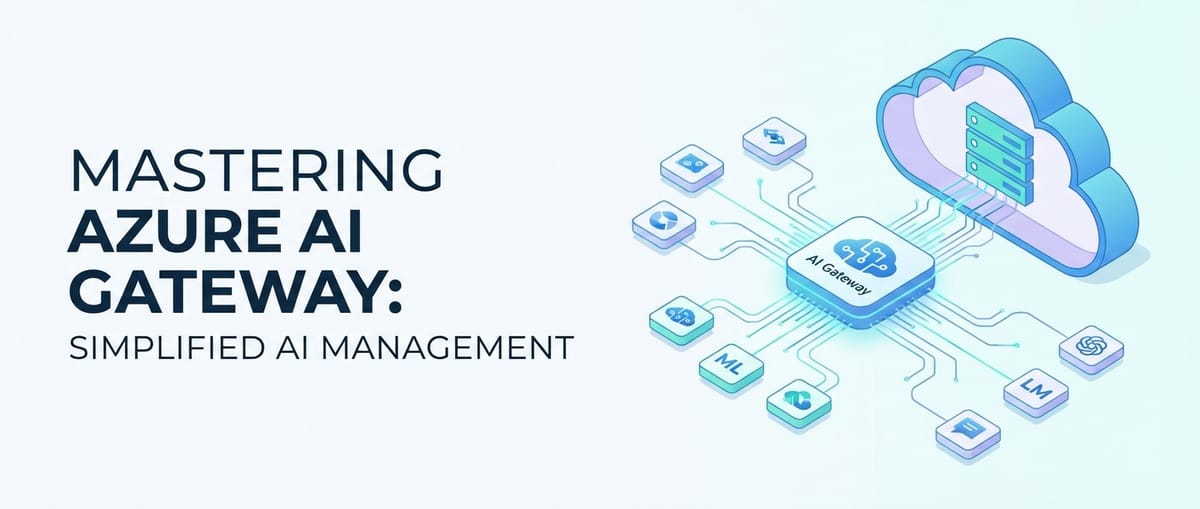
- Unified Access Point to Diverse AI Services: Perhaps the most significant benefit of Azure AI Gateway is its ability to present a unified, consistent API endpoint for a multitude of underlying Azure AI services. Imagine an application that needs to perform sentiment analysis using Azure Language Service, generate content with Azure OpenAI, and classify images using a custom model deployed on Azure Machine Learning. Without a gateway, the application would need to interact with three distinct endpoints, each with its own API key, request format, and error handling logic. The Azure AI Gateway consolidates these into a single, intuitive interface. This greatly simplifies development, reduces integration time, and minimizes code complexity, allowing developers to focus on building intelligent features rather than managing diverse service integrations.
- Robust Security and Access Control: Security is paramount when dealing with AI, especially when models process sensitive data. Azure AI Gateway provides a centralized and fortified security perimeter for all your AI resources.
- Centralized Authentication: It integrates seamlessly with Azure Active Directory (Azure AD), allowing you to leverage existing enterprise identities for authenticating callers. This means you can enforce role-based access control (RBAC) at the gateway level, granting specific users or applications access to particular AI models or services.
- Authorization Policies: Beyond authentication, the gateway enables you to define granular authorization policies. For instance, you can restrict certain departments to only use specific translation models, or limit external partners to only access anonymized data through a particular vision model.
- Network Isolation: For high-security scenarios, Azure AI Gateway can be integrated into your Azure Virtual Network (VNet). This ensures that AI inference traffic remains within your private network, never traversing the public internet, thereby significantly reducing the attack surface and complying with stringent regulatory requirements. This capability is critical for industries like healthcare, finance, and government.
- Threat Protection: The gateway can also be configured with Azure Security Center and Azure Firewall to provide advanced threat protection, detecting and blocking malicious requests aimed at your AI endpoints.
- Intelligent Traffic Management: AI workloads often experience unpredictable spikes and troughs. Azure AI Gateway is engineered to handle these fluctuations with sophisticated traffic management capabilities:
- Load Balancing: It automatically distributes incoming AI inference requests across multiple instances of your backend AI services, ensuring no single instance becomes a bottleneck and maintaining high availability. This is crucial for performance and reliability under heavy loads.
- Request Routing: Based on custom rules, headers, or URL paths, the gateway can intelligently route requests to different versions of a model (e.g., routing 10% of traffic to a new experimental model version), different regions for disaster recovery, or even different underlying AI services for A/B testing or feature flagging.
- Rate Limiting and Throttling: To prevent abuse, manage costs, and protect backend AI services from being overwhelmed, the gateway allows you to define rate limits per user, per application, or per specific AI model. If a client exceeds their allocated quota, the gateway can respond with an appropriate error, preventing excessive consumption and ensuring fair usage for all.
- Comprehensive Monitoring and Logging: Observability is key to understanding the performance, health, and usage patterns of your AI services. Azure AI Gateway acts as a central point for collecting vital operational data:
- Detailed Logging: It captures comprehensive logs for every AI inference request and response passing through it, including timestamps, request IDs, client IP addresses, requested AI service, and response status. These logs are invaluable for auditing, compliance, and post-incident analysis.
- Metric Collection: The gateway publishes a rich set of metrics to Azure Monitor, covering aspects like request volume, latency, error rates, CPU/memory usage, and data transfer. These metrics provide real-time insights into the gateway's performance and the health of the underlying AI services.
- Alerting and Dashboards: By integrating with Azure Monitor and Log Analytics, you can configure custom alerts for anomalies (e.g., sudden spikes in error rates, unusually high latency) and build interactive dashboards to visualize AI usage patterns, performance trends, and cost metrics. This proactive monitoring allows teams to identify and address issues before they impact end-users.
- Cost Management and Optimization: Managing the operational expenditure of AI models, particularly LLMs, can be a significant concern. Azure AI Gateway provides tools to gain control over these costs:
- Usage Tracking and Attribution: The gateway offers granular tracking of AI model invocations, allowing you to attribute usage to specific applications, departments, or users. This data is critical for internal chargeback models and understanding which AI services are driving costs.
- Quota Enforcement: By enforcing rate limits and quotas, the gateway directly contributes to cost control by preventing uncontrolled consumption of expensive AI services.
- Intelligent Routing for Cost Optimization: In advanced configurations, the gateway could potentially route requests to the most cost-effective variant of an AI model or even different providers based on real-time pricing and performance metrics, although this would typically require custom policies.
- Model Management and Versioning: The lifecycle of an AI model is dynamic, involving training, deployment, experimentation, and iteration. Azure AI Gateway streamlines this process:
- Seamless Model Updates: Deploying a new version of an AI model (e.g., a retrained fraud detection model) can be done transparently through the gateway. You can update the backend service endpoint without requiring changes to consuming applications.
- A/B Testing and Canary Releases: The gateway facilitates advanced deployment strategies. You can route a small percentage of live traffic to a new model version (canary release) to monitor its performance and stability before a full rollout. Similarly, A/B testing allows you to compare the performance of two different model versions side-by-side with real user traffic.
- Blue/Green Deployments: For critical AI services, the gateway supports blue/green deployments, where a new model version (green) is deployed alongside the existing stable version (blue). Once validated, traffic is instantaneously switched to the green environment, minimizing downtime and risk.
- Prompt Engineering and Transformation (Especially for LLMs): Recognizing the critical role of prompts in generative AI, Azure AI Gateway can incorporate advanced features for prompt management:
- Prompt Templating: Centralizing and managing common prompt templates ensures consistency and quality across LLM interactions. Developers can simply call a templated prompt by name, and the gateway will inject relevant context or parameters.
- Input Validation and Sanitization: The gateway can validate and sanitize prompts to remove malicious inputs or sensitive information before they reach the LLM, enhancing security and preventing prompt injection attacks.
- Contextual Enrichment: It can dynamically inject additional context (e.g., user profile data, historical conversation turns) into prompts based on the incoming request, improving the relevance and quality of LLM responses.
- Output Transformation: The gateway can also perform post-processing on LLM outputs, such as formatting the response, extracting specific entities, or applying content moderation filters before returning the result to the client.
Integration with the Broader Azure Ecosystem
One of the significant advantages of using Azure AI Gateway is its deep integration with the wider Azure ecosystem. This ensures a cohesive management experience and leverages existing enterprise tools:
- Azure Active Directory (Azure AD): For centralized identity and access management.
- Azure Monitor: For comprehensive logging, metrics, and alerting capabilities.
- Azure Policy: To enforce organizational standards, compliance requirements, and governance rules across AI resources.
- Azure DevOps: For integrating gateway configuration and AI model deployments into automated CI/CD pipelines, enabling rapid and reliable changes.
- Azure API Management: While Azure AI Gateway is specialized for AI, it can often complement or be integrated with Azure API Management for broader API governance across all enterprise services, not just AI.
By providing a single, intelligent control plane, Azure AI Gateway transforms the complex task of AI service management into a streamlined, secure, and highly optimized process, empowering organizations to harness the full potential of their intelligent applications without getting bogged down in operational overhead.
Key Benefits of Adopting Azure AI Gateway
The strategic implementation of Azure AI Gateway offers a multitude of tangible benefits that resonate across different levels of an organization, from individual developers and operations teams to business strategists and executive leadership. These advantages collectively contribute to a more efficient, secure, and innovative AI landscape.
- Simplified Operations and Reduced Overhead: At its most fundamental level, the Azure AI Gateway significantly reduces the operational burden associated with managing disparate AI services. Instead of configuring and monitoring multiple endpoints, each with its own scaling, security, and logging requirements, operations teams can now manage a single, centralized gateway. This consolidation translates directly into:
- Fewer Moving Parts: Less infrastructure to provision and maintain.
- Standardized Procedures: Consistent operational runbooks for all AI services.
- Reduced Configuration Drift: Centralized policy enforcement minimizes inconsistencies.
- Faster Troubleshooting: A single point of control for logs and metrics simplifies problem identification. Developers also benefit immensely. They no longer need to be experts in the specific nuances of every Azure AI service. Instead, they interact with a standardized, well-documented API provided by the gateway, allowing them to integrate AI capabilities into their applications much faster and with fewer errors. This shift frees up valuable developer and operations time, enabling them to focus on higher-value tasks such as building innovative features and optimizing business logic.
- Enhanced Security Posture and Compliance: Security is often cited as a top concern for AI adoption, especially with the increasing volume of sensitive data processed by intelligent models. Azure AI Gateway significantly elevates an organization's security posture by:
- Centralizing Security Enforcement: All authentication and authorization logic for AI services is consolidated at the gateway. This eliminates the need to implement security individually for each model endpoint, reducing the risk of misconfigurations and vulnerabilities.
- Fine-Grained Access Control: Through integration with Azure AD and RBAC, the gateway allows for precise control over who can access which AI models and under what conditions. This adherence to the principle of least privilege ensures that users and applications only have access to the AI resources necessary for their specific tasks.
- Protection Against Threats: The gateway acts as a robust perimeter, capable of filtering malicious requests, identifying suspicious patterns (like unusual access attempts or prompt injection vectors for LLMs), and integrating with Azure's broader security services for comprehensive threat detection and prevention.
- Simplified Compliance: For industries with strict regulatory requirements (e.g., GDPR, HIPAA), the gateway helps ensure that all AI interactions adhere to data privacy and security mandates by enforcing policies like data masking, logging, and audit trails at a central point. Network isolation through VNet integration further strengthens compliance.
- Improved Scalability and Reliability: AI workloads are inherently dynamic and can fluctuate dramatically. Azure AI Gateway is built for resilience and performance at scale:
- Automatic Scaling: The gateway itself can be configured to automatically scale its resources up or down based on incoming traffic, ensuring that it can handle sudden spikes in demand without performance degradation.
- Intelligent Load Distribution: By effectively load balancing requests across multiple instances of backend AI services, the gateway prevents bottlenecks and ensures that resources are utilized efficiently. This means your AI applications remain responsive and available even under peak loads.
- High Availability and Disaster Recovery: Architecting AI services for high availability across multiple Azure regions is simplified with a gateway. In the event of a regional outage, the gateway can intelligently route traffic to healthy services in another region, minimizing downtime and ensuring business continuity.
- Circuit Breaking: By isolating failing backend services, the gateway prevents cascading failures, ensuring that a problem in one AI model doesn't bring down your entire AI application ecosystem.
- Optimized Cost Efficiency: Managing AI costs effectively is critical for long-term sustainability. Azure AI Gateway provides several mechanisms to optimize expenditure:
- Precise Cost Attribution: By logging and tracking every API call to an AI service, the gateway provides granular data that allows organizations to accurately attribute costs to specific teams, applications, or even individual users. This transparency is crucial for internal chargeback models and budget planning.
- Reduced Unnecessary Consumption: Rate limiting and quotas prevent excessive or accidental consumption of expensive AI services.
- Caching for Reduced Inference Costs: For frequently asked questions or deterministic AI models, caching inference results at the gateway level significantly reduces the number of calls to the underlying AI service, leading to substantial cost savings on compute and API usage.
- Smart Routing for Cheaper Models: In scenarios with multiple AI model options for a given task, the gateway can be configured to prioritize routing to the most cost-effective model or even switch between providers based on real-time pricing and performance, especially relevant for LLMs.
- Faster Innovation and Time-to-Market: By abstracting away the operational complexities of AI, Azure AI Gateway empowers developers to innovate more rapidly:
- Accelerated Development: Developers can quickly integrate AI capabilities into new and existing applications without needing to understand the intricate details of each AI service's API, authentication, or scaling. This significantly reduces development cycles.
- Seamless Model Updates: The ability to deploy new AI model versions or experiment with different models through the gateway without impacting client applications means that organizations can iterate on their AI solutions much faster.
- Experimentation and A/B Testing: The built-in support for A/B testing and canary releases allows teams to quickly validate new AI models or features with real user data, accelerating the feedback loop and ensuring that only the most effective solutions are rolled out to production.
- Focus on Business Logic: With the gateway handling the "how" of AI service delivery, developers can concentrate on the "what" – building innovative AI-powered features that directly address business needs and create value.
- Consistency and Governance: As AI adoption scales, maintaining consistency and enforcing governance becomes paramount. Azure AI Gateway ensures a unified approach:
- Standardized API Experience: All AI services are exposed through a consistent API interface at the gateway, providing a predictable and easy-to-use experience for all consuming applications.
- Policy Enforcement: Organizational policies regarding data usage, security, and resource consumption can be enforced at the gateway level, ensuring adherence across all AI initiatives.
- Auditing and Traceability: Comprehensive logging provides a complete audit trail of all AI interactions, crucial for governance, compliance, and debugging.
- Lifecycle Management: The gateway supports a structured lifecycle for AI models, from development and testing to deployment, versioning, and eventual deprecation, ensuring a well-governed AI ecosystem.
In essence, adopting Azure AI Gateway is a strategic investment that pays dividends across the entire AI lifecycle. It transforms the management of complex AI services into a cohesive, secure, and highly efficient operation, allowing organizations to truly master their AI initiatives and drive sustainable business value.
APIPark is a high-performance AI gateway that allows you to securely access the most comprehensive LLM APIs globally on the APIPark platform, including OpenAI, Anthropic, Mistral, Llama2, Google Gemini, and more.Try APIPark now! 👇👇👇
Practical Use Cases and Implementation Strategies
The versatility and power of Azure AI Gateway unlock numerous practical use cases across various industries and organizational sizes. Understanding these scenarios helps in formulating effective implementation strategies to maximize its benefits.
Enterprise-wide AI Consumption
For large enterprises with diverse departments, numerous applications, and a growing portfolio of AI models, managing access and consumption can be overwhelming. Azure AI Gateway provides the central orchestration layer needed for coherent, enterprise-wide AI utilization.
Scenario: A multinational conglomerate has several business units: a finance division using AI for fraud detection, a marketing team leveraging generative AI for campaign content, and an HR department using natural language processing for resume screening. Each team might use different Azure AI services or custom-built models.
Implementation Strategy: 1. Centralized Gateway Deployment: Deploy a robust Azure AI Gateway instance (or a cluster for high availability) that can serve as the single point of entry for all AI services across the enterprise. 2. Service Integration: Integrate all relevant Azure AI services (Azure OpenAI, Azure Cognitive Services, custom Azure ML endpoints) behind the gateway. 3. Role-Based Access Control (RBAC): Define granular RBAC policies through Azure AD. For instance, the marketing team's applications might only have access to specific generative AI models, while the finance team's applications have permissions for fraud detection models. HR applications would be limited to NLP services. 4. Usage Quotas: Implement quotas and rate limits per department or application to manage costs and ensure fair usage, preventing one department from monopolizing resources. 5. Cost Attribution: Leverage the gateway's detailed logging to attribute AI consumption costs accurately back to each business unit for internal chargeback and budget management. 6. Security Policies: Enforce enterprise-wide security policies, such as data masking or encryption, at the gateway level before data reaches or leaves AI models, ensuring compliance across all divisions.
Multi-model Orchestration and Complex AI Workflows
Many advanced AI applications require the sequential or parallel invocation of multiple AI models to achieve a complex outcome. Orchestrating these interactions efficiently and reliably is a prime use case for an AI Gateway.
Scenario: A customer service chatbot needs to first understand the user's intent (NLP model), then analyze their sentiment (sentiment analysis model), potentially search a knowledge base (retrieval model), and finally generate a personalized response (LLM).
Implementation Strategy: 1. Chained API Calls: Configure the Azure AI Gateway to handle a sequence of AI calls. The initial request from the client hits the gateway, which then routes it to the NLP model. The output of the NLP model is then transformed and used as input for the sentiment analysis model, and so on. 2. Conditional Routing: Implement conditional logic within the gateway (e.g., using custom policies or Azure Functions integrated with the gateway) to route requests based on the output of a preceding AI model. For example, if sentiment is negative, route to a human agent escalation model instead of a generic LLM. 3. Unified Workflow API: Expose a single, high-level API endpoint through the gateway that encapsulates this entire multi-model workflow. Clients simply call this single endpoint, abstracting away the complexity of the underlying orchestration. 4. Error Handling and Fallbacks: Implement robust error handling at each step within the gateway. If one AI service fails, the gateway can initiate a fallback mechanism (e.g., retry, use an alternative model, or return a graceful error to the client). 5. Caching Intermediate Results: Cache intermediate results from specific AI models within the workflow to reduce latency and cost for repeated sub-tasks.
Developer Experience Enhancement
A major hurdle in AI adoption is the developer experience. Providing a clean, consistent, and stable API for AI services empowers developers to integrate AI faster and more reliably.
Scenario: An internal developer portal needs to offer easy access to various AI capabilities (e.g., image recognition, text summarization, translation) for application teams across the company.
Implementation Strategy: 1. Standardized API Contracts: Define clear, consistent API contracts (e.g., OpenAPI specifications) for all AI services exposed through the Azure AI Gateway. The gateway enforces these contracts. 2. Centralized Documentation: Provide comprehensive, up-to-date documentation for the gateway's APIs, including examples and SDKs. (Potentially integrate with Azure API Management's developer portal for this). 3. Abstracting Underlying Complexity: The gateway hides the specifics of each AI model (e.g., different API keys, varying input/output formats, scaling logic). Developers only interact with the gateway's uniform interface. 4. Consistent Authentication: Ensure a single, consistent authentication mechanism (e.g., Azure AD tokens) across all AI APIs exposed via the gateway, simplifying security integration for developers. 5. Sandbox Environments: Create gateway configurations for sandbox or development environments that point to development versions of AI models, allowing developers to experiment without impacting production systems. 6. APIPark Integration: For organizations that want to further enhance their developer experience with an open-source, comprehensive API developer portal that also specializes in AI management, integrating the Azure AI Gateway with a platform like APIPark can be highly beneficial. APIPark, as an open-source AI gateway and API management platform, can serve as an all-in-one developer portal, centralizing the display of all API services, including those exposed through the Azure AI Gateway. It enables quick integration of 100+ AI models, unifies API formats for AI invocation, and allows prompt encapsulation into REST APIs, thereby simplifying AI usage and maintenance for developers even further. It provides independent API and access permissions for each tenant and robust end-to-end API lifecycle management, making it easier for different teams to find, subscribe to, and use required AI services with approval processes. This combination offers both the robust, scalable backbone of Azure AI Gateway and the flexible, developer-friendly features of an open-source platform like APIPark.
Compliance and Regulatory Adherence
Many industries operate under strict regulatory frameworks that dictate how data is handled, especially when processed by AI. Azure AI Gateway can be a critical tool for ensuring compliance.
Scenario: A healthcare provider uses AI for diagnostic assistance and patient record analysis, requiring strict adherence to HIPAA and other privacy regulations.
Implementation Strategy: 1. VNet Integration: Deploy the Azure AI Gateway within a private Azure Virtual Network (VNet) to ensure that all AI inference traffic remains within a secure, isolated network boundary, preventing data exposure over the public internet. 2. Data Masking/Redaction Policies: Implement custom policies at the gateway level to automatically identify and redact or mask sensitive patient information (e.g., PHI) from both inputs to AI models and their outputs, before data leaves the secure environment. 3. Auditable Logging: Enable detailed logging for all AI interactions, including access attempts, data processed, and model invoked. Configure these logs to be immutable and stored in compliance with regulatory requirements, providing a robust audit trail. 4. Access Approval Workflow: Require explicit approval for any application or user attempting to access sensitive AI models through the gateway. This can be implemented via custom workflows integrated with Azure functions or, as APIPark demonstrates, through an integrated subscription approval feature, ensuring callers must subscribe to an API and await administrator approval before invocation, preventing unauthorized API calls and potential data breaches. 5. Geographic Restrictions: Configure the gateway to enforce data residency requirements, ensuring that certain types of data are only processed by AI models deployed in specific geographic regions.
Building Custom AI Applications and Microservices
Modern applications often comprise many microservices, some of which leverage AI. The AI Gateway integrates seamlessly into this architecture.
Scenario: A financial institution is building a suite of microservices for personalized wealth management, including services for risk assessment, market prediction, and client communication, each powered by different AI models.
Implementation Strategy: 1. Gateway-as-a-Service for Microservices: Each microservice that needs to consume AI capabilities does so by calling the central Azure AI Gateway, rather than directly interacting with individual AI models. This decouples the microservices from the specific AI implementations. 2. API Versioning for AI: If the risk assessment AI model has a new version, the gateway can expose /v1/risk-assessment and /v2/risk-assessment endpoints, allowing different microservices to consume the version they are compatible with, or gradually transition. 3. Resilience Patterns: Microservices benefit from the gateway's built-in resilience features like circuit breakers and retries, which protect them from transient failures in underlying AI models. 4. Caching for Performance: Cache frequent AI model predictions at the gateway to improve the responsiveness of microservices that rely on fast AI insights. 5. Blue/Green Deployments: When deploying updates to an AI-powered microservice, the gateway can facilitate blue/green deployments by smoothly shifting traffic from the old version to the new version of the AI backend or the microservice itself.
By strategically applying Azure AI Gateway across these diverse use cases, organizations can move beyond mere AI deployment to truly mastering its management, ensuring that their intelligent systems are robust, secure, scalable, and fully aligned with business objectives.
Advanced Topics and Best Practices for Azure AI Gateway
While the core functionalities of Azure AI Gateway provide significant benefits, delving into advanced topics and adopting best practices can further amplify its impact, enabling organizations to build highly sophisticated, resilient, and performant AI solutions.
Custom Policies and Transformations
One of the most powerful features of API gateways, including Azure AI Gateway, is the ability to define custom policies that modify the behavior of requests and responses. These policies can be written using XML or through code (e.g., Azure Functions) and allow for highly tailored logic.
Best Practices: * Prompt Engineering Logic: For LLM workloads, implement policies to automatically inject common prompt prefixes, few-shot examples, or context from a user's session into incoming prompts. This ensures consistency and reduces token usage by preventing clients from sending redundant prompt components. * Output Post-Processing: Create policies to format AI model outputs (e.g., converting JSON structures, extracting specific fields, translating text), making them consistent for consuming applications regardless of the underlying model's raw output. * Data Masking/Redaction: Implement policies to identify and mask sensitive information (PII, PHI) in both request payloads (before they reach the AI model) and response payloads (before they leave the gateway). This is crucial for data privacy and compliance. * Dynamic Routing: Beyond simple URL-based routing, use custom policies to implement dynamic routing based on request headers (e.g., routing a specific client ID to a beta model version), geographical origin, or even the content of the request itself (e.g., routing urgent requests to a high-priority, more expensive AI endpoint). * Enrichment: Add metadata to requests (e.g., client ID, timestamp, correlation ID) before forwarding them to the AI model, which can be useful for downstream logging and monitoring.
Integrating with CI/CD Pipelines
For rapid and reliable AI development, integrating Azure AI Gateway configurations into your Continuous Integration/Continuous Deployment (CI/CD) pipelines is essential. This automates the deployment and management of gateway policies, API definitions, and backend service configurations.
Best Practices: * Infrastructure as Code (IaC): Manage your Azure AI Gateway instances and their configurations (APIs, policies, backend pools) using IaC tools like Azure Resource Manager (ARM) templates, Bicep, or Terraform. This ensures version control, reproducibility, and consistent deployments. * Automated Policy Deployment: Include policy updates and new API definitions as part of your application deployment pipeline. When a new AI model version is released, the associated gateway routing rules and security policies should be automatically updated. * Automated Testing: Develop automated tests for your gateway configurations. These tests should verify that routing rules work as expected, rate limits are enforced, and security policies are active. * Staging Environments: Use distinct gateway instances for development, staging, and production environments. CI/CD pipelines can then promote configurations through these environments, ensuring thorough testing before reaching live users.
Monitoring and Alerting Strategies for AI Gateway
While the gateway provides extensive logging and metrics, a robust monitoring and alerting strategy is critical for proactive management and maintaining system health.
Best Practices: * Centralized Logging (Log Analytics): Route all gateway logs to Azure Log Analytics workspaces for centralized storage, querying, and analysis. This allows you to correlate gateway events with logs from your backend AI services and consuming applications. * Key Metrics Dashboards: Create custom dashboards in Azure Monitor that visualize critical gateway metrics: request volume (overall and per AI service), latency (p90, p99), error rates, cache hit ratios, and CPU/memory utilization. * Proactive Alerts: Configure alerts for anomalies and thresholds: * High error rates (e.g., 5xx errors from backend AI services). * Spikes in latency for specific AI models. * Exceeding rate limits (indicating potential abuse or misconfiguration). * Unexpected drops in request volume (potential service outage). * High CPU/memory usage on the gateway itself. * Distributed Tracing: Integrate the gateway with distributed tracing tools (e.g., Azure Application Insights) to trace individual AI requests end-to-end, from the client through the gateway to the backend AI service and back. This is invaluable for pinpointing performance bottlenecks in complex AI workflows. * Token Usage Alerts (for LLMs): Set up alerts for unexpected spikes in token consumption for LLM services, indicating potential prompt issues or cost overruns.
Performance Tuning
Optimizing the performance of your Azure AI Gateway ensures low-latency AI inference and efficient resource utilization.
Best Practices: * Caching: Aggressively utilize gateway caching for deterministic AI models or frequently requested prompts (for LLMs). Configure appropriate cache durations and cache keys. For LLMs, explore semantic caching if available or implement through custom policies. * Optimized Policy Execution: Keep custom policies efficient. Avoid complex computations or excessive external calls within the gateway policy engine, as this can introduce latency. If complex logic is required, consider offloading it to a lightweight Azure Function that the policy calls. * Instance Sizing: Choose the appropriate tier and scale unit for your Azure AI Gateway based on your anticipated traffic volume and performance requirements. Monitor CPU and memory usage to adjust scaling proactively. * Backend Connection Pooling: Ensure efficient connection pooling to backend AI services to reduce connection establishment overhead. * Geographic Proximity: Deploy your Azure AI Gateway in Azure regions geographically close to your consuming applications and backend AI services to minimize network latency.
Disaster Recovery and High Availability
Ensuring that your AI services remain available even during outages is critical. The gateway plays a central role in your disaster recovery (DR) strategy.
Best Practices: * Zone Redundancy: Deploy Azure AI Gateway with zone redundancy enabled (if available in your region) to distribute instances across multiple availability zones, protecting against datacenter-level failures within a region. * Multi-Region Deployment: For mission-critical AI workloads, deploy redundant Azure AI Gateway instances in multiple Azure regions. Use Azure Front Door or Azure Traffic Manager to intelligently route client traffic to the nearest healthy gateway instance. * Automated Failover: Configure your multi-region setup with automated failover mechanisms. If one gateway instance or its primary backend AI services in a region become unhealthy, traffic should automatically be directed to the secondary region. * Regular DR Drills: Conduct regular disaster recovery drills to test your failover procedures and ensure that your AI services can indeed recover within your defined Recovery Time Objective (RTO) and Recovery Point Objective (RPO).
Considerations for Hybrid and Multi-cloud AI Scenarios
While Azure AI Gateway is optimized for the Azure ecosystem, organizations often have AI models deployed in on-premises data centers, edge devices, or other cloud providers.
Best Practices: * Hybrid Connectivity: If connecting to on-premises AI models, leverage Azure ExpressRoute or VPN Gateways to establish secure, high-bandwidth connections between your Azure VNet (where the AI Gateway resides) and your on-premises network. * Unified Abstraction Layer: Even for non-Azure AI services, if they expose an API, you can potentially expose them through the Azure AI Gateway as a unified API. This still centralizes security, rate limiting, and monitoring, even if the specialized AI features might be less applicable to external services. * Policy-driven Routing: Use custom policies to intelligently route certain AI requests to models residing in different clouds or on-premises, based on factors like data residency, cost, or specialized hardware availability. * API Management Complement: For multi-cloud API governance, consider using a broader API Management solution that can federate or integrate with Azure AI Gateway.
By strategically implementing these advanced topics and best practices, organizations can transform their Azure AI Gateway from a mere proxy into a powerful, intelligent control plane that not only simplifies AI management but also drives resilience, performance, and strategic advantage for their entire AI ecosystem.
Beyond Azure - The Broader AI Gateway Landscape and APIPark
While the Azure AI Gateway provides a robust and deeply integrated solution for managing AI services within the Microsoft Azure ecosystem, it's important to acknowledge that the concept of an AI Gateway is not exclusive to a single cloud provider. The fundamental need for centralized control, security, scalability, and observability for AI workloads is universal, leading to the development of various gateway solutions across different platforms, including open-source alternatives.
Organizations often operate in hybrid or multi-cloud environments, or they may prefer the flexibility and community-driven innovation of open-source software. In such scenarios, exploring solutions that offer broader compatibility and a different set of features becomes crucial. This is where platforms like APIPark come into play, providing a comprehensive, open-source approach to AI gateway and API management.
APIPark - An Open Source AI Gateway & API Management Platform
APIPark stands out as an all-in-one AI gateway and API developer portal, openly licensed under Apache 2.0. It is meticulously designed to empower developers and enterprises with effortless management, integration, and deployment of both AI and traditional REST services. For those seeking flexibility beyond a single-cloud vendor, or a comprehensive open-source solution, APIPark offers a compelling alternative or complementary tool.
Let's delve into the key features that make APIPark a powerful contender in the AI Gateway landscape:
- Quick Integration of 100+ AI Models: One of APIPark's core strengths is its ability to rapidly integrate a vast array of AI models. It provides a unified management system that streamlines authentication and cost tracking across these diverse models, reducing the complexity typically associated with juggling multiple AI providers and frameworks. This means whether you're using models from OpenAI, Hugging Face, custom-trained models, or others, APIPark can bring them under a single, coherent management umbrella.
- Unified API Format for AI Invocation: A significant challenge in AI adoption is the disparate API formats and interaction patterns of different AI models. APIPark addresses this by standardizing the request data format across all integrated AI models. This crucial feature ensures that changes in underlying AI models or prompt structures do not necessitate modifications in the consuming application or microservices. This abstraction layer dramatically simplifies AI usage, reduces maintenance costs, and accelerates development cycles.
- Prompt Encapsulation into REST API: Prompt engineering is an art and a science, especially with LLMs. APIPark allows users to quickly combine AI models with custom prompts and encapsulate these into new, callable REST APIs. Imagine needing a "sentiment analysis" API or a "data summarization" API; with APIPark, you can define the prompt and the target LLM, then expose it as a standard REST endpoint. This simplifies access for developers who might not be prompt engineering experts, offering ready-to-use intelligent functions.
- End-to-End API Lifecycle Management: Beyond just AI, APIPark offers comprehensive API lifecycle management. It assists organizations in overseeing the entire journey of their APIs, from initial design and publication to invocation, versioning, and eventual decommissioning. This includes regulating API management processes, managing traffic forwarding, implementing robust load balancing, and handling versioning of published APIs, ensuring a well-governed and stable API ecosystem.
- API Service Sharing within Teams: Collaboration is key in modern development. APIPark facilitates this by providing a centralized display of all available API services. This makes it incredibly easy for different departments, teams, or even individual developers to discover, understand, and utilize the required API services, fostering reuse and preventing redundant efforts.
- Independent API and Access Permissions for Each Tenant: For larger organizations or those providing services to multiple clients, multi-tenancy is crucial. APIPark enables the creation of multiple teams (tenants), each operating with independent applications, data, user configurations, and security policies. Critically, these tenants share the underlying applications and infrastructure, which significantly improves resource utilization and reduces operational costs while maintaining necessary isolation.
- API Resource Access Requires Approval: Security and controlled access are paramount. APIPark incorporates an integrated subscription approval feature. This means that callers must subscribe to an API and await administrator approval before they can invoke it. This mechanism effectively prevents unauthorized API calls, strengthens security, and mitigates potential data breaches, offering an essential layer of governance.
- Performance Rivaling Nginx: Performance is non-negotiable for an API gateway. APIPark is engineered for high throughput, demonstrating performance that rivals leading web servers like Nginx. With a modest 8-core CPU and 8GB of memory, APIPark can achieve over 20,000 Transactions Per Second (TPS), and it supports cluster deployment to effectively handle even larger scales of traffic, making it suitable for demanding enterprise environments.
- Detailed API Call Logging: Comprehensive observability is built-in. APIPark provides extensive logging capabilities, meticulously recording every detail of each API call. This feature is invaluable for businesses to quickly trace and troubleshoot issues in API calls, ensuring system stability, security, and aiding in compliance audits.
- Powerful Data Analysis: Beyond raw logs, APIPark offers powerful data analysis features. It processes historical call data to display long-term trends and performance changes. This predictive capability helps businesses with proactive maintenance, allowing them to identify potential issues and take corrective actions before they impact service availability or performance.
Deployment and Commercial Support: APIPark boasts incredibly quick deployment, ready in just 5 minutes with a single command line, making it highly accessible for developers and startups to get started immediately. While the open-source product caters to basic API resource needs, APIPark also offers a commercial version, which includes advanced features and professional technical support tailored for leading enterprises requiring more sophisticated capabilities and dedicated assistance.
About APIPark: APIPark is an initiative by Eolink, a prominent leader in API lifecycle governance solutions in China. Eolink serves over 100,000 companies globally with professional API development management, automated testing, monitoring, and gateway operation products. Their deep involvement in the open-source ecosystem, serving millions of professional developers worldwide, underscores the robust foundation and community commitment behind APIPark.
Value to Enterprises: Ultimately, APIPark's powerful API governance solution is designed to enhance efficiency, fortify security, and optimize data management for all stakeholders – developers, operations personnel, and business managers alike. For organizations that value the flexibility of open-source, require multi-cloud capabilities, or wish to combine the strengths of a cloud-native solution like Azure AI Gateway with a comprehensive developer portal, APIPark offers a compelling and feature-rich platform to consider in their AI and API management strategy. Its focus on unified AI model integration and prompt encapsulation makes it a true LLM Gateway and AI Gateway in its own right, addressing the contemporary challenges of intelligent service delivery.
Future Trends in AI Gateway Technology
The rapid pace of innovation in Artificial Intelligence guarantees that the AI Gateway will continue to evolve, adapting to new models, deployment patterns, and operational demands. The future of AI gateway technology is poised to deliver even greater intelligence, autonomy, and security, becoming an increasingly critical component in the AI ecosystem.
Here are some key trends shaping the future of AI Gateway technology:
- More Intelligent Routing based on Model Performance and Cost: Future AI Gateways will move beyond static routing rules to incorporate real-time intelligence. They will dynamically route requests to the best-performing or most cost-effective AI model or provider based on live telemetry (latency, error rates, token prices, inference speed). This could involve integrating with AI marketplaces to fetch real-time pricing for different LLMs or leveraging reinforcement learning to optimize routing decisions over time. The gateway might also intelligently break down complex prompts and route sub-queries to specialized, smaller, and cheaper models, then reassemble the results.
- Enhanced Security Features for Adversarial Attacks and Responsible AI: As AI models become more ubiquitous, so do the risks of adversarial attacks (e.g., prompt injection, data poisoning, model stealing). Future AI Gateways will integrate advanced security features specifically designed to detect and mitigate these threats. This could include:
- AI-Powered Threat Detection: Using AI models within the gateway itself to analyze incoming prompts and outgoing responses for suspicious patterns indicative of attacks or unsafe content.
- Automated Guardrails: More sophisticated content moderation and output filtering capabilities that can be dynamically updated based on emerging threats or ethical guidelines.
- Attestation and Trust: Verifying the integrity and origin of AI models before allowing traffic, ensuring that only trusted models are being used.
- Differential Privacy: Implementing techniques at the gateway to preserve privacy of user data while still allowing AI inference.
- Deeper Integration with AI Governance and MLOps Frameworks: The governance of AI models (fairness, transparency, accountability) is becoming a regulatory imperative. Future AI Gateways will seamlessly integrate with broader AI governance frameworks and MLOps platforms. This means:
- Automated Audit Trails: Generating detailed, tamper-proof audit trails of every AI interaction, including model version, input data, and output, to support regulatory compliance.
- Explainability (XAI) Integration: Potentially capturing or even generating explanations for AI model predictions (if the model supports it) at the gateway level, making AI more transparent for users and auditors.
- Policy-as-Code for Governance: Allowing AI governance policies (e.g., model usage restrictions, data handling rules) to be defined as code and enforced automatically by the gateway.
- Auto-scaling and Self-healing Gateways with Predictive Capabilities: Current gateways offer auto-scaling, but future iterations will be more proactive. They will leverage AI to predict traffic spikes based on historical patterns, external events, or business forecasts, allowing for pre-emptive scaling to ensure zero-downtime performance. Self-healing capabilities will become more sophisticated, automatically detecting and recovering from failures in both the gateway itself and the underlying AI services, potentially even suggesting remediation steps.
- Edge AI Gateway Capabilities: With the rise of edge computing, AI Gateways will extend their reach to devices closer to the data source. Edge AI Gateways will manage local AI models, perform pre-processing of data, and intelligently decide whether to process inference locally or offload to the cloud, optimizing for latency, bandwidth, and cost. This is crucial for applications in IoT, manufacturing, and autonomous systems.
- Standardization and Interoperability: As the AI landscape matures, there will be an increasing drive for standardization in how AI models are exposed and consumed. Future AI Gateways will play a key role in supporting emerging standards for AI API definitions, model interoperability, and data exchange formats, reducing vendor lock-in and fostering a more open AI ecosystem.
- Serverless and Event-Driven AI Gateways: The evolution towards serverless computing will also impact AI Gateways. Future gateways might be fully serverless, scaling instantly and only consuming resources when requests arrive. They will also be deeply integrated with event-driven architectures, allowing AI inference to be triggered by events (e.g., a new image uploaded, a sensor reading), and generating events based on AI outcomes.
These trends signify a future where the AI Gateway is not just a passive proxy but an active, intelligent, and highly adaptable orchestrator of AI, crucial for navigating the complexities and unlocking the full potential of artificial intelligence in every facet of business and technology. Mastering the current capabilities of platforms like Azure AI Gateway and understanding the broader landscape including open-source alternatives like APIPark will prepare organizations to embrace these exciting advancements.
Conclusion
The journey through the intricate world of Artificial Intelligence management reveals a clear and compelling narrative: the burgeoning complexity of AI models, from traditional machine learning to the revolutionary Large Language Models, necessitates a sophisticated, unified approach. The unmanaged deployment of diverse AI services can quickly transform the promise of innovation into an operational quagmire, fraught with security vulnerabilities, scalability challenges, and ballooning costs. It is within this intricate landscape that the AI Gateway emerges not merely as a beneficial tool, but as an indispensable architectural cornerstone for any organization serious about harnessing the full power of AI.
We have seen how the API Gateway laid the foundational principles of centralized service management, and how the AI Gateway specifically extended these capabilities to address the unique demands of AI inference, security, and versioning. Furthermore, the advent of generative AI models has given rise to the specialized LLM Gateway, tailored to manage the nuances of prompt engineering, token optimization, and content moderation. Azure AI Gateway masterfully consolidates these functionalities within the robust and expansive Azure ecosystem, providing a singular, intelligent control plane for all your AI endeavors.
By embracing Azure AI Gateway, organizations can unlock a myriad of transformative benefits: * Simplified Operations: Streamlining the deployment and management of AI services, freeing up valuable developer and operations time. * Enhanced Security: Fortifying AI workloads with centralized authentication, authorization, network isolation, and threat protection, crucial for sensitive data. * Improved Scalability & Reliability: Ensuring consistent performance and high availability for dynamic AI workloads through intelligent traffic management and resilience patterns. * Optimized Cost Efficiency: Gaining granular control over AI expenditure through detailed usage tracking, quota enforcement, and smart caching. * Accelerated Innovation: Empowering developers to rapidly integrate and iterate on AI-powered features, reducing time-to-market. * Stronger Governance: Enforcing consistency, compliance, and auditability across all AI initiatives.
Beyond the Azure ecosystem, the broader landscape offers innovative solutions, such as the open-source APIPark. APIPark exemplifies the flexibility and comprehensive features available for those seeking an all-in-one AI gateway and API developer portal, capable of integrating 100+ AI models, unifying API formats, and providing robust lifecycle management across diverse environments. Its focus on prompt encapsulation and high performance further highlights the critical features of a modern AI Gateway.
In essence, mastering the Azure AI Gateway, or any comparable AI Gateway solution, is about more than just managing technology; it's about simplifying complexity to unlock agility, security, and sustained innovation. As AI continues its relentless march forward, evolving in capabilities and complexity, the intelligent gateway will remain at the forefront, ensuring that enterprises can not only keep pace but truly lead the charge in the era of artificial intelligence. It empowers organizations to transform their AI aspirations into tangible, well-governed, and powerfully effective realities.
Frequently Asked Questions (FAQ)
Q1: What is the primary difference between a traditional API Gateway and an AI Gateway?
A1: A traditional API Gateway primarily acts as a single entry point for all client requests into backend services, offering features like routing, authentication, rate limiting, and load balancing for generic APIs. An AI Gateway, while building on these core functionalities, is specifically tailored for AI services. It adds specialized capabilities such as unified endpoints for diverse AI models, intelligent routing based on model versions, AI-specific security policies, prompt management for LLMs, AI inference caching, and detailed cost attribution for AI workloads. In essence, an AI Gateway understands and manages the unique lifecycle and operational demands of artificial intelligence models, providing deeper control and optimization relevant to machine learning inference.
Q2: How does Azure AI Gateway help with cost management for Large Language Models (LLMs)?
A2: Azure AI Gateway significantly aids in managing LLM costs through several mechanisms. Firstly, it provides granular usage tracking, allowing organizations to monitor token consumption and API calls for different LLMs, attributing costs to specific applications or teams. This transparency helps in budget planning and internal chargeback. Secondly, it can enforce rate limits and quotas, preventing uncontrolled or accidental over-consumption of expensive LLM services. Thirdly, by supporting caching of LLM responses for identical or semantically similar prompts, it reduces the number of calls to the actual LLM, thereby saving on token-based billing. Lastly, with advanced configurations, it could potentially implement intelligent routing to select the most cost-effective LLM provider or model for a given request in real-time.
Q3: Can Azure AI Gateway be used to manage custom AI models developed in-house, not just Azure's pre-built services?
A3: Yes, absolutely. Azure AI Gateway is designed to provide a unified management layer for a broad spectrum of AI services. This includes not only Azure's pre-built Cognitive Services and Azure OpenAI Service but also custom AI models. If your custom models are deployed on Azure Machine Learning (e.g., as endpoints), Azure Kubernetes Service (AKS), or even as Azure Functions, the Azure AI Gateway can be configured to route requests to these custom endpoints. This allows organizations to apply the same security, scaling, monitoring, and traffic management policies to their proprietary AI solutions as they do to managed Azure AI services, consolidating governance across their entire AI portfolio.
Q4: What is the role of an LLM Gateway in the context of prompt engineering and safety?
A4: An LLM Gateway plays a crucial role in prompt engineering and safety by acting as an intelligent intermediary between client applications and Large Language Models. For prompt engineering, it can centralize the management of prompt templates, allowing developers to reuse validated and optimized prompts, ensuring consistency and quality of LLM outputs. It can also dynamically inject context, user history, or guardrails into prompts. Regarding safety, an LLM Gateway can apply pre- and post-processing filters to both prompts and LLM responses. These filters can detect and mitigate risks such as prompt injection attacks, sensitive information disclosure, or the generation of harmful, unethical, or inappropriate content, thereby helping organizations deploy LLMs responsibly and securely.
Q5: How does a platform like APIPark complement or offer an alternative to cloud-native solutions like Azure AI Gateway?
A5: APIPark complements cloud-native solutions like Azure AI Gateway by offering a flexible, open-source AI gateway and API management platform that can manage AI and REST services across diverse environments, including multi-cloud and hybrid setups. While Azure AI Gateway is deeply integrated with the Azure ecosystem, APIPark provides an agnostic platform that can unify the management of 100+ AI models from various providers (including Azure's, if exposed) under a single, standardized API format. It serves as an all-in-one API developer portal, enhancing developer experience with features like prompt encapsulation into REST APIs, comprehensive lifecycle management, and independent tenancy. For organizations prioritizing open-source flexibility, multi-cloud compatibility, or needing a powerful developer portal alongside their cloud-specific gateways, APIPark offers a compelling alternative or a valuable complementary layer for broader AI and API governance.
🚀You can securely and efficiently call the OpenAI API on APIPark in just two steps:
Step 1: Deploy the APIPark AI gateway in 5 minutes.
APIPark is developed based on Golang, offering strong product performance and low development and maintenance costs. You can deploy APIPark with a single command line.
curl -sSO https://download.apipark.com/install/quick-start.sh; bash quick-start.sh

In my experience, you can see the successful deployment interface within 5 to 10 minutes. Then, you can log in to APIPark using your account.

Step 2: Call the OpenAI API.