Mastering Asynchronous Data Sending to Two APIs
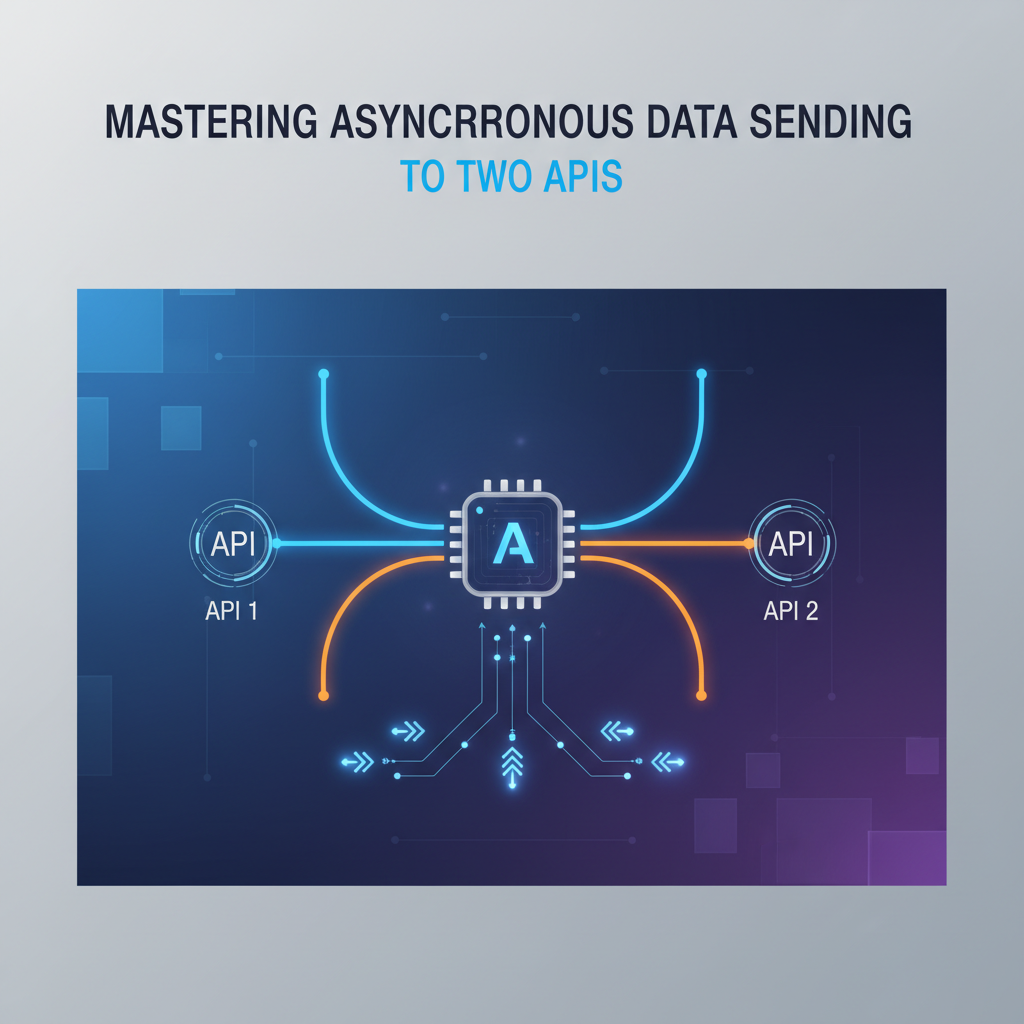


In the intricate tapestry of modern software architecture, applications rarely exist in isolation. They are, more often than not, deeply interconnected ecosystems, communicating with a myriad of internal services and external third-party apis. From processing payments and updating inventory to sending notifications and logging audit trails, the need to interact with multiple endpoints simultaneously or near-simultaneously is a fundamental requirement. However, simply making sequential calls to different apis can quickly become a bottleneck, leading to sluggish user experiences, inefficient resource utilization, and systems prone to cascading failures. This is where the mastery of asynchronous data sending to two, or indeed many, apis becomes not just an advantage, but a necessity.
The landscape of modern application development, characterized by microservices, cloud-native deployments, and an ever-increasing reliance on external services, inherently demands highly responsive and resilient systems. A user submitting an order, for instance, might trigger a cascade of actions: debiting funds via a payment api, updating stock levels through an inventory api, sending a confirmation email via a notification service, and logging the transaction to an analytics platform. Performing these actions synchronously would mean the user waits for the slowest api call to complete, a scenario that is simply unacceptable in today's fast-paced digital world. Therefore, understanding and implementing robust asynchronous patterns for multi-api communication is paramount for building high-performance, fault-tolerant, and scalable applications.
This comprehensive guide delves deep into the methodologies, considerations, and best practices for mastering asynchronous data sending to two apis. We will explore various architectural patterns that facilitate this complex interaction, from direct asynchronous calls within your application code to leveraging powerful intermediaries like message queues and api gateways. We will dissect the technical implementations, focusing on concurrency management, robust error handling, data consistency strategies, and critical performance optimizations. Furthermore, we will touch upon advanced concepts and emerging trends that are shaping the future of multi-api integration. By the end of this journey, developers, architects, and system administrators will possess the knowledge and tools to design and implement highly efficient and reliable systems that can gracefully handle the complexities of interacting with multiple external apis, ensuring seamless data flow and an exceptional user experience.
Understanding the Fundamentals: The Core of Asynchronous Interaction and Multi-API Needs
Before we dive into the intricate patterns and strategies, it's crucial to lay a solid foundation by understanding what asynchronous programming truly entails and why the requirement to send data to multiple apis is so prevalent in modern software. This foundational knowledge will serve as our compass as we navigate the complexities of building resilient and scalable integrated systems.
What is Asynchronous Programming? A Paradigm Shift
At its heart, asynchronous programming is a method of concurrent programming that allows a unit of work to run independently from the main application thread. Instead of waiting for a long-running operation to complete before moving on to the next task, an asynchronous operation is initiated, and the application continues to execute other tasks. Once the asynchronous operation finishes, it notifies the application (e.g., via a callback, a Promise resolution, or an await statement completing), allowing it to process the result.
This approach stands in stark contrast to synchronous programming, where tasks are executed sequentially. In a synchronous model, if an application makes an api call, the entire application thread is blocked until a response is received. For I/O-bound operations like network requests to external apis, which can take milliseconds or even seconds, this blocking behavior leads to significant performance degradation, unresponsive user interfaces, and inefficient utilization of computational resources. Imagine a single-lane highway where only one car can pass at a time; that's synchronous. Asynchronous programming, on the other hand, is like a multi-lane highway or a complex interchange, allowing many vehicles to move simultaneously, even if some have to wait briefly at a signal.
The benefits of embracing asynchronous programming are profound, particularly when dealing with network I/O:
- Improved Responsiveness: Applications remain responsive, as the main thread isn't blocked waiting for external resources. This is critical for user experience in graphical interfaces and for service-level apis that need to handle many concurrent requests.
- Better Resource Utilization: Instead of threads sitting idle, waiting for I/O operations, they can be freed up to perform other computations or handle new requests, leading to more efficient use of CPU and memory.
- Enhanced Scalability: By allowing more concurrent operations per server instance, asynchronous patterns inherently contribute to better scalability, enabling systems to handle higher loads with the same or fewer resources.
- Fault Tolerance: Asynchronous operations can be designed with built-in retry mechanisms, timeouts, and fallback strategies, making the system more resilient to transient network issues or api failures.
Common paradigms for asynchronous programming vary across languages, but the underlying principles remain consistent. JavaScript heavily relies on Promises and async/await. Python utilizes asyncio with async/await. Java has CompletableFuture and reactive programming frameworks like Reactor or RxJava. C# offers async/await with Task-based asynchronous pattern. Regardless of the syntax, the goal is always to manage operations that don't complete immediately without blocking the application's flow.
Why the Need to Send Data to Two APIs? Common Use Cases and Challenges
The imperative to send data to two or more apis simultaneously arises from a multitude of business requirements and architectural decisions aimed at decoupling concerns, enriching data, ensuring redundancy, or orchestrating complex business processes. These scenarios are ubiquitous in modern distributed systems.
Here are some common use cases that necessitate sending data to multiple apis:
- Data Replication and Synchronization:
- Primary Database and Analytics Service: When a new user registers or a transaction occurs, the data might need to be saved to a primary transactional database and simultaneously pushed to an analytics api or data warehouse for reporting and business intelligence.
- CRM Integration: A customer update in one system (e.g., an e-commerce platform) might need to be replicated to a Customer Relationship Management (CRM) system via its api to maintain a unified customer view.
- Orchestration of Business Processes:
- Order Fulfillment: An e-commerce order involves processing payment through a payment gateway api and then updating inventory or initiating shipment via an order fulfillment api. Both steps are critical for completing the order.
- User Registration with Welcome Flow: After a user registers, their details are saved to the user management system, and then their email address is sent to a marketing automation api to trigger a welcome email series.
- Redundancy and Failover:
- In mission-critical scenarios, data might be sent to two distinct storage apis or processing services to ensure that even if one fails, the other has a copy or can complete the task, providing higher availability and fault tolerance.
- Data Enrichment and Transformation:
- When an event occurs, raw data might be sent to a data enrichment api (e.g., geolocation lookup, sentiment analysis) and simultaneously to a logging or auditing api for compliance or debugging purposes. The enriched data might then be sent to a third api.
- Auditing and Compliance:
- Almost every significant operation in a regulated industry requires an audit trail. A transaction might be processed by a financial api and then the details logged to a separate, immutable audit api to meet compliance requirements.
While the need is clear, implementing this multi-api interaction asynchronously presents its own set of challenges:
- Data Consistency: What happens if one api call succeeds and the other fails? How do you ensure that your system maintains a consistent state across all integrated services? This is the core problem of distributed transactions.
- Error Handling and Retries: Each api can fail for different reasons (network error, rate limit, internal server error). A robust system needs sophisticated retry logic, potentially with exponential backoff, and mechanisms to handle unrecoverable failures.
- Performance Bottlenecks: While asynchronous calls improve overall throughput, poorly managed concurrency can still lead to resource exhaustion or unexpected delays if external apis are slow.
- Monitoring and Observability: Tracing the flow of data and diagnosing issues across multiple independent api calls can be significantly more complex than in a monolithic application.
- Security: Managing authentication, authorization, and rate limits for multiple external apis adds layers of security complexity.
Addressing these challenges effectively requires careful architectural planning, robust implementation strategies, and the intelligent use of supporting infrastructure. This brings us to the pivotal role of an api gateway.
The Indispensable Role of an API Gateway in Multi-API Interactions
An api gateway serves as a single entry point for a multitude of apis, acting as a reverse proxy that sits in front of your microservices or external apis. It intercepts all incoming requests, routing them to the appropriate backend service, and often performing a variety of cross-cutting concerns on the way. In the context of sending data to two or more apis, an api gateway transitions from being merely beneficial to becoming an indispensable component, dramatically simplifying and enhancing the process.
Here's how an api gateway facilitates and improves multi-api interactions:
- Centralized Routing and Request Aggregation: Instead of clients needing to know the individual endpoints of two or more apis, they interact with a single api gateway endpoint. The gateway can then fan out this single request to multiple backend apis in parallel, aggregate their responses, or initiate separate asynchronous flows. This simplifies client-side logic immensely.
- Authentication and Authorization: An api gateway can centralize security concerns. Instead of each backend api implementing its own authentication and authorization logic, the gateway handles it once, typically using schemes like OAuth, JWTs, or api keys. This ensures consistent security policies across all services. For complex environments, platforms like APIPark offer comprehensive API gateway capabilities that streamline the management of security policies, access controls, and tenant-specific permissions across diverse api ecosystems, which is critical when orchestrating data flow between various services.
- Rate Limiting and Throttling: To protect backend apis from overload and ensure fair usage, an api gateway can enforce rate limits and throttling policies. This is particularly important when interacting with external apis that have strict usage quotas or when your own services need protection. APIPark, for example, excels in this area, offering performance rivaling Nginx and the ability to handle over 20,000 TPS with an 8-core CPU and 8GB memory, ensuring your API infrastructure can scale and remain stable under heavy loads.
- Load Balancing and High Availability: Gateways can distribute incoming requests across multiple instances of a backend service, providing load balancing and improving fault tolerance. If one instance fails, requests are automatically routed to healthy ones.
- Protocol Translation and Data Transformation: An api gateway can translate between different protocols (e.g., HTTP to gRPC) or transform data formats to meet the requirements of different backend apis, abstracting these complexities from the client.
- Caching: Frequently accessed data can be cached at the api gateway level, reducing the load on backend services and improving response times for clients.
- Logging, Monitoring, and Tracing: Gateways provide a centralized point for logging all api requests and responses, emitting metrics, and integrating with distributed tracing systems. This offers invaluable insights into the overall system health and aids in debugging multi-api interactions. APIPark, for instance, provides detailed api call logging and powerful data analysis tools that display long-term trends and performance changes, which are invaluable for proactive maintenance and troubleshooting in a multi-api environment.
- Versioning and Lifecycle Management: An api gateway helps manage different versions of apis, allowing for seamless updates and retirement of older versions without disrupting client applications. Products like APIPark are designed for end-to-end api lifecycle management, from design and publication to invocation and decommission, ensuring a regulated and efficient process, especially when dealing with complex integrations involving multiple apis.
By centralizing these cross-cutting concerns, an api gateway significantly reduces the cognitive load on individual service developers, promotes consistency, enhances security, and ultimately makes the overall system more robust and easier to manage. In scenarios requiring asynchronous data sending to two apis, the gateway can act as an orchestrator, kicking off parallel calls and managing their outcomes, effectively abstracting much of the complexity from the client or upstream service.
Architectural Patterns for Asynchronous Multi-API Communication
When embarking on the journey of sending data asynchronously to two apis, the choice of architectural pattern profoundly impacts the system's scalability, resilience, and maintainability. There isn't a one-size-fits-all solution; rather, the optimal pattern depends on specific requirements such as data consistency needs, expected load, acceptable latency, and operational complexity.
Direct Asynchronous Calls within Application Logic
This is often the simplest and most direct approach, particularly for applications written in languages with native asynchronous programming support (e.g., JavaScript with async/await, Python with asyncio, Java with CompletableFuture, C# with Task). In this pattern, your application code explicitly initiates multiple api calls in parallel without blocking the main thread.
How it Works: When a request comes into your service, instead of making a blocking call to API_A and then another blocking call to API_B, you initiate both calls almost simultaneously. The application continues to do other work, and only "awaits" the results of these calls when it actually needs them.
Example (Conceptual Python):
import asyncio
import httpx # An async HTTP client

async def send_data_to_apis(data):
    # Prepare data for API A
    payload_a = {"key_a": data["value_x"]}
    # Prepare data for API B
    payload_b = {"key_b": data["value_y"]}

    async with httpx.AsyncClient() as client:
        # Create asynchronous tasks for each API call
        task_a = asyncio.create_task(client.post("https://api.example.com/serviceA", json=payload_a))
        task_b = asyncio.create_task(client.post("https://api.example.com/serviceB", json=payload_b))

        # Wait for both tasks to complete concurrently
        results = await asyncio.gather(task_a, task_b, return_exceptions=True)

        # Process results and handle potential errors
        if isinstance(results[0], Exception):
            print(f"Error calling API A: {results[0]}")
            # Implement retry, fallback, or compensation logic
        else:
            print(f"API A response: {results[0].status_code}")

        if isinstance(results[1], Exception):
            print(f"Error calling API B: {results[1]}")
            # Implement retry, fallback, or compensation logic
        else:
            print(f"API B response: {results[1].status_code}")

        # Further logic based on combined outcomes
Pros:
- Simplicity for Simple Cases: For a limited number of api calls (typically two or three) and straightforward error handling, this approach is easy to understand and implement.
- Direct Control: The developer has granular control over the concurrency, error handling, and response processing for each api call.
- Low Latency (for client-side perception): Since calls are made in parallel, the total perceived latency for the client is often dictated by the slowest of the parallel calls, rather than the sum of all calls.
Cons:
- Increased Complexity with More APIs: As the number of apis increases, managing dependencies, complex error scenarios (e.g., if API A needs data from API B before it can proceed, but API B is slow), and consistent error handling becomes unwieldy.
- Error Handling Burdens: The application code is responsible for handling partial failures (one api succeeds, the other fails), retries, and potential rollbacks. This can lead to significant boilerplate code.
- Resource Strain (Client/Service Side): If many concurrent requests are made, the initiating service or client can exhaust its own connection pool or CPU resources, especially if the external apis are slow to respond.
Message Queues/Brokers: Decoupling for Resilience and Scalability
For more robust, scalable, and resilient multi-api integrations, especially in event-driven architectures, message queues (e.g., RabbitMQ, Apache Kafka, AWS SQS, Azure Service Bus) are an extremely powerful pattern. They introduce an intermediary layer that decouples the producer of data from its consumers.
How it Works: 1. Producer: Your application (the producer) sends a message containing the data to a message queue. This operation is typically very fast and non-blocking. 2. Queue: The message queue reliably stores the message. 3. Consumers: Independent services (the consumers) subscribe to the queue (or specific topics/partitions). When a message arrives, they pick it up and process it. In our scenario, Service A would consume the message and send data to API_A, and Service B would consume the same message (or a related one) and send data to API_B.
Example Flow: Client Request -> Your Service (publishes "OrderCreated" event to Message Queue) -> Message Queue -> Payment Processor Service (consumes event, calls Payment API) Message Queue -> Inventory Service (consumes event, calls Inventory API) Message Queue -> Notification Service (consumes event, calls Email API)
Pros:
- Decoupling: Producers and consumers are completely independent. The producer doesn't need to know who the consumers are or how they process the data. This makes the system much more flexible and easier to evolve.
- Resilience: If one consumer api is down or slow, the message remains in the queue and can be retried later. This prevents cascading failures and improves the overall fault tolerance of the system.
- Scalability: Consumers can be scaled independently. If
API_Aprocessing is a bottleneck, you can add more instances of theService Aconsumer. - Guaranteed Delivery and Retries: Most message queues offer mechanisms to ensure messages are delivered and processed at least once (or exactly once, with more effort), and provide built-in retry capabilities.
- Load Leveling: Message queues can absorb bursts of traffic, preventing backend services from being overwhelmed.
Cons:
- Increased Operational Complexity: Managing and maintaining a message queue infrastructure adds operational overhead.
- Eventual Consistency: Data consistency across multiple apis becomes eventual. There's a delay between when the producer sends data and when all consumers successfully process it. Strict transactional consistency across multiple systems is harder to achieve directly with this pattern.
- Debugging: Tracing messages through a queue system can be more challenging than direct api calls.
Event-Driven Architectures: A Broader Paradigm
While message queues are a common component, event-driven architecture (EDA) is a broader paradigm where systems react to events. Instead of services directly calling each other, they publish events, and other services subscribe to those events. This is a highly scalable and loosely coupled approach.
How it Works: An event occurs (e.g., UserRegistered, ProductStockUpdated). This event is published to an event broker (often a message queue like Kafka). Various services that are interested in this event consume it and perform their respective actions, which might include calling an external api. For example, a UserRegistered event might trigger a service to call a CRM api and another service to call an email marketing api.
Pros:
- Extreme Decoupling: Services are maximally decoupled, reacting only to events, leading to highly independent and maintainable microservices.
- High Scalability and Flexibility: New services can easily be added to subscribe to existing events without modifying producers.
- Real-time Processing: Can enable near real-time reactions across the system.
Cons:
- Complex Eventual Consistency: Managing eventual consistency and understanding the overall system state becomes more challenging.
- Distributed Debugging: Tracing the flow of an event through multiple services and api calls requires sophisticated distributed tracing tools.
- Event Schema Management: Careful management of event schemas is crucial to avoid breaking changes across services.
Orchestration vs. Choreography: Managing the Flow
When dealing with multiple apis, the overall interaction flow can be managed in two primary ways:
- Orchestration: A central component (an orchestrator) is responsible for coordinating the flow. It dictates the order of operations, invokes apis, and handles decisions based on their responses. If
API_Aneeds to be called beforeAPI_B, the orchestrator ensures this sequence.- Pros: Clearer control flow, easier to implement complex business logic, good for transactional consistency across a defined set of steps.
- Cons: The orchestrator can become a single point of failure or a bottleneck. It introduces tight coupling between the orchestrator and the services it calls.
- Choreography: Services react independently to events, without a central coordinator. Each service performs its task and emits events, which other services then consume.
- Pros: Highly decoupled, resilient, scalable. No single point of failure.
- Cons: Harder to trace the overall flow, difficult to manage complex dependencies or ensuring an overall consistent state across the entire business process. Logic for compensating actions (rollbacks) needs to be distributed.
For sending data to two apis, orchestration is often simpler if the calls are tightly coupled or require a specific order. Choreography is better suited for scenarios where the calls are largely independent and can proceed concurrently based on events.
API Gateway as an Orchestrator/Aggregator: Centralized Multi-API Logic
Revisiting the api gateway within architectural patterns, it can play a significantly more active role than just a simple proxy. An advanced api gateway can itself become an orchestrator or aggregator, handling the logic of fanning out requests to multiple backend apis.
How it Works: A client sends a single request to the api gateway. The gateway, based on its configuration, takes this request, splits it, and sends data simultaneously to API_A and API_B (which could be internal microservices or external third-party apis). It then waits for responses, potentially aggregates them, and sends a single consolidated response back to the client. Alternatively, it might simply initiate asynchronous calls and return an immediate acknowledgment to the client.
Example: Client -> API Gateway -> (Parallel calls to API_A and API_B) -> API Gateway (collects results, potentially transforms) -> Client
Pros:
- Simplifies Client: The client doesn't need to know about the multiple backend apis or the logic to call them. It interacts with a single, stable api endpoint.
- Centralized Logic: Multi-api orchestration logic is moved to the gateway, simplifying backend services and improving maintainability. This logic can include data transformation, error handling, caching, and security enforcement.
- Performance Benefits: The gateway can handle parallel calls efficiently, often using non-blocking I/O, and can also cache responses to reduce backend load.
- Improved Security: As previously mentioned, the gateway centralizes authentication, authorization, and rate limiting for all integrated apis, providing a unified security posture.
Cons:
- Gateway Complexity: The gateway itself can become complex if too much business logic is pushed into it, potentially turning into a monolithic "super-gateway."
- Single Point of Failure (if not highly available): The gateway must be robust, scalable, and highly available to avoid becoming a bottleneck or a single point of failure.
- Vendor Lock-in: Relying heavily on specific api gateway features can lead to vendor lock-in if you use a proprietary solution. However, open-source alternatives like APIPark mitigate this risk by providing powerful, flexible, and extensible API management capabilities without proprietary constraints.
The choice between these patterns hinges on a careful analysis of the specific requirements, balancing factors like consistency, performance, scalability, and operational overhead. Often, a combination of these patterns is employed within a larger architecture, with api gateways handling edge concerns, message queues orchestrating background processes, and direct asynchronous calls managing simple, tightly coupled interactions.
Implementation Strategies and Best Practices
Implementing asynchronous data sending to two apis effectively requires more than just choosing an architectural pattern; it demands meticulous attention to detail in areas like concurrency, error handling, data consistency, security, and observability. These are the pillars that transform a functional system into a truly robust, scalable, and maintainable one.
Concurrency Management: Harnessing Parallel Power
Effective concurrency management is fundamental to asynchronous operations. It's about efficiently managing the execution of multiple tasks simultaneously, ensuring that resources are used optimally without introducing new problems like deadlocks or excessive resource consumption.
- Thread Pools vs. Event Loops:
- Thread Pools: In traditional multi-threaded environments (e.g., Java, C#), you might use thread pools to limit the number of concurrent operations. This prevents overwhelming the system with too many active threads, each consuming memory and CPU cycles. When an asynchronous api call needs to be made, a thread from the pool can be dispatched to handle it, returning to the pool once the call is initiated (or completed, depending on the model).
- Event Loops: Languages like Node.js (JavaScript) and Python's
asyncioframework leverage a single-threaded event loop. Non-blocking I/O operations are offloaded to the operating system, and the event loop continues to process other tasks until an I/O operation completes. This model is highly efficient for I/O-bound tasks, as it avoids the overhead of context switching between many threads.
- Resource Limits and Connection Pools: When making external api calls, your application typically uses HTTP clients that manage a pool of network connections. It is crucial to configure these connection pools with appropriate limits (e.g., maximum concurrent connections to a single host, maximum total connections). Without these limits, your service could exhaust its outgoing network ports or overwhelm the target api.
- Semaphores and Rate Limiters (Internal): Beyond external api rate limits, you might need to implement internal rate limiting or use semaphores to control the maximum number of concurrent calls your service makes to a specific external api or resource. This acts as a protective mechanism for both your service and the downstream apis.
- Avoiding Deadlocks and Race Conditions: While less common in purely asynchronous, I/O-bound multi-api calls, if your asynchronous operations involve shared mutable state or complex internal synchronization, carefully design your logic to avoid deadlocks (where two tasks wait indefinitely for each other) and race conditions (where the outcome depends on the non-deterministic timing of operations). Immutability and atomic operations are key here.
Error Handling and Retries: Building Resilience
The reality of distributed systems is that failures are inevitable. Networks can be flaky, external apis can go down, and transient issues can occur. Robust error handling and intelligent retry mechanisms are paramount for resilience.
- Partial Failures: This is the most common and challenging scenario when sending data to two apis. What if
API_Asucceeds butAPI_Bfails?- Idempotency: Design your api calls to be idempotent where possible. This means that making the same request multiple times has the same effect as making it once. For example, if updating a record, sending the same update payload twice shouldn't create a duplicate or cause unintended side effects. This simplifies retry logic immensely.
- Compensating Transactions: For scenarios requiring eventual consistency or where strict ACID transactions aren't feasible across distributed systems, the Saga pattern is often employed. If one step in a multi-api sequence fails, a compensating transaction is triggered to undo the successful prior steps, bringing the system back to a consistent state.
- Retry Mechanisms: Not all failures are permanent. Many are transient (e.g., network timeout, temporary api overload).
- Exponential Backoff: Instead of immediately retrying a failed request, wait for an increasing amount of time between retries (e.g., 1s, 2s, 4s, 8s). This gives the downstream system time to recover and prevents your service from contributing to a denial-of-service against the struggling api.
- Jitter: Add a small random delay to the exponential backoff interval. This prevents a "thundering herd" problem where many clients retry simultaneously after the same backoff period.
- Max Retries: Always define a maximum number of retries before classifying a failure as permanent and triggering an alert or moving the task to a Dead-Letter Queue.
- Circuit Breakers: This pattern prevents your service from continuously trying to access a failing api, leading to cascading failures. When an api call fails repeatedly, the circuit breaker "trips" (opens), and subsequent calls immediately fail without attempting to reach the downstream api. After a configurable timeout, it enters a "half-open" state, allowing a few test requests to see if the api has recovered. If successful, it "closes" the circuit; otherwise, it re-opens. Libraries like Hystrix (Java) or Polly (.NET) implement this.
- Dead-Letter Queues (DLQs): For messages or tasks that fail repeatedly after retries, they can be moved to a DLQ. This prevents them from blocking the main processing queue and allows for manual inspection or automated reprocessing once the underlying issue is resolved.
Data Consistency and Transactionality: Navigating Distributed State
Achieving data consistency across multiple independent apis is one of the most significant challenges in distributed systems. Unlike monolithic applications with single database transactions, you cannot easily roll back changes across external services.
- Distributed Transactions (Two-Phase Commit - 2PC): While conceptually appealing for ACID-like guarantees across multiple resources, 2PC is notoriously difficult to implement correctly, has significant performance overhead, and can lead to blocking issues if any participant fails. It's generally avoided for cross-service api calls.
- Eventual Consistency: This is the more common and practical approach. It acknowledges that data across different systems may not be immediately consistent but will eventually converge to the same state.
- Saga Pattern: As mentioned under error handling, Sagas are a sequence of local transactions where each transaction updates its own database and publishes an event. If a local transaction fails, a series of compensating transactions are executed to undo the changes made by the preceding local transactions.
- Idempotency and Conflict Resolution: Design your apis and data models with idempotency in mind. Implement logic to detect and resolve conflicts if updates from different sources arrive in an unexpected order.
- Outbox Pattern: When an event is triggered (e.g., a new order), it's first saved to a local "outbox" table within your database transaction alongside the main data change. Only after the local transaction commits is the event published to a message queue. This ensures atomicity: either both the data change and the event publication succeed, or both fail, avoiding scenarios where data is saved but no event is published (or vice-versa).
Performance Optimization: Speed and Efficiency
Asynchronous operations inherently boost performance, but further optimizations are always possible.
- Non-Blocking I/O: Ensure all network operations are truly non-blocking. This allows your application to handle many more concurrent requests with fewer threads or processes.
- Batching Requests: If the target apis support it, batch multiple logical operations into a single api call. For example, updating 10 inventory items in one request is typically much faster than 10 separate requests. However, be mindful of potential failure modes with partial batch processing.
- Caching:
- API Gateway Caching: An api gateway can cache responses from frequently accessed apis. This reduces the load on backend services and significantly improves response times for repeated requests.
- Application-Level Caching: Your application can also implement caching for api responses that change infrequently, avoiding redundant calls.
- Efficient Data Serialization/Deserialization: Choose efficient data formats (e.g., Protobuf, Avro) over less efficient ones (e.g., XML) and optimize your serialization/deserialization logic to minimize CPU overhead.
- Profiling and Benchmarking: Regularly profile your application and benchmark api interactions to identify bottlenecks. Tools like
perf(Linux) or language-specific profilers can provide deep insights.
Security Considerations: Protecting Your Data and Systems
Interacting with multiple apis, especially external ones, introduces significant security challenges that must be addressed rigorously.
- Authentication and Authorization for Each API:
- API Keys: Simple, but less secure. Use with care and rotate frequently.
- OAuth 2.0/OpenID Connect: Industry-standard for delegated authorization, allowing clients to access protected resources on behalf of a user.
- JWTs (JSON Web Tokens): Used for transmitting information between parties, often as part of OAuth flows for identity verification.
- Mutual TLS (mTLS): For service-to-service communication, mTLS ensures that both the client and server verify each other's identity using certificates, providing strong cryptographic authentication.
- When an api gateway is in place, it centralizes the authentication and authorization logic, enforcing policies uniformly before requests reach backend services. This is a core strength of platforms like APIPark, which provides independent api and access permissions for each tenant, supporting features like subscription approval to prevent unauthorized api calls and potential data breaches.
- Secure Data Transmission (TLS/SSL): Always use HTTPS for all api communication, both internal and external. This encrypts data in transit, protecting against eavesdropping and man-in-the-middle attacks.
- Input Validation and Sanitization: Never trust data received from any api or client. Always validate and sanitize all inputs to prevent common vulnerabilities like SQL injection, cross-site scripting (XSS), and command injection.
- Rate Limiting and Throttling (External): Beyond protecting your own services, respect the rate limits imposed by external apis to avoid being blocked. An api gateway is an ideal place to enforce these external rate limits on outgoing traffic.
- Secrets Management: Store api keys, database credentials, and other sensitive information securely using dedicated secrets management services (e.g., AWS Secrets Manager, HashiCorp Vault, Kubernetes Secrets). Avoid hardcoding credentials in your code or configuration files.
- Vulnerability Scanning: Regularly scan your applications and dependencies for known vulnerabilities.
Observability: Seeing Inside Your Distributed System
In a system where data flows asynchronously to multiple apis, understanding what's happening becomes critical. Observability—logging, monitoring, and tracing—provides the necessary visibility.
- Logging:
- Structured Logging: Emit logs in a structured format (e.g., JSON) to facilitate automated parsing and analysis.
- Correlation IDs: Implement correlation IDs that are passed through all api calls and services involved in a single logical transaction. This allows you to trace the entire flow of an operation from start to finish across multiple systems and logs.
- Contextual Logging: Include relevant context in your logs (e.g., user ID, request ID, api endpoint, response status, error messages).
- APIPark offers comprehensive logging capabilities, recording every detail of each api call, enabling businesses to quickly trace and troubleshoot issues in multi-api interactions, ensuring system stability and data security.
- Monitoring:
- Metrics: Collect metrics on api call latency, error rates, throughput, and resource utilization (CPU, memory, network I/O) for both your services and the external apis you interact with.
- Dashboards and Alerts: Visualize these metrics on dashboards and set up alerts for deviations from normal behavior (e.g., high error rates, slow response times).
- Distributed Tracing: Tools like Jaeger, Zipkin, or AWS X-Ray allow you to visualize the entire request path across multiple services and api calls. This is invaluable for pinpointing latency bottlenecks and understanding how different components interact in complex asynchronous flows. By adding instrumentation to your code (or leveraging api gateways that provide it), you can see the sequence and timing of all calls related to a single user request.
By rigorously applying these implementation strategies and best practices, developers can construct highly resilient, performant, secure, and understandable systems that effectively master the art of asynchronous data sending to two or more apis, transforming potential complexity into robust functionality.
APIPark is a high-performance AI gateway that allows you to securely access the most comprehensive LLM APIs globally on the APIPark platform, including OpenAI, Anthropic, Mistral, Llama2, Google Gemini, and more.Try APIPark now! 👇👇👇
Advanced Concepts and Future Trends
The landscape of api integration is constantly evolving, with new technologies and paradigms emerging to tackle the complexities of distributed systems. Understanding these advanced concepts and future trends is crucial for building future-proof architectures that can handle the growing demands of asynchronous multi-api communication.
Serverless Functions (FaaS): Event-Driven Orchestration in the Cloud
Serverless functions, or Function-as-a-Service (FaaS) platforms (e.g., AWS Lambda, Azure Functions, Google Cloud Functions), have revolutionized how developers build and deploy event-driven applications. They are inherently designed for asynchronous, reactive workloads and are perfectly suited for orchestrating multi-api calls.
How it Works: A serverless function is a piece of code that runs in response to events (e.g., an HTTP request, a new message in a queue, a file upload). When an event occurs that necessitates sending data to two apis, a serverless function can be triggered. Inside the function, you can write code to make parallel asynchronous calls to API_A and API_B, leveraging the FaaS platform's robust infrastructure for scaling, concurrency, and error handling.
Pros:
- Extreme Scalability: Serverless platforms automatically scale functions up or down based on demand, handling bursts of traffic without requiring manual provisioning.
- Reduced Operational Overhead: You don't manage servers or infrastructure; the cloud provider handles it all. This frees up development teams to focus purely on business logic.
- Cost-Effective: You pay only for the compute time consumed by your function executions, making it highly cost-efficient for intermittent or variable workloads.
- Natural Fit for Asynchronous Processing: The event-driven nature of FaaS makes it a natural fit for reacting to events and asynchronously triggering subsequent api calls.
Cons:
- Cold Starts: When a function hasn't been invoked for a while, the first invocation might experience a "cold start" delay as the runtime environment is initialized. This can impact latency for specific use cases.
- Vendor Lock-in: Migrating serverless functions between different cloud providers can be challenging due to platform-specific services and apis.
- Debugging and Observability: Debugging distributed serverless applications and tracing requests across multiple functions and apis can be complex, though cloud providers offer dedicated tools.
- Resource Limits: Functions typically have time limits and memory limits, which might restrict very long-running or memory-intensive multi-api orchestration logic.
Stream Processing: Real-Time API Integrations
For scenarios requiring real-time reactions and continuous data flow to multiple apis, stream processing platforms like Apache Kafka Streams, Apache Flink, or Kinesis Data Streams become invaluable. These technologies allow you to process data as it arrives, enabling immediate api interactions based on streaming events.
How it Works: Data flows as a continuous stream of events (e.g., sensor readings, clickstream data, financial transactions). A stream processing application consumes these events, applies transformations, aggregations, or filtering, and then in real-time, makes asynchronous calls to two or more downstream apis based on defined logic. For instance, a stream of stock trades might trigger calls to a fraud detection api and an portfolio update api simultaneously.
Pros:
- Real-time Responsiveness: Enables immediate actions and responses to events as they occur.
- High Throughput and Low Latency: Designed to handle vast volumes of data with minimal delay.
- Complex Event Processing: Can detect patterns and correlations in event streams to trigger sophisticated multi-api workflows.
- Scalability and Fault Tolerance: Stream processing platforms are typically highly scalable and fault-tolerant, ensuring continuous operation.
Cons:
- High Complexity: Setting up and managing stream processing infrastructure and developing stream processing applications requires specialized skills.
- State Management: Managing state across a stream (e.g., aggregating data over time windows) adds complexity.
- Debugging: Debugging issues in real-time data streams and ensuring data consistency can be challenging.
GraphQL Gateways: Simplifying Client-Side Multi-API Data Retrieval
While primarily focused on data retrieval rather than sending data to multiple external apis, GraphQL gateways (or API Federation Layers) warrant mention as they significantly simplify the client's interaction with diverse backend services. A client can make a single GraphQL query that logically requests data from multiple underlying apis, and the GraphQL gateway orchestrates these calls.
How it Works (for data retrieval, conceptually related to sending): A client sends a single GraphQL query to the gateway. The gateway, using its schema, understands which parts of the query map to which backend apis. It then makes the necessary calls to those internal or external apis (often asynchronously and in parallel), aggregates the results, and sends a single, tailored JSON response back to the client. This concept of aggregation and parallel execution by a gateway can be extended for mutation operations (sending data) in certain contexts.
Pros:
- Client-Centric Development: Clients can request exactly the data they need, reducing over-fetching and under-fetching.
- Single Endpoint: Simplifies client interactions by providing a unified api interface across multiple backend services.
- Efficient Data Loading: The gateway handles fetching data from multiple sources efficiently, often making parallel calls internally.
- Schema Stitching/Federation: Allows combining multiple independent GraphQL services into a single unified schema.
Cons:
- Complexity: Building and maintaining a GraphQL gateway and its schema can be complex.
- Performance Overhead: The gateway adds a layer of abstraction and processing that can introduce some overhead.
- N+1 Problem: Without careful optimization, a GraphQL server can suffer from the "N+1 problem," leading to many redundant database or api calls.
Service Mesh: Inter-Service Communication Control
A service mesh (e.g., Istio, Linkerd, Envoy) is a dedicated infrastructure layer that handles service-to-service communication in a microservices architecture. While not directly focused on sending data to external third-party apis from an application's perspective, it profoundly impacts how internal services interact, which can underpin multi-api workflows.
How it Works: A service mesh deploys a proxy (sidecar) alongside each service instance. All incoming and outgoing network traffic for that service goes through its sidecar proxy. The mesh then provides features like traffic management (routing, load balancing), policy enforcement (authentication, authorization), observability (metrics, distributed tracing), and resilience (retries, circuit breakers) for inter-service communication.
Pros:
- Decouples Cross-Cutting Concerns: Removes networking, security, and observability logic from application code, simplifying service development.
- Enhanced Resilience: Built-in retry logic, circuit breakers, and fault injection capabilities improve system robustness.
- Advanced Traffic Management: Enables fine-grained control over traffic routing, canary deployments, A/B testing, and dark launches.
- Deep Observability: Automatically collects metrics and tracing data for all service interactions.
Cons:
- Increased Complexity: Deploying and managing a service mesh adds significant operational complexity to a Kubernetes cluster.
- Resource Overhead: Each sidecar proxy consumes CPU and memory resources.
- Learning Curve: Requires a steep learning curve for developers and operations teams.
Low-Code/No-Code Integration Platforms: Democratizing Multi-API Workflows
For specific business users or less technical developers, low-code/no-code (LCNC) integration platforms (e.g., Zapier, Integromat, IFTTT, Microsoft Power Automate) are gaining immense popularity. These platforms allow users to create multi-api workflows with visual interfaces, often without writing a single line of code.
How it Works: Users visually connect different applications (represented by their apis) through pre-built connectors. They define triggers (e.g., "new email in Gmail") and actions (e.g., "add row to Google Sheets" and "send message to Slack"). The platform handles the underlying api calls, authentication, and asynchronous execution.
Pros:
- Speed and Agility: Rapidly build integrations without development resources.
- Empowers Business Users: Allows non-technical users to automate workflows.
- Reduces IT Burden: Offloads simple integration tasks from core development teams.
Cons:
- Limited Customization: Less flexible for complex or highly customized integration logic.
- Scalability Limitations: May not be suitable for high-volume or performance-critical asynchronous integrations.
- Vendor Lock-in: Integrations are tied to the specific platform.
- Security and Governance: Requires careful management of credentials and access permissions on the platform.
AI-Driven API Management: The Intelligent Future
The advent of Artificial Intelligence and Machine Learning is poised to transform api management, including how we handle multi-api interactions. AI can optimize routing, predict loads, enhance security, and even automate the creation of integration logic.
- Intelligent Routing and Load Prediction: AI algorithms can analyze historical traffic patterns and real-time telemetry to intelligently route requests across different api versions or backend services, optimizing for latency and availability. They can predict load spikes and proactively scale resources or adjust rate limits.
- Enhanced Security: AI can detect anomalous api access patterns, identifying potential threats like credential stuffing, DDoS attacks, or data exfiltration more effectively than static rules.
- Automated API Orchestration: Future AI-powered tools might analyze business requirements and automatically generate or suggest optimal asynchronous multi-api integration workflows, reducing development effort.
- Unified AI Gateway: Platforms are emerging that specifically cater to integrating and managing AI models. An AI Gateway, such as APIPark, stands at the forefront of this trend. It offers quick integration of 100+ AI models and the capability to encapsulate complex prompts into simple REST apis. This inherently involves sending data to and orchestrating various intelligent services, managing their specific input/output formats, and providing a unified invocation format, simplifying the development of AI-powered applications that leverage multiple models.
By staying abreast of these advanced concepts and trends, architects and developers can design systems that are not only robust and scalable today but also adaptable and ready for the challenges and opportunities of tomorrow's api economy. The future of multi-api integration is one of increasing automation, intelligence, and seamless connectivity.
Case Study: E-commerce Order Processing with Asynchronous Multi-API Communication
To concretize the concepts discussed, let's walk through a common business scenario: an e-commerce platform processing a customer's order. This involves interacting with at least two critical apis: a Payment Gateway api and an Inventory Management api. We'll illustrate how asynchronous communication, potentially orchestrated by an api gateway, can handle this robustly.
Scenario: A customer completes checkout on an e-commerce website. Their order contains multiple items. The system needs to: 1. Process Payment: Authorize and capture funds via an external Payment Gateway api (e.g., Stripe, PayPal). 2. Update Inventory: Deduct the ordered items from stock via an internal Inventory Management api.
Challenges in a Synchronous Model: * If the payment api is slow, the customer waits. * If the inventory api fails after payment, the customer is charged but the order can't be fulfilled immediately. * High traffic could overwhelm the system if each step blocks.
Solution: Asynchronous Multi-API Communication with an API Gateway
Here's how a robust asynchronous approach can be structured, leveraging an api gateway:
- Client Initiates Order: The customer's browser sends a single
POST /orderrequest to the e-commerce application's api gateway endpoint. This request includes order details (items, quantities, shipping address) and payment information (tokenized card details). - API Gateway Orchestration:
- The api gateway receives the request. Instead of directly routing it to a single backend service, it's configured to orchestrate multiple internal calls asynchronously.
- The gateway immediately sends an acknowledgment (e.g., HTTP 202 Accepted) back to the client, indicating that the order has been received and is being processed, without waiting for payment or inventory updates to complete. This vastly improves the perceived responsiveness for the customer.
- Internal Gateway Logic (Asynchronous Fan-out):
- The gateway (or an underlying orchestration service it triggers) prepares a message containing payment details and publishes it to a
PaymentProcessingQueue. - Simultaneously, it prepares another message with inventory deduction details and publishes it to an
InventoryUpdateQueue. - It also stores the initial order in a temporary
PendingOrdersstore with a uniqueorderIdandstatus: "PENDING".
- The gateway (or an underlying orchestration service it triggers) prepares a message containing payment details and publishes it to a
- Payment Processing Service (Consumer):
- An independent
PaymentProcessingServicemonitors thePaymentProcessingQueue. - It consumes the payment message.
- Asynchronously calls Payment Gateway API: It makes an asynchronous
POST /chargerequest to the external Payment Gateway api. - Handles Payment Gateway Response:
- If successful, it updates the
PendingOrdersstore withpaymentStatus: "PAID"and publishes aPaymentSucceededevent. - If failed (e.g., card declined), it updates
paymentStatus: "FAILED", publishes aPaymentFailedevent, and initiates a compensating action (e.g., cancels the inventory deduction if it already occurred or marks the entire order for review). It might also retry the payment for transient errors with exponential backoff.
- If successful, it updates the
- An independent
- Inventory Service (Consumer):
- An independent
InventoryServicemonitors theInventoryUpdateQueue. - It consumes the inventory deduction message.
- Asynchronously calls Internal Inventory Management API: It makes an asynchronous
POST /deduct-stockrequest to the internal Inventory Management api. - Handles Inventory API Response:
- If successful, it updates the
PendingOrdersstore withinventoryStatus: "DEDUCTED"and publishes anInventoryDeductedevent. - If failed (e.g., insufficient stock), it updates
inventoryStatus: "FAILED", publishes anInventoryFailedevent, and initiates a compensating action (e.g., reverses the payment if it already occurred, or marks the order for manual fulfillment). It also employs retry logic for transient issues.
- If successful, it updates the
- An independent
- Order Fulfillment/Status Monitoring Service:
- A separate service (or the original gateway) monitors the
PaymentSucceededandInventoryDeductedevents. - Once both events are received for a given
orderId, it updates thePendingOrdersstore tostatus: "CONFIRMED"and triggers further actions like sending a confirmation email (via another api call to a Notification Service) or initiating shipping. - If
PaymentFailedorInventoryFailedevents are received, it updates the overallorderStatustoFAILEDorCANCELLEDand triggers appropriate customer notifications and internal alerts.
- A separate service (or the original gateway) monitors the
Benefits of this Approach:
- High Responsiveness: The customer gets immediate feedback, vastly improving user experience.
- Resilience: Failures in one external api (e.g., Payment Gateway) do not block the entire system or prevent other operations. Messages remain in queues for retries.
- Scalability: Each service (Payment Processing, Inventory Service) can scale independently based on its workload.
- Decoupling: Services are loosely coupled, making the system easier to develop, deploy, and maintain.
- Clearer Error Handling: Specific services are responsible for handling errors related to their domain, simplifying logic.
- Observability: Each step of the process can emit logs and metrics, and correlation IDs can trace the entire order flow.
The Role of APIPark: In this scenario, APIPark would serve as the central api gateway and management platform. It would receive the initial POST /order request, manage its routing to internal orchestration services, enforce rate limits on incoming requests, and centralize authentication. Its powerful logging capabilities would capture every detail of the incoming order request and the internal calls made to trigger payment and inventory processes. Furthermore, if the payment or inventory services themselves exposed apis, APIPark's lifecycle management features would govern their design, publication, and versioning, ensuring a consistent and secure api ecosystem. For instance, if the Inventory Management was an AI-driven system, APIPark could even manage the integration of its AI models.
Table: Comparative Analysis of Asynchronous Data Sending Methods in Order Processing
| Feature / Method | Direct Async Calls (within service) | Message Queue / Event-Driven | API Gateway Orchestration | Serverless Function (FaaS) |
|---|---|---|---|---|
| Complexity | Medium (for multi-step order) | High (infra + dev) | Medium-High (gateway config) | Medium (code + cloud infra) |
| Decoupling | Low-Medium | High | Medium | High |
| Resilience to API failure | Manual handling, prone to cascades | High (retries, DLQs) | High (with policies, retries) | High (platform managed) |
| Scalability | Medium | Very High | High | Very High |
| Latency (client perceived) | Low (if fast APIs) | Very Low (immediate ACK) | Very Low (immediate ACK) | Very Low (immediate ACK) |
| Data Consistency (overall) | Challenging (manual rollbacks) | Eventual (Saga pattern needed) | Eventual (Saga pattern needed) | Eventual (Saga pattern needed) |
| Operational Overhead | Low-Medium | High | Medium-High | Low |
| Primary Benefit | Quick implementation for simple flows | Robustness, extreme decoupling | Simplifies client, central control | Pay-per-use, auto-scaling |
| Best Fit for Order Flow | Only for very simple, tightly coupled steps | Ideal for entire order fulfillment flow | Ideal for initial client interaction & fan-out | Great for individual event reactions (e.g., "process payment") |
This case study vividly demonstrates how a carefully chosen asynchronous architectural pattern, bolstered by robust implementation strategies and potentially an api gateway, can transform a complex, failure-prone synchronous operation into a highly responsive, resilient, and scalable business process.
Conclusion
Mastering asynchronous data sending to two, or indeed many, apis is no longer an optional skill but a core competency for modern software development. As applications become increasingly distributed, reliant on microservices, and integrated with diverse external services, the ability to manage concurrent api interactions efficiently and reliably directly impacts user experience, system performance, and overall business agility. We have explored the fundamental principles of asynchronous programming, understood the myriad reasons why sending data to multiple apis is a common requirement, and dissected various architectural patterns from direct code-level concurrency to sophisticated message queues and api gateways.
The journey through implementation strategies underscored the critical importance of meticulous planning in areas such as robust error handling with retries and circuit breakers, ensuring data consistency through patterns like Sagas, and optimizing performance with non-blocking I/O and caching. We also emphasized the non-negotiable role of strong security measures and comprehensive observability practices—logging, monitoring, and distributed tracing—to maintain control and insight into these complex distributed flows.
Furthermore, we looked ahead at advanced concepts and future trends, including the transformative power of serverless functions, real-time stream processing, the client-centric benefits of GraphQL, the infrastructure-level control of service meshes, and the democratizing force of low-code/no-code platforms. The emerging influence of AI-driven api management, exemplified by platforms like APIPark, promises even greater automation, intelligence, and efficiency in integrating diverse services, particularly AI models themselves.
Ultimately, the choice of pattern and specific implementation details will always depend on the unique constraints and requirements of your project. There is no single "right" way, but rather a spectrum of effective approaches. By diligently applying the principles and practices outlined in this guide, developers and architects can build systems that gracefully navigate the complexities of multi-api communication, delivering not just functionality, but also unparalleled resilience, scalability, and responsiveness. The future of software is interconnected and asynchronous; mastering this domain is key to unlocking its full potential.
Frequently Asked Questions (FAQs)
Q1: What are the primary benefits of asynchronous data sending to multiple APIs? A1: The primary benefits include significantly improved application responsiveness and user experience (as the application doesn't block waiting for API responses), enhanced scalability (by efficiently utilizing resources and handling more concurrent operations), better resource utilization (threads/processes aren't idle during I/O operations), and increased fault tolerance and resilience (as failures in one API don't necessarily halt the entire process, and retry mechanisms can be implemented).
Q2: How does an API Gateway assist in this process? A2: An api gateway acts as a central entry point, simplifying client-side logic by allowing a single request to fan out to multiple backend apis. It centralizes cross-cutting concerns like authentication, authorization, rate limiting, and logging. Furthermore, an api gateway can orchestrate parallel calls to multiple services, aggregate responses, or trigger independent asynchronous workflows, abstracting complexity from the client and providing a unified, secure, and performant interface. Platforms like APIPark offer comprehensive API gateway capabilities tailored for modern API management.
Q3: What are common challenges when sending data to two APIs asynchronously? A3: Common challenges include managing data consistency (what if one API succeeds and the other fails?), designing robust error handling and retry strategies for each API, ensuring observability (tracing requests across multiple systems), handling potential performance bottlenecks if external APIs are slow, and securing interactions with multiple external endpoints. These challenges necessitate careful architectural design and implementation.
Q4: How can I ensure data consistency across multiple API calls, especially if one fails? A4: Ensuring data consistency in distributed, multi-API scenarios often involves embracing "eventual consistency" rather than strict ACID transactions. Key strategies include: * Idempotency: Designing API calls so that repeating them has the same effect as doing it once. * Compensating Transactions (Saga Pattern): If one step in a multi-API sequence fails, executing a series of compensating actions to undo previous successful steps. * Outbox Pattern: Atomically saving data changes and publishing events within a single local transaction to ensure consistency between your local state and published events. * Retry with Exponential Backoff: For transient failures, retrying the failed API call intelligently.
Q5: When should I choose a message queue over direct asynchronous calls for multi-API communication? A5: You should prefer a message queue when: * Decoupling is Critical: You need producers and consumers to be completely independent, allowing services to evolve separately. * High Resilience is Required: Your system must withstand downstream API failures without losing data or blocking upstream processes, using features like retries and Dead-Letter Queues. * Scalability is a Priority: You anticipate high throughput and need to scale processing by adding more consumers independently. * Event-Driven Architecture: Your system is built around reacting to events, enabling more complex, asynchronous workflows across multiple services. * Load Leveling: You need to buffer bursts of traffic to protect downstream APIs from being overwhelmed. For simpler, tightly coupled, and fewer API calls, direct asynchronous calls might suffice, but message queues offer superior robustness for complex distributed systems.
🚀You can securely and efficiently call the OpenAI API on APIPark in just two steps:
Step 1: Deploy the APIPark AI gateway in 5 minutes.
APIPark is developed based on Golang, offering strong product performance and low development and maintenance costs. You can deploy APIPark with a single command line.
curl -sSO https://download.apipark.com/install/quick-start.sh; bash quick-start.sh

In my experience, you can see the successful deployment interface within 5 to 10 minutes. Then, you can log in to APIPark using your account.

Step 2: Call the OpenAI API.