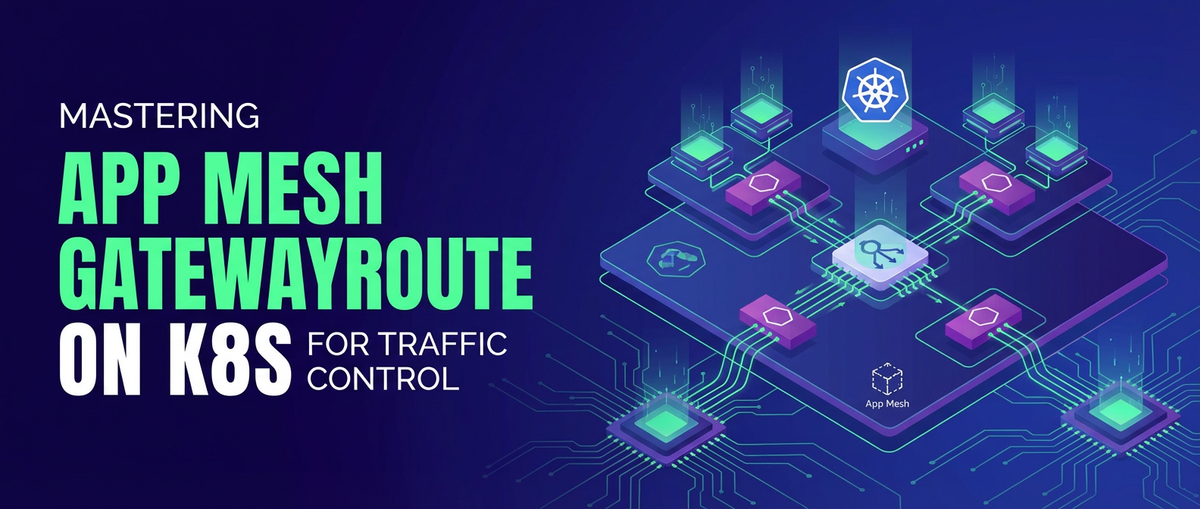
Mastering App Mesh GatewayRoute on K8s for Traffic Control


APIPark is a high-performance AI gateway that allows you to securely access the most comprehensive LLM APIs globally on the APIPark platform, including OpenAI, Anthropic, Mistral, Llama2, Google Gemini, and more.Try APIPark now! 👇👇👇
Mastering App Mesh GatewayRoute on K8s for Traffic Control
In the intricate tapestry of modern cloud-native architectures, microservices have emerged as the de facto standard for building scalable, resilient, and agile applications. However, the very distributed nature that grants microservices their power also introduces a significant layer of complexity, particularly when it comes to managing the flow of traffic between these numerous, independent services. Orchestration platforms like Kubernetes have become indispensable for deploying and managing these services, yet they still present challenges in fine-grained traffic control, observability, and security at the application layer. This is where the concept of a service mesh, and specifically AWS App Mesh, steps in as a transformative solution, providing a dedicated infrastructure layer for managing service-to-service communication.
Among the critical components within App Mesh that empower developers and operators to exert precise control over incoming application traffic to their microservices running on Kubernetes is the GatewayRoute. While internal service-to-service communication is primarily governed by Route resources, the GatewayRoute is the lynchpin for defining how external traffic, entering the mesh through a VirtualGateway, is directed to the appropriate backend VirtualService. It acts as the intelligent dispatcher at the very edge of your service mesh, ensuring that every incoming API call or client request finds its intended destination with granular control, sophisticated routing logic, and inherent resilience. Mastering GatewayRoute on Kubernetes is not merely about configuration; it's about unlocking advanced traffic management patterns, enhancing application reliability, and establishing a robust perimeter for your microservices, ultimately paving the way for more confident deployments and seamless user experiences in an increasingly distributed world. This comprehensive guide will delve deep into the mechanics, deployment, and advanced applications of GatewayRoute, empowering you to take full command of your application traffic on Kubernetes using AWS App Mesh.
The Foundation: Understanding Service Meshes and AWS App Mesh
Before we embark on a detailed exploration of GatewayRoute, it's crucial to solidify our understanding of the broader context: service meshes and, more specifically, AWS App Mesh. These technologies fundamentally alter how we perceive and manage networking within a microservices environment, shifting from a network-centric view to an application-centric one.
What is a Service Mesh? Decoupling Network Concerns from Business Logic
A service mesh is a configurable, low-latency infrastructure layer designed to handle communication between services using a proxy. Instead of baking complex network logic like retries, timeouts, load balancing, and circuit breaking into each microservice, a service mesh offloads these concerns to sidecar proxies deployed alongside each application instance. These proxies form the data plane, intercepting all incoming and outgoing network traffic for their respective service. The control plane, on the other hand, is responsible for configuring and managing these proxies, providing a centralized brain for the entire mesh. This architectural pattern brings several profound benefits:
- Traffic Management: Gain fine-grained control over how requests are routed, enabling advanced patterns like canary deployments, A/B testing, and blue/green rollouts. You can define rules for traffic splitting, request retries, and timeouts without modifying application code.
- Observability: Collect comprehensive metrics, logs, and traces for all service-to-service communication. This drastically improves visibility into the health and performance of your distributed system, making it easier to identify bottlenecks and troubleshoot issues.
- Security: Enforce strong authentication and authorization policies, including mutual TLS (mTLS) encryption for all communication within the mesh. This ensures that only trusted services can communicate with each other, enhancing the overall security posture.
- Reliability: Implement resilience patterns such as circuit breaking, automatic retries, and rate limiting to prevent cascading failures and ensure the stability of the application even under adverse conditions.
By decoupling these cross-cutting concerns from the application's business logic, developers can focus purely on delivering features, while operators gain powerful tools for managing the operational aspects of their microservices architecture.
Introducing AWS App Mesh: A Managed Service Mesh Solution
AWS App Mesh is a managed service mesh that makes it easy to monitor and control microservices applications running on AWS. It provides consistent visibility and network traffic controls for services deployed across various compute environments, including Amazon Elastic Kubernetes Service (EKS), Amazon Elastic Container Service (ECS), AWS Fargate, and Amazon EC2 instances. At its core, App Mesh leverages the open-source Envoy proxy as its data plane, renowned for its high performance and robust feature set.
The conceptual model of App Mesh revolves around several key resources that define the mesh's behavior:
- Mesh: The logical boundary that encapsulates all your microservices and their configurations. All other App Mesh resources belong to a specific mesh.
- Virtual Node: A logical representation of a service or a specific version of a service (e.g.,
product-v1,product-v2). It corresponds to the actual compute workload (e.g., a Kubernetes Pod) running your application. - Virtual Service: An abstract representation of a real service provided by one or more
Virtual Nodes. Clients within the mesh send requests to aVirtual Servicename, and App Mesh handles the routing to the appropriateVirtual Nodes based on defined rules. This provides a stable, logical endpoint that abstracts away the underlying concrete implementations. - Virtual Router: A component that receives requests for a
Virtual Serviceand then evaluates a set ofRoutes to determine whichVirtual Nodeshould receive the traffic. This is where internal traffic routing decisions are made. - Route: Defines how traffic for a
Virtual Serviceis distributed among differentVirtual Nodes or versions of a service. This is used for internal service-to-service communication within the mesh. - Virtual Gateway: A logical representation of an Envoy proxy that sits at the edge of your mesh. It's the entry point for traffic coming into the mesh from external clients (e.g., internet, other services outside the mesh). A
Virtual Gatewayis backed by actual compute resources, often an existinggatewayor ingress controller like Nginx or an AWS Application Load Balancer (ALB). - GatewayRoute: The specific resource that defines routing rules for traffic entering the mesh through a
Virtual Gateway, directing it to the correctVirtual Servicewithin the mesh. This is the star of our show.
The integration of App Mesh with Kubernetes is facilitated by the App Mesh Controller for Kubernetes. This controller watches for App Mesh custom resources (CRDs) in your Kubernetes cluster and translates them into App Mesh API calls, ensuring that your mesh configuration is synchronized with your Kubernetes deployments. This seamless integration allows you to define your service mesh topology and traffic management rules using familiar Kubernetes YAML manifests.
App Mesh vs. Traditional API Gateways
It's important to differentiate App Mesh's role from that of a traditional API Gateway. While both manage API traffic, their scopes and primary functions differ significantly:
- App Mesh (
GatewayRoute): Primarily focuses on Layer 7 traffic management within or at the edge of a microservices mesh. It provides advanced routing, observability, and security for internal service-to-service communication and ingress into the mesh. It's designed for complex internal networking and operational resilience. - Traditional
API Gateway: Typically sits at the very front of your application stack, handling external client requests. It offers a broader range of features for public-facingAPIs, including authentication, authorization, rate limiting, request/response transformation,APIversioning, developer portals, andAPImonetization. AnAPI Gatewayoften acts as a single entry point for all externalAPIcalls.
In many robust architectures, these two components are complementary. An API Gateway might handle the initial public exposure, authentication, and rate limiting for an external API, and then forward validated requests to a Virtual Gateway in App Mesh, which then uses GatewayRoutes to direct traffic into the appropriate Virtual Services. This layered approach leverages the strengths of both technologies. For organizations that require a comprehensive API Gateway solution with advanced features like unified API format for AI invocation, end-to-end API lifecycle management, and team sharing capabilities, platforms like APIPark offer a robust and open-source alternative or complement. APIPark, as an all-in-one AI gateway and API developer portal, focuses on managing, integrating, and deploying AI and REST services, providing a centralized platform for API governance and consumption, often sitting at the edge or within a layered architecture alongside service meshes to handle the external-facing API concerns with enterprise-grade capabilities.
Deep Dive into App Mesh GatewayRoute: The Ingress Traffic Dispatcher
The GatewayRoute is a cornerstone of traffic control for microservices within App Mesh on Kubernetes, specifically designed to govern how external traffic makes its initial entry into your mesh. Unlike internal Routes that manage service-to-service communication once traffic is already inside the mesh, the GatewayRoute is exclusively paired with a VirtualGateway to direct incoming requests to their ultimate VirtualService destinations. Understanding its nuances is paramount for establishing a secure, flexible, and highly controllable ingress for your applications.
The Purpose and Mechanics of GatewayRoute
The primary purpose of a GatewayRoute is to map incoming requests from a VirtualGateway to specific VirtualServices. Imagine your VirtualGateway as the doorman of a secure building (your mesh). The GatewayRoutes are the instructions that tell the doorman exactly which office (your VirtualService) to send each visitor (an incoming request) to, based on various criteria like the visitor's name (hostname), the purpose of their visit (path), or specific credentials they present (headers).
Crucially, a GatewayRoute does not directly route to VirtualNodes. Instead, it targets VirtualServices. This abstraction is powerful because it means your GatewayRoutes remain stable even if the underlying VirtualNodes (and their physical instances) change due to deployments, scaling, or version updates. The VirtualService itself, through its associated VirtualRouter and Routes, then handles the internal distribution of traffic to the appropriate VirtualNodes. This separation of concerns simplifies ingress management and promotes architectural stability.
Key Components Interacting with GatewayRoute
To fully grasp GatewayRoute, we must understand its inseparable partners:
VirtualGateway: As mentioned, this is the entry point for traffic into your mesh. It represents an Envoy proxy that is not injected as a sidecar to your application pods but rather deployed as a standalonegatewayservice (e.g., a Deployment and Service in Kubernetes). Thisgatewayservice typically exposes a port that an external ingress controller (like an Nginx Ingress Controller, AWS ALB Ingress Controller, or even a classic Load Balancer) can forward traffic to. TheVirtualGatewaydefinition itself specifies its listeners (e.g., HTTP on port 80, HTTPS on port 443) and optionally TLS termination settings. It's the physical manifestation of your mesh's edge.When you define aVirtualGatewayin Kubernetes, you're essentially telling App Mesh about this external-facing Envoy proxy. This Envoy proxy will then be configured by the App Mesh control plane to receive incoming requests and, based on theGatewayRoutes associated with thisVirtualGateway, forward them to the correct internalVirtualServices.VirtualService: This is the logical representation of your service within the mesh. For instance, if you have afrontendservice and abackend-apiservice, you'd defineVirtualServices namedfrontend.mesh.localandbackend-api.mesh.local. These names are what yourGatewayRoutes target. TheVirtualServiceensures that theGatewayRoutedoesn't need to know the specific deployment details (like IP addresses or pod names) of your application.
GatewayRoute Configuration Details: The Art of Precision Routing
A GatewayRoute object defines a set of matching rules and a target VirtualService. It supports several types of routing protocols and detailed matching criteria, allowing for highly specific traffic control:
httpRoute: For HTTP/1.1 traffic.http2Route: For HTTP/2 traffic.grpcRoute: For gRPC traffic.tcpRoute: For raw TCP traffic (less common for advanced ingress routing, but available).
Within each route type, you can define match criteria based on:
hostname: Matches theHostheader of the incoming request. This is particularly useful for routing traffic for different domains or subdomains to differentVirtualServices (e.g.,api.example.comtoapi-service,web.example.comtoweb-service). You can specify exact matches or wildcard matches (e.g.,*.example.com).path: Matches the URI path of the incoming request. This is the most common form of routing for microservices, allowing you to direct/usersto a user service,/productsto a product service, and so on. Path matching supports exact matches, prefix matches (e.g.,/api/*), and full regular expression matches.prefix: A simpler form of path matching where the URI path must begin with the specified prefix. This is often preferred over full regex for performance and simplicity when only prefix matching is needed.queryParameters: Matches specific query parameters in the URI. This enables powerful routing based on request parameters (e.g.,?version=v2to av2service). You can match by exact value, present (parameter exists), or absence.headers: Matches specific HTTP headers in the incoming request. This is incredibly versatile for A/B testing, internal tooling access, or routing based on client types. Headers can be matched by exact value, suffix, prefix, regex, range, or by presence/absence.method: For HTTP/HTTP2/gRPC routes, you can match based on the HTTP method (GET, POST, PUT, DELETE, etc.). This allows for routing different operations on the same path to different services or versions.
Each GatewayRoute also includes a priority field. When multiple GatewayRoutes are defined for the same VirtualGateway, App Mesh evaluates them in order of their priority, from lowest to highest. The first GatewayRoute whose match criteria are met will be used, and further routes will not be evaluated. This necessitates careful planning to ensure more specific routes have lower (higher precedence) priority values than more general ones.
The action of a GatewayRoute specifies the target VirtualService name. This is where the request is ultimately directed after matching.
Example Scenarios and Practical Applications
Let's illustrate the power of GatewayRoute with a few common scenarios:
Routing for Specific Hostnames: If your VirtualGateway is receiving traffic for multiple hostnames, you can use GatewayRoute to direct them to different VirtualServices.```yaml apiVersion: appmesh.k8s.aws/v1beta2 kind: GatewayRoute metadata: name: api-hostname-gateway-route namespace: my-app spec: gatewayRouteName: api-hostname-route virtualGatewayRef: name: my-virtual-gateway httpRoute: match: prefix: / hostname: exact: api.example.com action: target: virtualService: virtualServiceRef: name: api-service priority: 1
apiVersion: appmesh.k8s.aws/v1beta2 kind: GatewayRoute metadata: name: website-hostname-gateway-route namespace: my-app spec: gatewayRouteName: website-hostname-route virtualGatewayRef: name: my-virtual-gateway httpRoute: match: prefix: / hostname: exact: www.example.com action: target: virtualService: virtualServiceRef: name: website-service priority: 2 ```
Header-Based Routing for A/B Testing or Internal Tools: Imagine you want to route requests from internal developers to a special beta version of a service, identified by a custom header x-user-type: internal. All other traffic goes to the production service.```yaml apiVersion: appmesh.k8s.aws/v1beta2 kind: GatewayRoute metadata: name: frontend-beta-gateway-route namespace: my-app spec: gatewayRouteName: frontend-beta-route virtualGatewayRef: name: my-virtual-gateway httpRoute: match: prefix: / headers: - name: x-user-type match: exact: internal action: target: virtualService: virtualServiceRef: name: frontend-beta-service # This targets a VirtualService pointing to beta VirtualNodes priority: 10 # This must have higher precedence than the default route
apiVersion: appmesh.k8s.aws/v1beta2 kind: GatewayRoute metadata: name: frontend-default-gateway-route namespace: my-app spec: gatewayRouteName: frontend-default-route virtualGatewayRef: name: my-virtual-gateway httpRoute: match: prefix: / action: target: virtualService: virtualServiceRef: name: frontend-production-service # Default VirtualService priority: 20 # Lower precedence `` In this example, requests withx-user-type: internalwill hitfrontend-beta-servicefirst due to higher priority (lower numerical value), while all other requests will fall through tofrontend-production-service`.
Simple Path-Based Routing: Directs traffic based on the URI path. For example, all requests starting with /users go to the user-service, and requests starting with /products go to the product-service.```yaml apiVersion: appmesh.k8s.aws/v1beta2 kind: GatewayRoute metadata: name: user-service-gateway-route namespace: my-app spec: gatewayRouteName: user-service-gateway-route virtualGatewayRef: name: my-virtual-gateway httpRoute: match: prefix: /users action: target: virtualService: virtualServiceRef: name: user-service priority: 100 # Higher priority for more specific routes
apiVersion: appmesh.k8s.aws/v1beta2 kind: GatewayRoute metadata: name: product-service-gateway-route namespace: my-app spec: gatewayRouteName: product-service-gateway-route virtualGatewayRef: name: my-virtual-gateway httpRoute: match: prefix: /products action: target: virtualService: virtualServiceRef: name: product-service priority: 99 # Slightly higher priority for products ```
These examples demonstrate the versatility of GatewayRoute in directing ingress traffic. The granular control offered by various match types, combined with the priority system, allows for incredibly sophisticated routing logic that would be cumbersome, if not impossible, to manage within individual application codebases or basic Kubernetes Ingress resources alone. It truly empowers operators to define how their mesh interacts with the outside world.
Setting Up App Mesh GatewayRoute on Kubernetes: A Step-by-Step Guide
Deploying and configuring App Mesh GatewayRoute on Kubernetes involves several steps, from setting up the necessary controllers to defining the mesh resources themselves. This section will walk you through the process, providing a practical guide to get your ingress traffic under sophisticated App Mesh control.
Prerequisites for a Smooth Deployment
Before diving into configuration, ensure you have the following in place:
- Kubernetes Cluster: A running Kubernetes cluster (e.g., Amazon EKS, self-managed).
- AWS Account and CLI: Configured AWS CLI with appropriate permissions to create App Mesh resources and EKS cluster resources.
kubectl: The Kubernetes command-line tool, configured to connect to your cluster.helm(Optional but Recommended): For easier installation of the App Mesh Controller and other supporting components.- IAM Permissions: The Kubernetes worker nodes (or the service account used by the App Mesh Controller) must have IAM permissions to interact with App Mesh APIs (e.g.,
appmesh:*).
Step-by-Step Deployment and Configuration
Let's assume we have a simple application with two versions (color-v1, color-v2) and we want to expose it via a VirtualGateway and control traffic with GatewayRoutes.
Step 1: Install the AWS App Mesh Controller for Kubernetes
The App Mesh Controller translates Kubernetes App Mesh CRDs into App Mesh API calls. This is the bridge between your kubectl commands and the managed App Mesh service.
# Add the EKS Helm repository
helm repo add eks https://aws.github.io/eks-charts

# Update your Helm repositories
helm repo update

# Install the App Mesh Controller
helm upgrade -i appmesh-controller eks/appmesh-controller \
    --namespace appmesh-system \
    --set region=YOUR_AWS_REGION \
    --set serviceAccount.create=false \
    --set serviceAccount.name=appmesh-controller \
    --set enableEgress=true \
    --create-namespace

# Create a service account and bind necessary IAM permissions (if not using IRSA)
# For EKS, using IAM Roles for Service Accounts (IRSA) is highly recommended.
# Assuming you have an IRSA role for appmesh-controller, attach it to the service account.
Note: Ensure your appmesh-controller service account has permissions to manage App Mesh resources (e.g., arn:aws:iam::aws:policy/AWSAppMeshFullAccess). If using IRSA, you'd annotate the service account with eks.amazonaws.com/role-arn: arn:aws:iam::ACCOUNT_ID:role/AppMeshControllerRole.
Step 2: Create Your App Mesh Namespace and Mesh Resource
All App Mesh resources live within a logical Mesh. It's also good practice to namespace your applications.
# my-app-namespace.yaml
apiVersion: v1
kind: Namespace
metadata:
  name: my-app
  labels:
    appmesh.k8s.aws/sidecarInjector: enabled # Enable sidecar injection for this namespace
kubectl apply -f my-app-namespace.yaml
# my-mesh.yaml
apiVersion: appmesh.k8s.aws/v1beta2
kind: Mesh
metadata:
  name: my-app-mesh
spec:
  # Optionally, specify egress filters if needed
  egressFilter:
    type: ALLOW_ALL
kubectl apply -f my-mesh.yaml
Step 3: Deploy Application Services and Define VirtualNodes and VirtualServices
Let's deploy a simple colorapp that can run in blue and green versions. Each version will have its own VirtualNode. We'll then create a single VirtualService that points to both, with initial routing handled by a VirtualRouter.
First, the colorapp deployment (simplified):
# colorapp-v1-deployment.yaml
apiVersion: apps/v1
kind: Deployment
metadata:
  name: colorapp-v1
  namespace: my-app
  labels:
    app: colorapp
    version: v1
spec:
  replicas: 1
  selector:
    matchLabels:
      app: colorapp
      version: v1
  template:
    metadata:
      labels:
        app: colorapp
        version: v1
      annotations:
        # App Mesh sidecar injection for this pod
        appmesh.k8s.aws/mesh: my-app-mesh
        appmesh.k8s.aws/virtualNode: colorapp-v1
    spec:
      containers:
      - name: colorapp
        image: public.ecr.aws/aws-appmesh/colorapp:latest # A sample app that returns its color
        ports:
        - containerPort: 8080
        env:
        - name: COLOR_VARIANT
          value: blue
---
# colorapp-v2-deployment.yaml
apiVersion: apps/v1
kind: Deployment
metadata:
  name: colorapp-v2
  namespace: my-app
  labels:
    app: colorapp
    version: v2
spec:
  replicas: 1
  selector:
    matchLabels:
      app: colorapp
      version: v2
  template:
    metadata:
      labels:
        app: colorapp
        version: v2
      annotations:
        appmesh.k8s.aws/mesh: my-app-mesh
        appmesh.k8s.aws/virtualNode: colorapp-v2
    spec:
      containers:
      - name: colorapp
        image: public.ecr.aws/aws-appmesh/colorapp:latest
        ports:
        - containerPort: 8080
        env:
        - name: COLOR_VARIANT
          value: green
kubectl apply -f colorapp-v1-deployment.yaml
kubectl apply -f colorapp-v2-deployment.yaml
Now, define the VirtualNodes and VirtualService for our colorapp.
# colorapp-virtualnodes.yaml
apiVersion: appmesh.k8s.aws/v1beta2
kind: VirtualNode
metadata:
  name: colorapp-v1
  namespace: my-app
spec:
  meshRef:
    name: my-app-mesh
  listeners:
    - portMapping:
        port: 8080
        protocol: http
  serviceDiscovery:
    kubernetes:
      serviceName: colorapp-service-v1 # Kubernetes Service name for v1
      namespace: my-app
---
apiVersion: appmesh.k8s.aws/v1beta2
kind: VirtualNode
metadata:
  name: colorapp-v2
  namespace: my-app
spec:
  meshRef:
    name: my-app-mesh
  listeners:
    - portMapping:
        port: 8080
        protocol: http
  serviceDiscovery:
    kubernetes:
      serviceName: colorapp-service-v2 # Kubernetes Service name for v2
      namespace: my-app
# colorapp-services.yaml (Kubernetes Services for the App Mesh VirtualNodes)
apiVersion: v1
kind: Service
metadata:
  name: colorapp-service-v1
  namespace: my-app
spec:
  ports:
  - port: 8080
    name: http
  selector:
    app: colorapp
    version: v1
---
apiVersion: v1
kind: Service
metadata:
  name: colorapp-service-v2
  namespace: my-app
spec:
  ports:
  - port: 8080
    name: http
  selector:
    app: colorapp
    version: v2
kubectl apply -f colorapp-virtualnodes.yaml
kubectl apply -f colorapp-services.yaml
# colorapp-virtualservice.yaml
apiVersion: appmesh.k8s.aws/v1beta2
kind: VirtualService
metadata:
  name: colorapp.my-app.mesh.local # The logical name for the service within the mesh
  namespace: my-app
spec:
  meshRef:
    name: my-app-mesh
  provider:
    virtualRouter:
      virtualRouterRef:
        name: colorapp-virtual-router
# colorapp-virtualrouter.yaml
apiVersion: appmesh.k8s.aws/v1beta2
kind: VirtualRouter
metadata:
  name: colorapp-virtual-router
  namespace: my-app
spec:
  meshRef:
    name: my-app-mesh
  listeners:
    - portMapping:
        port: 8080
        protocol: http
---
# colorapp-route.yaml (Initial route for internal traffic distribution)
apiVersion: appmesh.k8s.aws/v1beta2
kind: Route
metadata:
  name: colorapp-route
  namespace: my-app
spec:
  routeName: colorapp-route
  virtualRouterRef:
    name: colorapp-virtual-router
  httpRoute:
    match:
      prefix: /
    action:
      weightedTargets:
        - virtualNodeRef:
            name: colorapp-v1
          weight: 100 # Initially send all internal traffic to v1
        - virtualNodeRef:
            name: colorapp-v2
          weight: 0
kubectl apply -f colorapp-virtualservice.yaml
kubectl apply -f colorapp-virtualrouter.yaml
kubectl apply -f colorapp-route.yaml
Step 4: Create a VirtualGateway and its Kubernetes Deployment
This is the ingress point. We need to define the VirtualGateway App Mesh resource and then a corresponding Kubernetes Deployment and Service for the Envoy proxy that will act as this gateway. For simplicity, we'll expose it with a Kubernetes LoadBalancer Service.
# my-virtual-gateway.yaml
apiVersion: appmesh.k8s.aws/v1beta2
kind: VirtualGateway
metadata:
  name: my-virtual-gateway
  namespace: my-app
spec:
  meshRef:
    name: my-app-mesh
  listeners:
    - portMapping:
        port: 8080
        protocol: http
  # If you need TLS termination at the gateway, configure it here:
  # tls:
  #   mode: STRICT
  #   certificate:
  #     acm:
  #       certificateArns: ["arn:aws:acm:REGION:ACCOUNT_ID:certificate/CERT_ID"]
  #   mutualTlsValidation:
  #     trust:
  #       acm:
  #         certificateArns: ["arn:aws:acm:REGION:ACCOUNT_ID:certificate/CA_CERT_ID"]
kubectl apply -f my-virtual-gateway.yaml
Now, the actual Kubernetes Deployment and Service for the VirtualGateway's Envoy proxy. This will be an Envoy proxy running outside your application pods, acting as the ingress point.
# virtual-gateway-deployment.yaml
apiVersion: apps/v1
kind: Deployment
metadata:
  name: my-virtual-gateway-proxy
  namespace: my-app
spec:
  selector:
    matchLabels:
      app: my-virtual-gateway-proxy
  replicas: 1
  template:
    metadata:
      labels:
        app: my-virtual-gateway-proxy
      annotations:
        # App Mesh proxy injection for the VirtualGateway
        appmesh.k8s.aws/mesh: my-app-mesh
        appmesh.k8s.aws/virtualGateway: my-virtual-gateway
    spec:
      containers:
        - name: envoy
          image: public.ecr.aws/appmesh/aws-appmesh-envoy:v1.27.2.0-prod # Use the recommended Envoy image
          ports:
            - containerPort: 8080
              name: http
            - containerPort: 9901 # Envoy admin port
          env:
            - name: APPMESH_VIRTUAL_GATEWAY_NAME
              value: my-virtual-gateway
            - name: AWS_REGION
              value: YOUR_AWS_REGION
            # Necessary for App Mesh controller to configure Envoy
            - name: ENVOY_LOG_LEVEL
              value: info
          resources:
            requests:
              memory: "128Mi"
              cpu: "100m"
---
apiVersion: v1
kind: Service
metadata:
  name: my-virtual-gateway-service
  namespace: my-app
spec:
  selector:
    app: my-virtual-gateway-proxy
  ports:
    - protocol: TCP
      port: 80
      targetPort: 8080
      name: http
  type: LoadBalancer # Expose the gateway externally
kubectl apply -f virtual-gateway-deployment.yaml
Once deployed, kubectl get svc -n my-app my-virtual-gateway-service should show an external IP or hostname for your LoadBalancer. This is the endpoint clients will use to access your application through the VirtualGateway.
Step 5: Create GatewayRoutes for Traffic Control
Now, define how incoming traffic to my-virtual-gateway should be routed to our colorapp.my-app.mesh.local VirtualService.
Let's start with a simple GatewayRoute that directs all traffic to colorapp.my-app.mesh.local.
# colorapp-gateway-route-default.yaml
apiVersion: appmesh.k8s.aws/v1beta2
kind: GatewayRoute
metadata:
  name: colorapp-default-gateway-route
  namespace: my-app
spec:
  gatewayRouteName: colorapp-default-route
  virtualGatewayRef:
    name: my-virtual-gateway
  httpRoute:
    match:
      prefix: /
    action:
      target:
        virtualService:
          virtualServiceRef:
            name: colorapp.my-app.mesh.local # Target the VirtualService
  priority: 100 # Default route, lower precedence
kubectl apply -f colorapp-gateway-route-default.yaml
Now, if you access the LoadBalancer IP/hostname, you should get a response from colorapp-v1 (because our VirtualRouter colorapp-virtual-router is weighted 100% to colorapp-v1).
To demonstrate a more advanced GatewayRoute, let's add a GatewayRoute for a specific path, perhaps /admin, that should go to a different VirtualService or even apply different logic. Or, let's create a GatewayRoute that uses a header to direct traffic to v2.
# colorapp-gateway-route-header-based.yaml
apiVersion: appmesh.k8s.aws/v1beta2
kind: GatewayRoute
metadata:
  name: colorapp-v2-header-gateway-route
  namespace: my-app
spec:
  gatewayRouteName: colorapp-v2-header-route
  virtualGatewayRef:
    name: my-virtual-gateway
  httpRoute:
    match:
      prefix: /
      headers:
        - name: x-app-version
          match:
            exact: v2
    action:
      target:
        virtualService:
          virtualServiceRef:
            name: colorapp.my-app.mesh.local # Still targets the same VirtualService
                                              # The internal VirtualRouter/Route will handle v2 weighting
  priority: 1 # Higher precedence than the default route
kubectl apply -f colorapp-gateway-route-header-based.yaml
Now, update your colorapp-route to send v2 traffic if the x-app-version: v2 header is present. This is an example of GatewayRoute defining the ingress, and Route defining the internal split.
To achieve specific v2 routing via header through the VirtualService requires the VirtualRouter to handle that. A more direct way to leverage GatewayRoute for v2 is if you had colorapp-v2.my-app.mesh.local as a separate VirtualService. But for a single VirtualService colorapp.my-app.mesh.local, the GatewayRoute sends to this logical service. The VirtualRouter associated with colorapp.my-app.mesh.local then needs its Routes to handle the header-based splitting if you want to route directly to colorapp-v2 VirtualNode.
Let's adjust the example to show GatewayRoute routing to different VirtualServices for better clarity. Imagine we have colorapp-v1.my-app.mesh.local and colorapp-v2.my-app.mesh.local as separate VirtualServices.
First, delete the previous VirtualService, VirtualRouter, and Route:
kubectl delete vs colorapp.my-app.mesh.local -n my-app
kubectl delete vr colorapp-virtual-router -n my-app
kubectl delete route colorapp-route -n my-app
Now, create separate VirtualServices for v1 and v2:
# colorapp-v1-virtualservice.yaml
apiVersion: appmesh.k8s.aws/v1beta2
kind: VirtualService
metadata:
  name: colorapp-v1.my-app.mesh.local
  namespace: my-app
spec:
  meshRef:
    name: my-app-mesh
  provider:
    virtualNode:
      virtualNodeRef:
        name: colorapp-v1
---
# colorapp-v2-virtualservice.yaml
apiVersion: appmesh.k8s.aws/v1beta2
kind: VirtualService
metadata:
  name: colorapp-v2.my-app.mesh.local
  namespace: my-app
spec:
  meshRef:
    name: my-app-mesh
  provider:
    virtualNode:
      virtualNodeRef:
        name: colorapp-v2
kubectl apply -f colorapp-v1-virtualservice.yaml
kubectl apply -f colorapp-v2-virtualservice.yaml
Now, redefine the GatewayRoutes to point to these distinct VirtualServices.
# colorapp-gateway-route-default-to-v1.yaml (Redirect default traffic to v1)
apiVersion: appmesh.k8s.aws/v1beta2
kind: GatewayRoute
metadata:
  name: colorapp-default-to-v1-gateway-route
  namespace: my-app
spec:
  gatewayRouteName: colorapp-default-to-v1-route
  virtualGatewayRef:
    name: my-virtual-gateway
  httpRoute:
    match:
      prefix: /
    action:
      target:
        virtualService:
          virtualServiceRef:
            name: colorapp-v1.my-app.mesh.local
  priority: 100
---
# colorapp-gateway-route-header-to-v2.yaml (Redirect specific header traffic to v2)
apiVersion: appmesh.k8s.aws/v1beta2
kind: GatewayRoute
metadata:
  name: colorapp-header-to-v2-gateway-route
  namespace: my-app
spec:
  gatewayRouteName: colorapp-header-to-v2-route
  virtualGatewayRef:
    name: my-virtual-gateway
  httpRoute:
    match:
      prefix: /
      headers:
        - name: x-app-version
          match:
            exact: v2
    action:
      target:
        virtualService:
          virtualServiceRef:
            name: colorapp-v2.my-app.mesh.local
  priority: 1 # Higher precedence
kubectl apply -f colorapp-gateway-route-default-to-v1.yaml
kubectl apply -f colorapp-gateway-route-header-to-v2.yaml
Now, testing the LoadBalancer IP: * curl http://YOUR_LB_IP: Should return "blue" (from colorapp-v1). * curl -H "x-app-version: v2" http://YOUR_LB_IP: Should return "green" (from colorapp-v2).
This demonstrates the precision of GatewayRoute in directing ingress traffic based on defined criteria directly to different VirtualServices.
Troubleshooting Common Issues
- No App Mesh Sidecar: Ensure your namespace is labeled
appmesh.k8s.aws/sidecarInjector: enabledand pods haveappmesh.k8s.aws/mesh: my-app-meshannotation. - Permissions Errors: Check IAM roles associated with worker nodes or the App Mesh Controller service account.
- Incorrect
VirtualGatewaySetup: Verify theVirtualGatewayKubernetes Deployment and Service are running and exposed correctly. Check Envoy logs for errors (kubectl logs <envoy-pod> -c envoy). GatewayRoutePriority Conflicts: Overlapping match rules with incorrect priorities can lead to unexpected routing. More specific rules should have lowerpriorityvalues.- DNS Resolution Issues: Ensure
VirtualServicenames can be resolved within the mesh (e.g.,colorapp.my-app.mesh.local).
Observability Integration
GatewayRoutes are integral to App Mesh's comprehensive observability story. Since the VirtualGateway is an Envoy proxy, it emits detailed metrics, logs, and traces for all incoming requests it handles.
- Metrics: Envoy proxies automatically expose metrics (e.g., request counts, latencies, error rates) which can be collected by Prometheus and visualized in Grafana, or published to AWS CloudWatch for monitoring and alarming. These metrics offer insights into the health and performance of your ingress traffic.
- Tracing: App Mesh integrates with AWS X-Ray, allowing you to trace requests as they enter the
VirtualGateway, pass throughGatewayRoutes, and traverse through variousVirtualServices within your mesh. This end-to-end tracing is invaluable for pinpointing latency issues and understanding request flow across distributed services. - Logging: Detailed access logs from the Envoy proxy provide visibility into every request, including source IP, destination, headers, and response codes. These logs can be shipped to a centralized logging system (e.g., CloudWatch Logs, OpenSearch) for analysis and debugging.
By leveraging these observability features, you gain an unparalleled understanding of how external clients interact with your microservices, enabling proactive issue detection and faster resolution.
Advanced Traffic Control Patterns with GatewayRoute
The true power of App Mesh GatewayRoute unfolds when it's employed for advanced traffic management scenarios, enabling highly resilient and agile deployments. These patterns allow organizations to minimize risk during releases, test new features with subsets of users, and maintain high availability.
Canary Deployments: Gradual, Controlled Rollouts
Canary deployments involve gradually rolling out a new version of a service to a small percentage of users, monitoring its performance and stability, and then incrementally increasing the traffic to the new version if it proves stable. GatewayRoute, in conjunction with VirtualService and Route, is perfectly suited for this.
How GatewayRoute contributes: While the actual weighted routing between different service versions (e.g., v1 and v2) is handled by a VirtualRouter and its Routes internally, GatewayRoute plays the crucial role of directing the initial ingress traffic to the correct VirtualService (which then uses its router to split traffic). If you have two distinct VirtualServices, my-service-v1.mesh.local and my-service-v2.mesh.local, your GatewayRoute can initially send 100% of traffic to my-service-v1. To perform a canary, you would:
- Define a new
GatewayRoutewith higher priority: This new route would match specific criteria (e.g.,x-canary-user: trueheader or specific query parameters) and direct this segment of traffic tomy-service-v2.mesh.local. - Gradual Weight Adjustment on Internal Route: More commonly, if you have a single
VirtualService(e.g.,my-service.mesh.local) whoseVirtualRoutersplits traffic betweenmy-service-v1andmy-service-v2VirtualNodes, theGatewayRoutesimply directs all incoming traffic tomy-service.mesh.local. The canary rollout is then performed by adjusting theweighton theRoutewithinmy-service.mesh.local'sVirtualRouter(e.g., 95% tov1, 5% tov2).
However, GatewayRoute can directly facilitate splitting if different versions are exposed as distinct VirtualServices, which is often done for simpler canary deployments for external-facing services when a VirtualRouter might be overkill or when direct routing to a distinct canary environment is desired.
Example: Header-based Canary for a subset of users (direct to a v2 VirtualService)
# GatewayRoute for a canary group
apiVersion: appmesh.k8s.aws/v1beta2
kind: GatewayRoute
metadata:
  name: canary-gateway-route
  namespace: my-app
spec:
  gatewayRouteName: canary-route
  virtualGatewayRef:
    name: my-virtual-gateway
  httpRoute:
    match:
      prefix: /api/products
      headers:
        - name: x-user-group
          match:
            exact: canary
    action:
      target:
        virtualService:
          virtualServiceRef:
            name: product-service-v2.my-app.mesh.local # Targets the new version
  priority: 10 # High priority for canary traffic
---
# Default GatewayRoute
apiVersion: appmesh.k8s.aws/v1beta2
kind: GatewayRoute
metadata:
  name: default-product-gateway-route
  namespace: my-app
spec:
  gatewayRouteName: default-product-route
  virtualGatewayRef:
    name: my-virtual-gateway
  httpRoute:
    match:
      prefix: /api/products
    action:
      target:
        virtualService:
          virtualServiceRef:
            name: product-service-v1.my-app.mesh.local # Targets the stable version
  priority: 20 # Lower priority for default traffic
In this setup, any request to /api/products with the header x-user-group: canary will be routed to product-service-v2, while all other requests will go to product-service-v1. You can then use tools like a load balancer or an API gateway (like APIPark) to gradually inject this header for a small percentage of real user traffic, performing a true canary.
A/B Testing: User Segment-Based Routing
A/B testing involves showing different versions of a feature or UI to different segments of users to determine which performs better against a specific metric. GatewayRoute is excellent for segmenting users at the ingress level based on various request attributes.
How GatewayRoute contributes: Similar to canary deployments, GatewayRoute can direct traffic based on headers (e.g., User-Agent, x-ab-test-group), query parameters (e.g., ?variant=B), or even source IP ranges (though less common for A/B testing). This allows you to route specific user groups to different VirtualServices that implement the 'A' or 'B' variant of your application.
Example: Routing based on User-Agent for desktop vs. mobile experiences
apiVersion: appmesh.k8s.aws/v1beta2
kind: GatewayRoute
metadata:
  name: mobile-frontend-gateway-route
  namespace: my-app
spec:
  gatewayRouteName: mobile-frontend-route
  virtualGatewayRef:
    name: my-virtual-gateway
  httpRoute:
    match:
      prefix: /
      headers:
        - name: User-Agent
          match:
            regex: ".*(Mobile|Android|iPhone|iPad).*" # Regex to match common mobile user agents
    action:
      target:
        virtualService:
          virtualServiceRef:
            name: frontend-mobile.my-app.mesh.local
  priority: 10
---
apiVersion: appmesh.k8s.aws/v1beta2
kind: GatewayRoute
metadata:
  name: desktop-frontend-gateway-route
  namespace: my-app
spec:
  gatewayRouteName: desktop-frontend-route
  virtualGatewayRef:
    name: my-virtual-gateway
  httpRoute:
    match:
      prefix: /
    action:
      target:
        virtualService:
          virtualServiceRef:
            name: frontend-desktop.my-app.mesh.local
  priority: 20
This configuration ensures that mobile users are routed to a specialized mobile frontend VirtualService, while desktop users receive the standard desktop experience, all managed transparently by the GatewayRoute.
Blue/Green Deployments: Near-Zero Downtime Swaps
Blue/Green deployments involve running two identical production environments, "blue" (current live) and "green" (new version). Once "green" is fully tested, traffic is instantly switched from "blue" to "green."
How GatewayRoute contributes: GatewayRoute makes blue/green deployments incredibly straightforward. You deploy your new "green" version as a separate set of VirtualNodes and a corresponding VirtualService (e.g., my-service-green.mesh.local). Your existing GatewayRoute will point to my-service-blue.mesh.local. To switch, you simply update the GatewayRoute to point to my-service-green.mesh.local.
Example: Switching from Blue to Green
Initial state (all traffic to blue):
apiVersion: appmesh.k8s.aws/v1beta2
kind: GatewayRoute
metadata:
  name: my-app-gateway-route
  namespace: my-app
spec:
  gatewayRouteName: my-app-route
  virtualGatewayRef:
    name: my-virtual-gateway
  httpRoute:
    match:
      prefix: /
    action:
      target:
        virtualService:
          virtualServiceRef:
            name: my-app-blue.my-app.mesh.local # Currently points to blue
  priority: 1
To switch to green, you update this GatewayRoute resource:
apiVersion: appmesh.k8s.aws/v1beta2
kind: GatewayRoute
metadata:
  name: my-app-gateway-route
  namespace: my-app
spec:
  gatewayRouteName: my-app-route
  virtualGatewayRef:
    name: my-virtual-gateway
  httpRoute:
    match:
      prefix: /
    action:
      target:
        virtualService:
          virtualServiceRef:
            name: my-app-green.my-app.mesh.local # Updated to point to green
  priority: 1
The App Mesh control plane will then reconfigure the VirtualGateway Envoy proxy to immediately start routing all new incoming requests to my-app-green.my-app.mesh.local. This provides a rapid, single-point-of-change for switching environments with minimal downtime risk.
Fault Injection (Briefly) and Stability
While App Mesh's fault injection (delay and abort) is typically configured on Routes for internal service-to-service communication to test the resilience of downstream services, the VirtualGateway and GatewayRoute play a crucial role in ensuring the stability of the ingress layer itself. By carefully crafting GatewayRoutes and employing robust VirtualGateway configurations (e.g., proper timeouts, circuit breakers on the underlying Envoy proxy), you ensure that external requests are handled gracefully, preventing the gateway from becoming a bottleneck or single point of failure. The inherent resilience of Envoy, managed by App Mesh, provides a solid foundation for ingress stability.
Timeouts and Retries at the Edge
Though not directly specified within the GatewayRoute resource itself, the VirtualGateway configuration can define important network behaviors for requests entering the mesh. For instance, VirtualGateway listeners can specify connectionPool settings (maximum connections, maximum pending requests) and timeouts for HTTP requests. These settings apply to traffic traversing the VirtualGateway's Envoy proxy. This ensures that slow or unresponsive upstream services don't tie up the gateway indefinitely, enhancing the overall resilience and user experience for incoming API calls. While internal retries and timeouts are handled by Routes, the VirtualGateway safeguards the initial ingress.
By mastering these advanced patterns with GatewayRoute, teams can significantly improve their deployment velocity, reduce the risk associated with changes, and enhance the overall reliability and performance of their microservices applications on Kubernetes. The granular control at the ingress point is invaluable for sophisticated operational strategies.
Security and Observability with App Mesh GatewayRoute
Beyond just traffic management, App Mesh GatewayRoute significantly contributes to the security posture and observability of your microservices applications. By centralizing ingress control through a robust service mesh mechanism, organizations gain crucial capabilities for protecting their services and understanding their operational health.
Enhancing Security at the Mesh Edge
Security in a microservices environment is multi-faceted, and the ingress point is a critical perimeter. VirtualGateways, combined with GatewayRoutes, provide several layers of defense and control:
- Mutual TLS (mTLS) Termination and Origination: A
VirtualGatewaycan be configured to terminate TLS connections from external clients. This means external traffic can be encrypted from the client to theVirtualGateway. More powerfully, after terminating external TLS, theVirtualGatewaycan then originate new mTLS connections to the internalVirtualServices. This establishes strong identity-based encryption and authentication for all traffic within the mesh, even for requests that originated externally.- External TLS: Your
VirtualGatewaycan terminate TLS using certificates managed by AWS Certificate Manager (ACM). This is configured in theVirtualGatewayresource definition. - Internal mTLS: By defining a
TLSconfiguration with amodeofSTRICTwithin theVirtualGateway's listener, and by ensuring yourVirtualServices have corresponding TLS configurations, you enforce that traffic from theVirtualGatewayto anyVirtualNode(backing aVirtualService) must use mTLS. This means only trusted services within the mesh can receive traffic from theVirtualGateway, preventing unauthorized access even if the network is compromised.
- External TLS: Your
- Access Control and Identity: While
GatewayRouteitself defines what traffic goes where, theVirtualGateway's underlying Envoy proxy can be integrated with external identity and access management solutions. For example, if an AWS ALB or Nginx Ingress Controller sits in front of theVirtualGateway, thesegateways can handle authentication (e.g., OAuth, JWT validation) and authorization before forwarding requests. App Mesh resources themselves can be protected using AWS IAM policies, ensuring that only authorized individuals or CI/CD pipelines can modifyGatewayRouteorVirtualGatewayconfigurations. - Network Isolation and Segmentation:
VirtualGateways act as a clear logical boundary. They allow you to control which external traffic is permitted into your mesh and to which services. This segmentation helps in isolating problematic services and preventing lateral movement of attacks. By carefully craftingGatewayRouterules, you can ensure that only specific paths, hostnames, or request characteristics are allowed to reach certain internalVirtualServices, enforcing a least-privilege approach to network access. - Integration with AWS WAF (Web Application Firewall): When an AWS ALB or CloudFront distribution is used as the ingress point in front of your
VirtualGateway, you can integrate AWS WAF to provide protection against common web exploits and bots. WAF operates at the application layer and can filter malicious traffic before it even reaches yourVirtualGateway's Envoy proxy, adding another crucial layer of defense for your public-facingAPIendpoints.
By combining GatewayRoute's granular routing with VirtualGateway's TLS capabilities and broader AWS security features, you can construct a highly secure ingress perimeter for your Kubernetes microservices.
Comprehensive Observability for Ingress Traffic
Observability is paramount for understanding the behavior and performance of distributed systems. VirtualGateways and GatewayRoutes are prime sources of rich telemetry data, providing deep insights into incoming traffic patterns and potential issues.
- Detailed Metrics: The Envoy proxy powering the
VirtualGatewayexposes an extensive set of metrics. These include:- Request Counts: Total requests, requests per second, HTTP status code distribution (2xx, 4xx, 5xx).
- Latency: Request latency percentiles (p50, p90, p99) provide insights into performance bottlenecks.
- Connection Metrics: Number of active connections, upstream/downstream bytes sent/received.
- Error Rates: Specific error rates from the
VirtualGatewayitself or from upstreamVirtualServices. These metrics can be collected by Prometheus, integrated into AWS CloudWatch, or exported to other monitoring systems. Visualizing these metrics in dashboards allows operations teams to quickly identify spikes in traffic, increases in error rates, or latency degradations affecting external users.
- End-to-End Distributed Tracing: App Mesh seamlessly integrates with AWS X-Ray. When a request enters the
VirtualGateway, the Envoy proxy can inject tracing headers (e.g.,x-amzn-trace-id). As this request traverses through theGatewayRouteto aVirtualServiceand subsequently through otherVirtualServices within the mesh, each Envoy sidecar proxy (and potentially the application itself, if instrumented) contributes span data to the trace. This provides a complete, end-to-end view of the request's journey, from the moment it hits thegatewayto its final backend service, showing exactly where latency is introduced or errors occur. This is invaluable for debugging complex interactions in a microservices architecture. - Comprehensive Access Logging: The
VirtualGateway's Envoy proxy generates detailed access logs for every incoming request. These logs typically include:- Timestamp
- Source IP address
- Destination
VirtualService - Request method and URI
- HTTP headers
- Response status code
- Latency information These logs are critical for auditing, debugging, and security analysis. They can be shipped to a centralized logging platform (e.g., CloudWatch Logs, OpenSearch, Splunk) for aggregation, searching, and alerting. By analyzing these logs, teams can identify unusual traffic patterns, unauthorized access attempts, or detailed information about failed
APIcalls. APIPark, for instance, offers powerful data analysis and detailedAPIcall logging, recording every detail of eachAPIcall, allowing businesses to quickly trace and troubleshoot issues inAPIcalls and analyze historical data for long-term trends and performance changes. This capability complements the observability provided by a service mesh for comprehensiveAPIgovernance.
By integrating GatewayRoute into your observability stack, you gain an unparalleled understanding of how external clients interact with your microservices, enabling proactive issue detection, faster resolution, and continuous performance optimization. The VirtualGateway acts as a crucial observation point at the very entrance of your mesh, providing the first critical insights into your application's health from an external perspective.
Comparison and Ecosystem Integration
Understanding GatewayRoute's role also involves situating it within the broader ecosystem of Kubernetes networking and API gateway solutions. While it provides powerful ingress control, it often works in conjunction with or complements other tools.
App Mesh GatewayRoute vs. Kubernetes Ingress
Kubernetes Ingress is the native way to expose HTTP and HTTPS routes from outside the cluster to services within the cluster. It's often implemented by Ingress Controllers like Nginx Ingress or AWS Load Balancer Controller.
| Feature | Kubernetes Ingress | App Mesh VirtualGateway / GatewayRoute |
|---|---|---|
| Primary Focus | Basic L7 routing from external clients to services. | Advanced L7 routing into the service mesh and internal mesh traffic management. |
| Traffic Patterns | Path-based, hostname-based routing. | Path, hostname, header, query param matching; weighted routing (via Route on VirtualRouter), fault injection, retries. |
| Observability | Controller-dependent (e.g., Nginx logs/metrics). | Envoy-native metrics (Prometheus, CloudWatch), X-Ray tracing, detailed Envoy access logs. |
| Security | TLS termination, basic auth (controller-dependent). | mTLS into the mesh, granular access control, rich TLS options. |
| Complexity | Relatively simpler for basic routing. | Higher initial setup complexity due to service mesh concepts. |
| Integration | Directs traffic to Kubernetes Services. | Directs traffic to App Mesh VirtualServices, which abstract Kubernetes Services. |
| Deployment Model | Ingress Controller as a gateway (Deployment/Service). |
VirtualGateway Envoy proxy as a gateway (Deployment/Service). Often sits behind an Ingress Controller. |
In many production environments, an Ingress Controller (e.g., AWS ALB Ingress Controller) will sit in front of the VirtualGateway. The Ingress Controller handles the very first layer of external traffic (e.g., public IP, basic TLS, maybe WAF integration), and then forwards requests to the VirtualGateway's Kubernetes Service. The VirtualGateway then uses GatewayRoutes to apply advanced mesh-specific routing and policies. This layered approach leverages the strengths of both: Kubernetes Ingress for external exposure and App Mesh for internal, granular control.
App Mesh GatewayRoute vs. Dedicated API Gateways
As discussed earlier, API Gateways offer a broader set of features than just routing. GatewayRoute is an ingress mechanism into the mesh, providing advanced internal traffic control, whereas a dedicated API gateway typically provides a full suite of features for exposing and managing public-facing APIs.
| Feature | App Mesh VirtualGateway / GatewayRoute |
Dedicated API Gateway (e.g., APIPark, AWS API Gateway, Nginx Plus) |
|---|---|---|
| Primary Role | Ingress for service mesh, internal traffic management. | Edge proxy for public APIs, full API lifecycle management. |
| Key Features | L7 routing, mTLS, tracing, metrics, advanced deployment patterns (canary, A/B within mesh). | Authentication, authorization, rate limiting, request/response transformation, API versioning, developer portal, monetization, analytics, API lifecycle management. |
| Audience | Internal developers, operations, SREs. | External clients, internal developers, business units. |
| Deployment | Runs within Kubernetes as an Envoy proxy managed by App Mesh. | Can be managed service, self-hosted, or containerized. |
| Complementary Use | API gateway can sit in front of VirtualGateway to provide enhanced external API capabilities, then VirtualGateway routes into mesh. |
API gateway can route to VirtualGateway which then uses GatewayRoute for advanced internal routing. |
API Governance |
Focus on network governance within the mesh. | Comprehensive API governance from design to retirement. |
For organizations managing a large number of APIs, especially public-facing ones, or those integrating with AI models, a dedicated API gateway is indispensable. Platforms like APIPark exemplify this, providing an open-source AI gateway and API management platform. APIPark offers capabilities far beyond what GatewayRoute alone can provide, such as:
- Quick Integration of 100+ AI Models: Unifying management, authentication, and cost tracking for diverse AI models.
- Unified
APIFormat for AI Invocation: Standardizing request formats to abstract AI model changes from applications. - Prompt Encapsulation into REST
API: Rapidly creating newAPIs from AI models and custom prompts. - End-to-End
APILifecycle Management: GuidingAPIs through design, publication, invocation, and decommission. APIService Sharing within Teams: Centralized display for easy discovery and use across departments.- Independent
APIand Access Permissions for Each Tenant: Multi-tenancy support for isolation and resource optimization. APIResource Access Requires Approval: Enhanced security with subscription approval workflows.- Performance Rivaling Nginx: High throughput, supporting cluster deployment for large-scale traffic.
- Detailed
APICall Logging and Powerful Data Analysis: Comprehensive insights intoAPIusage and performance.
An architecture might typically involve an API gateway like APIPark handling external client requests, performing initial authentication, rate limiting, and transformations, and then forwarding these requests to an App Mesh VirtualGateway. The VirtualGateway then uses GatewayRoutes to direct the traffic to the appropriate VirtualService within the App Mesh, leveraging the mesh's advanced traffic management, observability, and security features for internal service-to-service communication. This layered approach creates a highly robust, scalable, and manageable API infrastructure.
Conclusion
The journey through mastering App Mesh GatewayRoute on Kubernetes reveals it to be a profoundly powerful and indispensable tool for modern microservices architectures. As applications become increasingly distributed and complex, the need for sophisticated traffic control at the very edge of the service mesh grows exponentially. GatewayRoute fulfills this critical role, acting as the intelligent dispatcher for all ingress traffic, enabling granular routing decisions based on a rich set of criteria.
We've explored its fundamental purpose—to connect external clients through a VirtualGateway to internal VirtualServices—and delved into the intricacies of its configuration, from simple path-based routing to advanced header and hostname matching. The step-by-step deployment guide demonstrated how to establish a fully functional GatewayRoute setup, illustrating how App Mesh seamlessly integrates with Kubernetes through its custom resources and controller.
Beyond basic routing, GatewayRoute unlocks a spectrum of advanced traffic control patterns. Whether it's gradually rolling out new features with canary deployments, segmenting users for A/B testing, or performing near-zero-downtime blue/green switches, GatewayRoute provides the precision and agility required for confident and resilient releases. Furthermore, its deep integration with App Mesh's observability suite (metrics, tracing, logging) ensures unparalleled visibility into ingress traffic, while its support for mTLS and integration with broader AWS security features fortifies the mesh's perimeter.
While GatewayRoute excels at ingress control within the service mesh, it operates as part of a larger ecosystem. It often complements Kubernetes Ingress for initial public exposure and, for comprehensive API governance, can work hand-in-hand with dedicated API gateway solutions like APIPark. This layered architectural approach allows organizations to harness the specialized strengths of each component, creating an robust, high-performance, and secure API infrastructure.
Mastering GatewayRoute empowers developers and operations teams to build more reliable, resilient, and agile microservices applications on Kubernetes. It transforms the challenging landscape of distributed traffic management into a controlled and predictable environment, ultimately accelerating innovation and enhancing the user experience. By embracing App Mesh GatewayRoute, you are not just managing traffic; you are engineering the future of your cloud-native applications.
Five Frequently Asked Questions (FAQs)
1. What is the primary difference between an App Mesh GatewayRoute and a Kubernetes Ingress?
A Kubernetes Ingress is a native Kubernetes resource designed for basic HTTP/HTTPS routing from outside the cluster to services within it, typically handled by an Ingress Controller (like Nginx or ALB). It provides foundational Layer 7 routing based on hostnames and paths. An App Mesh GatewayRoute, on the other hand, is an App Mesh specific resource that defines advanced routing rules for traffic entering the service mesh through a VirtualGateway and directing it to a VirtualService. While an Ingress might forward traffic to the VirtualGateway, the GatewayRoute then provides much more granular control within the mesh, including header, query parameter matching, and integration with App Mesh's advanced traffic policies like weighted routing (via VirtualRouter), fault injection, and end-to-end observability (metrics, tracing, mTLS).
2. Can I use GatewayRoute for weighted traffic splitting (e.g., 90% to v1, 10% to v2)?
Directly on a GatewayRoute itself, you cannot specify weighted targets. A GatewayRoute always targets a single VirtualService. The weighted traffic splitting logic (e.g., 90% to VirtualNode A and 10% to VirtualNode B) is handled by a VirtualRouter and its associated Routes, which are configured as the provider for your VirtualService. So, typically, your GatewayRoute will direct traffic to a VirtualService, and then the VirtualRouter behind that VirtualService will perform the weighted distribution to the various VirtualNodes (representing different versions of your service). However, you can achieve similar effects by having separate VirtualServices for each version (e.g., my-service-v1 and my-service-v2) and then using an external API Gateway or Load Balancer in front of your VirtualGateway to distribute traffic by weight to these distinct VirtualServices, or by using header-based GatewayRoutes to steer specific traffic segments.
3. How does GatewayRoute enhance the security of my microservices?
GatewayRoute, as part of the VirtualGateway component, significantly enhances security by acting as a controlled entry point into your service mesh. It can be configured to terminate external TLS connections and then originate mutual TLS (mTLS) connections to your internal VirtualServices, ensuring all traffic within the mesh is encrypted and authenticated based on service identity. This prevents unauthorized services from communicating with your application. Additionally, GatewayRoute rules provide granular access control by allowing you to define precisely which incoming requests (based on path, header, hostname, etc.) are permitted to reach specific VirtualServices, thus enforcing a least-privilege networking model and segmenting access.
4. What kind of observability does GatewayRoute provide for my incoming API calls?
Since the VirtualGateway is an Envoy proxy, it offers comprehensive observability for all API calls entering your mesh. It emits detailed metrics (e.g., request counts, latencies, error rates) that can be integrated with Prometheus, CloudWatch, or other monitoring systems. These metrics provide real-time insights into the performance and health of your ingress traffic. Furthermore, GatewayRoute integrates with AWS X-Ray for end-to-end distributed tracing, allowing you to follow a request's entire journey from the VirtualGateway through all internal VirtualServices. Detailed access logs are also generated for every request, providing valuable data for auditing, debugging, and security analysis.
5. How does a platform like APIPark complement or work with App Mesh GatewayRoute?
APIPark, as a comprehensive API Gateway and API management platform, typically complements App Mesh GatewayRoute by handling the public-facing aspects of APIs. An API gateway like APIPark can sit in front of an App Mesh VirtualGateway, providing features that GatewayRoute doesn't natively offer. These include advanced authentication/authorization (OAuth, JWT validation), rate limiting, request/response transformation, API versioning, developer portals, monetization, and a full API lifecycle management. APIPark would receive external API calls, apply its policies, and then forward the validated requests to the App Mesh VirtualGateway. The VirtualGateway would then use its GatewayRoutes to direct these requests with granular control into the appropriate VirtualService within the mesh, leveraging App Mesh's robust internal traffic management, observability, and security features. This creates a powerful layered architecture for both external API exposure and internal microservice governance.
🚀You can securely and efficiently call the OpenAI API on APIPark in just two steps:
Step 1: Deploy the APIPark AI gateway in 5 minutes.
APIPark is developed based on Golang, offering strong product performance and low development and maintenance costs. You can deploy APIPark with a single command line.
curl -sSO https://download.apipark.com/install/quick-start.sh; bash quick-start.sh

In my experience, you can see the successful deployment interface within 5 to 10 minutes. Then, you can log in to APIPark using your account.

Step 2: Call the OpenAI API.