Mastering API Gateway Security Policy Updates
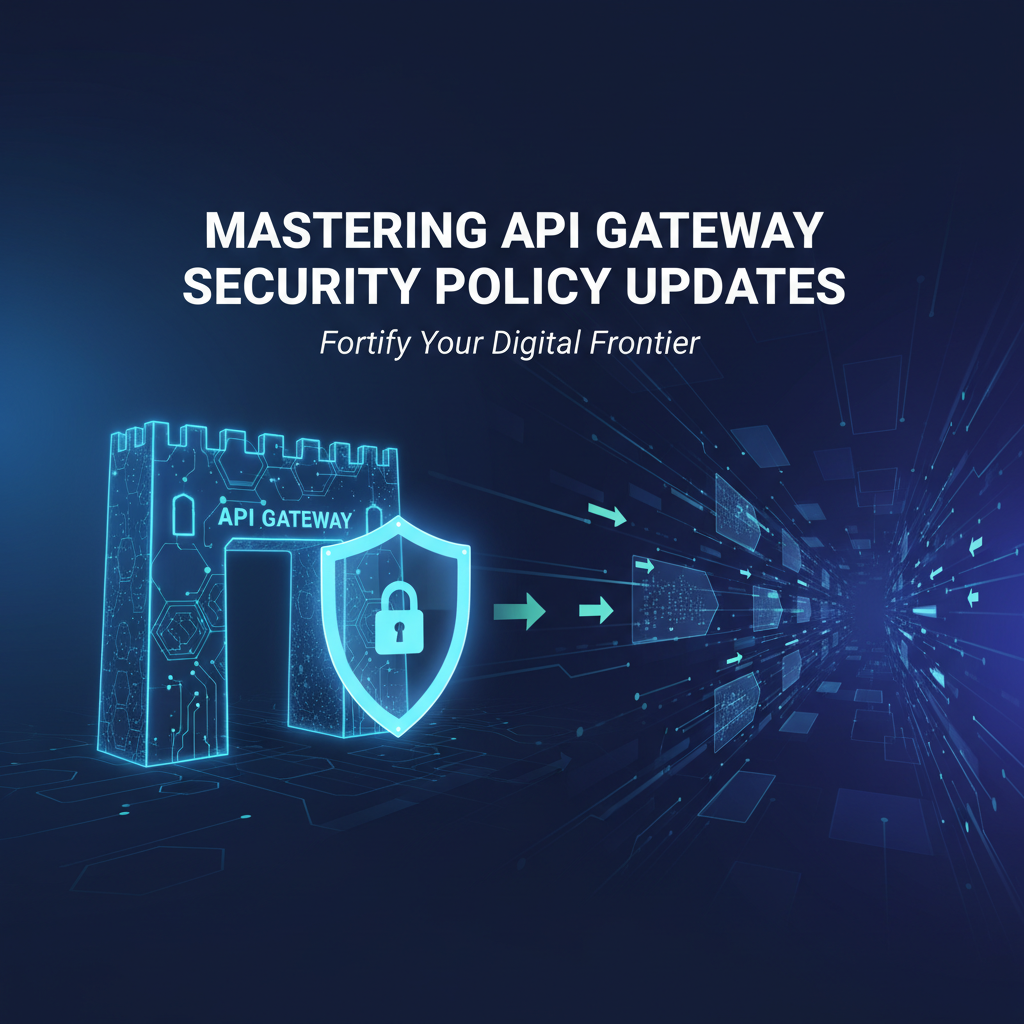


In the vast and interconnected landscape of the modern digital economy, Application Programming Interfaces (APIs) have emerged as the foundational building blocks, enabling seamless communication between disparate systems, powering innovative applications, and driving digital transformation across every industry imaginable. From mobile applications interacting with backend services to intricate microservices architectures exchanging data within enterprises, APIs are the very veins and arteries through which digital information flows. This omnipresence, however, casts a long shadow of responsibility, as securing these critical interfaces is not merely an optional best practice but an absolute imperative. The exposure of business logic, sensitive data, and core functionalities through APIs makes them prime targets for malicious actors seeking to exploit vulnerabilities, disrupt services, or exfiltrate valuable information.
At the vanguard of API security stands the api gateway – a crucial architectural component that acts as a single entry point for all API calls. It serves as a central enforcement point, intercepting requests, applying policies, and routing traffic to the appropriate backend services. More than just a traffic cop, an api gateway is the digital bouncer, security guard, and bouncer combined, meticulously vetting every incoming request to ensure it adheres to predefined rules before granting access. Its capabilities extend far beyond simple routing, encompassing essential functions like authentication, authorization, rate limiting, caching, and most critically, the enforcement of robust security policies.
However, the digital world is anything but static. The threat landscape evolves with breathtaking speed, new vulnerabilities are discovered daily, and compliance regulations are constantly updated. Consequently, the security policies enforced by an api gateway cannot remain stagnant. They require continuous, dynamic, and often urgent updates to adapt to emerging threats, accommodate new business requirements, and maintain an impregnable defense. Mastering these updates is not a trivial task; it demands a sophisticated understanding of security principles, meticulous planning, robust automation, and a strong commitment to proactive API Governance. This comprehensive guide will delve deep into the intricacies of mastering api gateway security policy updates, exploring the foundational principles, identifying common challenges, detailing best practices, and outlining the tools and strategies necessary to safeguard your digital ecosystem effectively.
The Evolving Threat Landscape and the Imperative for Dynamic Security
The necessity for dynamic api gateway security policy updates is directly correlated with the constantly shifting sands of the cybersecurity landscape. What might be considered secure today could become a critical vulnerability tomorrow, rendering static or infrequently updated policies dangerously obsolete. Understanding the nature of these evolving threats is the first step towards building a resilient defense mechanism.
One of the most prominent frameworks for understanding API vulnerabilities is the OWASP API Security Top 10. This list, periodically updated to reflect current attack vectors, highlights common weaknesses such as Broken Object Level Authorization, Broken User Authentication, Excessive Data Exposure, Lack of Resources & Rate Limiting, and Security Misconfiguration. Attackers are constantly probing these known vulnerabilities, developing sophisticated methods to exploit them. For instance, a change in an application's data model could inadvertently expose sensitive fields through an existing api, necessitating an immediate policy update to mask or restrict access to that data. Without dynamic policies, such an exposure could go unnoticed until a breach occurs.
Beyond known vulnerabilities, zero-day exploits pose a particularly insidious threat. These are vulnerabilities that are unknown to vendors and for which no patch or fix exists. When a zero-day is discovered and exploited, the window for defense is incredibly narrow. An api gateway with flexible policy update capabilities can be quickly configured to mitigate the impact of such exploits, perhaps by blocking specific request patterns, restricting access to affected endpoints, or imposing stricter rate limits while a permanent fix is being developed. This rapid response capability is a cornerstone of modern cybersecurity.
Moreover, the sheer volume and sophistication of automated attacks, such as credential stuffing, brute-force attempts, and distributed denial-of-service (DDoS) attacks, have escalated dramatically. Bots, often indistinguishable from legitimate users without advanced analysis, can overwhelm an api or attempt to compromise accounts at scale. Security policies related to rate limiting, bot detection, and anomaly flagging must be continuously fine-tuned and updated to counter these evolving tactics. A static rate limit, for example, might be effective against simple attacks but quickly circumvented by a more distributed or polymorphic botnet. Dynamic policies allow administrators to adjust thresholds, implement adaptive rate limiting based on observed behavior, or integrate with advanced threat intelligence feeds to block known malicious IP addresses or user agents in real-time.
Furthermore, compliance requirements from various regulatory bodies (e.g., GDPR, CCPA, HIPAA, PCI DSS) are not static. They are frequently updated or interpreted in new ways, necessitating corresponding adjustments to data handling, privacy, and access control policies enforced at the api gateway. Failure to adapt to these changes can result in severe legal penalties, reputational damage, and loss of customer trust. For example, a new privacy regulation might demand stronger data anonymization for specific data fields before they are exposed via an api, requiring an immediate policy update to transform or redact that data within the gateway before it reaches the consumer.
The integration of new technologies, the deployment of new microservices, and the evolution of existing applications also introduce new attack surfaces and operational complexities. Each new api endpoint, each new authentication mechanism, and each new data flow potentially introduces new risks. A robust API Governance strategy, therefore, must inherently include a mechanism for rapidly assessing these changes and updating api gateway policies accordingly. This constant state of flux underscores why static security policies are a relic of the past and why dynamic, agile, and continuously updated policies are an indispensable component of contemporary api security. Without this agility, an organization's digital perimeter remains perpetually vulnerable, waiting for the next sophisticated attack to find a chink in its outdated armor.
Understanding API Gateway Security Policies
To truly master api gateway security policy updates, one must first possess a thorough understanding of what an api gateway is and the diverse array of security policies it can enforce. An api gateway serves as the central orchestration point for all api traffic, abstracting backend services, providing a single point of entry, and delivering a consistent interface for consuming applications. Its primary functions include request routing, load balancing, caching, protocol translation, and aggregation. However, its role in security is arguably its most critical contribution.
The api gateway acts as a policy enforcement point (PEP), applying a set of rules and conditions to incoming requests before they reach the backend services. These security policies are the directives that dictate how requests are authenticated, authorized, transformed, and protected. They are the granular controls that allow organizations to define precisely who can access what, under what conditions, and with what level of assurance.
Let's delve into the various types of security policies commonly enforced by an api gateway:
- Authentication Policies: These policies verify the identity of the client making the api call. Without proper authentication, an api is open to anyone, making it an easy target for abuse. Common authentication mechanisms enforced by an api gateway include:
- API Keys: Simple tokens often used for basic client identification and rate limiting. Policies ensure keys are present, valid, and linked to authorized clients.
- OAuth 2.0: A widely adopted authorization framework that enables third-party applications to obtain limited access to an HTTP service, either on behalf of a resource owner or by orchestrating identity for the client. Policies handle token issuance, validation, and refresh.
- JSON Web Tokens (JWT): Compact, URL-safe means of representing claims between two parties. The api gateway validates the signature and claims within the JWT to ensure its integrity and authenticity.
- Mutual TLS (mTLS): A robust form of authentication where both the client and the server verify each other's digital certificates, establishing a cryptographically secured communication channel. Policies ensure valid client certificates are presented.
- Basic Authentication: Username and password sent Base64 encoded. While simpler, it's typically combined with TLS for security.
- Authorization Policies: Once a client's identity is authenticated, authorization policies determine what specific actions that client is permitted to perform and what resources it can access.
- Role-Based Access Control (RBAC): Assigns permissions based on a user's role within an organization (e.g., "admin," "user," "guest"). The api gateway checks the authenticated user's role against the required role for a specific api endpoint or operation.
- Attribute-Based Access Control (ABAC): Provides more granular control by using attributes associated with the user, resource, action, and environment. Policies can be highly dynamic, for example, "allow access to document X if user's department is 'finance' AND document status is 'approved'."
- Policy-Based Authorization: Leveraging external policy decision points (PDPs) that evaluate complex rulesets to grant or deny access.
- Rate Limiting and Throttling Policies: These policies protect backend services from being overwhelmed by excessive requests, whether accidental or malicious (e.g., DDoS attacks, brute-force attempts).
- Fixed Window: Limits the number of requests within a defined time window (e.g., 100 requests per minute).
- Sliding Window: More advanced, it tracks requests over a rolling time window, providing smoother traffic control.
- Token Bucket/Leaky Bucket: Algorithms that control the rate at which requests are processed, allowing for burst handling while maintaining an average rate.
- Policies can be applied globally, per api, per client, or per IP address.
- IP Whitelisting/Blacklisting: Simple but effective policies to restrict api access based on the source IP address. Whitelisting allows only specified IPs; blacklisting blocks specified malicious IPs.
- Web Application Firewall (WAF) Integrations: While some api gateways have built-in WAF capabilities, many integrate with dedicated WAFs to provide deeper inspection and protection against common web vulnerabilities like SQL injection, cross-site scripting (XSS), and command injection. Policies define which WAF rules are applied and how threats are handled (block, log, alert).
- Data Encryption and Transformation Policies: These policies ensure data security in transit and can also modify data payloads.
- TLS/SSL Enforcement: Mandates encrypted communication between the client and the api gateway, and often between the gateway and backend services, ensuring data confidentiality and integrity.
- Data Masking/Redaction: Policies to obscure or remove sensitive information (e.g., credit card numbers, PII) from api responses before they are sent to the client.
- Schema Validation: Policies that validate the structure and content of incoming request bodies and outgoing response bodies against a defined schema (e.g., OpenAPI/Swagger). This prevents malformed requests and ensures data consistency.
- Threat Protection Policies: Beyond WAF integration, specialized policies can detect and block specific types of threats:
- Content-Based Threat Detection: Inspecting request bodies for known malicious patterns (e.g., virus signatures, known exploit strings).
- OWASP API Security Top 10 Specific Policies: Policies designed to mitigate risks like mass assignment, broken function level authorization, or security misconfigurations.
- Policy Chaining and Orchestration: A sophisticated api gateway allows for the chaining of multiple policies, where requests pass through a sequence of checks. For example, a request might first be authenticated, then authorized, then have its rate checked, and finally undergo schema validation before being routed to the backend. The order of these policies is crucial and often configurable.
Understanding these diverse policy types is foundational. Each policy serves a specific purpose, contributing to the overall security posture of the api gateway. The challenge, and indeed the art, lies in effectively combining, configuring, and dynamically updating these policies to create an adaptive and robust defense mechanism that can respond swiftly to the ever-present and evolving threats targeting your digital assets. This granular control over api interactions is precisely what elevates an api gateway from a mere traffic router to a critical enforcer of API Governance.
The Lifecycle of API Gateway Security Policy Updates
Mastering api gateway security policy updates requires a structured, lifecycle-driven approach, much like software development. It's not a one-time configuration but a continuous process involving identification, design, testing, deployment, monitoring, and review. Each phase is critical to ensuring that updates are effective, introduce no new vulnerabilities, and seamlessly integrate into the existing infrastructure without causing disruptions.
1. Identification of Need
The initial phase is about recognizing why a policy update is necessary. This awareness often stems from a variety of sources:
- Threat Intelligence Monitoring: Proactive monitoring of cybersecurity bulletins, industry reports, and threat intelligence feeds (e.g., CISA alerts, OWASP updates) can reveal new attack vectors or vulnerabilities targeting specific technologies or api patterns. If a new critical vulnerability affecting JWTs is announced, it might necessitate an update to JWT validation policies within the gateway.
- Vulnerability Scanning and Penetration Testing Results: Regular security audits, vulnerability scans, and penetration tests of your apis and infrastructure are invaluable. Findings from these assessments, such as exposed endpoints, improper authorization checks, or configuration weaknesses, directly translate into specific policy update requirements. For instance, a pen test might reveal that an api endpoint allows access to sensitive data without sufficient authorization, requiring a new RBAC policy at the gateway.
- New Compliance and Regulatory Requirements: Legal and industry-specific regulations (e.g., GDPR, CCPA, HIPAA, PCI DSS) are dynamic. Updates or clarifications to these mandates may require immediate adjustments to data handling, privacy, consent, or access control policies. If a new regulation demands stronger anonymization for customer data, the api gateway might need a policy to mask specific fields in responses.
- Application Updates and New Features: As development teams release new application features or update existing ones, new api endpoints may be introduced, existing ones modified, or data models changed. These changes can inadvertently introduce new security risks or necessitate new policies to protect the updated functionalities. A new api for financial transactions, for example, will require stringent authentication, authorization, and rate limiting policies that did not exist before.
- Performance Optimization Needs: While primarily a security concern, some policy updates might be driven by performance needs. Inefficient policies can introduce latency. Identifying these bottlenecks through performance monitoring can lead to refining policy logic or offloading certain checks.
- Incident Response and Post-Mortem Analysis: Following a security incident, the post-mortem analysis often reveals gaps in existing security policies or identifies new types of attacks that were not adequately covered. These findings directly inform subsequent policy updates to prevent recurrence.
2. Policy Definition/Design
Once the need is identified, the next step is to design or modify the specific security policy. This phase requires careful thought and collaboration:
- Collaborative Approach: Security policy design should not be siloed. It requires close collaboration between security architects, development teams (who understand the api's functionality), and operations teams (who understand the gateway's deployment and performance implications). This ensures policies are effective, feasible, and don't break existing functionalities.
- Policy-as-Code Principles: Embracing Policy-as-Code (PaC) is a crucial best practice. Treat security policies like application code: define them in declarative languages (e.g., YAML, JSON, or domain-specific languages), store them in version control systems (e.g., Git), and subject them to peer review. This approach enhances consistency, auditability, and automation.
- Granular and Targeted Design: Policies should be as granular as possible, targeting specific apis, endpoints, or data elements. Avoid broad, sweeping policies that might have unintended side effects. For example, instead of a global rate limit, define specific limits per api based on its criticality and expected traffic.
- Versioning of Policies: Just like any software component, security policies must be versioned. This allows for clear tracking of changes, facilitates rollbacks if issues arise, and supports different policy sets for various environments (e.g., staging vs. production).
3. Testing and Validation
A new or updated security policy must undergo rigorous testing before it is deployed to production. Rushing this phase can lead to broken functionalities, performance degradation, or even new security gaps.
- Unit Tests for Individual Policies: Test each policy in isolation to ensure its logic is sound and it behaves as expected under various conditions (e.g., valid requests, invalid requests, edge cases).
- Integration Tests within the API Gateway Environment: Deploy the updated policy to a non-production api gateway instance (e.g., a staging or UAT environment) that mirrors production as closely as possible. Run a comprehensive suite of functional and integration tests against all affected apis to ensure the policy enforces security without breaking legitimate traffic or introducing regressions.
- Performance Testing: Security policies, especially those involving complex logic or deep packet inspection, can introduce overhead. Performance tests are crucial to ensure that the updated policies do not negatively impact the latency, throughput, or resource utilization of the api gateway.
- Security Testing (Negative Testing/Penetration Testing): Actively try to bypass or break the new policy. This includes negative testing (sending invalid or malicious requests that should be blocked) and even mini-penetration tests specifically targeting the updated policy. This ensures the policy truly provides the intended protection.
- Rollback Plan Validation: Part of testing involves validating the rollback procedure. Can the previous policy version be quickly and cleanly restored if the new one causes unforeseen issues?
4. Deployment Strategies
Deploying security policy updates to production requires strategic planning to minimize risk and ensure continuity of service.
- Phased Rollouts (Canary Deployments/Blue/Green Deployments): Instead of a big-bang deployment, consider phased rollouts.
- Canary Deployment: Route a small percentage of live traffic to the api gateway instance with the new policies. Monitor closely. If all looks good, gradually increase the traffic percentage. This limits the blast radius of any issues.
- Blue/Green Deployment: Maintain two identical production environments ("blue" and "green"). Deploy the new policies to one environment (e.g., "green"), test it with live traffic (or synthetic traffic), and once confident, switch all incoming traffic to the "green" environment. The "blue" environment acts as an immediate rollback option.
- Automated CI/CD Pipelines: Integrate policy updates into existing Continuous Integration/Continuous Delivery (CI/CD) pipelines. This ensures that updates are deployed consistently, automatically, and with reduced human error. The pipeline can include steps for policy validation, testing, and deployment to various environments.
- Rollback Plans and Procedures: Always have a clear, well-documented rollback plan. In case of unexpected issues, the ability to quickly revert to a previous stable policy version is paramount. This should be a practiced procedure, not just a theoretical one.
5. Monitoring and Review
Deployment is not the end of the lifecycle; it's the beginning of continuous vigilance.
- Real-time Logging and Alerting: Implement robust logging of all policy enforcement events (e.g., blocks, allows, transformations, errors). Integrate this with a real-time alerting system to notify relevant teams immediately if policies are behaving unexpectedly or if a high volume of blocks indicates an attack or a misconfiguration.
- Performance Impact Analysis: Continuously monitor the performance metrics of the api gateway after a policy update. Look for changes in latency, CPU utilization, memory consumption, and error rates.
- Regular Audits and Reviews: Periodically review the effectiveness of existing policies. Are they still relevant? Are there better ways to achieve the same security goal? Are there any redundant or conflicting policies? This proactive review helps maintain an optimal security posture.
- Feedback Loop: The insights gained from monitoring and review should feed back into the "Identification of Need" phase, creating a continuous improvement loop. An anomaly detected during monitoring might reveal a new threat, leading to the need for a new policy update, thus completing the cycle.
By meticulously following these lifecycle phases, organizations can ensure that their api gateway security policies remain current, effective, and responsive to the dynamic demands of securing their valuable apis, all within a well-defined framework of API Governance. This systematic approach minimizes risks, enhances agility, and reinforces trust in the digital services being provided.
Key Challenges in Managing Security Policy Updates
While the benefits of dynamic api gateway security policies are undeniable, the process of managing their updates is fraught with challenges. These obstacles can hinder agility, introduce new risks, or lead to operational inefficiencies if not addressed proactively. Understanding these challenges is the first step toward developing robust strategies to overcome them.
- Complexity and Scale: Modern enterprises often manage hundreds, if not thousands, of apis, each potentially with unique security requirements. Defining, testing, and deploying policies for such a vast and diverse api landscape can quickly become an overwhelming task. A single change in a common policy component could have cascading effects across numerous apis, making impact analysis incredibly complex. The sheer volume of policies, combined with their intricate interdependencies, makes manual management prone to errors and delays.
- Integration with Existing Systems and Ecosystems: API gateways often operate within complex IT environments that include legacy systems, multiple identity providers, diverse microservices, and various security tools. Ensuring that new or updated security policies integrate seamlessly with these disparate systems, without disrupting existing workflows or creating authentication/authorization conflicts, is a significant challenge. For instance, a new authorization policy might require integration with a new identity management system, which itself might have its own set of complexities.
- Maintaining Agility vs. Security: One of the perennial tensions in software development is balancing speed with security. Development teams aim for rapid iteration and deployment, while security teams prioritize thorough vetting and risk mitigation. Striking the right balance when updating api gateway policies is crucial. Overly cautious or manual policy update processes can become a bottleneck, slowing down innovation. Conversely, hasty updates can introduce critical vulnerabilities or break production systems. The challenge lies in enabling rapid, automated policy updates without compromising the integrity of the security posture.
- Lack of Standardized Processes and Tooling: In many organizations, the process for updating security policies can be ad-hoc, varying between teams or even individual engineers. This lack of standardization leads to inconsistencies, makes auditing difficult, and increases the likelihood of human error. Without integrated tooling that supports the entire policy lifecycle – from definition to deployment and monitoring – organizations struggle to achieve efficiency and reliability. Disparate tools for policy definition, version control, testing, and deployment exacerbate the problem.
- Visibility and Observability: After deploying a policy update, understanding its real-time impact on api traffic, performance, and security posture is critical. However, achieving comprehensive visibility and observability can be challenging. Generic logging might not provide enough context, and integrating data from various sources (gateway logs, application logs, security information and event management (SIEM) systems) to form a coherent picture requires sophisticated infrastructure. Without clear insights, detecting misconfigurations or identifying new attack patterns against updated policies becomes exceedingly difficult.
- Team Collaboration and Skill Gaps: Effective api gateway security policy management requires a multidisciplinary approach involving security engineers, developers, operations personnel, and compliance officers. Bridging the communication gap between these teams, each with its own priorities and technical language, can be challenging. Furthermore, there's often a skill gap in teams regarding advanced api gateway policy languages, security architecture principles, and automated security practices. This can lead to policies that are either overly restrictive, too permissive, or simply incorrect.
- Testing Effectiveness: Designing comprehensive and effective tests for security policy updates is inherently difficult. It's not enough to ensure legitimate traffic passes; one must also rigorously test that malicious or unauthorized traffic is definitively blocked. This requires extensive negative testing, edge-case analysis, and sometimes specialized security testing tools. The risk of "false negatives" (malicious traffic passing through) or "false positives" (legitimate traffic being blocked) is high if testing is inadequate.
- Managing Configuration Drift: In environments with multiple api gateway instances or environments (development, staging, production), ensuring that security policies remain consistent across all of them is a constant battle. Manual updates or inadequate automation can lead to "configuration drift," where policies in one environment diverge from others. This can result in unexpected behavior, security vulnerabilities in specific environments, and difficulties in troubleshooting.
Addressing these challenges necessitates a holistic approach that combines robust processes, advanced tooling, a culture of collaboration, and a continuous commitment to learning and adaptation. Ignoring them can lead to significant security breaches, operational inefficiencies, and a loss of trust in the digital services offered.
APIPark is a high-performance AI gateway that allows you to securely access the most comprehensive LLM APIs globally on the APIPark platform, including OpenAI, Anthropic, Mistral, Llama2, Google Gemini, and more.Try APIPark now! 👇👇👇
Best Practices for Mastering API Gateway Security Policy Updates
Mastering api gateway security policy updates requires more than just technical know-how; it demands a strategic, disciplined, and proactive approach. By adopting a set of best practices, organizations can transform a daunting task into a streamlined, secure, and efficient process, significantly bolstering their overall api security posture.
1. Embrace Comprehensive API Governance
The foundational best practice is to establish and enforce robust API Governance across the entire organization. API Governance is not just about security; it's a holistic framework that encompasses the design, development, deployment, versioning, security, monitoring, and deprecation of all APIs. For security policy updates, good governance means: * Defined Standards: Clear, documented standards for API design, security requirements, and policy definitions. * Centralized Oversight: A dedicated team or committee responsible for overseeing API strategy and ensuring compliance with governance policies. * Lifecycle Management: Integrating security from the earliest stages of API design through to its retirement. * Enforcement Mechanisms: Tools and processes to ensure that governance policies, including security policies, are actually enforced across the API landscape.
A strong API Governance strategy ensures that security policy updates are not ad-hoc reactions but rather integral parts of a well-orchestrated and continuously improving system.
2. Implement Policy-as-Code (PaC)
Treating security policies like any other piece of critical software code is paramount. Policy-as-Code involves: * Declarative Definitions: Defining policies using declarative languages (e.g., YAML, JSON, OPA's Rego, or domain-specific languages) that are human-readable and machine-executable. * Version Control: Storing all policy definitions in a version control system (like Git). This enables tracking changes, auditing who made what change when, facilitating peer reviews, and providing a clear history for rollbacks. * Peer Review: Subjecting policy changes to review by security experts, developers, and operations teams before deployment. This catches errors, improves policy quality, and fosters shared ownership. * Automated Testing: Integrating automated tests for policies into CI/CD pipelines, as discussed below.
PaC significantly reduces manual errors, improves consistency, and accelerates the policy update process while enhancing auditability.
3. Automate Policy Updates with CI/CD Pipelines
Manual policy updates are slow, error-prone, and unsustainable at scale. Integrating policy updates into automated Continuous Integration/Continuous Delivery (CI/CD) pipelines is essential for agility and reliability: * Automated Validation: The pipeline should automatically lint, parse, and validate the syntax and basic logic of new policies. * Automated Testing: Run unit, integration, and security tests automatically as part of the pipeline. * Automated Deployment: Deploy policies to development, staging, and production environments in a controlled, automated manner. * Rollback Mechanism: The pipeline should include automated rollback capabilities to quickly revert to a previous stable state if a deployed policy causes issues.
This automation not only speeds up deployment but also ensures consistency and reduces human intervention, minimizing the risk of misconfiguration.
4. Granular Policy Definition and the Principle of Least Privilege
Avoid monolithic, overly broad security policies. Instead: * Granular Policies: Define specific policies for specific apis, endpoints, or even individual operations. For example, a "read" operation might have different authorization requirements than a "write" operation on the same resource. * Least Privilege: Apply the principle of least privilege, meaning that any user, application, or service should only be granted the minimum necessary permissions to perform its intended function. Regularly review and trim unnecessary permissions. This limits the blast radius if an account is compromised.
Granularity allows for more precise control and reduces the likelihood of unintended side effects when policies are updated.
5. Implement a Robust Testing Regimen
Thorough testing is non-negotiable for security policy updates: * Unit Testing: Test individual policy components or rules to ensure their logic is correct. * Integration Testing: Verify that policies interact correctly with each other and with the api gateway's core functionalities in a simulated or staging environment. * Performance Testing: Measure the impact of new policies on the gateway's latency, throughput, and resource consumption. * Security Testing (Negative Testing): Actively attempt to bypass or exploit the new policies using malicious inputs, unauthorized access attempts, and other attack vectors. This is critical for validating policy effectiveness. * Regression Testing: Ensure that new policy updates do not inadvertently break existing functionalities or reintroduce old vulnerabilities.
Automate as much of this testing as possible within your CI/CD pipeline.
6. Centralized Policy Management and Consistency
Managing policies across multiple api gateway instances, environments, and even different types of gateways can become chaotic. * Centralized Platform: Leverage a centralized platform for defining, storing, and deploying all api gateway security policies. This ensures a single source of truth and consistency across your infrastructure. * Configuration Management: Use tools that can enforce consistent configurations and policies across all gateway instances, preventing configuration drift.
Platforms like APIPark, an open-source AI gateway and API management platform, offer comprehensive features for end-to-end API Governance, including centralized policy definition, management of access permissions for each tenant, and end-to-end API lifecycle management, ensuring consistency and ease of updates across diverse API landscapes. This approach significantly streamlines the complexity of managing security policies for a large number of APIs.
7. Real-time Monitoring and Alerting
Deployment is just one step; continuous monitoring is essential: * Detailed Logging: Configure the api gateway to produce comprehensive logs of all policy enforcement actions (e.g., successful authentications, authorization failures, rate limit blocks, WAF alerts). * Real-time Monitoring Tools: Integrate logs with monitoring systems (e.g., ELK Stack, Splunk, Prometheus/Grafana) to visualize trends, detect anomalies, and track policy effectiveness. * Automated Alerting: Set up alerts for critical events, such as a sudden spike in authorization failures, an unusually high number of blocked requests from a specific IP, or performance degradation. This enables proactive response to potential issues or attacks.
8. Regular Audits and Compliance Checks
Security policies are not "set and forget." * Scheduled Audits: Conduct regular audits of your api gateway policies to ensure they are still relevant, effective, and aligned with current security best practices and business requirements. * Compliance Validation: Periodically verify that your policies meet all applicable regulatory and industry compliance standards (e.g., GDPR, HIPAA, PCI DSS). * Policy Review: Engage security experts to review the logic and configuration of critical policies for potential weaknesses or misconfigurations.
9. Foster a Security-Aware Culture and Team Collaboration
Security is a shared responsibility. * Cross-Functional Teams: Encourage collaboration between security, development, and operations teams throughout the policy update lifecycle. * Training and Education: Provide regular training on api security best practices, emerging threats, and the proper use of api gateway policy management tools. Empower teams to understand the security implications of their work.
10. Implement Blue/Green or Canary Deployment for Policies
To minimize the risk associated with deploying new policies: * Blue/Green Deployment: Maintain two identical production environments. Deploy new policies to one (green), thoroughly test it, and then switch all traffic. If issues arise, switch back to the old (blue) environment immediately. * Canary Release: Roll out new policies to a small subset of your users or traffic first. Monitor its performance and security impact closely. If stable, gradually expand the rollout.
These strategies allow for rapid rollbacks and limit the blast radius of any unforeseen problems.
By diligently applying these best practices, organizations can move beyond reactive security measures to a proactive, integrated, and highly effective approach to managing api gateway security policy updates, ultimately strengthening their entire api ecosystem.
Tools and Technologies Facilitating Policy Updates
The effective management of api gateway security policy updates is significantly enhanced by leveraging the right set of tools and technologies. These tools automate processes, provide visibility, ensure consistency, and integrate security into the development and operations workflow. They range from the api gateway itself to sophisticated CI/CD platforms and monitoring solutions.
- API Gateways: At the core, the api gateway is the enforcement point for policies. Modern gateways offer rich capabilities for defining and applying security rules.
- Kong Gateway: An open-source, highly performant gateway that supports a wide range of plugins for authentication, authorization, traffic control, and security policies. Its declarative configuration (often in YAML) lends itself well to Policy-as-Code.
- Apigee (Google Cloud): A comprehensive api management platform with robust security features, including advanced threat protection, OAuth 2.0 support, and configurable policies for traffic management and access control.
- AWS API Gateway: A fully managed service that provides strong integration with other AWS services, enabling granular access control policies via IAM, WAF integration, and custom authorizers (e.g., Lambda functions for JWT validation).
- Azure API Management: Similar to Apigee and AWS, offering comprehensive api management, including security policies, caching, and analytics, integrated with Azure security services.
- Nginx/Envoy Proxy: While often used as reverse proxies or service meshes, they can be configured with powerful scripting capabilities (e.g., Lua for Nginx) or filter chains (for Envoy) to implement various security policies at the edge or within a service mesh.
- APIPark: As an open-source AI gateway and API management platform, APIPark provides not only quick integration of 100+ AI models but also robust features for end-to-end API lifecycle management. This includes regulating API management processes, managing traffic forwarding, load balancing, and crucially, enforcing independent API and access permissions for each tenant through flexible security policies. Its capability for detailed API call logging and powerful data analysis directly supports monitoring the effectiveness and impact of policy updates, ensuring both security and optimal performance.
- Configuration Management Tools: These tools help maintain consistency across multiple api gateway instances and environments.
- Ansible, Puppet, Chef: Used to define and apply configurations, including api gateway policy files, across entire infrastructures. They ensure that policies are deployed uniformly and prevent configuration drift.
- Terraform (HashiCorp): An Infrastructure-as-Code (IaC) tool that can provision and manage api gateway resources and their associated policies as code, allowing for version control, automation, and consistent deployments. Cloud-specific IaC tools like AWS CloudFormation or Azure Resource Manager serve similar purposes.
- CI/CD Platforms: These platforms automate the entire software delivery pipeline, including the testing and deployment of api gateway policies.
- Jenkins: A highly extensible automation server that can orchestrate complex CI/CD pipelines for policy validation, testing, and deployment.
- GitLab CI/CD: Built directly into GitLab, it provides a comprehensive platform for version control, CI/CD, and security scanning, making it ideal for managing Policy-as-Code.
- GitHub Actions: Allows for powerful custom workflows to automate CI/CD processes directly within GitHub repositories, perfect for integrating policy development with code repositories.
- API Management Platforms: Beyond basic gateways, these platforms provide a holistic approach to managing the entire api lifecycle, making security policy updates a part of a larger governance strategy. Many of the listed gateways are part of broader API management solutions.
- APIPark is a prime example, providing a unified management system not just for AI models but also for general API lifecycle management. Its features like 'API Resource Access Requires Approval' and 'Independent API and Access Permissions for Each Tenant' highlight its strong governance capabilities, directly supporting the secure and controlled updating of policies. This platform streamlines the process of defining, deploying, and enforcing security policies, making it easier to manage, integrate, and secure both AI and REST services.
- Security Testing Tools: Tools specifically designed to test the robustness of security policies.
- OWASP ZAP (Zed Attack Proxy): An open-source web application security scanner that can be used to find vulnerabilities in web applications and APIs, including testing the effectiveness of WAF and authorization policies.
- Burp Suite: A popular commercial tool for penetration testers, offering a comprehensive set of tools for manual and automated security testing of web applications and APIs.
- Postman/Insomnia: While primarily for api development and testing, they can be used for negative testing by crafting malicious or unauthorized requests to validate policy enforcement.
- Monitoring and Logging Systems: Essential for observing the real-time impact and effectiveness of policy updates.
- ELK Stack (Elasticsearch, Logstash, Kibana): A popular open-source stack for collecting, parsing, storing, and visualizing logs from api gateways and other components.
- Splunk: A powerful commercial platform for searching, monitoring, and analyzing machine-generated big data, including security logs and performance metrics.
- Prometheus and Grafana: Prometheus is a monitoring system with a flexible query language, and Grafana is a visualization tool. Together, they are excellent for monitoring api gateway performance metrics and policy-related events.
- Policy Decision Points (PDP) and Policy Enforcement Points (PEP): For highly complex or dynamic authorization policies, external PDPs can be integrated.
- Open Policy Agent (OPA): An open-source, general-purpose policy engine that can be used to enforce policies for microservices, Kubernetes, api gateways, and more. Policies are written in Rego language, allowing for centralized policy management and decision-making decoupled from the application logic.
By strategically combining these tools, organizations can build a robust, automated, and observable pipeline for managing api gateway security policy updates, transforming what was once a manual burden into an agile and secure process. The synergy between these technologies, particularly with comprehensive platforms like APIPark that manage the full api lifecycle, empowers organizations to maintain an advanced and adaptive security posture.
The Future of API Gateway Security Policy Management
The trajectory of api gateway security policy management is rapidly evolving, driven by advancements in artificial intelligence, the increasing complexity of cloud-native architectures, and an unyielding focus on proactive security. The future promises more intelligent, automated, and adaptive defense mechanisms that will further enhance API Governance.
- AI and Machine Learning for Predictive Threat Detection and Adaptive Policies: This is perhaps the most transformative area. Future api gateways will increasingly integrate AI and ML models to move beyond static rule-based policies.
- Predictive Analytics: ML algorithms will analyze vast datasets of historical traffic patterns, attack signatures, and security incidents to predict potential threats before they materialize. This could involve identifying emerging attack campaigns or zero-day exploit attempts based on subtle anomalies in traffic.
- Adaptive Rate Limiting and Bot Detection: AI will enable api gateways to dynamically adjust rate limits, identify sophisticated bots, and differentiate between legitimate and malicious traffic in real-time, based on behavioral analytics rather than just IP addresses or user agents.
- Automated Policy Generation and Optimization: Imagine an api gateway that can learn from observed traffic patterns and automatically suggest new security policies or optimize existing ones to enhance security without hindering legitimate usage. For example, if a new api endpoint is deployed, AI could analyze its traffic and propose appropriate authentication and authorization policies.
- Zero Trust Architectures as the Default: The principle of "never trust, always verify" will become even more ingrained. Every api request, regardless of its origin (internal or external), will be explicitly authenticated and authorized.
- Continuous Authentication: User and service identities will be continuously verified throughout their session, not just at the initial login. This might involve evaluating contextual factors like device posture, location, and behavioral biometrics.
- Micro-segmentation: Policies will enforce highly granular access controls, segmenting networks down to individual apis or even specific api operations, limiting lateral movement for attackers.
- Identity-First Security and Contextual Access Management: The focus will shift even more heavily towards identity as the primary control plane.
- Rich Identity Context: Policies will leverage a richer set of identity attributes (user role, department, project, device, network, time of day, geographic location, etc.) to make highly dynamic and context-aware access decisions. This moves beyond simple RBAC to more sophisticated ABAC and policy-based authorization.
- Centralized Identity Fabrics: Organizations will adopt centralized identity management systems that feed comprehensive identity context to api gateways and other security enforcement points.
- Service Mesh Integration and Decentralized Policy Enforcement: As microservices architectures become standard, service meshes (like Istio, Linkerd, or Consul Connect) will play an increasing role in policy enforcement.
- Policies Closer to the Service: While api gateways manage edge traffic, service meshes will enforce granular security policies (mTLS, authorization, rate limiting) between individual microservices within the internal network, ensuring east-west traffic is as secure as north-south traffic.
- Unified Policy Management: The challenge will be to manage policies consistently across both the external api gateway and the internal service mesh, potentially through a unified control plane or a common policy language like OPA.
- API Security as a Service (ASaaS) and Cloud-Native Security:
- Managed Security Offerings: More vendors will offer specialized, cloud-native api security services that integrate seamlessly with existing api gateways and cloud platforms, providing advanced threat detection, vulnerability management, and policy enforcement as a managed service.
- Security by Design in Cloud-Native Gateways: Cloud providers will continue to enhance their native api gateway offerings with deeper security integrations, making it easier to embed security policies directly into cloud infrastructure.
- Enhanced API Governance Frameworks with Automated Enforcement:
- Automated Policy Remediation: Governance frameworks will evolve to not only define policies but also to automatically detect deviations and initiate remediation actions. For example, if an api is deployed without a required security policy, the system could automatically block it or apply a default, secure policy.
- Policy Orchestration Across Diverse Gateways: As organizations use multiple api gateway solutions (e.g., a cloud-native gateway for some services, an open-source gateway like APIPark for others), future governance frameworks will provide unified orchestration layers to manage policies consistently across this heterogeneous landscape. This ensures a consistent security posture regardless of the underlying gateway technology.
The future of api gateway security policy management is one of increasing intelligence, automation, and integration. It aims to create self-healing, self-optimizing security perimeters around apis, capable of responding to threats faster than human operators, and ensuring that API Governance is not just a set of guidelines but an actively enforced and continuously adapting reality. Organizations that embrace these emerging trends will be best positioned to protect their digital assets and sustain trust in an increasingly api-driven world.
Conclusion
The digital economy runs on APIs, making the api gateway the indispensable sentinel guarding the integrity and security of modern enterprises. As the frontline enforcer of security, its policies are the bedrock of protection against an ever-evolving barrage of cyber threats. Mastering api gateway security policy updates is, therefore, not merely a technical task but a strategic imperative, a continuous commitment to safeguarding the vital digital arteries of an organization.
We have traversed the complex landscape of api gateway security, from understanding the diverse policy types—authentication, authorization, rate limiting, and threat protection—to navigating the intricate lifecycle of updates, encompassing identification, design, rigorous testing, strategic deployment, and vigilant monitoring. The journey reveals that challenges such as complexity at scale, integration hurdles, balancing agility with security, and skill gaps are inherent but surmountable.
The path to mastery lies in the diligent application of best practices: embracing a comprehensive API Governance framework, treating policies as code, automating updates through robust CI/CD pipelines, defining granular and least-privilege policies, and implementing an exhaustive testing regimen. Crucially, centralized policy management, continuous real-time monitoring, and regular audits form the pillars of ongoing vigilance. Solutions like APIPark, an open-source AI gateway and API management platform, exemplify how modern platforms facilitate this mastery by providing end-to-end API lifecycle management, centralized policy definition, and robust security features crucial for effective API Governance.
Looking ahead, the horizon of api gateway security is illuminated by the promise of AI-driven adaptive policies, the pervasive adoption of Zero Trust architectures, and a deeper integration with service meshes for decentralized enforcement. These innovations promise a future where security policies are not just reactive but predictive, not just static but intelligently adaptive, capable of defending against threats with unprecedented speed and precision.
In essence, mastering api gateway security policy updates is about building resilience, fostering agility, and instilling confidence in your digital services. It’s about creating a dynamic defense mechanism that is as agile and intelligent as the threats it seeks to repel. By embracing the principles and practices outlined in this guide, organizations can move beyond merely reacting to security incidents to proactively shaping a secure and robust api ecosystem, ensuring the continued trust and success of their digital ventures in an api-first world.
Frequently Asked Questions (FAQs)
1. What is an API Gateway and why is its security policy crucial?
An api gateway acts as a single entry point for all API requests, providing a unified interface to backend services. Its security policy is crucial because it serves as the primary enforcement point for authentication, authorization, rate limiting, and threat protection, safeguarding sensitive data and business logic exposed via apis from various attacks and unauthorized access. Without robust and up-to-date policies, the gateway becomes a single point of failure, leaving the entire api ecosystem vulnerable.
2. What are the main types of security policies enforced by an API Gateway?
API gateways enforce a variety of security policies including: * Authentication: Verifying client identity (e.g., API Keys, OAuth2, JWT, mTLS). * Authorization: Determining what an authenticated client can access or do (e.g., RBAC, ABAC). * Rate Limiting/Throttling: Preventing abuse or overload by restricting request volumes. * IP Whitelisting/Blacklisting: Controlling access based on source IP addresses. * Threat Protection: Guarding against common web vulnerabilities (e.g., SQL Injection, XSS) often through WAF integration or specific policy rules. * Data Transformation/Masking: Modifying api responses to protect sensitive data. * Schema Validation: Ensuring request and response data conforms to defined schemas.
3. Why are dynamic updates to API Gateway security policies necessary?
Dynamic updates are necessary because the cybersecurity threat landscape is constantly evolving. New vulnerabilities emerge, attack vectors become more sophisticated, and compliance regulations frequently change. Static policies quickly become obsolete, leaving apis exposed. Dynamic updates allow organizations to rapidly adapt to new threats, mitigate zero-day exploits, respond to compliance changes, and secure new api endpoints introduced by application updates, maintaining a proactive and effective defense.
4. What are the biggest challenges in managing API Gateway security policy updates?
Key challenges include: * Complexity and Scale: Managing policies across a large number of diverse apis. * Integration: Ensuring seamless operation with existing legacy systems and diverse identity providers. * Balancing Agility and Security: Rapidly deploying updates without compromising thorough vetting. * Lack of Standardization: Inconsistent processes leading to errors and delays. * Visibility: Difficulty in monitoring the real-time impact and effectiveness of updated policies. * Team Collaboration and Skill Gaps: Bridging communication and knowledge gaps between security, development, and operations teams.
5. How does API Governance relate to API Gateway security policy updates?
API Governance provides the overarching framework for managing the entire api lifecycle, including its security. It establishes standards, processes, and oversight to ensure that all apis adhere to defined policies, including security. In the context of api gateway security policy updates, strong API Governance ensures that updates are not ad-hoc but part of a structured, consistent, and continuously improving process. It mandates Policy-as-Code, automated CI/CD pipelines for policies, regular audits, and cross-functional collaboration, making security an intrinsic part of api development and operation. Tools like APIPark can play a significant role in enforcing this governance by providing centralized management and control over API resources and security settings.
🚀You can securely and efficiently call the OpenAI API on APIPark in just two steps:
Step 1: Deploy the APIPark AI gateway in 5 minutes.
APIPark is developed based on Golang, offering strong product performance and low development and maintenance costs. You can deploy APIPark with a single command line.
curl -sSO https://download.apipark.com/install/quick-start.sh; bash quick-start.sh

In my experience, you can see the successful deployment interface within 5 to 10 minutes. Then, you can log in to APIPark using your account.

Step 2: Call the OpenAI API.