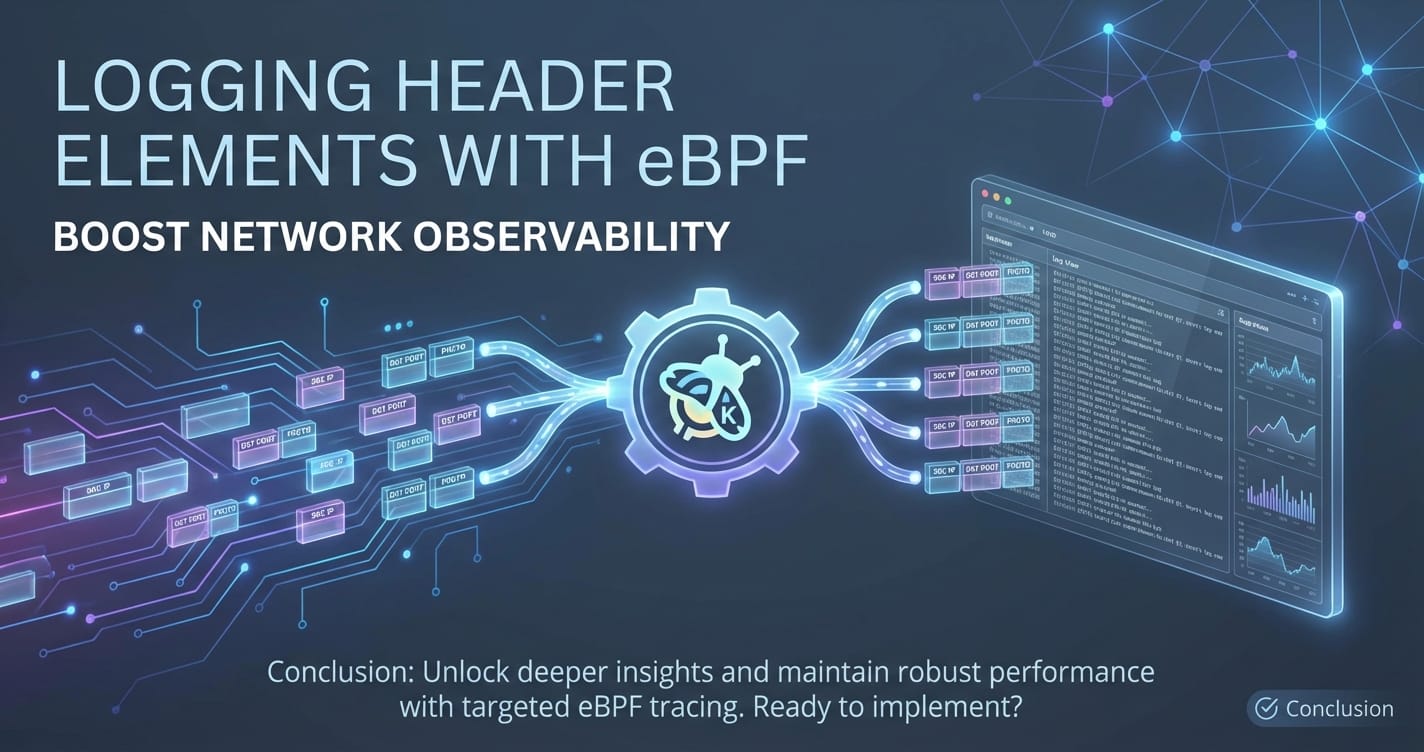
Logging Header Elements with eBPF: Boost Network Observability


The digital world thrives on communication, and at the heart of this intricate web lie network packets, diligently ferrying data between applications, services, and users. In an era dominated by microservices, containers, and serverless architectures, the sheer volume and velocity of this network traffic present both immense opportunity and significant challenges for observability. Traditional monitoring tools often scratch the surface, providing high-level metrics but leaving critical blind spots when deep-seated issues arise. This article delves into a revolutionary approach to boost network observability: leveraging Extended Berkeley Packet Filter (eBPF) to meticulously log header elements. This advanced technique offers an unprecedented granular view into the fabric of network communications, proving indispensable for debugging, security auditing, and performance optimization, particularly for operations involving an api gateway, individual api calls, and the intricate interactions across a distributed gateway infrastructure.
Modern applications are no longer monolithic giants; they are finely tuned orchestrations of smaller, independent services communicating over networks. This paradigm shift, while offering unparalleled agility and scalability, introduces a new layer of complexity to understanding how data flows and why issues occur. When an api request fails or latency spikes, the journey of that packet across multiple service boundaries, load balancers, and potentially an api gateway becomes a black box without adequate tools. HTTP headers, often overlooked in the summary metrics, contain a treasure trove of information – from authentication tokens and tracing IDs to user agents and content types – all critical for diagnosing problems, understanding user behavior, and enforcing security policies. By tapping into the kernel's very core with eBPF, we unlock the ability to inspect these header elements with minimal overhead, transforming opaque network interactions into transparent, actionable insights. This granular visibility is not just a luxury; it's a fundamental requirement for maintaining robust, performant, and secure distributed systems in today's demanding digital landscape.
The Evolving Landscape of Network Observability: Beyond the Surface
In the nascent days of networking, observing traffic was a relatively straightforward affair. Packet sniffers and basic logging provided sufficient insight into the limited number of network interactions within a monolithic application. However, the architectural shifts of the past decade have profoundly redefined what constitutes adequate network observability. The rise of cloud-native computing, characterized by containerization, microservices, and serverless functions, has fragmented application logic into thousands of ephemeral processes, each communicating over a dynamic and often encrypted network. This transformation has rendered traditional observability tools and methodologies increasingly inadequate, creating significant gaps in our understanding of network behavior.
One of the primary challenges stems from the sheer volume and ephemeral nature of network interactions. A single user request might traverse dozens of microservices, each interacting with others, leading to an explosion of inter-service communication. Tracing the path of a single request through this labyrinthine network using conventional logs from individual services or application performance monitoring (APM) agents can be a Herculean task. These tools often incur significant overhead, require extensive application-level instrumentation, and may not capture the low-level network details necessary for pinpointing elusive issues. For instance, an api gateway, while providing crucial aggregation and routing functions, typically logs request and response details at the application layer, post-processing. While immensely valuable, this perspective doesn't fully expose the intricacies of what happens at the very network interface, before the request even reaches the gateway's processing pipeline, or how specific low-level network conditions might be impacting the api's performance.
Furthermore, the proliferation of encrypted traffic (SSL/TLS) has introduced a new layer of obfuscation. While encryption is vital for security, it inherently makes passive network inspection significantly more challenging. Traditional packet capture tools, unless deployed at points where traffic is decrypted (like an api gateway or load balancer), will only see encrypted bytes, rendering header analysis impossible. This blind spot can be particularly problematic when debugging performance issues or security incidents that manifest at the transport or session layer. The inability to inspect critical metadata within headers, such as custom tracing IDs, authentication tokens, or specific client attributes, means that diagnosing a failing api call can devolve into a time-consuming process of sifting through fragmented logs and making educated guesses.
The limitations extend to performance monitoring as well. While metrics like bandwidth usage, packet loss, and latency are foundational, they often lack the contextual richness required for deep analysis. Knowing that network latency is high is useful, but understanding which specific api calls or which client requests are being disproportionately affected, and more importantly, why, requires a far more detailed examination of the underlying communication patterns. This is where the contents of network headers become indispensable. Headers carry the context – the "who, what, and where" – of each network interaction. Without efficient means to capture, parse, and analyze these header elements, network operators and developers are left navigating a vast ocean of traffic with an incomplete map, struggling to identify anomalies, diagnose performance bottlenecks within the api landscape, or audit security events effectively across their entire gateway infrastructure. The evolving landscape demands a more profound, less intrusive, and kernel-aware approach to network observability, a void that eBPF is uniquely positioned to fill.
Understanding eBPF: A Paradigm Shift in Kernel Programming
The term eBPF, or Extended Berkeley Packet Filter, represents a revolutionary leap in kernel programmability, transforming the Linux kernel from a static, monolithic entity into a dynamic, programmable platform. Its roots trace back to the original BPF, introduced in 1992, designed primarily for efficient packet filtering. However, eBPF extends this concept far beyond packet filtering, allowing developers to run custom, sandboxed programs within the kernel without modifying the kernel's source code or reloading kernel modules. This capability unlocks unprecedented visibility and control over the operating system's internal workings, providing a new dimension for network observability, security, and performance analysis.
At its core, eBPF allows user-space programs to attach small, event-driven programs to various hooks within the kernel. These hooks can be triggered by a wide array of events, including network packet reception (e.g., at the network interface driver level via XDP or traffic control layer), system calls, function entries/exits in kernel or user space (kprobes/uprobes), and even kernel tracepoints. When an event occurs, the associated eBPF program executes, performing its logic directly within the kernel context. This execution is incredibly efficient because the eBPF programs run in a highly optimized, sandboxed virtual machine inside the kernel, leveraging CPU registers and direct memory access.
The magic of eBPF lies in several key features that differentiate it from traditional kernel modules or user-space daemon approaches:
- Safety and Isolation: Before an eBPF program is loaded into the kernel, it must pass through a rigorous in-kernel verifier. This verifier ensures that the program terminates, does not contain infinite loops, does not access invalid memory addresses, and does not crash the kernel. This sandboxing mechanism provides a critical security guarantee, making eBPF programs safe to run in production environments without compromising system stability.
- Efficiency: eBPF programs are compiled into native machine code (JIT-compiled) for the specific architecture, allowing them to execute at near-native speed. Because they operate directly in the kernel, they avoid the costly context switches between user space and kernel space that plague traditional monitoring solutions. This minimal overhead makes eBPF ideal for high-performance networking tasks, such as filtering, modifying, or observing packets on busy network interfaces.
- Flexibility and Programmability: eBPF isn't just for networking; its scope has expanded significantly. Developers can write eBPF programs in a restricted C-like language, which is then compiled into eBPF bytecode using tools like LLVM/Clang. This bytecode can then interact with various kernel functions (eBPF helpers) and data structures (eBPF maps). eBPF maps are highly efficient key-value stores that can be shared between eBPF programs and user-space applications, enabling complex data aggregation, stateful processing, and communication back to user space for further analysis.
- No Kernel Modification Required: Crucially, eBPF allows for deep kernel visibility and control without requiring modifications to the kernel source code or recompilation. This means administrators can deploy eBPF-based solutions on standard Linux distributions without concerns about compatibility or maintaining custom kernel builds.
The eBPF ecosystem has matured rapidly, providing a rich set of tools and frameworks that simplify development and deployment. Projects like BCC (BPF Compiler Collection) offer a collection of useful eBPF tools and Python bindings, making it easier to write and interact with eBPF programs. Libbpf, a C/C++ library, provides a robust and efficient way to load and manage eBPF programs and maps. More recently, projects like Cilium have demonstrated the power of eBPF for cloud-native networking, security, and observability, building entire networking and security stacks directly in the kernel using eBPF. Frameworks in Go (e.g., cilium/ebpf) also streamline eBPF program development, making it accessible to a wider audience.
In contrast to older kernel modules, which require precise kernel version compatibility and can destabilize the system if buggy, eBPF's verifier and JIT compilation offer a safer, more portable, and performant alternative. Compared to user-space solutions that rely on iptables or tcpdump, eBPF operates at a much lower level, with greater efficiency and precision, before packets even reach user-space processes or are processed by higher-level networking stacks. This unique combination of safety, performance, and programmability makes eBPF a true paradigm shift, empowering engineers to observe, debug, and secure systems with an unprecedented level of detail and efficiency, a capability profoundly impactful for managing complex api interactions and robust api gateway deployments.
The Power of eBPF for Header Element Logging
The ability of eBPF to execute custom programs directly within the kernel's networking stack is particularly transformative for logging header elements. Network headers, often seen as mere envelopes for data, are in fact vital carriers of context and metadata. For modern distributed applications, particularly those relying heavily on api calls mediated by an api gateway, understanding the specific contents of these headers is not just helpful—it's often critical for effective troubleshooting, security, and performance analysis.
Why Headers Matter
HTTP/2, gRPC, and even older HTTP/1.1 protocols rely heavily on headers to convey essential information about a request or response. Consider the following:
- Authentication and Authorization: Headers like
Authorizationcarry tokens (e.g., JWTs, API keys) that identify and authenticate the client. Logging these can help trace unauthorized access attempts or misconfigured credentials. - Tracing and Correlation:
X-Request-ID,Traceparent, andGrpc-Metadata-Trace-Idheaders are crucial for distributed tracing, allowing a single logical request to be tracked across multiple services. Without these, piecing together a request's journey through a microservices mesh is nearly impossible. - Client Information:
User-Agenthelps identify the client application or device making theapicall, useful for analytics, compatibility checks, and detecting suspicious automated traffic. - Content Negotiation and Type:
Content-TypeandAcceptheaders indicate the data format being sent and expected, crucial forapiinteroperability. - Custom Headers: Many applications define custom headers (e.g.,
X-Internal-Service,X-Customer-Segment) to pass application-specific metadata. These are often invaluable for debugging specific business logic issues. - Load Balancing and Routing: Headers like
Hostand specificapi gatewayrouting headers inform how a request is directed within a complex infrastructure.
Without the ability to inspect these elements, much of the context surrounding a network interaction remains opaque, turning debugging into a guessing game.
How eBPF Intercepts
eBPF programs can attach at various strategic points within the kernel's network stack to intercept packets with minimal overhead:
- XDP (eXpress Data Path): XDP programs run at the earliest possible point on the network driver, even before the kernel's full network stack processes the packet. This allows for extremely high-performance packet processing, including filtering, redirection, or capturing header data. XDP is ideal for high-volume traffic scenarios where every microsecond counts.
- TC (Traffic Control): eBPF programs can be attached to the ingress and egress points of a network interface at the
traffic controllayer. This provides more context than XDP, as packets have already passed through some initial kernel processing, and offers more flexibility in terms of accessing higher-level network structures. - Socket Filters: These eBPF programs can be attached to sockets, allowing per-socket packet filtering. While useful, for global network observability, XDP or TC attachments are generally more suitable.
- Kprobes/Uprobes: For inspecting application-level headers, especially in encrypted traffic, eBPF
kprobes(kernel probes) oruprobes(user-space probes) can be attached to specific functions within libraries like OpenSSL or to functions within anapi gatewayprocess itself (e.g., a function that processes HTTP headers after TLS decryption). This approach shifts the point of inspection from the raw network interface to where application data is accessible in plaintext.
By selecting the appropriate attachment point, developers can tailor their eBPF solution to capture the most relevant header information for their specific needs.
Packet Parsing with eBPF
Parsing complex protocols like HTTP within the constrained environment of an eBPF program requires careful design. An eBPF program must:
- Navigate the Network Stack: First, it identifies the Ethernet frame, then parses the IP header (IPv4 or IPv6) to determine the protocol (TCP, UDP).
- Extract Transport Layer Information: For TCP, it identifies source/destination ports, sequence numbers, and flag bits.
- Identify Application Layer Protocol: Based on well-known ports (e.g., 80 for HTTP, 443 for HTTPS, 8080 for common
apiservices), the program can infer the application-layer protocol. - Parse HTTP/2 or HTTP/1.1 Headers: This is the most complex part. For HTTP/1.1, headers are plaintext key-value pairs separated by
\r\n. The eBPF program needs to iterate through these, identify specific header names (e.g.,Host,User-Agent), and extract their values. For HTTP/2 and gRPC, headers are compressed using HPACK and sent in binary frames, requiring more sophisticated parsing logic within the eBPF program. - Handling TLS/SSL: This is the primary challenge. At the raw network interface (XDP/TC), if traffic is encrypted (HTTPS), the HTTP headers are part of the encrypted payload. An eBPF program attached here cannot directly inspect them. To overcome this, strategies include:
- User-space Probes: Attaching
uprobesto functions in cryptographic libraries (e.g.,SSL_read,SSL_writein OpenSSL) or directly into theapi gatewayor service application that handles TLS termination. This allows the eBPF program to inspect the plaintext data after decryption but before the application processes it. This method provides the greatest visibility into encryptedapitraffic. - Trusting the Gateway: Relying on the
api gatewayor service mesh proxy to decrypt traffic and then expose internal metrics or logs that contain header information. eBPF can then be used to supplement this by observing the unencrypted traffic within thegateway's process or between services after decryption, if thegatewayis not the final decryption point.
- User-space Probes: Attaching
eBPF helpers, such as bpf_skb_load_bytes or bpf_probe_read_kernel, allow the program to safely read specific byte ranges from the packet buffer or kernel memory. eBPF maps are invaluable here for aggregating counts, storing extracted header values, or maintaining state across multiple packet fragments if necessary.
Extracting Header Elements: Examples
An eBPF program can be designed to look for specific byte patterns representing header names. For instance, to extract the User-Agent header in HTTP/1.1:
- Locate the start of the HTTP payload after TCP header.
- Scan for the byte sequence
User-Agent:(case-insensitive search can be implemented or assumed standard capitalization). - Once found, read the subsequent bytes until
\r\nis encountered, which marks the end of the header value. - The extracted value can then be stored in an eBPF map, alongside source IP, destination IP, and timestamp, before being pushed to user space.
Similarly, other headers like Host, Content-Type, or custom X-API-Key headers can be extracted. For HTTP/2, this requires parsing the binary frame structure, identifying header frames, and then decompressing HPACK-encoded headers, which is more complex but entirely feasible with careful eBPF program design.
Advantages over Proxies/Sidecars
While service meshes and api gateway solutions often provide detailed logging of api request headers, eBPF offers distinct advantages:
- Lower Overhead: eBPF operates in the kernel, avoiding context switches and minimizing resource consumption compared to user-space proxies or sidecars that require dedicated processes and consume CPU and memory. For high-throughput scenarios, this efficiency is critical.
- Earlier Inspection Point: XDP-attached eBPF programs inspect packets at the earliest possible stage, before they even hit the full network stack or user-space applications. This provides a view of traffic that might otherwise be dropped or significantly altered upstream.
- Ubiquity: eBPF can monitor any network traffic on a Linux host, regardless of whether it's managed by a service mesh, an
api gateway, or a custom application. This provides a universal observability layer. - Security Auditing: For security teams, eBPF offers an unalterable, kernel-level record of network interactions, making it harder for attackers to bypass or tamper with. It provides an independent source of truth compared to application-level logs which can be compromised.
- Pre-Processing Visibility: eBPF can identify and log malicious or malformed requests even before they reach an
api gatewayor application, potentially mitigating attacks earlier.
Data Export and Analysis
Once header elements are extracted by an eBPF program, they are typically stored in eBPF maps. A user-space application then polls or asynchronously reads data from these maps. This user-space component is responsible for:
- Further Processing: Aggregating data, adding timestamps, enriching with other metadata (e.g., process ID).
- Serialization: Formatting the data into a structured format (e.g., JSON, Protobuf).
- Exporting: Sending the processed logs to various destinations:
- Centralized Logging Systems: Elasticsearch, Splunk, Loki.
- Time-Series Databases: Prometheus (via custom exporters), InfluxDB.
- Distributed Tracing Systems: Jaegertracing, OpenTelemetry collectors.
- Custom Dashboards: For real-time visualization and alerts.
This seamless pipeline from kernel-level capture to centralized analysis empowers teams with unparalleled insights into their network traffic, providing the granular detail necessary to deeply understand and troubleshoot every api interaction, whether it passes through an api gateway or directly between services. This capability transforms raw network activity into actionable intelligence, significantly boosting network observability.
APIPark is a high-performance AI gateway that allows you to securely access the most comprehensive LLM APIs globally on the APIPark platform, including OpenAI, Anthropic, Mistral, Llama2, Google Gemini, and more.Try APIPark now! 👇👇👇
Implementation Details and Practical Considerations
Implementing eBPF for logging header elements requires a nuanced understanding of eBPF programming, network protocols, and the specific observability goals. While the underlying concepts are powerful, getting a practical solution up and running involves several steps and considerations, from environment setup to dealing with the ubiquitous challenge of encrypted traffic.
Setting Up an eBPF Environment
The journey begins with setting up the development environment. Most modern Linux distributions (kernel 4.9+ for basic eBPF, 5.x+ for advanced features) provide sufficient eBPF support. Key tools and libraries include:
- Clang/LLVM: These compilers are essential for compiling C-like eBPF code into eBPF bytecode.
- BCC (BPF Compiler Collection): A toolkit that simplifies eBPF program development by providing Python bindings and a collection of example tools. It allows writing eBPF programs in C and embedding them within Python scripts that handle loading, map interaction, and user-space logic. This is often the easiest entry point for experimenting with eBPF.
- Libbpf: A C/C++ library that provides a more robust, lower-level API for loading and managing eBPF programs and maps. It's often preferred for production-grade applications due to its stability and performance. Modern eBPF applications often follow the
BPF CO-RE(Compile Once – Run Everywhere) principle, which useslibbpfand BTF (BPF Type Format) to ensure eBPF programs are portable across different kernel versions without recompilation. - Go eBPF Libraries: For Go developers, libraries like
cilium/ebpfoffer idiomatic ways to interact with eBPF, making it possible to build user-space agents in Go that load and communicate with eBPF programs.
Choosing the right library depends on the project's complexity, performance requirements, and preferred programming language for the user-space component.
Example Scenario (Conceptual Flow): Logging HTTP Host Header
Let's walk through a conceptual example of how an eBPF program might log the Host header from unencrypted HTTP traffic.
- eBPF Program (C-like code):
- Attachment Point: The program is attached to a
TC ingresshook on a network interface (e.g.,eth0). - Packet Parsing:
- The program receives a
sk_buff(socket buffer) pointer, representing the incoming packet. - It first parses the Ethernet header to determine the EtherType (e.g.,
ETH_P_IP). - Then, it parses the IP header to identify the IP protocol (e.g.,
IPPROTO_TCP). - Next, it parses the TCP header to extract source/destination ports and verify it's an HTTP connection (e.g.,
dport == 80). - It then calculates the offset to the start of the HTTP payload.
- Header Extraction: The program scans the HTTP payload for the string
Host:followed by its value. This involves iterating through bytes, comparing them to theHoststring, and then reading subsequent bytes until a\r\n(CRLF) sequence. This parsing must be done carefully to avoid out-of-bounds access and adhere to eBPF verifier rules.
- The program receives a
- Data Storage: Once the
Hostvalue is extracted, it's stored in an eBPF map (e.g., aBPF_MAP_TYPE_RINGBUForBPF_MAP_TYPE_PERF_EVENT_ARRAY) along with a timestamp, source IP, and destination IP. This map acts as a conduit to user space. - Return: The program returns
TC_ACT_OKto allow the packet to continue its normal path.
- Attachment Point: The program is attached to a
- User-Space Application (Python/Go/C):
- Load eBPF Program: The user-space application uses
libbpfor BCC (orcilium/ebpfin Go) to load the compiled eBPF bytecode into the kernel. - Attach Program: It attaches the eBPF program to the specified TC hook on
eth0. - Read from Map: It then continuously polls or listens for events from the eBPF map.
- Process Data: When an event is received (e.g., a
Hostheader log entry), the user-space application reads the data, processes it (e.g., decodes the byte array to a string), and formats it. - Export: Finally, it exports the processed data to a logging system (e.g., printing to
stdout, sending to an Elasticsearch instance, or forwarding to an OpenTelemetry collector).
- Load eBPF Program: The user-space application uses
This conceptual flow illustrates the core mechanics. Real-world implementations would involve more robust error handling, protocol parsing (including HTTP/2 and gRPC complexities), and advanced data structures.
Handling TLS: The Elephant in the Room
As mentioned earlier, directly inspecting HTTP headers from encrypted HTTPS traffic at the network interface level (XDP/TC) is impossible without the private keys. This is the biggest hurdle for eBPF-based header logging. However, several strategies exist:
- User-Space Probes (
uprobes): This is often the most effective method. Instead of inspecting packets in the kernel's network stack, attachuprobesto cryptographic library functions (likeSSL_readorSSL_writein OpenSSL, BoringSSL, or NSS) within the application's user-space memory. These functions handle the decryption/encryption. An eBPF program attached toSSL_readcan then access the plaintext application data, including headers, after decryption. This requires knowing which cryptographic library the target application (e.g.,api gateway, web server, microservice) uses. - Application-Specific Probes: If the
api gatewayor application is open-source or debug symbols are available,uprobescan be attached to internal functions that specifically parse or handle HTTP headers after TLS termination. This is highly effective but specific to each application. - Service Mesh Integration: In environments with a service mesh (e.g., Istio, Linkerd), traffic is often decrypted at the sidecar proxy. eBPF can then be used to observe the plaintext communication between the sidecar and the application, or
uprobescan be attached to the sidecar proxy itself. - API Gateway Decryption: For traffic managed by an
api gatewaythat performs TLS termination, thegatewayitself has access to the plaintext headers. While comprehensiveapi gatewaysolutions like ApiPark offer detailedapicall logging and powerful data analysis forapiservices, integrating eBPF provides an unparalleled low-level perspective into network traffic, complementing thegateway's capabilities. For instance, eBPF could monitor traffic before it reaches theapi gatewayfor initial filtering, or monitor traffic between theapi gatewayand backend services if thegatewaydoesn't fully expose all required internal header information.
The choice of strategy depends heavily on the architecture and security constraints. For full end-to-end visibility of encrypted api traffic, user-space uprobes on cryptographic libraries are often the most comprehensive solution.
Performance Impact
One of eBPF's greatest strengths is its minimal performance overhead. Because eBPF programs run directly in the kernel, are JIT-compiled to native code, and avoid context switches, their impact on system performance is significantly lower than traditional user-space packet processors or agents. For simple header extraction, the overhead is typically negligible, allowing systems to handle extremely high network throughput without degradation. The verifier ensures that eBPF programs are efficient and won't consume excessive CPU cycles or memory. This makes eBPF an ideal choice for high-volume api gateway environments or distributed systems where performance is paramount.
Security Implications
While the eBPF verifier ensures safety, granting a program the ability to run in the kernel carries inherent security implications. Malicious eBPF programs, if somehow circumventing the verifier or leveraging vulnerabilities, could potentially leak sensitive data or disrupt system operations. Therefore:
- Least Privilege: eBPF programs should be designed with the principle of least privilege, only accessing the necessary memory regions and helpers.
- Source Validation: Only load eBPF programs from trusted sources.
- Kernel Capabilities: Limit the capabilities of processes that can load eBPF programs (
CAP_BPForCAP_SYS_ADMIN). - Runtime Monitoring: Monitor the behavior of loaded eBPF programs to detect any anomalies.
Despite these considerations, eBPF is generally considered secure due to its robust verifier and sandboxing.
Integration with Existing Observability Stacks
The data gathered by eBPF-powered header logging isn't meant to replace existing observability solutions but to augment them. The extracted header data, combined with other network telemetry, can be integrated into:
- Logging Platforms: Enrich existing application logs in Elasticsearch, Splunk, or Loki with low-level network context.
- Metrics Systems: Convert extracted header values into metrics (e.g., count of requests per
User-Agent, distribution ofX-Request-IDvalues) for Prometheus or Graphite. - Tracing Systems: Correlate eBPF-derived network events with distributed traces using
X-Request-IDorTraceparentheaders, providing a full picture from kernel to application. - Security Information and Event Management (SIEM): Feed suspicious header patterns or unauthorized
apicall attempts into SIEM systems for real-time threat detection and incident response.
By thoughtfully integrating eBPF into the broader observability ecosystem, organizations can achieve a truly comprehensive and deep understanding of their network traffic, bolstering their ability to manage and secure their complex api and gateway infrastructure.
Benefits of eBPF-Powered Header Logging
The adoption of eBPF for logging header elements represents a significant leap forward in network observability, offering a multitude of benefits that directly impact the reliability, security, and performance of modern distributed systems. From rapid troubleshooting to granular traffic analysis, the insights gained are transformative for anyone operating a complex network, especially those managing an api gateway or extensive api ecosystems.
Enhanced Troubleshooting and Faster Root Cause Analysis
One of the most immediate and profound benefits is the dramatic improvement in troubleshooting capabilities. When an api call fails, or a service experiences unexpected latency, pinpointing the exact cause can be a nightmare in a microservices architecture. Traditional logs might indicate a failure, but they often lack the granular network context needed for definitive diagnosis. By logging specific header elements with eBPF, engineers gain:
- Precise Context: Headers like
X-Request-ID,Traceparent, andUser-Agentprovide critical context, allowing operators to immediately link network events to specific application requests, user sessions, or backend services. - Identification of Anomalies: Detailed header logs can quickly highlight unusual request patterns, malformed headers, or unexpected client behaviors that might be contributing to issues. For example, a sudden influx of requests from an unfamiliar
User-Agentmight indicate a scraping attempt or a misconfigured client. - Reduced MTTR (Mean Time To Resolution): With detailed, low-level insights available directly from the kernel, engineers can more rapidly identify the source of network-related problems, whether it's a misconfigured
api gatewayrule, an overloaded backendapi, or a client sending incompatible requests. This dramatically reduces the time spent on debugging and restoring service.
Improved Security Auditing and Threat Detection
Network headers are often the first line of defense and attack. Logging them with eBPF provides an invaluable source of information for security teams:
- Detecting Unauthorized Access: The
Authorizationheader is paramount. Logging its presence and partial content (e.g., token type or a hash of the token) can help identify unauthorizedapicalls or attempts to bypass anapi gateway. - Identifying Malicious Traffic: Anomalies in
User-Agentstrings, unexpectedRefererheaders, or unusualX-Forwarded-Forpatterns can signal DDoS attacks, credential stuffing, or other malicious activities. eBPF provides the real-time, low-overhead mechanism to capture these indicators directly. - Compliance and Forensics: For industries with stringent compliance requirements, having a detailed, kernel-level record of network interactions, including header metadata, can be essential for audit trails and forensic analysis after a security incident involving
apiendpoints. - Policy Enforcement Validation: Security teams can verify that
api gatewaypolicies for header manipulation or security checks are being correctly applied by observing the headers that actually traverse the network.
Granular Traffic Analysis and Performance Optimization
Beyond troubleshooting and security, eBPF-powered header logging unlocks deep insights into overall network behavior and provides opportunities for optimization:
- Understanding Client Behavior: By aggregating
User-Agentand other client-specific headers, businesses can gain a clearer picture of their user base, device usage, andapiclient distributions. This data can inform futureapidesign and development. - API Usage Patterns: Tracking specific custom headers or path information within the headers can reveal how different
apiendpoints are being utilized, which features are popular, and identify rarely usedapis that might be deprecated. This informsapilifecycle management, a core feature of platforms like APIPark. - Performance Bottleneck Identification: Correlating header data with latency metrics can help identify specific types of requests (e.g., from certain clients, with particular
Content-Types) that consistently experience performance issues. This enables targeted optimization efforts on theapi gateway, backend services, or client applications. - Resource Allocation: Understanding the characteristics of traffic hitting different
apis can help in more intelligent resource allocation, ensuring that critical services have sufficient capacity and that thegatewayinfrastructure is appropriately scaled.
Reduced Overhead and Proactive Monitoring
Compared to traditional methods, eBPF's kernel-level operation offers a more efficient approach:
- Minimal Resource Consumption: Running code in the kernel's eBPF virtual machine consumes significantly fewer CPU cycles and memory than user-space proxies or full packet capture tools. This is crucial for high-throughput environments where adding any overhead can degrade performance.
- Proactive Anomaly Detection: Real-time analysis of eBPF-captured header data can enable proactive monitoring. Automated systems can detect deviations from baseline header patterns (e.g., unexpected header values, sudden changes in header counts) and trigger alerts before these anomalies lead to critical system failures or security breaches.
- Avoidance of Application Changes: eBPF offers a way to gain deep observability without modifying application code. This reduces developer burden and allows for more consistent monitoring across diverse applications, regardless of their instrumentation level.
By combining the low-overhead, kernel-native capabilities of eBPF with the rich contextual information found in network headers, organizations can elevate their network observability to an unprecedented level. This directly translates into more resilient systems, faster problem resolution, stronger security postures, and a deeper understanding of how their api landscape and gateway infrastructure are truly performing.
Challenges and Future Directions
While eBPF offers a transformative approach to network observability, particularly for logging header elements, it's not without its challenges. Understanding these hurdles and the ongoing advancements in the eBPF ecosystem is crucial for successful adoption and for anticipating its future impact on api gateway and general api management.
Complexity and Learning Curve
The most significant barrier to entry for eBPF is its inherent complexity. Developing eBPF programs requires:
- Deep Kernel Knowledge: An understanding of the Linux kernel's networking stack, system calls, and internal data structures is often necessary to write effective eBPF code.
- C-like Programming: While high-level frameworks exist, core eBPF programs are typically written in a restricted C-like language, which may be unfamiliar to many application developers.
- eBPF Toolchain Familiarity: Navigating tools like Clang/LLVM, BCC,
libbpf, and understanding eBPF maps and helpers requires dedicated learning. - Debugging Difficulties: Debugging eBPF programs, especially those running in the kernel, can be more challenging than debugging user-space applications. Tools like
bpftooland kernel tracepoints help, but it's a specialized skill.
However, the eBPF community is actively working to lower this barrier. Higher-level languages and frameworks that abstract away some of the kernel-level complexities are emerging, making eBPF more accessible to a broader range of developers.
TLS/SSL Encryption: The Persistent Obstacle
As discussed, TLS/SSL encryption remains the primary technical challenge for passive, kernel-level header inspection. While uprobes offer a viable solution by hooking into cryptographic library functions in user space, this approach itself has drawbacks:
- Application-Specific: It requires knowing which cryptographic library an application uses and the specific function signatures, making it less universal than kernel-level packet inspection.
- Fragility: Library updates or changes in application versions could break
uprobeattachments, requiring constant maintenance. - Performance Implications: While still efficient,
uprobesintroduce more overhead than XDP or TC programs, as they involve more complex kernel-user space interactions. - Lack of Universal Solution: There isn't a single, universally applicable eBPF solution that decrypts and inspects all encrypted traffic transparently at the kernel level without explicit application-level hooks or access to private keys.
Future developments might explore more standardized mechanisms for eBPF to safely access decrypted data streams, perhaps through new kernel interfaces or closer integration with secure enclaves, but for now, careful consideration of the TLS decryption point is paramount. This makes the api gateway a critical point of interest, as it often terminates TLS, providing a natural decryption point for observability.
Tooling Maturity and Integration
While the eBPF ecosystem is vibrant and growing rapidly, the maturity of tooling for specific, complex use cases like deep HTTP/2 or gRPC header parsing might still require custom development.
- Complex Protocol Parsing: High-performance, robust parsing of protocols like HTTP/2 (with HPACK compression) or gRPC within the constrained eBPF environment is a non-trivial task that may not be fully covered by off-the-shelf eBPF tools.
- Data Integration Pipelines: While eBPF can efficiently capture data, integrating that data into existing observability platforms (logging, metrics, tracing) requires custom user-space agents and connectors. Standardized output formats and integrations are still evolving.
- Visualizations and Dashboards: Translating raw eBPF-derived header logs into meaningful visualizations and dashboards for operations teams often requires additional effort in building custom frontends or configuring existing tools.
However, the pace of innovation in the eBPF space is incredibly fast. Projects like Cilium and Pixie are pushing the boundaries of what's possible, providing higher-level abstractions and comprehensive solutions that integrate eBPF seamlessly into cloud-native environments.
Future Directions
The trajectory of eBPF points towards even greater sophistication and broader applicability:
- Higher-Level Abstractions: Expect more frameworks and libraries that allow developers to write eBPF programs using higher-level languages (e.g., Rust, Go) and provide more abstract APIs, reducing the need for deep kernel knowledge.
- AI/ML for Anomaly Detection: eBPF's ability to capture extremely granular, real-time data makes it an ideal data source for AI/ML models. These models could analyze header patterns to automatically detect subtle anomalies, security threats, or performance regressions that human operators might miss, providing proactive insights for
apiandgatewaymanagement. - Standardized API for Observability: Efforts like OpenTelemetry are working towards standardizing telemetry data. eBPF-generated data will increasingly conform to these standards, making integration with existing observability stacks more seamless.
- Hardware Offloading: As eBPF capabilities mature, there's growing interest in offloading eBPF programs to smart NICs (Network Interface Cards) or other hardware accelerators. This could push performance even further, allowing for line-rate processing and inspection of network traffic with virtually zero CPU overhead on the host. This would be revolutionary for high-throughput
api gatewaydeployments. - Beyond Linux: While eBPF is currently Linux-centric, the underlying concepts could inspire similar kernel-programmability initiatives on other operating systems, broadening its impact across the computing landscape.
In conclusion, while eBPF-powered header logging presents challenges in terms of complexity and TLS handling, its benefits in terms of efficiency, visibility, and security are undeniable. As the eBPF ecosystem matures and tooling becomes more accessible, it will solidify its position as an indispensable technology for boosting network observability, securing api interactions, and optimizing api gateway performance in the increasingly complex world of distributed systems. The future promises even more innovative uses, making network operations more transparent, resilient, and intelligent.
| Feature / Method | eBPF-Powered Header Logging | Traditional API Gateway Logging |
Packet Sniffing (e.g., tcpdump) |
Service Mesh Sidecar Logging |
|---|---|---|---|---|
| Operating Layer | Kernel-level (XDP/TC) or User-space (uprobes) | Application-level (Layer 7) | Kernel/Driver-level (raw packets) | Application-level (Layer 7) within a proxy |
| Overhead | Minimal to low (JIT-compiled kernel code) | Moderate (application process, I/O to disk/network) | High for sustained full capture, moderate for filtering | Moderate to high (dedicated proxy process per service) |
| Visibility | Extremely granular, early in stack, includes kernel context | High-level API request/response, often post-processing |
All raw packet data, but often unencrypted and hard to parse | High-level API request/response within the mesh |
| TLS/SSL Handling | Challenging at kernel-level; possible with uprobes on crypto libraries or at decryption points. |
Handles decrypted traffic naturally. | Cannot decrypt without external keys. | Handles decrypted traffic naturally as proxy terminates TLS. |
| Deployment Complexity | High (eBPF code, kernel hooks, user-space agent) | Low to moderate (built-in feature, configuration) | Low (command-line tool) | High (sidecar injection, mesh configuration) |
| Data Export | Custom user-space agent to various backends | Built-in logging to files, stdout, or remote collectors | Raw pcap files, or stream to analysis tools | Built-in logging to files, stdout, or remote collectors |
| Security Audit Potential | Very High (kernel-level, independent source of truth) | Moderate (application-level, can be tampered with by app) | High (raw, immutable record) | Moderate (proxy-level, can be tampered with by proxy) |
| Use Cases | Deep network diagnostics, security, performance tuning, pre-gateway analysis. |
API usage, billing, general error tracking, traffic management. |
Deep network debugging, protocol analysis, forensics (often reactive). | Inter-service communication, policy enforcement, traffic shaping. |
| API Gateway Complementary? | Highly Complementary: Provides deeper insights before/between gateway processing. | Primary source for API service logs. |
Can complement, but difficult to integrate for continuous logging. | Often used alongside or integrated into gateway solutions. |
Conclusion
In the intricate tapestry of modern distributed systems, where api calls crisscross dynamic networks and api gateway infrastructures manage torrents of requests, comprehensive observability is no longer a luxury but an absolute imperative. Traditional monitoring approaches, while valuable, often fall short of providing the granular, low-level insights necessary to truly understand network behavior, diagnose elusive problems, and safeguard against sophisticated threats.
This article has explored the transformative potential of eBPF, a groundbreaking technology that empowers us to program the Linux kernel itself, unlocking unprecedented visibility. By leveraging eBPF to meticulously log header elements—those often-overlooked yet critical carriers of context within network packets—we can move beyond superficial metrics. This approach illuminates the dark corners of network interactions, revealing crucial details like X-Request-ID for distributed tracing, Authorization tokens for security auditing, and User-Agent strings for client behavior analysis.
The benefits are far-reaching: from drastically reducing Mean Time To Resolution (MTTR) for complex api issues and enhancing the security posture against unauthorized access attempts, to providing granular data for performance optimization and deep traffic analysis across every gateway and service. While challenges remain, particularly with the inherent complexity of eBPF development and the pervasive nature of TLS/SSL encryption, the eBPF ecosystem is rapidly evolving, with new tools and abstractions emerging to democratize its power.
As organizations continue to embrace cloud-native architectures and rely heavily on api-driven communication, integrating eBPF into their observability strategy becomes a strategic advantage. It complements existing api gateway logging and APM solutions by offering an independent, low-overhead, kernel-level perspective that no other tool can match. By embracing eBPF, engineers can gain an unparalleled understanding of their network, build more resilient systems, and ensure the robust, secure, and efficient operation of their digital infrastructure. The future of network observability is undoubtedly eBPF-powered, ushering in an era of unprecedented clarity and control.
5 Frequently Asked Questions (FAQs)
1. What is eBPF and why is it useful for network observability? eBPF (Extended Berkeley Packet Filter) allows developers to run small, sandboxed programs directly inside the Linux kernel without modifying the kernel's source code. For network observability, this is revolutionary because it enables highly efficient, low-overhead inspection, filtering, and processing of network packets at various kernel hooks (like network interface drivers or traffic control layers). This provides unprecedented granular visibility into network traffic, including header elements, before packets even reach user-space applications, which is crucial for diagnosing issues, enhancing security, and optimizing performance in complex distributed systems and api gateway environments.
2. Can eBPF log HTTP headers from encrypted (HTTPS) traffic? Directly logging HTTP headers from encrypted HTTPS traffic at the raw network interface level (e.g., using XDP or TC programs) is generally not possible with eBPF, as the data is encrypted. However, eBPF can inspect encrypted traffic by using uprobes (user-space probes). These uprobes can be attached to functions within cryptographic libraries (like SSL_read or SSL_write in OpenSSL) or directly into the api gateway or application code that handles TLS decryption. This allows eBPF to access the plaintext HTTP headers after decryption, providing deep visibility into api calls even when they are secured by TLS.
3. How does eBPF-powered header logging compare to traditional api gateway logging? eBPF-powered header logging offers a complementary, deeper, and more efficient perspective than traditional api gateway logging. An api gateway typically logs request and response details at the application layer (Layer 7), post-processing. While valuable for api usage and general error tracking, it may not capture low-level network details or traffic that doesn't fully reach the gateway. eBPF operates at the kernel level (Layer 2-4 or user-space via uprobes), providing an earlier, more granular, and often more performant view of packets, including those before they reach the api gateway or for direct service-to-service communication. This makes eBPF ideal for low-overhead troubleshooting, security auditing, and performance analysis that complements the higher-level insights from an api gateway.
4. What kind of header elements can eBPF extract, and why are they important? eBPF can extract virtually any header element from network protocols (e.g., HTTP/1.1, HTTP/2, gRPC) provided the traffic is unencrypted or accessed post-decryption. Key header elements include: * Host: For virtual hosting and routing. * User-Agent: To identify client applications or devices. * Authorization: For authentication tokens and security auditing. * X-Request-ID or Traceparent: Crucial for distributed tracing and correlating logs across microservices. * Content-Type and Accept: For api content negotiation. * Custom headers: Application-specific metadata for debugging and business logic. These elements are vital for understanding network flow, diagnosing api errors, auditing security events, and gaining insights into client behavior within a complex gateway architecture.
5. What are the main challenges when implementing eBPF for header logging? The primary challenges include: * Complexity and Learning Curve: eBPF development requires knowledge of the Linux kernel, a C-like programming language, and specialized eBPF toolchains. * TLS/SSL Encryption: Inspecting headers in encrypted traffic at the kernel network level is not feasible, requiring reliance on uprobes in user space or inspection at decryption points like an api gateway. * Protocol Parsing: Accurately parsing complex application-layer protocols (like HTTP/2 with HPACK compression) within the constrained eBPF environment can be intricate. * Tooling and Integration: While the eBPF ecosystem is growing, integrating eBPF-captured data into existing observability platforms (logging, metrics, tracing) often requires custom user-space agents and connectors. Despite these, the benefits of eBPF for deep network observability far outweigh the challenges for critical infrastructure.
🚀You can securely and efficiently call the OpenAI API on APIPark in just two steps:
Step 1: Deploy the APIPark AI gateway in 5 minutes.
APIPark is developed based on Golang, offering strong product performance and low development and maintenance costs. You can deploy APIPark with a single command line.
curl -sSO https://download.apipark.com/install/quick-start.sh; bash quick-start.sh

In my experience, you can see the successful deployment interface within 5 to 10 minutes. Then, you can log in to APIPark using your account.

Step 2: Call the OpenAI API.