IP Allowlisting vs. Whitelisting: What's the Difference?


In the intricate landscape of modern cybersecurity, access control stands as a non-negotiable pillar. Among the foundational strategies for restricting network access, IP-based controls have long been paramount. These mechanisms dictate which specific network addresses are permitted to interact with a system, service, or application. For decades, the term "IP Whitelisting" has been the standard vocabulary to describe this critical security measure. However, as the industry evolves, driven by a desire for clearer, more inclusive, and precise language, "IP Allowlisting" has emerged as a widely preferred alternative. This shift often prompts questions: Are these terms truly different, or are we simply witnessing a semantic evolution? Does the change in terminology imply a change in technical implementation or security efficacy?
This comprehensive article will embark on an in-depth exploration of IP whitelisting and IP allowlisting. We will meticulously dissect their definitions, operational mechanisms, and practical applications. While acknowledging their functional equivalence in most technical contexts, we will shine a spotlight on the nuances that differentiate them, particularly concerning terminology, modern preferences, and their critical role in safeguarding sensitive data and digital assets. Furthermore, we will delve into the best practices for implementing these controls, address common challenges, and underscore the pivotal role of specialized infrastructure like an API gateway in managing and enforcing such policies effectively for your APIs and services. By the end, readers will possess a clear understanding of both concepts, empowering them to make informed decisions regarding their organization's security posture and communication strategies.
IP Whitelisting: The Foundational Concept in Network Security
For many years, "IP Whitelisting" was the undisputed, go-to term for explicitly permitting a defined set of IP addresses while implicitly denying all others. It represents a fundamental security paradigm: instead of trying to identify and block every possible malicious entity (a "blacklist" approach), you instead meticulously define and permit only known, trusted entities, assuming everything else is hostile. This "deny by default, allow by exception" philosophy forms the bedrock of many robust security architectures.
Definition and Historical Context
Historically, IP whitelisting has been the most common way to describe a security policy that restricts network access to a predetermined list of trusted IP addresses or IP ranges. Any attempt to connect from an IP address not present on this list is automatically blocked. This method gained prominence in the early days of networked computing as a straightforward and effective way to secure administrative interfaces, sensitive internal systems, and connections with trusted business partners. It was often the first line of defense, a digital bouncer at the perimeter of an organization's network, deciding who could even knock on the door, let alone enter. The term itself, "whitelist," is derived from the analogy of a physical list of approved items or individuals, distinguishing them from the "blacklist" of prohibited ones. This dualistic terminology was pervasive across various technological domains, from email spam filters to access control lists.
Mechanism and Operational Flow
The operational mechanism behind IP whitelisting is relatively simple yet incredibly powerful. When a network packet arrives at a protected resource, its source IP address is extracted and compared against a pre-configured list of approved IP addresses or networks. * Packet Inspection: Every incoming network packet carries a source IP address, indicating where it originated. * List Comparison: A security device or software (like a firewall, router, or server application) intercepts the packet and checks its source IP against its internal "whitelist." * Decision: * If the source IP matches an entry on the whitelist, the packet is allowed to proceed to its intended destination. * If the source IP does not match any entry on the whitelist, the packet is immediately dropped, and the connection attempt is denied. This happens silently to the attacker, providing no information about why the connection was refused, which is another security benefit.
This process occurs at various layers of the network stack, depending on where the whitelist is implemented:
- Network Layer (Firewalls and Routers): Enterprise-grade firewalls, both hardware and software-based, are often configured with IP whitelists. These firewalls sit at the network perimeter, examining all incoming and outgoing traffic. Router Access Control Lists (ACLs) also function similarly, allowing or denying traffic based on source IP, destination IP, port numbers, and protocols. Implementing whitelisting at this layer provides the earliest possible interception of unauthorized traffic.
- Operating System Level (Host-based Firewalls): Individual servers or workstations can implement host-based firewalls (e.g.,
iptableson Linux, Windows Firewall) to restrict access to services running on that specific machine. This adds a layer of defense even if the perimeter firewall is bypassed or misconfigured. For instance, an SSH daemon might be configured to only accept connections from a specific set of management IPs. - Application Layer (Web Servers and APIs): Web servers like Apache or Nginx can be configured with directives (e.g.,
.htaccessfiles for Apache,allowdirectives for Nginx) to restrict access to certain directories or virtual hosts based on client IP addresses. More importantly, an API gateway (which we will discuss in detail later) plays a crucial role in enforcing IP whitelists for API endpoints. This allows organizations to define granular access policies for each individual API or even specific API operations.
Compelling Advantages of IP Whitelisting
The enduring popularity of IP whitelisting stems from its significant security benefits, which are particularly impactful when protecting critical systems:
- Enhanced Security and Reduced Attack Surface: This is the primary and most compelling advantage. By explicitly defining allowed sources, the attack surface is dramatically minimized. Instead of trying to block the millions of potential malicious IPs, you only allow a handful of known good ones. This drastically reduces the likelihood of successful brute-force attacks, port scans from unknown sources, and unauthorized access attempts from the vast majority of the internet. For sensitive internal applications or databases, whitelisting ensures that they are not directly exposed to the public internet, even if other security layers fail.
- Granular Control and Precision: Whitelisting allows for extremely precise control over who can access what. You can specify individual IP addresses, CIDR blocks for entire subnets, or even a combination. This level of granularity is essential for complex environments where different services need to be accessed by different sets of trusted entities. For instance, your database administration tools might only be accessible from your internal IT department's IP range, while a partner's API might only be accessible from their specific gateway IP.
- Meeting Compliance and Regulatory Requirements: Many industry regulations and compliance standards (e.g., HIPAA for healthcare, PCI DSS for credit card data, GDPR for data privacy) mandate stringent access controls for systems handling sensitive data. IP whitelisting provides a clear, auditable mechanism to demonstrate that access to critical systems is restricted only to authorized sources, thus helping organizations meet these strict requirements. Auditors can easily verify that the specified controls are in place and are being enforced.
- Simplified Troubleshooting and Incident Response: When an unauthorized access attempt occurs, if an IP whitelist is in place, you immediately know that the attempt came from an unapproved source. This simplifies the initial investigation. If a breach occurs, and the attacker gained access through a whitelisted IP, it narrows down the scope of investigation significantly to focus on how that specific trusted IP was compromised.
- Reduced Unnecessary Traffic and Potential Performance Benefits: While not a primary driver, blocking unauthorized traffic at the perimeter means that downstream systems (like web servers, API servers, or databases) don't have to spend resources processing and rejecting these malicious or unwanted connection attempts. This can marginally improve performance for legitimate traffic by reducing the load on backend services.
Inherited Disadvantages and Challenges
Despite its powerful advantages, IP whitelisting is not without its drawbacks, and these challenges often become more pronounced in dynamic and complex modern IT environments:
- Significant Management Overhead: Keeping IP whitelists accurate and up-to-date is a continuous and often laborious task. Organizations frequently deal with:
- Dynamic IP Addresses: Many users (especially remote employees), and even some services, do not have static public IP addresses. When their IP changes, they lose access until the whitelist is updated. This can lead to frequent help desk requests and operational friction.
- Third-Party Integrations: Integrating with external vendors, SaaS providers, or partners often requires whitelisting their IP ranges. These ranges can change without much notice, necessitating constant communication and updates.
- Scaling Issues: As the number of applications, users, and partners grows, the whitelist can become extremely long and difficult to manage manually, increasing the likelihood of errors or omissions.
- False Sense of Security: While very effective at stopping external, unknown attackers, IP whitelisting provides no protection if a whitelisted IP address is compromised. If an attacker gains control of a trusted machine whose IP is on the whitelist, they effectively gain the same level of network access as that trusted machine. This underscores the need for multi-factor authentication, strong authorization, and other security layers even for whitelisted IPs.
- Operational Friction and User Experience: Blocking legitimate users due to an outdated or incorrect whitelist entry can severely impact productivity and user experience. Imagine a developer unable to access a critical API because their home IP address changed overnight and wasn't updated on the API gateway.
- Vulnerability to IP Spoofing (Theoretical but possible): While difficult to execute effectively in most internet scenarios without control over network routing, an attacker might theoretically spoof a whitelisted IP address to gain unauthorized access. However, this typically requires the attacker to be on the same local network segment or have sophisticated network access, making it a highly targeted and advanced attack.
- Does Not Protect Against Insider Threats: If a malicious actor is operating from within an allowed IP range (e.g., an employee with legitimate network access), IP whitelisting provides no defense against their actions. This highlights the necessity of robust internal authorization and monitoring systems.
IP Allowlisting: The Modern Terminology and Its Significance
The cybersecurity landscape is constantly evolving, not just in terms of technology but also in its language. In recent years, there has been a noticeable and deliberate shift in terminology within the industry, moving away from "whitelist/blacklist" towards "allowlist/denylist." This change reflects a broader movement towards more precise, inclusive, and unambiguous communication in technical fields.
Evolving Terminology: Why the Shift?
The transition from "whitelisting" to "allowlisting" is not a sudden, arbitrary change but rather a thoughtful evolution driven by several factors, primarily rooted in socio-linguistic considerations and a desire for greater clarity:
- Sociolinguistic Reasons and Inclusivity: The primary driver for the terminology shift is the recognition that "whitelist" and "blacklist" carry potentially negative racial connotations. In many cultures, "white" is associated with good or permitted, while "black" is associated with bad or forbidden. To avoid perpetuating these potentially harmful associations and to foster a more inclusive technical environment, many organizations and open-source projects have actively adopted alternative terms. Companies like Google, Microsoft, AWS, Cisco, and numerous open-source communities (e.g., Linux kernel, OpenSSL) have publicly committed to transitioning to "allowlist" and "denylist."
- Precision and Action-Oriented Language: "Allowlist" is arguably more precise and action-oriented. "Whitelist" is a descriptive term, implying a list that is white. "Allowlist," however, directly conveys the action being taken – actively allowing specific entities. This makes the purpose of the list immediately clear and unambiguous, even to those new to cybersecurity concepts. It emphasizes the active permission, rather than a passive description.
- Consistency and Clarity in Policy: Adopting "allowlist" contributes to a clearer and more consistent language across security policies, documentation, and communication. It reduces potential misinterpretation and aligns with broader efforts to make technical jargon more accessible and understandable. When discussing security decisions, saying "we allowlisted these IPs" is more direct than "we whitelisted these IPs," which for some, might imply a subjective judgment rather than an explicit technical permission.
Functional Equivalence: The Technical Reality
Crucially, it is vital to understand that from a purely technical and operational standpoint, IP allowlisting is functionally identical to IP whitelisting. There is no difference in how the underlying firewalls, routers, security groups, or API gateways process the lists. The mechanism remains precisely the same: 1. Define a set of trusted IP addresses or ranges. 2. Configure a network device, server, or application (like an API gateway) to inspect incoming traffic. 3. Permit traffic whose source IP matches an entry on the list. 4. Deny all other traffic.
The change is in the label, not the algorithm or the security outcome. Therefore, any discussion about the benefits, drawbacks, and implementation of "IP whitelisting" applies equally to "IP allowlisting." The core security principle of "deny by default, allow by exception" remains unchanged and continues to be a cornerstone of robust security strategies.
Implementation in Modern Infrastructures
The implementation of IP allowlisting follows the same principles as whitelisting but is often executed within the context of modern cloud environments and advanced security tools.
- Cloud Security Groups and Network Security Groups: In cloud platforms like AWS, Azure, and Google Cloud, access control is frequently managed through security groups (AWS) or Network Security Groups (Azure, GCP). These function as virtual firewalls that allow you to specify ingress (inbound) and egress (outbound) rules based on source/destination IP addresses, ports, and protocols. When you configure an inbound rule to permit traffic from a specific IP range to a particular port, you are effectively implementing an IP allowlist for that resource. This is a very common and flexible way to secure cloud instances, databases, and application servers.
- API Gateways: The Central Enforcement Point: For organizations leveraging APIs, an API gateway serves as an indispensable proxy that manages all incoming API requests. This strategic position makes it an ideal, centralized location to enforce security policies, including IP allowlisting.
- An API gateway sits between client applications and backend API services. All requests for APIs first pass through the gateway.
- The gateway can then inspect the source IP address of each incoming request.
- Based on pre-configured allowlists, the API gateway decides whether to forward the request to the backend API service or reject it.
- This approach not only centralizes security policy enforcement but also offloads this task from individual backend services, making them simpler and more secure.
For example, in an environment where numerous APIs interact, an API gateway acts as a central enforcement point. A robust API gateway solution like APIPark provides comprehensive API management capabilities, including the ability to meticulously configure and enforce IP allowlisting policies. APIPark, as an open-source AI gateway and API management platform, is designed to streamline the deployment and management of AI and REST services, offering granular control over access permissions, including sophisticated IP-based restrictions. This ensures that only pre-approved IP addresses can access specific API endpoints, significantly bolstering the security posture of your digital services. By integrating diverse AI models and standardizing API formats, APIPark simplifies AI usage and maintenance, all while maintaining rigorous security through features like end-to-end API lifecycle management and independent access permissions for each tenant. This makes it an invaluable tool for securing your AI and traditional API infrastructure against unauthorized access attempts.
Benefits of Adopting "Allowlisting" Terminology
While the technical benefits are the same, the shift to "allowlisting" offers distinct advantages in clarity and modern practice:
- Improved Clarity and Intent: The term "allowlist" clearly communicates the active decision to permit access. It leaves no room for ambiguity, which is crucial in security discussions where precision is paramount.
- Alignment with Modern Security Practices: Organizations committed to modern security practices and inclusive communication are increasingly adopting this terminology. This alignment can reflect positively on an organization's progressive values and commitment to best practices.
- Better Communication in Documentation and Policies: Using "allowlist" consistently across all internal and external documentation helps standardize language, making it easier for new team members, external partners, and auditors to understand security policies.
The Nuance: Where Do They Truly Differ?
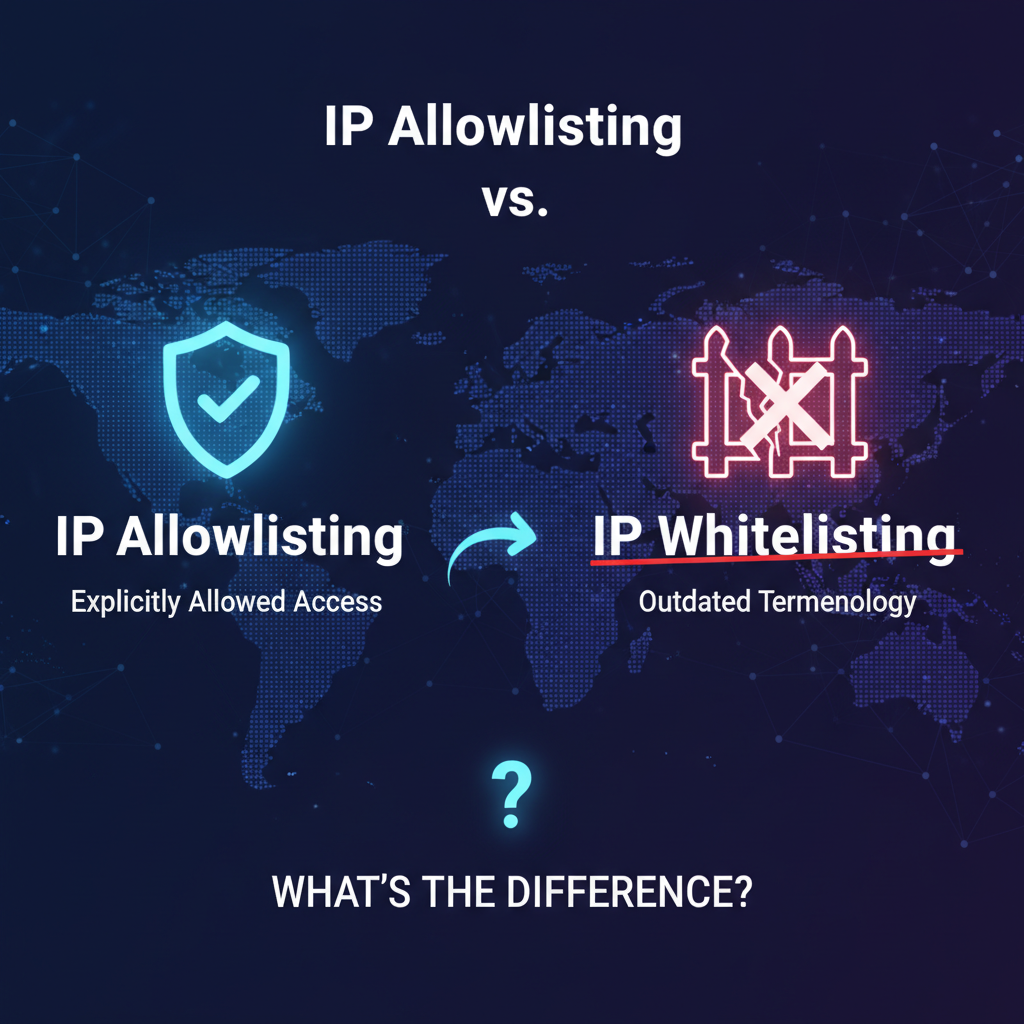
Having established that IP whitelisting and IP allowlisting are functionally identical, the discerning reader might still wonder: If they do the same thing, why bother with the distinction? The answer lies in the nuance of language, perception, policy, and industry trends. The difference is primarily semantic and prescriptive, not technical.
Semantic vs. Technical: The Core Distinction
At its heart, the difference between "IP whitelisting" and "IP allowlisting" is a classic case of semantic vs. technical. * Technically: They are identical. Any system or mechanism that performs "IP whitelisting" can be accurately described as performing "IP allowlisting," and vice versa. The algorithms, network packet processing, and security outcomes are the same. A firewall rule that permits 192.168.1.0/24 is an IP whitelist rule, and it is equally an IP allowlist rule. * Semantically: They differ in connotation, precision, and cultural appropriateness. "Whitelist" carries historical baggage and associations that "allowlist" seeks to shed. "Allowlist" is a more direct, action-oriented verb that clearly states intent.
This distinction is important because while engineers might understand the functional equivalence, communication with non-technical stakeholders, adherence to evolving industry standards, and internal policy documentation often benefit from the more precise and inclusive language.
Impact on Policy and Communication
The choice of terminology has tangible impacts on how security is communicated and documented within an organization and with external parties.
- Internal Policy Documentation: Organizations are increasingly revising their security policies, standards, and guidelines to reflect the "allowlist/denylist" terminology. This ensures consistency and modernizes internal language. For instance, a security policy might now state: "Access to critical APIs must be controlled via IP allowlisting configured on the API gateway," rather than "IP whitelisting."
- Communication with External Partners: When discussing integration requirements or access protocols with external vendors, clients, or partners, using the preferred modern terminology can convey professionalism and an awareness of industry best practices. It avoids any potential miscommunication or perception issues that might arise from using older terms.
- Auditing and Compliance Reports: As compliance frameworks evolve, they often adopt updated terminology. Using "allowlist" in compliance reports and audit responses demonstrates an organization's adherence to contemporary standards and sensitivity.
- Avoiding Ambiguity: While most people understand what a "whitelist" implies, the term "allowlist" removes any shred of ambiguity about its function. It explicitly states that a positive permission is granted, which is clearer for new employees or those less familiar with the specific technical jargon.
Industry Trends and Adoption
The movement towards "allowlist/denylist" is not a fringe initiative; it represents a significant trend within the technology industry, particularly among leading cloud providers, software companies, and open-source projects. * Major Tech Companies: As mentioned, giants like Google, Microsoft, AWS, and many others have made public commitments to update their documentation, codebases, and product interfaces to use the new terminology. This widespread adoption accelerates the shift across the industry. * Open Source Communities: Many influential open-source projects, which often set de facto standards for technical language, have also embraced "allowlist/denylist." This includes core Linux components, networking utilities, and development frameworks. * Security Frameworks and Standards Bodies: Organizations involved in defining cybersecurity standards and best practices are also encouraging or adopting the updated terminology to promote clarity and inclusivity.
This broad adoption indicates that "IP allowlisting" is not just a passing fad but a recognized best practice for communicating security controls. While "IP whitelisting" might persist in legacy systems, older documentation, and the informal lexicon for some time, "IP allowlisting" is the term of choice for forward-thinking organizations and new implementations.
The Psychological Aspect
Beyond technical precision and inclusivity, there's a subtle psychological aspect to the terminology change. "Allow" implies a deliberate, active, and permission-granting action. It forces the speaker and listener to consider what is being granted access. "White" on the other hand, can be perceived as a passive descriptor. This emphasis on active permission aligns well with the security principle of "explicitly allow, implicitly deny," reinforcing the intentionality behind access control decisions.
Implementing IP Allowlisting Effectively: Best Practices
Regardless of whether you use "whitelisting" or "allowlisting," the effectiveness of this security measure hinges on its correct implementation and diligent management. While fundamentally simple, practical deployment in complex, dynamic environments requires careful consideration of several best practices to maximize security benefits and minimize operational friction.
1. Principle of Least Privilege
The cornerstone of any robust security strategy, the principle of least privilege, applies directly to IP allowlisting. This means: * Only allow what is absolutely necessary: Do not open up broad IP ranges if specific IPs will suffice. Avoid /0 (all IPs) or /8 (a very large range) unless absolutely critical and thoroughly justified. * Granular access: Different services and resources should have different, tailored allowlists based on their specific access requirements. A sensitive database should have a much tighter allowlist than a public web server. * Time-bound access: For temporary access needs (e.g., a contractor working on a specific project for a limited time), implement time-bound entries that are automatically revoked or reviewed after a certain period.
2. Granular Application Across Multiple Layers
Effective IP allowlisting isn't a single switch; it's a multi-layered defense strategy. Apply these controls at various points in your infrastructure for maximum resilience:
- Network Layer (Perimeter Firewalls, Routers, Cloud VPCs): This is the first line of defense. Use network firewalls, router Access Control Lists (ACLs), or Virtual Private Cloud (VPC) security groups (in cloud environments) to block unauthorized IPs from even reaching your internal network or cloud resources. This reduces the sheer volume of malicious traffic reaching your internal systems.
- Transport Layer (VPNs): For remote access or highly sensitive internal network segments, enforce VPN connections. Then, allowlist only the VPN gateway's IP address to access critical services. This ensures that even if an attacker compromises a whitelisted IP, they still need VPN credentials to gain further access, adding another layer of authentication and encryption.
- Application Layer (Web Servers, API Gateways, Microservices): This layer provides application-specific control.
- Web Servers: Use web server configurations (e.g., Nginx
allow/deny, Apache.htaccess) to protect specific web application endpoints or administrative interfaces. - API Gateways: As discussed, an API gateway is the ideal place to implement IP allowlisting for your APIs. It centralizes policy enforcement, allowing you to apply different allowlists to different APIs or even specific API operations. Platforms like APIPark offer robust features for managing these API-specific access controls.
- Microservices: For internal microservice-to-microservice communication, consider service mesh technologies or granular network policies within container orchestration platforms (like Kubernetes Network Policies) to allowlist specific service identities rather than just IP addresses, offering an even more sophisticated layer of trust.
- Web Servers: Use web server configurations (e.g., Nginx
- Database Level: For highly sensitive databases, ensure that direct access is restricted only to a very limited set of application servers or administrative hosts. Never expose databases directly to the public internet.
3. Managing Dynamic IP Addresses
One of the biggest operational challenges of IP allowlisting is dealing with dynamic IP addresses, which are common for remote users and some cloud services.
- Static IPs for Critical Services/Partners: Wherever possible, insist that critical partners, vendors, or your own administrative interfaces use static IP addresses. This simplifies allowlist management significantly.
- VPNs for Remote Access: For remote employees or contractors, enforce the use of a corporate VPN. Then, allowlist only the public IP address(es) of your VPN gateway. This allows all authorized remote users to access resources securely, regardless of their individual home IP addresses.
- Cloud Service Endpoints: Many cloud services (e.g., serverless functions, managed databases) can integrate with VPCs (Virtual Private Clouds) or use private link technologies to avoid traversing the public internet, thereby negating the need for public IP allowlisting. If public access is unavoidable, consult the cloud provider's documentation for stable IP ranges they publish for their services, though these can still be large and change periodically.
- Proxy Services and CDNs: If your application sits behind a Content Delivery Network (CDN) or a reverse proxy (like Cloudflare, Akamai, or an application load balancer), the source IP address seen by your backend servers will be the IP of the CDN/proxy, not the actual client. In such cases, you must:
- Allowlist the IP ranges of your CDN/proxy.
- Configure your application/web server to correctly parse
X-Forwarded-Foror similar headers to identify the actual client IP for logging and other security checks. - Be aware that
X-Forwarded-Forheaders can be spoofed if traffic doesn't first pass through a trusted proxy.
4. Efficient Management with CIDR Notation
Classless Inter-Domain Routing (CIDR) notation is essential for efficiently managing IP address ranges. Instead of listing individual IPs, CIDR allows you to specify a network address and a subnet mask (e.g., 192.168.1.0/24) to represent a range of IP addresses.
192.168.1.0/24represents all IP addresses from192.168.1.0to192.168.1.255.- Using CIDR blocks significantly shortens and simplifies your allowlists, reducing the chance of human error and making them easier to read and audit.
- Always strive to use the smallest possible CIDR block that covers your legitimate needs. Avoid overly broad ranges like
/16or/8if a/24or/32(single IP) will suffice.
5. Regular Auditing and Review
IP allowlists are not set-and-forget configurations. They require continuous vigilance.
- Scheduled Reviews: Establish a regular schedule (e.g., monthly, quarterly) to review all allowlists across your infrastructure.
- Remove Stale Entries: Remove IP addresses that are no longer needed (e.g., for departed employees, decommissioned servers, or ended partner agreements). Stale entries represent unnecessary exposure.
- Automated Alerts for Changes: Implement monitoring to alert security teams whenever an allowlist is modified. This helps detect unauthorized changes or misconfigurations promptly.
- Justification and Documentation: For every entry on an allowlist, there should be a clear business justification and documentation of who requested it, when, and why. This is crucial for accountability and future audits.
6. Layered Security (Defense in Depth)
IP allowlisting is a powerful security control, but it is just one layer in a comprehensive defense strategy. It is not a silver bullet.
- Combine with Strong Authentication: Even if an IP is allowlisted, users or systems accessing resources should still be required to authenticate. Implement multi-factor authentication (MFA) wherever possible, especially for administrative access.
- Robust Authorization: After authentication, ensure that users or services only have access to the specific resources and actions they are authorized to perform. IP allowlisting only grants network access; authorization grants permission to act on the resource.
- Rate Limiting: Protect APIs and applications from abuse and denial-of-service attacks by implementing rate limiting. This restricts the number of requests a client can make within a given timeframe. API gateways often provide robust rate-limiting capabilities.
- Web Application Firewalls (WAFs): A WAF provides protection against common web vulnerabilities (e.g., SQL injection, cross-site scripting) that IP allowlisting cannot prevent.
- Intrusion Detection/Prevention Systems (IDS/IPS): These systems monitor network or system activities for malicious behavior or policy violations, providing another layer of detection and response.
7. Automation and Infrastructure as Code (IaC)
Manual management of allowlists is prone to errors, inconsistency, and scalability issues.
- Infrastructure as Code (IaC) Tools: Leverage tools like Terraform, Ansible, CloudFormation (AWS), ARM Templates (Azure), or Deployment Manager (GCP) to define and manage your IP allowlists programmatically. This ensures consistency, repeatability, and allows for version control and automated deployments.
- CI/CD Pipeline Integration: Integrate allowlist updates into your Continuous Integration/Continuous Deployment (CI/CD) pipelines to ensure that security configurations are deployed consistently alongside application code.
- Automated Validation: Implement automated tests to validate that allowlists are correctly applied and that only authorized IPs can access resources, while unauthorized IPs are blocked.
8. Robust Monitoring and Logging
Visibility into network access attempts is critical for security.
- Comprehensive Logging: Configure all relevant devices (firewalls, routers, API gateways, web servers) to log all connection attempts, both allowed and denied. Ensure these logs include source IP, destination IP, port, timestamp, and the action taken (allow/deny).
- Centralized Log Management (SIEM): Aggregate all logs into a centralized Security Information and Event Management (SIEM) system. This enables easier analysis, correlation of events, and long-term storage.
- Alerting: Set up alerts for suspicious activities, such as an unusually high number of denied connections from a specific IP (indicating a potential attack), or repeated failed login attempts from an allowed IP (indicating a compromised account).
- Regular Log Review: Periodically review logs for anomalies, patterns of unauthorized access attempts, or signs of compromise. This proactive approach can help detect issues before they escalate into major incidents.
By adhering to these best practices, organizations can transform IP allowlisting from a simple configuration into a powerful, dynamic, and resilient component of their overall cybersecurity strategy.
APIPark is a high-performance AI gateway that allows you to securely access the most comprehensive LLM APIs globally on the APIPark platform, including OpenAI, Anthropic, Mistral, Llama2, Google Gemini, and more.Try APIPark now! 👇👇👇
Advanced Considerations and Challenges
While the principles of IP allowlisting are straightforward, their application in real-world, complex environments introduces several advanced considerations and persistent challenges that security architects and operations teams must meticulously address.
Complex Network Topologies: Microservices, Containers, and Serverless
Modern application architectures, characterized by microservices, containers (Docker, Kubernetes), and serverless functions, present new layers of complexity for IP allowlisting:
- Ephemeral IPs: Containers and serverless functions often have ephemeral IP addresses that change frequently. Allowlisting specific container IPs is impractical. Instead, network policies within orchestration platforms (like Kubernetes Network Policies) or service meshes (e.g., Istio) become essential, allowing you to define access based on service identities rather than raw IP addresses.
- East-West Traffic: While perimeter firewalls handle North-South (external to internal) traffic, a significant portion of traffic in microservices architectures is East-West (internal service-to-service communication). Applying granular IP allowlisting to every internal service can be an enormous management burden. Here, solutions like service meshes that enforce authentication and authorization between services based on identity are more effective than pure IP-based controls.
- Shared Infrastructure: In serverless or multi-tenant container environments, the underlying infrastructure IPs might be shared by multiple customers. Allowlisting these broad IPs could inadvertently grant access to others' resources or expose your own. Focus on application-layer authentication and authorization in these scenarios.
Impact of CDNs, Load Balancers, and Proxy Servers
As discussed earlier, using Content Delivery Networks (CDNs), load balancers, and reverse proxy servers (e.g., AWS ALB/ELB, Nginx, Cloudflare) masks the original client's IP address.
- Source IP Masking: Your backend servers will see the IP address of the CDN/proxy, not the actual end-user's IP. This means your allowlist must include the IP ranges of these trusted proxies.
X-Forwarded-ForHeaders: To identify the real client IP, these proxies insert headers likeX-Forwarded-For. Your application must be configured to correctly parse and trust these headers only from known proxy IPs. If you allowlist proxy IPs, but your application trustsX-Forwarded-Forfrom any source, an attacker could spoof the header and bypass other IP-based controls. Careful configuration is paramount.- Security Implications: If the CDN or proxy's IP ranges are very broad, allowing them means you are trusting the security and filtering capabilities of that third-party service. While reputable CDNs are highly secure, it's an external dependency to consider.
Zero Trust Architecture Integration
IP allowlisting fits into a Zero Trust framework, but it's only one piece of a much larger puzzle.
- Beyond the Perimeter: Zero Trust mandates "never trust, always verify," meaning trust is never implicitly granted based solely on network location or IP address. Every request, from inside or outside the network, must be authenticated and authorized.
- Contextual Access: While IP allowlisting can still be used as an initial filter, Zero Trust extends beyond it by incorporating identity, device posture, location, time of day, and other contextual factors to make access decisions.
- Continuous Verification: Instead of one-time trust, Zero Trust involves continuous verification throughout a session. An IP allowlist might grant initial network access, but subsequent access to resources within that network still requires constant validation.
Thus, IP allowlisting serves as a foundational layer, reducing the attack surface by eliminating entire swathes of untrusted traffic, but it must be complemented by stronger identity- and context-based controls in a true Zero Trust model.
Insider Threats and Account Compromise
A critical limitation of IP allowlisting is its inability to defend against specific types of threats:
- Insider Threats: If a malicious actor is operating from within an allowlisted IP range (e.g., a rogue employee using their legitimate workstation IP), IP allowlisting provides no protection. This highlights the need for robust internal monitoring, logging of user activities, strong access management, and behavior analytics.
- Compromised Accounts: If an attacker compromises a user account (e.g., through phishing or weak passwords) and then accesses the system from a machine whose IP address is on the allowlist, the IP allowlist offers no defense. This reinforces the absolute necessity of strong authentication (especially MFA) and rigorous authorization controls.
In these scenarios, the IP allowlist successfully performed its job of validating the network source, but the threat vectors shifted to identity and internal privileges.
Maintenance Burden: The Enduring Challenge
Despite all the best practices and automation, the maintenance burden remains a significant, enduring challenge for IP allowlisting.
- Dynamic Environments: Cloud-native, ephemeral, and hybrid environments generate constant changes in IP addresses, making static allowlists quickly obsolete.
- Human Error: Despite automation, the initial configuration and exceptions still often involve human input, leading to potential misconfigurations, typos, or forgotten updates.
- Scale: As an organization grows its global presence, expands its partner ecosystem, or supports a large remote workforce, the sheer scale of managing hundreds or thousands of IP entries across multiple systems can become overwhelming.
Effective IP allowlisting requires a dedicated operational discipline, continuous monitoring, and a commitment to automation and regular review to prevent it from becoming a source of security vulnerabilities or operational bottlenecks.
The Pivotal Role of an API Gateway in IP-Based Security
In the modern, interconnected digital ecosystem, APIs have become the fundamental building blocks for applications, services, and integrations. They are the conduits through which data flows and functionalities are exposed. Consequently, securing APIs is paramount, and this is where an API gateway assumes a truly pivotal role, especially in enforcing IP allowlisting policies.
An API gateway acts as a single, centralized entry point for all API requests, effectively serving as a proxy between client applications and your backend API services. This strategic positioning makes it an ideal control point for applying a wide array of security policies, including robust IP-based access restrictions.
Centralized Policy Enforcement
One of the most significant advantages of an API gateway is its ability to centralize policy enforcement. Instead of configuring IP allowlists on each individual backend API service (which can be disparate, running on different technologies, and managed by different teams), the API gateway provides a unified platform. * Single Point of Control: All incoming API traffic flows through the gateway. This allows security administrators to define IP allowlists once, at the gateway level, and apply them across multiple APIs or even specific API endpoints. This eliminates the need for redundant configurations and reduces the risk of inconsistencies or omissions. * Streamlined Management: Managing API access for partners, developers, or internal services becomes significantly easier. If a partner's IP changes, it only needs to be updated on the API gateway, not on every single backend API they interact with. * Comprehensive Security Policies: Beyond IP allowlisting, an API gateway can enforce other critical security policies such as: * Authentication: Verifying the identity of the client making the API call (e.g., OAuth, JWT, API keys). * Authorization: Determining what specific actions an authenticated client is permitted to perform. * Rate Limiting and Throttling: Protecting backend APIs from overload and abuse by restricting the number of requests clients can make within a given timeframe. * Data Masking and Transformation: Ensuring sensitive data is handled securely and only necessary information is exposed. * Input Validation: Protecting against common API vulnerabilities like injection attacks by validating incoming request payloads.
Traffic Management and Backend Protection
The API gateway does more than just enforce security; it also intelligently manages traffic to your backend services: * Load Balancing: Distributing incoming API requests across multiple instances of your backend services to ensure high availability and optimal performance. * Routing: Directing API requests to the correct backend service based on the request path, headers, or other criteria. * Caching: Storing responses to frequently accessed API requests to reduce the load on backend services and improve response times. * Backend Decoupling: Shielding your backend API services from direct exposure to the internet. Clients only interact with the gateway, which acts as a protective shield, simplifying the security posture of your internal services.
APIPark: An Example of a Comprehensive API Gateway
Platforms like APIPark exemplify how a modern API gateway can integrate these multifaceted capabilities into a single, cohesive solution. APIPark, as an open-source AI gateway and API management platform, is specifically designed to manage and secure both traditional REST APIs and a rapidly growing landscape of AI services.
- Robust IP Allowlisting: APIPark enables you to configure precise IP allowlisting policies, ensuring that only trusted sources can invoke your critical APIs, whether they are powering your core business applications or integrating advanced AI models.
- End-to-End API Lifecycle Management: Beyond just security, APIPark assists with the entire API lifecycle – from design and publication to invocation and decommissioning. This includes traffic forwarding, load balancing, and versioning of published APIs, all contributing to a more secure and resilient API ecosystem.
- Unified AI Management: With the increasing adoption of AI, APIPark provides a unified system for authenticating and managing diverse AI models, standardizing invocation formats, and even encapsulating custom prompts into new REST APIs. This integration ensures that your AI services benefit from the same robust IP allowlisting and security policies as your traditional APIs.
- Performance and Scalability: A high-performance API gateway is critical. APIPark is engineered for performance, capable of handling large-scale traffic and supporting cluster deployments, ensuring that your security policies are enforced without becoming a bottleneck.
- Detailed Logging and Analytics: Comprehensive logging of all API calls, including source IPs and access decisions, is vital for auditing, troubleshooting, and security incident response. APIPark offers powerful data analysis capabilities, helping businesses monitor long-term trends and proactively identify potential issues.
In summary, an API gateway is far more than just a proxy; it is a strategic enforcement point that centralizes and streamlines the management of security policies, including IP allowlisting, for all your APIs. For organizations seeking to build secure, scalable, and manageable API ecosystems, leveraging a comprehensive platform like APIPark is not merely an option but a strategic imperative. It ensures that access to your valuable digital assets is meticulously controlled, from the basic network layer to the sophisticated application layer, safeguarding your innovations against an ever-evolving threat landscape.
Comparative Analysis: IP Whitelisting vs. IP Allowlisting
To distill the primary points of comparison, the following table summarizes the key aspects of IP Whitelisting and IP Allowlisting:
| Feature | IP Whitelisting | IP Allowlisting |
|---|---|---|
| Terminology | Traditional, historical term, widely recognized. Often found in older documentation and legacy systems. | Modern, preferred term, increasingly adopted by leading tech companies and open-source communities. |
| Primary Focus | Explicitly permitted IP addresses. The "white" implies a favorable or permitted status. | Explicitly allowed IP addresses. The "allow" clearly denotes an active permission-granting action. |
| Technical Mechanism | Functionally identical: Denies all traffic by default and permits only traffic originating from specified IP addresses or ranges. | Functionally identical: Denies all traffic by default and permits only traffic originating from specified IP addresses or ranges. |
| Connotation | Can carry negative racial connotations due to the "white/black" dichotomy. Seen as less inclusive by many. | Neutral, clear, and action-oriented. Avoids potentially problematic associations, promoting inclusivity. |
| Industry Trend | Gradually being phased out for new documentation, codebases, and product interfaces. Still prevalent in informal usage. | Increasingly adopted as the best practice for professional and inclusive technical communication. |
| Clarity | Generally understood, but the "white" can be seen as a passive description. | Unambiguous, emphasizes active permission, making the security intent clearer. |
| Security Impact | High effectiveness in reducing attack surface by blocking unknown sources. Requires diligent management. | High effectiveness in reducing attack surface by blocking unknown sources. Requires diligent management. (Same underlying security benefits). |
| Management Burden | High, especially for dynamic environments, large user bases, or numerous third-party integrations. Requires constant review and updates. | High, particularly in dynamic cloud environments and for large-scale API ecosystems. Demands robust processes and automation. |
| Examples in Use | Older firewall configurations, legacy application access lists, informal discussions. | Modern cloud security groups, API gateway policies, up-to-date corporate security documentation, new software development. |
In essence, while both terms refer to the same critical security function, the shift towards "IP Allowlisting" represents a conscious effort to align technical language with modern values of inclusivity and clarity, without compromising the fundamental security benefits derived from such access control mechanisms.
Conclusion
In the ever-evolving domain of cybersecurity, understanding and implementing robust access control mechanisms is non-negotiable. IP-based access control, whether referred to as "IP Whitelisting" or "IP Allowlisting," remains a foundational and highly effective strategy for securing digital assets. This comprehensive exploration has clarified that, from a technical standpoint, both terms describe the identical process: explicitly permitting traffic from a defined set of trusted IP addresses while implicitly denying all others. The core principle of "deny by default, allow by exception" stands unyieldingly at the heart of both concepts, delivering powerful benefits in reducing the attack surface, ensuring compliance, and providing granular control over network access.
The distinction between the two terms, therefore, lies predominantly in their semantics and the broader industry's move towards more precise, inclusive, and action-oriented language. "IP Allowlisting" has emerged as the preferred terminology, shedding potential negative connotations and offering a clearer articulation of active permission. This evolution in language reflects a maturing industry's commitment to not only technical excellence but also responsible and considerate communication.
Implementing IP allowlisting effectively demands more than just toggling a switch. It requires a strategic, multi-layered approach, adherence to the principle of least privilege, meticulous management of dynamic IP addresses, and diligent auditing. The complexities of modern cloud architectures, microservices, and API ecosystems necessitate advanced considerations and a reliance on sophisticated tools. This is where the pivotal role of an API gateway becomes evident. By acting as a central enforcement point, an API gateway streamlines the application of IP allowlisting policies, alongside other critical security measures like authentication and rate limiting, for all your APIs and services. Platforms such as APIPark exemplify how a comprehensive API gateway can integrate these features, providing end-to-end API management and robust security, thereby safeguarding your valuable digital interactions and innovations.
Ultimately, regardless of the chosen nomenclature, the underlying security principle remains indispensable. Organizations must prioritize the careful configuration, continuous monitoring, and regular review of their IP allowlists. By integrating these practices with a broader defense-in-depth strategy, including strong authentication, authorization, and advanced threat detection, businesses can build resilient and secure digital infrastructures capable of withstanding the complexities of today's threat landscape. The journey towards a more secure future is paved with clarity, precision, and unwavering vigilance.
Frequently Asked Questions (FAQs)
Q1: What is the primary difference between IP Whitelisting and IP Allowlisting?
A1: The primary difference is semantic, not technical. Both terms refer to the same security mechanism: explicitly permitting access only from a predefined list of trusted IP addresses and blocking all others. "IP Allowlisting" is the modern, preferred term, adopted for its clearer, action-oriented language and to avoid the potential negative connotations associated with "whitelist." Technically, firewalls, API gateways, and other security tools implement them identically.
Q2: Why has the industry shifted from "whitelisting" to "allowlisting"?
A2: The shift is driven by a desire for more inclusive, precise, and unambiguous language in technical communication. "Allowlisting" clearly conveys an active permission, removing any ambiguity. Furthermore, it addresses concerns regarding the potentially negative racial connotations of the "white/black" dichotomy often found in older terminology like "whitelist/blacklist."
Q3: Where should I implement IP Allowlisting in my network architecture?
A3: For maximum security, IP allowlisting should be implemented at multiple layers in a "defense-in-depth" strategy: 1. Network Perimeter: On firewalls or network access control lists (ACLs) to block traffic at the earliest point. 2. Cloud Security Groups: In cloud environments (e.g., AWS Security Groups, Azure Network Security Groups) to protect virtual machines and services. 3. API Gateway: For APIs, an API gateway (like APIPark) is an ideal centralized point to enforce granular IP allowlisting policies for specific API endpoints. 4. Host-based Firewalls: On individual servers for an additional layer of protection.
Q4: Does IP Allowlisting provide complete protection against all cyber threats?
A4: No, IP allowlisting is a powerful security control but not a complete solution. It significantly reduces the attack surface by blocking unauthorized network sources, but it does not protect against: * Insider Threats: Malicious actions from within an allowed IP range. * Compromised Accounts: If an attacker gains valid credentials and accesses from an allowed IP. * Application-level Vulnerabilities: Such as SQL injection or cross-site scripting, which require Web Application Firewalls (WAFs) and secure coding practices. It should always be part of a multi-layered security strategy, combined with strong authentication (MFA), authorization, rate limiting, and robust monitoring.
Q5: How does an API Gateway like APIPark help with IP Allowlisting for APIs?
A5: An API gateway acts as a central proxy for all API requests, making it an ideal point for enforcing IP allowlisting. APIPark specifically provides: * Centralized Policy Management: Define IP allowlists once on the gateway and apply them across multiple APIs or even specific API operations. * Backend Protection: Shields your backend API services from direct internet exposure, with the gateway handling the initial IP validation. * Integrated Security: Combines IP allowlisting with other crucial API security features like authentication, authorization, and rate limiting in a single platform. * Simplified Management: Reduces the operational overhead of managing IP access rules across disparate backend services, especially for a large number of APIs or external partners.
🚀You can securely and efficiently call the OpenAI API on APIPark in just two steps:
Step 1: Deploy the APIPark AI gateway in 5 minutes.
APIPark is developed based on Golang, offering strong product performance and low development and maintenance costs. You can deploy APIPark with a single command line.
curl -sSO https://download.apipark.com/install/quick-start.sh; bash quick-start.sh

In my experience, you can see the successful deployment interface within 5 to 10 minutes. Then, you can log in to APIPark using your account.

Step 2: Call the OpenAI API.