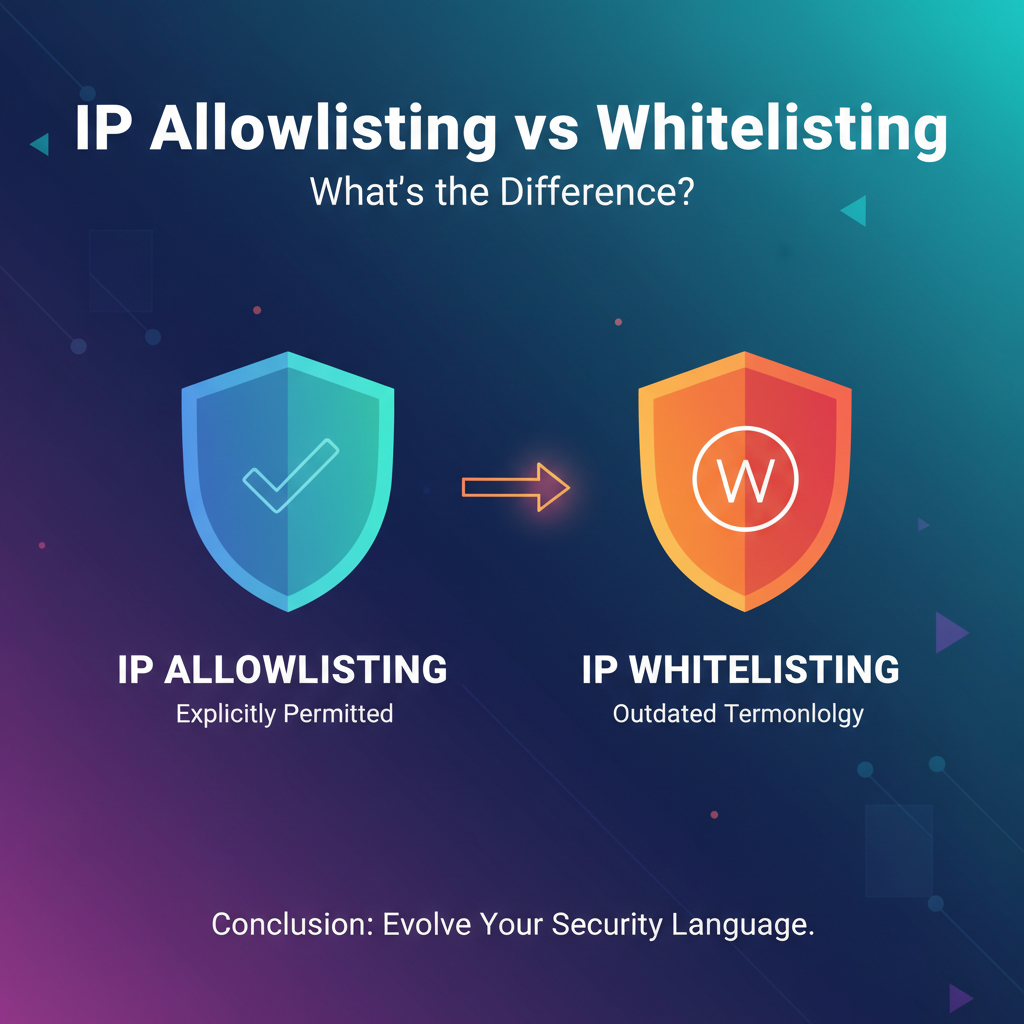
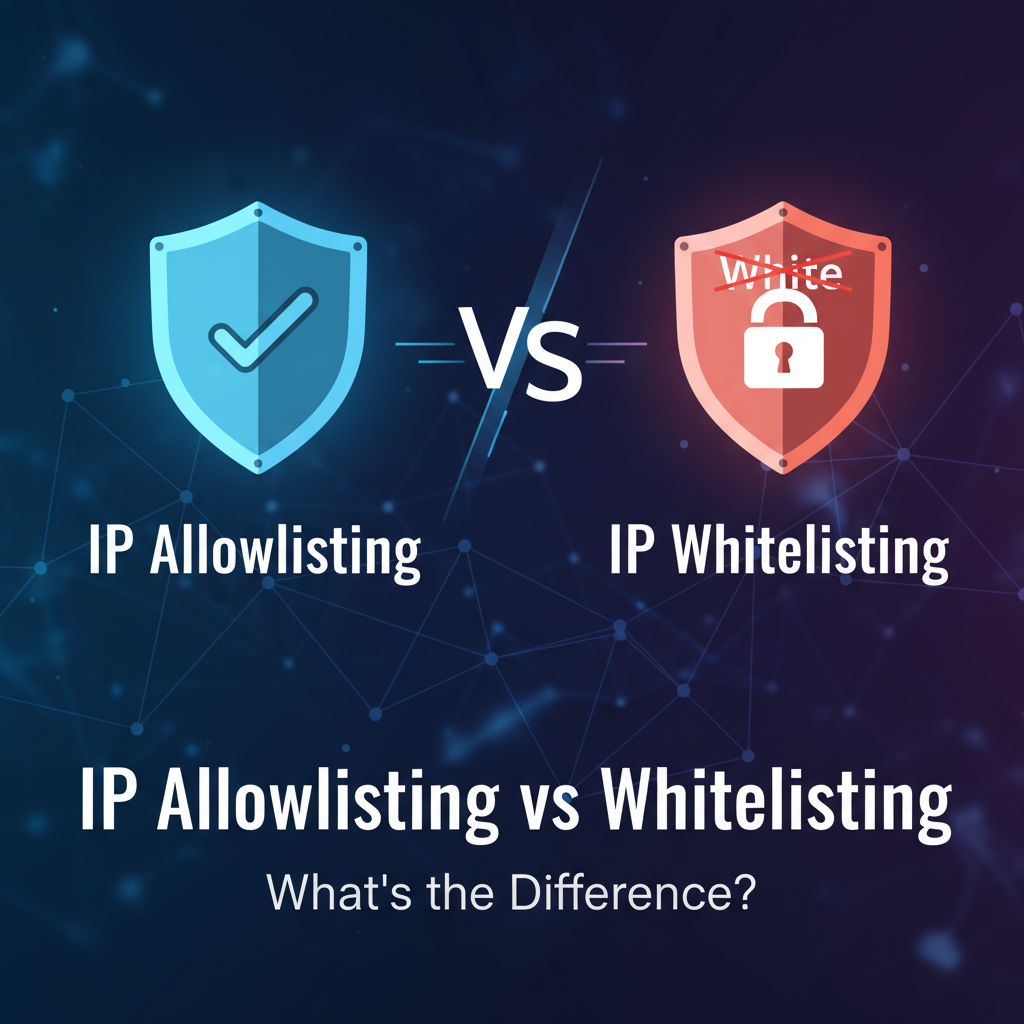
IP Allowlisting vs Whitelisting: What's the Difference?


In the intricate world of cybersecurity and network management, precision in terminology is not merely an academic exercise; it's a critical component of effective communication and robust defense. Among the many terms that permeate discussions about digital access, "IP allowlisting" and "IP whitelisting" frequently emerge, often used interchangeably, yet carrying subtle but significant distinctions, particularly in contemporary discourse. This extensive exploration will delve deep into these concepts, dissecting their technical underpinnings, historical evolution, and the practical implications for securing modern digital infrastructures, from basic network perimeters to sophisticated API gateway architectures.
The fundamental objective behind both concepts is identical: to restrict network access to a predetermined, approved set of IP addresses, thereby acting as a digital bouncer at the gates of your digital assets. This mechanism is a cornerstone of the principle of least privilege, ensuring that only trusted entities can connect to sensitive resources. However, the linguistic journey from "whitelisting" to "allowlisting" reflects a broader societal shift towards more inclusive and less racially charged language, a transition that, while seemingly minor, underscores a commitment to clarity and ethical communication within the tech community. As we navigate the complexities of securing data, applications, and services, understanding this distinction becomes paramount, not just for technical accuracy but for fostering a more thoughtful and responsible industry.
The Genesis of Access Control: Understanding the Core Principle
At its heart, any form of list-based access control, whether termed "whitelist" or "allowlist," operates on a simple yet powerful premise: define what is permitted, and by default, everything else is denied. This is a proactive security posture, contrasting with a "denylist" (or "blacklist") approach, which defines what is explicitly forbidden and allows everything else. For high-security environments, the "allow-by-default-deny-all-else" model is universally preferred because it significantly reduces the attack surface. It’s far easier to manage a list of a few dozen or hundreds of known, trusted IPs than to try and enumerate every possible malicious IP address across the globe.
Imagine a private club. An allowlist would be the guest list at the door, admitting only those names specifically written down. Anyone not on the list is turned away, regardless of their intentions. A denylist, on the other hand, would be a list of known troublemakers; anyone not on that list would be admitted, even if they were complete strangers. The former offers a much higher degree of control and predictability, which is precisely why it forms a fundamental layer in almost every robust security architecture today, from protecting sensitive databases to controlling access to mission-critical API endpoints.
The Evolution of Terminology: From Whitelist to Allowlist
The term "whitelisting" has been a staple in the cybersecurity lexicon for decades. Its origins are benign, drawing an analogy to a "white list" of approved items, contrasting with a "black list" of disallowed items. This color-coded dichotomy, however, has increasingly come under scrutiny for its problematic connotations. In many cultures and historical contexts, "white" has been associated with good, purity, and permission, while "black" has been linked to bad, illegality, and prohibition. This linguistic coupling has been criticized for inadvertently perpetuating racial biases and stereotypes, even if unintentionally.
As the tech industry, along with many other sectors, grappled with issues of diversity, equity, and inclusion, a conscious effort began to identify and replace potentially offensive or exclusionary language. Terms like "master/slave" in database replication, "man-in-the-middle," and indeed, "whitelist/blacklist" were flagged for revision. The move towards "allowlist" and "denylist" represents this shift.
Allowlist: This term explicitly conveys the function – a list of entities (IP addresses, email addresses, applications, etc.) that are explicitly allowed to perform a specific action or access a particular resource. It is precise, neutral, and avoids any potentially problematic associations.
Denylist: Similarly, this term clearly indicates a list of entities that are explicitly denied access or action.
While the technical implementation and operational impact of "IP allowlisting" and "IP whitelisting" remain identical, the preference for "allowlisting" is a nod to a more conscious and inclusive language practice. In practical terms, when you encounter an older system or documentation, "whitelisting" will likely be the term used. However, in modern deployments, new documentation, and forward-thinking organizations, "allowlisting" is the increasingly adopted standard. This distinction is crucial for understanding the contemporary landscape of cybersecurity and effective communication within it.
Deep Dive into IP Allowlisting: Mechanisms and Benefits
IP allowlisting is a network security measure that grants access to a specific network, server, API, or other resource only to IP addresses explicitly designated as trustworthy. All other IP addresses are automatically denied access. This forms a robust first line of defense against unauthorized access, malicious attacks, and even accidental misconfigurations.
How IP Allowlisting Works
The implementation of IP allowlisting can occur at various layers of the network stack, each offering different scopes and granularities of control:
- Network Firewall Level: This is perhaps the most common and foundational application. Network firewalls, whether hardware or software-based, are configured with rules that inspect the source IP address of incoming (ingress) and outgoing (egress) network traffic. If the source IP address matches an entry in the allowlist, the traffic is permitted to pass. If not, it is blocked. This operates at a low level, effectively filtering traffic before it even reaches the server or application.
- Example: An organization might configure its perimeter firewall to only allow SSH (port 22) access to its production servers from the IP addresses of its administrative office and a specific VPN gateway server.
- Cloud Security Groups/NACLs: In cloud environments (like AWS Security Groups, Azure Network Security Groups, or Google Cloud Firewall Rules), IP allowlisting is a standard and highly effective mechanism. These virtual firewalls are tied directly to instances, subnets, or virtual private clouds (VPCs). They allow administrators to define inbound and outbound rules based on source/destination IP addresses, ports, and protocols.
- Example: A database instance in a cloud environment might have a security group that only allows connections on its database port (e.g., 3306 for MySQL) from the IP addresses of the application servers that need to access it, and absolutely no public internet access.
- Web Server / Application Level: Beyond the network perimeter, individual web servers (e.g., Nginx, Apache) or even application code can implement IP allowlisting. This provides an additional layer of defense, especially useful in scenarios where a broader network firewall might allow traffic to the web server itself, but specific applications or directories require tighter control.
- Example: An administrator interface for a content management system might be configured at the Nginx level to only respond to requests from specific internal IP addresses, even if the general web server is publicly accessible.
- API Gateway Level: For modern distributed architectures, especially those relying heavily on microservices and external integrations, the API gateway becomes a critical enforcement point for IP allowlisting. An API gateway acts as a single entry point for all API requests, routing them to the appropriate backend services. This centralized position makes it ideal for implementing security policies, including IP allowlisting, authentication, rate limiting, and more. A robust API gateway can inspect incoming requests and deny access if the source IP is not on the approved list, effectively protecting the underlying API endpoints.
- Example: A public-facing API for a payment processor might allowlist IP addresses belonging to known, approved merchant systems, ensuring that only legitimate partners can invoke sensitive API functions.
Key Benefits of IP Allowlisting
The strategic implementation of IP allowlisting yields numerous benefits that contribute significantly to an organization's security posture and operational efficiency:
- Enhanced Security: By strictly limiting access to a predefined set of trusted IP addresses, the attack surface is drastically reduced. This inherently limits the exposure to various network-based attacks, including brute-force attacks, denial-of-service attempts (though not fully preventing them), and unauthorized reconnaissance. It makes it significantly harder for malicious actors outside the allowed list to even begin probing for vulnerabilities.
- Improved Compliance: Many regulatory frameworks and industry standards (e.g., PCI DSS, HIPAA, GDPR) mandate strict access controls for sensitive data and systems. IP allowlisting provides a verifiable mechanism to demonstrate that access to critical infrastructure is tightly controlled and restricted to authorized sources, aiding in compliance audits and reducing regulatory risk.
- Reduced Risk of Insider Threats (External Access): While IP allowlisting doesn't protect against malicious insiders already on the allowed network, it can prevent unauthorized external access attempts by former employees or compromised accounts whose access should be confined to specific corporate networks.
- Simplified Network Management (for specific use cases): For specific, controlled environments, IP allowlisting can simplify network security management by providing a clear, explicit set of rules. This can be easier to audit and troubleshoot compared to complex rule sets attempting to block every conceivable threat.
- Performance Optimization (Indirectly): By blocking unwanted traffic at the perimeter, IP allowlisting reduces the load on backend servers and applications, as they don't have to process or reject unauthorized requests. This can indirectly contribute to better performance and resource utilization.
- Granular Control for APIs: For organizations leveraging microservices and providing API access, IP allowlisting at the API gateway level offers granular control over who can invoke specific API endpoints. This is critical for securing B2B integrations, partner APIs, and internal service-to-service communication.
The Role of the API Gateway in Advanced Security and IP Allowlisting
In modern, cloud-native architectures, the API gateway has evolved from a simple traffic router into a powerful policy enforcement point. It sits between client applications and backend services, acting as a crucial control plane for all inbound API traffic. This strategic position makes it an ideal place to implement and manage sophisticated security measures, including IP allowlisting.
A robust API gateway not only forwards requests but also applies a suite of security policies, often configured centrally. This includes authentication (e.g., OAuth, JWT validation), authorization, rate limiting, data transformation, caching, and critically, IP allowlisting. When an API gateway receives an incoming request, it can immediately inspect the source IP address. If that IP address is not on the pre-approved allowlist for the target API, the gateway can reject the request immediately, preventing it from ever reaching the backend service. This proactive rejection saves backend resources and reduces potential exposure.
This is where a solution like APIPark demonstrates its value. As an open-source AI gateway and API management platform, APIPark is designed to streamline the management, integration, and deployment of both AI and REST services. Its capabilities extend directly to robust access control mechanisms, including the ability to enforce IP allowlisting as part of its end-to-end API lifecycle management. By consolidating security policies, including IP restrictions, at the gateway level, APIPark ensures that all API calls are subjected to consistent and stringent checks before reaching their destination.
For instance, consider APIPark's "End-to-End API Lifecycle Management" feature. This capability naturally includes the regulation of API management processes such as access control. Administrators can define granular security policies, including IP allowlisting, that apply to individual APIs or groups of APIs. Furthermore, features like "API Resource Access Requires Approval" complement IP allowlisting by adding another layer of human oversight, ensuring that even if an IP is allowed, a formal subscription and approval process is followed before an entity can invoke the API. This multi-layered approach to security, orchestrated at the gateway level, is indispensable for protecting sensitive digital assets in a complex, interconnected environment.
APIPark is a high-performance AI gateway that allows you to securely access the most comprehensive LLM APIs globally on the APIPark platform, including OpenAI, Anthropic, Mistral, Llama2, Google Gemini, and more.Try APIPark now! 👇👇👇
IP Allowlisting in Practice: Use Cases and Implementation Considerations
IP allowlisting is not a one-size-fits-all solution, but its versatility makes it applicable across a wide range of scenarios:
Common Use Cases:
- Securing Administrative Interfaces: Control Panel access, database administration tools, or server management dashboards should almost always be restricted to a very small set of known, internal IP addresses. This drastically reduces the risk of external unauthorized access.
- Protecting Internal Services/Microservices: In a microservices architecture, services often communicate with each other. While service mesh solutions offer advanced security, IP allowlisting at the network or gateway level can ensure that only authorized services (identified by their known internal IPs) can communicate with sensitive backend services.
- Restricting VPN Access: For remote access VPNs, IT departments often allowlist specific IP ranges (e.g., from corporate offices or known managed devices) to limit who can even attempt to connect to the VPN gateway.
- B2B Integrations and Partner APIs: When providing an API to a business partner, restricting access to their known public IP addresses adds a critical layer of security, ensuring only the intended partner can make calls to the API.
- Sensitive Data Access: Databases, data warehouses, and storage buckets containing highly sensitive information should always have stringent IP allowlisting rules applied to ensure only authorized application servers or specific analysts can connect.
- Cloud Resource Access: Limiting access to cloud resources (VMs, storage, serverless functions) from specific corporate networks or development environments.
Implementation Considerations and Best Practices:
- Principle of Least Privilege: Always apply the strictest possible allowlist. Only include the absolute minimum number of IP addresses necessary for legitimate operations. Every additional IP on the list is a potential point of compromise.
- Regular Review and Updates: IP addresses can change, or access requirements may evolve. The allowlist should be regularly reviewed and updated to remove stale entries or add new legitimate ones. Automation for this process, if possible, is highly recommended.
- Dynamic IPs: A significant challenge arises with dynamic IP addresses, common for home users or smaller businesses without static IPs. For these scenarios, IP allowlisting alone is insufficient and must be combined with stronger authentication (e.g., multi-factor authentication, client certificates) or alternative access methods like VPNs.
- Network Address Translation (NAT) and Proxies: Be aware that the apparent source IP address might be that of a NAT device, a proxy server, or a VPN gateway, not the end-user device. Ensure that the allowed IP is indeed the correct entry point you intend to authorize.
- Combine with Other Security Layers: IP allowlisting is a foundational security layer, not a silver bullet. It must be complemented by other robust security measures:
- Strong Authentication and Authorization: Ensure users or systems accessing allowed IPs still prove their identity (username/password, MFA, API keys, OAuth tokens) and have the necessary permissions.
- Encryption (TLS/SSL): All traffic, even from allowed IPs, should be encrypted to prevent eavesdropping and tampering.
- Input Validation: Guard against common vulnerabilities like SQL injection and cross-site scripting, as an allowed IP doesn't equate to trusted input.
- Rate Limiting: Protect against abuse and DoS attacks even from allowed IPs.
- Logging and Monitoring: Continuously monitor access logs for suspicious activity, even from allowed IPs.
- Web Application Firewalls (WAFs): Provide an additional layer of protection against various web-based attacks.
- Documentation: Clearly document why each IP address is on the allowlist, who requested it, and when it was added/last reviewed. This is crucial for auditing and troubleshooting.
- Automation: Wherever possible, automate the management of IP allowlists, especially in dynamic cloud environments. Infrastructure-as-Code (IaC) tools can manage security group rules efficiently.
The Broader Landscape of API Security: Beyond Allowlisting
While IP allowlisting is an essential building block, a comprehensive API security strategy extends far beyond it. Modern API ecosystems demand a multi-layered defense to thwart sophisticated threats. An API gateway, such as APIPark, serves as the control tower for these multifaceted security policies.
Consider the extensive features of APIPark that contribute to a holistic API security posture:
- Quick Integration of 100+ AI Models & Unified API Format for AI Invocation: While primarily focused on integration and standardization, this allows security policies to be applied consistently across a diverse set of APIs, simplifying management and reducing the chance of security gaps.
- Prompt Encapsulation into REST API: By turning prompts into managed APIs, APIPark ensures that these specialized AI functions can inherit all the security benefits applied at the gateway, including IP allowlisting, authentication, and monitoring.
- API Service Sharing within Teams & Independent API and Access Permissions for Each Tenant: These features enable granular access control based on user roles and tenant separation. Combined with IP allowlisting, this means that even if an IP address is allowed, the specific team or tenant associated with that request must also have the appropriate permissions to access the desired API resources.
- Detailed API Call Logging & Powerful Data Analysis: These capabilities are paramount for post-incident analysis, threat detection, and understanding access patterns. Comprehensive logs from the API gateway provide an audit trail of every API call, including its source IP, allowing security teams to quickly identify and respond to anomalies, even if they originate from an allowlisted IP. This proactive monitoring and reactive analysis are crucial for maintaining system stability and data security, moving beyond mere prevention to include detection and response.
- Performance Rivaling Nginx: The high performance of a gateway like APIPark ensures that security checks, including IP allowlisting, do not become a bottleneck, allowing robust security to scale with large-scale traffic demands.
The integration of these features within an API gateway creates a powerful shield for your APIs. IP allowlisting stops unauthorized actors at the perimeter, while authentication verifies identity, authorization checks permissions, rate limiting prevents abuse, and comprehensive logging provides the visibility needed to detect and respond to evolving threats.
Comparing IP Allowlisting to Other Security Controls
To better understand the distinct role of IP allowlisting, let's briefly compare it to other common security mechanisms:
| Feature | IP Allowlisting | Authentication | Authorization | Rate Limiting | Encryption (TLS) | Web Application Firewall (WAF) |
|---|---|---|---|---|---|---|
| Purpose | Restrict access based on source IP address | Verify identity of user/system | Determine what an authenticated user can do | Prevent abuse/DoS by limiting request volume | Secure data in transit | Protect against common web vulnerabilities |
| Mechanism | Firewall rules, ACLs, api gateway configurations |
API keys, OAuth, JWT, username/password | Role-Based Access Control (RBAC), policies | Request counters, time windows | SSL/TLS certificates | Rule sets, attack signatures |
| What it protects against | Unauthorized access from unknown IPs, network scans | Impersonation, unauthorized user access | Unauthorized actions by legitimate users | Brute-force, DoS attacks, resource exhaustion | Eavesdropping, data tampering, MITM attacks | SQL injection, XSS, RCE, OWASP Top 10 |
| Strengths | Strong perimeter defense, simple for static IPs | Verifies "who" is accessing | Controls "what" can be accessed | Mitigates abuse, protects backend | Ensures data confidentiality/integrity | Broad protection against known attack patterns |
| Limitations | Vulnerable to IP spoofing, difficult with dynamic IPs | Doesn't define permissions, susceptible to credential theft | Relies on prior authentication | Doesn't stop all malicious activity | Doesn't verify identity or permissions | Can have false positives/negatives, requires tuning |
| Interoperability | Best used with all other controls | Essential complement to allowlisting | Essential complement to allowlisting | Crucial for api abuse prevention |
Always necessary for public apis |
Works alongside api gateway and other controls |
This table clearly illustrates that IP allowlisting is one piece of a much larger security puzzle. Each control plays a vital, complementary role in building a resilient defense posture. A secure system, particularly one exposing APIs, requires a layered approach where multiple security mechanisms work in concert to protect against a diverse array of threats.
Conclusion: Embracing Precision and Comprehensive Security
The journey from "IP whitelisting" to "IP allowlisting" is more than just a linguistic change; it reflects a broader industry maturation towards more precise, inclusive, and thoughtful communication. While the underlying technical mechanism remains the same – granting access only to a predefined set of trusted IP addresses – adopting "allowlisting" aligns with modern best practices in terminology. This mechanism is a fundamental pillar of network security, drastically reducing the attack surface and providing a robust first line of defense against unauthorized access to critical systems, applications, and APIs.
However, it is crucial to reiterate that IP allowlisting, while powerful, is not a standalone solution. Its effectiveness is amplified when integrated into a comprehensive, multi-layered security strategy. Combining it with strong authentication and authorization, robust encryption, intelligent rate limiting, and continuous monitoring and logging creates an impermeable digital perimeter. Tools like an advanced API gateway play an indispensable role in orchestrating these diverse security controls, offering a centralized point of enforcement and visibility. An API gateway like APIPark, with its extensive features for API lifecycle management, access control, logging, and performance, exemplifies how modern platforms empower organizations to implement sophisticated security policies, protecting their valuable digital assets from ever-evolving threats. By embracing precision in language and a holistic approach to security, organizations can build more resilient, secure, and future-proof digital infrastructures.
Frequently Asked Questions (FAQs)
1. What is the fundamental difference between IP allowlisting and IP whitelisting?
Fundamentally, there is no technical difference in how IP allowlisting and IP whitelisting function. Both refer to a security mechanism that explicitly permits network access only from a predefined list of trusted IP addresses, while denying all others. The distinction is primarily linguistic and ethical. "Allowlisting" is the modern, preferred term that avoids the potentially problematic racial connotations associated with "whitelisting" and "blacklisting," reflecting a move towards more inclusive and neutral language in the technology industry.
2. Why is IP allowlisting considered a crucial security measure for APIs?
IP allowlisting is crucial for APIs because it provides a strong, perimeter-level defense by ensuring that only known and authorized client systems or partners can even attempt to connect to your API endpoints. This drastically reduces the attack surface by preventing unauthorized external IP addresses from initiating requests, thereby protecting against brute-force attacks, unauthorized reconnaissance, and preventing your API from being exposed to the general internet unnecessarily. When implemented at an API gateway, it acts as a central choke point for access control.
3. Can IP allowlisting alone guarantee API security?
No, IP allowlisting alone cannot guarantee API security. While it is an essential foundational layer, it must be complemented by a suite of other security measures. For instance, if an authorized IP address is compromised, a malicious actor could still gain access. Therefore, IP allowlisting should always be used in conjunction with strong authentication (e.g., API keys, OAuth, JWTs), robust authorization mechanisms, data encryption (TLS/SSL), input validation, rate limiting, and comprehensive logging and monitoring. A multi-layered security strategy, often orchestrated by an API gateway, is required for true API resilience.
4. What are the challenges of implementing and managing IP allowlisting?
One of the main challenges arises with dynamic IP addresses, especially for remote users or smaller partners who don't have static IPs, making allowlist management difficult and often requiring a different approach (like VPNs or stronger authentication). Another challenge is maintenance overhead; allowlists need regular review and updates as network configurations or partner IP addresses change. Incorrectly configured allowlists can inadvertently block legitimate traffic or, worse, leave systems exposed. Furthermore, IP allowlisting doesn't protect against threats from within the allowed IP range, such as compromised internal systems or malicious insiders.
5. How does an API gateway like APIPark assist with IP allowlisting and overall API security?
An API gateway like APIPark acts as a centralized enforcement point for API traffic, making it an ideal place to implement IP allowlisting and other security policies. APIPark enables administrators to configure granular IP allowlisting rules for individual APIs, ensuring that only approved sources can invoke them. Beyond allowlisting, APIPark provides end-to-end API lifecycle management, incorporating features like authentication, authorization (e.g., "API Resource Access Requires Approval," "Independent API and Access Permissions for Each Tenant"), rate limiting, and detailed API call logging. This comprehensive approach unifies various security controls at the gateway level, simplifying management, enhancing visibility, and significantly strengthening the overall security posture of your API ecosystem.
🚀You can securely and efficiently call the OpenAI API on APIPark in just two steps:
Step 1: Deploy the APIPark AI gateway in 5 minutes.
APIPark is developed based on Golang, offering strong product performance and low development and maintenance costs. You can deploy APIPark with a single command line.
curl -sSO https://download.apipark.com/install/quick-start.sh; bash quick-start.sh

In my experience, you can see the successful deployment interface within 5 to 10 minutes. Then, you can log in to APIPark using your account.

Step 2: Call the OpenAI API.