IP Allowlisting vs. Whitelisting Explained


The digital landscape, ever-expanding and increasingly interconnected, presents both unprecedented opportunities and persistent security challenges. At the heart of managing access to sensitive resources and services lies the fundamental principle of access control. Among the myriad techniques employed to secure digital assets, IP-based access control stands out as a foundational layer, often misunderstood in its terminology and application. This extensive guide delves deep into the world of IP Allowlisting, often synonymously but sometimes controversially referred to as IP Whitelisting, exploring its nuances, practical implementations, and critical role in modern cybersecurity strategies, particularly within the context of API gateways and general API management.
APIPark is a high-performance AI gateway that allows you to securely access the most comprehensive LLM APIs globally on the APIPark platform, including OpenAI, Anthropic, Mistral, Llama2, Google Gemini, and more.Try APIPark now! 👇👇👇
IP Allowlisting vs. Whitelisting Explained: A Deep Dive into Network Access Control
In an era where every transaction, communication, and data exchange traverses a network, ensuring that only authorized entities can access specific resources is paramount. IP-based access control, through mechanisms like allowlisting and denylisting, forms a crucial part of this security fabric. While the terms "allowlisting" and "whitelisting" are frequently used interchangeably, a closer examination reveals not just a semantic evolution but also a reflection of best practices in clear and inclusive communication within the technology sector. This comprehensive exploration aims to demystify these concepts, highlight their importance, and provide actionable insights into their effective deployment, especially for those managing complex API ecosystems.
Chapter 1: The Imperative of IP-Based Access Control in Modern Systems
The sheer volume and sensitivity of data processed by applications today necessitate robust security measures. From confidential customer information to proprietary business logic exposed via APIs, unauthorized access can lead to devastating data breaches, financial losses, reputational damage, and severe regulatory penalties. IP-based access control serves as a primary gatekeeper, restricting network communication based on the source or destination IP addresses.
Why is IP Access Control Crucial?
- Enhanced Security Posture: By explicitly defining who can connect, organizations drastically reduce the attack surface. Instead of trying to block every potential threat (a reactive and often futile exercise), allowlisting adopts a proactive stance: if you're not explicitly permitted, you're denied.
- Compliance and Regulatory Requirements: Many industry standards and regulations (e.g., GDPR, HIPAA, PCI DSS) mandate strict controls over data access. IP restrictions often form a critical component of satisfying these requirements, providing auditable proof of controlled access.
- Resource Management and Optimization: Preventing unauthorized or irrelevant traffic from reaching backend systems can significantly reduce server load, bandwidth consumption, and processing overhead, leading to better performance and reduced operational costs.
- Isolation and Segmentation: IP filtering allows for the logical separation of different network segments or services. For instance, an administrative interface for a database might only be accessible from a specific subnet used by database administrators, effectively isolating it from the broader corporate network or the internet.
- Integration with Partner Ecosystems: When integrating with third-party vendors or business partners, IP allowlisting provides a secure way to grant them access to specific APIs or services without exposing those services to the entire internet. Partners provide their egress IP addresses, which are then added to the allowlist.
Basic Concepts: IP Addresses, Network Layers, and the Role of a Gateway
At its core, IP access control relies on the Internet Protocol (IP), the fundamental protocol that dictates how data is sent and received over a network. Every device connected to a network has an IP address, a unique numerical label (e.g., 192.168.1.1 or 2001:0db8:85a3:0000:0000:8a2e:0370:7334).
Network communications occur across different layers, as described by models like the OSI (Open Systems Interconnection) model. IP filtering primarily operates at Layer 3 (Network Layer) and Layer 4 (Transport Layer, considering port numbers).
A gateway in this context refers to a network point that acts as an entrance to another network. This can be a physical router, a firewall, or a sophisticated API gateway software that mediates traffic. The gateway is the enforcement point where IP-based rules are applied, inspecting incoming and outgoing packets to determine whether they should be allowed to pass. The effectiveness of IP access control heavily depends on the intelligent deployment and configuration of these gateways.
Chapter 2: The Core Concept: Allowlisting – Explicit Permission for Enhanced Security
Allowlisting is a security strategy that explicitly permits a predefined list of entities (in this case, IP addresses or ranges) to access a particular resource or service, while implicitly denying all others. It operates on the principle of "default-deny," meaning that if an IP address is not on the approved list, access is automatically rejected. This approach is widely regarded as the most secure method for controlling access, as it minimizes the exposure of systems to unknown or untrusted sources.
Detailed Definition and Mechanism of Allowlisting
An IP allowlist is essentially a roster of trusted IP addresses or CIDR blocks (Classless Inter-Domain Routing notations, e.g., 192.168.1.0/24 representing a range of addresses) that are authorized to connect to a specific server, application, or network segment. When a connection request arrives, the gateway or firewall inspects the source IP address of the incoming packet. If that IP address matches an entry on the allowlist, the connection is permitted. If it does not, the connection is immediately dropped or rejected, often without any further processing.
This mechanism fundamentally shifts the security paradigm from trying to identify and block malicious actors to granting access only to known, legitimate entities. It's akin to having a strict guest list for a private event: only those whose names are on the list are allowed entry, regardless of who else tries to get in.
Benefits of IP Allowlisting:
- Maximum Security: By far the most significant advantage, allowlisting drastically reduces the attack surface. It provides protection against a vast array of potential threats, including generalized scanning attacks, brute-force attempts from unknown sources, and even sophisticated attacks if the attackers are operating from unlisted IP addresses.
- Reduced Exposure: Critical services, administrative dashboards, and sensitive API endpoints are not exposed to the public internet, making them invisible and inaccessible to the vast majority of potential attackers.
- Simplified Security Audits: Auditing access becomes straightforward. Administrators only need to review the allowlist to understand who has access, rather than trying to track every blocked attempt.
- Compliance Facilitation: Meets stringent regulatory requirements by demonstrating a "least privilege" access model, where access is granted only when absolutely necessary and from explicitly approved sources.
- Predictable Traffic Patterns: Helps in understanding and managing network traffic, as all legitimate incoming connections originate from known IP addresses.
Drawbacks and Considerations for Allowlisting:
While highly secure, allowlisting is not without its challenges:
- Operational Overhead: Maintaining an allowlist can be labor-intensive, especially in dynamic environments. Adding, removing, or updating IP addresses requires careful management. Incorrect entries can lead to legitimate users being locked out.
- Flexibility Issues: Organizations with a highly distributed workforce, remote employees using dynamic IP addresses, or partners with frequently changing network configurations might find allowlisting cumbersome. VPNs or static IP solutions are often required to mitigate this.
- Scalability Concerns: For applications or APIs designed for broad public consumption, allowlisting is impractical as the list of potential legitimate users would be astronomically large and constantly changing.
- False Sense of Security: Allowlisting protects against unauthorized external access based on IP. It does not protect against threats originating from within an allowed IP range (e.g., an compromised machine on an allowed network) or attacks that spoof IP addresses. It must be part of a multi-layered security strategy.
Use Cases for IP Allowlisting:
- Internal Corporate Applications: Access to CRM, ERP, HR systems, or internal development tools is often restricted to corporate network IP ranges or VPN egress points.
- Administrative Interfaces: Database administration panels, cloud provider consoles, or API gateway management portals are ideal candidates for allowlisting to prevent unauthorized configuration changes.
- Backend Services and Databases: To prevent direct internet exposure, backend microservices or database servers only accept connections from frontend application servers, API gateways, or specific internal services.
- Partner and Vendor Integrations: Securely grant access to specific APIs or data feeds to trusted third-party partners by allowlisting their designated egress IP addresses.
- DevOps and CI/CD Pipelines: Restrict access to code repositories, build servers, or deployment pipelines to the IP addresses of CI/CD runners or authorized developer machines.
Chapter 3: The Core Concept: Whitelisting – Historical Context and Evolving Terminology
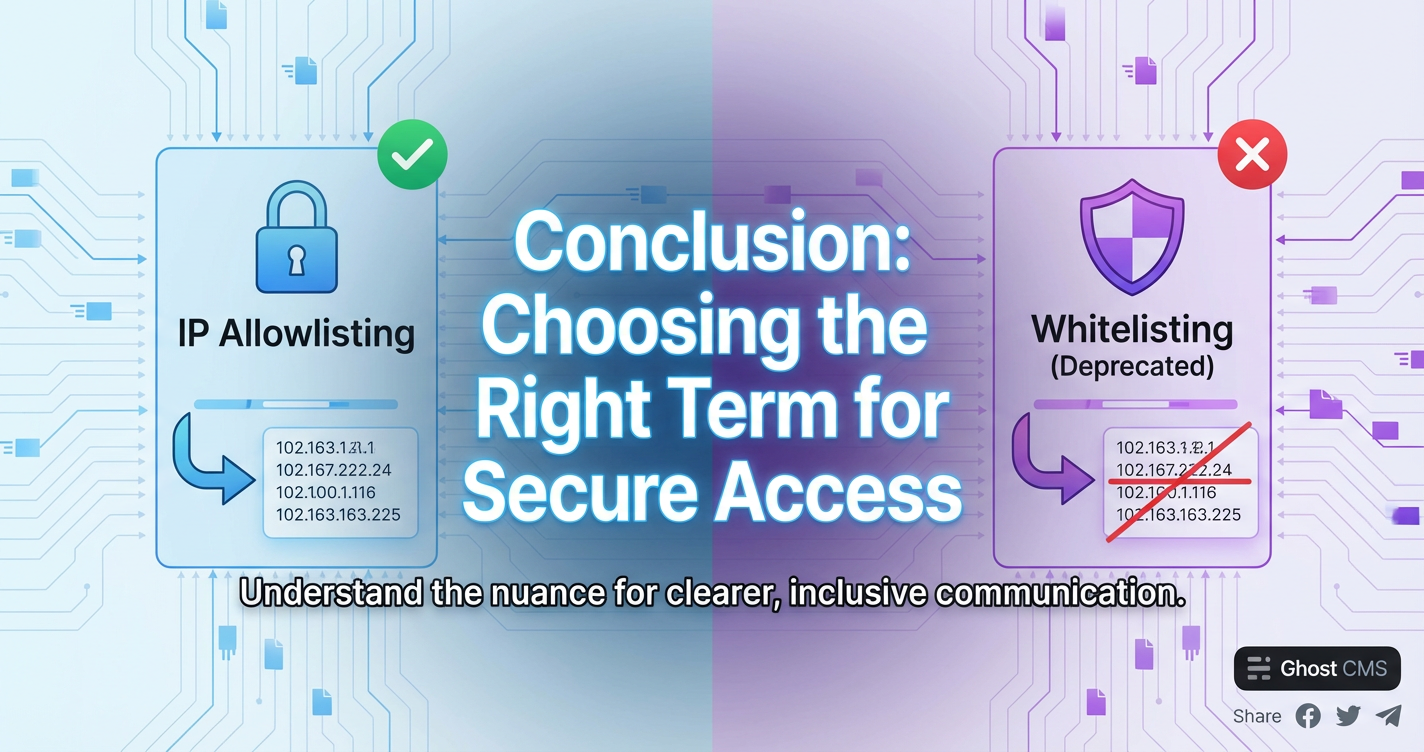
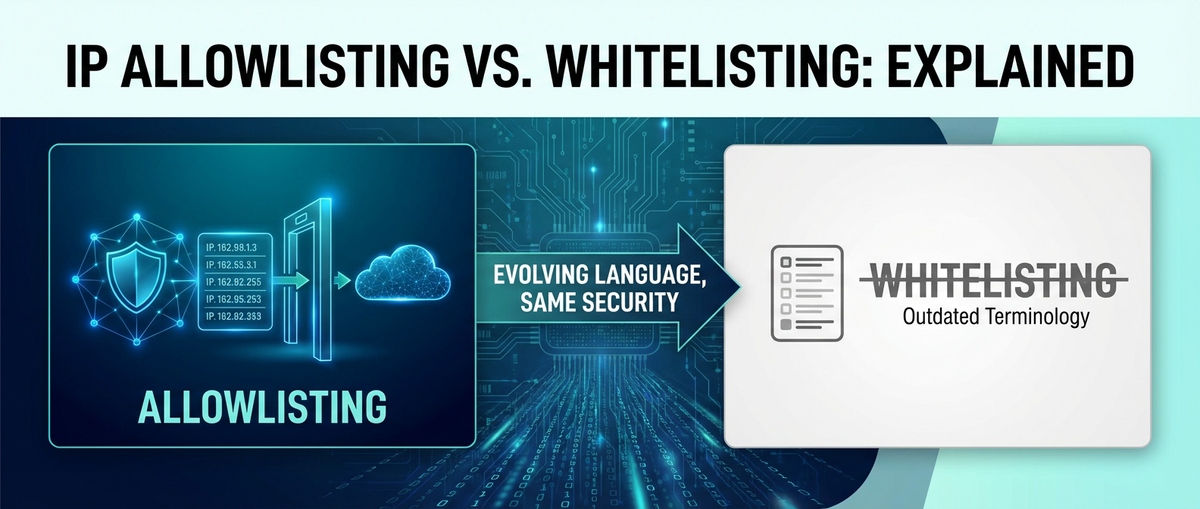
The term "whitelisting" has historically been and continues to be widely used as a direct synonym for "allowlisting." It carries the exact same functional meaning: creating an explicit list of permitted entities, with everything else being denied by default. However, in recent years, there has been a significant push within the technology community to move away from terms like "whitelist" and "blacklist" towards more neutral and inclusive language such as "allowlist" and "denylist."
Detailed Definition and Functional Equivalence
Functionally, "whitelisting" an IP address means adding it to a list of approved IP addresses that are allowed to access a particular resource. The operational mechanism, security benefits, and potential drawbacks are identical to those described for allowlisting. When you encounter documentation or hear discussions about "IP whitelisting," you should understand that it refers to the same concept of explicit permission based on IP addresses.
For example, when an organization states it "whitelists" an IP address for API access, it implies that only traffic originating from that specific IP address will be permitted to reach the API, and all other traffic will be blocked. This is a powerful and frequently used security measure, especially for sensitive APIs or those meant for specific B2B integrations.
Historical Usage and the Shift to "Allowlisting"
The terms "whitelist" and "blacklist" originated from older analogies that unfortunately carry racial connotations. As the tech industry strives for greater inclusivity and precision in its language, many organizations, open-source projects, and standards bodies have proactively adopted "allowlist" and "denylist." This shift is not just about political correctness; it's about fostering an environment where language is clear, unambiguous, and does not unintentionally alienate or marginalize any group.
Major tech companies, including Google, Microsoft, and IBM, have formally endorsed and adopted these new terms in their documentation and internal communications. The Linux kernel project, for instance, has also moved to remove such terminology. This widespread adoption signals a clear trend towards the preferred use of "allowlist."
When is "Whitelisting" Still Encountered?
Despite the move towards "allowlisting," "whitelisting" remains prevalent due to:
- Legacy Systems and Documentation: Older systems, established documentation, and long-standing codebases often still use the term "whitelist."
- Common Usage: Many professionals and non-technical users are simply more familiar with "whitelisting" due to its historical dominance in common parlance.
- Vendor Terminology: Some hardware and software vendors continue to use "whitelist" in their product interfaces and manuals.
It's important for practitioners to understand that both terms refer to the same technical concept. However, when creating new documentation, developing new software, or engaging in professional discourse, adopting "allowlisting" is generally recommended as best practice for clarity and inclusivity.
Chapter 4: Implementation Mechanics: How IP Allowlisting is Achieved
Implementing IP allowlisting requires deploying rules at various points within a network infrastructure. The choice of implementation strategy often depends on the specific resources being protected, the network architecture, and the desired level of control. These mechanisms range from low-level network devices to application-level software components.
1. Firewalls: The First Line of Defense
Firewalls are network security systems that monitor and control incoming and outgoing network traffic based on predetermined security rules. They are typically the first and most fundamental layer for implementing IP access control.
- Network Layer Firewalls: These operate at Layer 3 (Network Layer) and Layer 4 (Transport Layer) of the OSI model. They inspect packet headers (source/destination IP, port numbers, protocol) and block or allow traffic based on configured rules. Examples include hardware firewalls (e.g., Cisco ASA, Palo Alto Networks), software firewalls (e.g.,
iptableson Linux, Windows Firewall), and cloud-native firewalls (e.g., AWS Network ACLs). - Stateful Inspection: Modern firewalls use stateful inspection, meaning they keep track of the state of active connections. This allows them to make more intelligent decisions, for instance, automatically allowing return traffic for an established outbound connection.
- Implementation: Rules are typically defined to permit specific source IPs/CIDR blocks to specific destination IPs/ports. For example, "allow TCP traffic from 192.168.1.100 to 10.0.0.5 on port 8080."
2. API Gateways: Application-Layer Enforcement for APIs
An API gateway acts as a single entry point for all client requests, routing them to the appropriate backend services. It is a critical component in microservices architectures, providing centralized control over security, routing, rate limiting, caching, and monitoring. The API gateway is an ideal location to enforce IP allowlisting at the application layer, specifically for API endpoints.
- Centralized Control: Instead of configuring IP rules on each individual microservice, the API gateway can apply a consistent allowlist policy across all exposed APIs.
- Pre-Authentication/Authorization: IP allowlisting can be enforced even before authentication, preventing unauthorized traffic from consuming resources on downstream services.
- Granular Policies: Many API gateways allow for per-API or per-route IP restrictions, offering finer-grained control than network-level firewalls.
- Integration with Other Policies: IP allowlisting on an API gateway can be combined seamlessly with other security policies like JWT validation, OAuth, and rate limiting to create a robust security posture.
This is where a powerful platform like APIPark comes into play. As an open-source AI gateway and API management platform, APIPark provides an all-in-one solution for managing, integrating, and deploying AI and REST services. Within its robust framework for end-to-end API lifecycle management, APIPark naturally supports advanced security features, including the ability to implement IP allowlisting. By leveraging APIPark as your gateway, you can centralize your security policies, ensuring that only approved IP addresses can invoke your critical APIs, whether they are AI models or traditional REST services. This capability ensures that changes in API models or prompts do not affect the application's security posture, streamlining API usage and significantly reducing maintenance costs while enhancing overall security.
3. Web Servers (Nginx, Apache): Server-Level Access Control
Common web servers like Nginx and Apache have built-in directives for restricting access based on IP addresses. This is suitable for protecting specific web applications or content hosted on these servers.
- Nginx: Uses
allowanddenydirectives withinlocation,server, orhttpblocks. For example:nginx location /admin { allow 192.168.1.0/24; deny all; } - Apache: Uses
Require ipdirectives within.htaccessfiles orDirectoryconfigurations. For example:apache <Directory /var/www/html/admin> Require ip 192.168.1.0/24 </Directory> - Pros: Simple to implement for specific web resources.
- Cons: Can be less scalable or manageable for large numbers of services compared to a dedicated API gateway or firewall.
4. Cloud Security Groups (AWS Security Groups, Azure Network Security Groups): Infrastructure-as-Code Approach
In cloud environments, security groups or network security groups act as virtual firewalls for virtual machines, containers, or other cloud resources. They are stateful and allow for precise control over inbound and outbound traffic.
- Instance-Level Protection: Security groups attach directly to cloud resources (e.g., EC2 instances, Azure VMs) and define rules for traffic flow to and from those instances.
- Easy Management: They can be managed via cloud consoles, CLIs, or infrastructure-as-code tools (e.g., Terraform, CloudFormation), making policy management scalable and auditable.
- Granularity: Rules specify protocol, port range, and source/destination IP/CIDR. For example, "allow TCP port 22 from 54.1.2.3/32."
- Default Deny: Typically, security groups operate on a default-deny principle for inbound traffic, meaning you explicitly open ports and sources.
5. Application-Level Logic: Custom Code for Granular Control
While less common as a primary IP access control mechanism due to its distributed nature, applications can implement custom logic to check the source IP address of incoming requests.
- Use Cases: For very specific, highly granular controls not easily managed by network or gateway rules, or when dealing with highly dynamic environments where IP addresses might require real-time validation against an internal directory.
- Drawbacks: Increases complexity within the application code, distributes security logic, and requires careful implementation to avoid vulnerabilities (e.g., correctly extracting the client IP from
X-Forwarded-Forheaders when behind proxies). - Best Practice: Generally, it's better to push IP filtering logic upstream to firewalls or API gateways where it can be managed centrally and more efficiently.
Chapter 5: Best Practices for Effective IP Allowlisting
While IP allowlisting is a powerful security tool, its effectiveness hinges on thoughtful implementation and ongoing management. Adhering to best practices ensures robust security without hindering legitimate operations.
1. Principle of Least Privilege: This is the golden rule of security. Only allow the absolute minimum necessary access. Instead of allowing a broad 10.0.0.0/8 range, specify individual IPs or smaller CIDR blocks like 10.0.0.10/32 or 10.0.0.0/28. Each IP address granted access represents a potential point of compromise, so every entry on the allowlist should be justifiable and reviewed.
2. Granularity: Specific IPs vs. Broad CIDR Ranges: * Individual IPs (/32): Ideal for single-source access, like a specific administrative workstation or a single server instance. Provides the tightest control. * Small CIDR Ranges (/24, /28): Suitable for small subnets or teams within an organization. Be cautious; a /24 range contains 256 addresses, which might be more than truly needed. * Large CIDR Ranges (/16, /8): Generally discouraged unless absolutely necessary and thoroughly justified (e.g., allowing access from a very large corporate VPN egress range). Broad ranges significantly increase the attack surface if any machine within that range is compromised.
3. Handling Dynamic IP Addresses and VPNs: * Dynamic IPs: For remote users with dynamic home IPs, allowlisting becomes challenging. The most common solution is to require them to connect via a Corporate VPN. The VPN server's egress IP address (which should be static) is then added to the allowlist. * Cloud Services: Cloud providers often use dynamic IPs for their compute resources (e.g., AWS Lambda, Azure Functions). If these services need to access your allowlisted resources, you'll either need to * Use static egress IPs (e.g., NAT gateways with elastic IPs in AWS). * Allow the entire range of IPs from the cloud provider's region (a broader and less secure option, but sometimes unavoidable). * Leverage private networking solutions within the cloud (e.g., AWS PrivateLink, Azure Private Link) that bypass the need for public IP allowlisting entirely.
4. Regular Review and Auditing: Allowlists are not static. IP addresses can change, partners can cease operations, and internal infrastructure can evolve. * Scheduled Reviews: Establish a regular schedule (e.g., quarterly, semi-annually) to review all allowlist entries. * Justification: For each entry, ensure there's a clear business justification and owner. * Removal of Stale Entries: Promptly remove entries that are no longer needed. Stale entries are security liabilities. * Automated Audits: Use tools to periodically compare actual network traffic sources against your allowlist to identify anomalies or unlogged legitimate access.
5. Layered Security Approach (Defense in Depth): IP allowlisting is a powerful first line of defense, but it should never be the only one. * Authentication and Authorization: Even if an IP is allowlisted, users/applications must still authenticate (e.g., username/password, API keys, OAuth tokens) and be authorized for specific actions. * Encryption (TLS/SSL): All traffic should be encrypted in transit to prevent eavesdropping and tampering. * Rate Limiting: Protects against abuse from allowed IP addresses, preventing resource exhaustion or rapid-fire credential stuffing attacks. * Intrusion Detection/Prevention Systems (IDPS): Monitor traffic, even from allowed IPs, for suspicious patterns or known attack signatures. * Web Application Firewalls (WAFs): Protect against common web exploits (e.g., SQL injection, XSS) that IP filtering cannot address.
6. Monitoring and Alerting: Implement robust logging and monitoring for all IP access control mechanisms. * Log Denied Attempts: Log all attempts to access resources from non-allowlisted IPs. This helps identify potential attacks or misconfigurations. * Alerting: Set up alerts for repeated denied attempts from a single source, which could indicate a targeted attack. Also, alert on unexpected traffic patterns or changes to allowlist configurations.
7. Clear Documentation and Ownership: Maintain comprehensive documentation for every allowlist entry, including: * The IP address/range. * The resource it grants access to. * The business justification. * The start and end date (if temporary). * The owner/contact person responsible for that entry.
Chapter 6: IP Denylisting (Blacklisting) as a Counterpoint: Blocking the Known Bad
In contrast to allowlisting's "default-deny" philosophy, IP denylisting (or blacklisting) adopts a "default-allow" stance. It explicitly forbids a predefined list of entities (IP addresses or ranges) from accessing a resource, while implicitly allowing all others. Denylisting is primarily a reactive security measure, focusing on preventing known threats.
Definition and Mechanism of Denylisting
An IP denylist is a roster of IP addresses or CIDR blocks that are explicitly prohibited from connecting to a specific server, application, or network. When a connection request arrives, the gateway or firewall checks if the source IP address is on the denylist. If it matches an entry, the connection is immediately dropped. If it does not match, the connection is permitted to proceed, subject to any other access control policies.
This approach is like having a "do not call" list for telemarketers: you only block the numbers you know are problematic, but generally, you'll answer calls from unknown numbers.
Benefits of IP Denylisting:
- Addressing Known Threats: Effective for blocking specific malicious actors, bots, or sources of spam and abuse that have been identified.
- Easier for Public-Facing Services: For applications or APIs designed for a broad, unknown user base (e.g., a public website), denylisting is often the only practical approach, as allowlisting would be impossible.
- Low Operational Overhead for Public Services: Once a malicious IP is identified, adding it to a denylist is usually a quick and effective way to stop immediate threats without impacting legitimate users.
- Complements Allowlisting: Can be used in conjunction with allowlisting to provide an additional layer of protection. For instance, even if an IP is within an allowlisted range, it could still be denylisted if it's identified as a source of malicious activity (though this scenario is less common, as an allowlist would typically override a denylist unless rules are ordered carefully).
Drawbacks and Limitations of Denylisting:
- Reactive Nature: Denylisting is inherently reactive. You can only block threats that you already know about. New attackers or new attack vectors from different IP addresses will bypass the denylist until they are identified and added.
- "Whack-a-Mole" Problem: Attackers can easily change their IP addresses, use proxies, or compromise new machines, making denylisting a constant battle of adding new entries.
- Incomplete Protection: It cannot protect against unknown threats or zero-day exploits. The attack surface remains open to anything not explicitly blocked.
- Resource Consumption: A very long denylist can consume more resources for lookup, though modern firewalls are highly optimized.
- False Positives: Care must be taken to avoid accidentally blocking legitimate users if their IP addresses somehow end up on a denylist (e.g., shared proxies or VPNs).
When to Use Denylisting:
- Public Websites: To block known sources of DDoS attacks, web scraping bots, or spam.
- Public APIs: To block IP addresses exhibiting abusive patterns (e.g., excessive failed login attempts, suspicious requests).
- Email Servers: To block known spam relays.
- Complementary to Allowlisting: As a secondary layer of defense, block specifically identified threats even if they could theoretically originate from an allowlisted range (e.g., a compromised internal machine that becomes a source of attack).
Chapter 7: Choosing the Right Strategy: Allowlisting, Denylisting, or Hybrid?
The decision between allowlisting and denylisting (or a combination) depends heavily on the specific context, the sensitivity of the resources, the target audience, and the organization's risk tolerance. There's no one-size-fits-all answer, but clear guidelines can help inform the choice.
When to Prefer Allowlisting (Explicit Permission):
Allowlisting is generally the superior choice when security is paramount and the set of legitimate accessors is known and manageable.
- High-Security Internal Applications: For systems containing sensitive data (e.g., financial records, patient data) or critical operational controls.
- Administrative Interfaces: Any interface that allows configuration changes, data deletion, or user management should be protected by allowlisting.
- Partner APIs and B2B Integrations: When you are exposing APIs to a limited number of trusted business partners, allowlisting their specific IP addresses is the most secure method.
- Backend Services and Databases: These should ideally never be directly exposed to the internet. Access should be allowlisted from trusted application servers, API gateways, or internal tools.
- Development and Staging Environments: To prevent unauthorized access and potential data leakage during development or testing.
When Denylisting is Sufficient or Necessary (Blocking Known Bad):
Denylisting is more appropriate for public-facing services with a broad, unknown user base where allowlisting is infeasible.
- Public-Facing Websites and General APIs: For services intended for consumption by the general public (e.g., a blog, an e-commerce storefront, a public weather API), allowlisting is impossible. Denylisting is then used to block identified malicious sources.
- Mitigating Specific, Known Threats: If you are experiencing a sustained attack from a particular IP address or range, denylisting is an immediate and effective countermeasure.
- Supplementing Allowlisting: In rare cases, a denylist can be applied within an allowlisted network if a specific host or range inside that network is compromised and needs to be isolated.
Hybrid Approaches: The Best of Both Worlds
Many organizations implement a hybrid approach, leveraging the strengths of both strategies at different layers of their infrastructure.
- Perimeter Firewalls: Often use a combination of rules. A default-deny rule might be in place for most traffic, with specific ports and services allowlisted. Simultaneously, a denylist might be maintained to block IPs from known threat intelligence feeds.
- API Gateways: An API gateway might implement IP allowlisting for critical management APIs or partner APIs, while simultaneously using denylisting for public APIs to block abusive traffic, or even apply rate limits based on IP.
- Cloud Security Groups: These are typically configured with a default-deny for inbound traffic, acting as an allowlist (you explicitly open ports). However, you might also have network ACLs that explicitly deny certain ranges globally at the VPC level.
Table 7.1: Comparison of IP Allowlisting vs. IP Denylisting
| Feature/Aspect | IP Allowlisting (Whitelisting) | IP Denylisting (Blacklisting) |
|---|---|---|
| Core Principle | Default-deny: only explicit IPs are allowed. | Default-allow: only explicit IPs are blocked. |
| Security Level | High (proactive, minimal attack surface). | Moderate (reactive, open to unknown threats). |
| Primary Goal | Guarantee access for trusted sources, reduce exposure. | Prevent access for known malicious sources. |
| Attack Surface | Small (only exposed to allowed IPs). | Large (exposed to all IPs not explicitly blocked). |
| Management Effort | Higher for dynamic/large user bases, careful updates. | Lower for public services, but constant threat updates. |
| Use Cases | Internal apps, admin interfaces, partner APIs, backend. | Public websites, general APIs, blocking known attackers. |
| Effectiveness Against Unknown Threats | Very high. | Low (ineffective against new/unknown threats). |
| Ease of Bypass | Difficult (requires access from an allowed IP). | Easier (can use new IPs, proxies, VPNs). |
Considering Operational Complexity vs. Security Posture:
The ultimate decision often comes down to balancing stringent security requirements with operational feasibility. * High-Security Environments: For highly regulated industries or critical infrastructure, the increased operational complexity of allowlisting is a necessary trade-off for the enhanced security. * Public-Facing Services: For applications requiring broad public access, a combination of denylisting, Web Application Firewalls (WAFs), rate limiting, and robust authentication becomes the practical and necessary approach. * Dynamic Environments: For environments with frequently changing IP addresses, automating the allowlist management (e.g., through scripts that update firewall rules based on service discovery) or relying on higher-level authentication mechanisms (e.g., identity-based access control) might be more effective than manual IP allowlisting.
Chapter 8: The Role of an API Gateway in IP Access Control (Deep Dive)
An API gateway is not just a traffic router; it's a policy enforcement point that centralizes many critical functionalities, including security. For IP access control, an API gateway offers a powerful and flexible platform, especially within complex microservices architectures. Its position at the edge of your network, mediating all API traffic, makes it an ideal location to implement IP allowlisting and other access policies.
How an API Gateway Acts as a Central Enforcement Point
Imagine an organization with dozens or hundreds of microservices, each exposing various APIs. Without a central gateway, implementing IP allowlisting on each service would be a monumental task, prone to inconsistencies and errors. An API gateway consolidates this effort:
- Single Point of Entry: All client requests to your APIs flow through the gateway. This allows the gateway to inspect every incoming request's source IP address before it reaches any backend service.
- Unified Policy Management: Instead of scattering IP allowlist rules across multiple services or infrastructure components, they are defined and managed centrally on the API gateway. This ensures consistency, simplifies auditing, and reduces the chance of misconfiguration.
- Decoupling Security from Business Logic: The application services themselves can remain focused purely on their business logic, without needing to implement or manage IP-based security checks. The gateway handles this infrastructure concern, promoting a clean separation of concerns.
- Resource Protection: By blocking unauthorized IP addresses at the gateway, you prevent malicious or unwanted traffic from even reaching your backend services, saving computational resources, bandwidth, and reducing exposure.
Configuring IP Restrictions on a Gateway
Modern API gateways provide intuitive mechanisms for configuring IP restrictions. These typically involve defining rules associated with specific APIs, routes, or even globally for all traffic.
- Global Allowlists: Apply a default allowlist that all APIs inherit unless overridden.
- Per-API/Per-Route Allowlists: Define specific allowlists for individual API endpoints or groups of endpoints. For example, a
/v1/adminAPI might have a very restrictive allowlist, while a/v1/public-dataAPI might have a more open policy or only a denylist. - Hybrid Policies: Configure both allowlist and denylist rules, with a defined order of precedence (e.g., denylist rules evaluated before allowlist rules, or vice versa).
Integration with Other Security Policies: A Comprehensive Security Shield
The true power of implementing IP access control on an API gateway lies in its ability to seamlessly integrate with a suite of other security policies. This layered approach creates a robust security shield for your APIs.
- Authentication: After an IP address is allowlisted, the gateway can then enforce authentication policies. This could involve validating API keys, JWT tokens, OAuth access tokens, or integrating with identity providers (IdPs). IP allowlisting often acts as a pre-authentication filter.
- Authorization: Once authenticated, the gateway can determine if the caller has the necessary permissions to access the requested API resource, often by inspecting roles or scopes within authentication tokens.
- Rate Limiting: Even allowlisted IP addresses can generate excessive traffic. The gateway can apply rate limits (e.g., 100 requests per minute per IP) to prevent abuse, ensure fair usage, and protect backend services from overload.
- Traffic Transformation and Validation: The gateway can validate incoming request payloads against schemas, transform data formats, and inject headers, all contributing to security and reliability.
- Logging and Monitoring: Comprehensive logging of all API calls, including source IP, allows for auditing, security incident investigation, and performance monitoring. This is crucial for identifying patterns of abuse or unusual access attempts.
Benefits for Microservices Architectures
In a microservices world, where services communicate extensively and are often deployed independently, the API gateway becomes indispensable for managing access control.
- Service Mesh Integration: While a service mesh handles inter-service communication within the cluster, the API gateway manages ingress traffic from outside the cluster, providing the initial layer of defense.
- Simplified Security for Developers: Microservice developers can focus on business logic, knowing that the gateway handles external security concerns like IP filtering, authentication, and SSL termination.
- Scalability and Resilience: API gateways are designed to be highly scalable and resilient, capable of handling large volumes of traffic and enforcing policies without becoming a bottleneck.
As a practical example, APIPark offers a compelling solution for these challenges. Beyond its core function as an AI gateway and API management platform, APIPark is engineered to manage the entire lifecycle of APIs, from design and publication to invocation and decommission. Its feature set, including end-to-end API lifecycle management, allows businesses to regulate API management processes, manage traffic forwarding, load balancing, and versioning of published APIs. Crucially, APIPark enables the creation of multiple teams (tenants), each with independent APIs and access permissions, ensuring isolation and granular control. With features like requiring approval for API resource access (subscription approval) and detailed API call logging, APIPark significantly enhances security and auditability. The platform's performance, rivaling Nginx with over 20,000 TPS on modest hardware, further solidifies its position as an enterprise-grade solution for securing and managing APIs, making IP allowlisting an integral and high-performance part of its security toolkit. By integrating APIPark, organizations gain a unified management system for authentication, cost tracking, and, significantly, robust IP-based access control, ensuring that only authorized traffic interacts with valuable AI and REST services.
Chapter 9: Real-World Scenarios and Case Studies for IP Allowlisting
Understanding the practical application of IP allowlisting through real-world scenarios helps solidify its importance and demonstrate its versatility across different architectural contexts.
1. Protecting Backend Databases from Direct Internet Access: * Scenario: A company hosts its primary customer database in a cloud environment. The database should only be accessible by the application servers that process customer requests and by a small team of database administrators for maintenance. * Implementation: * Cloud Security Groups (or equivalent): The database instance's security group is configured to allow inbound traffic on the database port (e.g., 3306 for MySQL, 5432 for PostgreSQL) only from the private IP addresses of the application servers and the static public IP addresses (or VPN egress IPs) of the database administrator team. * Result: The database is completely inaccessible from the public internet, dramatically reducing the risk of direct attacks.
2. Securing Administrative Dashboards and Management Interfaces: * Scenario: A development team manages a critical CI/CD pipeline and monitoring dashboards (e.g., Jenkins, Grafana, Kubernetes dashboard) that control production deployments. These interfaces must be highly secure. * Implementation: * Web Server/API Gateway: The web server (e.g., Nginx proxying to the dashboards) or an API gateway sitting in front of these dashboards is configured with an IP allowlist. * Allowed IPs: This allowlist includes only the IP ranges of the internal corporate network, VPN egress points, or specific workstations of authorized DevOps personnel. * Result: Only users on the corporate network or connected via VPN can even attempt to access these sensitive interfaces, preventing external reconnaissance or brute-force attempts.
3. Allowing Partner API Consumption: * Scenario: A business integrates with a third-party logistics provider, granting them access to a specific API for shipping updates. The API contains sensitive customer order details. * Implementation: * API Gateway (e.g., APIPark): The API gateway managing the shipping update API is configured with an IP allowlist specific to that API route. * Partner's Egress IPs: The logistics provider shares its static egress IP addresses, which are then added to the allowlist on the gateway. * Result: Only requests originating from the trusted partner's network can reach the shipping update API. Combined with API key authentication, this provides a robust two-factor access control.
4. Restricting Access to Internal Microservices/APIs: * Scenario: A complex microservices architecture has internal APIs that should only be called by other specific internal services, not directly by external clients. * Implementation: * Service-to-Service Allowlisting (within a Service Mesh or Network Policy): If using a service mesh (like Istio or Linkerd) or Kubernetes Network Policies, define rules that explicitly allow communication between specific service pods. * Cloud VPC/Subnet Network ACLs: Configure network access control lists (NACLs) at the subnet level to restrict traffic flow between different subnets, ensuring that, for example, the "Payment Service" subnet can only communicate with the "Order Service" subnet on specific ports. * Result: This creates strong internal segmentation, preventing unauthorized internal services from calling others and limiting the blast radius of a compromised service.
5. Handling Mobile Applications with Dynamic IPs: * Scenario: A mobile application needs to access a backend API, but mobile devices often have dynamic public IP addresses (or route through cellular carrier NATs). * Challenge: Direct IP allowlisting of individual mobile clients is impossible due to dynamic IPs and carrier infrastructure. * Solution (Indirect Allowlisting): * Dedicated API Gateway: All mobile app traffic is routed through a central API gateway. * Strong Authentication: The API gateway enforces robust authentication (e.g., OAuth 2.0, API keys tied to specific app instances). * Regional Allowlisting/Denylisting: While individual client IPs can't be allowlisted, the API gateway could potentially denylist IP ranges known for malicious activity or enforce broad regional allowlists if the app is geographically constrained (e.g., only in specific countries). * Result: IP allowlisting at the client level is replaced by strong identity-based authentication and potentially regional IP-based filtering at the gateway level, effectively securing the API despite dynamic client IPs.
Chapter 10: Future Trends and the Evolving Landscape of Access Control
The field of cybersecurity is dynamic, constantly evolving in response to new threats and technological advancements. While IP allowlisting remains a fundamental security measure, newer paradigms are emerging that aim to provide even more granular and adaptive access control. Understanding these trends is crucial for building future-proof security architectures.
1. Zero Trust Architectures and Their Impact: The Zero Trust model, popularized by Google's BeyondCorp initiative, fundamentally shifts the security philosophy from "trust but verify" to "never trust, always verify." In a Zero Trust environment:
- No Implicit Trust: No user, device, or network is inherently trusted, regardless of its location (inside or outside the corporate network).
- Contextual Access: Access decisions are made based on multiple factors, including user identity, device posture (e.g., patched, encrypted), location, time of day, and the sensitivity of the resource being accessed.
- Micro-segmentation: Networks are segmented into smaller, isolated zones, and policies are applied to control traffic flow between these segments.
Impact on IP Allowlisting: While Zero Trust principles advocate for identity-based access over network-based, IP allowlisting still plays a foundational role. It acts as an initial filter, reducing the traffic that needs to be scrutinized by more sophisticated Zero Trust policies. In many Zero Trust implementations, IP allowlisting might be used to define trusted network zones from which device posture and user identity checks are performed. It simplifies the trusted network perimeter, allowing the focus to shift to individual identities and devices.
2. Identity-Based Access Control (IBAC) Superseding Pure IP-Based: IBAC focuses on the identity of the user or service requesting access, rather than just their IP address. This is achieved through robust authentication and authorization mechanisms like OAuth, OpenID Connect, SAML, and X.509 certificates.
- Granularity: IBAC offers far greater granularity, allowing policies like "user X can access resource Y, but only from device Z and only during business hours."
- Flexibility: It accommodates dynamic IP addresses, remote work, and multi-cloud environments much more effectively than rigid IP-based controls.
- Context Awareness: Can incorporate user roles, attributes, and real-time context into access decisions.
Relationship with IP Allowlisting: IBAC doesn't replace IP allowlisting entirely but often complements it. IP allowlisting can act as a coarse-grained filter, and IBAC then provides the fine-grained control for authenticated identities. For instance, an API gateway might allow traffic only from a specific corporate VPN egress IP (IP allowlist), and then within that allowed traffic, demand valid JWT tokens for user authentication (IBAC).
3. Machine Learning for Adaptive Access Control: The application of machine learning (ML) and artificial intelligence (AI) is transforming access control into a more dynamic and adaptive process.
- Behavioral Analytics: ML algorithms can analyze user and system behavior patterns to detect anomalies indicative of compromise or unauthorized activity. For example, if a user suddenly tries to access a sensitive API from an unusual location or at an odd hour, ML can flag this as suspicious.
- Threat Intelligence Integration: ML can ingest vast amounts of global threat intelligence data to dynamically update denylists or adjust risk scores associated with incoming IP addresses.
- Automated Policy Adjustment: In advanced systems, ML could potentially recommend or even automatically adjust access policies (e.g., temporarily block an IP range showing suspicious activity) in real-time.
4. The Continued Relevance of IP Filtering as a Foundational Layer: Despite the rise of these advanced techniques, IP filtering in the form of allowlisting will remain a critical foundational security layer for the foreseeable future.
- Simplicity and Effectiveness: For specific use cases (e.g., protecting a database, a management console), IP allowlisting offers a simple, highly effective, and resource-efficient first line of defense.
- Pre-Authentication Filtering: It efficiently blocks unwanted traffic before it reaches more resource-intensive authentication and authorization layers, saving computational resources and thwarting common scanning attempts.
- Hardware and Network Layer Efficiency: Network devices (firewalls, routers) can enforce IP rules extremely efficiently in hardware, making them ideal for high-volume traffic filtering.
- Compliance Baseline: Many compliance frameworks still explicitly mention or imply the need for IP-based access restrictions.
In conclusion, while the security landscape is moving towards more intelligent, identity-driven, and adaptive access control, IP allowlisting retains its position as an indispensable, fundamental tool in the cybersecurity arsenal. It serves as a strong outer perimeter, ensuring that only expected network traffic even gets the chance to interact with more sophisticated security mechanisms, solidifying its place in a multi-layered, defense-in-depth strategy.
Conclusion
The journey through the intricacies of IP allowlisting, and its historical counterpart, whitelisting, reveals a fundamental truth in cybersecurity: explicit control is always superior to implicit trust. While the terminology evolves towards more inclusive language with "allowlisting" gaining prominence, the underlying principle remains unwavering: define what is permitted, and deny everything else. This "default-deny" approach is the cornerstone of robust network security, significantly reducing the attack surface and enhancing an organization's overall security posture.
We have explored the compelling reasons why IP-based access control is not merely a technical configuration but a strategic imperative in today's digital infrastructure. From securing sensitive internal applications and administrative interfaces to enabling secure partner integrations and protecting backend services, IP allowlisting provides a critical layer of defense. Its implementation spans various points within the network, from foundational firewalls and cloud security groups to advanced application-layer enforcement facilitated by API gateways.
The role of an API gateway in this context cannot be overstated. As the central nervous system for API traffic, platforms like APIPark offer comprehensive solutions for integrating IP allowlisting with a broader suite of security policies, including authentication, authorization, and rate limiting. This unified approach not only streamlines management but also fortifies the defense around your valuable APIs, ensuring that only trusted sources can invoke your services. The natural, simple mention of APIPark highlights how such platforms provide the robust tooling necessary for deploying and managing these crucial security features efficiently and at scale, from quickly integrating 100+ AI models to managing end-to-end API lifecycles with performance rivaling traditional web servers like Nginx.
While IP allowlisting stands as a powerful proactive defense, its reactive counterpart, denylisting, serves a valuable purpose in mitigating known threats, especially for public-facing services. Ultimately, a balanced, hybrid strategy that intelligently combines both—often with allowlisting as the primary mechanism for critical assets and denylisting as a supplementary measure—yields the most resilient security framework.
As we look to the future, the cybersecurity landscape will undoubtedly continue to evolve, with Zero Trust architectures, identity-based access controls, and machine learning-driven adaptive policies pushing the boundaries of what's possible. However, IP allowlisting will endure as a foundational and indispensable component, serving as an efficient first line of defense that filters out unwanted noise before more sophisticated security layers engage. By mastering and diligently applying the principles of IP allowlisting, organizations can build stronger, more secure digital environments, safeguarding their data, applications, and reputation in an increasingly interconnected world.
Frequently Asked Questions (FAQs)
1. What is the main difference between IP Allowlisting and IP Denylisting? IP Allowlisting (formerly whitelisting) operates on a "default-deny" principle, meaning only explicitly listed IP addresses are allowed access, and all others are blocked. It's a proactive security measure. IP Denylisting (formerly blacklisting) operates on a "default-allow" principle, meaning all IP addresses are allowed access except for those explicitly listed as forbidden. It's a reactive measure, primarily used to block known malicious sources.
2. Why is "Allowlisting" now preferred over "Whitelisting"? The shift from "whitelisting" to "allowlisting" (and "blacklisting" to "denylisting") is driven by a move towards more inclusive and neutral language in technology. Many major tech companies and open-source projects have adopted these terms to avoid potentially problematic racial connotations associated with the traditional terms, promoting clearer and more professional communication.
3. Can IP Allowlisting fully protect my systems from all attacks? No, IP Allowlisting is a powerful first line of defense but is not a standalone solution. It primarily protects against unauthorized access from unlisted IP addresses. It does not protect against threats originating from within an allowlisted network (e.g., a compromised allowed device), attacks that spoof IP addresses, or application-layer vulnerabilities (e.g., SQL injection, XSS). It must be part of a multi-layered security strategy, combined with strong authentication, authorization, encryption, and other security controls.
4. How does an API Gateway like APIPark help with IP Allowlisting? An API gateway centralizes the enforcement of IP Allowlisting policies for all your APIs. Instead of configuring rules on individual backend services, the gateway inspects every incoming API request's source IP address. It can block unauthorized IPs before they even reach your backend, saving resources and enhancing security. Platforms like APIPark provide integrated features for managing these IP restrictions alongside other API security policies like authentication, rate limiting, and detailed logging, offering a unified and high-performance solution.
5. Is IP Allowlisting practical for mobile applications or users with dynamic IP addresses? Direct IP Allowlisting for individual mobile users or remote workers with dynamic IP addresses is generally impractical. For such scenarios, it's common to require users to connect via a Corporate VPN, whose static egress IP address can then be allowlisted. Alternatively, for broad public access via mobile apps, strong identity-based authentication (e.g., OAuth, API keys) at the API gateway level becomes the primary security mechanism, potentially supplemented by regional IP-based denylisting for known malicious ranges.
🚀You can securely and efficiently call the OpenAI API on APIPark in just two steps:
Step 1: Deploy the APIPark AI gateway in 5 minutes.
APIPark is developed based on Golang, offering strong product performance and low development and maintenance costs. You can deploy APIPark with a single command line.
curl -sSO https://download.apipark.com/install/quick-start.sh; bash quick-start.sh

In my experience, you can see the successful deployment interface within 5 to 10 minutes. Then, you can log in to APIPark using your account.

Step 2: Call the OpenAI API.