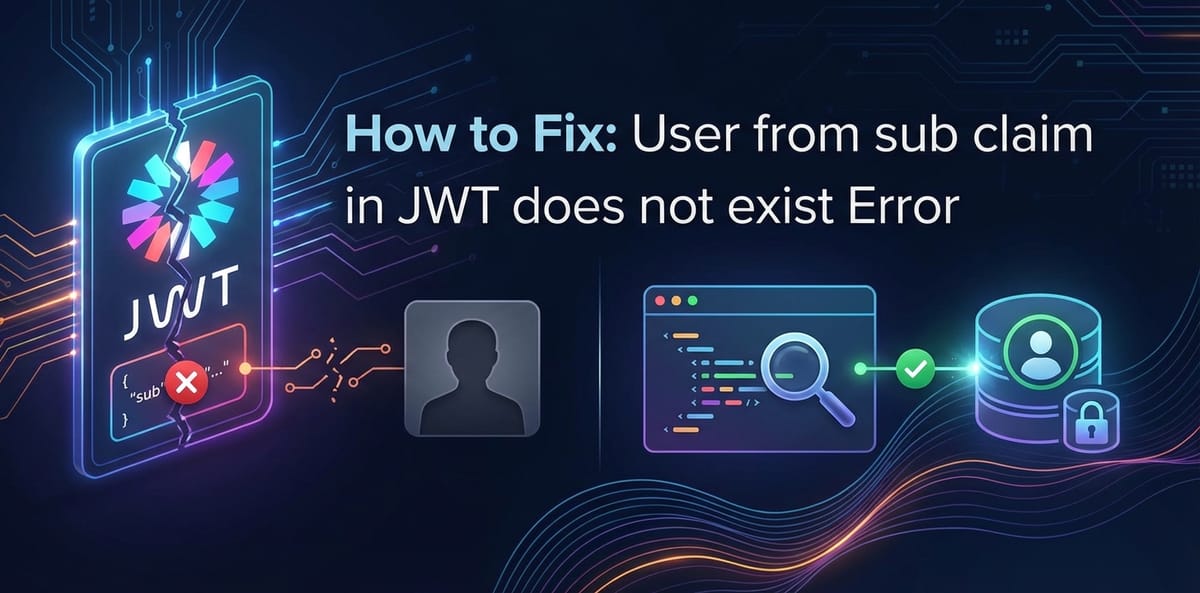
How to Fix: User from sub claim in JWT does not exist Error


In the intricate landscape of modern distributed systems, particularly those built on microservices architectures, JSON Web Tokens (JWTs) have emerged as the de facto standard for secure, stateless authentication and authorization. Their compact, URL-safe nature allows for efficient transmission of user identity and permissions across various services without the need for cumbersome session management. However, as with any sophisticated technology, challenges can arise, presenting developers and system administrators with perplexing errors that can disrupt service and compromise user experience. Among these, the error message "User from sub claim in JWT does not exist" stands out as a particularly common and often frustrating issue.
This error is more than just a fleeting anomaly; it is a critical indicator of a disconnect between an issued token's payload and the underlying identity store of the consuming service. It implies that while a JWT might be structurally valid and correctly signed, the core identifier it presents – the "subject" or sub claim – points to a user account that the system cannot find or recognize. The implications are far-reaching, ranging from legitimate users being denied access to potential security vulnerabilities if not addressed properly.
Understanding and resolving this specific error requires a deep dive into the mechanics of JWTs, the lifecycle of user identities, and the interaction between various system components, including Identity Providers (IdPs), authentication services, and the backend resources they protect. This comprehensive guide aims to unravel the complexities behind the "User from sub claim in JWT does not exist" error, exploring its fundamental causes, outlining robust diagnostic methodologies, and proposing practical, long-term solutions. We will delve into best practices for user lifecycle management, data consistency, and the pivotal role of advanced tools like AI Gateway and LLM Gateway platforms, often integrated into robust API Gateway solutions, in both preventing and mitigating such authentication failures. By the end, you will be equipped with the knowledge to not only fix this error when it occurs but also to architect systems that are inherently more resilient to such authentication discrepancies.
Demystifying JWTs and the sub Claim: The Core of Identity Verification
To effectively troubleshoot the "User from sub claim in JWT does not exist" error, it is imperative to first establish a firm understanding of what a JWT is, how it functions, and the specific significance of its sub (subject) claim. Without this foundational knowledge, diagnosing and resolving issues related to token-based authentication can feel like navigating a maze blindfolded.
What is a JSON Web Token (JWT)?
A JSON Web Token (JWT, pronounced "jot") is an open standard (RFC 7519) that defines a compact and self-contained way for securely transmitting information between parties as a JSON object. This information can be verified and trusted because it is digitally signed. JWTs are widely used for authorization and authentication, particularly in modern web applications and APIs, due to their stateless nature and efficiency.
The core premise of a JWT is its ability to convey claims – statements about an entity (typically the user) and additional metadata – in a cryptographically signed format. This signature ensures that the token's contents have not been tampered with since it was issued by a trusted entity. When a client presents a JWT to a server, the server can verify its authenticity and then use the claims within it to make authorization decisions without needing to query a centralized session store, thus enabling statelessness. This statelessness is a significant advantage in distributed systems, reducing server load and improving scalability.
Anatomy of a JWT: Header, Payload, and Signature
Every JWT consists of three distinct parts, separated by dots, typically represented as header.payload.signature. Each of these parts plays a crucial role in the token's overall functionality and security.
- Header: The header typically consists of two parts: the type of the token (which is
JWT) and the signing algorithm used, such as HMAC SHA256 or RSA.json { "alg": "HS256", "typ": "JWT" }This JSON object is then Base64Url-encoded to form the first part of the JWT. - Payload (Claims): The payload contains the "claims" – statements about an entity (usually the user) and additional data. Claims are essentially key-value pairs. There are three types of claims:A typical payload might look like this:
json { "sub": "user12345", "name": "John Doe", "admin": true, "iat": 1516239022, "exp": 1516242622 }This JSON object is also Base64Url-encoded to form the second part of the JWT.- Registered Claims: These are a set of predefined claims that are not mandatory but are recommended to provide a set of useful, interoperable claims. Examples include:
iss(issuer): Identifies the principal that issued the JWT.exp(expiration time): Identifies the expiration time on or after which the JWT MUST NOT be accepted for processing.sub(subject): Identifies the principal that is the subject of the JWT.aud(audience): Identifies the recipients that the JWT is intended for.iat(issued at time): Identifies the time at which the JWT was issued.jti(JWT ID): Provides a unique identifier for the JWT.
- Public Claims: These can be defined by anyone using JWTs. To avoid collisions, they should be registered in the IANA JSON Web Token Claims Registry or be defined as a URI that contains a collision-resistant namespace.
- Private Claims: These are custom claims created to share information between parties that agree on their meaning. They are not registered and should be used with caution to avoid name collisions.
- Registered Claims: These are a set of predefined claims that are not mandatory but are recommended to provide a set of useful, interoperable claims. Examples include:
- Signature: The signature is used to verify that the sender of the JWT is who it says it is and to ensure that the message hasn't been changed along the way. To create the signature, the Base64Url-encoded header, the Base64Url-encoded payload, and a secret (known only to the issuer and the verifying parties) are combined and run through the algorithm specified in the header. For example, using HMAC SHA256:
HMACSHA256( base64UrlEncode(header) + "." + base64UrlEncode(payload), secret )The resulting signature forms the third and final part of the JWT.
The Critical Role of the sub Claim for User Identification
Among the registered claims, the sub (subject) claim holds paramount importance when it comes to identifying the principal that the JWT refers to. In practical terms, this claim is almost universally used to store a unique identifier for the authenticated user. This identifier could be a user ID from a database, a unique username, an email address, or any other string that uniquely identifies an individual or entity within the system's context.
When a server or service receives a JWT, it first validates the signature to ensure the token's integrity and authenticity. Assuming the signature is valid and the token has not expired, the service then decodes the payload to extract the claims. The sub claim is typically the first piece of information extracted and used to look up the corresponding user in the service's internal user store (e.g., a database, an LDAP directory, or a cache). This lookup is critical because it links the abstract identifier in the token to a concrete user entity with specific roles, permissions, and profile data relevant to the current request.
If the sub claim contains a value that does not correspond to an active, recognized user in the system's identity store, the system cannot establish a valid context for the request. It cannot ascertain who is making the request, what permissions they possess, or which resources they are authorized to access. This inability to map the token's subject to an existing user account is precisely what triggers the "User from sub claim in JWT does not exist" error. It's a fundamental failure in establishing the identity of the requesting principal, effectively halting the request's progression. This critical function often falls under the purview of an API Gateway, which acts as the first line of defense, intercepting requests and performing initial authentication checks before forwarding them to downstream services.
Root Causes of the "User from sub Claim in JWT Does Not Exist" Error
The error "User from sub claim in JWT does not exist" is a symptom, not the root disease. Its appearance signifies a fundamental mismatch between the identifier presented in a valid JWT and the user accounts known to the system. Pinpointing the exact cause requires a meticulous examination of user lifecycle management, data synchronization processes, and the configuration of authentication flows. Understanding these underlying issues is the first step towards formulating effective and lasting solutions.
1. User Deletion or Deactivation
This is arguably the most prevalent and straightforward cause. A user account might have existed when a JWT was initially issued, but subsequently, that account was either permanently deleted or temporarily deactivated from the system's user store. If a valid, non-expired JWT belonging to this now-defunct user is presented, the system will attempt to look up the sub claim's value but will find no matching active user.
Detailed Explanation: Consider a scenario where an administrator removes a former employee's account from the central identity management system. However, the employee's issued JWT might still be valid for a period (e.g., several hours or days) until its expiration time. If this token, perhaps cached in a client application or an intermediary proxy, is used to make a request, the backend service, upon receiving and validating the token's signature and expiration, will then attempt to retrieve user details using the sub claim. Since the user no longer exists in the authoritative user directory, this lookup will fail, triggering the error. Deactivation, which often moves a user to a soft-deleted state or marks them as inactive, can similarly lead to this error if the application logic explicitly filters out inactive users during authentication.
2. Database Synchronization Issues
In distributed architectures, user data often resides in multiple places. An Identity Provider (IdP) or authentication service might manage the primary user database, while various microservices or backend applications might maintain their own cached copies or subsets of user information for performance or specific operational needs. If these separate data stores are not perfectly synchronized, inconsistencies can arise.
Detailed Explanation: Imagine a user being created in the central IdP. A JWT is issued, and its sub claim contains the new user's ID. However, due to a delay in replication, a failed data pipeline, or a misconfigured synchronization job, this new user's record has not yet propagated to the specific backend service attempting to process the request. The backend service, relying on its outdated or incomplete user store, will not find the user associated with the sub claim, even though the user legitimately exists in the IdP. Similarly, updates to user IDs (though rare and discouraged) or changes in user status (e.g., email verification status) that are not uniformly propagated can lead to this type of desynchronization error. This is particularly challenging in highly dynamic environments where user creation and deletion are frequent.
3. Incorrect sub Claim Mapping or Value
The value placed in the sub claim must be precisely what the consuming service expects to find in its user store. Any discrepancy in format, type, or the actual identifier used can lead to a lookup failure.
Detailed Explanation: * Format Mismatch: One service might store user IDs as UUIDs (e.g., a1b2c3d4-e5f6-7890-1234-567890abcdef), while another expects an integer ID (e.g., 12345). If the IdP puts a UUID in the sub claim but the backend service queries its database using an integer parser, the lookup will inevitably fail. * Identifier Type Mismatch: Some systems might use email addresses as the sub claim, while others expect a numeric user ID or a username. If the sub claim contains an email (user@example.com), but the backend service is configured to query a database column for a numeric user_id, the user will not be found. * Case Sensitivity: In some database systems or user stores, identifiers might be case-sensitive. If a sub claim is issued as JohnDoe but the database stores johndoe, a case-sensitive lookup will fail. * Extra Characters/Whitespace: Leading or trailing whitespace, or hidden non-printable characters accidentally included in the sub claim during generation, can prevent an exact match against the user store.
These seemingly minor discrepancies can have significant impacts, as the lookup mechanism often relies on exact matches for efficiency and security.
4. Environment Mismatches
Development, staging, and production environments often have distinct user databases and configurations. A JWT issued in one environment should ideally only be valid and consumable within that same environment.
Detailed Explanation: A common mistake is using a JWT obtained from a development environment's authentication server to access an API endpoint in the production environment. While the JWT itself might be validly signed by the development IdP's secret, the sub claim (e.g., dev_user_123) refers to a user that simply does not exist in the production user database. Production systems have their own set of user IDs, often generated differently or managed by a separate identity store. Similarly, if different environments use different iss (issuer) claims or secrets for signing, an API Gateway or backend service configured for one environment might reject tokens from another even if the sub claim could theoretically map to a user. This highlights the importance of rigorous environment segregation and proper credential management.
5. Multi-Tenant Scenarios
In multi-tenant applications, a single application instance serves multiple isolated groups of users (tenants). Each tenant often has its own set of users, even if the user IDs are globally unique.
Detailed Explanation: If a JWT's sub claim identifies a user, but the request also implicitly or explicitly carries a tenant identifier, the consuming service must verify that the user identified by sub belongs to the specified tenant. For example, a user with sub: "user_a" might exist in Tenant A, but not in Tenant B. If a token for user_a is used to access resources meant for Tenant B, and the system performs a lookup for user_a within the context of Tenant B's user store, it will report that the user does not exist. This is a common pattern in AI Gateway and LLM Gateway solutions, where tenant-specific access to models and data is crucial, and improper tenant context can lead to authorization failures that manifest as a "user not found" error. APIPark, for instance, offers independent API and access permissions for each tenant, ensuring that users and their access rights are properly segmented and managed, thereby helping to prevent such cross-tenant lookup errors.
6. Caching Inconsistencies
Many systems employ caching mechanisms to improve performance by storing frequently accessed user data. While beneficial, caching can introduce problems if the cached data becomes stale or inconsistent with the authoritative source.
Detailed Explanation: A user's account might be active and existing in the primary database. However, if the service processing the JWT relies on a local cache of user data, and that cache has not been updated since the user was created or reactivated, it might incorrectly report that the user does not exist. Conversely, if a user is deleted, but their record remains in a cache for longer than intended, the system might erroneously believe the user still exists until the cache expires, potentially leading to other authorization issues. The error "User from sub claim in JWT does not exist" specifically arises when the lookup fails against the cached data, which is out of sync with the true state.
7. Migration Issues
System migrations, whether moving to a new database, a new identity provider, or refactoring an existing service, are fertile ground for identity-related errors.
Detailed Explanation: During a migration, user IDs might be re-generated, transformed, or consolidated. If tokens issued before the migration (containing old sub values) are still in circulation and used after the migration, the consuming services, now looking up user IDs in the new schema or with new values, will fail to find a match. This is especially problematic if old tokens are not explicitly revoked or if the migration strategy doesn't account for backward compatibility or a graceful transition period for token validity. Careful planning for identity mapping and token invalidation is essential during any system overhaul.
8. Race Conditions (Less Common)
While less frequent, race conditions can theoretically contribute to this error in highly concurrent systems where user lifecycle events and token validation occur simultaneously.
Detailed Explanation: Imagine a precise sequence of events: a user account is deleted from the database. Almost instantaneously, a service attempts to validate a JWT for that very user. If the token validation logic is executed before the database transaction for deletion is fully committed and propagated, the lookup might succeed. However, if the deletion completes and the database's state is updated an instant before the lookup, the user will be reported as non-existent. Such scenarios are typically rare and often point to broader issues in concurrency control or transaction management, but they are a possibility to consider in high-throughput, real-time systems.
Each of these root causes demands a distinct diagnostic approach and a tailored solution. By carefully analyzing the context in which the "User from sub claim in JWT does not exist" error appears, developers can systematically narrow down the possibilities and implement the most appropriate fix.
Comprehensive Diagnostic Strategies
When confronted with the "User from sub claim in JWT does not exist" error, a systematic and methodical diagnostic approach is crucial. Haphazard investigation can lead to wasted time and misdiagnoses. The following strategies provide a structured framework for uncovering the precise root cause, enabling targeted and effective solutions.
1. Log Analysis: Your Digital Forensics Toolkit
Logs are often the first and most critical source of information in debugging distributed systems. Comprehensive logging provides an audit trail of events, requests, and system states.
Detailed Explanation: * Authentication Service Logs: Start by examining the logs of your Identity Provider (IdP) or the service responsible for issuing JWTs. Look for logs related to token issuance, user creation/deletion, and any errors occurring during these processes. Pay attention to timestamps to correlate events. For instance, if a user was deleted an hour ago and a token issued yesterday is still being used, the logs from the IdP might confirm the deletion event. * API Gateway Logs: If you are using an API Gateway (or an AI Gateway/LLM Gateway like APIPark), its logs are invaluable. The gateway is the first point of contact for many requests and often performs initial JWT validation. Look for entries indicating failed authentication attempts, specifically those that might log the sub claim or a correlation ID for the incoming request. APIPark, with its detailed API call logging, records every detail of each API call, enabling businesses to quickly trace and troubleshoot issues. This granular logging is essential for pinpointing when and where the authentication failure occurred. * Backend Service Logs: Examine the logs of the specific microservice or application that returned the "User from sub claim in JWT does not exist" error. This service's logs should contain entries related to the JWT validation process, the attempt to look up the user based on the sub claim, and the subsequent failure. These logs often include the exact sub value that was being sought, as well as any relevant database query failures or identity store lookup errors. * Correlation IDs: Implement and utilize correlation IDs across all services. When a request traverses multiple services, a unique correlation ID allows you to stitch together log entries from different components to form a coherent narrative of the request's journey and identify where the failure point lies.
By carefully sifting through these logs, paying close attention to error messages, timestamps, and contextual data (like sub claims), you can often narrow down the problem to a specific service or event.
2. JWT Decoding and Inspection
Directly inspecting the problematic JWT can reveal critical information about its contents, especially the sub claim.
Detailed Explanation: * Obtain the JWT: The first step is to get your hands on the actual JWT that is causing the error. This might involve inspecting network requests from the client using browser developer tools, intercepting API calls, or retrieving it from a log entry if it was logged (though be cautious about logging sensitive tokens in production). * Use Online Decoders: Tools like jwt.io allow you to paste a JWT and instantly decode its header and payload. This is an excellent way to visually inspect the sub claim. * Verify sub Claim: Carefully examine the value of the sub claim. * Format: Does it match the expected format (e.g., UUID, integer, email, username)? * Value: Is the value itself correct and what you expect for a valid user? Are there any unexpected characters, leading/trailing spaces, or case mismatches? * Expiration (exp) and Issued At (iat) claims: While not directly related to the "user does not exist" error, ensure the token is still valid (not expired) and that its issuance time is sensible. An expired token will typically yield a different error, but it's good to rule out other issues. * Programmatic Decoding: In automated tests or scripts, you can use libraries (e.g., PyJWT in Python, jsonwebtoken in Node.js, java-jwt in Java) to decode JWTs programmatically. This allows for validation of the sub claim against a regex or a known set of valid formats.
Inspecting the decoded JWT provides a direct look at the identity being presented to your system, which can immediately highlight issues like incorrect sub formatting or unexpected values.
3. Database Verification: The Source of Truth
The system's user store (database, LDAP, identity directory) is the ultimate source of truth for user existence. Verifying the sub claim against this store is a non-negotiable diagnostic step.
Detailed Explanation: * Direct Query: Once you have the sub claim value from the decoded JWT, perform a direct query against the database or identity store that your backend service uses for user lookups. * Match sub with User ID: Use the sub value to search for a corresponding user record. Ensure you are querying the correct table, column, and using the correct data type. For instance, if sub is user12345, try SELECT * FROM users WHERE user_id = 'user12345';. * Check User Status: If a user record is found, verify its status. Is the user marked as active, enabled, verified, or in any other state that the application considers valid for authentication? A user might exist but be inactive, leading to the "does not exist" error from the application's perspective. * Tenant Context: In multi-tenant systems, ensure your query includes the correct tenant identifier. For example, SELECT * FROM users WHERE user_id = 'user12345' AND tenant_id = 'tenant_A';.
If the user is found in the database, but the application still reports the error, it points to a problem with how the application accesses or interprets the database data (e.g., caching issues, incorrect ORM mapping, or application-level filtering). If the user is not found in the database, the problem lies with user lifecycle management or data synchronization.
4. Identity Provider (IdP) Trace
Tracing the token issuance process at the Identity Provider can help determine if the sub claim was correctly generated in the first place.
Detailed Explanation: * IdP Logs & Audits: Review the IdP's audit logs to see when the specific JWT was issued. Check what sub claim was embedded during issuance. This is crucial if you suspect the sub claim is being generated incorrectly by the IdP itself or if there are multiple IdPs in play. * User Provisioning: If the user is new or recently updated, trace the user provisioning process within the IdP. Confirm that the user account was created successfully and that the identifier that should be used as the sub claim is indeed present and correct within the IdP's authoritative user record. * IdP Configuration: Review the IdP's configuration for JWT generation. Ensure that the sub claim mapping is set up to pull the correct, unique user identifier from the IdP's user profiles. Sometimes, a configuration change in the IdP can inadvertently alter what gets put into the sub claim.
5. Reproducing the Issue
Attempting to consistently reproduce the error can provide invaluable insights into its triggers and context.
Detailed Explanation: * Step-by-Step Scenario: If possible, try to reproduce the exact sequence of actions that leads to the error. This might involve a specific user, a particular client application, or a unique API call pattern. * Test Accounts: Create a dedicated test account and try to replicate the user deletion/deactivation scenario, or a data synchronization delay. Issue a token for this test user, then delete/deactivate the user, and immediately try to use the token. This helps confirm hypotheses about user lifecycle management issues. * Network Interception: Use tools like Fiddler, Postman, or curl to construct and send requests with the problematic JWT. This allows you to isolate the authentication flow and observe the exact responses and headers, providing a controlled environment for testing different scenarios.
By combining these diagnostic strategies, developers can systematically eliminate potential causes and home in on the precise reason why the "User from sub claim in JWT does not exist" error is occurring, paving the way for targeted and effective solutions.
APIPark is a high-performance AI gateway that allows you to securely access the most comprehensive LLM APIs globally on the APIPark platform, including OpenAI, Anthropic, Mistral, Llama2, Google Gemini, and more.Try APIPark now! 👇👇👇
Robust Solutions and Best Practices
Resolving the "User from sub claim in JWT does not exist" error extends beyond a quick fix; it necessitates a re-evaluation of identity management processes, data consistency protocols, and the overall architecture of your authentication system. Implementing robust solutions and adhering to best practices can significantly enhance the resilience, security, and user experience of your applications.
1. User Lifecycle Management: From Creation to Decommission
Effective management of user accounts throughout their entire lifecycle is paramount to preventing identity-related errors. This includes not just creation but also updates, deactivation, and deletion.
Detailed Explanation: * Graceful User Deletion/Deactivation: When a user account is deleted or deactivated, it should trigger a cascade of actions to invalidate all active sessions and tokens for that user. This typically involves: * JWT Revocation: Implementing a mechanism to blacklist or revoke JWTs. Since JWTs are stateless, they typically don't have a built-in revocation mechanism without additional infrastructure. Solutions include: * Short-lived tokens with frequent refresh: Minimize the window of opportunity for an invalid token to be used. Users rely on refresh tokens (which can be revoked) to obtain new access tokens. * Centralized Revocation List/Cache: A shared cache (e.g., Redis) storing revoked JWT IDs (jti claim) or user IDs. When a JWT is presented, the system checks this list after signature validation and before user lookup. If the token's jti or sub is in the revocation list, access is denied. This adds a stateful component but is highly effective. * Reference Tokens (Opaque Tokens): Instead of JWTs, issue opaque tokens that are simply pointers to session data stored on the server. Revocation is then as simple as deleting the session data. While less "stateless" than JWTs, they offer easier revocation. * Session Termination: Explicitly invalidate any persistent sessions associated with the user across all relevant services. * Event-Driven Communication: When a user is deleted/deactivated in the Identity Provider, an event (e.g., via a message queue) should be published. All downstream services that maintain user-specific data or caches should subscribe to these events and update their stores accordingly in near real-time. This proactive approach helps prevent stale data.
2. Data Consistency and Synchronization: Bridging the Gaps
Ensuring that user data is consistent across all consuming services is critical, especially in distributed environments.
Detailed Explanation: * Robust Data Synchronization Mechanisms: Implement reliable and fault-tolerant data pipelines to synchronize user information from the authoritative Identity Provider to all downstream services that require user details. This could involve: * Change Data Capture (CDC): Monitoring the IdP's user database for changes and pushing these changes to subscribed services. * Event Sourcing: The IdP emits user lifecycle events (UserCreated, UserUpdated, UserDeleted) that other services consume and react to, updating their local user caches or databases. This ensures a consistent view of the user's status across the ecosystem. * Scheduled Reconciliation: Regular, scheduled jobs that compare user data across systems and resolve discrepancies. While less real-time, it acts as a failsafe. * Centralized User Management: Consolidate user management operations (creation, updates, deletion) to a single, authoritative system (your IdP). Avoid allowing individual microservices to directly create or modify user accounts independently, as this greatly increases the risk of data divergence. All user-related actions should flow through the central IdP.
3. Standardizing sub Claim Usage: The Common Language
Consistency in how the sub claim is generated and interpreted is crucial for seamless authentication.
Detailed Explanation: * Consistent Identifier Format: Mandate a single, universally adopted format for the sub claim across your entire system. If you choose UUIDs, ensure all services expect and generate UUIDs. If email addresses, ensure all services correctly handle case sensitivity and format. Avoid mixing different types of identifiers for sub. * Clear Documentation and Contracts: Document the expected format and content of the sub claim explicitly within your API specifications and developer guidelines. All developers building services that consume JWTs must adhere to this contract. This is particularly important for an API Gateway solution, as it sets the standard for interaction with all downstream services. * Strict Validation on Consumption: Services consuming JWTs should implement strict validation logic for the sub claim. This includes: * Format Validation: Regular expressions to ensure the sub claim conforms to the expected pattern (e.g., UUID format). * Type Coercion: If an integer ID is expected, ensure the sub claim can be safely converted to an integer. * Trim Whitespace: Always trim any leading or trailing whitespace from the sub claim before performing a lookup.
4. Token Refresh and Re-authentication Flows
Implement robust mechanisms for managing token validity and refreshing user sessions.
Detailed Explanation: * Short-Lived Access Tokens and Long-Lived Refresh Tokens: This is a common pattern. Access tokens have a short expiration (e.g., 5-15 minutes), minimizing the window during which a compromised or revoked token can be used. When an access token expires, the client uses a longer-lived refresh token to obtain a new access token without requiring the user to re-enter credentials. * Refresh Token Revocation: Refresh tokens should be revocable. If a user is deleted, their refresh token should be immediately invalidated at the IdP. This ensures that even if an old access token is still floating around, new ones cannot be generated for a non-existent user. * Prompt Re-authentication: If a token validation fails for reasons other than expiration (like the "user does not exist" error), gracefully prompt the user to re-authenticate. This clears any stale tokens and forces a fresh session with a valid identity. Provide clear, user-friendly messages rather than cryptic technical errors.
5. Error Handling and User Feedback
How your system responds to errors significantly impacts the developer and user experience.
Detailed Explanation: * Clear, Consistent Error Messages: Avoid exposing internal system details in error messages to end-users. Instead of "SQLSTATE[23502]: User 'sub123' not found in users table," provide a generic but helpful message like "Authentication failed. Please log in again" or "Access denied. Your account may have been deactivated." * Detailed Logging for Developers: Ensure that while user messages are generic, internal logs capture all necessary details for debugging, including the full sub claim (if permissible based on privacy concerns), token ID, request ID, and the exact error from the identity store lookup. * Alerting and Monitoring: Set up alerts for high volumes of "User from sub claim in JWT does not exist" errors. This can indicate a systemic issue with user deletion, synchronization, or a misconfigured service, allowing operations teams to intervene proactively.
6. Testing Strategies
Comprehensive testing is the bedrock of preventing authentication failures.
Detailed Explanation: * Unit and Integration Tests: Test individual components responsible for JWT generation, validation, and user lookup. Ensure that different sub claim formats are handled correctly. * End-to-End Authentication Flow Tests: Simulate the entire user login and API access flow. Include edge cases such as: * User creation followed by immediate API access. * User deletion followed by API access attempts with an old token. * User deactivation and reactivation. * Using tokens from different environments. * Load and Stress Testing: Ensure your authentication services and user stores can handle high concurrent loads without introducing synchronization delays or lookup failures.
7. Centralized Authentication Logic with API Gateways
Leveraging an API Gateway as a central point for authentication and authorization is one of the most effective architectural patterns for preventing and mitigating this error.
Detailed Explanation: * Single Point of Validation: An API Gateway acts as an enforcement point for all incoming API requests. By consolidating JWT validation logic at the gateway, you ensure consistent application of authentication policies across all your backend services. This prevents individual services from implementing potentially flawed or inconsistent validation, which could lead to discrepancies in user lookup. * User Context Enrichment at the Gateway: A sophisticated API Gateway can do more than just validate the JWT signature and expiration. It can be configured to: * Perform User Lookup: Before forwarding the request to a backend service, the gateway can use the sub claim to query the authoritative user store (or a highly consistent cache). If the user associated with the sub claim does not exist or is inactive, the gateway can immediately reject the request with an appropriate error (e.g., HTTP 401 Unauthorized or 403 Forbidden). This prevents invalid requests from ever reaching your backend services, reducing their load and simplifying their logic. * Enrich Request with User Data: If the user is found, the gateway can fetch additional user details (roles, permissions, tenant ID) and inject them into the request headers or context before forwarding to the downstream service. This empowers backend services with rich user context without each service needing to perform its own user lookup. * Centralized Revocation Enforcement: The gateway is an ideal place to enforce JWT revocation lists or check against a shared cache of revoked tokens. All requests pass through it, ensuring that blacklisted tokens are caught immediately. * Enhanced Logging and Monitoring: As mentioned in the diagnostics section, an API Gateway provides a unified logging point for all API traffic. Comprehensive logs at this layer, showing which sub claims are failing validation, provide invaluable insights and enable quicker detection of systemic issues. This makes the API Gateway a critical component for observability in a microservices ecosystem.
This architecture pattern is particularly potent for managing access to AI Gateway and LLM Gateway services. For instance, APIPark is an open-source AI Gateway and API Management Platform specifically designed for this purpose. It allows quick integration of 100+ AI models and provides a unified API format for AI invocation. Crucially, its end-to-end API lifecycle management capabilities ensure that authentication, authorization, traffic forwarding, and detailed logging are handled consistently. By positioning APIPark at the forefront of your AI and REST services, you centralize the identity verification process. If a JWT presented to an AI model through APIPark has a sub claim pointing to a non-existent user, APIPark can immediately deny access, preventing the request from consuming valuable AI inference resources and generating unnecessary backend errors. Its robust performance (over 20,000 TPS with modest resources) and powerful data analysis features, which analyze historical call data, are instrumental in preventing issues before they occur and quickly diagnosing them when they do. The ability to manage API resource access via approval and provide independent API and access permissions for each tenant further solidifies its role in a secure and scalable architecture that minimizes "user does not exist" errors in complex AI-driven environments.
By integrating these solutions and best practices, organizations can construct a highly secure, consistent, and resilient authentication system that effectively minimizes, and swiftly resolves, the "User from sub claim in JWT does not exist" error.
The Pivotal Role of API Gateways (and AI Gateways) in Preventing and Mitigating this Error
In the contemporary landscape of cloud-native applications and microservices, the API Gateway has evolved from a simple request router into an indispensable control plane for managing the complexities of distributed systems. Its strategic position at the edge of your network, acting as the single entry point for all API requests, makes it uniquely suited to address and often prevent identity-related errors like "User from sub claim in JWT does not exist." Furthermore, with the rise of artificial intelligence, specialized AI Gateway and LLM Gateway solutions extend these capabilities to securely and efficiently manage access to powerful AI models.
Centralized Authentication & Authorization Enforcement
One of the primary benefits of an API Gateway is its ability to centralize authentication and authorization logic. Instead of each microservice independently validating tokens and looking up user details, the gateway takes on this critical responsibility.
Detailed Explanation: When a client sends a request with a JWT, the API Gateway intercepts it. Here, it performs the initial, crucial validations: 1. JWT Signature Verification: Ensures the token hasn't been tampered with and was issued by a trusted authority. 2. Expiration Check: Verifies that the token is still within its validity period. 3. User Context Lookup: This is where the gateway directly addresses the "User from sub claim does not exist" error. Based on the sub claim in the JWT, the gateway can be configured to query a central Identity Provider (IdP), a user service, or a highly available cache for the corresponding user record. If the user identified by the sub claim is not found, or if their account is deactivated/deleted, the gateway can immediately reject the request. This prevents invalid tokens from consuming backend resources and standardizes the error response across your entire API surface. This centralized approach ensures that all services operate with a consistent understanding of user identity and status, dramatically reducing the potential for isolated lookup failures.
Token Validation and Introspection Beyond Simple Checks
Modern API Gateways offer sophisticated token validation capabilities that go beyond basic JWT structure and signature checks.
Detailed Explanation: * Policy-Driven Validation: Gateways allow you to define granular policies for JWT validation. This could include checking for specific audience (aud) claims, issuer (iss) claims, or custom claims that denote specific roles or permissions. If any policy is violated, the gateway can reject the request before it reaches any backend service. * IdP Introspection: For more dynamic user status checks, the gateway can perform token introspection. This involves sending the JWT (or its jti claim) to the original IdP to ask: "Is this token still valid? Is the user active?" The IdP can then respond with real-time status, allowing the gateway to make an informed decision, especially useful for handling immediate user deactivations or revocations that a stateless JWT wouldn't natively support. This adds a slight latency but provides an authoritative and up-to-date user status.
User Context Enrichment: Empowering Downstream Services
Once the API Gateway has successfully validated a JWT and confirmed the user's existence and active status, it can enrich the incoming request with additional user information before forwarding it to the backend.
Detailed Explanation: Instead of each microservice having to perform its own user lookup based on the sub claim, the gateway can fetch comprehensive user data (e.g., roles, permissions, tenant ID, full name) from the IdP or user service. This data can then be injected into request headers or a dedicated context object that accompanies the request to the downstream service. This pattern means: * Reduced Redundancy: Microservices no longer need to replicate user lookup logic. * Performance Improvement: Backend services receive pre-validated, enriched user context, reducing database queries and processing overhead. * Simplified Backend Logic: Services can simply trust the information provided by the gateway, making their code cleaner and less susceptible to identity-related errors. If the gateway ensures the user exists, the backend service can proceed without re-validating this fundamental aspect.
Rate Limiting & Throttling (Indirect Benefit)
While not directly addressing the sub claim error, API Gateways typically offer rate limiting and throttling capabilities.
Detailed Explanation: By controlling the volume of requests, especially unauthenticated or invalid ones, an API Gateway can protect your authentication services and user stores from being overwhelmed by malicious or misconfigured clients attempting to discover valid sub values through brute-force attacks or simply hammering the system with invalid tokens. This enhances the overall security posture and stability of the system.
Comprehensive Logging and Monitoring: Early Warning Systems
The API Gateway is a prime location for collecting detailed logs and metrics related to API traffic, including authentication failures.
Detailed Explanation: * Centralized Visibility: All requests passing through the gateway can be logged, providing a single point of visibility for monitoring authentication attempts, successes, and failures. * Detailed Error Reporting: Gateway logs can capture critical details of failed requests, such as the sub claim from invalid JWTs, the timestamp of the failure, the client IP, and the specific reason for rejection (e.g., "user not found"). This rich data is invaluable for quickly diagnosing the "User from sub claim does not exist" error, identifying patterns, and pinpointing its root cause. * Proactive Alerting: Integrating gateway logs with monitoring systems allows for setting up alerts for spikes in "user not found" errors. This acts as an early warning system, notifying operations teams of potential user lifecycle issues, synchronization problems, or even malicious activity before they significantly impact users.
Revocation Lists and Blacklisting
For sensitive applications or critical events, the API Gateway can enforce token revocation.
Detailed Explanation: In scenarios like user deletion or security breaches, specific JWTs or all tokens belonging to a user need to be invalidated immediately. Since JWTs are stateless by design, this often requires an external mechanism. The API Gateway can be configured to maintain or query a distributed cache or database (a "blacklist" or "revocation list") of invalid token IDs (jti) or user IDs (sub). Any incoming JWT whose jti or sub appears on this list is immediately rejected, ensuring that even validly signed but conceptually invalid tokens are denied access.
APIPark: An AI Gateway and API Management Platform in Action
This is where a robust solution like APIPark truly shines. APIPark is an open-source AI Gateway and API Management Platform that embodies all these critical functionalities and extends them specifically for the AI/LLM ecosystem.
Detailed Explanation of APIPark's Relevance: * Centralized Authentication for AI & REST Services: APIPark sits at the front, managing access to both traditional REST APIs and modern AI models. This means all JWTs, whether for general microservices or for invoking an LLM, pass through APIPark for unified authentication and authorization. This central point is perfect for catching "User from sub claim does not exist" errors before they propagate. * Unified API Format & Prompt Encapsulation: By standardizing AI invocation and allowing prompt encapsulation into REST APIs, APIPark ensures that the underlying AI models are accessed consistently. This consistency extends to authentication. If the sub claim is validated by APIPark, then the AI service itself doesn't need to re-validate, simplifying its internal logic and reducing error surface. * End-to-End API Lifecycle Management: From design to publication and invocation, APIPark helps regulate the entire API management process. This includes robust access control mechanisms. If a user is deleted, APIPark’s lifecycle management ensures that access to published APIs for that sub is promptly revoked, preventing the error. * Independent API and Access Permissions for Each Tenant: In multi-tenant AI applications, APIPark's ability to create multiple teams (tenants) with independent applications and security policies is crucial. It ensures that a sub claim is verified not just for existence, but for existence within the correct tenant context. This directly mitigates tenant-related "user not found" errors in AI model access. * Performance Rivaling Nginx: With high performance, APIPark can handle massive traffic, ensuring that real-time user lookups and policy enforcements don't become a bottleneck. This is critical for preventing latency-induced errors or service degradation, even under heavy load. * Detailed API Call Logging and Powerful Data Analysis: APIPark records every detail of each API call. When a "User from sub claim does not exist" error occurs, these logs become an indispensable tool for immediate troubleshooting. Furthermore, its powerful data analysis features allow businesses to spot long-term trends and anomalies, helping to implement preventive maintenance and identify systemic issues (like recurring user synchronization problems) before they escalate into widespread errors. This proactive capability is key to maintaining a robust authentication system.
In essence, by deploying an API Gateway like APIPark as your AI Gateway and LLM Gateway, you establish a resilient and intelligent perimeter around your services. This perimeter centralizes identity verification, proactively prevents unauthorized access by non-existent users, streamlines error handling, and provides the necessary insights to maintain a stable and secure environment. It transforms the challenge of "User from sub claim in JWT does not exist" from a recurring headache into a manageable, often preventable, exception.
Comparison of Strategies for Handling Non-Existent or Revoked Users at the Gateway Level
To provide a clearer picture of the different approaches an API Gateway can employ to manage user existence and token validity, especially in the context of the "User from sub claim in JWT does not exist" error, let's look at a comparative table. Each strategy offers distinct trade-offs in terms of performance, complexity, and real-time accuracy.
| Feature / Strategy | Direct User Lookup (API Gateway) | JWT Blacklisting (API Gateway) | Token Introspection (API Gateway to IdP) | Short-lived Tokens + Refresh Tokens (IdP + Gateway) |
|---|---|---|---|---|
| Primary Mechanism | Gateway queries user service/database with sub claim. |
Gateway checks local cache/database for revoked jti or sub. |
Gateway calls IdP's introspection endpoint with JWT. | IdP issues short access tokens; clients use refresh tokens for new ones. |
Handles "User from sub Does Not Exist"? |
Yes (directly checks user existence/status). | Potentially, if user deletion adds sub to blacklist. |
Yes (IdP confirms user validity/existence). | Indirectly, by expiring tokens, but requires separate revocation for active tokens. |
| Handles User Deactivation/Deletion? | Yes (if lookup checks user status/active flag). | Yes (if deletion adds sub to blacklist). |
Yes (IdP reflects real-time user status). | Yes (if refresh token is immediately revoked). |
| Handles JWT Revocation? | No (only user existence). | Yes (explicitly blacklists tokens). | Yes (IdP can mark token as inactive). | Indirectly (revoking refresh tokens stops new access tokens). |
| Performance Impact | Moderate-High: Requires an extra network call to user service/DB per request. | Low-Moderate: Fast local cache lookup. | High: Extra network call to IdP per request (can be cached). | Low (for access token validation); Refresh flow adds latency. |
| Complexity | Moderate (integrating gateway with user service). | Moderate (managing distributed blacklist/cache). | Moderate (IdP support, network config). | High (client-side refresh logic, refresh token management). |
| Real-Time Accuracy | High (if user service is up-to-date). | High (if blacklist is rapidly updated). | Highest (direct query to IdP). | High (for new access tokens). |
| Scalability | Can be a bottleneck if user service isn't highly scalable. | Highly scalable with distributed cache. | Can bottleneck IdP if not designed for high load. | Highly scalable, access tokens are stateless. |
| Implementation Notes | Ideal for critical user-centric APIs. Requires robust user service. | Best for immediate invalidation. Cache consistency is key. | Best for authoritative, real-time status. Can be costly. | Standard for most modern auth. Requires refresh token security. |
| APIPark Relevance | Highly relevant. APIPark can integrate user service lookup policies. | Highly relevant. APIPark's lifecycle management can manage blacklists. | Can integrate with IdP introspection for advanced scenarios. | Supports the overall secure architecture. |
Analysis of the Table:
The table illustrates that no single strategy is a silver bullet. Each has its strengths and weaknesses depending on the specific requirements of the application, such as latency tolerance, real-time revocation needs, and architectural complexity.
- Direct User Lookup at the API Gateway: This strategy directly tackles the "User from
subdoes not exist" error head-on by performing an immediate check against the authoritative user store. It's highly effective for ensuring user existence and status. Solutions like APIPark can be configured to implement such policies, acting as an AI Gateway to validate user contexts before allowing access to valuable AI resources. While it adds a network hop, for critical applications where a non-existent user should never access any resource, this is an invaluable layer of defense. - JWT Blacklisting: This method is excellent for real-time revocation. If a user is deleted, their
subcan be added to a blacklist, ensuring that any active tokens for that user are immediately rejected. It's generally faster than direct user lookup if the blacklist is a fast-access distributed cache. - Token Introspection: This offers the highest real-time accuracy as it consults the IdP directly. However, the performance overhead is significant, making it less suitable for every API request in high-throughput systems. It's often reserved for sensitive operations or initial session establishment.
- Short-lived Tokens + Refresh Tokens: This is a widely adopted best practice that mitigates many issues by limiting the lifespan of access tokens. While it doesn't directly prevent an expired short-lived token from being presented by a deleted user, the revocation of the refresh token ensures new access tokens cannot be issued.
Conclusion on Gateway Strategies:
For comprehensively addressing the "User from sub claim in JWT does not exist" error, a multi-layered approach combining several of these strategies is often the most robust. An API Gateway (like APIPark) is an ideal platform to orchestrate these layers:
- Initial Validation: The gateway performs basic JWT signature and expiration checks.
- Blacklist Check: If a
jticlaim is present, the gateway checks a fast-access blacklist for immediate revocation. - User Existence/Status Check: The gateway performs a quick lookup against a user service or a local, frequently updated cache based on the
subclaim. If the user doesn't exist or is inactive, the request is denied. - Token Refresh Flow Management: The gateway ensures that expired access tokens trigger the correct refresh token flow, validating the refresh token with the IdP and issuing new access tokens if the user is still valid and active.
By implementing these strategies at the API Gateway layer, you create a powerful, centralized defense that dramatically improves the security posture and reliability of your entire API ecosystem, ensuring that only legitimate, active users can access your services, including those powered by AI Gateway and LLM Gateway technologies. This proactive management minimizes the chances of the dreaded "User from sub claim in JWT does not exist" error ever reaching your core business logic.
Conclusion
The "User from sub claim in JWT does not exist" error, while seemingly simple in its declaration, belies a complex interplay of factors within modern distributed authentication systems. It represents a fundamental breach in trust: a token, carrying the promise of a known identity, fails to find its counterpart in the system's authoritative user store. This discrepancy can stem from a myriad of causes, ranging from the straightforward deletion of a user account to intricate data synchronization failures across microservices, subtle mismatches in identifier formats, or the challenges inherent in multi-tenant environments.
Resolving this error effectively demands a holistic approach that extends beyond mere patching. It necessitates a deep understanding of JSON Web Tokens, meticulous user lifecycle management, robust data consistency protocols, and the strategic deployment of architectural solutions. Implementing mechanisms for graceful user deactivation and deletion, coupled with immediate token revocation strategies like blacklisting or short-lived tokens with revocable refresh tokens, forms the bedrock of a resilient system. Standardizing the sub claim's format and ensuring seamless data synchronization across all services are equally critical in maintaining a coherent and consistent view of user identities.
Perhaps the most potent defense against this pervasive authentication challenge lies in the judicious use of an API Gateway. By acting as the central gatekeeper, an API Gateway consolidates authentication and authorization logic, validating tokens, performing user existence checks, and enriching requests with essential user context before they ever reach backend services. This not only streamlines the architecture but also provides a unified point for logging and monitoring, offering invaluable insights for proactive detection and rapid diagnosis of issues. For specialized applications leveraging artificial intelligence, an AI Gateway or LLM Gateway, such as APIPark, extends these crucial capabilities, ensuring secure, consistent, and managed access to advanced AI models while actively preventing identity-related access failures.
Ultimately, preventing the "User from sub claim in JWT does not exist" error is a testament to sound architectural design, diligent operational practices, and a commitment to security and user experience. By embracing the best practices outlined in this guide and leveraging powerful tools, developers and enterprises can build authentication systems that are not only secure and performant but also inherently resilient to the often-elusive intricacies of identity management in a distributed world. The goal is to move from reacting to errors to proactively preventing them, ensuring that every authenticated request is a request from a recognized, active, and authorized user.
5 FAQs about "User from sub Claim in JWT Does Not Exist Error"
Q1: What does the "User from sub claim in JWT does not exist" error fundamentally mean?
A1: This error signifies that a JSON Web Token (JWT) was presented to an application or API, and while the token's signature was successfully validated (meaning it's authentic and untampered), the unique user identifier contained within its sub (subject) claim does not correspond to an active, recognized user in the system's identity store (e.g., database, LDAP, identity provider). In simpler terms, the system knows the token is valid, but it can't find the user it claims to represent. This could be because the user was deleted, deactivated, or there's a mismatch in how the user ID is stored or looked up.
Q2: Why is this error particularly problematic in microservices architectures?
A2: In microservices, user data often needs to be consistent across multiple, independently deployed services or cached within them. If the central Identity Provider (IdP) or user management service updates a user's status (e.g., deactivates them), but this change isn't immediately and consistently propagated to all consuming microservices, stale data can lead to this error. One service might believe the user exists, while another, with outdated information, reports them as non-existent. The stateless nature of JWTs also means that simply revoking a token can be complex, requiring additional mechanisms like blacklisting or refreshing, which adds to the distributed challenge.
Q3: How can an API Gateway, AI Gateway, or LLM Gateway help prevent this error?
A3: An API Gateway acts as a central enforcement point for all incoming requests. By centralizing JWT validation at the gateway, it can perform a robust check on the sub claim against the authoritative user store before forwarding the request to any backend service. If the user doesn't exist or is inactive, the gateway can immediately deny access, preventing the error from occurring downstream. For AI Gateway and LLM Gateway solutions, like APIPark, this is even more crucial as it secures access to valuable AI resources, ensuring that only authenticated and authorized users can invoke complex AI models, thereby enhancing both security and resource efficiency. The gateway can also enrich requests with confirmed user context, so downstream services don't need to perform redundant lookups.
Q4: What are the immediate steps I should take to diagnose this error when it occurs?
A4: 1. Inspect the JWT: Decode the problematic JWT (e.g., using jwt.io) and verify the exact value and format of the sub claim. Check if it matches your expected user ID format. 2. Check Logs: Examine logs from your Identity Provider, API Gateway, and the affected backend service. Look for events related to the token's issuance, user creation/deletion, and the specific lookup failure, paying attention to timestamps. 3. Verify User Store: Directly query your user database or identity provider using the sub claim value from the JWT. Confirm if the user exists and, if so, their current active status. 4. Reproduce the Issue: Attempt to consistently recreate the error scenario to isolate the specific conditions that trigger it, such as a recently deleted user or a specific type of token.
Q5: What long-term solutions are recommended to avoid this error in the future?
A5: * Robust User Lifecycle Management: Implement clear processes for user creation, deactivation, and deletion, ensuring that all related tokens and sessions are immediately invalidated (e.g., through JWT blacklisting or refresh token revocation). * Strong Data Synchronization: Establish reliable, real-time mechanisms (like event-driven updates or Change Data Capture) to keep user data consistent across your Identity Provider and all consuming services. * Standardized sub Claim: Consistently use a single, well-defined format for the sub claim across your entire system, and ensure all services correctly interpret it. * API Gateway Deployment: Utilize an API Gateway (APIPark for AI and API management) to centralize authentication, user existence checks, and request enrichment, thereby acting as the first line of defense. * Short-Lived Access Tokens with Refresh Tokens: Implement a system where access tokens have a short lifespan, and clients use revocable refresh tokens to obtain new ones, limiting the window of opportunity for invalid tokens. * Comprehensive Testing: Include test cases for user lifecycle events (deletion, deactivation) in your automated test suites to catch such issues before deployment.
🚀You can securely and efficiently call the OpenAI API on APIPark in just two steps:
Step 1: Deploy the APIPark AI gateway in 5 minutes.
APIPark is developed based on Golang, offering strong product performance and low development and maintenance costs. You can deploy APIPark with a single command line.
curl -sSO https://download.apipark.com/install/quick-start.sh; bash quick-start.sh

In my experience, you can see the successful deployment interface within 5 to 10 minutes. Then, you can log in to APIPark using your account.

Step 2: Call the OpenAI API.