How to Build Microservices Input Bots: A Step-by-Step Guide
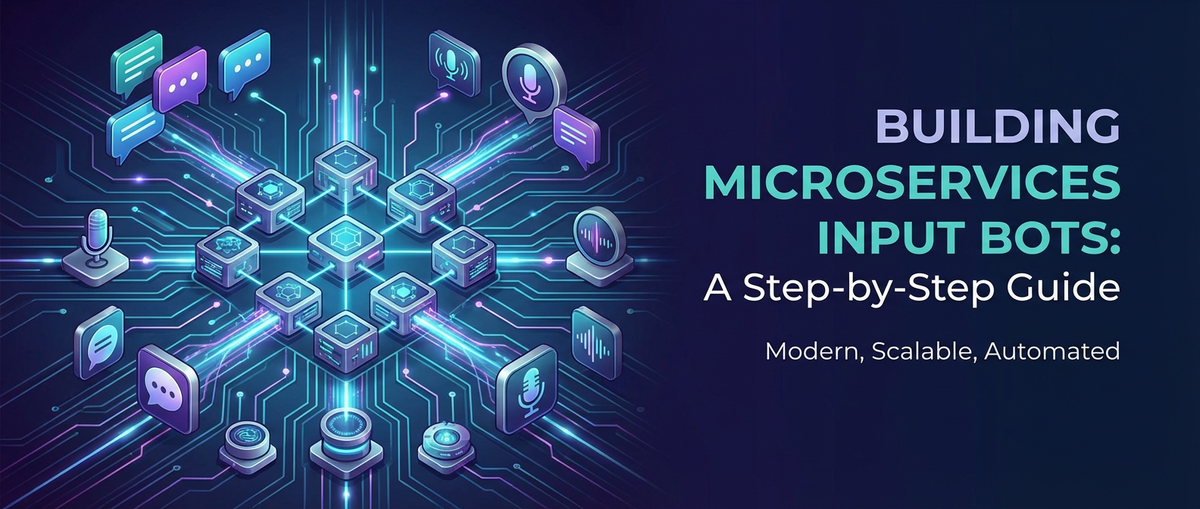


In an increasingly interconnected and automated world, intelligent bots have transitioned from sci-fi concepts to indispensable tools for businesses and individuals alike. These sophisticated systems, capable of understanding and responding to human input, streamline operations, enhance customer service, and unlock new avenues for interaction. However, as the complexity and demands placed upon these bots grow, traditional monolithic architectures often falter, leading to scalability issues, maintenance nightmares, and slow development cycles. This is where the power of microservices architecture, coupled with robust API management and specialized AI Gateway solutions, becomes not just beneficial, but essential.
This comprehensive guide delves deep into the methodology of constructing sophisticated input bots using a microservices paradigm. We will explore the fundamental principles that underpin this architectural style, offering a detailed, step-by-step roadmap from conceptualization to deployment. You’ll learn how to decompose your bot’s functionalities into small, independent, and manageable services, enabling unparalleled scalability, resilience, and development agility. Crucially, we will illuminate the pivotal roles of the API, the API Gateway, and the cutting-edge AI Gateway in orchestrating these disparate services, ensuring secure, efficient, and intelligent communication flows. By the end of this journey, you will possess a profound understanding of how to architect, build, and maintain highly performant and adaptable input bots that stand ready to meet the evolving challenges of the digital age.
Chapter 1: Understanding the Foundation – Microservices Architecture for Bots
The journey to building a highly scalable and resilient input bot begins with a fundamental shift in architectural thinking: embracing microservices. This paradigm offers a compelling alternative to traditional monolithic applications, particularly well-suited for the dynamic and evolving nature of bot development.
1.1 What are Microservices?
Microservices represent an architectural approach where a single application is composed of many loosely coupled, independently deployable, and highly specialized services. Unlike a monolithic application, where all components are tightly integrated into a single, indivisible unit, each microservice in this model operates as its own mini-application. These services communicate with each other primarily through lightweight mechanisms, most commonly via APIs (Application Programming Interfaces), often using RESTful protocols over HTTP or asynchronous messaging queues.
The core characteristics of microservices include:
- Small and Focused: Each service is designed to do one thing and do it well, typically encapsulating a single business capability. For an input bot, this might mean a service dedicated solely to natural language understanding, another for managing conversation state, and a third for integrating with an external CRM system.
- Independent Deployment: Because services are loosely coupled, they can be developed, tested, and deployed independently of other services. This significantly accelerates the development lifecycle, allowing teams to iterate rapidly without impacting the entire application.
- Loose Coupling: Services interact with minimal dependencies on each other's internal implementation details. They expose well-defined APIs, acting as contracts that define how other services can interact with them. This isolation prevents changes in one service from cascading into widespread failures across the system.
- Decentralized Data Management: While not strictly enforced, microservices often favor decentralized data management, meaning each service might manage its own database. This enhances autonomy and prevents a single database schema change from impacting multiple services.
- Technology Heterogeneity: Teams are free to choose the best technology stack (programming language, database, frameworks) for each service, based on its specific requirements. This flexibility can lead to more efficient and performant services, though it does introduce complexity in managing diverse tech stacks.
- Resilience: The failure of one microservice does not necessarily bring down the entire application. Other services can continue to operate, and robust error handling mechanisms can be implemented to gracefully degrade functionality or retry operations.
Contrasting this with a monolithic architecture, where all bot functionalities—from input processing to intent recognition, business logic, and external integrations—are bundled into a single application, highlights the advantages. Monoliths are simpler to initially develop and deploy, but they quickly become cumbersome as the bot grows, leading to slow startup times, difficulty scaling specific components, and a higher risk of system-wide failures.
1.2 Why Microservices for Input Bots?
The unique demands of building sophisticated input bots make microservices an exceptionally suitable architectural choice. The advantages derived from this approach directly address many of the common challenges faced in bot development:
- Exceptional Scalability: Input bots often experience fluctuating traffic patterns, particularly during peak usage periods. With microservices, individual components of the bot—such as the NLP service or a specific integration service—can be scaled independently based on their specific load. If the NLP service is under heavy load, only that service needs more resources (e.g., more instances), leaving other services unaffected and optimizing resource utilization. This fine-grained control over scaling is a critical advantage for maintaining performance under varying demand.
- Enhanced Flexibility and Agility: The bot landscape is constantly evolving, with new communication channels, AI models, and business requirements emerging regularly. Microservices allow for rapid iteration and adaptation. A new NLP model or an updated business rule can be deployed as a new version of a specific service without requiring a redeployment of the entire bot. This significantly reduces the time-to-market for new features and allows teams to experiment and innovate more freely. Want to add a new language support? Just deploy a new language-specific NLP microservice.
- Improved Resilience and Fault Isolation: Imagine a critical bug in a specific business logic module of a monolithic bot. This bug could potentially crash the entire bot, rendering it unusable. In a microservices architecture, if one service encounters an issue, it primarily affects only that service. Other services can continue to function, and the overall bot experience might degrade gracefully rather than fail entirely. Implementing circuit breakers, bulkheads, and retries becomes much more effective at the service level, enhancing the overall fault tolerance of the system.
- Facilitated Team Autonomy and Parallel Development: Large bot projects often involve multiple teams specializing in different domains (e.g., NLP, backend integration, UI/UX for specific channels). Microservices enable these teams to work independently on their respective services with minimal coordination overhead. Each team can own its service end-to-end, from development and testing to deployment and operations. This fosters a sense of ownership, reduces bottlenecks, and allows for parallel development, accelerating the overall project timeline.
- Simplified Technology Evolution: As technologies advance, certain components might benefit from being rewritten in a newer, more efficient language or framework. With microservices, such a rewrite can happen for an individual service without affecting the entire application. This prevents technological obsolescence and allows the bot to leverage the latest advancements where they provide the most value, ensuring its long-term viability and performance.
1.3 Core Components of a Microservices Bot
A typical microservices-based input bot architecture is comprised of several distinct services, each handling a specific aspect of the bot's functionality. The orchestration of these services, often facilitated by an API Gateway, is key to the bot's operation.
- Input Handler Service: This is the bot's first point of contact with the user. Its primary responsibility is to receive messages from various communication channels (e.g., web chat, Slack, WhatsApp, Facebook Messenger, email). It performs initial parsing, validates the incoming message format, and then routes the raw user input to the appropriate downstream service, typically the NLP Service. This service acts as a crucial abstraction layer, isolating the rest of the bot from the specifics of each communication platform's API.
- Natural Language Processing (NLP) Service: The intelligence core of the input bot. This service takes the raw text input from the Input Handler and performs critical linguistic analysis. Its functions include:
- Intent Recognition: Determining the user's goal or purpose (e.g., "book a flight," "check order status," "get weather").
- Entity Extraction: Identifying key pieces of information within the user's utterance (e.g., "London," "tomorrow," "iPhone 15," "2 PM").
- Sentiment Analysis: Assessing the emotional tone of the user's message (e.g., positive, negative, neutral). This service often leverages sophisticated machine learning models and can be highly resource-intensive, making it an excellent candidate for independent scaling.
- Business Logic/Decision Service: Once the NLP Service has interpreted the user's intent and extracted relevant entities, the Business Logic Service takes over. This service encapsulates the core intelligence and decision-making capabilities of the bot. It orchestrates the flow of the conversation, determines the appropriate response based on the detected intent and context, and potentially invokes other microservices to fulfill the user's request. For example, if the intent is "book a flight," this service might call a "Flight Booking Service."
- Integration Services: Most useful bots need to interact with external systems to retrieve or update information. Integration Services act as wrappers around third-party APIs or internal legacy systems. Examples include:
- CRM Integration Service: To fetch customer details or update customer records.
- Payment Gateway Service: To process transactions.
- Order Management Service: To check order status or place new orders.
- Weather Service: To retrieve weather forecasts. Each of these external interactions can be encapsulated within its own microservice, isolating the complexity and potential failure points of external dependencies.
- Output Generator Service: Once the Business Logic Service has determined what to say, and potentially gathered necessary data from Integration Services, the Output Generator Service crafts the actual response. This service is responsible for formatting the message appropriately for the specific communication channel. It might convert plain text into rich media elements like buttons, cards, images, or carousels, ensuring a user-friendly and engaging experience across different platforms.
- Database/State Management Service: Bots often need to maintain conversation context and user-specific data across multiple turns. A dedicated State Management Service, often backed by a database (SQL or NoSQL), stores conversational history, user preferences, and any temporary data required for ongoing interactions. This ensures that the bot remembers previous interactions and provides a coherent conversational experience.
- API Gateway: This is a single, centralized entry point for all client requests into the microservices ecosystem. Instead of clients having to know the addresses of multiple individual services, they simply interact with the API Gateway. The API Gateway handles request routing, load balancing, authentication, authorization, rate limiting, and potentially caching. It acts as a crucial facade, simplifying client-side interactions and providing a layer of security and management for the underlying microservices. For bots, it can manage incoming requests from various platforms and route them to the correct Input Handler, and also manage outbound responses.
- AI Gateway: While an API Gateway handles general API traffic, an AI Gateway specializes in managing requests to and from AI models. This emerging component is particularly vital for bots that leverage multiple AI models (e.g., different NLP models for different languages, image recognition, speech-to-text). It standardizes API calls to diverse AI services, handles authentication, usage tracking, and can encapsulate complex prompts into simpler, reusable APIs. This significantly streamlines the integration and management of AI capabilities within the bot architecture.
Chapter 2: Designing Your Microservices Input Bot System
The success of a microservices-based input bot hinges significantly on a thoughtful and robust design phase. This involves moving beyond a simple list of features to a structured approach that considers user needs, service decomposition, communication patterns, and underlying technologies.
2.1 Defining Bot Scope and User Journeys
Before writing a single line of code, it's paramount to clearly define what your bot is intended to do and how users will interact with it. This foundational step ensures that all subsequent design and development efforts are aligned with concrete business objectives and user needs.
- Initial Problem Statement and Business Goals: Begin by articulating the core problem your bot aims to solve. Is it to reduce customer support calls, automate internal workflows, provide personalized recommendations, or something else entirely? Clearly defined business goals will guide feature prioritization and provide measurable success metrics. For instance, a problem statement might be: "Users struggle to find specific product information quickly on our website, leading to high call center volumes." The goal then becomes: "Reduce product information-related customer support calls by 30% within six months through an automated bot."
- Persona Identification: Understand who your target users are. What are their demographics, technical proficiency, motivations, and pain points? Creating detailed user personas helps in empathizing with your users and designing conversations that resonate with them. A persona might be "Sarah, a tech-savvy customer looking for troubleshooting steps," or "John, a new employee needing HR policy information."
- Mapping User Interactions and Desired Bot Responses (User Journeys): This is where you visualize the entire conversational flow. For each user persona and intended use case, map out step-by-step user journeys.
- Triggers: How does a user initiate an interaction with the bot? (e.g., "Hi," clicking a chat widget, asking a specific question).
- User Utterances: What are typical phrases or questions users might ask? (e.g., "How do I reset my password?", "What's the weather in London?", "Tell me about your latest products").
- Bot Responses: What should the bot say or do in response to each utterance? Consider different branches for successful outcomes, clarifying questions, error handling, and escalation to a human agent.
- Data Points: What information does the bot need to collect or retrieve to fulfill the request? (e.g., product ID, date, location, user login). Tools like flowcharts, sequence diagrams, or conversational design platforms can be invaluable here. For example, a user journey for "checking order status" might involve:
- User: "Where's my order?"
- Bot: "No problem, I can help with that. Could you please provide your order number?"
- User: "It's #12345."
- Bot (calling Order Management Service via API): "Got it. Your order #12345 is currently out for delivery and expected by 5 PM today." This detailed mapping ensures that all necessary services and their interactions are considered from the outset.
2.2 Service Decomposition Strategy
Once the bot's scope and user journeys are clear, the next critical step is to break down the monolithic concept into a set of well-defined, independent microservices. This is perhaps the most challenging aspect of microservices design and requires careful consideration.
- Bounded Contexts (from Domain-Driven Design): This concept suggests that different parts of a large application (or bot) can have different models and terminologies for the same entities, as long as these models are consistent within their "bounded context." For example, a "customer" in a sales context might have different attributes than a "customer" in a support context. Applying this to bot design means identifying natural boundaries in your business domain that can form distinct microservices.
- Example: Instead of a single "User Management" service, you might have an "Authentication Service" (handling login/logout), a "Profile Service" (storing user preferences), and a "Subscription Service" (managing user plan details). Each operates within its own bounded context, exposing a clear API for others to interact with.
- Identifying Clear Responsibilities for Each Microservice (Single Responsibility Principle): Each microservice should ideally have one primary responsibility and one reason to change. This principle guides you to create highly cohesive services.
- Cohesion: A measure of how strongly related and focused the responsibilities of a single module are. High cohesion is desirable in microservices.
- Coupling: A measure of how dependent one module is on another. Low coupling is desirable, meaning services can evolve independently.
- Poor Decomposition Example: A "Chatbot Core" service handling NLP, business logic, and external integrations would be a fat, low-cohesion service.
- Good Decomposition Example: Separate services for "NLP & Intent Recognition," "Conversation Management," "Product Catalog," and "Order Fulfillment." Each has a clear, focused responsibility.
- Decomposition Heuristics:
- By Business Capability: Group services around business domains (e.g., "Order Processing," "User Profile," "Product Search"). This is often the most natural way.
- By Subdomain: Similar to business capability but at a finer grain.
- By Feature: Less common for core services, but might apply to very specific, isolated functionalities.
- Separation of Concerns: Separate technical concerns (e.g., logging, monitoring) from business logic. While a separate service for logging might be overkill, robust logging mechanisms should be integrated into each service. Avoid "god services" that try to do too much. Start with identifying the major functional areas of your bot and then break them down further into smaller, manageable units. Each unit should be capable of independent development, testing, and deployment.
2.3 Data Flow and Communication Patterns
Once services are defined, understanding how they communicate and how data flows between them is paramount. This decision impacts performance, resilience, and complexity.
- Synchronous vs. Asynchronous Communication:
- Synchronous (Request/Response): A client sends a request and waits for a response from the service. This is ideal for scenarios where an immediate response is required.
- Pros: Simple to understand and implement, immediate feedback.
- Cons: Tightly coupled, caller waits, susceptible to service availability issues. If one service is down, the whole chain might break.
- Use Cases for Bots: Fetching real-time information (e.g., "What's the current stock price?"), submitting immediate actions (e.g., "Place this order").
- Asynchronous (Event-Driven): A client sends a message or event and does not wait for an immediate response. The response, if any, is delivered later via another mechanism or a callback. This is often achieved using message queues or event brokers.
- Pros: Loosely coupled, highly resilient (messages can be retried), scalable, enables complex workflows.
- Cons: More complex to implement, harder to trace errors across systems, eventual consistency.
- Use Cases for Bots: Long-running processes (e.g., "Notify me when this product is back in stock"), processing large batches of input, triggering subsequent actions without blocking the user (e.g., after an order is placed, send a confirmation email).
- Synchronous (Request/Response): A client sends a request and waits for a response from the service. This is ideal for scenarios where an immediate response is required.
- RESTful APIs for Synchronous Calls: Representational State Transfer (REST) is a widely adopted architectural style for building networked applications. RESTful APIs use standard HTTP methods (GET, POST, PUT, DELETE) to interact with resources. Each microservice typically exposes a RESTful API for other services or the API Gateway to consume.
- Example: A "Product Service" might expose
/products/{id}(GET to retrieve, PUT to update),/products(POST to create). - Design Considerations: Clear resource naming, versioning, consistent error handling, proper use of HTTP status codes.
- Example: A "Product Service" might expose
- Message Queues for Asynchronous Events (Kafka, RabbitMQ): Message queues facilitate asynchronous communication by providing a buffer between producers (services sending messages) and consumers (services receiving messages).
- Producer-Consumer Model: A service publishes a message to a queue, and another service subscribes to that queue to consume the message.
- Event-Driven Architecture: Services communicate by emitting and reacting to events. For example, an "Order Placement Service" might emit an "OrderPlaced" event, which is then consumed by a "Notification Service" (to send an email), a "Inventory Service" (to update stock), and a "Billing Service" (to process payment). This decoupling enhances resilience and scalability.
- Choosing a Queue: Kafka is excellent for high-throughput, fault-tolerant event streaming. RabbitMQ is a more traditional message broker suited for general-purpose messaging.
- The Role of the API Gateway in Orchestration: While services communicate directly or via message queues, the API Gateway acts as the initial orchestrator for client requests. It can perform simple composition or aggregation of data from multiple backend services before sending a single response to the client. This reduces the number of requests a client needs to make, simplifying client-side logic. For example, a bot's Input Handler might receive a request, and the API Gateway could route it to the NLP service, then the Business Logic service, and finally the Output Generator, before sending a response back to the client.
2.4 Choosing Your Technology Stack
One of the freedoms and challenges of microservices is the ability to choose different technology stacks for different services. This choice should be driven by the specific requirements of each service and the expertise of your development team.
- Programming Languages:
- Python: Excellent for NLP and AI-driven services due to its rich ecosystem of libraries (NLTK, SpaCy, TensorFlow, PyTorch, Hugging Face). Also great for web services (Flask, FastAPI, Django).
- Node.js (JavaScript): Ideal for highly concurrent, I/O-bound services. Perfect for real-time interactions, like the Input Handler or Output Generator services, due to its non-blocking nature.
- Java: Robust, mature, and highly performant for complex business logic and enterprise-grade services (Spring Boot).
- Go: Known for its performance, concurrency, and small binary size, making it suitable for high-throughput, low-latency services like an API Gateway component or critical background processors.
- C# (.NET Core): A strong choice for enterprise applications, offering good performance and a comprehensive ecosystem, especially for teams already familiar with Microsoft technologies.
- Frameworks:
- Python: Flask (lightweight), FastAPI (modern, high-performance, async-ready), Django (full-featured web framework).
- Node.js: Express.js (minimalist), NestJS (structured, opinionated).
- Java: Spring Boot (industry standard for microservices).
- Go: Gin, Echo (lightweight web frameworks).
- Database Choices:
- SQL Databases (PostgreSQL, MySQL): Excellent for structured data where strong consistency and complex querying are crucial (e.g., user profiles, transactional data).
- NoSQL Databases (MongoDB, Cassandra, Redis):
- Document Databases (MongoDB): Flexible schema, good for storing JSON-like conversational history or diverse entity data.
- Key-Value Stores (Redis): Extremely fast for caching, session management, and ephemeral conversation state.
- Graph Databases (Neo4j): For complex relationships, like knowledge graphs or recommendation engines.
- Database per Service: A common microservices pattern where each service owns its data store. This reinforces autonomy but introduces challenges for data aggregation and distributed transactions.
- Containerization (Docker, Kubernetes):
- Docker: Essential for packaging microservices into portable, self-contained units (containers). It ensures that your services run consistently across different environments (development, staging, production).
- Kubernetes: An orchestration platform for automating the deployment, scaling, and management of containerized applications. It's critical for managing a complex microservices architecture at scale, handling load balancing, service discovery, self-healing, and rolling updates.
- Importance of a Robust API Gateway: Regardless of the specific languages or frameworks chosen for individual services, a robust API Gateway is a non-negotiable component. It acts as the central traffic cop, managing all ingress and egress from your microservices ecosystem. It provides a unified entry point, simplifies client interaction, enhances security through centralized authentication and authorization, performs load balancing, and offers invaluable monitoring and analytics capabilities. Without a well-configured API Gateway, managing diverse microservices becomes an operational nightmare, especially as the number of services grows.
Chapter 3: Implementing Core Microservices for Your Bot
With the design in place, the next phase involves bringing your microservices bot to life by implementing its core components. Each service, though independent, contributes to the overall intelligent functionality of the bot.
3.1 Input Handler Service
The Input Handler Service is the bot's initial interface with the outside world. It acts as a universal adapter, normalizing input from diverse communication channels before passing it on for processing.
- Receiving Messages from Various Channels: Modern bots interact with users across a plethora of platforms, including web chat widgets, mobile applications, social media platforms (Facebook Messenger, WhatsApp, Twitter DMs), enterprise collaboration tools (Slack, Microsoft Teams), and even voice interfaces. The Input Handler Service must be capable of integrating with the APIs provided by each of these platforms.
- Webhooks: Many platforms use webhooks to send incoming messages to your bot. The Input Handler exposes an HTTP endpoint, and when a user sends a message on the platform, the platform makes an HTTP POST request to this endpoint with the message payload.
- Polling (Less Common but Possible): For platforms that don't support webhooks, the Input Handler might periodically poll the platform's API to check for new messages. This is generally less efficient and can introduce latency.
- Basic Validation and Parsing: Upon receiving an incoming message, the Input Handler performs initial validation. This includes checking if the message format is correct, if it contains expected fields (e.g., sender ID, message text), and if it's from an authorized source. It then parses the raw, channel-specific message payload into a standardized internal format. This internal format should be consistent regardless of the source channel, simplifying downstream processing. For example, a message from Slack might have a different JSON structure than one from WhatsApp, but the Input Handler transforms both into a generic
{"sender_id": "...", "text": "...", "channel": "..."}object. - Forwarding to NLP Service: After validation and parsing, the Input Handler's primary task is to forward the cleaned, standardized user input to the NLP Service for deeper analysis. This communication typically occurs via a synchronous API call (e.g., an HTTP POST request to the NLP service's
/process-textendpoint) or by publishing an event to a message queue (e.g.,user_input_receivedtopic). The choice depends on whether immediate NLP results are strictly necessary or if processing can be asynchronous.
Example Workflow (Pseudo-code): ```python # input_handler_service.py from flask import Flask, request, jsonifyapp = Flask(name)@app.route('/webhook/slack', methods=['POST']) def handle_slack_webhook(): slack_payload = request.json # Perform Slack-specific validation/event filtering # ...
user_text = slack_payload.get('event', {}).get('text')
user_id = slack_payload.get('event', {}).get('user')

if user_text and user_id:
    standardized_input = {
        "sender_id": user_id,
        "text": user_text,
        "channel": "slack"
    }
    # Asynchronously send to NLP via message queue
    # message_queue.publish("input_queue", standardized_input)

    # Or synchronously send to NLP via HTTP API call
    # nlp_response = requests.post("http://nlp-service/analyze", json=standardized_input)
    # if nlp_response.status_code == 200:
    #     return jsonify({"status": "processing"}), 200
    # else:
    #     return jsonify({"error": "NLP service error"}), 500

    return jsonify({"status": "received", "message": "Input forwarded"}), 200
return jsonify({"error": "Invalid Slack payload"}), 400
Add similar handlers for /webhook/whatsapp, /webhook/webchat, etc.
if name == 'main': app.run(port=5000) ```
3.2 Natural Language Processing (NLP) Service
This is the cognitive brain of your bot, responsible for understanding the nuances of human language. Its effectiveness directly correlates with the bot's intelligence.
- Intent Recognition and Entity Extraction: These are the two primary functions of an NLP Service for input bots.
- Intent Recognition: Identifying the underlying purpose or goal of the user's utterance. For example, "I want to buy a new phone" clearly indicates a
Purchaseintent, while "What's the status of my order?" indicates anOrderStatusInquiryintent. This is often achieved using classification models. - Entity Extraction (Named Entity Recognition - NER): Pulling out key pieces of information (entities) from the text that are relevant to the user's intent. In "Book a flight from London to Paris next Tuesday," "London" and "Paris" are
locations, and "next Tuesday" is adate. This uses sequence labeling models.
- Intent Recognition: Identifying the underlying purpose or goal of the user's utterance. For example, "I want to buy a new phone" clearly indicates a
- Using Libraries/Frameworks:
- NLTK (Natural Language Toolkit) / SpaCy: These are powerful Python libraries for foundational NLP tasks like tokenization, part-of-speech tagging, dependency parsing, and some basic NER. SpaCy is generally preferred for production due to its speed and pre-trained models.
- Hugging Face Transformers: For state-of-the-art NLP, especially if you need to leverage large language models (LLMs) or fine-tune models for specific domains, Hugging Face provides access to a vast collection of pre-trained transformer models (BERT, GPT, RoBERTa, etc.) that can achieve very high accuracy for intent recognition and entity extraction tasks.
- Dedicated NLP Platforms: Cloud providers like Google Cloud AI, AWS Comprehend, or Azure Cognitive Services offer pre-trained NLP capabilities as managed services, often accessible via APIs.
- Integration with External AI Gateway Services for Advanced Models: As bot capabilities become more sophisticated, integrating with multiple, specialized AI models becomes necessary. These could be for advanced tasks like sentiment analysis, emotion detection, question answering over documents, or even image-to-text conversion if your bot handles multimedia input. Managing diverse APIs from different AI providers (e.g., OpenAI, Anthropic, custom ML models) can be complex due to varying authentication methods, rate limits, and data formats.
- This is precisely where an AI Gateway proves invaluable. Solutions like APIPark act as a unified interface for over 100+ AI models. Instead of the NLP service directly calling various AI provider APIs, it calls the AI Gateway, which then handles the translation, authentication, and routing to the correct AI model. This standardizes the request and response formats, simplifies integration, and allows for centralized cost tracking and prompt management. For instance, the NLP service might send a generic
analyze_textrequest to the AI Gateway, which then invokes the best available sentiment analysis model, regardless of its underlying provider.
- This is precisely where an AI Gateway proves invaluable. Solutions like APIPark act as a unified interface for over 100+ AI models. Instead of the NLP service directly calling various AI provider APIs, it calls the AI Gateway, which then handles the translation, authentication, and routing to the correct AI model. This standardizes the request and response formats, simplifies integration, and allows for centralized cost tracking and prompt management. For instance, the NLP service might send a generic
- Training and Model Deployment Considerations:
- Data Collection and Annotation: High-quality training data is crucial. This involves collecting real user utterances and manually annotating them with intents and entities.
- Model Training: Using annotated data to train your chosen NLP models. This often involves iterative processes and hyperparameter tuning.
- Model Versioning: As models are updated, maintaining different versions and seamlessly deploying new ones is important.
- Deployment: NLP models can be computationally intensive. Deploying them as containerized microservices (e.g., using Flask/FastAPI with a pre-loaded model) allows for efficient scaling and resource allocation, often leveraging GPUs for inference.
3.3 Business Logic & Orchestration Service
This service is the core decision-maker, orchestrating the bot's actions based on the user's intent and current conversation state. It's where the "intelligence" beyond pure language understanding resides.
- Decision-Making Based on NLP Output: After receiving the parsed intent and extracted entities from the NLP Service, the Business Logic Service determines the next course of action.
- Intent Mapping: It maps recognized intents to specific business processes or workflows. For example,
OrderStatusInquiryintent maps to the "Check Order Status" workflow. - Conditional Logic: It applies rules and conditions. If the user wants to "book a flight" but hasn't provided a destination, the service determines that it needs to ask a clarifying question.
- Intent Mapping: It maps recognized intents to specific business processes or workflows. For example,
- Calling Other Microservices via Their APIs: The Business Logic Service acts as an orchestrator, making synchronous API calls to other microservices to fulfill the user's request.
- Example: For a
FlightBookingintent, it might sequentially call:- A "User Profile Service" (to get user's preferred departure airport).
- A "Flight Search Service" (to find available flights based on extracted entities like origin, destination, date).
- A "Booking Service" (to reserve the selected flight).
- A "Payment Service" (to process the payment).
- Example: For a
- Managing Conversation State: Bots need to remember past interactions to maintain context and have coherent conversations. The Business Logic Service typically interacts with a State Management Service (often a dedicated database or Redis cache) to:
- Store Context: What was the user's last intent? What information has already been collected?
- Track Slot Filling: If an intent requires multiple pieces of information (slots, e.g., origin, destination, date for a flight), the service tracks which slots have been filled and which still need to be prompted for.
- Manage Turn-by-Turn Interaction: Keep track of the current step in a multi-turn conversation.
Workflow Examples (Python pseudo-code): ```python # business_logic_service.py from flask import Flask, request, jsonify import requests # For making API calls to other servicesapp = Flask(name) STATE_SERVICE_URL = "http://state-service:5003" FLIGHT_SERVICE_URL = "http://flight-service:5004"@app.route('/process-intent', methods=['POST']) def process_intent(): nlp_output = request.json sender_id = nlp_output['sender_id'] intent = nlp_output['intent'] entities = nlp_output['entities']
# Retrieve current conversation state
state_response = requests.get(f"{STATE_SERVICE_URL}/state/{sender_id}")
current_state = state_response.json() if state_response.status_code == 200 else {}

response_message = ""
action_required = ""

if intent == "book_flight":
    origin = entities.get("origin") or current_state.get("flight_origin")
    destination = entities.get("destination") or current_state.get("flight_destination")
    date = entities.get("date") or current_state.get("flight_date")

    if not origin:
        response_message = "Where would you like to depart from?"
        action_required = "ask_for_origin"
    elif not destination:
        response_message = "And where are you flying to?"
        action_required = "ask_for_destination"
    elif not date:
        response_message = "When would you like to travel?"
        action_required = "ask_for_date"
    else:
        # All slots filled, call flight booking service
        flight_details = {"origin": origin, "destination": destination, "date": date}
        flight_booking_res = requests.post(f"{FLIGHT_SERVICE_URL}/book", json=flight_details)
        if flight_booking_res.status_code == 200:
            response_message = f"Your flight from {origin} to {destination} on {date} has been booked! Confirmation: {flight_booking_res.json()['confirmation']}"
            action_required = "reset_state" # Clear state after successful booking
        else:
            response_message = "Sorry, I couldn't book the flight. Please try again."
            action_required = "error"

    # Update conversation state
    updated_state = {
        "last_intent": intent,
        "flight_origin": origin,
        "flight_destination": destination,
        "flight_date": date,
        "action_required": action_required
    }
    requests.put(f"{STATE_SERVICE_URL}/state/{sender_id}", json=updated_state)

elif intent == "greet":
    response_message = "Hello! How can I help you today?"
    action_required = "none"
else:
    response_message = "I'm sorry, I don't understand that request."
    action_required = "clarify"

return jsonify({"sender_id": sender_id, "message": response_message, "action": action_required}), 200
if name == 'main': app.run(port=5002) ```
3.4 Integration Services (External APIs)
These services are the bot's connection to the broader digital ecosystem, allowing it to retrieve real-time data or perform actions in other systems.
- Connecting to CRM, ERP, Payment Gateways, Weather Services, etc.: Almost every sophisticated bot needs to interact with external systems. Each such integration should ideally be encapsulated within its own microservice. This pattern promotes loose coupling, as the Business Logic Service doesn't need to know the intricate details of each external API. It simply calls the appropriate Integration Service's internal API.
- Examples:
- CRM Service:
GET /customer/{id},POST /customer/update - Payment Gateway Service:
POST /payment/process - Inventory Service:
GET /product/{id}/stock,POST /product/{id}/decrement_stock - Shipping Service:
GET /order/{id}/tracking
- CRM Service:
- Examples:
- Handling API Keys, Rate Limits, Error Handling: Integration Services are responsible for all the complexities of interacting with external APIs:
- Authentication: Securely managing and using API keys, OAuth tokens, or other credentials required by the external service. These should never be hardcoded but retrieved from secure configuration stores.
- Rate Limiting: Respecting the external API's rate limits to avoid being blocked. This often involves implementing strategies like token bucket algorithms or exponential backoff for retries.
- Error Handling: Gracefully handling errors returned by external APIs (e.g., HTTP 4xx for client errors, 5xx for server errors). This includes logging the errors, potentially retrying, or returning a user-friendly error message to the Business Logic Service.
- Data Transformation: Translating data formats between the bot's internal representation and the external API's required format.
- The Role of an API Gateway in Centralizing External API Access and Security: While individual Integration Services manage their specific external API calls, an API Gateway (or even a specialized AI Gateway for AI services) can play a significant role in centralizing access and security for the bot's own exposed APIs.
- The API Gateway protects the entire microservices backend, acting as a single choke point for all incoming requests. It can enforce security policies (authentication, authorization) before any request reaches an internal service.
- For external integrations where your bot consumes third-party APIs, the Integration Services handle the direct calls. However, if your bot exposes its own APIs for partners or internal dashboards, the API Gateway is crucial for managing these exposed endpoints.
3.5 Output Generator Service
The final step in the bot's interaction cycle is to craft and deliver a user-friendly response. The Output Generator Service takes the bot's intended message and formats it for the specific communication channel.
- Formatting Responses for Different Channels: Each communication platform has its own capabilities and limitations regarding message formatting. A simple text message might suffice for some, but others support rich media elements that can significantly enhance the user experience. The Output Generator needs to be aware of the
channelfrom which the original input came (passed down from the Input Handler) and tailor the output accordingly.- Example: For a web chat, it might generate HTML/CSS for a rich card. For Slack, it might use Slack's "blocks" format. For WhatsApp, it adheres to specific message templates.
- Rich Media Support (Buttons, Cards, Images): Beyond plain text, rich media elements can make bot interactions much more intuitive and engaging.
- Buttons: For quick replies or calls to action (e.g., "Yes," "No," "See more details").
- Cards/Carousels: To display structured information like product listings, flight options, or news articles with images, titles, descriptions, and multiple actions.
- Images/Videos: To provide visual context or instructions. The Output Generator Service translates the logical response from the Business Logic Service into the platform-specific JSON or XML payload required to render these rich media elements.
- Delivering Messages Back to the User: Once the response payload is generated, the Output Generator Service sends it back to the respective communication platform's API. This typically involves an HTTP POST request to the platform's messaging API endpoint, including the
sender_id(recipient) and the formatted message. This service is effectively the inverse of the Input Handler, completing the loop. - Error Handling: It also handles errors that might occur during message delivery (e.g., the platform API is down, invalid recipient ID).
By implementing these core microservices, your bot gains the ability to robustly handle user input, intelligently process language, make informed decisions, interact with external systems, and deliver engaging responses, all within a scalable and maintainable architecture.
Chapter 4: The Role of the API Gateway and AI Gateway in Bot Architectures
In a microservices ecosystem, especially one as dynamic as an intelligent input bot, managing the flow of requests and responses is paramount. This is where the API Gateway steps in, acting as the central nervous system. Furthermore, as AI capabilities become central to bot intelligence, a specialized AI Gateway emerges as an indispensable tool for managing the complexity of diverse AI models.
4.1 Understanding the API Gateway
An API Gateway is a server that acts as a single entry point for a set of microservices. It sits between the client applications (e.g., web browser, mobile app, or in our case, the user's communication channel via the Input Handler) and the backend microservices. Instead of clients needing to know the specific network locations of individual services, they simply make requests to the API Gateway.
- Definition: Single Entry Point for All Client Requests: This is the most fundamental function. All external traffic directed at your bot's backend flows through the API Gateway. This abstraction layer decouples clients from the internal architecture, allowing you to refactor or change backend services without impacting client applications.
- Benefits: The advantages of using an API Gateway are manifold and critical for microservices success:
- Request Routing: The API Gateway inspects incoming requests and determines which backend microservice (or sequence of services) should handle the request. For example,
/usersmight go to the User Service, while/productsgoes to the Product Service. For our bot, it would route initial input to the Input Handler Service. - Load Balancing: It can distribute incoming requests across multiple instances of a microservice, ensuring high availability and optimal resource utilization. If your NLP Service has 5 instances, the API Gateway can intelligently distribute the load among them.
- Authentication and Authorization: This is a crucial security benefit. The API Gateway can authenticate clients and authorize their requests before forwarding them to any backend service. This offloads security concerns from individual microservices, centralizing policy enforcement. It can validate JWTs, API keys, or OAuth tokens.
- Rate Limiting: To prevent abuse or control resource consumption, the API Gateway can enforce rate limits, blocking clients that make too many requests within a specified timeframe. This protects your backend services from being overwhelmed.
- Caching: It can cache responses from backend services for frequently accessed data, reducing latency and load on your microservices.
- Logging and Analytics: By being the central point of ingress, the API Gateway is an ideal place to collect comprehensive logs of all incoming requests and outgoing responses. This data is invaluable for monitoring, auditing, and generating analytics on bot usage and performance.
- Observability: It provides a central point for metrics collection, enabling better visibility into the overall health and performance of your microservices system.
- API Composition/Aggregation: For complex client requests that require data from multiple microservices, the API Gateway can sometimes compose or aggregate these responses into a single, unified response before sending it back to the client, simplifying client-side logic.
- Request Routing: The API Gateway inspects incoming requests and determines which backend microservice (or sequence of services) should handle the request. For example,
- How it Simplifies Client-Side Interaction with Microservices: Without an API Gateway, clients would need to know the endpoint of every microservice they interact with. As the number of services grows, this becomes unmanageable, introduces tight coupling, and complicates security. The API Gateway presents a clean, consistent API to clients, hiding the underlying complexity of the microservices architecture.
- Examples of API Gateways: Popular API Gateway solutions include:
- Nginx: A high-performance web server that can be configured as an API Gateway using its reverse proxy and load balancing capabilities.
- Kong: An open-source, cloud-native API Gateway built on Nginx, offering extensive plugins for authentication, traffic control, and analytics.
- Ocelot (.NET Core): A lightweight, open-source API Gateway specifically for .NET Core microservices.
- Spring Cloud Gateway (Java/Spring Boot): A popular choice within the Spring ecosystem.
- Envoy: A high-performance proxy designed for cloud-native applications, often used as a data plane in service mesh architectures, but can also function as an API Gateway.
4.2 AI Gateway: Specializing API Management for AI
While a general-purpose API Gateway handles routing and management of all microservice APIs, the unique characteristics and rapid evolution of Artificial Intelligence models necessitate a more specialized solution: the AI Gateway. This is particularly relevant for input bots that rely heavily on various AI/ML capabilities.
- What is an AI Gateway? An AI Gateway is a specialized type of API Gateway specifically designed to manage, secure, and streamline access to various AI and Machine Learning models. It acts as an abstraction layer between AI-consuming applications (like our bot's NLP or Business Logic services) and the diverse range of underlying AI model providers (e.g., OpenAI, Google AI, custom-trained models, open-source LLMs).
- Challenges with AI Models: Integrating and managing multiple AI models presents unique complexities:
- Diverse Formats: Different AI models (even for similar tasks like text generation) often have completely different API request and response formats, making integration cumbersome.
- Authentication: Each AI provider might have its own authentication scheme (API keys, OAuth, etc.).
- Cost Tracking: Monitoring and controlling costs across multiple AI services can be a significant challenge.
- Prompt Management: Engineering effective prompts for LLMs is an art. Managing, versioning, and deploying these prompts efficiently across different applications is difficult.
- Model Versioning: AI models are continuously updated. Ensuring smooth transitions between model versions without breaking downstream applications is crucial.
- Vendor Lock-in: Being too tightly coupled to a single AI provider's API can limit flexibility.
- How an AI Gateway Addresses These Challenges: An AI Gateway specifically tackles these issues:
- Unified API Format for AI Invocation: It standardizes the request data format across all integrated AI models. This means your bot's NLP service sends a single, consistent request format (e.g.,
predict_sentiment(text="...")) to the AI Gateway, regardless of whether the actual sentiment analysis is performed by Google AI, OpenAI, or a custom model. This decoupling ensures that changes in underlying AI models or providers do not affect your application or microservices, thereby simplifyingAI usageand maintenance costs. - Prompt Encapsulation into REST API: Users can quickly combine AI models with custom prompts to create new, reusable APIs. For example, a complex prompt for "summarize this document for a 10-year-old" can be encapsulated into a simple
summarize_for_child(document_text)REST API exposed by the AI Gateway. This allows prompt engineering to be managed centrally and consumed as a simple API by any service. - Quick Integration of 100+ AI Models: A robust AI Gateway offers out-of-the-box connectors for a wide array of popular AI models and platforms, allowing for rapid integration without custom coding for each one.
- Centralized Authentication and Cost Tracking: All AI model requests pass through the AI Gateway, enabling centralized authentication management and precise cost tracking per model, per application, or per team.
- Load Balancing and Fallback: An AI Gateway can intelligently route requests to the best available AI model based on factors like cost, latency, or specific capabilities. It can also implement fallback mechanisms, switching to an alternative model if a primary one fails or becomes unavailable.
- Observability: Comprehensive logging, monitoring, and analytics specifically tailored for AI model invocations.
- Unified API Format for AI Invocation: It standardizes the request data format across all integrated AI models. This means your bot's NLP service sends a single, consistent request format (e.g.,
- Natural Mention of APIPark: For organizations leveraging multiple AI models within their input bot architecture, an advanced solution like APIPark serves as an excellent open-source AI Gateway and API management platform. It standardizes request data formats, encapsulates complex prompts into simpler REST APIs, and offers unified management for authentication and cost tracking across a diverse range of AI models, significantly simplifying AI usage and maintenance. Beyond AI, APIPark provides comprehensive
End-to-End API Lifecycle Management, assisting with API design, publication, invocation, and decommission, ensuring robust governance for all your bot's internal and external APIs. ItsAPI Service Sharing within Teamsfeature also simplifies collaboration, centralizing all API services for easy discovery and use across different departments working on the bot. Furthermore, for mission-critical bot deployments requiring deep insights, APIPark providesDetailed API Call LoggingandPowerful Data Analysiscapabilities, offering a clear view into API performance and historical trends, which is essential for proactive maintenance and system optimization.
4.3 Securing Your Bot Microservices
Security is paramount in any application, and input bots, which often handle sensitive user information, are no exception. The microservices architecture introduces new security considerations, which the API Gateway helps address.
- Authentication and Authorization (OAuth, JWT):
- Authentication: Verifying the identity of a client. This is typically handled by the API Gateway for external requests. Clients might present API keys, JWT (JSON Web Tokens), or go through an OAuth 2.0 flow.
- Authorization: Determining if an authenticated client has permission to perform a requested action. The API Gateway can enforce coarse-grained authorization (e.g., "only authenticated users can access bot APIs"). For fine-grained authorization (e.g., "only the user who placed an order can check its status"), individual microservices might perform additional checks on the user's ID passed along with the request.
- JWT (JSON Web Tokens): A common mechanism. Once a user authenticates, a JWT is issued, containing claims about the user. This token is then sent with every subsequent request. The API Gateway validates the token, and then it can be passed to downstream microservices, which can also validate it or simply trust the API Gateway's validation.
- Network Isolation: Microservices should ideally be deployed in private networks, not directly accessible from the public internet. Only the API Gateway (and potentially specific Input Handler endpoints) should be exposed. This minimizes the attack surface.
- Data Encryption:
- In Transit: All communication between clients and the API Gateway, and ideally between microservices themselves, should be encrypted using TLS/SSL (HTTPS).
- At Rest: Sensitive data stored in databases or file systems should be encrypted.
- Role of the API Gateway in Enforcing Security Policies: The API Gateway is a critical enforcement point for many security policies:
- Centralized Security Policy Enforcement: Instead of implementing authentication and authorization logic in every microservice, it's centralized at the API Gateway. This reduces duplication, ensures consistency, and simplifies security updates.
- Threat Protection: The API Gateway can act as a first line of defense against common web attacks (e.g., SQL injection, cross-site scripting) through integrated web application firewall (WAF) capabilities or by filtering malicious requests.
- Auditing and Compliance: Its comprehensive logging capabilities (as mentioned above) are essential for security auditing and meeting compliance requirements.
- Circuit Breakers and Bulkheads: While primarily for resilience, these patterns can also contribute to security by preventing cascading failures that could be triggered by an attack on a single service.
By diligently applying these principles and leveraging the power of both API Gateway and AI Gateway solutions, you can build a bot architecture that is not only highly functional and scalable but also robustly secure against various threats.
APIPark is a high-performance AI gateway that allows you to securely access the most comprehensive LLM APIs globally on the APIPark platform, including OpenAI, Anthropic, Mistral, Llama2, Google Gemini, and more.Try APIPark now! 👇👇👇
Chapter 5: Deployment, Monitoring, and Scaling Your Bot
Building the microservices is only half the battle; successfully deploying, managing, monitoring, and scaling them in a production environment is equally critical. This chapter explores the tools and practices essential for operationalizing your microservices input bot.
5.1 Containerization with Docker
Docker has become the de facto standard for packaging and deploying microservices due to its ability to create isolated, consistent environments.
- Packaging Microservices: Docker allows you to package each microservice (along with its dependencies, libraries, and configurations) into a lightweight, portable unit called a container. A
Dockerfiledefines the steps to build a container image, starting from a base image (e.g., Python, Node.js) and adding your application code. - Ensuring Consistent Environments: One of Docker's most significant benefits is solving the "it works on my machine" problem. Because the container encapsulates everything needed to run the application, it behaves identically regardless of the underlying infrastructure (development laptop, staging server, production cloud). This consistency eliminates environment-related bugs and simplifies collaboration across development, testing, and operations teams.
- Resource Isolation: Containers provide process and resource isolation (CPU, memory, network). This means one microservice running in its container won't interfere with another microservice running in a different container on the same host, enhancing stability and security.
- Portability: Docker containers can run on any platform that supports Docker, whether it's a developer's laptop, a local server, a virtual machine, or a cloud platform (AWS, Azure, Google Cloud). This portability makes deployment and migration much easier.
5.2 Orchestration with Kubernetes
While Docker is excellent for individual containers, managing hundreds or thousands of containers in a complex microservices architecture quickly becomes overwhelming. Kubernetes (K8s) is an open-source container orchestration platform designed to automate the deployment, scaling, and management of containerized applications.
- Automated Deployment, Scaling, and Management: Kubernetes allows you to define the desired state of your application (e.g., "run 3 instances of the NLP Service," "expose the API Gateway on port 80"). It then automatically handles:
- Deployment: Launching new containers, performing rolling updates without downtime.
- Scaling: Automatically increasing or decreasing the number of container instances based on demand (e.g., CPU utilization, custom metrics). This is crucial for handling fluctuating bot traffic.
- Service Discovery: Automatically registering and discovering microservices, allowing them to find and communicate with each other without hardcoding IP addresses.
- Self-Healing Capabilities: Kubernetes can detect and automatically restart failed containers, replace unhealthy ones, and ensure that the desired number of replicas for each service is always running. This significantly enhances the resilience of your bot.
- Managing Multiple Services: In a microservices bot with dozens of services (Input Handler, NLP, Business Logic, various Integration Services, Output Generator, API Gateway, AI Gateway), Kubernetes provides a unified control plane to manage all of them as a single logical application. It handles networking, storage, secrets management, and configuration for all your services.
- Resource Management: Kubernetes efficiently allocates CPU and memory resources to containers based on their defined requests and limits, preventing resource starvation and optimizing infrastructure costs.
5.3 Continuous Integration/Continuous Deployment (CI/CD)
CI/CD pipelines are essential for modern software development, especially for microservices, enabling rapid and reliable delivery of new features and bug fixes to your bot.
- Automating Builds, Tests, and Deployments:
- Continuous Integration (CI): Developers frequently merge code changes into a central repository. A CI server (e.g., Jenkins, GitLab CI/CD, GitHub Actions) automatically triggers a build process, runs automated tests (unit, integration), and provides immediate feedback. This ensures that new code integrations don't break existing functionality and catches bugs early.
- Continuous Delivery (CD): After successful CI, the application is automatically prepared for release. This often involves building Docker images and storing them in a container registry. It means you can release new versions to production at any time, though manual approval might still be required.
- Continuous Deployment (CD): Takes Continuous Delivery a step further by automatically deploying every successful change to production without human intervention. This accelerates deployment cycles dramatically.
- Faster Iteration Cycles: CI/CD pipelines significantly reduce the time it takes to go from code commit to production deployment. This allows bot developers to iterate on features, experiment with new AI models, and respond to user feedback much more quickly, maintaining the bot's relevance and improving user satisfaction. For example, if a new NLP model improves intent recognition, it can be deployed rapidly through the pipeline.
- Improved Quality and Reliability: Automated testing throughout the pipeline helps catch bugs and regressions before they reach production, leading to higher-quality, more reliable bot services.
5.4 Monitoring and Logging
In a distributed microservices environment, understanding what's happening across your services is incredibly complex. Robust monitoring and logging are non-negotiable for diagnosing issues, tracking performance, and ensuring the bot's health.
- Importance of Observability in Microservices: Observability refers to the ability to infer the internal state of a system by examining its external outputs (logs, metrics, traces). In microservices, where interactions are distributed and asynchronous, traditional debugging is ineffective. You need tools to collect and analyze data across the entire system.
- Distributed Tracing: When a user interacts with your bot, their request often traverses multiple microservices (Input Handler -> NLP -> Business Logic -> Integration Service -> Output Generator). Distributed tracing systems (e.g., Jaeger, Zipkin, OpenTelemetry) track a single request as it flows through different services, generating a "trace" that shows the path, latency, and any errors at each step. This is invaluable for pinpointing performance bottlenecks or debugging issues in a complex flow.
- Centralized Logging (ELK Stack, Prometheus, Grafana): Each microservice generates its own logs. It's crucial to aggregate these logs into a central system where they can be searched, filtered, analyzed, and visualized.
- ELK Stack (Elasticsearch, Logstash, Kibana): A popular open-source suite for collecting (Logstash), storing and indexing (Elasticsearch), and visualizing (Kibana) logs.
- Prometheus (Metrics) and Grafana (Visualization): Prometheus is a powerful open-source monitoring system that collects metrics (CPU usage, memory, request rates, error rates) from your services. Grafana is a dashboarding tool that visualizes these metrics in real-time.
- How an API Gateway Like APIPark Can Provide Detailed Call Logging and Powerful Data Analysis: As the central entry point, the API Gateway is perfectly positioned to capture comprehensive data on every API call.
- APIPark provides
Detailed API Call Loggingcapabilities, recording every detail of each API invocation. This feature allows businesses to quickly trace and troubleshoot issues in API calls, ensuring system stability and data security. - Beyond raw logs, APIPark also offers
Powerful Data Analysisfeatures, analyzing historical call data to display long-term trends and performance changes. This helps businesses with preventive maintenance before issues occur, identifying patterns like rising error rates for a specific service or an increase in latency, enabling proactive intervention.
- APIPark provides
5.5 Scaling Strategies
The microservices architecture is inherently designed for scalability, but effective strategies are still needed to manage growing demand.
- Horizontal Scaling for Stateless Services: This is the primary scaling strategy for microservices. It involves running multiple identical instances of a service. If a service is stateless (meaning it doesn't store session-specific data internally), you can simply add more instances behind a load balancer (often handled by Kubernetes or the API Gateway) to handle increased load. Most of your bot's microservices (NLP, Business Logic, Integration Services, Output Generator) should ideally be stateless.
- Vertical Scaling for Stateful Components: Vertical scaling (adding more CPU, memory to a single server) is generally less preferred but sometimes necessary for stateful services that are difficult to horizontal scale (e.g., certain database instances). However, for bot state management, solutions like Redis or highly scalable cloud databases are often used, which can be scaled horizontally or leverage managed services.
- Load Balancing Facilitated by the API Gateway: The API Gateway and Kubernetes (for internal service-to-service communication) are responsible for distributing incoming requests across the available instances of a service. This ensures that no single instance becomes a bottleneck and that traffic is evenly spread.
- Asynchronous Processing for Throughput: For tasks that don't require an immediate response, using message queues for asynchronous processing (as discussed in Chapter 2) is a powerful scaling technique. It decouples producers and consumers, allowing them to process at different rates and providing buffering against sudden spikes in load.
By leveraging Docker, Kubernetes, CI/CD, and robust observability tools, your microservices input bot can be deployed, managed, and scaled effectively to meet the demands of a dynamic user base, while benefiting from the insights provided by comprehensive monitoring and analysis.
Chapter 6: Advanced Considerations and Best Practices
As your microservices input bot matures and its complexity grows, several advanced architectural patterns and best practices become crucial for maintaining agility, resilience, and long-term viability.
6.1 Event-Driven Architectures
Beyond simple synchronous API calls, event-driven architectures offer a powerful paradigm for building highly decoupled, scalable, and resilient microservices.
- Using Message Brokers for Loose Coupling: In an event-driven system, microservices communicate by publishing and subscribing to events via a message broker (e.g., Apache Kafka, RabbitMQ, Amazon SQS/SNS). Instead of directly calling another service (synchronous API call), a service simply emits an event when something significant happens (e.g.,
OrderPlaced,UserInputProcessed,FlightBooked). Other services that are interested in that event can subscribe to it and react accordingly. - Benefits for Scalability and Resilience:
- Decoupling: Services don't need to know about each other's existence, only about the events they produce or consume. This makes services much more independent and easier to evolve.
- Scalability: Event producers and consumers can scale independently. A burst of events won't overwhelm a consumer, as the message broker acts as a buffer.
- Resilience: If a consuming service is temporarily unavailable, events remain in the queue and can be processed later when the service recovers. This enhances fault tolerance.
- Real-time Processing: Enables real-time data pipelines and reactions to system events, which can be critical for dynamic bot behaviors.
- Auditability: Event logs can provide a historical record of all significant changes in the system.
- Application in Bots:
- The Input Handler can publish a
UserInputReceivedevent. - The NLP Service consumes
UserInputReceivedand publishesUserInputProcessed(containing intent and entities). - The Business Logic Service consumes
UserInputProcessed, performs actions, and might publishFlightBookedorCustomerDetailsUpdatedevents. - A Notification Service consumes these business events to send emails or push notifications.
- The Input Handler can publish a
6.2 Serverless Functions (FaaS)
For specific, ephemeral tasks within your bot's microservices ecosystem, serverless functions (Function-as-a-Service, FaaS) like AWS Lambda, Azure Functions, or Google Cloud Functions can be a highly cost-effective and scalable option.
- For Specific, Short-Lived Tasks: Serverless functions are ideal for "event-triggered" logic that runs for a short duration and doesn't require maintaining state. You only pay for the compute time your code consumes.
- Integrating with Existing Microservices:
- Pre-processing: A serverless function could be triggered by an incoming message (e.g., via the API Gateway or a message queue) to perform light pre-processing before handing off to a larger microservice.
- Post-processing/Notifications: After a core microservice completes a task, it could emit an event that triggers a serverless function to send a custom notification or update an external system.
- Specific Integrations: For integrations with third-party APIs that are only called occasionally (e.g., retrieving specific legacy data), a serverless function can encapsulate this logic efficiently.
- Benefits:
- Automatic Scaling: Functions automatically scale up and down based on demand, eliminating the need to manage servers.
- Cost Efficiency: Pay-per-execution model is very cost-effective for intermittent workloads.
- Reduced Operational Overhead: The cloud provider manages the underlying infrastructure.
- Considerations: Not suitable for long-running processes, complex state management, or tasks requiring strict cold-start latency.
6.3 Data Management in Microservices
Data management is one of the most complex aspects of microservices. The "database per service" pattern is common, but it introduces challenges that need careful handling.
- Database per Service Pattern: Each microservice owns its own private database. This reinforces service autonomy, allowing teams to choose the best database technology for their service's specific needs and evolve their schema independently.
- Pros: High autonomy, reduced coupling, easier scaling.
- Cons: Data duplication, challenges with data consistency across services, difficulty in performing complex queries that span multiple services.
- Saga Pattern for Distributed Transactions: When a business process (like booking a flight through your bot) involves actions across multiple services, each with its own database, a simple ACID transaction (Atomic, Consistent, Isolated, Durable) is not possible. The Saga pattern addresses this by breaking a distributed transaction into a sequence of local transactions, where each local transaction is performed by a different microservice.
- Orchestration Saga: A central orchestrator service (e.g., your Business Logic Service) tells each participating service which local transaction to execute.
- Choreography Saga: Services publish events, and other services react to these events, triggering their own local transactions.
- Compensation Transactions: If any local transaction in a saga fails, compensating transactions are executed to undo the effects of previous successful local transactions, ensuring eventual consistency.
- Example: Bot initiates
BookFlightintent -> Business Logic calls Flight Service (local transaction) -> Flight Service emitsFlightBookedevent -> Payment Service consumes event, processes payment (local transaction). If payment fails, Payment Service emitsPaymentFailedevent -> Flight Service consumes, cancels booking (compensation transaction).
6.4 Versioning Your APIs
As your bot's microservices evolve, their APIs will change. Proper API versioning is essential to maintain backward compatibility and avoid breaking existing client applications or other microservices.
- Importance for Long-term Maintainability: Without versioning, any change to an API contract could potentially break consuming services. Versioning allows you to introduce new features or make breaking changes without forcing all consumers to update simultaneously.
- Strategies:
- URL Versioning: Embed the version number directly in the URL (e.g.,
/api/v1/products,/api/v2/products). This is simple and highly visible. - Header Versioning: Include the version in a custom HTTP header (e.g.,
X-API-Version: 1). This keeps URLs cleaner but is less discoverable. - Query Parameter Versioning: Use a query parameter (e.g.,
/api/products?version=1). Generally less favored as it can be easily overlooked. - Content Negotiation: Use the
Acceptheader to specify the desired media type and version (e.g.,Accept: application/vnd.mycompany.v1+json). More complex but highly flexible.
- URL Versioning: Embed the version number directly in the URL (e.g.,
- API Gateway Support for Versioning: An API Gateway can greatly assist with API versioning. It can:
- Route requests based on the version specified in the URL, header, or query parameter to the correct backend microservice version.
- Support multiple versions of an API simultaneously, allowing for graceful deprecation cycles.
- Act as a translation layer, transforming requests from an older API version to a newer one before sending them to the backend service.
6.5 Team Collaboration and Governance
Building and operating microservices for a complex bot requires robust team collaboration and effective governance.
- DevOps Culture: Foster a culture where development and operations teams work closely together, sharing responsibility for the entire software lifecycle, from ideation to production. This includes practices like infrastructure as code, automated testing, and continuous monitoring.
- Centralized API Management: With numerous microservices exposing APIs, a centralized platform for
API managementbecomes indispensable. This is where tools like APIPark excel.- APIPark assists with managing the
End-to-End API Lifecycle Management, including design, publication, invocation, and decommission. It helps regulate API management processes, manage traffic forwarding, load balancing, and versioning of published APIs. This ensures consistency and quality across all your bot's APIs. - The platform also allows for the
API Service Sharing within Teams, enabling the centralized display of all API services, making it easy for different departments and teams (e.g., NLP team, integration team, bot design team) to find and use the required API services, fostering efficient collaboration and reuse. - Furthermore, APIPark supports
Independent API and Access Permissions for Each Tenant, allowing for the creation of multiple teams (tenants), each with independent applications, data, user configurations, and security policies, while sharing underlying applications and infrastructure. This is particularly useful for large enterprises or multi-client bot solutions. - For added security, APIPark allows for the activation of
API Resource Access Requires Approvalfeatures, ensuring that callers must subscribe to an API and await administrator approval before they can invoke it, preventing unauthorized API calls and potential data breaches.
- APIPark assists with managing the
- Documentation: Comprehensive and up-to-date documentation for each service's API contract is vital. Tools like Swagger/OpenAPI can generate interactive API documentation, making it easy for developers to understand and consume services.
By incorporating these advanced considerations and best practices, your microservices input bot will not only be powerful and intelligent but also highly adaptable, maintainable, and prepared for future growth and evolution.
Microservices Bot Component Overview
To provide a clear overview of the various microservices discussed, here is a summary table illustrating their primary responsibilities and typical interactions.
| Component Service | Primary Responsibilities | Key Inputs | Key Outputs | Interacts With (Examples) |
|---|---|---|---|---|
| Input Handler Service | Receives user input from channels; parses, validates, and standardizes input. | Raw channel message | Standardized user input object | NLP Service, API Gateway |
| NLP Service | Processes natural language; identifies user intent and extracts entities. | Standardized user input | Detected intent, extracted entities | Input Handler Service, Business Logic Service, AI Gateway |
| Business Logic Service | Orchestrates conversation flow; applies rules; manages state; invokes other services. | Intent, entities, sender ID | Action commands, raw response text, updated state | NLP Service, State Management Service, Integration Services, Output Generator Service |
| Integration Services | Connects to external systems (CRM, ERP, Payment, etc.) via their APIs. | Specific data query/action | External system data/status | Business Logic Service, External APIs |
| State Management Service | Stores and retrieves conversation context, user preferences, and session data. | User ID, state data | Conversation state object | Business Logic Service |
| Output Generator Service | Formats bot responses for specific channels; handles rich media. | Raw response text, channel | Channel-specific message payload | Business Logic Service, Communication Channel APIs |
| API Gateway | Single entry point; routes requests; authentication, rate limiting, logging. | Client requests | Routed requests, authenticated responses | All Microservices, External Clients |
| AI Gateway | Unifies access to AI models; handles authentication, prompt management, cost tracking. | AI model requests | Standardized AI model responses | NLP Service, other AI-consuming services, External AI Providers |
This table highlights the modular nature of the architecture, where each service has a distinct role, contributing to the overall functionality of the intelligent bot.
Conclusion
Building intelligent input bots in today's fast-paced digital landscape demands an architecture that is not only robust and scalable but also incredibly flexible and resilient. As this comprehensive guide has detailed, the microservices paradigm, when thoughtfully implemented, provides precisely this foundation. By decomposing complex bot functionalities into smaller, independent services, we unlock unparalleled advantages in terms of development velocity, operational agility, and the ability to adapt to ever-evolving user expectations and technological advancements.
We've walked through the essential components, from the initial Input Handler that gracefully receives diverse user messages, through the cognitive core of the NLP Service that deciphers human intent, to the orchestrating Business Logic Service that drives intelligent interactions. We’ve explored how specialized Integration Services connect your bot to the wider digital ecosystem, while the Output Generator crafts engaging and channel-appropriate responses. Crucially, the journey underscored the indispensable roles of the API Gateway as the central traffic cop and security enforcer for your entire microservices ecosystem, and the emerging, yet vital, AI Gateway in streamlining the integration and management of diverse and rapidly evolving AI models. Solutions like APIPark, acting as both an open-source AI Gateway and API management platform, demonstrate how these critical components can unify AI service invocation, simplify API lifecycle management, and empower seamless team collaboration, providing a powerful backbone for any sophisticated bot.
From the foundational design principles of service decomposition and communication patterns to the operational realities of containerization, orchestration with Kubernetes, and robust monitoring, every step contributes to building a bot that can not only understand but intelligently respond and grow. The future of intelligent automation is bright, and by mastering the principles outlined in this guide, you are now equipped with the knowledge and strategies to architect, build, and deploy next-generation microservices input bots that are secure, scalable, and truly intelligent. The journey of continuous learning and adaptation is ongoing, but with a solid architectural foundation, your bots are poised for success. Start building, iterating, and shaping the future of conversational AI.
5 Frequently Asked Questions (FAQs)
1. What is the primary benefit of using microservices for building an input bot compared to a monolithic architecture?
The primary benefit is enhanced scalability, resilience, and development agility. In a microservices architecture, each bot functionality (like NLP, business logic, or an integration) is an independent service. This means you can scale individual components based on their specific demand without affecting the entire bot. If one service fails, others can continue operating, preventing total system downtime. Additionally, independent deployment allows development teams to iterate and deploy new features or updates much faster and more frequently without impacting other parts of the bot.
2. How do an API Gateway and an AI Gateway differ in the context of a microservices bot?
An API Gateway serves as a unified entry point for all client requests to your microservices backend. It handles general concerns like request routing, load balancing, authentication, rate limiting, and logging for all your bot's services. An AI Gateway, on the other hand, is a specialized type of API Gateway specifically designed for managing AI model integrations. It addresses the unique challenges of AI, such as standardizing diverse AI model API formats, centralizing authentication and cost tracking across multiple AI providers, and encapsulating complex prompts into reusable APIs. For a bot leveraging multiple AI models, an AI Gateway streamlines AI usage and maintenance, separating AI logic from the bot's core business logic.
3. What role does Docker and Kubernetes play in deploying a microservices bot?
Docker is used for containerization, which means packaging each microservice into a lightweight, self-contained unit along with all its dependencies. This ensures that each service runs consistently across different environments (development, testing, production). Kubernetes is a container orchestration platform that automates the deployment, scaling, and management of these Docker containers. For a microservices bot, Kubernetes handles tasks like automatically deploying new service versions, scaling services up or down based on traffic, load balancing requests across service instances, and automatically restarting failed services, providing high availability and operational efficiency.
4. How can I ensure the conversation context is maintained across multiple turns in a microservices bot?
Maintaining conversation context is crucial for a natural bot experience. This is typically handled by a dedicated State Management Service. This service stores conversational history, user preferences, and any temporary data (like "slots" for collected information) in a persistent data store (e.g., a database or an in-memory cache like Redis). The Business Logic Service interacts with the State Management Service to retrieve and update the context for each user interaction, ensuring the bot remembers past information and can guide multi-turn conversations effectively.
5. What are the key considerations for securing my microservices input bot?
Securing your microservices bot involves several layers. Firstly, implement robust authentication and authorization at the API Gateway to verify client identities and control access to your services, often using mechanisms like JWTs or OAuth. Secondly, ensure network isolation, exposing only the API Gateway to the public internet while keeping backend microservices in private networks. Thirdly, encrypt all sensitive data, both in transit (using HTTPS/TLS for all communication) and at rest (encrypting data in databases). Finally, the API Gateway plays a critical role in enforcing security policies, rate limiting to prevent abuse, and providing detailed logs for auditing and compliance, forming the first line of defense for your entire microservices architecture.
🚀You can securely and efficiently call the OpenAI API on APIPark in just two steps:
Step 1: Deploy the APIPark AI gateway in 5 minutes.
APIPark is developed based on Golang, offering strong product performance and low development and maintenance costs. You can deploy APIPark with a single command line.
curl -sSO https://download.apipark.com/install/quick-start.sh; bash quick-start.sh

In my experience, you can see the successful deployment interface within 5 to 10 minutes. Then, you can log in to APIPark using your account.

Step 2: Call the OpenAI API.