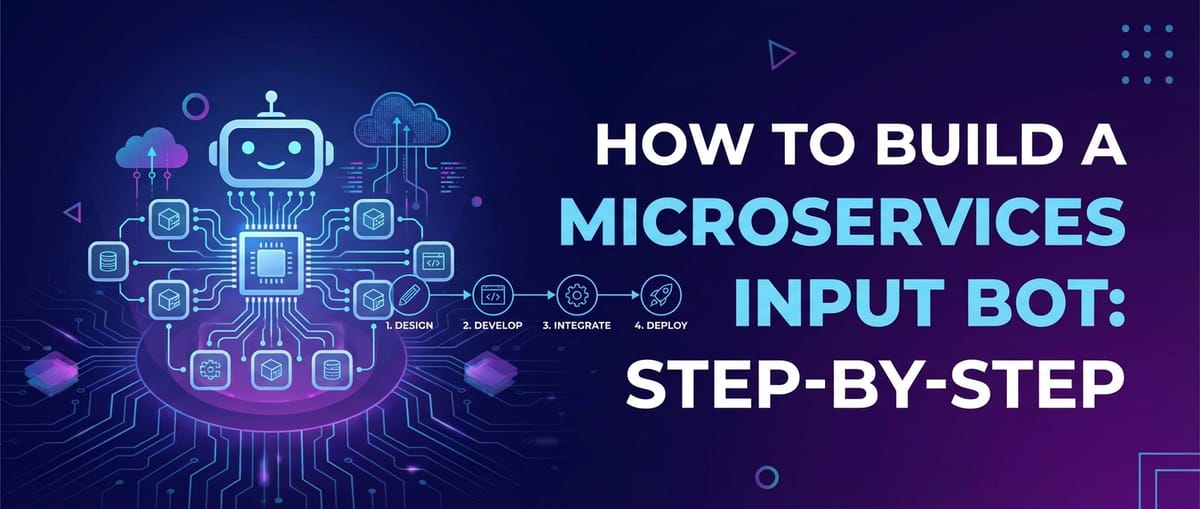
How to Build a Microservices Input Bot: Step-by-Step


In the relentless march towards digital transformation, automation stands as a cornerstone of efficiency, innovation, and competitive advantage. Enterprises across every sector are grappling with the complexities of managing vast streams of data and orchestrating intricate workflows. At the heart of this challenge lies the need for systems that can intelligently ingest inputs, process them, and trigger subsequent actions with minimal human intervention. This is precisely where the concept of a Microservices Input Bot emerges as a powerful solution, offering a highly scalable, resilient, and modular approach to automated data handling and task execution.
The traditional monolithic application, while once the standard, often struggles to adapt to the dynamic requirements of modern digital ecosystems. Its tightly coupled nature makes updates cumbersome, scalability challenging, and introduces single points of failure. The advent of microservices architecture has revolutionized software development, breaking down large applications into smaller, independent, and loosely coupled services that communicate over well-defined APIs. This paradigm shift provides the agility and flexibility necessary to build sophisticated automated systems, including the very input bots we aim to construct.
Imagine a bot that constantly monitors various external sources—social media feeds, sensor data streams, email inboxes, or even legacy system logs—and intelligently routes, transforms, or acts upon that information. Such a bot is not just a simple script; it's a sophisticated orchestration of multiple specialized services, each responsible for a distinct part of the overall process. From the initial data ingestion to the final action, every step can be handled by a dedicated microservice, ensuring robustness and maintainability. This article will delve deep into the strategic design and practical, step-by-step implementation of such a Microservices Input Bot, providing you with a comprehensive guide to building a resilient, scalable, and intelligent automation powerhouse. We will explore the architectural considerations, delve into the choice of technologies, and discuss best practices for deployment and maintenance, all while leveraging the power of API Gateways and even specialized AI Gateways to streamline complex integrations.
Chapter 1: Understanding the Landscape – Microservices and Bots in Tandem
Before embarking on the intricate journey of building a sophisticated input bot, it is imperative to establish a foundational understanding of its core components: microservices and the very nature of automated bots. Grasping these concepts individually and then appreciating their synergistic relationship will lay a robust groundwork for the architectural and implementation decisions that follow.
1.1 What are Microservices? Deconstructing the Distributed Paradigm
Microservices represent an architectural style that structures an application as a collection of small, autonomous services, modeled around business capabilities. Each service is self-contained, owning its own data storage, and can be developed, deployed, and scaled independently. This stands in stark contrast to the monolithic approach, where all functionalities are bundled into a single, indivisible unit. The beauty of microservices lies in their ability to foster agility and resilience.
Consider a large e-commerce platform. In a monolithic design, everything from user authentication to product catalog, order processing, and payment gateways would reside within a single codebase. Any change, no matter how minor, might require rebuilding and redeploying the entire application, introducing significant risk and downtime. With microservices, these functionalities are separated. A "Product Catalog Service," an "Order Processing Service," and a "User Authentication Service" operate independently. If an update is needed for the product catalog, only that specific service needs to be modified and redeployed, minimizing disruption to other parts of the system. This modularity also allows different teams to work on different services concurrently, using diverse programming languages and technologies best suited for each service's specific task, fostering innovation and speed. Each service exposes its functionalities through well-defined APIs, enabling seamless communication with other services and external clients. This reliance on clearly defined interfaces is a cornerstone of microservices architecture, ensuring that services can evolve independently without breaking integrations.
However, this decentralized approach introduces its own set of complexities, primarily around inter-service communication, distributed data management, and operational overhead. Managing a multitude of smaller services requires sophisticated tools for orchestration, monitoring, and logging, which necessitates a deeper dive into modern DevOps practices.
1.2 What is an Input Bot? The Engine of Automation
An input bot, in its essence, is an automated program designed to interact with various data sources, ingest information, and often initiate subsequent actions based on predefined rules or learned patterns. Its purpose is to automate tasks that would otherwise require manual intervention, thereby saving time, reducing human error, and operating tirelessly around the clock. Input bots can manifest in many forms, each tailored to specific operational needs.
For instance, a data ingestion bot might continuously monitor a file directory, an email inbox, or an external API endpoint for new data. Upon detecting new information, it could read the data, validate its format, and then forward it to a processing pipeline. Another type, a command execution bot, might respond to specific triggers, perhaps from a message queue or a scheduled event, to execute a series of commands on a remote server or within a specific application. Monitoring bots are designed to observe system metrics, log files, or specific events, triggering alerts or corrective actions when anomalies are detected. The core functionality across all these types, however, remains consistent: intelligent interaction with input channels, often involving parsing, validation, and routing of information. The sophistication of an input bot can range from simple rule-based automation to highly intelligent systems leveraging machine learning for pattern recognition and decision-making.
The defining characteristics of an effective input bot include its reliability, its ability to handle various data formats and sources, and its capacity to integrate seamlessly into existing IT infrastructure. As we push the boundaries of automation, these bots become critical components in a modern enterprise's operational toolkit, acting as digital operatives that bridge gaps and automate repetitive, high-volume tasks.
1.3 Why Combine Them? The Synergistic Power of Distributed Automation
The decision to combine microservices with input bot functionality is a natural evolution that addresses the inherent challenges of large-scale automation. Building a complex input bot as a monolith would quickly lead to the very problems microservices aim to solve: lack of scalability, rigidity, and operational fragility. By dissecting the bot's functionalities into distinct microservices, we unlock a plethora of advantages that make the entire system more robust and manageable.
Firstly, scalability becomes inherent. If your bot needs to process a sudden surge of inputs from a particular source, only the microservice responsible for ingesting that specific input stream needs to be scaled up, rather than the entire application. This efficient resource utilization is a significant economic and performance benefit. Secondly, resilience is dramatically enhanced. Should one microservice fail (e.g., the service responsible for validating a specific data type encounters an error), the rest of the bot's functionalities can continue to operate unimpeded. This isolation of failures prevents cascading system-wide outages, which are common in monolithic architectures.
Thirdly, modularity and maintainability improve significantly. Each microservice, being small and focused on a single responsibility, is easier to understand, test, and maintain. New features or changes to input sources can be integrated by updating or adding specific services without impacting the entire system. This agility accelerates development cycles and reduces the time-to-market for new automation capabilities. Finally, the combination allows for intelligent automation on an unprecedented scale. By leveraging specialized microservices, an input bot can incorporate advanced capabilities such as natural language processing, image recognition, or predictive analytics, with each of these complex functions potentially encapsulated within its own service.
The key components of such a combined system typically involve: diverse data sources (external APIs, message queues, databases, files), a series of processing microservices (validation, transformation, enrichment, decision-making), and various output destinations (databases, notification systems, other APIs, or even triggering human workflows). The orchestration of these components often relies heavily on event-driven architectures, where messages flow between services, defining the bot's overall behavior. This powerful synergy transforms a simple automation script into a sophisticated, distributed, and highly adaptable intelligent agent capable of tackling the most demanding enterprise automation challenges.
Chapter 2: Designing Your Microservices Input Bot Architecture
The success of any complex software system, especially one built on a distributed microservices architecture, hinges critically on a well-thought-out design. Rushing into coding without a clear architectural blueprint can lead to significant technical debt, scalability issues, and operational nightmares down the line. This chapter outlines the fundamental design considerations, architectural patterns, and technology choices necessary to build a robust and efficient Microservices Input Bot.
2.1 Defining Requirements and Use Cases: The Blueprint for Your Bot
Before a single line of code is written, a comprehensive understanding of what your input bot needs to achieve is paramount. This phase involves articulating clear requirements and identifying specific use cases, which will serve as the guiding principles for your entire design. Without this clarity, the project risks scope creep, feature bloat, or, worse, failing to address the actual business need.
Start by asking fundamental questions about the bot's purpose. What data will it ingest? Is it structured data like JSON from an external API, semi-structured data like CSV files, or unstructured data such as email content or social media posts? The nature of the data dictates the parsing and validation logic required. Where will this data originate from? Common sources include RESTful APIs, message queues (Kafka, RabbitMQ, AWS SQS), databases (both relational and NoSQL), file systems (local or cloud storage like S3), and streaming platforms. Each source has unique integration requirements and implications for latency and throughput.
Next, consider what actions will the bot perform once the data is ingested and processed. Will it transform the data into a different format, enrich it by pulling additional information from other services, validate its integrity against business rules, or trigger subsequent workflows? For example, an input bot monitoring IoT device data might transform raw sensor readings into standardized metrics, enrich them with device metadata, and then push them to an analytics dashboard. A critical aspect is defining the performance and scalability needs. How many inputs per second must the bot handle? What are the acceptable latency targets? These metrics will inform choices about messaging systems, database types, and horizontal scaling strategies.
Security considerations are non-negotiable. How will the bot authenticate with external sources and internal services? How will sensitive data be protected both in transit and at rest? This includes topics like encryption, access control (e.g., OAuth2, JWT), and input sanitization to prevent injection attacks. Finally, robust error handling and logging strategies must be designed from the outset. What happens when an input is malformed, an external API fails, or a database connection drops? The bot must be capable of gracefully handling failures, retrying operations where appropriate, and providing detailed logs for debugging and auditing. Defining these parameters meticulously creates a solid blueprint, ensuring that the final architecture is purpose-built and resilient.
2.2 Core Architectural Patterns: Crafting Resilience and Responsiveness
The microservices paradigm offers a rich tapestry of architectural patterns that can be woven together to form a highly resilient and responsive input bot. Selecting the appropriate patterns is crucial for addressing the complexities inherent in distributed systems, such as inter-service communication, data consistency, and fault tolerance.
A predominant and highly effective pattern for input bots is the Event-Driven Architecture (EDA). In an EDA, services communicate indirectly through events. When a service performs an action (e.g., an "Input Received" event), it publishes an event to a message broker (like Apache Kafka, RabbitMQ, or Amazon SQS/SNS). Other interested services (e.g., a "Data Validation Service" or a "Data Transformation Service") can then subscribe to these events and react accordingly. This decoupling offers immense benefits: services don't need to know about each other's existence, reducing dependencies and allowing for independent evolution. It inherently supports asynchronous processing, which is ideal for high-throughput input bots, as the initial ingestion service doesn't have to wait for downstream processing to complete. The message queue acts as a buffer, smoothing out traffic spikes and providing durability, ensuring events are not lost even if a consuming service is temporarily unavailable.
Another pattern to consider, particularly if your bot deals with complex data models and distinct read/write operations, is Command-Query Responsibility Segregation (CQRS). While perhaps overkill for simpler bots, CQRS separates the responsibilities of reading data (queries) from writing data (commands). This can optimize performance and scalability for systems with divergent read and write loads. For instance, the input processing microservices might exclusively issue commands to update a write model, while other services or user interfaces query a highly optimized read model.
The choice between stateless and stateful services is also critical. Generally, microservices are encouraged to be stateless, meaning they do not store any client-specific information between requests. This simplifies scaling, as any instance of a service can handle any request. For input bots, where processing tasks might be complex and multi-step, maintaining state within a microservice can introduce complications. Instead, any necessary state should be externalized to a durable data store (like a database or a distributed cache like Redis) that all service instances can access. This ensures that even if a service instance fails, the bot's overall state is preserved, and another instance can pick up where it left off. By carefully applying these patterns, you can engineer an input bot that is not only functional but also highly available, scalable, and adaptable to future demands.
2.3 Choosing Technologies: The Tools of the Trade
With a clear understanding of the bot's requirements and architectural patterns, the next critical step is to select the right technologies. This decision impacts everything from development velocity and performance to operational costs and long-term maintainability. The landscape of modern software development is vast, offering a plethora of choices across various categories.
For programming languages and frameworks, popular choices often include Python (with frameworks like Flask, Django, FastAPI) for its rapid development, rich ecosystem of libraries, and strong support for data science and machine learning. Go (with frameworks like Gin, Echo) is favored for high-performance, concurrent applications with minimal memory footprint, making it excellent for event-driven microservices. Java (with Spring Boot) remains a dominant choice for enterprise-grade applications, offering robustness, extensive tooling, and a mature ecosystem. Node.js (with Express.js) is excellent for I/O-bound applications and real-time processing, leveraging its asynchronous, non-blocking nature. The choice often comes down to team expertise, existing infrastructure, and specific performance requirements of each microservice.
Databases are essential for data persistence and state management. Relational databases like PostgreSQL or MySQL are excellent for structured data requiring strong consistency and complex querying. NoSQL databases like MongoDB (document-oriented), Cassandra (column-family), or DynamoDB (key-value) offer superior horizontal scalability and flexibility for unstructured or semi-structured data, often at the cost of strict ACID properties. For caching and real-time data storage, Redis is an industry-standard, providing blazing-fast key-value operations and various data structures.
Messaging systems are the backbone of event-driven microservices. Apache Kafka is a highly scalable, fault-tolerant, and high-throughput distributed streaming platform, ideal for handling massive streams of input data. RabbitMQ, a message broker implementing AMQP, is excellent for general-purpose messaging, robust queueing, and complex routing. Cloud-native options like AWS SQS/SNS or Azure Service Bus offer managed, scalable messaging solutions with less operational overhead.
Finally, containerization and orchestration are indispensable for deploying and managing microservices. Docker has become the de facto standard for packaging applications and their dependencies into portable, isolated containers. Kubernetes (K8s) is the leading container orchestration platform, automating the deployment, scaling, and management of containerized applications across clusters of machines. It provides self-healing capabilities, load balancing, and declarative configurations, greatly simplifying the operational complexity of a microservices architecture.
Crucially, as your input bot grows in complexity and interacts with multiple internal and external services, an API Gateway becomes an indispensable component. An API Gateway acts as a single entry point for all client requests, routing them to the appropriate microservice. Beyond simple routing, it provides a centralized location for cross-cutting concerns such as authentication, authorization, rate limiting, traffic management, and caching, offloading these responsibilities from individual microservices. This is particularly vital when your bot interacts with a myriad of external APIs or exposes its own APIs for consumption by other systems. For advanced scenarios, especially when your input bot needs to leverage the power of artificial intelligence or machine learning for intelligent processing (e.g., sentiment analysis of incoming text, image recognition on uploaded files, or predictive analytics on ingested data), a specialized AI Gateway can be a game-changer. An AI Gateway builds upon the functionalities of a standard API Gateway but adds features specifically designed to manage and streamline interactions with various AI models. For example, a robust platform like APIPark, an open-source AI Gateway and API Management Platform, allows for quick integration of over 100 AI models and unifies their API invocation formats. This means your processing microservice doesn't need to learn the idiosyncrasies of each AI provider; it simply interacts with the AI Gateway, which handles the complexity of calling the underlying AI models. This significantly reduces development time and maintenance costs when integrating AI capabilities into your input bot. By carefully considering these technological pillars, you can build a stable, performant, and future-proof foundation for your microservices input bot.
Chapter 3: Step-by-Step Implementation Guide
With the architectural design firmly in place, it's time to translate theory into practice. This chapter provides a practical, step-by-step guide to implementing the core components of your Microservices Input Bot, focusing on the distinct responsibilities of each service and how they interact. We'll outline the setup of a development environment and then detail the construction of key microservices that collectively form the intelligent bot.
3.1 Setting Up Your Development Environment: The Launchpad
A well-configured development environment is the bedrock of efficient and productive coding. Before diving into individual microservices, ensure your local machine is equipped with the necessary tools.
- Integrated Development Environment (IDE): Choose an IDE that supports your chosen programming language(s) and offers features like intelligent code completion, debugging, and version control integration. Popular options include Visual Studio Code, IntelliJ IDEA, PyCharm, or GoLand. Configure it with relevant extensions for linting, formatting, and language-specific features.
- Version Control System (VCS): Git is the ubiquitous standard. Ensure it's installed and configured correctly. Initialize a Git repository for your project from the outset, allowing you to track changes, collaborate with team members, and revert to previous states if necessary. Typically, each microservice will reside in its own subdirectory within a monorepo, or potentially in separate repositories depending on your team's structure and preference.
- Containerization Tools: Docker is indispensable for microservices development. Install Docker Desktop (for Windows/macOS) or Docker Engine (for Linux). This allows you to containerize each microservice, ensuring consistency between development, testing, and production environments. It also simplifies the setup of dependent services like databases and message queues by running them as local Docker containers. Docker Compose will be invaluable for orchestrating multiple local service containers for development purposes, allowing you to bring up your entire bot ecosystem with a single command.
- Language Runtimes and Package Managers: Install the appropriate runtime for your chosen language (e.g., Python, Node.js, Java JDK, Go) and its corresponding package manager (pip, npm/yarn, Maven/Gradle, Go modules). Manage dependencies carefully within each microservice's project directory.
- Local Message Queue/Database (Optional but Recommended): For local development and testing, it's often beneficial to run miniature versions of your chosen message queue (e.g., a single RabbitMQ container, a lightweight Kafka instance via
docker-compose) and database (e.g., PostgreSQL or MongoDB in a container). This mirrors the production environment closely, reducing "works on my machine" issues.
By establishing this robust development environment, you create a consistent, reproducible, and efficient workspace, allowing you to focus on the core logic of your microservices without being bogged down by environmental inconsistencies.
3.2 Service A: The Input Listener Microservice – The Ear of Your Bot
The Input Listener Microservice is the frontline of your bot, responsible for intelligently detecting, receiving, and initially validating raw inputs from various sources. Its design must prioritize reliability, responsiveness, and resilience, as it's the first point of contact for external data.
Purpose: The primary purpose of this microservice is to act as a gateway for incoming data. It continuously monitors one or more designated input channels, such as a RESTful API endpoint, a message queue topic, a file storage bucket (like AWS S3), or even a specific email inbox. Once an input is detected, it ingests the raw data, performs initial sanity checks, and then reliably hands it off for further processing, typically by publishing it to a message queue.
Implementation Details:
- Defining Input Channels:
- RESTful API Endpoint: If inputs are pushed to your bot, this service would expose a POST endpoint (e.g.,
/api/v1/inputs). It would be responsible for parsing the incoming JSON or XML payload, validating its basic structure, and ensuring all required fields are present. Error responses (e.g., 400 Bad Request) should be returned for malformed inputs. - Message Queue Consumer: For high-throughput, asynchronous inputs, this service might act as a consumer for a Kafka topic or a RabbitMQ queue. It would continuously poll or subscribe to the queue, receiving messages as they arrive.
- File System Watcher/Cloud Storage Listener: For inputs arriving as files, this service could monitor a directory (using libraries like
watchdogin Python) or subscribe to events from cloud storage services (e.g., S3 Event Notifications). - External API Poller: If the input source doesn't push data, this service might periodically make HTTP requests to an external API to fetch new data. Care must be taken to implement exponential backoff and handle rate limits for external APIs.
- RESTful API Endpoint: If inputs are pushed to your bot, this service would expose a POST endpoint (e.g.,
- Input Validation and Sanitization:
- Upon receiving data, the first step is always validation. This includes checking data types, ensuring required fields are present, and enforcing basic format rules (e.g., date formats, email patterns).
- Sanitization is crucial, especially for string inputs, to prevent common vulnerabilities like SQL injection or cross-site scripting (XSS), even if the data isn't directly rendered to a user. Libraries specific to your chosen language can assist with this.
- For example, if receiving sensor data, validate that numerical values are within expected ranges. If text, ensure it's properly encoded.
- Publishing to a Message Queue:
- After successful validation, the raw or lightly processed input data should be published to a central message queue (e.g., Kafka, RabbitMQ). This acts as a reliable buffer and decouples the input ingestion from subsequent processing.
- The message payload should typically be a standardized format (e.g., JSON) and include metadata like a unique
trace_idfor end-to-end observability,timestamp_received, andsource_channel. - Acknowledge the incoming message or API request only after successfully publishing to the message queue, ensuring message durability.
By making the Input Listener a dedicated microservice, you encapsulate the complexities of various input sources and initial validation, providing a clean, standardized stream of events for downstream services.
3.3 Service B: The Processing/Orchestration Microservice – The Brain of Your Bot
The Processing/Orchestration Microservice is where the core intelligence and business logic of your input bot reside. It consumes the validated inputs from the message queue and performs transformations, enrichments, complex decision-making, and orchestrates interactions with other services.
Purpose: This service is responsible for transforming raw input data into actionable information. It might perform data cleansing, apply business rules, fetch additional context from internal databases or external APIs, and make decisions about the subsequent actions to be taken. For sophisticated bots, this is also the ideal place to integrate Artificial Intelligence and Machine Learning capabilities.
Implementation Details:
- Consuming from the Message Queue:
- This service acts as a consumer for the message queue where the Input Listener Microservice publishes its validated inputs. It should be designed for high availability and concurrent processing, capable of handling a steady stream of messages.
- Implement robust error handling for message consumption, including dead-letter queues (DLQs) for messages that repeatedly fail processing, ensuring no data is lost and allowing for manual inspection of problematic inputs.
- Process messages in batches if appropriate for performance, but ensure individual message failures are isolated.
- Business Logic and Data Transformation:
- This is where the heart of your bot's logic is implemented. Examples include:
- Data Cleansing: Standardizing formats, correcting common errors, removing duplicates.
- Data Transformation: Converting units, re-structuring JSON payloads, aggregating fields.
- Rule Engine: Applying a set of predefined business rules to determine the next steps (e.g., "if sentiment is negative, escalate to human review").
- Keep the business logic encapsulated and testable, ideally using a clean architecture that separates domain logic from infrastructure concerns.
- This is where the heart of your bot's logic is implemented. Examples include:
- Data Enrichment:
- Often, raw input data lacks sufficient context. This service might enrich the data by:
- Querying Internal Databases: Fetching customer details, product information, or historical records based on identifiers in the input.
- Calling Other Internal Microservices: Requesting data from a "User Profile Service" or a "Product Inventory Service" via their internal APIs.
- Calling External APIs: Retrieving real-time exchange rates, weather information, or demographic data from third-party API providers. This is where an API Gateway can simplify managing external API credentials and rate limits.
- Often, raw input data lacks sufficient context. This service might enrich the data by:
- Integrating AI/ML Capabilities:
- For intelligent input bots, this microservice becomes the nexus for AI integration. Imagine your bot ingests customer feedback text. This service could send the text to a sentiment analysis model. If it's an image, it could be sent to an object detection model.
- Integrating these AI models directly can be cumbersome, as each model (or provider) might have a unique API format, authentication mechanism, and rate limits. This is where an AI Gateway like APIPark offers significant value. Instead of your processing service making direct, disparate calls to various AI providers, it makes a single, standardized call to APIPark. APIPark, as an AI Gateway, then handles the complexity of:
- Unified API Format: Standardizing request data across different AI models, so your service doesn't need to change if the underlying AI model is swapped.
- Prompt Encapsulation: Quickly combining AI models with custom prompts to create new, reusable APIs (e.g., a "Summarize Document" API that internally uses a large language model).
- Authentication and Cost Tracking: Centralizing security and monitoring for all AI invocations.
- By leveraging APIPark, your processing microservice remains lean and focused on its core business logic, offloading the complexities of AI model management to a specialized platform.
- Publishing Processed Data/Triggering Events:
- After processing and potential AI enrichment, the service publishes the transformed data or specific events to another message queue topic. This message will contain the complete, enriched context and instructions for the next step. For example, "OrderProcessedEvent," "SentimentAnalyzedEvent," or "HighPriorityAlert."
- Alternatively, it might directly call another internal microservice's API endpoint if a synchronous action is required, though event-driven communication is generally preferred for decoupling.
The Processing/Orchestration Microservice is the strategic hub, where raw inputs are imbued with intelligence and shaped into forms that drive meaningful outcomes for your organization. Its robust design is paramount to the bot's effectiveness.
3.4 Service C: The Output/Action Microservice – The Hands of Your Bot
The Output/Action Microservice is the final stage of your input bot's journey, responsible for executing the ultimate actions based on the processed and enriched data. This service translates the bot's intelligence into tangible outcomes, interacting with external systems or internal services to complete the intended workflow.
Purpose: This microservice takes the fully processed and enriched information from the message queue (or direct calls from the processing service) and performs the final, concrete actions. These actions could range from writing data to a database, sending notifications, triggering other automated workflows, or interacting with human users.
Implementation Details:
- Consuming from the Processed Message Queue:
- Similar to the processing service, this microservice subscribes to the message queue topic where the enriched data or action events are published. It should be designed to reliably consume these messages and act upon them.
- Ensure proper message acknowledgment and retry mechanisms are in place. If an action fails, the message should either be re-queued, moved to a DLQ, or an alert should be triggered, depending on the criticality and idempotency of the action.
- Performing Final Actions:
- The specific actions will vary greatly depending on your bot's use case:
- Database Writes: Storing processed data into a production database (e.g., customer records, analytics data, audit trails). This could involve inserting new records, updating existing ones, or archiving old data.
- External API Calls: Interacting with third-party services. This might include:
- Sending notifications via a messaging API (Slack, Twilio).
- Updating a CRM system (API call to Salesforce).
- Triggering a payment gateway.
- Logging events to an external analytics platform.
- API Gateways are extremely valuable here for managing security, rate limits, and credentials for these external API interactions.
- Sending Notifications: Pushing alerts or summary reports to specific channels (email, SMS, push notifications, internal chat systems).
- Triggering Other Workflows: Initiating another automated process within your organization, potentially through another internal API call or by publishing a new event to a different message queue.
- File Generation/Export: Creating reports, invoices, or data exports to specific locations.
- The specific actions will vary greatly depending on your bot's use case:
- Idempotency and Concurrency:
- Many actions, especially those interacting with external systems, should be idempotent. This means that performing the action multiple times should have the same effect as performing it once. This is crucial for resilience, as messages might be re-processed due to network issues or service restarts.
- Design the service to handle concurrent actions safely, especially if writing to shared resources. Use transactions for database operations and ensure thread-safe code.
- Error Reporting and Auditing:
- Any failure in performing a critical action must be immediately logged and, if necessary, trigger an alert.
- Maintain detailed audit logs of all actions performed, including the input data, the action taken, the timestamp, and the result (success/failure). This is vital for debugging, compliance, and understanding the bot's operational history.
The Output/Action Microservice is where your input bot truly makes its impact, converting abstract data processing into concrete, valuable business outcomes. Its reliability and precise execution are paramount for trust and operational effectiveness.
3.5 Inter-service Communication: The Nervous System of Your Bot
In a microservices architecture, the way services communicate is as critical as their individual functionalities. Effective inter-service communication ensures data flows seamlessly, dependencies are managed, and the overall system remains performant and resilient.
- RESTful API Calls:
- For synchronous, request-response communication between services, RESTful APIs are a common choice. A service exposes endpoints, and other services make HTTP requests (GET, POST, PUT, DELETE) to interact with it.
- Use Cases: When one service needs an immediate response from another (e.g., the Processing Service querying the User Profile Service for user details).
- Considerations:
- Contract Definition: Use tools like OpenAPI/Swagger to define and enforce API contracts, ensuring compatibility between services.
- Error Handling: Implement robust client-side error handling (timeouts, retries with exponential backoff, circuit breakers) to gracefully handle service unavailability or network issues.
- Authentication/Authorization: Secure internal APIs using mechanisms like JWTs or API keys, often enforced by an API Gateway.
- Message Queues/Event Streams:
- For asynchronous, decoupled communication, message queues (RabbitMQ, SQS) and event streams (Kafka) are the preferred choice. Services publish events or messages to a queue, and other services consume them independently.
- Use Cases: The primary communication mechanism for our input bot, moving data from the Input Listener to the Processing Service, and from the Processing Service to the Output/Action Service. Also, for triggering workflows that don't require an immediate response.
- Considerations:
- Message Durability: Ensure messages are not lost in case of consumer or broker failure.
- Idempotency: Design consumers to handle duplicate messages gracefully, as messages can be delivered more than once in distributed systems.
- Order Guarantees: Understand the ordering guarantees of your chosen message system; Kafka generally provides stronger ordering guarantees than traditional queues for a given partition.
- Scalability: Message queues naturally support horizontal scaling of consumers.
- The Indispensable API Gateway:
- As your microservices input bot evolves, the number of internal and external APIs it interacts with, or exposes, will grow. This is where an API Gateway becomes an architectural imperative.
- External API Consumption: When your bot's microservices need to call external APIs (e.g., the Processing Service enriching data from a weather API), the API Gateway can act as a proxy. It centralizes credential management, applies rate limiting to external calls to avoid exceeding quotas, handles retry logic, and potentially transforms requests/responses to a standardized format.
- Internal API Management: Even for internal service-to-service communication, an API Gateway can provide immense value. While direct message queue communication is often preferred for high-throughput asynchronous flows, synchronous API calls benefit from the API Gateway's capabilities. It can enforce authorization policies, log all requests, and provide load balancing across multiple instances of a downstream service. This simplifies service discovery and interaction for other internal systems that might want to trigger or query your bot.
- Security: A primary function of the API Gateway is security. It acts as the first line of defense, handling authentication and authorization for all incoming requests, protecting your backend microservices from unauthorized access. It can also enforce policies like IP whitelisting or block malicious traffic.
By strategically combining these communication patterns and leveraging an API Gateway for centralized management and security, you create a robust and highly observable nervous system for your microservices input bot.
3.6 Data Persistence and State Management: Ensuring Continuity
In a distributed system like a microservices input bot, managing data persistence and service state effectively is paramount for reliability, consistency, and recovery from failures. Each microservice typically owns its data, ensuring autonomy, but this also introduces complexities around distributed transactions and consistency.
- Database Choices and Responsibility:
- Microservice Database Per Service: The fundamental principle is that each microservice should own its data store, encapsulating its data models and business logic. This allows services to choose the database technology best suited for their needs (e.g., a relational database for complex joins, a NoSQL document database for flexible schemas, a graph database for relationships).
- Input Listener: Might temporarily store metadata about incoming inputs (e.g., a queue of incoming file paths to process, or a log of recently ingested external API calls) to ensure idempotency and prevent duplicate processing. This could be a lightweight key-value store or a simple table.
- Processing Service: This service might interact with several databases:
- Its own database for storing configuration, processing rules, or temporary state required for multi-step processing.
- External internal databases (e.g., a Customer Database managed by another microservice) for enriching data, strictly through that service's API.
- Output/Action Service: Will primarily write to the target production databases, which could be owned by other business services. It might also maintain its own log of successful and failed actions for auditing.
- Transaction Management: When multiple services need to update data, avoid distributed two-phase commits, which are problematic in microservices. Instead, embrace eventual consistency using the Saga pattern, where a sequence of local transactions (each within a single microservice) is coordinated through events. If one step fails, compensating transactions are executed.
- Caching for Performance:
- Caching is crucial for improving the performance and responsiveness of your bot, especially when services frequently query static or semi-static data.
- In-Memory Caches: For data that is frequently accessed and can be transient, in-memory caches within a microservice can provide ultra-low latency.
- Distributed Caches (e.g., Redis, Memcached): For sharing cached data across multiple instances of a microservice or between different microservices, a distributed cache is essential. This could store lookup tables, frequently accessed reference data, or temporary processing results.
- Cache Invalidation: Design clear strategies for invalidating cached data when the source data changes to prevent serving stale information.
- State Management for Long-Running Processes:
- While stateless services are generally preferred for scalability, some bot functionalities might involve long-running, multi-step processes where maintaining state across requests is unavoidable.
- Externalized State: Instead of storing state within the service instance, externalize it to a durable store like a database or a persistent message queue (e.g., Kafka with compacted topics). This allows any instance of a microservice to pick up where a previous instance left off, ensuring resilience.
- Workflow Engines: For highly complex, multi-step workflows that span multiple services and potentially human intervention, consider using a dedicated workflow orchestration engine (e.g., Apache Airflow, Camunda, AWS Step Functions). These tools manage the state and transitions of complex business processes.
Careful consideration of data persistence and state management strategies is key to building a reliable, consistent, and fault-tolerant microservices input bot that can recover gracefully from failures and scale effectively under load.
3.7 Error Handling, Logging, and Monitoring: Pillars of Operational Stability
Even the most meticulously designed systems encounter issues. How an input bot handles errors, logs its activities, and provides insights into its operational health are critical for its long-term stability, maintainability, and trustworthiness. These aspects are not afterthoughts but integral parts of the design process.
- Robust Error Handling:
- Graceful Degradation: Design services to degrade gracefully rather than crashing. For example, if an external API call fails, rather than stopping, the service could use cached data, return a default value, or queue the problematic request for later retry.
- Retry Mechanisms: Implement automatic retry logic with exponential backoff for transient failures (e.g., network glitches, temporary service unavailability). This prevents overwhelming a struggling service and allows it time to recover.
- Circuit Breakers: Employ the Circuit Breaker pattern to prevent a failing service from bringing down upstream services. If a service consistently fails, the circuit breaker "trips," preventing further calls to that service for a period, allowing it to recover and preventing a cascading failure.
- Dead-Letter Queues (DLQs): For messages that cannot be processed successfully after multiple retries, move them to a DLQ. This prevents poison pill messages from blocking queues and allows for manual investigation and re-processing.
- Idempotency: As mentioned before, design operations to be idempotent, so that retrying them does not cause unintended side effects (e.g., double-billing, duplicate data entries).
- Comprehensive Logging:
- Structured Logging: Avoid plain text logs. Instead, use structured logging (e.g., JSON format) that includes relevant metadata like
timestamp,log_level,service_name,trace_id,span_id, andmessage. This makes logs easily parsable and queryable by automated tools. - Contextual Logging: Crucially, implement a
trace_id(or correlation ID) that propagates across all microservices involved in processing a single input. This allows you to trace the entire lifecycle of an input, from ingestion to final action, across service boundaries, which is invaluable for debugging distributed systems. - Centralized Logging: Aggregate logs from all microservices into a centralized logging system (e.g., ELK stack - Elasticsearch, Logstash, Kibana; or Splunk, Grafana Loki). This provides a single pane of glass for searching, analyzing, and visualizing logs.
- Appropriate Log Levels: Use log levels (DEBUG, INFO, WARN, ERROR, FATAL) judiciously to control the verbosity and criticality of log output.
- Structured Logging: Avoid plain text logs. Instead, use structured logging (e.g., JSON format) that includes relevant metadata like
- Proactive Monitoring:
- Metrics Collection: Instrument every microservice to emit key operational metrics:
- Request Rates: Requests per second.
- Error Rates: Percentage of failed requests.
- Latency: Average, p95, p99 response times for requests and database queries.
- Resource Utilization: CPU, memory, disk I/O, network I/O.
- Queue Depths: Number of messages in queues, consumer lag.
- Monitoring Tools: Use specialized monitoring tools (e.g., Prometheus for metrics collection, Grafana for visualization and dashboards; Datadog, New Relic) to collect, store, and display these metrics in real-time.
- Alerting: Configure alerts based on predefined thresholds for critical metrics (e.g., high error rate, low disk space, high CPU usage, sudden spike in queue depth). Integrate alerts with notification systems (email, Slack, PagerDuty) to notify operations teams immediately of issues.
- Distributed Tracing: Beyond logs, implement distributed tracing (e.g., OpenTelemetry, Jaeger, Zipkin). This visualizes the flow of a single request across multiple services, showing the latency at each hop, making it much easier to pinpoint performance bottlenecks and identify which service is causing an issue.
- Metrics Collection: Instrument every microservice to emit key operational metrics:
By treating error handling, logging, and monitoring as first-class citizens in your design, you equip your microservices input bot with the necessary tools for self-diagnosis, rapid incident response, and continuous operational excellence.
APIPark is a high-performance AI gateway that allows you to securely access the most comprehensive LLM APIs globally on the APIPark platform, including OpenAI, Anthropic, Mistral, Llama2, Google Gemini, and more.Try APIPark now! 👇👇👇
Chapter 4: Advanced Concepts and Best Practices
Building a functional microservices input bot is one thing; building one that is secure, scalable, and maintainable in the long run requires adhering to advanced concepts and best practices. This chapter delves into critical aspects that elevate your bot from a simple automation tool to an enterprise-grade solution.
4.1 Security in Microservices Bots: Fortifying Your Digital Defenses
Security is not a feature; it's a foundational requirement, especially for an input bot that might handle sensitive data or trigger critical actions. A breach in one microservice can have cascading effects, compromising the entire system. Therefore, a multi-layered security strategy is essential.
- Authentication and Authorization (AuthN/AuthZ):
- Service-to-Service Authentication: Microservices should not blindly trust each other. Implement strong authentication mechanisms for inter-service communication. This often involves using API keys, client certificates, or ideally, a token-based system like JSON Web Tokens (JWTs) issued by an Identity Provider (IdP). For instance, when the Processing Service calls an internal User Profile Service, it should present a valid token.
- User/Client Authentication: If your bot exposes external APIs for clients to push inputs or query its status, implement industry-standard authentication protocols like OAuth2.0. The API Gateway is the ideal place to enforce these authentication policies, offloading the burden from individual microservices.
- Authorization: Beyond authentication, determine what a service or user is permitted to do. Implement fine-grained authorization policies (e.g., Role-Based Access Control - RBAC) within each microservice or via a centralized authorization service.
- Data Encryption:
- Encryption in Transit (TLS/SSL): All communication, both external (client-to-API Gateway) and internal (service-to-service, service-to-database, service-to-message queue), must be encrypted using Transport Layer Security (TLS). This prevents eavesdropping and tampering.
- Encryption at Rest: Sensitive data stored in databases, file systems, or message queues should be encrypted at rest. Most cloud providers offer managed encryption for their storage and database services. If self-hosting, use disk encryption or database-level encryption features.
- Input Validation and Sanitization (Revisited):
- While touched upon in the Input Listener, this cannot be overstressed. Rigorous input validation at every boundary (especially the API Gateway and the Input Listener) is crucial to prevent common vulnerabilities like SQL Injection, Cross-Site Scripting (XSS), Command Injection, and Buffer Overflows. Never trust external input.
- Use libraries designed for robust input sanitization and validation, specific to your programming language.
- Rate Limiting and Throttling:
- Implement rate limiting at the API Gateway level to protect your microservices from abusive or denial-of-service (DoS) attacks. Limit the number of requests a client or even an internal service can make within a given time frame.
- Throttling can also be applied to specific resource-intensive APIs to ensure fair usage and prevent any single client from monopolizing resources.
- Secrets Management:
- Never hardcode sensitive information like database credentials, API keys, or encryption keys directly in your code or configuration files.
- Use a dedicated secrets management solution (e.g., HashiCorp Vault, AWS Secrets Manager, Azure Key Vault, Kubernetes Secrets). These tools securely store and manage access to sensitive data, injecting them into your microservices at runtime.
- Network Security:
- Implement network segmentation to isolate microservices from each other and from the public internet. Use virtual private clouds (VPCs), subnets, and security groups/firewalls to control inbound and outbound traffic.
- Restrict direct access to individual microservices from outside the cluster; all external traffic should go through the API Gateway.
By embedding security considerations into every phase of design, development, and deployment, you can build a microservices input bot that is not only functional but also resilient against a wide array of cyber threats.
4.2 Scalability and Performance Optimization: Meeting Demand
A key advantage of microservices is their inherent ability to scale, but achieving optimal scalability and performance requires deliberate architectural choices and continuous optimization efforts. An input bot, potentially handling fluctuating and high-volume data streams, must be designed to adapt and perform efficiently.
- Horizontal Scaling:
- The cornerstone of microservices scalability is horizontal scaling: adding more instances of a microservice to handle increased load. Kubernetes, through its Horizontal Pod Autoscaler (HPA), can automatically scale services based on metrics like CPU utilization or custom metrics (e.g., message queue length).
- Design microservices to be stateless as much as possible, as this greatly simplifies horizontal scaling. If state is necessary, externalize it to a distributed database or cache.
- Load Balancing:
- When multiple instances of a microservice are running, a load balancer is essential to distribute incoming requests evenly among them. This prevents any single instance from becoming a bottleneck and improves overall system availability.
- The API Gateway typically handles external load balancing, while internal service meshes (e.g., Istio, Linkerd) or Kubernetes' native service discovery and load balancing can manage inter-service traffic.
- Caching Strategies (Revisited):
- Effective caching is a powerful performance optimization. Identify data that is frequently accessed but changes infrequently and cache it at appropriate layers (e.g., CDN for static assets, API Gateway cache for frequently requested API responses, distributed cache like Redis for database queries, in-memory cache within services).
- Implement intelligent cache invalidation policies to ensure data freshness.
- Asynchronous Processing and Event-Driven Architecture:
- As highlighted earlier, event-driven architectures and message queues are critical for scalability. They decouple services, allow for independent scaling of producers and consumers, and provide buffering against load spikes.
- Avoid synchronous calls when possible. If an immediate response isn't strictly necessary, use asynchronous communication patterns.
- Database Optimization:
- Indexing: Ensure databases are properly indexed for frequently queried columns to speed up read operations.
- Query Optimization: Profile and optimize slow database queries.
- Sharding/Partitioning: For very large datasets, consider sharding or partitioning databases to distribute data across multiple servers, improving read/write performance and scalability.
- Connection Pooling: Use connection pooling for database access to reduce the overhead of establishing new connections for every request.
- Resource Management:
- Resource Limits: In containerized environments, set appropriate CPU and memory limits for each microservice. This prevents a misbehaving service from consuming all available resources and impacting other services on the same host.
- Garbage Collection Tuning: For languages with garbage collectors (Java, Go, Python), tune GC parameters to minimize pause times and improve application responsiveness.
By systematically applying these strategies, your microservices input bot can effortlessly scale to meet growing demands, maintaining high performance and responsiveness even under heavy load.
4.3 Deployment and Orchestration: Automating the Release Cycle
Deploying and managing a multitude of microservices manually is a recipe for errors and operational inefficiency. Automation through containerization and orchestration platforms is paramount for a smooth and reliable release cycle.
- Containerization with Docker:
- Every microservice should be packaged into a Docker container. This ensures consistency across development, testing, and production environments, eliminating "it works on my machine" issues.
- A Dockerfile for each service clearly defines its dependencies, runtime environment, and startup command.
- Use multi-stage builds to create lean production images, reducing attack surface and deployment times.
- Orchestration with Kubernetes (K8s):
- Kubernetes is the de facto standard for orchestrating containerized applications. It automates:
- Deployment: Declaratively define the desired state of your application (number of replicas, resource limits, network policies), and Kubernetes ensures that state is maintained.
- Scaling: Automatically scales microservice instances up or down based on defined metrics (Horizontal Pod Autoscaler).
- Self-Healing: Automatically restarts failed containers, replaces unhealthy ones, and reschedules containers on healthy nodes.
- Service Discovery: Provides built-in service discovery and load balancing, allowing microservices to find and communicate with each other.
- Rolling Updates: Enables zero-downtime deployments by gradually replacing old versions of services with new ones.
- Learning Kubernetes involves understanding concepts like Pods, Deployments, Services, ConfigMaps, Secrets, and Ingress.
- Kubernetes is the de facto standard for orchestrating containerized applications. It automates:
- CI/CD Pipelines (Continuous Integration/Continuous Deployment):
- Automate the entire software delivery process from code commit to production deployment.
- Continuous Integration (CI):
- Whenever code is committed to version control, trigger an automated build process (compile code, run unit tests, run integration tests, create Docker images).
- Use CI tools like Jenkins, GitLab CI/CD, GitHub Actions, CircleCI, or Azure DevOps.
- Continuous Deployment (CD):
- After successful CI, automatically deploy the new Docker images to a staging or production environment.
- Implement robust testing gates (e.g., end-to-end tests, performance tests) before promoting to production.
- Utilize deployment strategies like blue/green deployments or canary releases for minimal risk.
By embracing Docker, Kubernetes, and CI/CD, you establish a streamlined, automated, and reliable deployment pipeline, allowing your team to iterate rapidly and deliver new features for your microservices input bot with confidence and efficiency.
4.4 Observability: Seeing Inside Your Distributed Bot
In a microservices architecture, understanding the behavior and health of your system is significantly more challenging than in a monolith. Observability—the ability to infer the internal state of a system by examining its external outputs—becomes paramount. It's about asking arbitrary questions about your system and getting answers, rather than just knowing if it's "up" or "down."
Observability is built upon three pillars: Logs, Metrics, and Traces.
- Logs (Revisited):
- As discussed, structured and centralized logging with
trace_idpropagation is crucial. Logs provide a narrative of events within individual services. - Log Analysis Tools: Beyond simple search, use tools that can parse and analyze log data to identify patterns, errors, and performance anomalies. Alerting based on log patterns (e.g., a sudden increase in specific error messages) is essential.
- As discussed, structured and centralized logging with
- Metrics (Revisited):
- Metrics provide quantitative data about the system's performance and health. They are numerical values collected over time.
- Types of Metrics:
- Red Metrics: Rate (how many requests per second?), Error (how many of them are failing?), Duration (how long do they take?). These are fundamental for any service.
- Resource Metrics: CPU, memory, disk, network utilization.
- Business Metrics: Specific to your bot's domain (e.g., number of inputs processed per hour, number of successful actions, processing time per input).
- Collection and Visualization: Use Prometheus for collecting time-series metrics and Grafana for creating interactive dashboards. These tools allow you to visualize trends, spot anomalies, and drill down into service performance.
- Distributed Tracing:
- While logs tell you what happened in a single service, and metrics tell you how a service is performing, traces show you the journey of a single request or transaction as it propagates across multiple microservices.
- Trace ID Propagation: A unique
trace_idis generated at the entry point of the system (e.g., the API Gateway or Input Listener) and propagated through every service call. Each service adds its own "span" (a unit of work) to the trace, with details like start time, end time, duration, and service name. - Tracing Tools: Tools like Jaeger, Zipkin, or commercial offerings (e.g., Datadog, New Relic) visualize these traces, providing a clear map of inter-service communication, identifying latency bottlenecks, and pinpointing exact service failures within a complex distributed transaction. This is invaluable for debugging "slow requests" or "failed transactions" that span multiple services.
By integrating robust logging, comprehensive metrics, and effective distributed tracing, you equip your operations and development teams with the super-powers needed to understand, troubleshoot, and optimize your microservices input bot, ensuring its continuous, reliable operation.
4.5 Integrating AI/ML Capabilities: The Intelligent Edge with AI Gateways
The true power of an input bot is often realized when it moves beyond simple rule-based automation to incorporate intelligence through Artificial Intelligence and Machine Learning (AI/ML). This allows the bot to understand natural language, recognize patterns in data, make predictions, and adapt its behavior dynamically. However, integrating diverse AI models can introduce significant complexity. This is precisely where a specialized AI Gateway becomes invaluable.
- Why Integrate AI/ML into Input Bots?
- Natural Language Understanding (NLU): An input bot could analyze customer feedback from social media (text input) to extract sentiment, identify topics, or categorize requests, directing them to the appropriate support channel.
- Image/Video Recognition: If the bot ingests visual data (e.g., surveillance footage, product images), AI can detect anomalies, identify objects, or categorize content, triggering actions based on the visual input.
- Predictive Analytics: By analyzing incoming sensor data, AI can predict potential equipment failures, allowing the bot to initiate proactive maintenance alerts.
- Anomaly Detection: Identifying unusual patterns in financial transactions or system logs, flagging them for human review.
- Automated Content Generation/Summarization: Generating responses or summaries based on complex inputs.
- Challenges of Direct AI Model Integration:
- API Proliferation: Different AI models (e.g., OpenAI, Google AI, custom models) often have distinct APIs, request/response formats, and authentication mechanisms. Integrating them directly means writing specific code for each, leading to a tangled codebase.
- Vendor Lock-in: Switching AI providers becomes costly due to the need to rewrite integration logic.
- Cost Management: Tracking and managing consumption costs across various AI models can be difficult.
- Prompt Engineering: Managing and versioning prompts for Large Language Models (LLMs) can be complex when hardcoded into services.
- Security: Ensuring secure access to AI models and managing API keys for multiple providers adds operational overhead.
- The Role of an AI Gateway:
- An AI Gateway addresses these challenges by acting as an intelligent proxy layer between your microservices and various AI models. It extends the functionalities of a traditional API Gateway with AI-specific capabilities.
- This is where platforms like APIPark excel. APIPark, as an open-source AI Gateway and API management platform, provides a unified interface for integrating and managing a multitude of AI models.
- Quick Integration of 100+ AI Models: Instead of your microservice directly integrating with each AI provider's SDK or API, APIPark offers a centralized way to connect to a vast array of models, simplifying the process.
- Unified API Format for AI Invocation: One of APIPark's most significant advantages is standardizing the request data format across all integrated AI models. This means your Processing Microservice sends a generic, unified request to APIPark (e.g., for "sentiment analysis"), and APIPark translates it into the specific format required by the chosen underlying AI model. This complete decoupling ensures that changes in AI models or providers do not necessitate modifications to your application or microservices, drastically reducing maintenance costs and increasing flexibility.
- Prompt Encapsulation into REST API: APIPark allows users to combine specific AI models with custom prompts to create new, specialized REST APIs. For example, you could define an API
/api/v1/summarize-documentthat internally uses an LLM with a carefully crafted prompt. Your Processing Service simply calls this standardized, internal API, without needing to manage the prompt logic itself. This promotes reusability and centralizes prompt management. - End-to-End API Lifecycle Management: Beyond AI, APIPark provides comprehensive features for managing the entire lifecycle of all your APIs (both AI and REST), including design, publication, invocation, and decommission. This helps regulate API management processes, manages traffic forwarding, load balancing, and versioning, which are all critical for a complex microservices bot interacting with many internal and external APIs.
- Performance and Scalability: With its high-performance architecture, APIPark can achieve over 20,000 TPS on modest hardware, supporting cluster deployment to handle large-scale traffic, ensuring your AI integrations don't become a bottleneck.
By strategically leveraging an AI Gateway like APIPark, your microservices input bot can seamlessly integrate advanced AI/ML capabilities, becoming an intelligent agent capable of complex understanding, decision-making, and proactive actions, all while maintaining a clean, manageable, and highly flexible architecture. This provides a clear competitive edge by enabling richer automation and deeper insights from your ingested data.
Chapter 5: Testing, Deployment, and Maintenance – Ensuring Longevity
The journey of building a microservices input bot doesn't end with initial deployment. To ensure its long-term viability, reliability, and continued evolution, robust strategies for testing, a well-defined deployment pipeline, and proactive maintenance are absolutely critical. These are the practices that transform a functional prototype into a resilient, production-ready system.
5.1 Testing Strategies: Validating Every Link in the Chain
In a distributed microservices environment, a multi-faceted testing approach is essential to validate not just individual components but also their interactions and the system's overall behavior. Testing microservices requires a shift from traditional monolithic testing paradigms.
- Unit Tests:
- These are the smallest and fastest tests, focusing on individual functions, methods, or classes within a single microservice.
- Purpose: To verify that small units of code behave as expected in isolation.
- Implementation: Use a testing framework specific to your language (e.g., JUnit for Java, Pytest for Python, Go's
testingpackage). Aim for high code coverage, but prioritize testing critical logic paths.
- Integration Tests:
- These tests verify the interactions between different components within a single microservice (e.g., a service interacting with its database, an external API client within the service).
- Purpose: To ensure components correctly communicate and collaborate. They might use test doubles (mocks, stubs) for external dependencies or spin up lightweight versions of databases/message queues in isolation.
- Implementation: These are often slightly slower than unit tests but provide more confidence in the internal wiring of a service.
- Contract Tests:
- Crucial for microservices! Contract tests verify that the APIs (or message formats) provided by one microservice (the provider) are compatible with the expectations of another microservice (the consumer).
- Purpose: To prevent breaking changes. If a provider changes its API, contract tests owned by the consumer will fail, alerting the provider before deployment.
- Implementation: Tools like Pact or Spring Cloud Contract help define and enforce API contracts between services, ensuring that services can evolve independently without causing integration issues.
- End-to-End (E2E) Tests:
- These tests simulate real-user scenarios, exercising the entire flow of your input bot from ingestion to final action, spanning multiple microservices.
- Purpose: To validate that the entire system works as a cohesive unit.
- Implementation: These are typically slower and more complex, often involving spinning up a full, albeit scaled-down, environment of all microservices. They might involve sending a test input, verifying database changes, checking for notifications, or asserting specific outcomes. Use frameworks like Cypress, Selenium (for UI interactions if any), or simply write scripts that interact with your bot's external APIs and observe outcomes.
- Performance and Load Tests:
- Purpose: To assess the bot's behavior under various load conditions, identify bottlenecks, and verify its scalability.
- Implementation: Simulate high volumes of inputs (e.g., using JMeter, Locust, K6) to measure throughput, latency, error rates, and resource utilization as the load increases. These tests help confirm if the bot can meet its defined performance and scalability needs.
- Chaos Engineering (Advanced):
- Intentionally inject failures into your system (e.g., shutting down a service instance, introducing network latency) in a controlled manner.
- Purpose: To identify weaknesses and vulnerabilities in your bot's resilience and error handling mechanisms before they occur in production.
By implementing a comprehensive testing strategy across all these levels, you build confidence in your microservices input bot's reliability, correctness, and performance, ensuring it can withstand the rigors of a production environment.
5.2 Deployment Strategies: Delivering Changes with Confidence
Deploying changes in a microservices architecture requires careful planning to minimize downtime, reduce risk, and ensure a smooth user experience. Modern deployment strategies leverage automation and smart traffic routing to achieve these goals.
- Rolling Updates:
- The most common deployment strategy, especially with Kubernetes. New versions of services are gradually rolled out, replacing old instances one by one. If issues arise, the deployment can be paused or rolled back.
- Benefits: Minimal downtime, gradual exposure to new code, easy rollback.
- Considerations: Requires backward compatibility of APIs and data schemas between the old and new versions during the transition phase.
- Blue/Green Deployments:
- Maintain two identical production environments: "Blue" (the current live version) and "Green" (the new version). Traffic is routed entirely to the Blue environment.
- When the Green environment is thoroughly tested, traffic is instantly switched from Blue to Green, often at the API Gateway or load balancer level.
- Benefits: Near-zero downtime, immediate rollback (just switch traffic back to Blue).
- Considerations: Higher resource cost as two full environments are maintained simultaneously.
- Canary Releases:
- A gradual rollout strategy where a new version of a service ("canary") is deployed to a small subset of production traffic (e.g., 5-10%).
- The canary's performance and error rates are closely monitored. If stable, gradually increase the traffic to the new version until it handles 100% of the load. If issues arise, traffic is rerouted back to the old version.
- Benefits: Minimizes risk, allows real-world testing with actual traffic, easy rollback.
- Considerations: Requires sophisticated monitoring and traffic routing capabilities, often provided by an API Gateway or a service mesh. This is particularly useful for an input bot, as you can test new processing logic on a small fraction of incoming data without affecting the majority.
- Feature Flags (Toggle):
- Allow specific features to be toggled on or off at runtime without redeploying code.
- Benefits: Decouples deployment from release, enables A/B testing, allows for phased rollouts to specific user segments or bot input sources, and provides an immediate kill switch for problematic features.
- Implementation: Use a feature flag management system (e.g., LaunchDarkly, Optimizely, or a simple configuration service).
By strategically choosing and implementing these deployment strategies, integrated within your CI/CD pipeline, you can deliver changes to your microservices input bot frequently, reliably, and with minimal risk to its continuous operation.
5.3 Monitoring and Maintenance: Sustaining Operational Excellence
Deployment is not the end; it's the beginning of the operational phase. Continuous monitoring and proactive maintenance are essential for the long-term health, performance, and security of your microservices input bot. This involves a commitment to ongoing vigilance and continuous improvement.
- Proactive Monitoring (Revisited and Enhanced):
- Beyond the basic metrics, logs, and traces discussed in Observability, focus on defining Service Level Objectives (SLOs) and Service Level Indicators (SLIs) for your bot.
- SLIs: Measurable aspects of service performance (e.g., request latency, error rate, throughput of processed inputs).
- SLOs: Target values for your SLIs (e.g., "99.9% of inputs processed within 500ms," "error rate below 0.1%").
- Monitor the business outcomes of your bot, not just technical metrics. Is the bot effectively achieving its automation goals? Are there any unexpected trends in the data it processes or the actions it takes?
- Implement dashboards that clearly visualize these SLIs and SLOs, providing immediate insight into the bot's health and performance.
- Incident Response and Post-Mortems:
- Establish clear procedures for responding to alerts. Who is on call? What are the escalation paths?
- When an incident occurs, conduct thorough post-mortems (root cause analysis) without blame. Document what happened, why it happened, what was done to resolve it, and what preventative measures will be implemented to avoid recurrence. This fosters a culture of continuous learning and improvement.
- Regular Updates and Patching:
- Operating systems, language runtimes, libraries, and frameworks all receive regular updates and security patches. It is crucial to have a process for regularly updating these components to address vulnerabilities and benefit from performance improvements.
- Automate this process as much as possible within your CI/CD pipeline, testing updates in staging environments before rolling them out to production.
- Capacity Planning:
- Continuously monitor resource utilization (CPU, memory, network, database connections, message queue depths) to anticipate future capacity needs.
- Based on historical trends and projected growth, plan for scaling out resources (e.g., adding more Kubernetes nodes, increasing database instance sizes) before capacity becomes a bottleneck.
- Cost Management:
- In a cloud-native microservices environment, costs can quickly escalate. Regularly review resource consumption and cloud billing reports.
- Identify underutilized services or resources that can be scaled down or optimized.
- Leverage tools provided by cloud providers for cost analysis and optimization.
- Code Refactoring and Technical Debt Management:
- Over time, code can accumulate technical debt. Allocate time for regular refactoring to improve code quality, maintainability, and performance.
- Keep API contracts clean and well-defined. Deprecate and remove old API versions when no longer needed, using tools like an API Gateway for version management.
- Security Audits and Penetration Testing:
- Periodically conduct security audits, vulnerability scanning, and penetration testing against your entire microservices input bot to identify and remediate security weaknesses.
- Review access control policies and secrets management practices regularly.
By committing to these comprehensive monitoring and maintenance practices, you ensure that your microservices input bot remains a robust, secure, and efficient automation asset, continually adapting to new challenges and delivering sustained value to your organization.
| Aspect | Monolithic Input Bot | Microservices Input Bot | Key Benefit for Bot Development |
|---|---|---|---|
| Scalability | Scales vertically (larger server); scales entire app. | Scales horizontally (more instances of specific services). | Efficient resource utilization, ability to handle spikes in specific input types independently. |
| Resilience/Fault Tolerance | Single point of failure; one bug can crash entire app. | Failure isolation; one service failure doesn't halt others. | Continuous operation even when components fail, crucial for mission-critical automation. |
| Development Speed | Slower with large teams due to shared codebase. | Faster with independent teams working on services. | Quicker iteration and feature delivery for new input sources or processing logic. |
| Technology Diversity | Limited to one technology stack. | Use best-fit tech for each service (Polyglot persistence). | Optimize performance for specific tasks (e.g., Python for AI, Go for high-throughput messaging). |
| Deployment | Complex, high-risk, all-or-nothing redeployment. | Independent, low-risk deployments of individual services. | Agile updates to specific bot functionalities without impacting the whole system. |
| Inter-Service Communication | In-process method calls. | Remote communication (REST API, Message Queues). | Decoupling enables independent evolution; facilitates event-driven workflows. |
| Data Management | Single, shared database. | Each service owns its data store. | Autonomy, flexibility in database choice, improved data governance. |
| Operational Complexity | Simpler to deploy initially, harder to maintain at scale. | Higher initial setup, easier to manage and scale long-term. | Requires robust CI/CD, monitoring, and orchestration (Kubernetes, API Gateway, AI Gateway). |
| AI/ML Integration | Direct, often complex, model-specific integrations. | Streamlined via dedicated AI services and AI Gateways. | Simplified integration of diverse AI models, unified API for AI invocation (e.g., using APIPark). |
Conclusion: Orchestrating the Future of Automation
The journey of building a Microservices Input Bot, as meticulously detailed through the preceding chapters, unveils a paradigm shift in how organizations approach automation. No longer confined to monolithic, rigid scripts, the modern input bot is a sophisticated orchestration of independent, resilient, and intelligent microservices. This architectural choice is not merely a technical preference; it is a strategic imperative for enterprises striving for agility, scalability, and long-term operational excellence in an increasingly data-driven world.
We embarked by establishing the fundamental principles of microservices, recognizing their power to decompose complex problems into manageable, autonomous units. This decomposition paves the way for a truly robust input bot, capable of gracefully handling diverse data sources and orchestrating intricate processing workflows. From the initial ingestion by the Input Listener to the intelligent transformations orchestrated by the Processing Service, and finally to the decisive actions executed by the Output/Action Service, each component plays a vital role. The nervous system of this distributed bot relies on well-defined APIs and message queues, ensuring seamless and asynchronous communication.
A central theme throughout our exploration has been the indispensable role of the API Gateway. It stands as the vigilant gatekeeper, simplifying external and internal service interactions, enforcing security policies, managing traffic, and providing a unified entry point into the bot's ecosystem. As we elevated the bot's intelligence, the discussion naturally evolved to the specialized realm of the AI Gateway. Platforms like APIPark exemplify how an AI Gateway can abstract away the complexities of integrating diverse AI models, offering a unified API format and centralized management for prompt encapsulation and model invocation. This dramatically simplifies the infusion of advanced AI/ML capabilities, allowing your bot to interpret, predict, and act with unprecedented intelligence without burdening individual microservices with bespoke integration logic.
While the benefits of this microservices approach are profound—including unparalleled scalability, superior resilience, accelerated development cycles, and enhanced modularity—we also acknowledged the inherent complexities. The challenges of distributed systems, such as inter-service communication, data consistency, and robust observability, demand diligent attention. Our discussion on advanced concepts like stringent security measures, meticulous performance optimization, automated deployment through CI/CD and Kubernetes, and comprehensive observability (logs, metrics, traces) underscores the commitment required to sustain such a system in production. Finally, the emphasis on continuous testing, strategic deployment, and proactive maintenance ensures the bot's longevity, reliability, and continuous adaptation to evolving business needs.
The future of automation is intelligent, distributed, and highly adaptable. By embracing the microservices paradigm and leveraging powerful tools like API Gateways and specialized AI Gateways, you are not just building a bot; you are architecting a flexible, future-proof automation platform. This step-by-step guide provides a comprehensive roadmap for transforming raw inputs into intelligent actions, empowering your organization to navigate the complexities of digital transformation with confidence and a competitive edge. The ability to quickly integrate, manage, and scale both traditional REST APIs and sophisticated AI models becomes a cornerstone for any enterprise seeking to build truly intelligent and responsive automated systems.
Frequently Asked Questions (FAQ)
1. What is the primary advantage of building an input bot using a microservices architecture compared to a monolithic approach? The primary advantage lies in scalability, resilience, and modularity. In a microservices architecture, individual components (like the input listener, processor, or action executor) can be developed, deployed, and scaled independently. This means if one part of the bot experiences high load, only that specific microservice needs to be scaled up, rather than the entire application. Furthermore, the failure of one microservice does not necessarily bring down the entire bot, enhancing overall system resilience. Modularity allows different teams to work on different parts of the bot concurrently, using technologies best suited for each task, leading to faster development and easier maintenance.
2. How does an API Gateway contribute to the effectiveness and security of a Microservices Input Bot? An API Gateway acts as a single entry point for all client requests, routing them to the appropriate microservice. For an input bot, it centralizes crucial cross-cutting concerns: * Security: Enforces authentication (e.g., OAuth2, JWT) and authorization policies, protecting backend microservices from unauthorized access and potential threats. * Traffic Management: Handles rate limiting, throttling, and load balancing, ensuring the bot can gracefully manage fluctuating input volumes and prevent abuse. * Simplified Integration: Provides a unified interface for external systems to interact with the bot, abstracting away the underlying microservice complexity. * Observability: Centralizes logging and metrics collection for all incoming requests, enhancing the ability to monitor and troubleshoot the bot's interactions.
3. What is the role of an AI Gateway in a Microservices Input Bot, and how is it different from a standard API Gateway? An AI Gateway is a specialized form of API Gateway designed specifically to manage interactions with Artificial Intelligence and Machine Learning models. While a standard API Gateway handles general RESTful API traffic, an AI Gateway like APIPark provides unique benefits for AI integration: * Unified API Format: It standardizes the request and response formats across different AI models from various providers, so your microservices don't need to adapt to each model's idiosyncrasies. * Prompt Encapsulation: It allows defining and managing prompts for Large Language Models (LLMs) as reusable APIs, decoupling prompt logic from service code. * Centralized Management: It centralizes authentication, cost tracking, and versioning for all AI model invocations, simplifying management and reducing vendor lock-in. This dramatically streamlines the integration of advanced AI capabilities (like sentiment analysis or image recognition) into your bot's processing logic.
4. What are some key best practices for ensuring the long-term maintainability and operational stability of a Microservices Input Bot? Long-term maintainability and stability rely on several best practices: * Comprehensive Observability: Implement robust logging (structured, contextualized with trace_id), metrics (RED metrics, business metrics), and distributed tracing to gain deep insights into the bot's behavior. * Automated CI/CD Pipelines: Automate the entire software delivery process from code commit to deployment using tools like Docker and Kubernetes for consistent and reliable releases. * Robust Error Handling: Implement retry mechanisms with exponential backoff, circuit breakers, and dead-letter queues to handle transient failures gracefully. * Security by Design: Embed security from the outset, including strong authentication/authorization, data encryption, input validation, and secrets management. * Regular Updates & Capacity Planning: Stay current with security patches, language runtimes, and libraries, and proactively plan resource scaling based on usage trends.
5. How does inter-service communication work in a Microservices Input Bot, and when should I use RESTful APIs versus Message Queues? Inter-service communication is typically handled through two primary mechanisms: * RESTful API Calls: Used for synchronous, request-response communication when one service needs an immediate response from another. For example, a processing service querying a user profile service for data. * Message Queues/Event Streams (e.g., Kafka, RabbitMQ): Preferred for asynchronous, decoupled communication. Services publish events or messages to a queue, and other services consume them independently. This is ideal for high-throughput input bots, where the input listener can publish raw inputs to a queue without waiting for processing, enhancing scalability and resilience. The choice depends on whether an immediate response is required and the need for decoupling between services.
🚀You can securely and efficiently call the OpenAI API on APIPark in just two steps:
Step 1: Deploy the APIPark AI gateway in 5 minutes.
APIPark is developed based on Golang, offering strong product performance and low development and maintenance costs. You can deploy APIPark with a single command line.
curl -sSO https://download.apipark.com/install/quick-start.sh; bash quick-start.sh

In my experience, you can see the successful deployment interface within 5 to 10 minutes. Then, you can log in to APIPark using your account.

Step 2: Call the OpenAI API.