How to Build a Microservices Input Bot: Step-by-Step
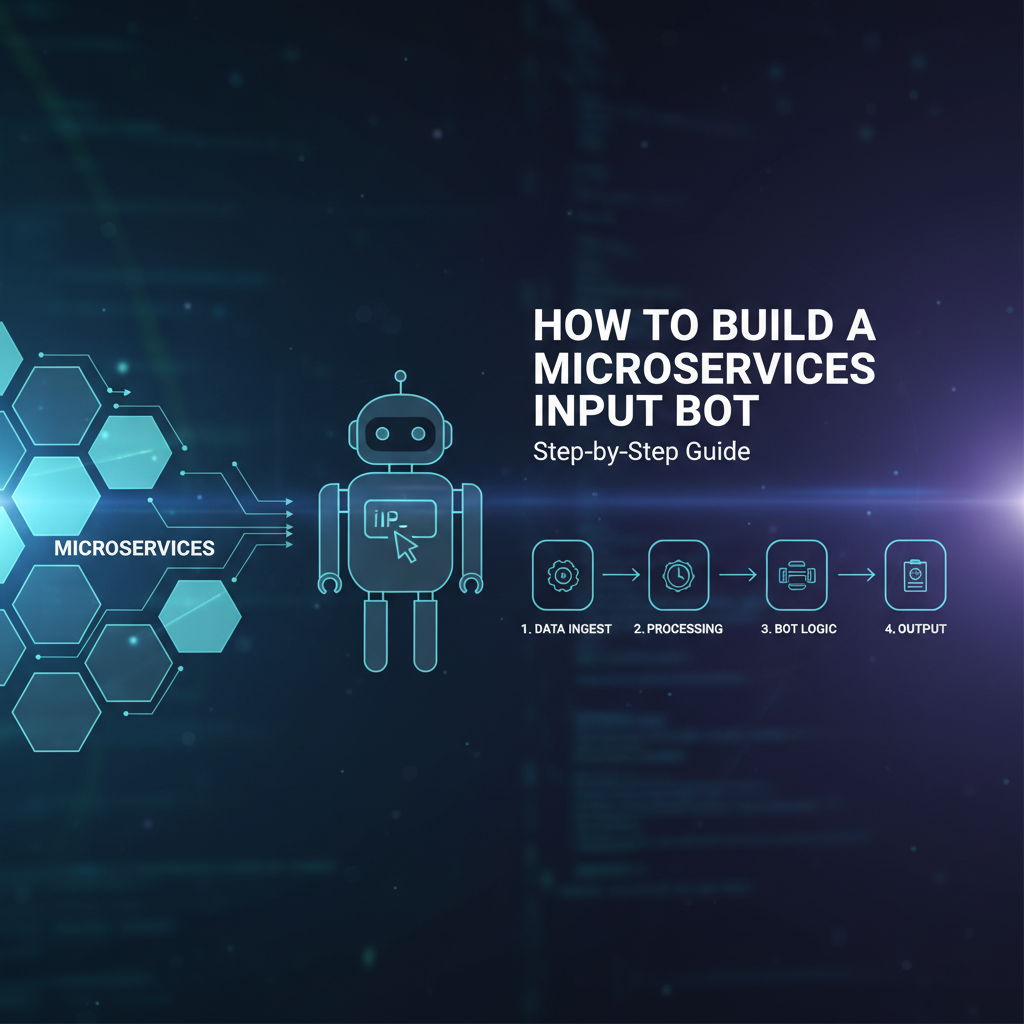


In the rapidly evolving landscape of modern software development, the ability to process, validate, and store user input efficiently and reliably is paramount. Whether you're building a sophisticated data entry system, an automated customer service assistant, or an intelligent data ingestion pipeline, an "input bot" serves as the crucial front line for data acquisition. Traditionally, such systems might have been built as monolithic applications, combining all functionalities into a single, tightly coupled codebase. However, with the increasing demands for scalability, flexibility, and resilience, a microservices architecture has emerged as a superior paradigm for constructing such complex systems.
This extensive guide will delve deep into the methodology of building a microservices input bot from the ground up. We will explore the architectural principles, design considerations, and practical implementation steps necessary to create a robust, scalable, and maintainable system. By decomposing the bot's functionalities into small, independent services, we unlock immense potential for parallel development, easier deployment, and enhanced fault isolation. This journey will cover everything from understanding the foundational concepts of microservices and their communication mechanisms to implementing an indispensable API gateway and ensuring the security and observability of your entire system. Prepare for a detailed exploration that will equip you with the knowledge to architect and build a cutting-edge input bot capable of handling diverse data streams and evolving business requirements.
1. Introduction: The Power of an Input Bot in a Microservices World
An input bot, at its core, is an automated system designed to receive, process, and often store or act upon various forms of user input. This input could range from structured data submitted via a web form, natural language queries through a chatbot interface, sensor readings, or even streams of financial transactions. The utility of such a bot spans numerous industries, from automating data entry in healthcare, processing customer feedback in retail, managing financial transactions, to orchestrating complex workflows in manufacturing. The primary goal is to streamline data ingestion, reduce human error, and enable quicker responses to incoming information.
When we talk about building an input bot using a microservices architecture, we are moving away from the "one big application" model. Instead, we envision our bot as a collection of small, autonomous services, each responsible for a specific business capability. For instance, one service might be dedicated solely to validating email addresses, another to storing validated data, and yet another to notifying relevant parties of new inputs. This approach offers compelling advantages over traditional monolithic designs. Scalability becomes granular; if the email validation service is experiencing high load, only that service needs to be scaled, not the entire application. Resilience improves because a failure in one service is less likely to bring down the entire system. Furthermore, development teams can work independently on different services using their preferred technologies, accelerating development cycles and fostering innovation. This guide will meticulously walk you through the process of harnessing these benefits to construct a powerful and adaptable input bot.
2. Understanding Microservices Architecture: The Foundation
Before we dive into the specifics of our input bot, it's crucial to firmly grasp the core tenets of microservices architecture. This paradigm isn't merely about breaking a large application into smaller pieces; it's a fundamental shift in how we conceive, design, deploy, and manage software systems.
2.1. Definition and Core Principles
A microservices architecture structures an application as a collection of loosely coupled, independently deployable services. Each service typically:
- Focuses on a single business capability: This adheres to the "single responsibility principle," ensuring that each service does one thing and does it well. For an input bot, this might mean a "Validation Service," a "Storage Service," or a "Notification Service."
- Is owned by a small, dedicated team: This promotes autonomy and reduces coordination overhead.
- Communicates via lightweight mechanisms: Often using RESTful APIs, message queues, or event streams. The API is the primary contract between services.
- Can be developed in different programming languages and frameworks: This allows teams to choose the best tool for the job.
- Has its own database: This ensures true independence and avoids shared data coupling, a common pitfall in monolithic architectures.
- Is independently deployable and scalable: Services can be updated, deployed, and scaled without affecting the entire application.
2.2. Benefits of Microservices for an Input Bot
The architectural choice of microservices brings several significant benefits, particularly pertinent to an input bot:
- Enhanced Scalability: As an input bot processes varying loads of data, certain components might become bottlenecks. With microservices, you can scale individual services horizontally based on demand. For example, if the input validation service receives a sudden surge of requests, you can deploy more instances of only that service, rather than scaling the entire monolithic application, which would be resource-intensive and inefficient. This granular control over scaling directly translates to optimized resource utilization and improved performance during peak times.
- Increased Resilience and Fault Isolation: In a monolithic application, a bug or failure in one component can potentially crash the entire system. In a microservices setup, services are isolated. If the notification service fails to send an email, it's unlikely to impact the input reception or data storage services. This isolation ensures that your input bot remains operational and continues to process critical data even if a peripheral service encounters an issue. Robust error handling and retry mechanisms within each service further enhance overall system stability.
- Greater Flexibility and Technology Diversity: Different services may have different technical requirements. A data processing service might benefit from a powerful computational language like Python, while a low-latency communication service might be better suited for Go. Microservices allow teams to use the most appropriate technology stack for each service, fostering innovation and maximizing efficiency. This flexibility also extends to data stores, enabling the use of relational databases for structured data and NoSQL databases for unstructured logs within the same ecosystem.
- Faster Development and Deployment Cycles: Small, independent services are quicker to develop, test, and deploy. Teams can work in parallel on different services without stepping on each other's toes. Continuous integration and continuous delivery (CI/CD) pipelines can be set up for each service, enabling rapid iterations and quicker time-to-market for new features or bug fixes. This agility is crucial for an input bot that needs to adapt quickly to changing business rules or new data formats.
- Easier Maintenance and Understandability: Each microservice has a smaller codebase than a monolith, making it easier for developers to understand, debug, and maintain. New team members can onboard more quickly as they only need to grasp the logic of a single service rather than an entire sprawling application. This reduced cognitive load improves developer productivity and reduces the risk of introducing new bugs.
2.3. Challenges and Considerations
While microservices offer numerous advantages, they also introduce complexities that must be carefully managed:
- Increased Operational Complexity: Managing multiple services, each with its own deployment, monitoring, and logging requirements, can be significantly more complex than managing a single monolith. This necessitates robust DevOps practices, containerization (e.g., Docker), and orchestration tools (e.g., Kubernetes).
- Distributed Data Management: Maintaining data consistency across multiple independent databases is a significant challenge. Strategies like the Saga pattern or eventual consistency often need to be employed. Traditional ACID transactions across services are difficult to achieve.
- Inter-Service Communication Overhead: Calls between services over a network are inherently slower and less reliable than in-process calls within a monolith. This necessitates careful design of APIs, robust error handling, and the use of message queues for asynchronous communication.
- Testing and Debugging: Testing a distributed system is more complex. End-to-end tests require the interaction of multiple services. Debugging issues that span several services can also be challenging, requiring sophisticated distributed tracing tools.
- Service Discovery and Routing: Services need to find each other. This requires a service discovery mechanism. Furthermore, clients need a single entry point to interact with the system, which is where an API gateway becomes indispensable.
Understanding these benefits and challenges is the first critical step toward successfully building our microservices input bot. The subsequent sections will guide you through mitigating these challenges and leveraging the strengths of this architectural style.
3. Core Components of a Microservices Input Bot
A microservices input bot is not a single entity but a constellation of specialized services working in concert. Let's outline the essential components that will form the backbone of our bot.
3.1. User Interface/Input Layer
This is the public-facing component that interacts directly with users or external systems to receive input. Its form can vary widely based on the bot's purpose:
- Web Form/Dashboard: For structured data entry, configuration, or monitoring. This provides a traditional graphical interface for users to submit information. It might be a React, Angular, or Vue.js application making API calls to your backend services.
- Chat Interface: For conversational bots that process natural language input (e.g., Slack bot, WhatsApp integration, custom chatbot widgets). These interfaces often translate natural language into structured commands or data points.
- Command Line Interface (CLI): For developers or system administrators who need to interact with the bot programmatically or for batch processing.
- RESTful API Endpoint: If the input bot is designed to receive data from other automated systems (e.g., IoT devices, third-party services, other microservices), a dedicated API endpoint that serves as a receiving hook is essential. This could be a
/receiveor/ingestendpoint that accepts POST requests.
Regardless of the specific interface, this layer's primary responsibility is to capture raw input and forward it, typically via an API, to the backend processing services.
3.2. Orchestration Service (Workflow Manager)
The orchestration service acts as the central coordinator for complex workflows. When an input arrives, this service determines the sequence of actions that need to be performed by other microservices. It doesn't perform the actual work but delegates tasks and manages the overall flow.
- Responsibilities:
- Receiving initial input (or a trigger from the Input Layer).
- Determining the necessary steps based on business rules.
- Invoking other microservices in the correct order.
- Aggregating results from multiple services.
- Handling workflow failures and retries.
- Example: For our input bot, if an input comes in, the Orchestration Service might first call the Validation Service, then the Enrichment Service, then the Persistence Service, and finally the Notification Service.
This service is crucial for maintaining the business logic flow without embedding it into every individual service, which would lead to tightly coupled designs.
3.3. Specialized Microservices
These are the worker bees, each performing a specific, well-defined task.
- Data Validation Service:
- Purpose: Ensures the integrity, correctness, and completeness of incoming data.
- Functions: Type checking (e.g., ensuring a field is an integer), format validation (e.g., email regex, date format), range checks, uniqueness checks, business rule validation (e.g., "order quantity cannot exceed stock").
- Output: Validated data or a list of validation errors.
- Data Enrichment Service (Optional but Common):
- Purpose: Adds valuable context or transforms the raw input data.
- Functions: Geocoding addresses, looking up customer details from a CRM, translating text, inferring categories using machine learning models, normalizing data formats.
- Output: Enhanced and more complete data payload.
- Data Storage/Persistence Service:
- Purpose: Securely stores the processed data in a chosen database.
- Functions: Inserting new records, updating existing ones, handling data versioning.
- Database Choice: Could use a relational database (PostgreSQL, MySQL) for structured data or a NoSQL database (MongoDB, Cassandra) for flexible schema requirements, depending on the data type and volume.
- External API Integration Service:
- Purpose: Communicates with third-party systems or external APIs.
- Functions: Sending data to an external CRM, triggering an email sending service, integrating with payment gateways, fetching data from a weather API.
- Abstractions: This service encapsulates the complexities of interacting with external APIs, shielding other internal services from external API changes or specific authentication mechanisms.
- Notification Service:
- Purpose: Informs users or other systems about the status or outcome of the input processing.
- Functions: Sending email alerts, SMS messages, push notifications, posting to a Slack channel, or updating a dashboard.
Each of these services exposes its functionality through a clearly defined API, allowing the Orchestration Service or other services to invoke them.
3.4. API Gateway
The API gateway is an indispensable component in a microservices architecture. It acts as a single entry point for all client requests, routing them to the appropriate backend microservice. Without an API gateway, clients would need to know the individual addresses and ports of each microservice, leading to complex client-side logic and increased network overhead.
- Key Functions of an API Gateway:
- Request Routing: Directs incoming requests to the correct microservice based on the URL path or other criteria.
- Authentication and Authorization: Handles security concerns, authenticating client requests before forwarding them to internal services. This offloads security logic from individual microservices.
- Rate Limiting: Protects backend services from abuse by limiting the number of requests a client can make within a certain timeframe.
- Load Balancing: Distributes incoming traffic across multiple instances of a service to ensure high availability and optimal performance.
- *API* Composition/Aggregation: Can combine responses from multiple microservices into a single response for the client, simplifying client-side development.
- Logging and Monitoring: Centralizes logging and metrics collection for all incoming requests, providing a clear overview of system health.
- Protocol Translation: Can translate between different client-side and backend-side protocols (e.g., expose a REST API to clients while communicating with backend services via gRPC).
The API gateway is the crucial intermediary that simplifies client interaction and centralizes common cross-cutting concerns, making the entire microservices system more manageable and secure. We will dedicate a specific section to its implementation and the integration of powerful tools like APIPark.
3.5. Message Broker (for Asynchronous Communication)
While direct API calls are suitable for synchronous requests, many operations in an input bot can be handled asynchronously, especially those that are time-consuming or don't require an immediate response. A message broker facilitates this:
- Purpose: Enables decoupled, asynchronous communication between services.
- How it Works: Services publish messages (events) to a queue or topic, and other services subscribe to these queues/topics to consume messages. The producer doesn't need to know about the consumer, only the message broker.
- Benefits:
- Decoupling: Services don't directly call each other, reducing dependencies.
- Resilience: If a consumer service is down, messages can be queued and processed once it recovers.
- Scalability: Consumers can be scaled independently to handle message load.
- Event-Driven Architecture: Supports complex workflows and real-time data processing.
- Common Choices: RabbitMQ, Apache Kafka, AWS SQS/SNS, Google Cloud Pub/Sub.
For our input bot, the Orchestration Service might publish an "InputValidated" event to a message broker, which the Persistence Service then consumes to store the data.
3.6. Database(s)
In a microservices architecture, each service ideally manages its own data store (the "database per service" pattern). This prevents tight coupling and allows services to choose the most appropriate database technology for their specific needs.
- Example:
- The "Validation Service" might use an in-memory database or cache for quick lookup of validation rules.
- The "Persistence Service" might use a PostgreSQL database for structured data archiving.
- A "User Preferences Service" (if applicable) might use a NoSQL document database like MongoDB.
- Challenges: This approach introduces challenges related to data consistency and distributed transactions, which must be addressed using patterns like Saga.
By understanding these core components, we lay a solid foundation for designing and building our microservices input bot.
APIPark is a high-performance AI gateway that allows you to securely access the most comprehensive LLM APIs globally on the APIPark platform, including OpenAI, Anthropic, Mistral, Llama2, Google Gemini, and more.Try APIPark now! 👇👇👇
4. Designing Your Microservices Input Bot
With a grasp of the fundamental concepts, the next step is to design our specific input bot. This involves defining its scope, decomposing its functionalities, modeling data, and establishing communication patterns.
4.1. Define Requirements and Scope
Before writing any code, clearly articulate what your input bot needs to achieve.
- What types of input will it accept? (e.g., JSON via an API, form data, text messages).
- What is the expected volume of input? (e.g., a few hundred submissions daily, thousands per second). This impacts scalability decisions.
- What validations are required? (e.g., mandatory fields, data types, specific formats).
- What transformations or enrichments are needed? (e.g., normalize case, add timestamps, call external services for additional data).
- Where will the data be stored? (e.g., relational database, document store, data lake).
- What notifications are necessary? (e.g., email confirmation, alert administrators).
- What are the performance and latency requirements?
- What are the security and compliance requirements? (e.g., GDPR, HIPAA).
For this guide, let's imagine our input bot is designed to receive customer feedback submissions through a web form. The requirements include: * Receiving customer name, email, feedback text, and rating (1-5). * Validating email format, ensuring all fields are present. * Storing feedback in a database. * Sending a confirmation email to the customer. * Notifying administrators if a low rating (1 or 2) is received.
4.2. Service Decomposition Strategy
The most crucial step in microservices design is correctly identifying and defining the boundaries of each service. A common and effective strategy is to decompose by business capability.
For our customer feedback bot, the logical services emerge as follows:
- Input Handler Service: Responsible for receiving raw feedback data from the web form. It doesn't perform business logic but acts as the initial entry point.
- Validation Service: Dedicated to verifying the integrity and correctness of the feedback data (e.g., email format, rating range).
- Feedback Persistence Service: Handles storing the validated feedback into a database.
- Notification Service: Manages sending various notifications (e.g., customer confirmation, admin alerts).
- API Gateway: (As discussed, this sits in front of all services to manage access).
This decomposition ensures each service has a clear, singular purpose and can evolve independently.
4.3. Data Modeling (Per Service)
Each microservice should ideally own its data schema and database. This prevents tight coupling and allows for independent evolution.
- Input Handler Service: Might not need its own persistent database; it might just temporarily hold the input before forwarding it. If it logs raw inputs, a simple local log file or a temporary message queue might suffice.
- Validation Service: Could use an in-memory cache for frequently accessed validation rules or configuration.
- Feedback Persistence Service: Will own the
Feedbacktable schema in its database. This table would contain fields likeid,customer_name,customer_email,feedback_text,rating,submission_timestamp. - Notification Service: Could have its own small database to store notification templates, delivery statuses, or retry queues.
4.4. Communication Patterns
Decide how your services will communicate. A combination of synchronous and asynchronous patterns is often best.
- Synchronous (RESTful APIs):
- Use Case: When an immediate response is required. The client (or calling service) waits for the response from the called service.
- Example: The Input Handler Service calling the Validation Service. The Orchestration Service calling the Feedback Persistence Service.
- Mechanism: HTTP/REST APIs are prevalent. Services expose endpoints (e.g.,
/validate,/store).
- Asynchronous (Message Queues/Event Streams):
- Use Case: For long-running operations, background tasks, or when services need to react to events without waiting for a direct response. Enhances resilience.
- Example: After data is successfully persisted, the Feedback Persistence Service could publish a "FeedbackStored" event to a message queue. The Notification Service would subscribe to this event and trigger appropriate notifications.
- Mechanism: Message brokers like RabbitMQ or Kafka.
For our feedback bot: 1. Web Form (client) -> API Gateway -> Input Handler Service (synchronous). 2. Input Handler Service -> Orchestration Service (synchronous internal call or message publish for more flexibility). 3. Orchestration Service -> Validation Service (synchronous, waits for validation result). 4. Orchestration Service -> Feedback Persistence Service (synchronous, waits for storage confirmation). 5. Feedback Persistence Service publishes "FeedbackStored" event to Message Broker (asynchronous). 6. Notification Service subscribes to "FeedbackStored" event (asynchronous).
4.5. Security Considerations
Security must be baked in from the start, not as an afterthought.
- Authentication: Who is allowed to access your API gateway? Use tokens (JWT, OAuth2).
- Authorization: What can an authenticated user do? Role-Based Access Control (RBAC).
- Data Encryption: Encrypt data in transit (TLS/SSL for API calls) and at rest (database encryption).
- Input Validation: Essential for preventing injection attacks (SQL injection, XSS). The Validation Service is critical here.
- Least Privilege: Each service should only have the necessary permissions to perform its function.
- Secure Secrets Management: Use environment variables or dedicated secret management services (e.g., HashiCorp Vault, AWS Secrets Manager) for database credentials, API keys.
- API Gateway Security: The API gateway is the first line of defense; it should enforce strong security policies.
By meticulously planning these design aspects, we lay the groundwork for a robust and efficient microservices input bot.
5. Step-by-Step Implementation Guide
Now, let's translate our design into a tangible system. This section will walk you through the practical steps of building each component and integrating them. We'll use Python with Flask for demonstration purposes, given its simplicity and popularity for microservices, but the principles apply broadly to any language/framework.
5.1. Step 1: Setting up the Development Environment
A consistent and isolated development environment is crucial for microservices.
- Programming Language: Python 3.9+
- Frameworks: Flask (for building RESTful APIs), Pydantic (for data validation/modeling).
- Containerization: Docker. This allows us to package each service and its dependencies into isolated containers, ensuring consistent environments across development, testing, and production.
- Dependency Management:
pipenvorpoetryfor Python virtual environments.
Basic Setup (per service):
Each microservice will typically have a directory structure like this:
feedback-bot/
├── input-handler-service/
│   ├── app/
│   │   ├── __init__.py
│   │   ├── main.py
│   │   └── schemas.py
│   ├── Dockerfile
│   └── Pipfile
├── validation-service/
│   ├── app/
│   │   ├── __init__.py
│   │   ├── main.py
│   │   └── schemas.py
│   ├── Dockerfile
│   └── Pipfile
├── persistence-service/
│   ├── app/
│   │   ├── __init__.py
│   │   ├── main.py
│   │   └── database.py
│   ├── Dockerfile
│   └── Pipfile
├── notification-service/
│   ├── app/
│   │   ├── __init__.py
│   │   ├── main.py
│   │   └── mailer.py
│   ├── Dockerfile
│   └── Pipfile
├── api-gateway/
│   ├── nginx.conf
│   └── Dockerfile
├── docker-compose.yml
└── README.md
You'll install Flask and other dependencies using pipenv install flask pydantic python-dotenv requests in each service's directory.
5.2. Step 2: Designing the Core Microservices
Let's outline the basic structure for our services.
5.2.1. Input Handler Service
This service's primary job is to receive the raw feedback from the client (e.g., web form) and forward it to the Orchestration Service (or directly to the Validation Service for simplicity in a smaller bot). It should perform minimal validation, mainly checking for basic structural correctness of the JSON payload.
# input-handler-service/app/schemas.py
from pydantic import BaseModel, Field, EmailStr

class RawFeedbackInput(BaseModel):
    customer_name: str = Field(min_length=1)
    customer_email: EmailStr
    feedback_text: str = Field(min_length=10)
    rating: int = Field(ge=1, le=5)

# input-handler-service/app/main.py
from flask import Flask, request, jsonify
from pydantic import ValidationError
from .schemas import RawFeedbackInput
import requests
import os

app = Flask(__name__)

# This would ideally call an Orchestration Service, but for simplicity,
# we'll call Validation Service directly.
VALIDATION_SERVICE_URL = os.getenv("VALIDATION_SERVICE_URL", "http://validation-service:5001/validate")

@app.route('/submit-feedback', methods=['POST'])
def submit_feedback():
    if not request.is_json:
        return jsonify({"message": "Request must be JSON"}), 400

    try:
        raw_data = RawFeedbackInput(**request.json)

        # Forward to Validation Service
        response = requests.post(VALIDATION_SERVICE_URL, json=raw_data.model_dump())
        response.raise_for_status() # Raise HTTPError for bad responses (4xx or 5xx)

        return jsonify(response.json()), response.status_code

    except ValidationError as e:
        return jsonify({"message": "Invalid input format", "details": e.errors()}), 400
    except requests.exceptions.RequestException as e:
        app.logger.error(f"Error communicating with validation service: {e}")
        return jsonify({"message": "Failed to process feedback due to internal service error"}), 500
    except Exception as e:
        app.logger.error(f"Unexpected error in input handler: {e}")
        return jsonify({"message": "An unexpected error occurred"}), 500

if __name__ == '__main__':
    app.run(host='0.0.0.0', port=5000)
5.2.2. Validation Service
This service performs comprehensive validation on the incoming feedback data. It should respond with either the validated data or a detailed list of errors.
# validation-service/app/schemas.py
from pydantic import BaseModel, EmailStr, Field

class ValidatedFeedback(BaseModel):
    customer_name: str
    customer_email: EmailStr
    feedback_text: str
    rating: int

# validation-service/app/main.py
from flask import Flask, request, jsonify
from pydantic import ValidationError
from .schemas import ValidatedFeedback
import requests
import os

app = Flask(__name__)

# This would ideally call an Orchestration Service, but for simplicity,
# we'll call Persistence Service directly.
PERSISTENCE_SERVICE_URL = os.getenv("PERSISTENCE_SERVICE_URL", "http://persistence-service:5002/store-feedback")

@app.route('/validate', methods=['POST'])
def validate_feedback():
    if not request.is_json:
        return jsonify({"message": "Request must be JSON"}), 400

    try:
        # Pydantic schema validation handles basic type and format checks
        validated_data = ValidatedFeedback(**request.json)

        # Additional custom business logic validation can go here
        if len(validated_data.feedback_text) < 20:
            return jsonify({"message": "Feedback text must be at least 20 characters long"}), 400

        # If valid, forward to Persistence Service
        response = requests.post(PERSISTENCE_SERVICE_URL, json=validated_data.model_dump())
        response.raise_for_status()

        return jsonify(response.json()), response.status_code

    except ValidationError as e:
        return jsonify({"message": "Validation failed", "details": e.errors()}), 400
    except requests.exceptions.RequestException as e:
        app.logger.error(f"Error communicating with persistence service: {e}")
        return jsonify({"message": "Failed to store feedback after validation"}), 500
    except Exception as e:
        app.logger.error(f"Unexpected error in validation service: {e}")
        return jsonify({"message": "An unexpected error occurred during validation"}), 500

if __name__ == '__main__':
    app.run(host='0.0.0.0', port=5001)
5.2.3. Feedback Persistence Service
This service is responsible for storing the validated feedback data into a database. We'll use SQLite for simplicity in local development, but it could easily be PostgreSQL or MySQL in production.
# persistence-service/app/database.py
import sqlite3
import os

DATABASE_FILE = os.getenv("DATABASE_FILE", "feedback.db")

def init_db():
    conn = sqlite3.connect(DATABASE_FILE)
    c = conn.cursor()
    c.execute('''
        CREATE TABLE IF NOT EXISTS feedback (
            id INTEGER PRIMARY KEY AUTOINCREMENT,
            customer_name TEXT NOT NULL,
            customer_email TEXT NOT NULL,
            feedback_text TEXT NOT NULL,
            rating INTEGER NOT NULL,
            submission_timestamp DATETIME DEFAULT CURRENT_TIMESTAMP
        )
    ''')
    conn.commit()
    conn.close()

def insert_feedback(name, email, text, rating):
    conn = sqlite3.connect(DATABASE_FILE)
    c = conn.cursor()
    c.execute("INSERT INTO feedback (customer_name, customer_email, feedback_text, rating) VALUES (?, ?, ?, ?)",
              (name, email, text, rating))
    conn.commit()
    feedback_id = c.lastrowid
    conn.close()
    return feedback_id

# persistence-service/app/main.py
from flask import Flask, request, jsonify
from .database import init_db, insert_feedback
import requests
import os
import datetime

app = Flask(__name__)
init_db() # Initialize the database when the app starts

NOTIFICATION_SERVICE_URL = os.getenv("NOTIFICATION_SERVICE_URL", "http://notification-service:5003/notify")

@app.route('/store-feedback', methods=['POST'])
def store_feedback():
    if not request.is_json:
        return jsonify({"message": "Request must be JSON"}), 400

    try:
        data = request.json
        feedback_id = insert_feedback(
            data['customer_name'],
            data['customer_email'],
            data['feedback_text'],
            data['rating']
        )

        # Publish an event or call Notification Service directly
        notification_payload = {
            "type": "feedback_received",
            "feedback_id": feedback_id,
            "customer_email": data['customer_email'],
            "customer_name": data['customer_name'],
            "rating": data['rating'],
            "timestamp": datetime.datetime.now().isoformat()
        }

        # For a truly asynchronous approach, this would publish to a message queue.
        # For simplicity here, we make a direct synchronous call.
        requests.post(NOTIFICATION_SERVICE_URL, json=notification_payload, timeout=5) # Non-blocking might be better

        return jsonify({"message": "Feedback stored successfully", "feedback_id": feedback_id}), 201

    except Exception as e:
        app.logger.error(f"Error storing feedback: {e}")
        return jsonify({"message": "Failed to store feedback"}), 500

if __name__ == '__main__':
    app.run(host='0.0.0.0', port=5002)
5.2.4. Notification Service
This service handles sending various types of notifications based on incoming events.
# notification-service/app/mailer.py
import smtplib
from email.mime.text import MIMEText
import os

SMTP_SERVER = os.getenv("SMTP_SERVER", "smtp.example.com")
SMTP_PORT = int(os.getenv("SMTP_PORT", 587))
SMTP_USERNAME = os.getenv("SMTP_USERNAME", "your_email@example.com")
SMTP_PASSWORD = os.getenv("SMTP_PASSWORD", "your_email_password")
SENDER_EMAIL = os.getenv("SENDER_EMAIL", "feedback-bot@example.com")
ADMIN_EMAIL = os.getenv("ADMIN_EMAIL", "admin@example.com")

def send_email(to_email, subject, body):
    msg = MIMEText(body)
    msg['Subject'] = subject
    msg['From'] = SENDER_EMAIL
    msg['To'] = to_email

    try:
        with smtplib.SMTP(SMTP_SERVER, SMTP_PORT) as server:
            server.starttls()
            server.login(SMTP_USERNAME, SMTP_PASSWORD)
            server.send_message(msg)
        print(f"Email sent to {to_email}: {subject}") # For logging
        return True
    except Exception as e:
        print(f"Failed to send email to {to_email}: {e}")
        return False

# notification-service/app/main.py
from flask import Flask, request, jsonify
from .mailer import send_email, ADMIN_EMAIL
import os

app = Flask(__name__)

@app.route('/notify', methods=['POST'])
def handle_notification():
    if not request.is_json:
        return jsonify({"message": "Request must be JSON"}), 400

    try:
        event_data = request.json
        event_type = event_data.get('type')

        if event_type == "feedback_received":
            customer_email = event_data.get('customer_email')
            customer_name = event_data.get('customer_name')
            rating = event_data.get('rating')
            feedback_id = event_data.get('feedback_id')

            # Send customer confirmation
            customer_subject = f"Thank You for Your Feedback, {customer_name}!"
            customer_body = f"Dear {customer_name},\n\nThank you for providing feedback (ID: {feedback_id}). We appreciate your input!\n\nBest regards,\nYour Feedback Bot Team"
            send_email(customer_email, customer_subject, customer_body)

            # Notify admin for low ratings
            if rating <= 2:
                admin_subject = f"URGENT: Low Feedback Rating Received (ID: {feedback_id})"
                admin_body = f"A new feedback with a low rating of {rating} has been received from {customer_name} ({customer_email}).\nFeedback ID: {feedback_id}\n\nPlease review immediately."
                send_email(ADMIN_EMAIL, admin_subject, admin_body)

            return jsonify({"message": "Notifications processed"}), 200

        return jsonify({"message": "Unknown event type"}), 400

    except Exception as e:
        app.logger.error(f"Error handling notification: {e}")
        return jsonify({"message": "Failed to process notification"}), 500

if __name__ == '__main__':
    app.run(host='0.0.0.0', port=5003)
5.3. Step 3: Implementing Inter-Service Communication
As seen in the code snippets, services communicate using HTTP POST requests for synchronous calls. For asynchronous communication, such as between the Persistence Service and Notification Service, a message broker would be used.
Example with RabbitMQ (Conceptual):
Instead of a direct requests.post(NOTIFICATION_SERVICE_URL, ...) call in persistence-service/app/main.py, you would:
- Connect to RabbitMQ.
- Declare a queue (e.g.,
feedback_events). - Publish the
notification_payloadtofeedback_events.
And in notification-service/app/main.py:
- Connect to RabbitMQ.
- Declare a queue (e.g.,
feedback_events). - Start consuming messages from
feedback_events. - When a message arrives, process it (i.e., call
send_email).
This decouples the services more effectively.
5.4. Step 4: Implementing an API Gateway
An API gateway is the crucial entry point for all external traffic. For our setup, clients will only ever interact with the API gateway, which then routes requests to the appropriate backend service. This provides a single, unified API for clients and centralizes concerns like security, rate limiting, and logging.
We can use Nginx as a lightweight and highly performant gateway.
5.4.1. Nginx Configuration for API Gateway
# api-gateway/nginx.conf
worker_processes 1;

events {
    worker_connections 1024;
}

http {
    include mime.types;
    default_type application/octet-stream;
    sendfile on;
    keepalive_timeout 65;

    # Upstream definitions for your microservices
    upstream input_handler_service {
        server input-handler-service:5000;
        # For production, add multiple servers and load balancing algorithms
        # server input-handler-service-2:5000;
    }

    # You could potentially route other services if they had external-facing APIs
    # For now, only input-handler-service is exposed externally through gateway

    server {
        listen 80;
        server_name localhost; # Replace with your domain in production

        location / {
            # Basic access control - for demonstration
            # real_ip_header X-Forwarded-For;
            # allow 192.168.1.0/24;
            # deny all;

            proxy_pass http://input_handler_service/submit-feedback; # Route all requests to this path
            proxy_set_header Host $host;
            proxy_set_header X-Real-IP $remote_addr;
            proxy_set_header X-Forwarded-For $proxy_add_x_forwarded_for;
            proxy_set_header X-Forwarded-Proto $scheme;

            # Error handling for gateway
            error_page 500 502 503 504 /50x.html;
            location = /50x.html {
                root html; # Default Nginx error page location
            }
        }
    }
}
This configuration routes all incoming requests to the input-handler-service's /submit-feedback endpoint. For a more sophisticated API gateway, you would have more complex location blocks to route different paths to different services (e.g., /feedback/* to Input Handler, /admin/* to an Admin Service).
5.4.2. Dockerfile for Nginx Gateway
# api-gateway/Dockerfile
FROM nginx:latest
COPY nginx.conf /etc/nginx/nginx.conf
EXPOSE 80
CMD ["nginx", "-g", "daemon off;"]
5.4.3. Integrating APIPark as an Advanced API Gateway
While Nginx serves as a capable reverse proxy and basic gateway, modern microservices architectures, especially those involving AI capabilities or requiring comprehensive API management, often benefit from a more feature-rich API gateway and management platform. This is where a product like APIPark - Open Source AI Gateway & API Management Platform (ApiPark) truly shines.
APIPark is an all-in-one AI gateway and API developer portal designed to manage, integrate, and deploy AI and REST services with remarkable ease. For our microservices input bot, integrating APIPark as the API gateway would significantly enhance its capabilities and manageability.
Why APIPark is Ideal for a Microservices Input Bot:
- Unified API Format and Quick Integration: While our bot currently uses simple REST APIs, future enhancements might involve AI models (e.g., sentiment analysis on feedback text). APIPark simplifies the integration of 100+ AI models with a unified API format, ensuring that if you later decide to use an AI service to categorize feedback, the integration process is seamless.
- Prompt Encapsulation into REST API: If you want to add AI-driven features like detecting the urgency of a feedback message or summarizing longer texts, APIPark allows you to quickly combine AI models with custom prompts to create new APIs. For example, you could define an
/analyze-sentimentAPI endpoint that internally calls an AI model via APIPark. - End-to-End API Lifecycle Management: As your input bot grows, you'll have more internal and potentially external APIs. APIPark assists with managing the entire lifecycle of these APIs, from design and publication to invocation and decommission. It provides features like traffic forwarding, load balancing, and versioning for published APIs, which are crucial for maintaining a healthy microservices ecosystem.
- Performance and Scalability: APIPark is engineered for high performance, rivaling Nginx, capable of handling over 20,000 TPS on modest hardware. This ensures that your gateway itself doesn't become a bottleneck, even with high volumes of incoming input. It supports cluster deployment to handle large-scale traffic, ensuring your input bot can scale to meet growing demands.
- Detailed API Call Logging and Data Analysis: For an input bot, understanding traffic patterns, identifying performance issues, and tracing requests is vital. APIPark provides comprehensive logging, recording every detail of each API call. This feature is invaluable for quickly tracing and troubleshooting issues in API calls, ensuring system stability and data security. Its powerful data analysis capabilities can display long-term trends and performance changes, helping with preventive maintenance.
- Centralized Security Features: APIPark supports features like subscription approval, ensuring callers must subscribe to an API and await administrator approval. This adds an extra layer of security, preventing unauthorized API calls and potential data breaches, which is especially important if your input bot handles sensitive data.
Integrating APIPark would involve configuring its gateway to route requests to your input-handler-service and potentially other services, while leveraging its advanced features for API management, security, and AI integration. For complex, enterprise-grade input bots, such a robust gateway is not just an option but a strategic necessity.
5.5. Step 5: Data Management in Microservices
In our example, the persistence-service owns its feedback.db (SQLite) database. In a real-world scenario with multiple services, each service would ideally have its own dedicated database instance (e.g., PostgreSQL for persistence-service, MongoDB for a user-profile-service).
Challenges with Distributed Data:
- Data Consistency: How do you ensure data is consistent across services if, for instance, the Notification Service needs access to customer data owned by a Customer Service?
- Eventual Consistency: Often, consistency isn't immediately required. Services can react to events published by other services (via a message broker) to update their own local copies of relevant data.
- Saga Pattern: For transactions that span multiple services (e.g., if storing feedback, updating user points, and sending an email all need to succeed or fail together), the Saga pattern defines a sequence of local transactions, with compensation transactions for failures.
- Data Duplication: Some data might be duplicated across services for performance or autonomy reasons. This must be managed carefully to avoid stale data.
For our simple input bot, where only the Feedback Persistence Service strictly owns data, these challenges are minimized. However, as the bot grows, these patterns become essential.
5.6. Step 6: Deploying and Scaling the Microservices Bot
Containerization with Docker and orchestration with Docker Compose (for local development) or Kubernetes (for production) are standard practices.
5.6.1. Docker Compose for Local Orchestration
docker-compose.yml provides a way to define and run multi-container Docker applications.
# docker-compose.yml
version: '3.8'

services:
  api-gateway:
    build: ./api-gateway
    ports:
      - "80:80"
    depends_on:
      - input-handler-service
    networks:
      - feedback-net

  input-handler-service:
    build: ./input-handler-service
    environment:
      - VALIDATION_SERVICE_URL=http://validation-service:5001/validate
    networks:
      - feedback-net

  validation-service:
    build: ./validation-service
    environment:
      - PERSISTENCE_SERVICE_URL=http://persistence-service:5002/store-feedback
    networks:
      - feedback-net

  persistence-service:
    build: ./persistence-service
    environment:
      - NOTIFICATION_SERVICE_URL=http://notification-service:5003/notify
      - DATABASE_FILE=/app/data/feedback.db # Persist data in a volume
    volumes:
      - feedback_data:/app/data # Mount volume for database persistence
    networks:
      - feedback-net

  notification-service:
    build: ./notification-service
    environment:
      - SMTP_SERVER=smtp.mailtrap.io # Example: Use Mailtrap for testing emails
      - SMTP_PORT=2525
      - SMTP_USERNAME=your_mailtrap_username
      - SMTP_PASSWORD=your_mailtrap_password
      - SENDER_EMAIL=feedback-bot@example.com
      - ADMIN_EMAIL=admin@example.com
    networks:
      - feedback-net

networks:
  feedback-net:
    driver: bridge

volumes:
  feedback_data:
To run: docker-compose up --build. This will build all service images, create containers, and link them via the feedback-net network.
5.6.2. CI/CD Pipelines
For automated deployment, integrate Docker builds and deployments into your CI/CD pipeline (e.g., GitHub Actions, GitLab CI, Jenkins). Each service should have its own pipeline that builds its Docker image, runs tests, and pushes the image to a container registry. Production deployment would then pull these images and deploy them to an orchestration platform like Kubernetes.
5.7. Step 7: Monitoring and Logging
Observability is paramount in microservices. When something goes wrong, you need to quickly identify which service is affected and why.
- Centralized Logging: Aggregate logs from all services into a central system. Tools like the ELK stack (Elasticsearch, Logstash, Kibana) or Grafana Loki are excellent for this. Each service should log relevant information (request details, errors, processing times).
- Metrics and Alerts: Collect performance metrics for each service (CPU usage, memory, request latency, error rates). Prometheus and Grafana are a powerful combination for monitoring and alerting. Define thresholds and trigger alerts for critical issues.
- Distributed Tracing: When a request spans multiple services, tracing allows you to visualize the entire request flow and pinpoint bottlenecks or failures. Tools like Jaeger or OpenTelemetry are essential for this.
- Health Checks: Each service should expose a
/healthendpoint that an orchestrator (like Kubernetes) can use to determine if the service is running correctly.
A robust monitoring setup ensures that you can proactively identify and resolve issues, keeping your input bot reliable and performing optimally. APIPark's detailed API call logging and powerful data analysis features mentioned earlier perfectly complement this step, providing granular insights into the performance and health of your API gateway and the services it fronts.
6. Advanced Topics and Best Practices
Building a basic microservices input bot is a great start, but to make it truly enterprise-grade, several advanced considerations and best practices are crucial.
6.1. Service Mesh
As the number of microservices grows, managing inter-service communication (traffic management, security, observability) becomes complex. A service mesh, like Istio or Linkerd, provides a dedicated infrastructure layer for managing service-to-service communication.
- Features:
- Traffic Management: Canary deployments, A/B testing, circuit breaking.
- Security: Mutual TLS (mTLS) between services, fine-grained access policies.
- Observability: Built-in metrics, logging, and tracing without modifying service code.
- Benefit for Input Bot: Ensures reliable and secure communication even as your bot scales to dozens of services, without adding complexity to individual service implementations.
6.2. Security Beyond the Gateway
While the API gateway handles external security, internal service-to-service communication also needs protection.
- Internal Authentication/Authorization: Services should not blindly trust calls from other internal services. Use internal JWTs or mutual TLS to verify the identity of the calling service.
- Data Masking/Redaction: Sensitive data (e.g., personally identifiable information) should be masked or redacted wherever possible, especially in logs and non-production environments.
- Vulnerability Scanning: Regularly scan your Docker images and dependencies for known vulnerabilities.
- Principle of Least Privilege: Ensure each service and its underlying database user has only the minimum necessary permissions.
6.3. Resilience Patterns
Distributed systems are inherently prone to failures. Implementing resilience patterns makes your bot robust.
- Circuit Breaker: Prevents a service from repeatedly trying to access a failing downstream service. Instead, it "breaks the circuit" and allows the calling service to fail fast, giving the downstream service time to recover. Hystrix (Java) or libraries like Tenacity (Python) implement this.
- Retry: Implement intelligent retry logic with exponential backoff for transient failures (e.g., network glitches, temporary service unavailability).
- Bulkhead: Isolates failing components to prevent cascading failures. For instance, separate thread pools or connection pools for different external service calls.
- Rate Limiting (Internal): In addition to external rate limiting at the API gateway, internal rate limiting can protect individual services from being overwhelmed by other internal services.
6.4. Testing Strategies
Testing microservices requires a multi-faceted approach.
- Unit Tests: Test individual components and functions within each service.
- Integration Tests: Test the interaction between two or more services. These are crucial for verifying API contracts and data flows.
- Contract Tests: Define and enforce the API contracts between services. Tools like Pact help ensure that services adhere to their agreed-upon API specifications.
- End-to-End Tests: Test the entire system flow from the client through all microservices. These are valuable but can be brittle and slow.
- Performance Tests: Simulate high load to identify bottlenecks and verify scalability.
- Chaos Engineering: Deliberately inject failures into the system (e.g., kill a service instance, introduce network latency) to test its resilience.
6.5. Documentation and API Contracts
Clear and up-to-date documentation is vital for microservices.
- API Documentation: Each service should provide clear documentation for its API endpoints, including request/response formats, authentication requirements, and error codes. Tools like OpenAPI (Swagger) can automate this.
- Service Catalog: Maintain a central catalog of all services, their owners, capabilities, and API endpoints. APIPark's developer portal feature could serve this purpose effectively.
- Event Schemas: If using an event-driven architecture, define and enforce schemas for events to ensure compatibility between producers and consumers.
By incorporating these advanced topics and best practices, your microservices input bot will evolve from a functional system into a highly resilient, secure, and manageable enterprise-grade solution. The upfront investment in these areas pays dividends in long-term stability and ease of evolution.
7. Conclusion: Empowering Your Data Ingestion with Microservices
Building an input bot within a microservices architecture is a strategic decision that empowers organizations with unprecedented levels of scalability, resilience, and flexibility. We've embarked on a comprehensive journey, dissecting the fundamental principles of microservices, designing individual components, and meticulously implementing a step-by-step guide for constructing a functional system. From the initial input handler to specialized validation, persistence, and notification services, each component plays a vital role, operating autonomously yet collaboratively.
A critical takeaway is the indispensable role of the API gateway. Serving as the unified entry point, it shields internal complexities, centralizes security, and optimizes traffic routing. Advanced solutions like APIPark elevate this further, offering a robust, open-source AI gateway and API management platform that not only handles the basics but also provides advanced features for AI integration, comprehensive API lifecycle management, high performance, and detailed observability. Its ability to simplify AI model integration and standardize API invocation makes it an ideal choice for future-proofing your input bot against evolving requirements, especially as AI becomes more integrated into data processing workflows.
While the initial setup of a microservices system demands a thoughtful approach to design, communication, data management, and operational complexity, the long-term benefits are profound. The ability to independently scale and deploy services, leverage diverse technologies, and isolate faults ensures that your input bot can gracefully adapt to changing demands, process vast quantities of data, and remain highly available. By embracing the detailed implementation steps and best practices outlined in this guide – from robust testing to comprehensive monitoring and security considerations – you are not just building an input bot; you are architecting a resilient, adaptable, and powerful data ingestion engine ready for the challenges of the modern digital landscape. This approach will not only enhance the efficiency and reliability of your data workflows but also pave the way for continuous innovation and growth.
8. Frequently Asked Questions (FAQs)
Q1: What are the primary advantages of using microservices for an input bot compared to a monolithic architecture?
A1: The primary advantages of microservices for an input bot revolve around enhanced scalability, resilience, and flexibility. In a monolithic application, if one component (e.g., validation logic) faces high load, the entire application needs to be scaled, which is inefficient. With microservices, only the specific overloaded service needs to be scaled. This granular scaling optimizes resource use. Furthermore, microservices offer better fault isolation; a failure in one service (like a notification sender) won't bring down the entire input processing pipeline, ensuring system stability. Finally, teams can use diverse technologies for different services, accelerating development and enabling faster innovation for specific tasks within the bot.
Q2: What is an API Gateway, and why is it essential for a microservices input bot?
A2: An API gateway acts as a single, unified entry point for all external client requests to your microservices system. Instead of clients having to know the addresses of multiple individual services, they communicate solely with the API gateway. It's essential because it centralizes critical cross-cutting concerns: 1. Request Routing: Directs incoming requests to the correct backend microservice. 2. Security: Handles authentication, authorization, and rate limiting, protecting internal services. 3. Load Balancing: Distributes traffic across multiple instances of a service. 4. Logging & Monitoring: Centralizes data for observability. For an input bot, it simplifies client interaction, enhances security, and improves the overall manageability and performance of the distributed system, preventing direct exposure of internal service endpoints.
Q3: How do microservices communicate with each other in an input bot, and when should I use synchronous versus asynchronous communication?
A3: Microservices primarily communicate using lightweight mechanisms, most commonly via APIs (like RESTful HTTP requests) for synchronous communication and message brokers (like RabbitMQ or Apache Kafka) for asynchronous communication. * Synchronous communication is used when an immediate response is required from the called service, such as an Input Handler Service asking a Validation Service to immediately check data integrity before proceeding. The calling service waits for the response. * Asynchronous communication (via message queues or event streams) is ideal for tasks that don't require an immediate response, long-running processes, or when services need to be highly decoupled. For example, a Persistence Service might publish an "Input Stored" event to a message queue, and a Notification Service can consume this event in the background to send an email without blocking the data storage process. This enhances resilience and scalability.
Q4: How does APIPark fit into building a microservices input bot?
A4: APIPark (ApiPark) can serve as a powerful and advanced API gateway and API management platform for a microservices input bot. While basic Nginx can act as a simple gateway, APIPark offers a comprehensive suite of features highly beneficial for modern microservices and AI-driven applications. It provides advanced API lifecycle management, unified API formats for easy AI model integration (useful if your bot processes natural language or uses AI for data enrichment), high performance, detailed API call logging, and powerful data analysis. This allows you to effectively manage, secure, and monitor all your bot's APIs from a central platform, enhancing its capabilities and future-proofing it for AI integration without adding complexity to individual microservices.
Q5: What are the key challenges in managing data across multiple microservices in an input bot?
A5: Managing data in a microservices architecture presents several challenges due to the "database per service" principle. 1. Data Consistency: Ensuring that data remains consistent across different databases owned by different services can be complex. Traditional ACID transactions across services are difficult to achieve. Solutions often involve "eventual consistency" or patterns like the Saga pattern for distributed transactions. 2. Data Duplication: Some data might be intentionally duplicated across services for performance or autonomy reasons, leading to challenges in keeping these duplicated copies synchronized and preventing stale data. 3. Data Integrity: Maintaining referential integrity without foreign keys across different databases requires careful design and application-level logic. 4. Querying Across Services: Generating reports or performing complex queries that require data from multiple services can be challenging, often necessitating data aggregation layers or specialized query services. Overcoming these challenges requires careful planning and the adoption of specific architectural patterns.
🚀You can securely and efficiently call the OpenAI API on APIPark in just two steps:
Step 1: Deploy the APIPark AI gateway in 5 minutes.
APIPark is developed based on Golang, offering strong product performance and low development and maintenance costs. You can deploy APIPark with a single command line.
curl -sSO https://download.apipark.com/install/quick-start.sh; bash quick-start.sh

In my experience, you can see the successful deployment interface within 5 to 10 minutes. Then, you can log in to APIPark using your account.

Step 2: Call the OpenAI API.