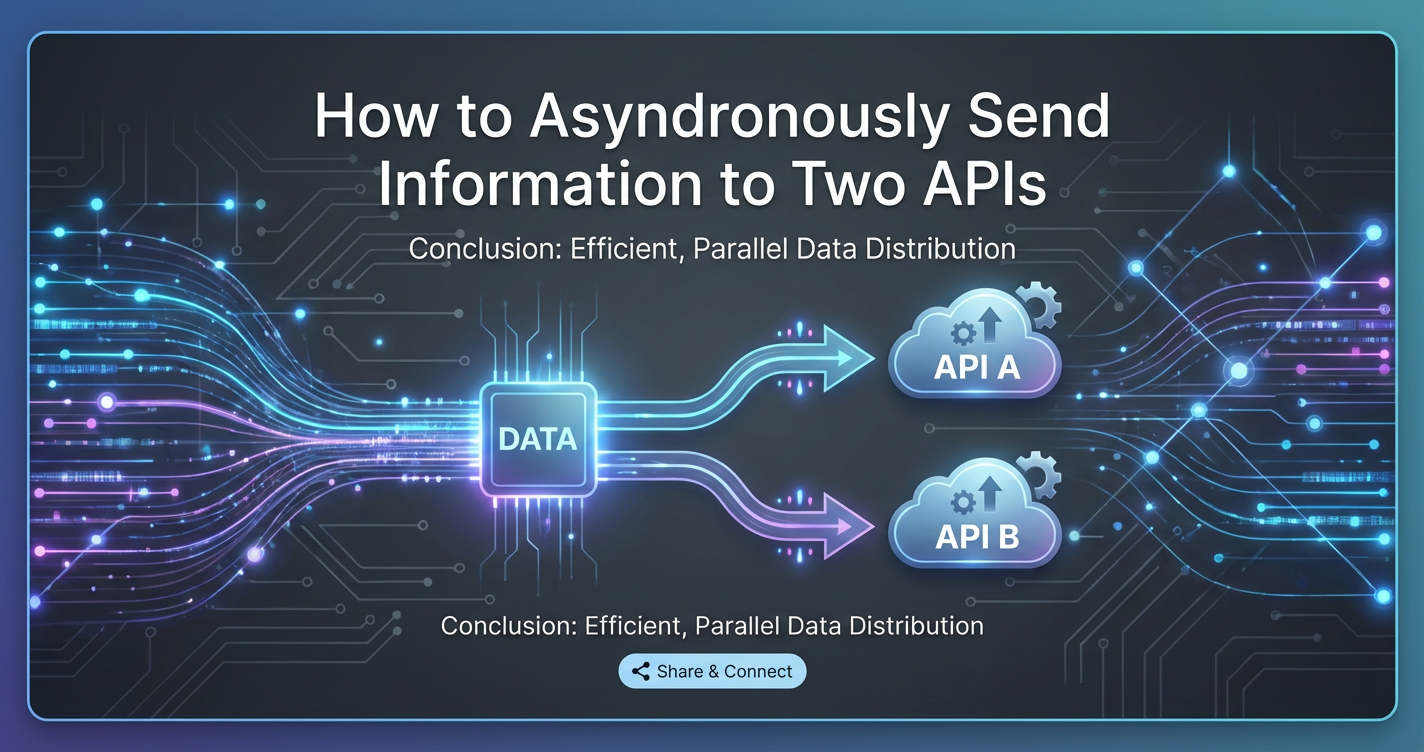
How to Asynchronously Send Information to Two APIs
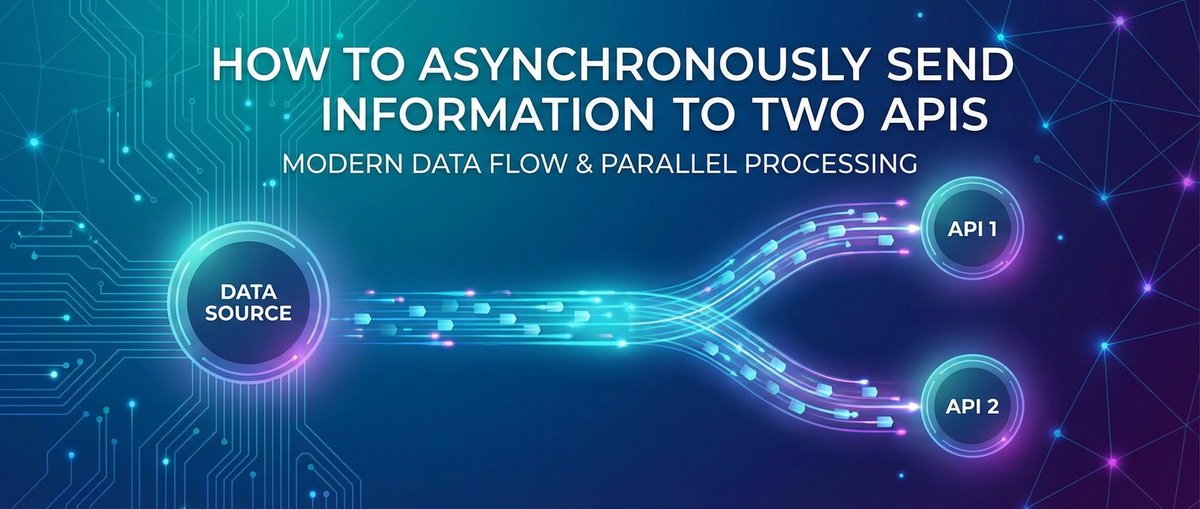


In the intricate tapestry of modern software architecture, the ability to communicate effectively and efficiently with external services is paramount. Applications rarely exist in isolation; they are often interconnected nodes in a vast network, constantly exchanging data and orchestrating complex workflows. Among the most frequent requirements is the need to send information to multiple external API endpoints. While seemingly straightforward, the synchronous approach to such interactions can quickly become a bottleneck, leading to sluggish user experiences, decreased system throughput, and a brittle architecture susceptible to single points of failure.
This exhaustive guide delves into the world of asynchronous communication, specifically focusing on the nuanced challenge of reliably dispatching information to two distinct API services. We will explore the fundamental principles that underpin asynchronous operations, dissect various architectural patterns and implementation strategies, and provide a wealth of best practices to ensure your systems remain performant, resilient, and scalable. From the foundational concepts of non-blocking I/O to the sophisticated orchestration capabilities of an API gateway, we will chart a comprehensive path for developers and architects navigating these critical integration challenges. Our journey aims not just to describe how to achieve this, but to illuminate the why behind each design choice, empowering you to build robust, future-proof applications.
The Imperative of Asynchronicity: Why Not Just Send Sequentially?
Before we dive into the mechanics of sending data to multiple APIs, it's crucial to understand the foundational shift from synchronous to asynchronous processing. This isn't merely a technical preference; it's an architectural paradigm that dictates an application's responsiveness, scalability, and resilience.
Synchronous vs. Asynchronous Communication: A Fundamental Distinction
At its core, synchronous communication implies a blocking operation. When your application initiates a request to an API synchronously, it effectively pauses its current execution thread, waiting for a response from the external service before proceeding. Imagine ordering a coffee: if you waited at the counter until your coffee was brewed, cooled, and served before you could even think about your next task, that would be synchronous. While simple to implement for single, isolated calls, this model introduces significant liabilities when dealing with external dependencies, especially multiple ones.
Conversely, asynchronous communication is non-blocking. When your application dispatches a request asynchronously, it doesn't wait for the response. Instead, it continues its execution, perhaps handling other tasks or preparing for subsequent operations, and expects to be notified (via a callback, a promise, or an event) when the response eventually arrives. Using our coffee analogy, asynchronous would be placing your order, receiving a pager, and then sitting down to check your emails while you await the buzz. This frees up resources and allows for parallel processing, fundamentally altering the performance profile of your application.
The Treacherous Path of Synchronous Dual-API Calls
Consider a scenario where your application needs to update a user profile in your primary user management API and simultaneously notify a separate analytics API about this update. If you were to perform these operations synchronously and sequentially:
- Request 1 (User Management API): Your application sends data to the user management API and blocks, waiting for its response.
- Wait Time: This wait could be milliseconds or even seconds, depending on network latency, the API's processing time, and its current load.
- Request 2 (Analytics API): Only after receiving a successful response from the user management API does your application then send data to the analytics API and blocks again.
- Another Wait Time: Another period of waiting ensues.
The total time taken for this operation is the sum of the processing times and network latencies for both API calls, plus any overhead. In an environment with microservices or geographically distributed APIs, this cumulative delay can quickly render your application unresponsive, especially under heavy load. If one API is slow or temporarily unavailable, the entire operation grinds to a halt, impacting the user experience and potentially cascading failures across your system.
The Unassailable Advantages of Asynchronous Dual-API Communication
Embracing asynchronous patterns for sending information to two APIs unlocks a multitude of benefits, transforming potential liabilities into architectural strengths:
- Enhanced Responsiveness and User Experience: By not blocking the main thread, your application can remain fluid and interactive. A user submitting a form can receive immediate confirmation, even if backend processes are still working on dispatching data to multiple services. This dramatically improves perceived performance.
- Superior Scalability: Asynchronous operations allow your application to handle a significantly higher volume of concurrent requests. Instead of dedicating a thread or process per blocking API call, a single thread can manage numerous non-blocking I/O operations simultaneously, leading to more efficient resource utilization and easier horizontal scaling.
- Increased Resilience and Fault Tolerance: When one of the target APIs is slow or temporarily unavailable, an asynchronous setup can gracefully handle the situation. Instead of blocking indefinitely or failing outright, the request to the problematic API can be retried, queued, or handled through a fallback mechanism, without affecting the call to the other API or the responsiveness of the client application. This isolation of failures is a cornerstone of robust distributed systems.
- Decoupling of Services: Asynchronous communication often involves intermediate components like message queues or event buses, which inherently decouple the sender from the receivers. The source application simply publishes an event or message, and multiple consumers (each responsible for a different API) can pick it up independently. This reduces direct dependencies, making individual services easier to develop, deploy, and scale.
- Optimized Resource Utilization: By eliminating idle waiting times, server resources (CPU, memory, network connections) are used more efficiently. This translates to lower infrastructure costs and a better return on investment for your computational resources.
Understanding these profound advantages lays the groundwork for exploring the various strategies and tools that facilitate the reliable asynchronous dispatch of information to two distinct API endpoints. The shift from synchronous to asynchronous isn't just a technical trick; it's a fundamental commitment to building more resilient, performant, and scalable applications.
Scenarios Demanding Dual-API Asynchronous Dispatch
The need to send information to two or more APIs asynchronously arises in a diverse array of business and technical contexts. Recognizing these common patterns helps in selecting the most appropriate architectural solution. These scenarios often highlight the dual objectives of operational efficiency and data consistency without sacrificing user experience.
1. Data Duplication and Synchronization
One of the most prevalent use cases involves maintaining data consistency across multiple data stores or services, each optimized for different access patterns or serving distinct business functions.
- Primary Database & Search Index: When a new product is added to an e-commerce platform, it's typically saved to a relational database. Simultaneously, this product information needs to be indexed in a search engine (like Elasticsearch or Apache Solr) to make it discoverable for customers. Synchronously updating both would mean waiting for potentially slow indexing operations. Asynchronously, the product is saved to the primary database immediately, and a separate process or event triggers the indexing in the search API, ensuring user responsiveness while eventually achieving full searchability.
- Customer Relationship Management (CRM) & Marketing Automation: A new customer registration might write to the primary CRM API for record-keeping, while also needing to update a marketing automation platform API to enroll the customer in a welcome email campaign. These are distinct operations that don't need to block each other.
- User Profile & Analytics Data Store: When a user updates their profile (e.g., changes their email address), this change must be reflected in the main user service and also potentially logged or replicated into a data warehouse or analytics service for reporting purposes.
2. Event Notification and Workflow Triggering
Asynchronous dispatch is ideal for reacting to events by triggering subsequent actions in various independent systems. This forms the backbone of event-driven architectures.
- Order Placement: When a customer places an order, the primary order processing API needs to record the order. Concurrently, a fulfillment API needs to be notified to start packaging and shipping, and a notification API needs to send a confirmation email or SMS to the customer. Each of these can proceed independently and asynchronously.
- Payment Processing & Inventory Update: After a successful payment via a payment API, an inventory API needs to decrement stock levels, and a separate accounting API needs to record the transaction. These operations are distinct and can occur in parallel without blocking the user's checkout experience.
- User Action Logging & Audit Trail: Any significant user action (e.g., login, password change, data export) might need to be logged into an audit API for compliance and security, while also updating a user activity stream API for real-time monitoring.
3. Data Enrichment and Transformation
In some cases, an initial piece of information needs to be enriched or transformed by one API before being sent to another, or two distinct enrichments need to happen in parallel.
- Geocoding and Customer Segmentation: A new customer's address might first be sent to a geocoding API to convert it into coordinates. Simultaneously, or as a follow-up, the customer's demographics might be sent to a customer segmentation API to classify them for targeted marketing.
- Content Moderation & Translation: User-generated content submitted to a platform might first go to a content moderation API for screening, and then, if approved, be sent to a translation API to make it available in multiple languages.
4. Cross-Cutting Concerns
Operations that span multiple functional domains, like logging, monitoring, or security auditing, are excellent candidates for asynchronous fan-out.
- Business Logic & Operational Logging: After a critical business operation (e.g., approving a loan, processing a refund) completes via a core business API, detailed operational logs might need to be sent to a separate logging API for debugging and performance analysis, independently of the business outcome.
- Security Event Reporting: A security event detected by one system might need to be reported to a security information and event management (SIEM) API for threat analysis, while also triggering an alert through a notification API to a security operations team.
5. Fan-out Architectures for Microservices
In microservices environments, a single event often needs to be consumed by multiple downstream services that subscribe to that event. While not strictly "sending to two APIs" from a single initial request, it achieves a similar outcome: one action leading to multiple parallel updates.
- User Registration Event: A "UserRegistered" event might trigger one service to provision resources for the new user, another service to send a welcome email, and a third service to update an internal user directory. Each service interacts with its own set of internal or external APIs.
These scenarios underscore the pervasive utility of asynchronous communication when dealing with multiple external dependencies. By understanding these patterns, developers can strategically apply the techniques discussed in the following sections to build resilient and high-performing distributed systems.
Core Techniques for Asynchronous Dual-API Communication
Achieving reliable asynchronous dispatch to two APIs involves a spectrum of techniques, ranging from client-side parallel execution to sophisticated server-side orchestration. The choice of technique often depends on the application's complexity, scale, latency requirements, and existing infrastructure.
1. Client-Side Parallel HTTP Requests
This is often the simplest approach for making two asynchronous API calls directly from the application code. Modern programming languages and frameworks provide built-in constructs to facilitate parallel, non-blocking HTTP requests.
Mechanism: Instead of making one HTTP POST request and waiting for its completion before initiating the second, the application simultaneously dispatches both HTTP POST requests. The main execution thread is not blocked by either request, allowing it to continue with other tasks until both (or either) responses arrive.
How it works (Conceptual Examples):
JavaScript (Node.js/Browser): Using Promise.all() or async/await with Promise.all(): ```javascript async function sendToTwoAPIs(data1, data2) { try { const [response1, response2] = await Promise.all([ fetch('https://api.service1.com/endpoint', { method: 'POST', body: JSON.stringify(data1) }), fetch('https://api.service2.com/endpoint', { method: 'POST', body: JSON.stringify(data2) }) ]);
    const result1 = await response1.json();
    const result2 = await response2.json();

    console.log('API 1 Response:', result1);
    console.log('API 2 Response:', result2);
    return { result1, result2 };
} catch (error) {
    console.error('Error sending to APIs:', error);
    // Handle individual or combined errors
    throw error;
}
} * **Python:** Using `asyncio.gather()` with `aiohttp` or `httpx`:python import asyncio import aiohttpasync def send_to_two_apis(data1, data2): async with aiohttp.ClientSession() as session: try: task1 = session.post('https://api.service1.com/endpoint', json=data1) task2 = session.post('https://api.service2.com/endpoint', json=data2)
        responses = await asyncio.gather(task1, task2)

        result1 = await responses[0].json()
        result2 = await responses[1].json()

        print('API 1 Response:', result1)
        print('API 2 Response:', result2)
        return result1, result2
    except aiohttp.ClientError as e:
        print(f"Error sending to APIs: {e}")
        raise
asyncio.run(send_to_two_apis({"key": "value1"}, {"key": "value2"}))
* **Java:** Using `CompletableFuture` (often with an `HttpClient` or Feign client):java import java.net.URI; import java.net.http.HttpClient; import java.net.http.HttpRequest; import java.net.http.HttpResponse; import java.util.concurrent.CompletableFuture;public class DualApiSender { private final HttpClient httpClient = HttpClient.newBuilder().build();
public CompletableFuture<Void> sendToTwoApis(String data1, String data2) {
    HttpRequest request1 = HttpRequest.newBuilder()
            .uri(URI.create("https://api.service1.com/endpoint"))
            .header("Content-Type", "application/json")
            .POST(HttpRequest.BodyPublishers.ofString(data1))
            .build();

    HttpRequest request2 = HttpRequest.newBuilder()
            .uri(URI.create("https://api.service2.com/endpoint"))
            .header("Content-Type", "application/json")
            .POST(HttpRequest.BodyPublishers.ofString(data2))
            .build();

    CompletableFuture<HttpResponse<String>> future1 = httpClient.sendAsync(request1, HttpResponse.BodyHandlers.ofString());
    CompletableFuture<HttpResponse<String>> future2 = httpClient.sendAsync(request2, HttpResponse.BodyHandlers.ofString());

    return CompletableFuture.allOf(future1, future2)
            .thenAccept(v -> {
                try {
                    HttpResponse<String> response1 = future1.join(); // .join() blocks to get result after allOf completes
                    HttpResponse<String> response2 = future2.join();
                    System.out.println("API 1 Response Status: " + response1.statusCode() + ", Body: " + response1.body());
                    System.out.println("API 2 Response Status: " + response2.statusCode() + ", Body: " + response2.body());
                } catch (Exception e) {
                    System.err.println("Error processing responses: " + e.getMessage());
                }
            })
            .exceptionally(ex -> {
                System.err.println("One or both API calls failed: " + ex.getMessage());
                return null; // Return null to complete the future exceptionally
            });
}
} ```
Considerations: * Network Overhead: While parallel, each request still incurs its own network latency. * Error Handling: You need to handle errors for each individual request. What if one succeeds and the other fails? Do you retry the failed one? Do you rollback the successful one? This can introduce complexity. * Coupling: The client application is directly responsible for knowing and calling both API endpoints, leading to tighter coupling. * Resource Limits: Direct client-side calls might not handle extreme loads as gracefully as dedicated message queues if thousands of such parallel calls are initiated simultaneously from many clients.
2. Server-Side/Middleware Approaches
For more robust, scalable, and decoupled asynchronous communication, moving the orchestration to dedicated middleware components is often preferred.
a. Message Queues
Message queues are a cornerstone of asynchronous, event-driven architectures. They act as intermediaries that store messages until they are consumed by a receiving service, decoupling producers from consumers.
Mechanism: 1. Your application (the producer) publishes a single message containing the necessary data to a message queue. This operation is typically very fast and non-blocking. 2. The message queue durable stores the message. 3. Two separate consumers (or processes), each specifically designed to interact with one of the target APIs, subscribe to this queue (or a topic derived from it). 4. Each consumer independently retrieves the message from the queue and dispatches the relevant information to its respective API.
Examples: RabbitMQ, Apache Kafka, AWS SQS, Azure Service Bus, Google Cloud Pub/Sub.
How it works (Conceptual Flow):
+------------------+     (1. Publish Message)     +-------------------+
| Your Application | ----------------------------> | Message Queue     |
+------------------+                              +-------------------+
                                                              |
                                                              | (2. Message Stored)
                                                              V
                                        +-------------------------------------+
                                        |                                     |
                                        | (3. Consume Message)                |
                                        V                                     V
                              +----------------+                    +----------------+
                              | Consumer for   |                    | Consumer for   |
                              | API 1          |                    | API 2          |
                              +----------------+                    +----------------+
                                      |                                     |
                                      | (4. Call API 1)                     | (5. Call API 2)
                                      V                                     V
                              +----------------+                    +----------------+
                              | External API 1 |                    | External API 2 |
                              +----------------+                    +----------------+
Benefits: * Decoupling: The producer doesn't need to know about the consumers or their APIs. It just publishes a message. This makes the system more modular and resilient to changes. * Resilience: If one API is down, its consumer can simply retry processing the message later, or the message can be moved to a dead-letter queue, without affecting the other API call. * Scalability: You can easily scale consumers independently to handle increased load on specific APIs. * Load Leveling: Queues absorb spikes in traffic, preventing your backend APIs from being overwhelmed. * Guaranteed Delivery: Most robust message queues offer mechanisms to ensure messages are processed at least once, or exactly once, even in the face of failures.
Considerations: * Increased Infrastructure Complexity: Introducing a message queue adds another component to manage and monitor. * Eventual Consistency: Data updates across different APIs might not be immediately consistent. This is a common trade-off in distributed systems. * Latency: There's a slight inherent latency introduced by the queue itself, though often negligible compared to API call times.
b. Event-Driven Architectures (EDAs)
EDAs are a broader architectural style where system components react to events. Message queues are often a core component of EDAs, but EDAs emphasize the event as the central piece of communication.
Mechanism: Similar to message queues, an event bus or broker receives events. Multiple subscribers (which can be microservices, serverless functions, or dedicated workers) listen for specific event types. When an event is published, all interested subscribers are notified and can take action, including calling their respective APIs. This is a natural fit for fan-out scenarios where one change triggers multiple independent updates.
Examples: AWS EventBridge, Kafka, custom event buses.
Benefits: * Highly decoupled and extensible. * Supports complex workflows across many services. * Promotes high cohesion within services (each service only cares about its own events).
Considerations: * Increased complexity in event schema management and debugging event flows. * Challenges in ensuring order and consistency across multiple downstream consumers.
3. API Gateway as a Central Orchestrator
An API gateway acts as a single entry point for all API clients, abstracting the complexities of the backend services. Beyond routing, an advanced API gateway can perform orchestration, security enforcement, rate limiting, and even asynchronous fan-out to multiple backend APIs. This is where a product like ApiPark truly shines, providing a comprehensive solution for managing API interactions.
Mechanism: 1. The client application makes a single request to the API gateway. 2. The API gateway, configured with specific routing rules, receives this request. 3. Instead of forwarding the request to a single backend, the gateway is configured to transform the incoming request (if necessary) and then concurrently dispatch it to two or more specified backend APIs. 4. The gateway can then aggregate the responses, apply further transformations, and send a single, consolidated response back to the client, or respond immediately if the fan-out is purely asynchronous and the client doesn't need to wait for backend responses.
How it works (Conceptual Flow):
+------------------+     (1. Single Request)      +-------------------+
| Client           | ----------------------------> | API Gateway       |
+------------------+                              +-------------------+
                                                              |
                                                              | (2. Orchestration & Fan-out)
                                                              V
                                        +-------------------------------------+
                                        |                                     |
                                        | (3. Call API 1 Asynchronously)      | (4. Call API 2 Asynchronously)
                                        V                                     V
                              +----------------+                    +----------------+
                              | External API 1 |                    | External API 2 |
                              +----------------+                    +----------------+
                                      ^                                     ^
                                      | (5. Response 1)                     | (6. Response 2)
                                      |                                     |
                                      +-------------------------------------+
                                                              ^
                                                              | (7. Aggregate & Respond (Optional))
                                                              |
                                                    +-------------------+
                                                    | API Gateway       |
                                                    +-------------------+
                                                              |
                                                              | (8. Single Response to Client)
                                                              V
                                                    +------------------+
                                                    | Client           |
                                                    +------------------+
Benefits of using an API Gateway for dual-API dispatch:
- Simplifies Client-Side Logic: The client only needs to know about one endpoint (the
gateway). All the complexity of calling multiple backend APIs is encapsulated within thegateway. This significantly reduces coupling at the client level. - Centralized Control: An
api gatewayprovides a centralized point for applying policies like authentication, authorization, rate limiting, and traffic management before requests hit your backend services. - Transformation Capabilities: The
gatewaycan transform request and response payloads, adapting them to different backend API contracts or consolidating responses into a unified format. - Service Mesh Integration: Many advanced
gatewaysolutions can integrate with service meshes, providing even finer-grained control over traffic, retry policies, and circuit breaking for the fan-out requests. - Asynchronous Processing: Modern
api gateways can initiate backend calls asynchronously. They can quickly acknowledge the client request while the backend calls are dispatched, improving client responsiveness. - Enhanced Observability: A robust
api gatewaycan provide detailed logging, metrics, and tracing for all API calls, including the fan-out operations, making it easier to monitor and troubleshoot distributed systems. This includes features like comprehensive call logging and powerful data analysis, which are crucial for understanding performance trends and preemptive maintenance. - Security: By acting as a single choke point, an
api gatewaycan enforce stricter security policies, inspect incoming requests for malicious patterns, and manage API keys or OAuth tokens for downstream services.
APIPark's Role in Orchestration:
For organizations dealing with complex API ecosystems, especially those integrating AI models alongside traditional REST services, a powerful api gateway solution becomes indispensable. ApiPark is an open-source AI gateway and API management platform specifically designed to streamline the management, integration, and deployment of such diverse services. When it comes to asynchronously sending information to two APIs, APIPark offers several compelling advantages:
- Unified API Management: It provides a centralized platform to manage the lifecycle of all your APIs, including those that need to receive fan-out requests. This helps regulate API management processes, manage traffic forwarding, load balancing, and versioning of published APIs, crucial for ensuring the reliability of dual-API calls.
- Simplified AI Integration: If one or both of your target APIs happen to be AI models, APIPark can quickly integrate over 100+ AI models, standardizing the request format. This means your
gatewaycan easily dispatch information to an AI model API and another traditional REST API with consistent management. - Prompt Encapsulation: You can encapsulate AI models with custom prompts into new REST APIs, allowing the
gatewayto call these tailored AI services alongside other standard services. - Performance: With performance rivaling Nginx (achieving over 20,000 TPS with modest resources), APIPark can handle high-volume asynchronous fan-out operations efficiently without becoming a bottleneck.
- Team Collaboration and Permissions: APIPark facilitates sharing API services within teams and provides independent API and access permissions for each tenant, ensuring that internal services collaborating on dual-API calls maintain proper isolation and security.
- Detailed Logging and Analysis: Its comprehensive logging capabilities record every detail of each API call, including successful dispatches and failures to individual backend APIs. This is invaluable for tracing and troubleshooting issues in complex asynchronous flows, empowering businesses with proactive maintenance capabilities through powerful data analysis.
By leveraging a robust api gateway like APIPark, developers can significantly simplify the implementation and ongoing management of complex asynchronous interactions involving multiple APIs, focusing on business logic rather than low-level integration challenges.
Comparison Table: Approaches for Dual-API Asynchronous Communication
To summarize the different approaches, let's look at their characteristics, advantages, and disadvantages in a comparative table.
| Feature | Client-Side Parallel HTTP Requests | Message Queues / Event-Driven Architectures | API Gateway Orchestration (e.g., APIPark) |
|---|---|---|---|
| Complexity | Low for basic cases, moderate for robust error handling. | Moderate to High (infrastructure setup, consumer logic). | Moderate (configuration, routing, transformation rules). |
| Decoupling | Low (client directly calls both APIs). | High (producer unaware of consumers). | High (client unaware of backend APIs; gateway acts as an intermediary). |
| Resilience | Moderate (requires custom retry/rollback logic). | High (built-in retries, dead-letter queues, load leveling). | High (gateway can manage retries, circuit breaking, fallback logic). |
| Scalability | Moderate (scales with client, but can overwhelm backends). | High (consumers scale independently; queue handles bursts). | High (gateway scales horizontally; protects backends). |
| Latency Impact | Sum of two API latencies (if waiting for both). | Minimal queue latency + API latencies (asynchronous). | Minimal gateway processing latency + API latencies (asynchronous). |
| Error Handling | Must be handled meticulously at the client level. | Built-in queue mechanisms; consumer-specific error logic. | Centralized error handling, configurable retries, and fallback strategies. |
| Observability | Requires client-side logging/metrics for each call. | Queue monitoring + consumer logs for each API call. | Centralized logging, metrics, tracing for all API interactions (e.g., APIPark's detailed logging). |
| Primary Use Case | Simple, low-volume fan-out where client control is okay. | Highly decoupled systems, microservices, long-running processes. | Centralized API management, complex routing, security, AI integration. |
| Infrastructure | Client application + HTTP client library. | Message broker (e.g., Kafka, RabbitMQ) + consumer applications. | Dedicated API Gateway instance (e.g., APIPark) + backend APIs. |
This table highlights that while client-side parallel requests offer a quick solution for basic needs, message queues and especially API gateway solutions like APIPark provide superior architectural benefits for managing complex, scalable, and resilient asynchronous interactions with multiple APIs in a production environment.
APIPark is a high-performance AI gateway that allows you to securely access the most comprehensive LLM APIs globally on the APIPark platform, including OpenAI, Anthropic, Mistral, Llama2, Google Gemini, and more.Try APIPark now! 👇👇👇
Advanced Considerations and Best Practices
Building robust asynchronous systems that interact with multiple external APIs goes beyond simply dispatching parallel requests or publishing messages. It requires a thoughtful approach to error handling, monitoring, consistency, and security. Neglecting these advanced considerations can lead to brittle systems prone to silent failures and operational nightmares.
1. Robust Error Handling and Retry Mechanisms
The distributed nature of asynchronous dual-API communication inherently increases the surface area for failures. Network glitches, unresponsive APIs, or unexpected data formats can all derail operations.
- Idempotency: A fundamental principle when retrying requests. An idempotent operation is one that can be applied multiple times without changing the result beyond the initial application. For example, setting a value is idempotent, while incrementing a counter is not. Ensure that your target APIs are idempotent for operations that might be retried. If they are not, you must design your retry logic carefully to avoid duplicate side effects.
- Timeouts: Configure appropriate timeouts for each API call. An infinite wait for a hanging service is unacceptable. Short timeouts protect your application from being blocked indefinitely, but too short might lead to premature failures.
- Circuit Breakers: Implement circuit breakers (e.g., using libraries like Hystrix or resilience4j) to prevent your application from continuously hammering a failing API. When an API consistently fails, the circuit breaker "opens," quickly failing subsequent requests to that API for a defined period, giving the downstream service time to recover. After a period, it moves to a "half-open" state, allowing a few test requests to see if the service has recovered.
- Backoff Strategies: When retrying failed API calls, don't immediately retry. Implement exponential backoff, where the delay between retries increases exponentially. This prevents overwhelming a struggling service and reduces network congestion. Add a jitter (random small delay) to prevent all retries from hitting the service at the exact same time.
- Dead-Letter Queues (DLQs): For message queue-based approaches, configure DLQs. Messages that cannot be processed after a maximum number of retries are moved to a DLQ for manual inspection and debugging, preventing them from blocking the main queue.
- Compensating Transactions/Rollbacks: If one of your dual API calls succeeds but the other fails, and both operations must logically succeed or fail together (atomicity), you might need a compensating transaction. This involves calling a separate API on the successful service to undo its previous action. This is the essence of the Saga pattern in distributed transactions and adds significant complexity. Consider if eventual consistency is sufficient before opting for complex compensation logic.
2. Comprehensive Monitoring and Observability
In asynchronous systems, understanding what's happening and why requires robust observability. Failures can be silent, and performance bottlenecks can be elusive without the right tools.
- Logging: Implement detailed logging at key points: when a request is dispatched, when a response is received, and specifically when errors occur. Log unique correlation IDs to trace a single logical operation across multiple API calls and services.
- Metrics: Collect metrics for each API call: request rates, error rates, average latency, and 95th/99th percentile latencies. Monitor queue depths and consumer lag for message queue-based solutions.
- Distributed Tracing: Tools like OpenTelemetry, Zipkin, or Jaeger are invaluable. They allow you to trace a single request's journey across multiple services and API calls, providing an end-to-end view of latency and pinpointing bottlenecks or failures in complex asynchronous flows. For an API gateway like APIPark, detailed API call logging and powerful data analysis features natively support this, providing insights into long-term trends and performance changes.
- Alerting: Set up alerts for critical metrics, such as high error rates for a specific API, unusual spikes in latency, or persistent messages in a dead-letter queue. Proactive alerts help in identifying and resolving issues before they impact users.
3. Consistency Models: Eventual vs. Strong
When sending data to two distinct APIs, especially asynchronously, immediate strong consistency is rarely achievable without significant overhead. Most distributed systems operate under an eventual consistency model.
- Eventual Consistency: This means that after a successful update to one API, the other API (or data store) will eventually reflect that update. There might be a temporary period where the two systems are out of sync. This is often perfectly acceptable for many business scenarios (e.g., a new user registration might be immediately visible in the user profile but take a few seconds to appear in the analytics dashboard).
- Strong Consistency: Requires that all copies of data are identical at all times. Achieving this across two independent APIs often necessitates complex distributed transactions (like Two-Phase Commit), which are notoriously difficult to implement, prone to performance issues, and generally avoided in favor of eventual consistency for most web-scale applications.
- Choosing the Right Model: Understand the business requirements. If a temporary inconsistency could lead to critical business errors or data corruption, then consider synchronous approaches or specialized distributed transaction frameworks, carefully weighing the performance implications. For most fan-out scenarios, eventual consistency with robust retry mechanisms is sufficient.
4. Security Considerations
Each API interaction opens potential security vulnerabilities. When dealing with two APIs, these concerns are magnified.
- Authentication and Authorization: Ensure that your application (or the
gateway/consumer) is correctly authenticated with each target API using appropriate credentials (API keys, OAuth tokens, JWTs). Enforce least privilege, ensuring that your application only has the permissions necessary for the specific actions it performs on each API. - Data Encryption: All communication between your application, any middleware (like message queues or
api gateways), and the target APIs should use TLS/SSL (HTTPS) to encrypt data in transit. - Input Validation: Even if your application sends "valid" data, external APIs might have different validation rules. Validate data before sending it to each API to prevent errors and potential injection attacks.
- API Gateway Security: An
api gatewayis a critical choke point for security. It can enforce access policies, perform JWT validation, manage API keys, protect against DDoS attacks, and inspect request payloads for malicious content. APIPark, as an open-source AI gateway and API management platform, offers features like API resource access requiring approval and independent access permissions for tenants, bolstering your overall security posture.
5. Performance Optimization
While asynchronous communication inherently boosts performance, specific optimizations can further enhance efficiency.
- Batching Requests: If you need to send multiple items of information to an API, check if the API supports batch operations. Sending one large request with multiple items is often more efficient than sending many small individual requests, reducing network overhead.
- Connection Pooling: For HTTP clients, use connection pooling to reuse established TCP connections, reducing the overhead of connection setup and tear down for each request.
- Efficient Data Serialization: Use efficient data serialization formats (e.g., Protocol Buffers, Avro, or efficient JSON libraries) to minimize payload size, reducing network transmission time.
- Load Balancing: For message queue consumers or
api gatewayinstances, ensure they are deployed with proper load balancing to distribute incoming requests or messages efficiently across multiple instances.
6. Scalability of Components
For high-volume scenarios, each component in your asynchronous dual-API flow needs to be scalable.
- Application/Producer Scalability: Ensure your producing application can horizontally scale to generate and dispatch messages or parallel requests effectively.
- Message Queue Scalability: Choose a message queue solution that can scale to handle the expected message throughput and storage requirements. Solutions like Kafka are designed for high throughput and durability.
- Consumer Scalability: Design your consumers to be stateless and independently scalable. You should be able to add more consumer instances as message volume increases.
- API Gateway Scalability: Your API gateway (like APIPark) must be capable of handling significant traffic volume and scaling horizontally to manage the fan-out requests effectively, without becoming a bottleneck.
By meticulously addressing these advanced considerations, you can move beyond mere functional implementation to create a truly resilient, high-performing, secure, and observable asynchronous system capable of reliably dispatching information to multiple external APIs in a production environment. These practices are not optional luxuries but fundamental requirements for building successful distributed applications.
Practical Examples: Illustrative Flows
To solidify the understanding of the discussed techniques, let's conceptualize practical examples for common scenarios. These won't be full runnable code snippets (as specific language/framework syntax varies widely), but rather illustrative flows emphasizing the architecture.
Scenario 1: User Registration with Profile Update & Marketing Notification
When a new user registers, we need to: 1. Create the user profile in the User Management API. 2. Send a welcome email via the Notification Service API.
Approach: API Gateway Orchestration (with Asynchronous Dispatch)
Imagine your frontend application or mobile app makes a single POST request to /register endpoint exposed by your API Gateway.
APIPark Configuration (Conceptual):
# API Gateway Configuration for User Registration
paths:
  /register:
    post:
      summary: Register a new user and notify marketing
      operationId: registerUser
      x-apipark-flows:
        - name: RegisterUserAndNotify
          # The gateway immediately responds to the client to confirm receipt
          # and then asynchronously dispatches to backend services.
          responseStrategy: immediateAcknowledgement # APIPark specific feature
          steps:
            - type: http-proxy
              name: createUserProfile
              url: https://user-management-api.com/users
              method: POST
              headers:
                Content-Type: application/json
                Authorization: "Bearer {{env.USER_MGMT_API_TOKEN}}"
              body:
                username: "{{request.body.username}}"
                email: "{{request.body.email}}"
                password: "{{request.body.password}}"
              # Enable async dispatch for this backend call
              async: true
              # Optional: Define retry policy for this specific API
              retryPolicy:
                maxAttempts: 3
                initialIntervalMillis: 1000
                backoffMultiplier: 2
                retryOn: [5xx, network-error]

            - type: http-proxy
              name: sendWelcomeEmail
              url: https://notification-service-api.com/send-email
              method: POST
              headers:
                Content-Type: application/json
                Authorization: "Bearer {{env.NOTIFICATION_API_TOKEN}}"
              body:
                to: "{{request.body.email}}"
                subject: "Welcome to our service!"
                template: "welcome-template"
              # Enable async dispatch for this backend call
              async: true
              # Optional: Define retry policy for this specific API
              retryPolicy:
                maxAttempts: 5
                initialIntervalMillis: 500
                backoffMultiplier: 1.5
                retryOn: [5xx]
Flow Explanation:
- Client Request: A user submits registration data to
APIPark's /registerendpoint. - APIPark Immediate Response: APIPark immediately acknowledges the client's request with a
202 Acceptedstatus, indicating that the request has been received and will be processed. This provides an excellent user experience. - APIPark Asynchronous Fan-out:
- Step 1 (
createUserProfile): APIPark extracts relevant data from the incoming request body and asynchronously dispatches aPOSTrequest to theUser Management API. It applies configured authentication and a retry policy. - Step 2 (
sendWelcomeEmail): Concurrently and asynchronously, APIPark prepares anotherPOSTrequest to theNotification Service APIwith the user's email and a template, also applying its own authentication and retry logic.
- Step 1 (
- Backend Processing: Both backend APIs (
User ManagementandNotification Service) process their respective requests independently. If one API is slow or temporarily fails, APIPark's retry mechanism handles it without blocking the other call or the client. - Monitoring: APIPark's detailed logging captures the status of both internal dispatches, allowing operators to trace each step and identify any issues.
This approach demonstrates how an api gateway like APIPark centralizes the orchestration, simplifies the client, enhances responsiveness, and builds in resilience for dual-API interactions.
Scenario 2: Product Update with Search Index Refresh & Inventory Sync
When a product's details are updated, we need to: 1. Update the product in the Primary Product Database API. 2. Re-index the product in the Search Engine API. 3. Potentially synchronize inventory details with a Warehouse Management API.
Approach: Message Queue / Event-Driven Architecture
In this scenario, a service (e.g., a Product Management Service) is responsible for handling product updates. Instead of directly calling multiple APIs, it publishes an event.
Conceptual Flow:
- Product Management Service (Producer):
- Receives a request to update a product.
- Updates its internal product database.
- Publishes a
ProductUpdatedevent to anEvent Bus(e.g., Kafka, RabbitMQ). - The event payload includes the
product_idand potentially relevant updated fields. - Responds immediately to the client.
- Event Bus (e.g., Kafka Topic
product_events):- The
ProductUpdatedevent is published to this topic.
- The
- Search Indexer Service (Consumer 1):
- Subscribes to the
product_eventstopic. - When a
ProductUpdatedevent is received:- Retrieves the full product details from the
Primary Product Database API(if needed, or directly from the event payload). - Transforms the data into the search engine's format.
- Sends an
HTTP POST/PUTrequest to theSearch Engine APIto re-index the product. - Handles retries for search engine API calls.
- Retrieves the full product details from the
- Subscribes to the
- Inventory Sync Service (Consumer 2):
- Subscribes to the
product_eventstopic. - When a
ProductUpdatedevent is received:- Extracts inventory-related fields (e.g.,
stock_level,warehouse_id). - Sends an
HTTP PUTrequest to theWarehouse Management APIto update inventory. - Handles retries for warehouse API calls.
- Extracts inventory-related fields (e.g.,
- Subscribes to the
Benefits Illustrated:
- Extreme Decoupling: The Product Management Service doesn't know or care about the Search Indexer or Inventory Sync services. It only publishes events.
- Resilience: If the Search Engine API is down, the Search Indexer Service can pause or retry, while the Inventory Sync Service continues to process events and interact with the Warehouse Management API without interruption. Unprocessed messages can go to a DLQ for later review.
- Scalability: Each consumer service can be scaled independently based on the load it receives from the event bus and the performance of its respective external API.
- Extensibility: Adding a new service (e.g., a "Recommendation Engine Updater") that also needs to react to product updates simply involves creating a new consumer that subscribes to the
product_eventstopic, without modifying the Product Management Service.
These examples illustrate the power and flexibility of asynchronous communication patterns when faced with the challenge of sending information to two or more APIs. The choice between client-side, api gateway orchestration, or message queues depends heavily on the specific requirements for coupling, resilience, scalability, and operational complexity.
Conclusion: Mastering the Art of Asynchronous Dual-API Integration
The modern digital landscape is a vast, interconnected network where applications must fluidly interact with a multitude of external services. The ability to send information reliably and efficiently to two distinct API endpoints, often concurrently and without blocking the initiating process, is no longer a luxury but a fundamental requirement for building high-performing, resilient, and scalable systems. Asynchronous communication patterns offer a powerful antidote to the performance bottlenecks and cascading failures inherent in synchronous, sequential interactions.
Throughout this comprehensive guide, we've journeyed from the foundational distinctions between synchronous and asynchronous operations to the diverse scenarios that demand such a flexible approach. We've explored core techniques, ranging from direct client-side parallel HTTP requests for simpler needs to sophisticated server-side middleware like message queues and event-driven architectures for robust decoupling and scalability. Crucially, we highlighted the transformative role of an API gateway as a central orchestrator, capable of abstracting away the complexity of multi-API dispatch, enforcing security, and providing invaluable observability – a domain where platforms like ApiPark offer comprehensive and high-performance solutions.
Beyond the mere mechanics, we delved into the advanced considerations and best practices that elevate an asynchronous system from functional to truly production-grade. Meticulous error handling with idempotency, circuit breakers, and backoff strategies; comprehensive monitoring and distributed tracing for profound observability; a pragmatic understanding of eventual consistency; rigorous security measures; and thoughtful performance and scalability optimizations are all non-negotiable pillars for success.
The art of asynchronously sending information to two APIs is not about choosing a single "best" solution, but rather about selecting the most appropriate combination of tools and patterns for your specific context. Whether it's the directness of client-side promises, the resilience of a message queue, or the centralized power of an API gateway, each approach offers unique trade-offs. By understanding these nuances, developers and architects can design systems that not only meet immediate functional requirements but are also adaptable, future-proof, and capable of gracefully navigating the inherent complexities of distributed computing. Embrace asynchronicity, plan for failure, and equip your applications with the tools to thrive in the interconnected world.
Frequently Asked Questions (FAQs)
1. Why should I send information to two APIs asynchronously instead of synchronously? Asynchronous communication allows your application to send requests to multiple APIs in parallel without blocking its main execution thread. This significantly improves responsiveness, user experience, and overall system performance. It also enhances scalability and resilience, as the failure or slowness of one API won't necessarily halt the entire operation or affect the call to the other API.
2. What are the main methods for asynchronously sending data to two APIs? There are three primary approaches: * Client-Side Parallel HTTP Requests: Using language features like Promise.all (JavaScript) or asyncio.gather (Python) to send requests concurrently. * Message Queues/Event-Driven Architectures: Publishing a single message to a queue/event bus, which is then consumed by two separate services, each calling one of the target APIs. * API Gateway Orchestration: Directing a single client request to an API Gateway, which then asynchronously dispatches the request to two (or more) backend APIs.
3. What role does an API Gateway play in this process? An API gateway acts as a centralized entry point. It can receive a single request from a client and then intelligently fan out that request to multiple backend APIs, often asynchronously. Beyond simple routing, a robust gateway (like APIPark) can handle authentication, authorization, rate limiting, request/response transformation, and provide crucial monitoring and error handling capabilities, simplifying client logic and centralizing control.
4. How do I handle errors when one of the two API calls fails asynchronously? Error handling is critical. For client-side approaches, you need to implement try-catch blocks or equivalent error propagation mechanisms for each parallel call. With message queues, messages can be retried automatically (with exponential backoff) or moved to a Dead-Letter Queue (DLQ) after persistent failures. An API gateway can also be configured with retry policies, circuit breakers, and fallbacks to manage partial failures gracefully, ensuring the system remains stable.
5. What is eventual consistency, and when is it acceptable for dual-API interactions? Eventual consistency is a consistency model where, after an update, the data will eventually propagate to all copies or related services, but there might be a temporary period where different systems have slightly different versions of the data. This is often acceptable when the business logic can tolerate a brief delay in full synchronization (e.g., a user profile update appearing immediately but analytics logs updating a few seconds later). For most asynchronous dual-API interactions, especially those designed for performance and resilience, eventual consistency is a common and practical trade-off, avoiding the complexity and overhead of strong consistency across distributed systems.
🚀You can securely and efficiently call the OpenAI API on APIPark in just two steps:
Step 1: Deploy the APIPark AI gateway in 5 minutes.
APIPark is developed based on Golang, offering strong product performance and low development and maintenance costs. You can deploy APIPark with a single command line.
curl -sSO https://download.apipark.com/install/quick-start.sh; bash quick-start.sh

In my experience, you can see the successful deployment interface within 5 to 10 minutes. Then, you can log in to APIPark using your account.

Step 2: Call the OpenAI API.