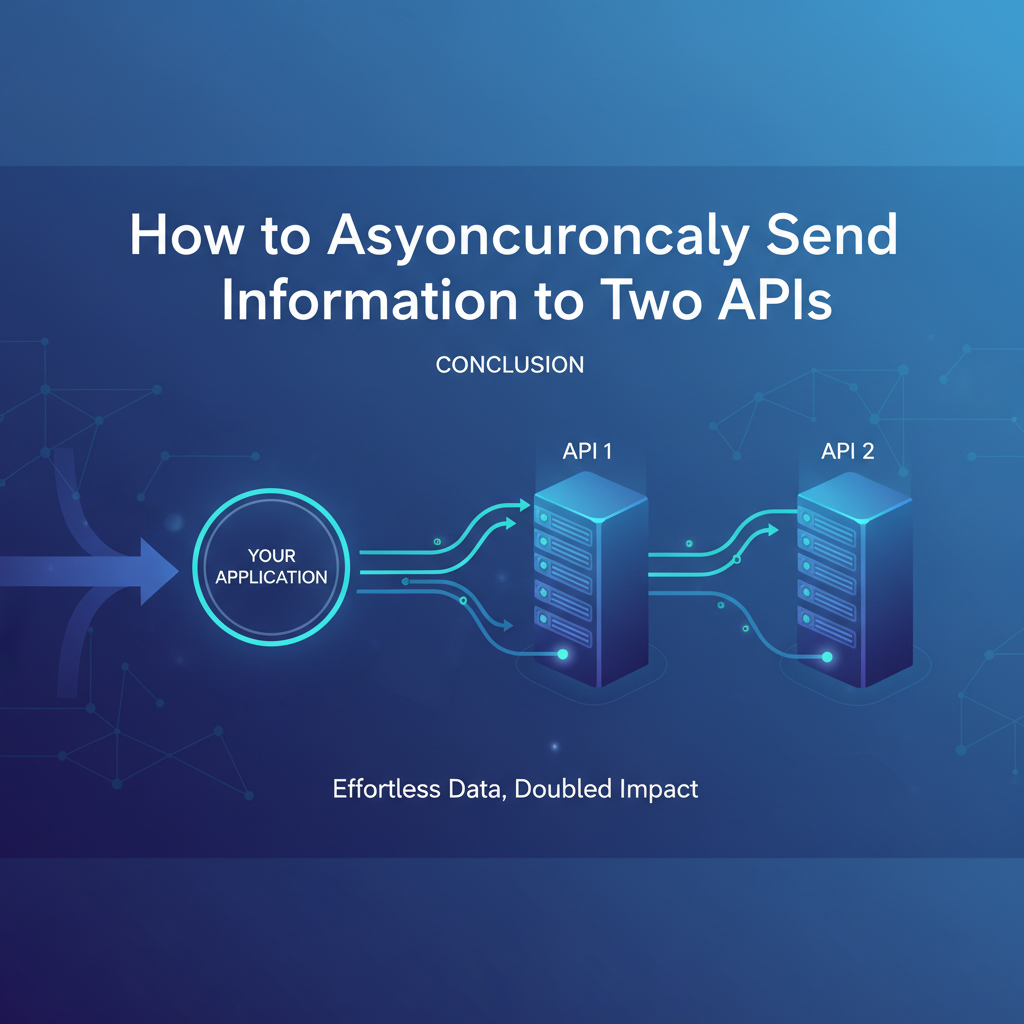
How to Asynchronously Send Information to Two APIs


In the intricate tapestry of modern software architecture, where microservices reign supreme and distributed systems are the norm, the ability to communicate efficiently and reliably between different components is paramount. Organizations are increasingly relying on external and internal Application Programming Interfaces (APIs) to power their applications, integrate with partners, and leverage specialized services. However, simply making an API call is often not enough; the manner in which these calls are executed dramatically impacts application performance, user experience, and overall system resilience. When the requirement arises to send information to not just one, but two or more distinct APIs, the complexities multiply, making synchronous, blocking operations a significant bottleneck. This is where the power of asynchronous communication truly shines, transforming potential performance traps into pathways for highly responsive and scalable systems.
Imagine a scenario where a user action triggers several backend processes – perhaps updating a customer record in one system, simultaneously notifying a marketing platform, and logging the event for analytics. If these operations are performed sequentially, the user might experience frustrating delays, waiting for the slowest API in the chain to respond before their request is acknowledged. In high-traffic environments, such blocking behavior can quickly exhaust server resources, leading to cascading failures. This article will meticulously explore the methodologies, architectural patterns, and best practices for asynchronously sending information to two or more APIs, ensuring efficiency, robustness, and superior performance. We will delve into various strategies, from client-side parallelization to sophisticated message queue systems and intelligent API gateway orchestrations, ultimately providing a comprehensive guide for developers navigating this critical aspect of distributed system design. Understanding these techniques is not merely an optimization; it is a fundamental shift towards building inherently more resilient and performant applications in a connected world.
Understanding Synchronous vs. Asynchronous API Calls
Before we dive into the specifics of interacting with multiple APIs, it's crucial to establish a clear understanding of the fundamental differences between synchronous and asynchronous communication paradigms. This distinction forms the bedrock of designing efficient and responsive systems.
The Nature of Synchronous API Calls
A synchronous API call is akin to a phone conversation where one party must wait for the other to finish speaking before they can respond. In technical terms, when your application makes a synchronous API request, it sends the request and then effectively pauses its current execution thread. It blocks and waits for the API server to process the request and send back a response. Only after receiving that response (or a timeout/error) does the application's thread resume its operations.
Flow of a Synchronous Call:
- Request Initiation: Your application sends an HTTP request to the target
API. - Blocking State: The requesting thread enters a blocking state, ceasing any further work.
- Server Processing: The
APIserver receives, processes the request, and generates a response. - Response Reception: Your application receives the
APIserver's response. - Thread Resumption: The blocking thread unblocks and continues its execution, processing the received data.
Drawbacks of Synchronous Communication:
- Latency Impact: The total time taken for an operation is directly proportional to the sum of the latencies of all
APIcalls made. If oneAPIis slow, the entire process slows down. - Resource Wastage: While a thread is blocked, it is still consuming system resources (memory, CPU cycles for context switching) but is not performing any useful work. In multi-threaded environments, this can lead to thread pool exhaustion, preventing other requests from being processed.
- Poor User Experience: For user-facing applications, synchronous operations often result in unresponsive user interfaces, frozen screens, or long loading spinners, frustrating users and degrading their experience.
- Reduced Scalability: A system relying heavily on synchronous calls will struggle to scale horizontally. Each incoming request might consume a dedicated thread for an extended period, limiting the number of concurrent requests the system can handle.
- Cascading Failures: If a downstream synchronous
APIfails or becomes unresponsive, it can cause the calling application to time out or crash, potentially triggering a chain reaction across interconnected services.
Illustrative Example (Python):
import requests
import time

def call_api_synchronously(url):
    print(f"[{time.time():.2f}] Calling API: {url}")
    response = requests.get(url)
    print(f"[{time.time():.2f}] Received response from {url} (Status: {response.status_code})")
    return response.json()

# Simulate two slow APIs
api1_url = "https://httpbin.org/delay/3" # Delays for 3 seconds
api2_url = "https://httpbin.org/delay/2" # Delays for 2 seconds

print("Starting synchronous API calls...")
start_time = time.time()

# First API call
data1 = call_api_synchronously(api1_url)
print(f"Data from API 1: {data1.get('url')}")

# Second API call (waits for the first to complete)
data2 = call_api_synchronously(api2_url)
print(f"Data from API 2: {data2.get('url')}")

end_time = time.time()
print(f"Synchronous calls finished in {end_time - start_time:.2f} seconds.")
# Expected output: ~5 seconds (3s + 2s)
In this example, the second API call to httpbin.org/delay/2 will not even start until the response from httpbin.org/delay/3 has been fully received. This sequential execution clearly demonstrates the blocking nature and the cumulative latency.
The Promise of Asynchronous API Calls
Asynchronous API calls, by contrast, are like sending a letter and continuing with other tasks while you wait for a reply. When your application initiates an asynchronous API request, it dispatches the request and then immediately frees up its execution thread to perform other work. It doesn't wait for the API server to respond. Instead, it typically registers a callback function or uses constructs like Promises or Futures that will be executed once the API response eventually arrives.
Flow of an Asynchronous Call:
- Request Initiation: Your application sends an HTTP request to the target
API. - Non-Blocking State: The requesting thread immediately returns to its pool or continues with other operations. It does not wait.
- Server Processing: The
APIserver receives, processes the request, and generates a response. - Event/Callback Trigger: When the
APIserver's response arrives, an event is triggered, or a registered callback function is invoked. - Result Handling: The callback function or event handler processes the received data, typically on a separate thread or event loop iteration.
Benefits of Asynchronous Communication:
- Enhanced Responsiveness: Applications remain responsive, as the main thread is not blocked. This translates to smoother user interfaces and faster acknowledgment for backend processes.
- Improved Resource Utilization: Threads are not idly waiting; they are actively performing other tasks, leading to more efficient use of CPU and memory. This allows a single server to handle significantly more concurrent connections.
- Greater Scalability: By making better use of resources, systems can handle a higher volume of concurrent requests with the same hardware, delaying the need for costly horizontal scaling.
- Fault Tolerance: Asynchronous operations often incorporate mechanisms like queues and retries, which inherently make the system more resilient to transient failures in downstream APIs. A temporary outage in one
APIwon't necessarily bring down the entire system. - Parallel Execution: Multiple
APIcalls can be initiated almost simultaneously, with results processed as they arrive, significantly reducing the total execution time for composite operations.
Illustrative Example (Python with asyncio):
import asyncio
import aiohttp
import time

async def call_api_asynchronously(session, url):
    print(f"[{time.time():.2f}] Calling API asynchronously: {url}")
    async with session.get(url) as response:
        data = await response.json()
        print(f"[{time.time():.2f}] Received response from {url} (Status: {response.status})")
        return data

async def main():
    print("Starting asynchronous API calls...")
    start_time = time.time()

    async with aiohttp.ClientSession() as session:
        # Create tasks for both API calls
        task1 = asyncio.create_task(call_api_asynchronously(session, "https://httpbin.org/delay/3"))
        task2 = asyncio.create_task(call_api_asynchronously(session, "https://httpbin.org/delay/2"))

        # Await both tasks concurrently
        data1, data2 = await asyncio.gather(task1, task2)

        print(f"Data from API 1: {data1.get('url')}")
        print(f"Data from API 2: {data2.get('url')}")

    end_time = time.time()
    print(f"Asynchronous calls finished in {end_time - start_time:.2f} seconds.")
    # Expected output: ~3 seconds (max of 3s and 2s)

if __name__ == "__main__":
    asyncio.run(main())
In this asynchronous example, task1 and task2 are initiated almost simultaneously. The asyncio.gather function waits for both tasks to complete, but crucially, it does not wait for task1 to finish before starting task2. Instead, it manages both operations concurrently within the event loop. The total time taken is approximately the duration of the longest running API call (3 seconds), rather than the sum, demonstrating the immense efficiency gain.
This foundational understanding is vital as we move into strategies for orchestrating multiple API interactions. The goal is almost always to move from the sequential, blocking nature of synchronous calls to the concurrent, non-blocking efficiency of asynchronous operations, especially when dealing with diverse external services.
Why Asynchronous Communication is Crucial for Multiple APIs
When an application needs to interact with two or more distinct API endpoints, the advantages of asynchronous communication are amplified, often shifting from mere optimization to a necessity for system viability. The sheer number of potential delays, points of failure, and resource contention can cripple a system built on synchronous principles. Asynchronous patterns address these challenges directly, providing a robust framework for handling multi-API interactions.
Performance Enhancement through Parallel Processing
The most immediate and obvious benefit of asynchronous communication when dealing with multiple APIs is the drastic improvement in performance. Instead of sequentially calling API A, waiting for its response, and then calling API B, asynchronous techniques allow these calls to be initiated in parallel. This means that the total execution time for fetching data or sending updates to multiple services is bottlenecked by the slowest API call, rather than the sum of all their latencies.
Consider a scenario where an e-commerce platform processes an order. This single event might necessitate: 1. Updating the inventory via the Inventory Management API (300ms). 2. Charging the customer via the Payment Gateway API (500ms). 3. Sending an order confirmation via the Notification API (200ms). 4. Logging the transaction for analytics via the Analytics API (100ms).
If these calls are made synchronously, the total time would be approximately 300 + 500 + 200 + 100 = 1100ms (1.1 seconds). For a user, this is a noticeable delay. If performed asynchronously and in parallel, the total time could be closer to 500ms (the duration of the slowest Payment Gateway API call), provided the application can efficiently manage these concurrent operations. This parallelism is a game-changer for applications with tight latency requirements or high throughput demands.
Resilience and Fault Tolerance
Distributed systems are inherently prone to failures. An API might experience a temporary outage, suffer from network latency, or return an error due to various reasons. In a synchronous chain of multiple API calls, the failure of any single API can bring the entire operation to a halt and potentially trigger cascading failures across dependent services.
Asynchronous patterns, especially those involving message queues or event-driven architectures, introduce a crucial layer of decoupling. If API B is temporarily unavailable, the message intended for it can remain in a queue, to be processed once API B recovers, without blocking the processing of messages for API A. This allows the system to:
- Isolate Failures: A problem with one
APIdoesn't necessarily impact others. - Implement Retries: Messages can be automatically retried with exponential backoff, making the system more robust against transient issues.
- Degrade Gracefully: If a non-critical
APIfails, the core functionality can still proceed, perhaps with a warning or a reduced feature set. For instance, if theAnalytics APIfails during an order process, the order can still be placed and processed, with the analytics logging retried later. - Utilize Circuit Breakers: Advanced patterns can detect persistent failures in an
APIand "trip the circuit," preventing further requests from being sent to the failing service and allowing it time to recover, rather than continuously hitting it with requests.
Scalability: Handling Increased Load Without Bottlenecks
As user bases grow and transaction volumes increase, applications must scale to meet demand. Synchronous interactions with multiple APIs pose a significant scalability challenge. Each API call, especially when blocking, ties up valuable resources (like threads or connection pools). If API A takes 500ms and API B takes 300ms, a synchronous request ties up a thread for 800ms. If you have 1000 concurrent requests, you'd need enough threads to handle 1000 * 800ms worth of work.
Asynchronous approaches, particularly those built on non-blocking I/O and event loops (like Node.js, Python's asyncio, or Go's goroutines), allow a single thread or a small pool of threads to manage thousands, even millions, of concurrent API calls. When an API call is initiated, the thread is released to handle other work while the network request is in flight. Only when the API response arrives is the thread briefly used again to process the result. This drastically reduces the number of active threads needed, leading to:
- Higher Throughput: More requests can be processed per unit of time.
- Reduced Resource Consumption: Lower memory footprint and CPU overhead per concurrent connection.
- Cost Efficiency: Maximizing the utility of existing infrastructure before needing to provision more servers.
Improved User Experience
For user-facing applications, responsiveness is king. Asynchronously interacting with multiple APIs means users get faster feedback, even if backend processes are complex. A common pattern is to quickly acknowledge a user's request (e.g., "Your order has been placed, you'll receive a confirmation soon!") while the more time-consuming API interactions (payment processing, inventory updates) happen in the background. This creates a perception of speed and efficiency, enhancing user satisfaction.
Without asynchronous calls, a user might stare at a loading spinner for several seconds, wondering if their action registered. With asynchronous techniques, the UI can update almost instantly, displaying a success message, while the background tasks work on completing the full transaction.
Resource Optimization
Beyond just threads, asynchronous programming extends to other critical resources like network connections and database connections. Efficient asynchronous HTTP clients (e.g., aiohttp in Python, axios in JavaScript, Go's default net/http with goroutines) manage connection pools more effectively. They reuse connections, minimize overhead for establishing new connections, and handle concurrent I/O operations without blocking the entire application. This optimization is particularly important when calling multiple external APIs, where network latency and connection management can be significant factors. The overall system becomes leaner, faster, and more capable of handling diverse workloads.
In essence, when orchestrating interactions with two or more APIs, asynchronous communication shifts from a "nice-to-have" to a "must-have." It empowers developers to build systems that are not only performant and scalable but also inherently more resilient and delightful for end-users, truly leveraging the full potential of distributed architectures.
Core Principles of Asynchronous API Design
To effectively implement asynchronous communication with multiple APIs, it's vital to grasp the underlying principles that enable non-blocking operations. These principles are fundamental, irrespective of the specific programming language or framework being used.
Non-Blocking I/O
At the heart of asynchronous programming lies the concept of non-blocking Input/Output (I/O). Traditional, blocking I/O operations (like reading from a file, making a network request, or querying a database) cause the executing thread to pause until the I/O operation completes. Non-blocking I/O, conversely, allows the thread to initiate an I/O operation and immediately return, signaling that the operation is in progress but not yet finished.
How it works: Operating systems provide mechanisms (like select, poll, epoll on Linux, kqueue on macOS/FreeBSD, IOCP on Windows) that allow an application to monitor multiple I/O streams simultaneously. Instead of waiting for one specific stream, the application can ask the OS to notify it when any of the monitored streams are ready for reading or writing.
Event Loops: Many asynchronous programming models (e.g., Node.js, Python's asyncio) are built around an "event loop." This single-threaded loop continuously checks for events (like an API response arriving, a file read completing, or a timer expiring). When an event occurs, the loop dispatches it to the appropriate handler (e.g., a callback function) and then continues checking for the next event. This allows a single thread to manage thousands of concurrent I/O operations without blocking.
Message Queues
Message queues are a cornerstone of robust asynchronous, decoupled architectures. They act as intermediaries that store messages temporarily between sender (producer) and receiver (consumer) services. Instead of directly calling API B from Service A, Service A publishes a message to a queue, and Service B (or a worker process dedicated to API B) consumes messages from that queue.
Benefits of Message Queues:
- Decoupling: Producers and consumers don't need to know about each other's existence or availability. They only need to know about the queue.
- Buffering: Queues can absorb bursts of messages, smoothing out traffic spikes and protecting downstream services from being overwhelmed.
- Durability: Messages can be persisted on disk, ensuring that they are not lost even if a consumer fails or the message broker restarts.
- Asynchronous Communication: Producers don't wait for consumers to process messages; they just publish and continue.
- Reliability: Many queue systems offer guaranteed delivery, ensuring messages are processed at least once or exactly once.
- Load Balancing & Scalability: Multiple consumers can listen to the same queue, allowing messages to be distributed among them, thus scaling processing power.
Examples: RabbitMQ, Apache Kafka, AWS SQS, Google Cloud Pub/Sub, Azure Service Bus. These systems are invaluable when orchestrating complex workflows involving multiple, independent API interactions where reliability and decoupling are critical.
Callbacks & Promises/Futures
When an asynchronous operation completes, how does your application know, and how does it get the result?
- Callbacks: The most traditional approach. You pass a function (the "callback") to the asynchronous operation. When the operation finishes, it invokes this callback function, often passing the result or any error as arguments. While effective, deeply nested callbacks can lead to "callback hell" or "pyramid of doom," making code hard to read and maintain.
- Promises (JavaScript) / Futures (Python, Java): These are objects that represent the eventual result of an asynchronous operation. A Promise/Future starts in a "pending" state. It will eventually "resolve" (with a value) or "reject" (with an error). You can attach handlers (e.g.,
.then()for success,.catch()for error) to a Promise/Future to process its outcome when it eventually settles. This provides a much cleaner, more sequential-looking way to compose asynchronous operations and handle errors, mitigating callback hell. Modern languages often haveasync/awaitsyntax sugar on top of Promises/Futures, allowing asynchronous code to be written almost like synchronous code, improving readability dramatically.
Event-Driven Architecture
An event-driven architecture (EDA) is a software design pattern where decoupled services communicate by producing and consuming events. An "event" is a significant occurrence or state change in a system (e.g., "Order Placed," "User Profile Updated"). Instead of direct API calls, services publish events to an event bus or message broker. Other services that are interested in these events subscribe to them and react accordingly.
How it relates to multiple APIs: If updating a user profile needs to trigger updates in an Analytics API and a CRM API, instead of the profile service directly calling both APIs, it can publish a "UserUpdated" event. The Analytics Service and CRM Service (or specific workers) would subscribe to this event and then, in turn, make their respective asynchronous calls to the Analytics API and CRM API.
Benefits: High degree of decoupling, enhanced scalability, flexibility, and real-time responsiveness. It allows services to evolve independently and react to changes across the system.
Idempotency
When dealing with asynchronous operations, especially those involving retries or eventual consistency, idempotency becomes critically important. An operation is idempotent if executing it multiple times produces the same result as executing it once.
Why it's crucial: In an asynchronous system, messages can sometimes be delivered multiple times (e.g., due to network retries, consumer restarts, or "at-least-once" delivery guarantees of message queues). If sending data to an API isn't idempotent, multiple deliveries could lead to duplicate data, incorrect updates, or unexpected side effects.
Example: * Non-idempotent: A POST /items API that creates a new item every time it's called. If a retry occurs, you'll get duplicate items. * Idempotent: A PUT /items/{id} API that updates an item with a specific ID. Calling it multiple times with the same data for the same ID will result in the same state. For POST requests that need idempotency, clients often send a unique "idempotency key" in the request header. The API uses this key to detect and ignore duplicate requests within a certain time window.
Ensuring that your API calls (especially POST and PATCH) are idempotent or that your system can handle non-idempotent operations safely (e.g., by ensuring unique message IDs at the consumer level) is a vital best practice for building robust asynchronous systems.
By understanding and applying these core principles – non-blocking I/O, strategic use of message queues, effective management of asynchronous results with Promises/Futures/Callbacks, embracing event-driven thinking, and prioritizing idempotency – developers can construct highly efficient, resilient, and scalable systems capable of seamlessly interacting with multiple APIs.
Architectural Patterns for Asynchronously Sending Information to Two APIs
When the need arises to send information to two distinct APIs asynchronously, several architectural patterns can be employed, each with its own trade-offs regarding complexity, control, and scalability. The choice of pattern often depends on the specific requirements of the application, the nature of the APIs being called, and the existing infrastructure.
A. Client-Side Asynchronicity
This is perhaps the simplest approach, where the client application itself is responsible for initiating multiple asynchronous requests directly to the target APIs. Modern programming languages and web browsers provide built-in capabilities to execute network requests concurrently.
Description: The client application, upon receiving input or triggering an event, makes two (or more) independent asynchronous API calls to the respective endpoints. It doesn't wait for the first call to complete before initiating the second. The client then typically waits for both responses to arrive before proceeding with any action that depends on aggregated data, or it handles each response independently as it arrives.
Pros: * Simplicity: For straightforward scenarios, it's easy to implement with minimal additional infrastructure. * Direct Control: The client has direct control over each API call. * Low Latency (for client-side aggregation): If the client needs the aggregated result, parallel calls reduce the total waiting time to the duration of the slowest API.
Cons: * Client Responsibility: The client is responsible for managing multiple API calls, handling errors from each, and potentially aggregating their results. This can complicate client-side logic. * Limited for Complex Scenarios: Not suitable for server-to-server communication where a robust backend orchestration is needed. * Exposure of Multiple Endpoints: The client needs direct access to potentially diverse API endpoints, which might have different authentication, rate limiting, and security requirements. * Network Overhead: The client makes two separate HTTP handshakes, which can be inefficient for mobile or high-latency networks. * Lack of Server-Side Resilience: If the client crashes or loses connection, any pending API calls are lost; there's no inherent retry mechanism from the server side.
Example (JavaScript with async/await and fetch):
async function sendInfoToTwoAPIsClientSide(dataToSend) {
    const api1Url = 'https://api.example.com/endpoint1';
    const api2Url = 'https://api.example.com/endpoint2';

    try {
        const [response1, response2] = await Promise.all([
            fetch(api1Url, {
                method: 'POST',
                headers: { 'Content-Type': 'application/json' },
                body: JSON.stringify(dataToSend.forApi1)
            }),
            fetch(api2Url, {
                method: 'POST',
                headers: { 'Content-Type': 'application/json' },
                body: JSON.stringify(dataToSend.forApi2)
            })
        ]);

        if (!response1.ok || !response2.ok) {
            throw new Error(`API call failed: ${response1.status} ${response1.statusText}, ${response2.status} ${response2.statusText}`);
        }

        const result1 = await response1.json();
        const result2 = await response2.json();

        console.log('Successfully sent data to both APIs.');
        console.log('API 1 Result:', result1);
        console.log('API 2 Result:', result2);
        return { api1: result1, api2: result2 };

    } catch (error) {
        console.error('Error sending data to APIs:', error);
        // Implement specific client-side error handling or notification
        throw error;
    }
}

// Example usage
// sendInfoToTwoAPIsClientSide({ forApi1: { key: 'value1' }, forApi2: { key: 'value2' } });
This pattern is best suited for scenarios where the client is a web browser or a mobile app and the logic for handling multiple API responses is relatively simple and can be managed client-side without critical server-side guarantees.
B. Message Queue Based Approach
The message queue approach introduces an intermediary layer that decouples the sender of information from the consumers that interact with the target APIs. This pattern significantly enhances reliability, scalability, and fault tolerance.
Description: Instead of directly calling API A and API B, the client (or an initial service) publishes a single message to a message queue. This message contains the necessary information to be processed by downstream services. Dedicated worker processes (consumers) continuously monitor the queue. When a message arrives, a consumer picks it up and then independently initiates the API call(s) required. If two APIs need information, you might have one consumer responsible for API A and another for API B, both listening to the same queue (or different queues if the information needs selective processing).
Pros: * Decoupling: The client/producer doesn't need to know if API A or API B are up, or how many workers are processing requests. It simply publishes a message and moves on. * Reliability: Messages are persisted in the queue. If a downstream API is temporarily unavailable or a worker crashes, the message remains in the queue and can be retried later by the same or another worker. Dead-letter queues (DLQs) can handle messages that consistently fail. * Scalability: Multiple workers can consume from the same queue in parallel, allowing for horizontal scaling of processing power to handle increased load. * Load Balancing: Message queues inherently distribute messages among available consumers, ensuring even load distribution. * Asynchronous Nature: The client gets an immediate acknowledgment that the message has been queued, without waiting for the API calls to complete. The actual API calls happen in the background.
Cons: * Increased Infrastructure Complexity: Requires setting up and maintaining a message broker (e.g., RabbitMQ, Kafka, AWS SQS). * Eventual Consistency: There might be a delay between the message being queued and the API calls actually completing. The system state is eventually consistent, not immediately. * Debugging Complexity: Tracing the flow of a request through a queue and multiple workers can be more challenging than direct API calls.
Detailed Workflow:
- Producer: A service (or a lightweight
APIendpoint) receives the initial request. Instead of callingAPI AandAPI Bdirectly, it constructs a message with all relevant data and publishes it to a designated message queue. It then returns an immediate acknowledgment to the client. - Message Queue: The message broker stores the message reliably.
- Consumer 1 (for API A): A worker service or a dedicated function continuously polls or subscribes to the queue. When it receives a message, it extracts the data relevant for
API A, makes an asynchronous call toAPI A, handles its response/errors, and then acknowledges the message to the queue. - Consumer 2 (for API B): Another worker service, possibly separate or part of the same application but with different logic, also consumes from the same queue. It extracts data for
API B, makes an asynchronous call toAPI B, handles its response/errors, and acknowledges the message.
Example Technologies: * RabbitMQ: A general-purpose message broker, great for task queues, often used with Python (Celery), Node.js, Java. * Apache Kafka: A distributed streaming platform, excellent for high-throughput, fault-tolerant real-time data feeds and event-driven architectures. * AWS SQS/SNS: Managed queue (SQS) and pub/sub (SNS) services, simple to integrate with other AWS services.
This pattern is highly recommended for critical background processing, long-running tasks, and scenarios requiring maximum resilience and scalability when interacting with multiple independent API endpoints.
C. API Gateway / Orchestration Layer
An API gateway acts as a single entry point for all client requests, effectively becoming a facade for multiple backend APIs. In the context of asynchronously sending information to two APIs, the API gateway can play an active role in orchestrating these calls.
Description: Instead of the client calling multiple backend API endpoints directly, it makes a single request to the API gateway. The API gateway then intelligently routes, transforms, and orchestrates the calls to the various backend services. For asynchronous processing to multiple APIs, the gateway can either: 1. Initiate Parallel Async Calls: Receive a request, internally fan out parallel asynchronous requests to API A and API B, aggregate their responses (if needed), and then return a single response to the client. 2. Publish to a Queue: Receive a request, publish a message to an internal message queue (similar to the previous pattern), and immediately return an acknowledgment to the client, letting backend workers handle the actual API calls. This offers ultimate decoupling. 3. Hybrid Approach: The gateway might call one critical API synchronously for immediate response and publish to a queue for other non-critical ones.
Pros: * Centralized Logic: API gateways centralize concerns like authentication, authorization, rate limiting, logging, request/response transformation, and caching. * Abstraction: Clients only interact with the gateway, shielding them from the complexity and diversity of backend services. This allows backend services to evolve independently without client-side changes. * Enhanced Security: The gateway can enforce security policies before requests reach backend services, acting as a critical perimeter defense. * Orchestration Capabilities: Modern API gateways can perform complex request transformations, execute multiple backend calls in parallel, and compose responses, making them powerful orchestration tools. * Single Point of Entry: Simplifies client development and network configuration. * Improved Observability: Centralized logging and monitoring of all API traffic.
Cons: * Single Point of Failure (if not properly scaled): A misconfigured or unscalable gateway can become a bottleneck or a critical failure point. * Added Latency: The gateway introduces an additional hop in the request path, potentially adding a small amount of latency. * Increased Complexity: Implementing and managing a full-fledged API gateway can be complex.
Keywords: This pattern is the definitive place for the api gateway keyword. It also involves multiple api interactions.
APIPark Integration: This is a natural and highly relevant place to mention APIPark. An API gateway like APIPark can greatly simplify this orchestration. APIPark, an open-source AI gateway and API management platform, provides robust features that are directly applicable to asynchronously sending information to multiple APIs, especially in a microservices environment. For instance, if one of your target APIs is an AI service (e.g., for sentiment analysis, image recognition, or translation), APIPark offers quick integration of over 100+ AI models and provides a unified API format for AI invocation. This means that instead of directly managing the intricacies of interacting with different AI model APIs, you can route all AI-related calls through APIPark, which standardizes the request format and even allows you to encapsulate custom prompts into new REST APIs.
When you need to send data to two APIs, one of which might be an AI service, APIPark can act as the central orchestrator. Your client sends a single request to APIPark, and then APIPark can: 1. Fan-out Asynchronously: Internally, APIPark can trigger parallel asynchronous calls to your traditional REST API and its integrated AI API (which might be an OpenAPI-compliant service managed within APIPark). 2. Manage Lifecycle: APIPark assists with managing the entire lifecycle of these APIs, including design, publication, invocation, and decommissioning. This means the rules for how your data is transformed, authenticated, and routed to both target APIs can be centrally defined and managed within APIPark. 3. Security & Access Control: It can handle authentication, authorization, and even requires approval for API resource access, ensuring that only authorized requests reach your backend services. This is critical when sending sensitive information. 4. Logging & Analytics: APIPark provides detailed API call logging and powerful data analysis, allowing you to monitor the performance and success rates of your asynchronous calls to both APIs from a single dashboard.
By leveraging a platform like APIPark, the complexity of managing multiple API interactions, securing them, and making them asynchronous becomes significantly more manageable, especially when dealing with diverse types of services including AI models.
Example Technologies: * Nginx/Kong: Often used as reverse proxies with plugins for API gateway functionalities. * AWS API Gateway/Azure API Management/Google Cloud API Gateway: Cloud-native managed API gateway services. * APIPark: An open-source AI gateway and API management platform focusing on ease of integration and comprehensive API lifecycle governance.
D. Event-Driven Microservices
This pattern represents a highly decoupled and distributed approach, often building upon message queues or event buses. It's suitable for complex systems with many independent services.
Description: Instead of a single service orchestrating calls to API A and API B, an initial service publishes an "event" to a central event bus (e.g., a Kafka topic). This event signifies a state change or an action that has occurred (e.g., "User profile updated," "Order created"). Multiple other microservices, including those responsible for interacting with API A and API B, are subscribed to relevant event types. When an event arrives on the bus, each subscribing service independently processes it. One service might react by calling API A, and another by calling API B, both asynchronously and in parallel with respect to the initial event.
Pros: * Extreme Decoupling: Services have minimal direct dependencies on each other, only needing to know about the event contract. This allows for independent development, deployment, and scaling. * Scalability & Resilience: Highly scalable as consumers can be scaled independently. The event bus acts as a buffer, making the system resilient to individual service failures. * Flexibility & Extensibility: Easy to add new services that react to existing events without modifying existing services. * Real-time Responsiveness: Events are processed as they occur, enabling real-time reactions across the system.
Cons: * Complexity: Building and managing an event-driven architecture, including event schemas, event buses, and tracing, can be significantly more complex than direct API calls. * Eventual Consistency: System state can be eventually consistent, making it harder to reason about immediate data consistency. * Distributed Debugging: Tracing a workflow across multiple services via events can be challenging. * Transaction Management: Implementing distributed transactions or compensating actions across multiple services reacting to events requires careful design.
Example Technologies: * Apache Kafka: Widely used as a highly scalable event streaming platform. * Cloud Pub/Sub Services: AWS SNS/SQS, Google Cloud Pub/Sub, Azure Event Hubs/Service Bus.
This pattern is ideal for large, complex enterprise systems where services need to react autonomously to business events and where maximum decoupling and scalability are paramount.
Comparison of Asynchronous Patterns
To provide a clear overview, here's a table comparing the different architectural patterns for asynchronously sending information to two APIs:
| Feature | Client-Side Asynchronicity | Message Queue Based Approach | API Gateway / Orchestration | Event-Driven Microservices |
|---|---|---|---|---|
| Complexity | Low | Medium | Medium-High | High |
| Decoupling | Low | High | Medium (client-backend) | Very High (service-service) |
| Reliability | Low | Very High (with retries/DLQ) | Medium (gateway resilience) | Very High (event persistence) |
| Scalability | Limited (client-bound) | Very High (worker scaling) | High (gateway scaling) | Very High (service/topic scaling) |
| Fault Tolerance | Low | Very High | Medium | Very High |
| Latency (to client) | Low (direct/parallel) | Very Low (immediate ACK) | Low-Medium (extra hop) | Very Low (immediate ACK) |
| Use Cases | Simple UI updates, parallel data fetches | Critical background tasks, reliable processing | Centralized API management, complex orchestration, security | Large-scale systems, real-time reactions, business events |
| Infrastructure Overhead | Minimal | Message broker, workers | API Gateway product/setup | Event bus, multiple services |
| Idempotency Importance | Medium | High | Medium | High |
Choosing the right pattern requires a thoughtful evaluation of your project's specific needs, existing infrastructure, team expertise, and future growth expectations. Often, a hybrid approach combining elements from these patterns provides the most balanced solution.
APIPark is a high-performance AI gateway that allows you to securely access the most comprehensive LLM APIs globally on the APIPark platform, including OpenAI, Anthropic, Mistral, Llama2, Google Gemini, and more.Try APIPark now! 👇👇👇
Deep Dive into Implementation Details & Best Practices
Regardless of the architectural pattern chosen, successfully implementing asynchronous API communication, especially with multiple endpoints, hinges on a set of critical implementation details and adherence to best practices. These elements are crucial for building systems that are not just fast, but also reliable, secure, and maintainable.
Error Handling and Retries
Failures are an inevitable part of distributed systems. Robust error handling and intelligent retry mechanisms are paramount for asynchronous interactions.
- Idempotency (Revisited): As discussed, ensuring
APIendpoints are idempotent is the first line of defense. If an operation can be safely retried multiple times without adverse side effects, it vastly simplifies error recovery. Implementidempotency keysforPOSTrequests to prevent duplicate processing during retries. - Exponential Backoff: When retrying failed
APIcalls, don't just retry immediately. Use an exponential backoff strategy, where the delay between retries increases exponentially (e.g., 1s, 2s, 4s, 8s). This prevents overwhelming a temporarily overloadedAPIand gives it time to recover. Add a random jitter to the backoff to prevent thundering herd problems. - Dead-Letter Queues (DLQs): For message queue-based systems, messages that repeatedly fail processing after a certain number of retries should be moved to a Dead-Letter Queue. This prevents poison-pill messages from endlessly clogging the main queue and provides a holding area for manual inspection and debugging without affecting ongoing operations.
- Circuit Breakers: Implement circuit breaker patterns (e.g., using libraries like Hystrix or Resilience4j). A circuit breaker monitors calls to an external service. If a certain threshold of failures is reached within a time window, the circuit "opens," and subsequent calls to that service are immediately failed (or rerouted to a fallback) without attempting the actual
APIcall. This prevents your service from continuously hammering a failing downstreamAPI, giving it time to recover and protecting your service from cascading failures. After a cool-down period, the circuit moves to a "half-open" state, allowing a few test requests to see if the downstreamAPIhas recovered. - Timeouts: Always configure sensible timeouts for
APIcalls. AnAPIcall that never responds is worse than one that responds with an error, as it can indefinitely tie up resources. Short timeouts for connection establishment and longer timeouts for read operations are often a good strategy.
Monitoring and Observability
In complex asynchronous systems involving multiple APIs, understanding what's happening at any given moment is challenging without proper observability.
- Logging: Implement comprehensive logging for every
APIcall, including request payloads, response payloads (sanitized for sensitive data), status codes, timestamps, and durations. Log errors with detailed stack traces. Centralized logging systems (e.g., ELK Stack, Splunk, Datadog) are essential for aggregating logs from distributed services. APIPark provides detailedAPIcall logging, recording every detail of eachAPIcall, which allows businesses to quickly trace and troubleshoot issues inAPIcalls, ensuring system stability and data security. This is invaluable when orchestrating multiple calls. - Metrics: Collect and expose metrics for
APIinteractions:- Latency: Average, p95, p99 latency for each
APIcall. - Error Rates: Number or percentage of failed
APIcalls. - Throughput: Number of requests per second.
- Connection Pool Usage: Monitor the utilization of HTTP connection pools.
- Queue Depths: For message queues, monitor the number of messages waiting in queues.
- These metrics allow you to identify performance bottlenecks and issues proactively.
- Latency: Average, p95, p99 latency for each
- Tracing: Implement distributed tracing (e.g., OpenTelemetry, Jaeger, Zipkin). Tracing assigns a unique ID to an incoming request and propagates it across all services and
APIcalls it touches. This allows you to visualize the entire flow of a request, identify which service orAPIcall is causing latency, and pinpoint the exact point of failure in a distributed asynchronous workflow. - Alerting: Set up alerts based on critical metrics (e.g., high error rates, increased latency, full message queues) to notify operations teams immediately when issues arise, enabling rapid response and incident resolution.
- Powerful Data Analysis: Platforms like APIPark go beyond just logging by analyzing historical call data to display long-term trends and performance changes. This predictive capability helps businesses with preventive maintenance before issues impact users, offering crucial insights into the health and efficiency of multi-
APIasynchronous operations.
Security
Interacting with multiple APIs, especially external ones, introduces multiple security vectors. A strong security posture is non-negotiable.
- Authentication and Authorization: Ensure every
APIcall (both to your internal services and external ones) is properly authenticated (e.g., API keys, OAuth2 tokens, JWTs) and authorized. Never hardcode credentials. Use secure secrets management. - Rate Limiting: Protect your own APIs from abuse and prevent your services from overwhelming downstream external APIs by implementing client-side and server-side rate limiting.
API gatewayslike APIPark can centralize rate limiting policies. - Input Validation: Rigorously validate all input data before sending it to any
API. This prevents common vulnerabilities like injection attacks and ensures data integrity. - Data Encryption: Use HTTPS for all
APIcommunication to encrypt data in transit. Consider encryption for sensitive data at rest. - Least Privilege: Configure
APIcredentials and service accounts with the minimum necessary permissions. - API Resource Access Approval: Features like
APIPark's subscription approval system ensure that callers must subscribe to anAPIand await administrator approval before they can invoke it. This prevents unauthorizedAPIcalls and potential data breaches, adding an essential layer of control when orchestrating sensitive multi-APIworkflows.
Scalability Considerations
Asynchronous patterns inherently promote scalability, but specific attention is still required.
- Horizontal Scaling: Design your message consumers,
API gateways, and any orchestration services to be stateless (or near-stateless) so they can be horizontally scaled by adding more instances as load increases. Containerization (Docker, Kubernetes) greatly facilitates this. - Message Broker Scalability: Choose a message broker that can scale to your anticipated throughput and storage needs (e.g., Kafka for high-throughput streaming, SQS for simplicity and high volume).
- Connection Pooling: Optimize HTTP client libraries for connection pooling and reuse to reduce overhead.
- Resource Limits: Implement resource limits (CPU, memory) for your services in container orchestration platforms to prevent a single service from consuming all available resources.
Choosing the Right Tools
The choice of programming language and specific libraries can significantly impact the ease and effectiveness of implementing asynchronous patterns.
- Programming Languages:
- Node.js: Built from the ground up on an event loop, making asynchronous I/O natural.
- Python (asyncio): Powerful asynchronous capabilities with
async/awaitsyntax for concurrent I/O. - Java (CompletableFuture, Project Loom):
CompletableFuturefor composing asynchronous tasks. Project Loom aims to bring lightweight virtual threads for simpler concurrency. - Go (Goroutines & Channels): Concurrency built into the language, making asynchronous operations straightforward and efficient.
- HTTP Clients: Use asynchronous HTTP client libraries specific to your language (e.g.,
aiohttpfor Python,axiosfor Node.js,OkHttporWebClientfor Java,net/httpfor Go). - Queue Clients: Use official client libraries for your chosen message broker (e.g.,
pikafor RabbitMQ,kafka-pythonorconfluent-kafka-pythonfor Kafka). - Containerization & Orchestration: Docker and Kubernetes are industry standards for deploying and managing scalable microservices.
Documentation (OpenAPI Specification)
Clear and consistent documentation for your APIs is crucial, especially when multiple services are interacting asynchronously.
- OpenAPI Specification (formerly Swagger): This is an industry-standard, language-agnostic interface description for REST APIs. Documenting each
APIclearly withOpenAPIensures that consumers (whether they are other services,API gateways, or external partners) understand:- Available endpoints and their operations (GET, POST, PUT, DELETE).
- Request parameters (path, query, header, body) and their data types.
- Response structures for various status codes (200 OK, 400 Bad Request, 500 Internal Server Error).
- Authentication methods.
- Examples for requests and responses.
Why OpenAPI is vital for asynchronous multiple API interactions: When you're building a system that asynchronously calls two APIs, the services responsible for making these calls need to know precisely how to interact with API A and API B. An OpenAPI document provides that contract. It simplifies development, reduces integration errors, and makes onboarding new developers much faster. Tools can even generate client SDKs directly from an OpenAPI spec, further streamlining the integration process. For any api that is part of your asynchronous workflow, having an OpenAPI definition is a non-negotiable best practice for clarity and maintainability.
By meticulously addressing these implementation details and adopting these best practices, you can build asynchronous systems that are not only performant and scalable but also robust, secure, and easy to operate in the long term, enabling seamless interaction with multiple APIs.
Example Scenario: User Profile Update and Notification
To consolidate our understanding, let's walk through a concrete example: a user updates their profile, which triggers updates in a central user database and simultaneously sends out a notification (e.g., an email confirmation). The key requirement is that the user's immediate profile update should not be blocked by the notification sending process, which can sometimes be slower or experience transient issues.
Scenario Details:
A user accesses a web application and updates their profile details (e.g., changes their email address, updates their preferences). This action needs to trigger two distinct downstream operations:
- Update User Database: The primary
UserProfile APIneeds to persist the updated user information in the main user data store. This is a critical, synchronous-like operation from the perspective of the profile update being confirmed. - Send Notification: A
Notification APIneeds to be invoked to send an email or SMS notification to the user, confirming the profile changes. This is a secondary, non-critical, and potentially slower operation that should not block the user's perceived completion of the profile update.
Implementation Strategy: Hybrid Approach (API Gateway + Message Queue)
We will use a hybrid approach that leverages an API Gateway for initial request handling and validation, and a Message Queue for reliable, asynchronous processing of the notification. This combines the benefits of centralized API management with robust background task execution.
Step-by-Step Workflow:
- Client (Web Browser/Mobile App):
- The user submits their updated profile data through the application's UI.
- The client makes a single
POSTorPUTrequest to a specific endpoint on theAPI Gateway, e.g.,/api/v1/user/profile. - The request payload contains the updated user data.
- API Gateway (e.g., APIPark):
- The
API Gateway(likeAPIPark) receives the client's request for/api/v1/user/profile. - Authentication & Authorization: APIPark first authenticates the user and authorizes the request based on predefined policies. It might check for valid tokens or API keys.
- Input Validation & Transformation: The gateway validates the incoming payload against a schema. It might transform the data if the internal
UserProfile APIexpects a different format than what the client sends. - Synchronous Call to UserProfile API (for immediate confirmation): The gateway makes a synchronous
APIcall to the internalUserProfile Service(e.g.,http://user-profile-service/users/{id}). This is crucial for the client to receive immediate feedback on whether the profile update itself was successful. If this call fails, the gateway can immediately return an error to the client.- Reasoning: While we aim for asynchronous, the core profile update is often seen by the user as an immediate action. Waiting for it synchronously provides faster failure feedback and ensures the core data is committed before other actions.
- Asynchronous Event Publication to Message Queue: If the
UserProfile APIcall is successful, theAPI Gatewaythen constructs an event message, e.g., "UserProfileUpdatedEvent," containing the user's ID and relevant updated details (e.g., new email, changed preferences). It publishes this message to a designated topic or queue in a message broker (e.g., "user-events" topic in Kafka or "profile-updates" queue in RabbitMQ). - Immediate Response to Client: After successfully publishing the message to the queue (and receiving a 2xx response from the
UserProfile API), theAPI Gatewayimmediately returns a200 OKor202 Acceptedresponse to the client. This confirms that the primary update was accepted and the notification process has been initiated in the background.
- The
- Message Queue (e.g., Apache Kafka / RabbitMQ):
- The message broker reliably stores the "UserProfileUpdatedEvent" message.
- Notification Service (Consumer):
- A dedicated
Notification Serviceis configured as a consumer for the "user-events" topic/queue. - Message Consumption: When the
Notification Servicereceives a "UserProfileUpdatedEvent" message, it extracts the user's ID and updated details (e.g., new email address). - Asynchronous Call to Notification API: The
Notification Servicethen makes an asynchronousAPIcall to the externalNotification API(e.g.,https://api.email-provider.com/send). This call includes the user's new email, a subject line, and the message content. - Error Handling & Retries: If the
Notification APIcall fails (e.g., network issue, email service temporarily down), theNotification Servicecan implement retries with exponential backoff. If it consistently fails, the message might be moved to a Dead-Letter Queue for further investigation. - Logging: The
Notification Servicelogs the outcome of the notification attempt, ensuring traceability.
- A dedicated
Illustrative Sequence Diagram:
sequenceDiagram
    participant C as Client (Web/Mobile)
    participant G as API Gateway (APIPark)
    participant P as UserProfile Service (Internal API)
    participant Q as Message Queue (Kafka/RabbitMQ)
    participant N as Notification Service
    participant E as External Notification API

    C->>G: 1. PUT /api/v1/user/profile (updated data)
    G->>G: 1.1 Authenticate & Authorize
    G->>P: 1.2 Synchronous Update User Profile
    P-->>G: 1.3 200 OK (Profile Updated)
    G->>Q: 1.4 Publish "UserProfileUpdatedEvent"
    G-->>C: 1.5 200 OK / 202 Accepted (User update accepted, notification processing started)

    Q->>N: 2. "UserProfileUpdatedEvent" consumed
    N->>N: 2.1 Process event data
    N->>E: 2.2 Asynchronous Send Email/SMS (via Notification API)
    E-->>N: 2.3 200 OK (Notification Sent) OR Error
    N->>N: 2.4 Handle Notification API response (log, retry, DLQ)
Benefits of this Approach:
- Responsiveness: The client receives an immediate
200 OKor202 Acceptedresponse, providing a smooth user experience. - Decoupling: The
UserProfile Serviceand the client are entirely decoupled from the complexities and potential delays of theNotification API. - Reliability: The message queue ensures that the notification event is not lost, even if the
Notification ServiceorExternal Notification APIis temporarily unavailable. Messages can be retried. - Scalability: The
Notification Servicecan be scaled independently by adding more instances to consume messages from the queue in parallel. - Centralized API Management: APIPark handles common
APImanagement concerns, security, and provides a unified entry point, simplifying client integration and backendAPIgovernance. - Auditability: Detailed logging from APIPark and the Notification Service provides a complete audit trail of the process.
This hybrid pattern effectively balances the need for immediate feedback on critical operations with the benefits of asynchronous processing for secondary, non-blocking tasks, ensuring a robust and efficient system for interacting with multiple APIs.
Advanced Topics and Future Trends
Asynchronous API communication is a continually evolving field. Beyond the foundational patterns, several advanced topics and emerging trends are shaping how distributed systems interact, offering even greater levels of real-time capability, efficiency, and architectural flexibility.
GraphQL Subscriptions
While traditional REST APIs typically follow a request-response model, GraphQL introduces a powerful query language for your APIs. GraphQL Subscriptions extend this by enabling real-time, event-driven communication. Instead of polling an API for updates, a client can subscribe to specific events or data changes. When that event occurs on the server, the server pushes the relevant data to all subscribed clients.
Relevance to multiple APIs: Imagine a scenario where a backend process (perhaps triggered by an asynchronous API call) updates a data point. Instead of just sending an API response, the server can also publish a GraphQL subscription update. This allows multiple interested clients (web apps, dashboards, other services) to receive this update in real-time, without themselves needing to initiate API calls or manage complex polling logic. This is particularly useful for dashboards, chat applications, or collaborative tools where immediate consistency across multiple clients is desired, providing an alternative to polling across several APIs to check for updates.
WebSockets
WebSockets provide a persistent, full-duplex communication channel over a single TCP connection. Unlike HTTP, which is stateless and uses short-lived connections, WebSockets maintain an open connection, allowing both the client and server to send data at any time without needing to repeatedly establish new connections.
Relevance to multiple APIs: While not directly for sending information to multiple APIs in a backend sense, WebSockets are critical for receiving information from backend processes (which might have been triggered by asynchronous calls to multiple APIs) and delivering it to clients in real-time. For instance, if an asynchronous API workflow completes a complex task, the backend service can use a WebSocket connection to notify the client instantly, bypassing the need for the client to constantly poll a "status" API. This significantly improves the user experience for long-running operations or real-time data streams.
Serverless Functions (FaaS - Functions as a Service)
Serverless computing allows you to run code (functions) in response to events without provisioning or managing servers. Cloud providers like AWS Lambda, Azure Functions, and Google Cloud Functions abstract away infrastructure concerns.
Relevance to multiple APIs: Serverless functions are inherently asynchronous and event-driven. A common pattern is to have one event trigger a serverless function, which then asynchronously calls one or more APIs. For example: * An S3 bucket event (e.g., a new file uploaded) triggers a Lambda function. * This Lambda function then calls an Image Processing API and a Metadata Storage API in parallel to process the file and store its details. * The function returns, and the API calls continue in the background if the functions are designed to be non-blocking. This model fits perfectly with the asynchronous interaction with multiple APIs, offering high scalability, cost-efficiency (pay-per-execution), and reduced operational overhead, making it a powerful tool for building event-driven API orchestrators.
Service Mesh
A service mesh is a dedicated infrastructure layer that handles service-to-service communication in a microservices architecture. It provides capabilities like traffic management, security, and observability without requiring changes to the application code. Popular service meshes include Istio, Linkerd, and Consul Connect.
Relevance to multiple APIs: For complex systems with numerous microservices, each potentially interacting with multiple internal or external APIs asynchronously, a service mesh brings immense value. It can: * Automate Retries & Circuit Breaking: The mesh can automatically apply retry policies and implement circuit breakers for all API calls between services, offloading this logic from individual applications. * Traffic Management: Facilitate advanced routing, load balancing, and canary deployments for API versions. * Centralized Observability: Provide consistent metrics, logs, and distributed traces for all service-to-service API interactions, making it easier to monitor and troubleshoot asynchronous flows across many services. * Enhanced Security: Enforce mTLS (mutual TLS) for all service-to-service communication, ensuring secure interaction even for internal API calls. While a service mesh doesn't directly implement asynchronous logic, it greatly enhances the reliability, observability, and security of the underlying API calls that form part of an asynchronous workflow.
The Role of AI in API Management
The integration of Artificial Intelligence (AI) is increasingly transforming various aspects of software development and operations, including API management. Platforms like APIPark are at the forefront of this trend.
How AI Enhances Asynchronous API Management: * Intelligent Routing and Optimization: AI algorithms can analyze API call patterns, latency, and error rates to dynamically optimize routing decisions, ensuring requests are sent to the most performant or available API instance, even across multiple providers. * Proactive Anomaly Detection: AI can monitor real-time API traffic and logs to detect unusual patterns (e.g., sudden spikes in error rates for a specific API, unusual latency for a specific user segment) that might indicate an impending issue, enabling proactive intervention before it impacts the asynchronous workflow. This goes beyond simple thresholds to find complex, hidden correlations. * Automated Response Transformation: AI-powered API gateways could potentially learn and automatically transform API responses or requests to ensure compatibility between disparate systems, reducing the need for manual configuration for each api integration. * Prompt Encapsulation for AI Models: As highlighted by APIPark's capabilities, the ability to quickly combine AI models with custom prompts to create new APIs (e.g., sentiment analysis, translation) is a direct application of AI to API design. When you need to asynchronously interact with an AI model, such an API abstraction simplifies the invocation, allowing the orchestrating service to treat the AI model like any other REST API, with APIPark handling the underlying AI model integration and standardization. This makes incorporating advanced AI capabilities into asynchronous multi-API workflows far more accessible and manageable. * Predictive Maintenance: As mentioned with APIPark's data analysis, AI can analyze historical call data to predict future trends and potential performance degradation, helping businesses perform preventive maintenance on their API infrastructure before issues manifest.
The convergence of asynchronous patterns with advanced technologies like GraphQL, WebSockets, Serverless, Service Mesh, and AI represents the next frontier in building highly performant, resilient, and intelligent distributed systems that can seamlessly interact with a multitude of APIs. Understanding these trends will enable developers to design future-proof architectures capable of meeting the ever-growing demands of the digital landscape.
Conclusion
The journey through the landscape of asynchronously sending information to two or more APIs reveals a fundamental truth about modern software development: efficiency, resilience, and scalability are not merely desirable traits, but essential pillars upon which robust distributed systems are built. The limitations of synchronous, blocking API calls become painfully apparent when orchestrating interactions across multiple services, leading to sluggish performance, resource exhaustion, and a brittle system susceptible to cascading failures. By embracing asynchronous communication paradigms, developers unlock a powerful toolkit for overcoming these challenges.
We've explored the stark contrast between synchronous and asynchronous operations, highlighting how the latter frees up precious computational resources, improves responsiveness, and lays the groundwork for inherently more resilient architectures. The necessity of asynchronous design amplifies when dealing with multiple API endpoints, transforming cumulative latencies into parallel efficiencies and isolated failures into graceful degradations.
Our deep dive into architectural patterns provided a spectrum of solutions: * Client-Side Asynchronicity offers simplicity for straightforward parallel fetches. * The Message Queue Based Approach provides robust decoupling, reliability, and scalability for critical background tasks. * The API Gateway / Orchestration Layer, exemplified by platforms like APIPark, acts as an intelligent intermediary, centralizing management, security, and orchestration of diverse API calls, including specialized AI services. * Event-Driven Microservices represent the pinnacle of decoupling, enabling highly scalable and flexible systems that react autonomously to business events.
Beyond the patterns, we emphasized crucial implementation details and best practices: from comprehensive error handling, intelligent retries with exponential backoff and circuit breakers, to meticulous monitoring, logging, and distributed tracing. The importance of security, scalability considerations, and leveraging the right tools cannot be overstated. Moreover, the OpenAPI specification emerges as a critical enabler, providing the unambiguous contract necessary for successful API integrations in complex asynchronous workflows.
The example scenario of a user profile update underscored how a hybrid strategy, combining the immediate feedback of a primary API call with the background reliability of a message queue orchestrated by an API gateway, can deliver both exceptional user experience and robust backend processing. Finally, looking ahead, advanced topics like GraphQL Subscriptions, WebSockets, Serverless Functions, Service Mesh, and the transformative role of AI in API management (as seen with APIPark's capabilities) paint a picture of an exciting future where API interactions become even more intelligent, seamless, and integrated.
In conclusion, the decision of how to asynchronously send information to two APIs is not a trivial one. It requires careful consideration of architectural trade-offs, a deep understanding of underlying principles, and a commitment to best practices. However, the investment yields significant returns: applications that are faster, more reliable, easier to scale, and ultimately, more capable of delivering exceptional value in an increasingly interconnected world. By mastering these techniques, you equip yourself to build the next generation of resilient and high-performing digital experiences.
Frequently Asked Questions (FAQs)
1. What is the primary benefit of sending information to two APIs asynchronously compared to synchronously? The primary benefit is a significant improvement in performance and responsiveness. Asynchronous calls allow your application to initiate both API requests almost simultaneously and continue with other tasks, without waiting for the first API call to complete before starting the second. This means the total execution time is determined by the slowest of the concurrent API calls, rather than the sum of all their individual latencies, leading to a much faster overall operation and a more responsive user experience. It also enhances resource utilization by not blocking threads.
2. When should I choose an API Gateway for orchestrating asynchronous calls to multiple APIs? An API Gateway is an excellent choice when you need a centralized point of control for multiple APIs. This includes requirements for centralized authentication, authorization, rate limiting, logging, request/response transformation, and the need to abstract the backend API complexity from clients. It's particularly useful when you need to fan out requests to several backend services (including AI models, which can be easily managed by platforms like APIPark), aggregate their responses, or quickly acknowledge a client request while delegating longer-running tasks to backend queues.
3. How do message queues enhance the reliability of asynchronous API interactions? Message queues significantly enhance reliability by decoupling the producer (sender) from the consumer (receiver) of information. If one of the target APIs or the service interacting with it is temporarily unavailable, the message remains safely stored in the queue. Consumers can then retry processing the message once the API or service recovers, or the message can be moved to a Dead-Letter Queue (DLQ) for manual intervention, preventing data loss and ensuring eventual processing without blocking the initial request.
4. What is idempotency, and why is it crucial in asynchronous multi-API scenarios? Idempotency means that an operation can be executed multiple times without changing the result beyond the initial execution. It is crucial in asynchronous multi-API scenarios because message delivery and API calls can sometimes be retried or occur multiple times due to network issues, temporary failures, or "at-least-once" delivery guarantees from message brokers. If your APIs are idempotent, duplicate requests won't lead to unintended side effects like creating duplicate records or incorrect updates, making your system more robust against failures and retries.
5. How can APIPark assist in managing asynchronous calls to multiple APIs, especially those involving AI? APIPark, as an open-source AI gateway and API management platform, centralizes the management and orchestration of diverse APIs. For asynchronous calls, it can act as the initial point of contact, handling security and routing. Crucially, APIPark simplifies the integration and invocation of over 100+ AI models by providing a unified API format and allowing the encapsulation of custom prompts into standard REST APIs. This means your backend services can asynchronously interact with complex AI models through a standardized, managed endpoint provided by APIPark, reducing complexity and ensuring robust lifecycle management, detailed logging, and performance analysis for all your API interactions.
🚀You can securely and efficiently call the OpenAI API on APIPark in just two steps:
Step 1: Deploy the APIPark AI gateway in 5 minutes.
APIPark is developed based on Golang, offering strong product performance and low development and maintenance costs. You can deploy APIPark with a single command line.
curl -sSO https://download.apipark.com/install/quick-start.sh; bash quick-start.sh

In my experience, you can see the successful deployment interface within 5 to 10 minutes. Then, you can log in to APIPark using your account.

Step 2: Call the OpenAI API.