gRPC vs tRPC: Which RPC Framework is Right for You?


In the dynamic and ever-evolving landscape of modern software development, efficient and robust communication between different services and applications is paramount. As systems grow in complexity, transitioning from monolithic architectures to distributed microservices, the choice of communication protocol and framework becomes a critical decision that profoundly impacts performance, scalability, developer experience, and maintainability. Remote Procedure Call (RPC) frameworks have emerged as powerful tools designed to simplify this intricate dance of inter-process communication, allowing developers to invoke functions or procedures on a remote server as if they were local, abstracting away the complexities of network protocols, serialization, and data transfer.
The fundamental challenge in distributed systems lies in bridging the gap between disparate processes, often running on different machines, written in different languages, and requiring different data formats. Historically, approaches like SOAP and RESTful APIs have dominated this space. While REST (Representational State Transfer) has achieved widespread popularity due largely to its simplicity, statelessness, and reliance on standard HTTP methods and JSON payloads, it often falls short in scenarios demanding high performance, strict contract enforcement, or real-time streaming capabilities. REST's human-readable text-based payloads can be verbose, and its request-response model isn't inherently optimized for long-lived connections or complex streaming patterns. This is where modern RPC frameworks step in, offering more specialized and often more performant alternatives.
Among the myriad of RPC frameworks available today, gRPC and tRPC stand out as two prominent contenders, each boasting distinct philosophies, design principles, and target use cases. While both aim to streamline inter-service communication and enhance developer productivity through type safety and robust contracts, they approach these goals from vastly different angles. gRPC, a battle-tested, open-source framework developed by Google, leverages Protocol Buffers and HTTP/2 to deliver high-performance, polyglot communication suitable for complex microservices architectures. On the other hand, tRPC, a relatively newer player, focuses exclusively on TypeScript, offering unparalleled end-to-end type safety and an exceptional developer experience for full-stack TypeScript applications, particularly within monorepos.
Choosing between gRPC and tRPC is not a matter of one being inherently superior to the other; rather, it's about aligning the framework's strengths with your project's specific requirements, your team's expertise, and your architectural goals. This comprehensive article will delve deep into the intricacies of both gRPC and tRPC, exploring their core concepts, design philosophies, technical implementations, and ideal use cases. By dissecting their advantages and disadvantages, and providing a detailed head-to-head comparison, we aim to equip you with the knowledge necessary to make an informed decision, guiding you towards the RPC framework that is truly right for your next project. We will also touch upon how these powerful internal communication mechanisms fit into the broader ecosystem of API management, especially concerning how a robust API gateway like APIPark can unify and manage diverse services, irrespective of their underlying RPC framework.
Deconstructing gRPC: The Performance Powerhouse
gRPC, short for "gRPC Remote Procedure Calls," stands as a testament to Google's commitment to building highly scalable and performant distributed systems. Open-sourced in 2015, gRPC was born out of Google's internal infrastructure, where it powered many of its core services, requiring a communication framework capable of handling massive scale, diverse programming languages, and complex data models efficiently. Its design philosophy centers around high performance, strong type safety, efficient serialization, and built-in support for various communication patterns, making it a robust choice for mission-critical microservices and real-time applications.
Origins and Philosophy: Google's Battle-Tested Solution for Internal Microservices
At its core, gRPC was designed to overcome the limitations of traditional HTTP/1.1-based RESTful services for internal, high-traffic communication within data centers. Google recognized the inefficiencies of text-based protocols like JSON over HTTP/1.1, especially when dealing with high volumes of requests, large payloads, or the need for persistent, bidirectional communication. The company sought a solution that could provide lower latency, higher throughput, and more efficient resource utilization across its heterogeneous service landscape, where services were written in dozens of different languages. This desire for efficiency, coupled with the need for strong contracts between services, led to the development and eventual open-sourcing of gRPC. Its philosophy emphasizes strict API contracts, robust error handling, and language agnosticism, ensuring that services written in different programming languages can communicate seamlessly and reliably.
Core Components and Workflow: A Deep Dive into gRPC's Architecture
Understanding gRPC requires familiarity with its foundational components and the typical development workflow. These elements work in concert to deliver its characteristic performance and reliability:
1. Protocol Buffers (Protobuf): The Schema Definition Language and Serialization Format
The cornerstone of gRPC is Protocol Buffers, often simply referred to as Protobuf. This is Google's language-neutral, platform-neutral, extensible mechanism for serializing structured data. Unlike JSON or XML, which are text-based and human-readable, Protobuf serializes data into a compact binary format.
- What it is: Protobuf acts as both an Interface Definition Language (IDL) and a data serialization format. Developers define their data structures and service contracts in
.protofiles using a simple, intuitive syntax. These definitions specify the types of messages that will be exchanged and the remote procedures (methods) that services will expose. - How it works: A
.protofile serves as the single source of truth for the API contract. For example, you might define aUsermessage with fields likeid,name, andemail, and then define aUserServicewith methods likeGetUser(id)orCreateUser(user). The Protobuf compiler (protoc) then takes these.protofiles and generates code in your chosen programming language (e.g., C++, Java, Python, Go, Node.js, C#). This generated code includes classes for your messages (e.g.,Userobject) and client/server stub interfaces for your services (e.g.,UserServiceClientandUserServiceBase). - Advantages: The binary serialization of Protobuf offers several significant advantages over text-based formats. It results in much smaller message sizes, which reduces network bandwidth consumption and improves transfer speeds. The parsing and serialization of Protobuf messages are also significantly faster due to their structured binary nature, contributing directly to lower latency and higher throughput. Furthermore, the strong typing enforced by Protobuf ensures that both clients and servers adhere to a predefined contract, catching type mismatches and missing fields at compile time rather than runtime, thus enhancing reliability and reducing debugging efforts.
2. IDL (Interface Definition Language): Defining the Contract
In gRPC, the .proto file serves as the authoritative IDL. This file defines the "contract" between the client and the server. It specifies: * Messages: The structure of the data payloads exchanged (e.g., Request, Response objects). * Services: The collection of remote methods that a server implements and a client can invoke. Each method has specific input and output message types. This strict contract is crucial in distributed systems, as it ensures all communicating parties understand the exact format and behavior expected, preventing integration surprises and facilitating robust API evolution.
3. Code Generation: Bridging the Language Gap
Once the .proto files are defined, the Protobuf compiler (protoc) comes into play. It translates these language-agnostic definitions into language-specific code. For each service defined in the .proto file, protoc generates: * Client Stubs (or client-side proxies): These are generated classes that the client application uses to make calls to the gRPC server. They abstract away the network communication, marshaling, and unmarshaling of messages, allowing the client developer to interact with the remote service as if it were a local object. * Server Stubs (or server-side interfaces/bases): These are interfaces or abstract classes that the server developer implements to provide the actual business logic for each remote method. The gRPC runtime then takes care of receiving incoming requests, deserializing them, invoking the correct server method, and serializing the response back to the client. This code generation step is foundational to gRPC's polyglot nature, enabling seamless communication between services written in C++, Java, Python, Go, Node.js, Ruby, C#, PHP, and many other languages, all adhering to the same .proto defined contract.
4. HTTP/2: The Underlying Transport Protocol
A significant differentiator for gRPC is its exclusive reliance on HTTP/2 as its underlying transport protocol. Unlike HTTP/1.1, which typically sends one request and receives one response per TCP connection, HTTP/2 offers several advanced features that are particularly beneficial for RPC:
- Multiplexing: HTTP/2 allows multiple concurrent requests and responses to be sent over a single TCP connection. This eliminates the "head-of-line blocking" issue prevalent in HTTP/1.1 and significantly reduces latency by avoiding the overhead of establishing new connections for each request. For gRPC, this means multiple RPC calls can be in flight simultaneously without waiting for previous ones to complete.
- Stream Prioritization: Clients can assign priorities to streams, informing the server which requests are more important, allowing for more efficient resource allocation.
- Header Compression (HPACK): HTTP/2 uses HPACK compression for request and response headers, which significantly reduces overhead, especially in scenarios with many small requests.
- Server Push: While not directly used by gRPC's core RPC model, server push allows servers to proactively send resources to clients, anticipating future needs.
These features of HTTP/2 directly contribute to gRPC's superior performance characteristics, including lower latency, increased throughput, and more efficient use of network resources, especially in high-traffic, real-time environments.
Communication Patterns (RPC Types): Beyond Simple Request-Response
gRPC supports a richer set of communication patterns than traditional REST, leveraging HTTP/2's streaming capabilities. These patterns cater to diverse application requirements:
1. Unary RPC: The Traditional Request-Response Model
This is the most straightforward and familiar RPC type, analogous to a standard HTTP request-response. The client sends a single request message to the server, and the server responds with a single response message. * Example Use Case: Fetching a user's profile by ID, creating a new database record, or performing a simple calculation.
2. Server Streaming RPC: One Request, Multiple Responses
In a server streaming RPC, the client sends a single request message, but the server responds with a sequence of messages. After sending all its messages, the server indicates completion. The client reads messages from the stream until there are no more. * Example Use Case: Subscribing to a real-time stock ticker, receiving a stream of sensor data, or getting live updates from a news feed. This is ideal for scenarios where a client needs continuous updates based on an initial query.
3. Client Streaming RPC: Multiple Requests, One Response
A client streaming RPC allows the client to send a sequence of messages to the server. After the client finishes sending its stream of messages, the server processes them and sends back a single response message. * Example Use Case: Uploading a large file in chunks, sending a continuous stream of logs from a device, or performing real-time voice transcription where the client streams audio and the server returns the final transcribed text.
4. Bi-directional Streaming RPC: Continuous Communication
This is the most flexible streaming mode, where both the client and the server can send a sequence of messages to each other independently. The streams operate independently, meaning the client can send messages while the server is still processing previous ones or sending its own. The order of messages within each stream is preserved. * Example Use Case: Real-time chat applications, live gaming updates, continuous data synchronization, or peer-to-peer communication where both sides need to exchange information continuously.
Key Features and Advantages of gRPC: A Summary of Strengths
gRPC's design and features provide a compelling set of advantages for particular architectural needs:
- High Performance: Thanks to its reliance on HTTP/2 for transport and Protocol Buffers for efficient binary serialization, gRPC consistently delivers lower latency and higher throughput compared to HTTP/1.1 and JSON-based REST APIs. This makes it an excellent choice for high-volume, performance-sensitive applications.
- Strong Typing and Schema Enforcement: The
.protofiles serve as an explicit, language-agnostic contract. This means that both clients and servers are forced to adhere to the agreed-upon data structures and method signatures. This compile-time type checking significantly reduces runtime errors, improves code reliability, and simplifies API evolution. - Polyglot Support: With generated code available for virtually all popular programming languages, gRPC excels in heterogeneous environments where different microservices might be implemented in different languages. This promotes independent development and freedom of technology choice.
- Efficiency: The compact binary format of Protobuf messages leads to reduced network bandwidth consumption. Coupled with HTTP/2's features like header compression and multiplexing, gRPC maximizes network efficiency, which is particularly beneficial in mobile environments or regions with limited bandwidth.
- Built-in Security: gRPC has built-in support for TLS (Transport Layer Security) for secure, encrypted client-server communication, ensuring data privacy and integrity. It also supports various authentication mechanisms.
- Rich Communication Patterns: Beyond simple request-response, gRPC's streaming capabilities (server, client, and bi-directional) enable the development of highly dynamic, real-time applications that would be complex or inefficient to implement with traditional REST.
- Mature Tooling and Ecosystem: Being backed by Google and having been adopted by countless enterprises, gRPC boasts a mature ecosystem with extensive documentation, robust client and server libraries, and integration with various cloud services and development tools.
Disadvantages and Considerations for gRPC: The Trade-offs
While powerful, gRPC is not without its trade-offs and challenges:
- Complexity/Learning Curve: For developers accustomed to REST and JSON, gRPC introduces new concepts like Protocol Buffers,
.protofiles, code generation, and the intricacies of HTTP/2. The initial setup and understanding can be steeper than simply defining a REST endpoint. Debugging can also be more challenging due to the binary nature of payloads. - Browser Support: Directly calling gRPC services from a web browser is not natively supported, as browsers do not expose the HTTP/2 frames required for gRPC. This necessitates the use of a proxy layer like gRPC-Web, which adds an additional component to the architecture.
- Developer Experience (for simple cases): For very simple APIs, the overhead of defining
.protofiles, generating code, and managing the build process can feel more verbose and less agile than quickly spinning up a REST endpoint with JSON. - Debugging: Inspecting gRPC traffic can be more challenging than inspecting human-readable JSON payloads in REST. Specialized tools or proxies are often required to decode Protobuf messages for debugging purposes.
Ideal Use Cases for gRPC: Where it Shines Brightest
gRPC is an excellent choice for: * Microservices Architectures: Where inter-service communication needs to be highly efficient, resilient, and language-agnostic. * Real-time Applications: Such as live dashboards, IoT device communication, gaming backends, or any system requiring low-latency, high-throughput streaming. * Mobile Clients: Where network bandwidth and battery consumption are critical concerns. * Polyglot Environments: Teams using multiple programming languages across different services. * API Gateways and Edge Services: As an internal communication mechanism behind a public-facing API gateway that might expose REST or GraphQL.
Unpacking tRPC: The TypeScript Native Solution
Emerging from the JavaScript/TypeScript ecosystem, tRPC (pronounced "tee-RPC") represents a fresh, developer-centric approach to building APIs. Unlike gRPC's focus on polyglot performance and strict IDL, tRPC's core philosophy revolves entirely around maximizing the developer experience and ensuring end-to-end type safety exclusively within full-stack TypeScript applications. It promises an API development workflow that feels less like calling a remote server and more like importing and invoking a local function, all while guaranteeing type correctness from the client to the server and back.
Origins and Philosophy: Born from the Desire for End-to-End Type Safety
tRPC was conceived out of a common pain point for full-stack TypeScript developers: the constant struggle to keep client-side and server-side types synchronized when building APIs. Traditional approaches often involve manually duplicating types, generating API client code from OpenAPI/Swagger specifications, or relying on runtime validation, all of which introduce friction, potential for errors, and additional development overhead. The philosophy behind tRPC is to leverage TypeScript's powerful type inference capabilities to eliminate this synchronization problem entirely. By allowing the client to infer its API types directly from the server's TypeScript code, tRPC removes the need for any separate schema definition language (like Protobuf or GraphQL SDL) or explicit code generation steps. It aims to make API development as seamless, type-safe, and enjoyable as possible within a purely TypeScript environment, typically thriving in monorepo setups where client and server codebases share the same type definitions.
Core Concepts and Workflow: The Magic of Type Inference
tRPC’s workflow is remarkably simple and elegant, relying heavily on TypeScript's ecosystem:
1. No IDL, No Explicit Code Generation: Directly Leveraging TypeScript Types
One of tRPC's most distinguishing features is the absence of a separate Interface Definition Language (IDL) or an explicit code generation step (like protoc for gRPC). Instead, tRPC directly uses your TypeScript code to define the API contract. Your server-side function signatures and return types are the API schema.
2. TypeScript First: Harnessing TypeScript's Power for Contract Enforcement
tRPC is unapologetically TypeScript-exclusive. It's designed from the ground up to take full advantage of TypeScript's static type checking, inference, and robust tooling. This tight coupling allows tRPC to provide a level of type safety that is hard to achieve with other frameworks without significant boilerplate or external tools.
3. Shared Types: The Monorepo Advantage
While tRPC can technically be used in multi-repo setups, its benefits are most profound in a monorepo architecture. In a monorepo, both the client and server applications share a common package.json and can directly import type definitions from a shared types or api package. This direct sharing of TypeScript types is the "secret sauce" that enables tRPC's end-to-end type safety without any extra steps. The client can literally import the server's router types and infer the exact types of all its available procedures, including their input arguments and return values.
4. Procedure Definition: Defining Server-Side API Endpoints
In tRPC, you define your API endpoints as "procedures" within a server-side router. A procedure is essentially a TypeScript function on your server that accepts an input (if any) and returns a value. These procedures can be of three types: * Queries: For fetching data (read operations), similar to GET requests in REST. * Mutations: For sending data to modify state (create, update, delete operations), similar to POST, PUT, DELETE requests. * Subscriptions: For real-time, bi-directional communication (though this is less core and often involves separate libraries like WebSockets).
You use tRPC's builder utility to create a router and define these procedures, providing strong types for inputs and outputs. For example, you might define a query getUser that takes a userId: string and returns a User object.
5. Client-Side Invocation: Strongly Typed Calls with Autocompletion
On the client side, you create a tRPC client instance that points to your server. This client dynamically infers the types of all procedures defined in your server router. When you then call client.query('getUser', { userId: '123' }), your IDE (e.g., VS Code) provides full autocompletion for getUser and immediately flags any type mismatches or missing arguments at compile time. The return type of getUser will also be correctly inferred as a User object. This creates an incredibly fluid development experience, as if you're calling a local function.
How tRPC Achieves End-to-End Type Safety: The Inference Mechanism
tRPC's magic lies in its sophisticated use of TypeScript's type inference system:
Server-side Definition: You define your server's API procedures directly in TypeScript, specifying input schemas (often with validation libraries like Zod or Yup) and return types. ```typescript // Example server-side definition import { router, publicProcedure } from './trpc'; import { z } from 'zod';const appRouter = router({ getUser: publicProcedure .input(z.object({ id: z.string() })) .query(({ input }) => { // Logic to fetch user by id return { id: input.id, name: 'John Doe' }; }), createUser: publicProcedure .input(z.object({ name: z.string(), email: z.string().email() })) .mutation(({ input }) => { // Logic to create a user return { id: 'new-id', ...input }; }), });export type AppRouter = typeof appRouter; // Export the router's type 2. **Type Export:** The server simply exports the *type* of its main router (e.g., `export type AppRouter = typeof appRouter;`). This type definition is then shared with the client. 3. **Client-side Inference:** The client imports this `AppRouter` type. When you create the tRPC client on the frontend, it uses this imported type to infer all available procedures, their input types, and their output types.typescript // Example client-side usage import { createTRPCReact } from '@trpc/react-query'; import type { AppRouter } from '../path/to/server/trpc'; // Import the server's router typeexport const trpc = createTRPCReact();function MyComponent() { const userQuery = trpc.getUser.useQuery({ id: '123' }); // Autocompletion and type checking here! const createUserMutation = trpc.createUser.useMutation();if (userQuery.isLoading) returnLoading...; if (userQuery.isError) returnError: {userQuery.error.message};const handleCreateUser = async () => { try { const newUser = await createUserMutation.mutateAsync({ name: 'Jane Doe', email: 'jane@example.com' }); console.log('User created:', newUser); } catch (error) { console.error('Failed to create user:', error); } };return (
User: {userQuery.data?.name}
Create New User); } ``` This seamless type flow means that if you change a procedure's input signature or return type on the server, TypeScript will immediately flag an error on the client side at compile time, preventing runtime bugs and ensuring consistency across your stack.
No Runtime Validation (Often Optional):
While tRPC’s core strength is compile-time type safety, it's important to note that TypeScript types are erased at runtime. For true runtime data validation (e.g., ensuring a string is indeed an email format, or a number is within a certain range, especially for public-facing APIs where external inputs cannot be fully trusted), tRPC encourages integrating runtime validation libraries like Zod or Yup. These libraries allow you to define schemas that are then used by tRPC to validate incoming data on the server before processing, and importantly, can also infer TypeScript types from those schemas, further enhancing the end-to-end type safety.
Key Features and Advantages of tRPC: Elevating Developer Experience
tRPC brings a compelling set of advantages, particularly for TypeScript developers:
- Unparalleled Developer Experience (DX): This is tRPC's strongest selling point. With full autocompletion for API endpoints and their arguments, immediate compile-time feedback on type mismatches, and no manual type syncing, developers can iterate much faster and with greater confidence. It genuinely feels like calling a local function.
- End-to-End Type Safety: By leveraging shared TypeScript types and inference, tRPC guarantees that the data types you send from the client are what the server expects, and the data types you receive from the server are what your client code anticipates. This eliminates an entire class of runtime errors related to API contract mismatches.
- Simplified Development Workflow: There's no separate schema definition language to learn, no
codegenstep to run, and no complex build processes for the API layer. You write plain TypeScript on the server, and the client automatically understands the API contract. This significantly reduces boilerplate and accelerates development. - Lightweight: tRPC itself is very lightweight, with a small bundle size, contributing to faster load times for web applications. It doesn't introduce a heavy runtime or complex network protocols.
- Focus on Monorepos: While not strictly mandatory, tRPC shines brightest in monorepos where sharing type definitions between client and server is trivial. This setup maximizes its core benefit of frictionless end-to-end type safety.
- Reduced Boilerplate: Compared to setting up a REST API with manual type definitions or a gRPC API with
.protofiles and code generation, tRPC often requires significantly less boilerplate code, allowing developers to focus more on business logic. - Familiarity: For TypeScript developers, the syntax and patterns used in tRPC feel very natural and familiar, resembling local function calls rather than complex remote API interactions.
Disadvantages and Considerations for tRPC: Understanding the Limitations
Despite its strengths, tRPC has specific limitations that make it unsuitable for certain scenarios:
- TypeScript Exclusive: The biggest limitation is its strict adherence to TypeScript. tRPC simply doesn't work if your backend is in Python, Go, Java, or any other language. This makes it unsuitable for polyglot microservices architectures.
- Monorepo Preference: While possible to use in multi-repo setups (by publishing and consuming types as a package), its core benefits of direct type inference and frictionless setup are significantly diminished. It often requires additional tooling or publishing steps to keep types in sync across repositories.
- Ecosystem Maturity: Compared to established frameworks like gRPC, tRPC is relatively newer. While its community is vibrant and growing rapidly, the ecosystem of third-party tools, integrations, and long-term enterprise adoption is less mature.
- Performance: tRPC typically uses standard HTTP/1.1 and JSON for communication. While often performant enough for most web applications, it does not offer the same raw performance benefits (low latency, high throughput, efficient binary serialization) that gRPC achieves with HTTP/2 and Protobuf. For highly performance-critical, high-traffic scenarios, gRPC often has an edge.
- Limited Streaming Support: tRPC is primarily designed for query/mutation patterns (request-response). While it does offer experimental support for subscriptions (often backed by WebSockets), it is not built for the advanced, bi-directional streaming capabilities that gRPC inherently provides via HTTP/2.
- Less Interoperable: Because it's so tightly coupled to TypeScript types and its own client/server implementation, tRPC is not designed for easy interoperability with arbitrary external clients (e.g., a mobile app in Swift, a third-party service in Python) without building custom adapters or proxy layers.
Ideal Use Cases for tRPC: Where it Finds its Niche
tRPC is an excellent fit for: * Full-stack TypeScript Applications: Where both frontend and backend are written in TypeScript, especially with frameworks like Next.js, Nuxt.js, or SvelteKit. * Monorepos: Architectures where client and server codebases reside in the same repository, allowing for seamless type sharing. * Internal APIs: APIs consumed exclusively by known TypeScript clients, where the priority is rapid development and minimizing bugs from type mismatches. * Rapid Prototyping: Its ease of use and quick setup make it ideal for quickly building and iterating on new features or projects. * Small to Medium-sized Teams: Where the benefits of streamlined DX outweigh the need for polyglot support or extreme low-level performance optimizations.
APIPark is a high-performance AI gateway that allows you to securely access the most comprehensive LLM APIs globally on the APIPark platform, including OpenAI, Anthropic, Mistral, Llama2, Google Gemini, and more.Try APIPark now! 👇👇👇
gRPC vs tRPC: A Head-to-Head Comparison
Having explored gRPC and tRPC in detail, it's time to pit them against each other, highlighting their core differences across various dimensions. Understanding these distinctions is crucial for making an informed decision for your project.
Core Architectural Differences
The fundamental architectural choices define the strengths and limitations of each framework:
- Schema Definition:
- gRPC: Relies on Protocol Buffers (Protobuf) as its Interface Definition Language (IDL). Developers write
.protofiles to explicitly define messages and services. This creates a language-agnostic, strict contract that all clients and servers must adhere to. The schema is separate from the implementation code. - tRPC: Leverages TypeScript types directly from the server's code. There is no separate IDL file. The TypeScript function signatures and return types on the server define the API contract, which is then inferred by the client. This tightly couples the API contract to the implementation language.
- gRPC: Relies on Protocol Buffers (Protobuf) as its Interface Definition Language (IDL). Developers write
- Transport Layer:
- gRPC: Exclusively built on HTTP/2. This modern protocol enables features like multiplexing, stream prioritization, and header compression, which are key to gRPC's high performance and streaming capabilities.
- tRPC: Typically uses HTTP/1.1 (though it can technically run over HTTP/2 if the underlying server infrastructure supports it, its core design doesn't depend on it for features like multiplexing in the same way gRPC does). It functions as a series of standard HTTP requests (GET for queries, POST for mutations).
- Serialization:
- gRPC: Employs Protocol Buffers binary format for data serialization. This is a compact, efficient binary representation that results in smaller message sizes and faster serialization/deserialization times compared to text-based formats.
- tRPC: Uses JSON for data serialization. JSON is human-readable, widely supported, and easy to debug, but it is typically more verbose and less efficient in terms of payload size and parsing speed than binary Protobuf.
- Language Agnosticism:
- gRPC: Designed to be polyglot, offering robust client and server implementations for a vast array of programming languages. This makes it ideal for heterogeneous microservices environments where different services might be written in C++, Go, Java, Python, Node.js, etc.
- tRPC: Strictly TypeScript-only. Its core mechanism of type inference relies entirely on TypeScript, meaning both the client and server must be implemented in TypeScript. This limits its use to homogenous TypeScript ecosystems.
Performance Metrics
Performance is often a key differentiator when choosing RPC frameworks:
- When gRPC Excels: gRPC is a clear winner for applications demanding high throughput, low latency, and efficient bandwidth utilization. Its use of HTTP/2's multiplexing and streaming, combined with Protobuf's compact binary serialization, makes it exceptionally fast for inter-service communication within data centers, real-time data streaming, and mobile applications where network constraints are significant. For scenarios involving large numbers of concurrent calls, large data payloads, or continuous data streams, gRPC generally outperforms tRPC and traditional REST.
- When tRPC is Sufficient: While tRPC's use of HTTP/1.1 and JSON is not as raw-performant as gRPC's stack, it is more than sufficient for most typical web applications. The performance bottlenecks in many web applications are often related to database queries, complex business logic, or client-side rendering, rather than the raw speed of the API transport layer itself. For typical CRUD operations in a web application, the overhead introduced by JSON and HTTP/1.1 is negligible compared to the massive developer experience gains tRPC offers. If your application doesn't have extreme real-time or high-volume streaming requirements, tRPC's performance will likely not be a limiting factor.
Developer Experience
The day-to-day experience of developers is a critical factor influencing project velocity and team happiness:
- gRPC: Offers a strong contract via Protobuf, which provides excellent compile-time type safety across different languages. However, it requires an explicit build step to compile
.protofiles into client/server stubs, and developers need to understand Protobuf syntax and HTTP/2 concepts. Debugging binary payloads can also be more complex. For simple APIs, the setup can feel more verbose. - tRPC: Provides an unparalleled developer experience, especially for full-stack TypeScript developers. The magic of type inference means there's no separate schema language, no explicit code generation, and immediate feedback (autocompletion, type errors) directly in the IDE. It "feels" like calling a local function, reducing cognitive load and significantly speeding up development iterations. The boilerplate is minimal, and the mental model is very intuitive for TS natives.
Ecosystem and Maturity
The breadth and maturity of a framework's ecosystem can impact long-term support and available resources:
- gRPC: Is a mature, enterprise-grade framework with massive adoption by large organizations and a robust, extensive ecosystem. It boasts comprehensive documentation, stable libraries for numerous languages, and strong community support. Its battle-tested nature means it's considered highly reliable for production systems.
- tRPC: Is a rapidly growing, vibrant framework, but it is newer compared to gRPC. Its community is highly engaged, and development is active, but its ecosystem of third-party integrations, advanced tooling, and long-term enterprise track record is less established. It's quickly gaining traction, especially in the Next.js and React communities.
Flexibility and Interoperability
How well a framework plays with other technologies is key for diverse architectures:
- gRPC: Excels in cross-service communication in heterogeneous environments. Its language-agnostic IDL and code generation make it incredibly flexible for microservices where different teams use different programming languages. It's designed for seamless interoperability between diverse components.
- tRPC: Is best suited within a homogenous TypeScript ecosystem, ideally within a monorepo. Its reliance on TypeScript types means direct interoperability with non-TypeScript clients or services is not straightforward without building custom adapters or proxy layers. It trades broad interoperability for deep, seamless type safety within its chosen ecosystem.
The API Gateway Context
Regardless of whether you choose gRPC or tRPC for internal service-to-service communication, it's crucial to consider how these services fit into a larger API ecosystem, especially when exposing functionalities to external consumers or managing a multitude of internal APIs. Both gRPC and tRPC services, particularly when part of a sprawling microservices architecture, often greatly benefit from being orchestrated and exposed through a unified API gateway.
An API gateway acts as a single entry point for all client requests, routing them to the appropriate backend services. This abstraction layer is invaluable because it can normalize various backend API protocols (be it gRPC, tRPC, traditional REST, or even GraphQL) into a single, consistent API interface for external consumers. This means your external partners or public-facing applications don't need to understand the nuances of your internal communication frameworks; they simply interact with the unified API exposed by the gateway. Beyond protocol translation, an API gateway is instrumental for critical cross-cutting concerns such as security (authentication, authorization), rate limiting, traffic management (load balancing, routing), caching, logging, monitoring, and analytics. It helps regulate API management processes, ensuring stability, security, and scalability.
This is where solutions like APIPark come into play. APIPark, an open-source AI gateway and API management platform, is designed to help developers and enterprises manage, integrate, and deploy AI and REST services with ease. While gRPC and tRPC might be powerful choices for your internal service communications, APIPark can act as that robust API gateway that sits in front of your diverse backend services. It offers features like "End-to-End API Lifecycle Management," assisting with API design, publication, invocation, and decommission. For organizations leveraging AI, its "Quick Integration of 100+ AI Models" and "Unified API Format for AI Invocation" are game-changers, simplifying the consumption of complex AI services regardless of their underlying implementation or communication protocol. APIPark helps centralize the display of all API services, making it easy for different departments and teams to find and use required API services, providing detailed API call logging and powerful data analysis to trace issues and observe performance trends. Even if your internal services communicate via gRPC for high-performance data streams or tRPC for type-safe internal web interactions, APIPark can provide the crucial gateway layer to manage, secure, and expose these services effectively to the wider world or other internal consumers, transforming complex backend systems into consumable, well-managed API products.
Comparison Table
To summarize the key differences, here's a comparative table:
| Feature | gRPC | tRPC |
|---|---|---|
| Primary Language | Polyglot (any language) | TypeScript only |
| Schema Definition | Protocol Buffers (IDL, .proto files) | TypeScript types (inferred from code) |
| Code Generation | Explicit step (compile .proto to stubs) | Implicit (handled by TS inference/compiler) |
| Transport Protocol | HTTP/2 | HTTP/1.1 (typically, uses standard HTTP) |
| Serialization | Protocol Buffers (binary) | JSON |
| Type Safety | Strong, schema-based, compile-time | End-to-end, inference-based, compile-time |
| Performance | High (HTTP/2, binary Protobuf) | Good (JSON, but optimized for DX over raw speed) |
| Streaming | Full support (unary, server, client, bi-dir) | Limited (query/mutation focus, subscriptions via WebSockets) |
| Ecosystem | Mature, enterprise, large community | Growing rapidly, web-focused |
| Use Cases | Microservices, real-time, polyglot systems | Full-stack TS apps, monorepos, internal APIs |
| Learning Curve | Steeper (Protobuf, HTTP/2 concepts) | Gentler (familiar TS syntax) |
| Interoperability | High (language-agnostic) | Low (TypeScript-specific) |
| Debugging | Requires specialized tools (binary) | Easier (human-readable JSON) |
Making the Right Choice: Factors to Consider
Deciding between gRPC and tRPC requires a thoughtful evaluation of your project's unique characteristics and constraints. There isn't a universally "better" framework; the optimal choice is always the one that best aligns with your specific needs. Here are the critical factors to consider:
A. Project Scope and Scale: Internal vs. External APIs
- Internal Microservices/Inter-service Communication: For communication between services within a distributed system, especially where services might be in different languages or require high throughput, gRPC's polyglot nature and performance advantages make it a strong candidate. If all internal services are TypeScript-based and live in a monorepo, tRPC could offer unparalleled DX.
- External/Public APIs: For APIs consumed by unknown external clients (e.g., mobile apps not built with TypeScript, third-party integrations, public web services), gRPC can be used, but you'd often need a proxy (like gRPC-Web for browsers) or an API Gateway (like APIPark) to translate. tRPC is generally not suitable for direct exposure to public APIs due to its TypeScript-specific nature and lack of broad client support. For external APIs, traditional REST or GraphQL are often more appropriate, managed through an API gateway to abstract backend complexity.
B. Team Expertise and Technology Stack: Language and Monorepo vs. Polyglot
- Full-Stack TypeScript & Monorepo: If your team is primarily composed of TypeScript developers, your client and server are both in TypeScript, and you operate within a monorepo, tRPC offers an almost irresistible developer experience. The friction of API development essentially vanishes.
- Polyglot Environment: If your backend services are implemented in a mix of languages (e.g., Go for one service, Python for another, Node.js for a third), gRPC is the clear choice. Its language agnosticism ensures seamless communication across diverse tech stacks without compromising type safety or performance.
- Frontend-only Teams: If your frontend team is integrating with a pre-existing backend (which might not be TypeScript), tRPC is not an option for that backend integration.
C. Performance Requirements: Latency, Throughput, and Streaming Needs
- Extreme Performance, Low Latency, High Throughput: If your application demands the absolute lowest latency, highest throughput, and most efficient use of network resources (e.g., real-time analytics, gaming, financial trading systems, IoT data ingestion), gRPC's HTTP/2 and Protobuf foundation will provide superior performance.
- Complex Streaming: For applications requiring server streaming, client streaming, or full bi-directional streaming (e.g., live dashboards, chat applications), gRPC's native support for these patterns is a significant advantage. tRPC's streaming capabilities are more limited and often rely on external WebSocket libraries.
- Typical Web Application Performance: For most standard web applications, where responsiveness and perceived speed are more critical than raw network throughput records, tRPC's performance is perfectly adequate, and its DX benefits often outweigh marginal performance differences.
D. Ecosystem and Interoperability: Within a Walled Garden or Across the Globe
- Homogenous TypeScript Ecosystem: For projects where the client and server are tightly coupled within a TypeScript universe, tRPC's end-to-end type safety creates an incredibly efficient and error-free development environment.
- Broad Interoperability & External Integrations: If your services need to interact with a wide array of clients (mobile, third-party services, other internal services in different languages) or be exposed to a broad public, gRPC's polyglot nature and standardized Protobuf schema make it much more interoperable. For truly open APIs, a well-managed API gateway would likely front even gRPC services.
E. Developer Experience vs. Strict Contract Enforcement
- Prioritizing Rapid Iteration & DX: If your team values rapid iteration, minimal boilerplate, and an "it just works" feeling for API development (especially within a monorepo), tRPC is a strong contender. The seamless type inference dramatically speeds up development and reduces context switching.
- Prioritizing Strict, Formal Contracts: If your architecture requires extremely strict, formally defined API contracts that are enforced across multiple languages and potentially large, independent teams, gRPC's Protocol Buffers provide that rigid, language-agnostic contract. This can be crucial for long-term maintainability and versioning in complex enterprise systems.
F. Future-Proofing: Scalability and Maintainability
- Long-term Scalability and Performance: Both frameworks are highly scalable. gRPC offers performance advantages that might be beneficial for future extreme scaling needs.
- Maintainability: Both frameworks aim to improve maintainability through type safety. gRPC via explicit schemas and tRPC via implicit, inferred schemas. The choice here often comes down to which approach better fits your team's development culture and preferred workflow for managing change.
Ultimately, the decision boils down to making a conscious trade-off. Are you building a performance-critical, polyglot microservices system where every millisecond and byte counts? gRPC is likely your champion. Are you developing a full-stack TypeScript application within a monorepo where developer happiness, rapid iteration, and compile-time type safety are paramount? tRPC will be an absolute joy to work with.
Conclusion: Harmony in Diversity
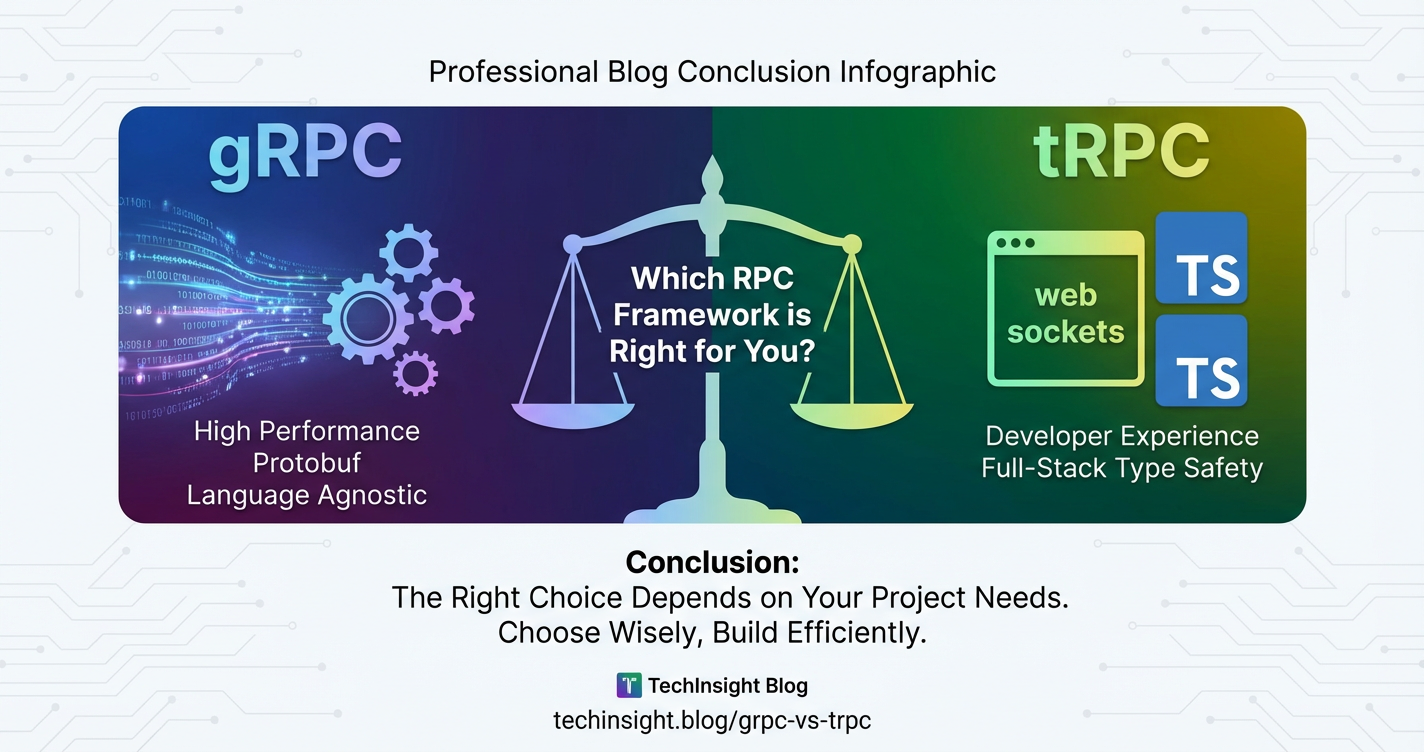
The journey through gRPC and tRPC reveals two distinctly powerful approaches to remote procedure calls, each meticulously crafted to excel in specific niches within the sprawling landscape of modern software development. There is no singular "best" RPC framework; instead, the choice hinges entirely on aligning the framework's inherent strengths with the nuanced requirements of your project, the composition of your development team, and your overarching architectural vision. Understanding this fundamental principle is paramount for making a decision that will empower your team and ensure the long-term success of your applications.
gRPC, forged in the crucible of Google's immense internal infrastructure, stands as the performance powerhouse and the polyglot champion. Its foundation on HTTP/2 and Protocol Buffers delivers unparalleled efficiency, enabling low-latency, high-throughput communication with compact binary payloads and robust streaming capabilities. It is the ideal choice for heterogeneous microservices architectures where services span multiple programming languages, for real-time applications demanding continuous data streams, and for environments where every byte of bandwidth and every millisecond of latency is critical. Its mature ecosystem, enterprise-grade reliability, and strict schema enforcement via Protobuf make it a cornerstone for complex, distributed systems requiring explicit contracts and predictable behavior across diverse components.
In stark contrast, tRPC emerges as the epitome of developer experience within the TypeScript ecosystem. By ingeniously leveraging TypeScript's type inference, tRPC eliminates the traditional API layer boilerplate, offering end-to-end type safety that makes API interactions feel like local function calls. For full-stack TypeScript applications, especially those residing within a monorepo, tRPC provides a development workflow that is remarkably fluid, error-resistant, and incredibly fast. It prioritizes developer happiness and rapid iteration, ensuring that type mismatches are caught at compile time, long before they can manifest as runtime bugs. While it trades raw performance and polyglot interoperability for this hyper-focused developer experience, its benefits are transformative for teams committed to a purely TypeScript stack.
The true art of architectural decision-making lies in recognizing that these frameworks are not in competition in the traditional sense, but rather offer complementary solutions for different problems. You might even find scenarios where both gRPC and tRPC coexist within a larger ecosystem. For instance, gRPC could power high-performance internal communications between core microservices written in Go and Java, while tRPC could handle the API layer for a specific Next.js frontend and its tightly coupled Node.js/TypeScript backend within a dedicated subdomain or monorepo.
Furthermore, it is vital to remember that these internal communication mechanisms often operate within a broader API management context. Whether your services utilize gRPC, tRPC, or even traditional REST, exposing and managing them effectively, especially to external consumers, frequently necessitates a robust API gateway. An API gateway serves as the crucial abstraction layer, unifying diverse backend services under a single, well-governed API. It handles critical functions like authentication, authorization, rate limiting, traffic routing, and analytics, ensuring security, stability, and scalability for all your API offerings.
This is precisely where platforms like APIPark demonstrate their immense value. As an open-source AI gateway and API management platform, APIPark provides the infrastructure to manage the entire lifecycle of your APIs. It can abstract away the underlying communication protocols of your backend services, presenting a unified API interface to the outside world. For enterprises integrating AI, APIPark’s capabilities to quickly integrate and standardize various AI models with a unified API format are particularly powerful, simplifying AI invocation and maintenance. By providing features such as end-to-end API lifecycle management, service sharing, and detailed API call logging, APIPark ensures that whether you’re leveraging the high performance of gRPC or the stellar developer experience of tRPC internally, your overall API ecosystem remains coherent, secure, and easily manageable, even extending to the complex domain of AI services.
In conclusion, the choice between gRPC and tRPC is a strategic one, deeply intertwined with your project's technical requirements, team dynamics, and future aspirations. Embrace the diversity these frameworks offer, leverage their individual strengths where they shine brightest, and always consider how they fit into your comprehensive API management strategy with robust solutions like API gateways to unlock the full potential of your distributed systems.
Frequently Asked Questions (FAQs)
1. Can gRPC and tRPC coexist in the same architecture?
Yes, absolutely. It's quite common for different communication frameworks to coexist in a larger microservices architecture. For instance, you might use gRPC for high-performance, polyglot inter-service communication between backend microservices (e.g., a Go service communicating with a Java service), and then use tRPC for a specific full-stack TypeScript application where the frontend and its tightly coupled Node.js/TypeScript backend live in a monorepo. An API gateway would typically sit in front of these diverse services to provide a unified public-facing API.
2. Is tRPC suitable for public APIs consumed by non-TypeScript clients?
Generally, no. tRPC's core strength and mechanism (end-to-end type safety) relies entirely on TypeScript type inference. If your public API needs to be consumed by clients written in other languages (e.g., Swift mobile app, Python script, or a JavaScript frontend without TypeScript), tRPC is not the right choice. For public APIs, RESTful APIs (often with OpenAPI/Swagger specifications) or GraphQL are typically more suitable due to their broad language support and standardization. You could, however, expose a tRPC backend via an API gateway that translates requests into a different format for external consumers.
3. How does performance compare between gRPC, tRPC, and REST?
In terms of raw network performance (latency, throughput, bandwidth efficiency): * gRPC generally offers the highest performance due to its use of HTTP/2 for multiplexing and streaming, and Protocol Buffers for compact binary serialization. * tRPC typically uses HTTP/1.1 and JSON, which is less performant than gRPC's stack in raw numbers but perfectly adequate for most typical web applications. Its focus is on developer experience rather than extreme network optimization. * REST (HTTP/1.1, JSON) is comparable to tRPC in terms of network performance, but often involves more verbose payloads and doesn't inherently support streaming as gRPC does.
For many applications, the performance difference between tRPC/REST and gRPC might be overshadowed by other bottlenecks like database queries or complex business logic.
4. What are the main alternatives to gRPC and tRPC?
Beyond gRPC and tRPC, other prominent RPC and API communication paradigms include: * RESTful APIs: The most common standard, using HTTP methods and typically JSON payloads. Highly flexible and widely understood. * GraphQL: A query language for your API, allowing clients to request exactly the data they need. Offers strong typing and reduces over/under-fetching. * SOAP: An older, XML-based protocol known for its strong typing and extensibility, but often considered more complex and heavyweight than REST or modern RPCs. * Apache Thrift / Apache Avro: Other robust IDL-based RPC frameworks similar in spirit to gRPC's Protobuf. * WebSockets: For full-duplex, persistent communication, often used for real-time features like chat or live updates. tRPC subscriptions often build on WebSockets.
5. Does tRPC use HTTP/2 like gRPC?
Not typically, or not by default as a core design principle. While the underlying server that hosts a tRPC application (e.g., Node.js with Express) could be configured to use HTTP/2, tRPC's protocol itself primarily leverages standard HTTP/1.1 requests and responses. It uses HTTP GET for queries and HTTP POST for mutations, sending JSON payloads. Unlike gRPC, tRPC does not inherently depend on HTTP/2's features like multiplexing or server push to function, nor does it define custom HTTP/2 frames. Its streaming capabilities for subscriptions are typically implemented using WebSockets, which is a separate protocol.
🚀You can securely and efficiently call the OpenAI API on APIPark in just two steps:
Step 1: Deploy the APIPark AI gateway in 5 minutes.
APIPark is developed based on Golang, offering strong product performance and low development and maintenance costs. You can deploy APIPark with a single command line.
curl -sSO https://download.apipark.com/install/quick-start.sh; bash quick-start.sh

In my experience, you can see the successful deployment interface within 5 to 10 minutes. Then, you can log in to APIPark using your account.

Step 2: Call the OpenAI API.