gRPC vs. tRPC: Choosing the Right RPC Framework
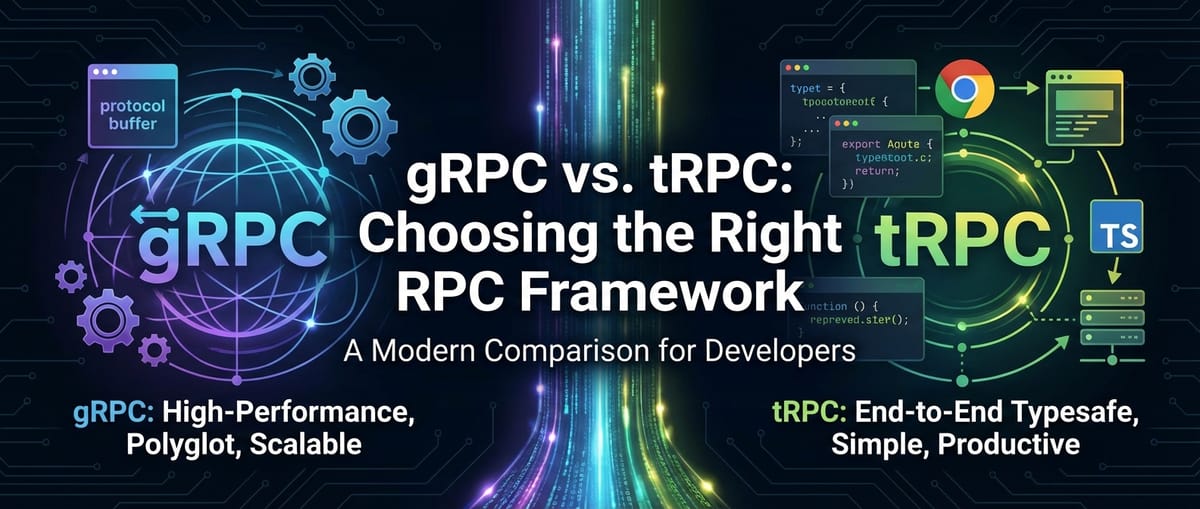


In the rapidly evolving landscape of distributed systems and microservices, the choice of a Remote Procedure Call (RPC) framework can profoundly influence an application's performance, developer experience, and long-term maintainability. Two prominent contenders in this arena, gRPC and tRPC, represent distinct philosophies and cater to different sets of engineering priorities. While both aim to simplify communication between services, they achieve this through fundamentally different mechanisms and target vastly different ecosystems. This comprehensive exploration delves into the intricacies of gRPC and tRPC, dissecting their architectural underpinnings, examining their strengths and weaknesses, and ultimately guiding developers and architects in making an informed decision that aligns with their specific project requirements.
The shift towards modular, distributed architectures has underscored the importance of efficient and robust inter-service communication. Traditional RESTful APIs, while ubiquitous and widely understood, often introduce overheads in terms of data serialization, network payload size, and the cognitive burden of managing HTTP verbs and status codes for complex interactions. This backdrop has fueled a resurgence of interest in RPC frameworks, which promise to abstract away network complexities, allowing developers to invoke remote functions as if they were local, thereby streamlining the development of highly integrated systems.
This article will meticulously compare gRPC, Google's robust, high-performance, and polyglot RPC framework, with tRPC, the innovative, TypeScript-centric solution focused on providing unparalleled end-to-end type safety and developer experience. By examining their core technologies, feature sets, typical use cases, and deployment considerations, we aim to provide a nuanced understanding of when and why one might be preferred over the other. Furthermore, we will explore how these frameworks integrate into broader architectural patterns, particularly the indispensable role of an API gateway in managing, securing, and optimizing the exposure of services built with these modern RPC solutions.
The Evolution of Remote Procedure Calls: From Monoliths to Microservices
The concept of Remote Procedure Calls has been a cornerstone of distributed computing for decades. Its fundamental premise—allowing a program to execute a subroutine or procedure in another address space (typically on a remote computer) as if it were a local subroutine—has captivated software architects since its inception. Early iterations, such as Sun RPC, CORBA, and DCOM, laid the groundwork but often suffered from complexity, vendor lock-in, and difficulties with interoperability across disparate systems and programming languages. These frameworks, while powerful, were often resource-intensive and presented steep learning curves, making them less appealing for rapidly developing internet-scale applications.
With the advent of the World Wide Web, HTTP emerged as the dominant communication protocol, and with it, new paradigms for distributed interaction. XML-RPC and SOAP (Simple Object Access Protocol) leveraged XML over HTTP to define service contracts and data exchange formats. SOAP, in particular, gained significant traction in enterprise environments due to its extensive standards, WSDL (Web Services Description Language) for formal interface definitions, and strong support for security and reliability. However, its verbosity, complexity, and performance overhead, largely due to XML's bulkiness, eventually led to a desire for simpler alternatives.
The early 2010s witnessed the rise of Representational State Transfer (REST), which quickly became the de facto standard for building web services. REST's simplicity, leveraging existing HTTP verbs (GET, POST, PUT, DELETE) for resource manipulation, its stateless nature, and its common use of JSON (JavaScript Object Notation) for data exchange, made it incredibly appealing. JSON's lightweight and human-readable format significantly reduced payload sizes compared to XML, leading to faster data transmission and easier debugging. RESTful APIs democratized the creation of accessible and scalable web services, powering countless web and mobile applications.
However, as architectures evolved from monolithic applications to fine-grained microservices, the limitations of REST began to surface. While excellent for external, client-facing APIs, REST could sometimes be inefficient for high-volume, inter-service communication within a microservices ecosystem. Issues like over-fetching (receiving more data than needed) and under-fetching (requiring multiple requests to gather all necessary data) often led to network chattiness and increased latency. Furthermore, the lack of a formal schema definition in many REST implementations could lead to integration challenges and runtime errors in polyglot environments. The proliferation of different versions of an API also added to the management overhead, necessitating robust versioning strategies and meticulous documentation.
These challenges created fertile ground for the resurgence of modern RPC frameworks. Developers sought solutions that offered: 1. Performance: Lower latency and higher throughput, especially for internal service-to-service calls. 2. Efficiency: Reduced payload sizes and optimized network usage. 3. Strong Typing: Formal contracts to ensure consistency and prevent errors across different services and languages. 4. Developer Experience: Tools and abstractions that simplify the process of defining, implementing, and consuming remote services.
This quest led to the development and widespread adoption of frameworks like gRPC and, more recently, tRPC, each addressing these modern requirements with distinct approaches. They represent a sophisticated evolution of the RPC concept, tailored to the demands of contemporary distributed systems, offering compelling alternatives or complements to traditional RESTful architectures.
The Powerhouse: gRPC – Google's High-Performance RPC Framework
gRPC, an open-source, high-performance RPC framework developed by Google and now part of the Cloud Native Computing Foundation (CNCF), stands as a testament to the enduring power of the RPC paradigm when combined with modern network technologies and data serialization techniques. Born out of Google's internal efforts to standardize and optimize communication across its vast microservice infrastructure, gRPC was open-sourced in 2015 and has since gained significant traction in enterprise and cloud-native environments. Its design principles are rooted in efficiency, interoperability, and scalability, making it a formidable choice for complex distributed systems.
At its core, gRPC leverages two powerful technologies: Protocol Buffers (Protobuf) for defining service interfaces and data structures, and HTTP/2 for its underlying transport protocol. These two pillars are instrumental in gRPC's ability to deliver on its promise of high performance and efficiency.
Core Concepts of gRPC
Protocol Buffers (Protobuf)
Protobuf is Google's language-agnostic, platform-neutral, extensible mechanism for serializing structured data. Unlike JSON or XML, which are text-based and human-readable, Protobuf serializes data into a compact binary format. This binary representation is significantly smaller than its text-based counterparts, leading to reduced network bandwidth consumption and faster serialization/deserialization times.
The process begins with defining messages and services in .proto files using a straightforward Interface Definition Language (IDL). For instance, a simple user service might define a User message and a GetUserDetails method:
syntax = "proto3";

package userservice;

message User {
  string id = 1;
  string name = 2;
  string email = 3;
}

message GetUserDetailsRequest {
  string user_id = 1;
}

message GetUserDetailsResponse {
  User user = 1;
}

service UserService {
  rpc GetUserDetails (GetUserDetailsRequest) returns (GetUserDetailsResponse);
  rpc CreateUser (User) returns (User);
}
This .proto file serves as the single source of truth for the API contract. From this definition, gRPC tools generate client and server boilerplate code (stubs or interfaces) in dozens of programming languages, including Go, Java, Python, C++, C#, Node.js, Ruby, and many more. This code generation is a cornerstone of gRPC's strong typing and interoperability. It ensures that both the client and server adhere strictly to the defined contract, catching potential mismatches at compile time rather than runtime, which greatly enhances reliability and reduces debugging efforts across a polyglot microservice architecture.
HTTP/2 as the Transport Layer
gRPC exclusively uses HTTP/2 for its transport protocol, a decision that underpins many of its performance advantages. HTTP/2, a significant revision of the HTTP protocol, introduces several features crucial for efficient RPC communication: * Multiplexing: Unlike HTTP/1.x, which typically requires a new TCP connection for each request or limits concurrent requests per connection, HTTP/2 allows multiple concurrent bidirectional streams over a single TCP connection. This reduces connection overhead and latency, especially for applications with many small requests. * Header Compression (HPACK): HTTP/2 compresses request and response headers, significantly reducing the size of redundant headers that are common in RPC calls, thus saving bandwidth. * Server Push: Although less directly utilized by gRPC's core RPC model, HTTP/2's ability for servers to proactively send responses that the client will likely need further optimizes resource loading. * Binary Framing Layer: HTTP/2 breaks down messages into smaller, binary-encoded frames, which allows for more efficient parsing and transmission compared to HTTP/1.x's text-based framing.
By combining the compact binary serialization of Protobuf with the efficient, multiplexed communication of HTTP/2, gRPC achieves significantly lower latency, higher throughput, and reduced network utilization compared to traditional REST over HTTP/1.x with JSON.
Key Features and Advantages of gRPC
- High Performance and Efficiency: This is gRPC's most touted advantage. The combination of HTTP/2's features and Protobuf's compact binary format makes gRPC exceptionally fast and efficient for inter-service communication, especially in high-volume, low-latency scenarios.
- Language Agnostic: With official support and robust tooling for virtually every major programming language, gRPC is ideal for polyglot microservice architectures. Teams can choose the best language for each service without compromising on communication efficiency or type safety.
- Powerful Streaming Capabilities: gRPC supports four types of service methods, beyond the simple request-response (unary) model:
- Unary RPC: The classic request-response model, where the client sends a single request and receives a single response.
- Server Streaming RPC: The client sends a single request, and the server responds with a sequence of messages. This is perfect for real-time data feeds, stock tickers, or live dashboards.
- Client Streaming RPC: The client sends a sequence of messages to the server, and after all messages are sent, the server responds with a single message. Useful for uploading large files or sending logs in batches.
- Bidirectional Streaming RPC: Both client and server send a sequence of messages using a read-write stream. This is ideal for real-time interactive applications like chat, video conferencing, or online gaming.
- Strongly Typed Contracts: The Protobuf
.protofiles serve as immutable contracts that define the services and messages. This ensures type safety across all services, regardless of the implementation language, leading to fewer integration errors and easier maintenance. - Built-in Features for Robustness: gRPC includes native support for deadlines, timeouts, and cancellation, allowing developers to build more resilient and fault-tolerant distributed systems. Interceptors, similar to middleware, enable cross-cutting concerns like authentication, logging, and error handling to be applied uniformly across services.
- Ecosystem and Tooling: Being a CNCF project and having Google's backing, gRPC boasts a mature ecosystem with extensive documentation, robust client/server libraries, and integrations with various cloud-native tools (e.g., Envoy proxy, service meshes).
Typical Use Cases for gRPC
- Microservices Communication: The primary use case. gRPC excels at high-throughput, low-latency communication between internal backend services written in different languages.
- IoT Devices: Its efficiency and compact messaging make it suitable for communication with resource-constrained IoT devices where bandwidth is limited.
- Mobile Backends: For mobile applications requiring efficient data transfer and real-time updates without heavy battery drain.
- Real-time Applications: Gaming, financial trading platforms, live dashboards, and any application requiring streaming data.
- Data Pipelines: For transferring large volumes of structured data between services or components in an efficient manner.
Challenges and Considerations with gRPC
Despite its advantages, gRPC is not without its complexities: * Browser Support: Direct gRPC from web browsers is not natively supported due to HTTP/2's underlying mechanisms and browser limitations. This typically requires a proxy layer, such as gRPC-Web, to translate gRPC calls into a browser-compatible format (e.g., HTTP/1.1 with Protobuf or JSON payloads). * Learning Curve: Developers new to gRPC need to understand Protobuf syntax, the code generation workflow, and HTTP/2 concepts. This can be a steeper learning curve compared to simple REST API development. * Debugging: The binary nature of Protobuf payloads can make debugging more challenging than inspecting human-readable JSON. Specialized tools are often required to interpret gRPC traffic. * Text-based API Exposure: While efficient for machine-to-machine communication, gRPC services are not directly human-readable or easily explorable via standard browser tools like REST APIs. For external exposure, especially to third-party developers, an API gateway that can transcode gRPC to REST (or gRPC-Web) is often necessary. * Infrastructure Requirements: Deploying gRPC services sometimes requires specific load balancers, proxies (like Envoy), or service meshes that understand HTTP/2 and gRPC semantics, which can add operational overhead. For instance, traditional HTTP/1.1 load balancers may not correctly handle gRPC's long-lived connections and multiplexing.
In summary, gRPC is a powerful, enterprise-grade framework designed for high-performance, resilient, and interoperable communication in complex, distributed systems. Its strengths lie in its efficiency, strong typing across multiple languages, and advanced streaming capabilities, making it a cornerstone for modern microservice architectures.
The TypeScript Native: tRPC – End-to-End Type Safety
While gRPC addresses the challenges of polyglot microservice communication and high-performance demands, tRPC (TypeScript Remote Procedure Call) enters the scene with a laser focus on a different, yet equally critical, pain point: end-to-end type safety and developer experience within the full-stack TypeScript ecosystem. tRPC is not a protocol replacement in the same vein as gRPC; rather, it's a framework designed to abstract the API layer completely, allowing developers to build and consume APIs with type safety guaranteed from the database layer, through the server, all the way to the frontend client, without any manual type definitions or code generation.
tRPC emerged from the desire to eliminate the traditional disconnect between frontend and backend type definitions. In typical full-stack TypeScript applications, developers often duplicate types or manually sync them, leading to potential mismatches and runtime errors when API contracts change. tRPC elegantly solves this by directly leveraging TypeScript's powerful inference system, allowing the client to "import" the server's types and methods directly.
Core Concepts of tRPC
No Code Generation
This is arguably the most distinguishing feature of tRPC. Unlike gRPC, which mandates the generation of client and server stubs from .proto files, tRPC completely bypasses this step. Instead, it relies on TypeScript's advanced type inference capabilities. The client-side code directly imports the types from the server-side API router, and TypeScript itself ensures that all calls, parameters, and responses adhere to the server's definitions. This eliminates an entire step in the development workflow, reduces boilerplate, and simplifies schema evolution.
Direct Type Imports and Server-Side Routers
In a tRPC application, the server defines its API using a system of "routers" and "procedures." A procedure can be a query (for fetching data), a mutation (for modifying data), or a subscription (for real-time data streams, often via WebSockets). These procedures are strongly typed from their input parameters to their output responses.
For example, a server-side tRPC router might look like this:
// server/routers/user.ts
import { publicProcedure, router } from '../trpc';
import { z } from 'zod'; // For input validation

export const userRouter = router({
  getById: publicProcedure
    .input(z.object({ id: z.string() }))
    .query(async (opts) => {
      // Logic to fetch user from DB
      return { id: opts.input.id, name: 'John Doe', email: 'john@example.com' };
    }),
  create: publicProcedure
    .input(z.object({ name: z.string(), email: z.string().email() }))
    .mutation(async (opts) => {
      // Logic to create user in DB
      return { id: 'new-user-id', name: opts.input.name, email: opts.input.email };
    }),
});

// server/trpc.ts
import { initTRPC } from '@trpc/server';

export const t = initTRPC.create();
export const router = t.router;
export const publicProcedure = t.procedure;
On the client side, typically in a frontend framework like React, the client code can directly import the AppRouter type from the server:
// client/utils/trpc.ts
import { createTRPCReact } from '@trpc/react-query';
import type { AppRouter } from '../../server/routers/_app'; // Important: direct import!

export const trpc = createTRPCReact<AppRouter>();

// client/components/UserList.tsx
import { trpc } from '../utils/trpc';

function UserList() {
  const { data, isLoading } = trpc.user.getById.useQuery({ id: 'some-id' }); // Fully type-safe query
  const createUserMutation = trpc.user.create.useMutation();

  if (isLoading) return <div>Loading...</div>;

  return (
    <div>
      <h1>User: {data?.name}</h1>
      <button onClick={() => createUserMutation.mutate({ name: 'Jane', email: 'jane@example.com' })}>
        Create Jane
      </button>
    </div>
  );
}
Notice how trpc.user.getById.useQuery and trpc.user.create.useMutation automatically infer the expected input parameters and the shape of the returned data. If the server-side definition of getById changes, or if create expects a different payload, TypeScript will immediately flag an error in the client-side code during development, preventing entire classes of common API integration bugs.
Underlying Transport
While gRPC explicitly uses HTTP/2, tRPC typically runs over standard HTTP (often HTTP/1.1 or HTTP/2 depending on the underlying fetch or Axios configuration) with JSON payloads. It's important to understand that tRPC is an abstraction over the API layer, not a replacement for the network protocol itself. For subscriptions, tRPC commonly leverages WebSockets for real-time bidirectional communication.
Key Features and Advantages of tRPC
- Unrivaled Developer Experience (DX): This is tRPC's paramount strength. Developers get full type-safety, auto-completion, and instant error feedback across the entire stack, from frontend component to backend database interaction. This significantly boosts productivity, reduces debugging time, and provides immense refactoring confidence.
- End-to-End Type Safety: By directly inferring types from the server, tRPC guarantees that the client always matches the server's API contract. This eliminates runtime errors caused by mismatched data structures or incorrect API parameters.
- Minimal Boilerplate: No
.protofiles, no schema generation, no manual type declarations for API endpoints. Developers write less code and focus more on business logic. - Small Bundle Size: tRPC's client-side library is extremely lightweight, as it mostly consists of utility functions and relies on TypeScript for type enforcement, rather than large runtime validation or serialization libraries.
- Framework Agnostic (Frontend): While commonly seen with React and Next.js due to its excellent integration with React Query, tRPC can technically be used with any frontend framework (Vue, Svelte, plain JavaScript applications) that can consume a simple HTTP API.
- Efficient Development Loop: Changes to the server API are immediately reflected in the client's types, providing instant feedback and minimizing the time spent manually updating interfaces.
- Input Validation: tRPC often integrates seamlessly with validation libraries like Zod, allowing developers to define robust input schemas that are also type-inferred for the client.
Typical Use Cases for tRPC
- Full-Stack TypeScript Applications: Ideal for projects where both the frontend and backend are written in TypeScript, especially in frameworks like Next.js, where a co-located backend is common.
- Single-Page Applications (SPAs): Perfect for building SPAs where the frontend and backend are tightly coupled and maintained by the same team.
- Internal APIs within a Monorepo: When managing a monorepo with multiple TypeScript services or applications, tRPC can provide seamless, type-safe communication between them.
- Rapid Prototyping: Its minimal boilerplate and excellent DX make it superb for quickly building and iterating on applications.
Challenges and Considerations with tRPC
- TypeScript Monoculture: The most significant limitation is its strict reliance on TypeScript for both the client and the server. tRPC is not designed for polyglot environments. If your backend is in Java, Go, or Python, tRPC is not a viable option for direct communication.
- Not a Protocol Replacement: While it offers an excellent API abstraction, tRPC doesn't inherently bring the network-level performance benefits of HTTP/2 and binary serialization that gRPC does. It typically uses JSON over HTTP, which is less efficient than Protobuf over HTTP/2 for raw performance.
- Limited Language Interoperability: Because it relies on TypeScript's type inference and direct module imports, it's not straightforward to call a tRPC server from a non-TypeScript client (e.g., a Python script or a mobile app built with Swift) without manually recreating the API contract.
- Maturity and Ecosystem: Compared to gRPC, which has been around longer and is backed by Google and the CNCF, tRPC is a newer framework. While its community is rapidly growing, especially in the React/Next.js ecosystem, its tooling and enterprise adoption are less mature than gRPC's.
- External API Exposure: tRPC is primarily designed for internal, trusted communication within a cohesive TypeScript stack. It's not typically used for public-facing APIs where arbitrary clients in different languages need to consume the service. For such scenarios, a more universally compatible API gateway (which might expose REST or GraphQL) would be required.
In essence, tRPC revolutionizes the developer experience for full-stack TypeScript projects by providing unparalleled type safety and reducing boilerplate to a minimum. It trades the polyglot interoperability and raw network performance of gRPC for an exceptionally smooth and confident development workflow within its specific ecosystem.
APIPark is a high-performance AI gateway that allows you to securely access the most comprehensive LLM APIs globally on the APIPark platform, including OpenAI, Anthropic, Mistral, Llama2, Google Gemini, and more.Try APIPark now! 👇👇👇
gRPC vs. tRPC: A Comprehensive Comparative Analysis
Having delved into the individual characteristics of gRPC and tRPC, it becomes clear that while both serve the broad purpose of simplifying remote communication, they do so with vastly different priorities and technical foundations. The choice between them is rarely about which is "better" overall, but rather which is "better suited" for a particular set of constraints, team skills, and project goals. This section provides a direct comparison across key dimensions, culminating in a detailed table to highlight their differentiators.
Architectural Philosophy and Target Audience
- gRPC: Is fundamentally designed for high-performance, polyglot microservice communication. Its philosophy is about creating rigid, efficient, and language-agnostic contracts that enable diverse backend services to communicate seamlessly and rapidly. It targets large-scale, distributed systems where interoperability between services written in different languages is a common requirement.
- tRPC: Operates with a philosophy centered entirely around developer experience and end-to-end type safety within a unified TypeScript stack. It assumes a monorepo or a tightly coupled full-stack TypeScript application where the client and server share the same language environment. Its goal is to eliminate the friction and error potential of manual API contract management between frontend and backend.
Language Support and Interoperability
- gRPC: Excels in polyglot environments. Its code generation from
.protofiles ensures that client and server stubs are available for almost every major programming language (Go, Java, Python, C++, C#, Node.js, Ruby, PHP, Dart, etc.). This makes it ideal for heterogeneous microservice architectures. - tRPC: Is exclusively a TypeScript affair. It relies on TypeScript's type system for its core functionality, meaning both your client and server must be written in TypeScript. This is a significant limitation for polyglot systems but a tremendous strength for homogeneous TypeScript stacks.
Serialization and Transport Protocol
- gRPC: Employs Protocol Buffers (Protobuf) for data serialization, which produces compact binary payloads. This, combined with HTTP/2 as the transport protocol, allows for efficient multiplexing, header compression, and long-lived connections. The result is significantly lower latency and higher throughput, especially over networks with limited bandwidth.
- tRPC: Typically uses JSON for data serialization, which is a text-based, human-readable format. It operates over standard HTTP (HTTP/1.1 or HTTP/2, depending on the underlying client like
fetchorAxios). While JSON is versatile and easy to debug, it is generally less efficient in terms of payload size and parsing speed compared to Protobuf. For real-time subscriptions, tRPC often leverages WebSockets.
Schema Definition and Code Generation
- gRPC: Mandates a formal schema definition using
.protofiles. From these definitions, code generation tools produce the necessary client and server stubs in various languages. This ensures strict adherence to the API contract across all services. - tRPC: Revolutionizes this aspect by eliminating code generation altogether. It leverages TypeScript's type inference system, allowing the client to directly import and use the server's types. This means no separate schema files to manage and no code generation step in the build process, simplifying the development workflow.
Performance Focus
- gRPC: Is engineered for raw performance. Its use of Protobuf and HTTP/2 is specifically chosen to minimize network overhead, reduce latency, and maximize throughput. It is a go-to for applications where every millisecond and every byte counts.
- tRPC: Prioritizes developer experience and type safety over raw network performance. While it is certainly performant enough for most web applications, its underlying use of JSON over HTTP means it won't match gRPC's wire-level efficiency. Its "performance" is more about development velocity and reducing errors than network optimization.
Developer Experience
- gRPC: Offers a strong developer experience through its generated code, which provides strong typing and reduces boilerplate. However, the initial learning curve associated with Protobuf, HTTP/2, and the code generation workflow can be steep. Debugging binary payloads also requires specialized tooling.
- tRPC: Provides an exceptional developer experience for TypeScript developers. The end-to-end type safety means auto-completion, instant error detection, and confident refactoring across the entire stack. This leads to significantly faster iteration cycles and a more enjoyable development process within its specified ecosystem.
Maturity and Ecosystem
- gRPC: Is a mature, battle-tested framework with a vast ecosystem, extensive documentation, and widespread adoption in enterprise and cloud-native environments. It's a CNCF project, ensuring long-term support and community involvement.
- tRPC: Is a newer, rapidly growing framework, particularly popular within the Next.js and React communities. While its community is vibrant and active, its overall ecosystem and enterprise adoption are not as extensive or mature as gRPC's.
Complexity and Learning Curve
- gRPC: Can have a higher initial complexity due to the need to understand Protobuf,
.protofile definitions, HTTP/2 concepts, and the code generation pipeline. Setting up a gRPC environment, especially with proxies and load balancers, can require specific knowledge. - tRPC: Is relatively simpler to grasp for developers already proficient in TypeScript and modern JavaScript frameworks. Its "no code generation" approach and direct type inference significantly reduce setup and cognitive overhead.
Browser Compatibility
- gRPC: Does not have native browser support due to its reliance on HTTP/2 features not fully exposed to browser APIs. It typically requires gRPC-Web, a proxy layer that translates gRPC calls into a browser-friendly format, effectively adding an extra layer of complexity.
- tRPC: Works directly from browsers using standard
fetchorAxiosrequests, as it relies on HTTP and JSON. This makes it inherently compatible with web frontend applications without additional proxies.
Table: gRPC vs. tRPC Key Differentiators
| Feature | gRPC | tRPC |
|---|---|---|
| Primary Goal | High-performance, polyglot microservice communication | End-to-end type safety for TypeScript applications |
| Core Technologies | Protocol Buffers (Protobuf), HTTP/2 | TypeScript's type system, HTTP (typically JSON payloads) |
| Language Support | Polyglot (Go, Java, Python, C#, Node.js, etc.) | TypeScript (both client and server) |
| Serialization | Protocol Buffers (binary, compact) | JSON (text-based, human-readable) |
| Transport Protocol | HTTP/2 (native, multiplexed, compressed) | HTTP/1.1 or HTTP/2 (via underlying client like fetch), WebSockets for subscriptions |
| Schema Definition | .proto files (strict, external contract) |
TypeScript types inferred from server code (internal contract) |
| Code Generation | Mandatory (from .proto files to stubs) |
None (direct type import from server) |
| Performance Focus | High throughput, low latency, bandwidth efficiency | Developer experience, type safety, rapid iteration |
| Streaming | Unary, Server Streaming, Client Streaming, Bi-directional | Unary (queries/mutations), Subscriptions (via WebSockets) |
| Developer Experience | Structured, multi-language, but steeper initial learning curve | Exceptional for TypeScript developers, less boilerplate, auto-completion |
| Maturity/Ecosystem | Mature, vast, enterprise-grade, CNCF project | Newer, rapidly growing, strong in Next.js/React ecosystem |
| Use Cases | Microservices, IoT, mobile backends, high-performance APIs, data pipelines | Full-stack TypeScript apps, internal monorepo communication, SPAs |
| Browser Compatibility | Requires gRPC-Web proxy for direct browser calls | Direct via standard browser fetch or XHR |
| Debugging | Requires specific tooling for Protobuf binary inspection | Standard browser dev tools (JSON payloads are readable) |
| External API Exposure | Often requires an API gateway for transcoding to REST or gRPC-Web | Best for internal APIs; external APIs typically use REST/GraphQL |
This detailed comparison underscores that gRPC and tRPC are not direct competitors vying for the same space but rather specialized tools addressing different needs within the broader landscape of distributed system communication. The optimal choice is contingent upon the specific architectural context, technological stack, team expertise, and ultimate goals of the project.
Choosing the Right Framework: Context-Driven Decisions
The decision between gRPC and tRPC is not a simple matter of choosing the "best" framework; instead, it is a context-driven choice that hinges on the unique requirements, constraints, and long-term vision of a project. Both frameworks are exceptionally good at what they set out to achieve, but their strengths lie in different domains. Understanding these distinctions is crucial for making a strategic decision that aligns with the architectural goals and team capabilities.
When to Choose gRPC
gRPC is the powerhouse for large-scale, high-performance, and interoperable distributed systems. You should lean towards gRPC when your project exhibits one or more of the following characteristics:
- Polyglot Microservices Architecture: If your backend services are implemented in a variety of programming languages (e.g., Go for high-performance services, Java for enterprise logic, Python for machine learning, Node.js for BFFs), gRPC's language-agnostic nature and code generation from
.protofiles make it the ideal choice. It ensures seamless, type-safe communication across diverse tech stacks, which is a hallmark of modern microservice environments. The generated client and server stubs abstract away the complexities of inter-language communication, allowing teams to leverage the best tools for each specific task. - High Performance and Efficiency Requirements: For applications where every millisecond of latency and every byte of bandwidth counts, gRPC's foundation on HTTP/2 and Protocol Buffers offers unparalleled performance advantages. This includes scenarios like:
- Financial trading systems: Where real-time updates and minimal latency are critical for competitive advantage.
- IoT backends: Communicating with a multitude of resource-constrained devices over potentially unstable networks, where compact payloads and efficient connections are essential.
- Internal analytics or data processing pipelines: Moving large volumes of structured data between services rapidly and efficiently.
- Real-time gaming or collaborative applications: Requiring frequent, low-latency updates and potentially streaming data.
- Extensive Streaming Data Needs: If your application requires more than simple request-response interactions, gRPC's native support for server streaming, client streaming, and bidirectional streaming is a significant advantage. This is crucial for:
- Live dashboards and monitoring systems: Where servers push continuous updates to clients.
- Chat applications or video conferencing: Utilizing bidirectional streams for real-time, interactive communication.
- Large file uploads/downloads: Where streaming allows for efficient chunking and transfer without holding entire files in memory.
- Strict and Evolving API Contracts: For large organizations or projects with numerous teams consuming the same APIs, the formal, versioned
.protofiles provide an unambiguous contract. Changes to this contract are explicitly managed and propagate through code generation, reducing the risk of integration errors. This strong contract enforcement is vital for maintaining stability and consistency in complex, distributed systems. - Mobile and Edge Computing: In environments with unreliable networks or limited computational resources, gRPC's efficient serialization and connection management reduce battery consumption and improve responsiveness for mobile applications and edge devices.
- Integration with Existing gRPC Infrastructure: If you are extending an existing system that already heavily utilizes gRPC, continuing with the same framework simplifies integration and leverages existing team expertise and tooling.
When to Choose tRPC
tRPC shines brightest in the realm of full-stack TypeScript development, prioritizing developer experience and type safety above all else. Opt for tRPC when your project fits these descriptions:
- Full-Stack TypeScript Application: The most crucial prerequisite. If your entire application, from frontend (e.g., React, Next.js, Vue, Svelte) to backend (Node.js/TypeScript), is written in TypeScript, tRPC offers an unparalleled development workflow. It leverages the inherent unity of the language across the stack.
- Unparalleled Developer Experience (DX) is a Top Priority: If your team values rapid iteration, auto-completion, compile-time error checking for API interactions, and refactoring confidence, tRPC delivers. It virtually eliminates the common class of bugs stemming from mismatched frontend-backend API contracts, freeing developers to focus on features rather than boilerplate and debugging. This significantly boosts productivity and developer satisfaction.
- Rapid Prototyping and Development: For startups, MVPs, or internal tools where speed of development and ease of modification are paramount, tRPC's minimal boilerplate and instant feedback loop accelerate the entire development cycle. You can make a change on the server and immediately see the type-safe implications on the client without any intermediate steps.
- Internal Monorepo Projects: If your client and server code reside within a single monorepo, tRPC's ability to directly import server types into the client is exceptionally powerful. It creates a seamless development environment where changes propagate instantly and safely across the stack, making it ideal for tightly coupled applications.
- Smaller to Medium-Sized Applications (primarily web): While tRPC can scale, its strengths are most evident in applications where the overhead of gRPC (Protobuf compilation, HTTP/2 infrastructure) might be excessive for the benefits it brings. For typical web applications that don't demand extreme low-level network optimization, tRPC offers a more streamlined and productive experience.
- Team Expertise in TypeScript: If your development team is deeply skilled in TypeScript and accustomed to its advanced features, tRPC will feel like a natural extension of their existing workflow, requiring minimal new learning outside of its specific API patterns.
Hybrid Approaches: Best of Both Worlds
It's also important to recognize that gRPC and tRPC are not mutually exclusive in a large enterprise architecture. A common pattern might involve:
- gRPC for Core Backend Microservices: For high-performance, inter-service communication between backend services, especially if they are polyglot. This leverages gRPC's efficiency and strong multi-language support.
- tRPC for Frontend-to-Backend Communication: If a specific frontend application (e.g., a web portal built with Next.js) is tightly coupled with its own dedicated Node.js/TypeScript backend, tRPC can be used for that specific full-stack interaction, offering its superior DX.
- API Gateways Bridging the Gap: An API gateway would then sit in front of these diverse backend services, translating between external RESTful APIs (for public consumption) and internal gRPC or tRPC services. This allows for unified management, security, and external exposure of a complex backend.
The choice is ultimately a strategic one, deeply intertwined with the existing technology stack, the composition and expertise of the development team, the specific performance and scalability requirements, and the long-term architectural vision. By carefully evaluating these factors, organizations can select the RPC framework (or combination of frameworks) that best empowers their developers and serves their application's needs.
Beyond the Frameworks: The Role of API Gateways and Management
While gRPC and tRPC provide powerful solutions for defining and executing remote procedures, their focus remains primarily on the communication protocol and developer experience between services. In real-world, production-grade environments, especially those involving multiple services, diverse client applications, and external consumers, the orchestration and management of these services extend far beyond the capabilities of an individual RPC framework. This is where the crucial role of an API gateway and comprehensive API management platforms comes into play.
An API gateway acts as a single entry point for all API requests from clients. It is a critical component in modern microservice architectures, providing a centralized point for managing, securing, and optimizing API traffic. Instead of clients interacting directly with individual microservices, they communicate with the API gateway, which then routes the requests to the appropriate backend service. This abstraction offers numerous benefits:
- Unified API Exposure: Presents a single, consistent API to external consumers, abstracting away the underlying complexity of potentially dozens or hundreds of microservices, each potentially using different communication protocols (REST, gRPC, GraphQL).
- Security and Access Control: Centralizes authentication, authorization, and rate limiting. This prevents unauthorized access, protects backend services from overload, and enforces security policies uniformly.
- Traffic Management: Handles load balancing, routing, retries, circuit breaking, and traffic splitting for A/B testing or canary deployments. This ensures high availability and resilience of the system.
- Policy Enforcement: Applies cross-cutting concerns like caching, logging, monitoring, and request/response transformation.
- Protocol Translation (Transcoding): Crucially, for frameworks like gRPC, an API gateway can act as a transcoder. It can expose a gRPC service as a traditional RESTful API (JSON over HTTP/1.1), allowing browsers and other non-gRPC-aware clients to interact with the service. For gRPC-Web, it can proxy these requests, making gRPC services accessible to web frontends.
- Analytics and Monitoring: Provides a centralized point to gather metrics, logs, and traces for all API calls, offering invaluable insights into system performance, usage patterns, and potential issues.
How gRPC and tRPC Interact with Gateways
- gRPC and API Gateways: For gRPC services, the integration with an API gateway is almost a necessity, especially when exposing services beyond the internal microservice mesh.
- External Exposure: Since gRPC relies on HTTP/2 and Protobuf, direct browser calls are not straightforward. An API gateway can serve as a gateway for gRPC-Web traffic, translating browser-compatible HTTP/1.1 requests into gRPC calls. Alternatively, it can perform full HTTP/JSON to gRPC transcoding, allowing any standard HTTP client to consume gRPC services as if they were REST APIs. This is particularly useful for public-facing APIs where developer experience for consumers is paramount.
- Internal Management: Even for internal gRPC services, an API gateway can provide centralized authentication, rate limiting, and observability. This ensures that even high-performance gRPC communications are properly governed and monitored. Popular choices for gRPC-aware gateways include Envoy Proxy, Nginx (with gRPC module), and specialized cloud-native API gateways.
- tRPC and API Gateways: While tRPC is often used for tightly coupled internal communication within a full-stack TypeScript application, there are still scenarios where an API gateway would be beneficial:
- Centralized Security and Management: If your tRPC backend grows to become a critical component or needs to expose specific functionalities to non-TypeScript clients or internal tools, an API gateway can layer on authentication, authorization, and rate limiting. The gateway would simply treat tRPC calls as standard HTTP requests with JSON payloads.
- Hybrid Environments: In a large organization using various API technologies, a gateway can provide a unified management plane, encompassing tRPC endpoints alongside REST and gRPC services.
Introducing APIPark for Comprehensive API Management
For organizations grappling with the complexities of managing a diverse portfolio of APIs—be they gRPC services, traditional RESTful endpoints, or even specialized internal tRPC interfaces—a powerful and flexible API management platform becomes indispensable. Solutions like APIPark stand out in this evolving landscape. APIPark is an open-source AI gateway and API management platform that streamlines the integration, deployment, and governance of both AI and REST services. Its capabilities extend to offering a unified API format for AI invocation, prompt encapsulation into REST APIs, and comprehensive end-to-end API lifecycle management.
This means whether you're dealing with the intricate details of gRPC for high-performance internal communication or optimizing the developer experience with tRPC for full-stack TypeScript applications, an advanced gateway like APIPark can provide the necessary layer for security, observability, and scalability, consolidating various API types under a single management umbrella.
APIPark offers a suite of features that directly address the challenges of modern API ecosystems: * End-to-End API Lifecycle Management: From design and publication to invocation and decommissioning, APIPark helps regulate API management processes, including traffic forwarding, load balancing, and versioning, critical for maintaining stability and scalability as your services evolve. * Unified API Format: While primarily highlighted for AI models, this concept of standardizing request data formats is highly valuable for any diverse API landscape, ensuring consistency and simplifying client integration. * Performance and Scalability: With performance rivaling Nginx, capable of over 20,000 TPS on modest hardware, APIPark supports cluster deployment to handle large-scale traffic, ensuring your gateway doesn't become a bottleneck. * Detailed Logging and Data Analysis: Comprehensive logging of every API call and powerful data analysis tools provide deep insights into API usage, performance trends, and potential issues, enabling proactive maintenance and troubleshooting. * Security Features: Such as resource access approval and independent API/access permissions for different tenants, provide robust control over who can access what, vital for enterprise security.
By deploying an API gateway and management platform like APIPark, organizations can bridge the gap between internal RPC efficiencies and external API discoverability, security, and scalability. It transforms a collection of disparate services into a cohesive, manageable, and performant API ecosystem, enabling developers to focus on core business logic while centralizing the complexities of API governance.
Conclusion: A Strategic RPC Decision
The journey through the intricate worlds of gRPC and tRPC reveals two sophisticated, yet distinct, approaches to solving the perennial challenge of efficient and reliable inter-service communication in distributed systems. gRPC stands as a titan of performance and polyglot interoperability, leveraging the power of Protocol Buffers and HTTP/2 to deliver unparalleled efficiency for microservices, IoT, and high-throughput real-time applications across diverse programming languages. Its strength lies in its rigid, schema-first contract and its capability to handle complex streaming patterns, making it an indispensable tool for large-scale, enterprise-grade architectures where language flexibility and raw speed are paramount.
Conversely, tRPC emerges as a champion for developer experience and end-to-end type safety within the vibrant full-stack TypeScript ecosystem. By ingeniously harnessing TypeScript's type inference, it eliminates the need for code generation and manual schema synchronization, providing an exceptionally smooth, error-free, and highly productive development workflow. Its appeal is undeniable for teams building cohesive web applications where the entire stack is unified under TypeScript, prioritizing rapid iteration and compile-time guarantees over polyglot interoperability or low-level network optimization.
The strategic decision between gRPC and tRPC, therefore, is not about identifying a single superior framework but rather about a meticulous alignment with specific project requirements. Factors such as the heterogeneity of your technology stack, the criticality of performance and bandwidth efficiency, the necessity for advanced streaming capabilities, the size and composition of your development team, and your overarching architectural goals must guide this choice.
Furthermore, it is crucial to recognize that the effectiveness of these RPC frameworks is often amplified by their integration into a broader API management strategy. Whether you choose gRPC for your internal microservices or tRPC for your tightly coupled full-stack applications, an API gateway remains an indispensable component. Solutions like APIPark provide the essential layer of abstraction, security, performance optimization, and observability that transforms individual service endpoints into a well-governed, scalable, and discoverable API ecosystem. A robust gateway can bridge protocol differences, enforce policies, manage traffic, and provide crucial insights, allowing developers to reap the benefits of specialized RPC frameworks while ensuring a cohesive and manageable enterprise API landscape.
In conclusion, both gRPC and tRPC represent significant advancements in remote communication. By understanding their core philosophies, technical merits, and practical implications, architects and developers can make informed decisions that not only meet current project demands but also lay a resilient foundation for future growth and evolution in the dynamic world of distributed computing. The path forward is not about monolithic choices, but rather about strategically deploying the right tools for the right jobs, orchestrated effectively within a well-designed API management framework.
Frequently Asked Questions (FAQs)
1. Can gRPC and tRPC be used together in the same project or organization?
Absolutely, gRPC and tRPC can coexist and complement each other within a larger project or organization. A common pattern involves using gRPC for high-performance, internal microservice communication where polyglot support and efficient binary serialization are critical. For instance, backend services written in Go, Java, and Python might communicate via gRPC. Concurrently, a frontend application (e.g., a Next.js app) and its dedicated Node.js/TypeScript backend might use tRPC for their tightly coupled, type-safe interactions. An API gateway would then often sit in front of these diverse services, providing a unified access point, handling security, traffic management, and potentially translating between external REST and internal gRPC/tRPC protocols. This hybrid approach allows organizations to leverage the specific strengths of each framework where they are most impactful.
2. Is tRPC suitable for public-facing APIs or external clients?
Generally, tRPC is not ideally suited for public-facing APIs or external clients that are not part of your cohesive TypeScript stack. Its primary strength lies in end-to-end type safety and an exceptional developer experience within a homogeneous TypeScript environment. For public APIs, you typically need broader language support, a more universally understood protocol (like REST over HTTP with JSON), and the ability for arbitrary clients to consume your services without direct type imports from your server code. While you could technically expose a tRPC backend directly, it would largely negate the benefits of type inference for external, non-TypeScript clients and would lack the conventional discoverability and tool integration of a RESTful API. For public exposure, it's usually better to put an API gateway in front of your tRPC services, which can then expose a standard REST or GraphQL API to external consumers, translating requests to the underlying tRPC endpoints as needed.
3. How does an API gateway handle gRPC services, especially for browser compatibility?
An API gateway plays a crucial role in managing and exposing gRPC services, particularly for browser compatibility. Since browsers do not natively support direct gRPC (HTTP/2 with Protobuf), an API gateway can act as a proxy and transcoder. * gRPC-Web Proxy: For web clients, the gateway can proxy gRPC-Web requests. gRPC-Web is a specification that allows browser-based applications to communicate with gRPC services by translating gRPC calls into a browser-compatible HTTP/1.1 format (often using Fetch API or XHR) with Protobuf or JSON payloads. The gateway then converts these back into native gRPC calls for the backend services. * REST Transcoding: For broader compatibility, an API gateway can perform full protocol transcoding, converting incoming RESTful HTTP/JSON requests into gRPC calls for the backend services, and vice versa for responses. This allows any standard HTTP client to consume gRPC services as if they were traditional REST APIs, abstracting away the underlying gRPC implementation. Popular API gateway solutions like Envoy Proxy, Nginx (with gRPC support), and dedicated cloud-native gateway products offer these capabilities, alongside essential features like authentication, rate limiting, and observability.
4. What are the main performance implications when choosing between gRPC and tRPC?
The performance implications are significant and stem from their core design differences: * gRPC: Generally offers superior raw network performance. Its use of HTTP/2 for multiplexing, header compression, and long-lived connections, combined with Protocol Buffers' compact binary serialization, results in: * Lower Latency: Reduced overhead per request. * Higher Throughput: More concurrent requests over a single connection. * Reduced Bandwidth Usage: Smaller payload sizes due to binary encoding. These benefits are particularly pronounced in high-volume, low-latency, or bandwidth-constrained environments. * tRPC: While performant enough for most web applications, it typically operates over standard HTTP (HTTP/1.1 or HTTP/2 implicitly) with JSON payloads. This means: * Higher Latency: Due to larger text-based JSON payloads and potentially more HTTP overhead if not fully utilizing HTTP/2. * Higher Bandwidth Usage: JSON is typically larger than Protobuf for the same data. tRPC's performance advantage is primarily in developer velocity and reduced bug count, not in raw network efficiency. For many applications, the performance difference might be negligible, but for highly optimized microservices or real-time systems, gRPC holds a clear edge.
5. Does tRPC truly eliminate the need for an API schema or contract definition?
Yes, tRPC effectively eliminates the manual need for a separate API schema or contract definition file (like Protobuf's .proto files or OpenAPI/Swagger JSON files) that needs to be generated or kept in sync. Instead, it leverages TypeScript's powerful static type system to infer the API contract directly from your server-side code. When you define your queries, mutations, and subscriptions on the server with TypeScript types, tRPC allows your client code to directly import these types. TypeScript then acts as the "schema validator" at compile time. If your client tries to call a procedure with incorrect arguments or expects a response with an incorrect shape, TypeScript will immediately flag an error during development. This process ensures end-to-end type safety without any explicit schema files to maintain, code generation steps, or runtime validation libraries (though you'd still use runtime validation like Zod for user inputs). While it eliminates a separate schema file, the server-side TypeScript code itself becomes the definitive API contract.
🚀You can securely and efficiently call the OpenAI API on APIPark in just two steps:
Step 1: Deploy the APIPark AI gateway in 5 minutes.
APIPark is developed based on Golang, offering strong product performance and low development and maintenance costs. You can deploy APIPark with a single command line.
curl -sSO https://download.apipark.com/install/quick-start.sh; bash quick-start.sh

In my experience, you can see the successful deployment interface within 5 to 10 minutes. Then, you can log in to APIPark using your account.

Step 2: Call the OpenAI API.