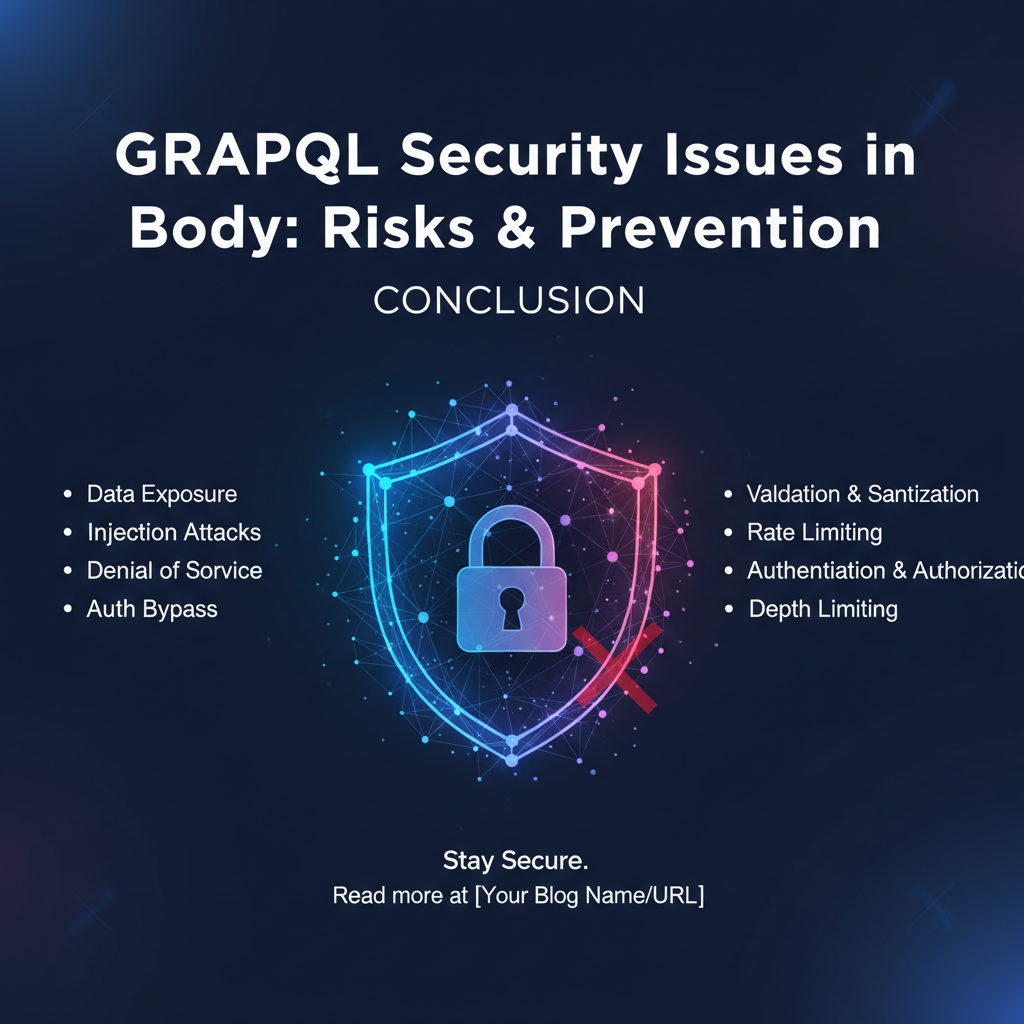
GraphQL Security Issues in Body: Risks & Prevention


GraphQL has rapidly emerged as a powerful and flexible query language for APIs, offering developers unprecedented control over data retrieval. Its ability to fetch exactly what’s needed, consolidate multiple requests into a single round trip, and provide a self-documenting schema has made it a favorite for modern application development. However, this flexibility, while a significant advantage, simultaneously introduces a new set of security challenges, particularly concerning the structure and content of the request body. Unlike traditional REST APIs, where endpoints are numerous and often map directly to specific resources, GraphQL typically exposes a single endpoint. This consolidates the attack surface but also makes it a high-value target for malicious actors seeking to exploit vulnerabilities through crafted queries and mutations.
The shift to GraphQL necessitates a paradigm change in how organizations approach api security. The traditional perimeter defense and endpoint-specific security measures often fall short when faced with GraphQL's dynamic nature. A deeply nested query, for instance, can bypass simple rate limits or lead to resource exhaustion, even if each individual field access seems benign. Similarly, the ability to request diverse data types in a single query can inadvertently expose sensitive information if authorization controls are not meticulously implemented at a granular level. Therefore, understanding and mitigating the security risks inherent in the GraphQL request body is paramount for any organization adopting this technology. This comprehensive guide will delve deep into the various security issues that can arise within GraphQL queries and mutations, exploring common vulnerabilities, and outlining robust prevention and mitigation strategies. We will also discuss the indispensable role of an api gateway in fortifying GraphQL API Governance and maintaining a secure, performant, and reliable API ecosystem.
Understanding GraphQL's Unique Attack Surface
Before diving into specific vulnerabilities, it's crucial to grasp why GraphQL presents a distinct security landscape compared to its RESTful counterparts. This understanding forms the bedrock for developing effective defense mechanisms.
The Single Endpoint Paradigm
A core tenet of GraphQL is its single-endpoint architecture. Instead of numerous URLs corresponding to different resources (e.g., /users, /products/{id}, /orders), GraphQL APIs typically expose a single /graphql endpoint (or similar). All data requests, whether for fetching information (queries) or modifying it (mutations), are routed through this one entry point. While this simplifies client-side development and API discovery, it concentrates the attack surface. A malicious actor only needs to find and target this single endpoint to interact with the entire API, making it a critical choke point for security monitoring and enforcement. This consolidation means that robust security controls applied at this single point, often facilitated by an api gateway, become absolutely essential.
Introspection Capabilities
GraphQL schemas are self-documenting, allowing clients to query the schema itself to understand available types, fields, and arguments. This feature, known as "introspection," is incredibly valuable for development tools, IDEs, and client libraries, enabling them to construct queries efficiently. However, in a production environment, introspection can become a significant information disclosure risk. An attacker can use introspection to map out the entire api, identifying potential data points, relationships, and even resolver functions, which can then be exploited for further attacks. This detailed blueprint provides an invaluable head-start for attackers, allowing them to craft highly targeted and effective malicious queries.
Flexible and Dynamic Query Structure
GraphQL's primary strength lies in its flexibility. Clients can request exactly the data they need, shaping the response structure to their specific requirements. This contrasts sharply with REST, where responses are often fixed. While efficient, this flexibility means that the server must process highly variable and often complex requests. An attacker can leverage this dynamic nature to craft queries that are deeply nested, fetch an exorbitant amount of data, or trigger computationally expensive operations. Without proper validation and resource management, such queries can quickly lead to performance degradation, resource exhaustion, or denial of service (DoS) conditions. The potential for arbitrary query construction demands a proactive approach to API Governance to ensure that legitimate flexibility isn't inadvertently exploited for malicious purposes.
Batching and Aliases
GraphQL allows clients to send multiple independent queries or mutations in a single request (batching) and to assign aliases to fields to differentiate results that would otherwise conflict. While these features enhance efficiency by reducing network round trips, they can also be abused. An attacker can use batching to execute multiple expensive operations simultaneously or to rapidly probe for vulnerabilities across different parts of the API, potentially bypassing rate limiting mechanisms that are based solely on the number of requests rather than their complexity or resource cost. This highlights the need for sophisticated api gateway solutions that can inspect and analyze the content of GraphQL requests, not just their frequency.
In essence, GraphQL's elegance and efficiency stem from its dynamic query capabilities, introspection, and single endpoint. However, each of these features also introduces unique security considerations that must be addressed through a combination of robust server-side logic, vigilant API Governance, and strategic deployment of an api gateway.
Common GraphQL Security Risks in the Body
The flexibility of GraphQL, particularly in how it processes the request body, opens avenues for several distinct security vulnerabilities. Understanding these specific risks is the first step toward effective mitigation.
1. Excessive Data Exposure and Information Disclosure
GraphQL's "fetch exactly what you need" principle can inadvertently lead to over-exposure of data if not carefully managed. Unlike REST, where an endpoint often returns a pre-defined set of data, a GraphQL client can explicitly ask for any field it's aware of.
Risks:
- Over-fetching by Design: Even if a client only intends to display a user's name, they might still be able to request and receive fields like
email,address,internal_id, or evenpassword_hashif the server-side authorization isn't granular enough. This is especially true if developers assume that clients will "do the right thing" and only ask for public data. If a field exists in the schema, it can be queried, and if not protected, its data will be returned. This can lead to sensitive internal data, not intended for external consumption, being exposed. For instance, an internal administrative field likelastLoginIPcould become accessible to general users, providing valuable intelligence for an attacker. - Introspection Queries Revealing Sensitive Details: As mentioned, introspection allows clients to query the schema itself. In a production environment, if introspection is enabled, an attacker can use queries like
__schemato discover every type, field, argument, and directive available on theapi. This provides a complete blueprint of the API's capabilities and underlying data model. Attackers can identify potentially vulnerable fields, understand relationships between data types, and even infer internal logic from field names and descriptions. This detailed knowledge significantly aids in crafting further attacks, from attempting to bypass authorization to exploiting business logic flaws. For example, discovering acreditCardNumberfield, even if access is restricted, tells an attacker exactly where to focus their efforts. - Verbose Error Messages: While not strictly a "body" issue in terms of request content, errors generated by processing the request body can leak critical information. If error messages include stack traces, database query failures, or internal server configurations, they can provide attackers with insights into the server's architecture, technologies used, and potential injection points. This detailed feedback loop can significantly accelerate an attacker's reconnaissance phase, turning a failed query into a valuable source of intelligence.
Prevention:
- Field-Level Authorization: Implement strict authorization checks at the field level, not just at the type or query level. Each field resolver should verify if the authenticated user has permission to access that specific piece of data. This ensures that even if a user can query a
Usertype, they might only be authorized to seenameandprofilePicture, but notemailorinternalNotes. Libraries and frameworks often provide mechanisms for this, allowing developers to define authorization rules directly within the schema or resolver logic. - Disable Introspection in Production: This is a fundamental security best practice. Introspection should be disabled in production environments. It is invaluable during development but poses an unnecessary risk once the API is public. Tools like an
api gatewaycan be configured to block introspection queries at the edge, or the GraphQL server itself should have a configuration option to turn it off. For example, some GraphQL server implementations allow you to conditionally enable/disable introspection based on environment variables or specific access tokens. - Sanitized Error Handling: Configure the GraphQL server to return generic, user-friendly error messages that do not leak internal server details. Detailed error information (stack traces, specific database errors) should only be logged internally for debugging purposes, not exposed to the client. Custom error formats can be implemented to provide only necessary information, such as an error code and a general message, without revealing implementation specifics.
2. Denial of Service (DoS) Attacks
GraphQL's ability to construct complex queries means that a single request can potentially consume vast server resources, making it a prime target for DoS attacks.
Risks:
- Deeply Nested Queries: An attacker can craft a query that repeatedly requests deeply nested relationships. For example,
user { friends { friends { friends { ... } } } }. If not constrained, such a query can quickly lead to an explosion in database queries, memory usage, and CPU cycles as the server attempts to resolve the entire graph. Each level of nesting can multiply the number of underlying database calls or computations, leading to resource exhaustion. - Expensive Queries/Resource Exhaustion: Certain fields or resolvers might be inherently more resource-intensive. For instance, a field that performs complex calculations, aggregates large datasets, or makes multiple external service calls can be expensive. An attacker could repeatedly query such fields or combine them with deep nesting to overload the server. A query like
products(limit: 10000) { reviews { author { orders { ... } } } }could quickly bring a server to its knees if not managed. - Batching/Alias Abuse: As mentioned, GraphQL allows multiple operations in a single request. An attacker could combine several deeply nested or expensive queries into one batch, potentially bypassing simpler rate limits that count requests rather than their underlying cost. Aliases can further obscure the true complexity of the batch, making it harder for basic security tools to detect malicious intent.
- Circular Queries: While less common due to typical GraphQL schema design, circular references (e.g.,
user { company { employees { user { ... } } } }) can be crafted if the schema allows it, leading to infinite loops and immediate resource exhaustion if not explicitly prevented by depth limiting or cycle detection.
Prevention:
- Query Depth Limiting: Implement a maximum allowable depth for incoming queries. Any query exceeding this depth is rejected. This directly counters deeply nested query attacks. For example, setting a limit of 7-10 levels is common. This is a relatively simple and effective first line of defense.
- Query Complexity Analysis: A more sophisticated approach involves assigning a "cost" to each field and argument in the schema. The server then calculates the total complexity of an incoming query and rejects it if it exceeds a predefined threshold. This allows for more nuanced control, where a wide but shallow query might be allowed, while a deeply nested but small query might also be permitted, depending on the assigned costs. This is often implemented using a visitor pattern that traverses the abstract syntax tree (AST) of the incoming query.
- Query Cost Analysis: Beyond complexity, this approach considers the actual runtime cost of resolvers. For example, fetching a single record might have a low cost, but fetching a million records, even with a low complexity score, has a high runtime cost. This can involve estimating database queries, external API calls, and computational cycles. Some GraphQL libraries offer plugins or integrations for this.
- Rate Limiting: Implement robust rate limiting mechanisms to restrict the number of requests a single client or IP address can make within a given timeframe. This should ideally be implemented at the
api gatewaylevel, which can inspect incoming GraphQL requests and apply limits based on various criteria (e.g., requests per second, per minute, or even per estimated query cost). Advanced rate limiting strategies can even consider the authentication status of the user, applying stricter limits to unauthenticated users. APIPark, for instance, with its performance rivaling Nginx and detailed call logging, can serve as an excellentapi gatewayfor implementing powerful rate-limiting policies, effectively protecting against DoS attacks by managing traffic forwarding and load balancing. - Timeout Mechanisms: Implement timeouts for GraphQL query execution. If a query takes too long to resolve, it should be terminated, preventing it from indefinitely consuming server resources. This acts as a last resort against runaway queries.
3. Injection Attacks
While GraphQL itself is generally resilient to injection attacks due to its typed nature, vulnerabilities can arise if resolvers are not properly implemented or interact insecurely with backend systems.
Risks:
- SQL/NoSQL Injection: If a GraphQL resolver directly constructs a database query using unsanitized user input from arguments, it becomes vulnerable to SQL or NoSQL injection. For example, if a resolver builds a
WHEREclause by concatenatingSELECT * FROM users WHERE name = '+args.name+', a maliciousargs.namelike' OR '1'='1could bypass authentication or extract arbitrary data. - Command Injection: Similarly, if a resolver uses user input as part of a system command execution (e.g., invoking a shell script or external program), command injection can occur. This could allow an attacker to execute arbitrary commands on the server.
- Cross-Site Scripting (XSS): If user-supplied data, such as a product review or user profile description, is stored without proper sanitization and later retrieved via GraphQL and rendered directly by a client-side application, it could lead to XSS. While not directly a GraphQL server vulnerability, the API plays a role in transmitting the malicious payload.
Prevention:
- Input Validation and Sanitization: All user-supplied arguments to GraphQL resolvers must be strictly validated against expected types, formats, and acceptable ranges. Additionally, any input that will be used in database queries or system commands must be thoroughly sanitized or escaped.
- Prepared Statements/Parameterized Queries: When interacting with databases, always use prepared statements or parameterized queries. These mechanisms separate the query logic from the data, preventing malicious input from being interpreted as part of the query structure. This is the gold standard for preventing SQL injection.
- Output Encoding: For any data returned by the GraphQL API that might be rendered in a web browser, ensure that client applications perform proper output encoding (HTML encoding, JavaScript encoding) to prevent XSS. While a client-side responsibility, the API provider should educate and enforce this best practice through documentation and security guidelines as part of robust
API Governance.
4. Broken Access Control and Authorization Issues
Improperly implemented authorization is a pervasive issue in all APIs, and GraphQL is no exception. Its flexibility can even amplify the problem if not addressed rigorously.
Risks:
- Field-Level Authorization Bypass: A common pitfall is implementing authorization only at the query or type level. For example, a user might be authorized to query the
Usertype but not authorized to view thesalaryfield within that type. If authorization isn't checked for each individual field, an attacker can simply request fields they shouldn't have access to. - IDOR (Insecure Direct Object Reference): Attackers might be able to directly access resources by their ID without proper authorization checks. For instance,
user(id: "malicious_user_id") { email }. If the resolver foruseronly checks if any user is authenticated but not if the authenticated user has permission to view that specific user's data, an IDOR vulnerability exists. This allows attackers to enumerate and access records belonging to other users. - Lack of Authentication/Authorization at Resolver Level: Developers might forget to add authentication or authorization checks to specific resolvers, especially for newly added fields or mutations. This creates an open door for anyone to access or modify data.
- Mutation Authorization Bypass: Mutations, by their nature, are designed to change data. If authorization for mutations is not strictly enforced, an attacker could manipulate data they shouldn't have access to, such as updating another user's profile, deleting critical records, or making unauthorized purchases.
Prevention:
- Granular Authorization (Field, Type, Argument): Implement robust authorization logic at multiple levels:
- Field Level: Every field resolver should include authorization checks relevant to the current user's role and permissions.
- Type Level: Authorization can restrict access to entire types for certain roles.
- Argument Level: Permissions might depend on the specific arguments passed to a query or mutation (e.g., a user can only query their own orders).
- Role-Based Access Control (RBAC) / Attribute-Based Access Control (ABAC): Design a comprehensive authorization system based on roles (e.g.,
admin,editor,customer) or attributes (e.g.,department: sales,country: USA). This system should be integrated into the GraphQL resolvers. - Centralized Authorization Enforcement: Leverage an
api gatewayto handle initial authentication and coarse-grained authorization checks (e.g., ensuring a valid token is present and belongs to an authorizedapiconsumer). While fine-grained authorization still resides in the GraphQL server, the gateway provides an essential outer layer of security. - Security by Default: Adopt a "deny all by default" policy, meaning that explicit authorization must be granted for any
apiaccess. This reduces the risk of accidentally exposing unauthorized data. - API Service Sharing within Teams & Access Approval: Platforms like APIPark emphasize
API Governanceby allowing for centralized display and sharing of API services within teams, along with features like "API Resource Access Requires Approval." This means callers must subscribe to an API and await administrator approval before invocation, preventing unauthorized calls and potential data breaches, which directly addresses broken access control issues by establishing a formal access workflow.
5. Parameter Tampering
Parameter tampering involves an attacker modifying the parameters (arguments) within a request to achieve unintended outcomes or bypass security controls.
Risks:
- Bypassing Business Logic: An attacker might alter arguments to change the behavior of a mutation. For example, changing a
priceargument in an order mutation, or astatusargument in an administrative action. - Mass Assignment/Over-posting: In mutations, if the server blindly maps all input arguments to an object without whitelisting, an attacker could include unexpected fields in the input that correspond to sensitive internal fields (e.g.,
isAdmin: true). If the server processes these unexpected fields, it could lead to privilege escalation or unauthorized data modification. This is a common vulnerability in many frameworks that automate object mapping.
Prevention:
- Server-Side Validation of All Arguments: Implement stringent validation on all incoming arguments. Don't rely solely on the GraphQL schema's type system; add business logic validation. For instance, verify that a
priceis positive, astatusis one of the allowed enums, and that the authenticated user has permission to set certain attributes. - Whitelisting Mutation Inputs: When processing mutation inputs, explicitly define and whitelist the fields that can be updated. Avoid generic update functions that accept arbitrary input objects. For example, if you have a
UserUpdateInputtype, ensure it only contains fields that users are allowed to modify. This directly combats mass assignment. - Strong Type Definitions and Enums: Leverage GraphQL's strong type system, especially enums, to restrict possible values for certain arguments. This makes it harder for attackers to guess valid inputs.
6. Rate Limiting Bypass via Batching
While rate limiting is a general api security measure, GraphQL's batching capability can complicate its effectiveness.
Risks:
- An attacker could send a single HTTP request containing dozens or hundreds of individual GraphQL queries or mutations. A naive rate limiter that counts only HTTP requests would perceive this as one request, effectively bypassing the intended rate limit and potentially causing a DoS.
Prevention:
- GraphQL-Aware Rate Limiting: Implement rate limiting that understands the internal structure of a GraphQL request. This means counting individual operations within a batch, or even better, using a query complexity/cost analysis to inform the rate limit. An advanced
api gatewaycan offer this capability, inspecting the GraphQL payload and applying sophisticated rate limits.
7. Abuse of Mutations
Mutations are designed to alter data on the server, making them critical targets for security vulnerabilities.
Risks:
- Mass Assignment/Over-posting: As discussed under parameter tampering, this is particularly dangerous for mutations. If an input type for a mutation (e.g.,
updateUser(input: UserUpdateInput!)) allows an attacker to send fields that map to sensitive internal attributes (likeroleorisAdmin), and the backend resolver blindly applies all input fields, it can lead to privilege escalation or unauthorized changes. - Insufficient Logging for Mutations: If mutations are not adequately logged, it can be extremely difficult to trace unauthorized data modifications, identify the source of an attack, or perform forensic analysis after a breach.
Prevention:
- Explicit Input Fields for Mutations: Design mutation input types (e.g.,
CreateUserInput,UpdateProductInput) to only include the fields that are explicitly meant to be created or updated by the client. Never expose internal or sensitive fields in these input types. - Strict Authorization on Mutations: Ensure every mutation resolver has robust authorization checks. Verify that the authenticated user has the necessary permissions to perform the requested action on the specific resources involved.
- Detailed API Call Logging for Mutations: Implement comprehensive logging for all mutation operations. This should include the user who initiated the mutation, the arguments provided, the resources affected, and the outcome. APIPark provides detailed API call logging, recording every detail of each API call, which is invaluable for tracing and troubleshooting issues, especially for mutations, ensuring system stability and data security.
These risks highlight that GraphQL security is not a matter of simply "turning on" a security feature, but rather a continuous process requiring careful design, meticulous implementation of authorization logic, and strategic use of an api gateway and robust API Governance practices.
Proactive Prevention and Mitigation Strategies
Securing a GraphQL API, especially against vulnerabilities stemming from the request body, requires a multi-layered and proactive approach. It's not enough to react to threats; developers and api operators must anticipate and prevent them.
1. Robust Authentication and Authorization
The bedrock of any secure api is strong authentication and granular authorization. For GraphQL, this is particularly critical due to its flexible nature.
- Token-Based Authentication (JWT, OAuth 2.0): Implement industry-standard authentication mechanisms. JSON Web Tokens (JWTs) are commonly used to transmit authenticated user identity. These tokens should be short-lived, signed securely, and validated on every request. OAuth 2.0 can be used for delegated authorization, allowing users to grant third-party applications limited access to their data. The
api gatewayis the ideal place to perform initial token validation, ensuring that only authenticated requests reach the GraphQL server. - Fine-Grained Authorization at Field and Resolver Levels: Move beyond simple endpoint-level access control. Authorization rules must be applied at the lowest possible level:
- Resolver-Level Checks: Within each resolver function, verify that the authenticated user has the necessary permissions to access or modify the requested data. This might involve checking roles, ownership of resources, or specific attributes of the user.
- Field-Level Checks: For sensitive fields, ensure that only authorized users can request them. For example, an
adminuser might seeinternalNoteson aUserobject, while a regular user cannot. Many GraphQL libraries provide directives or middleware to simplify the application of field-level authorization.
- Role-Based Access Control (RBAC) and Attribute-Based Access Control (ABAC): Design a scalable authorization system. RBAC assigns permissions based on user roles (e.g.,
admin,editor,viewer). ABAC provides even more granularity, granting permissions based on a combination of user attributes, resource attributes, and environmental conditions. This allows for highly dynamic and context-aware authorization policies. - Leveraging an API Gateway for Centralized Authentication and Authorization Enforcement: An
api gatewayacts as the first line of defense. It can enforce mandatory authentication, validateapikeys, inspect JWTs, and apply coarse-grained authorization policies before requests even reach the GraphQL service. This offloads critical security functions from the backend service, centralizing control and simplifyingAPI Governance.
2. Input Validation and Sanitization
The maxim "never trust user input" is particularly salient for GraphQL, where the body can contain complex and nested data structures.
- Strict Schema Validation: GraphQL's type system already provides a first layer of validation. Ensure your schema accurately reflects the expected types and constraints for all arguments. Invalid types will be rejected automatically.
- Server-Side Validation of All Arguments and Inputs: Go beyond basic type checking. Implement comprehensive server-side validation for all arguments and mutation inputs. This includes:
- Format Validation: Checking for valid email formats, phone numbers, UUIDs, etc.
- Range Validation: Ensuring numbers are within acceptable minimum/maximum values.
- Length Validation: Restricting string lengths.
- Business Logic Validation: Verifying that input makes sense in the context of your application (e.g., a start date must precede an end date).
- Sanitization of All User-Supplied Data: Any user input that will be stored in a database, displayed on a client, or used in system commands must be thoroughly sanitized or escaped. This prevents injection attacks and ensures data integrity. For database interactions, always use parameterized queries or ORM solutions that handle sanitization automatically.
3. Query Analysis and Throttling
To combat DoS and resource exhaustion, active monitoring and control over query complexity are essential.
- Depth Limiting: Implement a global or per-user limit on the maximum nesting depth of a GraphQL query. If a query exceeds this depth, reject it with an appropriate error. This is a straightforward and effective defense against deeply nested attacks.
- Complexity Analysis: Assign a "cost" to each field and argument in your schema based on its anticipated resource consumption. When a query is received, calculate its total complexity. If the total exceeds a predefined threshold, reject the query. This allows for more granular control than simple depth limiting.
- Rate Limiting: Implement robust rate limiting at the
api gatewaylevel. This should not only count the number of requests but, ideally, also factor in the estimated complexity or cost of GraphQL operations.- Per-Client/Per-IP Rate Limits: Restrict the number of requests from a specific IP address or authenticated client within a time window.
- Burst Limiting: Allow for short bursts of high traffic, but then enforce stricter limits.
- GraphQL-Aware Rate Limiting: Implement logic that inspects the GraphQL payload to apply limits based on the number of operations in a batch or the estimated query cost, rather than just HTTP request count. This is a crucial feature for a modern
api gatewaysupporting GraphQL.
- Query Timeouts: Implement timeouts for individual GraphQL query executions on the server. If a query takes an excessive amount of time to resolve, terminate it gracefully to prevent it from monopolizing server resources indefinitely.
4. Limiting Introspection
The introspection feature, while useful for development, can be a security vulnerability in production.
- Disabling Introspection in Production Environments: This is a critical step. Introspection should almost always be disabled in public-facing production APIs. Your
api gatewaycan be configured to block any requests to the__schemafield or related introspection queries. If it must be enabled for specific reasons (e.g., trusted internal tools), it should be protected by strong authentication and authorization. - Using Tools for Schema Discovery During Development Only: Rely on development tools that leverage introspection during the development phase but ensure it's not present when deploying to production.
5. Error Handling
How your API handles and reports errors can significantly impact its security posture.
- Avoiding Verbose Error Messages: Never expose detailed technical error messages, stack traces, or internal server information directly to clients in production. Such details can provide invaluable clues to attackers.
- Custom Error Formats: Implement custom error formats that provide only enough information for the client to understand what went wrong without revealing implementation details. Log detailed errors internally for debugging.
- GraphQL Error Extensions: Utilize GraphQL's error
extensionsfield to provide structured, non-sensitive error codes or messages that can be consumed by clients without compromising security.
6. API Governance Best Practices
Comprehensive API Governance is the framework that binds all security measures together, ensuring consistency and long-term viability.
- Defining Clear Security Policies and Guidelines: Establish clear documentation and policies for all GraphQL API development, including security requirements for authentication, authorization, input validation, and error handling.
- Regular Security Audits and Penetration Testing: Proactively seek out vulnerabilities. Regular security audits, code reviews, and penetration testing focused specifically on GraphQL APIs can identify weaknesses before they are exploited. Engage security experts who understand GraphQL's unique attack vectors.
- Secure Development Lifecycle (SDLC) Integration: Embed security considerations into every phase of the development lifecycle, from design to deployment and maintenance. This includes threat modeling GraphQL APIs early in the design phase.
- Using an API Gateway for Enforcing Policies and API Governance: An
api gatewayis a critical component for enforcingAPI Governanceacross all your APIs, including GraphQL. It provides a centralized point for applying security policies, monitoring traffic, and ensuring compliance. APIPark offers end-to-end API lifecycle management, assisting with design, publication, invocation, and decommission. It helps regulate API management processes, manage traffic forwarding, load balancing, and versioning, which are all integral to strongAPI Governance. Its capabilities for independentapiand access permissions for each tenant further strengthen the overallAPI Governanceframework.
7. Deployment and Infrastructure Security
While not directly related to the GraphQL body, the underlying infrastructure security provides a crucial protective layer.
- Secure API Endpoint Configuration: Ensure the GraphQL endpoint is served over HTTPS with strong TLS configurations. Implement HTTP security headers (e.g., HSTS, Content Security Policy).
- Web Application Firewalls (WAFs): Deploy a WAF in front of your
api gatewayor GraphQL service. While WAFs might struggle with deeply nested GraphQL queries, they can provide protection against common web attacks and known exploit patterns. - Network Segmentation: Deploy your GraphQL service in a segmented network zone, isolated from other critical infrastructure, and with strict ingress/egress rules.
- Keeping Dependencies Updated: Regularly update your GraphQL server libraries, frameworks, and all underlying dependencies to patch known vulnerabilities.
By diligently implementing these proactive prevention and mitigation strategies, organizations can significantly strengthen the security posture of their GraphQL APIs, turning its inherent flexibility into a controlled and secure asset rather than a liability.
APIPark is a high-performance AI gateway that allows you to securely access the most comprehensive LLM APIs globally on the APIPark platform, including OpenAI, Anthropic, Mistral, Llama2, Google Gemini, and more.Try APIPark now! 👇👇👇
The Indispensable Role of an API Gateway in GraphQL Security
An api gateway is not merely a traffic router; it is a strategic control point that provides a comprehensive layer of security, management, and observability for all your APIs, including GraphQL. For GraphQL specifically, an api gateway can address many of the unique challenges posed by its single endpoint and flexible query language, thereby bolstering overall API Governance.
Centralized Authentication and Authorization
One of the primary functions of an api gateway is to centralize authentication and initial authorization. Instead of each GraphQL service needing to implement and maintain its own authentication logic, the gateway handles this responsibility.
- Token Validation: The gateway can validate
apikeys, JWTs, or other access tokens before forwarding any request to the GraphQL server. This offloads the computational burden from the backend and ensures that only authenticated requests reach the application logic. - Coarse-Grained Access Control: Based on the authenticated identity, the gateway can apply initial authorization policies. For example, it can determine if a particular user or application is even allowed to access the GraphQL
apiat all, or if they are restricted to certain client applications. This acts as a robust perimeter defense, filtering out illegitimate access attempts before they can even attempt to craft malicious GraphQL queries.
Rate Limiting and Throttling
Given GraphQL's susceptibility to DoS attacks via complex queries, sophisticated rate limiting is paramount. An api gateway is perfectly positioned to enforce these limits effectively.
- HTTP Request-Based Limiting: The most basic form, limiting requests per second/minute from an IP address or
apikey. - GraphQL-Aware Limiting: More advanced
api gatewayscan inspect the GraphQL request body to understand its structure. They can apply rate limits based on:- Number of Operations: Counting individual queries or mutations within a batched request.
- Estimated Query Complexity/Cost: Using predefined costs for fields and arguments to calculate a total query cost and reject requests that exceed a budget. This is a powerful defense against resource exhaustion.
- Dynamic Throttling: Adjusting rate limits dynamically based on the current load of the backend services, preventing overload even from legitimate but high-volume traffic.
Traffic Inspection and Filtering
An api gateway can act as a crucial inspection point, examining the content of GraphQL requests for suspicious patterns.
- Blocking Introspection: As discussed, introspection queries can be a security risk in production. An
api gatewaycan be configured to specifically identify and block requests that attempt to query the__schemafield or related introspection directives, ensuring this information is not leaked. - Blocking Malformed Queries: The gateway can perform basic validation of the GraphQL query syntax and reject malformed requests, preventing potential errors or exploits further down the line.
- Threat Detection: Advanced gateways might integrate with threat intelligence feeds or employ machine learning to detect unusual query patterns that could indicate an ongoing attack, such as a sudden surge in deeply nested queries from a single source.
Load Balancing and Failover
While not directly a security feature, robust load balancing provided by an api gateway contributes to the availability and resilience of your GraphQL api, which is a key aspect of overall security.
- Distributing Traffic: The gateway can distribute incoming GraphQL requests across multiple instances of your GraphQL server, ensuring high availability and preventing a single point of failure.
- Health Checks and Failover: It can monitor the health of backend services and automatically redirect traffic away from unhealthy instances, maintaining continuous service and mitigating the impact of service disruptions.
API Governance and Lifecycle Management
An api gateway is central to enforcing and managing API Governance across your entire API portfolio. It provides a unified control plane.
- Policy Enforcement: The gateway enforces a consistent set of policies for all APIs, including security policies, routing rules, and transformation logic. This ensures compliance and reduces the risk of human error in applying security controls.
- API Lifecycle Management: From publication to versioning and deprecation, the gateway helps manage the entire lifecycle of your GraphQL APIs. It allows for controlled rollout of new versions, ensures backward compatibility, and manages access to different API versions. This structured approach is vital for maintaining a secure and manageable API ecosystem.
Integrating APIPark for Enhanced GraphQL Security and API Governance
This is where a product like APIPark - Open Source AI Gateway & API Management Platform becomes an incredibly valuable asset. While APIPark is primarily designed as an AI gateway and API developer portal for managing, integrating, and deploying AI and REST services, its robust feature set makes it highly adaptable and beneficial for securing GraphQL APIs as well.
APIPark's Official Website: ApiPark
By acting as a comprehensive api gateway, APIPark can provide many of the security and API Governance features crucial for GraphQL:
- Performance and Scalability: With performance rivaling Nginx (over 20,000 TPS with just an 8-core CPU and 8GB of memory), APIPark can handle the high traffic volumes that GraphQL APIs often experience, while also effectively mitigating DoS attempts through its traffic management capabilities. Its support for cluster deployment ensures it can handle large-scale traffic and remain resilient.
- End-to-End API Lifecycle Management: APIPark's ability to assist with managing the entire lifecycle of APIs—design, publication, invocation, and decommission—is directly applicable to GraphQL. This ensures that security policies are embedded from the initial design phase and maintained throughout the API's existence, reinforcing strong
API Governance. It helps regulate API management processes, including versioning and traffic routing, which are critical for secure API evolution. - API Resource Access Requires Approval: This feature directly addresses authorization issues. By enabling subscription approval, APIPark ensures that callers must subscribe to an API and await administrator approval before they can invoke it. This prevents unauthorized GraphQL API calls and potential data breaches, providing a strong access control layer.
- Detailed API Call Logging: Comprehensive logging is essential for security auditing and incident response. APIPark records every detail of each
apicall, allowing businesses to quickly trace and troubleshoot issues in API calls, identify suspicious GraphQL queries, and ensure system stability and data security. This granular visibility is invaluable for detecting and responding to attacks. - Powerful Data Analysis: By analyzing historical call data, APIPark can display long-term trends and performance changes. For GraphQL, this means identifying unusual query patterns or spikes in resource consumption, helping businesses with preventive maintenance and proactive threat detection before issues escalate.
- Independent API and Access Permissions for Each Tenant: For organizations running multi-tenant GraphQL services, APIPark allows for the creation of multiple teams (tenants), each with independent applications, data, user configurations, and security policies. This segmentation ensures that one tenant's activities or security posture does not compromise others, while sharing underlying infrastructure to improve resource utilization and reduce operational costs.
While APIPark's primary focus includes AI model integration and standardization, its underlying api gateway capabilities for managing, securing, and monitoring APIs are universally beneficial. By deploying APIPark, organizations can centralize the enforcement of security policies, manage api access, and gain critical insights into GraphQL API usage, thereby significantly enhancing their overall security posture and operational efficiency. It provides a robust platform for strong API Governance, regardless of the specific API type.
Conclusion
GraphQL has undeniably revolutionized how developers interact with data, offering unparalleled flexibility and efficiency. However, this power comes with a commensurate responsibility to implement robust security measures. The unique characteristics of GraphQL, such as its single endpoint, introspection capabilities, and dynamic query structure, introduce distinct attack vectors that traditional api security approaches often overlook. From the risks of excessive data exposure and denial of service attacks through deeply nested or expensive queries, to injection vulnerabilities and broken access control mechanisms, the potential for exploitation within the GraphQL request body is significant.
A truly secure GraphQL implementation demands a multi-layered defense strategy. This begins with foundational security practices like stringent input validation and sanitization, robust authentication, and granular authorization enforced at the field and resolver levels. Furthermore, proactive measures such as query depth and complexity limiting, careful management of introspection, and intelligent rate throttling are crucial to prevent resource exhaustion and DoS attacks. The adoption of a comprehensive API Governance framework, encompassing secure development lifecycles, regular security audits, and clear policy definitions, provides the overarching structure necessary to maintain a resilient and trustworthy API ecosystem.
At the heart of this layered security approach lies the api gateway. By centralizing critical security functions—authentication, authorization, intelligent rate limiting, traffic inspection, and logging—an api gateway acts as an indispensable first line of defense. It not only offloads these responsibilities from the GraphQL service itself but also ensures consistent policy enforcement across the entire API landscape. Products like APIPark exemplify how a modern api gateway can elevate API Governance by providing advanced features for lifecycle management, access control, detailed monitoring, and high performance, even when tailored for specific use cases like AI integration.
Ultimately, harnessing the full potential of GraphQL requires a commitment to understanding and mitigating its inherent security challenges. By embracing the strategies outlined in this article and leveraging the power of an api gateway, organizations can build GraphQL APIs that are not only flexible and efficient but also secure, reliable, and compliant, inspiring confidence in both developers and end-users. The future of APIs is dynamic, and with sound security practices, it can also be secure.
Table: GraphQL Security Risks and Mitigation Strategies
| Security Risk Category | Specific Risk in GraphQL Body | Description | Mitigation Strategy | API Gateway Role |
|---|---|---|---|---|
| Data Exposure | Over-fetching/Sensitive Data Exposure | Clients request and receive sensitive data they are not authorized to view due to lax authorization. | Field-level authorization, rigorous permission checks at resolver level. | Enforcement of authentication, API Resource Access Approval (e.g., APIPark). |
| Introspection Leaks Schema | Attackers use introspection queries (__schema) to map out the entire API schema in production. |
Disable introspection in production environments. | Block introspection queries at the edge. | |
| Verbose Error Messages | Error messages expose internal server details (stack traces, database errors). | Generic error messages, structured custom errors, detailed internal logging only. | Filter and sanitize error responses. | |
| Denial of Service (DoS) | Deeply Nested Queries | Querying deeply linked relationships consumes excessive server resources (CPU, memory, DB connections). | Query depth limiting, complexity analysis, query cost analysis. | Apply query depth/complexity limits, advanced rate limiting (e.g., APIPark's performance and traffic management). |
| Expensive Queries/Resource Exhaustion | Queries targeting computationally or data-intensive fields/resolvers drain server resources. | Query cost analysis, timeouts for query execution. | Apply resource-aware rate limiting, enforce timeouts, traffic shaping. | |
| Batching/Alias Abuse | Multiple expensive queries batched into a single request bypass simple rate limits. | GraphQL-aware rate limiting (counting individual operations/complexity per batch). | Implement GraphQL-aware rate limiting, analyze batch requests (e.g., APIPark's detailed logging). | |
| Injection Attacks | SQL/NoSQL/Command Injection | Resolvers build database queries or execute system commands using unsanitized user input. | Strict input validation, parameterization for DB queries (prepared statements), output encoding. | Input validation and sanitization policies, WAF integration. |
| Cross-Site Scripting (XSS) | User-supplied data returned by API is rendered by clients without proper encoding. | Output encoding on client side, server-side sanitization of stored user-generated content. | N/A (primarily client/server-side logic, but gateway can filter malicious payloads). | |
| Access Control | Field-Level Authorization Bypass | Users access specific fields within an authorized type that they shouldn't. | Granular authorization logic at each field resolver, RBAC/ABAC implementation. | Centralized authentication, initial authorization enforcement, API Access Approval (e.g., APIPark). |
| Insecure Direct Object Reference (IDOR) | Accessing other users'/resources' data by modifying IDs in queries/mutations. | Ownership checks in resolvers, tenant isolation, strict authorization based on resource ownership. | Enforce tenant-specific access policies, secure token validation. | |
| Lack of Authentication/Authorization | Missing security checks for specific resolvers, especially new ones. | "Deny all by default" principle, mandatory authentication/authorization middleware for all resolvers. | Centralized authentication and authorization, API Access Approval (e.g., APIPark). | |
| Parameter Tampering | Mass Assignment/Over-posting (Mutations) | Attacker includes unauthorized fields in mutation input, server processes them (e.g., isAdmin: true). |
Whitelisting mutation input fields, explicit argument definitions, rigorous server-side validation for all arguments. | Input validation policies, schema-based enforcement. |
| Bypassing Business Logic | Modifying arguments (e.g., price, status) to bypass intended business rules. |
Strict server-side validation of all input arguments against business rules and user permissions. | Input validation policies, anomaly detection. | |
| General API Governance | Inadequate Monitoring & Logging | Difficulty tracing unauthorized actions or performance issues. | Comprehensive logging for all API calls (especially mutations), centralized log management, performance monitoring, data analysis (e.g., APIPark's detailed logging and data analysis). | Centralized logging, real-time monitoring, analytics, anomaly detection (e.g., APIPark's detailed logging and powerful data analysis). |
| Lack of Policy Enforcement | Inconsistent security practices across different API teams/services. | Robust API Governance framework, clear security policies, secure SDLC integration, regular audits. |
Enforcement of global security policies, API lifecycle management, centralized API Governance (e.g., APIPark's end-to-end management). |
5 Frequently Asked Questions (FAQs) about GraphQL Security
Q1: What makes GraphQL inherently different from REST regarding security risks, especially in the request body? A1: GraphQL's fundamental difference lies in its single endpoint and flexible query language, which allows clients to request exactly what they need. Unlike REST, where security controls can often be applied per endpoint to specific, predefined responses, GraphQL's dynamic nature means the server must dynamically parse and resolve highly variable requests within a single entry point. This flexibility can lead to over-fetching sensitive data if field-level authorization is not meticulously implemented. Additionally, deeply nested or expensive queries, crafted within the request body, can easily bypass basic rate limits and lead to Denial of Service (DoS) conditions by consuming excessive server resources, a risk less pronounced in REST where each resource request is typically more isolated in its resource impact. The self-documenting nature via introspection also presents a unique information disclosure risk not present in typical REST APIs.
Q2: How can an API Gateway effectively enhance GraphQL security against vulnerabilities originating from the request body? A2: An api gateway acts as a crucial control plane, offering several layers of protection against GraphQL body-related vulnerabilities. Firstly, it centralizes authentication and initial authorization, validating tokens and api keys before requests even reach the GraphQL service. Secondly, a sophisticated api gateway can implement GraphQL-aware rate limiting, analyzing the complexity or number of operations within a batched request rather than just counting HTTP requests, thereby mitigating DoS attacks from complex queries. Thirdly, it can inspect the request body to block known malicious patterns, such as introspection queries in production, or enforce policies like API resource access approval, ensuring only authorized callers can invoke the API. Furthermore, an api gateway provides centralized logging and monitoring, offering visibility into query patterns and anomalies which are critical for detecting and responding to threats.
Q3: What are the most critical DoS attack vectors for GraphQL APIs, and how can they be prevented? A3: The most critical DoS attack vectors for GraphQL APIs typically involve deeply nested queries and expensive queries. Deeply nested queries exploit relationships in the schema to create an exponential number of database calls or computations, leading to resource exhaustion. Expensive queries target fields or resolvers that are inherently resource-intensive (e.g., performing complex calculations or large data aggregations). Prevention strategies include: 1. Query Depth Limiting: Setting a maximum allowable nesting depth for any incoming query. 2. Query Complexity Analysis: Assigning a "cost" to each field and argument, rejecting queries exceeding a total complexity threshold. 3. Query Cost Analysis: Estimating the actual runtime cost (e.g., database operations, external API calls) of a query. 4. Robust Rate Limiting: Implementing GraphQL-aware rate limits at the api gateway that consider query complexity, not just request count. 5. Timeouts: Implementing execution timeouts for queries to prevent runaway processes.
Q4: Is disabling GraphQL introspection in production always a recommended security practice? A4: Yes, disabling GraphQL introspection in production environments is almost universally recommended as a fundamental security best practice. While introspection is incredibly valuable during development for tools, IDEs, and client libraries to discover the API schema, it poses a significant information disclosure risk in production. An attacker can use introspection queries to map out the entire api, revealing every type, field, argument, and even descriptions, effectively providing a detailed blueprint for crafting targeted attacks. If introspection absolutely must be enabled in a production-like environment (e.g., for trusted internal tools), it should be strictly protected by robust authentication and fine-grained authorization, ensuring only specific, authorized users or services can access it.
Q5: How does API Governance tie into securing GraphQL APIs, and why is it important beyond technical controls? A5: API Governance provides the overarching framework for managing the entire lifecycle of an API, including its security. For GraphQL, it's crucial because technical controls alone are insufficient without consistent policies and processes. API Governance ensures that security considerations are embedded from the initial design phase through deployment and maintenance. This includes defining clear security policies for authentication, authorization (e.g., mandating field-level checks), input validation, and error handling. It promotes a secure development lifecycle, mandates regular security audits and penetration testing, and ensures that developers are educated on GraphQL-specific security risks. An api gateway like APIPark plays a vital role in enforcing these governance policies consistently across all APIs, providing centralized control, monitoring, and lifecycle management, which are essential for maintaining a secure, compliant, and well-managed GraphQL API ecosystem. It's about establishing a culture and process of security, not just implementing isolated technical fixes.
🚀You can securely and efficiently call the OpenAI API on APIPark in just two steps:
Step 1: Deploy the APIPark AI gateway in 5 minutes.
APIPark is developed based on Golang, offering strong product performance and low development and maintenance costs. You can deploy APIPark with a single command line.
curl -sSO https://download.apipark.com/install/quick-start.sh; bash quick-start.sh

In my experience, you can see the successful deployment interface within 5 to 10 minutes. Then, you can log in to APIPark using your account.

Step 2: Call the OpenAI API.