Debugging 'An Error Is Expected But Got Nil'
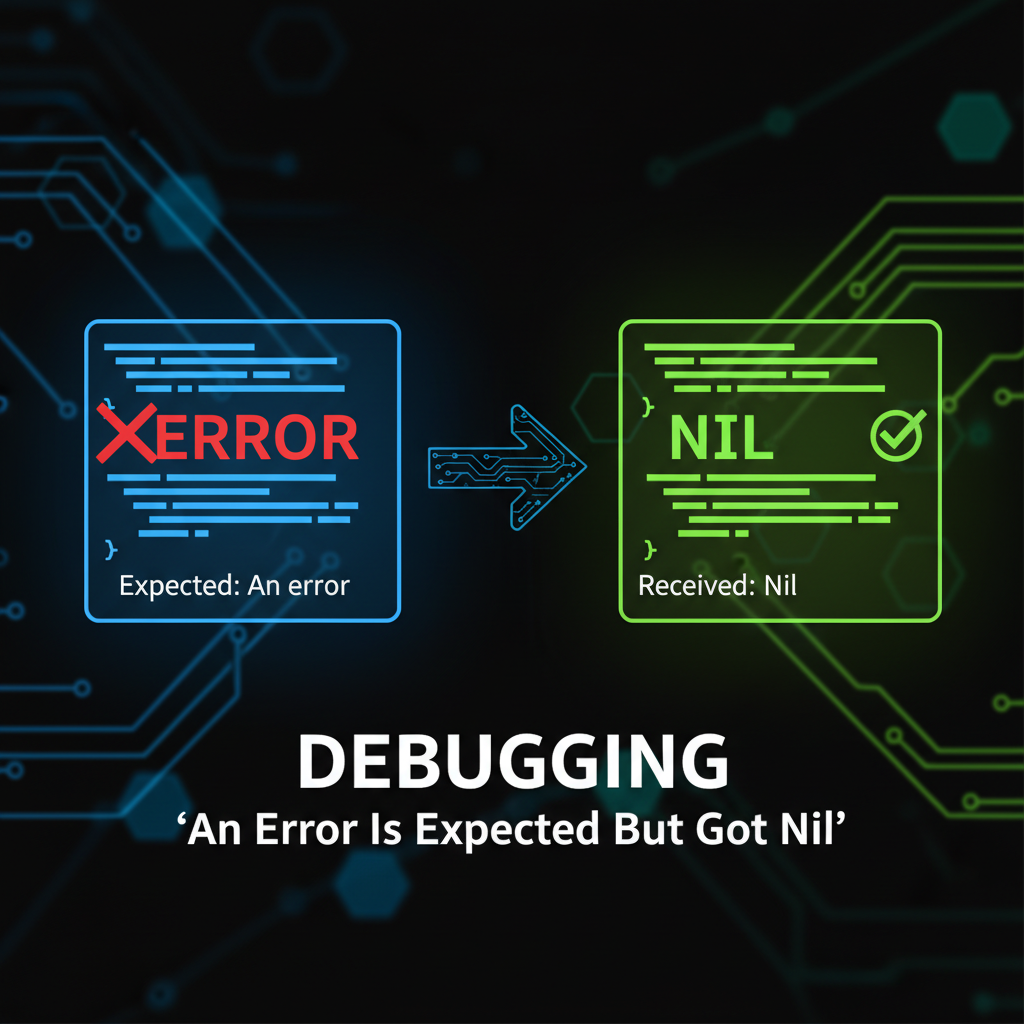


The world of software development is a tapestry woven with intricate logic, elegant design patterns, and, inevitably, a fair share of perplexing errors. Among the myriad of messages that can derail a developer's day, one stands out for its deceptively simple yet profoundly frustrating nature: "An Error Is Expected But Got Nil." This isn't a runtime crash or a syntax error; it's a silent whisper of a deeper flaw, a system that, under specific conditions, fails to report a failure it was designed to encounter. It's the digital equivalent of a smoke detector that remains silent during a fire, leaving developers scratching their heads, wondering why their carefully crafted tests aren't catching the very issues they were meant to expose.
This article delves into the heart of this enigmatic error, exploring its multifaceted origins, the contexts in which it most commonly appears, and, most importantly, a robust arsenal of debugging strategies and preventative measures. We will traverse the landscape of modern software architectures, from microservices interacting through complex APIs to the critical role of the api gateway in orchestrating these communications. We will also touch upon the nuances of model context protocol and how the flow of information can impact error detection. Our goal is not just to fix the immediate problem but to cultivate a deeper understanding of error handling, fostering more resilient and predictable systems. Prepare to embark on a journey that transforms confusion into clarity, enabling you to confidently tackle "An Error Is Expected But Got Nil" and build software that truly stands the test of time and, more importantly, the test of its own errors.
Unpacking the Paradox: What "An Error Is Expected But Got Nil" Truly Means
At its core, "An Error Is Expected But Got Nil" is a diagnostic message, typically generated by a testing framework or a robust validation layer, signaling a mismatch between anticipated behavior and actual outcome. It's not an error thrown by the application's runtime but rather a report about the application's error handling (or lack thereof). To fully grasp its significance, we must dissect both components: "An Error Is Expected" and "Got Nil."
The "Expected" Part: Why We Anticipate Failure
In software, anticipating errors is not a sign of pessimism but of prudent design. Robust systems are built with the understanding that things will go wrong: users will provide invalid input, network connections will drop, external services will become unavailable, databases will face integrity constraints, and resources will be exhausted. Consequently, developers consciously design specific code paths where an error condition should be met. These paths typically involve:
- Input Validation: When a user submits data that doesn't conform to expected formats, types, or business rules (e.g., an email address without an '@' symbol, a negative quantity for an order, an invalid date range). The system is expected to reject this input and report an error.
- Resource Unavailability: Attempting to access a file that doesn't exist, connect to a database that's offline, or consume an api that is rate-limited or returning a 5xx status code. In these scenarios, the operation cannot complete successfully, and an error should be propagated.
- Permission Denials: An unauthorized user attempting to perform an action they lack privileges for. The security layer should explicitly deny the request and signal an access error.
- Logical Constraints: Business logic that dictates certain conditions must be met (e.g., an item must be in stock before it can be purchased). If these conditions are not met, a domain-specific error is expected.
- External Service Failures: Interactions with third-party apis, payment gateways, or AI models might encounter their own issues (timeout, malformed response, internal server error). The calling system expects to receive an error indicating the external problem.
- Concurrency Issues: Race conditions or deadlocks that lead to unrecoverable states where an operation fails to complete within an acceptable timeframe or consistency guarantees are violated.
The "expectation" often originates from a test case specifically crafted to verify these failure scenarios. A well-designed unit or integration test will deliberately set up conditions that should trigger an error, then assert that the error object is indeed returned and, often, that its type or message matches the expected failure.
The "Got Nil" Part: The Absence of Expected Failure
"Nil" (or null, None, depending on the programming language) is universally understood to mean "nothing" or "the absence of a value." In the context of error handling, "Got Nil" means that where an error object was anticipated, the function or operation instead returned a nil error or simply completed without any indication of a problem. This is the crux of the issue: the system believes it succeeded, even when the conditions for failure were meticulously arranged.
Consider a function SaveUser(user User) error in Go. If user contains an invalid email, we expect SaveUser to return an error object. "Got Nil" implies that SaveUser returned nil, suggesting success, despite the invalid input. Similarly, in a JavaScript promise chain, if a catch block is expected to execute due to a rejected promise, but the promise instead resolves, that's a "Got Nil" situation.
The danger of "Got Nil" lies in its subtlety. Unlike a panic or an unhandled exception that brings down the application or halts execution, a nil error allows the program to continue executing down a success path, potentially leading to:
- Corrupted Data: Invalid data silently processed and stored in the database.
- Inconsistent State: Application state becoming desynchronized with reality.
- Security Vulnerabilities: Unauthorized actions proceeding undetected.
- Broken Business Logic: Core functionality failing silently, leading to incorrect outcomes.
- False Sense of Security: Tests passing while critical failure paths remain untested and vulnerable.
Effectively, "Got Nil" signifies a broken contract between the expected behavior of a system under stress or with invalid input, and its actual response. It's a critical signal that the error handling mechanism itself is flawed or incomplete, demanding immediate and thorough investigation.
Common Scenarios Leading to "An Error Is Expected But Got Nil"
Understanding the conceptual basis of the error is the first step; identifying its practical manifestations is the next. This section enumerates common scenarios across various layers of an application where "An Error Is Expected But Got Nil" frequently surfaces. Each scenario represents a distinct failure mode in the error handling or testing paradigm.
1. Flawed Error Handling Logic Within the Application Code
This is perhaps the most direct cause. The application's own logic, designed to detect and report errors, contains a loophole or an oversight.
- Silent Error Suppression: A common anti-pattern is to catch an error but then do nothing with it, or log it and continue execution as if nothing happened. For example, an empty
catchblock in JavaScript, or assigning an error to_in Go without checking its value.go // Example: Error is caught but not returned func ProcessPayment(amount float64) error { if amount < 0 { // Should return an error, but proceeds fmt.Println("Attempted to process negative amount") return nil // Incorrectly returns nil } // ... payment processing logic ... return nil }In a test expecting an error foramount < 0, this function would returnnil, leading to our dreaded message. - Conditional Logic Errors: The
ifstatement orswitchcase meant to trigger an error path simply isn't met under the expected failure conditions. Perhaps the conditionif err != nilis misplaced, or the variableerritself is never correctly assigned the actual error from a sub-function call. - Missing
returnStatements: In languages like Go, it's easy to check an error but forget toreturnit, allowing the function to continue and eventually returnnilimplicitly.go func FetchUserData(id string) error { data, err := db.GetUser(id) if err != nil { log.Printf("Error fetching user: %v", err) // Missing 'return err' here! } // Function continues and implicitly returns nil return nil }Ifdb.GetUserreturns an error, it's logged, but the function still signals success. - Resource Management Issues: When dealing with files, network connections, or database transactions, errors might occur during setup or teardown (e.g., failing to close a file or commit a transaction). If these errors are not correctly caught and propagated, the main function might return
nil.
2. Incorrect Test Setup and Mocking Strategies
Tests are the primary place where "An Error Is Expected But Got Nil" manifests. If the test itself is flawed, it won't accurately simulate failure.
- Mocks Not Configured for Failure: When testing a component that interacts with external dependencies (databases, other microservices, apis), developers often use mocks or stubs. If these mocks are configured to always succeed or to only return specific success data, they won't adequately simulate a failure scenario.
- Example: A test for a
UserServicethat callsUserRepository.SaveUser. If the mockUserRepositoryis set up toSaveUsersuccessfully every time, even when provided invalid user data, theUserServicetest expecting an error for invalid data will receivenilfrom its mocked dependency.
- Example: A test for a
- Missing Error Test Cases: Sometimes, developers simply forget to write tests that explicitly check for error conditions. They might cover all happy paths but overlook the crucial unhappy paths.
- Improper Test Data: The test data used to trigger an error might not be genuinely invalid in the way the error handling logic expects. For instance, testing with an empty string when the validation expects a malformed string.
- Asynchronous Test Challenges: In asynchronous operations (e.g., Promises in JavaScript, goroutines in Go), it's easy for tests to complete before the asynchronous error handling logic has a chance to execute, or for the error to be handled in a separate callback that the test isn't monitoring.
3. External API Interaction Problems, Especially with API Gateways
When our application interacts with external services or microservices, the error landscape becomes more complex. The api gateway plays a pivotal role here, acting as the traffic cop and often the first line of defense and error standardization.
- API Gateway Masking Errors: An api gateway might be configured to intercept upstream errors (e.g., 500s from a backend service) and return a generic 200 OK with an empty body or a non-error payload. This can happen if the gateway's error transformation policies are misconfigured or too aggressive. For instance, if an api gateway is set up to return a default success response even when a specific microservice behind it returns a 503 Service Unavailable. The client (your application) would then receive a
nilerror from its api call to the gateway, even though a failure occurred upstream. - Misunderstanding External API Contracts: The external api might not return errors in the format or HTTP status codes our application expects. It might, for example, return a 200 OK status code even for logical errors, embedding the error details within the JSON response body. If our client code only checks for non-2xx HTTP codes, it will miss these in-body errors and treat the response as a success, leading to
nilerror propagation. - Network Library Default Behavior: Some HTTP client libraries might treat certain non-2xx status codes as "successful" responses from a network perspective (meaning the request went through and a response was received), leaving the application to manually check the status code for errors. If this check is omitted or flawed, the library might report
nilfor an error-containing response. - Latency/Timeout Errors Handled Too Late: Network timeouts or slow responses from an api might not be immediately translated into errors by the calling client. If a client-side timeout is not properly configured or handled, it might simply wait indefinitely or return
nilif the connection eventually closes silently after a long delay.
This is where a robust api gateway like APIPark becomes invaluable. APIPark, as an open-source AI gateway and API management platform, offers features like comprehensive API call logging and powerful data analysis. These capabilities can provide deep insights into every API interaction, allowing developers to quickly trace and troubleshoot issues, including those masked by upstream services or misconfigured error propagation. Its ability to standardize API formats and manage API lifecycle ensures that error contracts are consistently enforced and monitored, reducing the likelihood of "An Error Is Expected But Got Nil" due to external dependencies.
4. model context protocol Misinterpretations
The term model context protocol can refer to various concepts, especially in modern distributed systems, AI/ML contexts, or microservices architectures. It generally pertains to how contextual information (e.g., trace IDs, user identity, tenant information, specific AI model parameters) is passed between different components or layers of an application. Misinterpretations or failures in this protocol can directly lead to "Got Nil" situations.
- Context Propagation Errors: If critical context needed for an operation (e.g., a user's permissions, a tenant ID, a specific AI model configuration) is not correctly propagated through the
model context protocol, a subsequent function might default to a "safe" or "success" path rather than correctly identifying the missing context as an error. For example, if aUser IDis expected in the context to determine access rights, but it'snil, the system might incorrectly grant access rather than throwing aPermissionDeniederror. - AI Model Inference Failures: In AI/ML services, a
model context protocolmight dictate how input data, hyper-parameters, or even chosen model versions are passed. If, for instance, a required parameter for an AI model (e.g., a specifictemperaturesetting for a text generation model) is missing or malformed in the context, the AI api might return a default, often empty or nonsensical,niloutput rather than a clear error message indicating invalid input parameters. Our application, not expectingnilas a valid error, would then process it as a success. - Schema Mismatch in Context: The
model context protocolmight define a specific schema for context objects. If a component receives a context object that doesn't conform to this schema (e.g., a field isnilthat shouldn't be), but the deserialization or validation logic for the context itself doesn't generate an error, subsequent operations relying on thatnilfield might proceed down an unintended path. - Security Context Mismanagement: If the security context (e.g., JWT token, session ID) is corrupted or absent, an authentication/authorization layer might fail open (allowing access) rather than fail closed (denying access with an error). This could be due to a bug in how the
model context protocolhandles empty or invalid security headers.
These subtle failures in propagating or interpreting contextual information can be exceptionally difficult to debug because the immediate cause of the "nil" error is far removed from where the context was initially malformed or lost.
Debugging Strategies: Illuminating the Path to Expected Errors
When faced with "An Error Is Expected But Got Nil," a systematic and methodical approach is crucial. This isn't an error that screams for attention; it's one that requires careful investigation.
1. Reproduce the Error Consistently
The absolute first step in debugging any issue is to make it reliably reproducible. Without a consistent way to trigger the "Got Nil" condition, any debugging efforts will be like shooting in the dark.
- Isolate the Test Case: Pinpoint the specific unit, integration, or end-to-end test that is generating the message. Ensure it's the smallest possible test that demonstrates the problem.
- Manual Trigger: If the error occurs in a complex integration or end-to-end test, try to reproduce the scenario manually using tools like
curl, Postman, or a custom script. This helps eliminate test framework intricacies as potential culprits. - Simplify Inputs: Reduce the complexity of the input data that's supposed to trigger the error. Use the absolute minimum required to cause the failure.
2. Deep Dive with Logging and Tracing
Logging and tracing are your eyes and ears inside the application's execution flow. Strategic placement can illuminate where the expected error path is being bypassed.
- Granular Logging: Add verbose log statements at critical junctures:
- Before and after calls to functions that are expected to return an error.
- Inside conditional blocks (
if,switch) that check for error conditions. - At the point where an external api call is made and its response is processed.
- Where any
model context protocoldata is being read or written. - Log the actual values of variables that dictate error conditions.
Example: ```go func ProcessRequest(req *Request, ctx context.Context) error { log.Printf("DEBUG: Entering ProcessRequest for request ID: %s", req.ID)
// Log context parameters relevant to model context protocol
modelConfig := GetModelConfigFromContext(ctx)
if modelConfig == nil {
    log.Println("DEBUG: Model config is nil in context.")
} else {
    log.Printf("DEBUG: Model config: %+v", modelConfig)
}

validationErr := ValidateRequest(req)
if validationErr != nil {
    log.Printf("DEBUG: ValidateRequest returned an error: %v", validationErr)
    return validationErr
}
log.Println("DEBUG: Request validation successful.")

// ... other processing ...

apiResponse, apiErr := CallExternalAPI(req)
if apiErr != nil {
    log.Printf("DEBUG: CallExternalAPI returned an error: %v", apiErr)
    return apiErr
}
log.Printf("DEBUG: CallExternalAPI successful, response status: %d", apiResponse.StatusCode)

if apiResponse.StatusCode >= 400 {
    // This is where an error *should* be generated if the external API returns a client/server error
    log.Printf("DEBUG: External API returned error status code %d. Processing as error.", apiResponse.StatusCode)
    return fmt.Errorf("external API error: %s", apiResponse.Body)
}
log.Println("DEBUG: ProcessRequest returning nil (success).")
return nil
} ``` * Structured Logging: Use structured logs (JSON, key-value pairs) for easier parsing and filtering, especially in complex microservice environments. Include trace IDs, span IDs, and request IDs to correlate logs across different services. * Distributed Tracing: For microservice architectures, tools like Jaeger, Zipkin, or OpenTelemetry are invaluable. They visualize the flow of a request across multiple services, highlighting latency and, crucially, where an error might have been dropped or transformed into a success. If an api gateway is involved, ensure it's configured to propagate tracing headers.
3. Step-by-Step Debugging with an IDE
There's no substitute for stepping through code line by line with a debugger. This allows you to inspect variable states, observe function return values, and understand the exact execution path.
- Set Breakpoints: Place breakpoints at the start of the function under test, inside conditional error checks, and at any points where external dependencies are called.
- Inspect Variables: Pay close attention to error variables. Is
errever non-nil? If it is, why isn't it being returned? What are the values of inputs that are supposed to trigger errors? - Follow Execution Path: Observe which
iforelsebranches are taken. If an error is expected in a certain branch, but the debugger skips it, you've found a critical clue.
4. Analyze External Dependencies and API Gateway Logs
When the error involves external services or an api gateway, their logs become primary sources of truth.
- API Gateway Logs: Examine the api gateway's access logs and error logs.
- Did the gateway receive the request correctly?
- Did it successfully forward the request to the upstream service?
- What response did the upstream service send back to the gateway (including status codes and full response bodies)?
- Was there any error transformation applied by the gateway that might have masked the original error?
- If you're using APIPark, its detailed API call logging will be indispensable here. It records every detail of each API call, enabling businesses to quickly trace and troubleshoot issues, offering granular visibility into the gateway's behavior and upstream responses.
- Upstream Service Logs: If you control the upstream service (the one your application or api gateway calls), check its logs. Did it receive the request? Did it process it? What error (if any) did it generate internally before sending a response?
- Network Tools: Use
curl -v, Wireshark, tcpdump, or browser developer tools to observe the raw HTTP traffic. This helps confirm what exactly is being sent and received over the wire, bypassing any client-side abstractions that might be misleading.- Check HTTP status codes, response headers, and the full response body for hidden error messages.
5. Code Review and Architectural Assessment
Sometimes, the problem isn't in a single line of code but in a broader design flaw or a missed pattern.
- Peer Review: Have another developer review the relevant code, especially the error handling logic and the test case. A fresh pair of eyes can often spot what you've overlooked.
- Error Handling Consistency: Review the project's overall error handling strategy. Is it consistent? Are there established patterns for how errors are returned, propagated, and logged? Inconsistent approaches are fertile ground for "Got Nil" errors.
- API Contracts: Revisit the api contract (OpenAPI/Swagger definition) for external services. Does our code correctly interpret its error response schemas? Are we expecting a 400 when the api actually returns a 200 with an error object in the payload?
- Model Context Protocol Review: Examine how the
model context protocolis implemented. Are all necessary context fields explicitly validated upon reception? Is there a clear protocol for handling missing or invalid context fields, and do these paths correctly generate errors?
APIPark is a high-performance AI gateway that allows you to securely access the most comprehensive LLM APIs globally on the APIPark platform, including OpenAI, Anthropic, Mistral, Llama2, Google Gemini, and more.Try APIPark now! 👇👇👇
The Critical Role of API Gateways in Error Management
The api gateway stands as a crucial intermediary in modern distributed architectures, particularly those built on microservices. Its role extends far beyond simple request routing; it is a nexus for security, traffic management, and, critically, error handling. A misconfigured or poorly understood api gateway can be a primary contributor to "An Error Is Expected But Got Nil," but conversely, a well-managed gateway can be your most potent tool for debugging and preventing such issues.
API Gateway as an Error Standardizer and Transformer
One of the significant advantages of an api gateway is its ability to standardize error responses across a multitude of disparate backend services. Imagine a scenario where you have ten microservices, each built by different teams using different technologies, and each returning errors in its own unique format (some JSON, some XML, some plain text, with varying status codes for similar logical errors). The api gateway can intercept these diverse upstream errors and transform them into a consistent, developer-friendly format that your client applications can reliably parse.
However, this powerful transformation capability is a double-edged sword. If the transformation rules are flawed, the gateway might inadvertently:
- Mask Upstream Errors: Convert a 500 Internal Server Error from a backend service into a 200 OK with a generic success message, or simply an empty body. Your client application, expecting a non-2xx status for an error, would then receive
nilwhere an error was expected. - Generate Vague Errors: Transform specific, actionable backend errors into generic "Something went wrong" messages, making debugging incredibly difficult for the client, even if an error is propagated.
- Misinterpret Status Codes: Some api gateways, by default, might not treat certain upstream non-2xx status codes (e.g., 404 Not Found from a specific service) as critical errors requiring a full error response to the client, especially if a fallback mechanism is misconfigured.
Observability at the Gateway Layer
A robust api gateway offers unparalleled observability into the flow of api requests and responses. This observability is paramount for debugging "An Error Is Expected But Got Nil" scenarios that involve external api calls.
- Detailed Request/Response Logging: The gateway's ability to log the full request and response (headers, body, status codes) for every api call, both to and from upstream services, provides a forensic trail. If your application receives
nilwhere an error was expected, examining the api gateway logs can reveal what the upstream service actually returned to the gateway. This often uncovers whether the upstream service returnednilitself, or if the gateway performed an erroneous transformation. - Metrics and Analytics: Gateways provide metrics on request rates, error rates (broken down by upstream service, status code, etc.), and latency. A sudden drop in the reported error rate for an upstream service, coupled with unexpected successes in your client tests, could be a strong indicator that errors are being silently swallowed. APIPark, for instance, offers powerful data analysis capabilities on historical call data, displaying long-term trends and performance changes, which can help in preventive maintenance and early detection of such error-masking issues before they escalate.
- Distributed Tracing Integration: Modern api gateways integrate with distributed tracing systems (e.g., OpenTelemetry). By adding trace IDs at the gateway level and propagating them to all downstream services, you can visualize the entire journey of a request, identifying precisely where an error might have originated and, more importantly, where it ceased to be an error and became
nil.
Configuring for Resilience and Explicit Error Handling
To mitigate "An Error Is Expected But Got Nil" errors, an api gateway must be configured not just for performance, but for explicit and robust error handling.
- Explicit Error Response Policies: Define clear policies for how different types of upstream errors (HTTP status codes, specific error payloads) should be translated into downstream client responses. Ensure these policies always return a meaningful error (e.g., a 4xx or 5xx status code with a standardized error JSON body) when an upstream service indicates a failure.
- Circuit Breakers and Timeouts: Implement circuit breakers and aggressive timeouts at the gateway level. If an upstream service is unhealthy or takes too long to respond, the gateway should fail fast with an error, rather than potentially returning
nilafter a prolonged wait, or allowing the client to timeout first. - Request/Response Schema Validation: Some advanced api gateways allow for schema validation of request and response bodies. If an upstream service returns a response that violates its own api contract (e.g., an error object in a success path with an unexpected structure), the gateway can catch this and generate a validation error, preventing the client from misinterpreting the response as
nilsuccess.
APIPark stands out as an open-source solution that addresses these challenges head-on. As an AI gateway and API management platform, it offers end-to-end API lifecycle management, which includes regulating API management processes and traffic forwarding. This ensures that error handling configurations are consistently applied and managed. Its quick integration of over 100+ AI models and unified API format for AI invocation means that even when dealing with complex AI services, the potential for model context protocol errors or misinterpretations is minimized through standardization. With APIPark's focus on detailed logging and data analysis, developers gain the granular visibility needed to debug even the most elusive "An Error Is Expected But Got Nil" scenarios, fostering a robust and predictable api ecosystem. You can explore its capabilities at ApiPark.
Understanding the Model Context Protocol and Its Impact on Error Handling
The term model context protocol is a sophisticated concept that typically refers to the standardized way in which various pieces of contextual information are encapsulated and propagated across different layers or components of a software system, especially those involving complex domain models, AI/ML inference, or distributed transaction flows. This context can include anything from user session details, tracing identifiers, tenant IDs, security tokens, to specific parameters required for a particular AI model's operation. When this protocol is either poorly defined, incorrectly implemented, or misinterpreted, it can directly lead to "An Error Is Expected But Got Nil."
What Constitutes Model Context Protocol?
In essence, a model context protocol defines:
- What information is relevant: Identifying the key data points that need to accompany a request or operation throughout its lifecycle.
- How information is structured: Specifying the schema or format for encapsulating this data (e.g., a Go
context.Contextobject, a JavaThreadLocal, HTTP headers, or a protobuf message). - How information is propagated: Defining the mechanisms for passing this context between functions, services, and even different processes (e.g., implicit passing, explicit function arguments, message queue headers).
- How information is interpreted: Establishing clear rules for how each component should consume and act upon the received context.
Examples of model context protocol in practice:
- Distributed Tracing: Standards like OpenTelemetry define a
model context protocolfor propagating trace IDs and span IDs across service boundaries using HTTP headers or message queue attributes. - Multi-Tenancy: A protocol for passing a
tenant IDto ensure data isolation. - Security Context: How authorization tokens or user roles are passed and verified.
- AI/ML Inference Parameters: A protocol for carrying specific model version, temperature, top-k, or other inference parameters from a user request through an api gateway to an AI inference service.
How Protocol Failures Lead to "An Error Is Expected But Got Nil"
When the model context protocol breaks down, it often leads to situations where an error should occur but nil is returned instead.
- Missing or Incomplete Context:
- Scenario: A downstream service or function requires a specific piece of context (e.g., a
user_idto check permissions, anapi_keyfor an internal api call, amodel_versionfor an AI prediction). However, due to a bug in themodel context protocolimplementation, this piece of information is either missing entirely or isnilwithin the context object. - Resulting Error: Instead of explicitly checking for the absence of this critical context and returning an error like
MissingRequiredContextError, the code might proceed with a default value (which could benil), leading to incorrect logic execution. For example, defaulting to "guest" permissions, or loading a default AI model version when a specific one was required and failed to propagate. The operation then completes "successfully" withnileven though it didn't adhere to the original intent.
- Scenario: A downstream service or function requires a specific piece of context (e.g., a
- Misinterpretation of Context Values:
- Scenario: The context is propagated, but a component misinterprets a value. For example, a
model_versionparameter is passed as a string "latest," but the processing logic expects an integer ID and defaults tonilwhen parsing fails, or worse, defaults to a an initial value that doesn't trigger an error. - Resulting Error: The system might then use an unintended model, or fail to apply specific business logic tied to that context, returning
nilbecause no explicit error path for "misinterpreted context" was triggered.
- Scenario: The context is propagated, but a component misinterprets a value. For example, a
- Invalid Context Structure:
- Scenario: The
model context protocoldefines a specific structure (e.g., a JSON object with certain keys). If the received context deviates from this structure (e.g., a required field is absent or malformed, but the parsing logic is too lenient and assignsnilto the missing field), subsequent logic might rely on thatnilfield. - Resulting Error: Instead of throwing a
ContextSchemaValidationError, the system silently processes thenilfield, potentially leading to incorrect decisions and eventually a "successful" (but wrong) outcome without an error being reported.
- Scenario: The
- Security Context Breaches:
- Scenario: A security token or user identity, part of the
model context protocol, becomes corrupted or expires mid-request. If the authentication/authorization layer fails to correctly identify this as an invalid context and instead passes aniluser object, subsequent permission checks might fail open (allow access) rather than throwing aPermissionDeniederror. - Resulting Error: The operation proceeds "successfully" (from an error-reporting perspective), but with a critical security vulnerability that should have generated an explicit error.
- Scenario: A security token or user identity, part of the
Debugging these scenarios requires a deep understanding of the model context protocol in use, careful logging of context values at each processing step, and robust validation of context integrity before it's consumed by business logic. The elegance of model context protocol lies in its ability to carry rich information, but its complexity also introduces new avenues for errors that can hide behind a deceiving "Got Nil."
Best Practices for Preventing "An Error Is Expected But Got Nil"
Prevention is always better than cure. By adopting a set of rigorous development practices, we can significantly reduce the occurrence of "An Error Is Expected But Got Nil" and build more reliable systems from the outset.
1. Robust Test Design: Test for Failure Explicitly
- Comprehensive Negative Testing: For every happy path test, consider at least one or more "unhappy path" tests. Test invalid inputs, edge cases (empty strings, zero, negative numbers), boundary conditions, and scenarios where external dependencies fail.
- Assert Error Types and Messages: Don't just assert that
err != nil. Assert that the type of error is correct (e.g.,IsUserNotFoundError(err)) and, where appropriate, that the error message is meaningful. This ensures that the correct error is being returned, not just any error, and crucially, notnil. - Dependency Injection and Mocks: Use dependency injection to easily swap out real dependencies with controlled mocks in tests. Ensure mocks are capable of simulating failure scenarios by returning specific error objects. A good mocking framework should make it straightforward to configure a mock to
ThrowError()orReturnError(mySpecificError). - Behavior-Driven Development (BDD): Frame your tests around behaviors: "Given this input, when I perform this action, then I expect this error to occur." This mindset naturally encourages testing both success and failure outcomes.
2. Defensive Programming and Explicit Error Handling
- Always Check for Errors: Never assume a function will succeed. After every operation that can potentially fail, immediately check for an error condition. ```go // Bad: Ignoring potential error result, _ := someFunction()// Good: Always check result, err := someFunction() if err != nil { return err // Or handle it appropriately }
`` * **Never Swallow Errors Silently:** Logging an error is good, but if that error prevents the intended operation from completing successfully, it must be propagated up the call stack or transformed into a new, appropriate error. Emptycatchblocks or_ = errassignments are major red flags. * **Return Early on Error:** In many languages, returning an error as soon as it's detected simplifies logic and prevents unintended execution of subsequent "success path" code. * **Meaningful Error Messages:** Provide clear, actionable error messages. Include context like variable values, function names, or originating component. This makes debugging much easier when an error *is* finally reported. * **Custom Error Types/Codes:** For domain-specific errors (e.g.,ValidationError,InsufficientFundsError,UserNotFound`), define custom error types or use standardized error codes. This allows callers to programmatically distinguish between different types of failures.
3. Consistent Error Handling Strategy
- Standardized Error Responses (APIs): For your apis, establish a consistent format for error responses (e.g., a JSON object with
code,message,detailsfields) and consistent HTTP status code usage (4xx for client errors, 5xx for server errors). This helps clients reliably parse errors and avoids misinterpreting error conditions. - Centralized Error Logging: Implement a centralized logging system that aggregates errors from all services. This allows for easy monitoring, alerting, and analysis of error patterns. Ensure sufficient context (request IDs, trace IDs, user IDs) is included in error logs.
- Error Boundaries and Recovery: Design clear "error boundaries" where errors are caught, transformed, and potentially recovered from. For example, an api gateway might transform a low-level network error into a higher-level
ServiceUnavailableerror for the client.
4. Contract-First Development for APIs
- Define API Contracts Explicitly: Use tools like OpenAPI (Swagger) to formally define your apis, including all possible request schemas, response schemas, and, crucially, error response schemas.
- Generate Client/Server Stubs: Generate client and server stubs from your OpenAPI definition. This ensures that both sides adhere to the defined contract, reducing the likelihood of
model context protocolmismatches or unexpectednilvalues when interacting with an api. - Validate Inputs and Outputs Against Contract: Implement runtime validation to ensure that incoming requests conform to the schema and outgoing responses (both success and error) also conform. This helps catch discrepancies early.
5. Continuous Integration/Continuous Deployment (CI/CD)
- Automated Testing in CI: Integrate all your unit, integration, and end-to-end tests into your CI pipeline. Every code commit should trigger a full suite of tests, including those designed to check for expected errors. This catches regressions quickly.
- Static Analysis and Linters: Use static code analysis tools (linters) that can identify common error-handling anti-patterns (e.g., unused error variables, ignored return values, empty catch blocks).
6. Monitoring and Alerting
- Production Error Monitoring: Even with the best testing, some errors will reach production. Implement robust monitoring and alerting systems to immediately detect increases in application error rates, specific error types, or even a sudden drop in expected error rates (which could signal "Got Nil" issues in production).
- Health Checks: Configure health checks for your services. If a service is consistently failing to return expected errors (e.g., always returning
nileven for invalid inputs), its health check might become degraded.
Table: Debugging "An Error Is Expected But Got Nil" - A Checklist
To provide a structured approach, the following table summarizes a practical checklist for debugging this specific error, incorporating the concepts discussed.
| Debugging Stage | Key Actions | Tools & Considerations | Potential Outcome |
|---|---|---|---|
| 1. Reproduce & Isolate | - Pinpoint the exact test/scenario. - Simplify inputs to minimum for failure. - Manual reproduction if necessary ( curl, Postman). |
Test framework, manual api clients. |
Consistent error trigger, narrowed scope. |
| 2. Observe & Log | - Add verbose logs at crucial points: function entry/exit, before/after external calls, inside error checks, model context protocol usage. - Log variable values. |
Application logging framework (e.g., Log4j, Winston, standard log in Go), structured logging, distributed tracing (Jaeger, OpenTelemetry). |
Identify which error path is not being taken, see if err variable is ever non-nil internally. |
| 3. Step-Through Code | - Use IDE debugger. - Set breakpoints: function start, error checks, external calls. - Inspect variables: err objects, input values. - Follow execution flow. |
IDE debugger (VS Code, IntelliJ, GoLand, Visual Studio). | Pinpoint the exact line where an expected error is missed or swallowed. |
| 4. External Dependencies | - Review api gateway logs: what did the upstream service actually return to the gateway? - Review upstream service logs. - Use network sniffers (Wireshark) / curl -v. |
APIPark logs, cloud provider logs, kubectl logs, docker logs, curl -v, Wireshark, Postman/Insomnia. |
Uncover masked errors from upstream services or incorrect gateway transformations. Confirm raw api responses. |
| 5. Protocol & Contract | - Revisit model context protocol definition: is context correctly populated/interpreted? - Check api contracts: does our client expect errors in the format the api provides? |
API documentation (OpenAPI/Swagger), internal model context protocol specifications. |
Identify model context protocol mismatches or misinterpretations of external api error responses. |
| 6. Code Review & Refine | - Peer review error handling logic. - Check for silent error suppression ( _ = err, empty catch). - Ensure return err statements are present. |
Code review tools, static analysis/linters. | Identify explicit coding errors in error propagation, improve overall error handling consistency. |
| 7. Test Enhancement | - Write specific new negative test cases. - Ensure mocks correctly simulate error conditions. - Assert on specific error types/messages. |
Test framework, mocking libraries. | Prevent future occurrences, validate current fix, ensure test suite robustness. |
By meticulously following these steps, developers can systematically dismantle the mystery of "An Error Is Expected But Got Nil" and restore confidence in their error handling mechanisms.
Conclusion: The Pursuit of Predictable Failures
The seemingly innocuous error message "An Error Is Expected But Got Nil" is far more than a simple diagnostic; it is a critical indicator of a fundamental misalignment between a system's intended behavior and its actual execution. It highlights a perilous gap in our error handling, where an anticipated failure silently transforms into an unexpected success, leaving corrupted data, inconsistent states, and a false sense of security in its wake. This journey has traversed the intricate landscape of programming logic, the pivotal role of the api gateway in orchestrating and standardizing api interactions, and the subtle yet profound impact of the model context protocol on the propagation of vital contextual information.
Debugging this elusive error demands a methodical, multi-pronged approach: from consistently reproducing the anomaly and leveraging granular logging and step-by-step debugging to meticulously analyzing external dependencies and understanding the nuances of how context is managed across services. Solutions like APIPark, with its robust API management, comprehensive logging, and analytical capabilities, offer invaluable assistance in gaining the visibility needed to dissect complex API flows and pinpoint where errors are being mishandled or swallowed.
Ultimately, preventing "An Error Is Expected But Got Nil" is a testament to the pursuit of predictable failures. It requires a commitment to defensive programming, designing tests that explicitly validate negative paths, and establishing a consistent, transparent error handling strategy across the entire software ecosystem. By adopting best practices like contract-first development, integrating static analysis into CI/CD pipelines, and maintaining vigilant monitoring, we empower our systems to not only succeed gracefully but, perhaps more importantly, to fail predictably and informatively. In the complex symphony of modern software, ensuring that an expected error never yields a deceptive nil is a cornerstone of building resilient, trustworthy, and maintainable applications.
Frequently Asked Questions (FAQs)
1. What does "An Error Is Expected But Got Nil" fundamentally mean?
At its core, "An Error Is Expected But Got Nil" means that in a specific test or operational scenario, your code or a dependency was set up to produce an error condition (e.g., invalid input, resource unavailable), but instead of returning an error object, it returned nil (or null/None), signaling a success. This indicates a flaw in your error handling logic or your test setup, allowing a failure scenario to silently pass as a success.
2. How can an API Gateway contribute to this specific error?
An api gateway can inadvertently cause "An Error Is Expected But Got Nil" if it's misconfigured to mask upstream errors. For example, it might transform a 500 Internal Server Error from a backend service into a 200 OK status with an empty body or a generic success message to the client. If your client-side code only checks for non-2xx HTTP status codes to detect errors, it will then receive nil where a genuine error should have been propagated. Conversely, robust api gateways like APIPark can help prevent and debug these issues through detailed logging, error transformation policies, and monitoring capabilities.
3. What is model context protocol and how does its failure lead to this error?
The model context protocol refers to the standardized way contextual information (e.g., user IDs, trace IDs, AI model parameters, tenant information) is structured and propagated across different components or layers of a system. A failure in this protocol (e.g., critical context being nil or misinterpreted) can lead to "An Error Is Expected But Got Nil" if subsequent logic, expecting this context to be present and valid, instead proceeds with a default or nil value, thus bypassing the intended error path and returning nil where an error for missing or invalid context should have occurred.
4. What are the most effective debugging strategies for this error?
The most effective debugging strategies include: 1. Consistent Reproduction: Ensuring you can reliably trigger the error. 2. Granular Logging & Tracing: Adding verbose logs at critical code paths, especially around error checks and external api calls, to observe if an error object is ever non-nil internally. Distributed tracing is vital for microservices. 3. Step-by-Step Debugging: Using an IDE debugger to inspect variable states and execution paths. 4. External System Analysis: Checking api gateway logs (like those from APIPark), upstream service logs, and raw network traffic (curl -v) to understand what responses are actually being returned. 5. Code Review: Having a fresh pair of eyes review error handling logic and test setups.
5. How can I prevent "An Error Is Expected But Got Nil" in my software development?
Prevention is key: * Robust Test Design: Write comprehensive negative tests that explicitly assert on expected error types and messages. * Defensive Programming: Always check for errors after operations that can fail, and never silently swallow errors. Return errors early. * Consistent Error Handling: Establish standardized error formats for apis and centralized logging. * Contract-First Development: Define clear api contracts, including error responses, and validate against them. * CI/CD & Static Analysis: Integrate automated tests and linters to catch error handling anti-patterns early. * Vigilant Monitoring: Implement monitoring and alerting to detect unusual error patterns in production, including unexpected drops in error rates.
🚀You can securely and efficiently call the OpenAI API on APIPark in just two steps:
Step 1: Deploy the APIPark AI gateway in 5 minutes.
APIPark is developed based on Golang, offering strong product performance and low development and maintenance costs. You can deploy APIPark with a single command line.
curl -sSO https://download.apipark.com/install/quick-start.sh; bash quick-start.sh

In my experience, you can see the successful deployment interface within 5 to 10 minutes. Then, you can log in to APIPark using your account.

Step 2: Call the OpenAI API.