Contract Testing Public APIs: What It Means
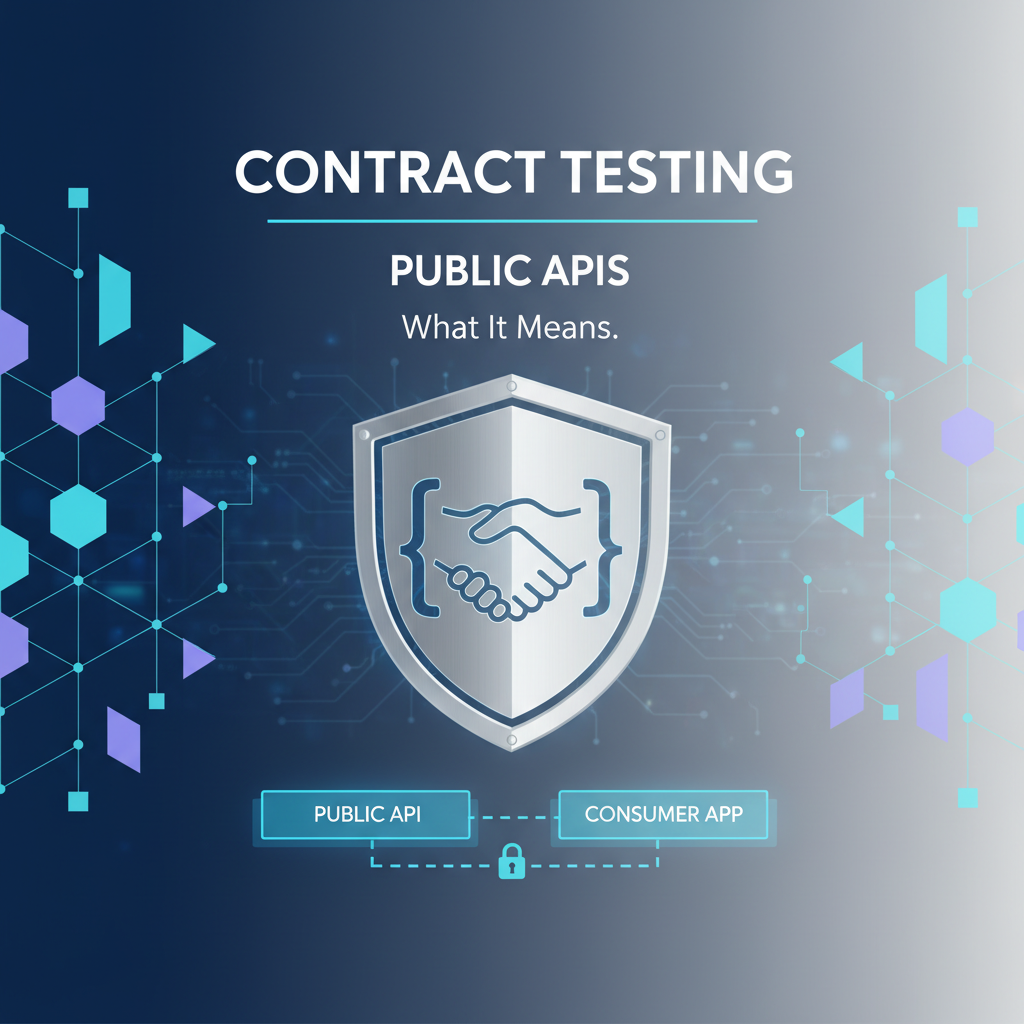


In the intricate, interconnected tapestry of modern software development, where applications rarely stand alone, the seamless interaction between different services is paramount. Public APIs, the open interfaces offered by third-party providers, serve as crucial conduits, enabling everything from payment processing and mapping services to social media integrations and data analytics. They empower developers to build sophisticated applications without having to reinvent the wheel, leveraging the specialized capabilities of external platforms. However, this reliance on external services, while immensely beneficial, introduces a unique set of challenges. The very act of integrating with an api, especially one controlled by an external entity, means relinquishing a degree of control over a critical component of your application's functionality. This is where the concept of contract testing emerges not merely as a valuable practice, but as an indispensable pillar of robust API integration, offering a proactive shield against the inherent volatility and potential instability that can plague such dependencies.
The digital landscape is a dynamic ecosystem, constantly evolving with new features, updates, and architectural shifts. Public APIs, by their nature, are subject to these same forces. A seemingly minor change by an api provider – a tweak in a response payload, an alteration to an endpoint path, or a modification in authentication requirements – can propagate through dependent systems like a ripple, potentially causing unforeseen errors, application failures, and significant operational overhead for consumers. Traditional testing methodologies, while effective in their own domains, often fall short in adequately addressing these inter-service vulnerabilities. Unit tests confirm the internal logic of individual components, integration tests verify direct connections between specific modules, and end-to-end tests validate entire user flows. Yet, none of these inherently provide a lightweight, efficient mechanism to ensure that the agreement or contract between a consumer and a public api remains consistently upheld, especially when the provider operates independently.
This comprehensive guide delves into the essence of contract testing specifically within the context of public APIs. We will embark on a journey to demystify this powerful testing paradigm, exploring its fundamental principles, elucidating its profound benefits, acknowledging its unique challenges, and charting a practical path for its implementation. Our exploration will illuminate how contract testing, coupled with modern API specifications like OpenAPI and the strategic deployment of an api gateway, can transform the precarious act of integrating with external services into a well-managed, confident, and resilient process. By understanding and adopting contract testing, developers and organizations can not only safeguard their applications against breaking changes but also foster a culture of clarity, predictability, and stability in an increasingly API-driven world.
Chapter 1: The Landscape of Public APIs and Their Inherent Challenges
The modern software world is built upon a foundation of interconnected services, and at the heart of this intricate web lie Application Programming Interfaces, or APIs. Public APIs, in particular, have democratized development, allowing innovators to integrate a vast array of functionalities into their applications without having to build every component from scratch. These interfaces expose specific functionalities of a service to external developers, enabling third-party applications to interact with them programmatically. Think of them as standardized doorways into a service, through which requests and responses flow in a predictable format.
Examples of ubiquitous public APIs abound: the Google Maps API allows millions of applications to embed maps and navigation features; the Stripe API provides a secure and robust payment processing infrastructure; Twitter and Facebook APIs enable social integrations; and countless weather, financial, and data analytics services expose their insights through public APIs. The sheer convenience and power offered by these interfaces have made them indispensable components in almost every contemporary software architecture, driving innovation and significantly accelerating development cycles. A small startup can leverage the authentication services of a tech giant or integrate a sophisticated machine learning model without needing the extensive resources to develop these complex systems internally.
However, this reliance on external public APIs, while incredibly empowering, introduces a unique and often underestimated set of challenges. Unlike internal APIs, which are typically under the control of the same organization, public APIs are managed by external entities whose priorities, development cycles, and release schedules may not align with your own. This fundamental lack of control over a critical dependency creates a precarious environment that necessitates robust strategies for mitigation and assurance.
One of the foremost challenges stems from the potential for frequent updates and breaking changes. Public API providers, in their quest to improve services, add new features, or optimize performance, might introduce changes that inadvertently break existing integrations. These could be subtle, like a change in the data type of a field from string to integer, or more significant, such as renaming an endpoint, altering the structure of a request body, or modifying authentication mechanisms. When such a change occurs without adequate communication or warning, consumer applications can suddenly cease to function correctly, leading to service disruptions, frustrated users, and emergency fixes. The impact can be substantial, particularly for mission-critical functionalities.
Another significant hurdle is documentation drift. While API providers generally strive to maintain up-to-date documentation, the reality of fast-paced development often means that the written specification might lag behind the actual implementation. Developers consuming the api might rely on outdated or incomplete documentation, leading to misinterpretations of expected behavior and integration errors that are difficult to diagnose. Even well-maintained OpenAPI (formerly Swagger) specifications, which aim to provide a machine-readable contract, can become outdated if not diligently synchronized with the api's evolution. This discrepancy between what is documented and what is actually implemented creates a gap that can be a source of constant frustration and unexpected behavior.
Performance and reliability issues are also a persistent concern. When your application relies on a public api, its performance and availability become, to some extent, tied to that of the third-party service. Downtime, latency spikes, or rate limiting imposed by the provider can directly impact your application's responsiveness and stability. While these are not directly testing concerns, they highlight the broader need for robust integration strategies that account for external service behavior. Furthermore, the sheer volume of traffic and the diverse range of clients interacting with a public api can sometimes lead to unpredictable performance characteristics that are difficult for an individual consumer to anticipate or fully test against.
Security concerns are another critical dimension. Integrating with a public api often means exchanging sensitive data, and ensuring that this data is handled securely, both in transit and at rest, is paramount. Developers must meticulously adhere to authentication protocols, manage API keys or tokens responsibly, and understand the security implications of data exposure. A public api that is itself vulnerable could become an indirect attack vector for applications that consume it, making the due diligence in integration and ongoing monitoring essential. The responsibility for securing the integration point often lies with the consumer, even if the underlying api has its own robust security measures.
Finally, the sheer complexity of integration itself can be daunting. Many public APIs, especially those offering rich functionality, come with extensive parameter options, nested data structures, and various authentication flows. Correctly implementing the requests, parsing the responses, and handling all possible error scenarios can be a time-consuming and error-prone process. Without a clear, verifiable contract, developers are often left to infer behavior through trial and error, which is inefficient and unreliable. The vastness of some public API ecosystems, with hundreds of endpoints and numerous versions, makes comprehensive manual testing impractical and unsustainable.
These challenges underscore the critical need for a more proactive and systematic approach to managing public api dependencies. While robust monitoring, thorough documentation review, and extensive integration testing are all valuable, they often react to problems after they've occurred or are too heavy-handed for continuous validation. This is precisely the void that contract testing aims to fill, offering a targeted, efficient, and confidence-instilling method to ensure that the delicate agreements between applications and their external public api counterparts remain intact, even amidst constant change.
Chapter 2: Understanding Contract Testing – The Agreement Between Services
Having explored the intricate landscape and inherent challenges associated with integrating public APIs, it becomes clear that a robust and efficient testing methodology is desperately needed to navigate these complexities. This is where contract testing enters the fray, offering a paradigm shift from traditional testing approaches by focusing on the explicit agreement between communicating services. At its heart, contract testing is a methodology for ensuring that two independently developed systems can communicate with each other correctly, based on a shared understanding of their interaction – the "contract."
So, what exactly is contract testing? In essence, it's a verification process that guarantees a producer service (the api provider) meets the expectations of its consumer services (the applications calling the api), and conversely, that the consumer services make requests in the format the producer expects. Unlike other testing types that might focus on the internal workings or the end-to-end flow, contract testing zeroes in on the interface between services. It ensures that the data format, request parameters, response structure, status codes, and other interaction details conform to an agreed-upon specification. This "contract" effectively becomes a living, executable document that both sides can use to validate their respective implementations.
To truly appreciate the value of contract testing, it's beneficial to understand how it differentiates itself from other common testing methodologies:
- Unit Testing: This is the most granular form of testing, focusing on individual components or functions in isolation. While crucial for verifying internal logic, unit tests do not address how different services interact across network boundaries. They confirm your code works as expected, but not that your code's expectations of an external
apiare met by thatapi. - Integration Testing: Integration tests verify the communication paths and interactions between different components or modules within a single system, or between a system and its direct dependencies. For APIs, this often involves spinning up parts of the system and making actual network calls. While more encompassing than unit tests, traditional integration tests can be slow, expensive to set up and maintain, and difficult to isolate failures – if an integration test fails against a public
api, it's often unclear if the issue lies with your code, the network, or the externalapiitself. They often treat the externalapias a black box, only asserting the final outcome without explicitly verifying the intermediate contract. - End-to-End (E2E) Testing: These tests simulate real user scenarios, validating entire workflows from start to finish, often across multiple services and user interfaces. E2E tests are the most comprehensive but also the most brittle, slowest, and most expensive to run. A failure in an E2E test might point to an issue anywhere in the entire stack, making diagnosis challenging. Furthermore, running E2E tests against live public APIs can incur costs, hit rate limits, and introduce non-determinism due to the external service's operational state.
Contract testing carves out a unique niche by providing a lightweight alternative that addresses the inter-service communication gap more efficiently. It doesn't replace unit, integration, or E2E tests; rather, it complements them, fitting snugly between unit and broader integration tests to provide targeted feedback on API compatibility without the overhead of full system deployment or actual service invocation during development cycles.
The core principles that underpin contract testing are fundamental to its effectiveness:
- Consumer-Driven Contracts (CDC): This is perhaps the most distinctive principle. In CDC, the consumer of an
apidefines the contract by specifying what requests it will make and what responses it expects to receive. These expectations are captured as a "pact" or a contract file. The crucial insight here is that the consumer's needs drive the contract, ensuring that theapievolves in a way that continues to serve its active users. For public APIs, this becomes even more vital as the consumer has no control over the provider's roadmap. - Defining the 'Contract': The contract is not a vague agreement; it's a precise, machine-readable specification of an interaction. It details:
- Requests: The HTTP method (GET, POST, PUT, DELETE), the URL path, query parameters, request headers, and the structure/content of the request body (e.g., JSON schema, specific values).
- Responses: The expected HTTP status code (200 OK, 201 Created, 400 Bad Request, 500 Internal Server Error), response headers, and the structure/content of the response body, including data types, field names, and potentially example values.
- State: Any prerequisite state the provider needs to be in for a particular interaction to occur (e.g., "a user with ID 123 exists"). This detailed definition acts as a clear communication channel, leaving little room for ambiguity.
- Verifying Provider Adherence: Once the consumer has defined its expectations and recorded them in a contract, the
apiprovider (or, in the case of public APIs, a well-defined mock of the provider) runs tests against this contract. These "provider verification" tests ensure that the provider's actualapiimplementation does indeed respond to the specified requests with the specified responses. If the provider deviates from the contract, these tests will fail, signaling a potential breaking change before it impacts consumers in production. - Verifying Consumer Expectations: While the provider verifies its adherence, the consumer also runs its tests against a mock of the provider, generated from the same contract. This ensures that the consumer's code correctly makes the expected requests and can correctly process the expected responses. This allows consumers to develop and test their integration logic even when the public
apiis unavailable, in development, or undergoing changes.
Several powerful tools and frameworks have emerged to facilitate contract testing:
- Pact: One of the most popular and feature-rich frameworks for consumer-driven contract testing, supporting multiple languages (JVM, Ruby, JavaScript, .NET, Python, etc.). Pact is excellent for recording consumer expectations and then replaying them against the provider.
- Spring Cloud Contract: A robust solution for JVM-based applications, it supports both consumer-driven and producer-driven approaches and integrates well with Spring Boot microservices.
- Dredd: Specifically designed for API Blueprint and
OpenAPIdocuments, Dredd acts as an HTTP API testing tool that validates if an API's implementation matches its documentation. While not strictly CDC, it helps ensure contract adherence.
In essence, contract testing establishes a safety net, an early warning system that catches incompatibilities between services long before they manifest as production failures. By formalizing the communication contract and continuously validating it from both ends, it transforms API integration from a high-stakes gamble into a predictable and manageable process, especially crucial when dealing with external, public API dependencies.
Chapter 3: Why Contract Testing is Crucial for Public APIs
The dynamic and often unpredictable nature of public APIs presents a unique set of challenges for developers. Unlike internal services where communication and coordination are relatively straightforward, external APIs evolve independently, and consumer applications have little to no influence over their development roadmap. This inherent disconnect makes traditional testing approaches less effective and elevates contract testing from a beneficial practice to an absolutely crucial component of a robust integration strategy. The reasons for its indispensable role are manifold, touching upon risk mitigation, independent development, communication, and significant cost savings.
Mitigating the Risks of External Dependencies
The primary and most compelling reason to adopt contract testing for public APIs is its unparalleled ability to mitigate the risks associated with external dependencies. When your application relies on a public api, you are essentially building on top of a service that you do not control. This introduces a constant threat of breaking changes. A provider might, for instance, remove a field from a JSON response, change the data type of an essential parameter, or alter an endpoint path. Without contract testing, such changes often go undetected until they hit your production environment, leading to:
- Early Detection of Breaking Changes: Contract tests act as an early warning system. By running consumer-defined tests against a mock or a controlled version of the public
api(or even periodically against the liveapifor sanity checks), you can quickly identify any deviation from the expected contract. This allows you to pinpoint the exact breaking change and react proactively, rather than scrambling to fix production outages. The feedback loop is significantly shortened, shifting detection left in the development lifecycle. - Reduced Integration Headaches: Integrating with a new or updated public
apican be a complex and often frustrating process. Without a clear and continuously validated contract, developers spend considerable time debugging mysterious errors that stem from misaligned expectations between their code and theapi's actual behavior. Contract testing formalizes these expectations, providing a solid foundation for integration and reducing the "trial and error" associated with newapiconsumption. - Improved Confidence in Third-Party Integrations: Knowing that your application's interactions with critical public APIs are continuously validated through contract tests instills a much higher degree of confidence. Developers can proceed with their own changes and deployments with less fear that an external
apiupdate will silently break their functionality. This psychological benefit translates directly into increased productivity and reduced stress for development teams.
Enabling Independent Development and Deployment
One of the cornerstones of agile and microservices architectures is the ability for teams to develop and deploy their services independently. Public API dependencies can become a bottleneck in this model. Contract testing helps restore this independence:
- Consumers Can Develop Against a Stable Contract: By creating a mock
apibased on the consumer-defined contract, developers can write and test their code against a consistent, reliable representation of the publicapi, even when the actualapiis undergoing changes, is temporarily unavailable, or is still in development. This allows consumer teams to continue their work unimpeded, reducing waiting times and accelerating their release cycles. - Providers (and their mocks) Can Evolve with Confidence: While you don't control the public
apiprovider, understanding that your mock of theirapiis based on a consumer-driven contract gives you confidence. If your mock passes your consumer tests, you know your integration code is solid against that specific contract. If the publicapidoes change, your provider verification tests (or periodic live checks) will flag it, indicating where your mock (and thus your expectations) needs updating. For your own public APIs, contract testing allows your provider team to make changes to theirapiwith the assurance that any breaking changes will be immediately flagged by their consumers' tests, preventing unintended disruptions.
Bridging the Communication Gap
Communication between disparate teams, especially across organizational boundaries, is notoriously challenging. Technical specifications, while vital, can often be misinterpreted or become outdated. Contract testing provides a formal, executable bridge:
- Formalizing Agreements Between Teams: The contract itself becomes the single source of truth for
apiinteractions. It's not just a document; it's a piece of code that both sides can run to verify compliance. This reduces ambiguity and miscommunication that often arise from natural language specifications. - Clearer Expectations: By explicitly defining what requests are made and what responses are expected, contract testing forces both the consumer (in defining the contract) and the provider (in verifying against it) to have a precise understanding of the
api's behavior. This clarity minimizes guesswork and ensures everyone is on the same page.
Cost and Time Savings
The tangible benefits of contract testing often translate directly into significant cost and time savings for organizations:
- Fewer Production Bugs Related to API Integrations: Catching compatibility issues early in the development cycle, rather than in production, drastically reduces the cost of fixing defects. Production bugs are exponentially more expensive to resolve due to their impact on users, brand reputation, and the urgency required for resolution.
- Reduced Need for Extensive, Slow Integration Tests: While integration tests still have their place, contract testing can significantly reduce the scope and frequency of full, end-to-end integration tests that involve actual calls to live public APIs. This saves computational resources, network traffic, and developer time.
- Faster Feedback Loops: Developers receive immediate feedback on whether their code adheres to the
apicontract. This rapid feedback allows for quicker iterations, reducing the time spent on debugging and enabling faster feature delivery. The ability to test against a local mock generated from the contract means developers don't have to wait for an external service to be available or configured.
Ensuring Data Integrity and Compatibility
The structure and integrity of data exchanged via APIs are critical. Contract testing explicitly defines the data types, formats, and required fields, ensuring that:
- Data Consistency: Both consumer and provider expect and produce data in a consistent format, preventing issues arising from mismatched data types or unexpected null values.
- Schema Validation: For complex APIs, contract testing can implicitly or explicitly validate data against schemas (like those defined in
OpenAPI), ensuring that all required fields are present and correctly formatted.
In summary, contract testing for public APIs is not merely a good practice; it is an essential strategy for building resilient, scalable, and maintainable applications in an API-centric world. It provides the necessary guardrails to navigate the inherent uncertainties of external dependencies, empowering development teams with confidence, efficiency, and a proactive approach to quality assurance.
Chapter 4: The Role of OpenAPI/Swagger in Defining API Contracts
In the realm of api development and consumption, clear, consistent, and machine-readable documentation is not just a nicety; it's a fundamental requirement. This is where OpenAPI (formerly known as Swagger) enters the picture, serving as a powerful standard for defining, describing, and documenting RESTful APIs. While contract testing focuses on the behavioral agreement between services, OpenAPI provides the structural specification of an api, making it an incredibly valuable precursor and complement to contract testing efforts.
What is OpenAPI/Swagger?
OpenAPI Specification (OAS) is a language-agnostic, human-readable, and machine-readable interface description language for RESTful APIs. It allows both humans and computers to discover and understand the capabilities of an api without access to source code, documentation, or network traffic inspection. Written in YAML or JSON, an OpenAPI document meticulously details every aspect of an api, including:
- Endpoints: All available paths (e.g.,
/users,/products/{id}) and the HTTP methods (GET, POST, PUT, DELETE) supported by each path. - Operations: For each path and method, it describes the operation, including a summary, description, and unique operation ID.
- Parameters: All possible parameters for requests, including their names, data types, locations (query, header, path, cookie), whether they are required, and their descriptions.
- Request Bodies: The structure and schema of data sent in request bodies, often using JSON Schema.
- Responses: The different possible responses for each operation, identified by their HTTP status codes (e.g., 200 OK, 404 Not Found), along with their descriptions and schema for the response body.
- Security Schemes: How the
apiis secured (e.g., API keys, OAuth2, Bearer tokens). - Tags: For grouping related operations.
- Examples: Illustrative examples for both request and response bodies.
Originally spearheaded by SmartBear Software as Swagger Specification, it was later donated to the Linux Foundation and renamed OpenAPI Specification, becoming an industry standard supported by a wide array of tools and communities.
How OpenAPI Complements Contract Testing
The relationship between OpenAPI and contract testing is symbiotic. While OpenAPI defines what an api should look like structurally, contract testing verifies how two services actually interact behaviorally. Here's how OpenAPI significantly enhances contract testing:
- Machine-Readable Specification as a Foundation: An
OpenAPIdocument provides a precise, unambiguous, and machine-readable definition of anapi's interface. This specification can serve as the foundational blueprint for generating the initial contracts for contract testing. Instead of manually inferring request and response structures, developers can leverage theOpenAPIdefinition to automatically scaffold the expected interactions. - Automated Tooling Ecosystem: The
OpenAPIecosystem is rich with tools. There are generators that can create server stubs (mockapiimplementations), client SDKs, and comprehensive interactive documentation (like Swagger UI) directly from anOpenAPIfile. For contract testing, this means:- Generating Mocks: Tools can automatically generate mock servers based on an
OpenAPIspecification, which can then be used by consumers to test their integration logic against a predefined contract. This is incredibly powerful for early-stage development when the publicapimight not yet be stable or even fully implemented. - Code Generation: Client libraries can be generated, ensuring that the consumer's code base is aligned with the latest
OpenAPIspec, reducing integration errors. - Validation: Many tools can validate incoming requests and outgoing responses against the
OpenAPIschema, providing an additional layer of verification.
- Generating Mocks: Tools can automatically generate mock servers based on an
Using OpenAPI Definitions as the Basis for Contracts
One of the most practical applications of OpenAPI in contract testing is using its definitions as a starting point or a primary reference:
- Generating Consumer Expectations: A consumer can take the public
api'sOpenAPIspecification and, using specialized tools or libraries, generate test stubs or initial contract files. These files will outline the expected request and response structures based on theOpenAPIschema. The consumer then refines these, adding specific example values and defining the exact interactions relevant to their use cases. This provides a strong starting point and ensures that the contract is at least initially aligned with theapi's documented interface. - Validating Provider Responses: An
apiprovider can use itsOpenAPIdefinition to ensure that its actual responses conform to the documented schemas. While not strictly "contract testing" in the consumer-driven sense, this is a crucial step for the provider to ensure internal consistency and adherence to its own published contract. Tools like Dredd can validate a running API against itsOpenAPIdocumentation. - Challenges: OpenAPI is a Specification, Contract Testing Verifies Behavior: It's vital to understand a key distinction: an
OpenAPIspecification describes the structure of anapiand its potential interactions. It specifies data types, endpoints, and status codes. However, it does not inherently guarantee the behavior or business logic behind those interactions. For example, anOpenAPIspec might say aPOST /orderendpoint returns a 201 status code with anorderIdin the body. Contract testing would verify not only that theorderIdexists and is a string, but also that, given specific input, theapiactually returns that 201 status and validorderId.OpenAPIdefines the shape, contract testing verifies the fit. Therefore,OpenAPIis an excellent foundation, but contract tests add the crucial layer of behavioral validation.
Integrating OpenAPI into the Contract Testing Workflow
Here's how OpenAPI can be seamlessly integrated into a contract testing workflow:
- Start with the OpenAPI Specification: For a public
api, obtain itsOpenAPIdefinition (if available). This provides the initial understanding of theapi's capabilities. - Generate Initial Consumer Contracts/Mocks: Use
OpenAPIto generate initial test cases or mockapiservers for the consumer. Frameworks like Pact allow you to define expectations using builders that can be informed byOpenAPIschemas. - Consumer Writes Tests: The consumer writes tests against the generated mocks, specifying their exact requests and expected responses, focusing on the specific fields and values they care about. These become the consumer's contract.
- Provider Verification (for your internal APIs or live public API checks):
- Internal Provider: If you are building a public
apithat others consume, your internal provider tests can validate their responses against both theOpenAPIspec and the consumer-generated contracts. This ensures structural and behavioral adherence. - External Public API: For external public APIs, you cannot force the provider to run your contract tests. However, you can periodically run automated tests that hit the live public
apiand validate its responses against yourOpenAPI-informed contract. This serves as a health check and identifies unexpected deviations.
- Internal Provider: If you are building a public
- Utilize API Gateway for Validation (Optional but Recommended): An
api gatewaycan be configured to validate incoming requests and outgoing responses againstOpenAPIschemas in real-time, enforcing the contract at the network edge. This is a powerful complement to build-time contract testing.
In essence, OpenAPI provides the authoritative structural blueprint, while contract testing provides the dynamic, behavioral verification. Together, they form a formidable duo for ensuring the stability, compatibility, and reliability of API integrations, especially when navigating the complexities of public APIs. By leveraging the power of OpenAPI, developers can build more robust contracts and streamline their contract testing efforts, fostering greater confidence in their API-driven applications.
APIPark is a high-performance AI gateway that allows you to securely access the most comprehensive LLM APIs globally on the APIPark platform, including OpenAI, Anthropic, Mistral, Llama2, Google Gemini, and more.Try APIPark now! 👇👇👇
Chapter 5: Implementing Contract Testing for Public APIs - A Practical Guide
Implementing contract testing for public APIs presents a unique set of considerations compared to internal services, primarily because you don't control the provider's deployment pipeline. However, by strategically applying the principles of consumer-driven contracts and leveraging appropriate tooling, you can establish a robust testing framework. This guide outlines a practical, phase-by-phase approach.
Phase 1: Defining the Contract (Consumer's Perspective)
This phase is entirely driven by the application that consumes the public api. The goal is to articulate precisely what your application expects from the external service.
- Identify Critical API Interactions: Begin by mapping out the essential interactions your application has with the public
api. Don't try to cover every single endpoint or parameter initially. Focus on the core functionalities that, if broken, would severely impact your application. For example, if you integrate with a payment gateway, the "create charge" and "retrieve transaction status" endpoints are critical. - Capture Required Requests: For each critical interaction, define the exact HTTP requests your application makes:
- HTTP Method: GET, POST, PUT, DELETE.
- URL Path: The specific endpoint (e.g.,
/api/v1/orders/{orderId}). - Query Parameters: Any parameters in the URL (e.g.,
?status=pending). - Headers: Required headers like
Authorizationtokens,Content-Type,Accept. - Request Body: If it's a POST or PUT, specify the JSON or XML structure, including field names, data types, and example values. Be precise about mandatory fields.
- Define Expected Responses: Equally important is specifying what your application expects back:
- HTTP Status Codes: The exact codes expected for success (e.g., 200 OK, 201 Created) and for various error scenarios (e.g., 400 Bad Request, 401 Unauthorized, 404 Not Found).
- Response Headers: Any specific headers your application relies on (e.g.,
Locationheader for created resources). - Response Body Structure: The JSON or XML structure, including field names, data types (string, integer, boolean, array, object), and example values. Focus on the fields your application actually uses. Avoid over-specifying fields your application ignores, as this makes the contract brittle. For instance, if you only need
orderIdandstatus, don't mandate every field theapimight return. - Consider Error Scenarios: Explicitly define the expected responses for common error conditions. How does the
apisignal invalid input or an unauthorized request? Your application should be able to handle these gracefully.
- Use Tools like Pact to Record Consumer Expectations: Frameworks like Pact are ideal for this. Your consumer application's tests would:
- Set up a mock
api(Pact mock service). - Define an "interaction" with the mock
api, specifying the expected request and the mock's response. - Call your application code, which then interacts with the mock
api. - Pact records this interaction into a "pact file" (the contract).
- Set up a mock
Example (simplified Pact-like interaction):
given('an order with ID 123 exists', () => {
  uponReceiving('a request to retrieve order 123')
    .withRequest({
      method: 'GET',
      path: '/api/v1/orders/123',
      headers: { 'Authorization': 'Bearer ABC' }
    })
    .willRespondWith({
      status: 200,
      headers: { 'Content-Type': 'application/json' },
      body: {
        orderId: '123',
        status: 'completed',
        total: 99.99,
        items: [ { itemId: 'A', quantity: 1 } ]
      }
    });
});
This pact file, generated by your consumer tests, now represents your application's definitive contract with the public api.
Phase 2: Provider Verification (for Public APIs – A Unique Approach)
This is the most critical phase when dealing with public APIs, as you cannot compel an external provider to run your contract tests. Your strategy shifts from directly verifying the provider's pipeline to either: a) verifying your own code's handling of the expected public api behavior using robust mocks, or b) periodically validating the live public `api* against your contract.
- Solution 1: Highly Realistic Mocks/Stubs (Primary Strategy for Public APIs)
- Generate Mocks from Contracts/OpenAPI: The pact files generated in Phase 1 are used to create a "provider mock" service. This mock service will respond precisely as the public
apiis expected to respond according to your contract. If the publicapiprovides anOpenAPIspecification, you can also use tools to generate more comprehensive mocks from that spec, then layer your specific contract expectations on top. - Run Consumer Tests Against Mocks: Your consumer application's integration tests (or even some unit tests that interact with the
apiclient) should run against this mockapi. This verifies that your application correctly formats requests and correctly parses responses based on your understanding of the publicapi's contract. This isolates your application's logic from the actual publicapi's availability or stability. - Benefit: This approach provides continuous, fast feedback during development without relying on the external service. It tests your code's adherence to the contract you defined.
- Limitation: It doesn't directly verify the public
apiitself. If the publicapichanges, your mock might become outdated, and your consumer tests would still pass, giving a false sense of security.
- Generate Mocks from Contracts/OpenAPI: The pact files generated in Phase 1 are used to create a "provider mock" service. This mock service will respond precisely as the public
- Solution 2: Regular Sanity Checks Against the Live Public API (Complementary)
- Automated Contract Validation Tests: Periodically (e.g., daily, hourly, or even upon
apiprovider announcements), run automated tests that make actual calls to the live publicapi. These tests should:- Send the requests defined in your contract.
- Validate the live
api's responses against the expected status codes, headers, and body structure/data types defined in your contract. - This can be done using generic HTTP clients and schema validation libraries, or even by adapting your contract testing framework (some support "provider verification" against a live endpoint).
- Synthetic Monitoring: Integrate these checks into your synthetic monitoring system. This means simulating
apicalls from various geographic locations and alerting if contract breaches or performance degradations occur. - Benefit: This is your "canary in the coal mine." It directly tells you if the public
apihas introduced a breaking change that deviates from your expectations. - Limitation: It hits the live
api, potentially incurring costs, rate limits, and is slower. It's not a development-time tool but a post-deployment validation. It also requires careful handling of real data and authentication.
- Automated Contract Validation Tests: Periodically (e.g., daily, hourly, or even upon
- Solution 3: Using an API Gateway to Enforce Contracts (Advanced & Recommended)
- This approach, detailed further in Chapter 7, involves deploying an
api gatewaybetween your application and the publicapi. Theapi gatewaycan be configured to perform real-time schema validation of requests and responses based onOpenAPIdefinitions or custom rules. - Introduce APIPark Here: For organizations seeking a robust solution to manage their API ecosystem, an API gateway like APIPark can be invaluable. It offers not just basic routing and security, but also sophisticated features for API lifecycle management, including tools that can implicitly support or directly enable aspects of contract adherence and testing. APIPark's capabilities, such as End-to-End API Lifecycle Management and detailed API call logging, provide an infrastructure where contract violations can be quickly identified and even prevented at the edge, before they impact your internal services.
- This approach, detailed further in Chapter 7, involves deploying an
Phase 3: Integration and Automation
For contract testing to be truly effective, it must be integrated into your development and deployment workflows.
- Integrating into CI/CD Pipelines:
- Consumer Side: Your consumer application's build pipeline should run its contract tests (against the generated mock) as part of its standard test suite. This ensures that any changes to your application's code haven't inadvertently broken its expectations of the public
api. - Provider Verification (for live checks): The automated live public
apivalidation tests (Solution 2) should run on a scheduled basis (e.g., nightly builds, or hourly checks) in your CI/CD environment or a dedicated monitoring system. Failures should trigger immediate alerts.
- Consumer Side: Your consumer application's build pipeline should run its contract tests (against the generated mock) as part of its standard test suite. This ensures that any changes to your application's code haven't inadvertently broken its expectations of the public
- Version Control for Contracts: Store your pact files or contract definitions in a version control system (e.g., Git) alongside your consumer application's code. This allows you to track changes to the contract and revert if necessary.
- Managing Contract Publication and Retrieval: For the internal "provider verification" step (if you are the public
apiprovider), tools like a Pact Broker can centrally store and manage pacts, allowing providers to easily retrieve all consumer contracts they need to verify against. While less directly applicable for consuming external public APIs, understanding how contracts are managed is useful for the broader API ecosystem.
Phase 4: Monitoring and Maintenance
Contract testing is not a one-time activity; it requires ongoing attention.
- Regularly Update Contracts: As your application evolves and its interactions with the public
apichange, or as the publicapiitself adds new features, you must update your contracts. The consumer always drives the contract, so if your application starts using a new field or a different endpoint, the contract needs to reflect that. - Monitor for Failures: Pay close attention to contract test failures. A failure in your consumer tests (against the mock) indicates a problem with your understanding or implementation of the contract. A failure in your live public
apivalidation tests indicates a breaking change by the provider. - Handling Contract Evolution and Deprecation: Public APIs often evolve with new versions or deprecate old endpoints. Your contracts should reflect these changes, perhaps by having separate contracts for different
apiversions, or by gradually phasing out tests for deprecated functionality.
By following these phases, organizations can systematically approach contract testing for public APIs, transforming a potentially fragile integration into a robust and continuously validated component of their software ecosystem. This proactive stance ensures that applications remain stable and reliable, even as external services continue their independent evolution.
Chapter 6: Overcoming Challenges and Best Practices in Public API Contract Testing
While contract testing offers profound benefits for managing public API dependencies, its implementation is not without challenges. These difficulties often stem from the inherent lack of control over the external api provider and the dynamic nature of real-world interactions. However, with careful planning and adherence to best practices, these hurdles can be effectively navigated.
Challenges in Public API Contract Testing
- You Can't Force an External Provider to Run Your Contract Tests: This is the elephant in the room. The consumer-driven contract testing model assumes the provider will incorporate and run the consumer's pacts in their CI/CD pipeline. For truly public, third-party APIs (e.g., Stripe, Twilio, Google Maps), this is simply not feasible. You cannot dictate their development practices. This necessitates the dual strategy outlined in Chapter 5: robust consumer testing against mocks and periodic live API validation.
- Complexity of Managing Contracts for Many APIs: Modern applications often integrate with dozens of public APIs. Managing individual contracts for each, keeping them up-to-date, and ensuring proper test coverage can become a significant undertaking. The sheer volume can lead to "contract fatigue" if not managed systematically.
- Keeping Contracts Up-to-Date with Evolving APIs: Public APIs are not static. They introduce new features, modify existing ones, and sometimes even deprecate functionalities. Manually updating contracts every time a public
apichanges can be time-consuming. Relying solely onOpenAPIdocumentation also has limitations, asOpenAPIdefines the structure, but changes in behavior might not always be immediately reflected or caught by schema validation alone. - Dealing with Non-Deterministic Responses: Many public APIs include dynamic data in their responses, such as timestamps, unique identifiers (UUIDs), generated URLs, or mutable status fields. If your contract rigidly specifies exact values for these, tests will frequently fail due to expected mismatches, even if the underlying
apibehavior is correct. This leads to brittle tests. - Testing Edge Cases and Error Handling: Explicitly defining contracts for all possible error responses (e.g., 400 Bad Request for various invalid inputs, 401 Unauthorized, 403 Forbidden, 429 Rate Limit Exceeded, 5xx Server Errors) can be arduous. Ensuring your consumer code gracefully handles all these scenarios requires comprehensive contract definitions for error paths.
- Authentication and Authorization Complexity: Public APIs often have complex authentication flows (OAuth2,
apikeys, JWTs). Setting up contracts that correctly account for tokens, refresh mechanisms, and permission checks adds another layer of complexity. Mocking these interactions needs to be realistic without exposing actual credentials. - Data State Management for Contract Tests: Some
apiinteractions depend on specific data states (e.g., "retrieve an order that is in 'pending' status"). Setting up these states in a mockapican be challenging, especially if theapihas internal dependencies or complex lifecycle management.
Best Practices for Effective Public API Contract Testing
To overcome these challenges and maximize the value of contract testing for public APIs, consider the following best practices:
- Start Small, Identify Critical Interactions: Don't try to contract-test every single
apicall from day one. Prioritize the most critical interactions that would cause severe production issues if they broke. Focus on the core business flows first, then expand coverage incrementally. - Version Your Contracts: Just as you version your code, version your contracts. If a public
apioffers different versions (e.g.,/v1/orders,/v2/orders), maintain separate contracts for each version your application consumes. If theapidoesn't explicitly version but introduces breaking changes, you might internally version your contract to match your application's understanding of differentapistates. - Automate Everything Possible: Manual contract creation and verification are unsustainable. Leverage contract testing frameworks (like Pact) to automatically generate pact files from consumer tests. Integrate automated live
apichecks into your CI/CD pipelines or dedicated monitoring systems. The less human intervention, the more reliable the process. - Use Realistic but Flexible Data in Mocks:
- Pact Matchers: Use built-in matchers in contract testing tools (e.g.,
term,regex,type,eachLikein Pact) instead of rigid exact values for non-deterministic fields. For example, instead oforderId: '123', useorderId: like('123')ororderId: type('string')to assert its type and format, but not its exact value. This makes contracts more resilient to minor, non-breaking changes. - Example Data: Provide meaningful example data in your contract definitions that represent realistic scenarios, including both success and failure cases.
- Pact Matchers: Use built-in matchers in contract testing tools (e.g.,
- Clear Communication of Contract Changes (Internal): Internally, if your team is responsible for managing a mock of a public
apithat is used by many consumers, ensure clear communication about when and why the mock's behavior (i.e., your understanding of the publicapi's contract) changes. - Leverage OpenAPI and Schema Validation: Use
OpenAPIspecifications as your primary reference for the publicapi's structure.- Code Generation: Generate
apiclients fromOpenAPIspecs to ensure your requests are structurally correct. - Schema Validation at the Edge: As discussed, an
api gatewaycan perform real-time schema validation of requests and responses against theOpenAPIspecification, providing an immediate layer of defense and ensuring contract adherence even before the request reaches your service or the external service's response reaches your client.
- Code Generation: Generate
- Focus on the Consumer's Perspective: Remember the consumer-driven nature. Only include fields and interactions that your application actually uses. Don't try to define the entire public
api's surface area if your application only interacts with a small subset. This keeps contracts lean and focused. - Strategic Use of API Gateways: An
api gatewaycan be a powerful ally in contract testing for public APIs. Beyond schema validation, it can:- Traffic Mirroring: Mirror production traffic to a testing environment where you can validate contract adherence against the live public
apiwithout affecting real users. - Request/Response Transformation: If the public
api's contract deviates slightly from what your internal services expect, anapi gatewaycan sometimes perform transformations to ensure compatibility, buying you time to update your services. - Centralized Logging and Monitoring: Utilize the
api gateway's logging capabilities to monitor actualapicalls and responses, helping to identify deviations from expected contracts in real-time. - For sophisticated
apimanagement, a product like APIPark can act as an intelligent intermediary, providing features that enhance security, observability, and potentially even validate payloads against schemas. This adds a crucial layer of control and insight when relying on external APIs.
- Traffic Mirroring: Mirror production traffic to a testing environment where you can validate contract adherence against the live public
- Develop a Clear Strategy for "Breaking Change" Detection: Combine your local consumer tests (against mocks) with periodic live
apivalidation tests. Define clear alert mechanisms and response protocols when a breaking change is detected in the liveapi. This might involve notifying theapiprovider, rapidly updating your mock and consumer code, or deploying a temporary workaround via anapi gateway.
By embracing these best practices, organizations can move beyond the reactive cycle of fixing production outages and instead adopt a proactive, resilient approach to integrating with public APIs. Contract testing, when implemented thoughtfully, becomes a powerful enabler of stability and confidence in an interconnected digital world.
Chapter 7: The Role of API Gateways and API Management in Contract Testing
As we've explored the nuances of contract testing for public APIs, it becomes evident that a holistic approach involves not just testing methodologies but also robust infrastructure. This is where the concept of an api gateway and a comprehensive api management platform becomes exceptionally relevant. While not directly a contract testing tool in the traditional sense, an api gateway serves as a critical control point, capable of enforcing, validating, and monitoring api interactions, thereby greatly complementing contract testing efforts and enhancing overall api stability.
What is an API Gateway?
An api gateway is a fundamental component in modern microservices and API-driven architectures. It acts as a single, centralized entry point for all api calls from clients (e.g., web applications, mobile apps, other services) to backend services. Instead of clients directly calling individual microservices, they interact with the api gateway, which then intelligently routes requests to the appropriate backend services.
Beyond simple request routing, an api gateway typically provides a suite of cross-cutting concerns and functionalities:
- Routing and Load Balancing: Directing incoming requests to the correct backend service instance and distributing traffic efficiently.
- Authentication and Authorization: Securing
apis by verifying credentials, managing tokens, and enforcing access policies before requests reach the backend. - Rate Limiting and Throttling: Protecting backend services from overload by limiting the number of requests clients can make within a certain timeframe.
- Request/Response Transformation: Modifying request payloads before forwarding them to backend services or altering response payloads before returning them to clients. This can include schema conversion, data enrichment, or removing sensitive information.
- Caching: Storing
apiresponses to reduce latency and load on backend services for frequently accessed data. - Logging and Monitoring: Centralizing
apitraffic logs and providing metrics for performance, usage, and error rates. - Protocol Translation: Converting requests from one protocol (e.g., HTTP/1.1) to another (e.g., gRPC).
- API Composition: Aggregating multiple backend service calls into a single response for the client, simplifying client-side logic.
Essentially, an api gateway centralizes many of the operational aspects of api management, allowing backend services to remain focused on their core business logic.
How API Gateways Can Facilitate Contract Testing
An api gateway can significantly bolster your contract testing strategy, especially when dealing with public APIs, by providing mechanisms to enforce and validate contracts in real-time:
- Schema Validation Against OpenAPI Definitions: Many
api gateways can be configured to validate incoming requests and outgoing responses againstOpenAPI(or other schema) definitions. If a request from a client (your consumer application) or a response from a backendapi(the publicapiyou're integrating with) deviates from the specified schema, the gateway can block it. This provides a crucial real-time enforcement of the structural contract, acting as an immediate guardrail against malformed requests or unexpected responses. It’s an effective way to prevent contract breaches from even reaching your application or impacting users. - Request/Response Transformation to Adhere to Internal Contracts: If a public
apiyou consume makes a non-breaking but inconvenient change to its response format (e.g., renames a field, nests data differently) that would require extensive changes in your consuming services, anapi gatewaycan perform on-the-fly transformations. It can rewrite the publicapi's response to match the contract your internal services expect. This buys time for your internal teams to update their code while maintaining service continuity. - Mocking Capabilities for Testing Downstream Services: Some advanced
api gateways offer mocking capabilities, allowing developers to simulate responses from backend services. This can be invaluable for internal development and testing, especially when the live publicapiis unavailable or when you want to test specific error scenarios without hitting the actual external service. - Traffic Mirroring for A/B Testing or Shadow Testing Contract Changes: An
api gatewaycan duplicate a portion of live production traffic and send it to a staging or testing environment. This "shadow testing" allows you to validate how your system (or a mock of the publicapi) behaves with real-world requests and responses without impacting production users. This is a powerful way to test contract changes orapiupdates in a realistic context. - Centralized Logging and Monitoring for Contract Adherence: An
api gatewaylogs allapitraffic, including requests, responses, headers, and status codes. This rich dataset can be invaluable for monitoring actualapibehavior against your defined contracts. Tools can analyze these logs to detect deviations, unusual response patterns, or frequent error codes, providing insights into potential contract violations by the publicapior issues with your consumer's requests. - Enforcing API Contracts at the Edge: By placing the contract enforcement logic at the
api gateway, you ensure that all traffic passes through a validated layer. This means that even if a publicapidoes change in a breaking way, your gateway can intercept and prevent the malformed response from reaching your application, or at least flag it immediately.
Introducing APIPark: An Open-Source AI Gateway & API Management Platform
For organizations seeking a robust solution to manage their API ecosystem, an api gateway like APIPark can be invaluable. It offers not just basic routing and security, but also sophisticated features for api lifecycle management, including tools that can implicitly support or directly enable aspects of contract adherence and testing.
APIPark, as an open-source AI gateway and api developer portal, provides a comprehensive platform for managing, integrating, and deploying both AI and REST services. Its features directly contribute to enhancing the stability and reliability that contract testing aims to achieve:
- End-to-End API Lifecycle Management: APIPark assists with managing the entire lifecycle of APIs, from design to publication, invocation, and decommission. This structured approach helps regulate
apimanagement processes, making it easier to maintainapiconsistency and track changes that might impact contracts. - Unified API Format for AI Invocation: For AI models, APIPark standardizes the request data format. While primarily for AI, this concept of a "unified format" inherently supports contract consistency, ensuring that internal services or applications consuming AI APIs always conform to a predictable interface.
- Prompt Encapsulation into REST API: The ability to quickly combine AI models with custom prompts to create new APIs means that these new APIs can themselves be subject to contract testing, ensuring their new interfaces are stable and reliable for consumers.
- Detailed API Call Logging: APIPark provides comprehensive logging capabilities, recording every detail of each
apicall. This feature is critical for troubleshooting issues and, crucially, for post-incident analysis of contract failures. By analyzing these logs, businesses can quickly trace and troubleshoot issues inapicalls, identifying if a contract breach occurred and where. - Powerful Data Analysis: By analyzing historical call data, APIPark displays long-term trends and performance changes. This data can be used to identify subtle
apibehavior shifts that might indicate an evolving contract, even before a hard failure. Such insights allow for preventive maintenance, anticipating potential contract mismatches before they cause critical problems. - Performance Rivaling Nginx: The high performance and scalability (over 20,000 TPS) of APIPark ensures that contract validation and other gateway functions do not become a bottleneck, even under heavy traffic.
By deploying an api gateway like APIPark, organizations gain a powerful mechanism to centralize api governance. This not only improves security and performance but also creates a control point where api contracts can be implicitly or explicitly enforced, monitored, and managed. While contract testing tools verify contracts during development, an api gateway validates them in runtime, creating a comprehensive safety net that protects applications from the unpredictable nature of public api evolution. It acts as the final line of defense, ensuring that the critical agreements between services are honored, even in the most dynamic environments.
Conclusion: Fortifying Your API Integrations with Contract Testing
In the ever-expanding universe of digital services, where applications are increasingly composites of countless interconnected APIs, the robustness of these interconnections dictates the resilience of the entire system. Public APIs, while offering unparalleled opportunities for innovation and accelerated development, inherently introduce dependencies that can become points of vulnerability if not managed with foresight and rigor. The journey through this article has underscored a critical truth: simply hoping that external APIs remain stable, or relying solely on reactive monitoring, is an insufficient strategy in today's dynamic landscape.
Contract testing emerges not as a mere optional enhancement, but as a foundational pillar for building and maintaining reliable applications that consume public APIs. We have delved into its core tenets, understanding how it defines an explicit, machine-readable agreement between consumer and provider, focusing precisely on the interaction interface rather than internal implementation details. By distinguishing itself from unit, integration, and end-to-end testing, contract testing fills a crucial gap, offering a lightweight yet potent mechanism for continuous compatibility assurance.
The benefits of embracing contract testing for public APIs are profound and far-reaching. It serves as an indispensable early warning system, proactively detecting breaking changes introduced by external providers, thereby mitigating the costly and disruptive impact of production outages. It empowers development teams with the confidence to evolve their own applications independently, knowing that their critical API integrations are continuously validated against a stable, agreed-upon contract. Furthermore, contract testing fosters clearer communication, reduces integration headaches, and ultimately translates into significant time and cost savings by shifting defect detection left in the development lifecycle.
The role of OpenAPI as a structural blueprint for API contracts cannot be overstated. By providing a machine-readable specification, it serves as an excellent foundation for generating and validating contracts, streamlining the process and ensuring a common understanding of API interfaces. While OpenAPI defines the "what," contract testing verifies the "how," ensuring the actual behavior aligns with the specified structure.
Furthermore, we've seen how robust infrastructure, particularly an api gateway and an api management platform, acts as a powerful complement to contract testing. By centralizing traffic management, security, and especially schema validation, an api gateway enforces contract adherence at the edge, protecting applications in real-time. Products like APIPark, with their comprehensive API lifecycle management, detailed logging, and data analysis capabilities, exemplify how modern API infrastructure can bolster the stability and observability of your API ecosystem, allowing for proactive detection and resolution of contract-related issues.
The path to building truly resilient, API-driven applications requires a commitment to proactive quality assurance. Contract testing, thoughtfully implemented alongside robust API management strategies, transforms the potentially precarious act of integrating with public APIs into a well-controlled, predictable, and confident endeavor. It's about empowering developers to build faster, deploy with greater assurance, and ensure that their applications remain stable and functional, even as the complex web of external services continues its independent and inevitable evolution. By fortifying your API integrations with contract testing, you are not just preventing failures; you are building a more stable, efficient, and ultimately more successful digital future.
5 FAQs about Contract Testing Public APIs
Q1: What is the primary difference between contract testing and traditional integration testing for public APIs? A1: The primary difference lies in their scope and focus. Traditional integration testing often treats the public api as a black box, verifying if the end-to-end functionality works, which can be slow, expensive, and difficult to diagnose failures. Contract testing, on the other hand, focuses specifically on the interface contract between your application (consumer) and the public api (provider). It defines precise expectations for requests and responses and verifies that both sides adhere to this agreement. For public APIs, this often involves testing your consumer against a high-fidelity mock of the api (generated from the contract) and periodically validating the live api against your contract.
Q2: Since I can't force a public API provider to run my contract tests, how can contract testing still be effective for public APIs? A2: You're right, direct provider verification isn't usually possible for external public APIs. Effectiveness comes from a dual strategy: 1. Consumer-Side Validation: You use contract testing tools (like Pact) to define your application's expectations of the public api and then run your consumer's integration tests against a mock api generated from these contracts. This ensures your code correctly handles the expected api behavior. 2. Live API Validation (Sanity Checks): Complement this with automated, periodic tests that hit the live public api and validate its responses against the contract you've defined. This acts as an early warning system for any breaking changes introduced by the provider, allowing you to react proactively. An api gateway can also aid in real-time schema validation of live traffic.
Q3: How does OpenAPI relate to contract testing for public APIs? A3: OpenAPI provides a machine-readable specification for the structure of an api (endpoints, parameters, data schemas). It's an excellent foundation for contract testing. You can use an OpenAPI definition to generate initial contract definitions or mock servers, ensuring your contract is structurally aligned with the documented api. However, OpenAPI describes what the api should look like, while contract testing verifies how your application interacts with it behaviorally. They complement each other: OpenAPI sets the structural blueprint, and contract testing validates the actual interaction against that blueprint and your application's specific needs.
Q4: Can an api gateway replace the need for contract testing for public APIs? A4: No, an api gateway doesn't replace contract testing; rather, it complements and strengthens it. Contract testing primarily happens during development and CI/CD to ensure your application's code and its understanding of the api contract are aligned. An api gateway (like APIPark) operates at runtime, acting as a real-time enforcement point. It can validate incoming requests and outgoing responses against OpenAPI schemas or other rules, effectively enforcing the structural contract at the network edge. This provides an additional layer of defense against contract breaches, but it doesn't remove the need for your development-time contract tests.
Q5: What are the key challenges when implementing contract testing for public APIs and how can I address them? A5: Key challenges include: 1. Lack of Provider Control: You can't force external providers to run your tests. Address this by using robust consumer-side mocking and periodic live api validation. 2. Managing Many Contracts: Start small, prioritize critical interactions, and use version control for contracts. 3. Keeping Contracts Updated: Leverage OpenAPI for initial definitions and use flexible matchers (e.g., regex, type matching) in your contract tests to make them less brittle to minor, non-breaking changes. 4. Non-Deterministic Data: Use advanced matching capabilities in contract testing frameworks (e.g., Pact matchers) to assert types and patterns rather than exact values for dynamic fields like timestamps or IDs. Addressing these requires a combination of strategic planning, appropriate tooling, and disciplined adherence to best practices.
🚀You can securely and efficiently call the OpenAI API on APIPark in just two steps:
Step 1: Deploy the APIPark AI gateway in 5 minutes.
APIPark is developed based on Golang, offering strong product performance and low development and maintenance costs. You can deploy APIPark with a single command line.
curl -sSO https://download.apipark.com/install/quick-start.sh; bash quick-start.sh

In my experience, you can see the successful deployment interface within 5 to 10 minutes. Then, you can log in to APIPark using your account.

Step 2: Call the OpenAI API.