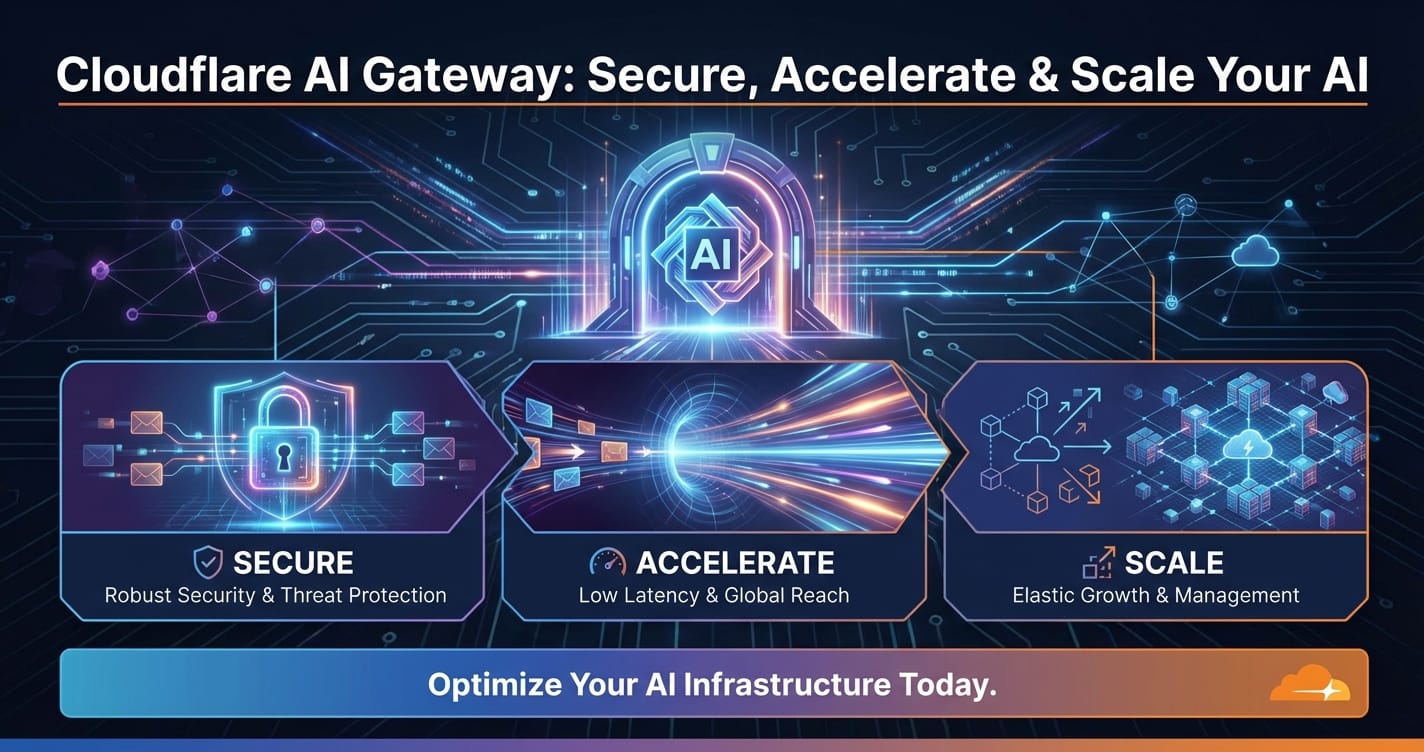
Cloudflare AI Gateway: Secure, Accelerate & Scale Your AI



The digital frontier is constantly evolving, and at its forefront, Artificial Intelligence, particularly Large Language Models (LLMs), is reshaping how businesses operate, innovate, and interact with the world. From automating customer service and generating creative content to powering sophisticated data analysis, AI is no longer a futuristic concept but a vital operational component. However, the immense power of AI comes with equally immense challenges: ensuring robust security, optimizing performance, and achieving scalable, cost-effective deployment across a fragmented ecosystem of models and providers. Navigating this complexity requires more than just integrating an API; it demands a dedicated, intelligent orchestration layer. This is where the concept of an AI Gateway becomes not just beneficial, but absolutely critical.
An AI Gateway acts as an intelligent intermediary, a centralized control plane for all AI interactions, abstracting away the underlying complexities of diverse AI models and providers. It serves as a single entry point for applications to access a multitude of AI services, providing a cohesive framework for managing security, performance, cost, and observability. In an era where organizations might be leveraging models from OpenAI, Anthropic, Hugging Face, Google, and potentially their own fine-tuned models, a unified LLM Gateway or broader AI Gateway solution is indispensable for maintaining consistency, control, and efficiency.
Cloudflare, renowned for its global network infrastructure and comprehensive suite of performance and security services, has extended its expertise into this burgeoning domain with the Cloudflare AI Gateway. By integrating AI-specific functionalities with its formidable edge network capabilities, Cloudflare offers a compelling solution designed to Secure, Accelerate & Scale Your AI applications and services. This article will delve deep into the imperative for such a gateway, explore its core functionalities, and meticulously examine how Cloudflare’s offering addresses the multifaceted demands of modern AI deployment, ensuring that your AI initiatives are not only powerful but also resilient, efficient, and cost-effective. We will unravel the intricate layers of security, the innovative approaches to performance optimization, and the robust scaling mechanisms that define the next generation of AI infrastructure.
The AI Revolution and Its Operational Challenges
The dawn of generative AI, particularly the widespread accessibility and capabilities of Large Language Models (LLMs) such as OpenAI's GPT series, Anthropic's Claude, and open-source alternatives like Llama 2, has ushered in a transformative era for technology and business alike. These sophisticated models are not merely tools; they are platforms for innovation, capable of understanding context, generating human-like text, summarizing vast amounts of information, translating languages with remarkable accuracy, and even writing code. The potential applications are seemingly boundless, ranging from enhancing customer experience through intelligent chatbots and personalizing content at scale, to accelerating research and development processes, and fundamentally altering how data is processed and insights are derived. Businesses across every sector are scrambling to integrate these powerful capabilities into their products, services, and internal operations, recognizing that embracing AI is no longer optional but a strategic imperative for competitive advantage. The ability to harness AI effectively can lead to unprecedented levels of efficiency, creativity, and customer engagement.
However, the journey from recognizing AI's potential to realizing its full value is fraught with significant operational challenges that can quickly overwhelm even the most technologically adept organizations. The very power and pervasiveness of AI models introduce a new layer of complexity that traditional IT infrastructure and API management practices were not designed to handle. Enterprises are grappling with a myriad of issues that threaten to slow down adoption, inflate costs, and introduce critical vulnerabilities if not properly addressed. Understanding these challenges is the foundational step towards appreciating the necessity and innovative design of an AI Gateway.
1. Security: The Unseen Frontier of AI
The integration of AI, especially LLMs, introduces novel and complex security concerns that extend beyond conventional web application vulnerabilities. Data privacy is paramount; sensitive information transmitted to or processed by AI models, whether for training, inference, or fine-tuning, must be rigorously protected from unauthorized access, leakage, or misuse. Prompt injection attacks, a new class of vulnerability specific to LLMs, allow malicious actors to manipulate model behavior by crafting adversarial prompts, potentially leading to data exfiltration, unauthorized actions, or the generation of harmful content. Ensuring the integrity and confidentiality of prompts and responses is critical. Furthermore, the risk of model poisoning, where manipulated training data compromises the model's output, or the potential for models to reveal training data (membership inference attacks), presents significant ethical and compliance challenges. Organizations must also contend with the broader implications of AI security, including protecting API keys, managing access controls for different models and users, and ensuring compliance with evolving data protection regulations like GDPR, CCPA, and HIPAA. A robust security posture for AI cannot be an afterthought; it must be ingrained at every layer of interaction.
2. Performance: The Need for Speed and Responsiveness
AI applications, particularly those interacting directly with users, demand low latency and high throughput. Slow response times can degrade user experience, leading to frustration and abandonment. The geographical distance between the application, the user, and the AI model endpoint can introduce significant latency. Furthermore, the computational intensity of AI inference means that models can be bottlenecks, especially under heavy load. Optimizing the flow of requests and responses, caching frequently accessed data or common prompt outputs, and efficiently managing connections to prevent overwhelming AI provider APIs are crucial for maintaining application responsiveness and scalability. Without performance optimization, even the most brilliant AI model will fail to deliver its promised value in a production environment.
3. Cost Management: Taming the Expenditure Beast
AI model usage, especially for commercial LLMs, is typically billed on a token-per-use basis, making cost management a complex and often unpredictable endeavor. Uncontrolled access, inefficient prompting, or redundant calls can quickly lead to exorbitant bills. Tracking usage across multiple departments, projects, and models becomes a formidable accounting challenge. Implementing intelligent routing to choose the most cost-effective model for a given task, enforcing rate limits and quotas to prevent budget overruns, and leveraging caching to reduce repetitive API calls are all essential strategies for controlling AI expenditure. Without granular visibility and proactive control, AI can become a significant financial drain rather than an investment.
4. Scalability: Meeting Dynamic Demand
The popularity and utility of AI applications can fluctuate dramatically, requiring infrastructure that can seamlessly scale up to handle sudden surges in traffic and scale down during periods of low demand. Managing multiple AI models from different providers, each with its own API limits and infrastructure, complicates scaling efforts. Organizations need the flexibility to switch between models or even fine-tune and deploy their own models without significant re-architecture of their consuming applications. Achieving elastic scalability, ensuring high availability, and maintaining consistent performance across diverse AI workloads is a non-trivial engineering feat. The capacity to seamlessly integrate and orchestrate numerous AI services while dynamically adapting to varying workloads is paramount for modern enterprises.
5. Observability and Monitoring: Understanding the AI Black Box
Successfully operating AI services requires deep visibility into their performance, usage, and potential issues. This includes comprehensive logging of all API requests and responses, detailed metrics on latency, throughput, and error rates, and tracing capabilities to understand the journey of a request through various AI models and services. Identifying and troubleshooting issues—whether they stem from network problems, model misbehavior, or prompt engineering failures—becomes exceedingly difficult without centralized and granular observability. Effective monitoring is essential for proactive problem detection, performance tuning, and ensuring the reliability of AI-powered applications.
6. Complexity and Interoperability: The Fragmented AI Landscape
The AI ecosystem is characterized by a dizzying array of models, frameworks, and APIs, each with its own quirks, data formats, and authentication mechanisms. Integrating these disparate services into a cohesive application can be a developer's nightmare. Standardizing the interaction layer, abstracting away vendor-specific API differences, and providing a unified interface for accessing various AI capabilities significantly reduces development overhead and accelerates time-to-market. The ability to swap out one LLM for another with minimal code changes, or to orchestrate calls to multiple models for a complex task, is crucial for agility and future-proofing AI investments.
These challenges highlight a critical gap in the existing enterprise technology stack. While traditional API Gateways address some of these concerns for general RESTful services, they often lack the AI-specific intelligence required for prompt security, LLM-aware caching, cost optimization for token usage, and sophisticated model routing. A dedicated AI Gateway or LLM Gateway is therefore not merely an enhancement but a fundamental requirement for any organization serious about securely, efficiently, and scalably deploying AI.
Understanding the AI Gateway Paradigm
In the face of the burgeoning complexities surrounding AI deployment, the AI Gateway has emerged as a specialized and indispensable architectural component. While it shares conceptual similarities with a traditional API Gateway, its core design and feature set are specifically tailored to address the unique challenges presented by Artificial Intelligence workloads, especially those involving Large Language Models. To truly grasp its significance, it's essential to delineate what an AI Gateway is, how it functions, and how it differentiates itself from its more generalized predecessors.
What is an AI Gateway? A Comprehensive Explanation
At its heart, an AI Gateway is an intelligent proxy that sits between your applications and various AI models and services. It acts as a single, centralized control point for all AI interactions, providing a layer of abstraction and enhancement that simplifies management, bolsters security, optimizes performance, and controls costs. Unlike a generic API Gateway, which primarily focuses on routing HTTP requests to backend services, an AI Gateway is context-aware regarding the nature of AI traffic. This means it understands prompts, responses, token counts, and the specific needs of different AI models, allowing it to apply AI-specific policies and optimizations.
Imagine a conductor orchestrating a complex symphony: the AI Gateway ensures that each instrument (AI model) plays its part correctly, securely, and in harmony, even if they come from different orchestras (providers) and have varying musical notations (APIs). It transforms a potentially chaotic and fragmented AI landscape into a unified, manageable, and performant ecosystem.
Key Functions of an AI Gateway
The specialized intelligence of an AI Gateway manifests in a suite of critical functionalities:
- Unified Access Layer: It provides a single, consistent endpoint for developers to interact with any underlying AI model, regardless of its provider (e.g., OpenAI, Anthropic, Hugging Face, custom models). This abstraction layer decouples applications from specific AI vendors, making it easier to switch models, integrate new ones, or even use multiple models simultaneously without altering application code. This significantly reduces development complexity and fosters agility in an rapidly evolving AI landscape.
- Security Enhancements: Beyond basic authentication and authorization, an AI Gateway implements AI-specific security measures. This includes prompt sanitization and validation to mitigate prompt injection attacks, ensuring that malicious inputs cannot manipulate model behavior. It can also perform data masking or anonymization on sensitive data before it reaches the AI model, bolstering data privacy and compliance. Robust API key management and fine-grained access controls ensure that only authorized applications and users can access specific AI capabilities, protecting against unauthorized usage and potential abuse.
- Performance Optimization: Latency is a critical factor for AI applications. An AI Gateway employs techniques like intelligent caching to store responses to common or repetitive prompts, drastically reducing latency and the number of calls to expensive backend AI services. Request batching aggregates multiple individual requests into a single call to the AI model, improving efficiency. Load balancing and intelligent routing direct requests to the fastest, most available, or most cost-effective AI endpoint, whether it’s a specific model instance, a particular region, or even a different provider altogether.
- Cost Control and Visibility: With usage-based billing prevalent in the AI space, cost management is paramount. An AI Gateway offers detailed usage tracking and analytics, providing transparency into token consumption, API call volumes, and associated costs across different models, users, and projects. It can enforce quotas and rate limits to prevent budget overruns and ensure fair resource allocation. Intelligent routing can also be configured to prioritize cheaper models for non-critical tasks, further optimizing expenditure.
- Observability: Logging, Metrics, and Tracing: Comprehensive visibility is essential for operational excellence. The gateway centralizes logging of all AI requests and responses, providing an audit trail and invaluable data for debugging and compliance. It collects real-time metrics on latency, throughput, error rates, and token usage, offering a clear picture of system health and performance. Distributed tracing helps pinpoint performance bottlenecks or errors across multiple AI services, enabling quick issue resolution.
- Model Abstraction and Standardization: Different AI models often have varying API specifications and data formats. An AI Gateway can normalize these discrepancies, providing a unified API interface to consuming applications. This means developers write against a single, consistent API, and the gateway handles the translation to the specific requirements of the chosen backend AI model. This greatly simplifies model swapping and multi-model orchestration.
- Rate Limiting and Throttling: Protecting backend AI services from being overwhelmed or abused is a fundamental security and stability function. The gateway applies granular rate limits based on IP address, API key, user, or application, preventing denial-of-service attacks and ensuring fair access for all users.
- Prompt Engineering and Versioning: More advanced AI Gateways can facilitate the management and versioning of prompts themselves, allowing developers to experiment with different prompt strategies and A/B test their effectiveness without modifying application code. This enables dynamic prompt injection and iteration, which is crucial for optimizing LLM outputs.
AI Gateway vs. LLM Gateway vs. API Gateway: Disentangling the Terms
While often used interchangeably or with significant overlap, it's important to understand the subtle yet crucial distinctions between these terms:
- API Gateway (Generic): This is the broadest term. A traditional API Gateway is a central entry point for all API requests into a backend system, typically composed of microservices. Its primary functions include routing requests, load balancing, authentication/authorization, rate limiting, and analytics for any type of API (REST, SOAP, GraphQL). It is protocol-agnostic regarding the content of the API calls and doesn't inherently understand the nuances of AI interactions. It's a foundational component for microservice architectures.
- LLM Gateway: This term specifically refers to an AI Gateway designed with a particular focus on Large Language Models. An LLM Gateway inherently understands tokens, prompt structures, model contexts, and the unique challenges associated with generative AI. Its features are highly optimized for LLM-specific concerns such as managing token usage, optimizing prompts, handling streaming responses, and routing requests to different LLM providers (e.g., OpenAI, Anthropic, Google Gemini). It excels in providing model abstraction and cost control for language models.
- AI Gateway (Comprehensive): This term is more encompassing. An AI Gateway includes all the capabilities of an LLM Gateway but extends its scope to manage a broader range of AI models beyond just language models. This could include vision models (e.g., image recognition, object detection), speech models (e.g., speech-to-text, text-to-speech), recommendation engines, and traditional machine learning models. It provides a holistic management layer for all types of AI services, acting as a universal translator and orchestrator for an organization's entire AI portfolio. Cloudflare’s offering, while particularly strong for LLMs, positions itself as a comprehensive AI Gateway solution.
In essence, an LLM Gateway is a specific type of AI Gateway, which in turn is a specialized evolution of a generic API Gateway. While a generic API Gateway can provide basic routing for AI APIs, it lacks the AI-specific intelligence required for robust security against prompt injection, intelligent caching of AI responses, and granular cost management based on tokens. The AI Gateway paradigm steps in to fill this critical void, offering a purpose-built solution for the unique operational demands of the artificial intelligence era.
Cloudflare AI Gateway: A Deep Dive into Features and Benefits
Cloudflare has long been a vanguard in delivering global internet performance and security at the edge. By leveraging its vast network, which spans over 300 cities in more than 120 countries, Cloudflare handles a significant portion of the world's internet traffic. This unparalleled scale and geographic distribution provide a natural foundation for an advanced AI Gateway, positioning Cloudflare to effectively address the challenges of securely, accelerating, and scaling AI applications. The Cloudflare AI Gateway integrates AI-specific intelligence with its foundational network capabilities, offering a robust solution that goes beyond traditional API management to meet the nuanced demands of modern AI workloads.
Let's meticulously explore how the Cloudflare AI Gateway delivers on its promise across security, acceleration, and scaling dimensions, providing a comprehensive management layer for your AI initiatives.
1. Unparalleled Security for AI Applications
Security is not just a feature; it's a foundational pillar of any successful AI deployment. The sensitive nature of data processed by AI models, coupled with emerging AI-specific threats, necessitates a robust and intelligent security framework. Cloudflare AI Gateway leverages Cloudflare's inherent security strengths, enhancing them with AI-aware protections.
- Web Application Firewall (WAF) for AI: Cloudflare’s industry-leading WAF is extended to protect AI endpoints. This is crucial for mitigating a new generation of threats, most notably prompt injection attacks. The WAF can be configured to detect and block malicious or carefully crafted prompts designed to hijack an LLM's behavior, bypass safety guardrails, or extract sensitive information. It scrutinizes incoming requests for patterns indicative of adversarial inputs, providing an essential layer of defense against sophisticated exploitation attempts. Beyond prompt injection, it also guards against traditional web vulnerabilities and denial-of-service (DoS) attacks targeting AI APIs, ensuring the availability and integrity of your AI services.
- Data Privacy and Compliance: Organizations often deal with highly sensitive or regulated data. The Cloudflare AI Gateway facilitates data anonymization and masking at the edge, allowing PII (Personally Identifiable Information) or confidential data to be scrubbed before it ever reaches the AI model provider. This significantly reduces data exposure risks and helps achieve compliance with stringent regulations like GDPR, CCPA, and HIPAA. Secure transmission is guaranteed through TLS encryption across Cloudflare's network, ensuring data integrity in transit.
- Authentication and Authorization: The gateway provides a centralized point for authentication and authorization for all AI API calls. It can integrate seamlessly with existing Identity Providers (IdPs) such as Okta, Auth0, or corporate directories, enforcing granular access controls. This means you can define precisely which users, teams, or applications have access to specific AI models, API keys, or functionalities, preventing unauthorized usage and bolstering internal security postures.
- IP Filtering and Rate Limiting: Beyond AI-specific threats, the gateway also offers fundamental network security. IP filtering allows you to whitelist or blacklist specific IP ranges, controlling who can access your AI endpoints. Sophisticated rate limiting and throttling mechanisms prevent abuse, brute-force attacks, and accidental overload of AI models by limiting the number of requests per user, IP, or API key within a given timeframe. This protects both your budget and the integrity of your AI services.
- DDoS Protection: Leveraging Cloudflare's global network, the AI Gateway inherently benefits from comprehensive DDoS protection. This means your AI services are shielded from volumetric attacks, ensuring continuous availability even under extreme duress, a critical factor for business continuity.
2. Accelerated Performance and Reduced Latency
Performance is paramount for interactive AI applications. Cloudflare's core strength lies in its ability to deliver blazing-fast internet experiences, and this capability is meticulously applied to the AI domain. The Cloudflare AI Gateway is engineered to minimize latency, maximize throughput, and optimize the delivery of AI responses.
- Intelligent Caching for AI Responses: One of the most impactful performance optimizations is intelligent caching. For repetitive prompts or common queries, the gateway can store the AI model's response at the nearest Cloudflare edge location. When the same prompt is made again, the response is served directly from the cache, bypassing the need to send the request to the origin AI model. This dramatically reduces latency, cuts down on API call costs, and lessens the load on backend AI services. The caching logic can be sophisticated, considering prompt similarity, context, and expiration policies.
- Global Network Edge for Low Latency Access: Cloudflare's expansive network places compute and caching capabilities physically closer to your users and applications worldwide. This "edge computing" paradigm means requests to AI models don't have to traverse long distances to a centralized datacenter. By processing requests and serving cached responses at the nearest edge location, the Cloudflare AI Gateway significantly reduces round-trip times (RTT) and overall latency, making AI-powered applications feel instantaneous.
- Load Balancing and Intelligent Routing: The gateway can intelligently load balance requests across multiple instances of an AI model, or even across different AI providers. For example, if you're using both OpenAI and Anthropic, the gateway can route traffic based on performance metrics, cost, or availability. This intelligent routing ensures that requests are always directed to the optimal backend, minimizing response times and maximizing resilience. It can also route requests to specific regions for data residency requirements or to leverage geographically dispersed model deployments.
- Request Deduplication and Optimization: In high-traffic scenarios, it's possible for duplicate requests to be made for the same AI inference within a short window. The Cloudflare AI Gateway can deduplicate these requests, sending only one call to the backend AI model and serving the response to all pending duplicate requests. This further saves on API costs and reduces unnecessary load. Additionally, it can perform request batching, aggregating multiple small individual requests into a single, larger request to the AI model where supported, improving efficiency and potentially reducing per-request overhead.
3. Seamless Scaling and Robust Management
Scaling AI applications requires more than just adding servers; it demands an intelligent orchestration layer that can manage diverse models, track usage, control costs, and provide deep insights. The Cloudflare AI Gateway offers a comprehensive suite of management tools designed for the dynamic nature of AI workloads.
- Unified Dashboard and Centralized Control: The gateway provides a single, intuitive dashboard to manage all your AI model integrations. From this central console, you can configure access rules, set up caching policies, monitor usage, and analyze performance across various AI providers like OpenAI, Anthropic, Google, and potentially your own self-hosted models. This eliminates the need to manage individual API keys, endpoints, and monitoring systems for each provider, significantly streamlining operations.
- Cost Observability and Control: One of the biggest challenges in AI adoption is managing unpredictable costs. The Cloudflare AI Gateway offers detailed cost observability, providing granular analytics on token usage, API call volumes, and estimated expenditures per model, user, or application. You can set up budget alerts and define hard quotas to prevent overspending. By leveraging intelligent routing and caching, the gateway actively helps optimize costs by reducing redundant calls and directing traffic to the most cost-effective model for a given task.
- Rate Limiting and Quotas for Usage Management: Beyond cost, managing resource allocation is key. The gateway allows you to define flexible rate limits and quotas to control how frequently users or applications can invoke AI models. This ensures fair usage, prevents a single application from monopolizing resources, and protects your budget from runaway API calls.
- Versioning and A/B Testing for Models and Prompts: The AI landscape is rapidly evolving, with new models and prompt engineering techniques emerging constantly. The Cloudflare AI Gateway facilitates versioning of AI models and prompts, allowing you to deploy new iterations or experiments without affecting production applications. You can easily A/B test different models or prompt variations in a controlled manner, routing a percentage of traffic to a new version to evaluate its performance and effectiveness before a full rollout. This capability is crucial for continuous improvement and innovation in AI.
- Comprehensive Logging and Analytics: For debugging, compliance, and performance tuning, detailed data is indispensable. The gateway provides comprehensive logging of every AI request and response, including timestamps, user IDs, prompt details, response content, and associated metadata. These logs are then fed into powerful analytics tools, offering insights into usage patterns, common errors, performance bottlenecks, and overall system health. This level of observability empowers teams to quickly identify and resolve issues, understand AI behavior, and make data-driven decisions.
- Observability and Monitoring with Real-time Metrics: Beyond historical logs, the AI Gateway offers real-time monitoring capabilities. Dashboards display key performance indicators (KPIs) such as latency, error rates, throughput, and token consumption in real-time. Configurable alerts can notify teams immediately of performance degradations, error spikes, or quota breaches, enabling proactive intervention and ensuring the high availability and reliability of AI-powered applications.
While Cloudflare offers a robust solution for large-scale enterprise deployments, developers and smaller teams seeking an open-source, flexible, and powerful AI Gateway and API Management Platform might find immense value in solutions like APIPark. APIPark, designed to quickly integrate over 100 AI models and provide end-to-end API lifecycle management, offers an excellent alternative or complementary tool for specific use cases, emphasizing unified API formats, prompt encapsulation, and team sharing capabilities, all while being open-sourced under Apache 2.0. It simplifies AI usage and maintenance costs by standardizing request formats across models, ensuring that changes in AI models or prompts do not affect the application or microservices. APIPark’s capability to encapsulate custom prompts into new REST APIs, manage API traffic forwarding and load balancing, and offer detailed call logging and powerful data analysis with performance rivaling Nginx (20,000+ TPS on modest hardware) makes it a compelling choice for developers seeking agility and control. With its independent API and access permissions for each tenant and approval-based API resource access, it offers robust management capabilities for shared environments. Its quick deployment via a single command makes it highly accessible for rapid prototyping and production use.
4. Developer Experience and Ease of Integration
Cloudflare's commitment to developer experience ensures that integrating with the AI Gateway is straightforward. It provides a consistent API, clear documentation, and easy-to-use tooling, reducing the learning curve and accelerating development cycles. Developers can focus on building innovative AI applications rather than wrestling with disparate AI vendor APIs. The ability to use a single endpoint and standardized request formats across various models simplifies backend logic and makes future model upgrades or changes much less disruptive.
The Cloudflare AI Gateway, therefore, represents a critical evolution in infrastructure for the AI era. By abstracting complexity, bolstering security, enhancing performance, and providing comprehensive management, it empowers organizations to confidently deploy, scale, and innovate with AI, transforming potential challenges into tangible strategic advantages.
To further illustrate the comprehensive capabilities of the Cloudflare AI Gateway, let's look at a comparative table of core functionalities.
| Feature Category | Generic API Gateway | LLM Gateway (Specialized) | Cloudflare AI Gateway (Comprehensive) |
|---|---|---|---|
| Primary Focus | General API routing, security, traffic management for any API. | LLM-specific orchestration, prompt management, cost for language models. | Holistic AI model management (LLM, Vision, Speech), global performance, enterprise security. |
| Traffic Management | Routing, load balancing, rate limiting (HTTP/S). | Routing, load balancing, rate limiting (LLM-aware, token-based). | Advanced routing, global load balancing, edge caching, intelligent request deduplication. |
| Security | AuthN/AuthZ, WAF (generic), DDoS. | Prompt injection defense, data masking (LLM-specific). | Advanced WAF (AI-aware), prompt sanitization, data anonymization, robust AuthN/AuthZ, comprehensive DDoS. |
| Performance | Basic caching, global CDN for static assets. | LLM-aware caching (prompts/responses), streaming optimization. | Intelligent edge caching, global network acceleration, request batching, real-time optimization. |
| Cost Control | API call quotas, basic usage metrics. | Token usage tracking, budget alerts, intelligent model routing for cost. | Granular token/API call tracking, advanced cost analytics, budget enforcement, cost-optimized routing. |
| Observability | Basic logs, request/response metrics. | LLM-specific logs (prompts/tokens), model performance metrics. | Comprehensive logs (prompts, tokens, errors), real-time metrics, distributed tracing, AI-specific analytics. |
| Model Abstraction | Minimal/None; acts on raw requests. | Standardized API for diverse LLMs, prompt versioning. | Unified API for all AI models (LLM, Vision, etc.), dynamic prompt management, seamless model swapping. |
| Deployment & Scale | Typically self-hosted or cloud-managed. | Focus on cloud deployment, scaling for LLM inference. | Global edge network scale, serverless integration, high availability, elastic scaling. |
| Developer Experience | API portals, SDKs. | LLM-focused SDKs, prompt management tools. | Unified API, extensive documentation, seamless integration with Cloudflare ecosystem. |
This table clearly illustrates how the Cloudflare AI Gateway builds upon the foundations of an API Gateway, specializing and expanding its capabilities to specifically address the nuanced requirements of the AI landscape, particularly for Large Language Models.
APIPark is a high-performance AI gateway that allows you to securely access the most comprehensive LLM APIs globally on the APIPark platform, including OpenAI, Anthropic, Mistral, Llama2, Google Gemini, and more.Try APIPark now! 👇👇👇
Implementation Scenarios and Use Cases
The versatility and robustness of the Cloudflare AI Gateway make it an ideal solution across a wide spectrum of implementation scenarios, from large enterprises to nimble startups. Its ability to centralize control, enhance security, and optimize performance for diverse AI models translates into tangible benefits across various industries and operational contexts.
1. Enterprise AI Integration and Governance
For large enterprises, the challenge of integrating AI extends beyond mere technical implementation; it involves robust governance, compliance, and cost control across numerous departments and projects.
- Scenario: A global financial institution wants to leverage various LLMs for internal research, customer service automation, and compliance checks. Different teams might prefer different models (e.g., GPT-4 for creative content, Claude for legal document analysis, a fine-tuned internal model for sensitive financial data).
- Solution: The Cloudflare AI Gateway provides a unified control plane. The institution can onboard all desired AI models, define strict access policies for each team and user based on their roles and data sensitivity, and enforce budget caps per department. Data anonymization features ensure compliance with financial regulations, while the WAF protects against prompt injection attempts that could compromise proprietary information. Centralized logging and auditing provide a complete trail for compliance officers, and intelligent routing directs requests to the most appropriate or cost-effective model, reducing overall expenditure. This ensures that AI innovation can flourish within a secure, compliant, and cost-controlled environment.
2. SaaS Providers Enhancing AI Features
SaaS companies are increasingly embedding AI capabilities into their core offerings to stay competitive and provide more intelligent services. These providers need reliable, scalable, and cost-effective AI backend infrastructure.
- Scenario: A marketing automation SaaS platform wants to offer AI-powered content generation, email personalization, and sentiment analysis features to its clients. They need to integrate with multiple LLM providers to offer choice and redundancy, manage costs effectively for thousands of clients, and ensure high availability.
- Solution: The Cloudflare AI Gateway acts as the single backend for all AI features. It allows the SaaS platform to abstract away specific LLM providers, presenting a unified API to their internal application. Caching frequent requests (e.g., common marketing copy elements, sentiment analysis on repetitive phrases) drastically reduces latency and API costs. Rate limiting per client ensures fair usage and prevents any single client from incurring excessive charges or overwhelming the backend. Global distribution through Cloudflare's edge network ensures low latency for clients worldwide, providing a seamless user experience regardless of geographic location. The platform can also easily A/B test new LLM versions or prompt strategies to continuously improve their AI features without downtime.
3. Developers and Startups Streamlining AI Model Experimentation and Deployment
For individual developers, research teams, and startups, agility and rapid iteration are key. They need tools that simplify the complex process of experimenting with, deploying, and managing various AI models.
- Scenario: A startup is building an innovative AI-driven educational tool. They are constantly experimenting with different LLMs and fine-tuning techniques to find the best model for generating personalized learning content. They need a flexible way to switch models, track performance, and manage limited budgets during development.
- Solution: The Cloudflare AI Gateway provides a single endpoint for the startup's application. They can easily configure the gateway to point to different LLM providers (OpenAI, Hugging Face endpoints, self-hosted models) or even specific versions of their fine-tuned models. The gateway’s logging and analytics offer clear insights into how each model performs, what the associated costs are, and where errors might be occurring. Budget controls prevent runaway spending during experimentation. This allows the startup to iterate quickly, test hypotheses, and confidently move from experimentation to production without re-architecting their application every time they change an AI model.
4. Enhancing Customer Service with Intelligent AI Bots
AI-powered chatbots and virtual assistants are becoming standard for customer support, but they require robust security, performance, and cost management.
- Scenario: A large e-commerce company deploys an AI chatbot to handle customer inquiries, order tracking, and product recommendations. This chatbot interacts with sensitive customer data and needs to provide real-time responses.
- Solution: The Cloudflare AI Gateway secures the interactions between the chatbot frontend and the backend LLM. Prompt sanitization prevents malicious users from manipulating the bot. Data masking ensures that PII is not sent to the LLM without necessity. Intelligent caching reduces response times for common queries, making the bot feel more responsive and reducing API costs. Detailed logs help monitor the bot's performance, identify common issues, and improve its accuracy over time. This ensures the chatbot is not only helpful but also secure, efficient, and cost-effective.
5. Content Generation Platforms and Media Houses
Media companies and content platforms are leveraging generative AI to accelerate content creation, translation, and summarization.
- Scenario: A media company uses multiple LLMs to generate news summaries, create social media posts, and translate articles into various languages. They need to manage diverse models, ensure consistent branding through specific prompts, and control costs across different content streams.
- Solution: The AI Gateway provides a unified interface for all content generation tasks. The company can manage and version specific prompts (e.g., "summarize this article in a journalistic tone, under 100 words") at the gateway level, ensuring consistency across all AI-generated content. Load balancing and intelligent routing can direct translation tasks to the most accurate or cost-effective translation model, while creative generation tasks go to another. The gateway’s analytics provide insights into which prompts and models are most effective and cost-efficient, allowing for continuous optimization of content workflows.
These scenarios underscore the transformative impact of a dedicated AI Gateway. By addressing core challenges related to security, performance, cost, and management, the Cloudflare AI Gateway empowers organizations across industries to unlock the full potential of AI, integrating it seamlessly and securely into their operations and products.
The Future of AI Gateways and Cloudflare's Vision
The rapid evolution of Artificial Intelligence ensures that the infrastructure supporting it must also be dynamic, adaptable, and forward-looking. The role of an AI Gateway is not static; it is poised to expand significantly as AI models become more sophisticated, edge computing matures, and the demand for real-time, context-aware AI interactions intensifies. Cloudflare, with its global network and commitment to innovation, is uniquely positioned to shape and lead this future.
Evolving Role of AI Gateways
In the immediate future, AI Gateways will become even more intelligent and proactive. We can anticipate deeper integration with model-agnostic prompt engineering, allowing organizations to define and manage prompt templates, variables, and few-shot examples directly within the gateway, abstracting this complexity from application logic. This will facilitate advanced A/B testing of prompt variations and dynamic prompt switching based on user context or desired output. The concept of "prompt firewalls" will evolve to include more sophisticated semantic analysis, not just pattern matching, to detect and neutralize increasingly subtle prompt injection attacks.
Furthermore, AI Gateways will likely incorporate more robust AI safety and ethics guardrails. This could involve automatically filtering outputs that violate predefined content policies, detecting bias, or ensuring responses adhere to specific ethical guidelines before reaching the end-user. The gateway could become a crucial enforcement point for responsible AI deployment.
As multi-modal AI (combining text, image, audio, video) becomes more prevalent, AI Gateways will need to handle diverse data types and model APIs, providing a unified abstraction layer for not just LLMs, but also vision, speech, and other specialized AI models simultaneously. This will require more complex data transformations and routing logic.
Cloudflare's Commitment to AI Infrastructure
Cloudflare's vision for AI infrastructure is deeply rooted in its philosophy of providing a performant, secure, and programmable edge network. The Cloudflare AI Gateway is not a standalone product but a strategic component of a larger ecosystem designed to empower AI development and deployment.
One of Cloudflare's core differentiators is its serverless computing platform, Cloudflare Workers. The AI Gateway is intrinsically linked to Workers, enabling developers to write custom logic at the edge for AI requests. This means organizations can perform pre-processing of prompts, post-processing of responses, custom authentication, dynamic routing based on real-time conditions, or even run smaller AI models directly on Workers at the edge. This provides unparalleled flexibility and allows for hyper-personalized and highly efficient AI interactions, further pushing the boundaries of what an LLM Gateway can achieve.
Cloudflare's R2 Storage also plays a pivotal role, offering object storage that is compatible with S3 but without egress fees. This is critical for AI workloads that involve large datasets for fine-tuning or model storage. Combining R2 with Workers and the AI Gateway creates a powerful platform for deploying custom AI models and data pipelines directly on Cloudflare's network, bringing AI inference closer to the data and users.
Moreover, Cloudflare is actively investing in AI research and development, not just in securing and accelerating existing models, but in exploring new ways to optimize AI inference, reduce costs, and enhance the capabilities of AI at the edge. This includes initiatives around model compression, distributed inference, and specialized hardware acceleration across its global network. The company aims to make AI accessible and efficient for every developer, regardless of their scale.
The Broader Trend of Intelligent Edge Computing for AI
The trajectory of AI deployment is inexorably moving towards the intelligent edge. Processing AI inference closer to the data source and the end-user minimizes latency, reduces bandwidth costs, and enhances data privacy. Cloudflare's vast global edge network is perfectly suited for this paradigm shift. By extending the capabilities of the AI Gateway, Cloudflare is enabling:
- Real-time AI: Critical for applications like autonomous vehicles, industrial IoT, and interactive gaming, where milliseconds matter.
- Data Locality and Compliance: Ensuring that sensitive data processing for AI remains within specific geographic boundaries, addressing regulatory requirements.
- Cost Efficiency: Reducing the need to send vast amounts of raw data back to centralized cloud data centers for processing, thereby cutting egress fees and compute costs.
- Resilience: Distributing AI inference across the edge network reduces single points of failure, enhancing the overall resilience and availability of AI applications.
The Cloudflare AI Gateway is more than just a tool for today's AI challenges; it's a foundational component for the AI-driven future. By continuously integrating cutting-edge AI capabilities with its robust edge network, Cloudflare is not only securing, accelerating, and scaling AI for the present but also laying the groundwork for the next generation of intelligent applications that will reshape our digital world. Its vision is to democratize access to powerful AI, ensuring that businesses of all sizes can harness its transformative potential with confidence and efficiency.
Conclusion
The era of Artificial Intelligence, characterized by the meteoric rise of Large Language Models and increasingly sophisticated AI applications, presents both unprecedented opportunities and significant operational challenges. From ensuring the stringent security of sensitive data and protecting against novel threats like prompt injection, to optimizing performance for real-time interactions and meticulously managing escalating costs, organizations face a complex landscape in deploying and scaling their AI initiatives. The traditional approach to API management, while foundational, simply does not possess the AI-specific intelligence required to navigate these intricate demands effectively.
This is precisely where the AI Gateway emerges as an indispensable architectural component. It serves as an intelligent, centralized control plane, abstracting the complexities of diverse AI models and providers while enforcing critical policies. Whether termed an LLM Gateway for language models or a broader API Gateway for all AI services, its core mission is to provide a unified, secure, performant, and cost-controlled interface for all AI interactions.
Cloudflare, leveraging its globally distributed network and decades of expertise in edge computing, performance optimization, and robust security, has engineered a formidable solution in the Cloudflare AI Gateway. It comprehensively addresses the multifaceted requirements of modern AI deployment by:
- Securing AI: Implementing advanced AI-aware WAF capabilities, prompt sanitization, data anonymization, and granular access controls to protect against emerging threats and ensure compliance.
- Accelerating AI: Utilizing intelligent edge caching, global load balancing, and request optimizations across its vast network to deliver lightning-fast response times and superior user experiences.
- Scaling AI: Providing a unified dashboard for managing multiple AI models, offering granular cost observability, enabling sophisticated rate limiting, and facilitating seamless versioning and A/B testing for continuous innovation.
The Cloudflare AI Gateway is more than just a conduit for AI requests; it is a strategic orchestrator that transforms a fragmented and challenging AI ecosystem into a streamlined, secure, and highly efficient operation. By abstracting away complexity and providing a robust, intelligent layer between applications and AI models, it empowers businesses to confidently embrace and innovate with AI, translating its immense potential into tangible competitive advantages.
As AI continues to evolve, the role of an intelligent gateway will only grow in importance, becoming the critical nexus for responsible, performant, and scalable AI adoption. Cloudflare stands at the forefront of this evolution, continuously enhancing its AI Gateway to meet the demands of tomorrow's intelligent applications, making the power of AI accessible, manageable, and secure for every enterprise.
Frequently Asked Questions (FAQs)
1. What is an AI Gateway, and how does it differ from a traditional API Gateway?
An AI Gateway is a specialized proxy that sits between your applications and various AI models and services, providing a centralized control plane. While a traditional API Gateway handles general HTTP/S traffic, routing, and basic security for any API, an AI Gateway is context-aware about AI interactions. It understands prompts, tokens, and AI-specific challenges, offering advanced features like prompt injection defense, AI-aware caching, granular cost tracking for token usage, and intelligent routing for specific AI models (e.g., LLMs, vision, speech models). Essentially, an AI Gateway is a highly intelligent and specialized evolution of a generic API Gateway, purpose-built for AI workloads.
2. How does Cloudflare AI Gateway improve security for AI applications?
Cloudflare AI Gateway significantly enhances AI security through several mechanisms. It extends Cloudflare's Web Application Firewall (WAF) to defend against AI-specific threats like prompt injection attacks, meticulously analyzing and sanitizing incoming prompts. It provides features for data anonymization and masking sensitive information before it reaches AI models, bolstering data privacy and compliance (e.g., GDPR, HIPAA). Furthermore, it centralizes authentication and authorization, offering fine-grained access controls and robust API key management. It also benefits from Cloudflare's comprehensive DDoS protection and intelligent rate limiting to prevent abuse and ensure service availability.
3. Can Cloudflare AI Gateway help reduce costs for LLM usage?
Absolutely. Cost management is a key benefit of the Cloudflare AI Gateway. It offers detailed usage tracking and analytics for token consumption and API calls across different LLMs, providing full transparency into expenditures. Through intelligent caching, it reduces the number of repetitive calls to expensive backend LLM providers, serving responses directly from the edge. It also enables intelligent routing to direct requests to the most cost-effective LLM for a given task, and allows organizations to set up granular budget alerts and hard quotas to prevent overspending and ensure cost predictability.
4. Is Cloudflare AI Gateway only for LLMs, or does it support other AI models?
While Cloudflare AI Gateway is exceptionally powerful for Large Language Models (LLMs) and includes specific features for managing prompt engineering and token usage (making it a strong "LLM Gateway"), its design is broader. It aims to be a comprehensive AI Gateway solution, supporting various types of AI models beyond just text-based LLMs. This includes the potential for managing vision models, speech models, and other machine learning services. Its architecture is built to provide a unified abstraction layer for an organization's entire AI portfolio, enabling consistent security, performance, and management across diverse AI capabilities.
5. How does Cloudflare AI Gateway integrate with existing infrastructure?
Cloudflare AI Gateway is designed for seamless integration. It acts as an intelligent proxy, meaning your existing applications simply point to the gateway's unified endpoint instead of individual AI provider APIs. This minimal change required on the application side makes integration straightforward. Furthermore, it leverages Cloudflare's existing ecosystem, allowing for custom logic at the edge using Cloudflare Workers for advanced prompt pre-processing or response post-processing. Its compatibility with various identity providers and robust logging/monitoring capabilities ensure it can fit into existing enterprise security and observability stacks without extensive re-architecture.
🚀You can securely and efficiently call the OpenAI API on APIPark in just two steps:
Step 1: Deploy the APIPark AI gateway in 5 minutes.
APIPark is developed based on Golang, offering strong product performance and low development and maintenance costs. You can deploy APIPark with a single command line.
curl -sSO https://download.apipark.com/install/quick-start.sh; bash quick-start.sh

In my experience, you can see the successful deployment interface within 5 to 10 minutes. Then, you can log in to APIPark using your account.

Step 2: Call the OpenAI API.