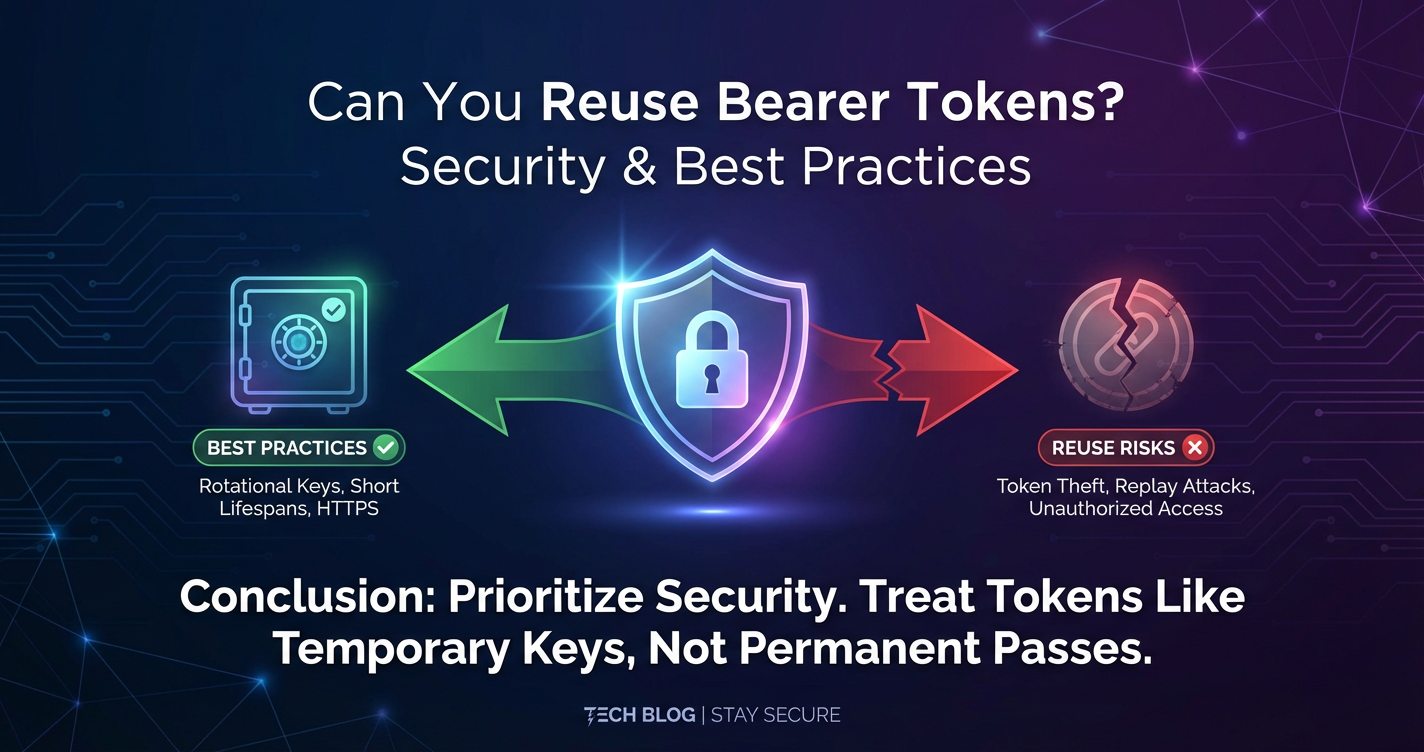
Can You Reuse Bearer Tokens? Security & Best Practices


In the intricate tapestry of modern web services and distributed systems, Application Programming Interfaces (APIs) serve as the fundamental threads that connect disparate components, enabling seamless data exchange and functionality. At the heart of secure api interactions lies authentication and authorization, mechanisms that verify user identity and determine their permissible actions. Among the myriad of authentication schemes, bearer tokens have emerged as a prevalent choice, particularly within the OAuth 2.0 framework, due to their simplicity and stateless nature. However, the seemingly straightforward concept of "bearer" tokens often raises a critical question among developers, security architects, and system administrators: Can you reuse bearer tokens? And if so, what are the profound security implications and the best practices that must be diligently followed to safeguard sensitive data and maintain system integrity?
This extensive exploration delves deep into the nuances of bearer token reuse, dissecting the legitimate and illegitimate scenarios, illuminating the inherent security risks, and prescribing a comprehensive set of best practices essential for any organization operating in today's api-driven world. We will navigate through the lifecycle of these tokens, examine their architectural implications, and underscore the pivotal roles of API Governance and the api gateway in establishing a robust security posture. The goal is to provide a holistic understanding that moves beyond surface-level definitions, offering practical insights for building secure, scalable, and resilient api ecosystems that can withstand an ever-evolving threat landscape.
Understanding the Anatomy and Purpose of Bearer Tokens
Before we can adequately address the question of reuse, it's imperative to establish a clear and detailed understanding of what bearer tokens are, how they function, and why they have become such a cornerstone of modern api security. In essence, a bearer token is a security credential that grants access to a protected resource to the bearer of the token. This is analogous to a concert ticket: whoever holds the ticket can enter, regardless of who originally purchased it. This "bearer" property is both its greatest strength and its most significant vulnerability.
Most commonly, bearer tokens are issued as part of an OAuth 2.0 flow, a widely adopted industry standard for authorization. When a client application (e.g., a mobile app, a single-page application, or a backend service) needs to access protected resources on behalf of a user, it first obtains an access token from an authorization server. This process typically involves the user granting consent, after which the authorization server issues an access token. This token is then sent by the client in subsequent requests to the resource server (the api that hosts the protected resources), typically in the Authorization header as Bearer <token_string>.
Bearer tokens can come in various forms, but two types are particularly prevalent:
- JSON Web Tokens (JWTs): JWTs are self-contained tokens that carry information about the user and the permissions granted. They are digitally signed, allowing the resource server to verify their authenticity and integrity without needing to consult the authorization server for every request. A JWT typically consists of three parts separated by dots: a header, a payload (containing claims like user ID, expiration time, scope, etc.), and a signature. Their self-validating nature makes them highly efficient for stateless apis, as the resource server can quickly validate the token locally. However, this also means that once issued, a JWT is generally valid until its expiration, making immediate revocation challenging without additional mechanisms.
- Opaque Tokens: Unlike JWTs, opaque tokens do not contain user or permission information within themselves. They are typically random strings that act as a reference to a session or authorization record stored on the authorization server. When a resource server receives an opaque token, it must perform an introspection call to the authorization server to validate the token and retrieve the associated claims. While this adds a round-trip overhead, it provides a powerful advantage for immediate token revocation, as the authorization server can simply invalidate the record associated with the token.
The ephemeral nature of bearer tokens, specifically their limited lifespan, is a critical design feature. Access tokens are generally designed to be short-lived, typically expiring within minutes or hours. This minimizes the window of opportunity for an attacker if a token is compromised. For applications requiring longer-term access, a separate, long-lived refresh token is issued alongside the access token. The refresh token allows the client to obtain new access tokens without requiring the user to re-authenticate, thereby improving user experience while maintaining a strong security posture.
The popularity of bearer tokens, especially JWTs, stems from several key advantages: they are stateless, reducing server load and simplifying scaling; they are relatively simple to implement and understand; and they offer a standardized way to handle authorization across diverse api landscapes. However, these very strengths also introduce specific security challenges that must be meticulously managed. The "bearer" property means that anyone in possession of a valid token can use it, which is precisely why the question of reuse, and more importantly, secure reuse, is so paramount.
The intricate details of how these tokens are generated, signed, and validated are central to understanding their security. For instance, the strength of the cryptographic algorithms used for signing JWTs, the secrecy of the signing keys, and the robustness of the authorization server's token issuance process all directly impact the overall security of an api ecosystem. Without a solid foundation in these principles, any discussion of token reuse would be incomplete and potentially misleading. Therefore, the architectural decisions surrounding token generation and handling are the first line of defense in ensuring that tokens, when reused, are done so under strictly controlled and secure conditions.
The Nuance of Token Reuse: Intended vs. Unintended Scenarios
The question "Can you reuse bearer tokens?" is not a simple yes or no. The answer lies in understanding the context and intent behind the reuse. Bearer tokens are, by their very design, intended to be reused within specific, well-defined parameters. However, there are also scenarios of unintended or malicious reuse that pose significant security threats.
Intended and Legitimate Reuse
When a client application obtains an access token, it is expected and indeed necessary to reuse that token for multiple subsequent requests to the protected resource server. This reuse is legitimate under the following conditions:
- Multiple Requests to the Same Endpoint: If a user is browsing a social media feed, their application will make numerous requests to the
/postsapi endpoint to fetch new content, update existing posts, or interact with comments. The same access token, provided it is still valid (i.e., not expired and not revoked), will be sent with each of these requests. This is the primary purpose of an access token: to avoid re-authentication for every single api call, thereby improving efficiency and user experience. - Requests to Different Endpoints within the Same Scope: An access token is typically associated with a set of permissions, often referred to as "scopes." For instance, a token might grant
read:profileandwrite:postspermissions. If the application needs to fetch the user's profile and then create a new post, it will reuse the same token for calls to/profileand/posts(assuming both actions fall within the token's granted scopes). The resource server, or more accurately, the api gateway protecting the resource server, validates the token and checks if the requested action is permitted by the token's scopes. - Within the Token's Validity Period: The most crucial aspect of legitimate reuse is that the token must be current and valid. Each access token comes with an expiration time (
expclaim in JWTs). As long as the token has not expired and has not been explicitly revoked, its reuse for authorized api calls is not only permissible but fundamental to the stateless architecture that bearer tokens facilitate. The server simply validates the token's signature, checks its expiration, and verifies its scopes on each incoming request. This design minimizes the server's need to maintain session state, making apis highly scalable and resilient.
This intended reuse is foundational to the efficiency and scalability of modern apis. It reduces the overhead associated with establishing new authentication contexts for every request, making interactions faster and less resource-intensive. Without this ability to reuse, every single api call would necessitate a full re-authentication flow, rendering most interactive applications impractical.
Unintended and Malicious Reuse
While legitimate reuse is expected, the "bearer" nature of these tokens also means that if an attacker gains possession of a valid token, they can reuse it to impersonate the legitimate user and access protected resources. This is where the concept of unintended or malicious reuse becomes a critical security concern.
- Replay Attacks: This occurs when an attacker intercepts a valid access token and then uses it to make unauthorized requests. Even if the attacker doesn't know the user's credentials, merely possessing the token grants them temporary access. This is a significant risk, particularly if tokens are transmitted over insecure channels or are exposed due to client-side vulnerabilities. The attacker is essentially "replaying" the legitimate user's authorization.
- Impersonation and Session Hijacking: If a token is stolen, an attacker can effectively hijack the legitimate user's session. They can perform actions, access data, and interact with the api as if they were the legitimate user, until the token expires or is revoked. This can lead to severe data breaches, unauthorized transactions, or other malicious activities. The impact is compounded if the stolen token has broad scopes or belongs to a highly privileged user.
- Reuse of Expired or Revoked Tokens: An attacker might attempt to reuse a token that has already expired or has been explicitly revoked (e.g., after a user logs out or a security incident is detected). Robust api security systems must meticulously validate token validity on every request, ensuring that expired or revoked tokens are unequivocally rejected. The challenge with JWTs, as mentioned earlier, is that their self-contained nature makes immediate server-side revocation difficult without maintaining a blacklist or employing other mechanisms.
- Cross-Application or Cross-User Reuse (if stolen): A token is tied to a specific user, client application, and often specific scopes for a particular authorization server. Malicious reuse involves attempting to use a stolen token outside its intended context – for a different user, a different application it wasn't issued for, or for actions beyond its granted scopes. While strong server-side validation should prevent this, the initial compromise of the token is the gateway to such attempts.
The ability for a token to be reused by anyone who possesses it underscores the absolute necessity of treating these tokens as highly sensitive credentials. Their security is paramount, and any lapse in their protection can lead to devastating consequences for users and organizations. This distinction between intended, secure reuse and unintended, malicious reuse forms the basis for understanding the security best practices that follow. The design of modern api security revolves around facilitating the former while rigorously preventing the latter.
Security Implications of Bearer Token Reuse: A Double-Edged Sword
The very nature of bearer tokens, which allows for their reuse, presents both compelling advantages and significant security vulnerabilities. Understanding this dichotomy is crucial for designing and implementing secure api ecosystems. When tokens are reused legitimately, they foster efficiency and scalability. When they are reused maliciously, they become powerful weapons for attackers.
Benefits of Intended Reuse
- Enhanced Efficiency and Performance: The primary benefit of reusing bearer tokens is the elimination of repeated authentication processes for every api request. Instead of performing a full user credential check or an OAuth flow for each call, the resource server simply validates the token. This significantly reduces latency, improves the responsiveness of applications, and minimizes the computational overhead on both the client and server sides. For microservices architectures and high-volume apis, this efficiency is indispensable.
- Statelessness and Scalability: Bearer tokens, especially JWTs, promote stateless apis. The resource server does not need to maintain session state for each client; all necessary authorization information is contained within the token itself (or verifiable via introspection for opaque tokens). This statelessness is a cornerstone of horizontal scalability, allowing apis to be easily deployed across multiple servers and load-balancers without the complexities of shared session storage. Any server can process any request, leading to more resilient and elastic architectures.
- Simplified Client-Side Logic: From a developer's perspective, handling a single token for a series of api calls is simpler than managing session cookies or complex re-authentication flows. Once acquired, the token is simply attached to subsequent requests until it expires, streamlining client-side development and reducing potential error points.
- Granular Authorization and Scope Management: Tokens are typically issued with specific scopes or claims that define the exact permissions granted. The repeated use of such a token allows for consistent enforcement of these granular permissions across multiple api calls. An api gateway, for instance, can validate these scopes on every incoming request, ensuring that even if a token is valid, it's only used for the actions it's authorized for. This supports the principle of least privilege.
Risks and Vulnerabilities of Malicious Reuse
The "bearer" property, while enabling efficiency, simultaneously creates a significant attack surface. If a token falls into the wrong hands, it can be reused by an unauthorized entity, leading to severe consequences.
- Replay Attacks and Impersonation: This is the most direct and dangerous implication. If an attacker intercepts a valid, unexpired token, they can use it to make unauthorized requests to the api as if they were the legitimate user. This can happen through various means:
- Man-in-the-Middle (MITM) Attacks: If tokens are transmitted over unencrypted channels (e.g., HTTP instead of HTTPS), an attacker can easily intercept them.
- Cross-Site Scripting (XSS): If a web application is vulnerable to XSS, an attacker can inject malicious scripts that steal tokens from local storage or cookies.
- Client-Side Storage Vulnerabilities: Insecure storage of tokens on the client (e.g., in browser local storage without proper safeguards) makes them susceptible to theft.
- Insider Threats: Malicious insiders with access to system logs or client-side environments could steal tokens. Once stolen, the attacker can leverage the token to impersonate the user, access sensitive data, modify resources, or perform other unauthorized actions. The impact depends on the privileges associated with the stolen token.
- Lack of Immediate Revocation (especially for JWTs): A critical challenge with JWTs is their stateless nature. Once signed and issued, a JWT is typically considered valid until its expiration time. This means that if a JWT is compromised, there is no inherent mechanism for the authorization server to immediately invalidate it across all resource servers without additional infrastructure. This "window of vulnerability" can be exploited by an attacker until the token naturally expires. While solutions like blacklists or short expiration times with frequent refresh token usage mitigate this, they add complexity. Opaque tokens, by contrast, offer easier immediate revocation as their validity is checked against a central store.
- Exposure of Sensitive Data: Stolen tokens can grant access to sensitive personal information, financial data, or proprietary business data. This can lead to compliance violations (e.g., GDPR, HIPAA), financial losses, and severe reputational damage. The broader the scope of the token, the greater the potential data exposure.
- Privilege Escalation: If a token belonging to a highly privileged user (e.g., an administrator) is compromised, an attacker could gain control over critical system functions, leading to widespread system compromise. The principle of least privilege is vital here, ensuring tokens only carry the minimum necessary permissions.
- Session Fixation: While more common with session cookies, if a bearer token is issued before a user fully authenticates and then reused post-authentication without being refreshed, it could lead to session fixation vulnerabilities. However, proper OAuth 2.0 flows are designed to prevent this by issuing new tokens after successful authentication.
- Denial of Service (DoS) Risks: While not directly related to token reuse, if an api gateway or resource server doesn't properly handle token validation, or if it is overwhelmed by requests using stolen tokens, it could inadvertently lead to a DoS scenario for legitimate users. Malicious reuse can also contribute to resource exhaustion by triggering numerous unauthorized api calls.
The inherent "bearer" property means that strong preventative measures and robust detection mechanisms are not optional; they are absolutely essential. The design choices made in token generation, distribution, storage, and validation directly impact the organization's overall security posture. Effective API Governance and the strategic deployment of an api gateway are non-negotiable components in managing these risks and harnessing the benefits of token reuse securely.
APIPark is a high-performance AI gateway that allows you to securely access the most comprehensive LLM APIs globally on the APIPark platform, including OpenAI, Anthropic, Mistral, Llama2, Google Gemini, and more.Try APIPark now! 👇👇👇
Best Practices for Secure Bearer Token Handling and Reuse
Given the dual nature of bearer tokens, a comprehensive strategy incorporating industry best practices is paramount to leverage their benefits while mitigating their significant risks. This strategy spans the entire token lifecycle, from issuance to revocation, and involves architectural, operational, and development considerations.
1. Short-Lived Access Tokens and Robust Refresh Token Mechanisms
This is arguably the most critical best practice. * Access Token Expiration: Design access tokens to be short-lived (e.g., 5 minutes to 1 hour). A shorter lifespan limits the window of opportunity for an attacker if a token is compromised. Even if a token is stolen, its utility to the attacker will quickly diminish. * Refresh Tokens for Longevity: For applications requiring persistent user sessions, issue a separate, longer-lived refresh token. When an access token expires, the client uses the refresh token to request a new access token from the authorization server. This avoids repeated user re-authentication. * Secure Refresh Token Storage: Refresh tokens are highly sensitive as they grant long-term access. They should be stored with the utmost security, ideally in HTTP-only, secure cookies (for web applications) or in secure enclaves/keychains (for mobile apps), and never exposed to JavaScript. * Refresh Token Rotation: Implement refresh token rotation. Each time a new access token is issued using a refresh token, the authorization server should also issue a new refresh token and immediately invalidate the old one. This makes it harder for an attacker to persist access if a refresh token is compromised, as the next attempted use of the stolen (old) refresh token will fail. * One-Time Use Refresh Tokens: Complementing rotation, ensuring refresh tokens can only be used once adds another layer of security. If a refresh token is used a second time, it indicates a potential compromise, and all associated tokens should be immediately invalidated.
2. Secure Token Storage on the Client-Side
The location where client applications store access tokens directly impacts their vulnerability to theft. * HTTP-Only, Secure Cookies: For browser-based applications, storing access tokens (or a session ID that points to the token on the server) in HTTP-only, Secure cookies is often recommended. HTTP-only prevents JavaScript from accessing the cookie, mitigating XSS attacks. Secure ensures the cookie is only sent over HTTPS. SameSite=Lax or Strict can help prevent CSRF attacks. * Avoid Local Storage and Session Storage for Sensitive Tokens: While easy to use, localStorage and sessionStorage are highly susceptible to XSS attacks. If an attacker injects malicious JavaScript, they can easily retrieve tokens stored here. They should generally be avoided for storing access tokens directly, especially in public-facing applications. * Secure Enclaves/Keychains (Mobile): On mobile platforms (iOS Keychain, Android Keystore), use secure hardware-backed storage mechanisms. These are designed to store sensitive data securely, isolated from other applications, and often require biometric authentication for access. * In-Memory Storage (Limited Scope): For extremely short-lived tokens or during an ongoing request cycle, in-memory storage might be acceptable, but it requires careful management to prevent memory leaks or exposure.
3. Always Use HTTPS/TLS for Token Transmission
This is a fundamental security requirement. All communication involving bearer tokens—from the client requesting a token, to the client sending the token to the resource server—must occur over HTTPS (TLS). * Prevent Eavesdropping: HTTPS encrypts the entire communication channel, making it virtually impossible for attackers to intercept tokens or other sensitive data during transit via Man-in-the-Middle (MITM) attacks. * Ensure Data Integrity: TLS also provides data integrity checks, ensuring that the token or request has not been tampered with during transmission. * Avoid Sending Tokens in URL Parameters: Never include tokens in URL query parameters (https://api.example.com/data?token=...). These can be logged in server logs, browser history, and referer headers, making them highly susceptible to exposure. Always use the Authorization header.
4. Robust Server-Side Token Validation
Every incoming request bearing an access token must undergo rigorous validation on the server side. This is typically handled by an api gateway or the resource server itself. * Signature Verification (for JWTs): For JWTs, verify the token's signature using the correct public key or shared secret. This confirms the token's authenticity and ensures it hasn't been tampered with. * Expiration Check: Ensure the token has not expired (exp claim). Expired tokens must always be rejected. * Audience and Issuer Validation: Verify that the token was issued for the correct audience (aud claim – the recipient of the token, e.g., your api) and by the expected issuer (iss claim – the authorization server). This prevents tokens issued for other services from being used against yours. * Scope and Permissions Check: Validate that the token grants the necessary permissions (scopes) for the requested api operation. Implement fine-grained authorization logic based on these scopes. * JTI (JWT ID) for Uniqueness: For JWTs, using a jti (JWT ID) claim can help prevent replay attacks if a blacklist is maintained. Each jti should be unique per token. * Centralized Validation via API Gateway: An api gateway is an ideal place to centralize token validation. It can offload this crucial security task from backend services, ensuring consistent enforcement of security policies, checking signatures, expiration, scopes, and even performing introspection for opaque tokens. This significantly strengthens the overall security posture and simplifies backend development.
5. Effective Token Revocation Mechanisms
While short-lived tokens reduce risk, the ability to immediately revoke a token is crucial in scenarios like user logout, password changes, or security incidents. * Authorization Server Revocation Endpoint: OAuth 2.0 defines a revocation endpoint where clients can send refresh tokens (and sometimes access tokens) to explicitly invalidate them. * Blacklisting (for JWTs): Since JWTs are stateless, immediate revocation requires a mechanism like a blacklist (or denylist). The resource server or api gateway maintains a list of invalidated token IDs (jti claims) and rejects any incoming token matching an entry on the blacklist. This introduces state but is necessary for immediate revocation of JWTs. * Opaque Token Introspection: For opaque tokens, revocation is simpler. The authorization server simply marks the associated record as invalid, and subsequent introspection calls from the resource server will fail validation. * Session Management: Link tokens to server-side sessions where possible (e.g., for refresh tokens or for auditing purposes) to enable centralized invalidation.
6. Implement Strong API Governance
Effective API Governance is not just about technical controls; it's about establishing policies, processes, and standards that ensure security is baked into every stage of the api lifecycle. * Security Policies: Define clear policies for token generation, distribution, storage, validation, and revocation. * Developer Training: Educate developers on secure coding practices, OAuth 2.0 flows, and token handling best practices. * Regular Security Audits: Conduct regular security audits and penetration testing to identify vulnerabilities related to token management. * Standardization: Enforce consistent security practices across all apis within the organization. This includes standardizing token formats, scope definitions, and error handling for authentication failures. * Lifecycle Management: Govern the entire lifecycle of APIs, from design to deprecation, ensuring security considerations are integrated at each phase. This includes how tokens relate to different API versions and access controls.
7. Leverage an API Gateway for Centralized Security Enforcement
An api gateway is a critical component in securing an api ecosystem, acting as the front door for all api traffic. It's ideally positioned to enforce many of the best practices discussed. * Centralized Authentication and Authorization: The api gateway can perform initial token validation (signature, expiration, issuer, audience, scope) before forwarding requests to backend services. This offloads security logic from individual microservices. * Traffic Management: Implement rate limiting and throttling at the gateway to prevent abuse, brute-force attacks on tokens, and Denial of Service (DoS) attacks. * Request/Response Transformation: The gateway can inject user information into request headers for backend services or strip sensitive token data from responses before sending them to clients. * Logging and Monitoring: Centralized logging of all api requests and token validations at the gateway provides a single point for auditing, security monitoring, and anomaly detection. This can help detect suspicious token reuse patterns. * Policy Enforcement: Enforce specific API Governance policies, such as requiring HTTPS, validating specific headers, or applying IP whitelisting.
A powerful tool that embodies these principles is APIPark. As an open-source AI gateway and API management platform, APIPark plays a crucial role in enabling secure and efficient api ecosystems. It offers end-to-end API Lifecycle Management, allowing organizations to regulate their API management processes, manage traffic forwarding, load balancing, and versioning of published APIs. Crucially for token reuse security, APIPark centralizes authentication and authorization, enabling features like subscription approval which ensures callers must subscribe to an API and await administrator approval before invocation, preventing unauthorized api calls and potential data breaches. Its robust performance and detailed API call logging capabilities also provide essential tools for monitoring token usage, detecting anomalies, and quickly troubleshooting any issues related to token security. By consolidating these functions, APIPark helps enforce consistent security policies, reduce the attack surface, and enhance the overall security posture surrounding bearer tokens.
8. Implement Comprehensive Logging and Monitoring
Effective security requires vigilance. * Audit Trails: Maintain detailed logs of all authentication and authorization attempts, including token issuance, validation successes/failures, and revocation events. * Anomaly Detection: Implement systems to monitor for unusual patterns of token usage (e.g., a single token being used from geographically disparate locations simultaneously, or an unusually high number of failed token validations). * Security Information and Event Management (SIEM): Integrate api logs with a SIEM system for centralized analysis, correlation, and alerting on potential security incidents.
9. Rate Limiting and Throttling
While primarily for availability, rate limiting also serves a security function for tokens. * Prevent Brute-Force Attacks: Limit the number of api requests (and thus token uses) within a given timeframe from a specific IP address or client. This can deter attackers attempting to repeatedly use compromised tokens or guess token values. * Mitigate DoS/DDoS: Prevent malicious actors from overwhelming your apis by endlessly reusing tokens in a high-volume attack.
10. Origin Validation (CORS)
For web apis, configure Cross-Origin Resource Sharing (CORS) policies carefully. * Restrict Token Usage to Approved Origins: Ensure your apis only accept requests originating from trusted domains. This prevents malicious websites from making cross-origin requests using stolen tokens. * Preflight Requests: Properly handle CORS preflight requests (OPTIONS) to confirm the legitimacy of cross-origin requests before actual data exchange.
11. Regular Security Reviews and Updates
The threat landscape is constantly evolving. * Stay Informed: Keep abreast of the latest security vulnerabilities, best practices, and updates in the OAuth 2.0 and token standards. * Patching and Updates: Ensure all components involved in token handling (authorization servers, api gateways, client libraries) are regularly patched and updated to address known security flaws. * Incident Response Plan: Have a clear incident response plan in place for token compromise scenarios, including steps for immediate revocation, user notification, and forensics.
By meticulously applying these best practices, organizations can confidently reuse bearer tokens, harnessing their architectural advantages while building formidable defenses against the inherent security risks. This layered approach, supported by robust API Governance and powerful platforms like api gateways, ensures that the convenience of token reuse does not come at the cost of security.
The Indispensable Role of API Governance and API Gateways in Token Security
In the complex and rapidly expanding universe of interconnected services, securing bearer tokens is not merely a technical implementation detail but a strategic imperative. This is where the overarching principles of API Governance and the practical enforcement capabilities of an api gateway become absolutely indispensable. They act as the twin pillars supporting a secure api ecosystem, especially concerning the lifecycle and reuse of authentication tokens.
The Strategic Imperative of API Governance
API Governance refers to the comprehensive set of policies, processes, and standards that dictate how APIs are designed, developed, deployed, managed, and retired within an organization. For bearer tokens, robust API Governance ensures:
- Standardized Security Policies: It establishes clear and consistent rules for token issuance, expiration, scope definition, storage, and validation across all APIs. Without governance, different teams might adopt disparate (and potentially insecure) practices, creating weak links in the security chain. Governance mandates policies like "all tokens must be short-lived," "refresh tokens must be rotated," and "tokens must never be stored in local storage."
- Lifecycle Management of Tokens and APIs: API Governance extends to the full lifecycle. This means defining how tokens are managed through API version changes, deprecation, and retirement. It also covers the processes for token revocation in various scenarios (e.g., user logout, account deletion, security breaches). By governing the entire api lifecycle, from initial design to eventual decommission, organizations can ensure that security considerations, including token handling, are integrated from the ground up, rather than being an afterthought. This regulation of API management processes is crucial for maintaining a coherent and secure architecture.
- Risk Management and Compliance: By enforcing stringent security policies related to token reuse, API Governance helps organizations identify, assess, and mitigate risks associated with token compromise. It ensures compliance with industry regulations (e.g., GDPR, HIPAA, PCI DSS) by dictating how sensitive data accessed via tokens is protected. This includes defining audit trails and logging requirements for token-related events.
- Developer Education and Enablement: A key aspect of governance is empowering developers with the knowledge and tools to implement secure token practices. This includes providing guidelines, best practice documents, secure libraries, and training sessions on OAuth 2.0, JWT security, and common pitfalls in token handling. It fosters a security-first culture.
- Auditability and Accountability: Clear governance frameworks define who is responsible for different aspects of token security, from the authorization server administrators to the api developers and security operations teams. It also ensures that all token-related actions are logged and auditable, providing transparency and facilitating forensic analysis in case of an incident.
In essence, API Governance provides the blueprint and the continuous oversight necessary to ensure that the reuse of bearer tokens, while efficient, remains consistently secure across the entire enterprise. It moves token security from a series of ad-hoc decisions to a structured, institutionalized practice.
The Enforcing Power of the API Gateway
An api gateway serves as the critical enforcement point for the policies defined by API Governance. It is the first line of defense for backend services, sitting between the client and the actual apis. Its strategic position makes it an ideal place to centralize and enforce token security policies, directly impacting how tokens are reused.
- Centralized Authentication and Authorization: The api gateway acts as a single, consistent point for validating bearer tokens. Instead of each backend service needing to implement token validation logic (signature, expiration, scope, issuer, audience), the gateway handles it centrally. This offloads complexity from developers, reduces the chance of misconfiguration, and ensures that every request, regardless of the target api, undergoes the same rigorous checks. This includes managing traffic forwarding and enforcing security policies.
- Traffic Management and Abuse Prevention: API gateways are equipped to implement essential security measures that directly impact token reuse:
- Rate Limiting and Throttling: They can control the frequency of api calls from specific clients or users. This is vital for preventing brute-force attacks on tokens (trying to guess or exhaust validity) and mitigating DoS attacks that might involve malicious reuse of tokens.
- IP Whitelisting/Blacklisting: Restricting access based on source IP addresses adds another layer of defense against unauthorized token reuse.
- Token Transformation and Propagation: A gateway can transform incoming tokens or extract relevant claims (e.g., user ID, roles) and inject them into internal headers before forwarding the request to backend services. This means backend services only receive the necessary context, further insulating them from raw token handling complexities.
- Logging, Monitoring, and Alerting: By funneling all api traffic through the gateway, it becomes a single point for comprehensive logging of all api requests, token validation attempts (successes and failures), and security events. This centralized logging is invaluable for monitoring token usage patterns, detecting anomalies (e.g., a token being used from multiple locations simultaneously, or an unusually high number of invalid token attempts), and generating real-time alerts for suspicious activity.
- Protection Against Direct API Exposure: The api gateway shields backend services from direct exposure to the internet. Clients interact only with the gateway, which acts as a protective barrier. This prevents attackers from bypassing security controls or directly targeting vulnerable backend services with stolen tokens.
- Seamless Integration with Identity Providers: Gateways can seamlessly integrate with various Identity Providers (IdPs) and Authorization Servers, acting as a proxy to handle OAuth 2.0 flows and token exchange, simplifying the overall security architecture.
The synergy between API Governance and the api gateway is undeniable. Governance defines what the rules are for secure token reuse, while the api gateway is the primary mechanism for how those rules are enforced at scale, across potentially hundreds or thousands of apis. This collaborative approach creates a robust and resilient security posture, ensuring that the critical function of bearer token reuse happens within a controlled, monitored, and highly secure environment. Without both, an organization risks a fragmented, vulnerable, and ultimately compromised api ecosystem.
Practical Scenarios and Common Pitfalls in Bearer Token Management
While the theoretical understanding and best practices are crucial, applying them in real-world scenarios often presents unique challenges. Examining common practical contexts and prevalent mistakes can further solidify a robust approach to secure bearer token reuse.
Practical Scenarios
- Single Page Applications (SPAs) and Web Browsers:
- Challenge: SPAs typically run entirely in the user's browser, making secure client-side storage of tokens particularly tricky.
localStorageis prone to XSS, andsessionStoragehas similar issues with limited persistence. StandardHttpOnlycookies are often preferred for refresh tokens (or session IDs that map to tokens), but accessing access tokens fromHttpOnlycookies requires careful server-side handling or a proxy pattern. - Best Practice: The "Backend For Frontend" (BFF) pattern can be effective. A lightweight server-side component (BFF) sits between the SPA and the backend APIs. The SPA sends secure, HttpOnly cookies (containing session IDs or encrypted refresh tokens) to the BFF, which then exchanges them for access tokens from the authorization server and forwards requests to the actual backend APIs. This keeps the sensitive access token server-side and outside the direct reach of browser JavaScript. Alternatively, using a memory-based storage for the access token within the SPA (which is re-obtained via refresh token frequently) combined with HttpOnly cookies for the refresh token can be a good compromise for stateless SPAs.
- Key Consideration: Mitigation of XSS vulnerabilities is paramount in SPAs, as any XSS can directly lead to token theft if tokens are client-side accessible.
- Challenge: SPAs typically run entirely in the user's browser, making secure client-side storage of tokens particularly tricky.
- Mobile Applications:
- Challenge: Mobile apps face similar storage challenges as SPAs but often have access to more secure, hardware-backed storage mechanisms. However, insecure app development practices, reverse engineering, or jailbroken/rooted devices can still expose tokens.
- Best Practice: Store tokens (especially refresh tokens) in platform-specific secure storage like iOS Keychain or Android Keystore. These leverage hardware security modules and often require user biometric authentication. Access tokens, being short-lived, can be stored in-memory during app usage. Implement certificate pinning to prevent MITM attacks on the device. Ensure sensitive api keys and secrets are never hardcoded into the app's binary.
- Microservices Architectures:
- Challenge: In a microservices environment, a single user request might involve multiple internal api calls between different services. How should tokens be propagated securely without incurring unnecessary overhead?
- Best Practice: The api gateway validates the initial bearer token from the client. For internal service-to-service communication, the gateway can either:
- Propagate the original token: If the internal services are part of the same security domain and trust each other, the gateway can forward the original token. Internal services then validate it.
- Issue a new, internal token: The gateway can issue a new, more granular, and short-lived internal token (e.g., a signed JWT with specific claims for internal use) that is propagated between services. This provides better isolation and minimizes the impact if an internal service is compromised.
- Use service-to-service authentication: For truly independent services, consider client credentials flow where services authenticate using their own identities rather than impersonating the end-user for every call.
- Key Consideration: The chain of trust must be meticulously managed. Each service in the chain must validate incoming tokens (or internal credentials) to ensure security.
- Machine-to-Machine Communication:
- Challenge: When one backend service needs to call another backend service without a user context (e.g., a cron job, a data processing service), bearer tokens are still relevant.
- Best Practice: Use the OAuth 2.0 Client Credentials Grant flow. The service authenticates itself with its own client ID and client secret to the authorization server, which then issues an access token for its own use. This token will have scopes specifically assigned to the service, not a user. These tokens should also be short-lived and securely managed.
- Key Consideration: Client secrets for machine-to-machine communication must be treated with the same (or higher) level of security as user credentials, securely stored (e.g., in secret management systems) and never hardcoded.
Common Pitfalls and How to Avoid Them
- Ignoring Token Expiration:
- Pitfall: Treating tokens as perpetually valid or not implementing logic to refresh them before they expire. This leads to broken user experiences or, worse, attempting to use expired tokens, which results in unnecessary errors.
- Avoidance: Always check
expclaim on the client side (if applicable) and always on the server side. Implement proactive refresh logic.
- Insecure Client-Side Storage:
- Pitfall: Storing access tokens or refresh tokens directly in
localStorageorsessionStoragein web browsers, or in insecure plain text files on mobile devices. - Avoidance: Refer to secure storage best practices discussed above (HTTP-only cookies, secure enclaves/keychains).
- Pitfall: Storing access tokens or refresh tokens directly in
- Not Using HTTPS/TLS:
- Pitfall: Transmitting tokens over unencrypted HTTP.
- Avoidance: This is non-negotiable. Always use HTTPS for all api communication. Configure HSTS (HTTP Strict Transport Security) to force browsers to use HTTPS.
- Hardcoding Tokens or Secrets:
- Pitfall: Embedding api keys, client secrets, or even example bearer tokens directly into source code, especially for public repositories.
- Avoidance: Use environment variables, secret management services (e.g., AWS Secrets Manager, HashiCorp Vault), or configuration files that are not committed to version control.
- Lack of Server-Side Validation:
- Pitfall: Trusting tokens implicitly once issued, or performing only partial validation (e.g., just checking expiration but not signature or audience).
- Avoidance: Implement comprehensive server-side validation for every request, ideally centralized at the api gateway.
- Broad Token Scopes:
- Pitfall: Issuing tokens with excessive permissions ("God tokens") when only a subset of permissions is needed.
- Avoidance: Adhere to the principle of least privilege. Request and issue tokens with the absolute minimum necessary scopes for the task at hand. This limits the damage if a token is compromised.
- Inadequate Revocation Mechanisms:
- Pitfall: Not having a way to immediately invalidate compromised tokens, especially for JWTs.
- Avoidance: Implement blacklisting for JWTs, use opaque tokens with introspection for easier revocation, and provide an OAuth 2.0 revocation endpoint.
- Ignoring API Gateway Capabilities:
- Pitfall: Not leveraging an api gateway for centralized security, relying on each microservice to handle its own token validation and security.
- Avoidance: Deploy an api gateway as a central enforcement point for all security policies, including token validation, rate limiting, and logging. This consolidates security logic and reduces the attack surface.
- Insufficient Logging and Monitoring:
- Pitfall: Not logging token issuance, validation, and revocation events, or not monitoring for suspicious token usage patterns.
- Avoidance: Implement robust logging, integrate with SIEM, and set up alerts for anomalies. Proactive monitoring can detect breaches before they escalate.
By understanding these common scenarios and actively avoiding these pitfalls, organizations can significantly strengthen their api security posture and ensure that bearer tokens, when reused, contribute positively to the system's efficiency without introducing unacceptable levels of risk. The devil is often in the details, and diligent implementation across all aspects of token management is the key to success.
Comparing Token Handling: Secure vs. Insecure Practices
To further consolidate the understanding of secure bearer token reuse, the following table provides a concise comparison of common practices, highlighting the secure, recommended approaches against the insecure, risky ones. This serves as a quick reference guide for developers and architects.
| Feature/Aspect | Secure Practice ## Conclusion on Bearer Token Reuse: Precision in Control
The discussion regarding "Can you reuse bearer tokens?" ultimately culminates in a resounding "yes," but with an immediate and urgent caveat: the security of these reusable credentials depends on an intricate ecosystem of robust practices and technologies. The efficiency, scalability, and statelessness that make bearer Tokens so appealing also imbue them with inherent vulnerabilities, demanding meticulous attention to their entire lifecycle.
The journey through understanding bearer tokens reveals them as a powerful yet sensitive asset. Their legitimate reuse, within their validity and scope, underpins the seamless functionality of modern web services. However, their "bearer" property means that any unauthorized possession immediately translates into unauthorized access, making protection paramount. The myriad of security implications, from replay attacks to impersonation, underscores the critical need for a multi-layered defense strategy.
Effective API Governance is the strategic bedrock upon which this defense is built. It's the framework that mandates the policies for short-lived tokens, secure storage, rigorous validation, and rapid revocation. It fosters a security-conscious culture, standardizes practices, and ensures that the design and operation of every api are aligned with the highest security standards. Without robust governance, even the most sophisticated technical controls can be undermined by inconsistent implementation or oversight.
Complementing governance, the api gateway stands as the indispensable tactical enforcer. Positioned at the forefront of the api ecosystem, it centralizes authentication and authorization, serving as the critical choke point for applying security policies. From validating token signatures and expiration to enforcing granular scopes, rate limits, and comprehensive logging, the gateway streamlines security operations and shields backend services. Solutions like APIPark exemplify how an advanced api gateway and management platform can integrate these essential security features, offering end-to-end lifecycle management and robust protection against the myriad threats associated with token reuse.
Ultimately, the reuse of bearer tokens is not a flaw; it's a feature. But like any powerful feature, it requires precision in control. By embracing short-lived tokens, robust refresh mechanisms, impeccable client-side storage, universal HTTPS, stringent server-side validation, effective revocation, comprehensive logging, and the strategic deployment of API Governance and api gateways, organizations can harness the full potential of bearer tokens while constructing resilient and secure api ecosystems capable of navigating the complexities of the digital age. The commitment to these best practices is not merely a technical task, but a continuous investment in trust, security, and the future viability of interconnected services.
Frequently Asked Questions (FAQ)
- What exactly does "reuse" mean for bearer tokens? "Reuse" refers to sending the same access token in multiple subsequent requests to an api after it has been initially obtained. This is the intended behavior and is legitimate as long as the token is still valid (not expired or revoked) and the requests fall within the token's granted permissions (scopes). Malicious reuse, on the other hand, involves an unauthorized party using a stolen token.
- Are JWTs inherently less secure than opaque tokens for reuse due to revocation challenges? Not necessarily less secure, but they present different challenges. JWTs are stateless and self-validating, making immediate revocation across all resource servers difficult without additional mechanisms like a blacklist. Opaque tokens, requiring introspection to an authorization server for validation, allow for easier and immediate revocation simply by invalidating the token's record on the server. The choice often depends on the specific trade-offs between performance (JWTs) and immediate revocation capabilities (opaque tokens), and how these challenges are addressed through robust API Governance and api gateway implementations.
- What is the single most important security practice for handling bearer tokens? While a multi-layered approach is always best, implementing short-lived access tokens combined with secure refresh token mechanisms is arguably the most critical practice. This significantly limits the window of opportunity for an attacker if an access token is compromised, as its utility quickly expires, forcing the attacker to obtain a new one via a (hopefully securely stored) refresh token, which can be rotated or revoked.
- How does an API Gateway contribute to the secure reuse of bearer tokens? An api gateway plays a pivotal role by acting as a centralized enforcement point. It intercepts all incoming api requests, performs initial token validation (checking signature, expiration, issuer, audience, and scope), implements rate limiting, and can apply other security policies before requests reach backend services. This offloads security logic from individual services, ensures consistent enforcement across all apis, and provides a central point for logging and monitoring token usage, enhancing the overall security posture and preventing unauthorized reuse.
- Is storing bearer tokens in browser
localStorageever acceptable for a web application? Generally, no, storing bearer tokens directly in browserlocalStorageorsessionStorageis strongly discouraged for sensitive access tokens. These storage mechanisms are highly susceptible to Cross-Site Scripting (XSS) attacks, where malicious JavaScript injected into your page could easily steal the token. For web applications,HttpOnly,Secure, andSameSitecookies (often for refresh tokens or session IDs managed by a Backend For Frontend) are preferred for greater security against client-side script access.
🚀You can securely and efficiently call the OpenAI API on APIPark in just two steps:
Step 1: Deploy the APIPark AI gateway in 5 minutes.
APIPark is developed based on Golang, offering strong product performance and low development and maintenance costs. You can deploy APIPark with a single command line.
curl -sSO https://download.apipark.com/install/quick-start.sh; bash quick-start.sh

In my experience, you can see the successful deployment interface within 5 to 10 minutes. Then, you can log in to APIPark using your account.

Step 2: Call the OpenAI API.