Caching vs. Stateless Operations: Performance Deep Dive
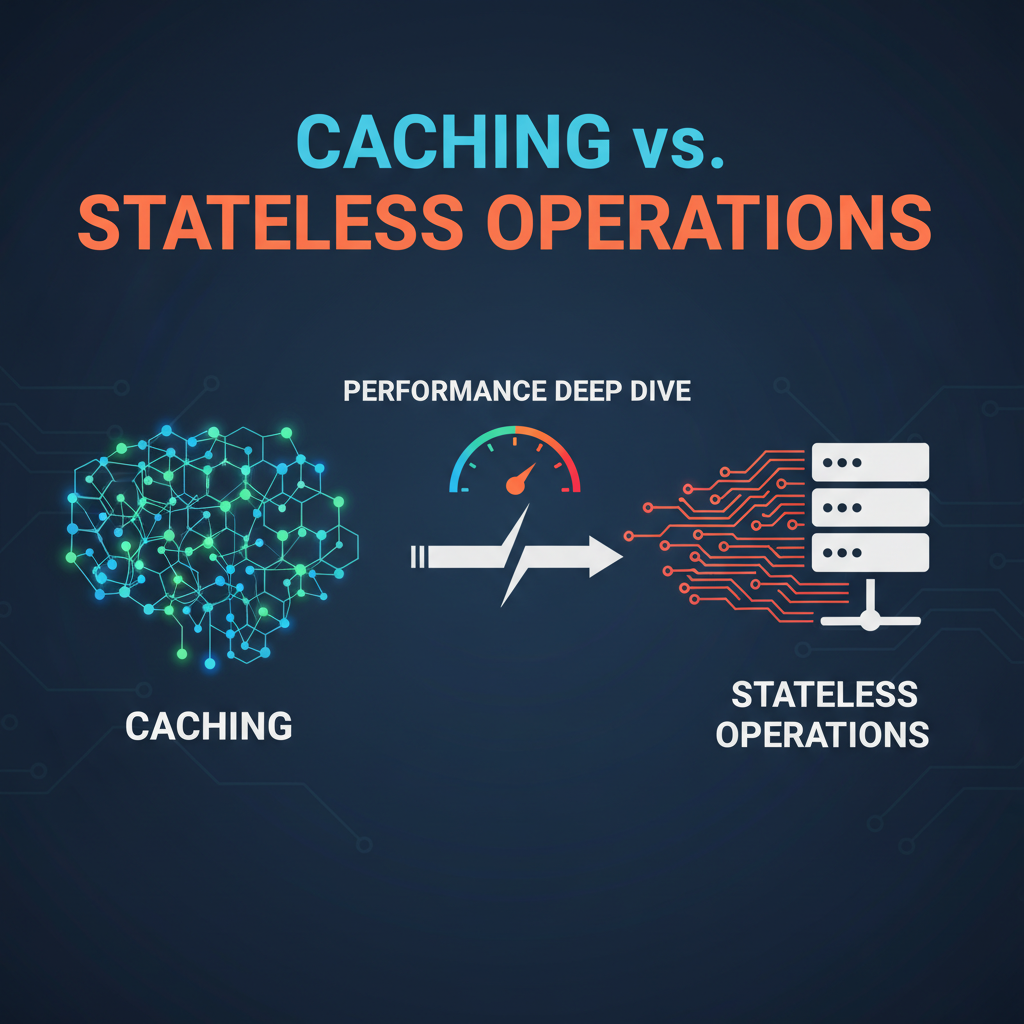


The relentless pursuit of speed and efficiency defines the landscape of modern software architecture. In an era where milliseconds can translate into millions in revenue or customer churn, understanding the foundational principles that govern system performance is not merely advantageous; it is imperative. At the heart of this pursuit lie two distinct yet often complementary paradigms: Caching and Stateless Operations. Both are powerful tools in the architect's arsenal, designed to enhance system responsiveness, scalability, and resilience. However, their underlying philosophies, mechanisms, and optimal use cases differ significantly, leading to a complex interplay of design choices that can profoundly impact an application's behavior.
This article embarks on a comprehensive deep dive into caching versus stateless operations, unraveling their core tenets, exploring their individual strengths and weaknesses, and meticulously dissecting their performance implications. We will navigate the intricate decisions involved in adopting one over the other, or more frequently, orchestrating their harmonious coexistence. From the front lines of user interaction to the deepest recesses of backend data stores, and crucially, within the pivotal role of an api gateway, we will examine how these concepts manifest and shape the very fabric of distributed systems. Our journey will highlight their critical relevance in emerging domains such as AI Gateway and LLM Gateway architectures, where computational intensity and data dynamism present unique optimization challenges. By the end, readers will possess a nuanced understanding, enabling them to make informed architectural decisions that propel their systems towards peak performance and unparalleled user experience.
Part 1: Understanding Caching
Caching is a time-honored technique in computer science, born from the fundamental observation that retrieving or computing certain pieces of data can be an expensive, time-consuming operation. By storing copies of these frequently accessed or computationally intensive data items in a faster, more readily accessible location – the cache – systems can significantly reduce the latency and resource consumption associated with subsequent requests for the same information. It's akin to keeping frequently used tools on a workbench rather than walking to the shed every time you need one; the tool is still in the shed, but having a copy closer at hand drastically improves efficiency.
1.1 What is Caching?
At its essence, caching involves creating a temporary storage area (the cache) for data that is likely to be needed again soon. When a system needs a particular piece of data, it first checks the cache. If the data is found there (a "cache hit"), it can be retrieved almost instantly, bypassing the original, slower data source. If the data is not in the cache (a "cache miss"), the system retrieves it from its primary source, uses it, and then often stores a copy in the cache for future use. This simple mechanism forms the basis of performance optimization across virtually all layers of modern computing, from CPU registers to global content delivery networks.
The primary purpose of caching extends beyond mere speed enhancement. It also plays a crucial role in reducing the load on backend systems, such as databases, microservices, or external APIs. By serving requests from the cache, the primary data source is spared the computational burden, allowing it to handle a greater volume of unique requests or to process complex operations without becoming a bottleneck. This offloading capability is particularly valuable in high-traffic environments where backend resources are finite and expensive.
1.2 Types of Caching
The ubiquity of caching means it manifests in various forms, each optimized for a specific layer within a system's architecture. Understanding these different types is crucial for designing a holistic caching strategy.
- Client-side Caching: This occurs closest to the end-user. Web browsers, for instance, cache static assets like images, CSS files, and JavaScript, as well as API responses, to speed up subsequent visits to the same website. Content Delivery Networks (CDNs) also fall into this category, distributing copies of web content to servers geographically closer to users, reducing latency by minimizing the physical distance data has to travel. This significantly enhances the user experience, making web applications feel snappier and more responsive.
- Server-side Caching: Within the server infrastructure, caching can be implemented at multiple levels:
- Application-level Caching: The application itself might maintain an in-memory cache of frequently used objects or processed results. This is often the fastest form of caching as it avoids network latency and serialization overhead. Frameworks often provide built-in caching mechanisms or integration points for external cache stores.
- Database Caching: Databases often have their own internal caching mechanisms (e.g., query caches, buffer pools) to store frequently accessed data blocks or compiled queries, thereby reducing disk I/O. ORMs (Object-Relational Mappers) can also implement caching at the application layer to cache database query results.
- Distributed Caching: For large-scale, distributed applications, a single in-memory cache is insufficient. Distributed caching solutions like Redis, Memcached, or Apache Ignite provide a shared, centralized cache that multiple application instances can access. This ensures cache consistency across horizontally scaled services and offers high availability and fault tolerance, critical for robust enterprise systems.
- Gateway-level Caching: This is particularly relevant in the context of an
api gateway. Anapi gatewayacts as a single entry point for all API requests, sitting in front of a collection of backend services. Caching at this layer allows the gateway to intercept requests, check if a cached response is available, and serve it directly without forwarding the request to the backend services. This is an incredibly powerful optimization point, as it can reduce load on all downstream services, decrease overall latency, and shield backend systems from traffic spikes. For example, if multiple clients request the same static data through anapi gateway, the gateway can serve the cached response to all of them, dramatically improving efficiency.
1.3 Caching Strategies
The effectiveness of caching heavily depends on the strategy employed to manage data within the cache. These strategies dictate when data is written to, read from, and evicted from the cache.
- Cache-aside (Lazy Loading): This is perhaps the most common strategy. The application is responsible for checking the cache first. If data is found, it's retrieved from the cache. If not, the application retrieves it from the primary data source, uses it, and then writes it to the cache for future requests. This strategy ensures that only requested data is cached, preventing the cache from being filled with infrequently accessed items.
- Read-through: Similar to cache-aside, but the cache itself is responsible for fetching data from the primary source on a miss. The application only interacts with the cache, simplifying application logic. The cache acts as a proxy, fetching data and populating itself transparently.
- Write-through: When data is written, it is written simultaneously to both the cache and the primary data store. This ensures data consistency between the cache and the primary source, as the cache always holds the most up-to-date version. The downside is that write operations take longer, as they must complete in both locations.
- Write-back: Data is written only to the cache, and the cache periodically flushes the updated data to the primary data store. This offers excellent write performance, as the application doesn't wait for the primary storage write. However, it introduces a risk of data loss if the cache fails before the data is persisted to the primary source.
- Cache Eviction Policies: When a cache reaches its capacity, it must decide which items to remove to make space for new ones. Common policies include:
- Least Recently Used (LRU): Evicts the item that has not been accessed for the longest period. It assumes that if an item was used recently, it is likely to be used again soon.
- Least Frequently Used (LFU): Evicts the item that has been accessed the fewest times. This policy prioritizes items that are consistently popular.
- First-In, First-Out (FIFO): Evicts the item that was added to the cache earliest, regardless of how often it has been used.
- Time-to-Live (TTL): Items are automatically evicted from the cache after a predefined duration, regardless of access patterns. This is crucial for managing data freshness and preventing stale data.
1.4 Advantages of Caching
The benefits of a well-implemented caching strategy are substantial and multifaceted, driving significant improvements across various performance metrics.
- Significant Performance Improvement: The most immediate and obvious advantage is the dramatic reduction in latency for data retrieval. By avoiding costly operations like database queries, external API calls, or complex computations, cache hits can serve responses orders of magnitude faster. This translates directly into a more responsive application and a smoother user experience. In high-throughput systems, caching can increase the number of transactions per second (TPS) an application can handle, pushing its performance ceiling considerably higher.
- Reduced Load on Backend Services: Caching acts as a protective shield for your backend infrastructure. Each request served from the cache is a request that doesn't hit your databases, microservices, or third-party APIs. This offloading effect reduces the computational burden, network traffic, and I/O operations on these core services, allowing them to operate more efficiently, scale more gracefully, and maintain stability even under heavy load. This is especially critical for services that have expensive rate limits or usage-based billing.
- Improved User Experience: For end-users, reduced latency means faster page loads, quicker application responses, and an overall more fluid interaction. In today's impatient digital world, even a slight delay can lead to user frustration and abandonment. Caching directly addresses this by making applications feel snappier and more intuitive, fostering greater engagement and satisfaction.
1.5 Challenges and Disadvantages of Caching
Despite its undeniable power, caching introduces its own set of complexities and potential pitfalls that must be carefully managed.
- Cache Invalidation – "The Hardest Problem in Computer Science": This often-quoted adage highlights the core difficulty of caching: ensuring that the data in the cache remains consistent with the primary data source. When the primary data changes, the cached copy becomes "stale." Invalidating the cache at the exact moment the source data changes, especially in a distributed system, is incredibly challenging. Incorrect invalidation can lead to users seeing outdated information, which can range from minor inconvenience to severe data integrity issues.
- Stale Data Issues: Even with careful invalidation strategies, there's always a window of potential staleness. If a system relies heavily on cached data, and that data is updated in the primary source, users might temporarily retrieve the old, cached version. This risk is amplified in systems where data changes frequently or where real-time consistency is paramount. Strategies like using short TTLs or implementing robust event-driven invalidation are necessary but add complexity.
- Increased Complexity: Introducing a cache layer adds another component to the system architecture. This means more infrastructure to manage (e.g., Redis clusters), more code to write (cache population and invalidation logic), and more potential points of failure. Debugging issues can also become more complex, as differentiating between primary data source problems and cache-related issues requires careful monitoring and logging.
- Memory Overhead: Caches consume memory. While modern systems have abundant memory, large caches can still put a strain on resources. Moreover, if the cache is not efficiently managed, it can lead to inefficient memory usage, potentially impacting other system processes. Choosing the right data to cache and implementing effective eviction policies are crucial to manage this overhead.
- Cache Warm-up Issues: When a cache is empty (e.g., after a system restart, or when a new cache instance is brought online), the initial requests will all be cache misses. This period, known as "cache warm-up," can lead to temporary performance degradation as all requests hit the backend, potentially overwhelming it. Strategies like pre-populating the cache or gradually warming it up are often employed to mitigate this.
Part 2: Understanding Stateless Operations
In stark contrast to caching, which focuses on retaining data for future use, stateless operations are built on the principle of forgetting. A system designed around statelessness ensures that each request from a client to a server contains all the necessary information for the server to process that request independently, without relying on any prior context or stored session information on the server side. This architectural philosophy has profound implications for scalability, resilience, and simplicity in distributed systems.
2.1 What is Statelessness?
A stateless operation means that the server does not store any client-specific state between requests. Every request is treated as an isolated, self-contained transaction. Imagine making a phone call to customer service: a stateful interaction would involve the agent remembering your previous calls, your history, and your specific problem without you having to repeat yourself. A stateless interaction, however, would require you to provide all your details and explain your issue anew with every single call, regardless of how recently you called or spoke to the same agent.
In the context of software, this means that a server processing a request does not retain any memory of previous interactions with that particular client. If a client sends two consecutive requests, the server treats them as entirely separate events. Any information required to process the second request that might have been generated or used during the first request must be explicitly included in the second request itself, typically sent by the client. This design choice simplifies server logic and significantly alters how systems are scaled and managed.
2.2 Principles of Stateless Design
Adhering to stateless principles guides the architecture towards systems that are inherently more scalable and robust.
- Self-contained Requests: Each request must carry all the data needed for the server to fulfill it. This includes authentication tokens, user preferences, transaction identifiers, or any other context that might be necessary. Common ways to achieve this include using request headers, URL parameters, or the request body to pass all required information.
- No Server-side Sessions: The most defining characteristic of statelessness is the absence of server-side session management. Traditional stateful applications often rely on sessions stored on the server to maintain user context across multiple requests. In a stateless design, this context is either managed entirely on the client side (e.g., through cookies, local storage, or JWTs - JSON Web Tokens) or stored in an external, shared state store that is not tied to a specific application instance.
- Scalability Through Horizontal Scaling: Because no server instance holds unique client state, any server instance can handle any client request at any time. This dramatically simplifies horizontal scaling. You can add or remove server instances dynamically without worrying about sticky sessions or state synchronization issues. Load balancers can distribute requests across available servers indiscriminately, enhancing both capacity and fault tolerance.
2.3 Advantages of Stateless Operations
The benefits derived from embracing statelessness are primarily centered around operational simplicity, scalability, and resilience.
- Simplified Scaling (Easily Add/Remove Servers): This is arguably the most compelling advantage. Without client-specific state residing on individual servers, you can scale your application instances up or down with remarkable ease. A new server can immediately join the pool and start processing requests without any complex state initialization. Conversely, a server can be removed or crash without losing any critical client context, as that context resides either with the client or in a highly available external store. This flexibility is foundational for cloud-native architectures and dynamic environments.
- Improved Resilience and Fault Tolerance: Since no server holds critical, unique client state, the failure of any single server instance does not directly impact the overall client interaction. A client whose request was being processed by a failing server can simply retry the request, and a different healthy server can pick it up and process it successfully. This makes stateless systems inherently more robust against individual component failures, enhancing the overall availability and reliability of the service.
- Easier Load Balancing: Load balancers can distribute incoming requests across a pool of stateless servers using simple, round-robin or least-connection algorithms without concern for "session stickiness" (where a client must always return to the same server). This simplifies load balancer configuration and improves the efficiency of resource utilization, as requests can be evenly distributed among all available servers, preventing hot spots.
- Predictable Behavior: The isolated nature of each request in a stateless system often leads to more predictable behavior. There are fewer complex interactions and hidden dependencies between requests, making it easier to reason about system state, debug issues, and ensure consistent outcomes.
2.4 Challenges and Disadvantages of Stateless Operations
While powerful, stateless architectures are not without their trade-offs and potential drawbacks.
- Increased Data Transfer Per Request (if state needs to be sent repeatedly): If client context (e.g., user preferences, authorization details) is complex and required for every request, and it needs to be sent by the client with each interaction, it can lead to larger request sizes. This increased data payload can consume more bandwidth and potentially increase network latency, especially for clients with limited connectivity. Careful consideration must be given to what context truly needs to be sent with every request and what can be derived or kept minimal.
- Potential for Higher Latency if State Needs to Be Re-fetched/Recomputed for Every Request: While the server itself doesn't store state, if the processing of a request requires access to some external state (e.g., user profiles from a database, permissions from an identity service), and that state needs to be fetched for every single request, this can introduce significant latency. Each request essentially starts from scratch, incurring the cost of data retrieval or computation anew. This is where caching can beautifully complement statelessness, as we will explore.
- No Inherent Memory of Past Interactions: By design, stateless servers have no "memory." This means that features requiring context across multiple requests (e.g., a multi-step wizard, an intricate shopping cart flow) must explicitly manage this state elsewhere. This often involves either pushing the state back to the client (which then sends it with subsequent requests) or storing it in an external, highly available data store (like a database or a distributed cache) that all stateless application instances can access. While feasible, this shifts the complexity of state management, rather than eliminating it.
Part 3: Caching in the Context of api gateway, AI Gateway, and LLM Gateway
The principles of caching and statelessness converge and diverge in fascinating ways when applied to specific architectural components like an api gateway, especially as these gateways evolve to handle the unique demands of artificial intelligence workloads, giving rise to AI Gateway and LLM Gateway concepts. These components serve as critical intermediaries, and their performance directly impacts the user experience and the efficiency of the entire system.
3.1 The Role of api gateways
An api gateway is a fundamental pattern in modern microservices architectures. It acts as a single, centralized entry point for all client requests, routing them to the appropriate backend services. Beyond simple routing, api gateways typically encapsulate a wide array of cross-cutting concerns, providing a unified facade for a potentially complex backend landscape.
Key features of an api gateway include:
- Routing: Directing incoming requests to the correct microservice based on URL paths, headers, or other criteria.
- Authentication and Authorization: Verifying client credentials and permissions before forwarding requests, offloading this responsibility from individual microservices.
- Rate Limiting: Protecting backend services from being overwhelmed by too many requests from a single client.
- Monitoring and Logging: Centralizing the collection of request metrics and logs, providing observability into API usage and performance.
- Request/Response Transformation: Modifying request payloads or response formats to align with client expectations or backend service requirements.
- Load Balancing: Distributing requests across multiple instances of a backend service.
- And, crucially, Caching: Storing responses from backend services to serve subsequent identical requests more quickly.
How caching improves api gateway performance:
When caching is implemented at the api gateway level, it offers a powerful optimization point that benefits the entire system. Imagine an api gateway receiving numerous identical requests for a stable piece of data—for example, a list of product categories, currency exchange rates, or configuration parameters. Without caching, each of these requests would be forwarded to the respective backend service, which would then perform its own logic (e.g., a database query) to generate the response.
With gateway-level caching, the api gateway can intercept these requests. If the response for a particular request is already present in its cache and is still valid (not expired), the gateway can immediately return the cached response to the client. This bypasses the entire backend service stack, eliminating network latency to the backend, reducing the load on the backend service, and freeing up its resources for other unique requests. The performance gain is often dramatic, particularly for read-heavy APIs dealing with relatively static data. This significantly enhances the throughput and responsiveness of the entire API ecosystem.
3.2 Specifics for AI Gateways and LLM Gateways
The advent of Artificial Intelligence, especially Large Language Models (LLMs), introduces new dimensions to API management and performance optimization. AI Gateways and LLM Gateways are specialized forms of api gateways designed to manage, route, and optimize access to various AI models and services. The computational cost associated with AI/LLM inferences is often exceedingly high, making caching an even more critical component of their architecture.
- High Computational Cost of AI/LLM Inferences: Running an AI model, particularly a large language model, involves significant computational resources – typically powerful GPUs and substantial memory. Each inference request can consume considerable time and energy. For example, generating a complex piece of text, analyzing a large image, or performing intricate data analysis via an LLM can take seconds or even minutes, and incur substantial operational costs.
- Caching Frequently Requested Prompts/Responses: In this context, caching takes on an amplified importance. If an
AI GatewayorLLM Gatewayreceives the same prompt or a very similar prompt multiple times, and the underlying AI model is likely to produce an identical or nearly identical response, caching that response can lead to immense savings. Instead of re-running the computationally expensive inference, the gateway can serve the pre-computed response from its cache, drastically reducing latency, cutting down GPU/CPU utilization, and lowering infrastructure costs. - Example Scenarios:
- Common Queries: For an
LLM Gatewaypowering a chatbot, frequently asked questions (FAQs) might always yield the same model response. Caching these canonical Q&A pairs is a no-brainer. - Boilerplate Responses: If an AI service provides boilerplate summaries or standard interpretations for certain input patterns, these can be cached.
- Pre-computed Results: In scenarios where certain analytical tasks are run on fixed datasets, and the results are consistently needed, the outputs can be cached.
- Sentiment Analysis: If specific phrases or product reviews are often re-analyzed for sentiment, and their sentiment score is stable, caching these results avoids redundant processing.
- Common Queries: For an
- Challenges in AI/LLM Caching: While the benefits are clear, caching for AI and LLMs presents unique challenges:
- Dynamic Nature of AI Responses: Unlike traditional data, AI model outputs can sometimes be non-deterministic, especially with generative models. A slight change in prompt wording or even the model's internal state (e.g., temperature settings, random seed) might lead to different outputs for seemingly similar inputs. This complicates direct caching strategies.
- Prompt Engineering Variations: Users might phrase the "same" request in many slightly different ways. An effective
AI Gatewaycaching mechanism might need to employ advanced techniques like prompt normalization or semantic similarity matching to identify "semantically equivalent" requests and serve cached responses, even if the exact string input differs. This adds significant complexity beyond simple key-value lookups. - Model Updates and Retraining: When an underlying AI model is updated or retrained, its behavior might change, rendering previous cached responses stale. Robust cache invalidation strategies are essential to ensure that users always receive responses from the latest model version.
For organizations grappling with these complexities, particularly in the realm of AI and API management, platforms like ApiPark offer comprehensive solutions. As an open-source AI gateway and API management platform, APIPark provides robust features for unifying AI model invocation, prompt encapsulation, and end-to-end API lifecycle management. This includes sophisticated traffic forwarding, load balancing, and monitoring capabilities, which directly benefit from thoughtful caching strategies. APIPark simplifies the integration of over 100 AI models, standardizes API formats for AI invocation, and allows for prompt encapsulation into REST APIs, all of which are scenarios where judicious caching can dramatically enhance performance and resource utilization. With its powerful features and performance rivaling Nginx, APIPark can help manage the high demands placed on AI and LLM services, making intelligent caching a core component of its operational efficiency.
Part 4: Performance Deep Dive: Caching vs. Stateless Operations – A Comparative Analysis
While caching and stateless operations are often discussed separately, their performance implications are deeply intertwined. The most performant and scalable architectures typically combine both approaches, leveraging the strengths of each to mitigate their respective weaknesses. Understanding when to prioritize one or the other, or how to integrate them, is key to superior system design.
4.1 When Caching Excels
Caching shines brightest in scenarios characterized by predictable data access and a high cost of data generation or retrieval.
- Read-heavy Workloads, Predictable Data Access Patterns: Applications where the ratio of read operations to write operations is very high are ideal candidates for caching. Think of e-commerce product catalogs, news feeds, static documentation, or social media timelines. If the same data is requested repeatedly and changes infrequently, caching provides immense value. Predictable access patterns (e.g., popular items, trending topics) allow for efficient cache pre-population and effective eviction policies.
- High Cost of Data Generation/Retrieval: Whenever fetching data from the primary source or computing a response is resource-intensive, caching offers a significant performance boost. This includes:
- Complex Database Queries: Queries involving multiple joins, aggregations, or large datasets that take hundreds of milliseconds or seconds to execute.
- External API Calls: Retrieving data from third-party services often involves network latency and potential rate limits, making caching highly beneficial.
- AI/LLM Inferences: As discussed, the computational expense of running AI models means that caching common prompts or inference results directly translates into reduced GPU/CPU cycles and faster response times.
- Static or Semi-static Content: Web pages, images, CSS, JavaScript files, configuration data, and master data lists that change rarely or on a predictable schedule are perfectly suited for long-term caching at client-side, CDN, or
api gatewaylevels. This offloads immense traffic from application servers and databases.
4.2 When Statelessness is Paramount
Statelessness becomes the primary design goal when horizontal scalability, resilience, and simplicity of deployment are the overriding concerns.
- Write-heavy Workloads, Highly Dynamic Data: For applications where data changes frequently and rapidly, and where consistency is paramount for every write, caching can become more of a liability than an asset due to the cache invalidation problem. In such scenarios (e.g., real-time transaction processing, stock trading platforms, online gaming state), statelessness ensures that every write operation directly interacts with the primary data source, guaranteeing immediate consistency.
- Systems Requiring Extreme Horizontal Scalability and Resilience: When the ability to scale out (add more servers) or scale in (remove servers) dynamically is critical to handle fluctuating loads, and when the system must be highly resilient to individual server failures, stateless design is fundamental. Each server being interchangeable simplifies infrastructure management enormously, making it easier to leverage cloud elasticity.
- When Individual Request Processing is Relatively Inexpensive but Throughput is Critical: If the work involved in processing a single request is quick (e.g., a simple API call to retrieve a single record, or a lightweight calculation), but the system needs to handle millions of such requests per second, statelessness allows for maximum parallelization across many instances. The overhead of state management or cache misses might outweigh the benefits in such scenarios, making a pure stateless, horizontally scaled approach more effective.
4.3 The Synergy: Combining Caching with Statelessness
The most prevalent and arguably most effective architectural pattern in modern distributed systems involves a symbiotic relationship between caching and statelessness. Rather than an "either/or" choice, it is often a "both/and" scenario.
- Stateless Application Servers Backed by a Shared, Distributed Cache: This is the canonical pattern. Application servers are designed to be stateless, meaning they do not store any client-specific session data. This allows them to be scaled horizontally with ease and makes them resilient to individual failures. However, to combat the potential latency of re-fetching or re-computing data for every request (a drawback of pure statelessness), these stateless application instances interact with a shared, distributed cache (e.g., Redis cluster).
- When a request comes in, a stateless application server attempts to retrieve necessary data from the distributed cache.
- If a cache hit occurs, the server processes the request quickly.
- If a cache miss occurs, the server fetches the data from the primary source (e.g., database, external API), processes the request, and then stores the fetched data in the shared distributed cache for future use by any other stateless server instance.
- How this Combination Achieves Both Scalability and Performance:
- Scalability: The stateless nature of the application servers ensures that adding more instances directly increases capacity and throughput without state synchronization nightmares. Load balancers can operate efficiently.
- Performance: The distributed cache provides rapid data access, mitigating the repeated fetching cost that pure statelessness might incur. It acts as a shared, fast memory layer for the entire application cluster.
- Resilience: Both layers contribute to resilience. Stateless servers can fail and be replaced without data loss. Distributed caches are typically designed with high availability and replication, ensuring that cached data persists even if a cache node fails.
This hybrid approach leverages the best of both worlds, providing the robust horizontal scalability and fault tolerance of stateless architectures while delivering the low-latency, high-throughput benefits of caching. This pattern is commonly observed in virtually all high-performance web services and microservices ecosystems, often with an api gateway at the front providing additional caching capabilities.
4.4 Key Performance Metrics and Monitoring
Regardless of whether one emphasizes caching, statelessness, or their combination, continuous monitoring of key performance metrics is absolutely essential for understanding system behavior, identifying bottlenecks, and optimizing performance.
- Latency: The time taken for a request to travel from the client, be processed, and return a response. Caching significantly reduces latency for cache hits. Monitoring average, 95th, and 99th percentile latencies helps pinpoint performance issues.
- Throughput (TPS): The number of requests processed per unit of time (e.g., Transactions Per Second). Stateless architectures, with their horizontal scalability, can achieve very high throughput. Caching also boosts effective throughput by reducing the load on backend services, allowing them to handle more unique requests.
- Cache Hit Ratio: The percentage of requests that are successfully served from the cache. A high hit ratio (e.g., >80-90%) indicates an effective caching strategy. A low hit ratio suggests that the cache is not being utilized efficiently, potentially due to poor eviction policies, short TTLs, or data not being suitable for caching.
- Error Rates: The percentage of requests that result in an error. Both caching (e.g., stale data leading to logic errors) and statelessness (e.g., client failing to send complete context) can introduce errors if not handled correctly. Monitoring helps identify and resolve these issues.
- Resource Utilization (CPU, Memory, Network I/O): Tracking these metrics for application servers, database servers, and cache servers provides insights into where resources are being consumed and if there are any bottlenecks. High CPU on stateless servers might indicate inefficient code, while high memory on cache servers might mean the cache is too large or poorly managed.
The importance of robust monitoring cannot be overstated. Without it, architectural decisions are made in the dark, and optimizations are mere guesses. Detailed API call logging and powerful data analysis features, such as those provided by APIPark, become indispensable tools for understanding long-term trends, diagnosing issues, and driving continuous improvement in performance.
APIPark is a high-performance AI gateway that allows you to securely access the most comprehensive LLM APIs globally on the APIPark platform, including OpenAI, Anthropic, Mistral, Llama2, Google Gemini, and more.Try APIPark now! 👇👇👇
Part 5: Advanced Considerations and Best Practices
Moving beyond the fundamentals, several advanced considerations and best practices emerge when meticulously designing systems that leverage caching and statelessness. These address nuanced challenges and ensure the robustness, security, and efficiency of your architecture.
5.1 Cache Invalidation Strategies Revisited
The infamous "cache invalidation" problem demands a more detailed exploration of strategies to maintain data consistency. Getting this wrong is the quickest way to erode trust in your system.
- Time-based Invalidation (TTL): This is the simplest strategy: cache items expire after a fixed duration (Time-to-Live). It's effective for data that tolerates some staleness or changes predictably. For instance, an hourly
api gatewaycache for currency exchange rates is acceptable if real-time accuracy isn't strictly required. The drawback is that data might become stale before the TTL expires, or remain in the cache longer than necessary if its change is infrequent. - Event-driven Invalidation: This is generally the most robust approach for ensuring consistency. When the primary data source changes, it explicitly notifies the cache (or a message queue that the cache subscribes to) to invalidate or update the affected cache entries. For example, if a product description is updated in a database, a message is published to a topic, and the cache service (or
api gateway's caching module) consumes this message to evict the old product description from its cache. This ensures near real-time consistency but adds architectural complexity (e.g., message queues, distributed events). - Versioning and Etag Headers: For web caching, Etag (Entity Tag) headers are powerful. When a resource is served, an Etag (a hash or version identifier of the resource) is included in the response. On subsequent requests, the client sends this Etag back. If the Etag matches, the server knows the client has the latest version and returns a
304 Not Modifiedstatus, avoiding sending the entire response body. This is a form of client-side caching control that works hand-in-hand with stateless HTTP. - Distributed Cache Consistency: In systems with multiple cache nodes (e.g., a Redis cluster), ensuring all nodes invalidate or update consistently can be tricky. Techniques like consistent hashing, quorum-based updates, or using a central publish-subscribe mechanism are essential to propagate invalidation events across the entire cache cluster.
5.2 Idempotency and Stateless APIs
Idempotency is a crucial concept, especially for stateless APIs and operations. An idempotent operation is one that can be applied multiple times without changing the result beyond the initial application. In other words, calling the same API endpoint with the same parameters multiple times will produce the same outcome.
- Why Idempotency Matters for Statelessness: In a stateless system, clients often need to retry requests due to transient network issues, server failures, or timeouts. If an operation is not idempotent, retrying it might lead to unintended side effects (e.g., submitting the same order twice, deducting money multiple times). For example, a
POST /ordersendpoint is typically not idempotent, but aPUT /orders/{orderId}orDELETE /orders/{orderId}is usually designed to be. - Ensuring Reliable Retries: Designing APIs to be idempotent allows clients to safely retry failed requests without worrying about duplicate processing on the server. This significantly improves the reliability and fault tolerance of the client-server interaction in a stateless environment. Developers often implement idempotency keys (unique identifiers sent by the client with each request) at the
api gatewayor service layer to detect and discard duplicate requests.
5.3 Security Implications
Both caching and statelessness have significant security considerations that must be addressed.
- Caching Sensitive Data (GDPR, PII): Caching personally identifiable information (PII), financial data, or other sensitive information requires extreme caution. If a cache is compromised, sensitive data could be exposed. Regulations like GDPR mandate strict controls over such data. Best practices include:
- Avoiding caching sensitive data altogether: If possible, do not cache data that is highly sensitive or user-specific.
- Encryption at rest: Encrypt cached data when it is stored.
- Strict access controls: Ensure only authorized services can access the cache.
- Short TTLs: Minimize the window of exposure by using very short Time-to-Live values for any sensitive data that absolutely must be cached.
- Stateless Authentication (JWTs): Stateless authentication mechanisms, such as JSON Web Tokens (JWTs), are commonly used in stateless APIs. Once a client authenticates, the server issues a JWT, which the client then includes with every subsequent request. The
api gatewayor backend service can validate the JWT without needing to query a database or maintain a session, reinforcing the stateless principle. However, JWTs introduce challenges like revocation (what happens if a token is stolen?) and expiration management, which must be carefully designed.
5.4 Architectural Patterns
The interplay of caching and statelessness is central to several popular architectural patterns.
- Microservices: Stateless microservices are the foundation of many modern architectures. Each microservice typically manages its own data but often leverages a shared distributed cache (e.g., through an
api gatewayor a dedicated caching layer) for common, read-heavy data, allowing individual services to remain stateless and highly scalable. AnAI GatewayorLLM Gatewaywould sit as a specialized microservice (or collection of microservices) providing access to AI models, benefiting greatly from caching inference results. - Serverless Functions (FaaS): Serverless computing (e.g., AWS Lambda, Azure Functions) is an extreme embodiment of statelessness. Functions are ephemeral, spinning up to handle a single request and then shutting down. They have no memory of previous invocations. While this simplifies deployment and scaling, it can lead to "cold start" latency and repeated data fetches. Caching is still applicable at the edge (e.g., CDN in front of an API Gateway that invokes Lambda) or via external, shared data stores that these functions can access, mimicking the distributed cache pattern.
Part 6: Future Trends and Evolution
The ongoing evolution of computing paradigms continues to reshape how we approach caching and stateless operations. As new technologies emerge and demands on systems intensify, these fundamental concepts are adapting and finding new expressions.
- Edge Computing and Caching: The rise of edge computing, where computation and data storage are moved closer to the source of data generation and consumption, naturally amplifies the importance of caching. Edge caches can significantly reduce latency for users located far from central data centers, improve application responsiveness, and reduce backhaul network traffic. CDNs are an early form of edge caching, but newer platforms are bringing more complex computation and data persistence to the edge, blurring the lines between traditional client-side and server-side caching. For an
AI GatewayorLLM Gateway, distributing inference caching to the edge could revolutionize real-time AI applications, making them faster and more robust globally. - Intelligent Caching with Machine Learning (Predictive Caching): Traditional caching relies on heuristics like LRU or LFU, or simple TTLs. However, with advancements in machine learning, we are seeing the emergence of "intelligent caches" that can predict which data will be needed next. By analyzing access patterns, user behavior, and contextual information, ML models can proactively pre-fetch and cache data, anticipating demand rather than reacting to it. This can lead to significantly higher cache hit ratios and further reduce latency, especially for dynamic content or personalized experiences. Imagine an
LLM Gatewaythat predicts the next likely user query in a conversation and pre-caches potential model responses. - Serverless and Function-as-a-Service (FaaS) Furthering Stateless Paradigms: While already discussed, the continued growth and maturity of serverless computing platforms will push stateless design to its absolute limits. As more applications embrace this ephemeral, event-driven model, the challenges of persistent state management will become even more pronounced. This will drive innovation in how external state (e.g., databases, distributed caches, event streams) is efficiently accessed and managed by intrinsically stateless functions, reinforcing the symbiotic relationship between stateless compute and external, highly available data stores.
- Unified API Gateways and Service Meshes: The role of
api gateways is expanding, often integrating with service meshes in microservices environments. This provides more granular control over traffic, observability, and security. Caching capabilities are becoming standard features in these unified platforms, allowing for consistent caching policies across an entire service landscape, from the edge to individual service interactions. AnAI GatewayorLLM Gatewaymight be integrated into such a mesh, providing a centralized and performant access layer to AI capabilities within the broader enterprise architecture. - Cost Optimization Focus: With cloud computing becoming ubiquitous, the cost implications of operations are under constant scrutiny. Both caching and stateless architectures play a critical role here. Effective caching reduces the need for expensive backend compute resources (like GPUs for LLMs), while statelessness enables highly efficient auto-scaling, preventing over-provisioning. Future trends will likely see even more sophisticated tools and strategies focused on optimizing cost-performance ratios through intelligent application of these principles.
Conclusion
The journey through caching and stateless operations reveals them as twin pillars supporting the edifice of high-performance, scalable, and resilient software systems. Caching, with its unwavering focus on speed and resource offloading, acts as the system's short-term memory, holding frequently accessed or expensive-to-compute data closer to the point of use. Its power is undeniable in read-heavy scenarios, particularly when fronting computationally intensive services like an AI Gateway or LLM Gateway. Conversely, statelessness champions simplicity, horizontal scalability, and fault tolerance by ensuring that every interaction is self-contained, liberating servers from the burden of maintaining client context. This paradigm is the bedrock of modern microservices and serverless architectures, where dynamic scaling and resilience are non-negotiable.
The true mastery, however, lies not in choosing one over the other, but in understanding their nuanced interplay and strategically combining them. The most robust and performant systems often feature stateless application instances backed by intelligent, distributed caching layers, frequently orchestrated by a capable api gateway. This synergistic approach allows applications to achieve both elastic scalability and lightning-fast responsiveness, adapting gracefully to fluctuating loads and diverse data access patterns.
As technology continues its inexorable march forward, with edge computing, AI-driven intelligent caching, and the pervasive adoption of serverless paradigms, the fundamental principles of caching and statelessness will continue to evolve and find new applications. Architects and developers must remain vigilant, continuously monitoring their systems, analyzing performance metrics, and adapting their strategies. The ultimate goal is always to deliver an optimal user experience and maximize operational efficiency. By deeply understanding these core concepts and embracing best practices, one can sculpt architectures that not only meet today's demanding performance requirements but are also poised to tackle the challenges of tomorrow.
Comparison Table: Caching vs. Stateless Operations
| Feature | Caching | Stateless Operations |
|---|---|---|
| Core Principle | Store copies of data for faster retrieval. | Server holds no client-specific context between requests. |
| Primary Goal | Reduce latency, improve throughput, offload backend. | Enhance scalability, resilience, simplify deployment. |
| Data Context | Data retained/stored (temporarily) at an intermediate layer. | Each request carries all necessary context; server "forgets." |
| Scalability | Can improve effective scalability by offloading backend, but cache layer itself must scale. | Facilitates horizontal scaling by making servers interchangeable. |
| Resilience | Cache failure can impact performance (cold start); primary source is backup. | Server failure does not lose client context; any server can handle retries. |
| Complexity | Adds complexity for cache invalidation, consistency, and management. | Simpler server logic, but client or external store manages state. |
| Data Consistency | Potential for stale data if invalidation is not managed correctly. | High consistency as every request interacts with primary data or client state. |
| Performance Impact | Drastically reduces latency for cache hits; boosts TPS. | Can incur higher latency if state must be re-fetched/recomputed for every request. |
| Ideal Workloads | Read-heavy, expensive data retrieval/computation (e.g., AI Gateway, LLM Gateway). |
Write-heavy, dynamic data, extreme horizontal scaling needs. |
| Typical Implementation | In-memory, distributed caches (Redis), CDN, api gateway cache. |
API requests with JWTs, client-side state, external databases for shared state. |
| Security Concerns | Risk of sensitive data exposure if cache is compromised. | Requires secure transmission of state (e.g., encrypted JWTs). |
| Complementary Usage | Often combined: Stateless servers use distributed caches for performance. | Often combined: Stateless servers interact with caches for speed. |
5 FAQs
1. What is the fundamental difference between caching and stateless operations? The fundamental difference lies in how state is managed. Caching involves temporarily storing copies of data to reduce the need to retrieve it from its original source, thus retaining a form of "memory" for performance. Stateless operations, conversely, ensure that the server processes each request without relying on any stored client context or session information from previous interactions, essentially "forgetting" everything between requests. Caching is about holding onto data; statelessness is about not holding onto interaction context on the server side.
2. Can an api gateway be both stateless and implement caching? How? Yes, absolutely. An api gateway itself is often designed to be stateless, meaning it doesn't maintain client-specific session state between requests but rather processes each request independently. However, it can incorporate a caching layer internally. This caching layer stores responses from backend services (e.g., an AI Gateway's response to a common prompt) for a specified duration. So, while the gateway handles each client request without remembering past client interactions, it uses its cache to serve common responses quickly, benefiting the entire system without making the gateway itself stateful in terms of client sessions.
3. What are the main benefits of using caching in an AI Gateway or LLM Gateway? The main benefits of caching in an AI Gateway or LLM Gateway are directly tied to the high computational cost of AI/LLM inferences. Caching frequently requested prompts or their corresponding model responses dramatically reduces latency, cuts down on expensive GPU/CPU resource utilization, and lowers operational costs. For common queries or boilerplate responses, serving from a cache avoids re-running the heavy AI model, significantly boosting throughput and responsiveness for applications relying on these intelligent services.
4. When should I prioritize a stateless design over a stateful one, and vice versa? You should prioritize a stateless design when: extreme horizontal scalability and resilience are critical; each request can be processed independently; and the system needs to handle dynamic fluctuations in load without complex state synchronization. This is ideal for microservices and cloud-native applications. You might lean towards a stateful design (or manage state externally) if: complex multi-step user interactions require server-side context; performance benefits from keeping state close to processing for a single client; or if existing legacy systems dictate a stateful approach. In most modern high-performance systems, statelessness is preferred, with any necessary "state" pushed to the client or an external, shared, highly available data store.
5. What is the biggest challenge when implementing a caching strategy, and how can it be mitigated? The biggest challenge when implementing a caching strategy is "cache invalidation"—ensuring that the data in the cache is always consistent with the primary data source. If the primary data changes, the cached copy becomes stale, potentially leading to users seeing incorrect information. This can be mitigated through several strategies: * Time-to-Live (TTL): Automatically expiring cache entries after a set period. * Event-driven Invalidation: Notifying the cache to invalidate specific entries whenever the underlying data changes in the primary source. * Versioning: Using version numbers or ETags for cached data, allowing clients or the cache to quickly determine if their copy is outdated. * Write-through/Write-back: Strategies that ensure cache updates are synchronized with primary data updates, although they introduce their own complexities and potential performance trade-offs. The choice depends on the specific data consistency requirements and tolerance for staleness.
🚀You can securely and efficiently call the OpenAI API on APIPark in just two steps:
Step 1: Deploy the APIPark AI gateway in 5 minutes.
APIPark is developed based on Golang, offering strong product performance and low development and maintenance costs. You can deploy APIPark with a single command line.
curl -sSO https://download.apipark.com/install/quick-start.sh; bash quick-start.sh

In my experience, you can see the successful deployment interface within 5 to 10 minutes. Then, you can log in to APIPark using your account.

Step 2: Call the OpenAI API.