Caching vs. Stateless Operation: Boost Your System's Efficiency
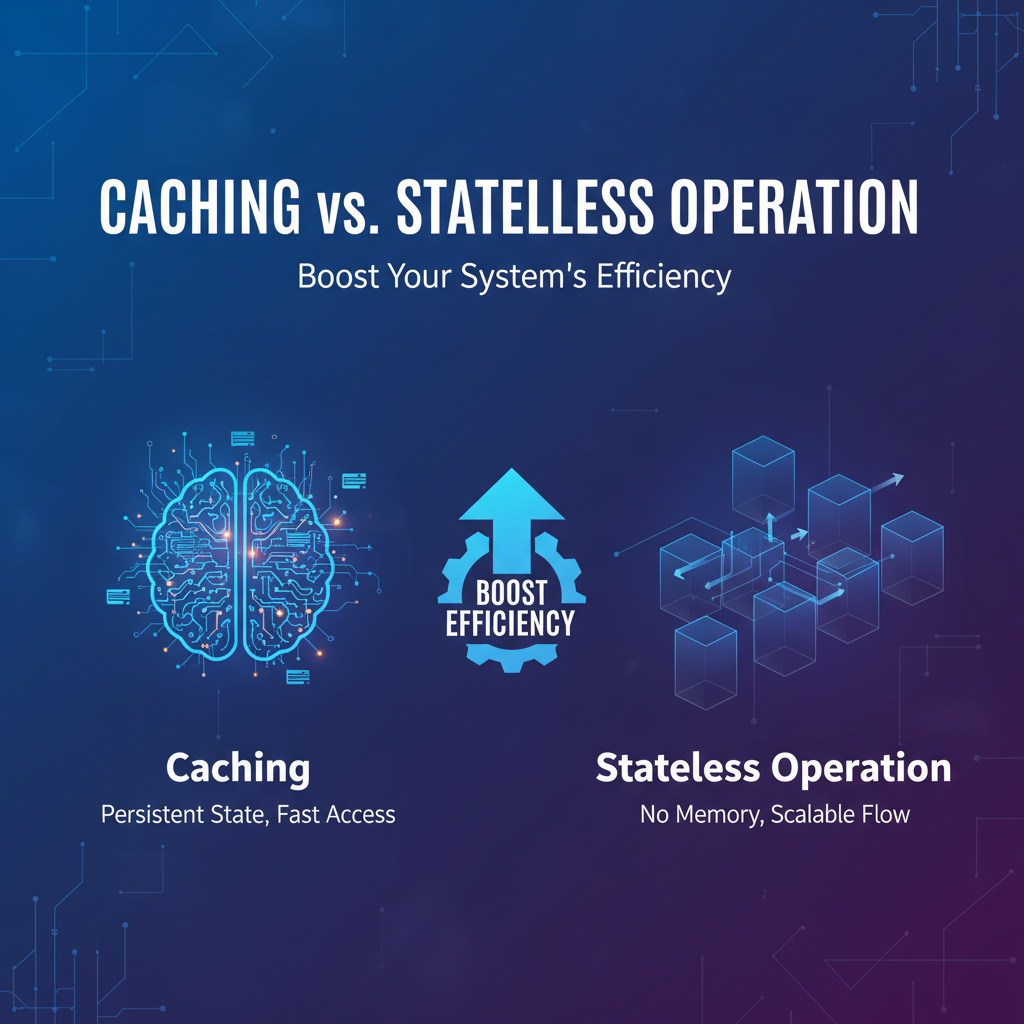


In the ever-evolving landscape of modern software architecture, the relentless pursuit of speed, scalability, and resilience stands as a paramount objective for developers and architects alike. The complex interplay between different design paradigms often dictates the success or failure of a system under real-world loads. Among these paradigms, two fundamental concepts frequently emerge as cornerstones of high-performance, distributed systems: caching and stateless operation. While seemingly distinct, these two principles are often deeply intertwined, forming a symbiotic relationship that, when skillfully managed, can unlock unprecedented levels of efficiency and responsiveness in an application. This comprehensive exploration delves into the intricacies of caching and statelessness, examining their individual merits, inherent challenges, and the strategic synergy they offer, particularly within the context of sophisticated API management and modern microservices architectures. We will dissect how these concepts empower systems, detailing their practical implementation, architectural implications, and the indispensable role played by an API gateway in orchestrating their harmonious coexistence.
The Foundational Quest for Efficiency: Understanding the Core Principles
At its heart, optimizing system efficiency is about minimizing resource consumption (CPU, memory, network, disk I/O) while maximizing output (speed, throughput, availability). This quest drives many architectural decisions, leading to patterns that reduce redundant work and distribute load effectively. Caching addresses the redundancy of data access, while statelessness addresses the redundancy of session management and server-side state.
Delving into the Realm of Caching: A Strategic Approach to Data Access
Caching is an optimization technique where copies of frequently accessed data are stored in a faster, more readily accessible location than their original source. The primary goal is to reduce the latency associated with data retrieval and alleviate the load on the primary data source, whether it be a database, a complex computation engine, or an external service. By intercepting requests for data and serving them from a local, high-speed store, caching dramatically improves response times, leading to a snappier user experience and a more resilient backend infrastructure. This strategy acknowledges that most data access patterns exhibit some degree of locality, meaning certain data items are accessed far more frequently than others. Capitalizing on this principle allows systems to perform exceptionally well even under intense demand.
The Mechanics of Caching: How Data Moves Closer to the Request
When a system implements caching, it introduces an intermediary layer between the consumer of data and the origin server. Upon receiving a request for data, the system first checks its cache. If the data (or a valid copy thereof) is found in the cache – a "cache hit" – it is immediately returned to the requester, bypassing the slower, more resource-intensive process of fetching it from the original source. If the data is not found – a "cache miss" – the system proceeds to retrieve it from the origin, serves it to the requester, and importantly, stores a copy in the cache for future requests. This simple yet powerful mechanism forms the bedrock of modern high-performance applications. The effectiveness of a cache is often measured by its hit ratio, which represents the percentage of requests that are successfully served from the cache. A higher hit ratio indicates a more efficient caching strategy and greater system performance gains.
Multifaceted Layers of Caching: From Client to Core
Caching is not a monolithic concept but rather a spectrum of techniques applied at various layers of a system architecture. Each layer serves a specific purpose, contributing to the overall efficiency:
- Client-Side Caching (Browser Cache): The simplest form, where web browsers store static assets (images, CSS, JavaScript) and even dynamic content to avoid re-downloading them on subsequent visits. This is governed by HTTP caching headers (e.g.,
Cache-Control,Expires,ETag). - Content Delivery Network (CDN) Caching: CDNs are globally distributed networks of proxy servers that cache static and sometimes dynamic web content closer to the end-users. When a user requests content, it's served from the nearest CDN edge node, drastically reducing latency and bandwidth usage from the origin server. This is particularly vital for global applications.
- Reverse Proxy/API Gateway Caching: Situated at the edge of an application's infrastructure, a reverse proxy or an API gateway can cache responses for upstream services. This is a critical layer, as it can intercept a vast number of requests before they even reach the application servers, providing significant load reduction and latency improvement for frequently accessed API endpoints. We will elaborate on this role later.
- Application-Level Caching: Within the application logic itself, developers can implement caching mechanisms. This can range from simple in-memory caches (e.g., using
HashMapin Java,dictin Python) for frequently computed results or lookup data, to more sophisticated distributed caches like Redis or Memcached. Distributed caches are essential in microservices architectures where multiple instances of a service might need to access the same cached data. - Database Caching: Databases often have internal caching mechanisms (e.g., query caches, buffer pools) to store frequently accessed data blocks or query results. Object-Relational Mappers (ORMs) can also implement caching at the application layer to avoid redundant database queries.
Strategies for Effective Caching: Navigating Data Lifecycle
Implementing caching isn't just about throwing data into a temporary store; it requires thoughtful strategies for how data enters and leaves the cache, and how its freshness is maintained.
- Cache-Aside (Lazy Loading): This is the most common strategy. The application directly interacts with the cache. On a read, the application first checks the cache. If the data is present (hit), it's returned. If not (miss), the application fetches data from the database, returns it, and then writes it to the cache for future use. This strategy ensures only requested data is cached, but it suffers from initial cache misses and potential for stale data if the database is updated directly.
- Write-Through: Data is written synchronously to both the cache and the database simultaneously. This ensures data consistency between the cache and the database at the time of writing. The drawback is increased write latency, as the operation waits for both writes to complete.
- Write-Back: Data is written only to the cache initially, and the write to the database occurs asynchronously or at a later time. This offers excellent write performance as the application doesn't wait for the database write. However, it introduces a risk of data loss if the cache fails before data is persisted to the database.
- Read-Through: Similar to cache-aside, but the cache itself is responsible for fetching data from the database on a miss. The application only interacts with the cache, simplifying application logic. This pattern is common in distributed caching solutions.
The Intricacy of Cache Invalidation: The Challenge of Freshness
The greatest challenge in caching is maintaining data consistency – ensuring that cached data remains fresh and reflects the most current state of the original source. "There are only two hard things in computer science: cache invalidation and naming things," as famously quipped by Phil Karlton. Poor cache invalidation can lead to users seeing stale or incorrect information, undermining the very purpose of caching.
- Time-Based Expiration (TTL - Time To Live): The simplest method, where each cached item is assigned a maximum lifespan. After this duration, the item is automatically removed or marked as stale, forcing a fresh retrieval on the next request. This is effective for data with predictable staleness tolerance but can lead to unnecessary cache misses if data is still fresh, or stale data if updates occur before expiry.
- Event-Driven Invalidation: When the original data source is updated, it triggers an event that explicitly invalidates the corresponding item(s) in the cache. This provides strong consistency but requires a more complex eventing system and careful coordination across distributed caches.
- Manual Invalidation: Administrators or specific application processes explicitly clear parts or all of the cache. This is often used for critical, infrequent updates or during system maintenance.
The Undeniable Benefits of Caching: A Catalyst for Performance
- Dramatic Performance Improvement: By serving data from faster memory rather than slower disk or network, caching significantly reduces response times for read-heavy operations.
- Reduced Backend Load: Less traffic reaches the primary data sources or backend services, freeing up their resources to handle more complex or write-intensive tasks. This can delay the need for scaling up backend infrastructure.
- Lower Network Latency and Bandwidth Costs: Especially with CDN and API gateway caching, less data needs to travel across long distances, reducing network latency for users and lowering data transfer costs for providers.
- Enhanced User Experience: Faster loading times and quicker interactions lead to higher user satisfaction and engagement.
- Increased System Resiliency: In cases where origin servers are temporarily unavailable or struggling, caches can still serve stale, but potentially acceptable, data, providing a graceful degradation of service.
The Inherent Drawbacks and Complexities of Caching: A Double-Edged Sword
Despite its powerful benefits, caching introduces its own set of challenges:
- Cache Coherency and Stale Data: The fundamental problem of ensuring cached data remains consistent with the source. Mismatches can lead to serious business logic errors.
- Increased System Complexity: Implementing and managing caching effectively, especially distributed caches and sophisticated invalidation strategies, adds significant complexity to the system architecture.
- Memory/Storage Overhead: Caches require dedicated memory or storage, which can become substantial for large datasets.
- Single Point of Failure (If Not Distributed): A single caching instance can become a bottleneck or a critical failure point if not designed for high availability and fault tolerance.
- Cache Warming: For critical applications, caches may need to be "warmed up" (pre-populated) before peak load to avoid performance degradation during initial cache misses.
Embracing Statelessness: The Foundation for Scalable and Resilient Architectures
While caching optimizes data access, stateless operation focuses on simplifying the interactions between components, particularly servers and clients. A stateless system is one where each request from a client to a server contains all the information necessary to understand the request, and the server does not store any client context or "session state" between requests. This means that every request is treated as an independent transaction; the server doesn't rely on any prior interaction with the client to process the current request.
The Essence of Statelessness: Decoupling and Independence
In a stateless architecture, the server processes a request based solely on the data provided within that request. It doesn't need to retrieve any stored session information or maintain a continuous "conversation" with a specific client. This contrasts sharply with stateful systems, where servers store session-specific data (like user login status, shopping cart contents, or ongoing transaction details) and rely on this state for subsequent requests from the same client. The HTTP protocol itself is inherently stateless, though various mechanisms have been developed (like cookies and server-side sessions) to introduce state on top of it. Adhering to statelessness, especially in API design, aligns with the principles of Representational State Transfer (REST), which advocates for self-contained requests and uniform interfaces.
Principles of Stateless Design: Building Blocks of Scalability
- Self-Contained Requests: Every request must carry all the necessary information for the server to fulfill it, including authentication tokens, request parameters, and any other relevant data. The server should not have to look up previous requests or maintain any in-memory client-specific state.
- No Server-Side Session State: The server does not store any information about the client's session between requests. If session information is needed, it is either managed entirely on the client side (e.g., using JWTs – JSON Web Tokens) or externalized to a dedicated state store (e.g., a distributed cache like Redis, a database, or a separate session service).
- Idempotence (Desirable but Not Strictly Required): While not a strict requirement for statelessness, stateless
APIoperations often strive for idempotence, meaning that making the same request multiple times has the same effect as making it once. This enhances robustness against network retries.
Examples of Statelessness in Practice: Ubiquitous and Powerful
- RESTful APIs: The quintessential example. Each request to a REST
APIendpoint typically includes all necessary authentication credentials (e.g., in headers) and payload data. The server processes the request and returns a response, without retaining any memory of prior interactions with that client. This allows any available server instance to handle any request. - HTTP Protocol: At its core, HTTP is stateless. Each request-response cycle is independent. Cookies and sessions were later additions to layer state on top of this naturally stateless foundation.
- Microservices Architectures: The design philosophy of microservices heavily favors statelessness. Individual services are typically designed to be stateless, making them easier to scale horizontally, deploy independently, and recover from failures without affecting other services or losing client context.
- Load Balancers: Statelessness greatly simplifies load balancing. Since any server can handle any request, a load balancer can distribute incoming requests across available server instances without needing "session stickiness" (affinity to a specific server), leading to more efficient resource utilization.
The Profound Benefits of Statelessness: Pillars of Modern Architecture
- Exceptional Scalability: This is arguably the most significant advantage. Since no server maintains client-specific state, new server instances can be added or removed effortlessly to handle varying loads. Any incoming request can be routed to any available server, making horizontal scaling straightforward and efficient. This dramatically improves throughput.
- Enhanced Resilience and Fault Tolerance: If a server instance fails, no client session state is lost, as it wasn't stored on that particular server. Clients can simply retry their request, and it can be routed to another healthy server. This makes the system more robust and easier to recover from outages.
- Simplified Server Design: Developers don't need to worry about managing, replicating, or persisting session data on the server. This reduces complexity in application logic and infrastructure.
- Improved Load Balancing: Load balancers can distribute requests more effectively and evenly across all available server instances, as there's no need for "sticky sessions" (where a client must always be routed to the same server to maintain its session). This optimizes resource utilization.
- Easier Debugging and Testing: Without the intricacies of session state, individual request processing becomes more predictable and easier to isolate, simplifying debugging and testing efforts.
The Trade-offs and Challenges of Statelessness: Nuances to Consider
While incredibly beneficial, statelessness is not without its considerations:
- Increased Request Payload (Potentially): If complex state needs to be maintained across requests, and it's pushed to the client, each request might carry a larger payload (e.g., a large JWT or complex client-side state). This can increase network bandwidth usage.
- Managing Client-Side State: While server-side state is eliminated, the responsibility shifts to the client or an external store. Managing complex state robustly on the client side can introduce its own set of complexities and security concerns (e.g., storing sensitive data, ensuring data integrity).
- Performance Overhead (If State is Complex): If session data is frequently needed and has to be re-transmitted with every request, or constantly fetched from an external state store, it can introduce latency and network overhead compared to an in-memory server-side session. However, this overhead is often offset by the gains in scalability and resilience.
- Security Concerns for Client-Side State: Storing sensitive information on the client-side requires careful encryption and validation to prevent tampering and disclosure.
The Synergistic Relationship: Caching and Statelessness in Harmony
At first glance, caching and statelessness might appear to be at odds. Caching involves storing data, which inherently feels like maintaining "state," while statelessness advocates for no server-side state. However, this is a superficial interpretation. The "state" introduced by caching is data state – copies of immutable or slowly changing data – not client session state. In fact, caching and statelessness are profoundly complementary, each enhancing the strengths of the other to create highly performant, scalable, and resilient systems.
Complementary Strengths: An Optimal Partnership
- Stateless Services Thrive with Caching: Stateless services, by design, are efficient at processing individual requests independently. However, if every request involves fetching the same data from a slow backend (e.g., database, external API), the benefits of statelessness can be undermined by data retrieval latency. Caching acts as an indispensable accelerator here. By caching responses or frequently accessed data, stateless services can serve requests much faster, reducing the load on their origin data sources and making their inherently scalable nature even more impactful. A stateless API gateway that caches responses for its upstream services is a prime example of this synergy.
- Caching Simplifies Statelessness: When state is required (e.g., user authentication tokens, user preferences), but the goal is to keep application servers stateless, externalizing this state to a distributed cache (like Redis) is a common pattern. In this scenario, the cache acts as the "stateful" component, storing session data, while the application servers remain stateless, merely reading and writing to this shared, fast cache when needed. This allows for horizontal scaling of application servers without worrying about session affinity.
- Reduced Network Traffic and Cost: Combining API gateway caching with stateless backend services ensures that many requests are served without ever reaching the application servers, significantly cutting down on internal network traffic and associated operational costs. This is particularly true for read-heavy APIs.
- Enhanced Resilience: A system with stateless services backed by a robust, distributed caching layer can withstand failures more gracefully. If a backend service becomes temporarily unavailable, a well-configured cache can continue to serve stale data for a period, providing a measure of degraded but continuous service. Meanwhile, stateless application servers can easily recover or be replaced without losing critical session data.
Navigating Potential Conflicts: When State Becomes a Challenge
While generally synergistic, mismanaging the relationship between caching and statelessness can lead to issues, primarily around data consistency:
- Stale Data in a Stateless World: If a stateless service relies on cached data that becomes stale due to updates to the original source, it can lead to incorrect behavior. This underscores the importance of robust cache invalidation strategies, even for stateless services. The "stateless" nature of the service doesn't absolve it from ensuring the data it processes is fresh.
- Caching Sensitive Information: Caching introduces a layer where data persists temporarily. For highly sensitive, context-specific information (e.g., one-time transaction tokens, PII), caching without extreme care can become a security risk. Stateless design implicitly avoids storing such information on the server for extended periods, but caching might inadvertently introduce this persistence.
The key is to understand that the "state" in caching refers to data being stored for performance, while the "state" in stateless refers to client-specific session data that dictates the server's behavior for that specific client. These are different concerns, and they can be managed independently but with an awareness of their overlap regarding data freshness.
The API Gateway: A Strategic Enabler for Caching and Statelessness
In modern microservices and distributed API architectures, the API gateway has emerged as an indispensable component. It acts as a single entry point for all client requests, routing them to the appropriate backend services. Beyond simple routing, an API gateway centralizes common cross-cutting concerns, providing a unified front that significantly enhances the efficiency, security, and manageability of the entire system. Crucially, it plays a pivotal role in enabling and optimizing both caching and stateless operations.
The API Gateway's Role in Caching: The First Line of Defense
An API gateway is ideally positioned to implement caching strategies at the very edge of the application infrastructure. Before a request even reaches any of the backend microservices, the gateway can determine if a cached response exists.
- Edge Caching for All APIs: By caching responses at the gateway level, common requests to various APIs can be served directly, dramatically reducing the load on upstream services. This is particularly effective for read-heavy APIs that serve relatively static or slowly changing data, such as product catalogs, public content, or configuration data.
- Reduced Latency and Improved Throughput: For cached requests, the response time is significantly lower, as the request avoids the overhead of network hops to backend services, database queries, and application logic execution. This translates directly to improved user experience and higher overall system throughput.
- Centralized Cache Management: The API gateway provides a single point for configuring cache policies (e.g., TTLs, cache keys based on request parameters/headers, invalidation rules) across multiple APIs, simplifying operations and ensuring consistency.
- Protection for Backend Services: During traffic spikes or temporary backend service outages, a robust API gateway cache can act as a buffer, shielding backend services from overwhelming loads or providing a graceful degradation of service by serving slightly stale data.
- Reduced Infrastructure Costs: Less load on backend services often means fewer instances are needed, leading to direct cost savings on compute resources.
The API Gateway's Role in Enabling Statelessness: Offloading Complexity
While backend services strive for statelessness, an API gateway can assist by offloading various concerns that might otherwise tempt services to manage state, thereby reinforcing the stateless principle.
- Authentication and Authorization: The gateway can handle user authentication (e.g., validating JWTs, API keys) and authorization (e.g., checking user roles, permissions) for all incoming requests. Once validated, it can inject user context into the request headers for backend services, allowing them to remain stateless regarding authentication state. This means backend services only receive requests that are already authenticated and authorized, without needing to maintain login sessions themselves.
- Rate Limiting and Throttling: The gateway can enforce rate limits and apply throttling policies to prevent abuse and protect backend services from being overwhelmed. These policies are managed by the gateway and do not require backend services to maintain call counters or client request histories.
- Traffic Management: Load balancing, routing, and circuit breaking are all handled by the gateway, ensuring requests are directed to healthy, available instances of stateless services without requiring those services to participate in complex traffic management logic.
- Protocol Translation and Transformation: If clients use different protocols or data formats, the gateway can perform transformations, presenting a unified interface to clients and allowing backend services to adhere to their preferred, typically stateless, protocols.
For organizations seeking to implement robust API management and leverage advanced features like caching and request routing, platforms such as APIPark offer comprehensive solutions. As an open-source AI gateway and API management platform, APIPark provides features like end-to-end API lifecycle management, performance rivaling Nginx, and detailed API call logging, which are critical for optimizing both cached and stateless operations within a complex system architecture. Specifically, its ability to manage traffic forwarding, load balancing, and API versioning directly contributes to the effective deployment of stateless services, ensuring requests are always routed to the correct, available instances. Furthermore, APIPark's powerful data analysis and detailed API call logging features provide invaluable insights into cache hit ratios and request patterns, allowing operators to fine-tune caching strategies and monitor the performance of stateless services in real-time. This comprehensive approach ensures that both caching and statelessness are not just architectural ideals but practical, measurable drivers of system efficiency. APIPark's commitment to enabling quick integration of 100+ AI models and prompt encapsulation into REST API also benefits immensely from strategic caching (for common AI requests) and stateless access to these AI capabilities.
APIPark is a high-performance AI gateway that allows you to securely access the most comprehensive LLM APIs globally on the APIPark platform, including OpenAI, Anthropic, Mistral, Llama2, Google Gemini, and more.Try APIPark now! 👇👇👇
Architectural Considerations and Best Practices: Forging an Optimal Path
Implementing caching and statelessness effectively requires a deep understanding of architectural patterns, data characteristics, and operational practices. Merely applying these concepts without careful thought can lead to more problems than solutions.
Microservices and Distributed Systems: A Natural Habitat
The rise of microservices has propelled statelessness into a fundamental design principle. Each microservice should ideally be stateless, making it independently deployable, scalable, and resilient. This design choice inherently mandates that any session-specific or persistent state be externalized, typically to dedicated data stores.
- Externalized State Management: For microservices, any state that needs to persist across requests (e.g., user sessions, shopping cart data) must be stored in a shared, external data store such as a distributed cache (like Redis), a NoSQL database, or a dedicated session service. This allows any instance of a microservice to pick up and process any request, maintaining its stateless characteristic.
- Eventual Consistency with Caching: In distributed systems, achieving strong consistency across all caches and the primary data source can be extremely challenging and often detrimental to performance. Eventual consistency, where data propagates through the system and eventually becomes consistent, is often an acceptable and practical compromise for cached data. This involves understanding the tolerance for stale data in different parts of the application.
- Cache Topologies in Distributed Environments: Distributed caches themselves need careful design. Solutions like Redis Cluster, Memcached, or Apache Ignite provide sharding and replication mechanisms to ensure high availability and scalability of the cache layer, preventing it from becoming a single point of failure or bottleneck for stateless services.
Choosing the Right Strategy: A Data-Driven Approach
The decision of where, what, and how to cache, and how strictly to enforce statelessness, should be driven by data characteristics and application requirements.
- Analyze Data Access Patterns: Identify frequently accessed data, read-heavy APIs, and hot spots in your application. These are prime candidates for caching. Use monitoring tools to understand which
APIendpoints receive the most traffic. - Assess Data Volatility: Highly volatile data (e.g., real-time stock prices, frequently updated sensor readings) is less suitable for long-term caching, or requires aggressive invalidation. Static or slowly changing reference data (e.g., country lists, product categories) is ideal for caching.
- Understand Consistency Requirements: For mission-critical data where even minor staleness is unacceptable (e.g., financial transactions), caching must be approached with extreme caution, often with short TTLs and strong invalidation mechanisms. For less critical data, eventual consistency with longer TTLs might be perfectly acceptable.
- Consider Data Size and Storage: While caching provides speed, it consumes memory or storage. Large datasets might require more sophisticated distributed caching solutions or sharding strategies.
Monitoring and Observability: The Eyes and Ears of Optimization
Without robust monitoring, it's impossible to know if caching and statelessness are delivering their intended benefits or causing unforeseen issues.
- Cache Hit Ratio: This metric is crucial. A high hit ratio indicates effective caching. A low ratio might suggest poor cache key design, short TTLs, or data that's not frequently reused.
- Cache Evictions: Monitoring when and why items are evicted from the cache (e.g., due to TTL, memory pressure) helps in optimizing cache size and policies.
- Latency Comparisons: Track the latency of requests served from the cache versus those hitting the origin. This quantifies the performance gains.
- Backend Load Reduction: Observe CPU, memory, and network utilization on your backend services and databases. A successful caching strategy should show a noticeable reduction in load.
- Error Rates: Monitor error rates, particularly for cache-related errors (e.g., cache server unavailability) or issues arising from stale data.
- APIPark's Detailed API Call Logging and Data Analysis: Platforms like APIPark provide invaluable tools for this. Its detailed API call logging allows businesses to record every aspect of each API call, including response times, status codes, and the precise path taken (e.g., whether it hit a cache or went to a backend service). The powerful data analysis capabilities then process this historical data to display long-term trends and performance changes, enabling proactive maintenance and continuous optimization of caching strategies and the efficiency of stateless services. By analyzing these metrics, teams can quickly identify bottlenecks, validate the effectiveness of their architectural choices, and troubleshoot issues, ensuring system stability and data security.
Security Implications: Guarding Against Vulnerabilities
Both caching and statelessness have security considerations that must be addressed.
- Sensitive Data and Caching: Exercise extreme caution when caching sensitive user data, personally identifiable information (PII), or confidential business data. Ensure appropriate encryption at rest and in transit for cached data. Consider whether such data should be cached at all, or if it should always be fetched fresh and securely.
- Cache Poisoning: Attackers might try to inject malicious data into a cache, which is then served to legitimate users. Implement strong validation and sanitization for all data entering the cache.
- Authentication and Statelessness: For stateless APIs, authentication is typically handled via tokens (e.g., JWTs) that are self-contained and signed. Ensure these tokens are properly secured, have appropriate expiration times, and are validated at every request (e.g., by the API gateway). Avoid sending sensitive state in clear text through client-side cookies or headers.
- Rate Limiting on the Gateway: Implementing rate limiting at the API gateway (a stateless operation) is a critical security measure to prevent denial-of-service attacks and resource exhaustion on backend services.
Case Studies and Hypothetical Scenarios: Illustrating Practical Impact
To further solidify the understanding of caching and statelessness, let's consider a few hypothetical scenarios where their combined application drives significant efficiency.
Scenario 1: E-commerce Product Catalog API
Imagine an e-commerce platform with millions of products. The product catalog API is extremely read-heavy, receiving thousands of requests per second for product details, search results, and category listings. Product data changes infrequently (e.g., once a day for price updates, rarely for descriptions).
- Caching Strategy: This is an ideal candidate for aggressive caching.
- An API gateway (like APIPark) would cache responses for product details and search results with a TTL of a few minutes to an hour. This ensures that the vast majority of requests are served directly from the gateway, significantly offloading the backend product service and database.
- A distributed application-level cache (e.g., Redis) would store frequently accessed product objects, preventing repeated database queries by the product microservice for cache misses at the gateway level.
- Stateless Operation:
- The backend product microservice would be designed to be completely stateless. It accepts requests for product IDs or search queries, fetches data (from its cache or database), and returns a response. It does not maintain any user-specific state.
- Authentication and authorization are handled by the API gateway, which passes a validated user ID to the product service if needed for personalized pricing, but the service itself doesn't manage sessions.
- Efficiency Boost: This combination ensures lightning-fast product browsing, even under immense load. The API gateway handles most traffic, reducing database load by over 90%. Scaling the product service is as simple as adding more instances, as they are stateless and can be spun up or down instantly. The system becomes highly resilient to backend database slowness or temporary service outages.
Scenario 2: Real-time Analytics Dashboard API
Consider an API that provides real-time analytics data (e.g., current active users, live transaction volumes). Data updates every few seconds.
- Caching Strategy: Caching here must be very short-lived.
- The API gateway might cache responses for only 5-10 seconds to reduce the burden on the analytics service slightly, mainly to absorb request bursts.
- Application-level caching would also have very short TTLs, perhaps just enough to serve multiple requests within the same second from an in-memory store before re-fetching.
- The primary goal is not long-term data freshness but reducing redundant computation within very small time windows.
- Stateless Operation:
- The analytics microservice would be strictly stateless. Each request calculates or retrieves the very latest data snapshot. Any user-specific filtering or context would be passed entirely within the request (e.g., as query parameters or in a JWT token).
- The
gatewayhandles authentication and passes user context, allowing the analytics service to filter data without maintaining session state.
- Efficiency Boost: While caching benefits are limited due to data volatility, the stateless design is paramount. It allows the analytics service to scale horizontally to handle many concurrent real-time queries. If one analytics service instance fails, another can immediately pick up new requests without any loss of "session" for the dashboards, ensuring continuous availability of real-time data.
Scenario 3: User Profile Service API
A service that manages user profile information (e.g., name, email, preferences). This data is often updated by the user but frequently read by various other services.
- Caching Strategy: Moderate caching with strong invalidation.
- The API gateway could cache user profiles for a few minutes.
- Crucially, when a user updates their profile, the backend user service must explicitly trigger an invalidation of that specific user's profile from the API gateway cache and any other relevant distributed caches. This ensures immediate consistency for critical data.
- Write-through caching could be used for profile updates to ensure immediate consistency in the cache and database.
- Stateless Operation:
- The user profile service itself is stateless. It performs CRUD (Create, Read, Update, Delete) operations based on the user ID provided in the request, typically authenticated by the API gateway. It doesn't store session data.
- Efficiency Boost: This hybrid approach provides fast reads for user profiles through caching, while the stateless nature of the service ensures scalability and resilience. The explicit invalidation mechanism mitigates the stale data problem, offering a balance between performance and consistency. The gateway offloads authentication, allowing the user service to focus purely on profile management.
The Future Landscape: Evolving Synergies
The interaction between caching and statelessness will continue to evolve with emerging architectural trends.
- Edge Computing: As computation moves closer to the data source and end-users, edge nodes will increasingly host both stateless functions and sophisticated caching layers, blurring the lines between client and server and optimizing latency even further.
- Serverless Architectures: Serverless functions are inherently stateless, making them highly scalable and cost-effective. However, their ephemeral nature means they cannot maintain in-memory state, making external caching solutions (like Redis or DynamoDB caches) even more critical for performance optimization and shared state management across function invocations.
- AI-Driven Optimization: Machine learning algorithms could intelligently predict data access patterns, optimize cache eviction policies, and even pre-warm caches based on anticipated demand, taking cache efficiency to new heights.
- The Evolving Role of the
API Gateway: As systems become more distributed and complex, the API gateway will continue to expand its role, integrating more advanced features like service mesh capabilities, AI inference offloading, and sophisticated policy enforcement engines, all while leveraging caching and facilitating statelessness as core tenets of its design. Platforms like APIPark, with their focus on AI gateway functionality and comprehensive API management, are at the forefront of this evolution, providing the infrastructure to manage the growing complexity of modern API ecosystems.
| Feature / Aspect | Caching | Stateless Operation |
|---|---|---|
| Primary Goal | Reduce data access latency, offload backend, improve read performance | Maximize scalability, simplify server design, enhance resilience, enable horizontal scaling |
| Core Principle | Store copies of data closer to the consumer | Server holds no client context/session data between requests |
| Mechanism | Intercept requests, serve from fast storage (memory/disk) if available | Each request contains all necessary info; independent processing |
| Key Benefits | Faster response times, reduced backend load, lower bandwidth costs, improved UX | Extreme scalability, high fault tolerance, simpler server logic, efficient load balancing |
| Main Challenge | Cache coherency, stale data, invalidation complexity, memory overhead | Potential for larger request payloads, managing client-side state, re-computation overhead if external state access is slow |
| Typical Use Cases | Read-heavy APIs (product catalogs, news feeds), static content, frequently accessed lookups | Microservices, RESTful APIs, web services requiring high concurrency |
| Role of API Gateway | Cache responses from upstream services, centralize cache configuration, protect backends | Handle authentication/authorization, rate limiting, traffic management; offload stateful concerns from backends |
| Relationship with Other | Can be stateful (e.g., distributed cache maintains data state) | Enables easier distributed systems; often relies on external state (e.g., distributed cache) for session management |
| Impact on System | Improves perceived performance, reduces operational costs | Boosts throughput, ensures high availability, simplifies deployment |
Conclusion: Orchestrating Efficiency Through Synergy
The journey to building highly efficient, scalable, and resilient software systems is a continuous process of architectural refinement and strategic implementation. In this journey, caching and stateless operation emerge not as competing ideologies, but as powerful allies. Caching, with its ability to accelerate data access and reduce backend load, ensures that frequently requested information is delivered with minimal delay. Statelessness, by simplifying server logic and allowing for effortless horizontal scaling, provides the foundational resilience and throughput necessary for modern distributed applications.
The true mastery lies in understanding where and how to apply each principle, recognizing their complementary strengths, and mitigating their inherent challenges. The API gateway stands as a critical orchestrator in this symphony, providing a centralized control point for implementing robust caching strategies and reinforcing the stateless nature of backend services by offloading common cross-cutting concerns. Platforms like APIPark exemplify how modern API gateway solutions can empower organizations to harness the full potential of these paradigms, providing the tools for end-to-end API lifecycle management, performance optimization, and comprehensive monitoring.
Ultimately, boosting system efficiency is not about choosing between caching and statelessness, but about intelligently combining them. By meticulously analyzing data patterns, embracing best practices, and leveraging the capabilities of advanced infrastructure components, architects and developers can forge systems that are not only performant and scalable but also robust, maintainable, and adaptable to the ever-increasing demands of the digital world. The ongoing dialogue between these two fundamental principles will continue to shape the future of high-performance computing, driving innovation and unlocking new frontiers of system optimization.
Frequently Asked Questions (FAQ)
1. What is the fundamental difference between caching and stateless operation? The fundamental difference lies in their primary concerns. Caching focuses on optimizing data access by storing copies of frequently requested data to reduce latency and load on origin servers. It's about optimizing data retrieval. Stateless operation, on the other hand, focuses on server design, ensuring that each request from a client contains all necessary information and the server does not store any client-specific "session state" between requests. It's about optimizing server scalability and resilience. While caching can involve storing data (a form of state), it's typically data that is shared or replicated, not unique client session data managed by the application server.
2. Can a system be both cached and stateless? How do they work together? Absolutely, and this is often the ideal scenario for high-performance distributed systems. A system can be designed with stateless backend services that don't maintain client session state, making them highly scalable and resilient. Simultaneously, these stateless services (or an upstream API gateway) can implement caching to store responses or frequently accessed data, reducing the load on databases and other backend resources. For example, an API gateway can cache responses for a stateless product catalog service, serving many requests directly without them ever reaching the backend. If client-specific state is needed (e.g., for user sessions), it's typically externalized to a distributed cache, allowing application servers to remain stateless while still providing a stateful experience.
3. What role does an API gateway play in implementing caching and statelessness? An API gateway is pivotal. For caching, it acts as an edge cache, intercepting requests and serving cached responses directly, significantly reducing load on backend services and improving response times. It centralizes cache configuration and invalidation. For statelessness, the gateway offloads many cross-cutting concerns that might otherwise introduce state into backend services, such as authentication (e.g., validating API keys or JWTs), authorization, rate limiting, and traffic management. By handling these concerns, it allows backend services to remain truly stateless, enhancing their scalability and resilience. Platforms like APIPark are designed to provide these comprehensive features.
4. What are the main challenges when implementing caching, and how can they be mitigated? The main challenges with caching revolve around cache coherency (ensuring cached data is fresh and consistent with the original source) and invalidation complexity. Mitigations include: * Time-To-Live (TTL): Setting appropriate expiration times for cached items based on data volatility. * Event-Driven Invalidation: Implementing mechanisms where data updates trigger explicit invalidation of corresponding cached items. * Write-Through/Write-Back Strategies: Carefully choosing how data is written to the cache and database to manage consistency. * Monitoring: Continuously tracking cache hit ratios, eviction rates, and latency differences to fine-tune caching policies. * Distributed Caches: Using robust distributed caching solutions (e.g., Redis Cluster) for high availability and scalability to avoid single points of failure.
5. When should I prioritize statelessness over caching, or vice-versa? You should prioritize statelessness when your primary goal is horizontal scalability, high availability, and resilience, especially in microservices architectures where you need to easily add or remove service instances without concern for losing client session data. It's fundamental for robust distributed systems. You should prioritize caching when you have read-heavy workloads, frequently accessed static or slowly changing data, and your primary goal is to reduce latency and offload backend systems. In most modern applications, it's not an either/or choice but rather a strategic combination. Ensure your core services are stateless for scalability, and then apply caching selectively and intelligently to specific endpoints or data elements that will benefit most, carefully managing the trade-offs between performance and data consistency.
🚀You can securely and efficiently call the OpenAI API on APIPark in just two steps:
Step 1: Deploy the APIPark AI gateway in 5 minutes.
APIPark is developed based on Golang, offering strong product performance and low development and maintenance costs. You can deploy APIPark with a single command line.
curl -sSO https://download.apipark.com/install/quick-start.sh; bash quick-start.sh

In my experience, you can see the successful deployment interface within 5 to 10 minutes. Then, you can log in to APIPark using your account.

Step 2: Call the OpenAI API.