Boost Performance: Asynchronously Send Information to Two APIs
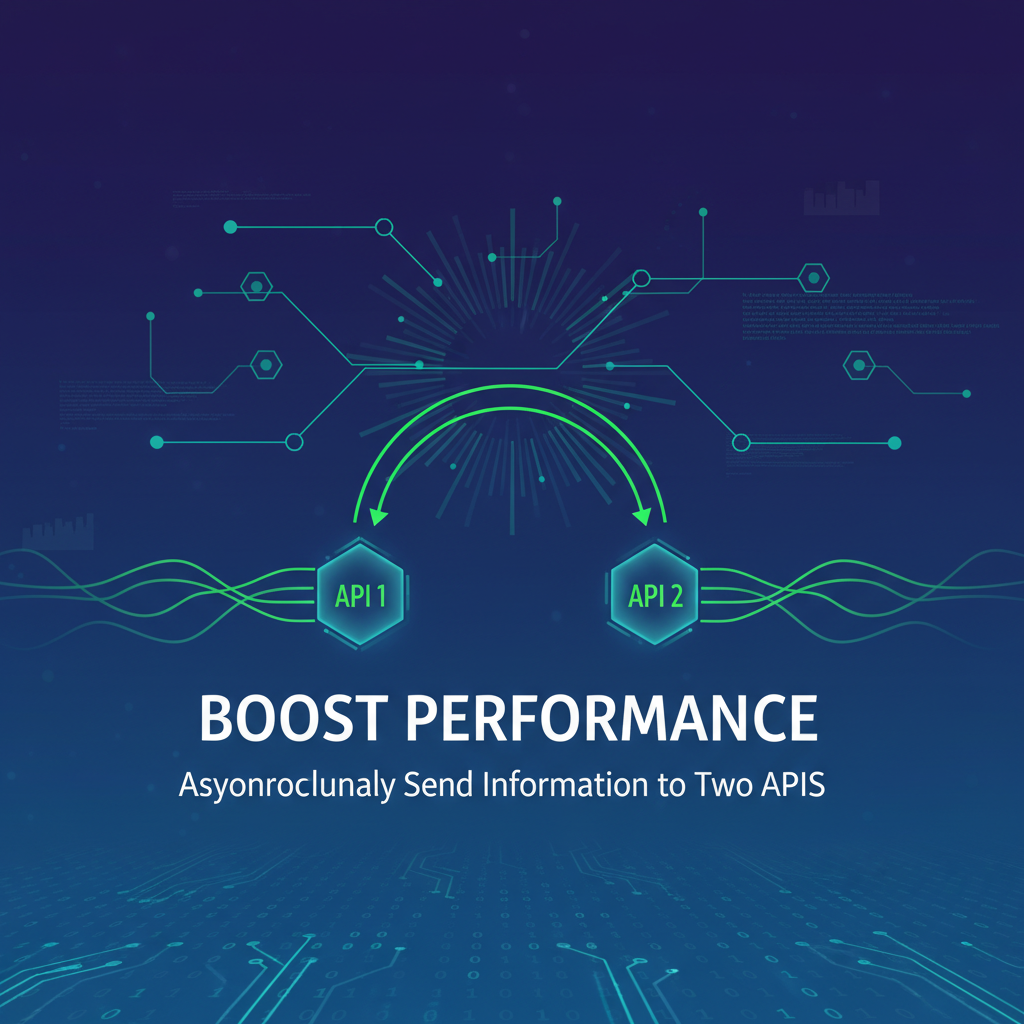


In the rapidly evolving landscape of modern software development, where microservices and distributed systems reign supreme, the ability to interact efficiently with external services is no longer a luxury but a fundamental necessity. Applications today rarely operate in isolation; they are intricately woven into a fabric of APIs, communicating with databases, payment gateways, authentication providers, and a myriad of specialized services. When an application needs to send information to multiple external APIs, the conventional synchronous approach, while straightforward in its logic, often becomes a significant bottleneck, directly impacting performance, user experience, and overall system responsiveness. The cumulative latency of waiting for each api call to complete sequentially can quickly render an otherwise well-designed system sluggish and inefficient.
Consider a common scenario: a user performs an action – perhaps placing an order on an e-commerce site, registering for a service, or updating their profile. This single action might trigger a cascade of necessary updates across different systems. For instance, an order placement might require updating the inventory api, processing payment through a third-party api, sending a confirmation email via another api, and potentially logging the event with an analytics service api. If each of these api calls is made one after another, the total time taken for the user's request to be fully processed is the sum of the individual api response times, plus any network overheads. This additive delay can lead to frustratingly long loading spinners, timeouts, and a generally poor user experience. Moreover, from a server perspective, the application thread responsible for handling the user's request remains blocked, idly waiting for api responses. This squanders valuable computing resources that could otherwise be serving other users or performing background tasks, thereby limiting the overall throughput of the system.
The solution to this pervasive challenge lies in a paradigm shift towards asynchronous processing. By embracing asynchronous patterns, developers can design systems that initiate multiple operations concurrently without blocking the main execution thread. Instead of waiting for api call A to finish before starting api call B, an asynchronous approach allows both calls to be initiated almost simultaneously. The application then "listens" for their completion, continuing with other tasks in the interim. This transformation from sequential to concurrent execution is particularly potent when dealing with multiple api interactions, such as sending information to two distinct APIs. It drastically reduces the perceived latency for the end-user and significantly improves the backend's resource utilization and scalability. This article delves into the intricacies of asynchronously sending information to two APIs, exploring the underlying principles, practical strategies, inherent benefits, and the associated complexities, offering a comprehensive guide to boosting your application's performance through intelligent api orchestration. We will also touch upon the crucial role of an api gateway in managing and optimizing these complex interactions.
Understanding Asynchronous Programming: The Foundation of High Performance
Before diving into the specifics of orchestrating multiple api calls, it's essential to grasp the fundamental concepts of asynchronous programming. At its core, asynchronous programming is a model that allows an application to initiate a task and then, without waiting for that task to complete, continue with other operations. When the initial task finishes, it notifies the application, often through a callback, a promise, or an event. This stands in stark contrast to synchronous programming, where each operation must complete before the next one can begin, leading to a "blocking" execution flow.
Synchronous vs. Asynchronous: A Fundamental Distinction
In a synchronous model, operations are executed sequentially. Imagine a chef preparing a meal: they first chop vegetables, then wait for the vegetables to cook, then prepare the sauce, and then wait for the sauce to simmer. Each step blocks the next. If chopping takes 5 minutes, cooking takes 10 minutes, and sauce preparation takes 7 minutes, the total time before serving is 22 minutes. In a software context, this translates directly to api calls. If your application needs to call api A (taking 200ms) and then api B (taking 300ms), the total elapsed time for these two operations will be at least 500ms, as the application cannot proceed with calling api B until api A's response has been fully received and processed. During this waiting period, the thread handling the request is essentially idle, consuming resources without performing productive work. This becomes particularly problematic under heavy load, as many threads can become blocked, leading to a build-up of requests and a degraded user experience.
Asynchronous programming, on the other hand, embraces concurrency. Using the chef analogy, an asynchronous chef might chop vegetables, put them on the stove to cook, and while they're cooking, immediately start preparing the sauce. Once the vegetables are done, they might get a notification and then proceed to combine them with the sauce. In this scenario, the total time is significantly reduced, potentially to the duration of the longest individual task or slightly more due to coordination overhead. For our api calls, this means initiating api call A and api call B almost simultaneously. If api A takes 200ms and api B takes 300ms, the total time for both to complete could be around 300ms (the duration of the longer call), rather than 500ms. The application's main thread is not blocked; it can initiate both calls and then potentially perform other computations or handle other incoming requests while waiting for the network responses. Once the responses arrive, predetermined callback functions or handlers are invoked to process them. This non-blocking nature is the cornerstone of building highly responsive and scalable applications.
Key Concepts in Asynchronous Programming
Several mechanisms facilitate asynchronous operations across different programming languages and environments:
- Callbacks: A function passed as an argument to another function, which is then executed when the asynchronous operation completes. While effective, deeply nested callbacks (callback hell) can lead to code that is difficult to read and maintain.
- Promises/Futures/Tasks: Objects that represent the eventual completion (or failure) of an asynchronous operation and its resulting value. They provide a cleaner way to handle asynchronous results and chain multiple asynchronous operations. For instance, in JavaScript, Promises allow
.then()to handle success and.catch()for errors, creating a more linear flow. - Async/Await: Syntactic sugar built on top of Promises (or similar constructs) that allows asynchronous code to be written in a synchronous-like style, making it much more readable and easier to reason about. The
awaitkeyword pauses the execution of theasyncfunction until the Promise settles, but without blocking the underlying thread. - Event Loops: A core component in many asynchronous runtimes (like Node.js or Python's
asyncio). The event loop continuously checks for tasks that are ready to be executed (e.g., anapiresponse has arrived, a timer has expired) and dispatches them to their respective handlers. This allows a single thread to manage a large number of concurrent I/O operations efficiently. - Threads/Goroutines/Actors: While asynchronous programming often aims to avoid explicit thread management for I/O-bound tasks, some models use lightweight concurrency primitives (like Go's goroutines or Erlang's actors) that can execute concurrently, sometimes in parallel across multiple CPU cores, without requiring traditional blocking I/O calls. These are often managed by a runtime scheduler, providing an asynchronous feel at a higher level.
Why Asynchronicity is Crucial for Multiple API Calls
The advantages of asynchronous programming become acutely evident when an application needs to interact with multiple external apis. The primary reason is the inherent latency associated with network communication. api calls are I/O-bound operations; they spend a significant amount of time waiting for data to travel across networks, be processed by a remote server, and then travel back. During this waiting period, the CPU of the calling application is largely idle.
By making api calls asynchronously, the application can:
- Reduce Latency: As demonstrated, initiating multiple
apicalls concurrently can reduce the overall response time for the user, as the total time is determined by the slowestapicall, rather than the sum of all calls. This is particularly impactful when calling two or more independentapis. - Improve Responsiveness: The main application thread remains free to handle other incoming requests or update the user interface, preventing the application from freezing or becoming unresponsive.
- Enhance Resource Utilization: Threads or processes are not blocked waiting for I/O. They can be reused to perform other tasks, leading to better utilization of CPU and memory resources and allowing the server to handle a higher volume of concurrent requests.
- Increase Throughput: By processing multiple
apicalls concurrently, the system can handle a greater number of user requests within the same timeframe, directly contributing to higher throughput.
In essence, asynchronous programming empowers applications to manage multiple concurrent I/O operations effectively, transforming potential bottlenecks into opportunities for superior performance and scalability. This foundational understanding sets the stage for exploring the practical challenges and strategies involved in orchestrating information flow to two APIs asynchronously.
The Challenge of Integrating with Multiple APIs: More Than Just Two Endpoints
While the theoretical benefits of asynchronous communication are clear, the practical reality of integrating with multiple APIs presents a unique set of challenges that extend far beyond simply making two concurrent network requests. Modern applications often depend on a complex ecosystem of internal and external services, each with its own characteristics, quirks, and requirements. Orchestrating these interactions, especially asynchronously, demands careful planning and robust implementation.
Navigating Disparate Systems
One of the most immediate challenges is the inherent diversity of APIs. Each api typically operates under its own set of rules:
- Authentication and Authorization: Different
apis may employ varying security mechanisms – OAuth 2.0 flows,apikeys, JWTs, mutual TLS, or even legacy basic authentication. Managing credentials securely and dynamically for multiple distinctapis adds a layer of complexity. Anapi gatewaycan centralize authentication, simplifying the client's interaction and providing a single point of enforcement. - Data Formats and Schemas: While JSON has become a de facto standard, variations in payload structure, field naming conventions, and data types are common. One
apimight expect asnake_casetimestamp string, while another requires acamelCaseUnix epoch integer. Transforming data to meet the expectations of each downstreamapibecomes a crucial step. - Error Handling Mechanisms: The way
apis signal errors can differ wildly. Some might use standard HTTP status codes (4xx for client errors, 5xx for server errors) with detailed JSON error bodies, while others might return a 200 OK status with an error message embedded in the response body, or even use custom error codes. Consistently interpreting and reacting to these varied error signals is vital for robust error management. - Rate Limits and Throttling: External APIs often impose limits on the number of requests a client can make within a given timeframe to prevent abuse and ensure fair usage. When sending information to two APIs simultaneously, it's easy to inadvertently hit these limits on one or both, leading to rejected requests. Intelligent
apiclients need to implement strategies like exponential backoff and retry logic, or anapi gatewaycan handle rate limiting policies centrally. - Network Latency and Reliability: Even with asynchronous calls, network round-trip times, packet loss, and temporary connectivity issues can impact the success of
apirequests. These external factors are beyond the application's direct control but must be accounted for.
Data Consistency and Transactional Integrity
When an action requires updates to two or more separate systems via their respective APIs, ensuring data consistency becomes a significant hurdle. What happens if information is successfully sent to one api but the call to the second api fails?
- Partial Failures: This is the most common and difficult scenario. For instance, if a user profile update successfully goes to the primary user service but fails to update the associated analytics
api, the data across the systems becomes inconsistent. - Rollbacks and Compensation: In a truly transactional system, a failure in one part would trigger a rollback of all preceding successful operations. However, cross-API transactions are notoriously hard to implement due to the distributed nature and lack of a universal two-phase commit protocol across disparate services. Instead, compensatory actions or eventual consistency models are often employed. For example, if the analytics
apiupdate fails, a mechanism might be needed to retry it later or to log the inconsistency for manual review. - Idempotency: Designing API calls to be idempotent is crucial, especially in asynchronous systems where retries are common. An idempotent operation produces the same result whether it's executed once or multiple times. This prevents duplicate data or unintended side effects if a retry sends the same information again.
Orchestration and Dependency Management
Beyond simple fan-out (sending the same data to multiple independent APIs), more complex scenarios involve dependencies. What if the input for api B depends on the output of api A? While this would force a sequential pattern for those specific calls, the overall workflow might still benefit from asynchronous execution of other independent api calls. Orchestrating these complex flows requires careful design, often leveraging workflow engines or message queues to manage dependencies and state.
The Performance Impact of Synchronous Approaches
To reiterate, the default synchronous approach stacks latencies. If api 1 takes 150ms and api 2 takes 250ms, the minimum time to complete both sequentially is 400ms. If you have 100 concurrent users performing such an action, the server threads will be blocked for 400ms each, potentially leading to slow response times or even server resource exhaustion if not adequately scaled. This linear scaling of latency and resource consumption makes synchronous multi-api calls a performance anti-pattern for user-facing applications.
Introducing the Role of an API Gateway
For managing the increasing complexity of api integrations, especially when dealing with asynchronous patterns and multiple services, robust solutions like an api gateway become indispensable. An api gateway acts as a single entry point for all client requests, abstracting the internal architecture of the microservices from the client.
Here's how an api gateway can mitigate the challenges:
- Centralized Authentication and Authorization: The gateway can handle security concerns for all upstream
apis, validating tokens orapikeys once, and then forwarding authenticated requests. This reduces boilerplate code in individual services and simplifies client-side security management. - Traffic Management: An
api gatewaycan manage routing, load balancing across multiple instances of a service, and apply rate limiting policies uniformly. This is critical for protecting backend services from overload and ensuring fair usage. - Request/Response Transformation: It can transform data formats between the client and the backend
apis, mapping fields, converting data types, and ensuring compatibility, thus offloading this logic from individual services. apiAggregation and Fan-out: For complex user requests that require data from multiple backend services, anapi gatewaycan aggregate responses from several services into a single client-friendly response. More relevant to our topic, it can also facilitateapifan-out, where a single incoming request triggers multiple concurrent requests to downstreamapis, effectively serving as an asynchronous proxy.- Monitoring and Logging: The gateway provides a central point for logging all
apitraffic, offering invaluable insights into performance, errors, and usage patterns. - Circuit Breakers and Retries: An
api gatewaycan implement resilience patterns like circuit breakers (to prevent cascading failures) and automatic retries with exponential backoff, making the system more robust against transientapifailures.
Platforms such as APIPark offer comprehensive api management capabilities, including features that can streamline the orchestration and performance of your asynchronous api interactions. By providing quick integration of numerous api models, unified formats, and end-to-end api lifecycle management, an advanced api gateway can significantly reduce the operational overhead and technical complexity associated with sending information to multiple apis asynchronously. It acts as a powerful intermediary that enhances security, reliability, and performance across your api ecosystem.
Strategies for Asynchronously Sending Information to Two APIs
Having understood the principles of asynchronous programming and the inherent challenges, let's explore concrete strategies for sending information to two APIs asynchronously. The choice of strategy often depends on the specific programming language, the criticality of the data, the desired level of coupling, and the architectural patterns already in place.
1. Concurrent Execution within Application Code (Async/Await, Promises, Futures)
This is perhaps the most direct and commonly used approach for applications that need to trigger multiple, independent api calls from a single request handler. Modern programming languages offer elegant constructs to manage concurrent asynchronous operations:
Java: CompletableFuture Java 8 introduced CompletableFuture, a powerful class for asynchronous programming, offering features for chaining, combining, and composing asynchronous computations.```java import java.net.URI; import java.net.http.HttpClient; import java.net.http.HttpRequest; import java.net.http.HttpResponse; import java.util.concurrent.CompletableFuture; import java.util.concurrent.ExecutionException; import com.fasterxml.jackson.databind.ObjectMapper; // For JSON serialization/deserializationpublic class AsyncApiCaller {
private final HttpClient httpClient = HttpClient.newHttpClient();
private final ObjectMapper objectMapper = new ObjectMapper();

public CompletableFuture<String> callApi(String url, Object payload) {
    try {
        String jsonPayload = objectMapper.writeValueAsString(payload);
        HttpRequest request = HttpRequest.newBuilder()
                .uri(URI.create(url))
                .header("Content-Type", "application/json")
                .POST(HttpRequest.BodyPublishers.ofString(jsonPayload))
                .build();

        return httpClient.sendAsync(request, HttpResponse.BodyHandlers.ofString())
                .thenApply(HttpResponse::body)
                .exceptionally(ex -> {
                    System.err.println("API call to " + url + " failed: " + ex.getMessage());
                    return null; // Handle error gracefully, perhaps return a default or propagate
                });
    } catch (Exception e) {
        System.err.println("Error preparing API call to " + url + ": " + e.getMessage());
        return CompletableFuture.completedFuture(null);
    }
}

public void sendDataToTwoApis(Object dataForApi1, Object dataForApi2) {
    CompletableFuture<String> api1Future = callApi("https://api.example.com/service1/data", dataForApi1);
    CompletableFuture<String> api2Future = callApi("https://api.example.com/service2/report", dataForApi2);

    // Combine both futures. allOf waits for all to complete.
    CompletableFuture<Void> combinedFuture = CompletableFuture.allOf(api1Future, api2Future);

    combinedFuture.thenRun(() -> {
        try {
            String result1 = api1Future.get(); // get() blocks only after allOf completes.
            String result2 = api2Future.get();

            System.out.println("API 1 Result: " + result1);
            System.out.println("API 2 Result: " + result2);

            // Further processing of results
        } catch (InterruptedException | ExecutionException e) {
            System.err.println("Error retrieving results from futures: " + e.getMessage());
        }
    }).exceptionally(ex -> {
        System.err.println("One or more API calls failed: " + ex.getMessage());
        return null; // Return null as there's no meaningful return value for a void thenRun
    });

    // The main thread can continue here without blocking.
    System.out.println("Initiated API calls asynchronously. Main thread continues...");
}

// main method to run example
// public static void main(String[] args) {
//     AsyncApiCaller caller = new AsyncApiCaller();
//     caller.sendDataToTwoApis(Map.of("id", 1, "value", "test"), Map.of("reportId", 123, "status", "processed"));
// }
} ``CompletableFuture.allOf()is used to create a newCompletableFuturethat completes when all the providedCompletableFutures complete. You then usethenRunorthenAcceptto process the results orexceptionallyto handle errors.handle()` provides a more general way to deal with both success and failure for individual futures.
Python: asyncio with asyncio.gather() Python's asyncio library provides a robust framework for writing concurrent code using the async/await syntax. asyncio.gather() is similar to JavaScript's Promise.all().```python import asyncio import aiohttp # Asynchronous HTTP clientasync def fetch_api(session, url, data): async with session.post(url, json=data) as response: response.raise_for_status() # Raise an exception for bad status codes return await response.json()async def send_data_to_two_apis(data_to_send): async with aiohttp.ClientSession() as session: try: # Create coroutines for each API call task1 = fetch_api(session, 'https://api.example.com/service1/data', data_to_send['for_api1']) task2 = fetch_api(session, 'https://api.example.com/service2/report', data_to_send['for_api2'])
        # Run both tasks concurrently and wait for all to complete
        results = await asyncio.gather(task1, task2, return_exceptions=True)

        if isinstance(results[0], Exception):
            print(f"API 1 failed: {results[0]}")
            # Handle specific failure for API 1
        if isinstance(results[1], Exception):
            print(f"API 2 failed: {results[1]}")
            # Handle specific failure for API 2

        if not isinstance(results[0], Exception) and not isinstance(results[1], Exception):
            print(f"API 1 Result: {results[0]}")
            print(f"API 2 Result: {results[1]}")
            return {"success": True, "results": results}
        else:
            return {"success": False, "error": "One or both APIs failed"}

    except Exception as e:
        print(f"An unexpected error occurred: {e}")
        return {"success": False, "error": str(e)}
Example usage:
asyncio.run(send_data_to_two_apis({ 'for_api1': {'id': 1, 'value': 'test'}, 'for_api2': {'report_id': 123, 'status': 'processed'} }))
`` Thereturn_exceptions=Trueargument inasyncio.gatheris crucial for handling partial failures, allowing the execution to continue even if oneapi` call raises an exception, and returning the exception object instead of the result.
JavaScript (Node.js/Browser): Promise.all() with async/await In JavaScript, Promise.all() is the go-to method for running multiple Promises concurrently and waiting for all of them to settle. Combined with async/await, it makes the code appear synchronous while executing asynchronously.```javascript async function sendDataToTwoAPIs(dataToSend) { try { const apiCall1 = fetch('https://api.example.com/service1/data', { method: 'POST', headers: { 'Content-Type': 'application/json' }, body: JSON.stringify(dataToSend.forApi1) });
    const apiCall2 = fetch('https://api.example.com/service2/report', {
        method: 'POST',
        headers: { 'Content-Type': 'application/json' },
        body: JSON.stringify(dataToSend.forApi2)
    });

    // Await both promises concurrently
    const [response1, response2] = await Promise.all([apiCall1, apiCall2]);

    if (!response1.ok) {
        console.error('API 1 failed:', response1.statusText);
        // Handle partial failure for API 1
    }
    if (!response2.ok) {
        console.error('API 2 failed:', response2.statusText);
        // Handle partial failure for API 2
    }

    const result1 = await response1.json();
    const result2 = await response2.json();

    console.log('API 1 Result:', result1);
    console.log('API 2 Result:', result2);

    return { success: true, results: [result1, result2] };

} catch (error) {
    console.error('Error sending data asynchronously:', error);
    // Handle network errors or other exceptions
    return { success: false, error: error.message };
}
} // Example usage // sendDataToTwoAPIs({ forApi1: { id: 1, value: 'test' }, forApi2: { reportId: 123, status: 'processed' } }); ```Promise.all() will resolve only when all input promises have resolved, or it will reject immediately if any of the input promises reject. If you need to wait for all promises to settle regardless of success or failure, Promise.allSettled() (introduced in ES2020) is a better choice, as it returns an array of objects, each describing the outcome of an individual promise (either { status: "fulfilled", value: ... } or { status: "rejected", reason: ... }). This is crucial for robust error handling in partial failure scenarios.
Pros of this approach: * Low Overhead: No additional infrastructure (like message queues) is required. * Direct Control: Full control over the api calls and their immediate responses. * Fast: The fastest way to get results back from two independent APIs when they can be called directly.
Cons of this approach: * Tight Coupling: The application code is directly responsible for knowing and calling each api. * Limited Reliability: If the application crashes before responses are processed, data might be lost. Retries need to be built into the application logic. * Scalability Limits: While more scalable than synchronous, it still relies on the calling service's resources. Heavy fan-out can strain the caller. * Error Handling: Managing partial failures requires careful coding (e.g., Promise.allSettled, return_exceptions=True, handle in CompletableFuture).
2. Message Queues / Event-Driven Architectures
For scenarios demanding higher reliability, decoupling, and scalability, especially when the actions are non-critical to the immediate user response or require eventual consistency, message queues are an excellent choice.
- How it works:
- The client sends a request to the main application.
- The application processes the initial request (e.g., saves primary data, returns immediate success to the user).
- Instead of directly calling the two external APIs, the application publishes a message (an event) to a message queue (e.g., RabbitMQ, Kafka, AWS SQS, Azure Service Bus). This message contains the information that needs to be sent to the APIs.
- Two separate consumer services (or worker functions) are listening to this queue (or specific topics/queues for each API).
- Consumer 1 picks up the message and calls
api1. - Consumer 2 picks up the message (or a copy of it, if using pub/sub) and calls
api2.
- Example Scenario: A user signs up. The primary application stores user details in the database and immediately returns a success response. In the background, an
eventlikeUserRegisteredis published to a queue. One consumer picks this up to send a welcome email via an emailapi. Another consumer picks it up to sync user data with a CRMapi.
Pros: * Decoupling: The calling service is completely decoupled from the external APIs. It only needs to know how to publish a message. * Reliability and Durability: Message queues provide persistence, ensuring messages are not lost even if consumers are down. Built-in retry mechanisms and dead-letter queues handle transient failures gracefully. * Scalability: Consumers can be scaled independently of the main application. Multiple instances of a consumer can process messages in parallel. * Backpressure Handling: Queues can buffer messages if downstream APIs or consumers are temporarily overloaded, preventing the main application from crashing. * Auditing: Messages in a queue can serve as a durable log of events.
Cons: * Increased Complexity: Introduces new infrastructure (the message queue) and additional services (consumers). * Eventual Consistency: Data updates across the two APIs are not atomic. There will be a delay, and inconsistencies can temporarily exist. This might not be suitable for scenarios requiring strong transactional consistency. * Debugging: Tracing requests through a queue and multiple consumers can be more challenging, though distributed tracing tools help.
3. Serverless Functions (FaaS) as Orchestrators
Cloud providers offer Serverless Function services (e.g., AWS Lambda, Azure Functions, Google Cloud Functions) that can be triggered by various events. They are an excellent fit for asynchronous api orchestration, especially for event-driven patterns.
- How it works:
- An HTTP request or an event (e.g., an object uploaded to storage, a message arriving in a queue) triggers a serverless function.
- This "orchestrator" function then invokes two other serverless functions (or directly calls the two external APIs). Each of these invoked functions is responsible for calling one specific external
api. - The orchestrator function can either wait for both child functions to complete (if synchronous wait is configured) or simply fire and forget, allowing the child functions to run completely independently.
- Example Scenario: An image is uploaded to an S3 bucket. This S3 event triggers a Lambda function. This Lambda then asynchronously calls two other Lambdas: one for image compression (calling a compression
api) and another for metadata extraction (calling a metadataapi).
Pros: * Managed Infrastructure: No servers to provision or manage. * Scalability: Functions scale automatically based on demand. * Cost-Effective: Pay only for the compute time consumed. * Event-Driven Nature: Integrates seamlessly with other cloud services and event sources.
Cons: * Vendor Lock-in: Code and configuration are tied to a specific cloud provider's ecosystem. * Cold Starts: Infrequently used functions might experience initial latency (cold starts). * Debugging: Distributed debugging across multiple functions can be tricky. * Configuration Overhead: Managing multiple functions, permissions, and triggers can become complex for larger systems.
4. API Gateway Fan-Out
As previously mentioned, a robust api gateway can directly handle the fan-out logic.
- How it works:
- A single client request hits the
api gateway. - The
api gateway, configured with specific rules, then simultaneously forwards the relevant parts of the request (or transformed versions) toapi1 andapi2. - The gateway can collect responses (if needed) and either aggregate them before returning to the client or simply return an immediate acknowledgment to the client, letting the backend
apicalls complete asynchronously.
- A single client request hits the
- Example Scenario: An
api gatewayreceives a/user-updaterequest. It's configured to forward user data to a profileapiand a separate activityapiin parallel.
Pros: * Simplifies Client: The client only interacts with one api endpoint. * Centralized Logic: Fan-out, transformations, security, and rate limiting are managed at the gateway layer, outside the business logic of individual services. * Performance: Can be highly optimized for concurrent calls. * Decoupling: Clients are decoupled from the specific backend apis.
Cons: * Gateway Complexity: Requires an intelligent and configurable api gateway. * Limited Custom Logic: Gateways are generally for routing and basic transformations, not complex business logic or deep error recovery strategies. * Vendor/Product Dependency: Relies on the capabilities of the chosen api gateway product.
Here's a comparison of these strategies:
| Feature/Strategy | Application Code (Async/Await) | Message Queues | Serverless Functions | API Gateway Fan-Out |
|---|---|---|---|---|
| Primary Use Case | Immediate concurrent calls | Decoupling, reliability | Event-driven tasks | Centralized orchestration |
| Coupling | Moderate | Low (producer/consumer) | Low | Low (client/backend) |
| Reliability | Relies on retry logic | High (persistence, DLQ) | High (retries, DLQ) | High (retries, circuit breaker) |
| Scalability | Limited by caller's resources | Very high | Very high | High |
| Latency (to client) | Lowest | Medium (eventual consistency) | Medium/Low (cold starts) | Low |
| Complexity | Moderate | High (new infra) | Moderate (config) | Moderate (config) |
| Debugging | Easier (within one service) | Harder (distributed) | Harder (distributed) | Moderate |
| Cost | Existing compute | Infra + operational | Pay-per-execution | Gateway cost |
| Error Handling | Manual/built-in | Built-in (retries, DLQ) | Built-in (retries, DLQ) | Built-in (retries, CB) |
Implementing Robust Error Handling in Asynchronous Scenarios
Regardless of the chosen strategy, robust error handling is paramount when sending information to multiple APIs asynchronously. Partial failures (one api call succeeds, the other fails) are a common occurrence and must be addressed systematically.
- Partial Failure Management:
- Log and Alert: Immediately log any failed
apicalls with sufficient detail and trigger alerts for operational teams. - Compensatory Actions: If one
apisucceeds and the other fails, can you reverse the successful action? Or is it acceptable to have temporary inconsistency and rely on eventual consistency? - Retry Mechanisms: For transient errors (e.g., network timeout, service temporarily unavailable), implement retries with exponential backoff. This means waiting for increasing intervals between retry attempts (e.g., 1s, 2s, 4s, 8s) to avoid overwhelming the failing service.
- Dead-Letter Queues (DLQs): For message queue-based systems, messages that repeatedly fail processing after a certain number of retries should be moved to a DLQ for later inspection and manual intervention, preventing them from endlessly blocking the main queue.
- Log and Alert: Immediately log any failed
- Circuit Breakers: Implement a circuit breaker pattern (e.g., using libraries like Hystrix or resilience4j). If an
apistarts consistently failing, the circuit breaker "trips" and prevents further calls to thatapifor a predefined period. This prevents cascading failures and gives the failing service time to recover, shielding your application from its downstream dependencies. - Idempotency: Ensure that the
apis you are calling, or your requests to them, are idempotent. If a request is retried, it should produce the same result as if it were executed only once. This is critical in asynchronous systems where retries are a fundamental part of fault tolerance.
By carefully selecting the appropriate strategy and implementing comprehensive error handling, developers can harness the power of asynchronous api interactions to build high-performance, resilient, and scalable applications that gracefully handle the complexities of distributed systems.
APIPark is a high-performance AI gateway that allows you to securely access the most comprehensive LLM APIs globally on the APIPark platform, including OpenAI, Anthropic, Mistral, Llama2, Google Gemini, and more.Try APIPark now! 👇👇👇
Benefits and Trade-offs of Asynchronous API Interactions
Embracing asynchronous communication, particularly when sending information to two or more APIs, brings a myriad of compelling benefits that are crucial for modern applications. However, like any architectural decision, it also introduces certain complexities and trade-offs that must be thoughtfully considered.
Significant Benefits
- Dramatic Performance Boost: The most immediate and tangible advantage is the reduction in perceived latency. By initiating multiple API calls concurrently, the total time for these operations is determined by the slowest
apiresponse, not the sum of all response times. For an end-user, this translates to faster page loads, quicker transaction confirmations, and a generally more responsive application. From a backend perspective, it means fewer blocked threads and quicker processing of each request, improving overall system throughput. For example, if twoapicalls each take 200ms, synchronously they would take 400ms, but asynchronously they could complete in roughly 200ms. This 50% time saving directly impacts user satisfaction and system efficiency. - Enhanced Scalability: Asynchronous operations make more efficient use of server resources. When a thread isn't blocked waiting for an
apiresponse, it can be immediately re-tasked to handle another request or perform other useful work. This non-blocking I/O model allows a single server or process to handle a significantly higher number of concurrent connections andapiinteractions. This is fundamental for scaling applications to meet increasing user demand without proportionally increasing infrastructure costs. Systems can process more requests per second (TPS) with the same hardware. - Improved Responsiveness and User Experience: For user-facing applications, asynchronous communication directly contributes to a smoother and more fluid user experience. Actions that trigger background processes, such as sending emails, updating secondary systems, or generating reports, can be acknowledged immediately to the user while the actual work completes in the background. This eliminates frustrating waiting times and makes the application feel snappier and more interactive.
- Increased Resilience and Fault Isolation: Decoupling
apicalls through asynchronous mechanisms, especially with message queues or event-driven architectures, inherently improves system resilience. If one of the downstream APIs experiences an outage or becomes slow, it doesn't necessarily block the entire application. Messages can be queued, and calls can be retried without impacting the primary user flow. Circuit breakers, often integrated intoapi gatewaysolutions, further prevent cascading failures, allowing the application to gracefully degrade rather than collapse entirely. This isolation means a problem in oneapidoesn't automatically bring down the entire system. - Better Resource Utilization: Traditional synchronous applications tie up computational resources (CPU, memory, threads) while waiting for I/O operations to complete. Asynchronous programming liberates these resources. While one
apicall is in flight, the CPU can execute other parts of the application's code, process other requests, or manage other background tasks. This leads to more efficient utilization of server hardware and reduced operational costs.
Inherent Trade-offs and Complexities
While the benefits are substantial, asynchronous api interactions are not a panacea. They introduce their own set of challenges that must be carefully managed:
- Increased Code Complexity: Writing, debugging, and maintaining asynchronous code is generally more complex than synchronous code. Developers need to be proficient with concepts like callbacks, promises, async/await patterns, event loops, and error propagation in a non-linear flow. Debugging race conditions, deadlocks (though less common with non-blocking I/O), or subtle timing issues in asynchronous systems can be challenging. The flow of execution is less straightforward, making it harder to reason about the system's state at any given point.
- Challenges with Data Consistency: Achieving strong transactional consistency across multiple distinct
apis, especially in an asynchronous, eventually consistent model, is difficult. If an update toapi1 succeeds but the update toapi2 fails, the system enters a state of temporary inconsistency. While acceptable for many scenarios (e.g., sending an analytics event), it can be problematic for core business logic (e.g., inventory management and order fulfillment). Implementing complex patterns like Sagas (a sequence of local transactions, where each transaction updates data and publishes an event to trigger the next transaction) is often required to manage eventual consistency and potential rollbacks, adding significant architectural complexity. - Difficulties in Monitoring and Tracing: In a synchronous system, a single request path is easy to follow in logs. In an asynchronous, distributed system, a single user action might trigger multiple
apicalls, events, and background processes spread across several services and potentially message queues. Tracing a complete transaction end-to-end to diagnose issues or understand performance bottlenecks requires specialized distributed tracing tools (like OpenTelemetry, Zipkin, or Jaeger) and robust logging infrastructure. Correlating different logs across various services becomes crucial. - Error Handling and Retries are More Sophisticated: While asynchronous systems offer better resilience, implementing robust error handling and retry logic is more sophisticated. Developers must distinguish between transient and permanent errors, choose appropriate retry strategies (e.g., exponential backoff, jitter), implement circuit breakers, and decide on compensation logic for partial failures. Handling dead-letter queues and error recovery workflows adds operational overhead.
- Learning Curve and Skill Gap: For teams accustomed to synchronous programming, there's a significant learning curve involved in adopting asynchronous patterns and architectural principles. Investing in developer training and establishing clear coding standards are essential for successful implementation.
When to Choose Asynchronous Interactions
Despite the complexities, asynchronous interactions are almost always preferred when:
- Operations are I/O-bound and potentially high-latency: Such as network calls to external APIs, database operations, or file system interactions.
- The system requires high throughput and scalability: To handle a large number of concurrent users or requests.
- Decoupling between services is desired: To improve modularity and reduce dependencies.
- Immediate user feedback is critical, but the underlying tasks can be processed in the background: Enhancing perceived performance.
- Partial failures are tolerable, or eventual consistency is acceptable for specific data flows: When strict ACID transactions across distributed services are not a strict requirement.
Ultimately, the decision to employ asynchronous communication, especially for sending information to two APIs, is a strategic one. It involves weighing the significant performance, scalability, and resilience benefits against the increased architectural and developmental complexities. For modern, high-performance applications, the benefits typically outweigh the costs, provided the complexities are managed with careful design, robust tools, and a skilled development team.
Practical Considerations and Best Practices for Asynchronous API Interactions
Successfully implementing asynchronous api interactions, particularly when orchestrating calls to two or more distinct services, requires more than just understanding the technical patterns. It demands attention to practical considerations, best practices, and the strategic deployment of supporting tools. These elements collectively ensure that the benefits of asynchronicity are fully realized while mitigating its inherent complexities.
1. API Design with Asynchronous Consumers in Mind
The design of the APIs themselves plays a critical role in facilitating efficient asynchronous consumption.
- Idempotency: This is paramount. Design your APIs such that making the same request multiple times produces the same result (e.g., updating a user's status to "active" twice should still result in the user being "active", not creating a duplicate active status). This is essential for retry mechanisms inherent in asynchronous systems.
- Clear Response Semantics: APIs should return clear and consistent HTTP status codes and error messages. Differentiate between transient errors (e.g., 503 Service Unavailable, 429 Too Many Requests) that warrant retries, and permanent errors (e.g., 400 Bad Request, 404 Not Found) that indicate a data or logic issue requiring different handling.
- Webhooks for Notifications: For long-running asynchronous operations, instead of requiring clients to poll, design APIs that can send webhooks to notify clients when a process completes or status changes. This shifts the burden of monitoring from the client to the server.
- Batching Capabilities: If possible, design APIs to accept batched requests. Sending a single request with multiple data points can be more efficient than many individual requests, reducing network overhead even in asynchronous contexts.
- Minimal Payload Size: Optimize
apirequest and response payloads to include only necessary data. Smaller payloads reduce network transfer times, which is magnified when dealing with multiple concurrentapicalls.
2. Robust Tracing and Logging
Debugging and monitoring asynchronous, distributed systems can be notoriously difficult. A strong strategy for tracing and logging is indispensable.
- Distributed Tracing: Implement a distributed tracing system (e.g., using standards like OpenTelemetry or commercial solutions like Datadog, New Relic). This allows you to follow a single logical request across multiple services,
apicalls, and message queues, providing an end-to-end view of the transaction flow and pinpointing performance bottlenecks or failure points. Each request should carry a correlation ID (trace ID) that is propagated across all subsequent asynchronous operations. - Structured Logging: Use structured logging (e.g., JSON logs) with relevant context (request ID, user ID,
apiendpoint, execution time, error messages). This makes logs machine-readable and easier to query and analyze using log aggregation tools. - Informative Error Logs: When an
apicall fails, log the fullapirequest (sanitized for sensitive data), the exact response received, and the full stack trace. This detail is critical for diagnosing partial failures.
3. Comprehensive Monitoring and Alerting
Proactive monitoring is key to ensuring the health and performance of asynchronous api integrations.
- API Performance Metrics: Monitor response times, success rates, and error rates for each individual
apicall. Set up alerts for deviations from baselines (e.g.,apiA's latency spikes,apiB's error rate exceeds 1%). - Queue Lengths and Processing Rates: If using message queues, monitor queue depths, message processing rates, and the number of messages in dead-letter queues. Long queue lengths can indicate a bottleneck in your consumers or a downstream
api. - Resource Utilization: Keep an eye on CPU, memory, network I/O, and thread pool utilization of your application services, especially when performing concurrent
apicalls. This helps identify resource contention or scaling needs. - Business Metrics: Monitor end-to-end business metrics (e.g., number of successful orders, email delivery rates) to ensure that despite the underlying technical complexities, the business objectives are being met.
4. Security Considerations for Multi-API Interactions
When orchestrating multiple api calls, security becomes even more critical.
- Centralized Authentication: Utilize an
api gatewayto centralize authentication and authorization. This ensures that all incoming client requests are properly authenticated before being routed to any backendapiand abstracts security concerns from individual services. - Least Privilege: Ensure that each service or
apiclient only has the minimal necessary permissions to access the downstreamapis it needs. Avoid using overly permissive credentials. - Secure Communication: Always use HTTPS/TLS for all
apicommunication, both internal and external, to encrypt data in transit and prevent eavesdropping or tampering. - Secrets Management: Store API keys, tokens, and other sensitive credentials securely using dedicated secrets management solutions (e.g., AWS Secrets Manager, HashiCorp Vault) rather than hardcoding them or storing them in plain text configuration files.
5. Thorough Testing Strategies
Testing asynchronous interactions, especially with external dependencies, presents unique challenges.
- Unit Testing: Test individual asynchronous functions in isolation using mocks for external
apicalls. - Integration Testing: Test the interaction between your service and the actual external
apis. This often requires setting up test environments or using mock servers that simulateapiresponses, including success, various error codes, and different latencies. - Fault Injection Testing: Actively inject faults (e.g., network delays,
apierrors, timeouts) into your test environment to verify that your retry logic, circuit breakers, and error handling mechanisms behave as expected under adverse conditions. - Performance and Load Testing: Simulate high concurrency and heavy loads to ensure your asynchronous
apiintegration performs optimally and scales as required. Identify bottlenecks before they impact production.
The API Gateway's Crucial Role in Optimization
Reiterating the importance of an api gateway, solutions like APIPark are not just routing proxies; they are strategic control points that enhance the entire api ecosystem, particularly for complex asynchronous scenarios. A powerful api gateway can:
- Centralize Security and Policy Enforcement: Offloading authentication, authorization, rate limiting, and access control from individual services. This is especially beneficial when dealing with multiple
apis, as it provides a single, consistent security posture. - Facilitate Intelligent Routing and Fan-out: Configure the gateway to route a single incoming request to multiple backend services concurrently, effectively providing an asynchronous fan-out mechanism without needing to embed this logic in your application code.
- Perform Request/Response Transformation: Standardize data formats or enrich requests before sending them to downstream
apis, and transform responses before sending them back to the client. This reduces the burden on backend services to handle diverse client expectations. - Implement Resilience Patterns: Automatically apply circuit breakers, retry logic, and fallback mechanisms for downstream
apicalls, shielding your client applications from transient failures and ensuring higher availability. - Provide Unified Observability: Offer a single point for comprehensive logging, monitoring, and analytics across all
apitraffic, simplifying troubleshooting and performance analysis. - Manage the API Lifecycle: From design and publication to versioning and deprecation, an
api gatewayhelps regulate and govern the entire lifecycle of your APIs, which is vital for maintaining a clean and manageableapilandscape as your system grows in complexity.
By leveraging an advanced api gateway like APIPark, organizations can significantly reduce the operational complexity and technical debt associated with managing numerous api integrations. Its capabilities for quick integration, unified api format, detailed call logging, and powerful data analysis empower developers and operations personnel to build, deploy, and monitor high-performance asynchronous systems more efficiently and securely.
Conclusion: Embracing Asynchronicity for a High-Performance Future
In the fiercely competitive digital landscape, where user expectations for speed and reliability are ever-increasing, the judicious application of asynchronous programming has become an indispensable strategy for building high-performance, scalable, and resilient applications. When the imperative arises to send information to two or more APIs, the conventional synchronous approach, with its inherent latency stacking and resource blocking, is often a recipe for performance bottlenecks and a diminished user experience. Embracing asynchronicity offers a powerful antidote, transforming sequential, blocking operations into parallel, non-blocking executions that dramatically reduce overall response times and optimize resource utilization.
We've explored the foundational principles of asynchronous programming, contrasting it with its synchronous counterpart and highlighting its profound impact on latency reduction, throughput enhancement, and system responsiveness. The journey of integrating with multiple APIs is fraught with challenges, from navigating disparate authentication schemes and data formats to ensuring data consistency across distributed systems. It's a landscape where partial failures are a given, not an exception, demanding sophisticated error handling, retry mechanisms, and resilience patterns.
To overcome these hurdles, we delved into several practical strategies: from direct concurrent execution within application code using language-specific constructs like async/await and Promise.all(), to the robust decoupling offered by message queues and event-driven architectures. Serverless functions emerge as a flexible, managed option for event-triggered asynchronous workflows, while the api gateway stands out as a central orchestrator, capable of abstracting away much of the complexity, centralizing security, and facilitating intelligent fan-out. Each strategy presents its own blend of benefits and trade-offs, making the choice dependent on specific architectural needs, reliability requirements, and tolerance for eventual consistency.
Ultimately, the decision to pivot towards asynchronous api interactions is a strategic investment. While it undoubtedly introduces a layer of architectural and developmental complexity, demanding proficiency in asynchronous patterns, meticulous attention to error handling, and robust observability, the benefits far outweigh these challenges for any application striving for modern standards of performance and scalability. Reduced latency, enhanced responsiveness, superior resource utilization, and improved resilience are not mere optimizations; they are fundamental enablers of a superior user experience and a robust, future-proof system architecture.
The journey towards mastering asynchronous api interactions is continuous, necessitating a commitment to best practices in API design, comprehensive tracing, proactive monitoring, rigorous testing, and unwavering security protocols. Crucially, the strategic deployment of intelligent tools, such as advanced api gateway solutions, plays a pivotal role in simplifying this complex landscape. By providing centralized control over api management, security, traffic routing, and observability, an api gateway empowers development teams to harness the full potential of asynchronous api communication, paving the way for applications that are not just functional, but truly high-performing and adaptable to the ever-changing demands of the digital age.
Frequently Asked Questions (FAQ)
1. What is the primary benefit of sending information to two APIs asynchronously compared to synchronously? The primary benefit is a significant reduction in overall response time and improved system performance. Synchronous calls execute sequentially, so the total time is the sum of individual api call durations. Asynchronous calls initiate concurrently, meaning the total time is approximately the duration of the longest individual api call, leading to faster user experiences and more efficient resource utilization on the server.
2. What are the main challenges when implementing asynchronous calls to multiple APIs? Key challenges include managing data consistency (what if one API call succeeds and the other fails?), handling varied authentication methods and data formats across different APIs, implementing robust error handling and retry logic, and dealing with increased code complexity and debugging difficulties due to the non-linear execution flow. Centralized monitoring and tracing across distributed components also become more critical.
3. When should I consider using a message queue for asynchronous API calls instead of direct concurrent calls? You should consider a message queue when reliability, decoupling, and scalability are paramount. Message queues provide durability (messages aren't lost if services fail), enable independent scaling of consumer services, and introduce a buffer that helps handle backpressure from overloaded APIs. This is ideal for background tasks or non-critical updates where eventual consistency is acceptable and immediate feedback to the user is not strictly tied to the api completion.
4. How does an api gateway help in orchestrating asynchronous api calls to multiple services? An api gateway can act as a central orchestrator, providing a single entry point for clients. It can abstract away the complexity of multiple backend services, handle request fan-out to several APIs concurrently, and centralize critical functionalities like authentication, rate limiting, and traffic management. This offloads logic from individual services, simplifies client interaction, and enhances the overall security and resilience of the api ecosystem. Solutions like APIPark offer such comprehensive api management capabilities.
5. What is idempotency and why is it important for asynchronous API interactions? Idempotency means that making the same request multiple times has the same effect as making it once. It's crucial for asynchronous api interactions because network issues or transient failures often necessitate retrying api calls. If an api operation is not idempotent (e.g., a "create user" api creates a new user every time it's called), retrying a request that may have already succeeded could lead to duplicate data or unintended side effects. Ensuring idempotency helps build fault-tolerant systems that can safely recover from failures.
🚀You can securely and efficiently call the OpenAI API on APIPark in just two steps:
Step 1: Deploy the APIPark AI gateway in 5 minutes.
APIPark is developed based on Golang, offering strong product performance and low development and maintenance costs. You can deploy APIPark with a single command line.
curl -sSO https://download.apipark.com/install/quick-start.sh; bash quick-start.sh

In my experience, you can see the successful deployment interface within 5 to 10 minutes. Then, you can log in to APIPark using your account.

Step 2: Call the OpenAI API.