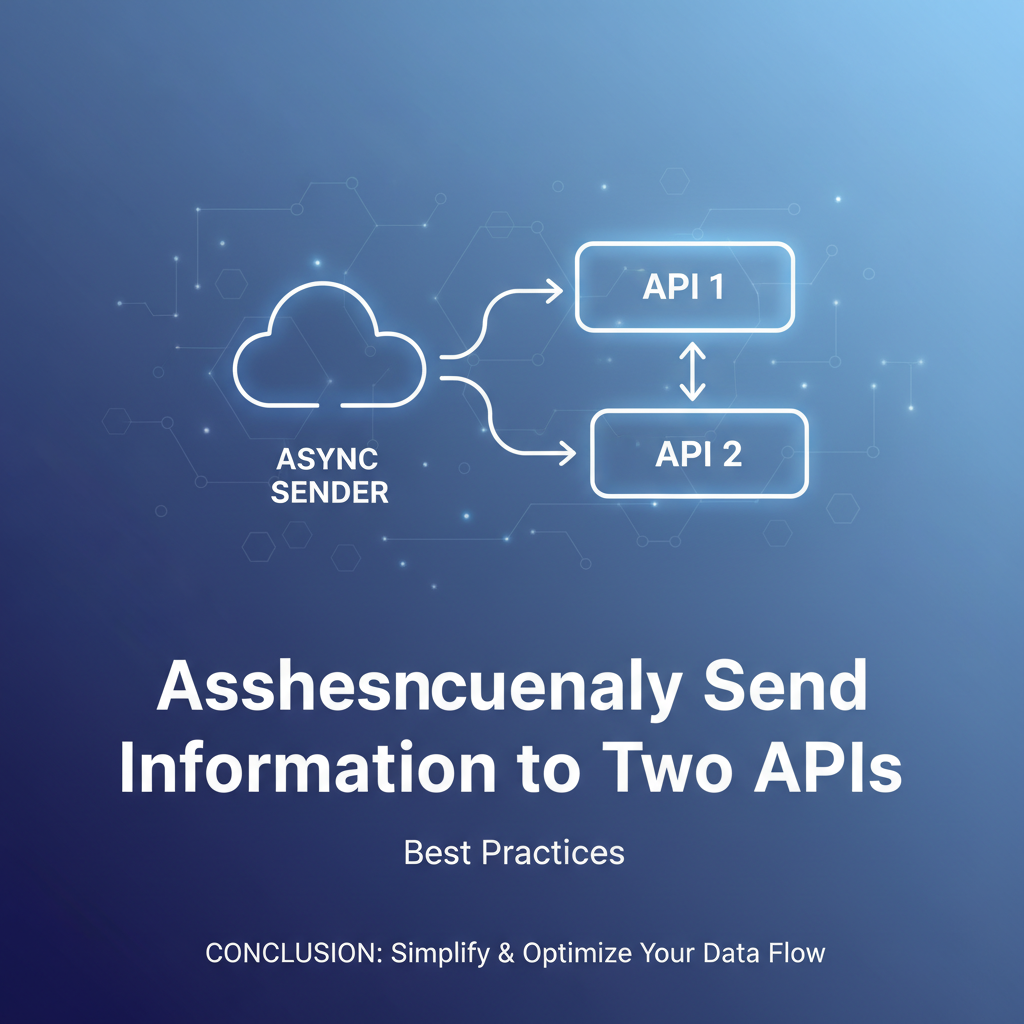
Asynchronously Send Information to Two APIs: Best Practices


In the intricate tapestry of modern software architecture, the need to interact with external services is ubiquitous. From user authentication to payment processing, real-time analytics to content delivery, applications constantly communicate with a myriad of Application Programming Interfaces (APIs). A particularly common and challenging scenario arises when an application needs to send information to not just one, but two or more distinct APIs in response to a single event or user action. While a synchronous, sequential approach might seem straightforward at first glance, it often becomes a bottleneck, a single point of failure, and a significant impediment to scalability and user experience. This article delves deep into the strategies and best practices for asynchronously sending information to multiple APIs, exploring the fundamental principles, architectural patterns, critical considerations, and how to build robust, resilient, and high-performing distributed systems.
The Imperative of Asynchronous Processing in Multi-API Interactions
The digital landscape is increasingly defined by real-time expectations and seamless user experiences. In this environment, any perceptible delay can lead to user dissatisfaction, abandoned transactions, and lost business opportunities. When an application needs to interact with two external APIs, a synchronous approach dictates that the application must wait for the first API call to complete before initiating the second. If each API call has even a modest latency, say 200ms, the combined interaction time quickly adds up, potentially exceeding acceptable response times, especially when internal processing overhead is factored in. This sequential dependency also creates a single point of failure: if the first API fails or times out, the entire operation grinds to a halt, and the second API call never even gets a chance to execute.
Asynchronous processing offers a compelling alternative, allowing an application to initiate multiple operations without waiting for each one to complete before moving to the next. This paradigm shift fundamentally alters how an application perceives and manages time and resources. Instead of blocking the execution thread, the application can dispatch requests and immediately free up resources, either to handle other incoming requests or to perform unrelated tasks. The results of these dispatched operations are then handled later, through callbacks, promises, or event mechanisms, once they become available. This non-blocking nature is not merely an optimization; it is a foundational pillar for building truly responsive, scalable, and resilient distributed systems that can withstand the inherent unpredictability of network communication and external service dependencies. The choice to embrace asynchronicity is thus not just a technical preference but a strategic decision to enhance application performance, improve fault tolerance, and ensure a superior user experience in an increasingly interconnected world.
Deconstructing the Challenges of Synchronous Multi-API Calls
To fully appreciate the benefits of asynchronous patterns, it's crucial to understand the inherent limitations and pitfalls of their synchronous counterparts when dealing with multiple API integrations. While seemingly simpler to implement for isolated cases, the complexities quickly escalate in real-world scenarios, leading to a cascade of performance, reliability, and scalability issues that can cripple an application.
Firstly, the most immediate and glaring issue is accumulated latency. Imagine a scenario where a user action triggers an update to their profile in an identity management API and simultaneously requires a notification to be sent via a messaging API. In a synchronous flow, the application calls the identity API, waits for its response (which might involve network hops, database operations, and internal processing), and only then, upon successful completion, does it proceed to call the messaging API. Each step in this sequence adds its own latency. If the identity API responds in 300ms and the messaging API in 250ms, the user has to wait at least 550ms, excluding any network overheads from the user to the application, and the application's internal processing. This cumulative delay directly impacts the user experience, often resulting in frustratingly slow interactions or even timeouts, especially for operations involving three, four, or more external API calls.
Secondly, failure propagation is a critical concern. In a synchronous chain, the failure of any single API call immediately halts the entire sequence. If the identity API call fails due to a network error, a server-side exception, or an invalid request, the messaging API call is never even attempted. This means the system enters an inconsistent state: the user's profile update might have failed, but the system then attempts to send a notification for a non-existent or failed update, or worse, fails entirely without completing either crucial step. Recovering from such failures becomes complex, often requiring manual intervention or sophisticated compensating transactions to maintain data integrity across different systems. Without robust error handling, the entire user-facing operation can collapse due to a single external dependency, making the system fragile.
Thirdly, resource exhaustion is a silent killer in synchronous architectures under load. When an application thread makes a synchronous API call, that thread is typically blocked, waiting for the external service to respond. It cannot perform any other useful work during this waiting period. In environments like web servers or microservices, where a finite pool of threads or connections handles incoming requests, blocking threads means fewer available resources to process new user requests. As concurrent user load increases, these blocked threads quickly consume the available pool, leading to thread starvation. New incoming requests are then queued or rejected, resulting in degraded performance, increased response times for other users, or outright service unavailability. This problem is exacerbated in systems with many long-running or high-latency external API dependencies.
Finally, lack of decoupling is an architectural drawback. Synchronous calls create tight coupling between the initiating service and the target external services. Any change in the external API's interface, availability, or performance directly impacts the calling service. This rigid dependency makes system evolution more challenging, limits independent scaling of components, and reduces the overall agility of the development process. Furthermore, it complicates testing, as unit tests often become integration tests requiring mock services, and end-to-end testing becomes brittle due to reliance on external system availability. These multifaceted challenges underscore why modern, resilient systems increasingly gravitate towards asynchronous patterns, using tools like an API gateway to manage and orchestrate these complex interactions.
Core Concepts Underpinning Asynchronous Operations
At its heart, asynchronous programming revolves around the idea of performing operations without waiting for them to complete. This fundamental shift from sequential, blocking execution to non-blocking, concurrent execution requires an understanding of several core concepts that empower developers to build responsive and scalable applications.
The bedrock of asynchronicity is Non-blocking I/O. In traditional synchronous I/O, when an application requests data from a disk or a network, the operating system kernel performs the operation, and the application thread remains idle, blocked, until the data is available. Non-blocking I/O flips this script: when an application requests an I/O operation, the kernel immediately returns control to the application, potentially indicating that the operation is in progress. The application can then continue with other tasks. When the I/O operation eventually completes, the kernel notifies the application (e.g., via an event, a callback, or by making the data available for polling). This model ensures that application threads are rarely idle, maximizing CPU utilization and allowing a single thread to manage multiple concurrent I/O operations, which is crucial for high-concurrency network applications like web servers or API gateway instances.
Building upon non-blocking I/O, higher-level abstractions like Callbacks, Promises, and Futures provide structured ways to handle the results of asynchronous operations. * Callbacks are functions passed as arguments to other functions, to be executed once the asynchronous operation they were associated with has completed. While powerful, nested callbacks (often termed "callback hell") can lead to code that is difficult to read, maintain, and debug due to deeply indented code and convoluted error handling. * Promises (or Futures in some languages) address many of the callback hell issues by representing the eventual result of an asynchronous operation. A Promise can be in one of three states: pending (initial state), fulfilled (operation completed successfully), or rejected (operation failed). They allow for chaining asynchronous operations in a more readable, linear fashion using methods like .then() and .catch(), significantly improving code clarity and error management. * More recently, the advent of async/await syntax in languages like JavaScript, C#, Python, and others has further refined asynchronous programming. async functions are those that can execute asynchronously, while await is used within an async function to pause execution until a Promise resolves. This syntax allows developers to write asynchronous code that looks and feels remarkably similar to synchronous code, enhancing readability and simplifying complex asynchronous flows, reducing the cognitive load associated with managing callbacks or raw Promises.
Beyond code-level constructs, Message Queues (or Message Brokers) are fundamental architectural components for decoupling services and enabling robust asynchronous communication in distributed systems. A message queue acts as an intermediary, storing messages between sending services (producers) and receiving services (consumers). When a service needs to send information to another, it simply publishes a message to a queue and immediately continues its own processing. The receiving service, at its own pace and independently, consumes messages from the queue. This pattern provides several critical benefits: * Decoupling: Producers and consumers don't need to know about each other's availability or implementation details. * Resilience: Messages are persisted in the queue, meaning if a consumer is temporarily down, messages are not lost and can be processed once it recovers. * Scalability: Consumers can be scaled independently, adding more instances to process messages faster during peak loads. * Load Leveling: Queues can absorb bursts of traffic, preventing downstream services from being overwhelmed. Popular message queues include RabbitMQ, Apache Kafka, AWS SQS, and Azure Service Bus.
Finally, Event-Driven Architectures (EDA) represent a broader paradigm built upon asynchronous communication, often leveraging message queues or event streams. In an EDA, services communicate by emitting and reacting to events. An "event" is a significant change of state, like "UserRegistered" or "OrderPlaced." Services publish events to an event bus or broker, and other interested services (subscribers) react to these events without direct knowledge of the publisher. This promotes extreme decoupling, allowing systems to be highly responsive, extensible, and scalable. For example, a user registration service might publish a "UserRegistered" event, and separate services for sending a welcome email, updating a CRM, or logging analytics can independently subscribe to and process this event. This contrasts with traditional request-response API calls, where services directly invoke each other. EDAs are particularly powerful for complex, distributed systems that require high concurrency and resilience across many independent components.
While these concepts often intertwine, understanding each distinct element—non-blocking I/O, promises, message queues, and event-driven architectures—is essential for designing and implementing effective asynchronous strategies for interacting with multiple APIs.
Architectural Patterns for Asynchronous API Calls to Multiple Endpoints
When the task at hand is to send information to two or more APIs asynchronously, several well-established architectural patterns emerge, each with its own strengths, weaknesses, and ideal use cases. Choosing the right pattern depends on factors such as desired latency, consistency requirements, system complexity, and existing infrastructure.
1. Client-Side Asynchronous Calls
This is often the simplest form of asynchronous communication, where the client (be it a web browser, mobile app, or another backend service) directly initiates multiple API calls concurrently. Modern programming languages and frameworks provide robust constructs to facilitate this.
How it works: The client application makes parallel requests to both external APIs without waiting for the response from the first before starting the second. * Example (JavaScript with async/await): ```javascript async function sendDataToMultipleAPIs(data) { try { const api1Promise = fetch('https://api1.example.com/endpoint', { method: 'POST', headers: { 'Content-Type': 'application/json' }, body: JSON.stringify(data.forApi1) }); const api2Promise = fetch('https://api2.example.com/endpoint', { method: 'POST', headers: { 'Content-Type': 'application/json' }, body: JSON.stringify(data.forApi2) });
        // Wait for both promises to settle (either fulfilled or rejected)
        const [response1, response2] = await Promise.allSettled([api1Promise, api2Promise]);

        if (response1.status === 'fulfilled') {
            console.log('API 1 Success:', await response1.value.json());
        } else {
            console.error('API 1 Failed:', response1.reason);
        }

        if (response2.status === 'fulfilled') {
            console.log('API 2 Success:', await response2.value.json());
        } else {
            console.error('API 2 Failed:', response2.reason);
        }

        // Handle overall success/failure based on both responses
        if (response1.status === 'fulfilled' && response2.status === 'fulfilled') {
            console.log('Both APIs updated successfully.');
        } else {
            console.warn('One or more API updates failed.');
        }

    } catch (error) {
        console.error('An unexpected error occurred:', error);
    }
}
```
In this example, `Promise.allSettled` is used to ensure that all promises are run to completion, regardless of individual success or failure, allowing for robust error handling for each API call independently.
Pros: * Simplicity for direct interactions: Easy to implement for clients making fire-and-forget or parallel requests. * Reduced overall latency (from client perspective): The total time is dictated by the slowest concurrent call, not the sum of all calls. * Direct control: The client has immediate feedback on each API's response.
Cons: * Client reliability: If the client (e.g., browser tab) closes or loses network connectivity, the operations might be interrupted or lost. * Network overhead: Each client directly communicates with each external API, potentially increasing load on the client and complex firewall/CORS configurations. * Security concerns: Exposing direct access to multiple external APIs from a client application might require more complex authentication/authorization on the client side. * Limited retry/resilience: Clients often have less sophisticated mechanisms for retries, exponential backoff, or dead-letter queues compared to server-side solutions.
2. Message Queues/Brokers for Server-Side Decoupling
For more robust, scalable, and reliable asynchronous operations, particularly in backend systems, message queues are an indispensable tool. They act as an intermediary, decoupling producers from consumers.
How it works: 1. A service (producer) initiates an event (e.g., "User Registered"). 2. Instead of directly calling external APIs, the producer publishes a message detailing this event to a message queue. The producer's work is done; it immediately continues its own processing. 3. Separate worker services (consumers) subscribe to this queue. 4. Each consumer picks up a message, parses its content, and then performs its specific task, which could be calling an external API. For sending information to two APIs, two different consumers (or a single consumer with fan-out logic) could react to the same message.
Use Cases: * Notifications: Sending welcome emails, SMS, push notifications after user sign-up. * Analytics: Publishing events for downstream analytics engines. * Long-running processes: Offloading tasks that take a long time to complete, preventing request timeouts. * Data synchronization: Ensuring data consistency across multiple disparate systems.
Pros: * Extreme decoupling: Services operate independently, improving resilience and maintainability. * Durability and reliability: Messages are persisted, ensuring "at-least-once" delivery, even if consumers fail. * Scalability: Consumers can be scaled horizontally to handle increased message load without affecting the producer. * Load leveling: Queues can buffer messages, protecting downstream APIs from being overwhelmed during traffic spikes. * Retry mechanisms and Dead-Letter Queues (DLQ): Message brokers often provide built-in features for automatic retries and moving failed messages to a DLQ for later inspection.
Cons: * Increased complexity: Introduces another layer of infrastructure (the message queue itself) to manage. * Eventual consistency: Operations might not be immediately reflected in all systems, leading to a period of inconsistency. This is acceptable for many scenarios but problematic for those requiring strong immediate consistency. * Debugging challenges: Tracing the flow of a message through multiple queues and consumers can be more complex.
3. Event-Driven Architectures (EDA)
Building on the principles of message queues, EDAs formalize the communication through events, often using an event bus or streaming platform (like Apache Kafka). This pattern is a broader conceptual framework for system design.
How it works: 1. A core service emits an event when its state changes (e.g., "OrderCreated"). 2. This event is published to an event bus. 3. Multiple other services (subscribers) that are interested in "OrderCreated" events consume this event independently. 4. Each subscriber performs its own asynchronous task, which might involve calling an external API. For example, one subscriber calls a payment API, another calls an inventory API, and a third calls a shipping API.
Pros: * High responsiveness: Services react immediately to changes in other services. * Loose coupling: Services are highly independent, facilitating microservices development and deployment. * Extensibility: Adding new functionalities simply means adding new event subscribers, without modifying existing services. * Scalability and resilience: Inherits benefits from underlying message queue technologies.
Cons: * Increased complexity: Requires careful event design, robust event ingestion, and management of potential event storms. * Distributed transactions: Ensuring atomicity across multiple services reacting to events (saga pattern) is complex. * Observability: Tracing the flow of a transaction across many event-driven services can be challenging without proper tooling.
4. API Gateway as an Orchestrator/Proxy
An API gateway serves as the single entry point for a group of microservices or external APIs. While primarily known for security, routing, and rate limiting, a sophisticated API gateway can also act as an orchestrator for complex asynchronous multi-API interactions.
How it works: 1. A client makes a single request to the API gateway. 2. The API gateway, based on its configuration, internally fans out this single request into multiple asynchronous calls to two or more backend APIs. 3. The API gateway can then either: * Respond immediately: Acknowledge receipt of the request and perform the fan-out asynchronously, returning a 202 Accepted status to the client. The client can then poll for status or receive a webhook later. * Aggregate and respond: Wait for all backend API responses, aggregate them, and then send a single, composite response back to the client. This is more common for synchronous aggregation but can be done asynchronously for improved resilience.
Benefits of using an API Gateway for asynchronous fan-out: * Centralized management: All API interactions are routed through one point. * Reduced client-side complexity: The client only needs to know about the API gateway. * Enhanced security: The API gateway can enforce authentication, authorization, and rate limiting before requests reach backend services. * Resilience features: The API gateway can implement retries, circuit breakers, and timeouts for downstream APIs, shielding the client from direct failures. * Transformation and protocol translation: The gateway can transform request/response formats as needed. * Observability: Centralized logging and monitoring of all API calls through the gateway.
For enterprises managing a diverse array of APIs, especially those integrating AI models or complex REST services, a robust API gateway is invaluable. Products like ApiPark exemplify how a sophisticated API gateway and API management platform can streamline these processes. APIPark offers end-to-end API lifecycle management, enabling the design, publication, invocation, and decommissioning of APIs, while also regulating traffic forwarding, load balancing, and versioning. Its ability to quickly integrate 100+ AI models with a unified management system and standardize API formats makes it particularly adept at handling complex, multi-API orchestrations, including scenarios where asynchronous fan-out to various internal and external services is required. Furthermore, APIPark boasts performance rivaling Nginx, capable of handling over 20,000 TPS, ensuring that the gateway itself does not become a bottleneck when orchestrating numerous asynchronous calls.
Pros: * Simplifies client interaction: Clients interact with a single, well-defined endpoint. * Encapsulates complexity: The internal asynchronous fan-out logic is hidden behind the gateway. * Strong security and governance: All requests pass through a controlled choke point. * Centralized error handling and resilience: Gateway can manage retries, circuit breakers.
Cons: * Single point of failure (if not highly available): The gateway itself must be robust and scalable. * Increased latency (for aggregation): If the gateway waits for all responses before replying, it can introduce latency. * Overhead: Requires deploying and managing an additional component.
5. Serverless Functions (Function-as-a-Service - FaaS)
Serverless functions (e.g., AWS Lambda, Azure Functions, Google Cloud Functions) provide an excellent environment for handling event-driven, asynchronous tasks, often interacting with multiple APIs.
How it works: 1. An event (e.g., an HTTP request, a message in a queue, a file upload to storage) triggers a serverless function. 2. Within the function, the logic is executed, which can include making multiple concurrent asynchronous calls to external APIs. 3. The function can then either return a response immediately (e.g., 202 Accepted) or store results in a database, publish to another queue, or trigger another function.
Pros: * Automatic scaling: Functions scale automatically based on demand, eliminating server management. * Cost-effective: You only pay for the compute time consumed. * Event-driven: Natively integrates with a wide array of event sources. * High concurrency: Can handle many parallel executions. * Reduced operational overhead: No servers to provision or manage.
Cons: * Cold starts: The first invocation of an idle function can have higher latency. * Vendor lock-in: Often tied to specific cloud provider ecosystems. * Execution duration limits: Functions typically have time limits for execution (e.g., 15 minutes for AWS Lambda). * Observability challenges: Debugging and tracing across distributed functions can be complex without specialized tools.
The choice among these patterns is not mutually exclusive; often, a sophisticated system will combine them. For instance, an API gateway might receive a request, fan it out to a serverless function, which then publishes messages to a queue, where consumers then interact with external APIs. The key is to understand the trade-offs and select the pattern that best aligns with the specific functional and non-functional requirements of the application.
APIPark is a high-performance AI gateway that allows you to securely access the most comprehensive LLM APIs globally on the APIPark platform, including OpenAI, Anthropic, Mistral, Llama2, Google Gemini, and more.Try APIPark now! 👇👇👇
Choosing the Right Asynchronous Approach: Key Decision Factors
Selecting the optimal asynchronous pattern for sending information to multiple APIs is a critical architectural decision that impacts performance, reliability, scalability, and maintainability. There isn't a one-size-fits-all solution; instead, the choice should be guided by a careful evaluation of several interconnected factors.
1. Data Consistency Requirements: Immediate vs. Eventual
This is perhaps the most fundamental consideration. Does your application require all external systems to be updated simultaneously and consistently before acknowledging success to the user? Or can updates propagate over time, eventually reaching consistency? * Immediate Consistency (Strong Consistency): If the application cannot proceed or acknowledge success until both APIs have successfully processed the information, then patterns that offer immediate feedback or require aggregation (like a sophisticated API gateway waiting for all responses) might be chosen, though this inherently limits the benefits of pure asynchronicity in terms of user-perceived latency. Even then, an asynchronous internal fan-out mechanism within the gateway can improve resilience. For scenarios demanding strong consistency across distributed services, traditional distributed transaction management (two-phase commit) is generally avoided in favor of patterns like the Saga pattern in event-driven architectures, which orchestrate a series of local transactions with compensating actions in case of failure. * Eventual Consistency: For most asynchronous multi-API interactions, eventual consistency is acceptable and often preferred. This means the system acknowledges receipt of the request quickly, and the updates to the external APIs happen in the background. The user might not see the immediate effect in all integrated systems, but it will eventually propagate. Message queues and event-driven architectures are perfectly suited for eventual consistency, as they inherently decouple the producer from the consumer and allow for processing delays. This is ideal for scenarios like sending notifications, updating analytics, or synchronizing secondary data.
2. Latency Tolerance: How Quickly Must the Response Be?
How critical is the time taken from the initial request to the final confirmation for the end-user? * Low Latency (User-facing): If the user needs immediate feedback (e.g., a payment confirmation), and the two API calls are crucial for this, then mechanisms that offer quick internal fan-out and aggregation, or highly optimized client-side asynchronous calls, might be considered. However, true low-latency often pushes towards making the initial interaction asynchronous (e.g., returning a 202 Accepted) and then providing updates later via polling or webhooks. An API gateway can play a role here by quickly acknowledging the request and then asynchronously handling the downstream calls. * High Latency Tolerance (Background Processing): For tasks that don't require immediate user feedback (e.g., sending daily reports, processing large data batches, updating CRM records), patterns like message queues or serverless functions are excellent. The user receives an immediate acknowledgment, and the actual work happens in the background, allowing for significant delays without impacting the user experience.
3. System Complexity: Introducing New Components
Every architectural pattern comes with a certain level of inherent complexity. * Minimal Complexity: For very simple scenarios where direct control and immediate feedback are sufficient, client-side asynchronous calls or basic server-side async/await can be straightforward. * Moderate Complexity: Introducing an API gateway adds a new component but centralizes many cross-cutting concerns (security, routing, rate limiting) and can simplify client-side logic. * High Complexity: Message queues, event brokers, and serverless architectures introduce significant infrastructure overhead, requiring expertise in deployment, monitoring, and debugging of distributed systems. However, this complexity often pays off in terms of scalability and resilience for large, enterprise-grade applications. When considering a solution like ApiPark, the value lies in its ability to abstract away much of this complexity for API management, offering a unified platform for integrating and managing diverse APIs, even as it enables powerful asynchronous patterns underneath.
4. Scalability Needs: Anticipated Load and Growth
How much traffic do you anticipate? Will the system need to scale to handle massive loads? * Modest Scale: Simple client-side or server-side async/await might suffice. * High Scale: Message queues, event-driven architectures, and serverless functions are designed for horizontal scalability. Producers, consumers, and functions can be scaled independently to handle millions of events per second. An API gateway like APIPark also offers cluster deployment and high TPS capabilities, ensuring that the orchestration layer can keep up with demand.
5. Cost Implications: Managed Services vs. Self-Hosting
Cost is always a factor, encompassing both infrastructure and operational expenses. * Self-Hosting: Running your own message brokers (e.g., RabbitMQ, Kafka) or API gateway (e.g., Kong, Envoy, or the open-source APIPark) requires significant operational expertise and investment in hardware/VMs, but offers maximum control. * Managed Services: Cloud provider services (AWS SQS/Lambda, Azure Service Bus/Functions, Google Cloud Pub/Sub/Functions) abstract away infrastructure management, offer pay-as-you-go models, and reduce operational burden, but might lead to higher per-transaction costs for very high volumes and potential vendor lock-in. Understanding the balance between upfront investment and ongoing operational costs is crucial.
6. Existing Infrastructure and Ecosystem
What technologies are already in use within your organization? * Leveraging existing message queues, cloud platforms, or API gateway solutions can significantly reduce implementation time and learning curves. Integrating new components should ideally align with the broader technology stack and organizational capabilities. If an organization already has an investment in, for example, Kafka, then building an event-driven system around it makes more sense than introducing an entirely new message broker.
7. Security Concerns
How sensitive is the information being sent? How critical is access control? * API gateway solutions excel in centralized security enforcement (authentication, authorization, rate limiting, threat protection). They provide a single point to apply security policies. * Message queues introduce their own security considerations for message encryption in transit and at rest, and access control to the queues themselves. * Serverless functions require careful management of IAM roles and permissions.
By systematically evaluating these factors against the specific requirements of your application, you can make an informed decision about the most appropriate asynchronous pattern to implement, ensuring that your multi-API interactions are not only functional but also performant, reliable, and scalable.
Best Practices for Robust Asynchronous API Integrations
Regardless of the chosen architectural pattern for asynchronous multi-API interactions, adhering to a set of best practices is paramount to building systems that are not just functional, but also resilient, observable, secure, and maintainable. These practices address the inherent complexities of distributed asynchronous operations, mitigating common pitfalls and ensuring long-term system health.
1. Idempotency: Ensuring Safe Retries
One of the most critical best practices for asynchronous systems is designing for idempotency. In a distributed system with retries, a single logical operation might be executed multiple times due to network errors, timeouts, or consumer restarts. An idempotent operation is one that, when executed multiple times with the same parameters, produces the same result as executing it once, without causing unintended side effects.
For example, if an API call to create a user is not idempotent, retrying a failed call might create duplicate user accounts. Instead, the API should check if the user already exists (perhaps using a unique identifier passed in the request, like a correlation ID or a client-generated UUID) before attempting to create it. If it exists, it should simply return a success status without re-creating. Update operations are often idempotent if they replace the state (PUT) rather than append to it (POST). Designing APIs to be idempotent is fundamental for systems that rely on message queues and automatic retry mechanisms, as it prevents data inconsistencies and unintended consequences when messages are processed multiple times. This requires careful consideration during the design phase of both the calling service and the target APIs.
2. Comprehensive Error Handling and Resiliency Patterns
Failures are an inevitable part of distributed systems. Robust asynchronous integrations must anticipate and gracefully handle these failures. * Retry Mechanisms: Implement automatic retries for transient failures (e.g., network glitches, temporary service unavailability). Crucially, employ exponential backoff with jitter: instead of retrying immediately or at fixed intervals, wait exponentially longer between retries, and add a small random "jitter" to the wait time to prevent all retrying services from hitting the target API simultaneously, causing a thundering herd problem. * Circuit Breakers: This pattern prevents an application from repeatedly trying to invoke a service that is likely to fail. When a downstream API or service exhibits a high rate of failures, the circuit breaker "trips," preventing further calls to that service for a period. Instead of waiting for a timeout, requests immediately fail, saving resources and allowing the service to recover. After a configurable time, the circuit breaker enters a "half-open" state, allowing a few test requests to pass through to see if the service has recovered. Libraries like Hystrix (Java, though deprecated, its concepts live on) or Polly (.NET) provide robust implementations. * Timeouts: Configure sensible timeouts for all external API calls. Long timeouts can block resources unnecessarily. If an API doesn't respond within a reasonable timeframe, it's better to fail fast and retry or fallback. * Dead-Letter Queues (DLQ): For messages that consistently fail processing even after retries (poison pill messages), move them to a DLQ. This prevents them from continuously blocking the main queue and allows operators to inspect, fix, and potentially reprocess them later, ensuring no data is lost. Message queue systems often provide built-in DLQ functionality. * Fallbacks: Define alternative actions to take if an API call fails or times out. For non-critical operations, this might mean logging the error and proceeding without the desired outcome. For critical operations, it might involve invoking a simpler, less functional alternative.
3. Monitoring and Observability: Seeing What's Happening
Understanding the health and performance of asynchronous API integrations is crucial for debugging and operational excellence. * Logging: Implement comprehensive and structured logging for every API call, including request payloads, responses, timestamps, correlation IDs, and any errors. This allows for tracing individual transactions and understanding system behavior. Platforms like ApiPark offer detailed API call logging, recording every aspect to help businesses quickly trace and troubleshoot issues, ensuring system stability and data security. * Metrics: Collect key performance indicators (KPIs) such as request latency, error rates, throughput, queue depths, and retry counts. These metrics provide real-time insights into system performance and help identify bottlenecks or failing services. Dashboarding tools can visualize these metrics. * Distributed Tracing: In a system where a single logical request spans multiple services and asynchronous calls, distributed tracing (e.g., OpenTelemetry, Zipkin, Jaeger) is invaluable. It provides an end-to-end view of a request's journey, showing dependencies and latency at each hop, making it easier to pinpoint performance issues in complex flows. * Alerting: Set up proactive alerts based on defined thresholds for critical metrics (e.g., high error rates, increased latency, growing queue depths). This ensures that operational teams are notified of potential issues before they impact users. APIPark also provides powerful data analysis tools that analyze historical call data to display long-term trends and performance changes, assisting with preventive maintenance.
4. Security: Protecting Data and Access
Integrating with external APIs, especially asynchronously, introduces several security considerations. * Authentication and Authorization: Ensure all API calls are properly authenticated (e.g., OAuth2, API keys, JWTs) and authorized. The principle of least privilege should be applied: services should only have the permissions necessary for their specific tasks. An API gateway is excellent for centralizing and enforcing these security policies, acting as a security proxy. APIPark, for instance, supports independent API and access permissions for each tenant and allows for subscription approval features, ensuring controlled access to APIs. * Input Validation: Thoroughly validate all data received from clients and before sending it to external APIs. This prevents injection attacks, malformed requests, and ensures data integrity. * Encryption in Transit and at Rest: Use TLS/SSL for all network communication to encrypt data in transit. Consider encrypting sensitive data at rest, especially if messages are stored in queues or databases. * Rate Limiting: Implement rate limiting to protect your own backend services and to prevent abuse of external APIs. An API gateway is the ideal place to enforce rate limits, preventing any single client or service from overwhelming downstream APIs. This is a standard feature in platforms like APIPark.
5. Batching vs. Real-time
Decide whether individual API calls are necessary or if requests can be batched. * Batching: For non-time-sensitive data, accumulating multiple requests into a single batch call to an external API can significantly reduce network overhead, API call limits, and processing load on both sides. This is often done by a consumer processing multiple messages from a queue before making a single, batched API call. * Real-time: For immediate user feedback or critical updates, individual real-time API calls are necessary. The decision depends on the latency and consistency requirements.
6. Throttling and Concurrency Management
Prevent overwhelming downstream APIs or your own resources. * Throttling: Beyond rate limiting, implement throttling to control the number of concurrent requests made to a specific external API. This respects the external API's capacity and prevents your system from being blacklisted. * Concurrency Limits: Manage the number of active threads, connections, or function invocations processing asynchronous tasks. Uncontrolled concurrency can lead to resource exhaustion and degraded performance.
7. Thorough Testing Strategies
Asynchronous and distributed systems are notoriously difficult to test. * Unit Tests: Test individual components (e.g., message producers, API wrappers, consumer logic) in isolation. * Integration Tests: Test the interaction between components (e.g., producer sending a message, consumer receiving and processing it). Mock external APIs to ensure consistent test environments. * End-to-End Tests: Verify the complete flow from the initial event to the final updates in all external systems. These tests are more brittle but crucial for validating overall system behavior. * Chaos Engineering: Proactively inject failures (e.g., network latency, service outages, resource exhaustion) into the system to test its resilience and verify that error handling mechanisms (retries, circuit breakers) function as expected.
By diligently applying these best practices, developers can construct asynchronous multi-API integrations that are not only efficient and scalable but also robust, secure, and maintainable in the face of the inevitable complexities of distributed computing. The proactive adoption of these measures transforms potential vulnerabilities into strengths, laying the groundwork for highly reliable and performant applications.
Detailed Example Scenario: User Registration and Multi-API Updates
To solidify the understanding of asynchronous multi-API interactions and the application of best practices, let's consider a common scenario: a new user registers on a platform. Upon successful registration, the system needs to:
- Send a welcome email to the user.
- Update the user's profile in a Customer Relationship Management (CRM) system.
- Log the registration event for analytics purposes.
Each of these actions typically involves an interaction with a different external API: an Email Sending API, a CRM API, and an Analytics Logging API.
Synchronous Approach: The Pitfalls
In a synchronous setup, the user registration service would perform these actions sequentially:
- User submits registration form.
- Application saves user data to its internal database.
- Application calls the Email Sending API, waits for its response.
- Upon successful email send, application calls the CRM API, waits for its response.
- Upon successful CRM update, application calls the Analytics Logging API, waits for its response.
- Finally, the application returns a success response to the user.
Problems with this approach: * High Latency: The user has to wait for the sum of all API call latencies (e.g., 200ms Email + 300ms CRM + 100ms Analytics = 600ms minimum), plus internal processing, leading to a sluggish user experience. * Single Point of Failure: If the Email Sending API fails or times out, the CRM update and analytics logging never occur, and the entire user registration process might fail or return an error to the user, even if their account was successfully created internally. This leaves the system in an inconsistent state where the user is registered but no welcome email was sent and the CRM is not updated. * Resource Exhaustion: During peak registration times, the application threads handling registrations become blocked, waiting for external API responses, potentially leading to thread pool exhaustion and degraded performance for other users. * Tight Coupling: The registration service is tightly coupled to the availability and performance of three external APIs.
Asynchronous Approach: Message Queues and API Gateway Orchestration
A more robust and scalable approach involves asynchronous processing, leveraging a message queue and potentially an API gateway.
Architecture: 1. User Registration Service (Producer): * Receives user registration request. * Saves user data to its internal database. * Publishes a "UserRegistered" event message to a message queue (e.g., Kafka, RabbitMQ). This message contains relevant user information (ID, email, name). * Immediately returns a success response (e.g., 200 OK or 202 Accepted) to the user, without waiting for the downstream API calls. 2. Message Queue: Stores the "UserRegistered" event messages reliably. 3. Email Service (Consumer 1): * Subscribes to the "UserRegistered" queue. * When it receives a message, it extracts user details. * It then calls the Email Sending API (e.g., SendGrid, Mailgun) through an API Gateway. * Implements retry logic with exponential backoff for transient email API failures. * If permanent failure, moves message to a Dead-Letter Queue. 4. CRM Update Service (Consumer 2): * Also subscribes to the "UserRegistered" queue (or a dedicated CRM update queue). * When it receives a message, it extracts user details. * Calls the CRM API (e.g., Salesforce, HubSpot) through the same API Gateway or a dedicated one. * Implements retry logic and idempotency (e.g., checking if the user already exists in CRM before creating/updating). * If permanent failure, moves message to a Dead-Letter Queue. 5. Analytics Logging Service (Consumer 3): * Subscribes to the "UserRegistered" queue. * Extracts user details and relevant event metadata. * Calls the Analytics Logging API (e.g., Google Analytics, custom logging service) through the API Gateway. * This is typically a fire-and-forget operation, with fewer strong consistency requirements. 6. API Gateway: Sits in front of the Email Sending API, CRM API, and Analytics Logging API. * Authentication & Authorization: Ensures only authorized services (Email Service, CRM Update Service, Analytics Logging Service) can access these external APIs. * Rate Limiting & Throttling: Protects the external APIs from being overwhelmed by too many requests from the consumers. * Centralized Logging: Provides a single point for logging all outgoing API calls for observability. * Circuit Breakers: Monitors the health of external APIs and "trips" the circuit if an API is unhealthy, preventing further calls from consumers until recovery. * Routing & Transformation: Can handle any necessary request/response transformations or routing logic.
Visualizing the Flow:
[User] --> HTTP Request --> [User Registration Service]
                               |
                               | (Saves User to DB)
                               |
                               v
                       [Message Queue (UserRegistered)]
                               |    |    |
                               v    v    v
                       [Email Service] [CRM Update Service] [Analytics Logging Service]
                               |          |                   |
                               v          v                   v
                        [API Gateway] --> [Email API]
                        [API Gateway] --> [CRM API]
                        [API Gateway] --> [Analytics API]
This pattern significantly enhances resilience and scalability. The user gets an instant response, failures in individual downstream APIs don't block the user, and each consumer service can be scaled independently. The API gateway provides a crucial layer of control, security, and observability for all outgoing external API calls. A platform like ApiPark could serve as this central API gateway, simplifying the management, security, and performance of interactions with the Email, CRM, and Analytics APIs. Its powerful data analysis and detailed logging features would be particularly useful for monitoring the health of these asynchronous interactions.
Comparison Table: Synchronous vs. Asynchronous (with Message Queue & API Gateway)
| Feature | Synchronous Approach | Asynchronous Approach (Message Queue + API Gateway) |
|---|---|---|
| User Latency | High (sum of all API call latencies) | Low (user gets immediate 200/202 response) |
| Reliability | Fragile (single point of failure) | Highly Resilient (decoupled, retries, DLQ, circuit breakers in gateway) |
| Scalability | Limited (threads blocked, resource exhaustion) | High (producers & consumers scale independently) |
| Consistency | Strong (if all calls succeed), or inconsistent if any fail | Eventual (updates propagate over time) |
| Complexity | Simple to code initially, complex error recovery | Higher initial setup, but simpler error handling, robust in the long run |
| Resource Usage | Inefficient (blocked threads/connections) | Efficient (non-blocking, resources quickly freed) |
| Fault Isolation | Poor (failure of one API impacts entire transaction) | Excellent (failure of one downstream API doesn't affect others or the user) |
| Observability | Simpler tracing within one call stack | More complex tracing, but robust tools (distributed tracing, centralized logging from API gateway) |
| Decoupling | Tight Coupling | Loose Coupling (services independent) |
| Security | Managed at each API call | Centralized and enforced by API gateway |
This detailed example clearly illustrates the advantages of adopting asynchronous patterns, particularly with the strategic use of message queues and an API gateway, for handling multi-API interactions in modern applications. The initial investment in architectural complexity yields significant returns in terms of system robustness, performance, and scalability.
Conclusion: Embracing Asynchronicity for Future-Proof API Integrations
The journey of sending information to two or more APIs, especially in today's demanding digital landscape, inevitably leads to the adoption of asynchronous strategies. While the allure of synchronous, sequential execution might appear simpler initially, the inherent challenges of accumulated latency, rampant failure propagation, and potential resource exhaustion quickly highlight its limitations for any system aiming for resilience, scalability, and optimal user experience. Modern applications, characterized by their distributed nature and reliance on a myriad of external services, demand an architectural approach that can decouple components, absorb transient failures, and efficiently manage resources under varying loads.
The exploration of patterns like client-side asynchronous calls, robust message queues, event-driven architectures, the orchestrating power of an API gateway, and the agile nature of serverless functions reveals a spectrum of solutions tailored to different needs. Each pattern offers distinct advantages in terms of reliability, scalability, and the level of decoupling it provides. The choice between them is not trivial, hinging on critical factors such as data consistency requirements, acceptable latency, the desired level of system complexity, and cost implications.
Beyond selecting the right architectural pattern, the success of asynchronous multi-API integrations is heavily reliant on adhering to a comprehensive set of best practices. Implementing idempotency ensures that operations can be safely retried, preventing data corruption. Robust error handling mechanisms, including exponential backoff, circuit breakers, and dead-letter queues, are essential for graceful degradation and automatic recovery from transient failures. Comprehensive monitoring, logging, distributed tracing, and proactive alerting provide the critical visibility needed to diagnose issues swiftly and maintain system health. Furthermore, strong security practices, including centralized authentication, authorization, and rate limiting—often facilitated by an API gateway—are non-negotiable for protecting sensitive data and controlling access. Finally, careful consideration of batching versus real-time processing, along with disciplined testing strategies, fortifies the entire integration lifecycle.
Ultimately, the future of API integrations is inherently asynchronous. By strategically employing the patterns and best practices discussed, developers and architects can build systems that are not only capable of interacting with multiple APIs efficiently but are also inherently more resilient, scalable, and adaptable to the ever-evolving demands of the digital world. Solutions like ApiPark play a crucial role in this paradigm shift, providing a powerful API gateway and management platform that simplifies the complexities of orchestrating, securing, and observing these intricate asynchronous API interactions, allowing enterprises to focus on innovation rather than infrastructure. Embracing asynchronicity is not merely a technical choice; it is a fundamental shift towards building more robust, performant, and future-proof applications.
Frequently Asked Questions (FAQs)
1. What is the primary benefit of asynchronously sending information to multiple APIs compared to a synchronous approach? The primary benefit is significantly improved performance and responsiveness, especially for the user experience. In an asynchronous approach, the application doesn't wait for each API call to complete sequentially. Instead, it dispatches requests concurrently and continues processing, returning a quick response to the user. This reduces overall latency, as the total time is determined by the slowest concurrent call, rather than the sum of all sequential calls. It also enhances resilience, as the failure of one API doesn't necessarily block the entire operation.
2. When should I consider using a Message Queue for asynchronous API calls to multiple endpoints? You should consider a Message Queue (like RabbitMQ or Kafka) when you need strong decoupling between services, enhanced reliability for message delivery (guaranteeing "at-least-once" delivery), and scalable processing of tasks. Message queues are ideal for scenarios where immediate consistency across all systems is not strictly required, and tasks can be processed eventually in the background, such as sending notifications, updating CRM systems, or processing analytics, particularly under high load.
3. How does an API Gateway contribute to asynchronously sending information to two APIs? An API gateway can act as an intelligent orchestrator. A client makes a single request to the gateway, which then internally fans out this request into multiple asynchronous calls to two or more backend APIs. The gateway can then either respond immediately (acknowledging receipt) or aggregate the responses before sending a single composite response back. It centralizes cross-cutting concerns like security, rate limiting, and monitoring, and can implement resilience patterns such as retries and circuit breakers for downstream API calls, abstracting this complexity from the client. Products like ApiPark are designed precisely for this kind of robust API management and orchestration.
4. What is idempotency, and why is it important in asynchronous API integrations? Idempotency means that performing an operation multiple times with the same input produces the same result as performing it once, without causing unintended side effects. It's critically important in asynchronous integrations because, due to network issues, timeouts, or retries (which are common in asynchronous systems), a single logical request might be processed multiple times. If an API endpoint is not idempotent, these retries could lead to duplicate data (e.g., creating duplicate user accounts or processing duplicate payment transactions), causing data inconsistencies and system errors.
5. What are some key best practices for handling errors and ensuring resilience in asynchronous multi-API calls? Key best practices include implementing: * Retry mechanisms with exponential backoff and jitter for transient failures. * Circuit breakers to prevent repeated calls to failing services. * Sensible timeouts for all external calls. * Dead-Letter Queues (DLQ) for messages that consistently fail processing. * Fallbacks for non-critical operations to provide graceful degradation. * Additionally, robust monitoring, logging, and distributed tracing are essential for quickly identifying and diagnosing issues.
🚀You can securely and efficiently call the OpenAI API on APIPark in just two steps:
Step 1: Deploy the APIPark AI gateway in 5 minutes.
APIPark is developed based on Golang, offering strong product performance and low development and maintenance costs. You can deploy APIPark with a single command line.
curl -sSO https://download.apipark.com/install/quick-start.sh; bash quick-start.sh

In my experience, you can see the successful deployment interface within 5 to 10 minutes. Then, you can log in to APIPark using your account.

Step 2: Call the OpenAI API.