API Gateway Main Concepts: An Essential Guide
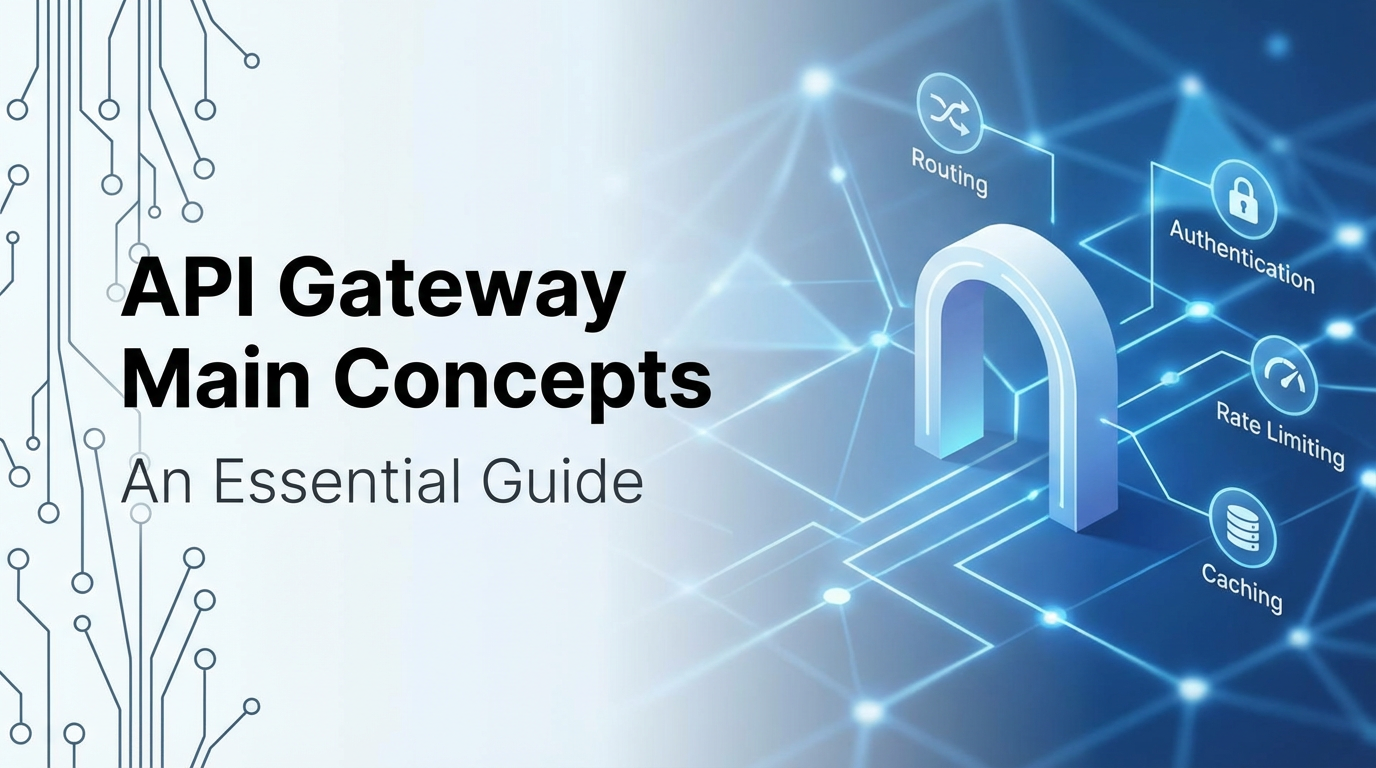


In the intricate tapestry of modern software architecture, where microservices communicate across networks and cloud-native applications scale with unprecedented agility, the Application Programming Interface (API) has emerged as the indispensable connective tissue. APIs facilitate interactions, enabling disparate systems to speak a common language, share data, and invoke functionalities seamlessly. However, as the number of APIs proliferates within an organization and across its digital ecosystem, managing their lifecycle, securing their access, and ensuring their performance becomes a monumental challenge. It is precisely in this complex landscape that the API Gateway steps forward as a foundational and indispensable component, acting as the intelligent traffic cop, the vigilant bouncer, and the efficient translator for all inbound and outbound API calls. This comprehensive guide will delve deep into the core concepts surrounding the API Gateway, exploring its critical role, fundamental capabilities, architectural considerations, and the myriad benefits it confers upon organizations navigating the complexities of distributed systems. We will embark on a journey from its conceptual genesis to its advanced functionalities, providing an essential understanding for anyone involved in designing, developing, or managing modern digital infrastructures.
The Genesis and Evolution of APIs and Gateways in Modern Architectures
The journey towards the ubiquitous adoption of API Gateways is intrinsically linked to the evolution of software architectures themselves. In the not-so-distant past, monolithic applications reigned supreme. These large, single-unit codebases contained all the business logic, data access layers, and user interface components within one deployable artifact. While simpler to develop and deploy initially, monoliths often became unwieldy as they grew, suffering from slow development cycles, difficult scaling, and a high risk of system-wide failure even from minor changes. Each new feature or modification required a full redeployment of the entire application, a process fraught with potential downtime and complex testing matrices.
The limitations of monolithic architectures spurred the industry towards more modular, distributed approaches. Service-Oriented Architecture (SOA) marked an important early step, advocating for the decomposition of applications into distinct, reusable services. However, SOA often involved heavy enterprise service bus (ESB) implementations and complex, often proprietary, messaging protocols. It laid the groundwork but still presented challenges in agility and true independence of services.
The true inflection point arrived with the widespread adoption of microservices architecture. This paradigm takes the principles of modularity to an extreme, breaking down applications into a collection of small, independently deployable services, each running in its own process and communicating through lightweight mechanisms, typically HTTP/REST APIs. Microservices offered unparalleled agility, allowing teams to develop, deploy, and scale services independently. They embraced technologies like containers (Docker) and orchestrators (Kubernetes), pushing applications towards cloud-native environments.
However, the proliferation of microservices, while solving many problems, introduced new complexities, particularly at the system's edge. Suddenly, instead of a single application endpoint, clients (web browsers, mobile apps, other services) needed to interact with dozens, sometimes hundreds, of individual microservices. This direct client-to-microservice communication presented several formidable challenges:
- Direct Exposure of Internal Services: Exposing every microservice directly to external clients meant tight coupling between client and service implementation details, making refactoring or versioning services difficult without breaking client applications.
- Increased Network Latency and Complexity: A single client interaction might require multiple round trips to different services, leading to higher latency and more complex client-side code to manage these interactions.
- Security Vulnerabilities: Each service would need its own authentication, authorization, rate limiting, and other security mechanisms, leading to duplicated effort, inconsistencies, and potential security gaps.
- Cross-Cutting Concerns: Implementing common functionalities like logging, monitoring, caching, and request transformation across every single service was inefficient, error-prone, and distracting for development teams.
- Protocol Inconsistencies: Different microservices might use different communication protocols or data formats, requiring clients to understand and adapt to each one.
It became clear that an intermediary layer was needed—a single, intelligent entry point that could centralize these cross-cutting concerns, simplify client interactions, and provide a robust facade over the evolving backend services. This necessity gave birth to the API Gateway pattern. The gateway acts as the front door, a single point of ingress that abstracts the internal architecture from external consumers, providing a unified and secure interface to the entire ecosystem of backend services. Its evolution has been driven by the need to manage complexity, enhance security, and improve the performance and maintainability of modern, distributed applications.
Core Concepts of an API Gateway: The Intelligent Intermediary
At its heart, an API Gateway is a server that acts as an API frontend, sitting between clients and a collection of backend services. It serves as a single entry point for all client requests, routing them to the appropriate backend service, and often performing a variety of other functions along the way. Conceptually, it functions as a reverse proxy, but with significantly enhanced capabilities tailored specifically for managing API traffic. Unlike a simple load balancer, which primarily distributes network traffic, an API Gateway operates at the application layer, understanding the semantics of API requests and responses. This intelligence allows it to apply a wide array of policies and transformations, making it a critical control point for the entire API ecosystem.
Definition and Role
An API Gateway is essentially a centralized management system for inbound and outbound API calls. It abstracts the complexity of the backend services, presenting a simplified, unified interface to external clients. Its strategic position at the edge of the system makes it an ideal place to enforce security policies, manage traffic, and optimize performance before requests ever reach the individual microservices. Think of it as the control tower at an airport: it doesn't build the planes (microservices), but it directs their take-offs and landings (API requests), ensuring safety, efficiency, and adherence to regulations.
The primary roles of an API Gateway include:
- Simplification for Clients: Clients interact with a single, well-defined API Gateway endpoint, rather than needing to know the network locations and specific interfaces of multiple backend services. This simplifies client-side development and reduces coupling.
- Encapsulation of Backend Complexity: The gateway shields clients from the internal architecture of the microservices, allowing backend services to evolve, scale, or even be replaced without impacting external consumers.
- Centralized Policy Enforcement: It provides a single point to apply cross-cutting concerns like security, rate limiting, monitoring, and logging, preventing redundant implementation in each microservice.
- Traffic Management: The gateway is responsible for intelligent routing, load balancing, and potentially circuit breaking, ensuring efficient and resilient communication.
Key Functions and Capabilities: A Deep Dive
The utility of an API Gateway extends far beyond simple request forwarding. Modern gateways are feature-rich platforms that offer a comprehensive suite of functionalities essential for robust API management. Let's explore these in detail:
1. Request Routing
One of the most fundamental capabilities of an API Gateway is intelligent request routing. When a client sends an API request to the gateway, the gateway must determine which backend service or set of services should handle that request. This decision is typically based on various factors contained within the incoming request, such as the URL path, HTTP method, headers, query parameters, or even the request body content.
For instance, a gateway might route /users/{id} requests to a User Service, /products/{id} to a Product Service, and /orders/{id} to an Order Service. Advanced routing logic can include content-based routing, where the gateway inspects the payload to direct requests, or header-based routing, used for A/B testing or feature flagging. The ability to precisely direct traffic to the correct backend service, often without clients needing to know the service's specific network location, is crucial for maintaining a flexible and evolvable microservices architecture. It decouples the client from the service topology, allowing backend teams to refactor, rename, or even migrate services without breaking client applications.
2. Load Balancing
In distributed systems, services often run multiple instances to handle varying loads and ensure high availability. An API Gateway integrates seamlessly with load balancing capabilities, distributing incoming requests across these available instances of a backend service. This prevents any single instance from becoming a bottleneck and improves the overall responsiveness and fault tolerance of the system.
Common load balancing algorithms include:
- Round Robin: Distributes requests sequentially to each server in the pool.
- Least Connections: Sends requests to the server with the fewest active connections.
- IP Hash: Directs requests from the same client IP to the same server, useful for session stickiness.
- Weighted Load Balancing: Prioritizes servers with higher capacity or performance.
By performing load balancing at the gateway level, organizations can ensure that their backend services are efficiently utilized, resilient to individual instance failures, and capable of scaling horizontally to meet demand without requiring clients to manage this complexity. This centralized approach simplifies operational overhead and enhances service reliability.
3. Authentication and Authorization
Security is paramount for any exposed API, and the API Gateway serves as the primary enforcement point for authentication and authorization. Rather than requiring each backend service to implement its own security mechanisms, the gateway centralizes this critical function, ensuring consistent and robust security policies across all APIs.
- Authentication: The gateway verifies the identity of the client making the request. This can involve validating API keys, JSON Web Tokens (JWTs), OAuth 2.0 tokens, or other credentials. If the client cannot be authenticated, the gateway rejects the request, preventing unauthorized access.
- Authorization: Once authenticated, the gateway determines if the authenticated client has the necessary permissions to access the requested resource or perform the desired operation. This often involves checking roles, scopes, or specific permissions embedded in the authentication token or retrieved from an identity provider.
Centralizing authentication and authorization at the gateway provides several benefits: it reduces boilerplate security code in individual microservices, ensures consistent application of security policies, simplifies security audits, and offers a single point for managing user and application access, enhancing the overall security posture of the API ecosystem.
4. Rate Limiting and Throttling
To protect backend services from abuse, resource exhaustion, and denial-of-service (DoS) attacks, API Gateways offer robust rate limiting and throttling capabilities. These mechanisms control the number of requests a client can make to an API within a specified timeframe.
- Rate Limiting: This defines the maximum number of requests allowed from a client (identified by IP address, API key, or user ID) over a period (e.g., 100 requests per minute). Once the limit is reached, subsequent requests are typically rejected with an HTTP 429 Too Many Requests status code until the window resets.
- Throttling: Similar to rate limiting, but often more dynamic and can be used to smooth out traffic spikes or prioritize certain users. For example, a premium user might have a higher throttle limit than a free-tier user.
Rate limiting and throttling are essential for maintaining the stability and availability of backend services, preventing resource monopolization, and ensuring fair usage across all consumers of the API. They also enable API providers to define usage tiers and enforce service level agreements (SLAs).
5. Protocol Translation/Transformation
In diverse architectural landscapes, clients might communicate using different protocols or data formats than backend services. An API Gateway can act as a sophisticated translator, converting requests and responses between different communication paradigms.
For example:
- REST to gRPC: A client might send a standard RESTful HTTP request, but the backend service might be implemented using gRPC for high-performance inter-service communication. The gateway can translate the REST request into a gRPC call and convert the gRPC response back to a RESTful JSON response.
- SOAP to REST: For integrating with legacy systems, a gateway can expose a modern RESTful API to clients while communicating with a backend SOAP service.
- Data Format Transformation: The gateway can convert data between JSON, XML, Protobuf, or other formats, accommodating various client and service requirements.
This capability significantly enhances interoperability, allowing organizations to adopt new technologies on the backend without forcing all existing clients to update their integration logic. It fosters flexibility and reduces the friction associated with technology transitions.
6. Caching
To improve performance and reduce the load on backend services, API Gateways can implement caching mechanisms. By storing responses to frequently requested API calls, the gateway can serve subsequent identical requests directly from its cache, bypassing the backend service entirely. This significantly reduces response times for clients and conserves backend computational resources.
Caching strategies can include:
- Time-to-Live (TTL): Responses are cached for a specified duration.
- Cache Invalidation: The cache can be programmatically invalidated when underlying data changes.
- Content-Based Caching: Caching based on specific request parameters.
Effective caching can drastically improve the perceived performance of APIs, especially for read-heavy operations, leading to a better user experience and reduced infrastructure costs.
7. Request/Response Transformation
Beyond protocol translation, API Gateways can perform granular transformations on both incoming requests and outgoing responses. This capability is invaluable for standardizing data, enhancing security, or tailoring output for specific client needs.
Examples include:
- Header Manipulation: Adding, removing, or modifying HTTP headers (e.g., adding an API key for the backend, removing internal headers before sending to the client).
- Payload Transformation: Modifying the JSON or XML body of a request or response. This could involve removing sensitive fields from an outgoing response, enriching an incoming request with additional data, or flattening/unflattening data structures.
- URL Rewriting: Changing the incoming URL path before routing to the backend.
These transformations allow the gateway to adapt the API interface to client expectations or backend requirements without altering the core service logic, promoting greater flexibility and decoupling.
8. Monitoring, Logging, and Analytics
As the central point of contact for all API traffic, the API Gateway is ideally positioned to collect comprehensive operational data. It can log every incoming request and outgoing response, record metrics like response times, error rates, and traffic volumes, and provide rich analytics on API usage.
- Logging: Detailed logs can capture request headers, bodies (with appropriate sanitization for sensitive data), client IP addresses, timestamps, and the backend service invoked. These logs are crucial for debugging, auditing, and security investigations.
- Monitoring: Integration with monitoring systems allows the gateway to expose metrics that reflect the health and performance of the entire API ecosystem. This includes tracking latency, throughput, error rates, and resource utilization.
- Analytics: By analyzing historical call data, the gateway can provide insights into API popularity, peak usage times, client demographics, and potential performance bottlenecks. This data is invaluable for capacity planning, business intelligence, and identifying areas for API improvement. For instance, APIPark, an open-source AI gateway and API management platform, provides powerful data analysis capabilities, displaying long-term trends and performance changes from historical call data, helping businesses with preventive maintenance and identifying issues before they occur. It also offers detailed API call logging, recording every detail of each API call for quick tracing and troubleshooting, ensuring system stability and data security. You can learn more about it at ApiPark.
These capabilities ensure full observability into the API landscape, enabling proactive problem solving, performance optimization, and informed decision-making.
9. Security Policies (WAF Integration, DDoS Protection)
Beyond basic authentication and authorization, API Gateways can integrate with or provide advanced security features to protect against a broader range of threats.
- Web Application Firewall (WAF) Integration: A WAF protects APIs from common web vulnerabilities like SQL injection, cross-site scripting (XSS), and other OWASP Top 10 threats by inspecting incoming traffic for malicious patterns.
- DDoS Protection: While a gateway itself isn't a full DDoS mitigation solution, its rate limiting and throttling features contribute to resilience against denial-of-service attacks by preventing overwhelming traffic from reaching backend services. Many gateways also integrate with specialized DDoS protection services.
- Schema Validation: The gateway can validate incoming request bodies against predefined JSON schemas or OpenAPI specifications, ensuring that requests conform to expected data structures and preventing malformed inputs from reaching backend services.
By centralizing these advanced security measures, the API Gateway significantly strengthens the overall security posture of the API ecosystem, offloading complex security logic from individual services.
10. Version Management
Managing multiple versions of an API concurrently is a common challenge, especially in long-lived systems with diverse client bases. The API Gateway provides an elegant solution for API version management.
It can route requests to different versions of a backend service based on criteria like:
- URL Path: e.g.,
/v1/usersvs./v2/users. - Header: e.g.,
Accept-Version: v2. - Query Parameter: e.g.,
?api-version=2.
This allows older clients to continue using an older API version while newer clients can leverage the latest functionalities. The gateway ensures backward compatibility, facilitates smooth transitions between versions, and enables progressive rollout of new API features without disrupting existing consumers. It simplifies the lifecycle management of APIs significantly.
11. Circuit Breaker Pattern
In a distributed system, individual service failures are inevitable. If a backend service becomes unresponsive or starts throwing errors, continuing to send requests to it will only exacerbate the problem, potentially leading to cascading failures throughout the system. The API Gateway can implement the Circuit Breaker pattern to enhance system resilience.
When a service experiences a high rate of failures, the circuit breaker "trips" and opens, preventing further requests from being sent to that service for a specified period. Instead, the gateway immediately returns an error (or a fallback response) to the client. After a timeout, the circuit moves to a "half-open" state, allowing a few test requests through. If these succeed, the circuit closes, and traffic resumes normally. If they fail, the circuit re-opens. This pattern prevents clients from wasting resources on a failing service, allows the service time to recover, and protects other services from being overwhelmed by retries to a failed component.
12. Service Discovery Integration
In dynamic cloud-native environments, the network locations (IP addresses and ports) of microservices can change frequently due to scaling, deployments, or failures. API Gateways often integrate with service discovery mechanisms (e.g., Consul, Eureka, Kubernetes' built-in service discovery).
Instead of hardcoding service addresses, the gateway queries the service discovery system to find the current location of the desired backend service before routing a request. This dynamic approach ensures that the gateway always routes to healthy and available instances, making the architecture more resilient, scalable, and adaptable to changes in service topology.
Table: Key API Gateway Functions and Their Benefits
| API Gateway Function | Description | Primary Benefits |
|---|---|---|
| Request Routing | Directs incoming client requests to the appropriate backend service based on URL path, headers, etc. | Decouples clients from service topology, enables flexible service evolution, simplifies client-side logic. |
| Load Balancing | Distributes requests across multiple instances of a backend service to prevent bottlenecks and ensure high availability. | Improves system responsiveness, enhances fault tolerance, maximizes resource utilization, scales horizontally. |
| Authentication & Authorization | Verifies client identity and permissions before allowing access to backend APIs. | Centralized security enforcement, reduces redundant security code, consistent policy application, stronger overall security posture. |
| Rate Limiting & Throttling | Controls the number of requests a client can make within a specified timeframe. | Protects backend services from abuse/DDoS, ensures fair usage, maintains service stability and availability, supports API monetization tiers. |
| Protocol Translation | Converts requests/responses between different communication protocols (e.g., REST to gRPC, SOAP to REST). | Enhances interoperability, integrates legacy systems, allows technology evolution on backend without client impact. |
| Caching | Stores responses to frequently requested APIs to serve subsequent requests directly from cache. | Reduces backend load, improves API response times, conserves computational resources, enhances user experience. |
| Request/Response Transformation | Modifies HTTP headers or body payloads of requests/responses. | Adapts API interface to client/backend needs, removes sensitive data, enriches requests, standardizes data formats. |
| Monitoring, Logging & Analytics | Collects detailed operational data on API usage, performance, and errors. | Provides full observability, facilitates debugging and troubleshooting, supports auditing, enables informed business and operational decisions, aids proactive maintenance. |
| Security Policies (WAF, DDoS) | Integrates with WAFs and contributes to DDoS protection, performs schema validation. | Protects against common web vulnerabilities, enhances resilience against attacks, ensures data integrity, centralizes advanced security measures. |
| Version Management | Routes requests to different versions of backend services based on defined criteria. | Ensures backward compatibility, facilitates smooth API evolution, enables progressive rollouts, simplifies API lifecycle. |
| Circuit Breaker Pattern | Stops sending requests to failing backend services for a period to allow recovery and prevent cascading failures. | Improves system resilience, prevents cascading failures, allows services time to recover, protects other system components. |
| Service Discovery Integration | Dynamically finds the current network locations of backend services. | Ensures routing to healthy instances, makes architecture more resilient, scalable, and adaptable to dynamic environments. |
Architectural Patterns and Deployment Models
The flexibility of API Gateways means they can be deployed in various architectural patterns, each suited to different organizational needs and scales. Understanding these models is key to selecting the right gateway strategy.
Centralized Gateway
In a centralized gateway model, a single API Gateway instance (or a highly available cluster of instances) handles all external traffic for an entire application or a significant portion of an organization's APIs. This is often the simplest approach for smaller to medium-sized deployments, or when consolidating access to a broad range of services.
Advantages:
- Single Point of Control: All API policies (security, rate limiting, logging) are managed from one location, ensuring consistency.
- Simplified Management: Easier to deploy, configure, and monitor a single gateway compared to many smaller ones.
- Cost-Effective: Can leverage shared infrastructure and reduce operational overhead.
Disadvantages:
- Single Point of Failure (SPOF): Without proper high-availability (HA) clustering, a failure in the gateway can bring down all APIs. Mitigation involves robust clustering and redundancy.
- Performance Bottleneck: As traffic scales, a single gateway might become a bottleneck, requiring significant resources and careful optimization.
- Team Dependency: Different teams building different microservices might become dependent on the central gateway team for configuration changes, slowing down development cycles.
Decentralized/Microgateway
The decentralized or microgateway pattern emerges from the needs of large-scale microservices architectures where a single, monolithic gateway might introduce bottlenecks or organizational friction. In this model, smaller, lightweight gateways are deployed, often one per business domain, per team, or even per service. Each microgateway only handles traffic for a specific subset of APIs.
Advantages:
- Increased Agility: Teams can manage their own gateways and API policies independently, accelerating development and deployment.
- Reduced Bottlenecks: Traffic is distributed across multiple gateways, improving scalability and reducing the impact of any single gateway's performance issues.
- Improved Resilience: A failure in one microgateway affects only a subset of APIs, not the entire system.
- Domain-Specific Policies: Policies can be tailored precisely to the needs of specific business domains.
Disadvantages:
- Increased Complexity: Managing many small gateways can be more complex than a single one, especially regarding monitoring and consistent policy application.
- Duplication of Effort: Some cross-cutting concerns might need to be configured across multiple gateways.
- Higher Resource Consumption: More gateway instances mean more overall resource usage.
Sidecar Gateway (Service Mesh Integration)
In the context of service mesh architectures (e.g., Istio, Linkerd), API Gateways can adopt a sidecar pattern. Here, a lightweight gateway proxy (like Envoy) runs alongside each microservice instance, typically within the same pod in Kubernetes. This sidecar intercepts all inbound and outbound network traffic for its associated service, effectively extending the service mesh's capabilities to the edge.
While the service mesh focuses on inter-service communication (east-west traffic), an API Gateway deployed as an Ingress Gateway (or edge proxy) often forms the entry point for external traffic (north-south traffic) into the mesh. The sidecar pattern, when applied to services, ensures that all service-level policies (mTLS, retries, circuit breaking) are applied consistently.
Advantages:
- Deep Integration with Service Mesh: Leverages the robust traffic management, security, and observability features of the service mesh.
- Fine-Grained Control: Policies can be applied at the service instance level.
- Simplified Service Logic: Services don't need to implement these cross-cutting concerns; the sidecar handles them.
Disadvantages:
- Increased Resource Overhead: Each service instance gets a proxy, increasing memory and CPU usage.
- Complexity: Service meshes themselves introduce a significant learning curve and operational overhead.
Cloud-Managed Gateways
Cloud providers offer fully managed API Gateway services, abstracting away the operational complexities of deploying and managing the gateway infrastructure. Examples include AWS API Gateway, Azure API Management, and Google Apigee.
Advantages:
- Reduced Operational Burden: The cloud provider handles scaling, patching, and maintaining the gateway.
- High Availability and Scalability: Built-in elasticity and redundancy.
- Tight Integration with Cloud Ecosystem: Seamless integration with other cloud services (IAM, monitoring, serverless functions).
- Pay-as-You-Go Model: Cost scales with usage.
Disadvantages:
- Vendor Lock-in: Migrating to another cloud provider or self-hosted solution can be challenging.
- Less Customization: May have limitations on highly specialized or custom functionalities compared to self-hosted solutions.
- Cost: For very high traffic volumes, cumulative costs can become significant.
Self-Hosted/On-Premise Gateways
Organizations can choose to deploy and manage open-source or commercial API Gateway software on their own infrastructure, whether on-premises data centers or self-managed cloud VMs/Kubernetes clusters. Popular options include Kong, Tyk, Envoy Proxy (often used with API Gateway products like Ambassador or custom configurations), and Nginx (which can be configured as a powerful reverse proxy with gateway capabilities).
Advantages:
- Full Control and Customization: Complete flexibility to tailor the gateway to specific needs and integrate with existing systems.
- No Vendor Lock-in: Freedom to choose and change underlying infrastructure.
- Cost Predictability: Can be more cost-effective for very high traffic if operational expertise is available in-house.
- Data Sovereignty: Important for organizations with strict regulatory or compliance requirements.
Disadvantages:
- High Operational Burden: Requires significant expertise and resources for deployment, configuration, scaling, patching, and maintenance.
- Complexity: Managing high availability, performance, and security for a self-hosted gateway can be complex.
- Slower Feature Development: Internal teams need to implement or integrate new features, unlike cloud services that get continuous updates.
The choice of deployment model heavily depends on factors such as organizational size, development agility needs, existing infrastructure, budget, and desired level of control. Many large enterprises adopt a hybrid approach, using cloud gateways for external-facing APIs and self-hosted or microgateways for internal service-to-service communication.
Benefits of Implementing an API Gateway
The strategic adoption of an API Gateway brings a multitude of advantages that profoundly impact the efficiency, security, performance, and long-term evolvability of modern application architectures. It's not merely a technical component but a foundational enabler for digital transformation and effective API management.
Simplified Client-Side Development
One of the most immediate and tangible benefits of an API Gateway is the simplification it brings to client applications. Instead of needing to know the specific network locations, API contracts, and security mechanisms of potentially dozens or hundreds of individual backend services, clients only interact with a single, consistent API Gateway endpoint. This significantly reduces the complexity of client-side code, making it easier to develop, test, and maintain web, mobile, and third-party applications. Clients become decoupled from the internal architecture of the microservices, meaning that backend changes (like refactoring a service or splitting it into two) do not necessarily require client-side updates. This decoupling accelerates client development cycles and reduces the risk of breaking existing applications.
Enhanced Security
An API Gateway serves as the primary enforcement point for security policies, acting as a fortified perimeter for the entire API ecosystem. By centralizing authentication, authorization, rate limiting, and other security measures, organizations can ensure consistent application of robust security controls across all APIs. This eliminates the need for each individual microservice to implement its own security logic, reducing the surface area for vulnerabilities, preventing inconsistent implementations, and simplifying security audits. Furthermore, the gateway can filter out malicious requests (via WAF integration), protect against denial-of-service attacks, and mask internal service details, significantly bolstering the overall security posture and compliance with regulatory requirements. This centralized vigilance is critical in an era of increasing cyber threats.
Improved Performance and Scalability
Performance and scalability are crucial for any modern application, and an API Gateway makes substantial contributions in both areas. Through capabilities like caching, it can serve common requests directly, dramatically reducing the load on backend services and improving response times for clients. Load balancing capabilities ensure that incoming traffic is efficiently distributed across multiple service instances, preventing bottlenecks and allowing the system to scale horizontally to handle increased demand. The gateway can also offload SSL/TLS termination, freeing backend services from computationally intensive cryptographic operations. By optimizing traffic flow and resource utilization, the API Gateway enhances the overall responsiveness and capacity of the application, leading to a superior user experience and more efficient infrastructure usage.
Better Manageability and Observability
As the central traffic cop, the API Gateway is the ideal point to gather comprehensive operational data about API usage and performance. It can collect detailed logs for every request and response, providing invaluable data for debugging, auditing, and troubleshooting. Centralized monitoring allows operators to gain real-time insights into API health, latency, error rates, and traffic patterns across the entire system. Powerful analytics capabilities can derive business intelligence from this data, identifying trends, popular APIs, and potential areas for improvement or monetization. This holistic view of API operations significantly improves manageability, enabling teams to proactively identify and resolve issues, optimize resource allocation, and make data-driven decisions about their API strategy.
Increased Agility and Flexibility
The abstraction layer provided by an API Gateway fosters greater organizational agility and architectural flexibility. Backend services can be developed, deployed, scaled, and updated independently without affecting client applications, as long as the gateway's external API contract remains stable (or is versioned appropriately). This means development teams can innovate faster, iterate more rapidly on new features, and adopt new technologies without fear of widespread client disruption. The gateway facilitates smooth API versioning, enabling a gradual transition for clients and reducing the pressure of "big bang" updates. This decoupling empowers teams to move with greater speed and confidence, essential attributes in today's fast-paced digital landscape.
Monetization Opportunities
For organizations looking to expose their data and functionalities as products, the API Gateway is an indispensable tool for API monetization. It provides the necessary infrastructure to package, publish, and manage API products, enforcing usage policies (e.g., free tiers, premium access, pay-per-use models) through features like rate limiting and quota management. The gateway can integrate with billing systems, track API consumption, and manage developer portals where consumers can discover, subscribe to, and manage their access to APIs. This transforms APIs from mere integration points into valuable revenue streams, enabling new business models and fostering an ecosystem of third-party developers and partners.
APIPark is a high-performance AI gateway that allows you to securely access the most comprehensive LLM APIs globally on the APIPark platform, including OpenAI, Anthropic, Mistral, Llama2, Google Gemini, and more.Try APIPark now! 👇👇👇
Challenges and Considerations
While the benefits of an API Gateway are compelling, their implementation is not without challenges. Organizations must carefully consider these aspects to ensure a successful deployment and long-term operational efficiency.
Single Point of Failure (SPOF)
By consolidating all incoming traffic, an API Gateway inherently becomes a critical component, and potentially a single point of failure. If the gateway goes down, all APIs behind it become inaccessible.
Mitigation Strategies:
- High Availability (HA) Clustering: Deploying the gateway in a highly available cluster with redundant instances and automatic failover mechanisms is crucial.
- Redundant Deployment: Using multiple gateways across different availability zones or regions for disaster recovery.
- Monitoring and Alerting: Robust monitoring to detect issues quickly and alert operations teams for immediate action.
- Automated Recovery: Implementing automation for self-healing or quick restarts of gateway instances.
Increased Latency
Introducing an additional hop in the request path means that every API call must traverse the gateway before reaching the backend service. This inevitably adds a small amount of latency due to network traversal, processing of policies (authentication, transformations), and routing logic.
Mitigation Strategies:
- Performance Optimization: Choosing a high-performance gateway solution, optimizing gateway configuration, and using efficient programming languages/runtimes.
- Caching: Leveraging the gateway's caching capabilities to serve frequently requested data directly, avoiding backend calls altogether.
- Proximity Deployment: Deploying the gateway geographically close to both clients and backend services where possible.
- Efficient Policy Application: Minimizing the number and complexity of policies applied to critical paths.
Operational Complexity
While an API Gateway simplifies client development and backend service logic, it introduces its own layer of operational complexity. Configuring routing rules, security policies, transformations, and monitoring for a large number of APIs can be a non-trivial task.
Mitigation Strategies:
- Infrastructure as Code (IaC): Managing gateway configurations using tools like Terraform or Ansible to ensure consistency, version control, and automation.
- Developer Portals and Self-Service: Providing tools and interfaces for development teams to manage their own API definitions and configurations on the gateway within defined guardrails.
- Standardization: Establishing clear guidelines and templates for API design and gateway policy configuration.
- Dedicated Operations Team: For large-scale deployments, a dedicated team or individuals specializing in API Gateway operations can be beneficial.
Vendor Lock-in (for Cloud Solutions)
When using a cloud-managed API Gateway service, organizations might face a degree of vendor lock-in. While these services offer convenience and scalability, migrating to a different cloud provider or a self-hosted solution later can be challenging due to proprietary configurations, integrations, and feature sets.
Mitigation Strategies:
- Abstractions: Where possible, design API contracts and backend services to be cloud-agnostic.
- Evaluate Portability: Understand the effort required to migrate configurations if a multi-cloud or hybrid strategy is a long-term goal.
- Strategic Choice: Weigh the benefits of convenience against the risks of lock-in based on long-term strategy.
Performance Overhead for Very Simple APIs
For extremely simple API calls that perform minimal logic and have no complex cross-cutting concerns, the overhead introduced by an API Gateway (even if minimal) might not always be justified. In rare cases, direct service access might be slightly faster, especially for internal service-to-service communication within a trusted network.
Considerations:
- Contextual Application: Recognize that the gateway pattern is most beneficial for external-facing APIs and complex internal API facades, not necessarily for every single inter-service call in a high-performance, trusted internal network (where a service mesh might be more appropriate).
- Strategic Value: Even for simple APIs, the gateway still offers centralized management, security, and observability, which often outweighs the minuscule performance difference.
Successfully navigating these challenges requires careful planning, robust architectural design, and ongoing operational excellence. The investment in addressing these considerations ultimately leads to a more resilient, secure, and manageable API ecosystem.
Choosing the Right API Gateway
Selecting the appropriate API Gateway solution is a critical decision that influences the agility, security, and scalability of your API ecosystem. There isn't a one-size-fits-all answer, as the best choice depends heavily on an organization's specific requirements, existing infrastructure, team expertise, and strategic goals. Here are key factors to consider when making this important decision:
1. Performance and Scalability
- Throughput (TPS): How many transactions per second can the gateway handle? Look for benchmarks and real-world performance data.
- Latency: How much additional latency does the gateway introduce?
- Elasticity: Can it scale up and down dynamically to meet fluctuating demand?
- Clustering: Does it support high-availability clustering for resilience?
2. Features and Capabilities
- Core Functionalities: Does it support essential features like routing, load balancing, authentication, authorization, rate limiting, and caching?
- Advanced Features: Are more advanced features like protocol translation, request/response transformation, service discovery integration, circuit breakers, and GraphQL proxies available?
- Extensibility: Can you easily add custom plugins, policies, or integrations if needed?
- Developer Portal: Does it include or integrate with a developer portal for API discovery, documentation, and subscription management?
3. Deployment Options
- Cloud-Managed: Do you prefer the convenience and reduced operational overhead of a fully managed cloud service (e.g., AWS API Gateway, Azure API Management)?
- Self-Hosted/On-Premise: Do you require full control, customization, or have specific data sovereignty requirements that necessitate deploying on your own infrastructure (e.g., Kong, Tyk, Nginx)?
- Kubernetes Native: Does it integrate well with Kubernetes, running as an Ingress Controller or within a service mesh (e.g., Ambassador, Istio)?
4. Cost
- Licensing Fees: For commercial products, understand the licensing model (per request, per instance, per feature).
- Infrastructure Costs: For self-hosted solutions, consider the compute, memory, and storage required for the gateway instances and supporting databases.
- Operational Costs: Factor in the cost of engineering time for deployment, configuration, maintenance, and monitoring.
- Cloud Usage Fees: For cloud-managed gateways, understand the pricing structure based on requests, data transfer, and features used.
5. Community and Commercial Support
- Open-Source vs. Commercial: Open-source gateways often have vibrant communities, but commercial versions typically offer professional support, enterprise features, and SLAs.
- Documentation: Is the documentation comprehensive, up-to-date, and easy to understand?
- Vendor Reputation: For commercial products, research the vendor's reputation, responsiveness, and long-term commitment to the product.
6. Integration Capabilities
- Identity Providers: Can it integrate with your existing identity management systems (e.g., Okta, Auth0, Keycloak)?
- Monitoring and Logging: Does it integrate with your preferred observability tools (e.g., Prometheus, Grafana, Splunk, ELK stack)?
- CI/CD Pipelines: Can gateway configurations be easily managed and deployed through your existing Continuous Integration/Continuous Delivery pipelines?
7. Team Expertise
- Learning Curve: How steep is the learning curve for your development and operations teams?
- Existing Skills: Does the chosen gateway align with your team's existing skill sets and preferred technologies?
When considering these factors, an organization might identify a need for robust API lifecycle management, especially in an era increasingly influenced by Artificial Intelligence. For instance, if your strategy involves rapid integration of numerous AI models and standardized API invocation for AI services, exploring specialized platforms becomes crucial. An example of such a platform is APIPark. APIPark is an open-source AI gateway and API management platform, designed to help developers and enterprises manage, integrate, and deploy AI and REST services with ease. It stands out with features like quick integration of 100+ AI models, unified API format for AI invocation, and prompt encapsulation into REST API. Its end-to-end API lifecycle management, performance rivaling Nginx, and powerful data analysis capabilities make it a strong contender, particularly for organizations building AI-driven applications and needing comprehensive API governance. Whether opting for a general-purpose solution or a specialized AI gateway like APIPark, a thorough evaluation against your specific requirements will lead to the most effective choice.
Advanced Topics and Future Trends
The landscape of API management is continuously evolving, and API Gateways are at the forefront of this innovation. As architectures become more complex and new technologies emerge, gateways adapt and integrate new capabilities, pushing the boundaries of what's possible in distributed systems.
API Gateways in Service Meshes: A Complementary Relationship
Initially, the roles of API Gateways and service meshes might seem to overlap, leading to confusion. However, they are largely complementary:
- API Gateways: Primarily handle north-south traffic (external client to services), focusing on public API exposure, security at the edge, rate limiting, and client-specific transformations. They are the "front door" of your application.
- Service Meshes: Primarily handle east-west traffic (service-to-service communication within the cluster), focusing on reliable and secure communication, traffic management, and observability between microservices. They are the "internal road network."
In a modern architecture, an API Gateway often acts as the ingress controller for the service mesh, directing external traffic into the mesh. Once inside, the service mesh takes over, managing inter-service communication. This combination provides a robust and layered approach to traffic management, security, and observability, where the gateway secures the perimeter and the service mesh ensures reliability and control within the internal network. Future trends will likely see even tighter integration and clearer delineation of responsibilities between these two powerful paradigms.
GraphQL Gateways
The rise of GraphQL as an alternative to REST for API design has led to the emergence of specialized GraphQL Gateways. Unlike traditional REST APIs where clients typically make multiple requests to different endpoints to fetch all necessary data, GraphQL allows clients to request exactly the data they need from a single endpoint in a single query.
A GraphQL gateway (often called a GraphQL "federation" or "stitching" gateway) acts as a unified facade over multiple backend services, which might expose their data via REST, GraphQL, or even databases. The gateway takes a client's GraphQL query, breaks it down, fetches the required data from various backend sources, combines the results, and returns a single, tailored response to the client.
Benefits:
- Reduced Over-fetching/Under-fetching: Clients get precisely what they ask for.
- Simplified Client-Side Development: Single endpoint, powerful query language.
- Backend Flexibility: The gateway can integrate diverse backend services seamlessly.
GraphQL Gateways are becoming increasingly important for applications that require highly flexible data access, especially for complex UIs that need to aggregate data from many sources efficiently.
AI Gateways: The Next Evolution of API Management
Artificial Intelligence (AI) is set to revolutionize various aspects of software, and API Gateways are no exception. The concept of an "AI Gateway" signifies a gateway specifically designed to manage, secure, and optimize access to AI models and services. This is particularly relevant as organizations increasingly integrate AI capabilities into their applications.
AI Gateways can offer:
- Unified Access to Diverse AI Models: Abstracting away the complexities of integrating with different AI providers (e.g., OpenAI, Hugging Face, custom models) by providing a standardized API interface.
- Prompt Management and Encapsulation: Allowing users to define and manage prompts, encapsulate them into REST APIs, and apply them consistently across different models.
- Cost Optimization for AI Invocations: Tracking and optimizing usage of expensive AI model inferences.
- AI-Driven Security: Using AI to detect anomalies, identify malicious patterns in prompts, or prevent data leakage through model outputs.
- Intelligent Routing and Fallback: Routing requests to the best-performing or most cost-effective AI model based on real-time metrics or predefined rules, with automated fallback in case of model failure.
As mentioned earlier, APIPark is a prime example of an open-source AI gateway and API management platform that embodies these future trends, focusing on quick integration of AI models, unified invocation formats, and prompt encapsulation, alongside traditional API lifecycle management. This specialized focus highlights a significant emerging area in the gateway space, addressing the unique challenges and opportunities presented by AI.
Event-Driven API Gateways
While traditional API Gateways are primarily focused on synchronous request-response APIs (like REST), the rise of event-driven architectures (EDA) and streaming data has led to interest in "Event API Gateways." These gateways would manage access to asynchronous event streams (e.g., Kafka topics, Message Queues), allowing clients to subscribe to events or publish events into the system.
Capabilities could include:
- Event Filtering and Transformation: Modifying event payloads or filtering events based on content before delivery.
- Subscription Management: Managing client subscriptions to event streams.
- Security for Event Streams: Authenticating and authorizing clients for specific event topics.
- Protocol Bridging: Translating between different event protocols (e.g., HTTP to Kafka).
This area is still maturing but represents a logical extension of the gateway concept to the asynchronous world, providing a unified control plane for both synchronous APIs and asynchronous events.
Serverless Gateways
With the increasing adoption of serverless computing (e.g., AWS Lambda, Azure Functions), API Gateways are often integrated directly with serverless platforms. These "serverless gateways" provide the necessary HTTP endpoint and routing capabilities to trigger serverless functions, without needing to manage any servers for the gateway itself.
Benefits:
- Pay-per-execution: Costs scale precisely with API usage.
- Automatic Scaling: Handles traffic spikes without manual intervention.
- Reduced Operational Overhead: No servers to provision or manage.
The evolution of API Gateways is a dynamic process, driven by shifts in architectural patterns, the emergence of new technologies like AI and GraphQL, and the ever-increasing demand for secure, performant, and manageable API ecosystems. These advanced topics and future trends underscore the API Gateway's enduring relevance and its continued transformation as a vital component in the digital infrastructure.
Conclusion
The API Gateway stands as an indispensable cornerstone in the architecture of modern distributed systems, particularly those built on microservices and cloud-native principles. From its origins as a solution to the burgeoning complexity of direct client-to-service communication, it has evolved into a sophisticated, multi-functional intermediary that orchestrates, secures, and optimizes the flow of API traffic. By centralizing crucial cross-cutting concerns such as authentication, authorization, rate limiting, and request routing, the API Gateway simplifies client development, enhances security, improves performance, and significantly boosts the manageability and agility of an entire API ecosystem.
Organizations that strategically implement an API Gateway gain a powerful control point that not only mitigates the inherent challenges of distributed architectures but also unlocks new opportunities for efficiency, innovation, and API monetization. Whether choosing a robust self-hosted solution, leveraging the convenience of a cloud-managed service, or exploring specialized offerings like an AI gateway to manage emerging technologies, the fundamental concepts remain constant: providing a unified, secure, and performant facade to a complex backend.
As the digital landscape continues its rapid evolution, embracing new paradigms like service meshes, GraphQL, serverless computing, and especially Artificial Intelligence, the API Gateway will undoubtedly continue to adapt and expand its capabilities. It will remain a foundational component, ensuring that our interconnected applications can communicate effectively, securely, and seamlessly, powering the next generation of digital experiences. Understanding the core concepts of the API Gateway is no longer optional; it is an essential guide for anyone navigating the intricate world of modern software development and operations.
Frequently Asked Questions (FAQs)
1. What is the fundamental difference between an API Gateway and a traditional Reverse Proxy or Load Balancer? While an API Gateway often includes reverse proxy and load balancing capabilities, its fundamental difference lies in its application-layer intelligence and policy enforcement. A traditional reverse proxy primarily forwards HTTP requests to backend servers based on URL paths or hostnames, and a load balancer distributes network traffic without deep inspection of the application layer. An API Gateway, however, understands the semantics of API calls. It can inspect and transform API request/response bodies, apply sophisticated authentication and authorization rules, perform rate limiting based on API keys, manage API versions, and integrate with backend service discovery, acting as a much more intelligent and feature-rich intermediary specifically tailored for managing APIs.
2. Why is an API Gateway considered essential for microservices architectures? In microservices architectures, an application is broken down into many small, independent services. Without an API Gateway, client applications would need to know and interact with numerous service endpoints directly, leading to complex client-side logic, increased network calls, and difficulties in managing cross-cutting concerns like security and rate limiting across individual services. The API Gateway centralizes these concerns, provides a single entry point, abstracts backend complexity, enhances security, and allows microservices to evolve independently without breaking client applications, making it indispensable for maintaining agility and manageability in a distributed environment.
3. Can I use an API Gateway for both external (client-facing) and internal (service-to-service) communication? While an API Gateway is primarily known for managing external, client-facing (north-south) API traffic, it can be used for internal service-to-service (east-west) communication to some extent, especially for managing APIs between different organizational domains or teams. However, for high-volume, performance-critical internal communication within a trusted network of microservices, a service mesh is often a more appropriate and efficient solution. Service meshes like Istio or Linkerd are purpose-built for inter-service communication concerns such as mutual TLS, traffic shifting, and sophisticated retry policies, often with less overhead than a full-fledged API Gateway for internal calls.
4. What are the key security benefits of using an API Gateway? The API Gateway significantly enhances security by centralizing and enforcing a wide array of security policies. Key benefits include: * Centralized Authentication and Authorization: All incoming requests are authenticated and authorized at a single point, ensuring consistent security posture and reducing duplicated effort in backend services. * Rate Limiting and Throttling: Protects backend services from abuse, DDoS attacks, and resource exhaustion. * Threat Protection: Many gateways integrate with Web Application Firewalls (WAFs) to block common web vulnerabilities (e.g., SQL injection, XSS) and can contribute to DDoS mitigation strategies. * Masking Internal Details: Hides the internal network topology and specific service endpoints from external clients, reducing the attack surface. * API Key Management: Provides a secure way to manage and validate API keys for client access.
5. How does an API Gateway help with API versioning and lifecycle management? An API Gateway simplifies API versioning by acting as a routing layer that can direct requests to different versions of a backend service based on criteria like URL path (e.g., /v1/products vs. /v2/products), request headers, or query parameters. This allows organizations to introduce new API versions without immediately deprecating older ones, supporting a smooth transition for clients. For lifecycle management, the gateway provides a single point to publish new APIs, manage their configurations, monitor their usage, and eventually decommission older versions, ensuring consistent governance throughout the API's lifespan from design to retirement.
🚀You can securely and efficiently call the OpenAI API on APIPark in just two steps:
Step 1: Deploy the APIPark AI gateway in 5 minutes.
APIPark is developed based on Golang, offering strong product performance and low development and maintenance costs. You can deploy APIPark with a single command line.
curl -sSO https://download.apipark.com/install/quick-start.sh; bash quick-start.sh

In my experience, you can see the successful deployment interface within 5 to 10 minutes. Then, you can log in to APIPark using your account.

Step 2: Call the OpenAI API.